Discovery and DNS Mike Freedman COS 461: Computer
Description: Discovery and DNS Mike Freedman COS 461: Computer Networks http:www.cs.princeton.educoursesarchivespr20cos461 http:mosaic.cnfolio.comB101CW2011Article581 Relationship Between Layers 2 logical link name Routing: Mapping Link to
Related Topics
Download Presentation
"Discovery and DNS Mike Freedman COS 461: Computer" is the property of its rightful owner. Permission is granted to download and print the materials on this website for personal, non-commercial use only, and to display it on your personal computer provided you do not modify the materials and that you retain all copyright notices contained in the materials. By downloading content from our website, you accept the terms of this agreement.
Presentation Transcript
slide1. Discovery and DNS Mike Freedman
COS 461: Computer Networks
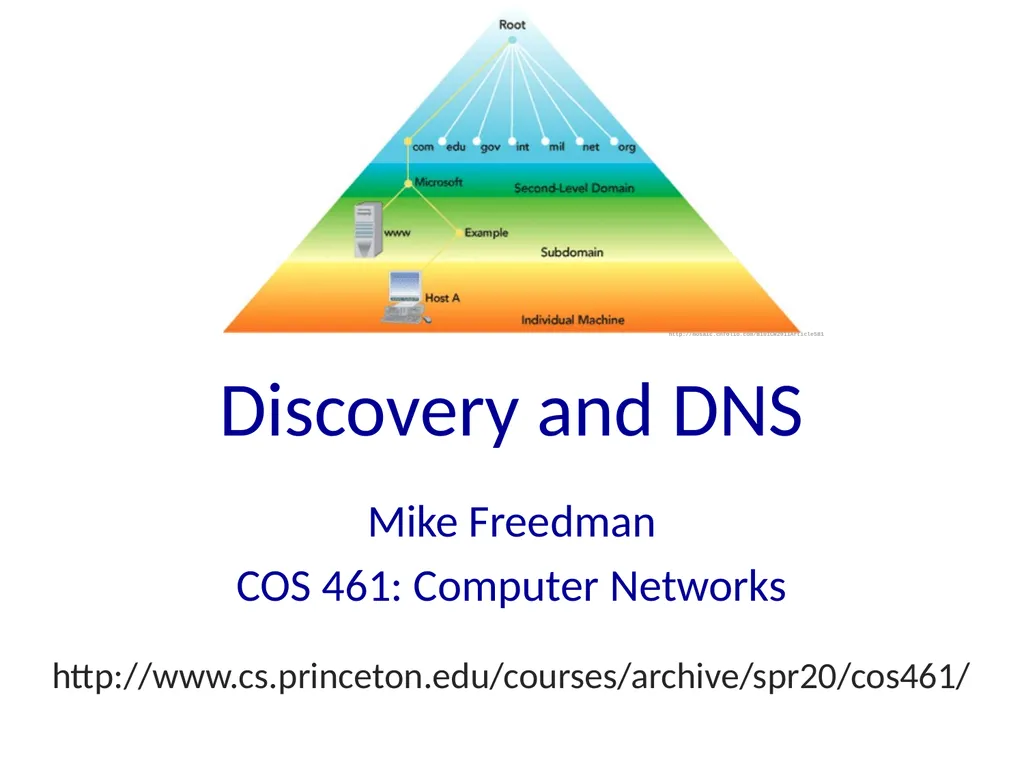
http://www.cs.princeton.edu/courses/archive/spr20/cos461/ http://mosaic.cnfolio.com/B101CW2011Article581<br>
slide2. Relationship Between Layers 2 logical link name<br>
slide3. Routing: Mapping Link to Path 3 name address logical link physical
path<br>
slide4. Discovery: Mapping Name to Address 4 logical link name address<br>
slide5. Discovery 5<br>
slide6. Directories A key-value store
Key: name; value: address(es)
Answer queries: given name, return address(es)
Caching the response
Reuse the response, for a period of time
Better performance and lower overhead
Allow entries to change
Updating the address(es) associated with a name
Invalidating or expiring cached responses 6<br>
slide7. Directory Design: Three Extremes Flood the query (e.g., ARP)
The named node responds with its address
But, high overhead in large networks
Push data to all clients (/etc/hosts)
All nodes store a full copy of the directory
But, high overhead for many names and updates
Central directory server
All data and queries handled by one machine
But, poor performance, scalability, and reliability 7<br>
slide8. Directory Design: Distributed Solutions Hierarchical directory (e.g., DNS)
Follow the hierarchy in the name space
Distribute the directory, distribute the queries
Enable decentralized updates to the directory
Distributed Hash Table (e.g. P2P applications)
Directory as a hash table with flat names
Each directory node handles range of hash outputs
Use hash to direct query to the directory node 8<br>
slide9. Domain Name System (DNS) Computer science concepts underlying DNS
Indirection: names in place of addresses
Hierarchy: in names, addresses, and servers
Caching: of mappings from names to/from addresses 9<br>
slide10. Strawman Solution #1: Local File Original name to address mapping
Flat namespace
/etc/hosts
SRI kept main copy
Downloaded regularly
Count of hosts was increasing: moving from a machine per domain to machine per user
Many more downloads
Many more updates 10<br>
slide11. Strawman Solution #2: Central Server Central server
One place where all mappings are stored
All queries go to the central server
Many practical problems
Single point of failure
High traffic volume
Distant centralized database
Single point of update
Does not scale 11 Need a distributed, hierarchical collection of servers<br>
slide12. Domain Name System (DNS) Properties of DNS
Hierarchical name space divided into zones
Distributed over a collection of DNS servers
Hierarchy of DNS servers
Root servers
Top-level domain (TLD) servers
Authoritative DNS servers
Performing the translations
Local DNS servers and client resolvers 12<br>
slide13. 13 Distributed Hierarchical Database com edu org ac uk zw arpa unnamed root bar west east foo my ac cam usr in-
addr 12 34 56 generic domains country domains my.east.bar.edu usr.cam.ac.uk 12.34.56.0/24<br>
slide14. DNS Root Servers 13 root servers (see http://www.root-servers.org/)
Labeled A through M. Most are IP Anycasted. 14 B USC-ISI Marina del Rey, CA
L ICANN Los Angeles, CA E NASA Mt View, CA
F Internet Software C. Palo Alto, CA (and 17 other locations) I Autonomica, Stockholm (plus 3 other locations) K RIPE London (+ Amsterdam, Frankfurt) m WIDE Tokyo A Verisign, Dulles, VA
C Cogent, Herndon, VA (also Los Angeles)
D U Maryland College Park, MD
G US DoD Vienna, VA
H ARL Aberdeen, MD
J Verisign, ( 11 locations)<br>
slide15. TLD and Authoritative DNS Servers Global Top-level domain (gTLD) servers
Generic domains (e.g., .com, .org, .edu)
Country domains (e.g., .uk, .fr, .ca, .jp)
Managed professionally (e.g., Verisign for .com .net)
Authoritative DNS servers
Provide public records for hosts at an organization
For the organization’s servers (e.g., Web and mail)
Can be maintained locally or by a service provider 15<br>
slide16. Reliability DNS servers are replicated
Name service available if at least one replica is up
Queries can be load balanced between replicas
$ dig NS nytimes.com +norecurse
;; QUESTION SECTION:
;nytimes.com. IN NS
;; AUTHORITY SECTION:
nytimes.com. 349 IN NS ns2.p24.dynect.net.
nytimes.com. 349 IN NS ns3.p24.dynect.net.
nytimes.com. 349 IN NS dns2.p06.nsone.net.
nytimes.com. 349 IN NS ns4.p24.dynect.net.
nytimes.com. 349 IN NS ns1.p24.dynect.net.
nytimes.com. 349 IN NS dns3.p06.nsone.net.
nytimes.com. 349 IN NS dns4.p06.nsone.net.
nytimes.com. 349 IN NS dns1.p06.nsone.net. 16<br>
slide17. Reliability DNS servers are replicated
Name service available if at least one replica is up
Queries can be load balanced between replicas
UDP used for queries
Need reliability: must implement this on top of UDP
Try alternate servers on timeout
Exponential backoff when retrying same server
Same identifier for all queries
Don’t care which server responds 17<br>
slide18. DNS Queriesand Caching 18<br>
slide19. Using DNS Local DNS server (“default name server”)
Usually near the end hosts who use it
Local hosts configured with local server (e.g., /etc/resolv.conf) or learn the server via DHCP
Client application
Extract server name (e.g., from the URL)
Do gethostbyname() or getaddrinfo() to get address
Server application
Extract client IP address from socket
Optional gethostbyaddr() to translate into name 19<br>
slide20. DNS Protocol DNS protocol : query and reply msg,
both with same msg format Message header
Identification: 16 bit # for query, reply to query uses same #
Flags:
Query or reply
Recursion desired
Recursion available
Reply is authoritative 20<br>
slide21. DNS Resource Records 21 Type=A
Name: hostname
Value: IP address Type=CNAME
Name: alias for some “canonical” (the real) name:
www.ibm.com is really
srveast.backup2.ibm.com
Value: canonical name Type=MX
Value: name of mailserver associated with name Type=NS
Name: domain
Value: hostname of name server for domain<br>
slide22. Break for Demo 22<br>
slide23. requesting host
a.cs.princeton.edu www.umass.edu root DNS server for . 3 authoritative DNS server
for umass.edu
dns.umass.edu TLD DNS server for .edu DNS Queries Host a.cs.princeton.edu wants IP address for www.umass.edu
Note Recursive vs. Iterative Queries 23 1 2 4 5 6 7 8 9 10<br>
slide24. root DNS server for . 3 authoritative DNS server
for umass.edu
dns.umass.edu TLD DNS server for .edu DNS Caching 24 1 2 4 5 6 7 8 9 10 DNS query latency
E.g., 1 sec latency before starting a download
Caching to reduce overhead and delay
Small # of top-level servers, that change rarely
Popular sites visited often
Where to cache?
Local DNS server
Browser requesting host
a.cs.princeton.edu www.umass.edu<br>
slide25. 25 $ dig nytimes.com +norecurse @a.root-servers.net
;; QUESTION SECTION:
;nytimes.com. IN A
;; AUTHORITY SECTION:
com. 172800 IN NS a.gtld-servers.net.
com. 172800 IN NS b.gtld-servers.net.
com. 172800 IN NS c.gtld-servers.net.
com. 172800 IN NS d.gtld-servers.net.
com. 172800 IN NS e.gtld-servers.net.
com. 172800 IN NS f.gtld-servers.net.
com. 172800 IN NS g.gtld-servers.net.
com. 172800 IN NS h.gtld-servers.net.
com. 172800 IN NS i.gtld-servers.net.
com. 172800 IN NS j.gtld-servers.net.
com. 172800 IN NS k.gtld-servers.net.
com. 172800 IN NS l.gtld-servers.net.
com. 172800 IN NS m.gtld-servers.net.
;; ADDITIONAL SECTION:
a.gtld-servers.net. 172800 IN A 192.5.6.30
b.gtld-servers.net. 172800 IN A 192.33.14.30
c.gtld-servers.net. 172800 IN A 192.26.92.30
d.gtld-servers.net. 172800 IN A 192.31.80.30
e.gtld-servers.net. 172800 IN A 192.12.94.30
f.gtld-servers.net. 172800 IN A 192.35.51.30<br>
slide26. 26 $ dig nytimes.com +norecurse @b.gtld-servers.net
;; QUESTION SECTION:
;nytimes.com. IN A
;; AUTHORITY SECTION:
nytimes.com. 172800 IN NS ns3.p24.dynect.net.
nytimes.com. 172800 IN NS ns1.p24.dynect.net.
nytimes.com. 172800 IN NS ns2.p24.dynect.net.
nytimes.com. 172800 IN NS ns4.p24.dynect.net.
nytimes.com. 172800 IN NS dns1.p06.nsone.net.
nytimes.com. 172800 IN NS dns2.p06.nsone.net.
nytimes.com. 172800 IN NS dns3.p06.nsone.net.
nytimes.com. 172800 IN NS dns4.p06.nsone.net.
;; Query time: 11 msec
;; SERVER: 192.33.14.30#53(192.33.14.30)
;; WHEN: Sat Mar 28 10:56:03 2020
;; MSG SIZE rcvd: 201<br>
slide27. 27 $ dig nytimes.com +norecurse @ns3.p24.dynect.net
;; QUESTION SECTION:
;nytimes.com. IN A
;; ANSWER SECTION:
nytimes.com. 500 IN A 151.101.193.164
nytimes.com. 500 IN A 151.101.129.164
nytimes.com. 500 IN A 151.101.65.164
nytimes.com. 500 IN A 151.101.1.164
;; AUTHORITY SECTION:
nytimes.com. 300 IN NS ns2.p24.dynect.net.
nytimes.com. 300 IN NS ns4.p24.dynect.net.
nytimes.com. 300 IN NS ns3.p24.dynect.net.
nytimes.com. 300 IN NS ns1.p24.dynect.net.
nytimes.com. 300 IN NS dns3.p06.nsone.net.
nytimes.com. 300 IN NS dns2.p06.nsone.net.
nytimes.com. 300 IN NS dns4.p06.nsone.net.
nytimes.com. 300 IN NS dns1.p06.nsone.net.
;; Query time: 14 msec
;; SERVER: 208.78.71.24#53(208.78.71.24)
;; WHEN: Sat Mar 28 11:23:19 2020
;; MSG SIZE rcvd: 265<br>
slide28. 28 $ dig ANY nytimes.com +norecurse @ns3.p24.dynect.net
;; Truncated, retrying in TCP mode.
;; QUESTION SECTION:
;nytimes.com. IN ANY
;; ANSWER SECTION:
nytimes.com. 300 IN SOA dns1.p06.nsone.net. hostmaster.nytimes.com. 2019121930 300 150 1209600 300
nytimes.com. 300 IN NS dns3.p06.nsone.net.
nytimes.com. 300 IN NS dns1.p06.nsone.net.
nytimes.com. 300 IN NS dns4.p06.nsone.net.
nytimes.com. 300 IN NS ns3.p24.dynect.net.
nytimes.com. 300 IN NS ns4.p24.dynect.net.
nytimes.com. 300 IN NS ns2.p24.dynect.net.
nytimes.com. 300 IN NS ns1.p24.dynect.net.
nytimes.com. 300 IN NS dns2.p06.nsone.net.
nytimes.com. 500 IN A 151.101.129.164
nytimes.com. 500 IN A 151.101.193.164
nytimes.com. 500 IN A 151.101.1.164
nytimes.com. 500 IN A 151.101.65.164
nytimes.com. 300 IN MX 10 ASPMX2.GOOGLEMAIL.COM.
nytimes.com. 300 IN MX 10 ASPMX3.GOOGLEMAIL.COM.
nytimes.com. 300 IN MX 1 ASPMX.L.GOOGLE.com.
nytimes.com. 300 IN MX 5 ALT2.ASPMX.L.GOOGLE.com.
nytimes.com. 300 IN MX 5 ALT1.ASPMX.L.GOOGLE.com.<br>
slide29. 29 nytimes.com. 500 IN TXT "google-site-verification=aReMr8hkX3gxeHLKKk4tJ1s970U7QdEqUMIhMmLUfjQ"
nytimes.com. 500 IN TXT "dropbox-domain-verification=4ld3jahx0psi"
nytimes.com. 500 IN TXT "google-site-verification=ZTCMdpSKM7HwqTvGUf_00Ef008JhOnbzGgCSUGYfsro"
nytimes.com. 500 IN TXT "docusign=bd506110-db79-430e-b159-cc1d74fe1176"
nytimes.com. 500 IN TXT "google-site-verification=NIqXa_F8IaqdPJhTtexgR0NYbzVLD_-X-uRUvyf4GyQ"
nytimes.com. 500 IN TXT "MS=ms22827202"
nytimes.com. 500 IN TXT "adobe-idp-site-verification=5ce4d99c-af0a-4b76-9217-bd49d3336df0"
nytimes.com. 500 IN TXT "google-site-verification=4qJm5sAZa1_29BTwFjqW09t7_7D4Vee3LBFQqg8xYbs"
nytimes.com. 500 IN TXT "google-site-verification=ZsySMeZ_SRbJZFu-53ptepytP7h5pxHO0qAg8Z2bKug"
nytimes.com. 500 IN TXT "MS=A1BFCA84E21B7011CA98DF9DC251CDDF90E0174B"
nytimes.com. 500 IN TXT "google-site-verification=4TE2ggBoy6PktLjtZ03t32A2oEZ0VD0PY6MnTj8IL_g"
nytimes.com. 500 IN TXT "v=spf1 mx ptr ip4:170.149.160.0/19 ip4:170.149.240.0/19 ip4:209.11.220.51/32 include:alerts.wallst.com include:authsmtp.com include:sendgrid.net include:_spf.google.com include:inyt.com include:_spf.e.sparkpost.com include:mail.zendesk.com ~all"
nytimes.com. 500 IN TXT "google-site-verification=ic0Ur9LVhZ1hIjTj8LhMOhqx2Z52oS3hU_W2EqBY6UM"
nytimes.com. 500 IN TXT "google-site-verification=jZcmQFxPEP38yqYpmRvo0v_9hQFAdBZPUEBwTNUPUF8"
nytimes.com. 500 IN TXT "253961548-4297453"
nytimes.com. 500 IN TYPE257 \# 22 000569737375656C657473656E63727970742E6F7267
nytimes.com. 500 IN TYPE257 \# 19 00056973737565636F6D6F646F63612E636F6D
nytimes.com. 500 IN TYPE257 \# 19 0005697373756561777374727573742E636F6D
nytimes.com. 500 IN TYPE257 \# 22 00056973737565616D617A6F6E74727573742E636F6D
nytimes.com. 500 IN TYPE257 \# 15 00056973737565706B692E676F6F67
nytimes.com. 500 IN TYPE257 \# 19 0005697373756564696769636572742E636F6D
nytimes.com. 500 IN TYPE257 \# 17 00056973737565616D617A6F6E2E636F6D
nytimes.com. 500 IN TYPE257 \# 19 0005697373756573796D616E7465632E636F6D
nytimes.com. 500 IN TYPE257 \# 20 00056973737565616D617A6F6E6177732E636F6D<br>
slide30. DNS Cache Consistency Goal: Ensuring cached data is up to date
DNS design considerations
Cached data is “read only”
Explicit invalidation would be expensive
Server would need to keep track of all resolvers caching
Avoiding stale information
Responses include a “time to live” (TTL) field
Delete the cached entry after TTL expires
Perform negative caching (for dead links, misspellings)
So failures quick and don’t overload gTLD servers 30<br>
slide31. Setting the Time To Live (TTL) TTL trade-offs
Small TTL: fast response to change
Large TTL: higher cache hit rate
Following the hierarchy
Top of the hierarchy: days or weeks
Bottom of the hierarchy: seconds to hours
Tension in practice
CDNs set low TTLs for load balancing and failover
Browsers cache for 15-60 seconds 31<br>
slide32. Questions Tension:
DNS operators want high TTL for low load on DNS servers,
Domains want low TTL for faster failover b/w IP addrs
(Y) True (M) False
By returning IP addresses in “round robin” fashion, DNS operators can ensure equal load better servers
(Y) True (M) False
Most applications obey TTLs on DNS records
(Y) True (M) False 32<br>
slide33. Tension:
DNS operators want high TTL for low load on DNS servers,
Domains want low TTL for faster failover b/w IP addrs
(Y) True (M) False
By returning IP addresses in “round robin” fashion, DNS operators can ensure equal load better servers
(Y) True (M) False
Most applications obey TTLs on DNS records
(Y) True (M) False Questions 33<br>
slide34. Inserting Resource Records into DNS Example: just created startup “FooBar”
Register foobar.com at namecheap.com
Provide registrar with names and IP addresses of authoritative name server (primary and secondary)
Registrar inserts two RRs into the com TLD server:
(foobar.com, dns1.foobar.com, NS)
(dns1.foobar.com, 212.212.212.1, A)
Put in authoritative server dns1.foobar.com
Type A record for www.foobar.com
Type MX record for foobar.com 34<br>
slide35. DNS attacks (1) DNS cache poisoning
Client: Ask for www.evil.com
Attacker responds with additional section for (www.cnn.com, 1.2.3.4, A)
Client/resolver: Thanks! I won’t bother check what I asked for. 35<br>
slide36. DNS attacks (2) DNS hijacking
Attacker sends forged DNS reply to client for www.cnn.com, even when they don’t receive the request
How to prevent?
Client remembers the 16-bit DNS ID
Client only accepts reply if reply ID matches query ID
16 bits: 65K possible IDs
What rate for attacker to enumerate all in 1 sec? 64B/packet
64*65536*8 / 1024 / 1024 = 32 Mbps
Prevention: Also randomize the DNS source port
e.g., Windows DNS alloc’s 2500 DNS ports, leads to ~164M possible IDs
Would require 80 Gbps
Kaminsky attack: this source port…wasn’t random after all 36<br>
COS 461: Computer Networks
http://www.cs.princeton.edu/courses/archive/spr20/cos461/ http://mosaic.cnfolio.com/B101CW2011Article581<br>
slide2. Relationship Between Layers 2 logical link name<br>
slide3. Routing: Mapping Link to Path 3 name address logical link physical
path<br>
slide4. Discovery: Mapping Name to Address 4 logical link name address<br>
slide5. Discovery 5<br>
slide6. Directories A key-value store
Key: name; value: address(es)
Answer queries: given name, return address(es)
Caching the response
Reuse the response, for a period of time
Better performance and lower overhead
Allow entries to change
Updating the address(es) associated with a name
Invalidating or expiring cached responses 6<br>
slide7. Directory Design: Three Extremes Flood the query (e.g., ARP)
The named node responds with its address
But, high overhead in large networks
Push data to all clients (/etc/hosts)
All nodes store a full copy of the directory
But, high overhead for many names and updates
Central directory server
All data and queries handled by one machine
But, poor performance, scalability, and reliability 7<br>
slide8. Directory Design: Distributed Solutions Hierarchical directory (e.g., DNS)
Follow the hierarchy in the name space
Distribute the directory, distribute the queries
Enable decentralized updates to the directory
Distributed Hash Table (e.g. P2P applications)
Directory as a hash table with flat names
Each directory node handles range of hash outputs
Use hash to direct query to the directory node 8<br>
slide9. Domain Name System (DNS) Computer science concepts underlying DNS
Indirection: names in place of addresses
Hierarchy: in names, addresses, and servers
Caching: of mappings from names to/from addresses 9<br>
slide10. Strawman Solution #1: Local File Original name to address mapping
Flat namespace
/etc/hosts
SRI kept main copy
Downloaded regularly
Count of hosts was increasing: moving from a machine per domain to machine per user
Many more downloads
Many more updates 10<br>
slide11. Strawman Solution #2: Central Server Central server
One place where all mappings are stored
All queries go to the central server
Many practical problems
Single point of failure
High traffic volume
Distant centralized database
Single point of update
Does not scale 11 Need a distributed, hierarchical collection of servers<br>
slide12. Domain Name System (DNS) Properties of DNS
Hierarchical name space divided into zones
Distributed over a collection of DNS servers
Hierarchy of DNS servers
Root servers
Top-level domain (TLD) servers
Authoritative DNS servers
Performing the translations
Local DNS servers and client resolvers 12<br>
slide13. 13 Distributed Hierarchical Database com edu org ac uk zw arpa unnamed root bar west east foo my ac cam usr in-
addr 12 34 56 generic domains country domains my.east.bar.edu usr.cam.ac.uk 12.34.56.0/24<br>
slide14. DNS Root Servers 13 root servers (see http://www.root-servers.org/)
Labeled A through M. Most are IP Anycasted. 14 B USC-ISI Marina del Rey, CA
L ICANN Los Angeles, CA E NASA Mt View, CA
F Internet Software C. Palo Alto, CA (and 17 other locations) I Autonomica, Stockholm (plus 3 other locations) K RIPE London (+ Amsterdam, Frankfurt) m WIDE Tokyo A Verisign, Dulles, VA
C Cogent, Herndon, VA (also Los Angeles)
D U Maryland College Park, MD
G US DoD Vienna, VA
H ARL Aberdeen, MD
J Verisign, ( 11 locations)<br>
slide15. TLD and Authoritative DNS Servers Global Top-level domain (gTLD) servers
Generic domains (e.g., .com, .org, .edu)
Country domains (e.g., .uk, .fr, .ca, .jp)
Managed professionally (e.g., Verisign for .com .net)
Authoritative DNS servers
Provide public records for hosts at an organization
For the organization’s servers (e.g., Web and mail)
Can be maintained locally or by a service provider 15<br>
slide16. Reliability DNS servers are replicated
Name service available if at least one replica is up
Queries can be load balanced between replicas
$ dig NS nytimes.com +norecurse
;; QUESTION SECTION:
;nytimes.com. IN NS
;; AUTHORITY SECTION:
nytimes.com. 349 IN NS ns2.p24.dynect.net.
nytimes.com. 349 IN NS ns3.p24.dynect.net.
nytimes.com. 349 IN NS dns2.p06.nsone.net.
nytimes.com. 349 IN NS ns4.p24.dynect.net.
nytimes.com. 349 IN NS ns1.p24.dynect.net.
nytimes.com. 349 IN NS dns3.p06.nsone.net.
nytimes.com. 349 IN NS dns4.p06.nsone.net.
nytimes.com. 349 IN NS dns1.p06.nsone.net. 16<br>
slide17. Reliability DNS servers are replicated
Name service available if at least one replica is up
Queries can be load balanced between replicas
UDP used for queries
Need reliability: must implement this on top of UDP
Try alternate servers on timeout
Exponential backoff when retrying same server
Same identifier for all queries
Don’t care which server responds 17<br>
slide18. DNS Queriesand Caching 18<br>
slide19. Using DNS Local DNS server (“default name server”)
Usually near the end hosts who use it
Local hosts configured with local server (e.g., /etc/resolv.conf) or learn the server via DHCP
Client application
Extract server name (e.g., from the URL)
Do gethostbyname() or getaddrinfo() to get address
Server application
Extract client IP address from socket
Optional gethostbyaddr() to translate into name 19<br>
slide20. DNS Protocol DNS protocol : query and reply msg,
both with same msg format Message header
Identification: 16 bit # for query, reply to query uses same #
Flags:
Query or reply
Recursion desired
Recursion available
Reply is authoritative 20<br>
slide21. DNS Resource Records 21 Type=A
Name: hostname
Value: IP address Type=CNAME
Name: alias for some “canonical” (the real) name:
www.ibm.com is really
srveast.backup2.ibm.com
Value: canonical name Type=MX
Value: name of mailserver associated with name Type=NS
Name: domain
Value: hostname of name server for domain<br>
slide22. Break for Demo 22<br>
slide23. requesting host
a.cs.princeton.edu www.umass.edu root DNS server for . 3 authoritative DNS server
for umass.edu
dns.umass.edu TLD DNS server for .edu DNS Queries Host a.cs.princeton.edu wants IP address for www.umass.edu
Note Recursive vs. Iterative Queries 23 1 2 4 5 6 7 8 9 10<br>
slide24. root DNS server for . 3 authoritative DNS server
for umass.edu
dns.umass.edu TLD DNS server for .edu DNS Caching 24 1 2 4 5 6 7 8 9 10 DNS query latency
E.g., 1 sec latency before starting a download
Caching to reduce overhead and delay
Small # of top-level servers, that change rarely
Popular sites visited often
Where to cache?
Local DNS server
Browser requesting host
a.cs.princeton.edu www.umass.edu<br>
slide25. 25 $ dig nytimes.com +norecurse @a.root-servers.net
;; QUESTION SECTION:
;nytimes.com. IN A
;; AUTHORITY SECTION:
com. 172800 IN NS a.gtld-servers.net.
com. 172800 IN NS b.gtld-servers.net.
com. 172800 IN NS c.gtld-servers.net.
com. 172800 IN NS d.gtld-servers.net.
com. 172800 IN NS e.gtld-servers.net.
com. 172800 IN NS f.gtld-servers.net.
com. 172800 IN NS g.gtld-servers.net.
com. 172800 IN NS h.gtld-servers.net.
com. 172800 IN NS i.gtld-servers.net.
com. 172800 IN NS j.gtld-servers.net.
com. 172800 IN NS k.gtld-servers.net.
com. 172800 IN NS l.gtld-servers.net.
com. 172800 IN NS m.gtld-servers.net.
;; ADDITIONAL SECTION:
a.gtld-servers.net. 172800 IN A 192.5.6.30
b.gtld-servers.net. 172800 IN A 192.33.14.30
c.gtld-servers.net. 172800 IN A 192.26.92.30
d.gtld-servers.net. 172800 IN A 192.31.80.30
e.gtld-servers.net. 172800 IN A 192.12.94.30
f.gtld-servers.net. 172800 IN A 192.35.51.30<br>
slide26. 26 $ dig nytimes.com +norecurse @b.gtld-servers.net
;; QUESTION SECTION:
;nytimes.com. IN A
;; AUTHORITY SECTION:
nytimes.com. 172800 IN NS ns3.p24.dynect.net.
nytimes.com. 172800 IN NS ns1.p24.dynect.net.
nytimes.com. 172800 IN NS ns2.p24.dynect.net.
nytimes.com. 172800 IN NS ns4.p24.dynect.net.
nytimes.com. 172800 IN NS dns1.p06.nsone.net.
nytimes.com. 172800 IN NS dns2.p06.nsone.net.
nytimes.com. 172800 IN NS dns3.p06.nsone.net.
nytimes.com. 172800 IN NS dns4.p06.nsone.net.
;; Query time: 11 msec
;; SERVER: 192.33.14.30#53(192.33.14.30)
;; WHEN: Sat Mar 28 10:56:03 2020
;; MSG SIZE rcvd: 201<br>
slide27. 27 $ dig nytimes.com +norecurse @ns3.p24.dynect.net
;; QUESTION SECTION:
;nytimes.com. IN A
;; ANSWER SECTION:
nytimes.com. 500 IN A 151.101.193.164
nytimes.com. 500 IN A 151.101.129.164
nytimes.com. 500 IN A 151.101.65.164
nytimes.com. 500 IN A 151.101.1.164
;; AUTHORITY SECTION:
nytimes.com. 300 IN NS ns2.p24.dynect.net.
nytimes.com. 300 IN NS ns4.p24.dynect.net.
nytimes.com. 300 IN NS ns3.p24.dynect.net.
nytimes.com. 300 IN NS ns1.p24.dynect.net.
nytimes.com. 300 IN NS dns3.p06.nsone.net.
nytimes.com. 300 IN NS dns2.p06.nsone.net.
nytimes.com. 300 IN NS dns4.p06.nsone.net.
nytimes.com. 300 IN NS dns1.p06.nsone.net.
;; Query time: 14 msec
;; SERVER: 208.78.71.24#53(208.78.71.24)
;; WHEN: Sat Mar 28 11:23:19 2020
;; MSG SIZE rcvd: 265<br>
slide28. 28 $ dig ANY nytimes.com +norecurse @ns3.p24.dynect.net
;; Truncated, retrying in TCP mode.
;; QUESTION SECTION:
;nytimes.com. IN ANY
;; ANSWER SECTION:
nytimes.com. 300 IN SOA dns1.p06.nsone.net. hostmaster.nytimes.com. 2019121930 300 150 1209600 300
nytimes.com. 300 IN NS dns3.p06.nsone.net.
nytimes.com. 300 IN NS dns1.p06.nsone.net.
nytimes.com. 300 IN NS dns4.p06.nsone.net.
nytimes.com. 300 IN NS ns3.p24.dynect.net.
nytimes.com. 300 IN NS ns4.p24.dynect.net.
nytimes.com. 300 IN NS ns2.p24.dynect.net.
nytimes.com. 300 IN NS ns1.p24.dynect.net.
nytimes.com. 300 IN NS dns2.p06.nsone.net.
nytimes.com. 500 IN A 151.101.129.164
nytimes.com. 500 IN A 151.101.193.164
nytimes.com. 500 IN A 151.101.1.164
nytimes.com. 500 IN A 151.101.65.164
nytimes.com. 300 IN MX 10 ASPMX2.GOOGLEMAIL.COM.
nytimes.com. 300 IN MX 10 ASPMX3.GOOGLEMAIL.COM.
nytimes.com. 300 IN MX 1 ASPMX.L.GOOGLE.com.
nytimes.com. 300 IN MX 5 ALT2.ASPMX.L.GOOGLE.com.
nytimes.com. 300 IN MX 5 ALT1.ASPMX.L.GOOGLE.com.<br>
slide29. 29 nytimes.com. 500 IN TXT "google-site-verification=aReMr8hkX3gxeHLKKk4tJ1s970U7QdEqUMIhMmLUfjQ"
nytimes.com. 500 IN TXT "dropbox-domain-verification=4ld3jahx0psi"
nytimes.com. 500 IN TXT "google-site-verification=ZTCMdpSKM7HwqTvGUf_00Ef008JhOnbzGgCSUGYfsro"
nytimes.com. 500 IN TXT "docusign=bd506110-db79-430e-b159-cc1d74fe1176"
nytimes.com. 500 IN TXT "google-site-verification=NIqXa_F8IaqdPJhTtexgR0NYbzVLD_-X-uRUvyf4GyQ"
nytimes.com. 500 IN TXT "MS=ms22827202"
nytimes.com. 500 IN TXT "adobe-idp-site-verification=5ce4d99c-af0a-4b76-9217-bd49d3336df0"
nytimes.com. 500 IN TXT "google-site-verification=4qJm5sAZa1_29BTwFjqW09t7_7D4Vee3LBFQqg8xYbs"
nytimes.com. 500 IN TXT "google-site-verification=ZsySMeZ_SRbJZFu-53ptepytP7h5pxHO0qAg8Z2bKug"
nytimes.com. 500 IN TXT "MS=A1BFCA84E21B7011CA98DF9DC251CDDF90E0174B"
nytimes.com. 500 IN TXT "google-site-verification=4TE2ggBoy6PktLjtZ03t32A2oEZ0VD0PY6MnTj8IL_g"
nytimes.com. 500 IN TXT "v=spf1 mx ptr ip4:170.149.160.0/19 ip4:170.149.240.0/19 ip4:209.11.220.51/32 include:alerts.wallst.com include:authsmtp.com include:sendgrid.net include:_spf.google.com include:inyt.com include:_spf.e.sparkpost.com include:mail.zendesk.com ~all"
nytimes.com. 500 IN TXT "google-site-verification=ic0Ur9LVhZ1hIjTj8LhMOhqx2Z52oS3hU_W2EqBY6UM"
nytimes.com. 500 IN TXT "google-site-verification=jZcmQFxPEP38yqYpmRvo0v_9hQFAdBZPUEBwTNUPUF8"
nytimes.com. 500 IN TXT "253961548-4297453"
nytimes.com. 500 IN TYPE257 \# 22 000569737375656C657473656E63727970742E6F7267
nytimes.com. 500 IN TYPE257 \# 19 00056973737565636F6D6F646F63612E636F6D
nytimes.com. 500 IN TYPE257 \# 19 0005697373756561777374727573742E636F6D
nytimes.com. 500 IN TYPE257 \# 22 00056973737565616D617A6F6E74727573742E636F6D
nytimes.com. 500 IN TYPE257 \# 15 00056973737565706B692E676F6F67
nytimes.com. 500 IN TYPE257 \# 19 0005697373756564696769636572742E636F6D
nytimes.com. 500 IN TYPE257 \# 17 00056973737565616D617A6F6E2E636F6D
nytimes.com. 500 IN TYPE257 \# 19 0005697373756573796D616E7465632E636F6D
nytimes.com. 500 IN TYPE257 \# 20 00056973737565616D617A6F6E6177732E636F6D<br>
slide30. DNS Cache Consistency Goal: Ensuring cached data is up to date
DNS design considerations
Cached data is “read only”
Explicit invalidation would be expensive
Server would need to keep track of all resolvers caching
Avoiding stale information
Responses include a “time to live” (TTL) field
Delete the cached entry after TTL expires
Perform negative caching (for dead links, misspellings)
So failures quick and don’t overload gTLD servers 30<br>
slide31. Setting the Time To Live (TTL) TTL trade-offs
Small TTL: fast response to change
Large TTL: higher cache hit rate
Following the hierarchy
Top of the hierarchy: days or weeks
Bottom of the hierarchy: seconds to hours
Tension in practice
CDNs set low TTLs for load balancing and failover
Browsers cache for 15-60 seconds 31<br>
slide32. Questions Tension:
DNS operators want high TTL for low load on DNS servers,
Domains want low TTL for faster failover b/w IP addrs
(Y) True (M) False
By returning IP addresses in “round robin” fashion, DNS operators can ensure equal load better servers
(Y) True (M) False
Most applications obey TTLs on DNS records
(Y) True (M) False 32<br>
slide33. Tension:
DNS operators want high TTL for low load on DNS servers,
Domains want low TTL for faster failover b/w IP addrs
(Y) True (M) False
By returning IP addresses in “round robin” fashion, DNS operators can ensure equal load better servers
(Y) True (M) False
Most applications obey TTLs on DNS records
(Y) True (M) False Questions 33<br>
slide34. Inserting Resource Records into DNS Example: just created startup “FooBar”
Register foobar.com at namecheap.com
Provide registrar with names and IP addresses of authoritative name server (primary and secondary)
Registrar inserts two RRs into the com TLD server:
(foobar.com, dns1.foobar.com, NS)
(dns1.foobar.com, 212.212.212.1, A)
Put in authoritative server dns1.foobar.com
Type A record for www.foobar.com
Type MX record for foobar.com 34<br>
slide35. DNS attacks (1) DNS cache poisoning
Client: Ask for www.evil.com
Attacker responds with additional section for (www.cnn.com, 1.2.3.4, A)
Client/resolver: Thanks! I won’t bother check what I asked for. 35<br>
slide36. DNS attacks (2) DNS hijacking
Attacker sends forged DNS reply to client for www.cnn.com, even when they don’t receive the request
How to prevent?
Client remembers the 16-bit DNS ID
Client only accepts reply if reply ID matches query ID
16 bits: 65K possible IDs
What rate for attacker to enumerate all in 1 sec? 64B/packet
64*65536*8 / 1024 / 1024 = 32 Mbps
Prevention: Also randomize the DNS source port
e.g., Windows DNS alloc’s 2500 DNS ports, leads to ~164M possible IDs
Would require 80 Gbps
Kaminsky attack: this source port…wasn’t random after all 36<br>