
Discrete Mathematicsq Trees Outline 10.1

Description: Discrete Mathematicsq Trees Outline 10.1 Introduction to Trees 10.2 Applications of Trees 10.3 Tree Traversal 10.4 Spanning Trees 10.5 Minimal Spanning Trees Ch10-2 10.1 Introduction to Trees Example 1. Which of the graphs are trees? Def 1
Related Topics
Download Presentation
"Discrete Mathematicsq Trees Outline 10.1" is the property of its rightful owner. Permission is granted to download and print the materials on this website for personal, non-commercial use only, and to display it on your personal computer provided you do not modify the materials and that you retain all copyright notices contained in the materials. By downloading content from our website, you accept the terms of this agreement.
Presentation Transcript
slide1. Discrete
Mathematicsq Trees<br>
slide2. Outline 10.1 Introduction to Trees
10.2 Applications of Trees
10.3 Tree Traversal
10.4 Spanning Trees
10.5 Minimal Spanning Trees Ch10-2<br>
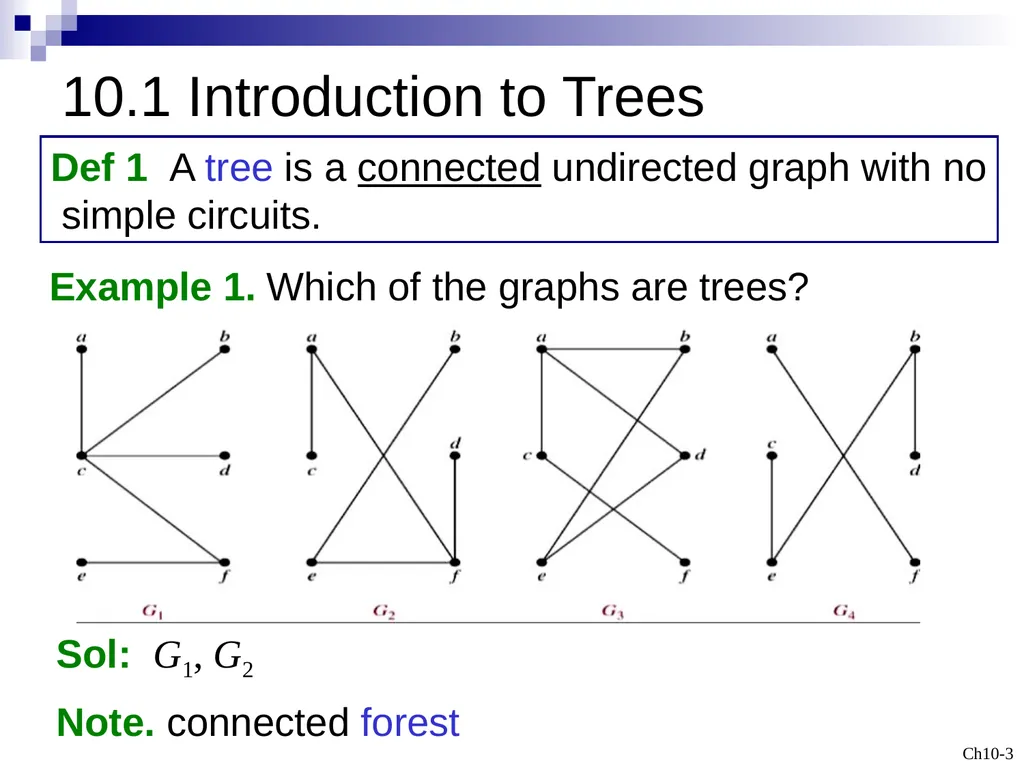
slide3. 10.1 Introduction to Trees Example 1. Which of the graphs are trees? Def 1 A tree is a connected undirected graph with no simple circuits. Sol: G1, G2 Note. connected forest Ch10-3<br>
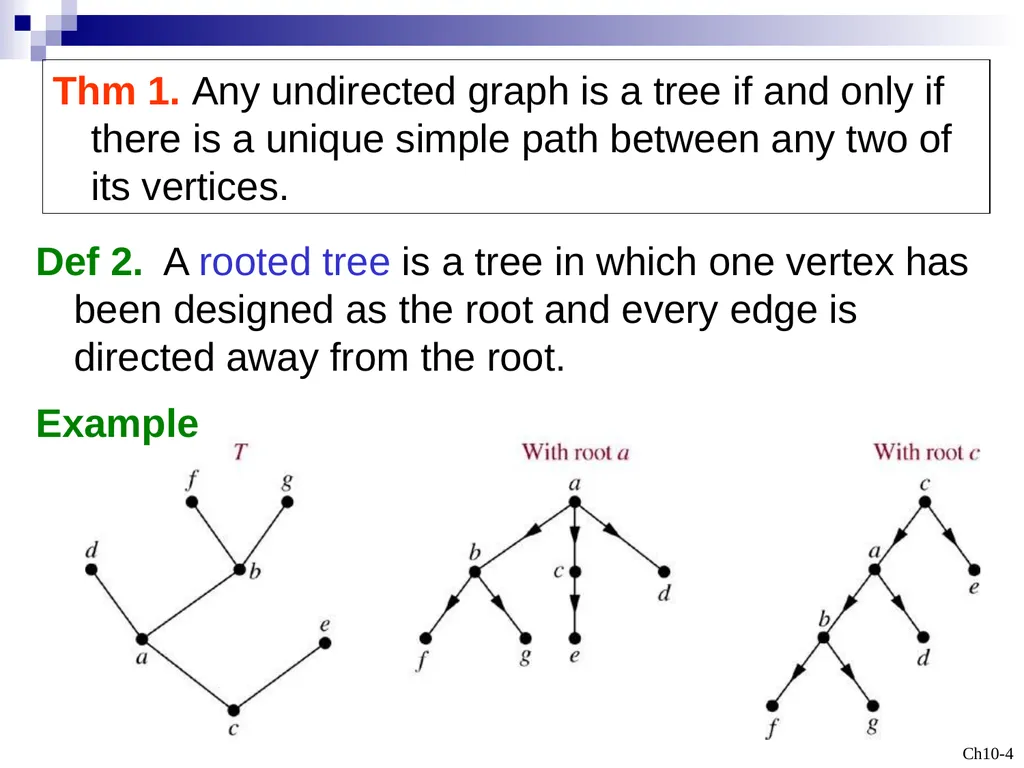
slide4. Thm 1. Any undirected graph is a tree if and only if there is a unique simple path between any two of its vertices. Def 2. A rooted tree is a tree in which one vertex has been designed as the root and every edge is directed away from the root. Example Ch10-4<br>
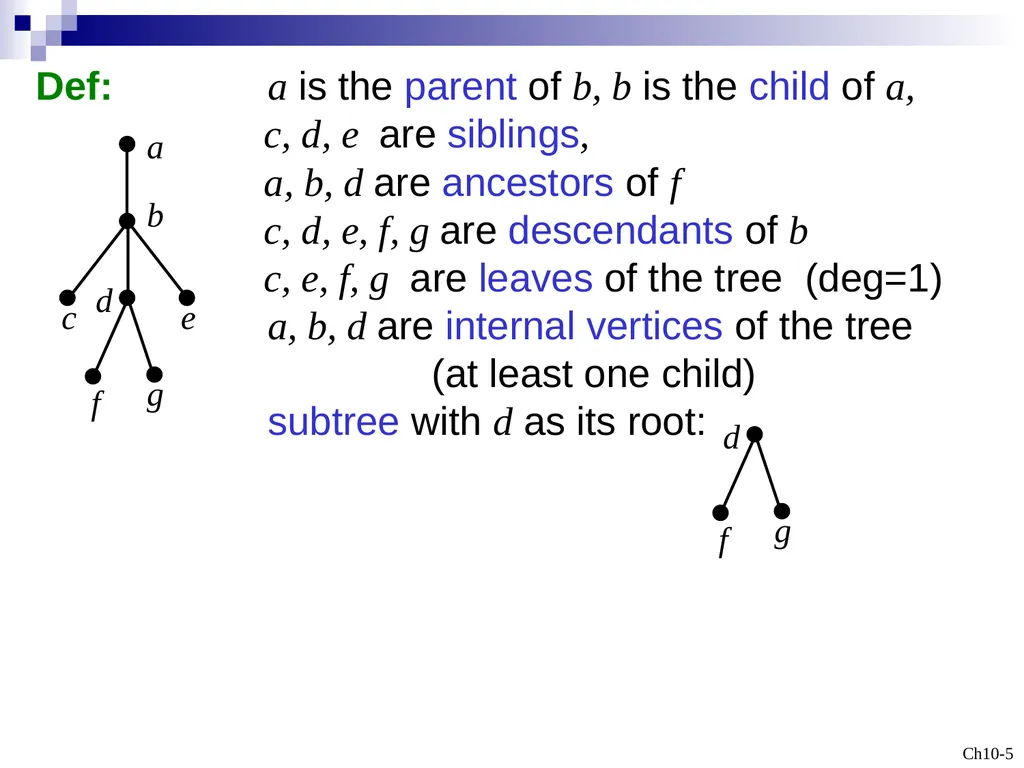
slide5. Def: a is the parent of b, b is the child of a, c, d, e are siblings, a, b, d are ancestors of f c, d, e, f, g are descendants of b c, e, f, g are leaves of the tree (deg=1) a, b, d are internal vertices of the tree (at least one child) subtree with d as its root: Ch10-5<br>
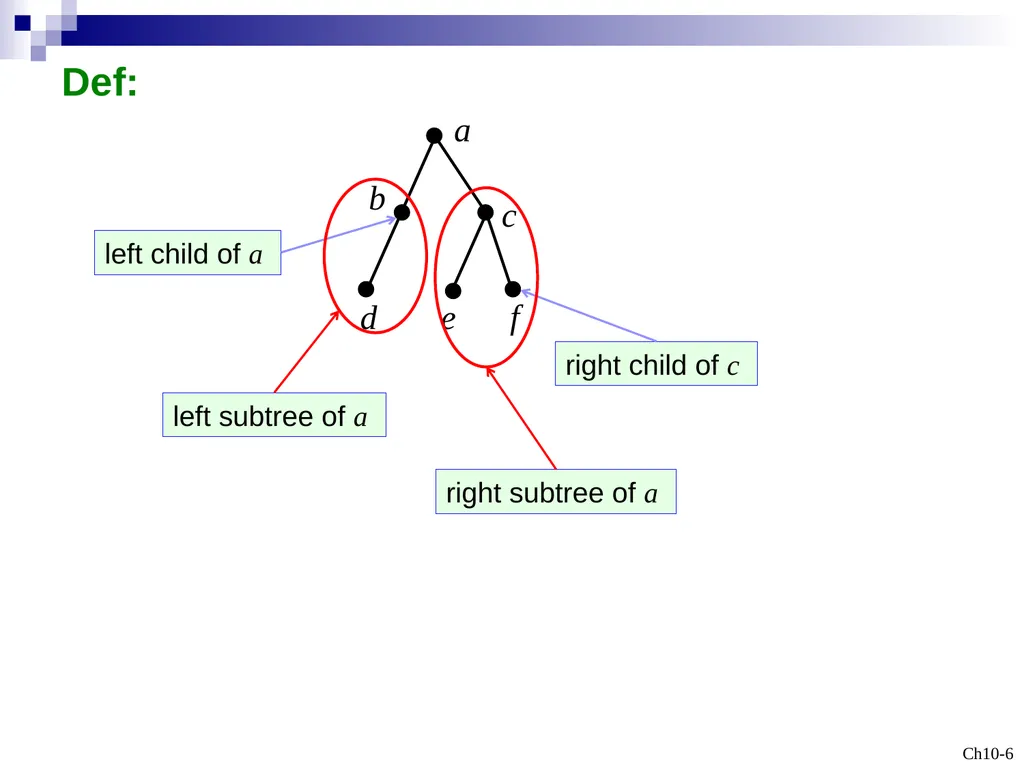
slide6. a e b c f Def: left child of a right child of c right subtree of a d left subtree of a Ch10-6<br>
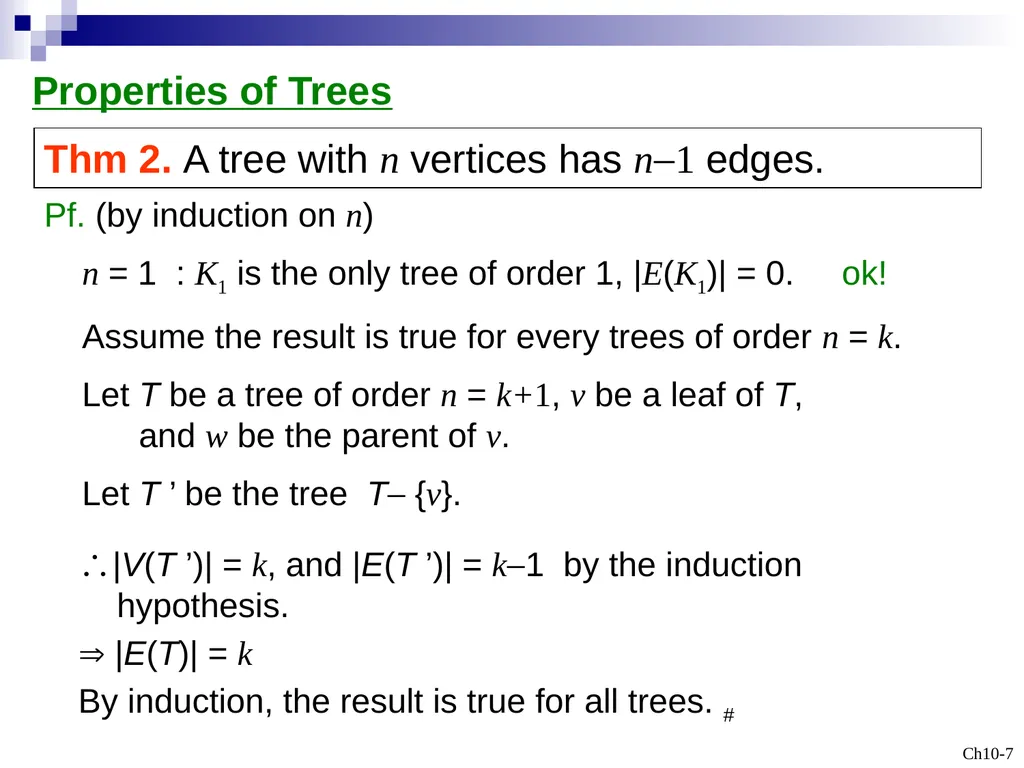
slide7. Properties of Trees Thm 2. A tree with n vertices has n-1 edges. Pf. (by induction on n)
n = 1 : K1 is the only tree of order 1, |E(K1)| = 0. ok!
Assume the result is true for every trees of order n = k.
Let T be a tree of order n = k+1, v be a leaf of T, and w be the parent of v.
Let T ’ be the tree T- {v}. ∴|V(T ’)| = k, and |E(T ’)| = k-1 by the induction hypothesis.
|E(T)| = k
By induction, the result is true for all trees. # Ch10-7<br>
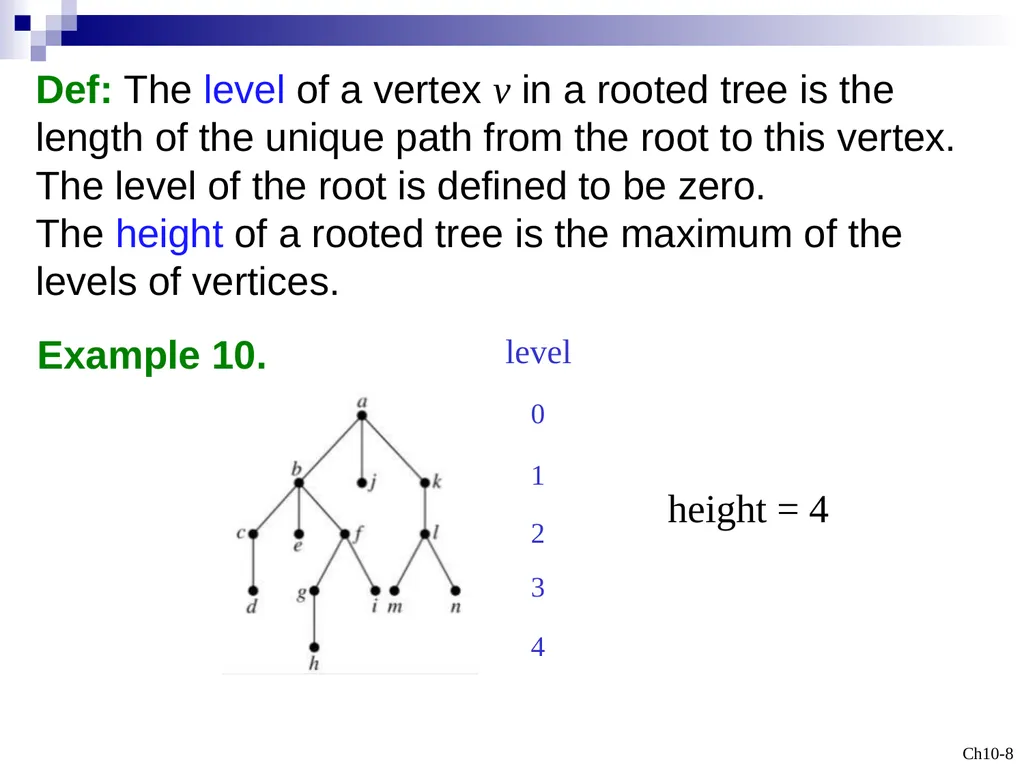
slide8. Def: The level of a vertex v in a rooted tree is the length of the unique path from the root to this vertex. The level of the root is defined to be zero. The height of a rooted tree is the maximum of the levels of vertices. Example 10. height = 4 level 0 1 2 3 4 Ch10-8<br>
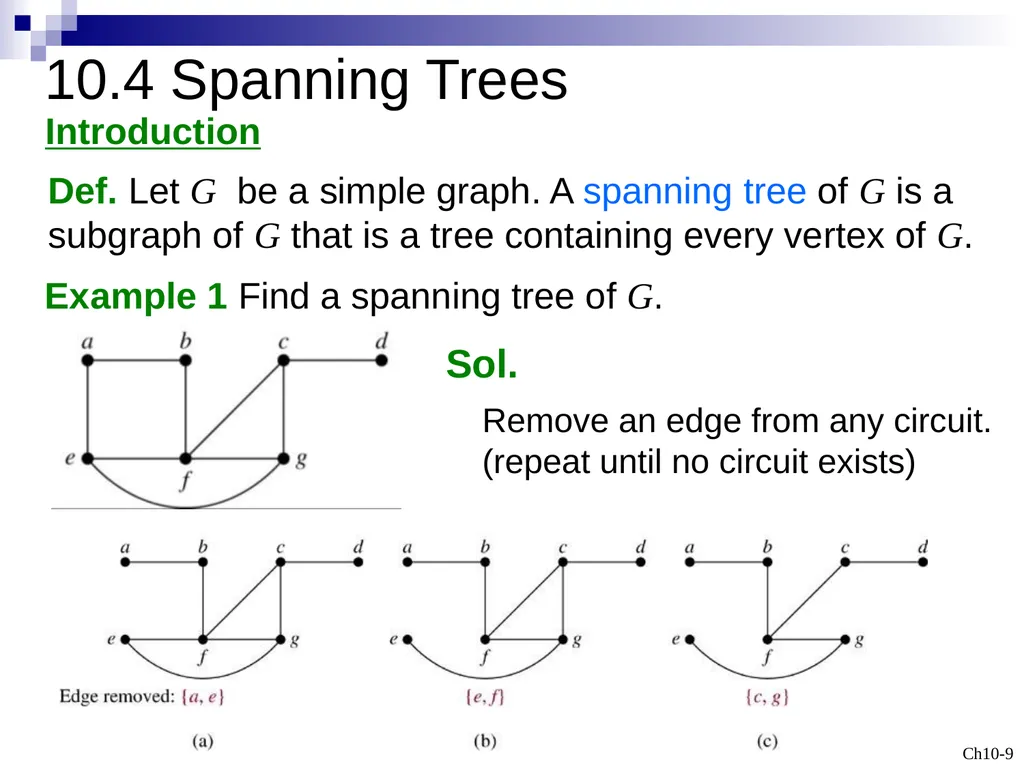
slide9. 10.4 Spanning Trees Def. Let G be a simple graph. A spanning tree of G is a subgraph of G that is a tree containing every vertex of G. Introduction Example 1 Find a spanning tree of G. Sol. Remove an edge from any circuit. (repeat until no circuit exists) Ch10-9<br>
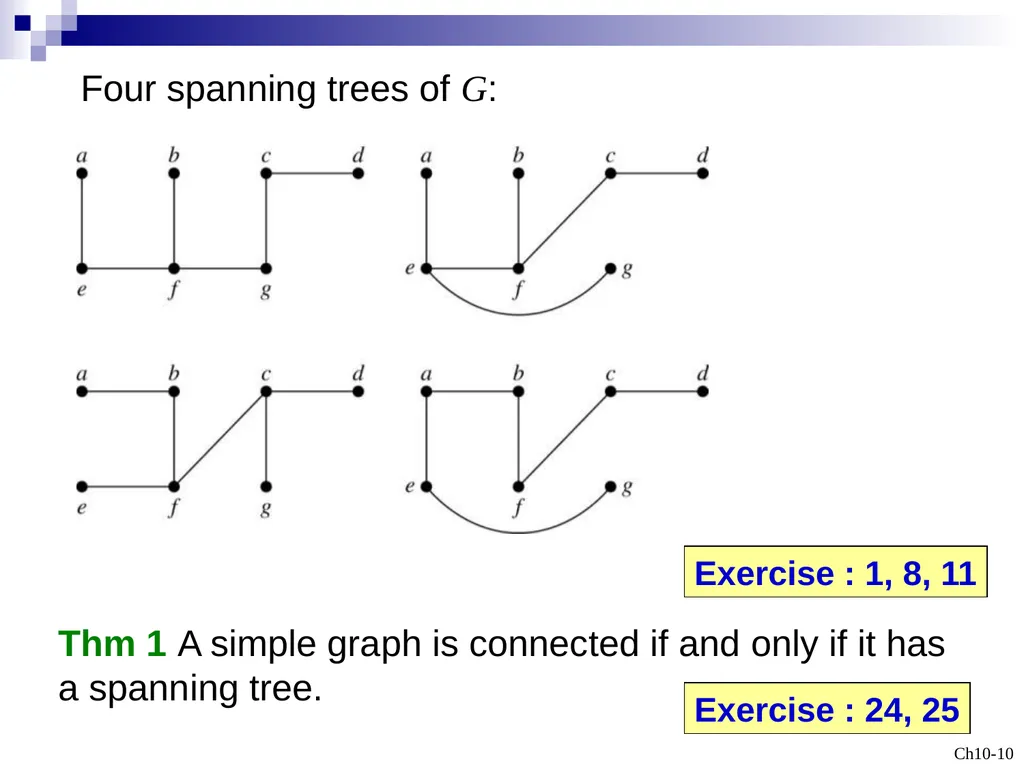
slide10. Four spanning trees of G: Ch10-10 Exercise : 1, 8, 11 Thm 1 A simple graph is connected if and only if it has a spanning tree. Exercise : 24, 25<br>
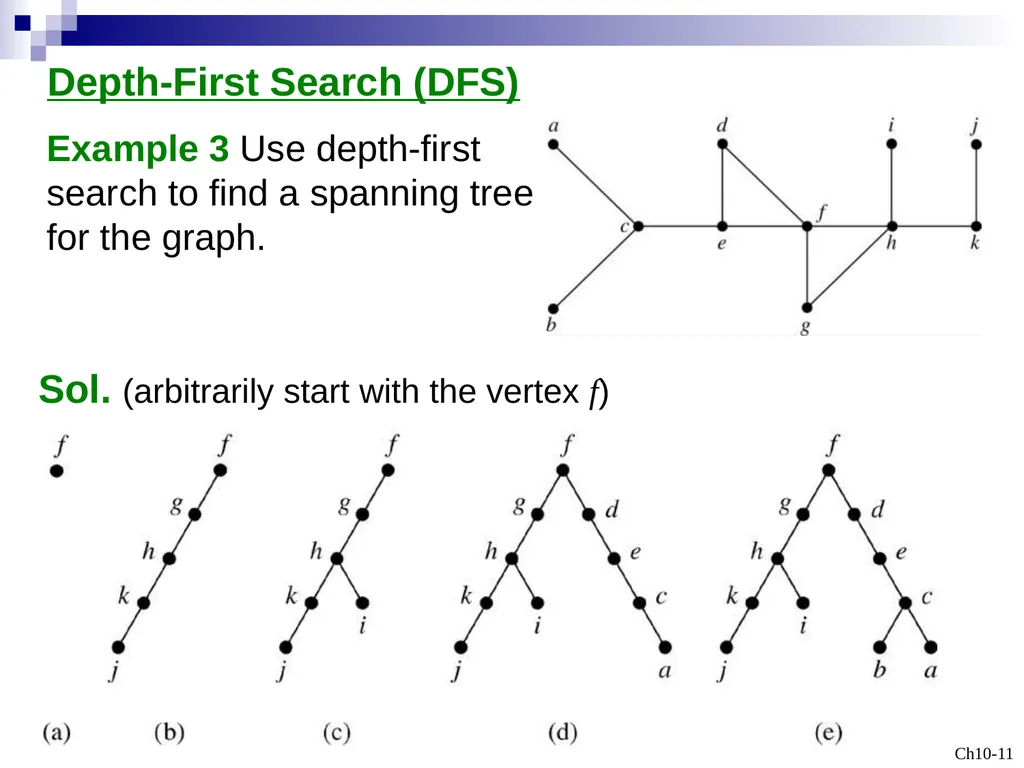
slide11. Example 3 Use depth-first search to find a spanning tree for the graph. Sol. (arbitrarily start with the vertex f) Ch10-11 Depth-First Search (DFS)<br>
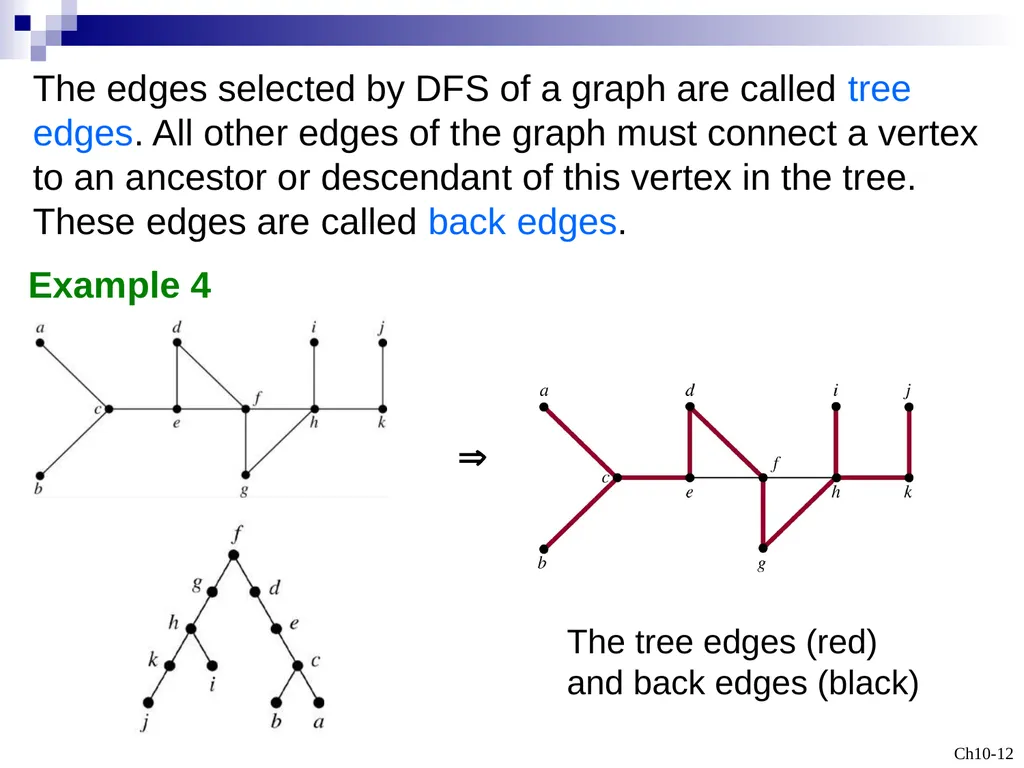
slide12. Ch10-12 Example 4 The edges selected by DFS of a graph are called tree edges. All other edges of the graph must connect a vertex to an ancestor or descendant of this vertex in the tree. These edges are called back edges. The tree edges (red) and back edges (black) <br>
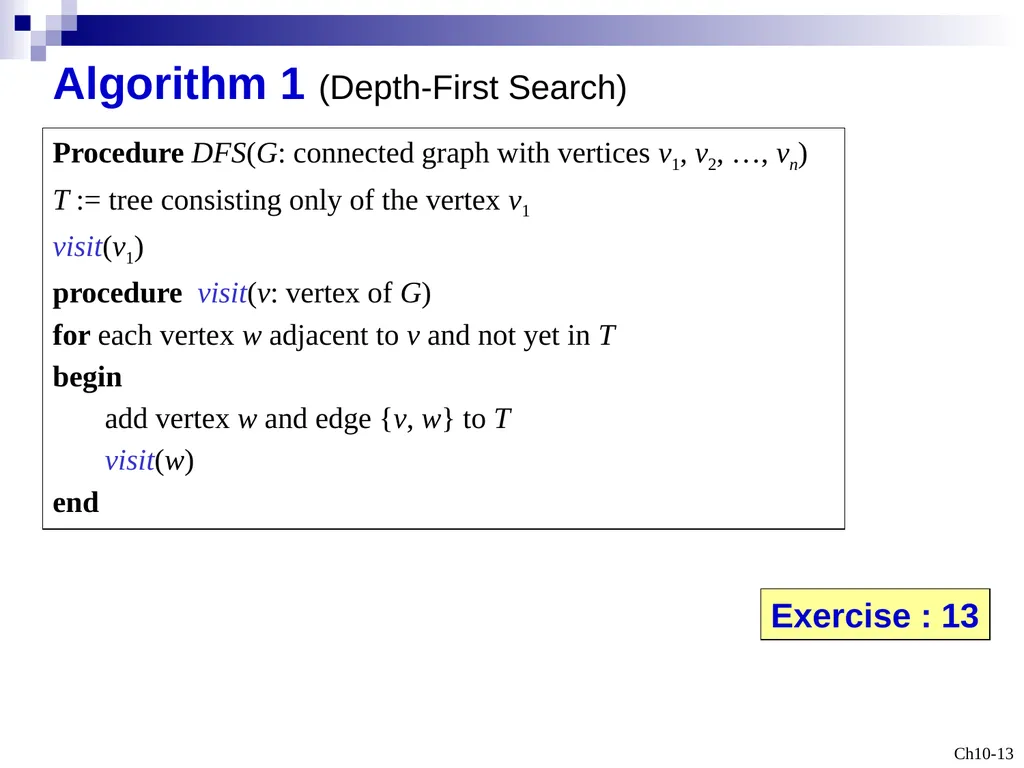
slide13. Procedure DFS(G: connected graph with vertices v1, v2, …, vn)
T := tree consisting only of the vertex v1
visit(v1)
procedure visit(v: vertex of G)
for each vertex w adjacent to v and not yet in T
begin
add vertex w and edge {v, w} to T
visit(w)
end Algorithm 1 (Depth-First Search) Ch10-13 Exercise : 13<br>
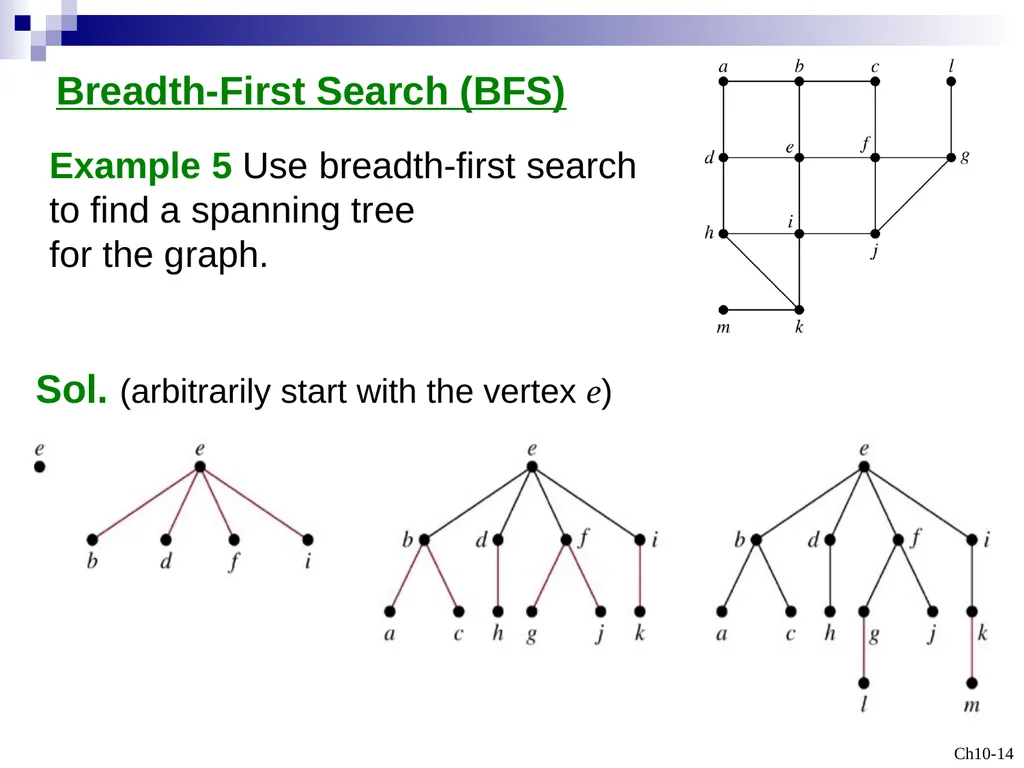
slide14. Example 5 Use breadth-first search to find a spanning tree for the graph. Sol. (arbitrarily start with the vertex e) Ch10-14 Breadth-First Search (BFS)<br>
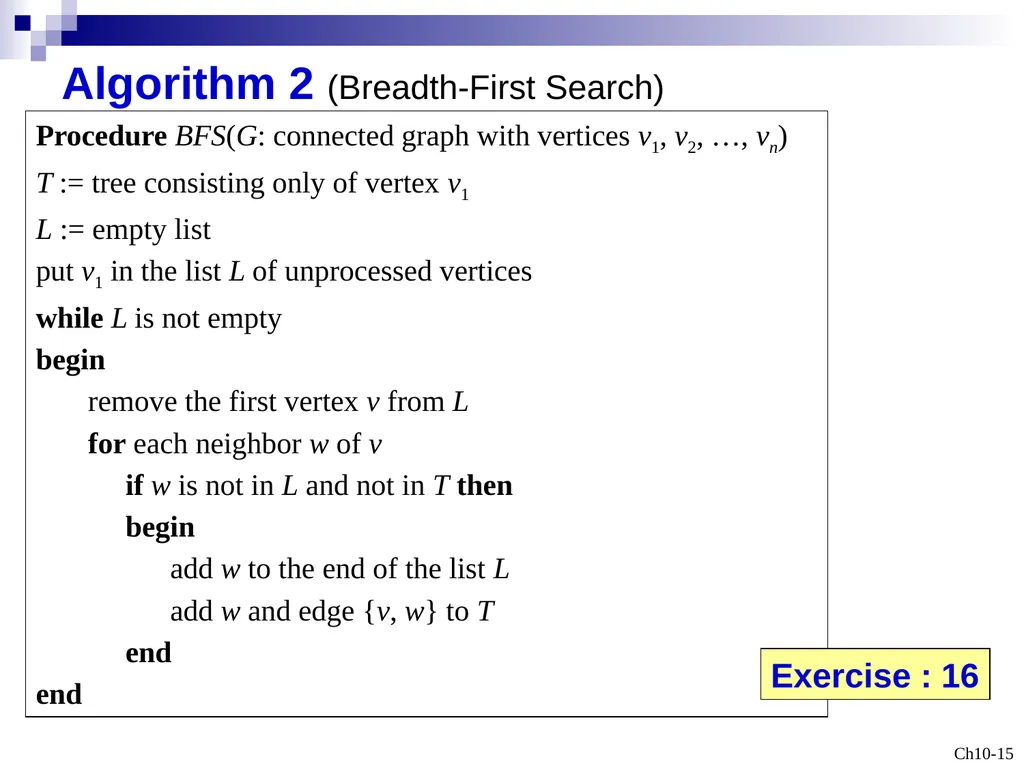
slide15. Procedure BFS(G: connected graph with vertices v1, v2, …, vn)
T := tree consisting only of vertex v1
L := empty list
put v1 in the list L of unprocessed vertices
while L is not empty
begin
remove the first vertex v from L
for each neighbor w of v
if w is not in L and not in T then
begin
add w to the end of the list L
add w and edge {v, w} to T
end
end Algorithm 2 (Breadth-First Search) Ch10-15 Exercise : 16<br>
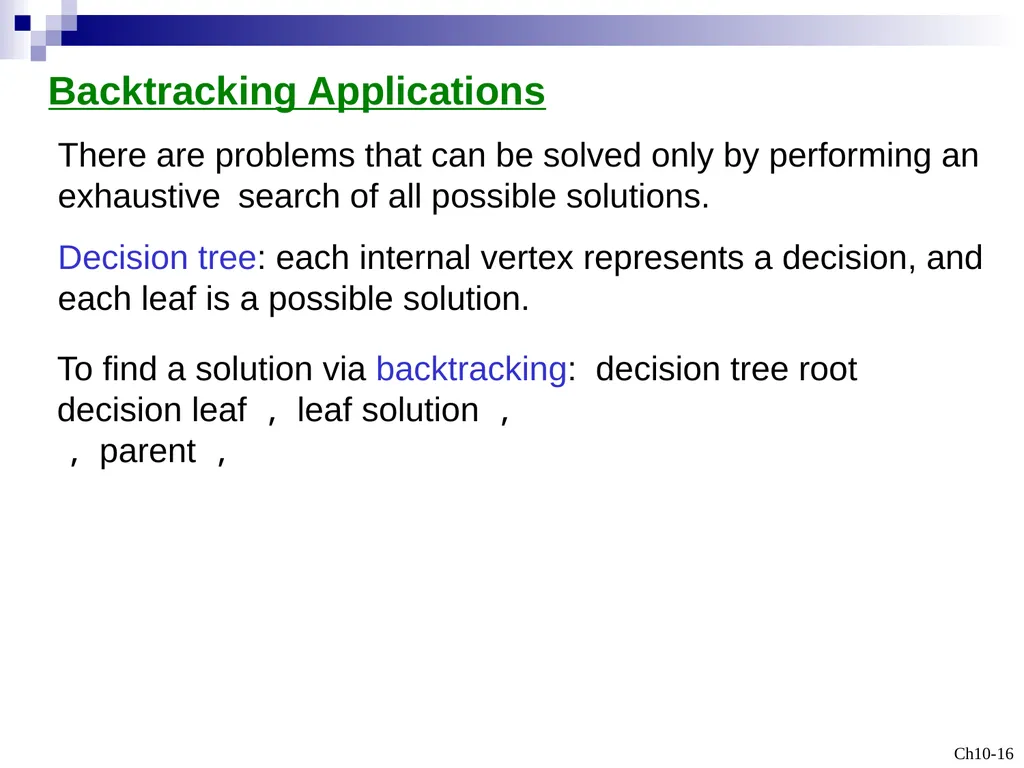
slide16. There are problems that can be solved only by performing an exhaustive search of all possible solutions. Ch10-16 Backtracking Applications Decision tree: each internal vertex represents a decision, and each leaf is a possible solution. To find a solution via backtracking: decision tree root decision leaf,leaf solution, ,parent,<br>
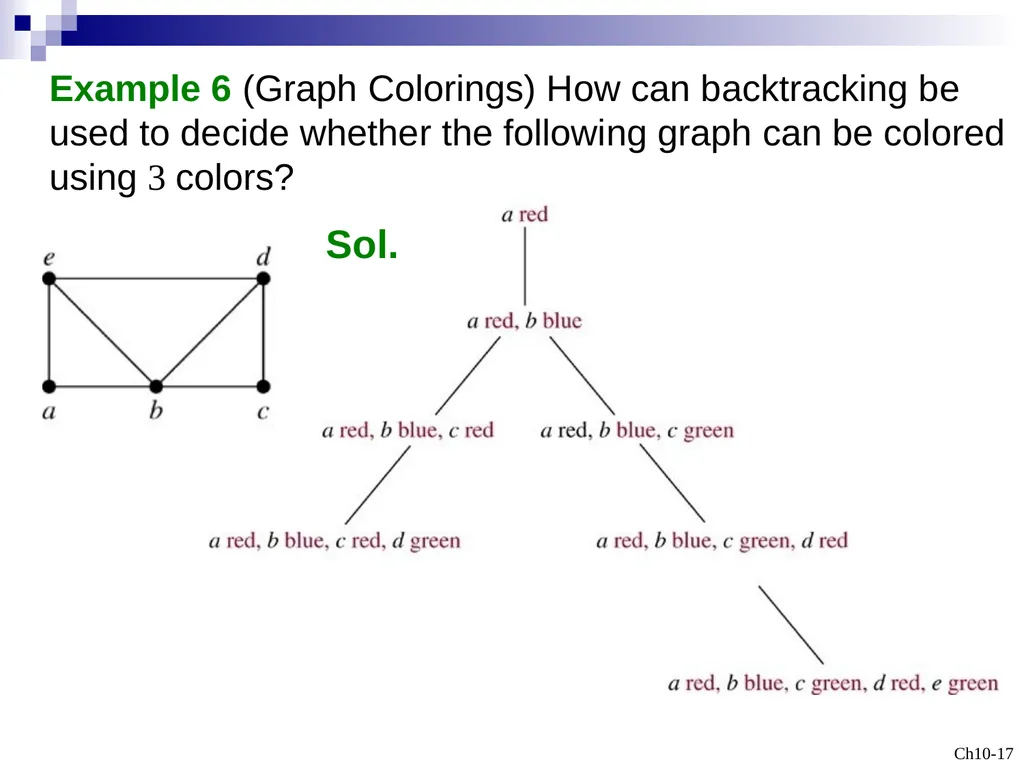
slide17. Ch10-17 Example 6 (Graph Colorings) How can backtracking be used to decide whether the following graph can be colored using 3 colors? Sol.<br>
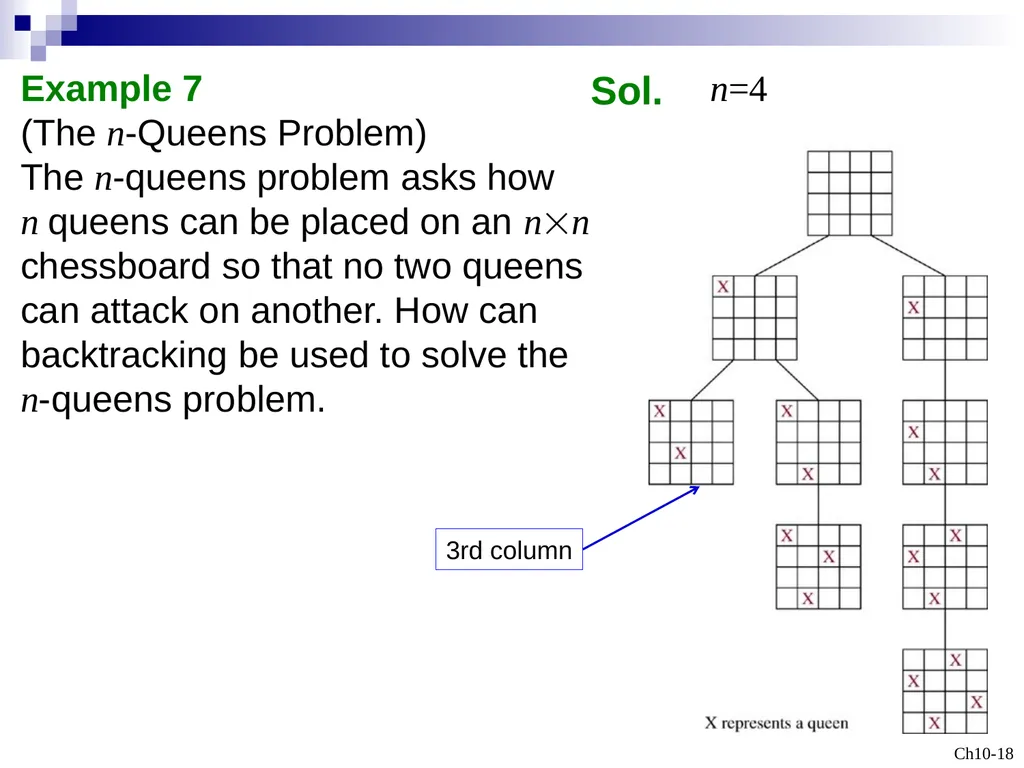
slide18. Ch10-18 Example 7 (The n-Queens Problem) The n-queens problem asks how n queens can be placed on an nn chessboard so that no two queens can attack on another. How can backtracking be used to solve the n-queens problem. Sol. n=4<br>
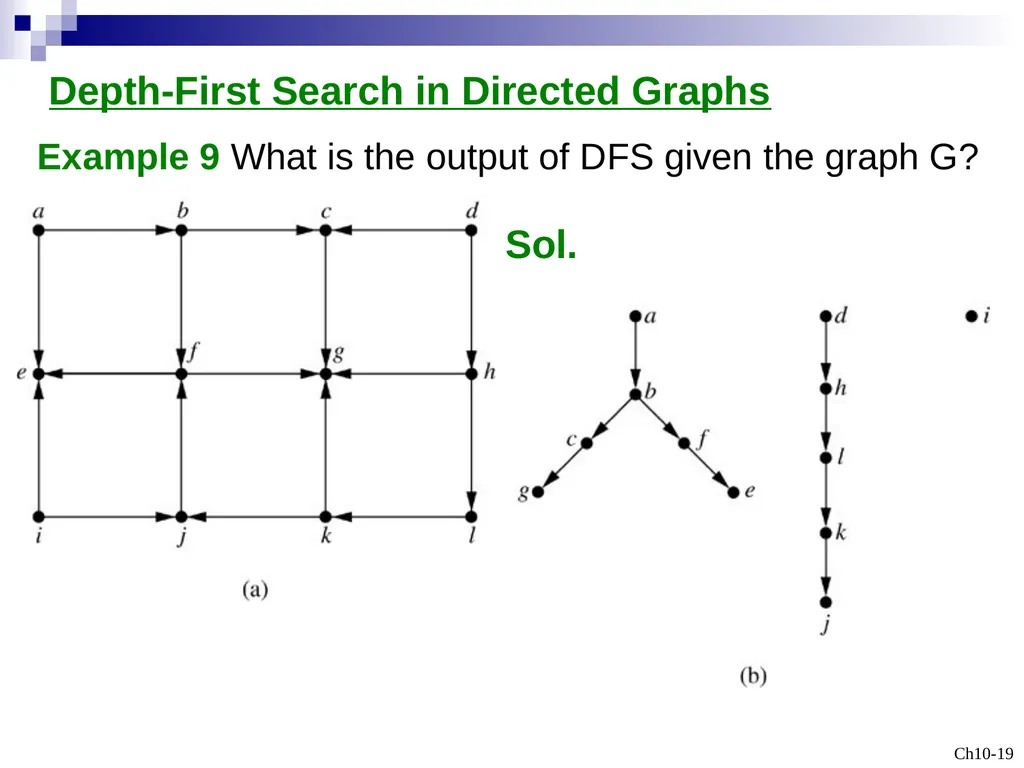
slide19. Ch10-19 Depth-First Search in Directed Graphs Example 9 What is the output of DFS given the graph G? Sol.<br>
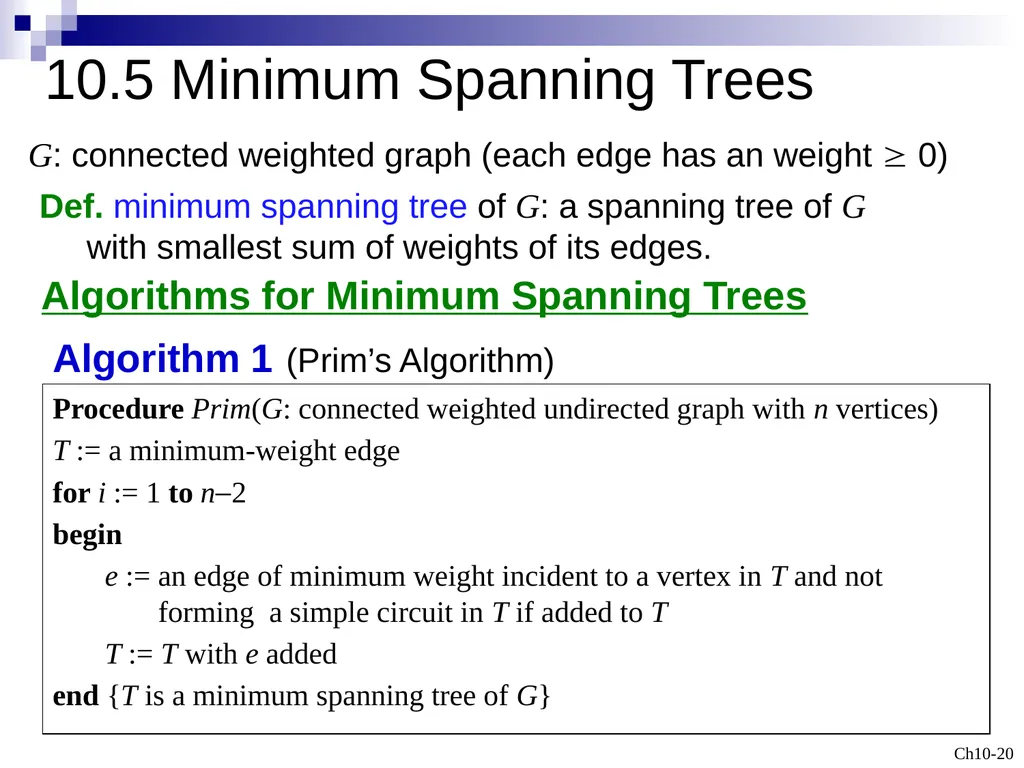
slide20. Ch10-20 10.5 Minimum Spanning Trees G: connected weighted graph (each edge has an weight 0) Def. minimum spanning tree of G: a spanning tree of G with smallest sum of weights of its edges. Algorithms for Minimum Spanning Trees Procedure Prim(G: connected weighted undirected graph with n vertices)
T := a minimum-weight edge
for i := 1 to n-2
begin
e := an edge of minimum weight incident to a vertex in T and not forming a simple circuit in T if added to T
T := T with e added
end {T is a minimum spanning tree of G} Algorithm 1 (Prim’s Algorithm)<br>
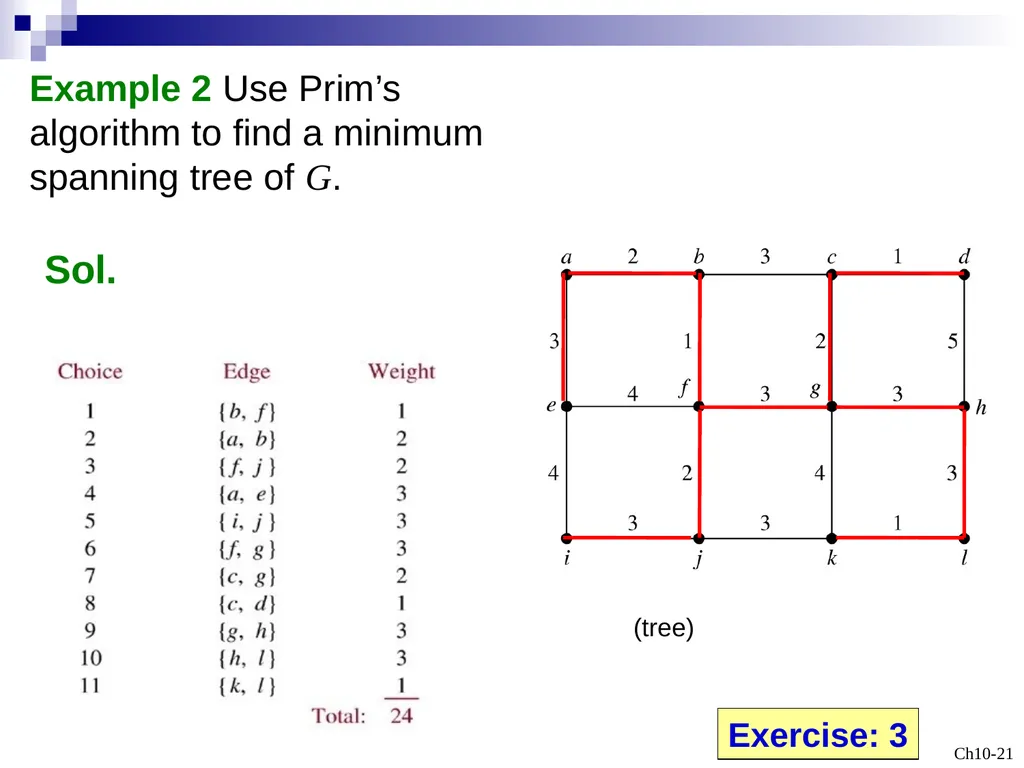
slide21. Ch10-21 Example 2 Use Prim’s algorithm to find a minimum spanning tree of G. Sol. Exercise: 3 (tree)<br>
slide22. Ch10-22 Procedure Kruskal(G: connected weighted undirected graph with n vertices)
T := empty graph
for i := 1 to n-1
begin
e := any edge in G with smallest weight that does not form a simple circuit when added to T
T := T with e added
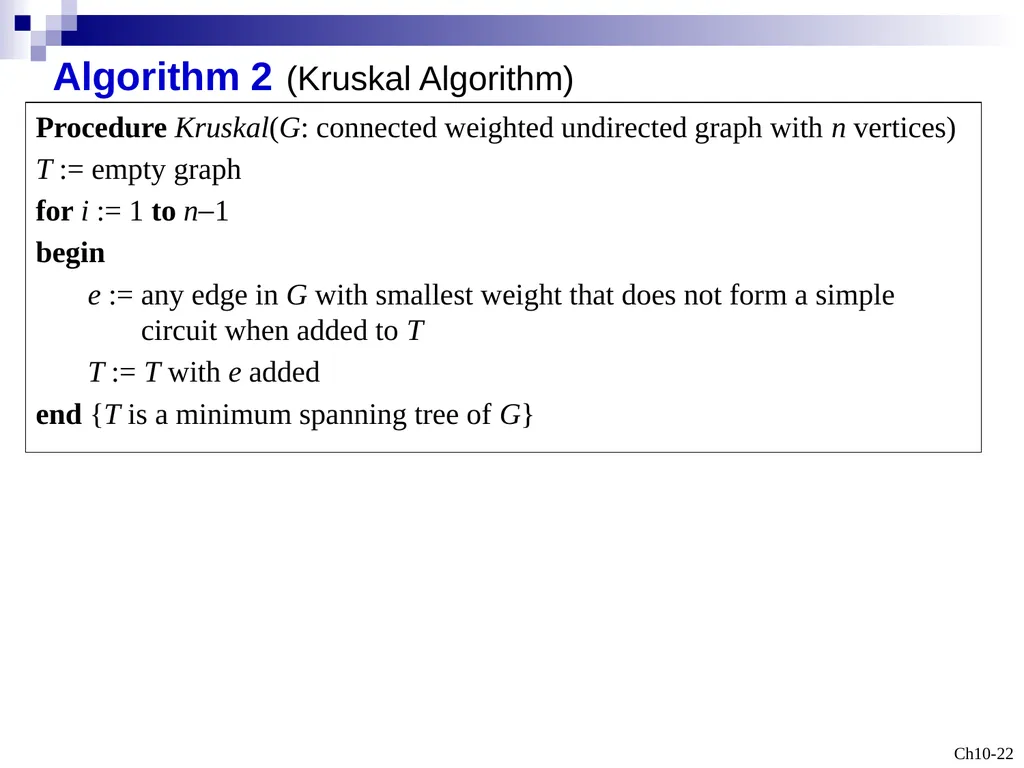
end {T is a minimum spanning tree of G} Algorithm 2 (Kruskal Algorithm)<br>
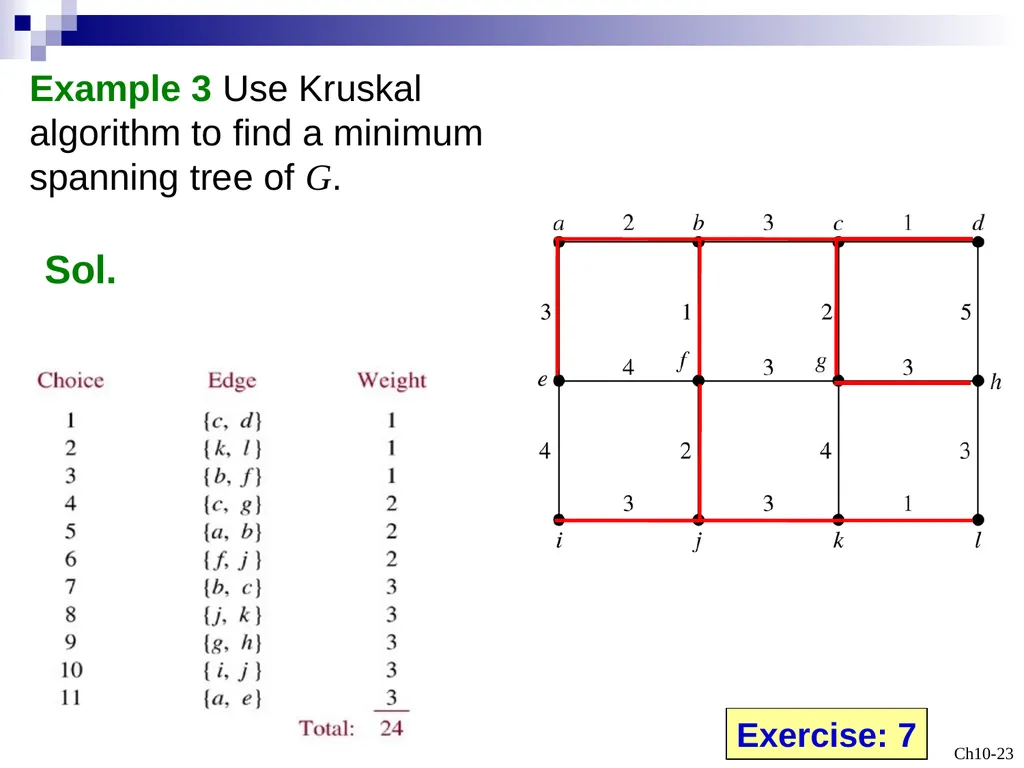
slide23. Ch10-23 Example 3 Use Kruskal algorithm to find a minimum spanning tree of G. Sol. Exercise: 7<br>
slide2. Outline 10.1 Introduction to Trees
10.2 Applications of Trees
10.3 Tree Traversal
10.4 Spanning Trees
10.5 Minimal Spanning Trees Ch10-2<br>
slide3. 10.1 Introduction to Trees Example 1. Which of the graphs are trees? Def 1 A tree is a connected undirected graph with no simple circuits. Sol: G1, G2 Note. connected forest Ch10-3<br>
slide4. Thm 1. Any undirected graph is a tree if and only if there is a unique simple path between any two of its vertices. Def 2. A rooted tree is a tree in which one vertex has been designed as the root and every edge is directed away from the root. Example Ch10-4<br>
slide5. Def: a is the parent of b, b is the child of a, c, d, e are siblings, a, b, d are ancestors of f c, d, e, f, g are descendants of b c, e, f, g are leaves of the tree (deg=1) a, b, d are internal vertices of the tree (at least one child) subtree with d as its root: Ch10-5<br>
slide6. a e b c f Def: left child of a right child of c right subtree of a d left subtree of a Ch10-6<br>
slide7. Properties of Trees Thm 2. A tree with n vertices has n-1 edges. Pf. (by induction on n)
n = 1 : K1 is the only tree of order 1, |E(K1)| = 0. ok!
Assume the result is true for every trees of order n = k.
Let T be a tree of order n = k+1, v be a leaf of T, and w be the parent of v.
Let T ’ be the tree T- {v}. ∴|V(T ’)| = k, and |E(T ’)| = k-1 by the induction hypothesis.
|E(T)| = k
By induction, the result is true for all trees. # Ch10-7<br>
slide8. Def: The level of a vertex v in a rooted tree is the length of the unique path from the root to this vertex. The level of the root is defined to be zero. The height of a rooted tree is the maximum of the levels of vertices. Example 10. height = 4 level 0 1 2 3 4 Ch10-8<br>
slide9. 10.4 Spanning Trees Def. Let G be a simple graph. A spanning tree of G is a subgraph of G that is a tree containing every vertex of G. Introduction Example 1 Find a spanning tree of G. Sol. Remove an edge from any circuit. (repeat until no circuit exists) Ch10-9<br>
slide10. Four spanning trees of G: Ch10-10 Exercise : 1, 8, 11 Thm 1 A simple graph is connected if and only if it has a spanning tree. Exercise : 24, 25<br>
slide11. Example 3 Use depth-first search to find a spanning tree for the graph. Sol. (arbitrarily start with the vertex f) Ch10-11 Depth-First Search (DFS)<br>
slide12. Ch10-12 Example 4 The edges selected by DFS of a graph are called tree edges. All other edges of the graph must connect a vertex to an ancestor or descendant of this vertex in the tree. These edges are called back edges. The tree edges (red) and back edges (black) <br>
slide13. Procedure DFS(G: connected graph with vertices v1, v2, …, vn)
T := tree consisting only of the vertex v1
visit(v1)
procedure visit(v: vertex of G)
for each vertex w adjacent to v and not yet in T
begin
add vertex w and edge {v, w} to T
visit(w)
end Algorithm 1 (Depth-First Search) Ch10-13 Exercise : 13<br>
slide14. Example 5 Use breadth-first search to find a spanning tree for the graph. Sol. (arbitrarily start with the vertex e) Ch10-14 Breadth-First Search (BFS)<br>
slide15. Procedure BFS(G: connected graph with vertices v1, v2, …, vn)
T := tree consisting only of vertex v1
L := empty list
put v1 in the list L of unprocessed vertices
while L is not empty
begin
remove the first vertex v from L
for each neighbor w of v
if w is not in L and not in T then
begin
add w to the end of the list L
add w and edge {v, w} to T
end
end Algorithm 2 (Breadth-First Search) Ch10-15 Exercise : 16<br>
slide16. There are problems that can be solved only by performing an exhaustive search of all possible solutions. Ch10-16 Backtracking Applications Decision tree: each internal vertex represents a decision, and each leaf is a possible solution. To find a solution via backtracking: decision tree root decision leaf,leaf solution, ,parent,<br>
slide17. Ch10-17 Example 6 (Graph Colorings) How can backtracking be used to decide whether the following graph can be colored using 3 colors? Sol.<br>
slide18. Ch10-18 Example 7 (The n-Queens Problem) The n-queens problem asks how n queens can be placed on an nn chessboard so that no two queens can attack on another. How can backtracking be used to solve the n-queens problem. Sol. n=4<br>
slide19. Ch10-19 Depth-First Search in Directed Graphs Example 9 What is the output of DFS given the graph G? Sol.<br>
slide20. Ch10-20 10.5 Minimum Spanning Trees G: connected weighted graph (each edge has an weight 0) Def. minimum spanning tree of G: a spanning tree of G with smallest sum of weights of its edges. Algorithms for Minimum Spanning Trees Procedure Prim(G: connected weighted undirected graph with n vertices)
T := a minimum-weight edge
for i := 1 to n-2
begin
e := an edge of minimum weight incident to a vertex in T and not forming a simple circuit in T if added to T
T := T with e added
end {T is a minimum spanning tree of G} Algorithm 1 (Prim’s Algorithm)<br>
slide21. Ch10-21 Example 2 Use Prim’s algorithm to find a minimum spanning tree of G. Sol. Exercise: 3 (tree)<br>
slide22. Ch10-22 Procedure Kruskal(G: connected weighted undirected graph with n vertices)
T := empty graph
for i := 1 to n-1
begin
e := any edge in G with smallest weight that does not form a simple circuit when added to T
T := T with e added
end {T is a minimum spanning tree of G} Algorithm 2 (Kruskal Algorithm)<br>
slide23. Ch10-23 Example 3 Use Kruskal algorithm to find a minimum spanning tree of G. Sol. Exercise: 7<br>