Discussion Do you need to be a quant to be a better hedge fund manager? A. Hassouni, H. Pirotte Guillaume Monarcha Head of Research, Orion Financial Partners 12th Financial Risks International Conference, March 18-19, 2019 Summary
"Discussion – Do you need to be a quant to" is the property of its rightful owner. Permission is granted to
download and print the materials on this website for personal, non-commercial use only, and to display it
on your personal computer provided you do not modify the materials and that you retain all copyright
notices contained in the materials. By downloading content from our website, you accept the terms of this
agreement.
Share
Embed code
Presentation Transcript
01
Discussion – Do you need to be a quant to be a better hedge fund manager? A. Hassouni, H. Pirotte Guillaume Monarcha
Head of Research, Orion Financial Partners 12th Financial Risks International Conference, March 18-19, 2019<br>
02
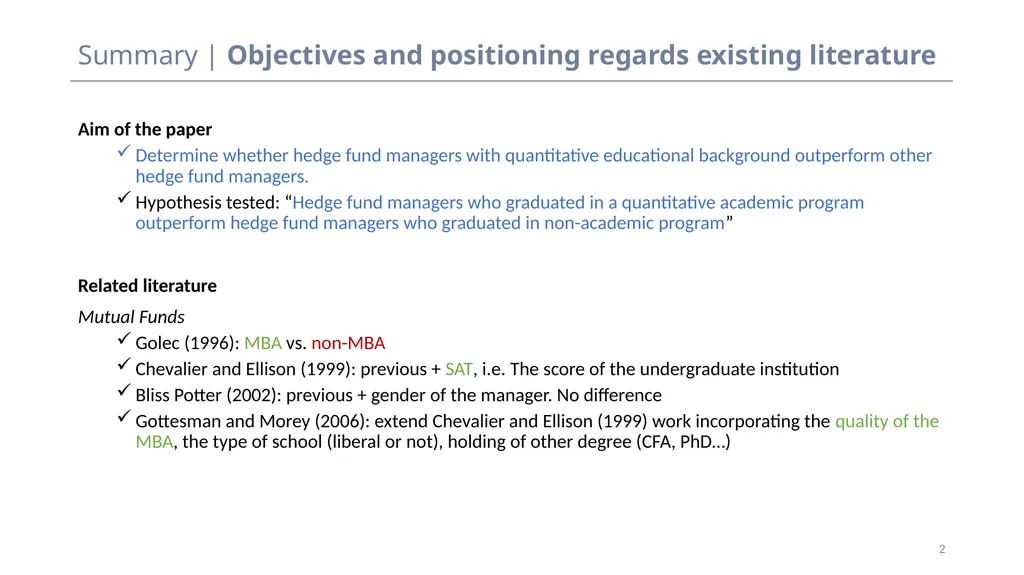
Summary | Objectives and positioning regards existing literature Aim of the paper
Determine whether hedge fund managers with quantitative educational background outperform other hedge fund managers.
Hypothesis tested: “Hedge fund managers who graduated in a quantitative academic program outperform hedge fund managers who graduated in non-academic program”
Related literature
Mutual Funds
Golec (1996): MBA vs. non-MBA
Chevalier and Ellison (1999): previous + SAT, i.e. The score of the undergraduate institution
Bliss Potter (2002): previous + gender of the manager. No difference
Gottesman and Morey (2006): extend Chevalier and Ellison (1999) work incorporating the quality of the MBA, the type of school (liberal or not), holding of other degree (CFA, PhD…) 2<br>
03
Summary | Objectives and positioning regards existing literature Related literature
Hedge funds
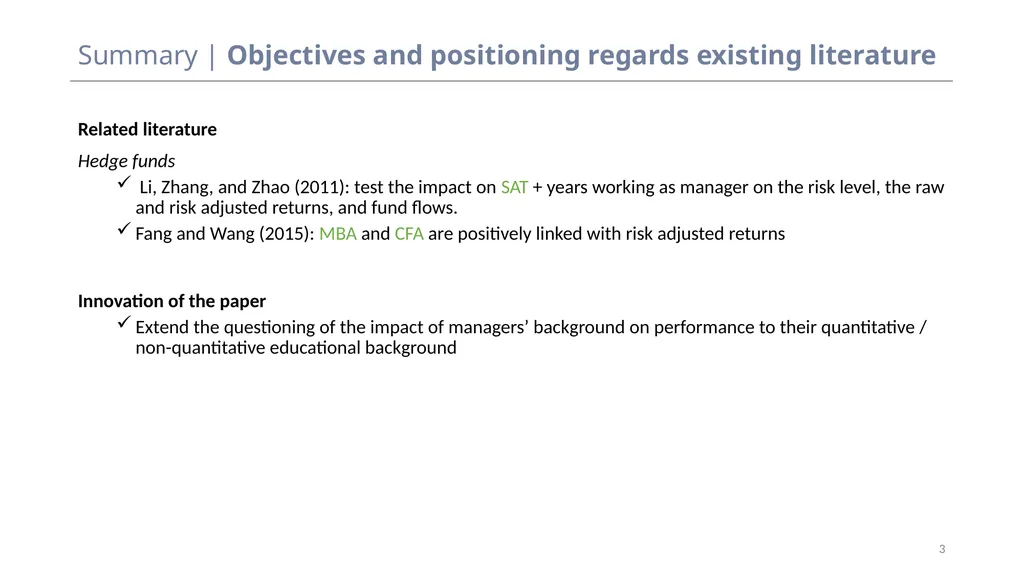
Li, Zhang, and Zhao (2011): test the impact on SAT + years working as manager on the risk level, the raw and risk adjusted returns, and fund flows.
Fang and Wang (2015): MBA and CFA are positively linked with risk adjusted returns
Innovation of the paper
Extend the questioning of the impact of managers’ background on performance to their quantitative / non-quantitative educational background 3<br>
04
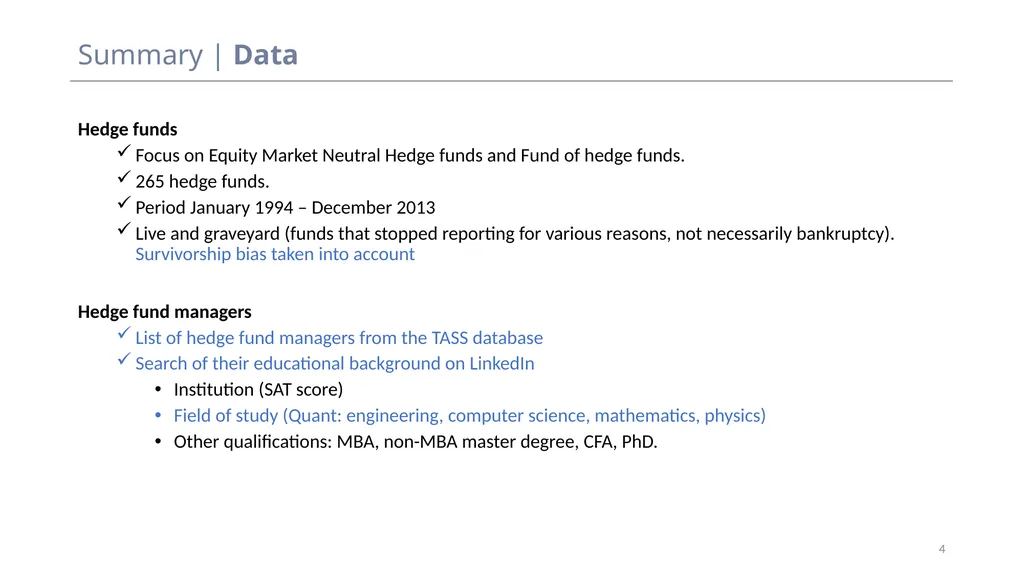
Summary | Data Hedge funds
Focus on Equity Market Neutral Hedge funds and Fund of hedge funds.
265 hedge funds.
Period January 1994 – December 2013
Live and graveyard (funds that stopped reporting for various reasons, not necessarily bankruptcy). Survivorship bias taken into account
Hedge fund managers
List of hedge fund managers from the TASS database
Search of their educational background on LinkedIn
Institution (SAT score)
Field of study (Quant: engineering, computer science, mathematics, physics)
Other qualifications: MBA, non-MBA master degree, CFA, PhD. 4<br>
05
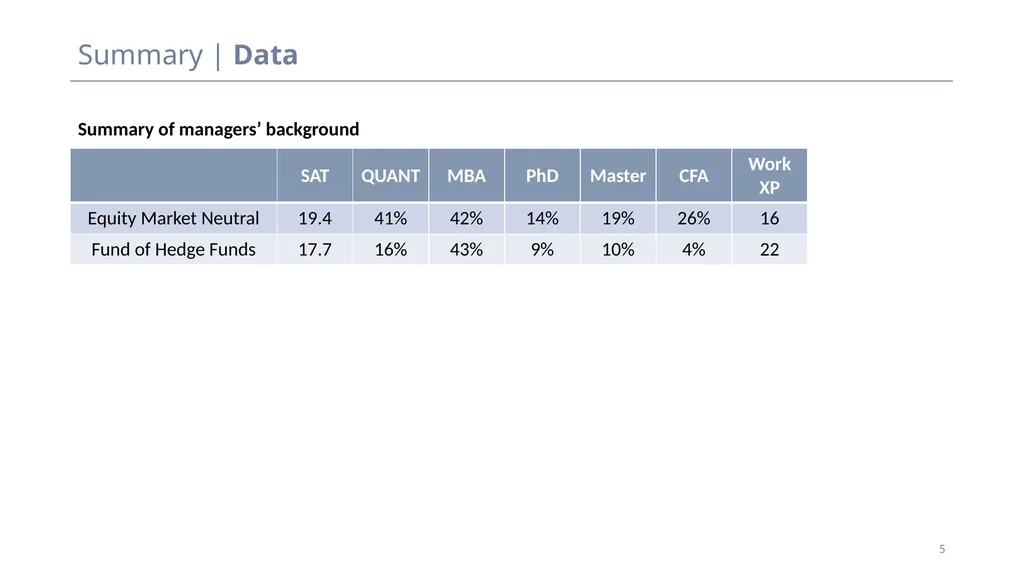
Summary | Data Summary of managers’ background 5<br>
06
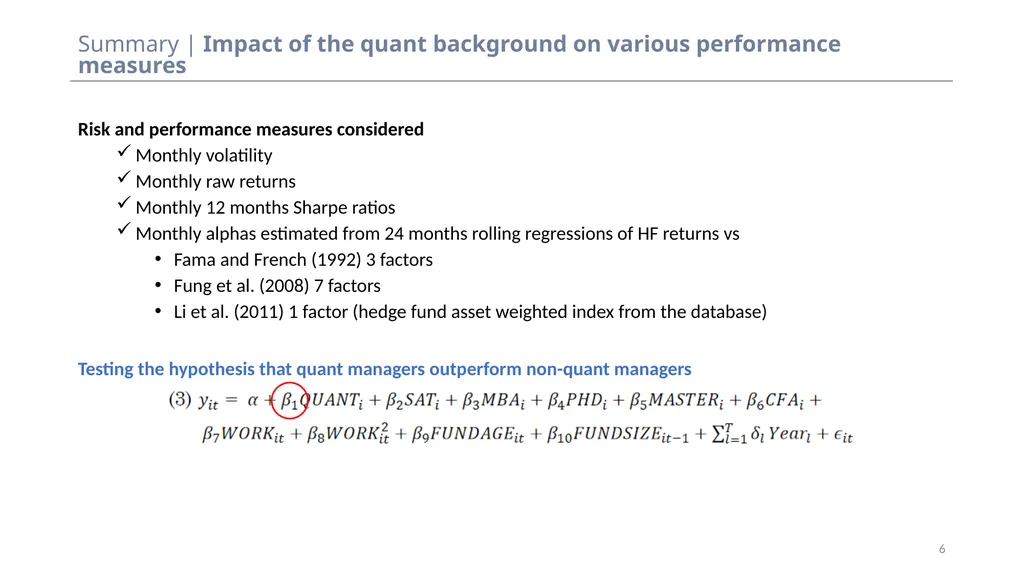
Summary | Impact of the quant background on various performance measures Risk and performance measures considered
Monthly volatility
Monthly raw returns
Monthly 12 months Sharpe ratios
Monthly alphas estimated from 24 months rolling regressions of HF returns vs
Fama and French (1992) 3 factors
Fung et al. (2008) 7 factors
Li et al. (2011) 1 factor (hedge fund asset weighted index from the database)
Testing the hypothesis that quant managers outperform non-quant managers 6<br>
07
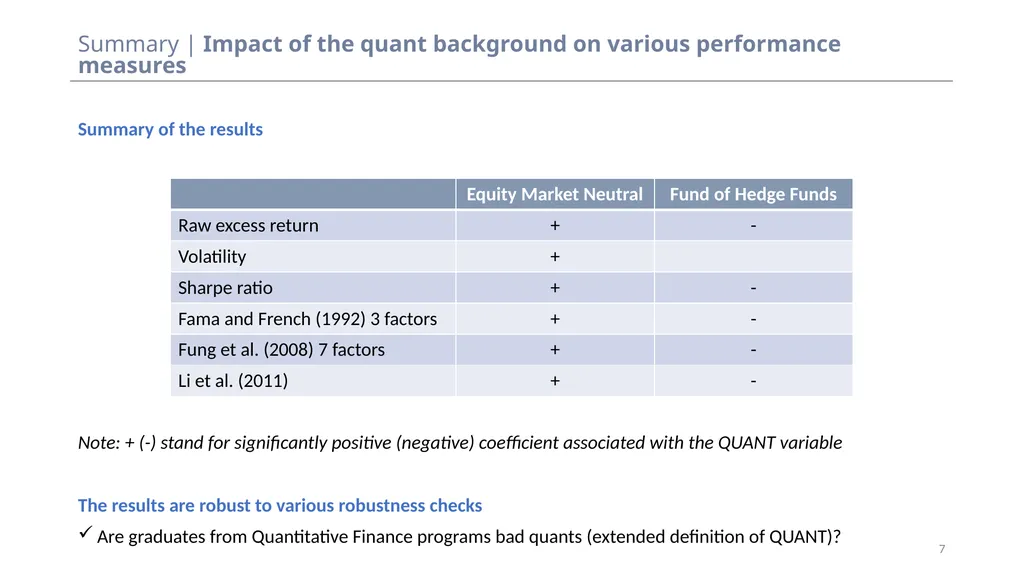
Summary | Impact of the quant background on various performance measures Summary of the results
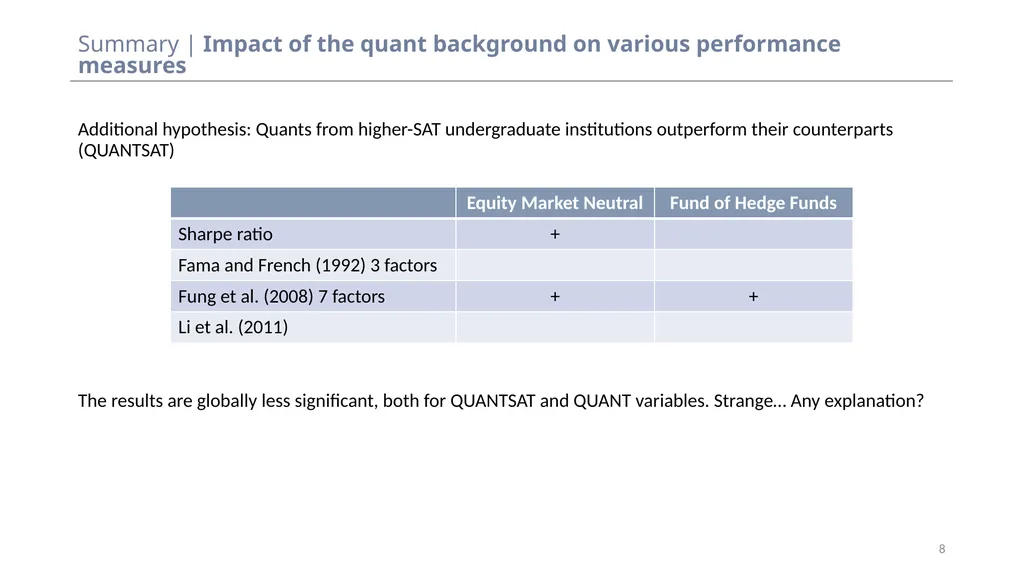
Note: + (-) stand for significantly positive (negative) coefficient associated with the QUANT variable
The results are robust to various robustness checks
Are graduates from Quantitative Finance programs bad quants (extended definition of QUANT)? 7<br>
08
Summary | Impact of the quant background on various performance measures Additional hypothesis: Quants from higher-SAT undergraduate institutions outperform their counterparts (QUANTSAT)
The results are globally less significant, both for QUANTSAT and QUANT variables. Strange… Any explanation? 8<br>
09
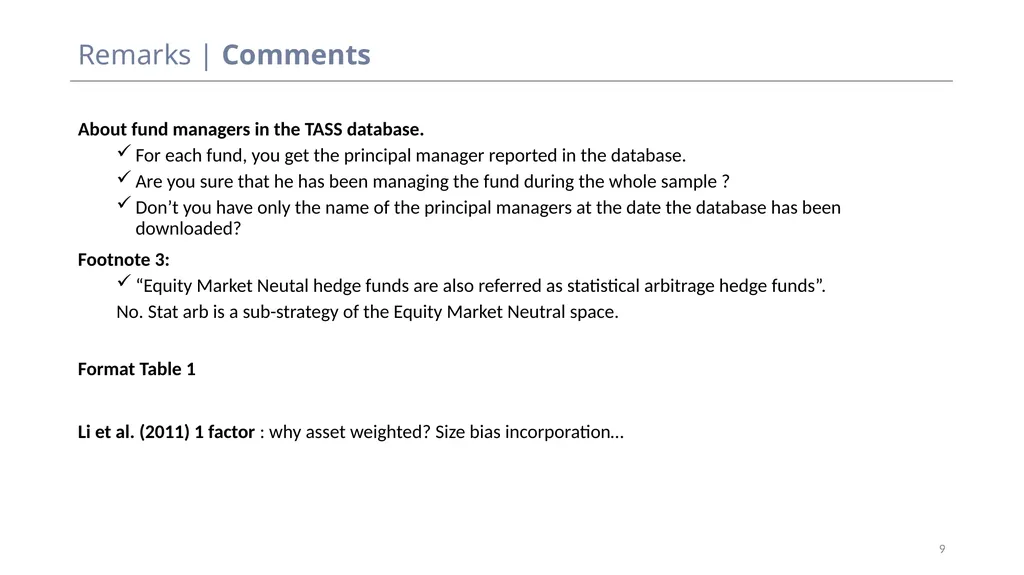
Remarks | Comments About fund managers in the TASS database.
For each fund, you get the principal manager reported in the database.
Are you sure that he has been managing the fund during the whole sample ?
Don’t you have only the name of the principal managers at the date the database has been downloaded?
Footnote 3:
“Equity Market Neutal hedge funds are also referred as statistical arbitrage hedge funds”.
No. Stat arb is a sub-strategy of the Equity Market Neutral space.
Format Table 1
Li et al. (2011) 1 factor : why asset weighted? Size bias incorporation… 9<br>
10
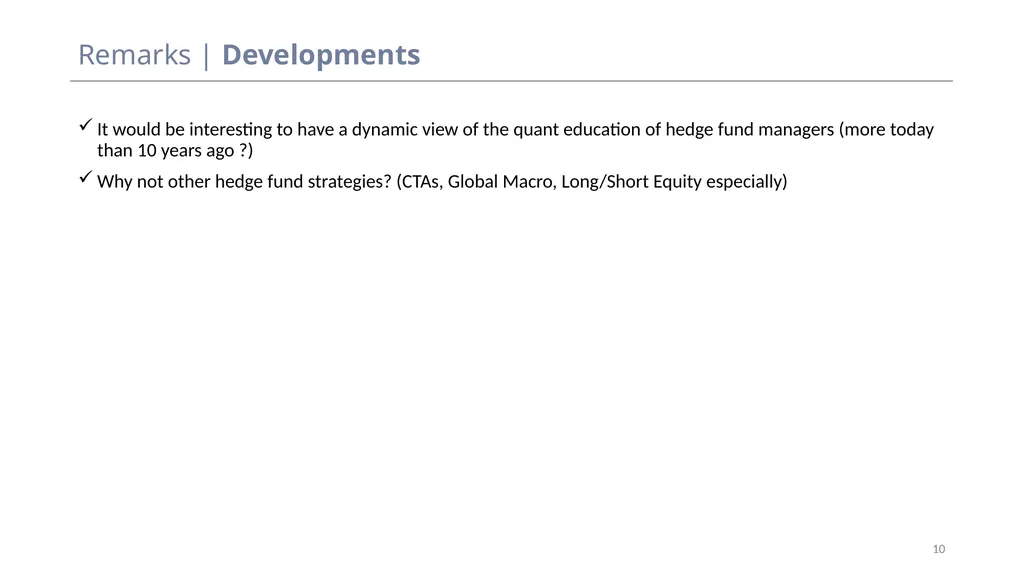
Remarks | Developments It would be interesting to have a dynamic view of the quant education of hedge fund managers (more today than 10 years ago ?)
Why not other hedge fund strategies? (CTAs, Global Macro, Long/Short Equity especially) 10<br>
11
Discussion – Trends everywhere? The case of hedge fund styles C. Chevalier, S. Darolles Guillaume Monarcha
Head of Research, Orion Financial Partners 12th Financial Risks International Conference, March 18-19, 2019<br>
12
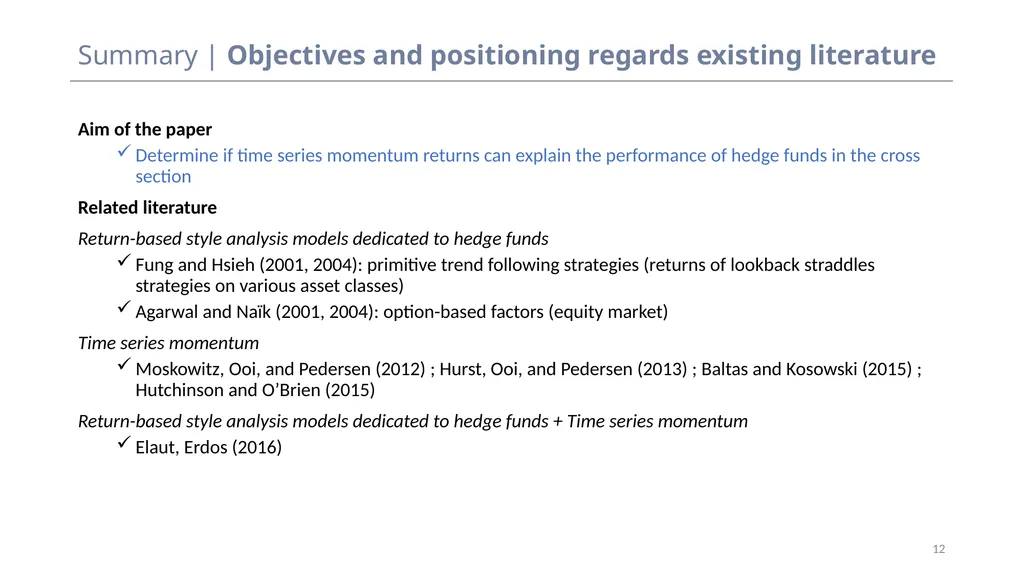
Summary | Objectives and positioning regards existing literature Aim of the paper
Determine if time series momentum returns can explain the performance of hedge funds in the cross section
Related literature
Return-based style analysis models dedicated to hedge funds
Fung and Hsieh (2001, 2004): primitive trend following strategies (returns of lookback straddles strategies on various asset classes)
Agarwal and Naïk (2001, 2004): option-based factors (equity market)
Time series momentum
Moskowitz, Ooi, and Pedersen (2012) ; Hurst, Ooi, and Pedersen (2013) ; Baltas and Kosowski (2015) ; Hutchinson and O’Brien (2015)
Return-based style analysis models dedicated to hedge funds + Time series momentum
Elaut, Erdos (2016) 12<br>
13
Summary | Objectives and positioning regards existing literature Innovation of the paper
Build a set of hierarchical trend factors according to two dimensions: the time horizon of the signal and he asset class traded
Extend asset-based style factor models with this set of factors 13<br>
14
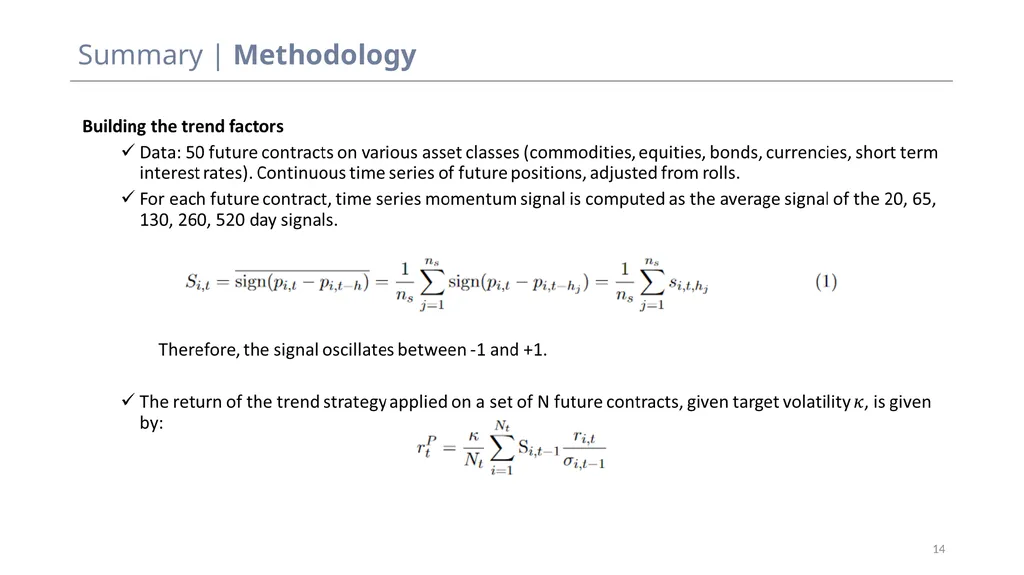
Summary | Methodology 14<br>
15
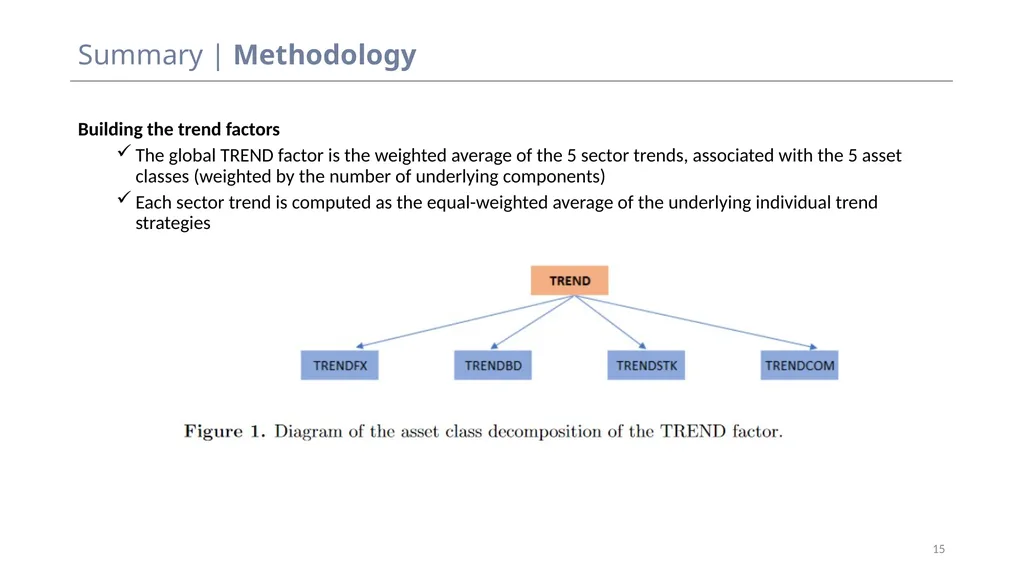
Summary | Methodology Building the trend factors
The global TREND factor is the weighted average of the 5 sector trends, associated with the 5 asset classes (weighted by the number of underlying components)
Each sector trend is computed as the equal-weighted average of the underlying individual trend strategies 15<br>
16
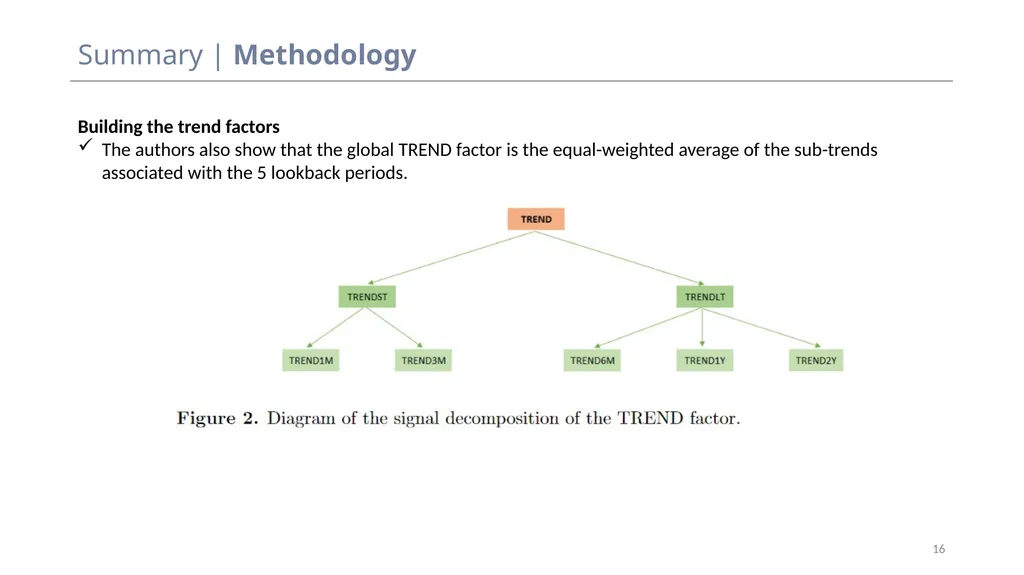
Summary | Methodology 16 Building the trend factors
The authors also show that the global TREND factor is the equal-weighted average of the sub-trends associated with the 5 lookback periods.<br>
17
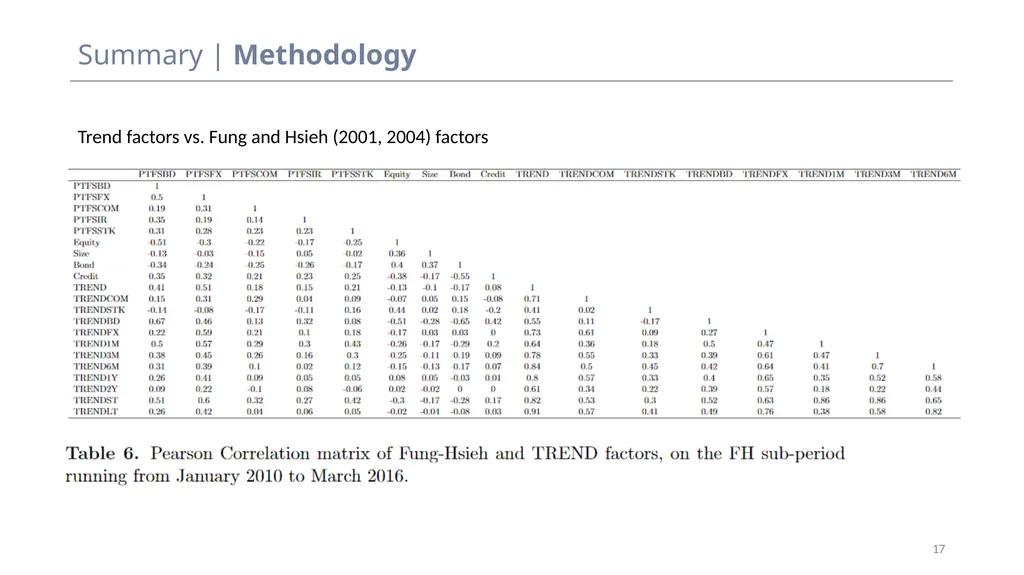
Summary | Methodology 17 Trend factors vs. Fung and Hsieh (2001, 2004) factors<br>
18
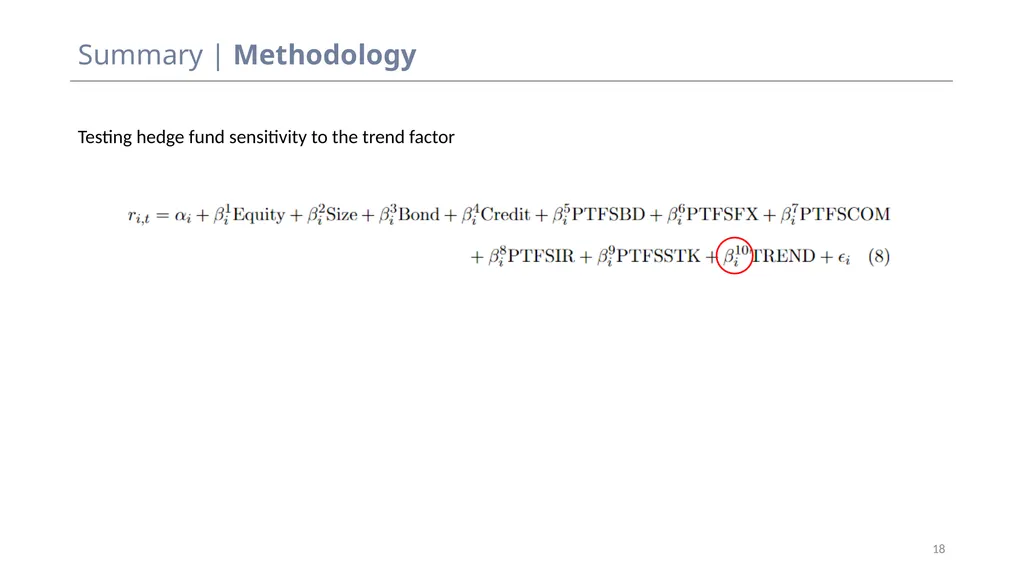
Summary | Methodology 18 Testing hedge fund sensitivity to the trend factor<br>
19
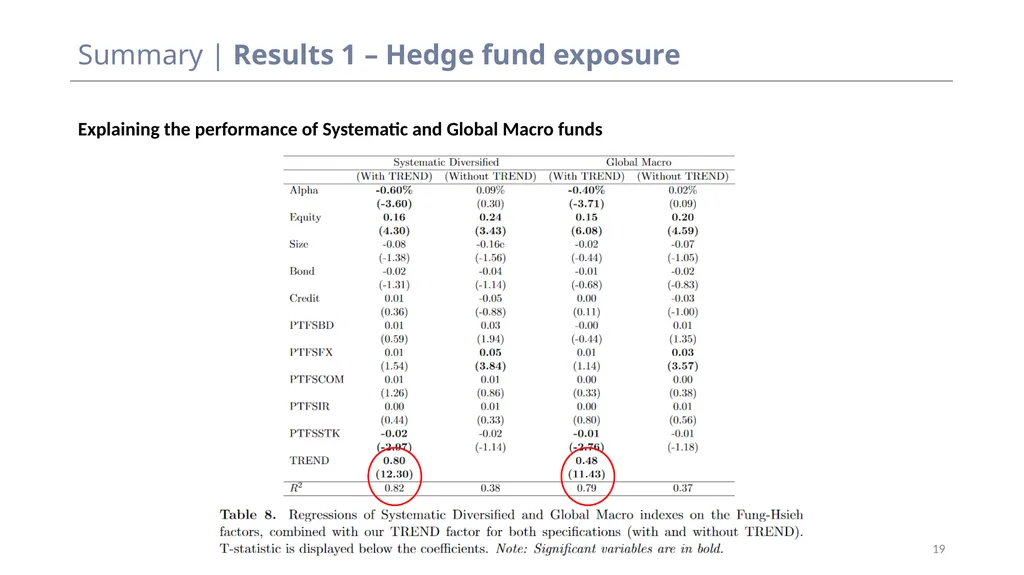
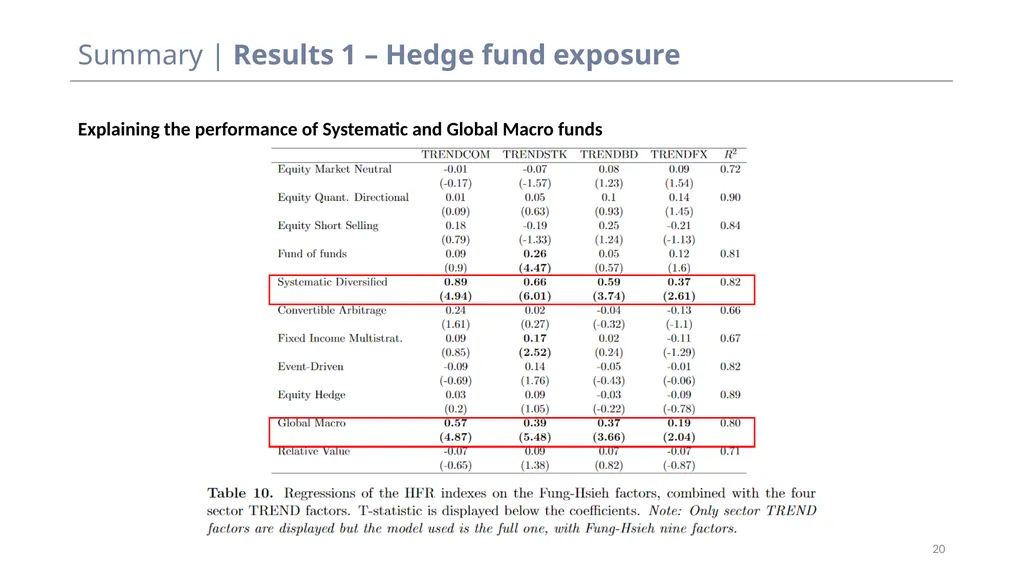
Summary | Results 1 – Hedge fund exposure Explaining the performance of Systematic and Global Macro funds 19<br>
20
Summary | Results 1 – Hedge fund exposure Explaining the performance of Systematic and Global Macro funds 20<br>
21
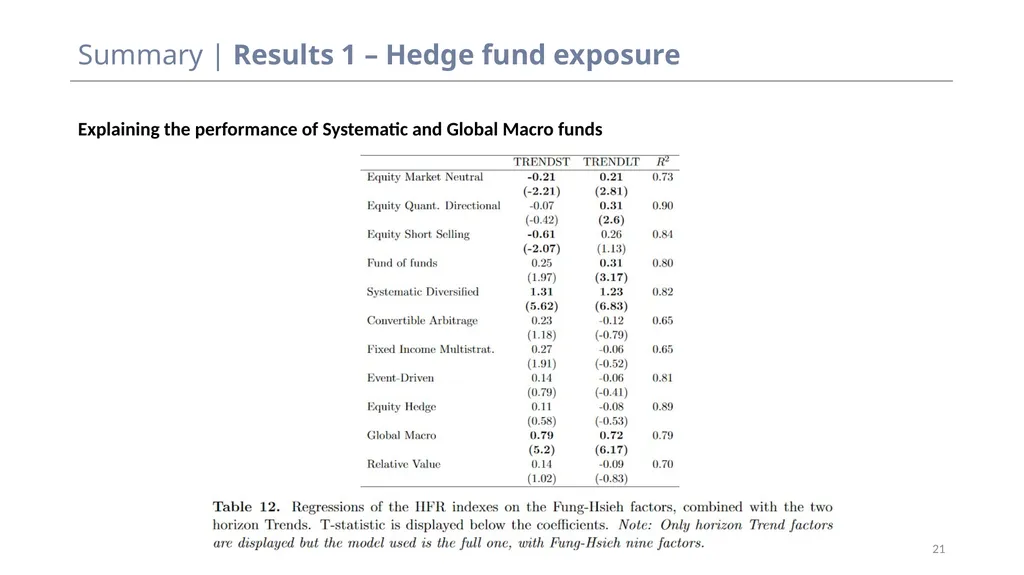
Summary | Results 1 – Hedge fund exposure Explaining the performance of Systematic and Global Macro funds 21<br>
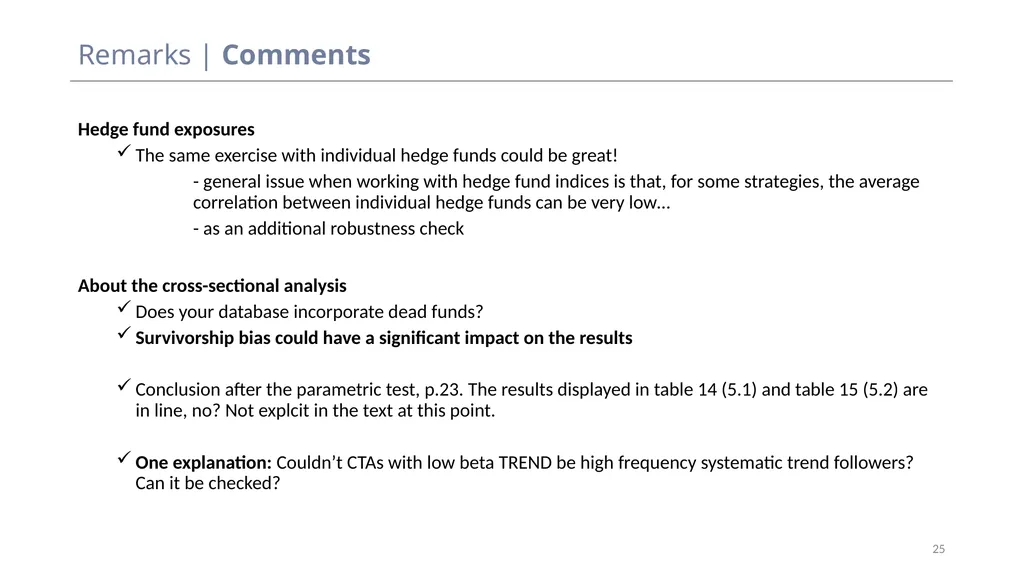
Remarks | Comments Hedge fund exposures
The same exercise with individual hedge funds could be great!
- general issue when working with hedge fund indices is that, for some strategies, the average correlation between individual hedge funds can be very low…
- as an additional robustness check
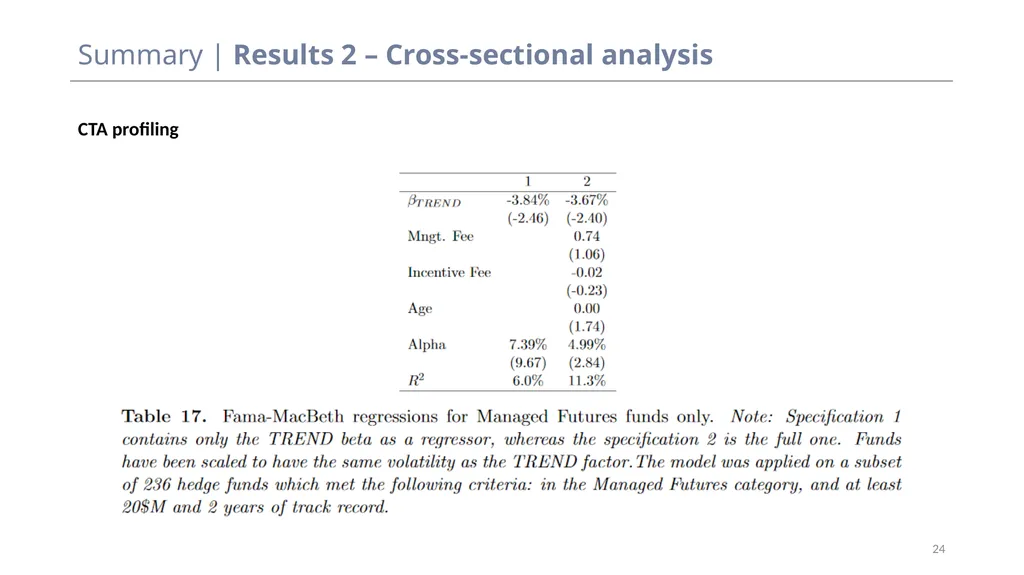
About the cross-sectional analysis
Does your database incorporate dead funds?
Survivorship bias could have a significant impact on the results
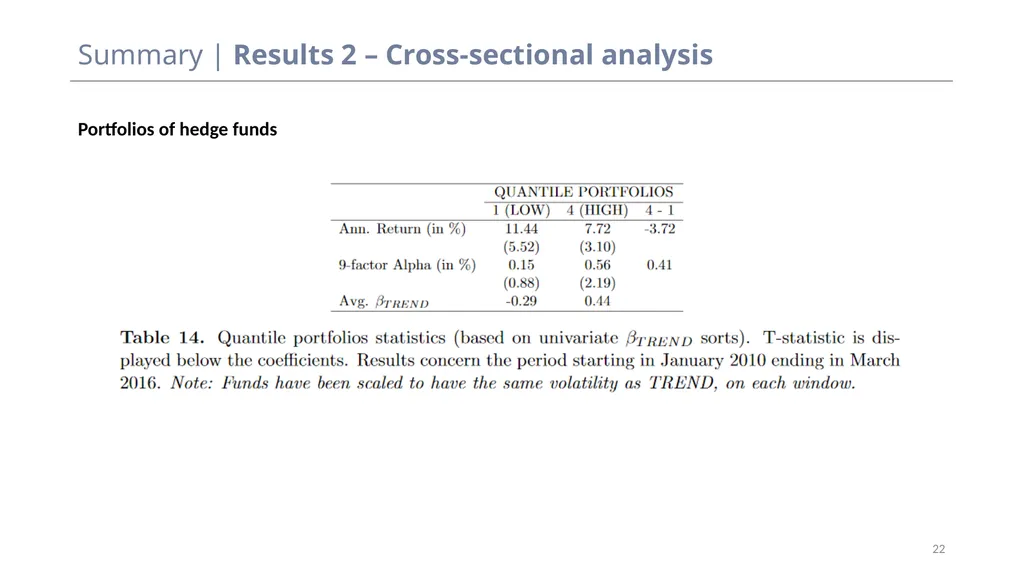
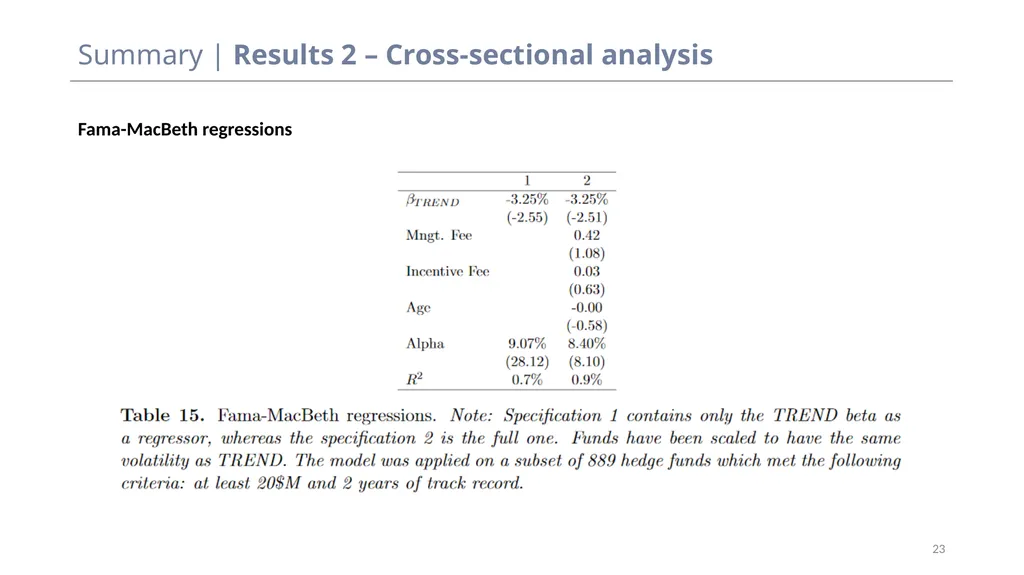
Conclusion after the parametric test, p.23. The results displayed in table 14 (5.1) and table 15 (5.2) are in line, no? Not explcit in the text at this point.
One explanation: Couldn’t CTAs with low beta TREND be high frequency systematic trend followers? Can it be checked? 25<br>