01
Dispersal Mechanisms for Protoplanetary Disks�Yasuhiro Hasegawa et al. Science Questions: How long can the process of planet formation last before the parent disk of gas and dust disperses? What is the dominant mechanism for disk dispersal – inner magnetic winds or outer photoevaporation?
Data & Results: Models of disk evolution are applied for a range of disk masses, disk sizes, and UV environments. Different dispersal mechanisms lead to different values of both the mass accretion rate onto the central star and the wind mass loss rate.
Significance: Observations of the wind mass loss rate can distinguish between various disk dispersal mechanisms, providing a critical constraint on how circumstellar disks evolve and form planets. Hasegawa, Haworth, Hoadley, et al. (2022), ApJ 926, L23
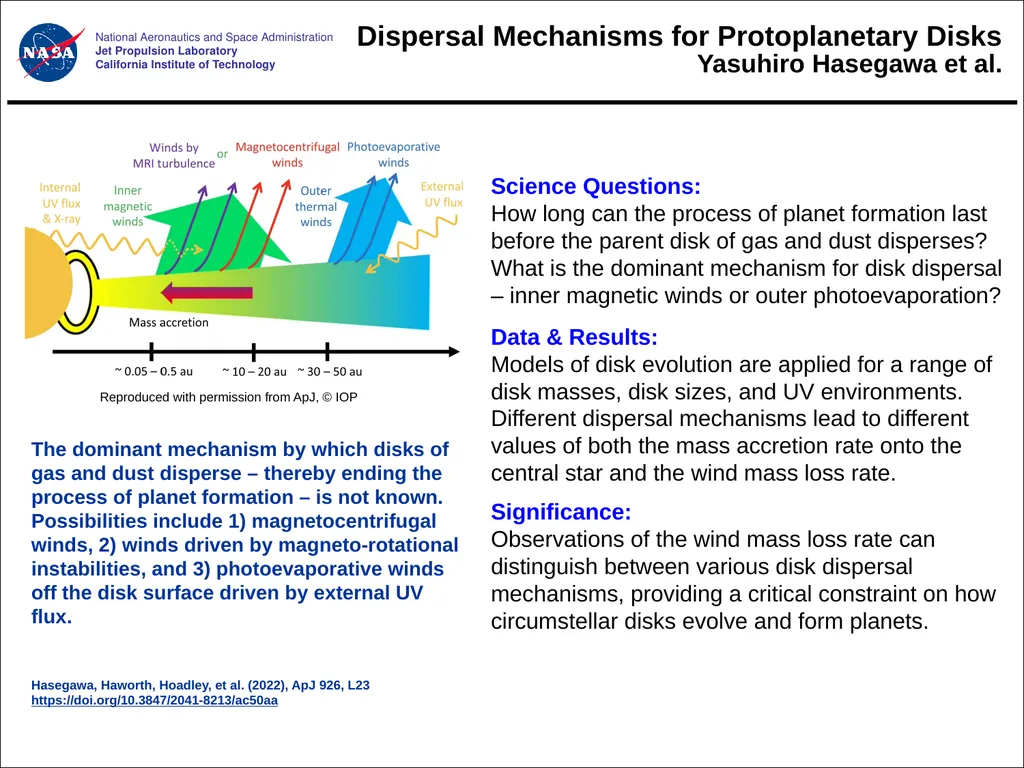
https://doi.org/10.3847/2041-8213/ac50aa The dominant mechanism by which disks of gas and dust disperse – thereby ending the process of planet formation – is not known.
Possibilities include 1) magnetocentrifugal winds, 2) winds driven by magneto-rotational instabilities, and 3) photoevaporative winds off the disk surface driven by external UV flux. Reproduced with permission from ApJ, © IOP National Aeronautics and Space Administration
Jet Propulsion Laboratory
California Institute of Technology<br>
02
National Aeronautics and Space Administration
Jet Propulsion Laboratory
California Institute of Technology Contact:
Dr. Yasuhiro Hasegawa
Research Scientist
169-506, Jet Propulsion Laboratory, Pasadena, CA 91109
Yasuhiro.Hasegawa@jpl.nasa.gov
https://orcid.org/0000-0002-9017-3663
Citation:
“Determining Dispersal Mechanisms of Protoplanetary Disks Using Accretion and Wind Mass Loss Rates”
Hasegawa, Y., Haworth, T. J., Hoadley, K., et al. (2022), ApJ 926, L23
https://doi.org/10.3847/2041-8213/ac50aa
Data Sources:
Keck/HIRES
VLT/X-shooter
Telescopio Nazionale Galileo (TNG)
Hubble Space Telescope (HST)
Atacama Large Millimeter Array (ALMA)
Technical Description of Figure:
The dominant mechanism by which disks of gas and dust disperse – thereby ending the process of planet formation – is not known. This disk schematic represents some of the possibilities, including 1) magnetocentrifugal winds, 2) winds driven by magneto-rotational instabilities, and 3) photoevaporative winds off the disk surface driven by external UV flux.
Scientific significance, societal relevance, and relationships to future missions:
Observations of the mass loss rate from disk winds – e.g. hydrogen fluorescence observations by Hyperion,
a proposed NASA MIDEX mission – can distinguish between various disk dispersal mechanisms,
providing a critical constraint on how circumstellar disks evolve and form planets.<br>