
Distributed Simulation with NS-3 Ken Renard US
Description: Distributed Simulation with NS-3 Ken Renard US Army Research Lab Outline Introduction and Motivation for Distributed NS-3 Parallel Discrete Event Simulation MPI Concepts Distributed NS-3 Scheduler Limitations Example Code Walk-through Error
Related Topics
Download Presentation
"Distributed Simulation with NS-3 Ken Renard US" is the property of its rightful owner. Permission is granted to download and print the materials on this website for personal, non-commercial use only, and to display it on your personal computer provided you do not modify the materials and that you retain all copyright notices contained in the materials. By downloading content from our website, you accept the terms of this agreement.
Presentation Transcript
slide1. Distributed Simulation with NS-3 Ken Renard
US Army Research Lab<br>
slide2. Outline Introduction and Motivation for Distributed NS-3
Parallel Discrete Event Simulation
MPI Concepts
Distributed NS-3 Scheduler
Limitations
Example Code Walk-through
Error Conditions
Performance Considerations
Advanced Topics<br>
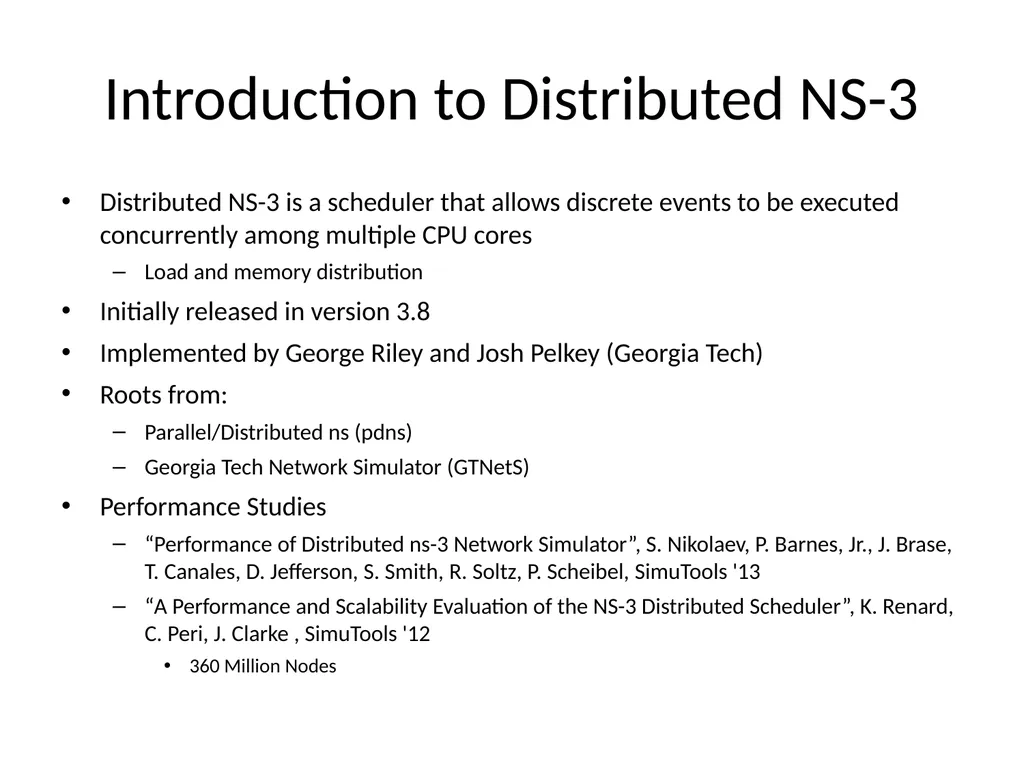
slide3. Introduction to Distributed NS-3 Distributed NS-3 is a scheduler that allows discrete events to be executed concurrently among multiple CPU cores
Load and memory distribution
Initially released in version 3.8
Implemented by George Riley and Josh Pelkey (Georgia Tech)
Roots from:
Parallel/Distributed ns (pdns)
Georgia Tech Network Simulator (GTNetS)
Performance Studies
“Performance of Distributed ns-3 Network Simulator”, S. Nikolaev, P. Barnes, Jr., J. Brase, T. Canales, D. Jefferson, S. Smith, R. Soltz, P. Scheibel, SimuTools '13
“A Performance and Scalability Evaluation of the NS-3 Distributed Scheduler”, K. Renard, C. Peri, J. Clarke , SimuTools '12
360 Million Nodes<br>
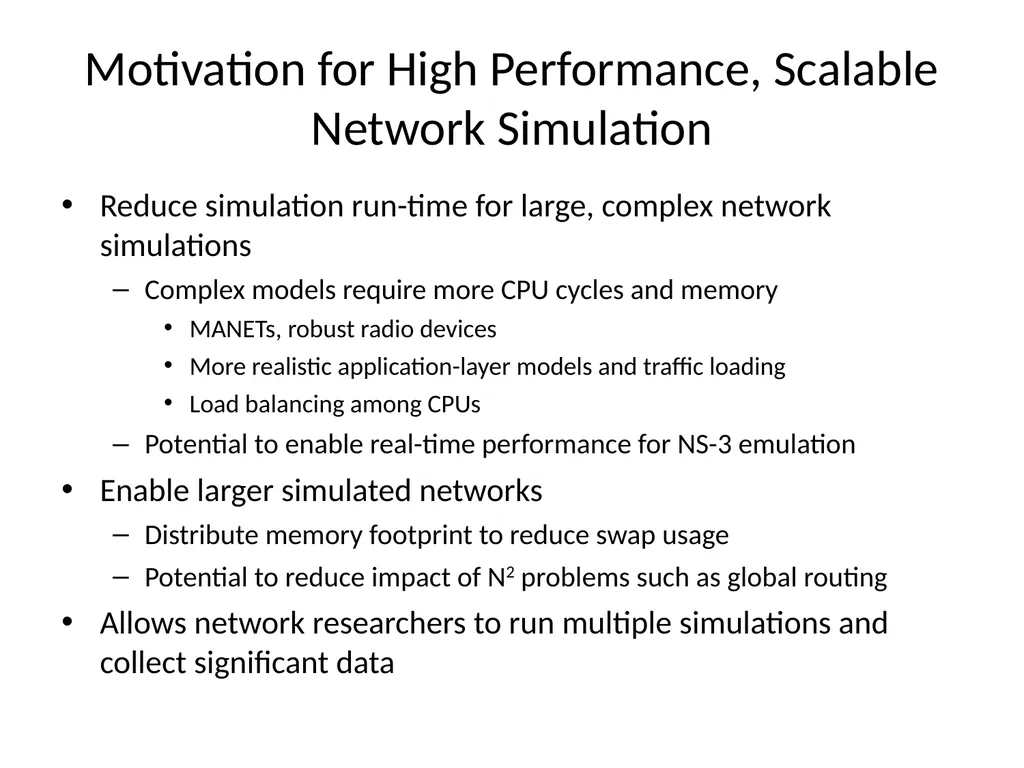
slide4. Motivation for High Performance, Scalable Network Simulation Reduce simulation run-time for large, complex network simulations
Complex models require more CPU cycles and memory
MANETs, robust radio devices
More realistic application-layer models and traffic loading
Load balancing among CPUs
Potential to enable real-time performance for NS-3 emulation
Enable larger simulated networks
Distribute memory footprint to reduce swap usage
Potential to reduce impact of N2 problems such as global routing
Allows network researchers to run multiple simulations and collect significant data<br>
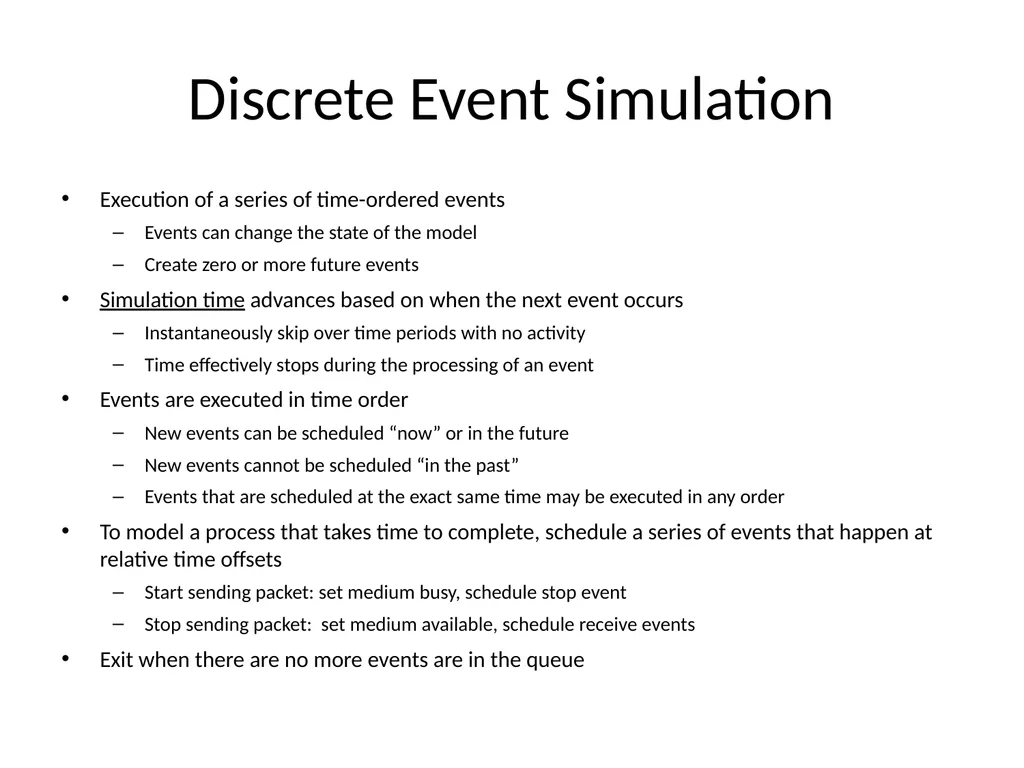
slide5. Discrete Event Simulation Execution of a series of time-ordered events
Events can change the state of the model
Create zero or more future events
Simulation time advances based on when the next event occurs
Instantaneously skip over time periods with no activity
Time effectively stops during the processing of an event
Events are executed in time order
New events can be scheduled “now” or in the future
New events cannot be scheduled “in the past”
Events that are scheduled at the exact same time may be executed in any order
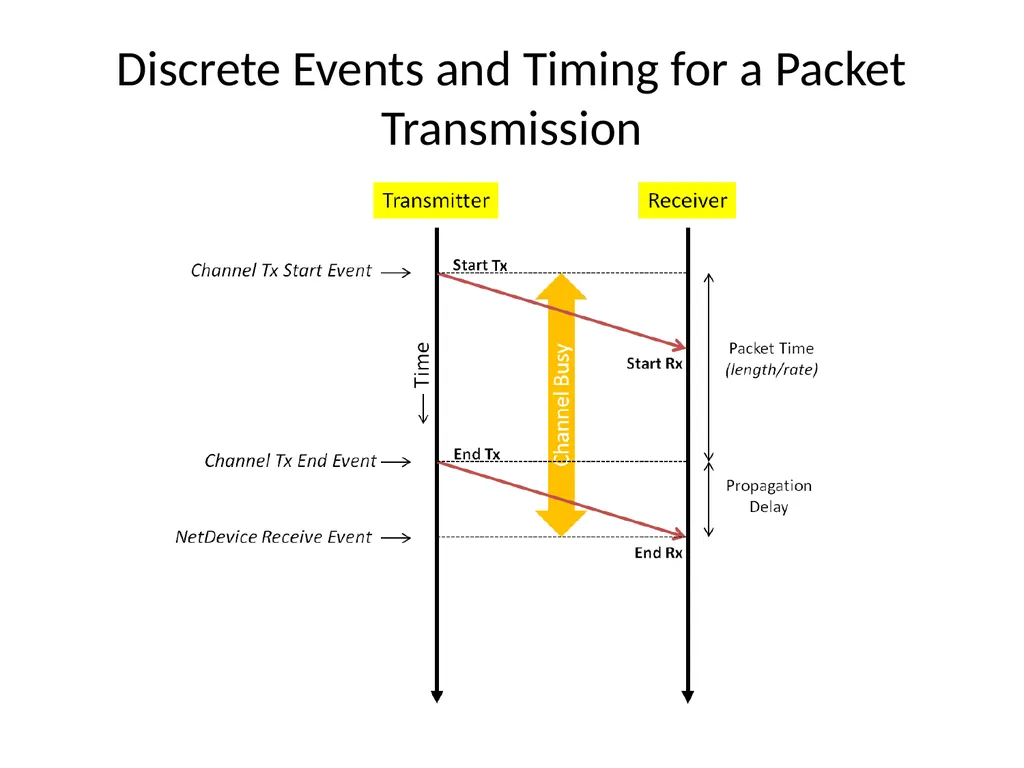
To model a process that takes time to complete, schedule a series of events that happen at relative time offsets
Start sending packet: set medium busy, schedule stop event
Stop sending packet: set medium available, schedule receive events
Exit when there are no more events are in the queue<br>
slide6. Discrete Events and Timing for a Packet Transmission<br>
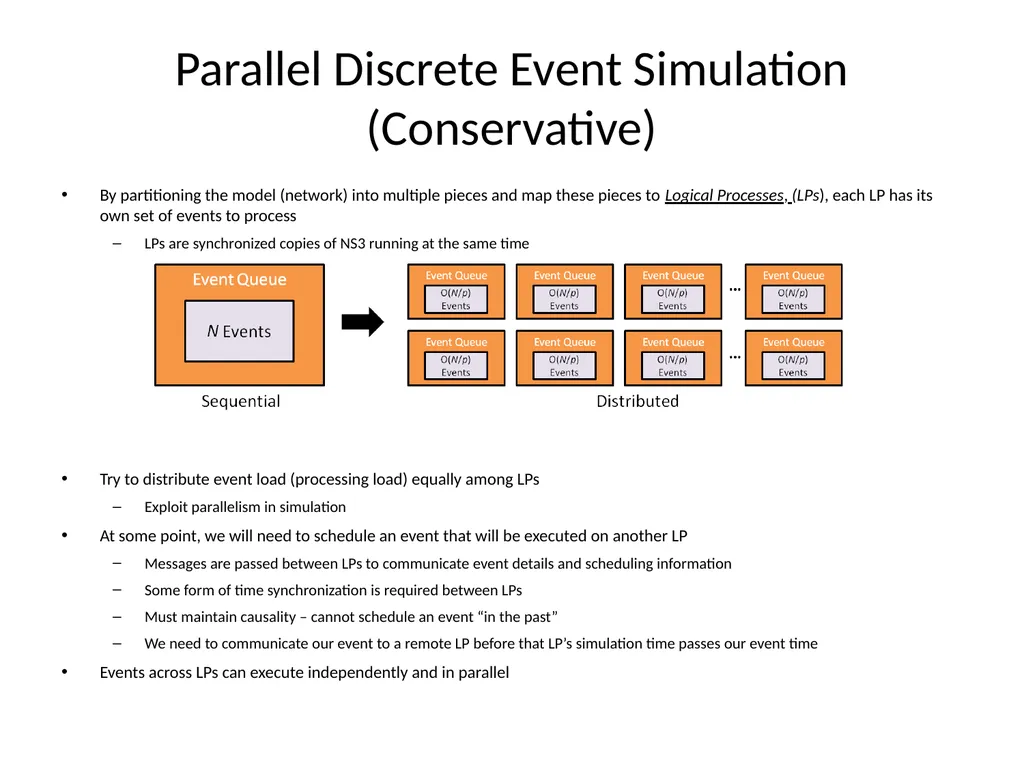
slide7. Parallel Discrete Event Simulation (Conservative) By partitioning the model (network) into multiple pieces and map these pieces to Logical Processes, (LPs), each LP has its own set of events to process
LPs are synchronized copies of NS3 running at the same time
Try to distribute event load (processing load) equally among LPs
Exploit parallelism in simulation
At some point, we will need to schedule an event that will be executed on another LP
Messages are passed between LPs to communicate event details and scheduling information
Some form of time synchronization is required between LPs
Must maintain causality – cannot schedule an event “in the past”
We need to communicate our event to a remote LP before that LP’s simulation time passes our event time
Events across LPs can execute independently and in parallel<br>
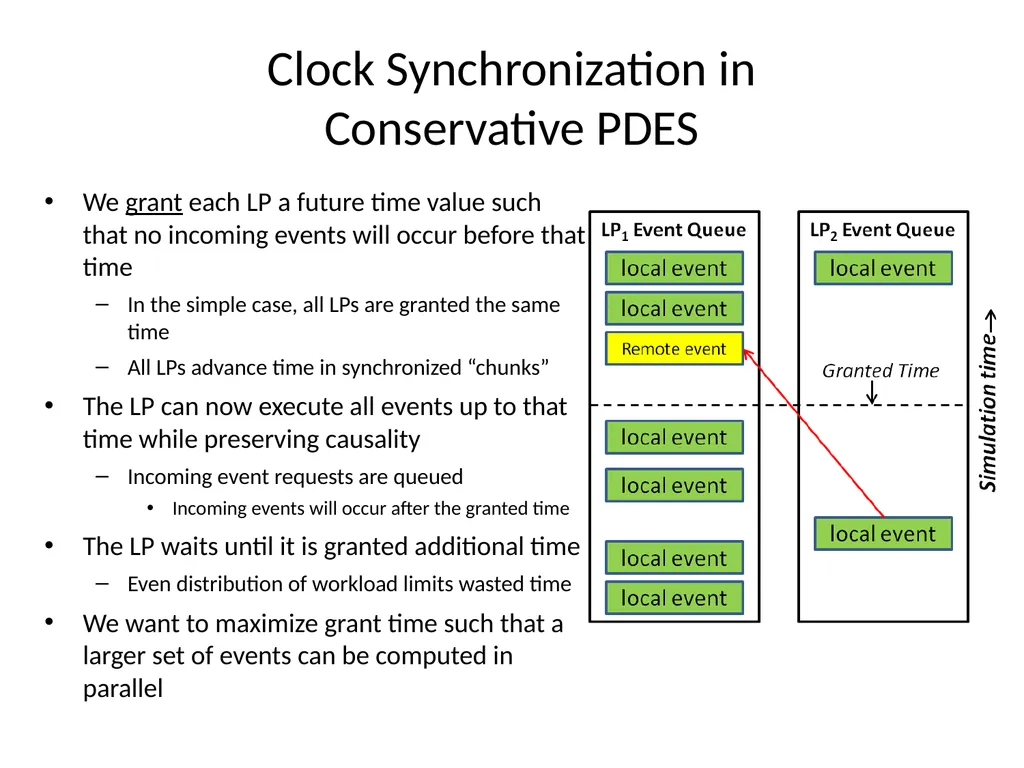
slide8. Clock Synchronization in Conservative PDES We grant each LP a future time value such that no incoming events will occur before that time
In the simple case, all LPs are granted the same time
All LPs advance time in synchronized “chunks”
The LP can now execute all events up to that time while preserving causality
Incoming event requests are queued
Incoming events will occur after the granted time
The LP waits until it is granted additional time
Even distribution of workload limits wasted time
We want to maximize grant time such that a larger set of events can be computed in parallel<br>
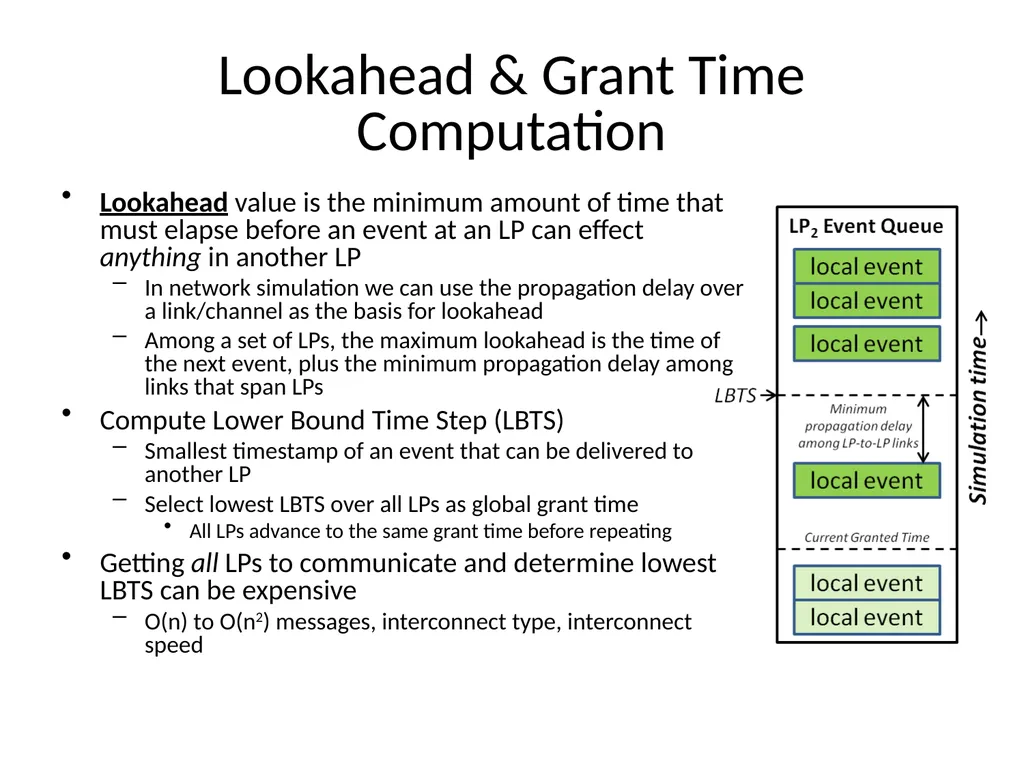
slide9. Lookahead & Grant Time Computation Lookahead value is the minimum amount of time that must elapse before an event at an LP can effect anything in another LP
In network simulation we can use the propagation delay over a link/channel as the basis for lookahead
Among a set of LPs, the maximum lookahead is the time of the next event, plus the minimum propagation delay among links that span LPs
Compute Lower Bound Time Step (LBTS)
Smallest timestamp of an event that can be delivered to another LP
Select lowest LBTS over all LPs as global grant time
All LPs advance to the same grant time before repeating
Getting all LPs to communicate and determine lowest LBTS can be expensive
O(n) to O(n2) messages, interconnect type, interconnect speed<br>
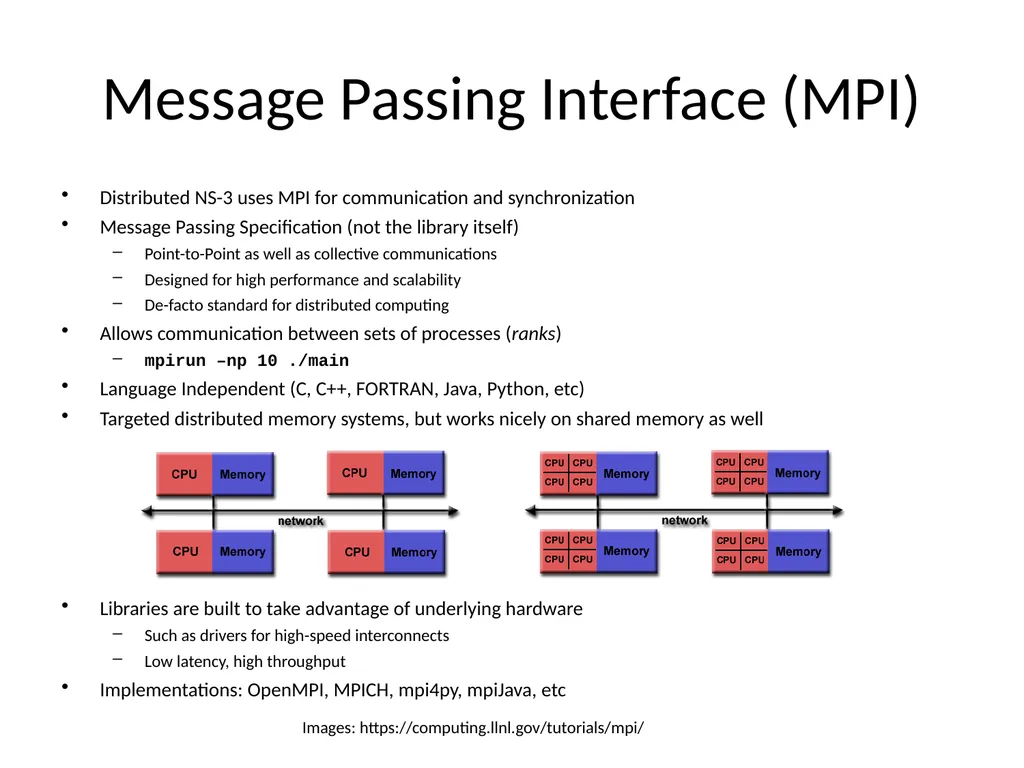
slide10. Message Passing Interface (MPI) Distributed NS-3 uses MPI for communication and synchronization
Message Passing Specification (not the library itself)
Point-to-Point as well as collective communications
Designed for high performance and scalability
De-facto standard for distributed computing
Allows communication between sets of processes (ranks)
mpirun –np 10 ./main
Language Independent (C, C++, FORTRAN, Java, Python, etc)
Targeted distributed memory systems, but works nicely on shared memory as well
Libraries are built to take advantage of underlying hardware
Such as drivers for high-speed interconnects
Low latency, high throughput
Implementations: OpenMPI, MPICH, mpi4py, mpiJava, etc Images: https://computing.llnl.gov/tutorials/mpi/<br>
slide11. MPI Concepts Communicators
A “channel” among a group of processes (unsigned int)
Each process in the group is assigned an ID or rank
Rank numbers are contiguous unsigned integers starting with 0
Used for directing messages or to assign functionality to specific processes
if (rank == 0) print “Hello World”
Default [“everybody”] communicator is MPI_COMM_WORLD
Point-To-Point Communications
A message targeting a single specific process
MPI_Send(data, data_length, data_type, destination, tag, communicator)
Data/Data Length – Message contents
Data Type – MPI-defined data types
Destination – Rank Number
Tag – Arbitrary message tag for applications to use
Communicator – Specific group where destination exists
MPI_Send() / MPI_Isend() – blocking and non-blocking sends
MPI_Recv() / MPI_Irevc() – blocking and non-blocking receive<br>
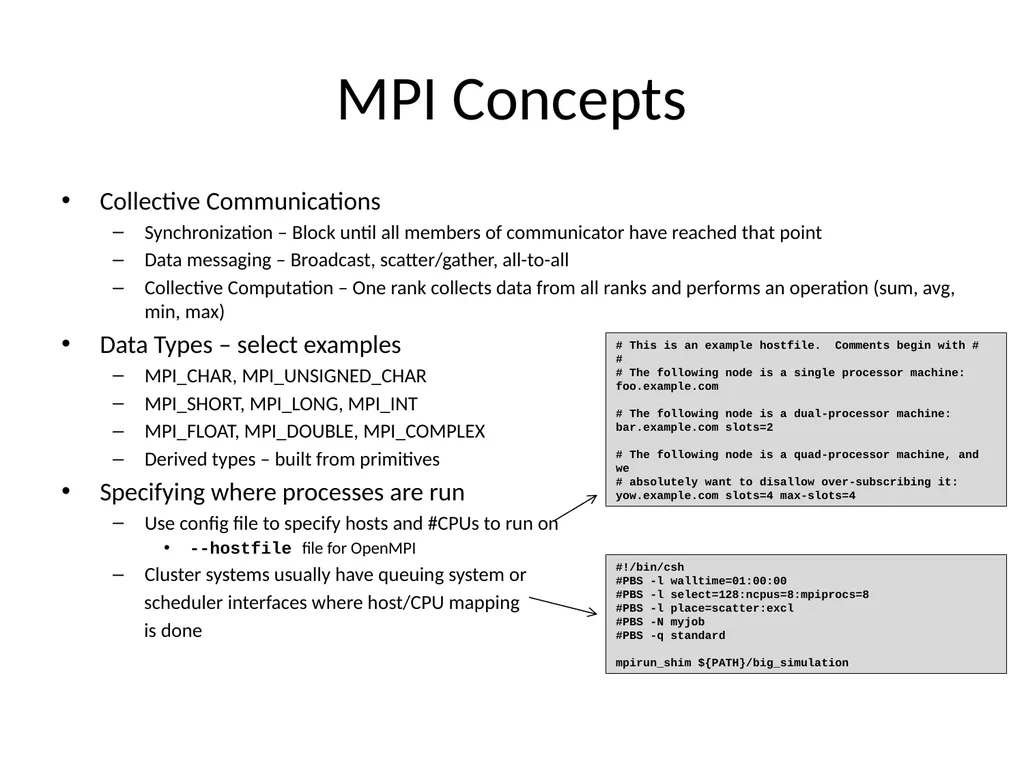
slide12. MPI Concepts Collective Communications
Synchronization – Block until all members of communicator have reached that point
Data messaging – Broadcast, scatter/gather, all-to-all
Collective Computation – One rank collects data from all ranks and performs an operation (sum, avg, min, max)
Data Types – select examples
MPI_CHAR, MPI_UNSIGNED_CHAR
MPI_SHORT, MPI_LONG, MPI_INT
MPI_FLOAT, MPI_DOUBLE, MPI_COMPLEX
Derived types – built from primitives
Specifying where processes are run
Use config file to specify hosts and #CPUs to run on
--hostfile file for OpenMPI
Cluster systems usually have queuing system or
scheduler interfaces where host/CPU mapping
is done # This is an example hostfile. Comments begin with #
#
# The following node is a single processor machine:
foo.example.com
# The following node is a dual-processor machine:
bar.example.com slots=2
# The following node is a quad-processor machine, and we
# absolutely want to disallow over-subscribing it:
yow.example.com slots=4 max-slots=4 #!/bin/csh
#PBS -l walltime=01:00:00
#PBS -l select=128:ncpus=8:mpiprocs=8
#PBS -l place=scatter:excl
#PBS -N myjob
#PBS -q standard
mpirun_shim ${PATH}/big_simulation<br>
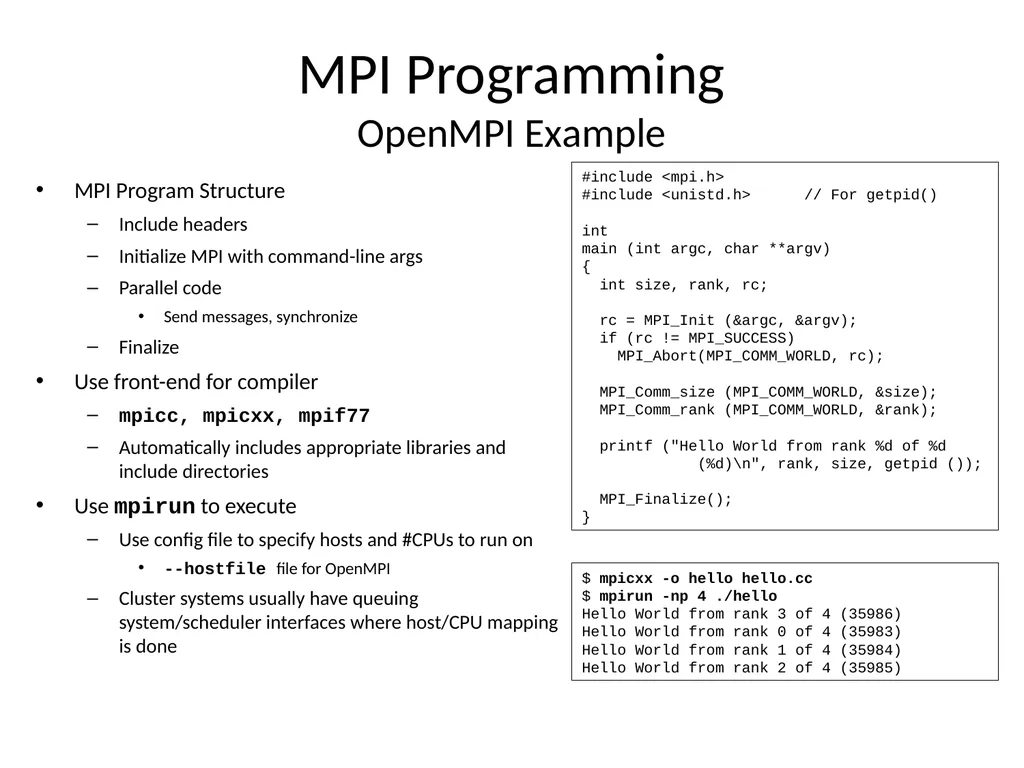
slide13. MPI Programming OpenMPI Example MPI Program Structure
Include headers
Initialize MPI with command-line args
Parallel code
Send messages, synchronize
Finalize
Use front-end for compiler
mpicc, mpicxx, mpif77
Automatically includes appropriate libraries and include directories
Use mpirun to execute
Use config file to specify hosts and #CPUs to run on
--hostfile file for OpenMPI
Cluster systems usually have queuing system/scheduler interfaces where host/CPU mapping is done #include <mpi.h>
#include <unistd.h> // For getpid()
int
main (int argc, char **argv)
{
int size, rank, rc;
rc = MPI_Init (&argc, &argv);
if (rc != MPI_SUCCESS)
MPI_Abort(MPI_COMM_WORLD, rc);
MPI_Comm_size (MPI_COMM_WORLD, &size);
MPI_Comm_rank (MPI_COMM_WORLD, &rank);
printf ("Hello World from rank %d of %d
(%d)\n", rank, size, getpid ());
MPI_Finalize();
} $ mpicxx -o hello hello.cc
$ mpirun -np 4 ./hello
Hello World from rank 3 of 4 (35986)
Hello World from rank 0 of 4 (35983)
Hello World from rank 1 of 4 (35984)
Hello World from rank 2 of 4 (35985)<br>
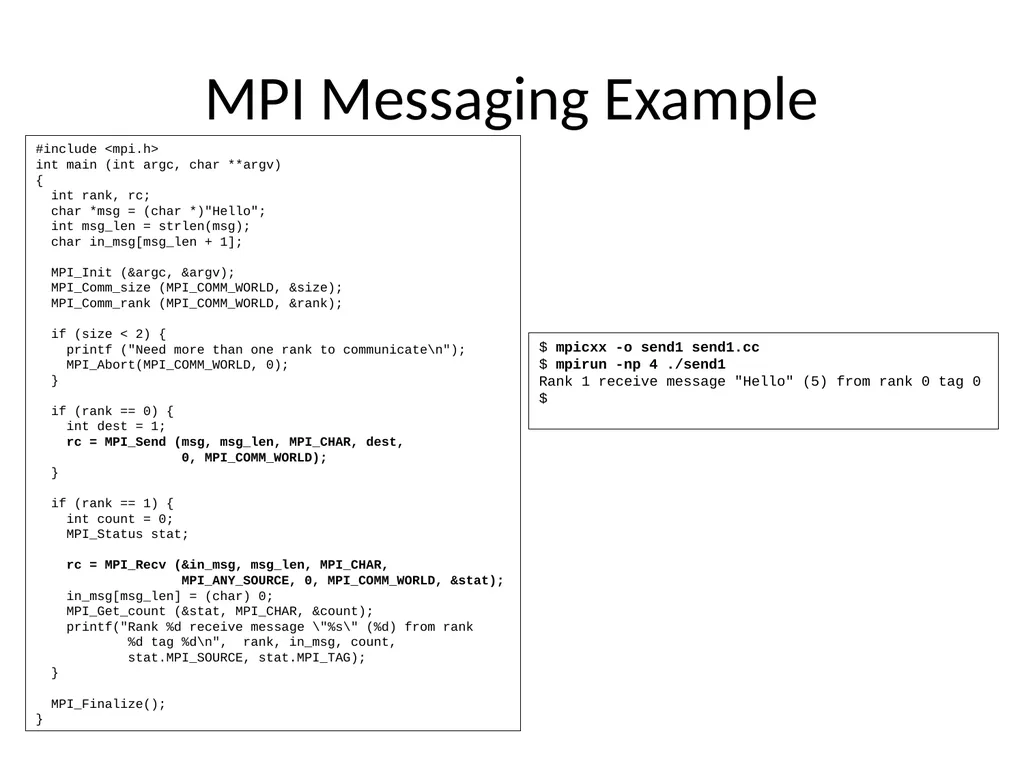
slide14. MPI Messaging Example #include <mpi.h>
int main (int argc, char **argv)
{
int rank, rc;
char *msg = (char *)"Hello";
int msg_len = strlen(msg);
char in_msg[msg_len + 1];
MPI_Init (&argc, &argv);
MPI_Comm_size (MPI_COMM_WORLD, &size);
MPI_Comm_rank (MPI_COMM_WORLD, &rank);
if (size < 2) {
printf ("Need more than one rank to communicate\n");
MPI_Abort(MPI_COMM_WORLD, 0);
}
if (rank == 0) {
int dest = 1;
rc = MPI_Send (msg, msg_len, MPI_CHAR, dest,
0, MPI_COMM_WORLD);
}
if (rank == 1) {
int count = 0;
MPI_Status stat;
rc = MPI_Recv (&in_msg, msg_len, MPI_CHAR,
MPI_ANY_SOURCE, 0, MPI_COMM_WORLD, &stat);
in_msg[msg_len] = (char) 0;
MPI_Get_count (&stat, MPI_CHAR, &count);
printf("Rank %d receive message \"%s\" (%d) from rank
%d tag %d\n", rank, in_msg, count,
stat.MPI_SOURCE, stat.MPI_TAG);
}
MPI_Finalize();
} $ mpicxx -o send1 send1.cc
$ mpirun -np 4 ./send1
Rank 1 receive message "Hello" (5) from rank 0 tag 0
$<br>
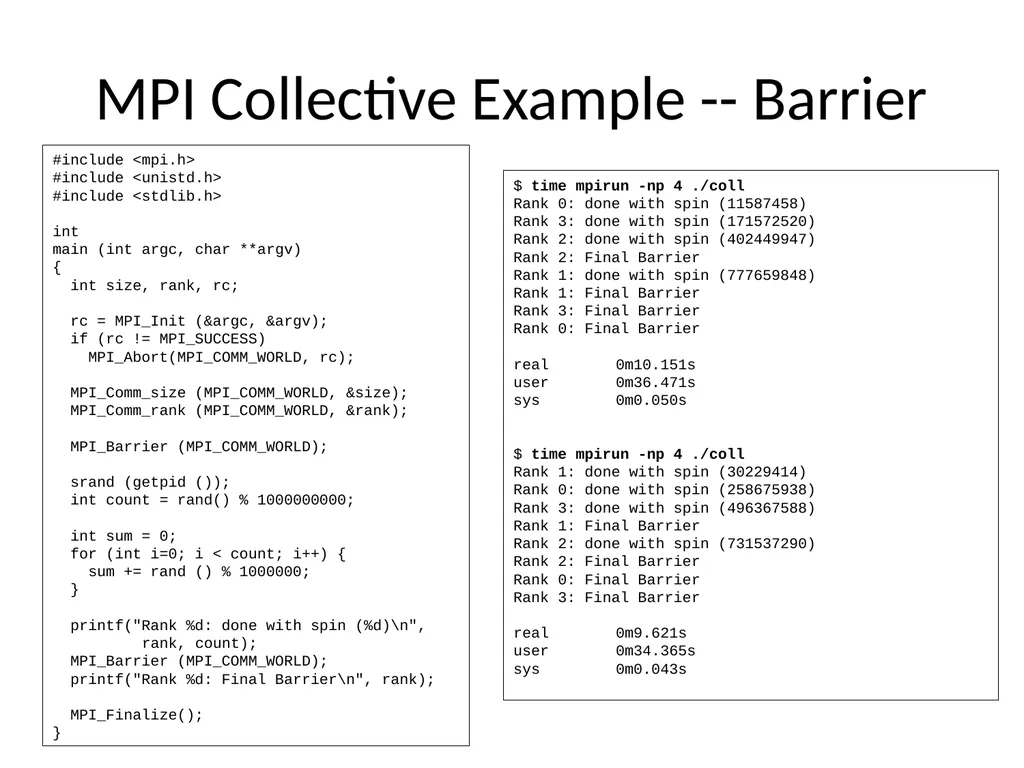
slide15. MPI Collective Example -- Barrier #include <mpi.h>
#include <unistd.h>
#include <stdlib.h>
int
main (int argc, char **argv)
{
int size, rank, rc;
rc = MPI_Init (&argc, &argv);
if (rc != MPI_SUCCESS)
MPI_Abort(MPI_COMM_WORLD, rc);
MPI_Comm_size (MPI_COMM_WORLD, &size);
MPI_Comm_rank (MPI_COMM_WORLD, &rank);
MPI_Barrier (MPI_COMM_WORLD);
srand (getpid ());
int count = rand() % 1000000000;
int sum = 0;
for (int i=0; i < count; i++) {
sum += rand () % 1000000;
}
printf("Rank %d: done with spin (%d)\n",
rank, count);
MPI_Barrier (MPI_COMM_WORLD);
printf("Rank %d: Final Barrier\n", rank);
MPI_Finalize();
} $ time mpirun -np 4 ./coll
Rank 0: done with spin (11587458)
Rank 3: done with spin (171572520)
Rank 2: done with spin (402449947)
Rank 2: Final Barrier
Rank 1: done with spin (777659848)
Rank 1: Final Barrier
Rank 3: Final Barrier
Rank 0: Final Barrier
real 0m10.151s
user 0m36.471s
sys 0m0.050s
$ time mpirun -np 4 ./coll
Rank 1: done with spin (30229414)
Rank 0: done with spin (258675938)
Rank 3: done with spin (496367588)
Rank 1: Final Barrier
Rank 2: done with spin (731537290)
Rank 2: Final Barrier
Rank 0: Final Barrier
Rank 3: Final Barrier
real 0m9.621s
user 0m34.365s
sys 0m0.043s<br>
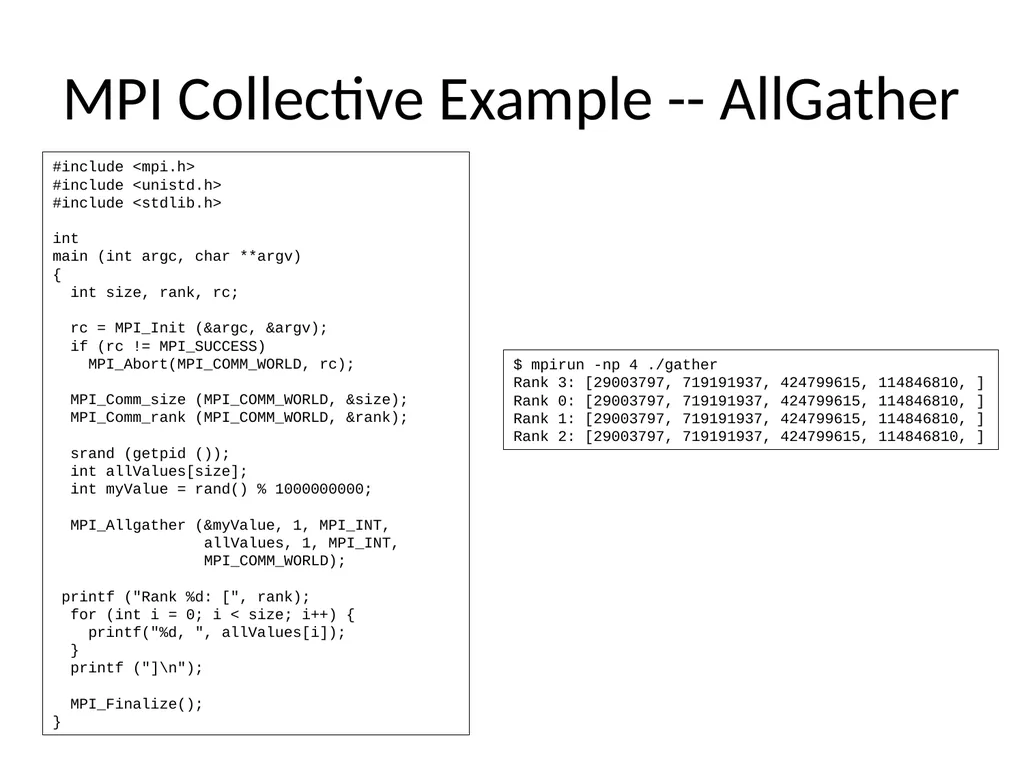
slide16. MPI Collective Example -- AllGather #include <mpi.h>
#include <unistd.h>
#include <stdlib.h>
int
main (int argc, char **argv)
{
int size, rank, rc;
rc = MPI_Init (&argc, &argv);
if (rc != MPI_SUCCESS)
MPI_Abort(MPI_COMM_WORLD, rc);
MPI_Comm_size (MPI_COMM_WORLD, &size);
MPI_Comm_rank (MPI_COMM_WORLD, &rank);
srand (getpid ());
int allValues[size];
int myValue = rand() % 1000000000;
MPI_Allgather (&myValue, 1, MPI_INT,
allValues, 1, MPI_INT,
MPI_COMM_WORLD);
printf ("Rank %d: [", rank);
for (int i = 0; i < size; i++) {
printf("%d, ", allValues[i]);
}
printf ("]\n");
MPI_Finalize();
} $ mpirun -np 4 ./gather
Rank 3: [29003797, 719191937, 424799615, 114846810, ]
Rank 0: [29003797, 719191937, 424799615, 114846810, ]
Rank 1: [29003797, 719191937, 424799615, 114846810, ]
Rank 2: [29003797, 719191937, 424799615, 114846810, ]<br>
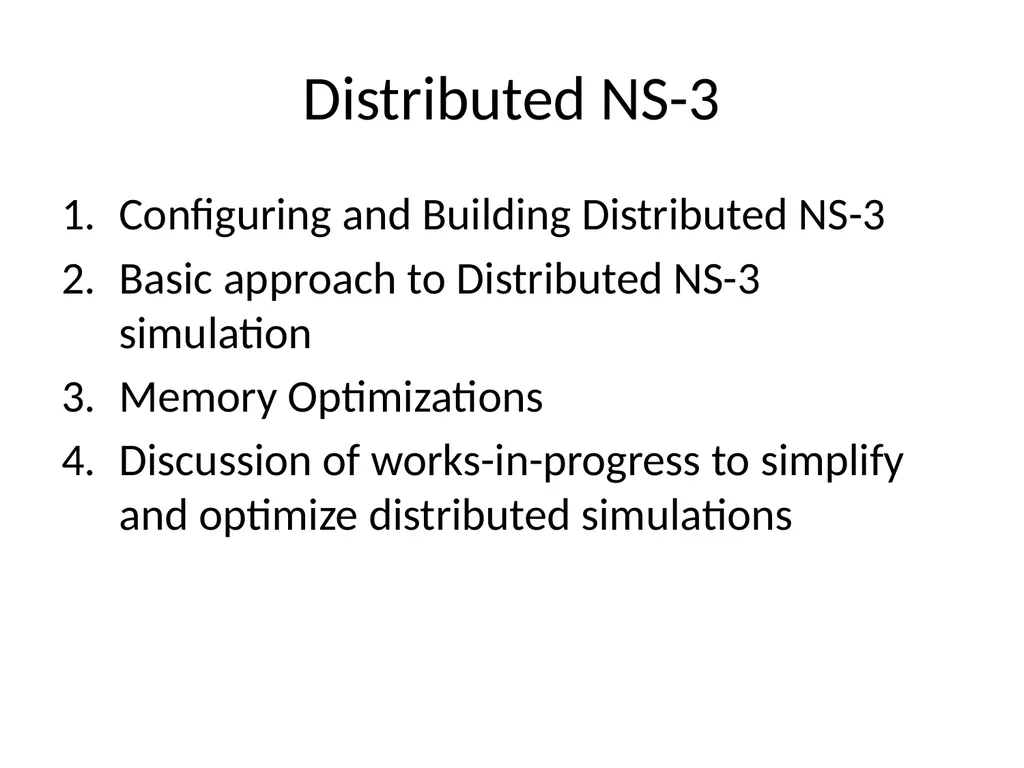
slide17. Distributed NS-3 Configuring and Building Distributed NS-3
Basic approach to Distributed NS-3 simulation
Memory Optimizations
Discussion of works-in-progress to simplify and optimize distributed simulations<br>
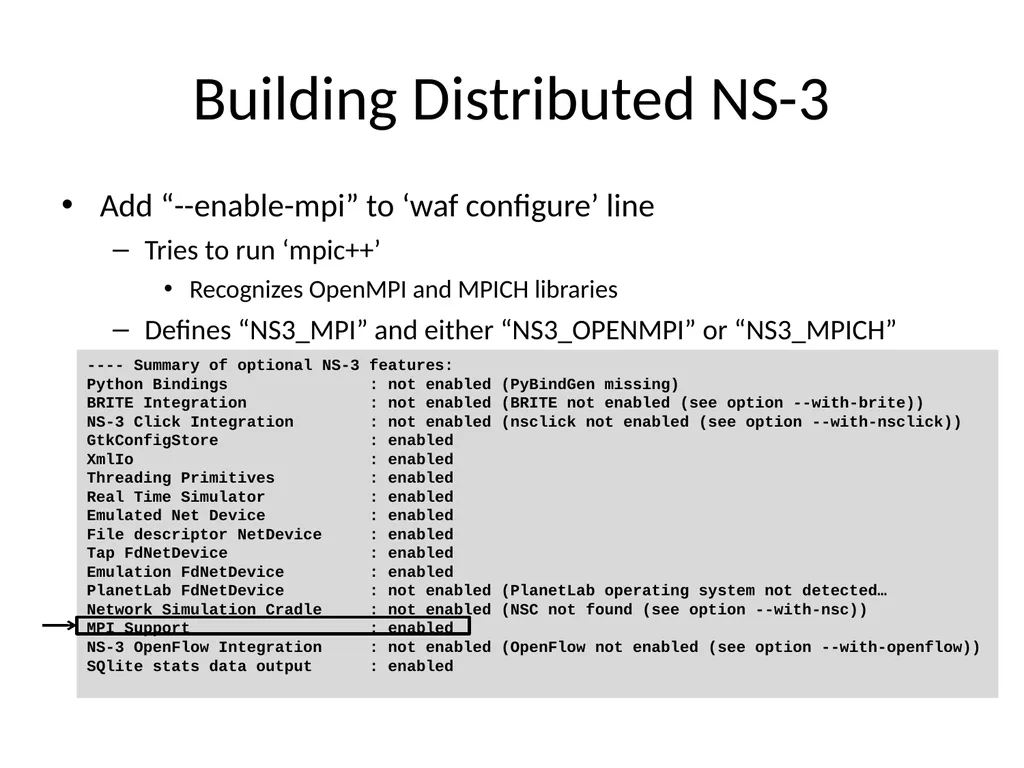
slide18. Building Distributed NS-3 Add “--enable-mpi” to ‘waf configure’ line
Tries to run ‘mpic++’
Recognizes OpenMPI and MPICH libraries
Defines “NS3_MPI” and either “NS3_OPENMPI” or “NS3_MPICH” ---- Summary of optional NS-3 features:
Python Bindings : not enabled (PyBindGen missing)
BRITE Integration : not enabled (BRITE not enabled (see option --with-brite))
NS-3 Click Integration : not enabled (nsclick not enabled (see option --with-nsclick))
GtkConfigStore : enabled
XmlIo : enabled
Threading Primitives : enabled
Real Time Simulator : enabled
Emulated Net Device : enabled
File descriptor NetDevice : enabled
Tap FdNetDevice : enabled
Emulation FdNetDevice : enabled
PlanetLab FdNetDevice : not enabled (PlanetLab operating system not detected…
Network Simulation Cradle : not enabled (NSC not found (see option --with-nsc))
MPI Support : enabled
NS-3 OpenFlow Integration : not enabled (OpenFlow not enabled (see option --with-openflow))
SQlite stats data output : enabled<br>
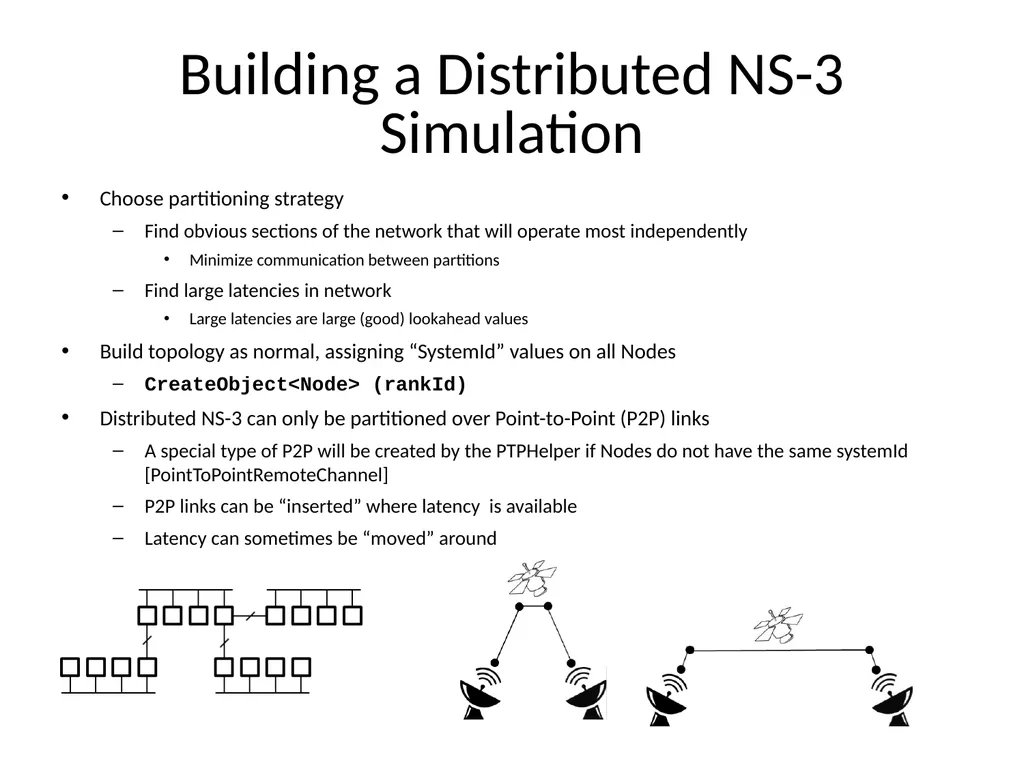
slide19. Building a Distributed NS-3 Simulation Choose partitioning strategy
Find obvious sections of the network that will operate most independently
Minimize communication between partitions
Find large latencies in network
Large latencies are large (good) lookahead values
Build topology as normal, assigning “SystemId” values on all Nodes
CreateObject<Node> (rankId)
Distributed NS-3 can only be partitioned over Point-to-Point (P2P) links
A special type of P2P will be created by the PTPHelper if Nodes do not have the same systemId [PointToPointRemoteChannel]
P2P links can be “inserted” where latency is available
Latency can sometimes be “moved” around<br>
slide20. Distributed NS-3 Load Distribution All ranks create all nodes and links
Setup time and memory requirements are similar to sequential simulation
Event execution happens in parallel
Memory is used for nodes/stacks/devices that “belong” to other ranks
Non-local nodes do not have to be fully configured
Application models should not be installed on non-local nodes
Stacks and addresses probably should be installed on non-local nodes
So that global routing model can ‘see’ the entire network
When packets are transmitted over P2P-Remote links, the receive event is communicated to the receiving rank
Send event immediately, do not wait for grant time
Receive event is added to remote rank’s queue instead of local
At end of grant time
Read and schedule all incoming events
Compute and negotiate next grant time<br>
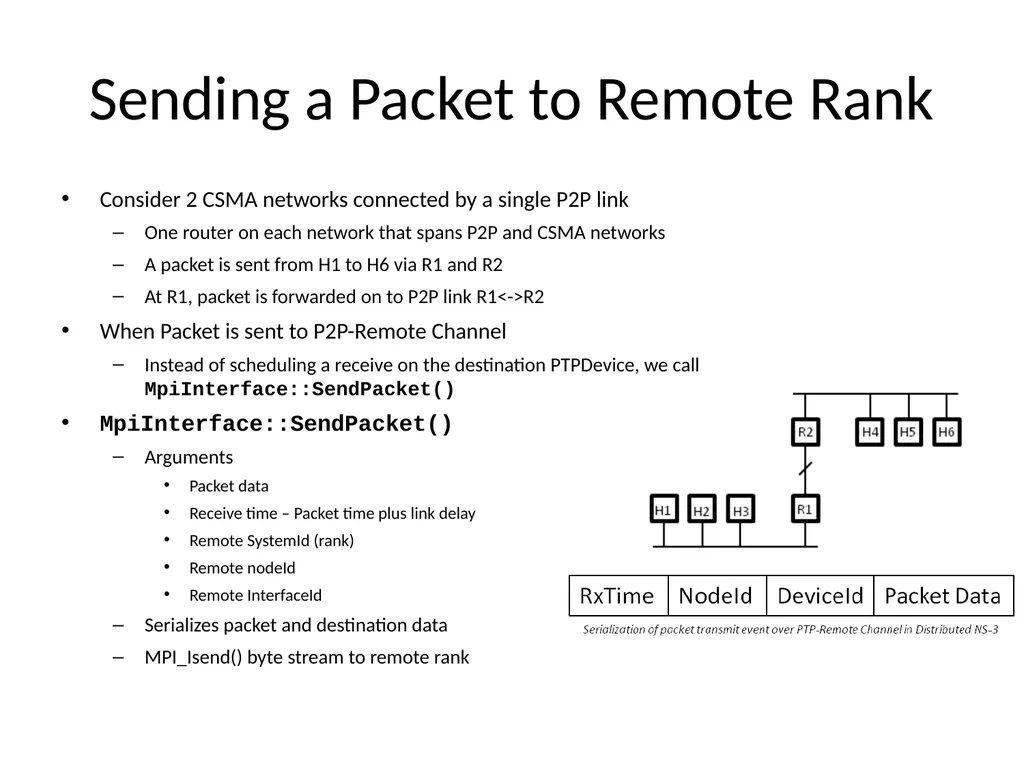
slide21. Sending a Packet to Remote Rank Consider 2 CSMA networks connected by a single P2P link
One router on each network that spans P2P and CSMA networks
A packet is sent from H1 to H6 via R1 and R2
At R1, packet is forwarded on to P2P link R1<->R2
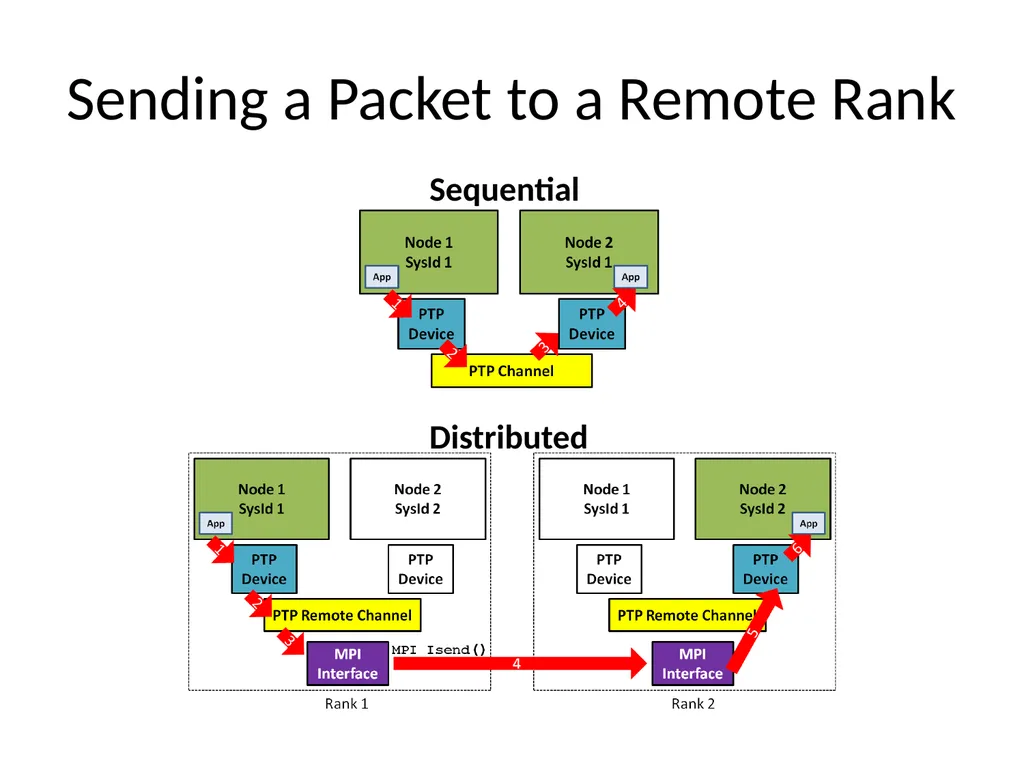
When Packet is sent to P2P-Remote Channel
Instead of scheduling a receive on the destination PTPDevice, we call MpiInterface::SendPacket()
MpiInterface::SendPacket()
Arguments
Packet data
Receive time – Packet time plus link delay
Remote SystemId (rank)
Remote nodeId
Remote InterfaceId
Serializes packet and destination data
MPI_Isend() byte stream to remote rank<br>
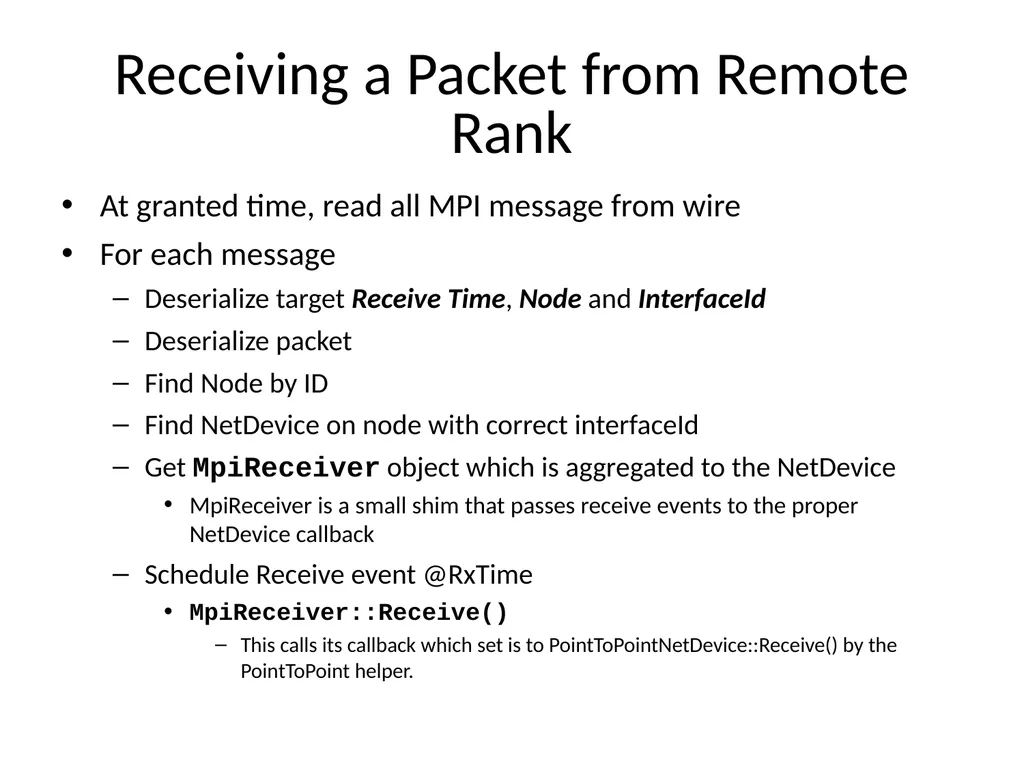
slide22. Receiving a Packet from Remote Rank At granted time, read all MPI message from wire
For each message
Deserialize target Receive Time, Node and InterfaceId
Deserialize packet
Find Node by ID
Find NetDevice on node with correct interfaceId
Get MpiReceiver object which is aggregated to the NetDevice
MpiReceiver is a small shim that passes receive events to the proper NetDevice callback
Schedule Receive event @RxTime
MpiReceiver::Receive()
This calls its callback which set is to PointToPointNetDevice::Receive() by the PointToPoint helper.<br>
slide23. Sending a Packet to a Remote Rank Sequential Distributed<br>
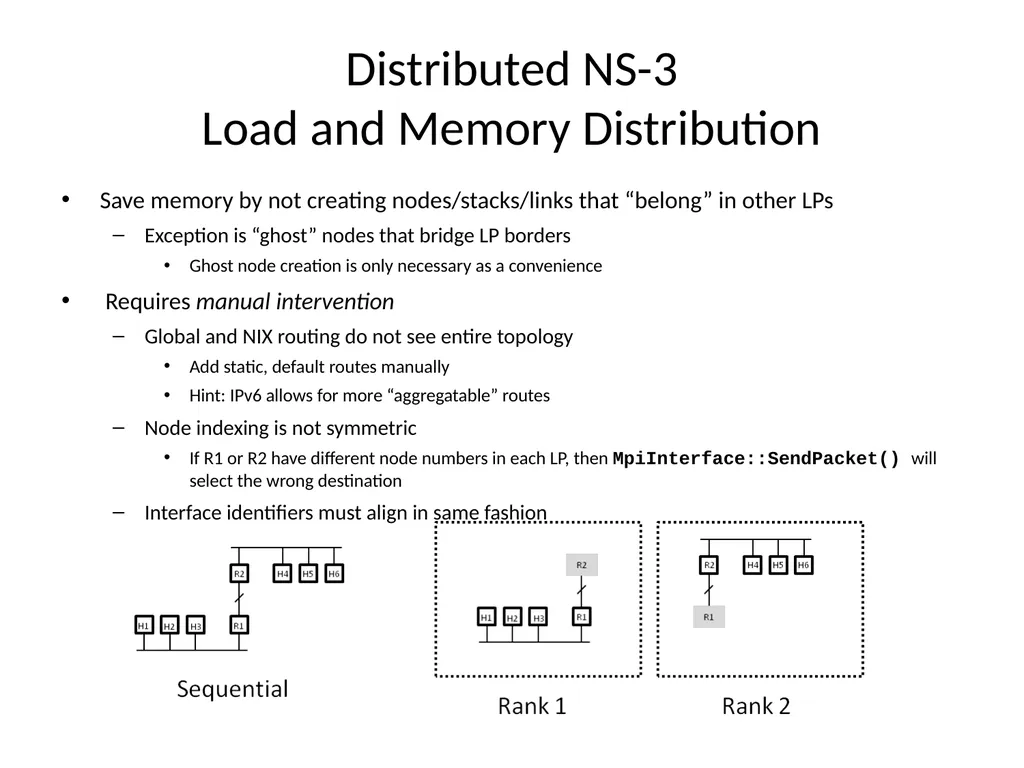
slide24. Distributed NS-3 Load and Memory Distribution Save memory by not creating nodes/stacks/links that “belong” in other LPs
Exception is “ghost” nodes that bridge LP borders
Ghost node creation is only necessary as a convenience
Requires manual intervention
Global and NIX routing do not see entire topology
Add static, default routes manually
Hint: IPv6 allows for more “aggregatable” routes
Node indexing is not symmetric
If R1 or R2 have different node numbers in each LP, then MpiInterface::SendPacket() will select the wrong destination
Interface identifiers must align in same fashion<br>
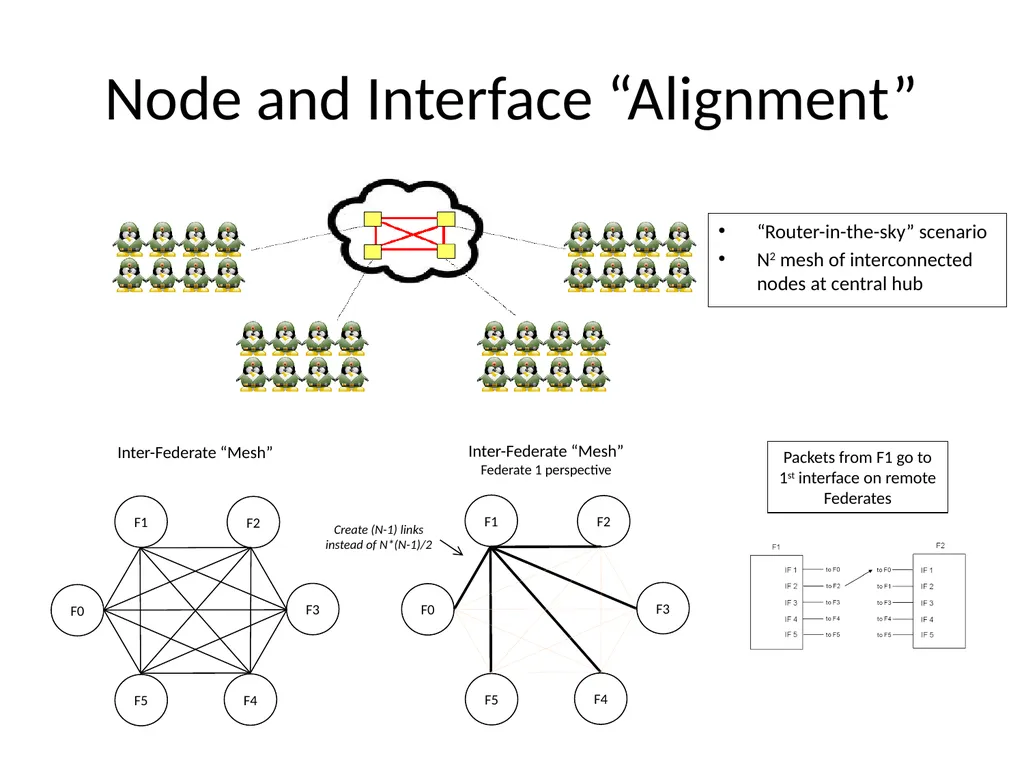
slide25. Node and Interface “Alignment” Packets from F1 go to 1st interface on remote Federates Create (N-1) links instead of N*(N-1)/2 “Router-in-the-sky” scenario
N2 mesh of interconnected nodes at central hub<br>
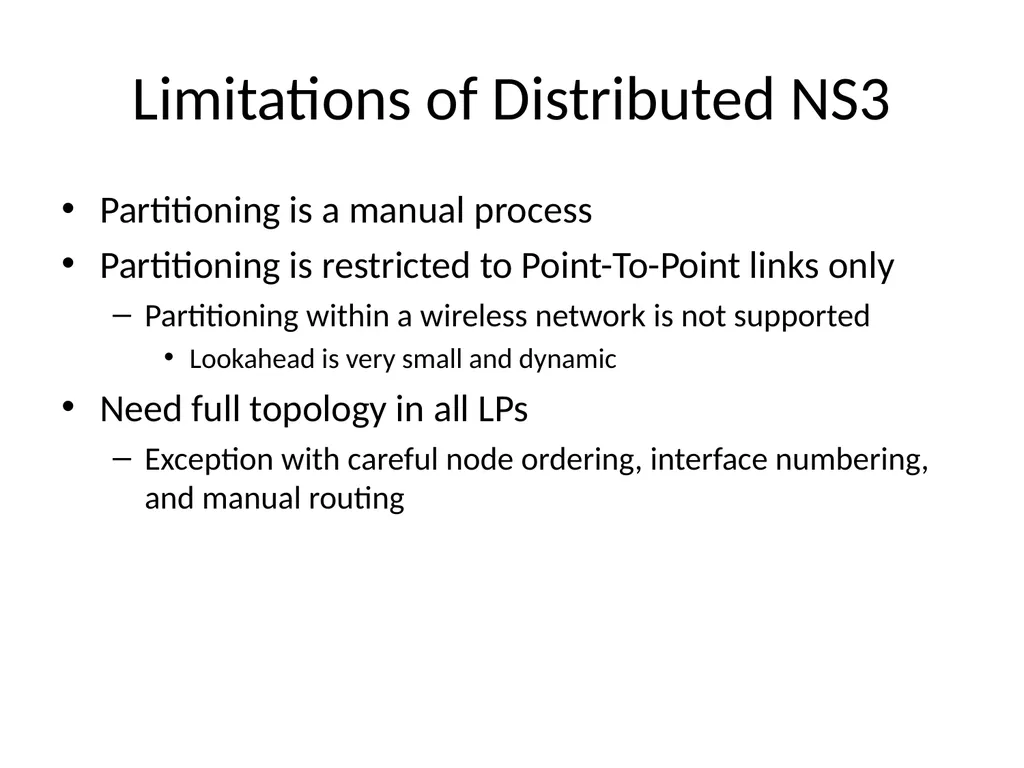
slide26. Limitations of Distributed NS3 Partitioning is a manual process
Partitioning is restricted to Point-To-Point links only
Partitioning within a wireless network is not supported
Lookahead is very small and dynamic
Need full topology in all LPs
Exception with careful node ordering, interface numbering, and manual routing<br>
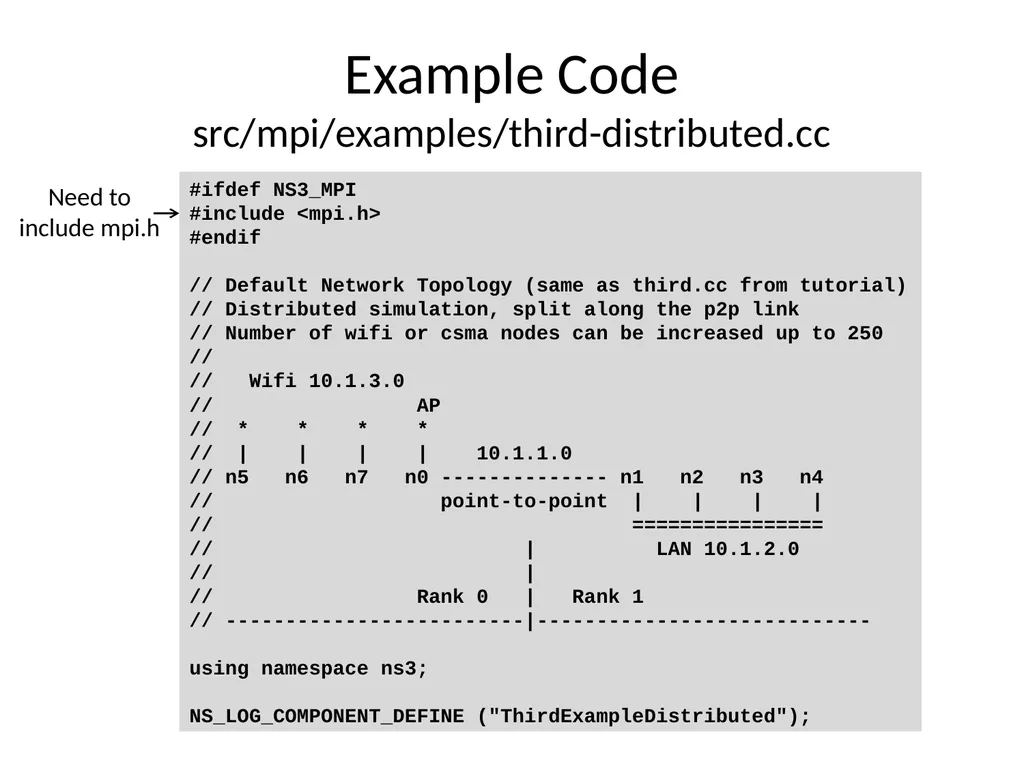
slide27. Example Code src/mpi/examples/third-distributed.cc #ifdef NS3_MPI
#include <mpi.h>
#endif
// Default Network Topology (same as third.cc from tutorial)
// Distributed simulation, split along the p2p link
// Number of wifi or csma nodes can be increased up to 250
//
// Wifi 10.1.3.0
// AP
// * * * *
// | | | | 10.1.1.0
// n5 n6 n7 n0 -------------- n1 n2 n3 n4
// point-to-point | | | |
// ================
// | LAN 10.1.2.0
// |
// Rank 0 | Rank 1
// -------------------------|----------------------------
using namespace ns3;
NS_LOG_COMPONENT_DEFINE ("ThirdExampleDistributed"); Need to include mpi.h<br>
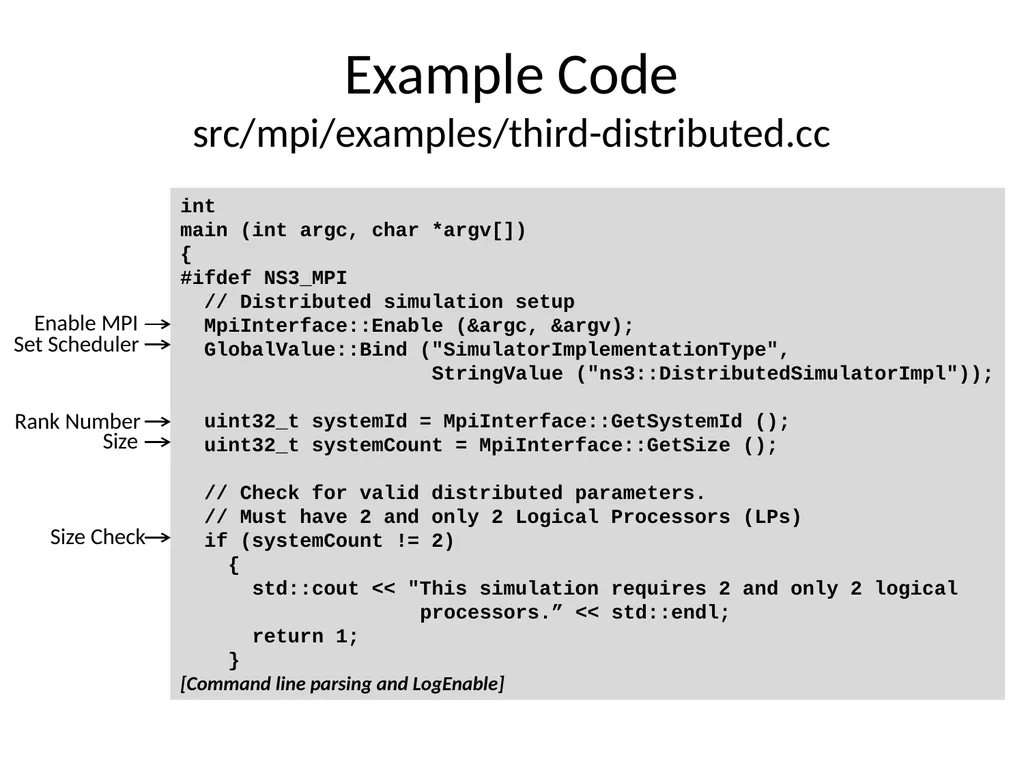
slide28. int
main (int argc, char *argv[])
{
#ifdef NS3_MPI
// Distributed simulation setup
MpiInterface::Enable (&argc, &argv);
GlobalValue::Bind ("SimulatorImplementationType",
StringValue ("ns3::DistributedSimulatorImpl"));
uint32_t systemId = MpiInterface::GetSystemId ();
uint32_t systemCount = MpiInterface::GetSize ();
// Check for valid distributed parameters.
// Must have 2 and only 2 Logical Processors (LPs)
if (systemCount != 2)
{
std::cout << "This simulation requires 2 and only 2 logical
processors.” << std::endl;
return 1;
}
[Command line parsing and LogEnable] Example Code src/mpi/examples/third-distributed.cc Enable MPI Set Scheduler Rank Number Size Size Check<br>
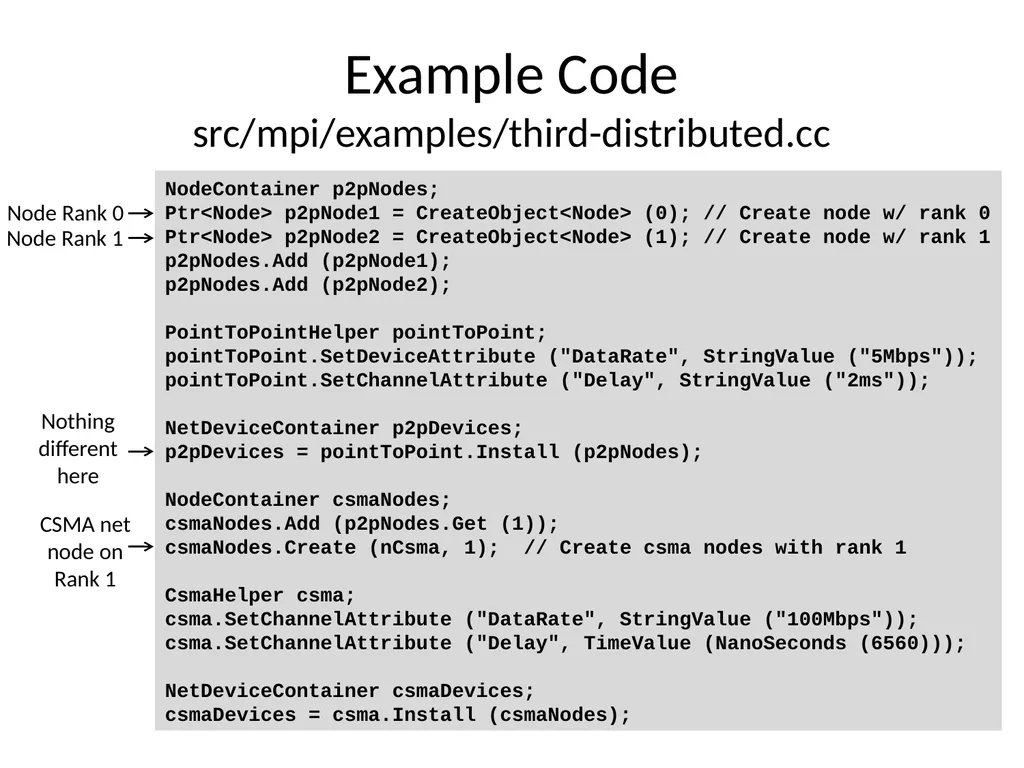
slide29. NodeContainer p2pNodes;
Ptr<Node> p2pNode1 = CreateObject<Node> (0); // Create node w/ rank 0
Ptr<Node> p2pNode2 = CreateObject<Node> (1); // Create node w/ rank 1
p2pNodes.Add (p2pNode1);
p2pNodes.Add (p2pNode2);
PointToPointHelper pointToPoint;
pointToPoint.SetDeviceAttribute ("DataRate", StringValue ("5Mbps"));
pointToPoint.SetChannelAttribute ("Delay", StringValue ("2ms"));
NetDeviceContainer p2pDevices;
p2pDevices = pointToPoint.Install (p2pNodes);
NodeContainer csmaNodes;
csmaNodes.Add (p2pNodes.Get (1));
csmaNodes.Create (nCsma, 1); // Create csma nodes with rank 1
CsmaHelper csma;
csma.SetChannelAttribute ("DataRate", StringValue ("100Mbps"));
csma.SetChannelAttribute ("Delay", TimeValue (NanoSeconds (6560)));
NetDeviceContainer csmaDevices;
csmaDevices = csma.Install (csmaNodes); Example Code src/mpi/examples/third-distributed.cc Node Rank 0 Node Rank 1 Nothing different here CSMA net node on Rank 1<br>
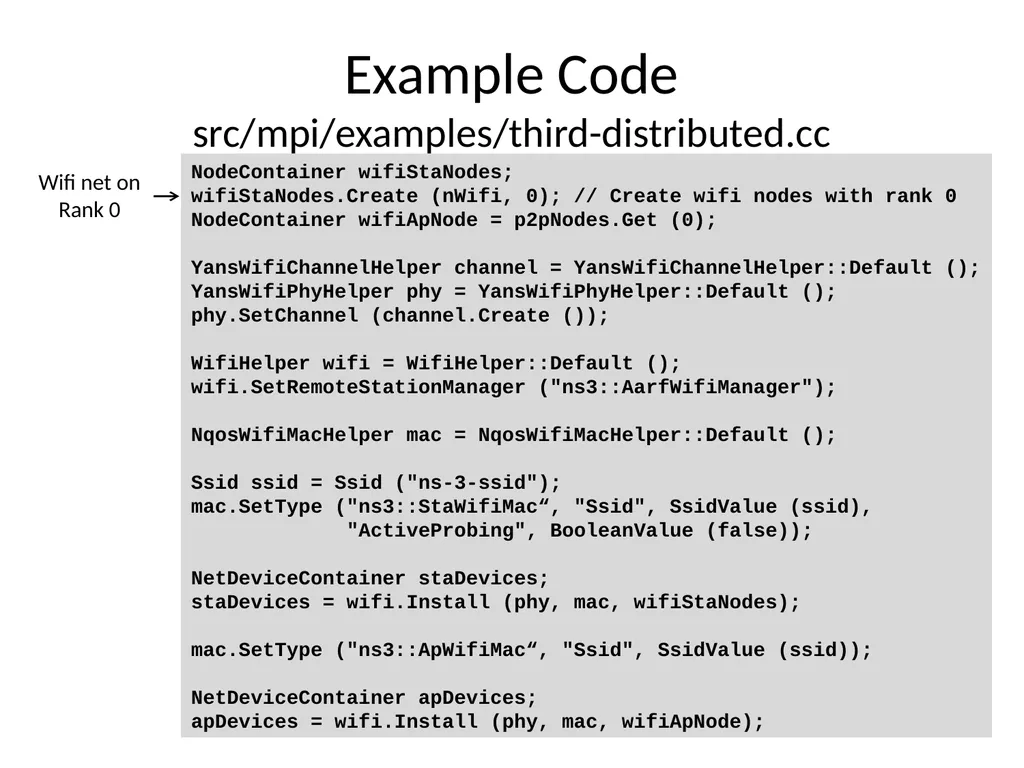
slide30. NodeContainer wifiStaNodes;
wifiStaNodes.Create (nWifi, 0); // Create wifi nodes with rank 0
NodeContainer wifiApNode = p2pNodes.Get (0);
YansWifiChannelHelper channel = YansWifiChannelHelper::Default ();
YansWifiPhyHelper phy = YansWifiPhyHelper::Default ();
phy.SetChannel (channel.Create ());
WifiHelper wifi = WifiHelper::Default ();
wifi.SetRemoteStationManager ("ns3::AarfWifiManager");
NqosWifiMacHelper mac = NqosWifiMacHelper::Default ();
Ssid ssid = Ssid ("ns-3-ssid");
mac.SetType ("ns3::StaWifiMac“, "Ssid", SsidValue (ssid),
"ActiveProbing", BooleanValue (false));
NetDeviceContainer staDevices;
staDevices = wifi.Install (phy, mac, wifiStaNodes);
mac.SetType ("ns3::ApWifiMac“, "Ssid", SsidValue (ssid));
NetDeviceContainer apDevices;
apDevices = wifi.Install (phy, mac, wifiApNode); Example Code src/mpi/examples/third-distributed.cc Wifi net on Rank 0<br>
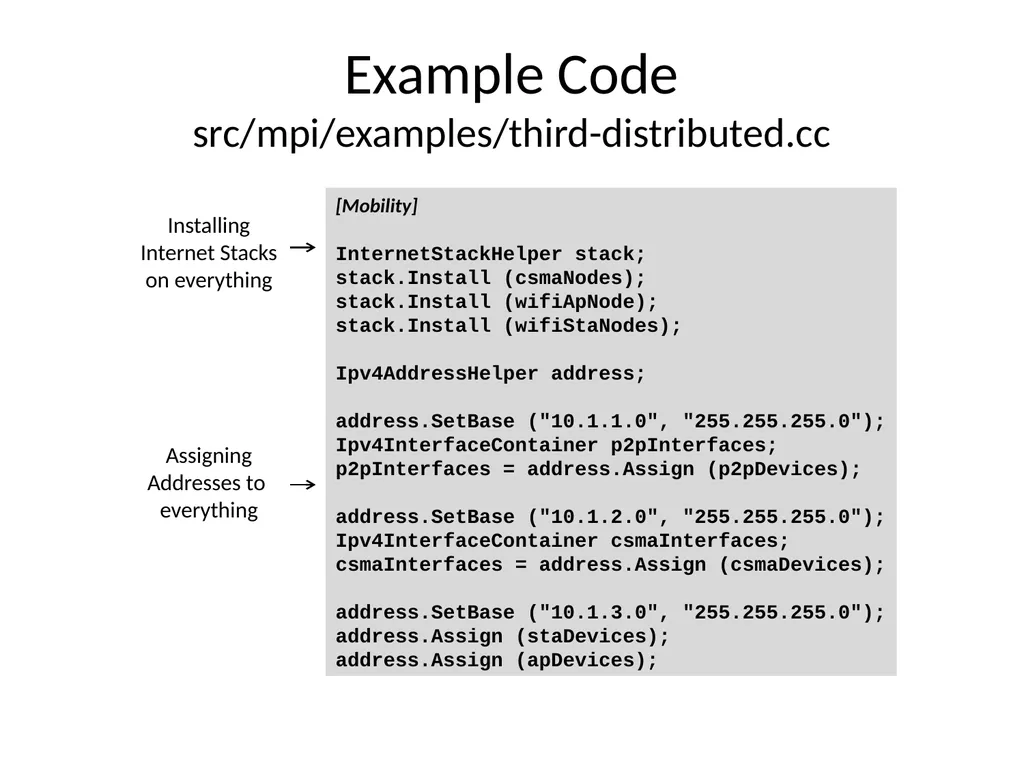
slide31. [Mobility]
InternetStackHelper stack;
stack.Install (csmaNodes);
stack.Install (wifiApNode);
stack.Install (wifiStaNodes);
Ipv4AddressHelper address;
address.SetBase ("10.1.1.0", "255.255.255.0");
Ipv4InterfaceContainer p2pInterfaces;
p2pInterfaces = address.Assign (p2pDevices);
address.SetBase ("10.1.2.0", "255.255.255.0");
Ipv4InterfaceContainer csmaInterfaces;
csmaInterfaces = address.Assign (csmaDevices);
address.SetBase ("10.1.3.0", "255.255.255.0");
address.Assign (staDevices);
address.Assign (apDevices); Example Code src/mpi/examples/third-distributed.cc Installing Internet Stacks on everything Assigning Addresses to everything<br>
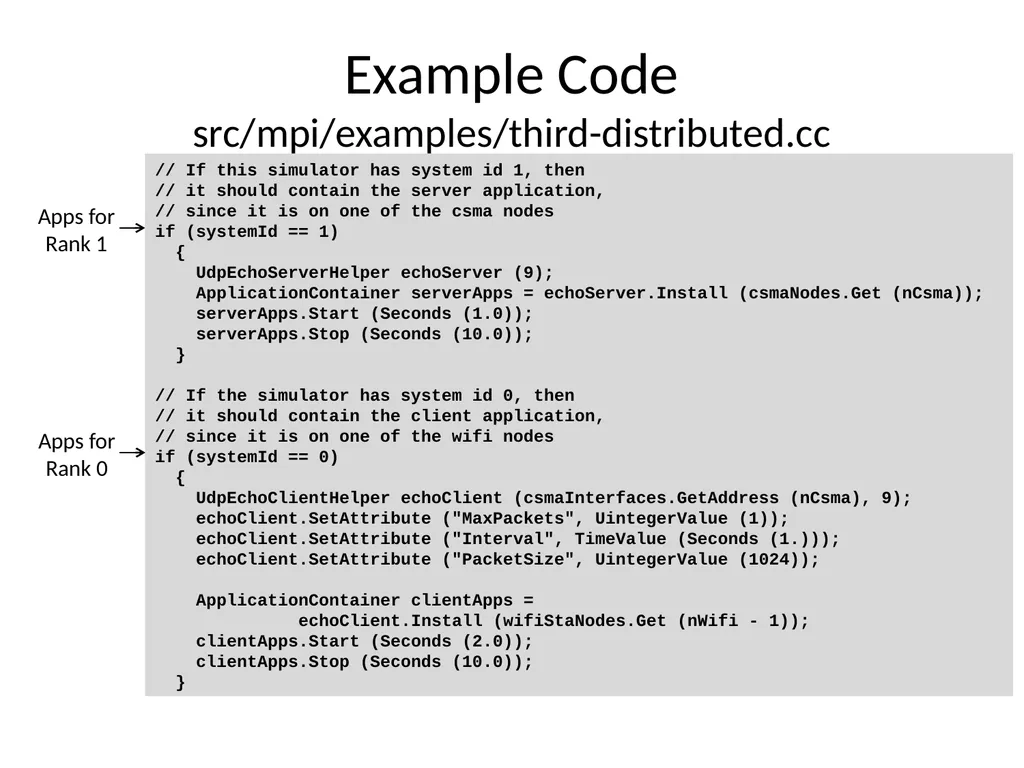
slide32. // If this simulator has system id 1, then
// it should contain the server application,
// since it is on one of the csma nodes
if (systemId == 1)
{
UdpEchoServerHelper echoServer (9);
ApplicationContainer serverApps = echoServer.Install (csmaNodes.Get (nCsma));
serverApps.Start (Seconds (1.0));
serverApps.Stop (Seconds (10.0));
}
// If the simulator has system id 0, then
// it should contain the client application,
// since it is on one of the wifi nodes
if (systemId == 0)
{
UdpEchoClientHelper echoClient (csmaInterfaces.GetAddress (nCsma), 9);
echoClient.SetAttribute ("MaxPackets", UintegerValue (1));
echoClient.SetAttribute ("Interval", TimeValue (Seconds (1.)));
echoClient.SetAttribute ("PacketSize", UintegerValue (1024));
ApplicationContainer clientApps =
echoClient.Install (wifiStaNodes.Get (nWifi - 1));
clientApps.Start (Seconds (2.0));
clientApps.Stop (Seconds (10.0));
} Example Code src/mpi/examples/third-distributed.cc Apps for Rank 1 Apps for Rank 0<br>
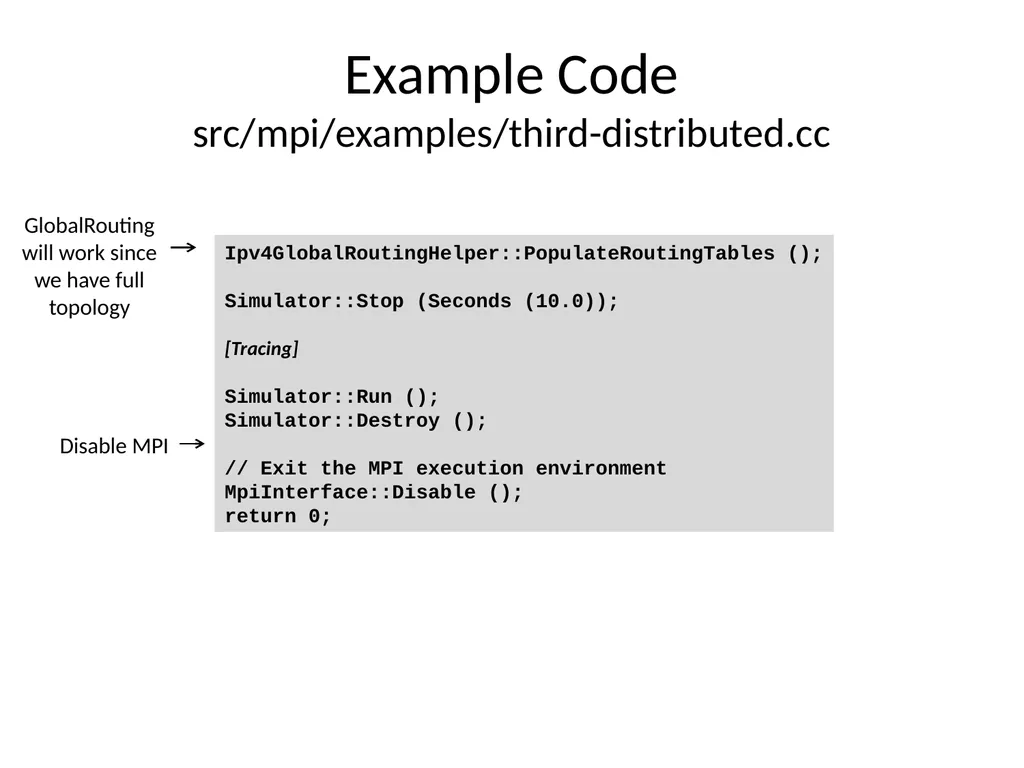
slide33. Ipv4GlobalRoutingHelper::PopulateRoutingTables ();
Simulator::Stop (Seconds (10.0));
[Tracing]
Simulator::Run ();
Simulator::Destroy ();
// Exit the MPI execution environment
MpiInterface::Disable ();
return 0; Example Code src/mpi/examples/third-distributed.cc GlobalRouting
will work since we have full topology Disable MPI<br>
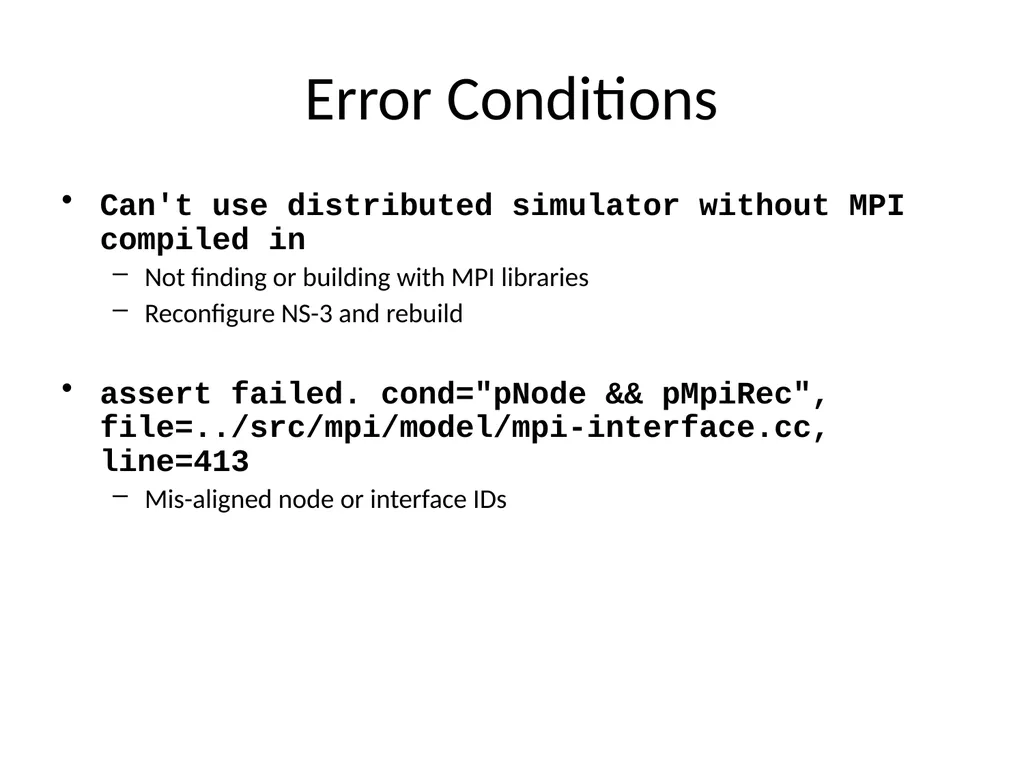
slide34. Error Conditions Can't use distributed simulator without MPI compiled in
Not finding or building with MPI libraries
Reconfigure NS-3 and rebuild
assert failed. cond="pNode && pMpiRec", file=../src/mpi/model/mpi-interface.cc, line=413
Mis-aligned node or interface IDs<br>
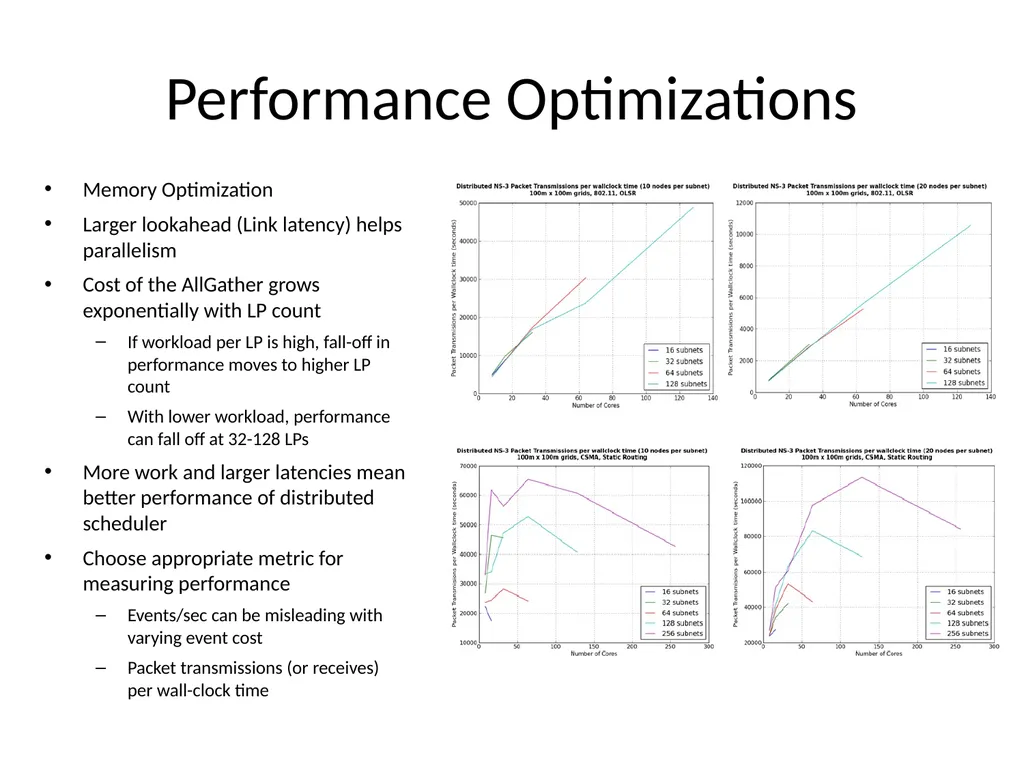
slide35. Performance Optimizations Memory Optimization
Larger lookahead (Link latency) helps parallelism
Cost of the AllGather grows exponentially with LP count
If workload per LP is high, fall-off in performance moves to higher LP count
With lower workload, performance can fall off at 32-128 LPs
More work and larger latencies mean better performance of distributed scheduler
Choose appropriate metric for measuring performance
Events/sec can be misleading with varying event cost
Packet transmissions (or receives) per wall-clock time<br>
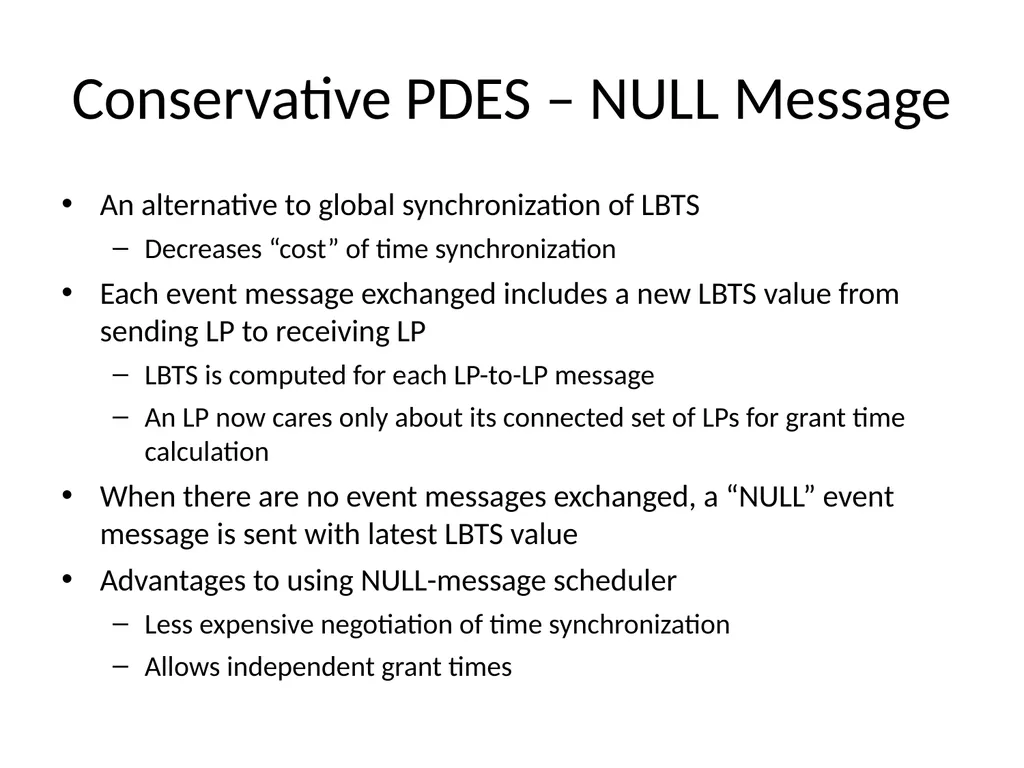
slide36. Conservative PDES – NULL Message An alternative to global synchronization of LBTS
Decreases “cost” of time synchronization
Each event message exchanged includes a new LBTS value from sending LP to receiving LP
LBTS is computed for each LP-to-LP message
An LP now cares only about its connected set of LPs for grant time calculation
When there are no event messages exchanged, a “NULL” event message is sent with latest LBTS value
Advantages to using NULL-message scheduler
Less expensive negotiation of time synchronization
Allows independent grant times<br>
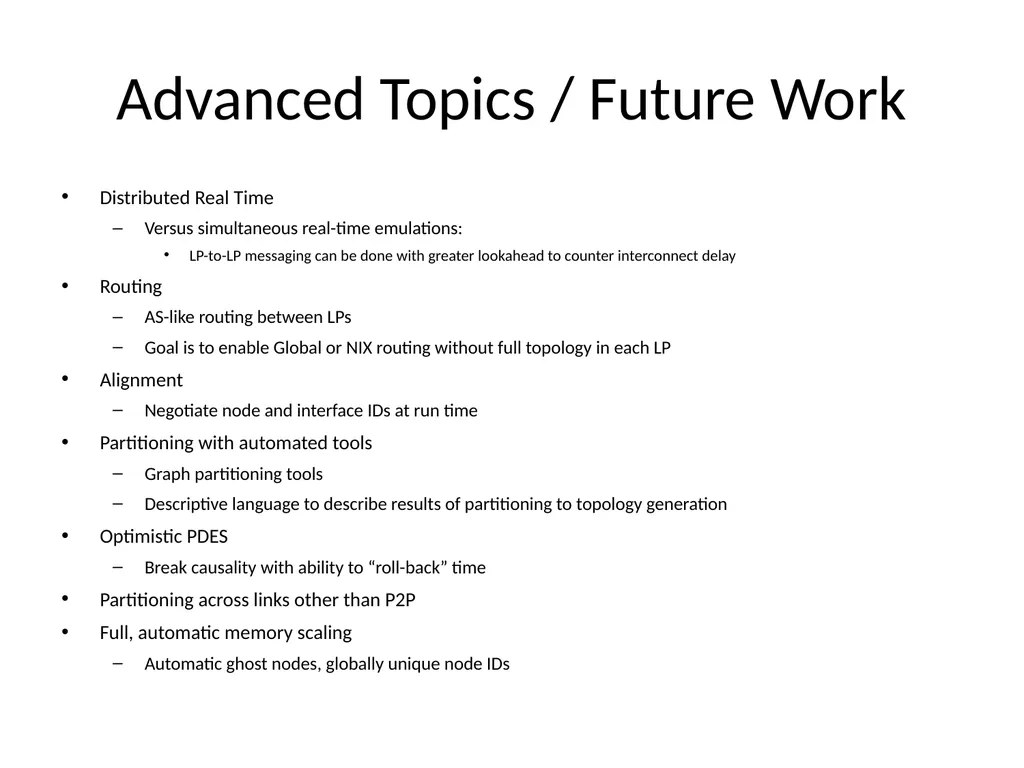
slide37. Advanced Topics / Future Work Distributed Real Time
Versus simultaneous real-time emulations:
LP-to-LP messaging can be done with greater lookahead to counter interconnect delay
Routing
AS-like routing between LPs
Goal is to enable Global or NIX routing without full topology in each LP
Alignment
Negotiate node and interface IDs at run time
Partitioning with automated tools
Graph partitioning tools
Descriptive language to describe results of partitioning to topology generation
Optimistic PDES
Break causality with ability to “roll-back” time
Partitioning across links other than P2P
Full, automatic memory scaling
Automatic ghost nodes, globally unique node IDs<br>
slide38. References “Parallel and Distributed Simulation Systems”, R. M. Fujimoto, Wiley Interscience, 2000.
“Distributed Simulation with MPI in ns-3”, J. Pelkey, G. Riley, Simutools ‘11.
“Performance of Distributed ns-3 Network Simulator”, S. Nikolaev, P. Barnes, Jr., J. Brase, T. Canales, D. Jefferson, S. Smith, R. Soltz, P. Scheibel, SimuTools '13.
“A Performance and Scalability Evaluation of the NS-3 Distributed Scheduler”, K. Renard, C. Peri, J. Clarke , SimuTools '12.<br>
US Army Research Lab<br>
slide2. Outline Introduction and Motivation for Distributed NS-3
Parallel Discrete Event Simulation
MPI Concepts
Distributed NS-3 Scheduler
Limitations
Example Code Walk-through
Error Conditions
Performance Considerations
Advanced Topics<br>
slide3. Introduction to Distributed NS-3 Distributed NS-3 is a scheduler that allows discrete events to be executed concurrently among multiple CPU cores
Load and memory distribution
Initially released in version 3.8
Implemented by George Riley and Josh Pelkey (Georgia Tech)
Roots from:
Parallel/Distributed ns (pdns)
Georgia Tech Network Simulator (GTNetS)
Performance Studies
“Performance of Distributed ns-3 Network Simulator”, S. Nikolaev, P. Barnes, Jr., J. Brase, T. Canales, D. Jefferson, S. Smith, R. Soltz, P. Scheibel, SimuTools '13
“A Performance and Scalability Evaluation of the NS-3 Distributed Scheduler”, K. Renard, C. Peri, J. Clarke , SimuTools '12
360 Million Nodes<br>
slide4. Motivation for High Performance, Scalable Network Simulation Reduce simulation run-time for large, complex network simulations
Complex models require more CPU cycles and memory
MANETs, robust radio devices
More realistic application-layer models and traffic loading
Load balancing among CPUs
Potential to enable real-time performance for NS-3 emulation
Enable larger simulated networks
Distribute memory footprint to reduce swap usage
Potential to reduce impact of N2 problems such as global routing
Allows network researchers to run multiple simulations and collect significant data<br>
slide5. Discrete Event Simulation Execution of a series of time-ordered events
Events can change the state of the model
Create zero or more future events
Simulation time advances based on when the next event occurs
Instantaneously skip over time periods with no activity
Time effectively stops during the processing of an event
Events are executed in time order
New events can be scheduled “now” or in the future
New events cannot be scheduled “in the past”
Events that are scheduled at the exact same time may be executed in any order
To model a process that takes time to complete, schedule a series of events that happen at relative time offsets
Start sending packet: set medium busy, schedule stop event
Stop sending packet: set medium available, schedule receive events
Exit when there are no more events are in the queue<br>
slide6. Discrete Events and Timing for a Packet Transmission<br>
slide7. Parallel Discrete Event Simulation (Conservative) By partitioning the model (network) into multiple pieces and map these pieces to Logical Processes, (LPs), each LP has its own set of events to process
LPs are synchronized copies of NS3 running at the same time
Try to distribute event load (processing load) equally among LPs
Exploit parallelism in simulation
At some point, we will need to schedule an event that will be executed on another LP
Messages are passed between LPs to communicate event details and scheduling information
Some form of time synchronization is required between LPs
Must maintain causality – cannot schedule an event “in the past”
We need to communicate our event to a remote LP before that LP’s simulation time passes our event time
Events across LPs can execute independently and in parallel<br>
slide8. Clock Synchronization in Conservative PDES We grant each LP a future time value such that no incoming events will occur before that time
In the simple case, all LPs are granted the same time
All LPs advance time in synchronized “chunks”
The LP can now execute all events up to that time while preserving causality
Incoming event requests are queued
Incoming events will occur after the granted time
The LP waits until it is granted additional time
Even distribution of workload limits wasted time
We want to maximize grant time such that a larger set of events can be computed in parallel<br>
slide9. Lookahead & Grant Time Computation Lookahead value is the minimum amount of time that must elapse before an event at an LP can effect anything in another LP
In network simulation we can use the propagation delay over a link/channel as the basis for lookahead
Among a set of LPs, the maximum lookahead is the time of the next event, plus the minimum propagation delay among links that span LPs
Compute Lower Bound Time Step (LBTS)
Smallest timestamp of an event that can be delivered to another LP
Select lowest LBTS over all LPs as global grant time
All LPs advance to the same grant time before repeating
Getting all LPs to communicate and determine lowest LBTS can be expensive
O(n) to O(n2) messages, interconnect type, interconnect speed<br>
slide10. Message Passing Interface (MPI) Distributed NS-3 uses MPI for communication and synchronization
Message Passing Specification (not the library itself)
Point-to-Point as well as collective communications
Designed for high performance and scalability
De-facto standard for distributed computing
Allows communication between sets of processes (ranks)
mpirun –np 10 ./main
Language Independent (C, C++, FORTRAN, Java, Python, etc)
Targeted distributed memory systems, but works nicely on shared memory as well
Libraries are built to take advantage of underlying hardware
Such as drivers for high-speed interconnects
Low latency, high throughput
Implementations: OpenMPI, MPICH, mpi4py, mpiJava, etc Images: https://computing.llnl.gov/tutorials/mpi/<br>
slide11. MPI Concepts Communicators
A “channel” among a group of processes (unsigned int)
Each process in the group is assigned an ID or rank
Rank numbers are contiguous unsigned integers starting with 0
Used for directing messages or to assign functionality to specific processes
if (rank == 0) print “Hello World”
Default [“everybody”] communicator is MPI_COMM_WORLD
Point-To-Point Communications
A message targeting a single specific process
MPI_Send(data, data_length, data_type, destination, tag, communicator)
Data/Data Length – Message contents
Data Type – MPI-defined data types
Destination – Rank Number
Tag – Arbitrary message tag for applications to use
Communicator – Specific group where destination exists
MPI_Send() / MPI_Isend() – blocking and non-blocking sends
MPI_Recv() / MPI_Irevc() – blocking and non-blocking receive<br>
slide12. MPI Concepts Collective Communications
Synchronization – Block until all members of communicator have reached that point
Data messaging – Broadcast, scatter/gather, all-to-all
Collective Computation – One rank collects data from all ranks and performs an operation (sum, avg, min, max)
Data Types – select examples
MPI_CHAR, MPI_UNSIGNED_CHAR
MPI_SHORT, MPI_LONG, MPI_INT
MPI_FLOAT, MPI_DOUBLE, MPI_COMPLEX
Derived types – built from primitives
Specifying where processes are run
Use config file to specify hosts and #CPUs to run on
--hostfile file for OpenMPI
Cluster systems usually have queuing system or
scheduler interfaces where host/CPU mapping
is done # This is an example hostfile. Comments begin with #
#
# The following node is a single processor machine:
foo.example.com
# The following node is a dual-processor machine:
bar.example.com slots=2
# The following node is a quad-processor machine, and we
# absolutely want to disallow over-subscribing it:
yow.example.com slots=4 max-slots=4 #!/bin/csh
#PBS -l walltime=01:00:00
#PBS -l select=128:ncpus=8:mpiprocs=8
#PBS -l place=scatter:excl
#PBS -N myjob
#PBS -q standard
mpirun_shim ${PATH}/big_simulation<br>
slide13. MPI Programming OpenMPI Example MPI Program Structure
Include headers
Initialize MPI with command-line args
Parallel code
Send messages, synchronize
Finalize
Use front-end for compiler
mpicc, mpicxx, mpif77
Automatically includes appropriate libraries and include directories
Use mpirun to execute
Use config file to specify hosts and #CPUs to run on
--hostfile file for OpenMPI
Cluster systems usually have queuing system/scheduler interfaces where host/CPU mapping is done #include <mpi.h>
#include <unistd.h> // For getpid()
int
main (int argc, char **argv)
{
int size, rank, rc;
rc = MPI_Init (&argc, &argv);
if (rc != MPI_SUCCESS)
MPI_Abort(MPI_COMM_WORLD, rc);
MPI_Comm_size (MPI_COMM_WORLD, &size);
MPI_Comm_rank (MPI_COMM_WORLD, &rank);
printf ("Hello World from rank %d of %d
(%d)\n", rank, size, getpid ());
MPI_Finalize();
} $ mpicxx -o hello hello.cc
$ mpirun -np 4 ./hello
Hello World from rank 3 of 4 (35986)
Hello World from rank 0 of 4 (35983)
Hello World from rank 1 of 4 (35984)
Hello World from rank 2 of 4 (35985)<br>
slide14. MPI Messaging Example #include <mpi.h>
int main (int argc, char **argv)
{
int rank, rc;
char *msg = (char *)"Hello";
int msg_len = strlen(msg);
char in_msg[msg_len + 1];
MPI_Init (&argc, &argv);
MPI_Comm_size (MPI_COMM_WORLD, &size);
MPI_Comm_rank (MPI_COMM_WORLD, &rank);
if (size < 2) {
printf ("Need more than one rank to communicate\n");
MPI_Abort(MPI_COMM_WORLD, 0);
}
if (rank == 0) {
int dest = 1;
rc = MPI_Send (msg, msg_len, MPI_CHAR, dest,
0, MPI_COMM_WORLD);
}
if (rank == 1) {
int count = 0;
MPI_Status stat;
rc = MPI_Recv (&in_msg, msg_len, MPI_CHAR,
MPI_ANY_SOURCE, 0, MPI_COMM_WORLD, &stat);
in_msg[msg_len] = (char) 0;
MPI_Get_count (&stat, MPI_CHAR, &count);
printf("Rank %d receive message \"%s\" (%d) from rank
%d tag %d\n", rank, in_msg, count,
stat.MPI_SOURCE, stat.MPI_TAG);
}
MPI_Finalize();
} $ mpicxx -o send1 send1.cc
$ mpirun -np 4 ./send1
Rank 1 receive message "Hello" (5) from rank 0 tag 0
$<br>
slide15. MPI Collective Example -- Barrier #include <mpi.h>
#include <unistd.h>
#include <stdlib.h>
int
main (int argc, char **argv)
{
int size, rank, rc;
rc = MPI_Init (&argc, &argv);
if (rc != MPI_SUCCESS)
MPI_Abort(MPI_COMM_WORLD, rc);
MPI_Comm_size (MPI_COMM_WORLD, &size);
MPI_Comm_rank (MPI_COMM_WORLD, &rank);
MPI_Barrier (MPI_COMM_WORLD);
srand (getpid ());
int count = rand() % 1000000000;
int sum = 0;
for (int i=0; i < count; i++) {
sum += rand () % 1000000;
}
printf("Rank %d: done with spin (%d)\n",
rank, count);
MPI_Barrier (MPI_COMM_WORLD);
printf("Rank %d: Final Barrier\n", rank);
MPI_Finalize();
} $ time mpirun -np 4 ./coll
Rank 0: done with spin (11587458)
Rank 3: done with spin (171572520)
Rank 2: done with spin (402449947)
Rank 2: Final Barrier
Rank 1: done with spin (777659848)
Rank 1: Final Barrier
Rank 3: Final Barrier
Rank 0: Final Barrier
real 0m10.151s
user 0m36.471s
sys 0m0.050s
$ time mpirun -np 4 ./coll
Rank 1: done with spin (30229414)
Rank 0: done with spin (258675938)
Rank 3: done with spin (496367588)
Rank 1: Final Barrier
Rank 2: done with spin (731537290)
Rank 2: Final Barrier
Rank 0: Final Barrier
Rank 3: Final Barrier
real 0m9.621s
user 0m34.365s
sys 0m0.043s<br>
slide16. MPI Collective Example -- AllGather #include <mpi.h>
#include <unistd.h>
#include <stdlib.h>
int
main (int argc, char **argv)
{
int size, rank, rc;
rc = MPI_Init (&argc, &argv);
if (rc != MPI_SUCCESS)
MPI_Abort(MPI_COMM_WORLD, rc);
MPI_Comm_size (MPI_COMM_WORLD, &size);
MPI_Comm_rank (MPI_COMM_WORLD, &rank);
srand (getpid ());
int allValues[size];
int myValue = rand() % 1000000000;
MPI_Allgather (&myValue, 1, MPI_INT,
allValues, 1, MPI_INT,
MPI_COMM_WORLD);
printf ("Rank %d: [", rank);
for (int i = 0; i < size; i++) {
printf("%d, ", allValues[i]);
}
printf ("]\n");
MPI_Finalize();
} $ mpirun -np 4 ./gather
Rank 3: [29003797, 719191937, 424799615, 114846810, ]
Rank 0: [29003797, 719191937, 424799615, 114846810, ]
Rank 1: [29003797, 719191937, 424799615, 114846810, ]
Rank 2: [29003797, 719191937, 424799615, 114846810, ]<br>
slide17. Distributed NS-3 Configuring and Building Distributed NS-3
Basic approach to Distributed NS-3 simulation
Memory Optimizations
Discussion of works-in-progress to simplify and optimize distributed simulations<br>
slide18. Building Distributed NS-3 Add “--enable-mpi” to ‘waf configure’ line
Tries to run ‘mpic++’
Recognizes OpenMPI and MPICH libraries
Defines “NS3_MPI” and either “NS3_OPENMPI” or “NS3_MPICH” ---- Summary of optional NS-3 features:
Python Bindings : not enabled (PyBindGen missing)
BRITE Integration : not enabled (BRITE not enabled (see option --with-brite))
NS-3 Click Integration : not enabled (nsclick not enabled (see option --with-nsclick))
GtkConfigStore : enabled
XmlIo : enabled
Threading Primitives : enabled
Real Time Simulator : enabled
Emulated Net Device : enabled
File descriptor NetDevice : enabled
Tap FdNetDevice : enabled
Emulation FdNetDevice : enabled
PlanetLab FdNetDevice : not enabled (PlanetLab operating system not detected…
Network Simulation Cradle : not enabled (NSC not found (see option --with-nsc))
MPI Support : enabled
NS-3 OpenFlow Integration : not enabled (OpenFlow not enabled (see option --with-openflow))
SQlite stats data output : enabled<br>
slide19. Building a Distributed NS-3 Simulation Choose partitioning strategy
Find obvious sections of the network that will operate most independently
Minimize communication between partitions
Find large latencies in network
Large latencies are large (good) lookahead values
Build topology as normal, assigning “SystemId” values on all Nodes
CreateObject<Node> (rankId)
Distributed NS-3 can only be partitioned over Point-to-Point (P2P) links
A special type of P2P will be created by the PTPHelper if Nodes do not have the same systemId [PointToPointRemoteChannel]
P2P links can be “inserted” where latency is available
Latency can sometimes be “moved” around<br>
slide20. Distributed NS-3 Load Distribution All ranks create all nodes and links
Setup time and memory requirements are similar to sequential simulation
Event execution happens in parallel
Memory is used for nodes/stacks/devices that “belong” to other ranks
Non-local nodes do not have to be fully configured
Application models should not be installed on non-local nodes
Stacks and addresses probably should be installed on non-local nodes
So that global routing model can ‘see’ the entire network
When packets are transmitted over P2P-Remote links, the receive event is communicated to the receiving rank
Send event immediately, do not wait for grant time
Receive event is added to remote rank’s queue instead of local
At end of grant time
Read and schedule all incoming events
Compute and negotiate next grant time<br>
slide21. Sending a Packet to Remote Rank Consider 2 CSMA networks connected by a single P2P link
One router on each network that spans P2P and CSMA networks
A packet is sent from H1 to H6 via R1 and R2
At R1, packet is forwarded on to P2P link R1<->R2
When Packet is sent to P2P-Remote Channel
Instead of scheduling a receive on the destination PTPDevice, we call MpiInterface::SendPacket()
MpiInterface::SendPacket()
Arguments
Packet data
Receive time – Packet time plus link delay
Remote SystemId (rank)
Remote nodeId
Remote InterfaceId
Serializes packet and destination data
MPI_Isend() byte stream to remote rank<br>
slide22. Receiving a Packet from Remote Rank At granted time, read all MPI message from wire
For each message
Deserialize target Receive Time, Node and InterfaceId
Deserialize packet
Find Node by ID
Find NetDevice on node with correct interfaceId
Get MpiReceiver object which is aggregated to the NetDevice
MpiReceiver is a small shim that passes receive events to the proper NetDevice callback
Schedule Receive event @RxTime
MpiReceiver::Receive()
This calls its callback which set is to PointToPointNetDevice::Receive() by the PointToPoint helper.<br>
slide23. Sending a Packet to a Remote Rank Sequential Distributed<br>
slide24. Distributed NS-3 Load and Memory Distribution Save memory by not creating nodes/stacks/links that “belong” in other LPs
Exception is “ghost” nodes that bridge LP borders
Ghost node creation is only necessary as a convenience
Requires manual intervention
Global and NIX routing do not see entire topology
Add static, default routes manually
Hint: IPv6 allows for more “aggregatable” routes
Node indexing is not symmetric
If R1 or R2 have different node numbers in each LP, then MpiInterface::SendPacket() will select the wrong destination
Interface identifiers must align in same fashion<br>
slide25. Node and Interface “Alignment” Packets from F1 go to 1st interface on remote Federates Create (N-1) links instead of N*(N-1)/2 “Router-in-the-sky” scenario
N2 mesh of interconnected nodes at central hub<br>
slide26. Limitations of Distributed NS3 Partitioning is a manual process
Partitioning is restricted to Point-To-Point links only
Partitioning within a wireless network is not supported
Lookahead is very small and dynamic
Need full topology in all LPs
Exception with careful node ordering, interface numbering, and manual routing<br>
slide27. Example Code src/mpi/examples/third-distributed.cc #ifdef NS3_MPI
#include <mpi.h>
#endif
// Default Network Topology (same as third.cc from tutorial)
// Distributed simulation, split along the p2p link
// Number of wifi or csma nodes can be increased up to 250
//
// Wifi 10.1.3.0
// AP
// * * * *
// | | | | 10.1.1.0
// n5 n6 n7 n0 -------------- n1 n2 n3 n4
// point-to-point | | | |
// ================
// | LAN 10.1.2.0
// |
// Rank 0 | Rank 1
// -------------------------|----------------------------
using namespace ns3;
NS_LOG_COMPONENT_DEFINE ("ThirdExampleDistributed"); Need to include mpi.h<br>
slide28. int
main (int argc, char *argv[])
{
#ifdef NS3_MPI
// Distributed simulation setup
MpiInterface::Enable (&argc, &argv);
GlobalValue::Bind ("SimulatorImplementationType",
StringValue ("ns3::DistributedSimulatorImpl"));
uint32_t systemId = MpiInterface::GetSystemId ();
uint32_t systemCount = MpiInterface::GetSize ();
// Check for valid distributed parameters.
// Must have 2 and only 2 Logical Processors (LPs)
if (systemCount != 2)
{
std::cout << "This simulation requires 2 and only 2 logical
processors.” << std::endl;
return 1;
}
[Command line parsing and LogEnable] Example Code src/mpi/examples/third-distributed.cc Enable MPI Set Scheduler Rank Number Size Size Check<br>
slide29. NodeContainer p2pNodes;
Ptr<Node> p2pNode1 = CreateObject<Node> (0); // Create node w/ rank 0
Ptr<Node> p2pNode2 = CreateObject<Node> (1); // Create node w/ rank 1
p2pNodes.Add (p2pNode1);
p2pNodes.Add (p2pNode2);
PointToPointHelper pointToPoint;
pointToPoint.SetDeviceAttribute ("DataRate", StringValue ("5Mbps"));
pointToPoint.SetChannelAttribute ("Delay", StringValue ("2ms"));
NetDeviceContainer p2pDevices;
p2pDevices = pointToPoint.Install (p2pNodes);
NodeContainer csmaNodes;
csmaNodes.Add (p2pNodes.Get (1));
csmaNodes.Create (nCsma, 1); // Create csma nodes with rank 1
CsmaHelper csma;
csma.SetChannelAttribute ("DataRate", StringValue ("100Mbps"));
csma.SetChannelAttribute ("Delay", TimeValue (NanoSeconds (6560)));
NetDeviceContainer csmaDevices;
csmaDevices = csma.Install (csmaNodes); Example Code src/mpi/examples/third-distributed.cc Node Rank 0 Node Rank 1 Nothing different here CSMA net node on Rank 1<br>
slide30. NodeContainer wifiStaNodes;
wifiStaNodes.Create (nWifi, 0); // Create wifi nodes with rank 0
NodeContainer wifiApNode = p2pNodes.Get (0);
YansWifiChannelHelper channel = YansWifiChannelHelper::Default ();
YansWifiPhyHelper phy = YansWifiPhyHelper::Default ();
phy.SetChannel (channel.Create ());
WifiHelper wifi = WifiHelper::Default ();
wifi.SetRemoteStationManager ("ns3::AarfWifiManager");
NqosWifiMacHelper mac = NqosWifiMacHelper::Default ();
Ssid ssid = Ssid ("ns-3-ssid");
mac.SetType ("ns3::StaWifiMac“, "Ssid", SsidValue (ssid),
"ActiveProbing", BooleanValue (false));
NetDeviceContainer staDevices;
staDevices = wifi.Install (phy, mac, wifiStaNodes);
mac.SetType ("ns3::ApWifiMac“, "Ssid", SsidValue (ssid));
NetDeviceContainer apDevices;
apDevices = wifi.Install (phy, mac, wifiApNode); Example Code src/mpi/examples/third-distributed.cc Wifi net on Rank 0<br>
slide31. [Mobility]
InternetStackHelper stack;
stack.Install (csmaNodes);
stack.Install (wifiApNode);
stack.Install (wifiStaNodes);
Ipv4AddressHelper address;
address.SetBase ("10.1.1.0", "255.255.255.0");
Ipv4InterfaceContainer p2pInterfaces;
p2pInterfaces = address.Assign (p2pDevices);
address.SetBase ("10.1.2.0", "255.255.255.0");
Ipv4InterfaceContainer csmaInterfaces;
csmaInterfaces = address.Assign (csmaDevices);
address.SetBase ("10.1.3.0", "255.255.255.0");
address.Assign (staDevices);
address.Assign (apDevices); Example Code src/mpi/examples/third-distributed.cc Installing Internet Stacks on everything Assigning Addresses to everything<br>
slide32. // If this simulator has system id 1, then
// it should contain the server application,
// since it is on one of the csma nodes
if (systemId == 1)
{
UdpEchoServerHelper echoServer (9);
ApplicationContainer serverApps = echoServer.Install (csmaNodes.Get (nCsma));
serverApps.Start (Seconds (1.0));
serverApps.Stop (Seconds (10.0));
}
// If the simulator has system id 0, then
// it should contain the client application,
// since it is on one of the wifi nodes
if (systemId == 0)
{
UdpEchoClientHelper echoClient (csmaInterfaces.GetAddress (nCsma), 9);
echoClient.SetAttribute ("MaxPackets", UintegerValue (1));
echoClient.SetAttribute ("Interval", TimeValue (Seconds (1.)));
echoClient.SetAttribute ("PacketSize", UintegerValue (1024));
ApplicationContainer clientApps =
echoClient.Install (wifiStaNodes.Get (nWifi - 1));
clientApps.Start (Seconds (2.0));
clientApps.Stop (Seconds (10.0));
} Example Code src/mpi/examples/third-distributed.cc Apps for Rank 1 Apps for Rank 0<br>
slide33. Ipv4GlobalRoutingHelper::PopulateRoutingTables ();
Simulator::Stop (Seconds (10.0));
[Tracing]
Simulator::Run ();
Simulator::Destroy ();
// Exit the MPI execution environment
MpiInterface::Disable ();
return 0; Example Code src/mpi/examples/third-distributed.cc GlobalRouting
will work since we have full topology Disable MPI<br>
slide34. Error Conditions Can't use distributed simulator without MPI compiled in
Not finding or building with MPI libraries
Reconfigure NS-3 and rebuild
assert failed. cond="pNode && pMpiRec", file=../src/mpi/model/mpi-interface.cc, line=413
Mis-aligned node or interface IDs<br>
slide35. Performance Optimizations Memory Optimization
Larger lookahead (Link latency) helps parallelism
Cost of the AllGather grows exponentially with LP count
If workload per LP is high, fall-off in performance moves to higher LP count
With lower workload, performance can fall off at 32-128 LPs
More work and larger latencies mean better performance of distributed scheduler
Choose appropriate metric for measuring performance
Events/sec can be misleading with varying event cost
Packet transmissions (or receives) per wall-clock time<br>
slide36. Conservative PDES – NULL Message An alternative to global synchronization of LBTS
Decreases “cost” of time synchronization
Each event message exchanged includes a new LBTS value from sending LP to receiving LP
LBTS is computed for each LP-to-LP message
An LP now cares only about its connected set of LPs for grant time calculation
When there are no event messages exchanged, a “NULL” event message is sent with latest LBTS value
Advantages to using NULL-message scheduler
Less expensive negotiation of time synchronization
Allows independent grant times<br>
slide37. Advanced Topics / Future Work Distributed Real Time
Versus simultaneous real-time emulations:
LP-to-LP messaging can be done with greater lookahead to counter interconnect delay
Routing
AS-like routing between LPs
Goal is to enable Global or NIX routing without full topology in each LP
Alignment
Negotiate node and interface IDs at run time
Partitioning with automated tools
Graph partitioning tools
Descriptive language to describe results of partitioning to topology generation
Optimistic PDES
Break causality with ability to “roll-back” time
Partitioning across links other than P2P
Full, automatic memory scaling
Automatic ghost nodes, globally unique node IDs<br>
slide38. References “Parallel and Distributed Simulation Systems”, R. M. Fujimoto, Wiley Interscience, 2000.
“Distributed Simulation with MPI in ns-3”, J. Pelkey, G. Riley, Simutools ‘11.
“Performance of Distributed ns-3 Network Simulator”, S. Nikolaev, P. Barnes, Jr., J. Brase, T. Canales, D. Jefferson, S. Smith, R. Soltz, P. Scheibel, SimuTools '13.
“A Performance and Scalability Evaluation of the NS-3 Distributed Scheduler”, K. Renard, C. Peri, J. Clarke , SimuTools '12.<br>