"Distributing Content Simplifies ISP Traffic" is the property of its rightful owner. Permission is granted to
download and print the materials on this website for personal, non-commercial use only, and to display it
on your personal computer provided you do not modify the materials and that you retain all copyright
notices contained in the materials. By downloading content from our website, you accept the terms of this
agreement.
*University of Massachusetts Amherst
~Akamai Technologies 1<br>
02
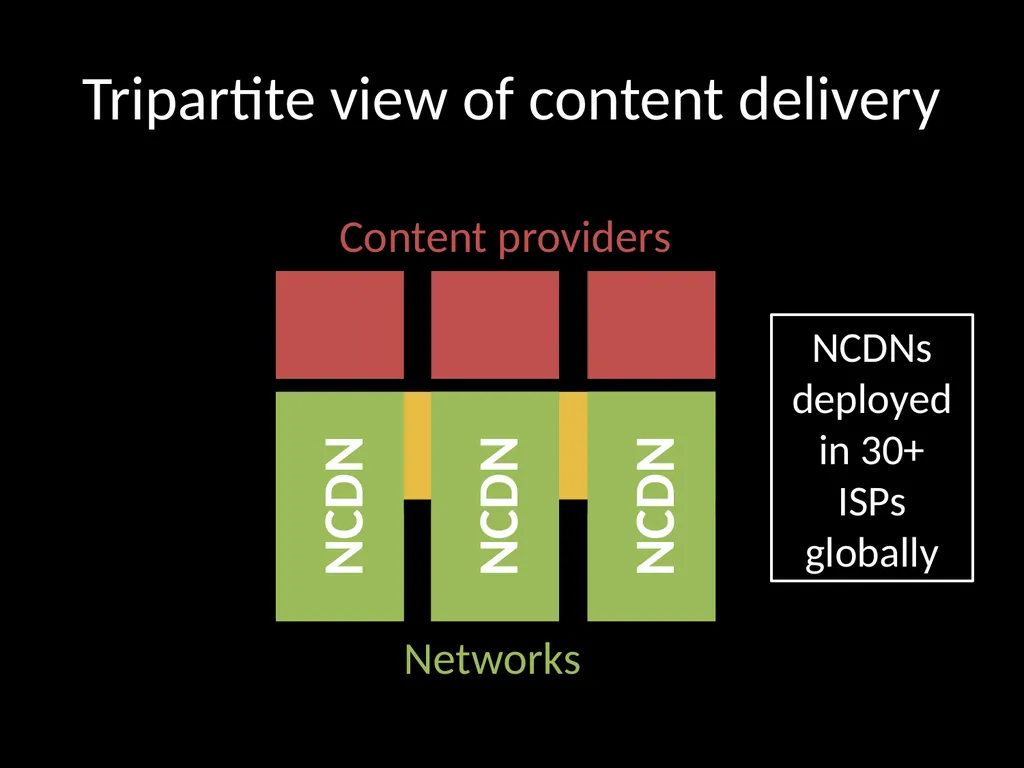
Tripartite view of content delivery CDN Networks Content providers NCDN NCDN NCDNs deployed in 30+ ISPs globally NCDN<br>
03
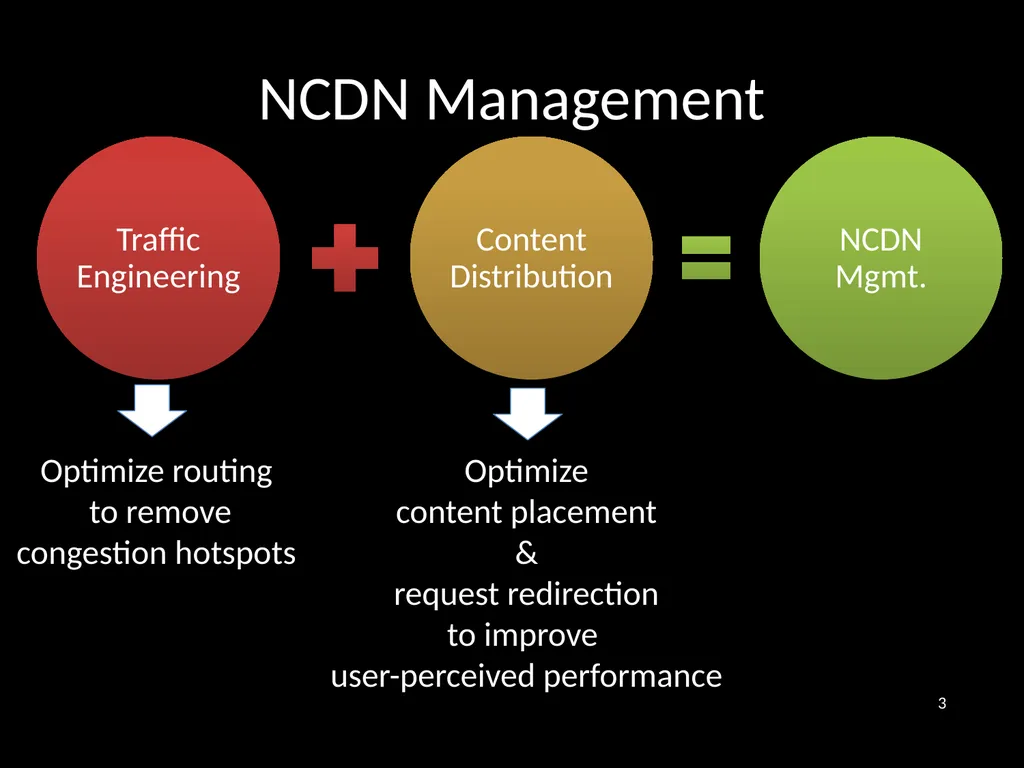
NCDN Management 3 Optimize routing
to remove congestion hotspots Optimize
content placement
&
request redirection
to improve
user-perceived performance<br>
04
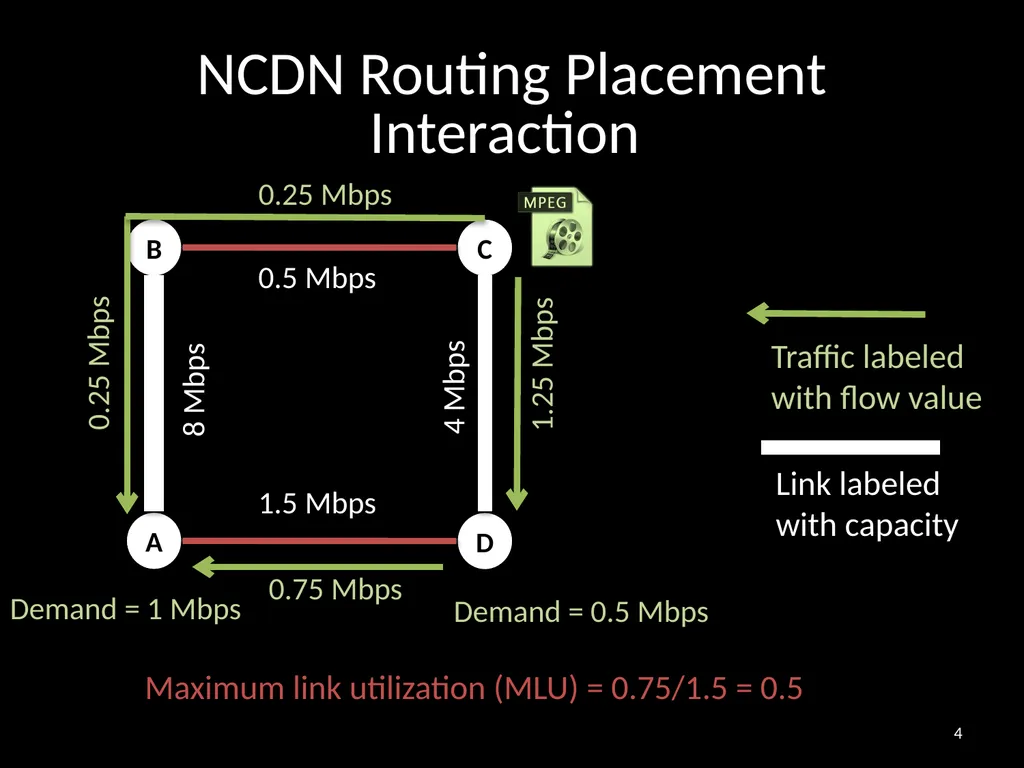
NCDN Routing Placement Interaction B C A D 8 Mbps 4 Mbps 0.5 Mbps 1.5 Mbps Demand = 1 Mbps Demand = 0.5 Mbps Maximum link utilization (MLU) = 0.75/1.5 = 0.5 4 1.25 Mbps 0.25 Mbps 0.25 Mbps 0.75 Mbps Traffic labeled with flow value Link labeled with capacity<br>
05
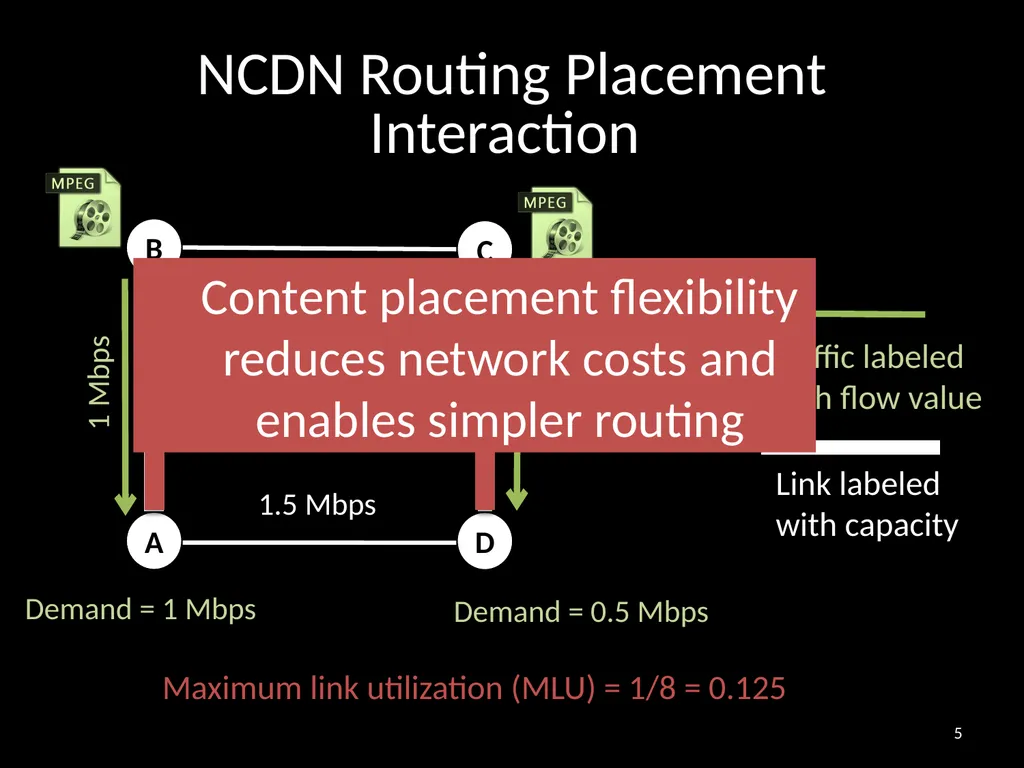
NCDN Routing Placement Interaction B C A D 8 Mbps 4 Mbps 0.5 Mbps 1.5 Mbps Demand = 1 Mbps Demand = 0.5 Mbps Maximum link utilization (MLU) = 1/8 = 0.125 5 Traffic labeled with flow value Link labeled with capacity 0.5 Mbps 1 Mbps Content placement flexibility reduces network costs and enables simpler routing<br>
Outline Network CDN
NCDN Model & Joint Optimization
Datasets: Akamai Traces & ISP Topologies
Results
Related Work 8<br>
09
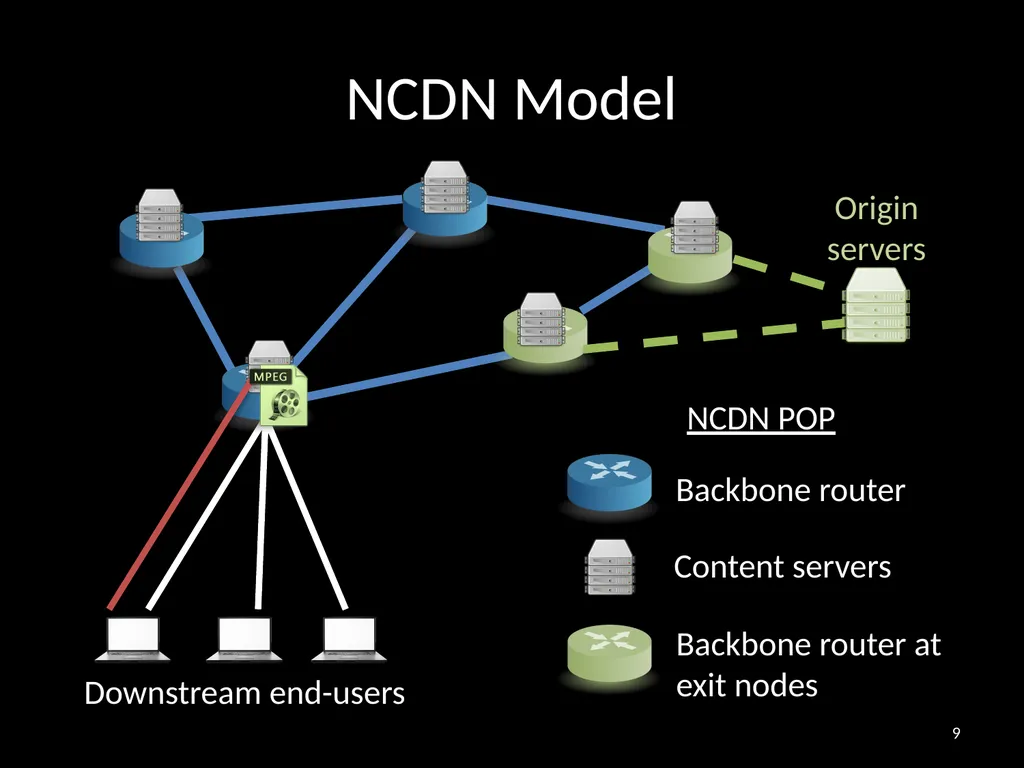
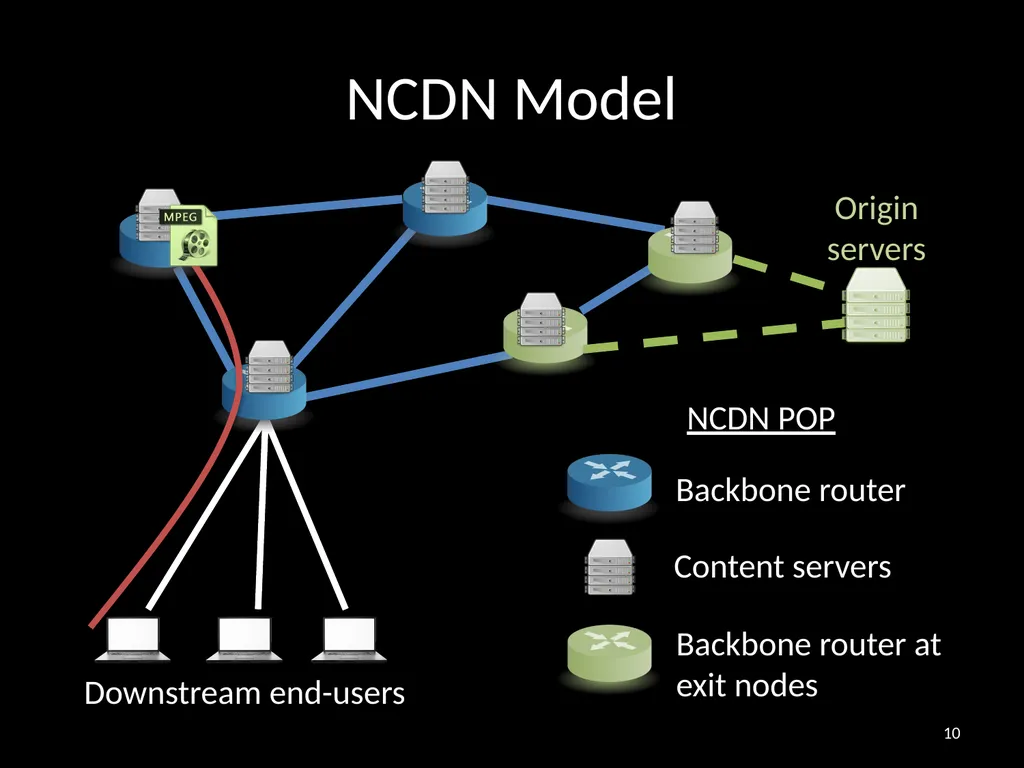
NCDN Model Downstream end-users 9 Origin servers NCDN POP Content servers Backbone router at
exit nodes Backbone router<br>
10
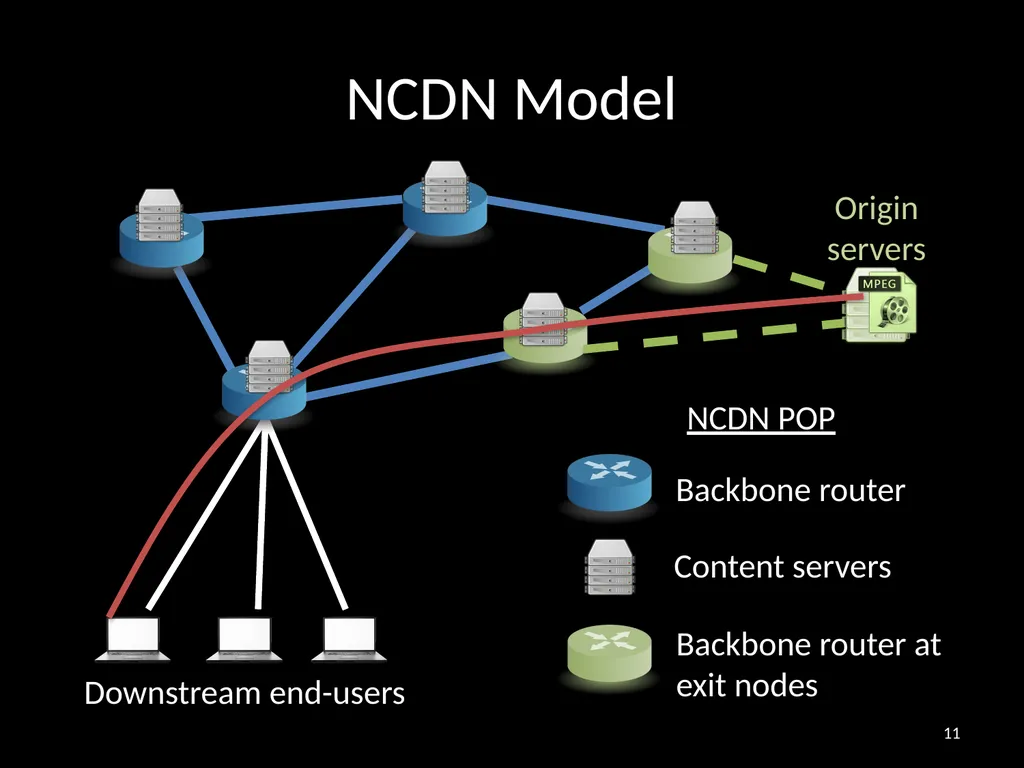
NCDN Model Downstream end-users 10 Origin servers NCDN POP Content servers Backbone router at
exit nodes Backbone router<br>
11
NCDN Model Downstream end-users 11 Origin servers NCDN POP Content servers Backbone router at
exit nodes Backbone router<br>
12
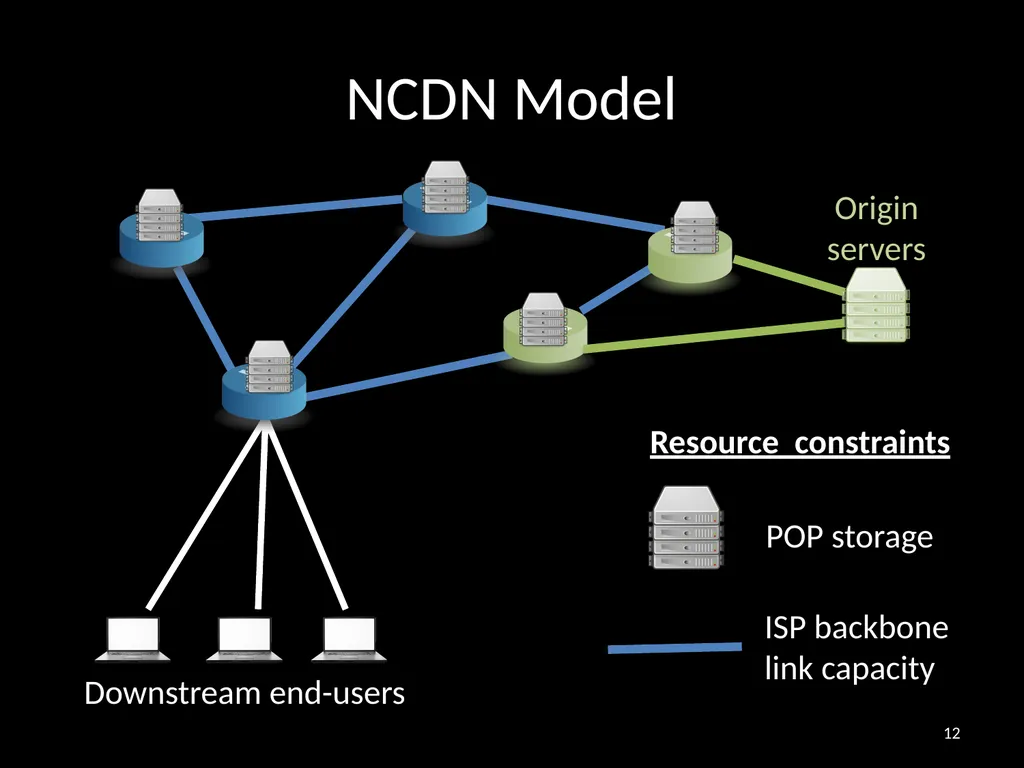
NCDN Model Downstream end-users 12 Origin servers ISP backbone
link capacity Resource constraints POP storage<br>
13
NCDN Joint Optimization Hardness
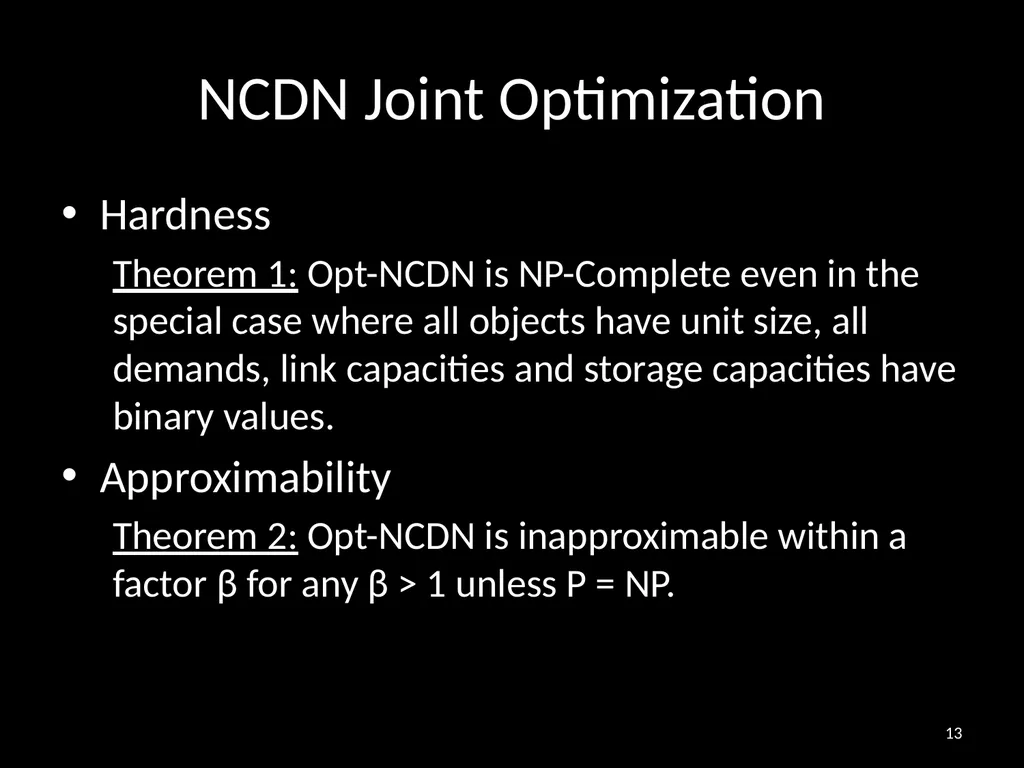
Theorem 1: Opt-NCDN is NP-Complete even in the special case where all objects have unit size, all demands, link capacities and storage capacities have binary values.
Approximability
Theorem 2: Opt-NCDN is inapproximable within a factor β for any β > 1 unless P = NP. 13<br>
14
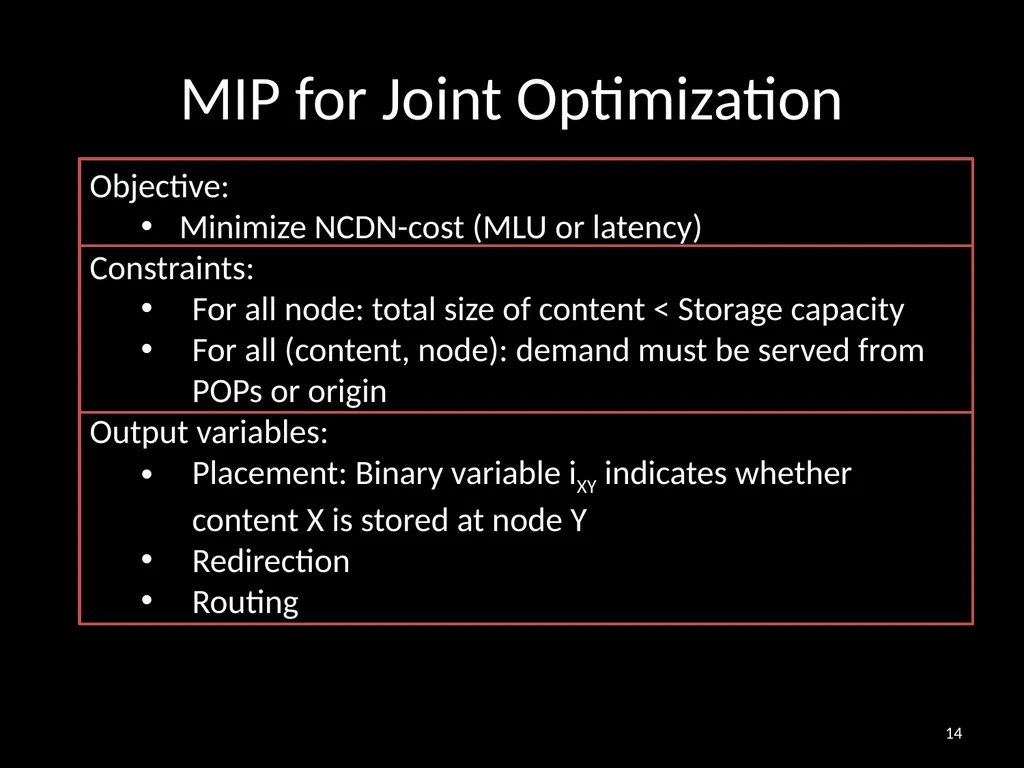
MIP for Joint Optimization 14 Objective:
Minimize NCDN-cost (MLU or latency)
Constraints:
For all node: total size of content < Storage capacity
For all (content, node): demand must be served from POPs or origin
Output variables:
Placement: Binary variable iXY indicates whether content X is stored at node Y
Redirection
Routing<br>
15
Outline Network CDN
NCDN Model & Joint Optimization
Datasets: Akamai Traces & ISP Topologies
Results
Related Work 15<br>
16
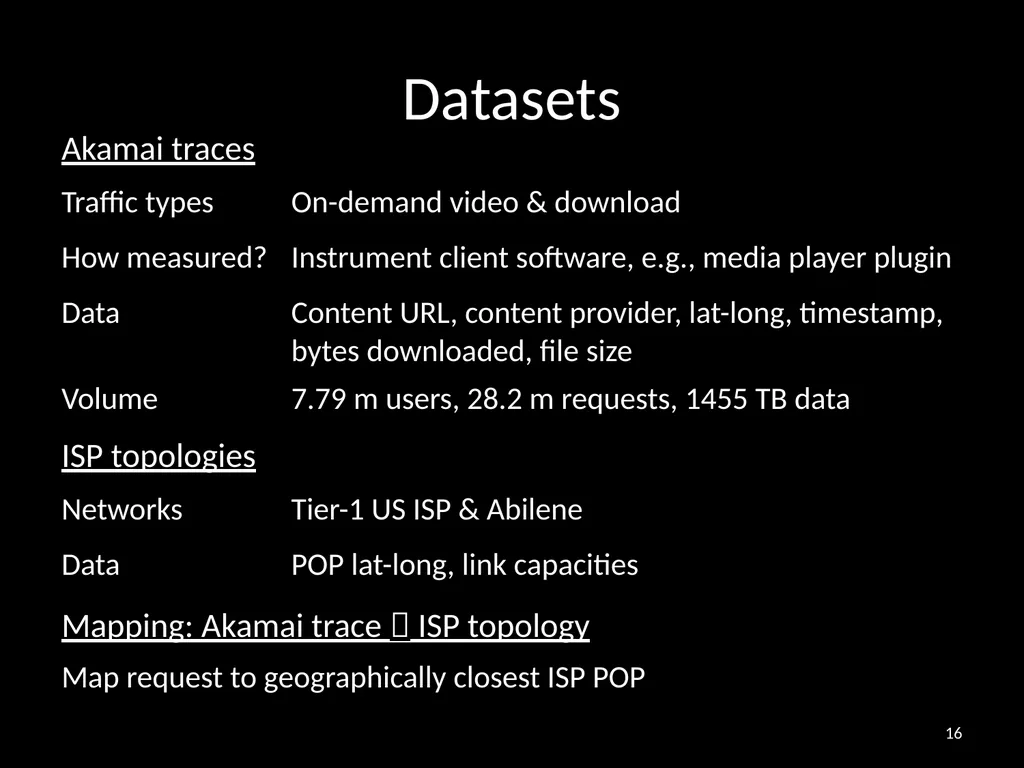
Datasets 16<br>
17
Outline Network CDN
NCDN Model & Joint Optimization
Datasets: Akamai Traces & ISP Topologies
Results
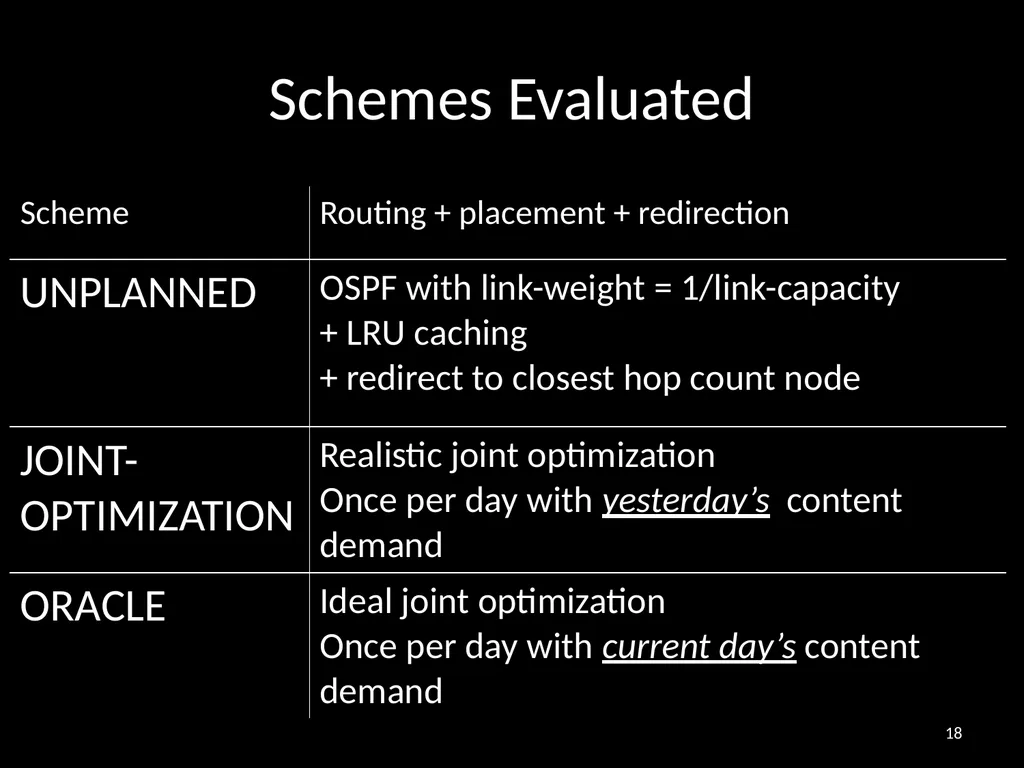
Schemes Evaluated
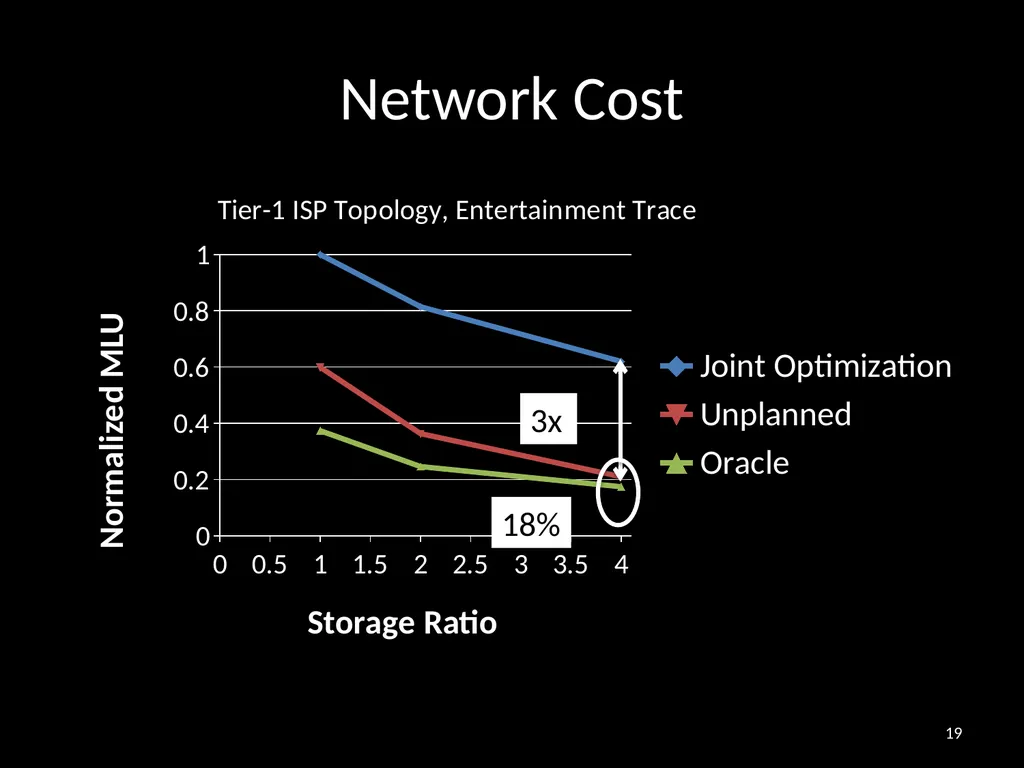
Network Cost
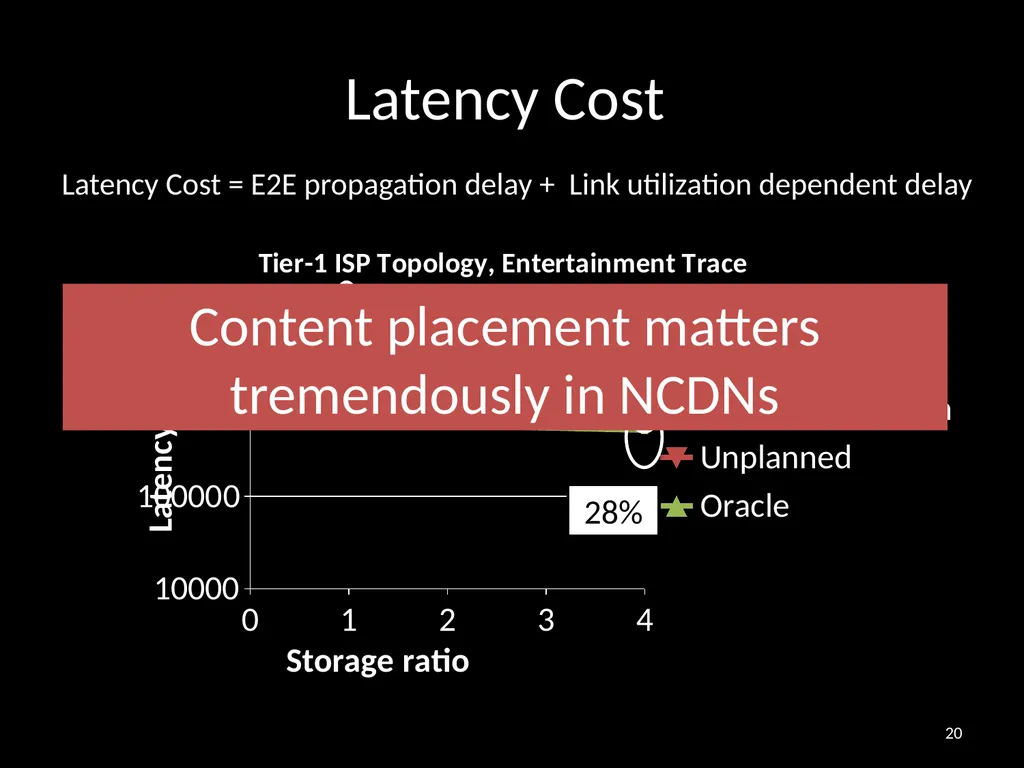
Latency Cost
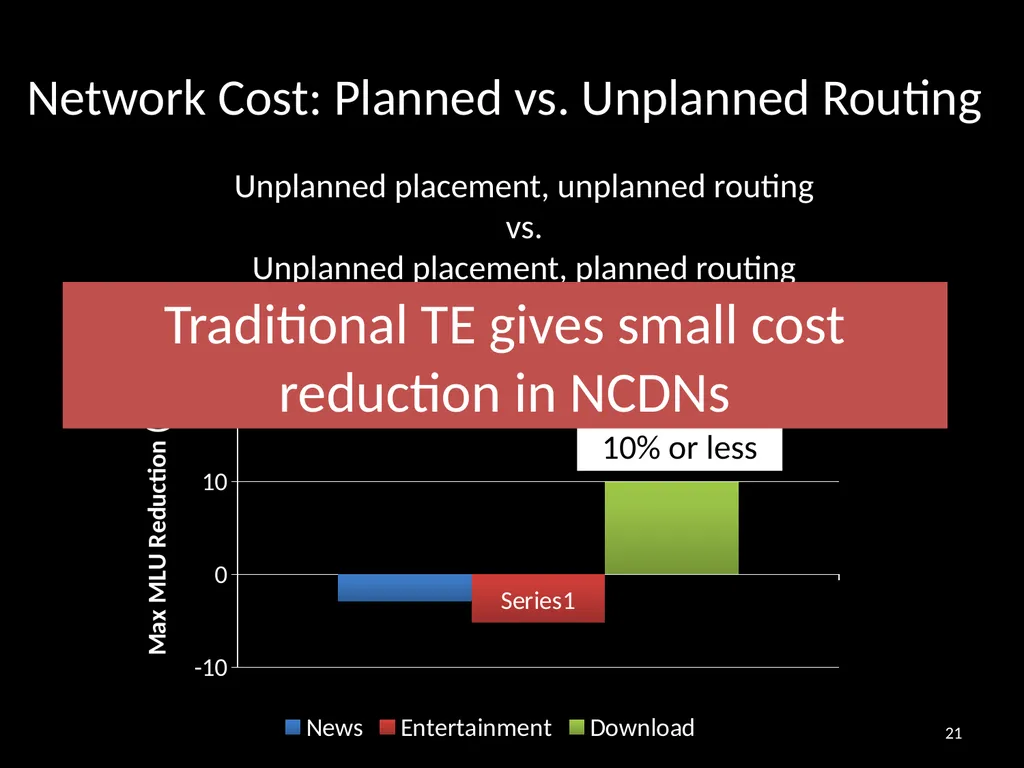
Network Cost: Planned vs. Unplanned Routing
Related Work 17<br>
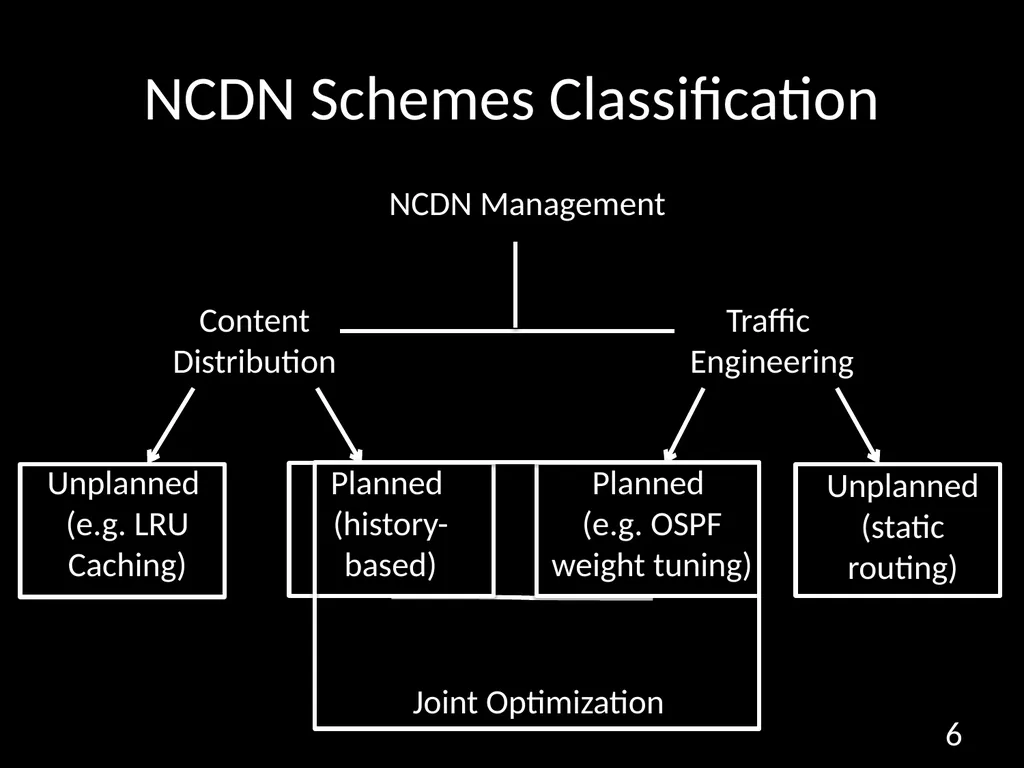
Network Cost: Planned vs. Unplanned Routing 21 10% or less Unplanned placement, unplanned routing
vs.
Unplanned placement, planned routing Traditional TE gives small cost reduction in NCDNs<br>
22
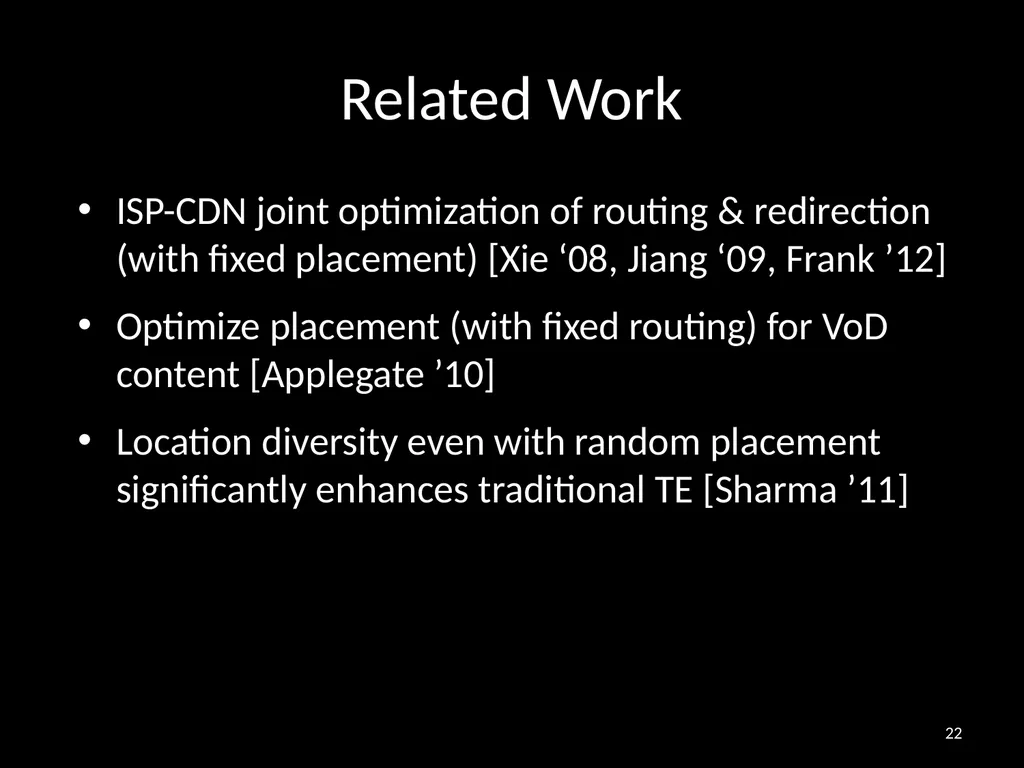
Related Work 22 ISP-CDN joint optimization of routing & redirection (with fixed placement) [Xie ‘08, Jiang ‘09, Frank ’12]
Optimize placement (with fixed routing) for VoD content [Applegate ’10]
Location diversity even with random placement significantly enhances traditional TE [Sharma ’11]<br>
23
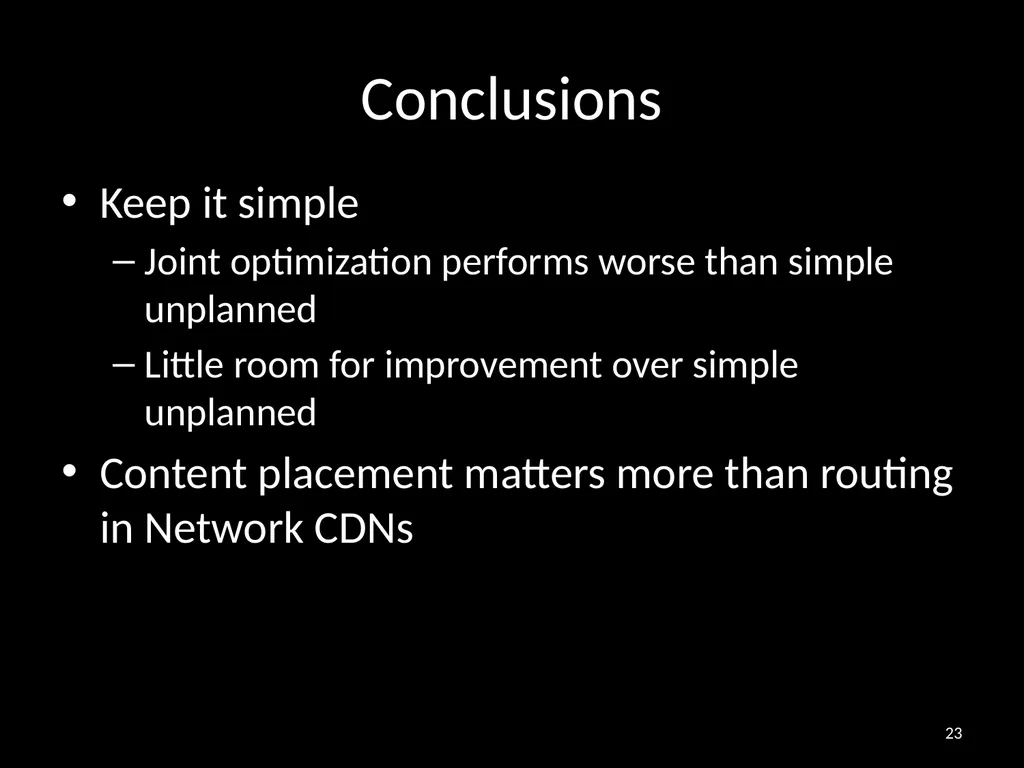
Conclusions Keep it simple
Joint optimization performs worse than simple unplanned
Little room for improvement over simple unplanned
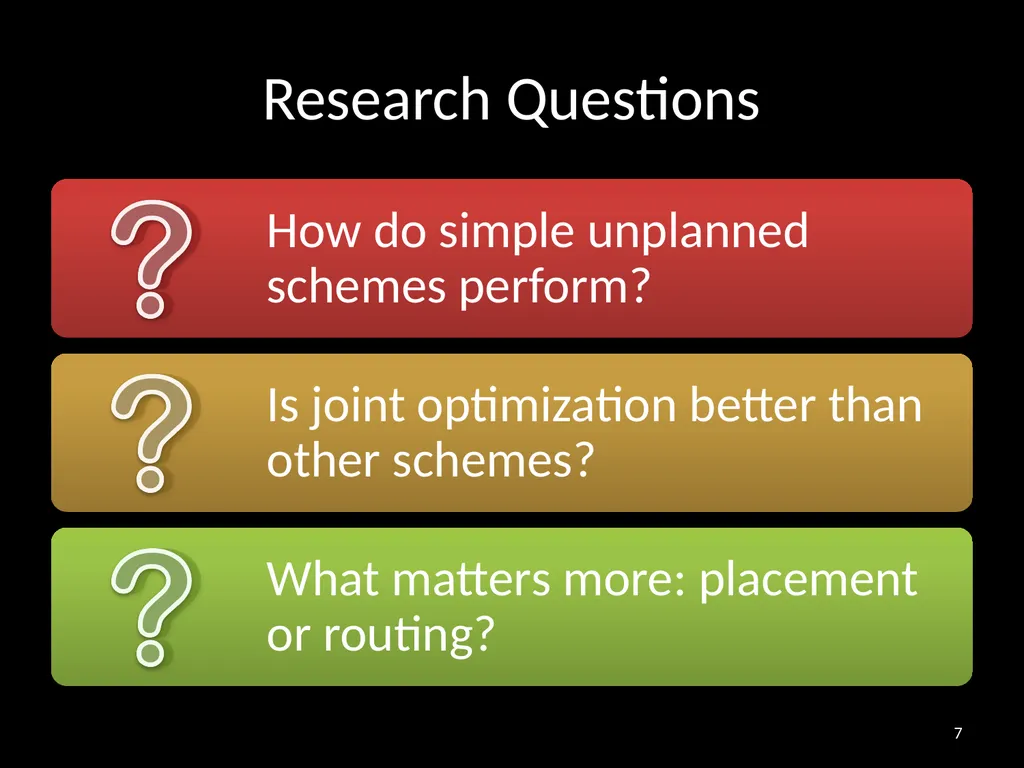
Content placement matters more than routing in Network CDNs 23<br>