
Do Now #9: Palm Beach Writes If you have been
CM
Published · 29 slides · 0 views

1 / 1

Description
Do Now 9: Palm Beach Writes If you have been living in Palm Beach county for at least a year, you know what Palm Beach Writes is. What is it? How do you feel about it? Why do you think we have to do it? What kind of scores do you usually
Related Topics
Share
Embed code
Download this presentation From Below
"Do Now #9: Palm Beach Writes If you have been" is the property of its rightful owner. Permission is granted to download and print the materials on this website for personal, non-commercial use only, and to display it on your personal computer provided you do not modify the materials and that you retain all copyright notices contained in the materials. By downloading content from our website, you accept the terms of this agreement.
Presentation Transcript
01
Do Now #9: Palm Beach Writes If you have been living in Palm Beach county for at least a year, you know what Palm Beach Writes is. What is it? How do you feel about it? Why do you think we have to do it? What kind of scores do you usually make on them? How much effort do you usually put into it? Discuss the Palm Beach Writes assessment (AKA PBPA) in AT LEAST FIVE SENTENCES.
If you are new to the area, did you have essay tests at your last school, where you had to read a few articles and then write an essay based on a given prompt? What was the test called? Were you told why you had to complete them? How did you feel about the tests? How did you usually do on them? Do you feel like they were preparing you for an important state test? What state test?<br>
If you are new to the area, did you have essay tests at your last school, where you had to read a few articles and then write an essay based on a given prompt? What was the test called? Were you told why you had to complete them? How did you feel about the tests? How did you usually do on them? Do you feel like they were preparing you for an important state test? What state test?<br>
02
Palm Beach Writes Prep (Palm Beach Performance Assessment)<br>
03
NOOOOOO!!!! WHY do we have to do these EVERY YEAR????? TO PRACTICE FOR THE FSA!!!!
Passing the 10th grade Reading and Writing FSA is VITAL if you want to GRADUATE!!!
Even if you have ALL your credits and straight As in EVERY CLASS, if you do not pass the FSA you CAN NOT GRADUATE HIGH SCHOOL!!!
So this is SUPER IMPORTANT, and the best way to prepare is to PRACTICE!
Passing the 9th grade Reading and Writing FSA will get you out of Intensive Reading and allow you to take another elective!!!
TAKE THESE SERIOUSLY! The more you try on the PBWs the more you’ll be prepared for the FSA!<br>
Passing the 10th grade Reading and Writing FSA is VITAL if you want to GRADUATE!!!
Even if you have ALL your credits and straight As in EVERY CLASS, if you do not pass the FSA you CAN NOT GRADUATE HIGH SCHOOL!!!
So this is SUPER IMPORTANT, and the best way to prepare is to PRACTICE!
Passing the 9th grade Reading and Writing FSA will get you out of Intensive Reading and allow you to take another elective!!!
TAKE THESE SERIOUSLY! The more you try on the PBWs the more you’ll be prepared for the FSA!<br>
04
Palm Beach Writes, Round 1: Informative You will be writing an Informative (or expository) piece. This means you will be proving your reader with INFORMATION. (Duh.)
BEFORE YOU START, Read the Prompt CAREFULLY! Ask yourself:
WHO is my audience? (This will help determine what tone you should use! Formal or informal or somewhere in between?)
WHAT am I writing? (Are you writing a letter, an essay, an article or a blog? This will help determine what format you should use, although no matter what you’re writing it should have the same basic format.)
WHAT do I need to cover in my writing? (Look for key words in the prompt like “AND.” Mark these to remind yourself that you MUST cover everything the prompt mentions!)
WHAT is my purpose? (Since we know this is informative, we know our purpose is to INFORM, but are we giving information on one topic alone or two sides of an issue?)<br>
BEFORE YOU START, Read the Prompt CAREFULLY! Ask yourself:
WHO is my audience? (This will help determine what tone you should use! Formal or informal or somewhere in between?)
WHAT am I writing? (Are you writing a letter, an essay, an article or a blog? This will help determine what format you should use, although no matter what you’re writing it should have the same basic format.)
WHAT do I need to cover in my writing? (Look for key words in the prompt like “AND.” Mark these to remind yourself that you MUST cover everything the prompt mentions!)
WHAT is my purpose? (Since we know this is informative, we know our purpose is to INFORM, but are we giving information on one topic alone or two sides of an issue?)<br>
05
1. WHO is my audience? Do you speak to everyone the same way? (Teachers, parents, friends, grandparents, priests, coaches, the Pope?)
If your audience is your principal, your teachers, your senator, your president, or anyone that SHOULD be shown respect, your tone must be FORMAL!
If your audience is your friends or your classmates, you can be more casual.
Exercise: You are going to be late to class. Send an email to your teacher letting them know, and a text to your friend. Examine the difference.<br>
If your audience is your principal, your teachers, your senator, your president, or anyone that SHOULD be shown respect, your tone must be FORMAL!
If your audience is your friends or your classmates, you can be more casual.
Exercise: You are going to be late to class. Send an email to your teacher letting them know, and a text to your friend. Examine the difference.<br>
06
2. WHAT am I writing? Are you writing a letter to the president? How would it start?
Are you writing an article for a school newspaper? What format would it be in?
Are you writing a blog? Who will be reading it?<br>
Are you writing an article for a school newspaper? What format would it be in?
Are you writing a blog? Who will be reading it?<br>
07
3. WHAT do I need to cover in my writing and 4. WHAT is my purpose? READ THE PROMPT CAREFULLY!
Look for key words like: “inform fellow students of recent advancements in medicine and the benefits and how those advancements affect teenagers and children.”
Those “and”s mean you need to talk about ALL THOSE POINTS!
Look carefully at what is being asked of you! Like: “Write a letter to your principal explaining the advantages and disadvantages of school uniforms.”
This means you have to talk about BOTH SIDES of the issue!<br>
Look for key words like: “inform fellow students of recent advancements in medicine and the benefits and how those advancements affect teenagers and children.”
Those “and”s mean you need to talk about ALL THOSE POINTS!
Look carefully at what is being asked of you! Like: “Write a letter to your principal explaining the advantages and disadvantages of school uniforms.”
This means you have to talk about BOTH SIDES of the issue!<br>
08
WHILE YOU READ Annotate! Use highlighters to mark important information that you want to return to or use in your essay! If something looks like it will be a good quote, highlight or underline it!
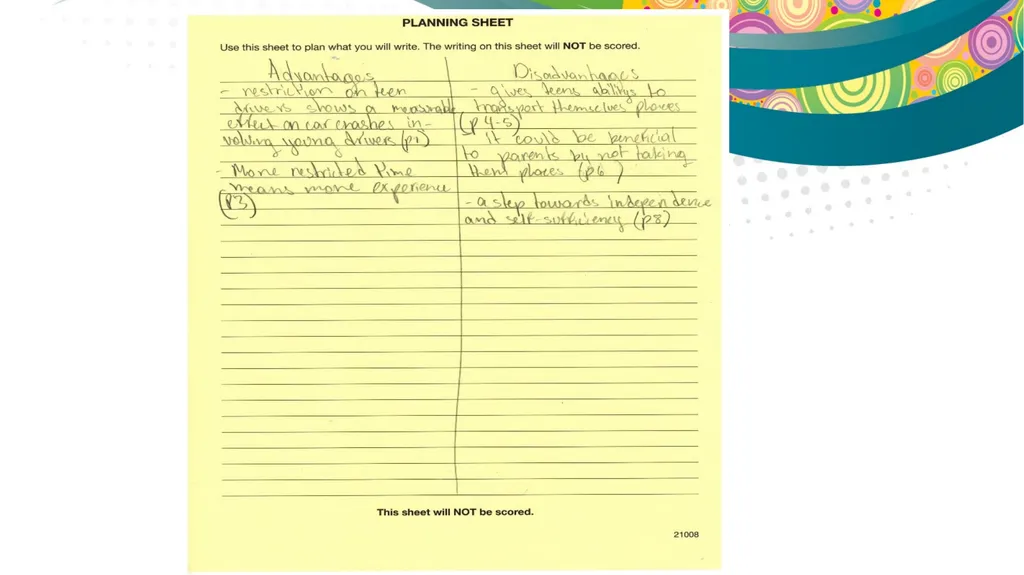
Plan! Use your planning sheet WHILE you read to outline your essay! Decide what your topics will be in each body paragraph! Create an outline or a T chart!<br>
Plan! Use your planning sheet WHILE you read to outline your essay! Decide what your topics will be in each body paragraph! Create an outline or a T chart!<br>
09
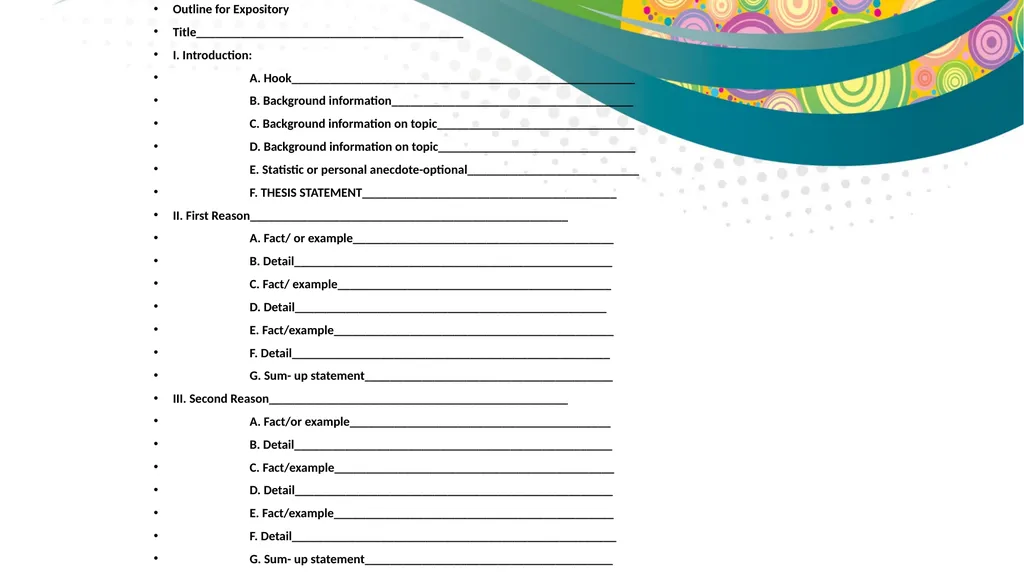
Outline for Expository
Title__________________________________________
I. Introduction:
A. Hook______________________________________________________
B. Background information______________________________________
C. Background information on topic_______________________________
D. Background information on topic_______________________________
E. Statistic or personal anecdote-optional___________________________
F. THESIS STATEMENT________________________________________
II. First Reason__________________________________________________
A. Fact/ or example_________________________________________
B. Detail__________________________________________________
C. Fact/ example___________________________________________
D. Detail_________________________________________________
E. Fact/example____________________________________________
F. Detail__________________________________________________
G. Sum- up statement_______________________________________
III. Second Reason_______________________________________________
A. Fact/or example_________________________________________
B. Detail__________________________________________________
C. Fact/example____________________________________________
D. Detail__________________________________________________
E. Fact/example____________________________________________
F. Detail___________________________________________________
G. Sum- up statement_______________________________________<br>
Title__________________________________________
I. Introduction:
A. Hook______________________________________________________
B. Background information______________________________________
C. Background information on topic_______________________________
D. Background information on topic_______________________________
E. Statistic or personal anecdote-optional___________________________
F. THESIS STATEMENT________________________________________
II. First Reason__________________________________________________
A. Fact/ or example_________________________________________
B. Detail__________________________________________________
C. Fact/ example___________________________________________
D. Detail_________________________________________________
E. Fact/example____________________________________________
F. Detail__________________________________________________
G. Sum- up statement_______________________________________
III. Second Reason_______________________________________________
A. Fact/or example_________________________________________
B. Detail__________________________________________________
C. Fact/example____________________________________________
D. Detail__________________________________________________
E. Fact/example____________________________________________
F. Detail___________________________________________________
G. Sum- up statement_______________________________________<br>
10
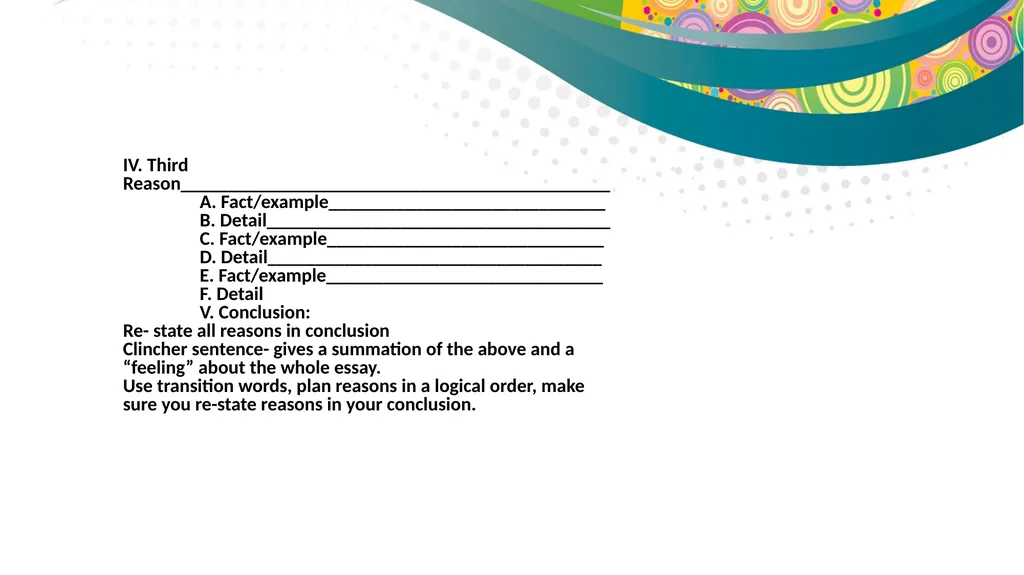
IV. Third Reason_____________________________________________
A. Fact/example_____________________________
B. Detail____________________________________
C. Fact/example_____________________________
D. Detail___________________________________
E. Fact/example_____________________________
F. Detail
V. Conclusion:
Re- state all reasons in conclusion
Clincher sentence- gives a summation of the above and a “feeling” about the whole essay.
Use transition words, plan reasons in a logical order, make sure you re-state reasons in your conclusion.<br>
A. Fact/example_____________________________
B. Detail____________________________________
C. Fact/example_____________________________
D. Detail___________________________________
E. Fact/example_____________________________
F. Detail
V. Conclusion:
Re- state all reasons in conclusion
Clincher sentence- gives a summation of the above and a “feeling” about the whole essay.
Use transition words, plan reasons in a logical order, make sure you re-state reasons in your conclusion.<br>
11
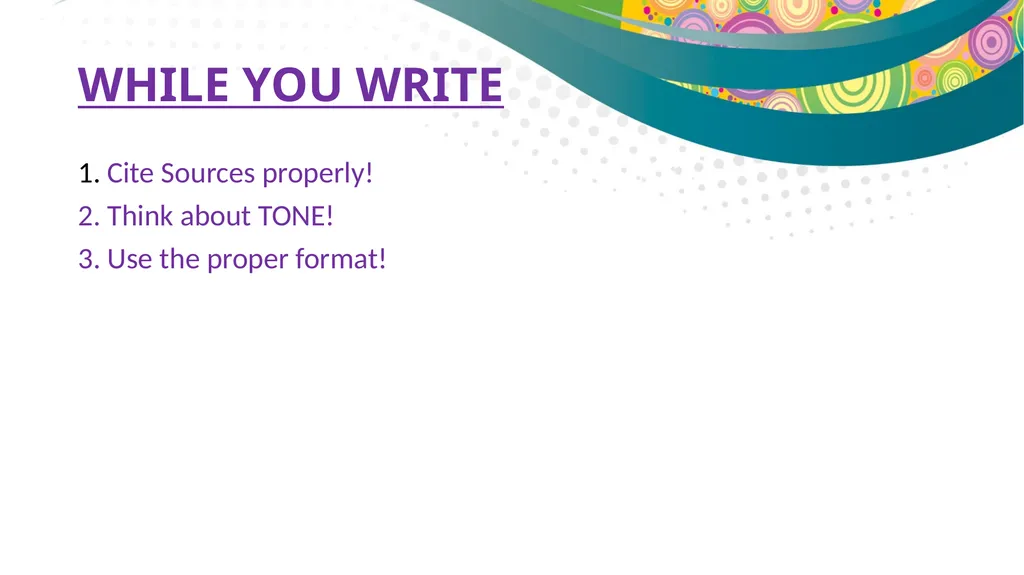
WHILE YOU WRITE 1. Cite Sources properly!
2. Think about TONE!
3. Use the proper format!<br>
2. Think about TONE!
3. Use the proper format!<br>
12
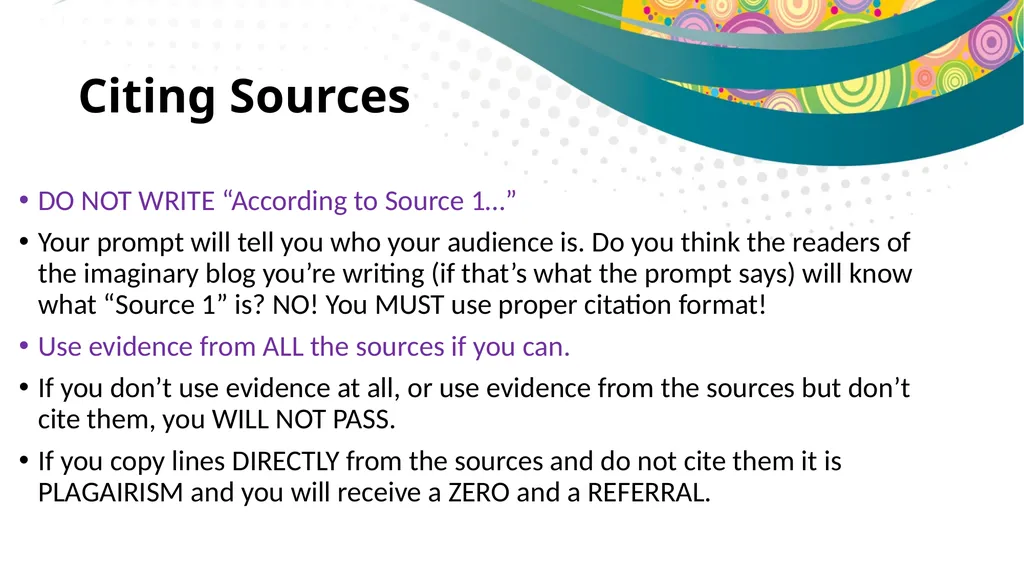
Citing Sources DO NOT WRITE “According to Source 1…”
Your prompt will tell you who your audience is. Do you think the readers of the imaginary blog you’re writing (if that’s what the prompt says) will know what “Source 1” is? NO! You MUST use proper citation format!
Use evidence from ALL the sources if you can.
If you don’t use evidence at all, or use evidence from the sources but don’t cite them, you WILL NOT PASS.
If you copy lines DIRECTLY from the sources and do not cite them it is PLAGAIRISM and you will receive a ZERO and a REFERRAL.<br>
Your prompt will tell you who your audience is. Do you think the readers of the imaginary blog you’re writing (if that’s what the prompt says) will know what “Source 1” is? NO! You MUST use proper citation format!
Use evidence from ALL the sources if you can.
If you don’t use evidence at all, or use evidence from the sources but don’t cite them, you WILL NOT PASS.
If you copy lines DIRECTLY from the sources and do not cite them it is PLAGAIRISM and you will receive a ZERO and a REFERRAL.<br>
13
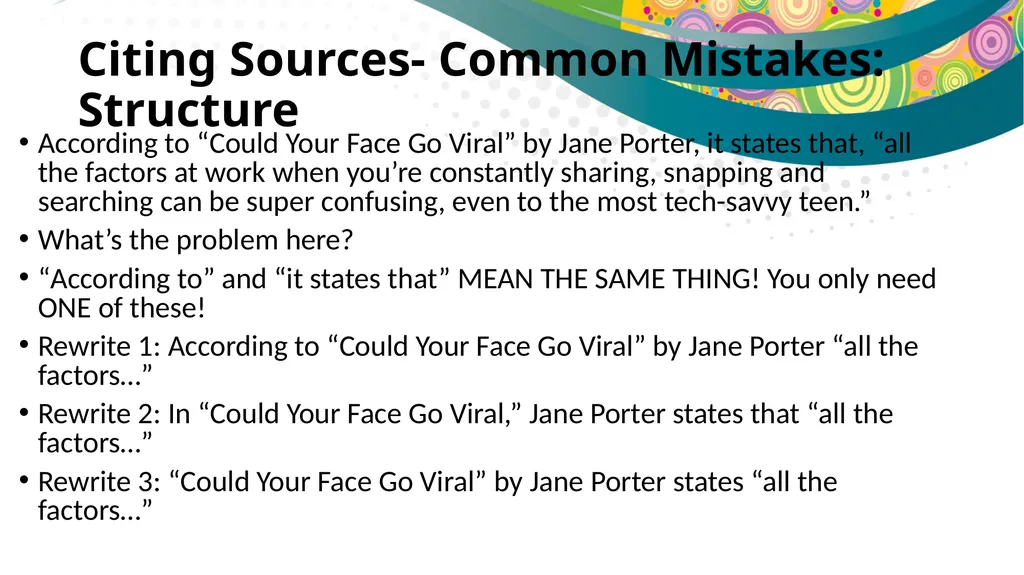
Citing Sources- Common Mistakes: Structure According to “Could Your Face Go Viral” by Jane Porter, it states that, “all the factors at work when you’re constantly sharing, snapping and searching can be super confusing, even to the most tech-savvy teen.”
What’s the problem here?
“According to” and “it states that” MEAN THE SAME THING! You only need ONE of these!
Rewrite 1: According to “Could Your Face Go Viral” by Jane Porter “all the factors…”
Rewrite 2: In “Could Your Face Go Viral,” Jane Porter states that “all the factors…”
Rewrite 3: “Could Your Face Go Viral” by Jane Porter states “all the factors…”<br>
What’s the problem here?
“According to” and “it states that” MEAN THE SAME THING! You only need ONE of these!
Rewrite 1: According to “Could Your Face Go Viral” by Jane Porter “all the factors…”
Rewrite 2: In “Could Your Face Go Viral,” Jane Porter states that “all the factors…”
Rewrite 3: “Could Your Face Go Viral” by Jane Porter states “all the factors…”<br>
14
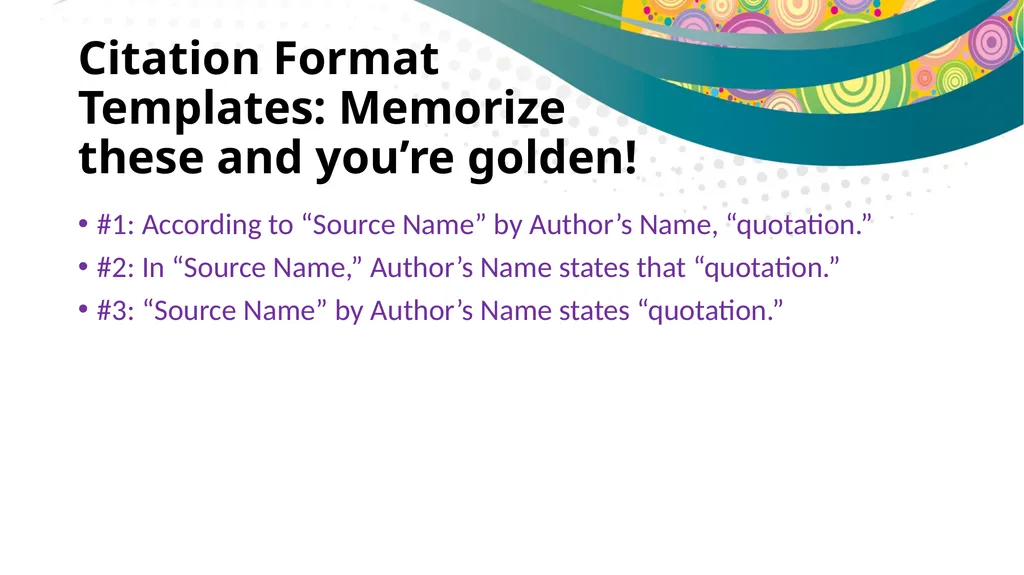
Citation Format Templates: Memorize these and you’re golden! #1: According to “Source Name” by Author’s Name, “quotation.”
#2: In “Source Name,” Author’s Name states that “quotation.”
#3: “Source Name” by Author’s Name states “quotation.”<br>
#2: In “Source Name,” Author’s Name states that “quotation.”
#3: “Source Name” by Author’s Name states “quotation.”<br>
15
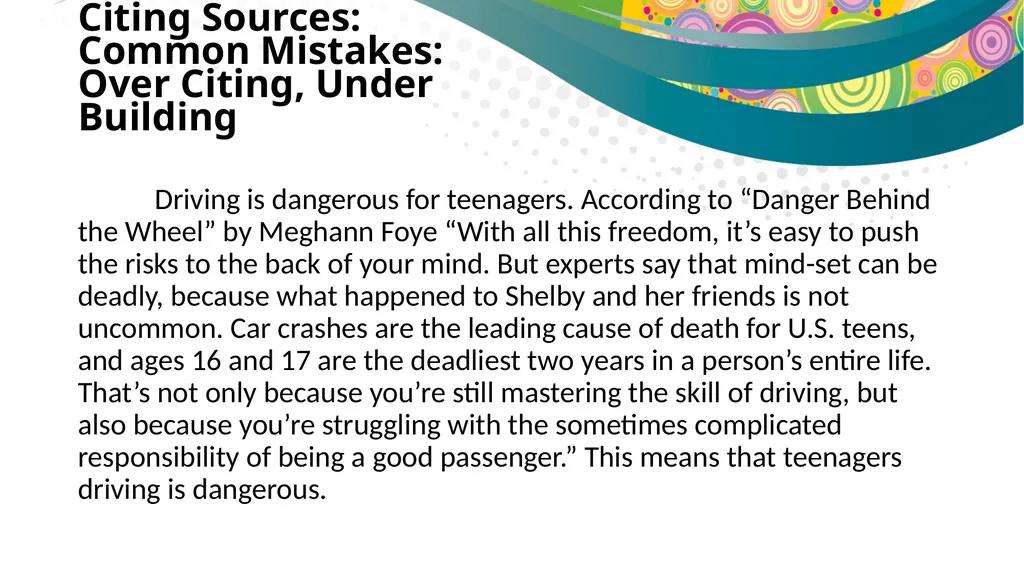
Citing Sources: Common Mistakes: Over Citing, Under Building Driving is dangerous for teenagers. According to “Danger Behind the Wheel” by Meghann Foye “With all this freedom, it’s easy to push the risks to the back of your mind. But experts say that mind-set can be deadly, because what happened to Shelby and her friends is not uncommon. Car crashes are the leading cause of death for U.S. teens, and ages 16 and 17 are the deadliest two years in a person’s entire life. That’s not only because you’re still mastering the skill of driving, but also because you’re struggling with the sometimes complicated responsibility of being a good passenger.” This means that teenagers driving is dangerous.<br>
16
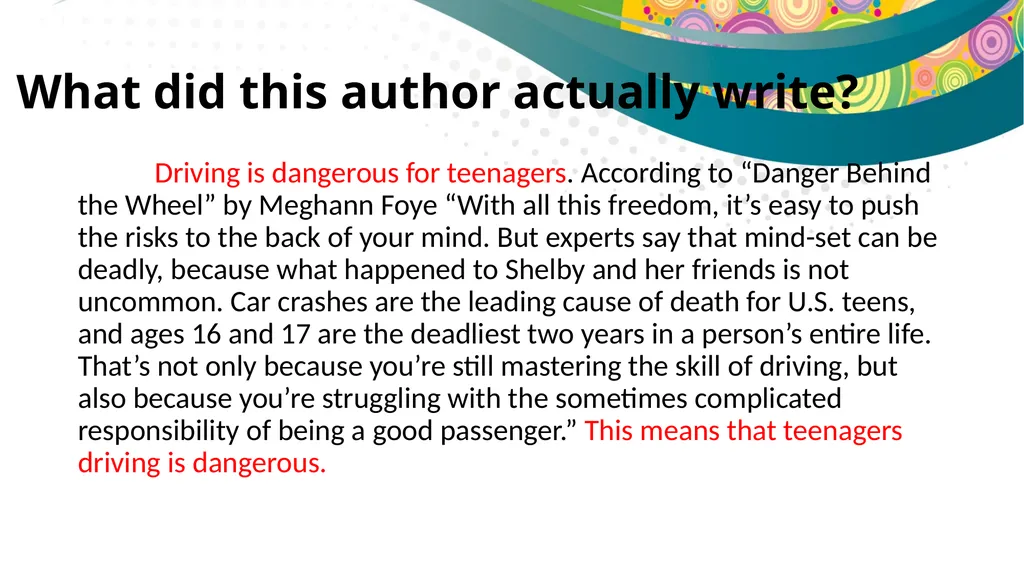
What did this author actually write? Driving is dangerous for teenagers. According to “Danger Behind the Wheel” by Meghann Foye “With all this freedom, it’s easy to push the risks to the back of your mind. But experts say that mind-set can be deadly, because what happened to Shelby and her friends is not uncommon. Car crashes are the leading cause of death for U.S. teens, and ages 16 and 17 are the deadliest two years in a person’s entire life. That’s not only because you’re still mastering the skill of driving, but also because you’re struggling with the sometimes complicated responsibility of being a good passenger.” This means that teenagers driving is dangerous.<br>
17
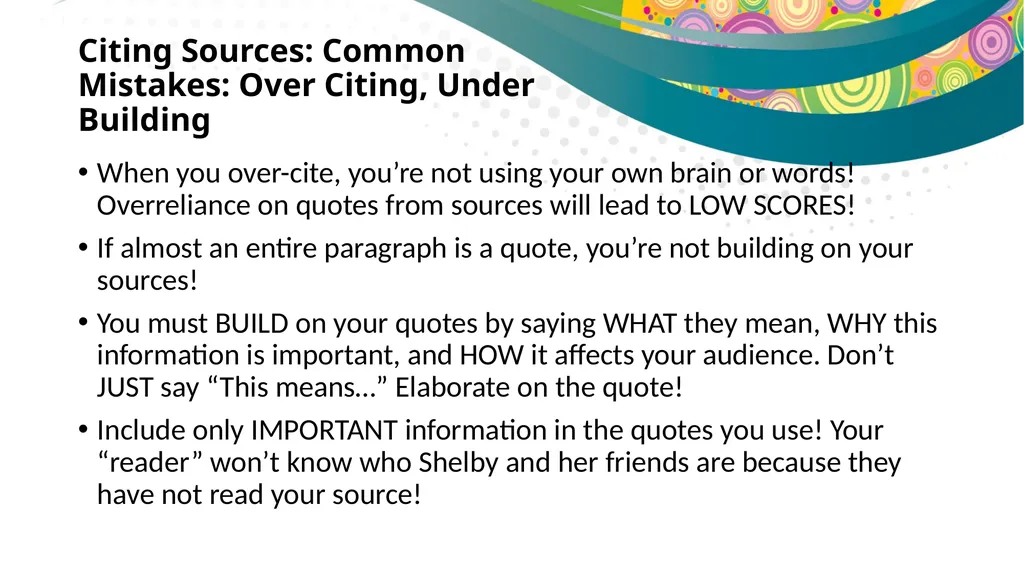
Citing Sources: Common Mistakes: Over Citing, Under Building When you over-cite, you’re not using your own brain or words! Overreliance on quotes from sources will lead to LOW SCORES!
If almost an entire paragraph is a quote, you’re not building on your sources!
You must BUILD on your quotes by saying WHAT they mean, WHY this information is important, and HOW it affects your audience. Don’t JUST say “This means…” Elaborate on the quote!
Include only IMPORTANT information in the quotes you use! Your “reader” won’t know who Shelby and her friends are because they have not read your source!<br>
If almost an entire paragraph is a quote, you’re not building on your sources!
You must BUILD on your quotes by saying WHAT they mean, WHY this information is important, and HOW it affects your audience. Don’t JUST say “This means…” Elaborate on the quote!
Include only IMPORTANT information in the quotes you use! Your “reader” won’t know who Shelby and her friends are because they have not read your source!<br>
18
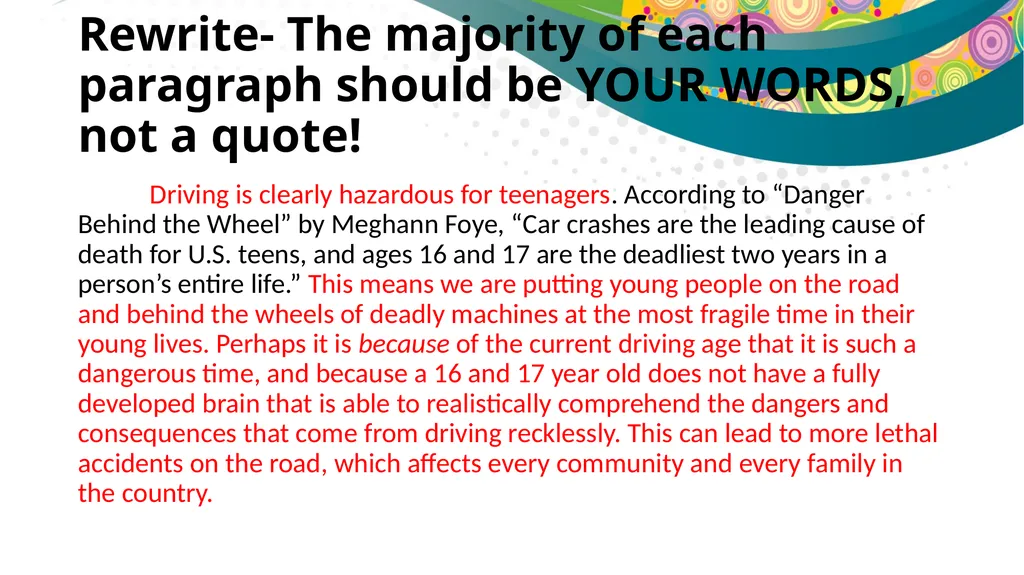
Rewrite- The majority of each paragraph should be YOUR WORDS, not a quote! Driving is clearly hazardous for teenagers. According to “Danger Behind the Wheel” by Meghann Foye, “Car crashes are the leading cause of death for U.S. teens, and ages 16 and 17 are the deadliest two years in a person’s entire life.” This means we are putting young people on the road and behind the wheels of deadly machines at the most fragile time in their young lives. Perhaps it is because of the current driving age that it is such a dangerous time, and because a 16 and 17 year old does not have a fully developed brain that is able to realistically comprehend the dangers and consequences that come from driving recklessly. This can lead to more lethal accidents on the road, which affects every community and every family in the country.<br>
19
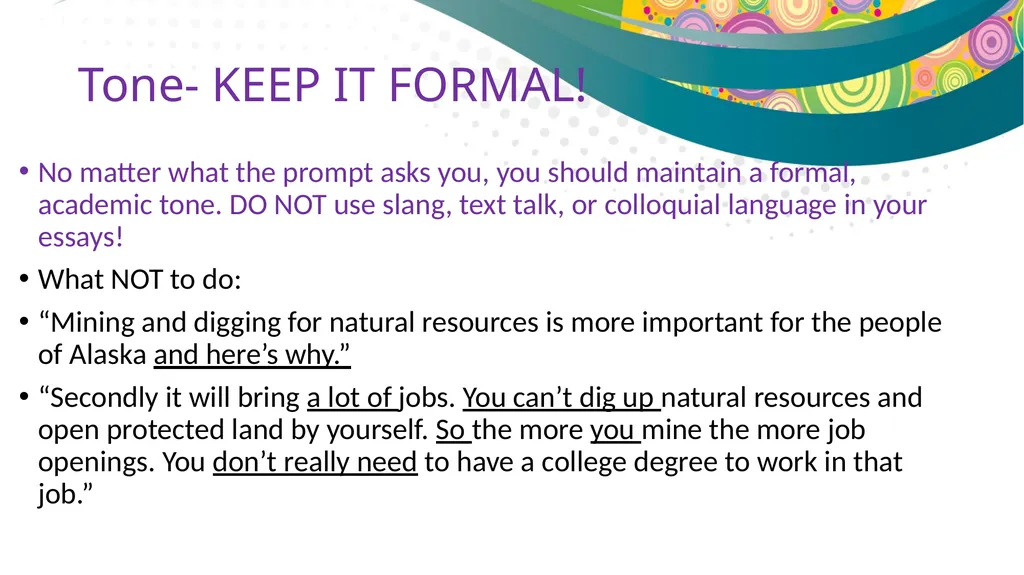
Tone- KEEP IT FORMAL! No matter what the prompt asks you, you should maintain a formal, academic tone. DO NOT use slang, text talk, or colloquial language in your essays!
What NOT to do:
“Mining and digging for natural resources is more important for the people of Alaska and here’s why.”
“Secondly it will bring a lot of jobs. You can’t dig up natural resources and open protected land by yourself. So the more you mine the more job openings. You don’t really need to have a college degree to work in that job.”<br>
What NOT to do:
“Mining and digging for natural resources is more important for the people of Alaska and here’s why.”
“Secondly it will bring a lot of jobs. You can’t dig up natural resources and open protected land by yourself. So the more you mine the more job openings. You don’t really need to have a college degree to work in that job.”<br>
20
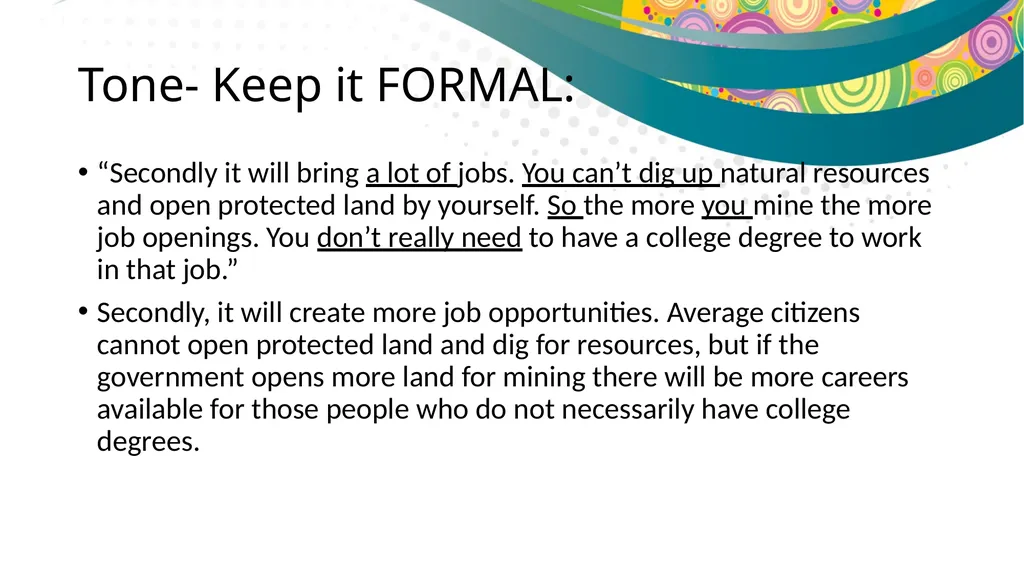
Tone- Keep it FORMAL: “Secondly it will bring a lot of jobs. You can’t dig up natural resources and open protected land by yourself. So the more you mine the more job openings. You don’t really need to have a college degree to work in that job.”
Secondly, it will create more job opportunities. Average citizens cannot open protected land and dig for resources, but if the government opens more land for mining there will be more careers available for those people who do not necessarily have college degrees.<br>
Secondly, it will create more job opportunities. Average citizens cannot open protected land and dig for resources, but if the government opens more land for mining there will be more careers available for those people who do not necessarily have college degrees.<br>
21
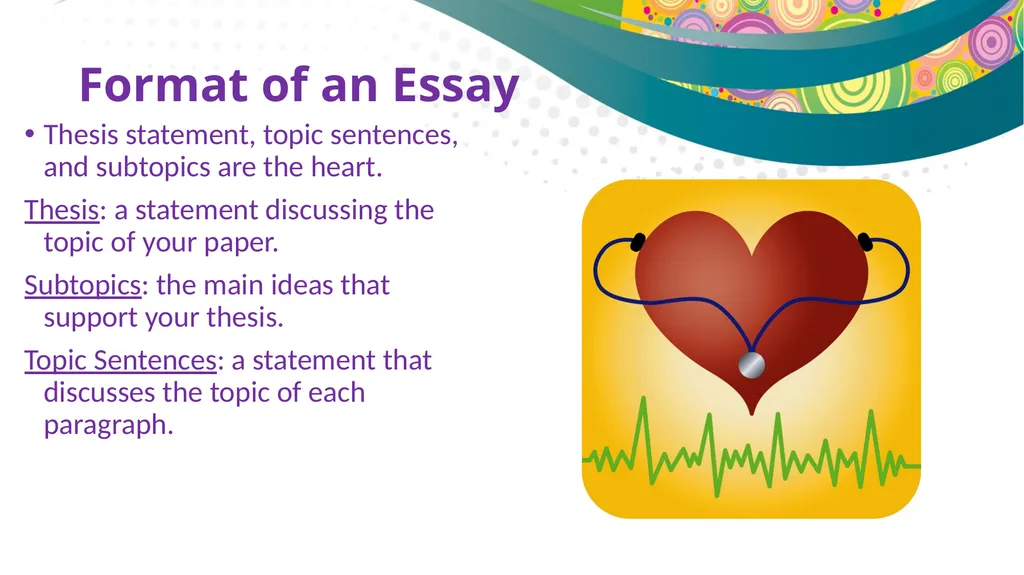
Format of an Essay Thesis statement, topic sentences, and subtopics are the heart.
Thesis: a statement discussing the topic of your paper.
Subtopics: the main ideas that support your thesis.
Topic Sentences: a statement that discusses the topic of each paragraph.<br>
Thesis: a statement discussing the topic of your paper.
Subtopics: the main ideas that support your thesis.
Topic Sentences: a statement that discusses the topic of each paragraph.<br>
22
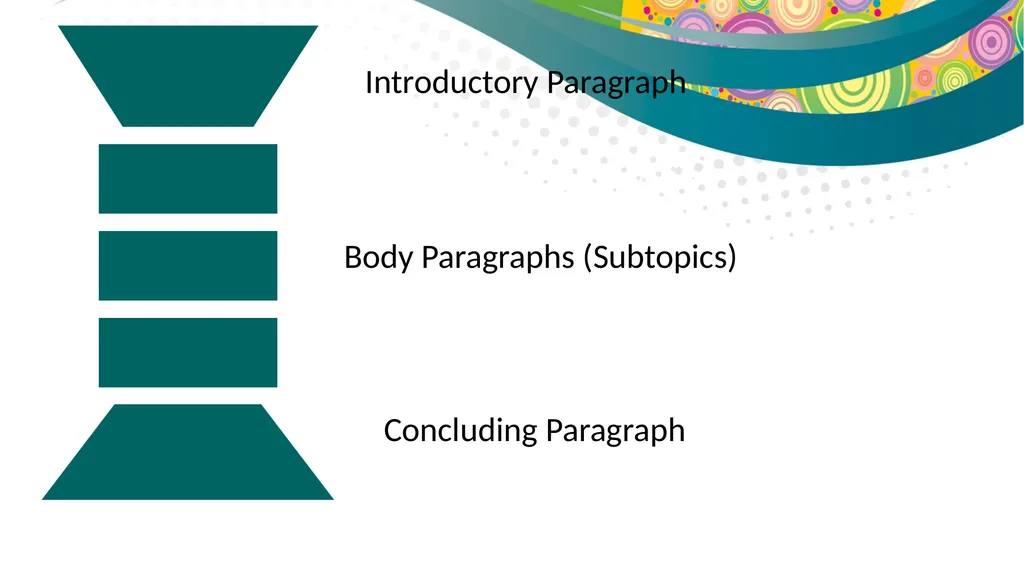
Introductory Paragraph Body Paragraphs (Subtopics) Concluding Paragraph<br>
23
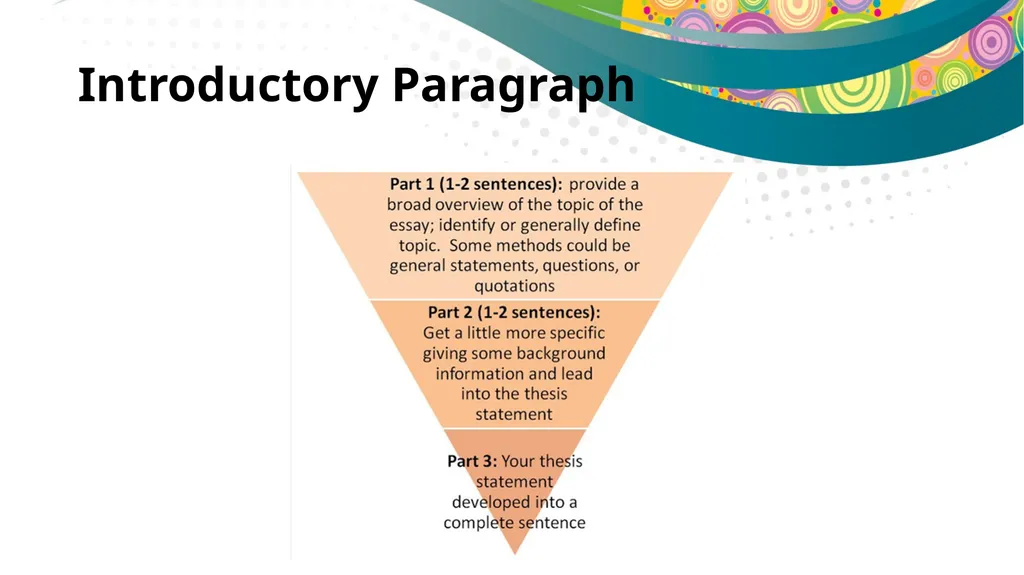
Introductory Paragraph<br>
24
Body Paragraphs Purpose of Body Paragraphs:
To support your topic statement using direct quotations, specific textual detail, and strong explanations.
Elements of a Body Paragraph:
Topic Sentence
Textual Evidence
Explanation of Evidence
Concluding/ Transition Sentence<br>
To support your topic statement using direct quotations, specific textual detail, and strong explanations.
Elements of a Body Paragraph:
Topic Sentence
Textual Evidence
Explanation of Evidence
Concluding/ Transition Sentence<br>
25
Vocabulary of Body Paragraphs TOPIC SENTENCE
The first sentence in each body paragraph. It gives the reader specific information about what will be explained in the body paragraph. It is best to use words from the TOPIC STATEMENT in this sentence.
TEXTUAL EVIDENCE
Sentences in the body paragraph which use the AUTHOR’S EXACT WORDS to help support your topic statement.
EXPLANATION OF EVIDENCE
Sentences in the body paragraph which explain to the reader HOW YOUR TEXTUAL EVIDENCE SUPPORTS YOUR TOPIC STATEMENT. BUILD on the quote with more information and support.<br>
The first sentence in each body paragraph. It gives the reader specific information about what will be explained in the body paragraph. It is best to use words from the TOPIC STATEMENT in this sentence.
TEXTUAL EVIDENCE
Sentences in the body paragraph which use the AUTHOR’S EXACT WORDS to help support your topic statement.
EXPLANATION OF EVIDENCE
Sentences in the body paragraph which explain to the reader HOW YOUR TEXTUAL EVIDENCE SUPPORTS YOUR TOPIC STATEMENT. BUILD on the quote with more information and support.<br>
26
Conclusion Purpose of Concluding Paragraph
To summarize your main ideas for your reader, so they leave your writing with clarity.
Elements of Concluding Paragraph
Restate your topic statement
Review body paragraphs
KEEP IN MIND- This is all that is required for PBW and FSA. AICE requires a DIFFERENT approach to the conclusion!<br>
To summarize your main ideas for your reader, so they leave your writing with clarity.
Elements of Concluding Paragraph
Restate your topic statement
Review body paragraphs
KEEP IN MIND- This is all that is required for PBW and FSA. AICE requires a DIFFERENT approach to the conclusion!<br>
27
AFTER WRITING CHECK YOUR WORK!
Don’t just decide you’re done and put your head down! You actually need to READ what you wrote! USE every second you have to perfect your work!
Check for:
Grammar errors
Spelling errors
Missing words
Punctuation
Colloquial language
Citation errors<br>
Don’t just decide you’re done and put your head down! You actually need to READ what you wrote! USE every second you have to perfect your work!
Check for:
Grammar errors
Spelling errors
Missing words
Punctuation
Colloquial language
Citation errors<br>
28
REVIEW: BEFORE YOU START:
Read the prompt carefully. Ask:
WHO and WHAT
WHILE YOU READ:
Annotate
Plan
WHILE YOU WRITE
Cite properly
Think of TONE
Think of FORMAT
AFTER YOU WRITE
Read it!
Fix it!<br>
Read the prompt carefully. Ask:
WHO and WHAT
WHILE YOU READ:
Annotate
Plan
WHILE YOU WRITE
Cite properly
Think of TONE
Think of FORMAT
AFTER YOU WRITE
Read it!
Fix it!<br>