
DoD Mechanisms to Assist in Commercializing
AM
Published · 28 slides · 0 views

1 / 1
Description
DoD Mechanisms to Assist in Commercializing Discoveries in Academia Third Annual C.W. Bill Young Federal RD Agency Workshop U.S. Capitol, Washington, D.C. October 8, 2015 Camylle Coley Senior Advisor to the Director DoD Basic Research
Related Topics
Share
Embed code
Download this presentation From Below
"DoD Mechanisms to Assist in Commercializing" is the property of its rightful owner. Permission is granted to download and print the materials on this website for personal, non-commercial use only, and to display it on your personal computer provided you do not modify the materials and that you retain all copyright notices contained in the materials. By downloading content from our website, you accept the terms of this agreement.
Presentation Transcript
01
DoD Mechanisms to Assist in Commercializing Discoveries in Academia Third Annual C.W. Bill Young
Federal R&D Agency Workshop
U.S. Capitol, Washington, D.C.
October 8, 2015 Camylle Coley
Senior Advisor to the Director
DoD Basic Research Office<br>
Federal R&D Agency Workshop
U.S. Capitol, Washington, D.C.
October 8, 2015 Camylle Coley
Senior Advisor to the Director
DoD Basic Research Office<br>
02
Basic Research Office Overview
a. Basic Research in DoD
b. Basic v. Applied Research
c. Emerging Research Areas 2<br>
a. Basic Research in DoD
b. Basic v. Applied Research
c. Emerging Research Areas 2<br>
03
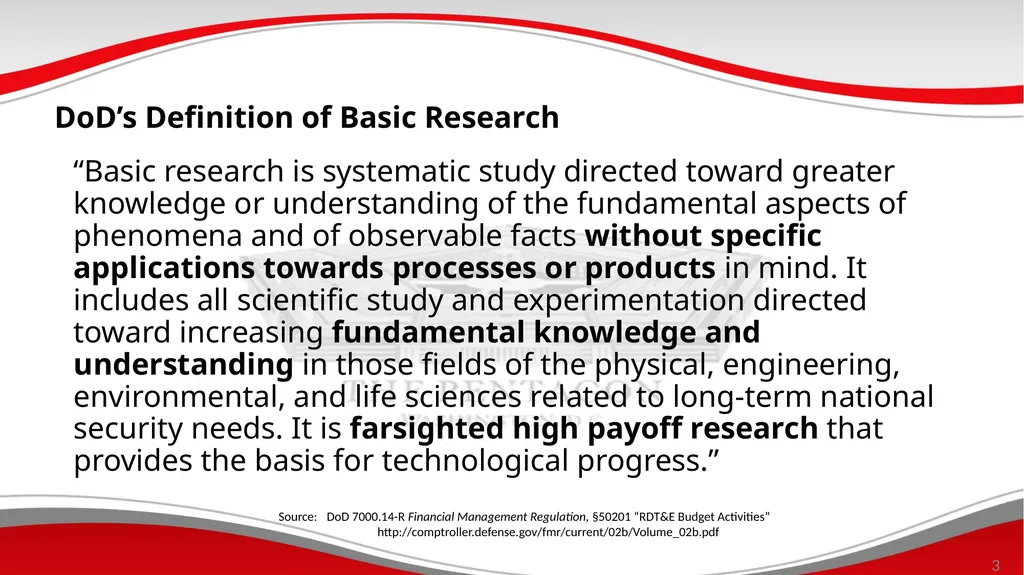
“Basic research is systematic study directed toward greater knowledge or understanding of the fundamental aspects of phenomena and of observable facts without specific applications towards processes or products in mind. It includes all scientific study and experimentation directed toward increasing fundamental knowledge and understanding in those fields of the physical, engineering, environmental, and life sciences related to long-term national security needs. It is farsighted high payoff research that provides the basis for technological progress.” Source: DoD 7000.14-R Financial Management Regulation, §50201 “RDT&E Budget Activities”
http://comptroller.defense.gov/fmr/current/02b/Volume_02b.pdf DoD’s Definition of Basic Research 3<br>
http://comptroller.defense.gov/fmr/current/02b/Volume_02b.pdf DoD’s Definition of Basic Research 3<br>
04
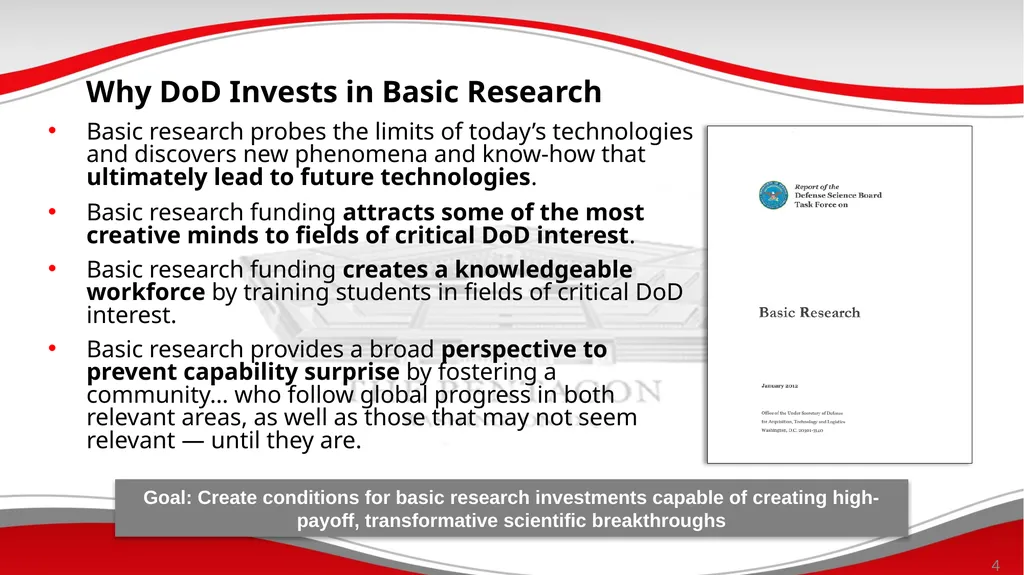
Basic research probes the limits of today’s technologies and discovers new phenomena and know‐how that ultimately lead to future technologies.
Basic research funding attracts some of the most creative minds to fields of critical DoD interest.
Basic research funding creates a knowledgeable workforce by training students in fields of critical DoD interest.
Basic research provides a broad perspective to prevent capability surprise by fostering a community… who follow global progress in both relevant areas, as well as those that may not seem relevant — until they are. Goal: Create conditions for basic research investments capable of creating high-payoff, transformative scientific breakthroughs Why DoD Invests in Basic Research 4<br>
Basic research funding attracts some of the most creative minds to fields of critical DoD interest.
Basic research funding creates a knowledgeable workforce by training students in fields of critical DoD interest.
Basic research provides a broad perspective to prevent capability surprise by fostering a community… who follow global progress in both relevant areas, as well as those that may not seem relevant — until they are. Goal: Create conditions for basic research investments capable of creating high-payoff, transformative scientific breakthroughs Why DoD Invests in Basic Research 4<br>
05
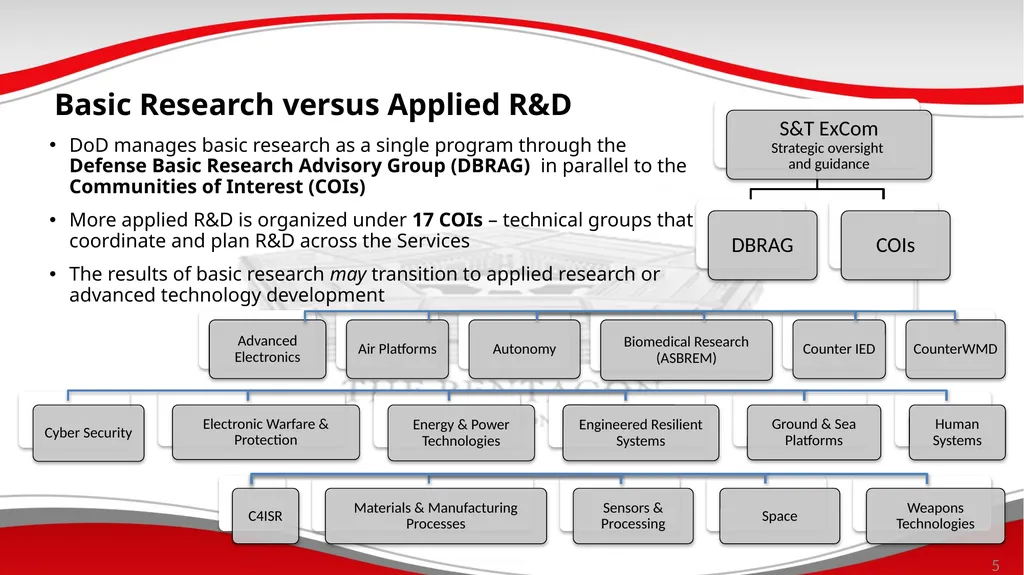
DoD manages basic research as a single program through the Defense Basic Research Advisory Group (DBRAG) in parallel to the Communities of Interest (COIs)
More applied R&D is organized under 17 COIs – technical groups that coordinate and plan R&D across the Services
The results of basic research may transition to applied research or advanced technology development Basic Research versus Applied R&D 5<br>
More applied R&D is organized under 17 COIs – technical groups that coordinate and plan R&D across the Services
The results of basic research may transition to applied research or advanced technology development Basic Research versus Applied R&D 5<br>
06
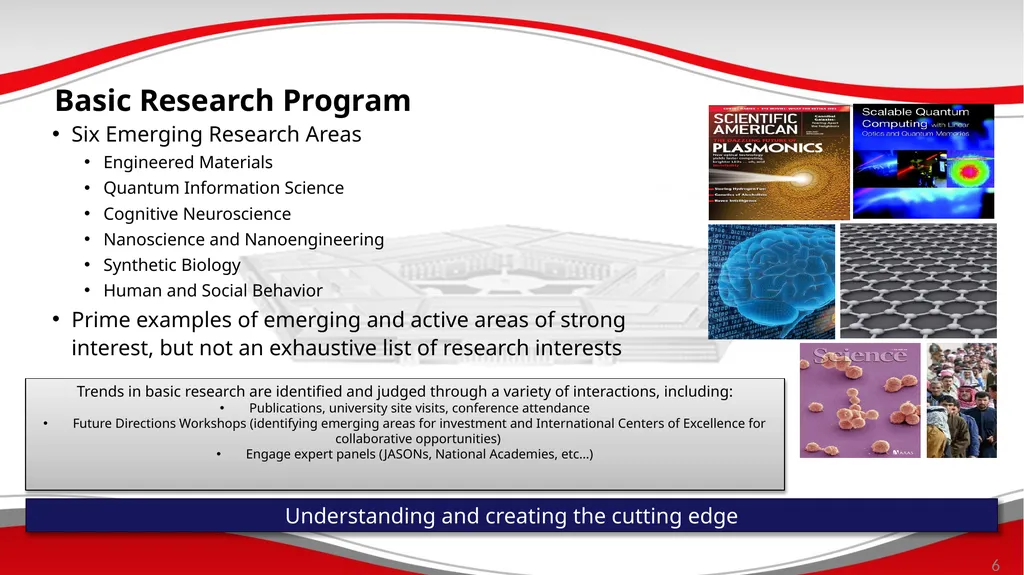
Six Emerging Research Areas
Engineered Materials
Quantum Information Science
Cognitive Neuroscience
Nanoscience and Nanoengineering
Synthetic Biology
Human and Social Behavior
Prime examples of emerging and active areas of strong interest, but not an exhaustive list of research interests Understanding and creating the cutting edge Trends in basic research are identified and judged through a variety of interactions, including:
Publications, university site visits, conference attendance
Future Directions Workshops (identifying emerging areas for investment and International Centers of Excellence for collaborative opportunities)
Engage expert panels (JASONs, National Academies, etc…) Basic Research Program 6<br>
Engineered Materials
Quantum Information Science
Cognitive Neuroscience
Nanoscience and Nanoengineering
Synthetic Biology
Human and Social Behavior
Prime examples of emerging and active areas of strong interest, but not an exhaustive list of research interests Understanding and creating the cutting edge Trends in basic research are identified and judged through a variety of interactions, including:
Publications, university site visits, conference attendance
Future Directions Workshops (identifying emerging areas for investment and International Centers of Excellence for collaborative opportunities)
Engage expert panels (JASONs, National Academies, etc…) Basic Research Program 6<br>
07
Department of Defense SBIRSTTR 7<br>
08
SBIR/STTR Overview
a. SBIR Impact
b. SBIR/STTR Programs
c. DoD SBIR 8<br>
a. SBIR Impact
b. SBIR/STTR Programs
c. DoD SBIR 8<br>
09
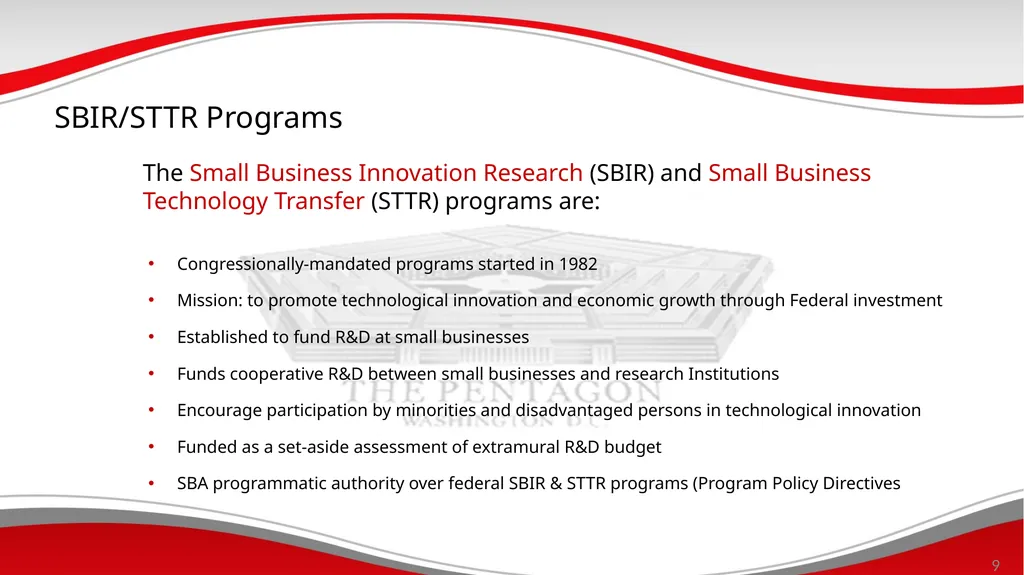
The Small Business Innovation Research (SBIR) and Small Business Technology Transfer (STTR) programs are: Congressionally-mandated programs started in 1982
Mission: to promote technological innovation and economic growth through Federal investment
Established to fund R&D at small businesses
Funds cooperative R&D between small businesses and research Institutions
Encourage participation by minorities and disadvantaged persons in technological innovation
Funded as a set-aside assessment of extramural R&D budget
SBA programmatic authority over federal SBIR & STTR programs (Program Policy Directives SBIR/STTR Programs 9<br>
Mission: to promote technological innovation and economic growth through Federal investment
Established to fund R&D at small businesses
Funds cooperative R&D between small businesses and research Institutions
Encourage participation by minorities and disadvantaged persons in technological innovation
Funded as a set-aside assessment of extramural R&D budget
SBA programmatic authority over federal SBIR & STTR programs (Program Policy Directives SBIR/STTR Programs 9<br>
10
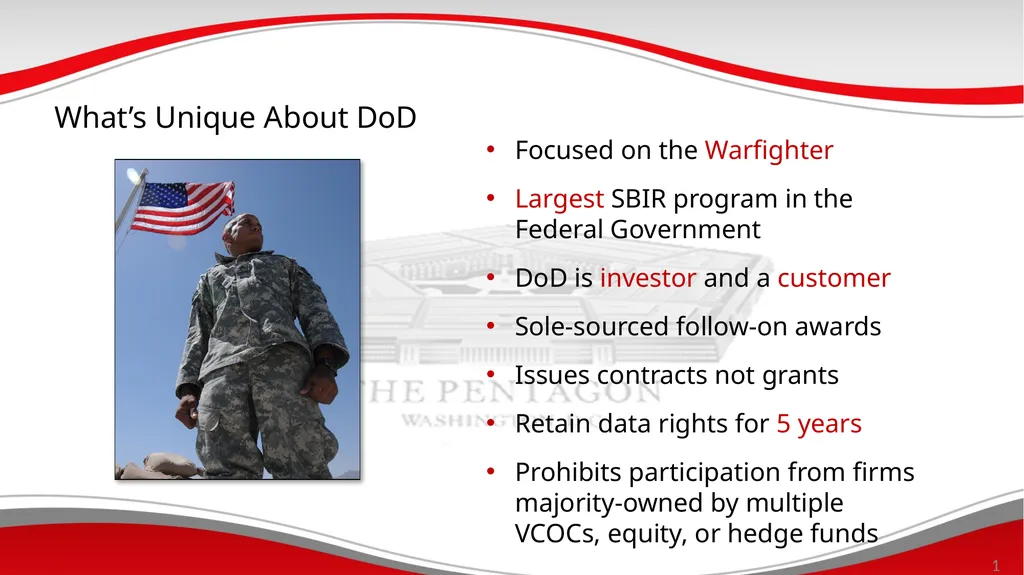
Focused on the Warfighter
Largest SBIR program in the Federal Government
DoD is investor and a customer
Sole-sourced follow-on awards
Issues contracts not grants
Retain data rights for 5 years
Prohibits participation from firms majority-owned by multiple VCOCs, equity, or hedge funds What’s Unique About DoD 10<br>
Largest SBIR program in the Federal Government
DoD is investor and a customer
Sole-sourced follow-on awards
Issues contracts not grants
Retain data rights for 5 years
Prohibits participation from firms majority-owned by multiple VCOCs, equity, or hedge funds What’s Unique About DoD 10<br>
11
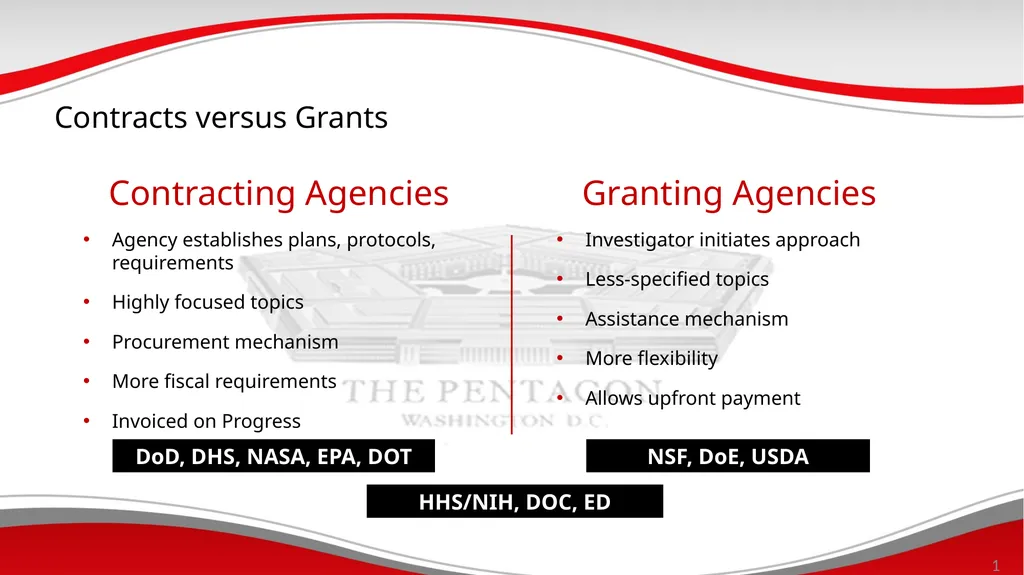
Contracting Agencies Agency establishes plans, protocols, requirements
Highly focused topics
Procurement mechanism
More fiscal requirements
Invoiced on Progress Granting Agencies Investigator initiates approach
Less-specified topics
Assistance mechanism
More flexibility
Allows upfront payment DoD, DHS, NASA, EPA, DOT NSF, DoE, USDA HHS/NIH, DOC, ED Contracts versus Grants 11<br>
Highly focused topics
Procurement mechanism
More fiscal requirements
Invoiced on Progress Granting Agencies Investigator initiates approach
Less-specified topics
Assistance mechanism
More flexibility
Allows upfront payment DoD, DHS, NASA, EPA, DOT NSF, DoE, USDA HHS/NIH, DOC, ED Contracts versus Grants 11<br>
12
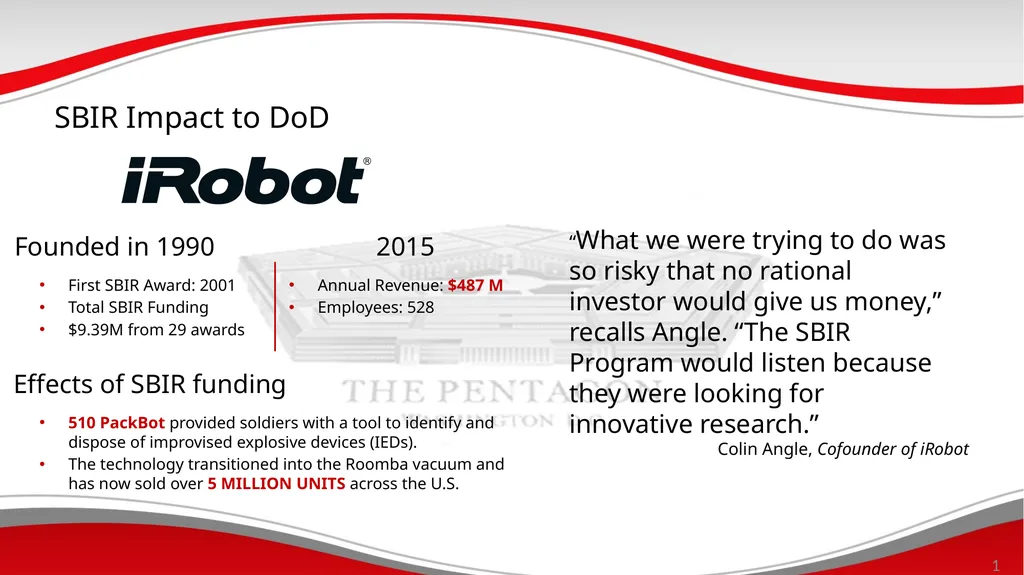
First SBIR Award: 2001
Total SBIR Funding
$9.39M from 29 awards Founded in 1990 Annual Revenue: $487 M
Employees: 528 2015 510 PackBot provided soldiers with a tool to identify and dispose of improvised explosive devices (IEDs).
The technology transitioned into the Roomba vacuum and has now sold over 5 MILLION UNITS across the U.S. Effects of SBIR funding “What we were trying to do was so risky that no rational investor would give us money,” recalls Angle. “The SBIR Program would listen because they were looking for innovative research.” Colin Angle, Cofounder of iRobot SBIR Impact to DoD 12<br>
Total SBIR Funding
$9.39M from 29 awards Founded in 1990 Annual Revenue: $487 M
Employees: 528 2015 510 PackBot provided soldiers with a tool to identify and dispose of improvised explosive devices (IEDs).
The technology transitioned into the Roomba vacuum and has now sold over 5 MILLION UNITS across the U.S. Effects of SBIR funding “What we were trying to do was so risky that no rational investor would give us money,” recalls Angle. “The SBIR Program would listen because they were looking for innovative research.” Colin Angle, Cofounder of iRobot SBIR Impact to DoD 12<br>
13
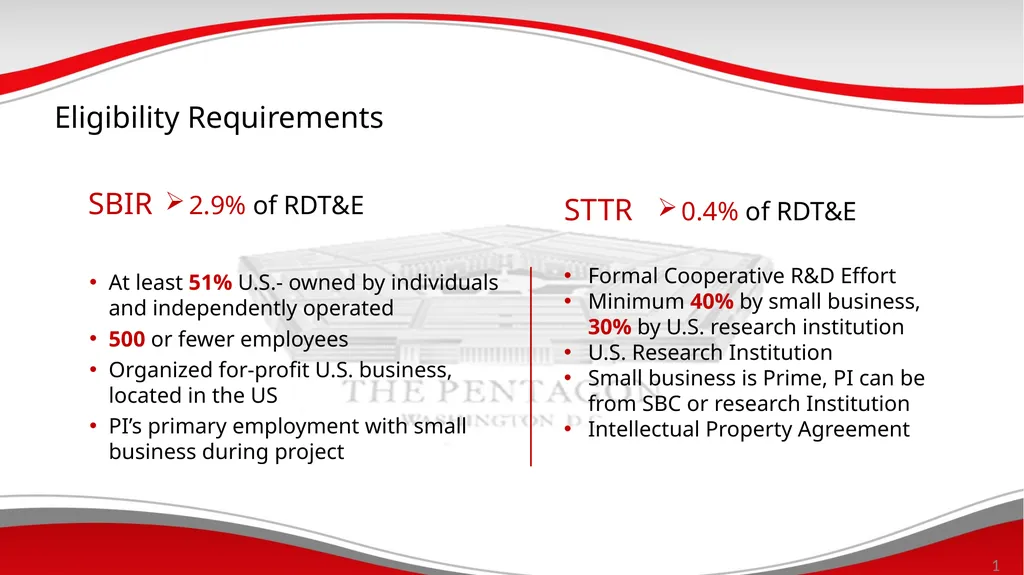
SBIR
At least 51% U.S.- owned by individuals and independently operated
500 or fewer employees
Organized for-profit U.S. business, located in the US
PI’s primary employment with small business during project STTR
Formal Cooperative R&D Effort
Minimum 40% by small business, 30% by U.S. research institution
U.S. Research Institution
Small business is Prime, PI can be from SBC or research Institution
Intellectual Property Agreement Eligibility Requirements 2.9% of RDT&E 0.4% of RDT&E 13<br>
At least 51% U.S.- owned by individuals and independently operated
500 or fewer employees
Organized for-profit U.S. business, located in the US
PI’s primary employment with small business during project STTR
Formal Cooperative R&D Effort
Minimum 40% by small business, 30% by U.S. research institution
U.S. Research Institution
Small business is Prime, PI can be from SBC or research Institution
Intellectual Property Agreement Eligibility Requirements 2.9% of RDT&E 0.4% of RDT&E 13<br>
14
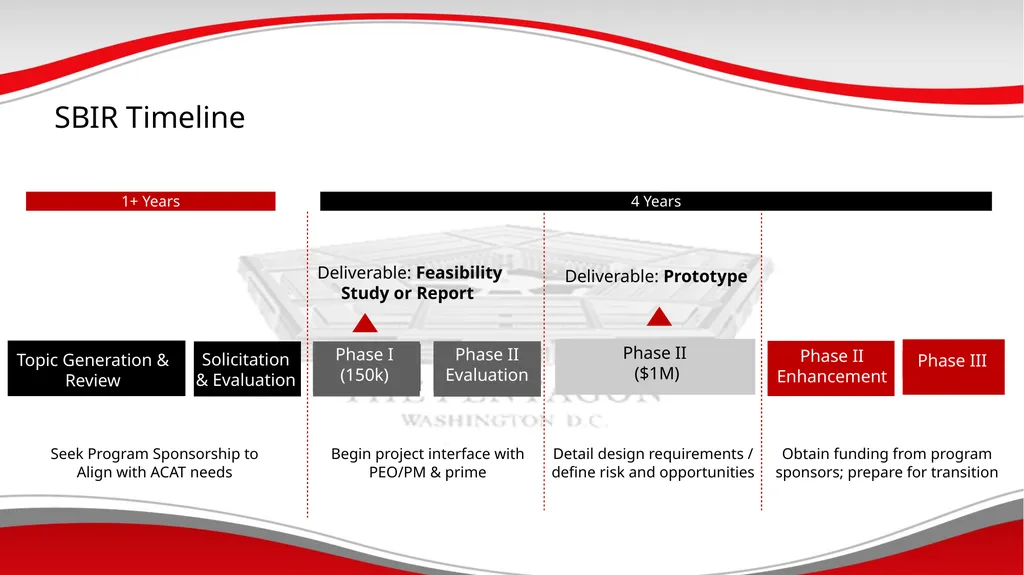
Seek Program Sponsorship to Align with ACAT needs Topic Generation & Review Begin project interface with PEO/PM & prime Detail design requirements / define risk and opportunities Obtain funding from program sponsors; prepare for transition Deliverable: Feasibility Study or Report Deliverable: Prototype 1+ Years 4 Years Phase II Enhancement SBIR Timeline<br>
15
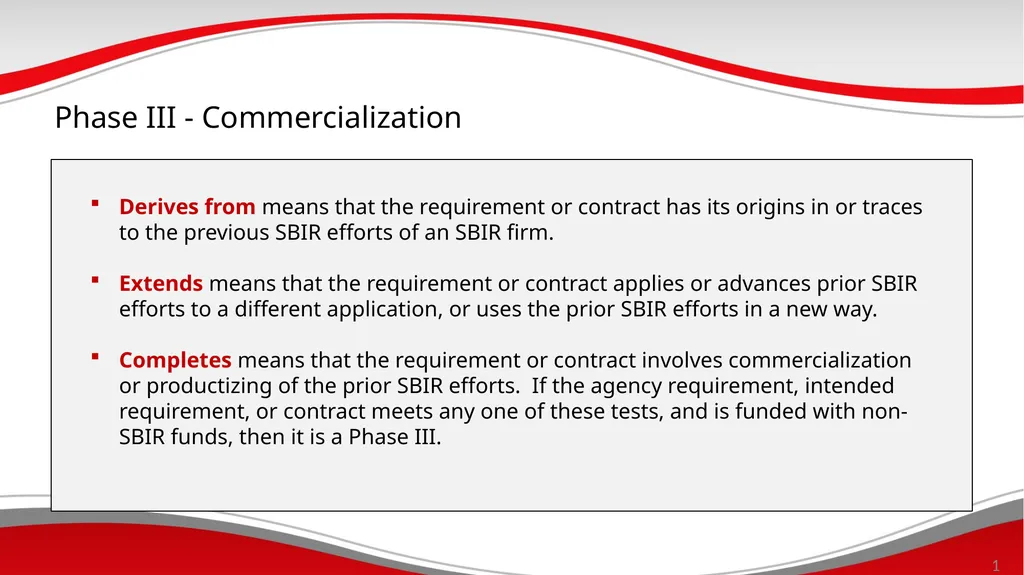
Phase III - Commercialization 15<br>
16
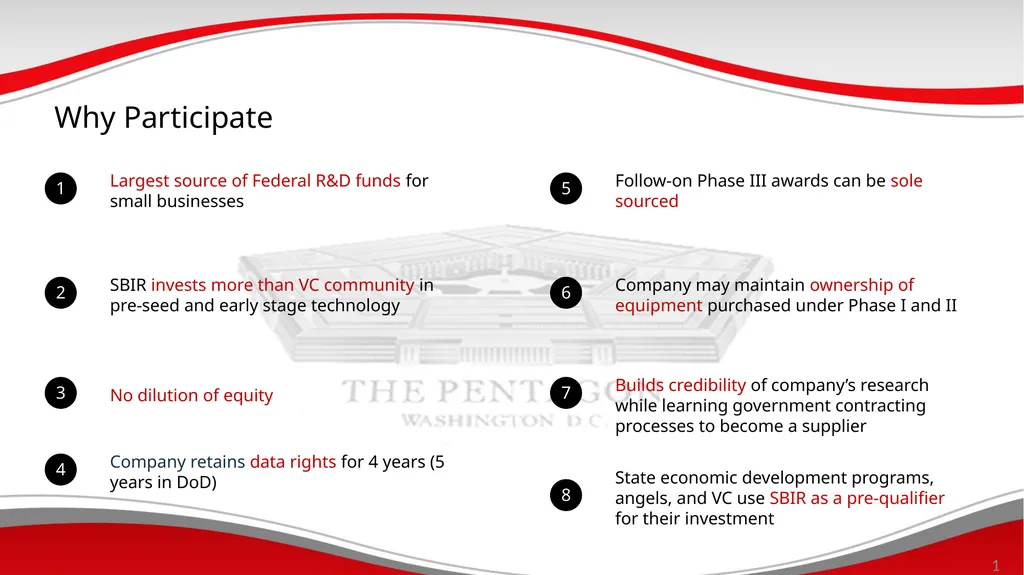
1 Largest source of Federal R&D funds for small businesses 2 SBIR invests more than VC community in pre-seed and early stage technology 3 No dilution of equity 4 Company retains data rights for 4 years (5 years in DoD) 5 Follow-on Phase III awards can be sole sourced 6 Company may maintain ownership of equipment purchased under Phase I and II 7 Builds credibility of company’s research while learning government contracting processes to become a supplier 8 State economic development programs, angels, and VC use SBIR as a pre-qualifier for their investment Why Participate 16<br>
17
Safe way to try out high-risk R&D
Small businesses are often more cost effective and innovative than large primes (i.e., agile, niche)
Test drive new companies while they establish a track record
Allows Acquisition programs to establish 2nd source/method to augment ongoing programs (risk management) How DoD Benefits from SBIR 17<br>
Small businesses are often more cost effective and innovative than large primes (i.e., agile, niche)
Test drive new companies while they establish a track record
Allows Acquisition programs to establish 2nd source/method to augment ongoing programs (risk management) How DoD Benefits from SBIR 17<br>
18
Rapid Innovation Fund Overview
a. RIF Purpose
b. RIF Implementation
c. RIF Impacts 18<br>
a. RIF Purpose
b. RIF Implementation
c. RIF Impacts 18<br>
19
Established as the Rapid Innovation Program (RIP) by the FY 2011 National Defense Authorization Act (Section 1073)
A competitive, merit-based program
Accelerate fielding of innovative technologies into military systems
Re-designated as the Rapid Innovation Fund (RIF) within the Department of Defense (DoD) Rapid Innovation Fund Bottom Line Goal: Transition Small Business Technologies into Defense Acquisition Programs 19<br>
A competitive, merit-based program
Accelerate fielding of innovative technologies into military systems
Re-designated as the Rapid Innovation Fund (RIF) within the Department of Defense (DoD) Rapid Innovation Fund Bottom Line Goal: Transition Small Business Technologies into Defense Acquisition Programs 19<br>
20
Over 80% of RIF awardees note that the program is vital to the transition of small business technologies
New employee hires
Teaming opportunities
Increase in market sales
Helps to advance Phase II SBIR-developed technologies, resulting in a finished produce for commercial and government sales
Gets innovation to DoD faster
Large business customers sometimes submit their smaller, supplier-based technologies to the government as an engineering change Incentivizing Productivity in Industry 20<br>
New employee hires
Teaming opportunities
Increase in market sales
Helps to advance Phase II SBIR-developed technologies, resulting in a finished produce for commercial and government sales
Gets innovation to DoD faster
Large business customers sometimes submit their smaller, supplier-based technologies to the government as an engineering change Incentivizing Productivity in Industry 20<br>
21
Satisfy an operational or national security need
Accelerate or enhance military capability
In support of a major defense acquisition program
Stimulate innovative technologies
Reduce acquisition/lifecycle costs
Address technical risk
Improve timeliness & thoroughness of test & evaluation outcomes
Can be completed within 24 months of award
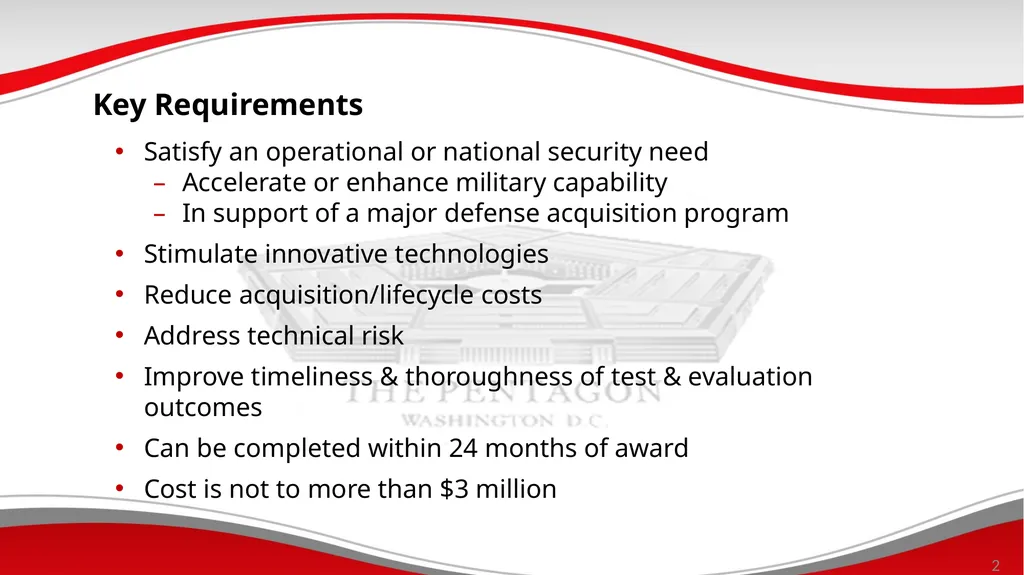
Cost is not to more than $3 million Key Requirements 21<br>
Accelerate or enhance military capability
In support of a major defense acquisition program
Stimulate innovative technologies
Reduce acquisition/lifecycle costs
Address technical risk
Improve timeliness & thoroughness of test & evaluation outcomes
Can be completed within 24 months of award
Cost is not to more than $3 million Key Requirements 21<br>
22
Technology Readiness Levels (TRL) Maturity Goal: TRL 6-9
System/subsystem model or prototype demonstration in a relevant environment
System prototype demonstration in an operational environment
Actual system completed and qualified through test and demonstration
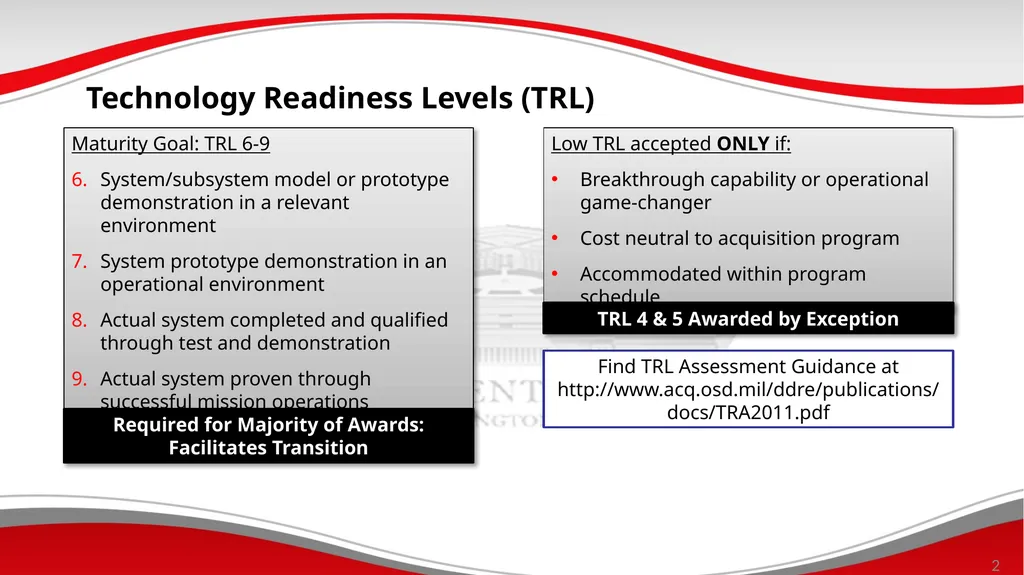
Actual system proven through successful mission operations Required for Majority of Awards: Facilitates Transition Low TRL accepted ONLY if:
Breakthrough capability or operational game-changer
Cost neutral to acquisition program
Accommodated within program schedule TRL 4 & 5 Awarded by Exception Find TRL Assessment Guidance at
http://www.acq.osd.mil/ddre/publications/docs/TRA2011.pdf 22<br>
System/subsystem model or prototype demonstration in a relevant environment
System prototype demonstration in an operational environment
Actual system completed and qualified through test and demonstration
Actual system proven through successful mission operations Required for Majority of Awards: Facilitates Transition Low TRL accepted ONLY if:
Breakthrough capability or operational game-changer
Cost neutral to acquisition program
Accommodated within program schedule TRL 4 & 5 Awarded by Exception Find TRL Assessment Guidance at
http://www.acq.osd.mil/ddre/publications/docs/TRA2011.pdf 22<br>
23
Competitive, Merit-Based Two-Step Process
Step 1:
Issue Broad Agency Announcement (BAA)
Industry Response: 3-page White Paper + Quad Chart
Evaluations are “Go” or “No Go”
Step 2;
Highest rated “Go” offerors invited to submit full proposals
This invitation does not guarantee an award
Highest-rated full proposals lead to award
Public Notice
Federal Business Opportunities: www.FedBizOpps.gov
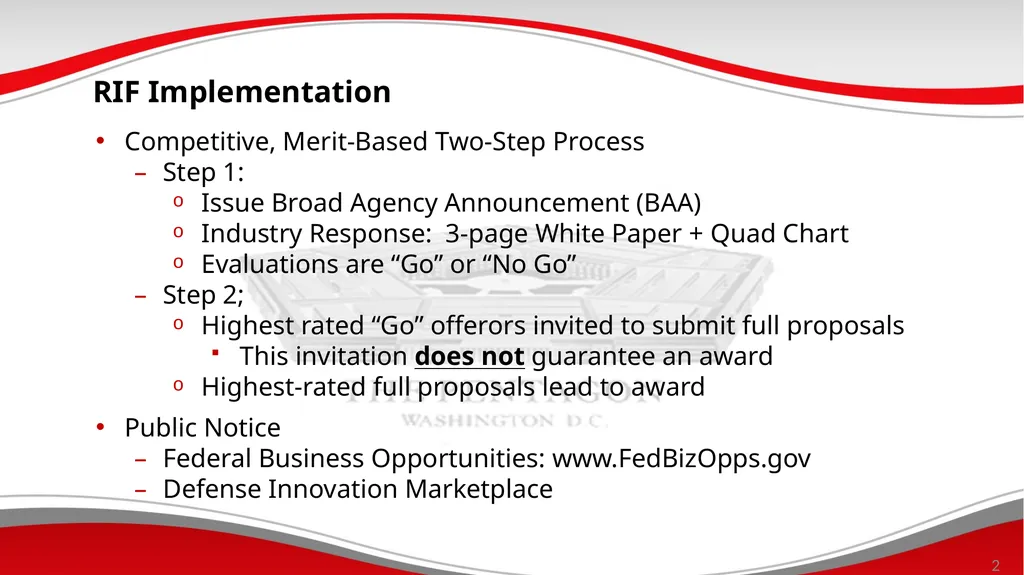
Defense Innovation Marketplace RIF Implementation 23<br>
Step 1:
Issue Broad Agency Announcement (BAA)
Industry Response: 3-page White Paper + Quad Chart
Evaluations are “Go” or “No Go”
Step 2;
Highest rated “Go” offerors invited to submit full proposals
This invitation does not guarantee an award
Highest-rated full proposals lead to award
Public Notice
Federal Business Opportunities: www.FedBizOpps.gov
Defense Innovation Marketplace RIF Implementation 23<br>
24
Competitive, Merit-Based Two-Step Process
Step 1:
Issue Broad Agency Announcement (BAA)
Industry Response: 3-page White Paper + Quad Chart
Evaluations are “Go” or “No Go”
Step 2;
Highest rated “Go” offerors invited to submit full proposals
This invitation does not guarantee an award
Highest-rated full proposals lead to award
Public Notice
Federal Business Opportunities: www.FedBizOpps.gov
Defense Innovation Marketplace RIF Implementation 24<br>
Step 1:
Issue Broad Agency Announcement (BAA)
Industry Response: 3-page White Paper + Quad Chart
Evaluations are “Go” or “No Go”
Step 2;
Highest rated “Go” offerors invited to submit full proposals
This invitation does not guarantee an award
Highest-rated full proposals lead to award
Public Notice
Federal Business Opportunities: www.FedBizOpps.gov
Defense Innovation Marketplace RIF Implementation 24<br>
25
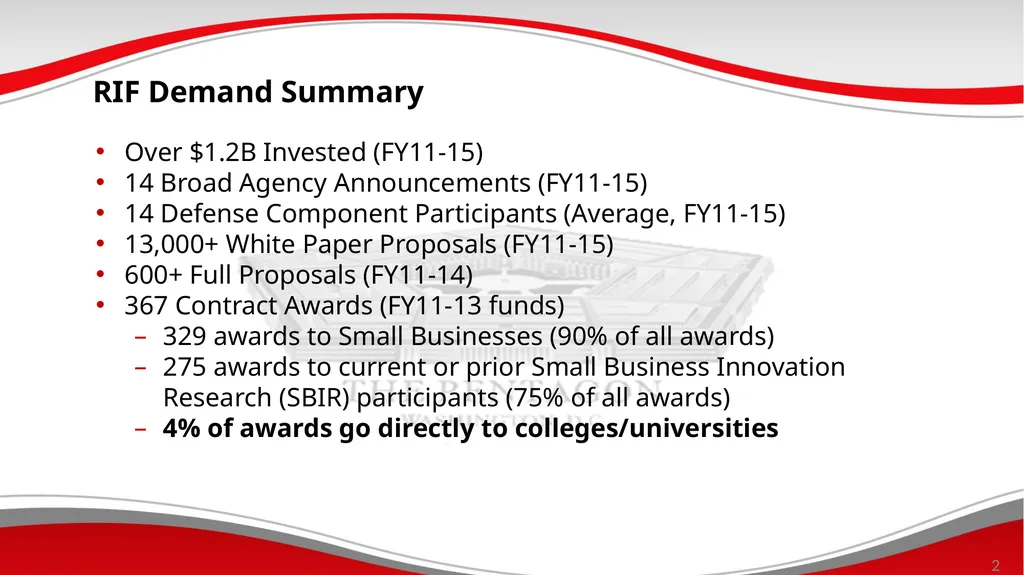
Over $1.2B Invested (FY11-15)
14 Broad Agency Announcements (FY11-15)
14 Defense Component Participants (Average, FY11-15)
13,000+ White Paper Proposals (FY11-15)
600+ Full Proposals (FY11-14)
367 Contract Awards (FY11-13 funds)
329 awards to Small Businesses (90% of all awards)
275 awards to current or prior Small Business Innovation Research (SBIR) participants (75% of all awards)
4% of awards go directly to colleges/universities RIF Demand Summary 25<br>
14 Broad Agency Announcements (FY11-15)
14 Defense Component Participants (Average, FY11-15)
13,000+ White Paper Proposals (FY11-15)
600+ Full Proposals (FY11-14)
367 Contract Awards (FY11-13 funds)
329 awards to Small Businesses (90% of all awards)
275 awards to current or prior Small Business Innovation Research (SBIR) participants (75% of all awards)
4% of awards go directly to colleges/universities RIF Demand Summary 25<br>
26
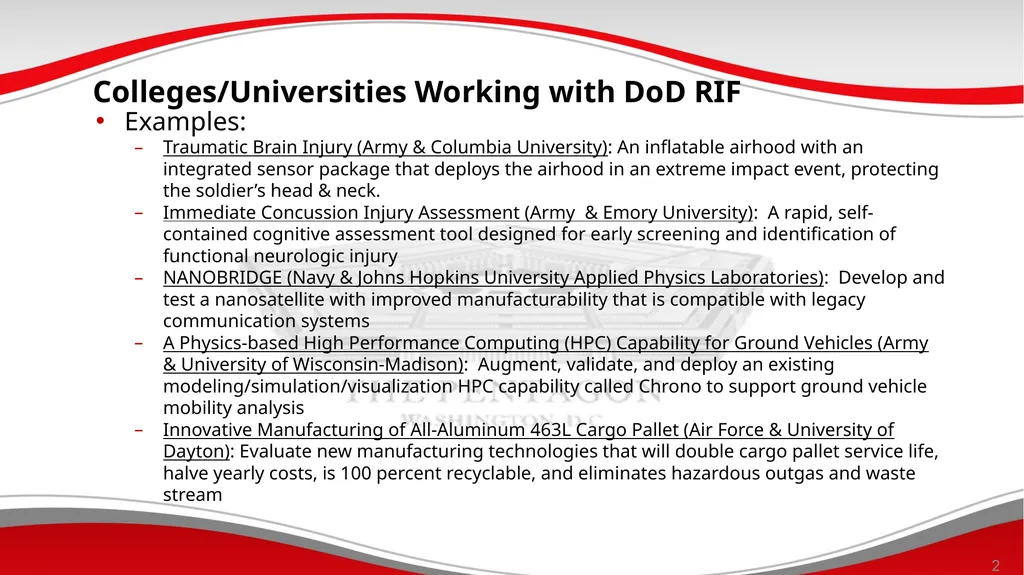
Examples:
Traumatic Brain Injury (Army & Columbia University): An inflatable airhood with an integrated sensor package that deploys the airhood in an extreme impact event, protecting the soldier’s head & neck.
Immediate Concussion Injury Assessment (Army & Emory University): A rapid, self-contained cognitive assessment tool designed for early screening and identification of functional neurologic injury
NANOBRIDGE (Navy & Johns Hopkins University Applied Physics Laboratories): Develop and test a nanosatellite with improved manufacturability that is compatible with legacy communication systems
A Physics-based High Performance Computing (HPC) Capability for Ground Vehicles (Army & University of Wisconsin-Madison): Augment, validate, and deploy an existing modeling/simulation/visualization HPC capability called Chrono to support ground vehicle mobility analysis
Innovative Manufacturing of All-Aluminum 463L Cargo Pallet (Air Force & University of Dayton): Evaluate new manufacturing technologies that will double cargo pallet service life, halve yearly costs, is 100 percent recyclable, and eliminates hazardous outgas and waste stream Colleges/Universities Working with DoD RIF 26<br>
Traumatic Brain Injury (Army & Columbia University): An inflatable airhood with an integrated sensor package that deploys the airhood in an extreme impact event, protecting the soldier’s head & neck.
Immediate Concussion Injury Assessment (Army & Emory University): A rapid, self-contained cognitive assessment tool designed for early screening and identification of functional neurologic injury
NANOBRIDGE (Navy & Johns Hopkins University Applied Physics Laboratories): Develop and test a nanosatellite with improved manufacturability that is compatible with legacy communication systems
A Physics-based High Performance Computing (HPC) Capability for Ground Vehicles (Army & University of Wisconsin-Madison): Augment, validate, and deploy an existing modeling/simulation/visualization HPC capability called Chrono to support ground vehicle mobility analysis
Innovative Manufacturing of All-Aluminum 463L Cargo Pallet (Air Force & University of Dayton): Evaluate new manufacturing technologies that will double cargo pallet service life, halve yearly costs, is 100 percent recyclable, and eliminates hazardous outgas and waste stream Colleges/Universities Working with DoD RIF 26<br>
27
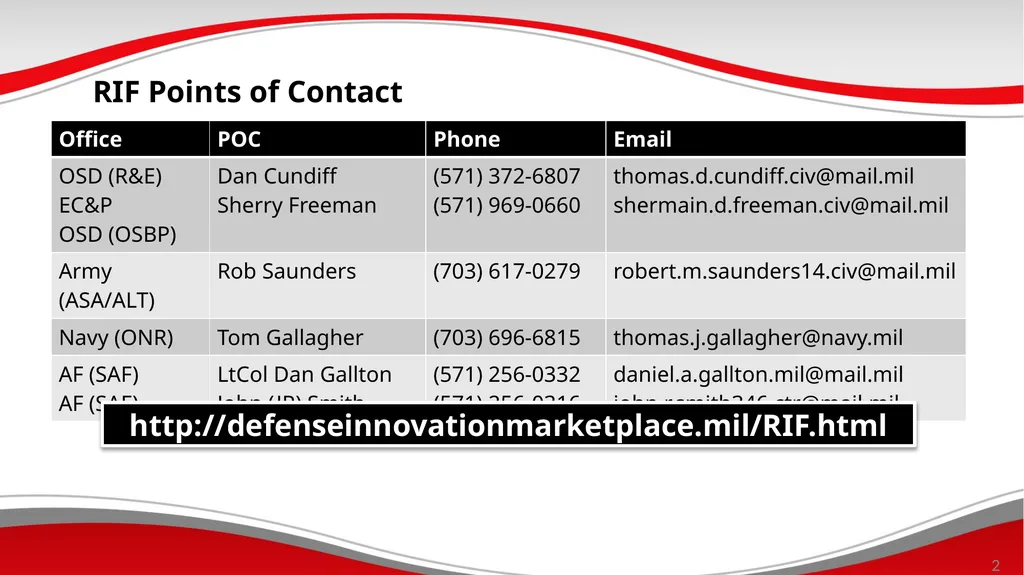
RIF Points of Contact http://defenseinnovationmarketplace.mil/RIF.html 27<br>
28
My Contact Information
Camylle Coley
Senior Advisor to the Director
Basic Research Office
(571) 372-6463
camylle.c.coley.ctr@mail.mil<br>