
Does your “SOX” Fit? Jonathan Fink, CPA, Partner 1
SN
Published · 34 slides · 0 views

1 / 1
Description
Does your SOX Fit? Jonathan Fink, CPA, Partner 1 Does your SOX Fit?- speaker background Jonathan Fink, CPA Audit partner West Hartford, Connecticut office BlumShapiro works with companies on the management side to assist them in SOX
Related Topics
Share
Embed code
Download this presentation From Below
"Does your “SOX” Fit? Jonathan Fink, CPA, Partner 1" is the property of its rightful owner. Permission is granted to download and print the materials on this website for personal, non-commercial use only, and to display it on your personal computer provided you do not modify the materials and that you retain all copyright notices contained in the materials. By downloading content from our website, you accept the terms of this agreement.
Presentation Transcript
01
Does your “SOX” Fit? Jonathan Fink, CPA, Partner 1<br>
02
Does your “SOX” Fit?- speaker background Jonathan Fink, CPA
Audit partner
West Hartford, Connecticut office
BlumShapiro works with companies on the management side to assist them in SOX compliance efforts and other internal control objectives
BlumShapiro does not audit public companies
My SOX experience includes the following industries:
Utilities
Manufacturing
Pharmaceuticals
Non-profits 2<br>
03
Does your “SOX” Fit?- today’s agenda Background on SOX
SOX environment
Where we were
Where we are today
Where we might be going
Applying SOX to non-registrants 3<br>
SOX environment
Where we were
Where we are today
Where we might be going
Applying SOX to non-registrants 3<br>
04
Does your “SOX” Fit?- Background on SOX Sarbanes-Oxley Act of 2002
Passed in response to large public company frauds in early 2000’s
Intended to toughen the penalties on senior executives at public companies where frauds occur
11 Sections of Act
Establishment of Public Company Accounting Oversight Board (PCAOB)
Some differences in compliance requirements for large and small public companies 4<br>
05
Does your “SOX” Fit?- Background on SOX Sarbanes-Oxley Act of 2002- Key Sections
Section 302
Quarterly certification by officers
Significant changes in internal control during the quarter
Certain interim fraud disclosures
Section 404
Assessment of effectiveness of internal controls over financial reporting
Related report from independent registered accounting firm 5<br>
Section 302
Quarterly certification by officers
Significant changes in internal control during the quarter
Certain interim fraud disclosures
Section 404
Assessment of effectiveness of internal controls over financial reporting
Related report from independent registered accounting firm 5<br>
06
Does your “SOX” Fit?- Where we were Before we get into the business side,
what was going on in popular culture in 2002? 6<br>
what was going on in popular culture in 2002? 6<br>
07
Does your “SOX” Fit?- Where we were 2002- popular culture
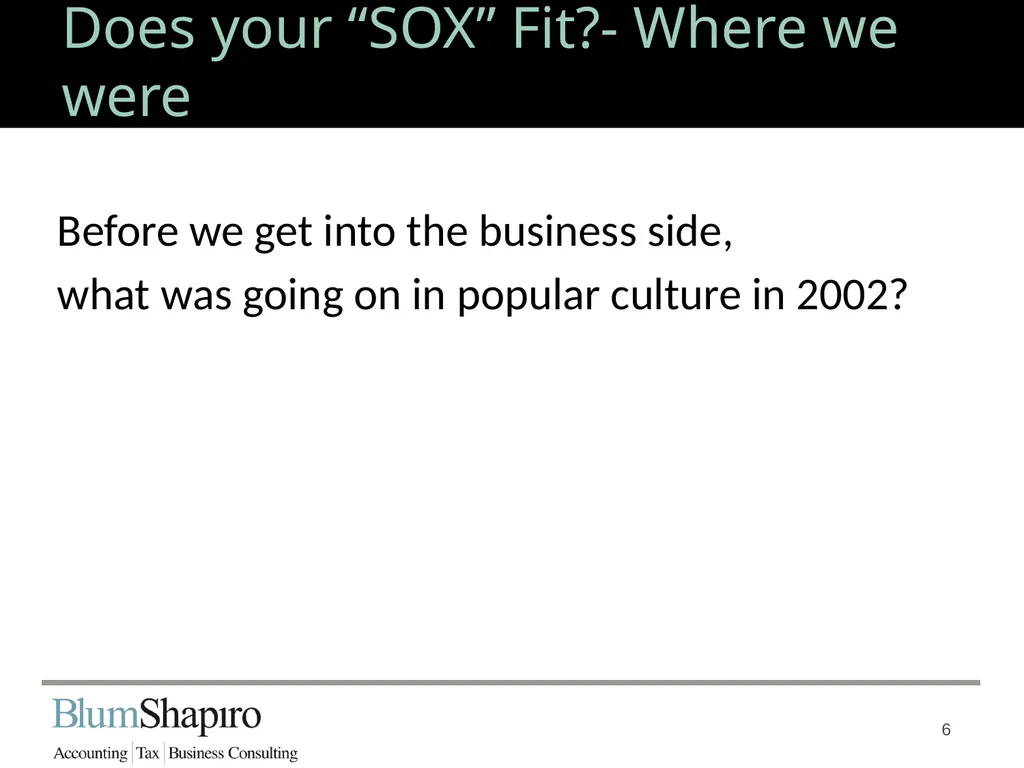
#1 song for the year- How You Remind Me by Nickelback 7<br>
#1 song for the year- How You Remind Me by Nickelback 7<br>
08
Does your “SOX” Fit?- Where we were 2002- popular culture
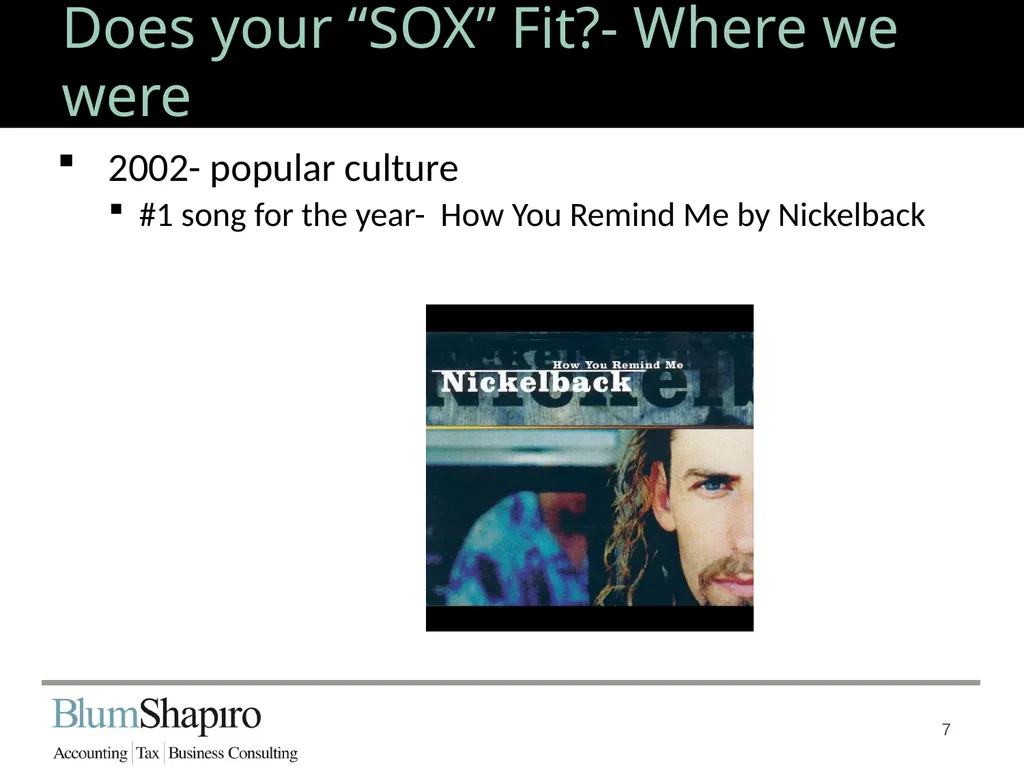
#1 movie for the year- Spider-Man 8<br>
#1 movie for the year- Spider-Man 8<br>
09
Does your “SOX” Fit?- Where we were 2002- popular culture
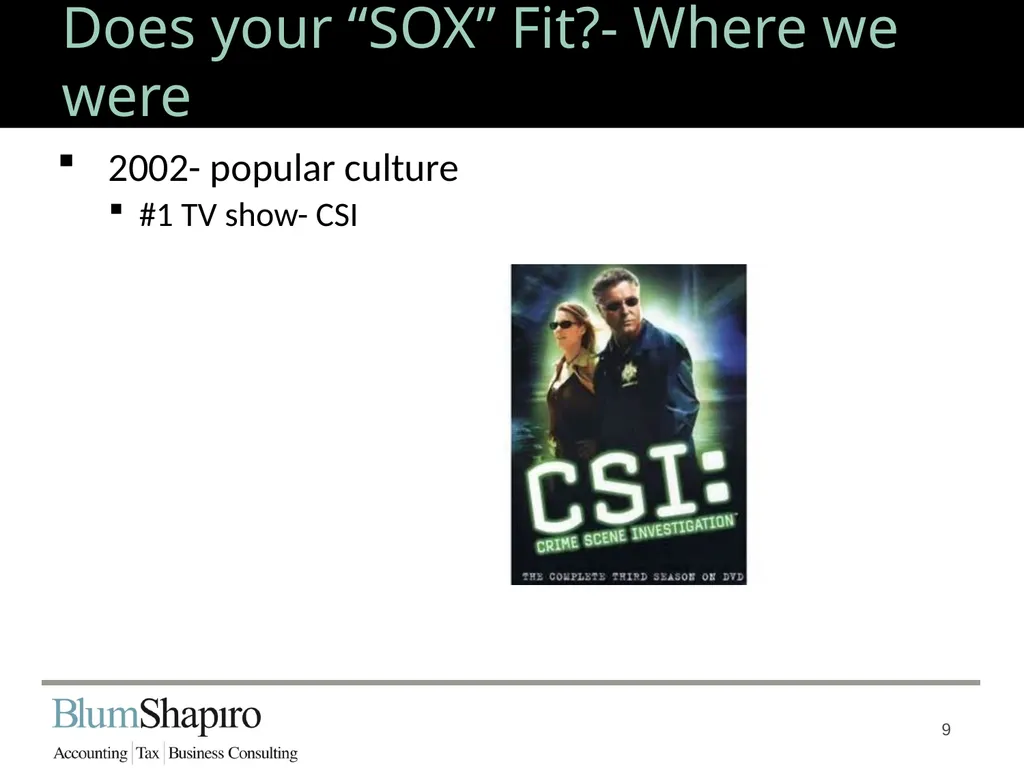
#1 TV show- CSI 9<br>
#1 TV show- CSI 9<br>
10
Does your “SOX” Fit?- Where we were 2002- popular culture
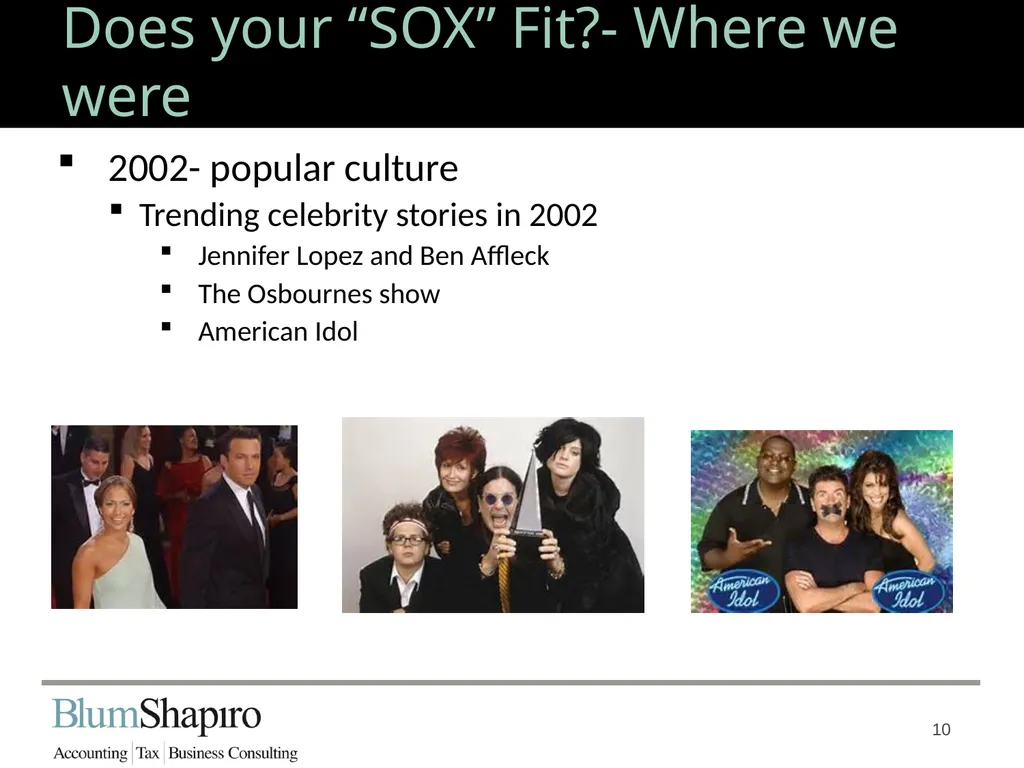
Trending celebrity stories in 2002
Jennifer Lopez and Ben Affleck
The Osbournes show
American Idol 10<br>
Trending celebrity stories in 2002
Jennifer Lopez and Ben Affleck
The Osbournes show
American Idol 10<br>
11
Does your “SOX” Fit?- Where we were Before the Sarbanes-Oxley Act (SOX), there were few restrictions on the services an auditor could provide to their client
Internal audit
Systems consulting
Accounting assistance
Stemming from the high-profile frauds at companies such as Enron, there was a public perception that auditors’ independence was not always maintained and that an auditor might be hesitant to challenge a client on an accounting or reporting issue that could damage their non-audit service revenues
Public outcry over lost retirement savings in affected public stocks 11<br>
12
Does your “SOX” Fit?- Where we were Establishment of PCAOB
Key mission of investor protection
Oversight of auditors of public companies (“audit the auditors”)
Profession was previously self-regulated
New set of audit rules created solely for auditors of public companies
Funded by fees charged to public companies
Overseen by the SEC 12<br>
Key mission of investor protection
Oversight of auditors of public companies (“audit the auditors”)
Profession was previously self-regulated
New set of audit rules created solely for auditors of public companies
Funded by fees charged to public companies
Overseen by the SEC 12<br>
13
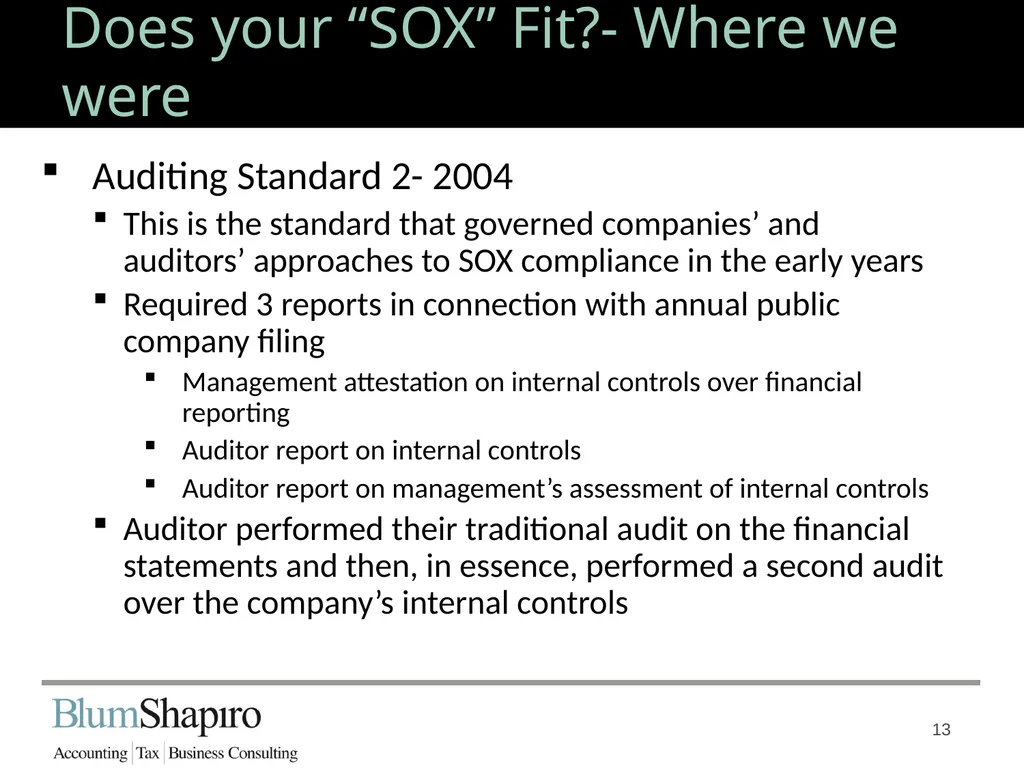
Does your “SOX” Fit?- Where we were Auditing Standard 2- 2004
This is the standard that governed companies’ and auditors’ approaches to SOX compliance in the early years
Required 3 reports in connection with annual public company filing
Management attestation on internal controls over financial reporting
Auditor report on internal controls
Auditor report on management’s assessment of internal controls
Auditor performed their traditional audit on the financial statements and then, in essence, performed a second audit over the company’s internal controls 13<br>
14
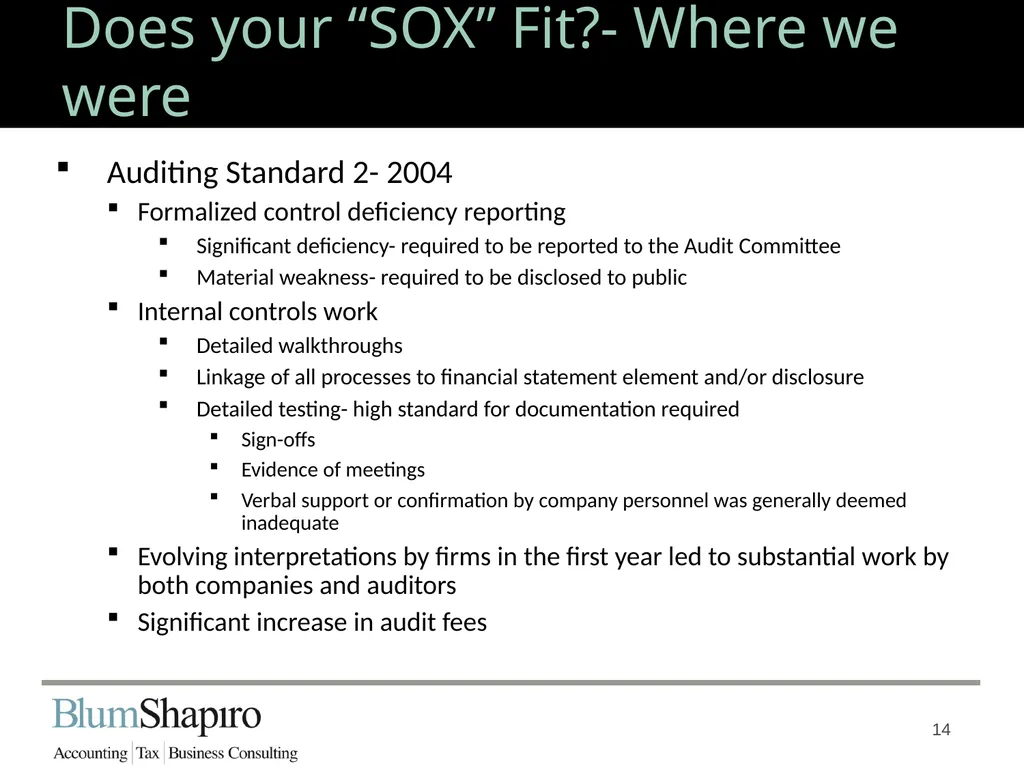
Does your “SOX” Fit?- Where we were Auditing Standard 2- 2004
Formalized control deficiency reporting
Significant deficiency- required to be reported to the Audit Committee
Material weakness- required to be disclosed to public
Internal controls work
Detailed walkthroughs
Linkage of all processes to financial statement element and/or disclosure
Detailed testing- high standard for documentation required
Sign-offs
Evidence of meetings
Verbal support or confirmation by company personnel was generally deemed inadequate
Evolving interpretations by firms in the first year led to substantial work by both companies and auditors
Significant increase in audit fees 14<br>
15
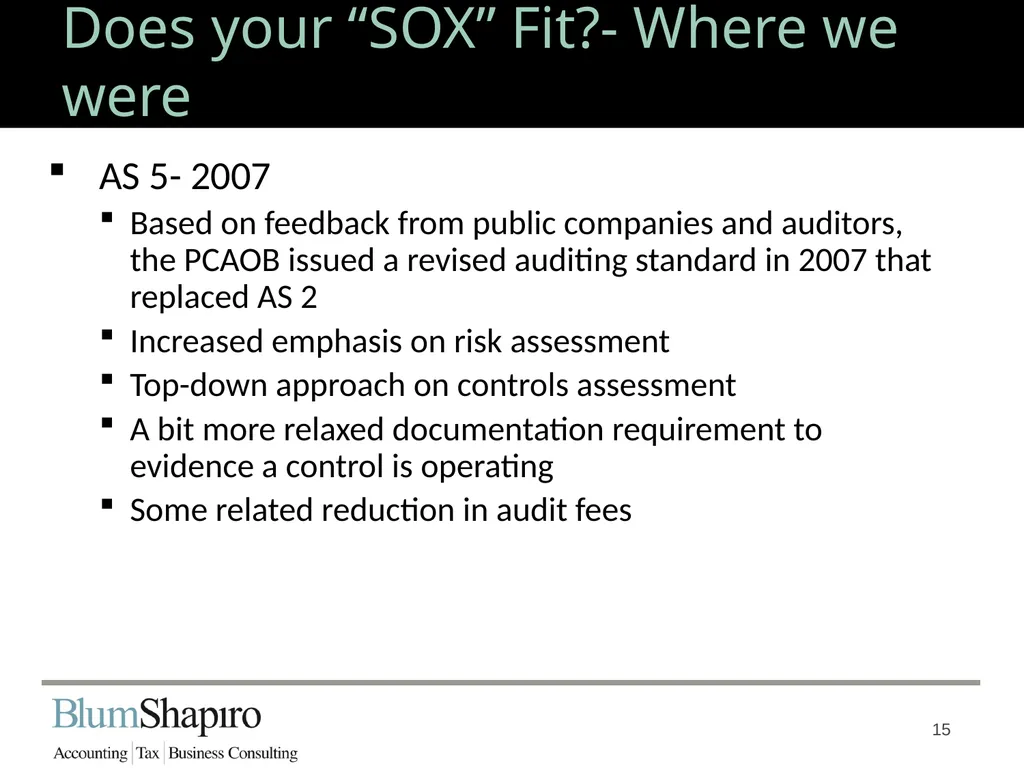
Does your “SOX” Fit?- Where we were AS 5- 2007
Based on feedback from public companies and auditors, the PCAOB issued a revised auditing standard in 2007 that replaced AS 2
Increased emphasis on risk assessment
Top-down approach on controls assessment
A bit more relaxed documentation requirement to evidence a control is operating
Some related reduction in audit fees 15<br>
16
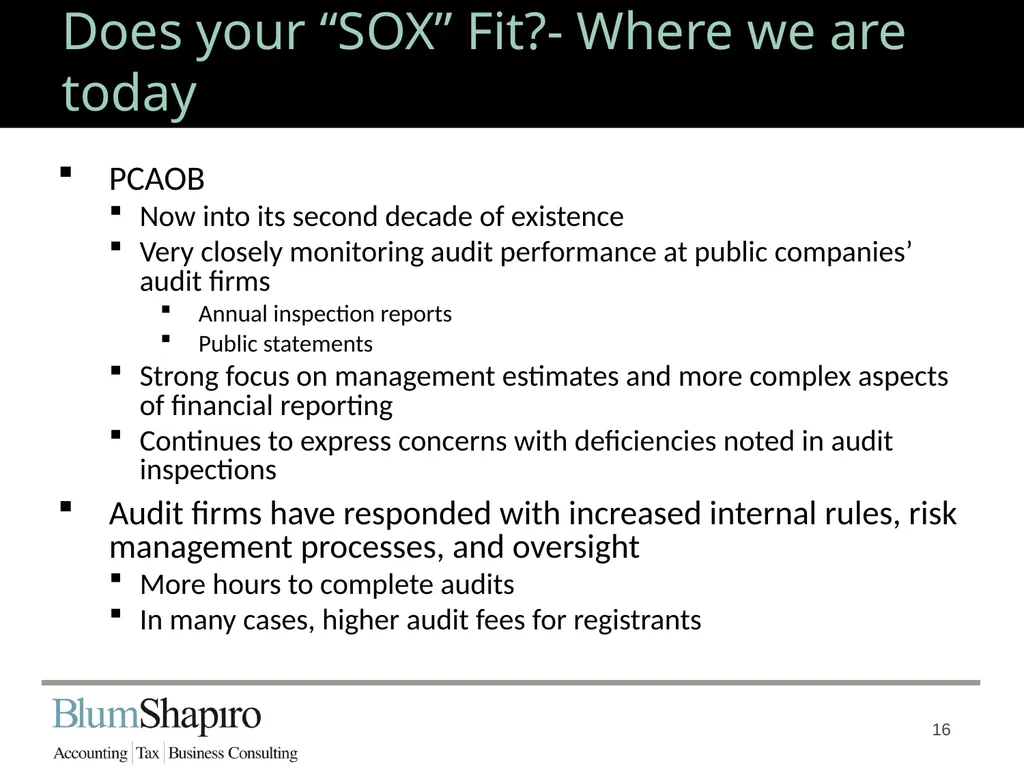
Does your “SOX” Fit?- Where we are today PCAOB
Now into its second decade of existence
Very closely monitoring audit performance at public companies’ audit firms
Annual inspection reports
Public statements
Strong focus on management estimates and more complex aspects of financial reporting
Continues to express concerns with deficiencies noted in audit inspections
Audit firms have responded with increased internal rules, risk management processes, and oversight
More hours to complete audits
In many cases, higher audit fees for registrants 16<br>
17
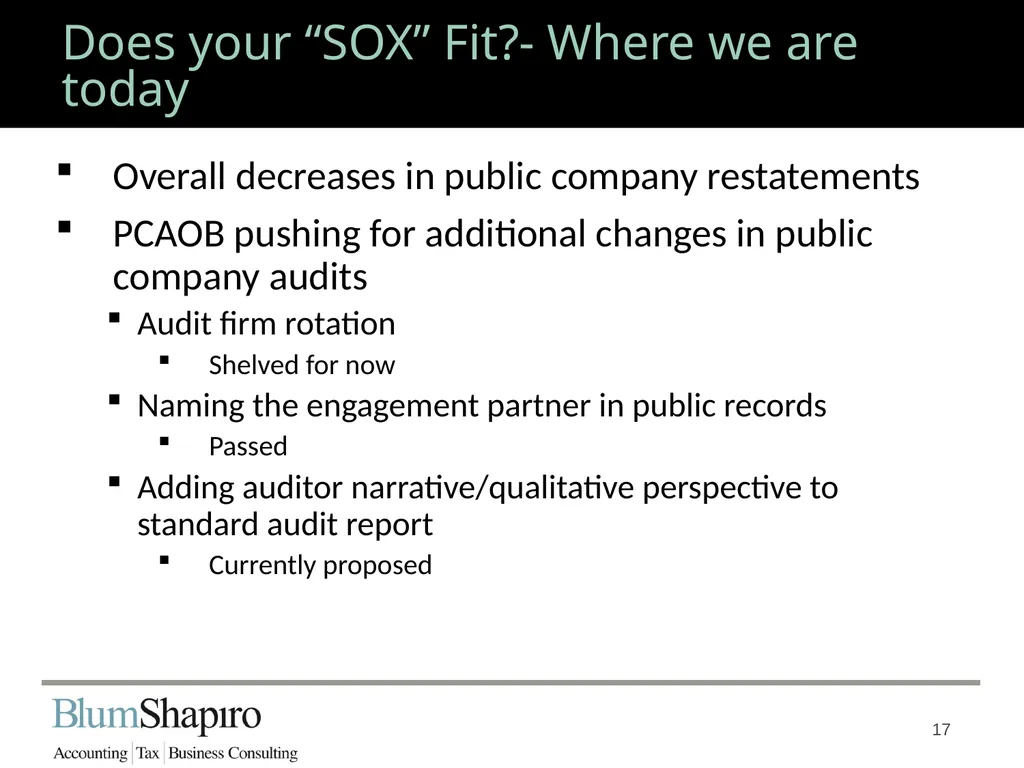
Does your “SOX” Fit?- Where we are today Overall decreases in public company restatements
PCAOB pushing for additional changes in public company audits
Audit firm rotation
Shelved for now
Naming the engagement partner in public records
Passed
Adding auditor narrative/qualitative perspective to standard audit report
Currently proposed 17<br>
PCAOB pushing for additional changes in public company audits
Audit firm rotation
Shelved for now
Naming the engagement partner in public records
Passed
Adding auditor narrative/qualitative perspective to standard audit report
Currently proposed 17<br>
18
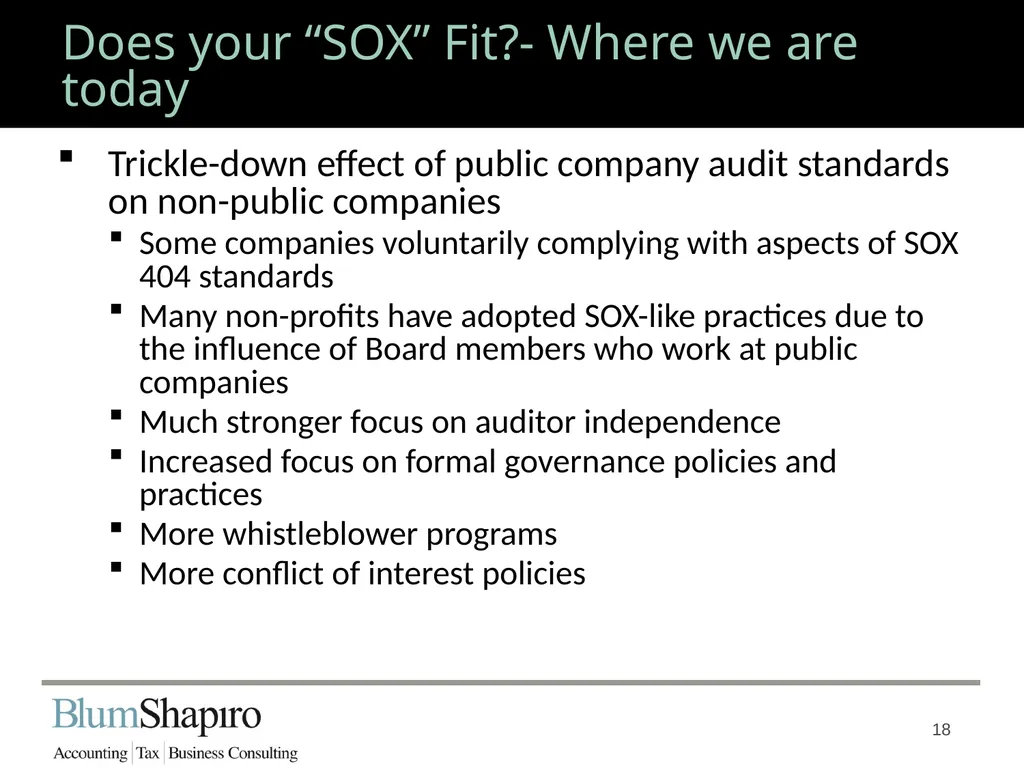
Does your “SOX” Fit?- Where we are today Trickle-down effect of public company audit standards on non-public companies
Some companies voluntarily complying with aspects of SOX 404 standards
Many non-profits have adopted SOX-like practices due to the influence of Board members who work at public companies
Much stronger focus on auditor independence
Increased focus on formal governance policies and practices
More whistleblower programs
More conflict of interest policies 18<br>
19
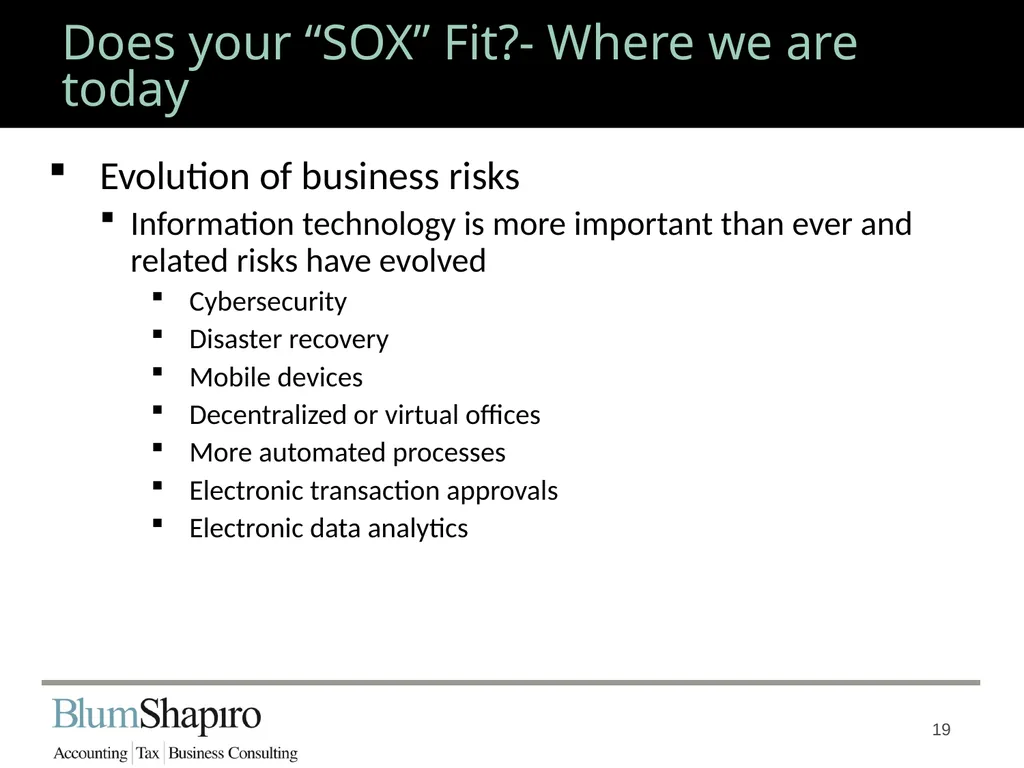
Does your “SOX” Fit?- Where we are today Evolution of business risks
Information technology is more important than ever and related risks have evolved
Cybersecurity
Disaster recovery
Mobile devices
Decentralized or virtual offices
More automated processes
Electronic transaction approvals
Electronic data analytics 19<br>
Information technology is more important than ever and related risks have evolved
Cybersecurity
Disaster recovery
Mobile devices
Decentralized or virtual offices
More automated processes
Electronic transaction approvals
Electronic data analytics 19<br>
20
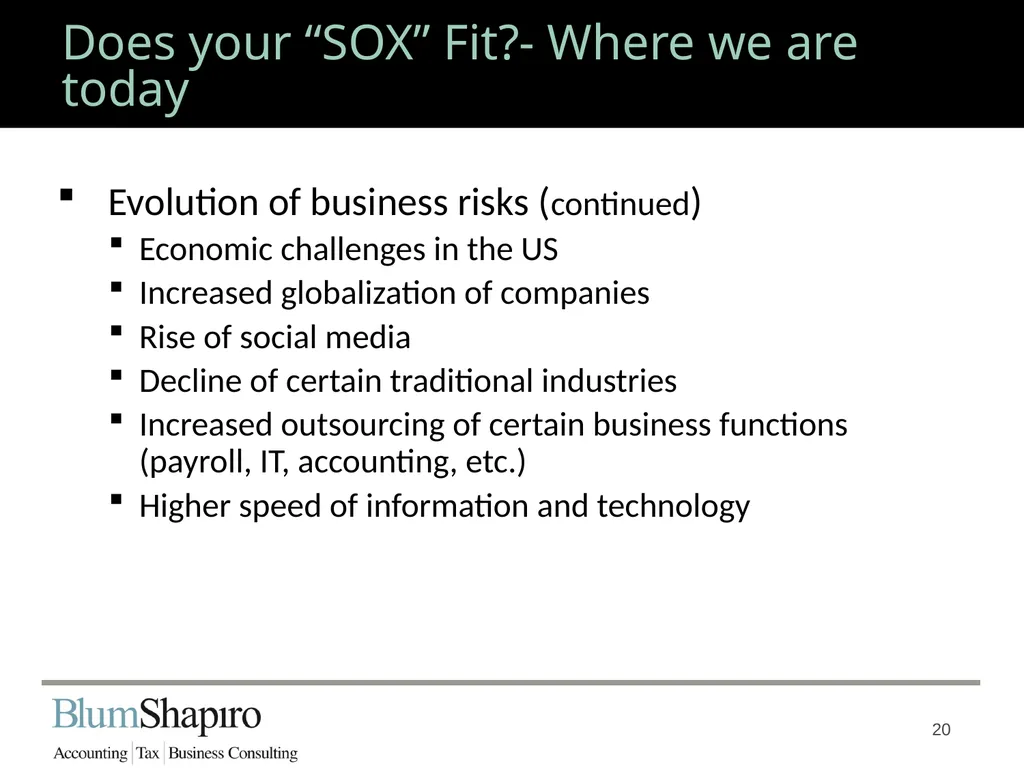
Does your “SOX” Fit?- Where we are today Evolution of business risks (continued)
Economic challenges in the US
Increased globalization of companies
Rise of social media
Decline of certain traditional industries
Increased outsourcing of certain business functions (payroll, IT, accounting, etc.)
Higher speed of information and technology 20<br>
Economic challenges in the US
Increased globalization of companies
Rise of social media
Decline of certain traditional industries
Increased outsourcing of certain business functions (payroll, IT, accounting, etc.)
Higher speed of information and technology 20<br>
21
Does your “SOX” Fit?- Where we are today What have these changes meant for SOX?
More IT audit expertise needed (in-house or outsourced)
With shift to more automated controls, less basic sample-based controls testing and more “sample of one” testing
Staffing needs have changed
Certain controls can now be tested remotely vs. on-site
With increased speed of information movement, outside risks have grown in potential significance
Example: public relations impact of a company compliance issue
SOX compliance has evolved from a special initiative to part of the ongoing compliance and business processes of a company 21<br>
22
Does your “SOX” Fit?- Where we are today What has not changed?
Continued demand for accountants (perhaps more now than ever)
Can be hard to fill employee needs
Risk of human error
Fraud risks
Companies managing staff sizes and, in some cases, those staff sizes do not allow for proper segregation of duties
External employee pressures (gambling problems, divorces, etc.)
Internal employee fraud motivations
Assets
Financial reporting 22<br>
23
Does your “SOX” Fit?- Where we might be going Further tightening of oversight and standards by PCAOB?
Concerns related to continued audit deficiencies noted during inspections
Pressure from external groups to improve audits
Potential impact of a large company fraud or market crisis?
Additional regulations possible
Does SOX get replaced by a different law/standard?
More “real-time” financial reporting beyond quarters and year-ends?
More timely financial information
Impact on how companies close their books, etc. 23<br>
24
Does your “SOX” Fit?- Where we might be going Expansion of SOX to cover more non-financial reporting risks?
Cybersecurity
Identity theft
Ethics violations
Increased market value placed on acquisition targets that are SOX-compliant?
Simplification of public company disclosures?
Concern that too much information prevents readers from identifying key facts and risks 24<br>
Cybersecurity
Identity theft
Ethics violations
Increased market value placed on acquisition targets that are SOX-compliant?
Simplification of public company disclosures?
Concern that too much information prevents readers from identifying key facts and risks 24<br>
25
Does your “SOX” Fit?- SOX concepts for non-public companies There are many practices that have emerged from public companies’ SOX efforts that have benefits for non-public companies
Risk assessment
Periodic review and discussion of enterprise and fraud risks
Many companies’ employees do this on an individual or departmental basis but do not necessarily get together to discuss risks across company functions
Gather people from sales, finance, operations, human resources, information technology, and executive areas to compare thoughts on the risks that the company is facing
The risks discussed should include anything that could have a negative impact on the company 25<br>
26
Does your “SOX” Fit?- SOX concepts for
non-public companies Risk assessment (continued)
Periodic review and discussion of enterprise and fraud risks
Significance and likelihood are key factors
Some risks (e.g. hurricane) are significant but may be low likelihood
Other risks may have a high likelihood but the potential impact on the company is not significant
Determine which risks are being adequately addressed by current controls and processes and which ones may represent a “gap”
Prioritize the order and method in which gap risks will be addressed
Set a timetable for action items
This type of comprehensive assessment should be performed at least every 2-3 years 26<br>
27
Does your “SOX” Fit?- SOX concepts for
non-public companies Documentation of internal controls
Can be accomplished either through written memos or flowcharts
Should capture what employees are actually doing- not what a policy says they do
No set level of detail- choose the level of detail based on the perceived value to the company
Can be valuable for several reasons:
Allows for easier identification of gaps or weaknesses in controls and related processes
Identifies potential areas where employee training may be needed
Facilitates cross-training of existing employees or training of new employees 27<br>
28
Does your “SOX” Fit?- SOX concepts for
non-public companies Documentation of controls’ performance
The biggest challenge here is for employees to incorporate documentation into their everyday work habits
Examples of controls documentation
Approvals of transactions
Memos describing key decisions
Analysis of system reports
Benefits of controls evidence documentation
Internal reference for analysis or key decisions
Support in compliance or legal matter 28<br>
29
Does your “SOX” Fit?- SOX concepts for
non-public companies Internal monitoring or testing
This could range from a full internal audit department to a review of select controls on an occasional basis
Key is to not make the testing or review predictable
Primary benefits
Identification of potential issues on a more immediate basis
Many employees will be more diligent about their work if they know it could be “tested”
Deterrent for potential fraud 29<br>
30
Does your “SOX” Fit?- SOX concepts for
non-public companies IT controls
Establish and document formal policies and procedures related to information technology
Security
Data back-ups
System development
Data processing
Consider the following:
Friendly hackers/penetration studies
Consulting with 3rd party experts to evaluate a company’s IT control structure 30<br>
Establish and document formal policies and procedures related to information technology
Security
Data back-ups
System development
Data processing
Consider the following:
Friendly hackers/penetration studies
Consulting with 3rd party experts to evaluate a company’s IT control structure 30<br>
31
Does your “SOX” Fit?- SOX concepts for
non-public companies Overall key considerations and takeaways
Incorporating SOX concepts in a non-public company is not a pass/fail approach
Some companies pursue a full public company type approach and others pick certain concepts for their use
Risk assessment is the key concept that should drive approach
Different companies have different needs; consider where SOX concepts make sense for your company
Many companies develop a plan and incorporate it over a multi-year period 31<br>
32
Does your “SOX” Fit?- SOX concepts for
non-public companies Overall key considerations and takeaways (continued)
Cost/benefit is an important consideration
Consider getting feedback from valued 3rd party advisors as part of any decision making process as well as during implementation:
Auditors/tax accountants
Bankers
Attorneys 32<br>
Cost/benefit is an important consideration
Consider getting feedback from valued 3rd party advisors as part of any decision making process as well as during implementation:
Auditors/tax accountants
Bankers
Attorneys 32<br>
33
Does your “SOX” Fit? Questions? 33<br>
34
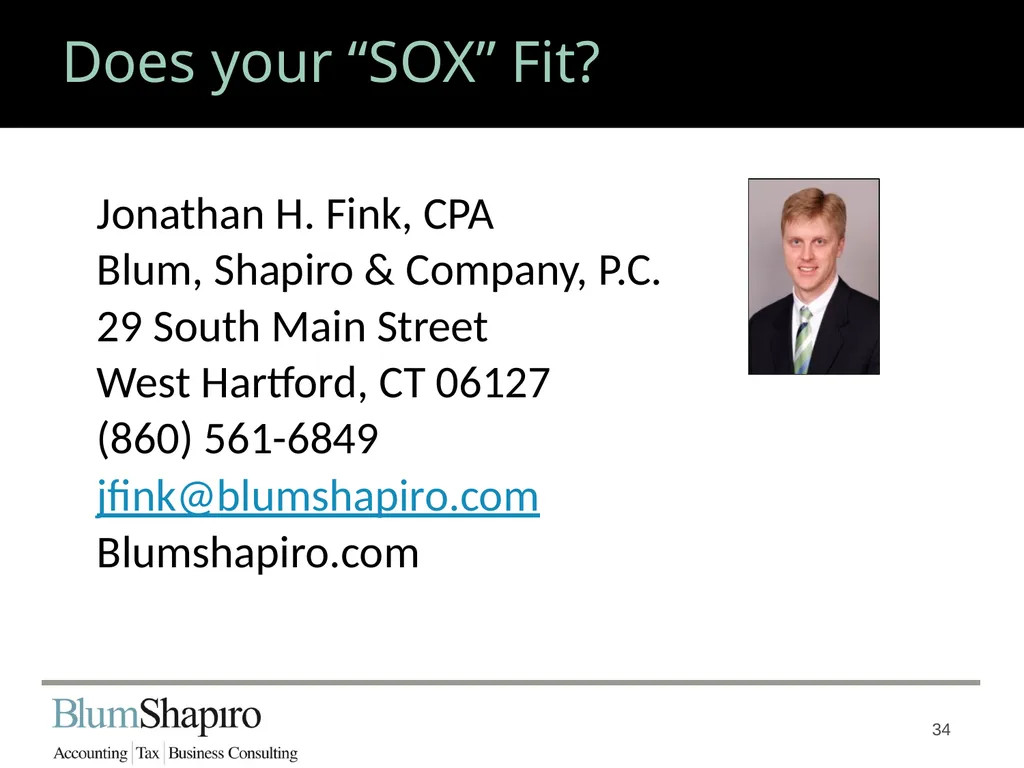
Does your “SOX” Fit? Jonathan H. Fink, CPA
Blum, Shapiro & Company, P.C.
29 South Main Street
West Hartford, CT 06127
(860) 561-6849
jfink@blumshapiro.com
Blumshapiro.com 34<br>
Blum, Shapiro & Company, P.C.
29 South Main Street
West Hartford, CT 06127
(860) 561-6849
jfink@blumshapiro.com
Blumshapiro.com 34<br>