
Doing Human Subjects Research? Changing NIH


Description: Doing Human Subjects Research? Changing NIH Policies May Impact You Purpose of Reforms Policy Changes In 2016, NIH announced initiatives targeted to enhance and improve: Efficiency Enhance the efficiency of how research studies involving
Related Topics
Download Presentation
"Doing Human Subjects Research? Changing NIH" is the property of its rightful owner. Permission is granted to download and print the materials on this website for personal, non-commercial use only, and to display it on your personal computer provided you do not modify the materials and that you retain all copyright notices contained in the materials. By downloading content from our website, you accept the terms of this agreement.
Presentation Transcript
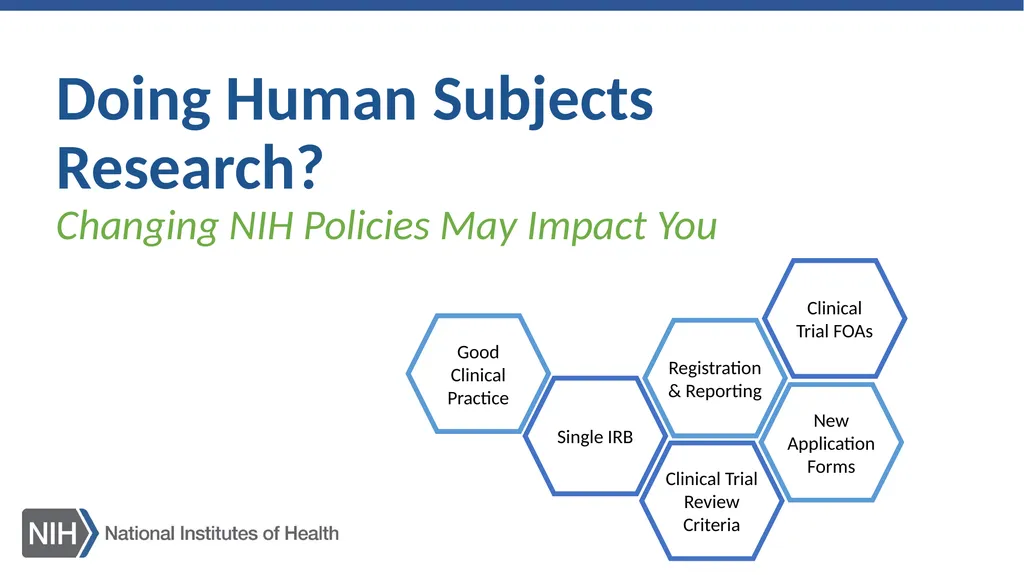
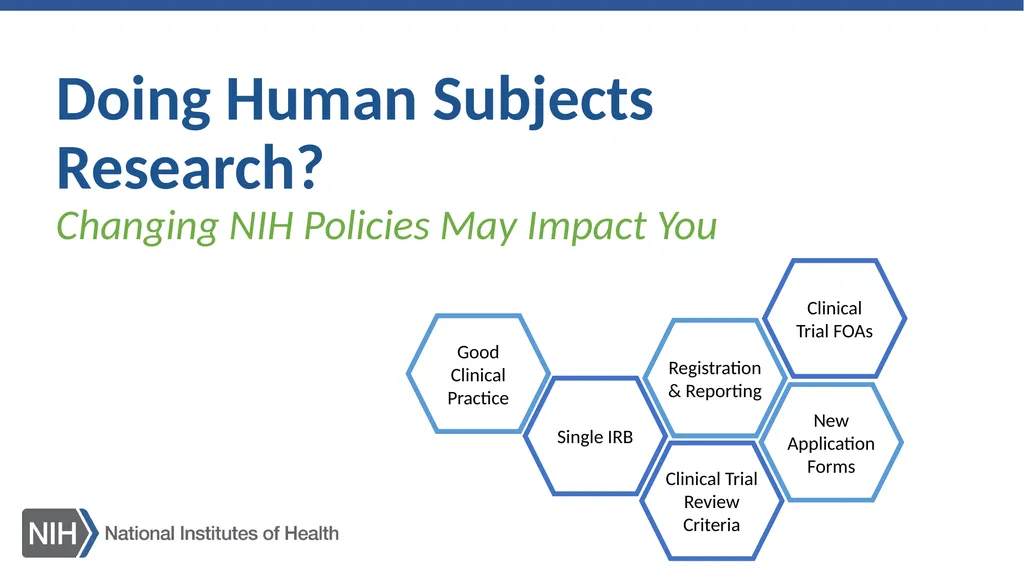
slide1. Doing Human Subjects Research?
Changing NIH Policies May Impact You<br>
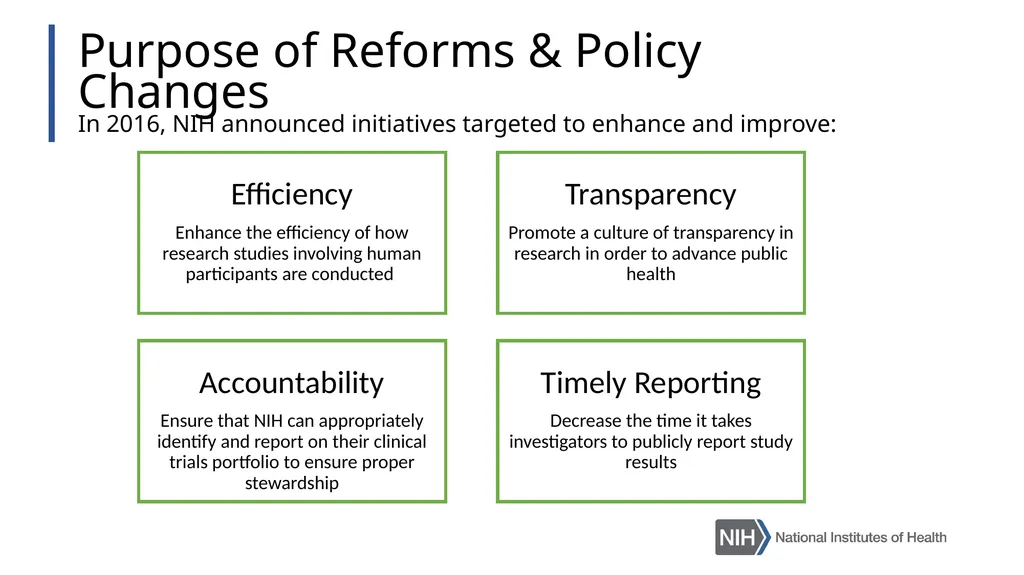
slide2. Purpose of Reforms & Policy Changes In 2016, NIH announced initiatives targeted to enhance and improve: Efficiency
Enhance the efficiency of how research studies involving human participants are conducted Transparency
Promote a culture of transparency in research in order to advance public health Accountability
Ensure that NIH can appropriately identify and report on their clinical trials portfolio to ensure proper stewardship Timely Reporting
Decrease the time it takes investigators to publicly report study results<br>
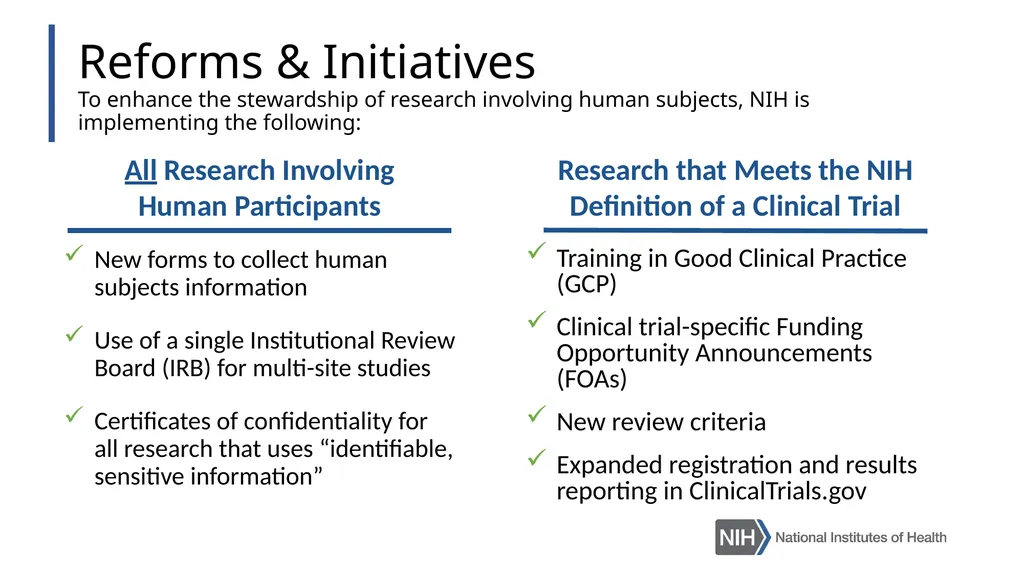
slide3. Reforms & Initiatives To enhance the stewardship of research involving human subjects, NIH is implementing the following: All Research Involving Human Participants New forms to collect human subjects information
Use of a single Institutional Review Board (IRB) for multi-site studies
Certificates of confidentiality for all research that uses “identifiable, sensitive information” Research that Meets the NIH Definition of a Clinical Trial Training in Good Clinical Practice (GCP)
Clinical trial-specific Funding Opportunity Announcements (FOAs)
New review criteria
Expanded registration and results reporting in ClinicalTrials.gov<br>
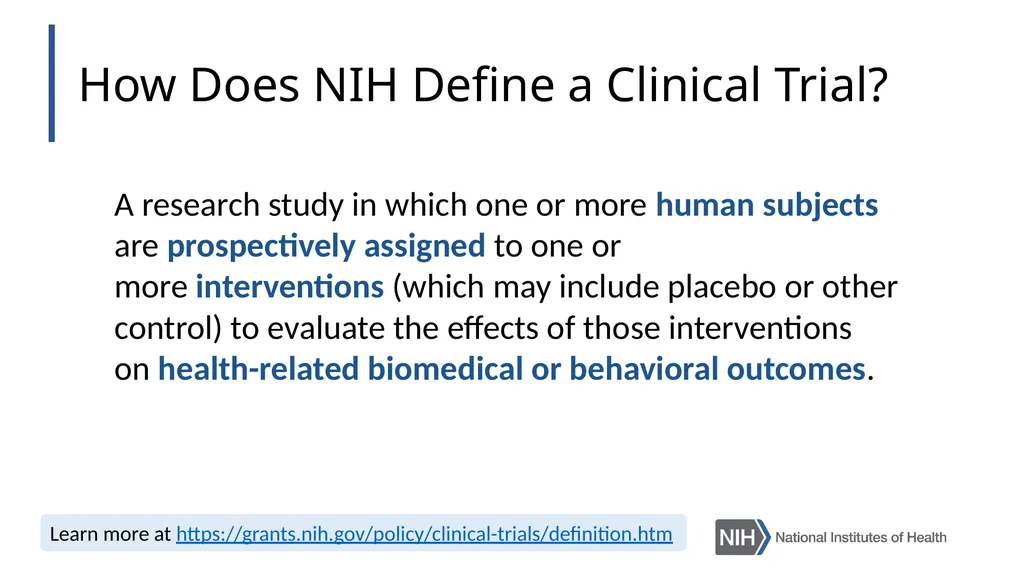
slide4. How Does NIH Define a Clinical Trial? A research study in which one or more human subjects are prospectively assigned to one or more interventions (which may include placebo or other control) to evaluate the effects of those interventions on health-related biomedical or behavioral outcomes. Learn more at https://grants.nih.gov/policy/clinical-trials/definition.htm<br>
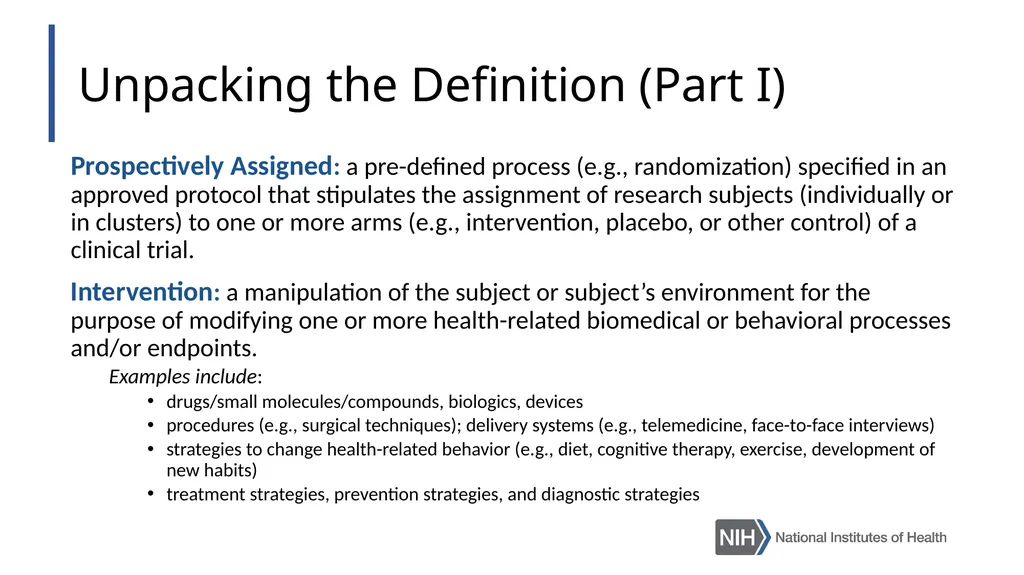
slide5. Unpacking the Definition (Part I) Prospectively Assigned: a pre-defined process (e.g., randomization) specified in an approved protocol that stipulates the assignment of research subjects (individually or in clusters) to one or more arms (e.g., intervention, placebo, or other control) of a clinical trial. Intervention: a manipulation of the subject or subject’s environment for the purpose of modifying one or more health-related biomedical or behavioral processes and/or endpoints.
Examples include:
drugs/small molecules/compounds, biologics, devices
procedures (e.g., surgical techniques); delivery systems (e.g., telemedicine, face-to-face interviews)
strategies to change health-related behavior (e.g., diet, cognitive therapy, exercise, development of new habits)
treatment strategies, prevention strategies, and diagnostic strategies<br>
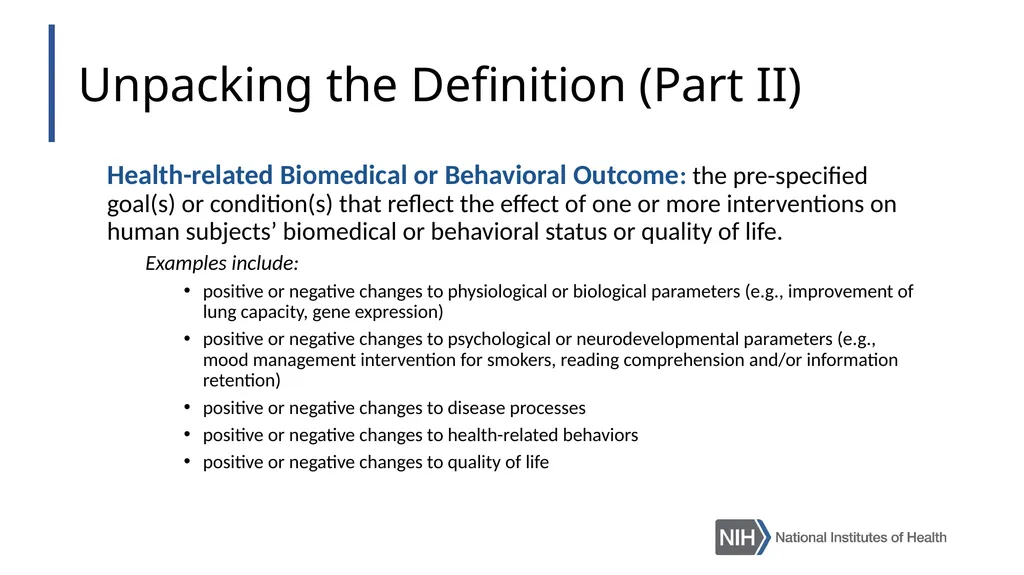
slide6. Unpacking the Definition (Part II) Health-related Biomedical or Behavioral Outcome: the pre-specified goal(s) or condition(s) that reflect the effect of one or more interventions on human subjects’ biomedical or behavioral status or quality of life.
Examples include:
positive or negative changes to physiological or biological parameters (e.g., improvement of lung capacity, gene expression)
positive or negative changes to psychological or neurodevelopmental parameters (e.g., mood management intervention for smokers, reading comprehension and/or information retention)
positive or negative changes to disease processes
positive or negative changes to health-related behaviors
positive or negative changes to quality of life<br>
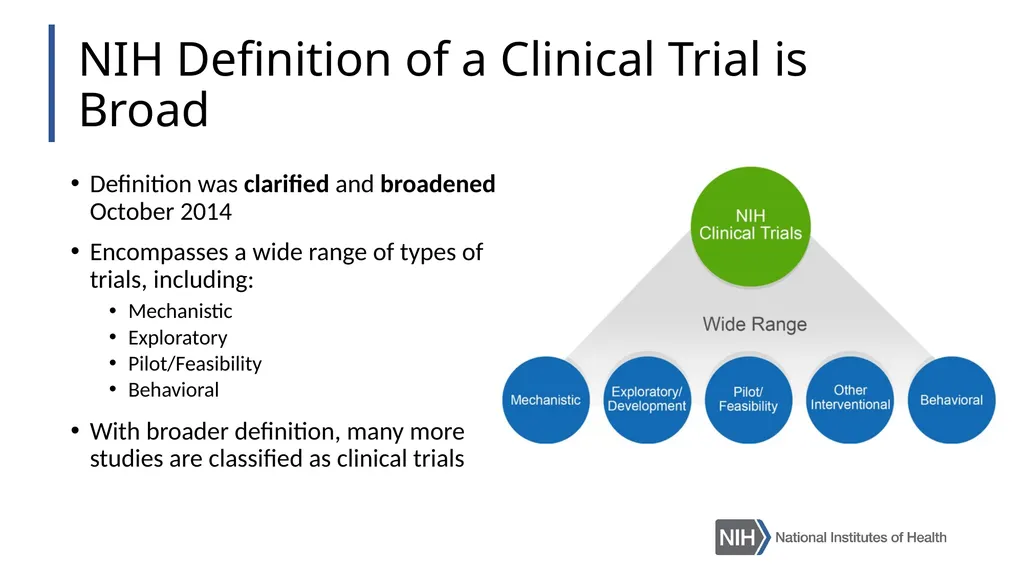
slide7. NIH Definition of a Clinical Trial is Broad Definition was clarified and broadened in October 2014
Encompasses a wide range of types of trials, including:
Mechanistic
Exploratory
Pilot/Feasibility
Behavioral
With broader definition, many more studies are classified as clinical trials<br>
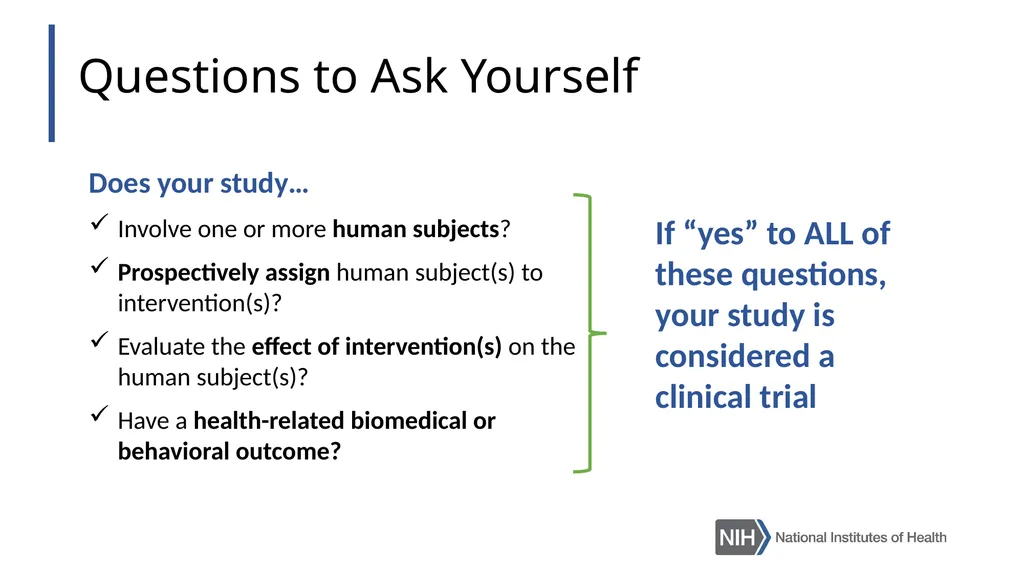
slide8. Questions to Ask Yourself Does your study…
Involve one or more human subjects?
Prospectively assign human subject(s) to intervention(s)?
Evaluate the effect of intervention(s) on the human subject(s)?
Have a health-related biomedical or behavioral outcome? If “yes” to ALL of these questions, your study is considered a clinical trial<br>
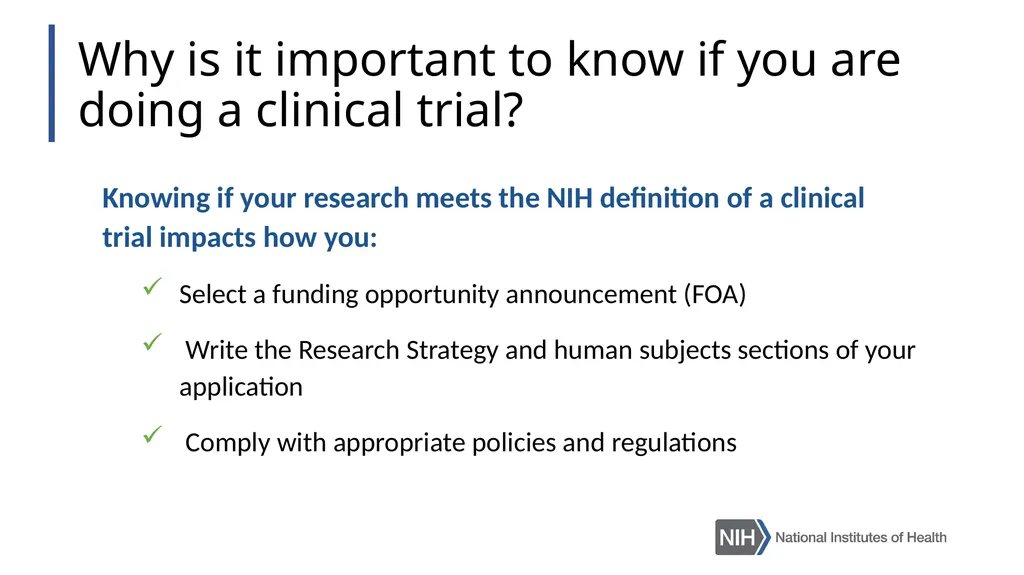
slide9. Why is it important to know if you are doing a clinical trial? Knowing if your research meets the NIH definition of a clinical trial impacts how you:
Select a funding opportunity announcement (FOA)
Write the Research Strategy and human subjects sections of your application
Comply with appropriate policies and regulations<br>
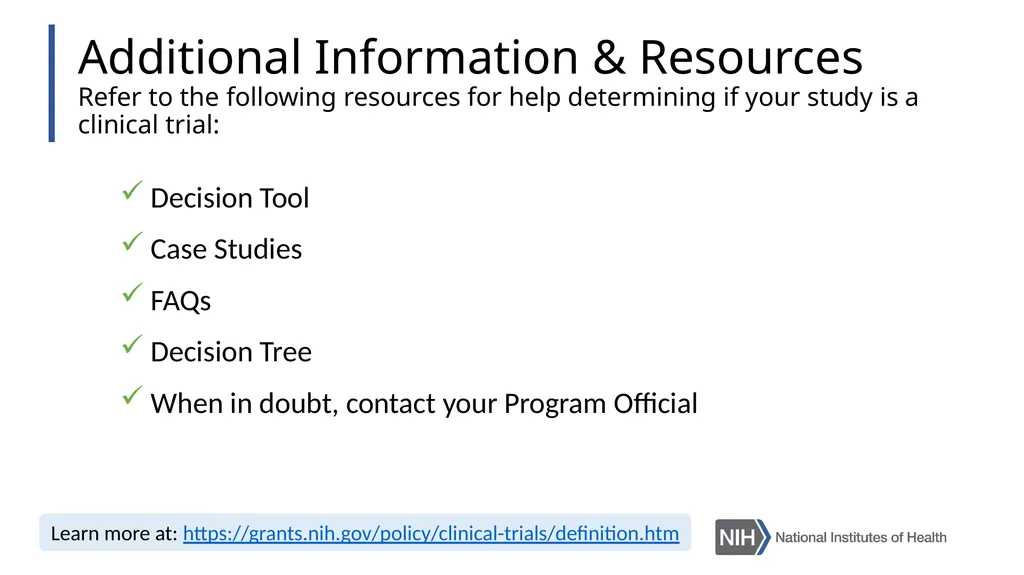
slide10. Additional Information & Resources Refer to the following resources for help determining if your study is a clinical trial: Decision Tool
Case Studies
FAQs
Decision Tree
When in doubt, contact your Program Official Learn more at: https://grants.nih.gov/policy/clinical-trials/definition.htm<br>
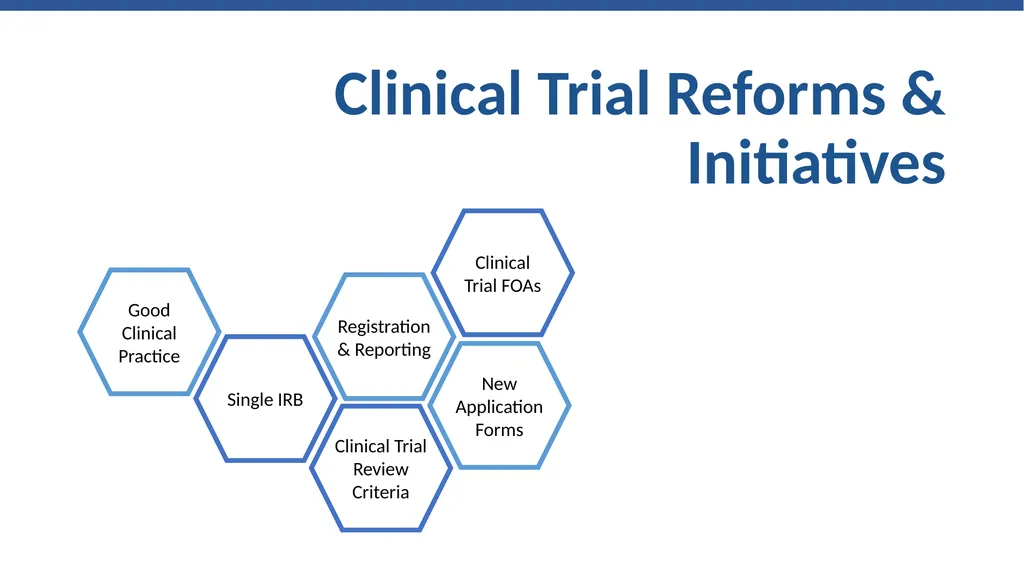
slide11. Clinical Trial Reforms & Initiatives<br>
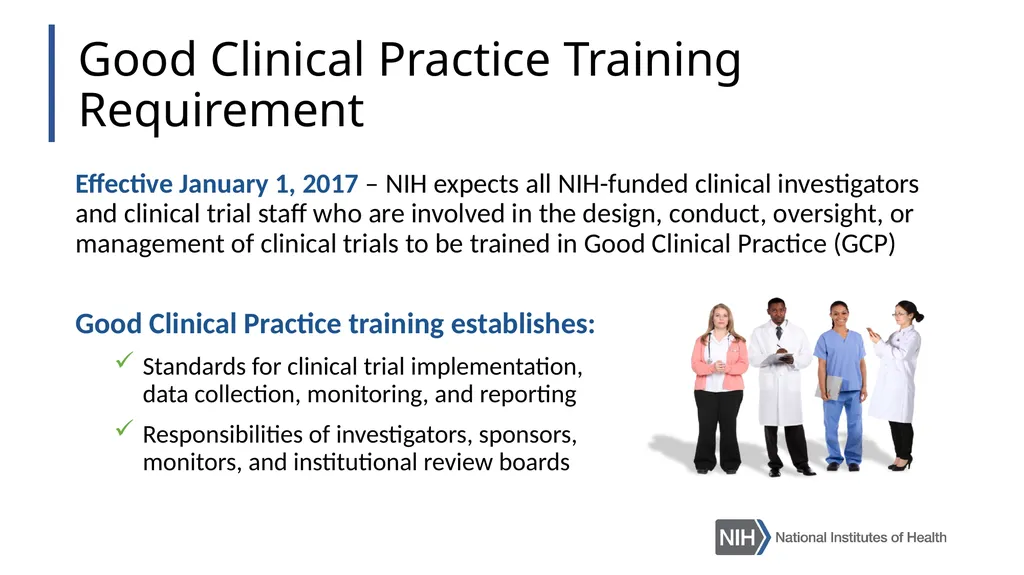
slide12. Good Clinical Practice Training Requirement Effective January 1, 2017 – NIH expects all NIH-funded clinical investigators and clinical trial staff who are involved in the design, conduct, oversight, or management of clinical trials to be trained in Good Clinical Practice (GCP) Good Clinical Practice training establishes:
Standards for clinical trial implementation, data collection, monitoring, and reporting
Responsibilities of investigators, sponsors, monitors, and institutional review boards<br>
slide13. Expectations for GCP Training GCP training can be achieved through several ways:
class or course
academic training program
certification from a recognized clinical research professional organization
Training should be refreshed every 3 years to stay up to date with regulations, standards, and guidelines
Recipients of GCP training are expected to retain documentation of their training and make it available to NIH upon request Learn more at https://grants.nih.gov/policy/clinical-trials/good-clinical-training.htm<br>
slide14. Funding Opportunity Announcements (FOAs) for Clinical Trials Effective for due dates on/after January 25, 2018 – All grant applications & contract proposals involving one or more clinical trials must be submitted through an FOA or Request for Proposal (RFP) specifically designated for clinical trials
Clinical Trial-specific FOAs allow NIH to:
identify proposed clinical trials
ensure that key pieces of clinical trial-specific information are submitted with each application
uniformly apply clinical trial-specific review criteria Important: Adding a clinical trial to a non-clinical trial application is no longer permitted via the prior approval process. Grantees must submit competitive renewal.<br>
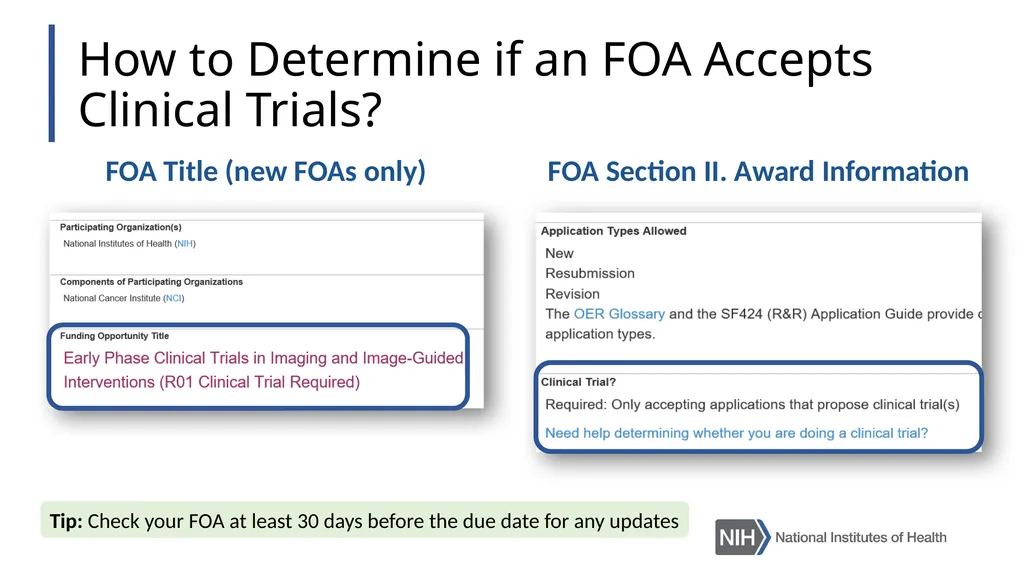
slide15. How to Determine if an FOA Accepts Clinical Trials? FOA Title (new FOAs only) FOA Section II. Award Information Tip: Check your FOA at least 30 days before the due date for any updates<br>
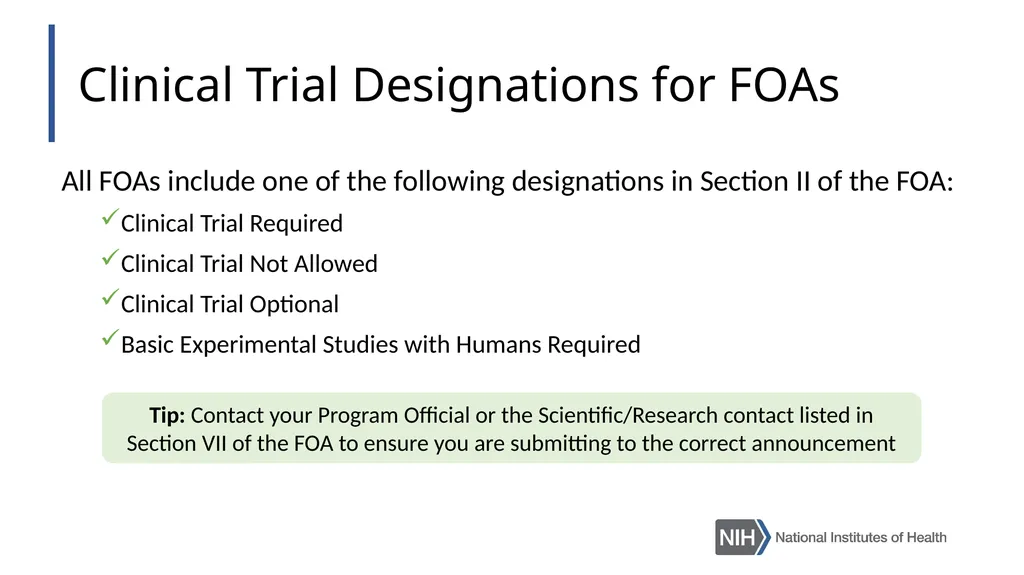
slide16. Clinical Trial Designations for FOAs All FOAs include one of the following designations in Section II of the FOA:
Clinical Trial Required
Clinical Trial Not Allowed
Clinical Trial Optional
Basic Experimental Studies with Humans Required Tip: Contact your Program Official or the Scientific/Research contact listed in Section VII of the FOA to ensure you are submitting to the correct announcement<br>
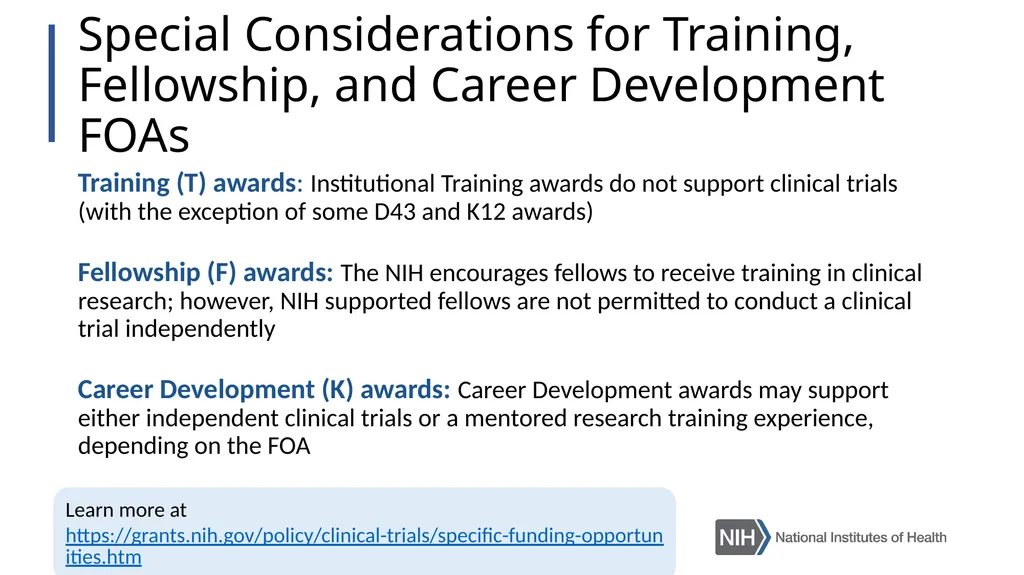
slide17. Special Considerations for Training, Fellowship, and Career Development FOAs Training (T) awards: Institutional Training awards do not support clinical trials (with the exception of some D43 and K12 awards)
Fellowship (F) awards: The NIH encourages fellows to receive training in clinical research; however, NIH supported fellows are not permitted to conduct a clinical trial independently
Career Development (K) awards: Career Development awards may support either independent clinical trials or a mentored research training experience, depending on the FOA Learn more at https://grants.nih.gov/policy/clinical-trials/specific-funding-opportunities.htm<br>
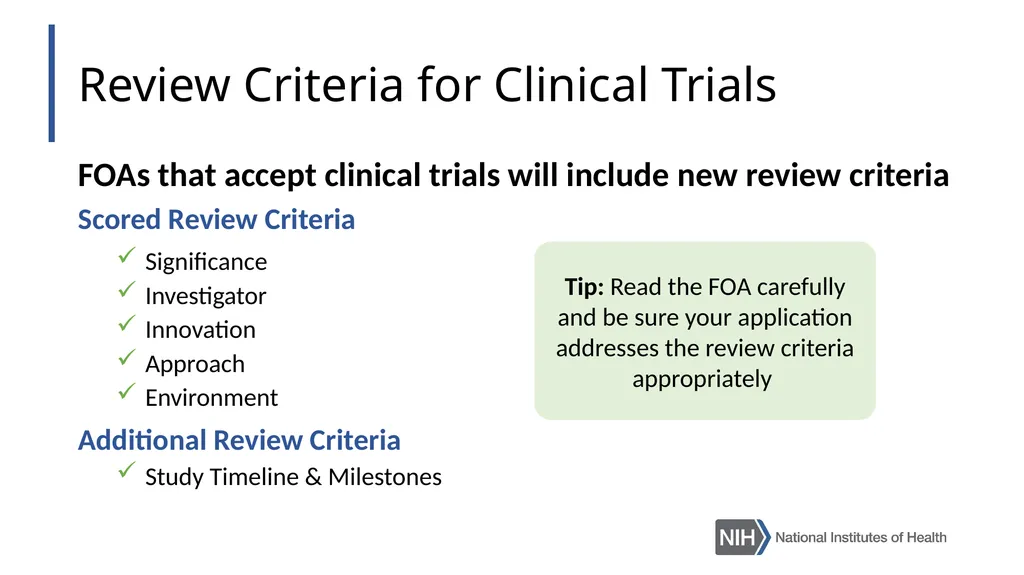
slide18. Review Criteria for Clinical Trials FOAs that accept clinical trials will include new review criteria
Scored Review Criteria
Significance
Investigator
Innovation
Approach
Environment
Additional Review Criteria
Study Timeline & Milestones Tip: Read the FOA carefully and be sure your application addresses the review criteria appropriately<br>
slide19. New Human Subjects & Clinical Trials Information Form A primary component of NIH’s clinical trial reform is the creation of a new application form that:
Consolidates human subjects, inclusion enrollment, and clinical trial information into one form
Collects information at the study-level
Uses discrete form fields to capture clinical trial information and provide the level of detail needed for peer review
Presents key information to reviewers and staff in a consistent format
Aligns with ClinicalTrials.gov (where possible) for future data exchange with ClinicalTrials.gov<br>
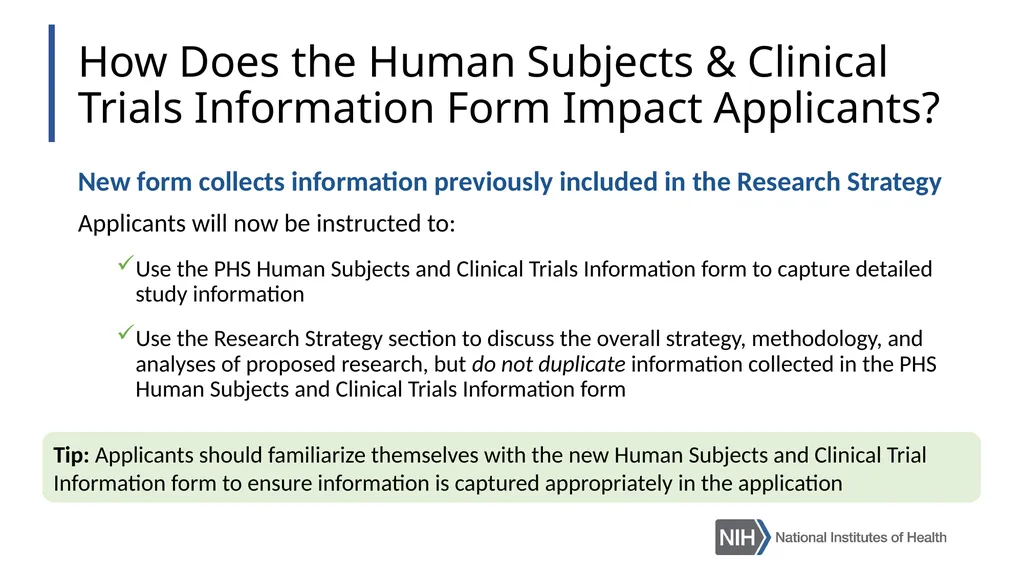
slide20. How Does the Human Subjects & Clinical Trials Information Form Impact Applicants? New form collects information previously included in the Research Strategy
Applicants will now be instructed to:
Use the PHS Human Subjects and Clinical Trials Information form to capture detailed study information
Use the Research Strategy section to discuss the overall strategy, methodology, and analyses of proposed research, but do not duplicate information collected in the PHS Human Subjects and Clinical Trials Information form Tip: Applicants should familiarize themselves with the new Human Subjects and Clinical Trial Information form to ensure information is captured appropriately in the application<br>
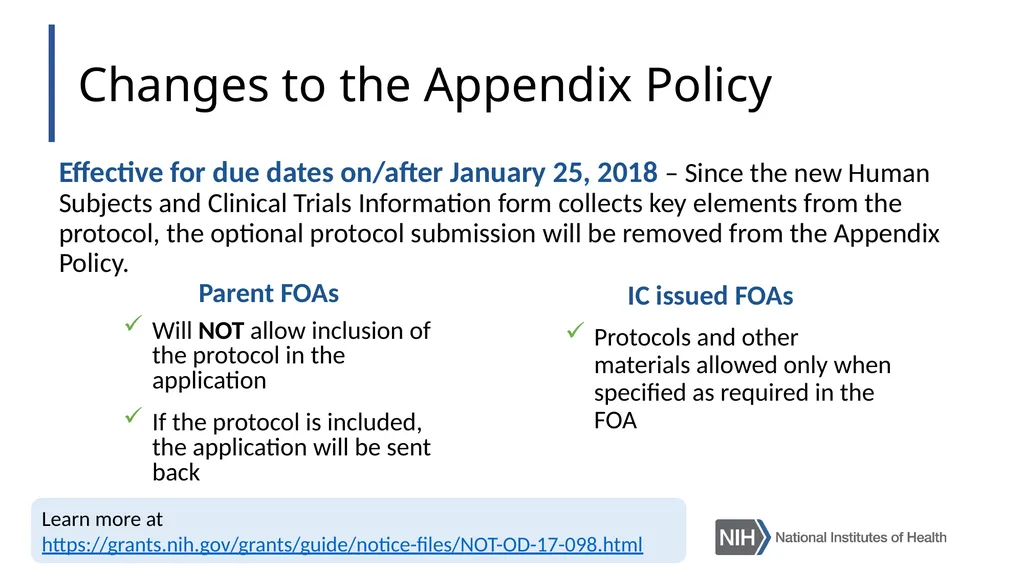
slide21. Changes to the Appendix Policy Effective for due dates on/after January 25, 2018 – Since the new Human Subjects and Clinical Trials Information form collects key elements from the protocol, the optional protocol submission will be removed from the Appendix Policy. Parent FOAs
Will NOT allow inclusion of the protocol in the application
If the protocol is included, the application will be sent back IC issued FOAs
Protocols and other materials allowed only when specified as required in the FOA Learn more at https://grants.nih.gov/grants/guide/notice-files/NOT-OD-17-098.html<br>
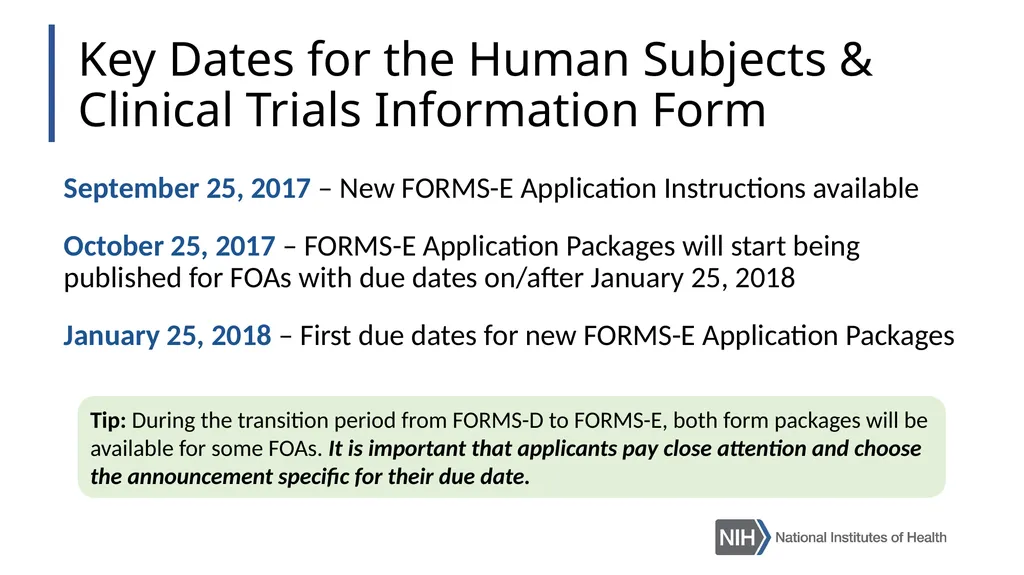
slide22. Key Dates for the Human Subjects & Clinical Trials Information Form September 25, 2017 – New FORMS-E Application Instructions available
October 25, 2017 – FORMS-E Application Packages will start being published for FOAs with due dates on/after January 25, 2018
January 25, 2018 – First due dates for new FORMS-E Application Packages Tip: During the transition period from FORMS-D to FORMS-E, both form packages will be available for some FOAs. It is important that applicants pay close attention and choose the announcement specific for their due date.<br>
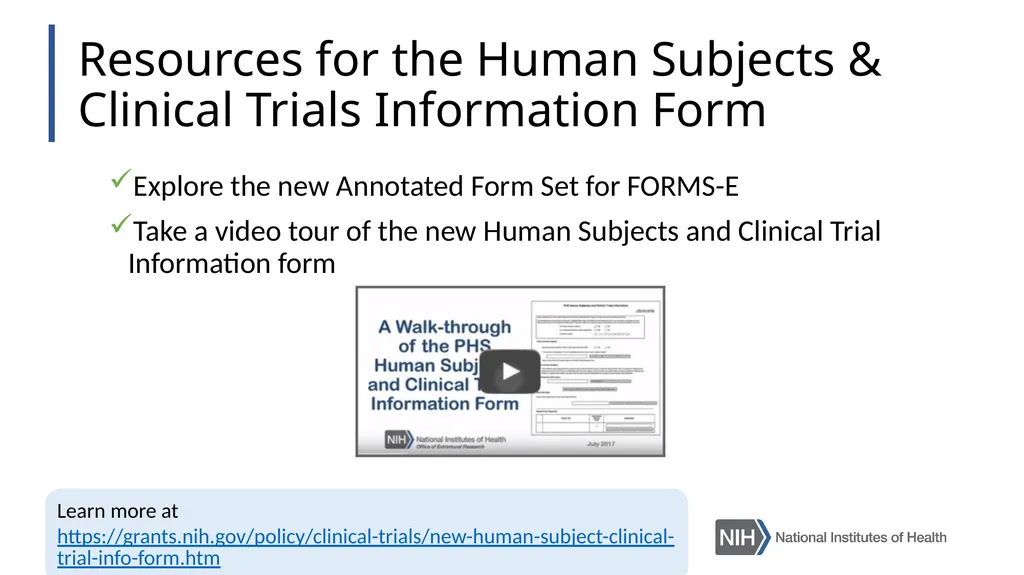
slide23. Resources for the Human Subjects & Clinical Trials Information Form Explore the new Annotated Form Set for FORMS-E
Take a video tour of the new Human Subjects and Clinical Trial Information form Learn more at https://grants.nih.gov/policy/clinical-trials/new-human-subject-clinical-trial-info-form.htm<br>
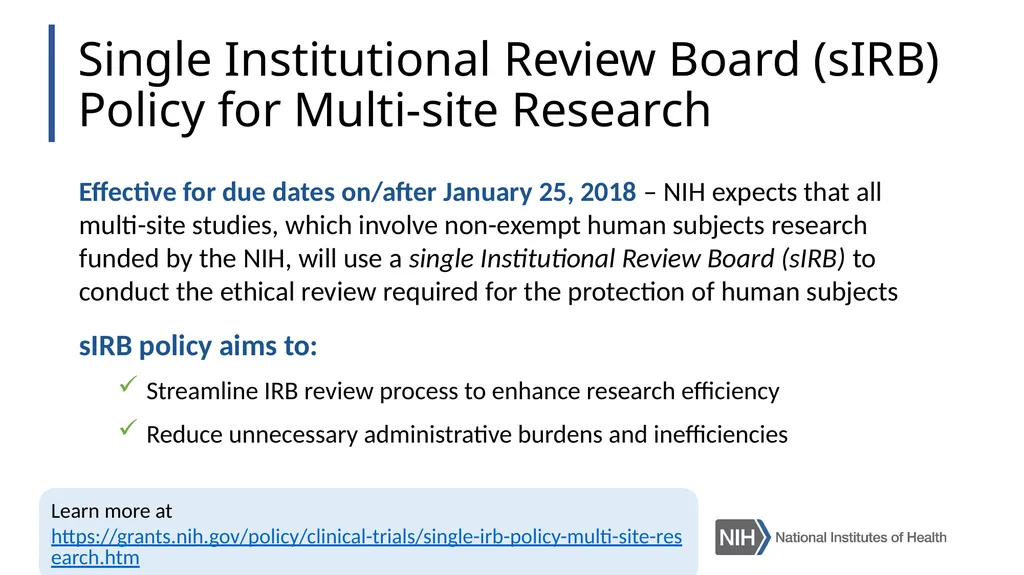
slide24. Single Institutional Review Board (sIRB) Policy for Multi-site Research Effective for due dates on/after January 25, 2018 – NIH expects that all multi-site studies, which involve non-exempt human subjects research funded by the NIH, will use a single Institutional Review Board (sIRB) to conduct the ethical review required for the protection of human subjects
sIRB policy aims to:
Streamline IRB review process to enhance research efficiency
Reduce unnecessary administrative burdens and inefficiencies Learn more at https://grants.nih.gov/policy/clinical-trials/single-irb-policy-multi-site-research.htm<br>
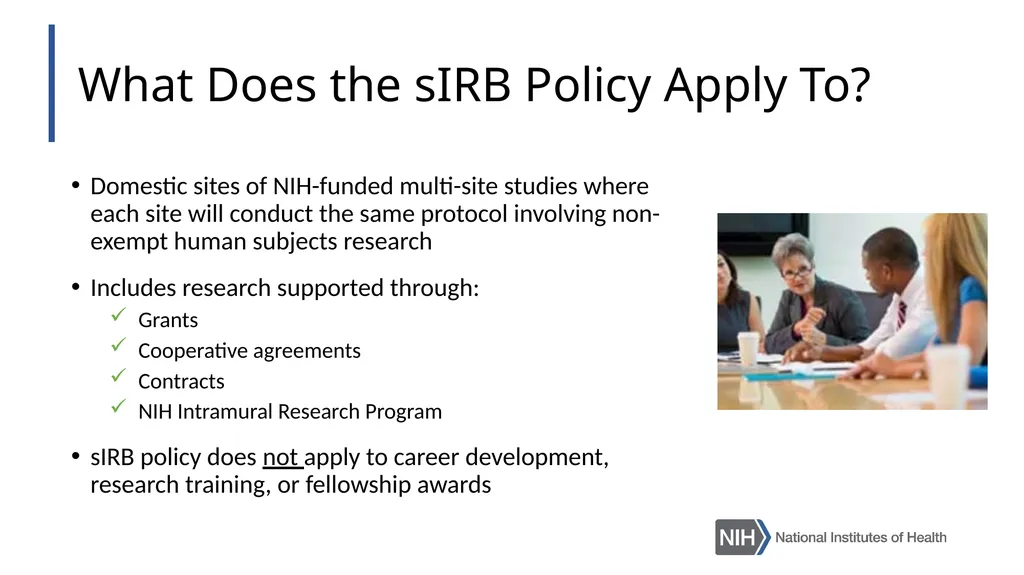
slide25. What Does the sIRB Policy Apply To? Domestic sites of NIH-funded multi-site studies where each site will conduct the same protocol involving non-exempt human subjects research
Includes research supported through:
Grants
Cooperative agreements
Contracts
NIH Intramural Research Program
sIRB policy does not apply to career development, research training, or fellowship awards<br>
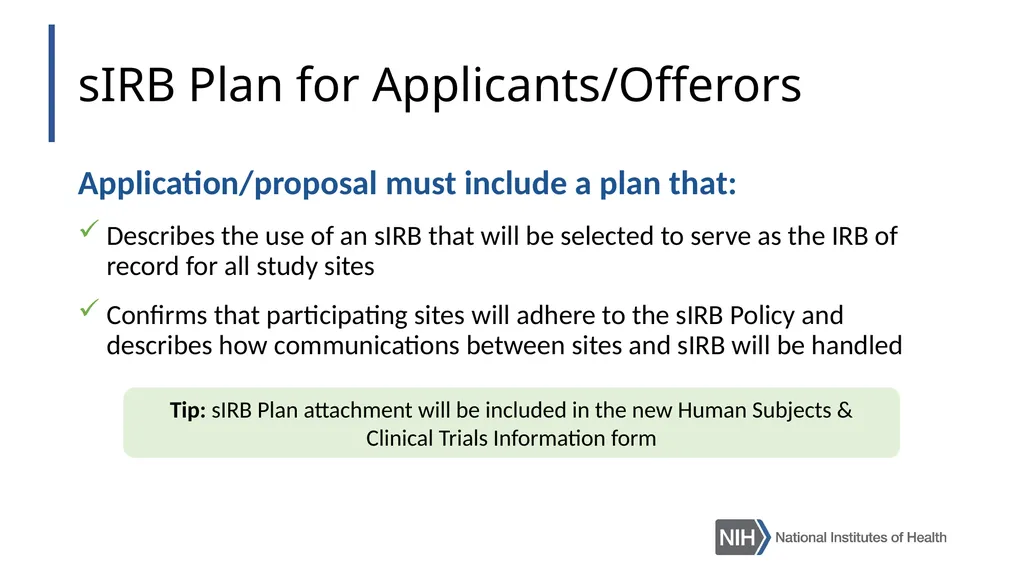
slide26. sIRB Plan for Applicants/Offerors Application/proposal must include a plan that:
Describes the use of an sIRB that will be selected to serve as the IRB of record for all study sites
Confirms that participating sites will adhere to the sIRB Policy and describes how communications between sites and sIRB will be handled Tip: sIRB Plan attachment will be included in the new Human Subjects & Clinical Trials Information form<br>
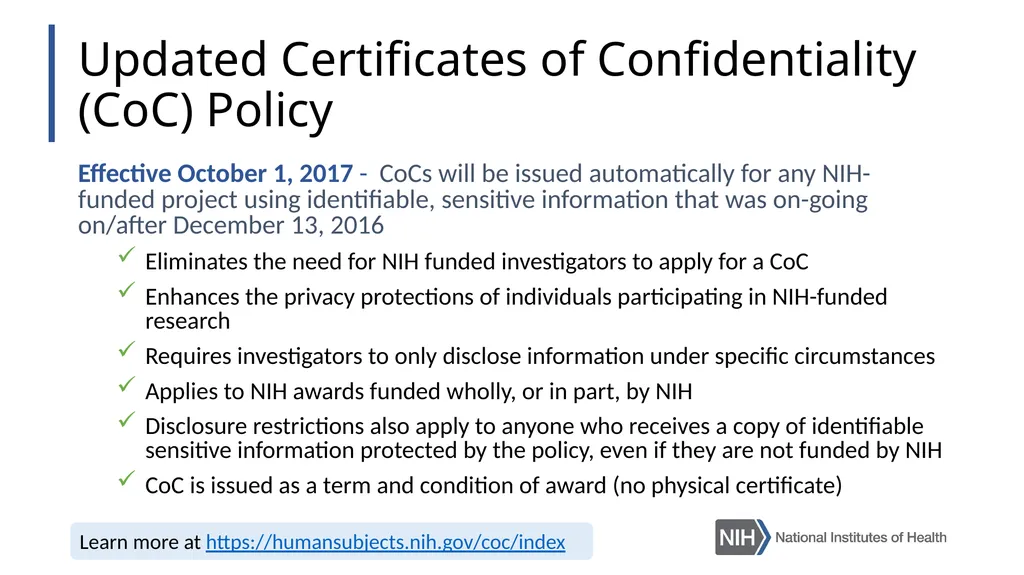
slide27. Updated Certificates of Confidentiality (CoC) Policy Effective October 1, 2017 - CoCs will be issued automatically for any NIH-funded project using identifiable, sensitive information that was on-going on/after December 13, 2016
Eliminates the need for NIH funded investigators to apply for a CoC
Enhances the privacy protections of individuals participating in NIH-funded research
Requires investigators to only disclose information under specific circumstances
Applies to NIH awards funded wholly, or in part, by NIH
Disclosure restrictions also apply to anyone who receives a copy of identifiable sensitive information protected by the policy, even if they are not funded by NIH
CoC is issued as a term and condition of award (no physical certificate) Learn more at https://humansubjects.nih.gov/coc/index<br>
slide28. NIH Policy on Dissemination of NIH-Funded Clinical Trial Information Effective for applications due on/after January 18, 2017 – All clinical trial applications requesting support for a trial that will be initiated on/after January 18, 2017 must register and report the results in ClinicalTrials.gov
NIH dissemination policy:
Extends previous HHS laws and regulations to apply to all NIH-funded clinical trials, including the defined subset of “applicable clinical trials”
Increases the availability of information to the public about clinical trials Learn more at https://grants.nih.gov/policy/clinical-trials/reporting/index.htm<br>
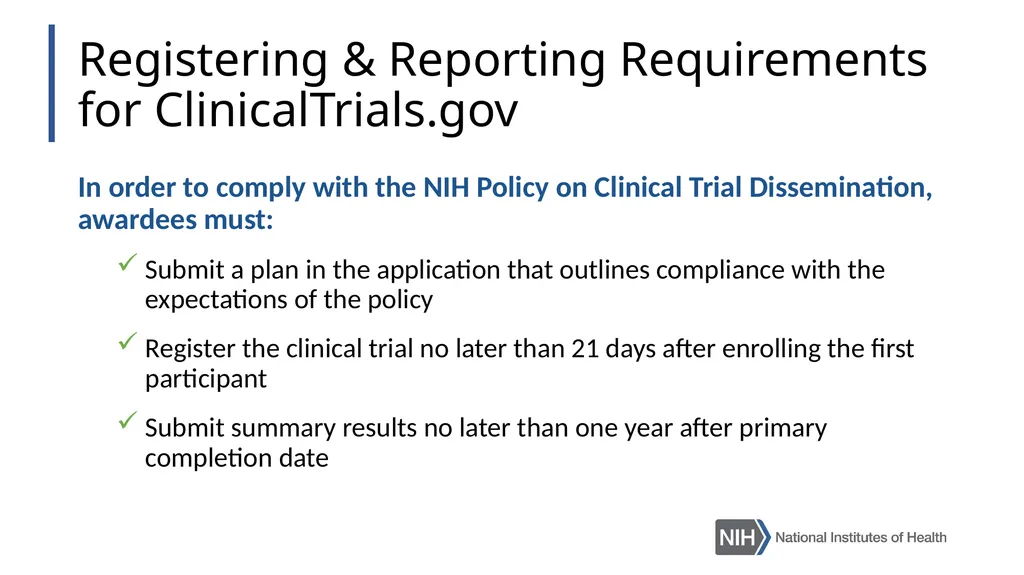
slide29. Registering & Reporting Requirements for ClinicalTrials.gov In order to comply with the NIH Policy on Clinical Trial Dissemination, awardees must:
Submit a plan in the application that outlines compliance with the expectations of the policy
Register the clinical trial no later than 21 days after enrolling the first participant
Submit summary results no later than one year after primary completion date<br>
slide30. More Information on Registering & Reporting in ClinicalTrials.gov Decision tree for ensuring compliance
FAQs Learn more at https://grants.nih.gov/policy/clinical-trials/reporting/index.htm<br>
slide31. Resources Website on Clinical Trial Requirements for Grants and Contracts: https://grants.nih.gov/policy/clinical-trials.htm
Training Resources: https://grants.nih.gov/policy/clinical-trials/training-resources.htm
Slides
Human Subjects/Clinical Trials Questionnaire
Videos
Training opportunities Help spread the word!<br>
slide2. Purpose of Reforms & Policy Changes In 2016, NIH announced initiatives targeted to enhance and improve: Efficiency
Enhance the efficiency of how research studies involving human participants are conducted Transparency
Promote a culture of transparency in research in order to advance public health Accountability
Ensure that NIH can appropriately identify and report on their clinical trials portfolio to ensure proper stewardship Timely Reporting
Decrease the time it takes investigators to publicly report study results<br>
slide3. Reforms & Initiatives To enhance the stewardship of research involving human subjects, NIH is implementing the following: All Research Involving Human Participants New forms to collect human subjects information
Use of a single Institutional Review Board (IRB) for multi-site studies
Certificates of confidentiality for all research that uses “identifiable, sensitive information” Research that Meets the NIH Definition of a Clinical Trial Training in Good Clinical Practice (GCP)
Clinical trial-specific Funding Opportunity Announcements (FOAs)
New review criteria
Expanded registration and results reporting in ClinicalTrials.gov<br>
slide4. How Does NIH Define a Clinical Trial? A research study in which one or more human subjects are prospectively assigned to one or more interventions (which may include placebo or other control) to evaluate the effects of those interventions on health-related biomedical or behavioral outcomes. Learn more at https://grants.nih.gov/policy/clinical-trials/definition.htm<br>
slide5. Unpacking the Definition (Part I) Prospectively Assigned: a pre-defined process (e.g., randomization) specified in an approved protocol that stipulates the assignment of research subjects (individually or in clusters) to one or more arms (e.g., intervention, placebo, or other control) of a clinical trial. Intervention: a manipulation of the subject or subject’s environment for the purpose of modifying one or more health-related biomedical or behavioral processes and/or endpoints.
Examples include:
drugs/small molecules/compounds, biologics, devices
procedures (e.g., surgical techniques); delivery systems (e.g., telemedicine, face-to-face interviews)
strategies to change health-related behavior (e.g., diet, cognitive therapy, exercise, development of new habits)
treatment strategies, prevention strategies, and diagnostic strategies<br>
slide6. Unpacking the Definition (Part II) Health-related Biomedical or Behavioral Outcome: the pre-specified goal(s) or condition(s) that reflect the effect of one or more interventions on human subjects’ biomedical or behavioral status or quality of life.
Examples include:
positive or negative changes to physiological or biological parameters (e.g., improvement of lung capacity, gene expression)
positive or negative changes to psychological or neurodevelopmental parameters (e.g., mood management intervention for smokers, reading comprehension and/or information retention)
positive or negative changes to disease processes
positive or negative changes to health-related behaviors
positive or negative changes to quality of life<br>
slide7. NIH Definition of a Clinical Trial is Broad Definition was clarified and broadened in October 2014
Encompasses a wide range of types of trials, including:
Mechanistic
Exploratory
Pilot/Feasibility
Behavioral
With broader definition, many more studies are classified as clinical trials<br>
slide8. Questions to Ask Yourself Does your study…
Involve one or more human subjects?
Prospectively assign human subject(s) to intervention(s)?
Evaluate the effect of intervention(s) on the human subject(s)?
Have a health-related biomedical or behavioral outcome? If “yes” to ALL of these questions, your study is considered a clinical trial<br>
slide9. Why is it important to know if you are doing a clinical trial? Knowing if your research meets the NIH definition of a clinical trial impacts how you:
Select a funding opportunity announcement (FOA)
Write the Research Strategy and human subjects sections of your application
Comply with appropriate policies and regulations<br>
slide10. Additional Information & Resources Refer to the following resources for help determining if your study is a clinical trial: Decision Tool
Case Studies
FAQs
Decision Tree
When in doubt, contact your Program Official Learn more at: https://grants.nih.gov/policy/clinical-trials/definition.htm<br>
slide11. Clinical Trial Reforms & Initiatives<br>
slide12. Good Clinical Practice Training Requirement Effective January 1, 2017 – NIH expects all NIH-funded clinical investigators and clinical trial staff who are involved in the design, conduct, oversight, or management of clinical trials to be trained in Good Clinical Practice (GCP) Good Clinical Practice training establishes:
Standards for clinical trial implementation, data collection, monitoring, and reporting
Responsibilities of investigators, sponsors, monitors, and institutional review boards<br>
slide13. Expectations for GCP Training GCP training can be achieved through several ways:
class or course
academic training program
certification from a recognized clinical research professional organization
Training should be refreshed every 3 years to stay up to date with regulations, standards, and guidelines
Recipients of GCP training are expected to retain documentation of their training and make it available to NIH upon request Learn more at https://grants.nih.gov/policy/clinical-trials/good-clinical-training.htm<br>
slide14. Funding Opportunity Announcements (FOAs) for Clinical Trials Effective for due dates on/after January 25, 2018 – All grant applications & contract proposals involving one or more clinical trials must be submitted through an FOA or Request for Proposal (RFP) specifically designated for clinical trials
Clinical Trial-specific FOAs allow NIH to:
identify proposed clinical trials
ensure that key pieces of clinical trial-specific information are submitted with each application
uniformly apply clinical trial-specific review criteria Important: Adding a clinical trial to a non-clinical trial application is no longer permitted via the prior approval process. Grantees must submit competitive renewal.<br>
slide15. How to Determine if an FOA Accepts Clinical Trials? FOA Title (new FOAs only) FOA Section II. Award Information Tip: Check your FOA at least 30 days before the due date for any updates<br>
slide16. Clinical Trial Designations for FOAs All FOAs include one of the following designations in Section II of the FOA:
Clinical Trial Required
Clinical Trial Not Allowed
Clinical Trial Optional
Basic Experimental Studies with Humans Required Tip: Contact your Program Official or the Scientific/Research contact listed in Section VII of the FOA to ensure you are submitting to the correct announcement<br>
slide17. Special Considerations for Training, Fellowship, and Career Development FOAs Training (T) awards: Institutional Training awards do not support clinical trials (with the exception of some D43 and K12 awards)
Fellowship (F) awards: The NIH encourages fellows to receive training in clinical research; however, NIH supported fellows are not permitted to conduct a clinical trial independently
Career Development (K) awards: Career Development awards may support either independent clinical trials or a mentored research training experience, depending on the FOA Learn more at https://grants.nih.gov/policy/clinical-trials/specific-funding-opportunities.htm<br>
slide18. Review Criteria for Clinical Trials FOAs that accept clinical trials will include new review criteria
Scored Review Criteria
Significance
Investigator
Innovation
Approach
Environment
Additional Review Criteria
Study Timeline & Milestones Tip: Read the FOA carefully and be sure your application addresses the review criteria appropriately<br>
slide19. New Human Subjects & Clinical Trials Information Form A primary component of NIH’s clinical trial reform is the creation of a new application form that:
Consolidates human subjects, inclusion enrollment, and clinical trial information into one form
Collects information at the study-level
Uses discrete form fields to capture clinical trial information and provide the level of detail needed for peer review
Presents key information to reviewers and staff in a consistent format
Aligns with ClinicalTrials.gov (where possible) for future data exchange with ClinicalTrials.gov<br>
slide20. How Does the Human Subjects & Clinical Trials Information Form Impact Applicants? New form collects information previously included in the Research Strategy
Applicants will now be instructed to:
Use the PHS Human Subjects and Clinical Trials Information form to capture detailed study information
Use the Research Strategy section to discuss the overall strategy, methodology, and analyses of proposed research, but do not duplicate information collected in the PHS Human Subjects and Clinical Trials Information form Tip: Applicants should familiarize themselves with the new Human Subjects and Clinical Trial Information form to ensure information is captured appropriately in the application<br>
slide21. Changes to the Appendix Policy Effective for due dates on/after January 25, 2018 – Since the new Human Subjects and Clinical Trials Information form collects key elements from the protocol, the optional protocol submission will be removed from the Appendix Policy. Parent FOAs
Will NOT allow inclusion of the protocol in the application
If the protocol is included, the application will be sent back IC issued FOAs
Protocols and other materials allowed only when specified as required in the FOA Learn more at https://grants.nih.gov/grants/guide/notice-files/NOT-OD-17-098.html<br>
slide22. Key Dates for the Human Subjects & Clinical Trials Information Form September 25, 2017 – New FORMS-E Application Instructions available
October 25, 2017 – FORMS-E Application Packages will start being published for FOAs with due dates on/after January 25, 2018
January 25, 2018 – First due dates for new FORMS-E Application Packages Tip: During the transition period from FORMS-D to FORMS-E, both form packages will be available for some FOAs. It is important that applicants pay close attention and choose the announcement specific for their due date.<br>
slide23. Resources for the Human Subjects & Clinical Trials Information Form Explore the new Annotated Form Set for FORMS-E
Take a video tour of the new Human Subjects and Clinical Trial Information form Learn more at https://grants.nih.gov/policy/clinical-trials/new-human-subject-clinical-trial-info-form.htm<br>
slide24. Single Institutional Review Board (sIRB) Policy for Multi-site Research Effective for due dates on/after January 25, 2018 – NIH expects that all multi-site studies, which involve non-exempt human subjects research funded by the NIH, will use a single Institutional Review Board (sIRB) to conduct the ethical review required for the protection of human subjects
sIRB policy aims to:
Streamline IRB review process to enhance research efficiency
Reduce unnecessary administrative burdens and inefficiencies Learn more at https://grants.nih.gov/policy/clinical-trials/single-irb-policy-multi-site-research.htm<br>
slide25. What Does the sIRB Policy Apply To? Domestic sites of NIH-funded multi-site studies where each site will conduct the same protocol involving non-exempt human subjects research
Includes research supported through:
Grants
Cooperative agreements
Contracts
NIH Intramural Research Program
sIRB policy does not apply to career development, research training, or fellowship awards<br>
slide26. sIRB Plan for Applicants/Offerors Application/proposal must include a plan that:
Describes the use of an sIRB that will be selected to serve as the IRB of record for all study sites
Confirms that participating sites will adhere to the sIRB Policy and describes how communications between sites and sIRB will be handled Tip: sIRB Plan attachment will be included in the new Human Subjects & Clinical Trials Information form<br>
slide27. Updated Certificates of Confidentiality (CoC) Policy Effective October 1, 2017 - CoCs will be issued automatically for any NIH-funded project using identifiable, sensitive information that was on-going on/after December 13, 2016
Eliminates the need for NIH funded investigators to apply for a CoC
Enhances the privacy protections of individuals participating in NIH-funded research
Requires investigators to only disclose information under specific circumstances
Applies to NIH awards funded wholly, or in part, by NIH
Disclosure restrictions also apply to anyone who receives a copy of identifiable sensitive information protected by the policy, even if they are not funded by NIH
CoC is issued as a term and condition of award (no physical certificate) Learn more at https://humansubjects.nih.gov/coc/index<br>
slide28. NIH Policy on Dissemination of NIH-Funded Clinical Trial Information Effective for applications due on/after January 18, 2017 – All clinical trial applications requesting support for a trial that will be initiated on/after January 18, 2017 must register and report the results in ClinicalTrials.gov
NIH dissemination policy:
Extends previous HHS laws and regulations to apply to all NIH-funded clinical trials, including the defined subset of “applicable clinical trials”
Increases the availability of information to the public about clinical trials Learn more at https://grants.nih.gov/policy/clinical-trials/reporting/index.htm<br>
slide29. Registering & Reporting Requirements for ClinicalTrials.gov In order to comply with the NIH Policy on Clinical Trial Dissemination, awardees must:
Submit a plan in the application that outlines compliance with the expectations of the policy
Register the clinical trial no later than 21 days after enrolling the first participant
Submit summary results no later than one year after primary completion date<br>
slide30. More Information on Registering & Reporting in ClinicalTrials.gov Decision tree for ensuring compliance
FAQs Learn more at https://grants.nih.gov/policy/clinical-trials/reporting/index.htm<br>
slide31. Resources Website on Clinical Trial Requirements for Grants and Contracts: https://grants.nih.gov/policy/clinical-trials.htm
Training Resources: https://grants.nih.gov/policy/clinical-trials/training-resources.htm
Slides
Human Subjects/Clinical Trials Questionnaire
Videos
Training opportunities Help spread the word!<br>