DOL Wage And Hour Division Some (Scary) Statistics Some (Scary) Statistics Some (Scary) Statistics The Plaintiffs Bar Some More (Scary) Statistics 6,716 FLSA cases filed between June 2019-June 2020. Top 3 Settlements in 2020: 100 million
Related Topics
Share
Embed code
Download this presentation From Below
"DOL Wage And Hour Division Some (Scary) Statistics" is the property of its rightful owner. Permission is granted to
download and print the materials on this website for personal, non-commercial use only, and to display it
on your personal computer provided you do not modify the materials and that you retain all copyright
notices contained in the materials. By downloading content from our website, you accept the terms of this
agreement.
Presentation Transcript
01
DOL Wage And Hour Division<br>
02
Some (Scary) Statistics<br>
03
Some (Scary) Statistics<br>
04
Some (Scary) Statistics<br>
05
The Plaintiff’s Bar<br>
06
Some More (Scary) Statistics 6,716 FLSA cases filed between June 2019-June 2020.
Top 3 Settlements in 2020:
$100 million (failure to provide meal and rest breaks)
$100 million (misclassified as independent contractors)
$98.8 million (training program violations)<br>
07
This Will Never Happen To My Bank….OH MY!<br>
08
Why Are These So Expensive Class/Collective Actions (Lots of plaintiffs)
Back Pay (2, maybe 3, years)
Liquidated Damages (2x back pay)
Attorneys’ Fees (Think seven figures)
Operational Pains (Depositions and documents)
Reputational Pains (#socialmediawhat?!)<br>
09
The Exempt Worker Every employee must be paid minimum wage unless clearly exempt under federal/state regulations.
”White-collar” exemptions (in PA):
Administrative
Executive
Professional
Outside sales
Highly-compensated<br>
10
Where The Employer Goes Wrong “She is the Manager of Operations.”
“He is paid a salary.”
“These are professionals.”
“Everyone else does it.”
“She makes $150,000.”
”He doesn’t want to punch a clock.”<br>
11
Administrative Exemption Gone Wrong Directly related to management or general business operations.
Tax, finance, accounting, budgeting, auditing, insurance, quality control, purchasing, procurement, advertising, marketing, research, safety and health, personnel management, human resources, employee benefits, labor relations, public relations, government relations, computer network, Internet and database administration, legal and regulatory compliance, and similar activities.
As opposed to working on a manufacturing line or selling a product in a retail or service establishment.<br>
12
Administrative Exemption Gone Wrong (Continued) What is “Discretion and Independent Judgment”?
What are “Matters of Significance?”
The Watch-Out Positions
Mortgage Loan Originators
Real Estate Evaluators and Appraisal Review Officers<br>
13
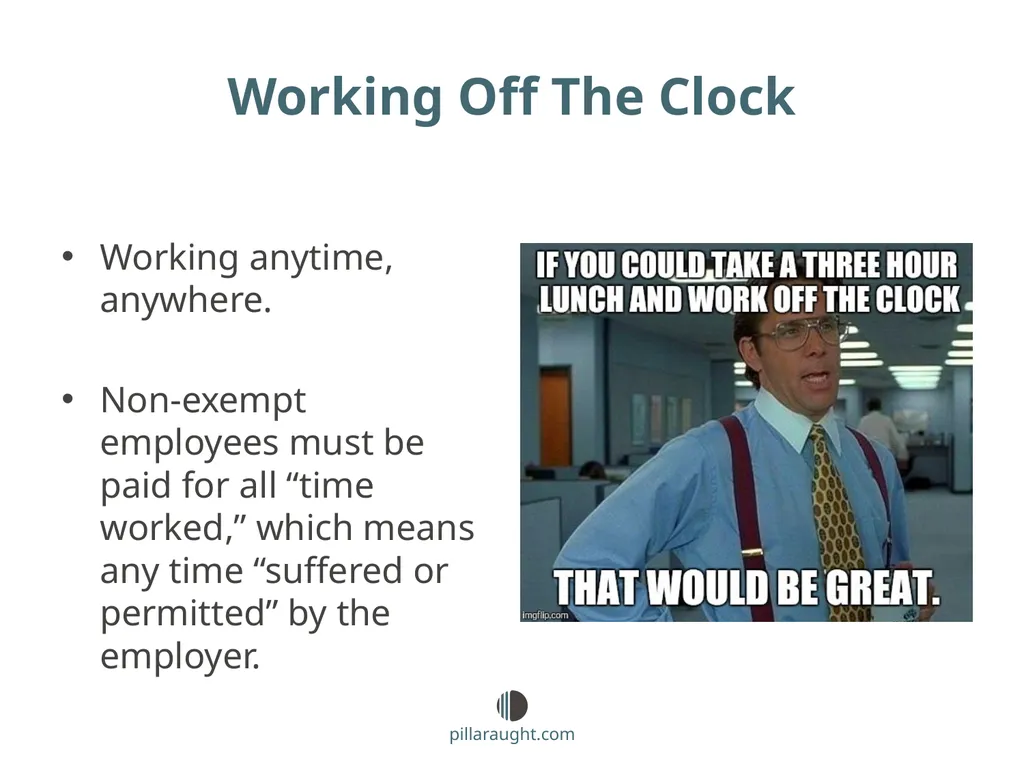
Working Off The Clock Working anytime, anywhere.
Non-exempt employees must be paid for all “time worked,” which means any time “suffered or permitted” by the employer.<br>
14
Where The Employer Goes Wrong Working during breaks, outside the workplace.
Rogue supervisors.
Tracking hours worked.
Travel time and trainings.
Rounding.<br>
15
The Overtime Dilemma It’s This Simple in PA:
All hours worked over forty (40) in a workweek must be paid at time-and-a-half.<br>
16
Where The Employer Goes Wrong The fluctuating workweek methodology.
Permissible under federal law.
Not permissible under PA law.
Pay no matter what (then discipline).
It’s 40 hours over one workweek, not 80 hours over two.
Comp time.
And again . . . rogue supervisors.<br>
17
Paychecks and Deductions Wages earned in a pay period must be made within a certain period of time.
Whenever an employee leaves the employer, voluntarily or involuntarily, compensation earned is due by the next regular pay day.
Only deductions made for the convenience of the employee are permissible.
Allowable deductions for exempt employees and non-employees are different.<br>
18
Where The Employer Goes Wrong Holding pay following separation.
Impermissible deductions.
Overpayments.
Weather issues.
Repayments for theft and/or damages.
Bringing pay down below minimum wage.<br>
19
Pay Equity Area of priority for EEOC’s Strategic Enforcement Plan since 2012.
“Equal pay for equal work.”
Salary history bans – coming to a place near you!
New Jersey – all employers.
Pennsylvania – state agencies.
Philadelphia – employs 1 or more persons.
Pittsburgh – city agencies and offices.
Maryland – all employers.<br>
20
Perform internal wage and hour audits.
Train your employees and your supervisors on wage and hour policies and procedures.
Follow good recordkeeping practices –at least 3 years.
Remember state laws –not just federal.
Review/update wage and hour policies –include the safe harbor language.
Review/update job descriptions (oh, and have them if you don’t!). Employer Best Practices<br>
21
4201 E. Park Circle
Harrisburg, PA 17111
(717) 308-9910
www.pillaraught.com Thank you for your time!<br>