Dont Let Rabies Get Your Goat! A collaboration between Jackson and Josephine County Public Health, Oregon State University Public Health and Human Sciences and Oregon State University Extension 1 2 Rabies is a public health problem Rabies
"Don’t Let Rabies Get Your Goat! A collaboration" is the property of its rightful owner. Permission is granted to
download and print the materials on this website for personal, non-commercial use only, and to display it
on your personal computer provided you do not modify the materials and that you retain all copyright
notices contained in the materials. By downloading content from our website, you accept the terms of this
agreement.
Presentation Transcript
01
Don’t Let Rabies Get Your Goat! A collaboration between Jackson and Josephine County Public Health, Oregon State University Public Health and Human Sciences and Oregon State University Extension 1<br>
02
2<br>
03
Rabies is a public health problem Rabies is a deadly viral infection spread by infected animals
Over 7,000 cases of animal rabies are reported to the Centers for Disease Control (CDC) annually
Annual human deaths worldwide exceed 55,000; deaths in the U.S have been contained to 3 per year since 1990 Sources: Centers for Disease Control (CDC) April 2011, Jackson County Public Health; U.S. National Library of Medicine 3<br>
04
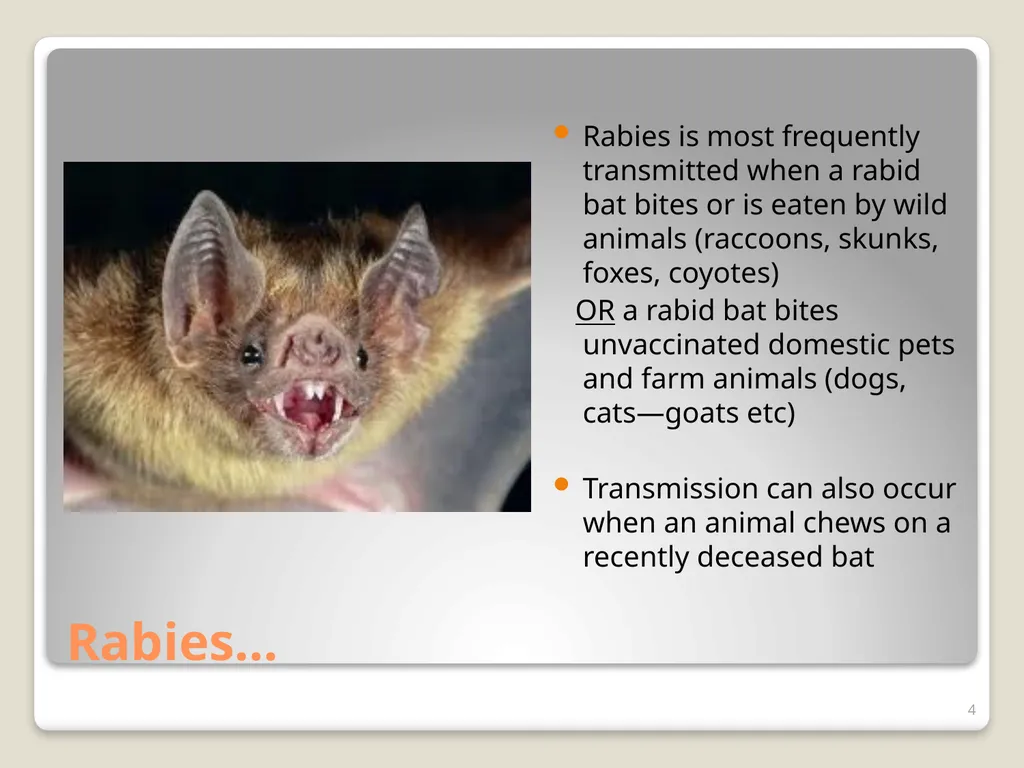
Rabies… Rabies is most frequently transmitted when a rabid bat bites or is eaten by wild animals (raccoons, skunks, foxes, coyotes)
OR a rabid bat bites unvaccinated domestic pets and farm animals (dogs, cats—goats etc)
Transmission can also occur when an animal chews on a recently deceased bat 4<br>
05
Rabies … The rabies virus is transmitted by infected saliva through a bite or wound
Symptoms can include: reclusive behavior, drooling, anorexia, a startle response to sudden light or noise exposure (“dumb” rabies)
Symptoms can include: excitation and marked aggressiveness i.e. biting of objects, animals humans or self (“furious” rabies) Salivation is profuse; there is usually a change in vocalizations
Wildlife seem to lose their fear of people
Central Nervous Symptoms (CNS) involvement includes ascending paralysis, incoordination, convulsions and blindness
In humans or animals, the virus spreads from the site of the bite through the spinal cord to the brain and throughout the rest of the body 5<br>
06
Path of the rabies virus... Here is what happens…
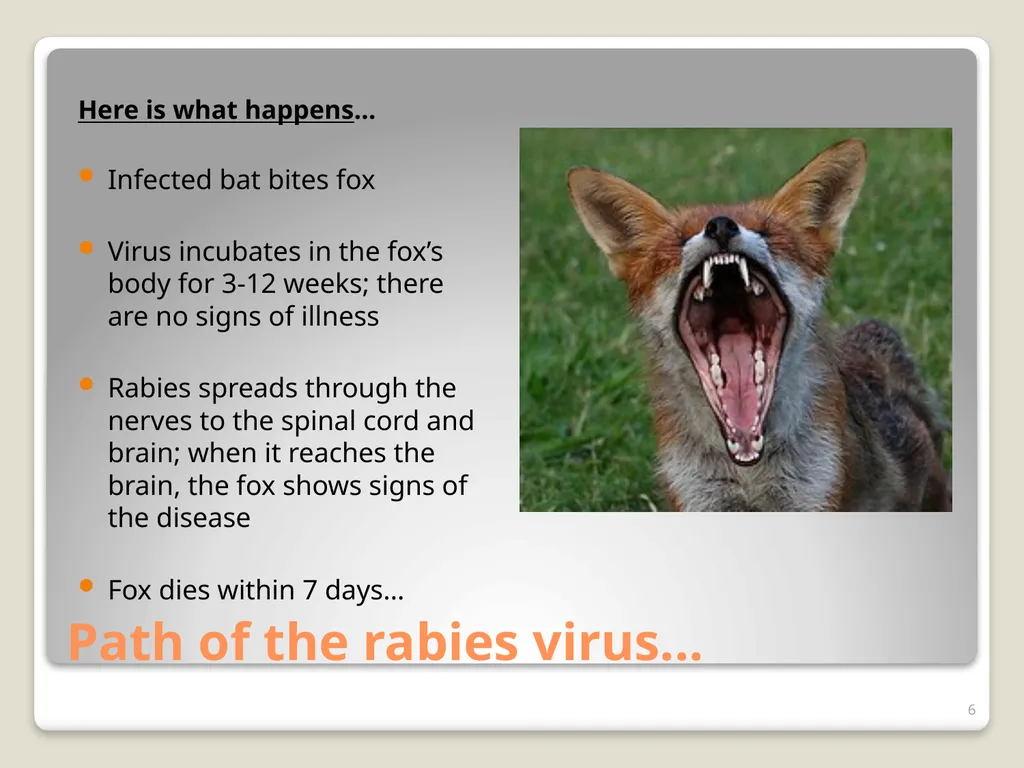
Infected bat bites fox
Virus incubates in the fox’s body for 3-12 weeks; there are no signs of illness
Rabies spreads through the nerves to the spinal cord and brain; when it reaches the brain, the fox shows signs of the disease
Fox dies within 7 days… 6<br>
07
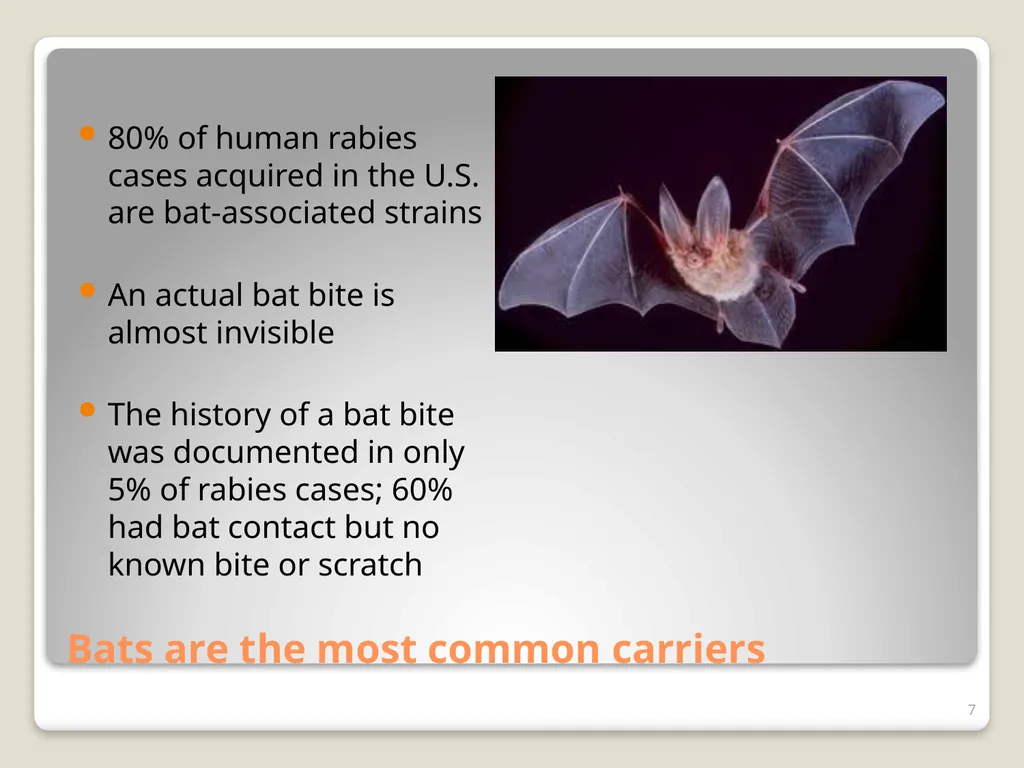
Bats are the most common carriers 80% of human rabies cases acquired in the U.S. are bat-associated strains
An actual bat bite is almost invisible
The history of a bat bite was documented in only 5% of rabies cases; 60% had bat contact but no known bite or scratch 7<br>
08
Rabies prevention and treatment… Prevention:
Initial animal vaccination is recommended at age 3 months and again at one or three year intervals
Oregon requires vaccination of all dogs; it is estimated about 50% are vaccinated
Oregon does not require vaccination of cats Treatment:
Immediately wash wound with soap and copious amounts of water
Administer rabies immune globulin (someone else’s antibodies) immediately
Four doses of vaccine on days 3, 7 and 14; injections given in muscle--usually upper arm 8<br>
09
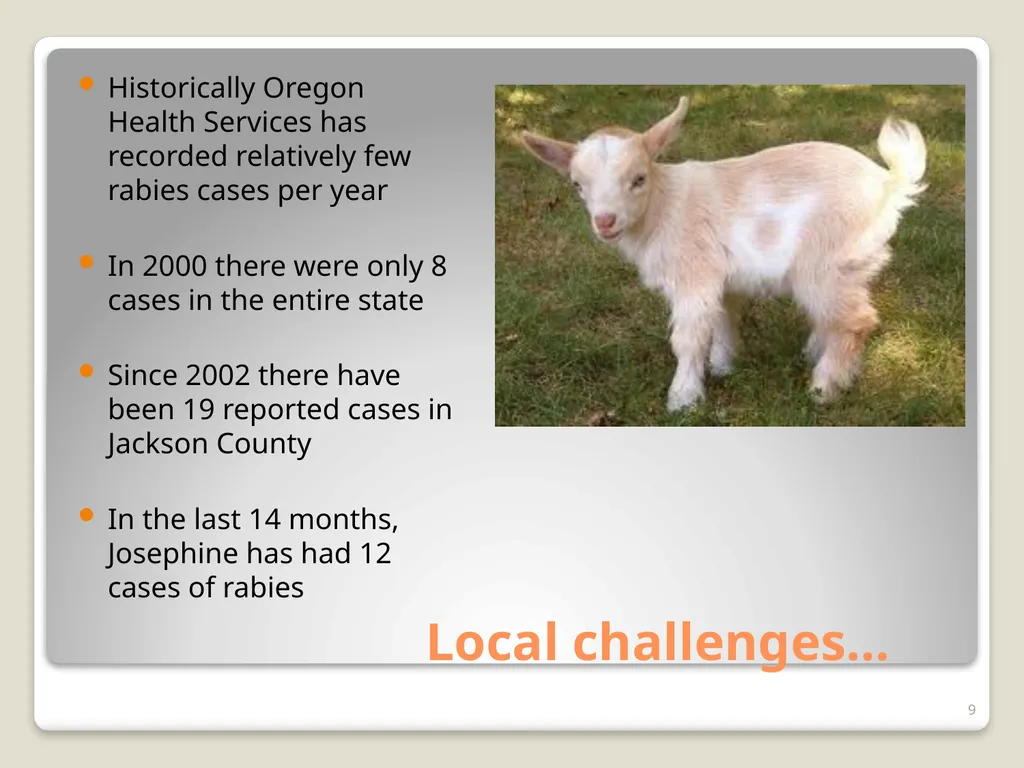
Local challenges… Historically Oregon Health Services has recorded relatively few rabies cases per year
In 2000 there were only 8 cases in the entire state
Since 2002 there have been 19 reported cases in Jackson County
In the last 14 months, Josephine has had 12 cases of rabies 9<br>
10
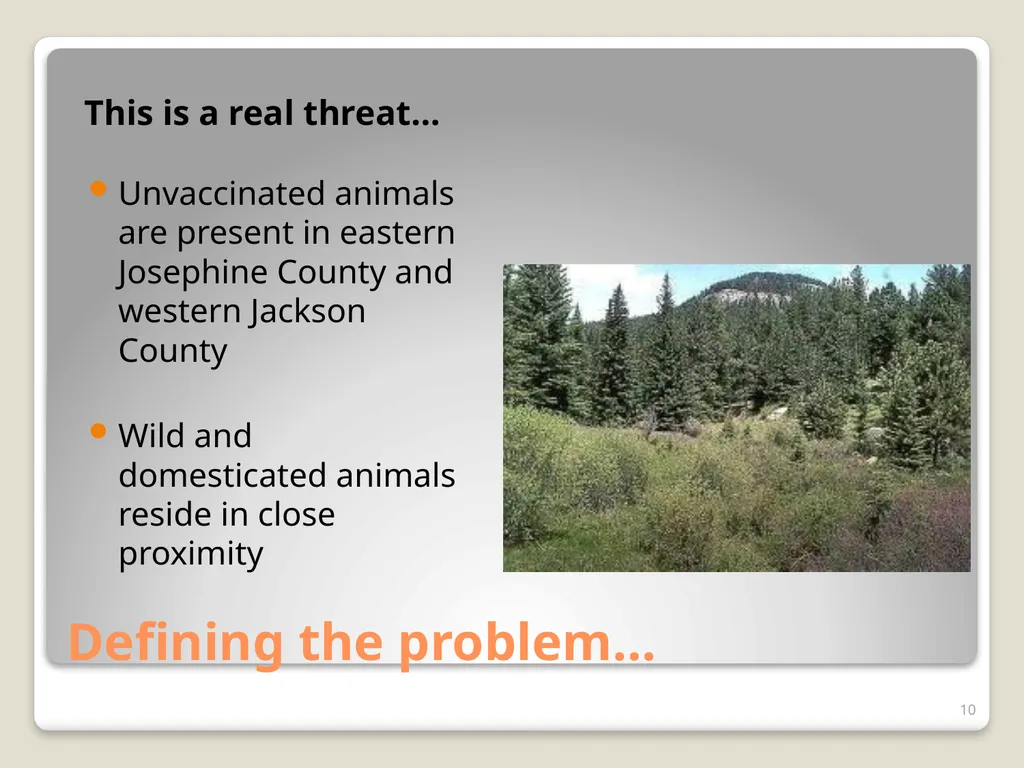
Defining the problem… This is a real threat… Unvaccinated animals are present in eastern Josephine County and western Jackson County
Wild and domesticated animals reside in close proximity 10<br>
11
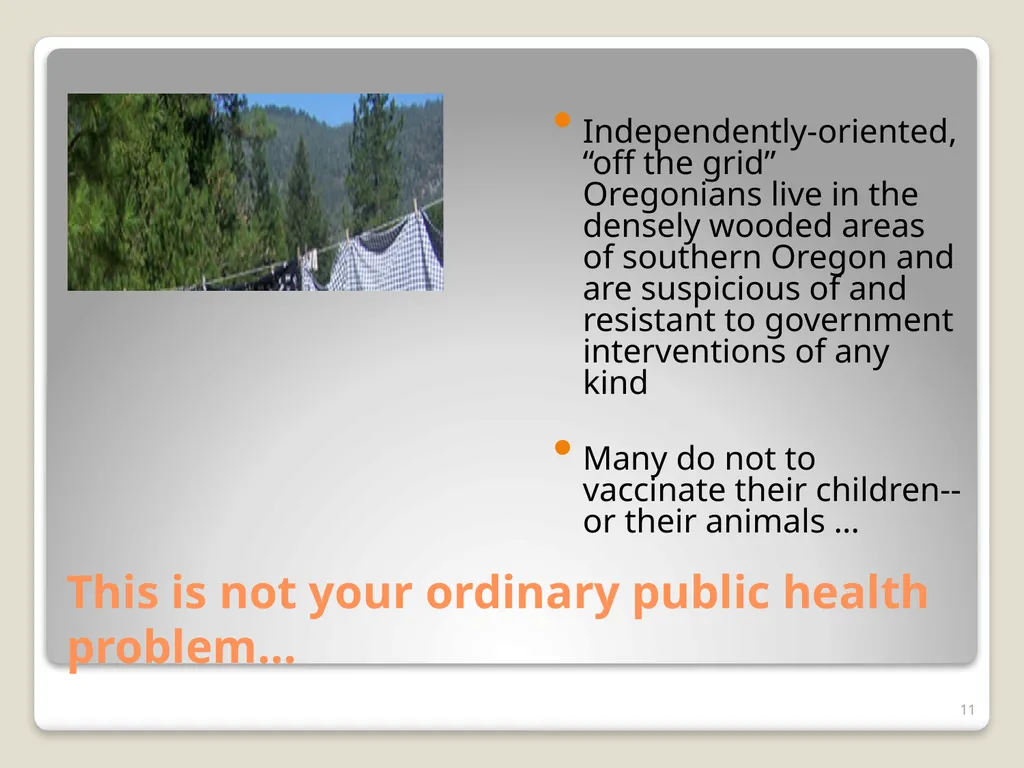
This is not your ordinary public health problem… Independently-oriented, “off the grid” Oregonians live in the densely wooded areas of southern Oregon and are suspicious of and resistant to government interventions of any kind
Many do not to vaccinate their children--or their animals … 11<br>
12
How do we have impact? Project Goals:
Educate the community; reduce the increasing potential for the spread of rabies through informational and educational campaigns
Actively encourage the vaccination of domestic animals; provide opportunities for low/no cost vaccinations
Assess the degree of continuing problem with a reluctant-to-vaccinate public 12<br>
13
The Plan:
Increase rabies awareness using classic public health practice and community-based engagement
Develop an educational campaign focused on the critical importance of vaccinating dogs, cats, goats etc
Hold low-cost vaccination clinics in Cave Junction, Selma and the Applegate area to vaccinate at-risk animals Engage 4-H youth in reaching out to youth and families in targeted rural areas; use social media
Involve 4-H youth in surveying fair goers to assess the percentage of vaccinated animals 13<br>
14
Objective:
Increase rabies awareness using classic public health practice and community-based approaches Progress:
“Award-winning” presence at early summer community events
“Speakers Bureau” launched
Television and radio programs aired 14<br>
15
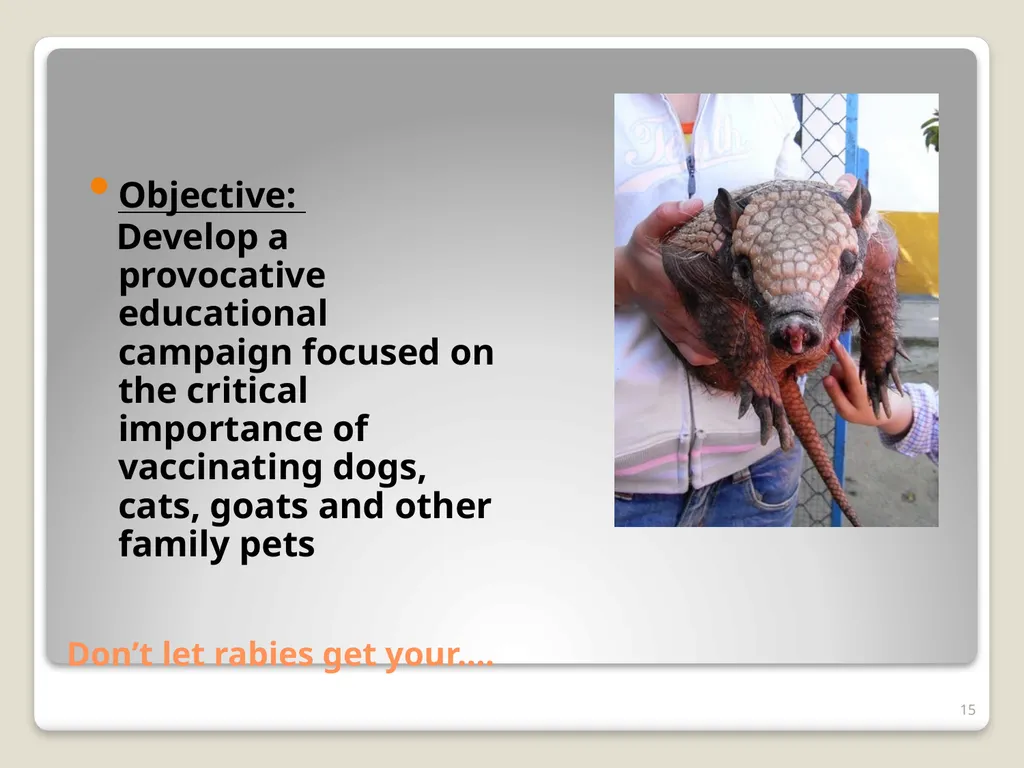
Don’t let rabies get your…. Objective:
Develop a provocative educational campaign focused on the critical importance of vaccinating dogs, cats, goats and other family pets 15<br>
16
Objectives:
Engage 4-H youth in reaching out to youth and families in targeted rural areas; use social media
Involve 4-H youth in surveying fair goers to assess the percentage of vaccinated animals Progress to date:
Justin Beiber UTube identified; Face book and Twitter postings readied
“Don’t Let Rabies Get Your Goat” T-shirts become a ‘hot’ item
4-H youth involved in county fair surveys; findings reinforce this as a public health issue 16<br>
17
Objective:
Hold low-cost vaccination clinics in Cave Junction/Selma area and the Applegate area to vaccinate at-risk animals Progress to date:
Field clinic sites identified
Participating veterinarians identified
Donated vaccine obtained; State veterinarian actively involved
Vet students willing to assist
Clinic dates scheduled and six clinics held in each county during the summer months