
Dr. Hima Mayaki Highlight an overview for the
EM
Published · 23 slides · 0 views

1 / 1







Description
Dr. Hima Mayaki Highlight an overview for the development of Islamic Banking and Finance in French speaking countries International development Strategy Director Head of Islamic Finance Department London School of Modern Studies (LSMS)
Related Topics
Share
Embed code
Download this presentation From Below
"Dr. Hima Mayaki Highlight an overview for the" is the property of its rightful owner. Permission is granted to download and print the materials on this website for personal, non-commercial use only, and to display it on your personal computer provided you do not modify the materials and that you retain all copyright notices contained in the materials. By downloading content from our website, you accept the terms of this agreement.
Presentation Transcript
01
Dr. Hima Mayaki Highlight an overview for the development of Islamic Banking and Finance in French speaking countries International development & Strategy Director
Head of Islamic Finance Department
London School of Modern Studies (LSMS)
United Kingdom 1<br>
Head of Islamic Finance Department
London School of Modern Studies (LSMS)
United Kingdom 1<br>
02
2 PLAN<br>
03
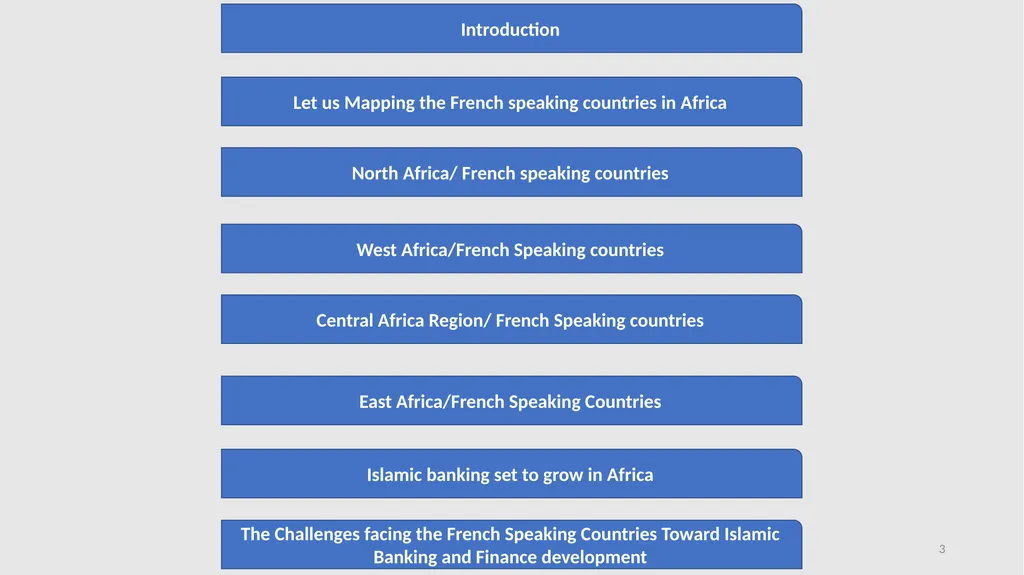
3 Introduction Let us Mapping the French speaking countries in Africa North Africa/ French speaking countries West Africa/French Speaking countries The Challenges facing the French Speaking Countries Toward Islamic Banking and Finance development East Africa/French Speaking Countries Central Africa Region/ French Speaking countries Islamic banking set to grow in Africa<br>
04
It is trite history to state that banks and the banking system have been in existence in many civilisations for several centuries, going back to the days of the Romans, Greeks and Egyptians. It is equally obvious that the banking system is a major driver of economic development, and its malfunctioning, as has been witnessed in recent years, can leave a trail of economic disasters in its wake. In the current scenario, supporters of Islamic Banking have become more vocal for its active promotion to substitute conventional banking. Their central thesis is that conventional banking lacks the kind of value-driven framework of Islamic Banking and is therefore subject to the vagaries of the market and fundamental weaknesses of the capitalist ethos.
Islamic banks have had a measure of notable success around the world and Islamic finance is one of the fastest growing segments of the global financial industry. In some countries, it has become systemically important and, in many others, it is too big to be ignored. It is estimated that the size of the Islamic banking industry at the global level will close to $3.7 trillion by end-2023. Introduction 4<br>
Islamic banks have had a measure of notable success around the world and Islamic finance is one of the fastest growing segments of the global financial industry. In some countries, it has become systemically important and, in many others, it is too big to be ignored. It is estimated that the size of the Islamic banking industry at the global level will close to $3.7 trillion by end-2023. Introduction 4<br>
05
Let us Mapping the French speaking countries in Africa There are around 26 countries which are French speaking, usual these countries have very strong tie with their former colonial Empire which is French, in term of political and socio -economic development. 5<br>
06
North Africa/ French speaking countries Actually, Morocco has one of the most successful financial systems in the MENA region, a competitive and highly developed capital market, an insurance sector that is positioned as the second largest in Africa, and a mature and highly developed banking sector that is proving its worth in several African countries. From 1987: The creation of the Moroccan Association for Studies and Research in Islamic Economics (ASMECI to August 2019: approval of the Takaful law (Islamic Insurance), Morocco has seen a rise in the development of the industry, On January 2, 2017; the central bank issued a press release announcing the approval of five banks to provide Shariah compliant products and services So, it’s observed that until 2014, there were no real and specific legal framework for Islamic banking services, but we can proceed with a Historical overview, and distinguish between two periods regarding the issues related to the implementation of Islamic Finance in Morocco; the first started from 2007 to 2014 which concern the evaluation of alternative products, and the second period started after 2014 which concerns the current regulation of Islamic banking (Participatory banks) under the banking Law 103-12. Morocco 6<br>
07
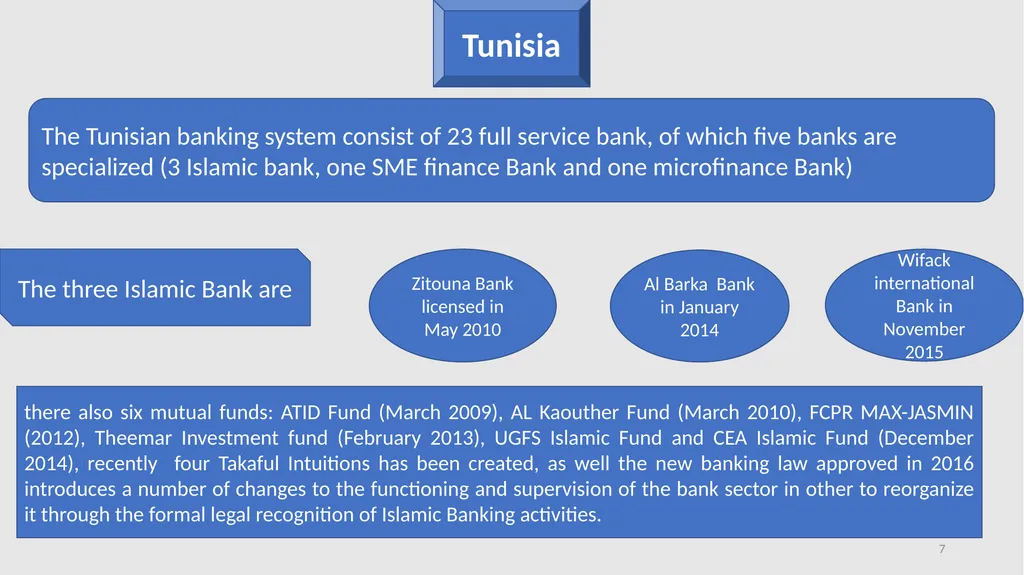
Tunisia The Tunisian banking system consist of 23 full service bank, of which five banks are specialized (3 Islamic bank, one SME finance Bank and one microfinance Bank) The three Islamic Bank are Zitouna Bank licensed in May 2010 Al Barka Bank in January 2014 Wifack international Bank in November 2015 there also six mutual funds: ATID Fund (March 2009), AL Kaouther Fund (March 2010), FCPR MAX-JASMIN (2012), Theemar Investment fund (February 2013), UGFS Islamic Fund and CEA Islamic Fund (December 2014), recently four Takaful Intuitions has been created, as well the new banking law approved in 2016 introduces a number of changes to the functioning and supervision of the bank sector in other to reorganize it through the formal legal recognition of Islamic Banking activities. 7<br>
08
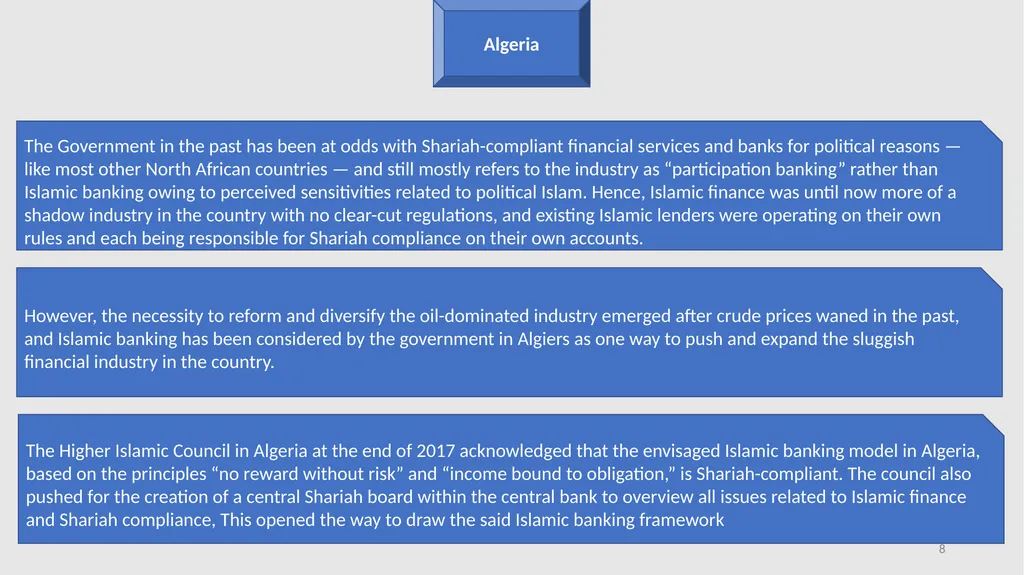
Algeria The Government in the past has been at odds with Shariah-compliant financial services and banks for political reasons — like most other North African countries — and still mostly refers to the industry as “participation banking” rather than Islamic banking owing to perceived sensitivities related to political Islam. Hence, Islamic finance was until now more of a shadow industry in the country with no clear-cut regulations, and existing Islamic lenders were operating on their own rules and each being responsible for Shariah compliance on their own accounts. However, the necessity to reform and diversify the oil-dominated industry emerged after crude prices waned in the past, and Islamic banking has been considered by the government in Algiers as one way to push and expand the sluggish financial industry in the country. The Higher Islamic Council in Algeria at the end of 2017 acknowledged that the envisaged Islamic banking model in Algeria, based on the principles “no reward without risk” and “income bound to obligation,” is Shariah-compliant. The council also pushed for the creation of a central Shariah board within the central bank to overview all issues related to Islamic finance and Shariah compliance, This opened the way to draw the said Islamic banking framework 8<br>
09
West Africa/French Speaking countries Niger Mauritania Mali Benin Burkina Faso Ivory Coast Guinea Togo Senegal Francophone West Africa, with a high concentration of a Muslim population, have arrived somewhat late in the day as far as the adoption of Islamic banking is concerned; it had its official inauguration only in 2010 9<br>
10
The central bank of west Africa, is and public institution comprising the states of west Africa union and economic monetary: Benin, Burkina Faso, Ivory Cost, Guinea Bissau (Portuguese), Mali, Niger, Senegal, Togo. Created in 1962 in response to the policy aspirations of the West Africa Monetary Union the BCEAO works closely with National central banks of member countries and has the following key functions: The control of the money supply The application of a common monetary policy Fixing interest rate The assistance of countries members in their relations with the international monetary institutions. The management and the control of foreign exchange reserve and external debt 10<br>
11
The Central Bank of West African States (French: Banque Centrale des États de l'Afrique de l'Ouest, BCEAO) is a central bank serving the eight west African countries which comprise the West African Economic and Monetary Union:Benin, Burkina Faso, Cote d'Ivoire, Guinea Bissau, Mali, Niger, Senegal, Togo. All, except Guinea-Bissau (Portuguese), were formerly French colonies. It was set up in 1994 with the broad aim of harmonizing economic policy to promote a greater degree of competitiveness throughout the region. BCEAO has all the features and attributes of a French conventional central bank. It authorized the adoption of Islamic banking in 2010. The stumbling-blocks facing these countries as regards Islamic banking, broadly relate to cultural and political issues on the one hand and the apparent incompatibility of conventional banking and Islamic banking on the other, however since 2018, the BCEAO has laid down, the fondation of regulatory framework of Introduction of the Islamic banking and finance Industry, by approving four instructions of the practice of Islamic Banking and Finance operation within West African Economic and Monetary Union. 11<br>
12
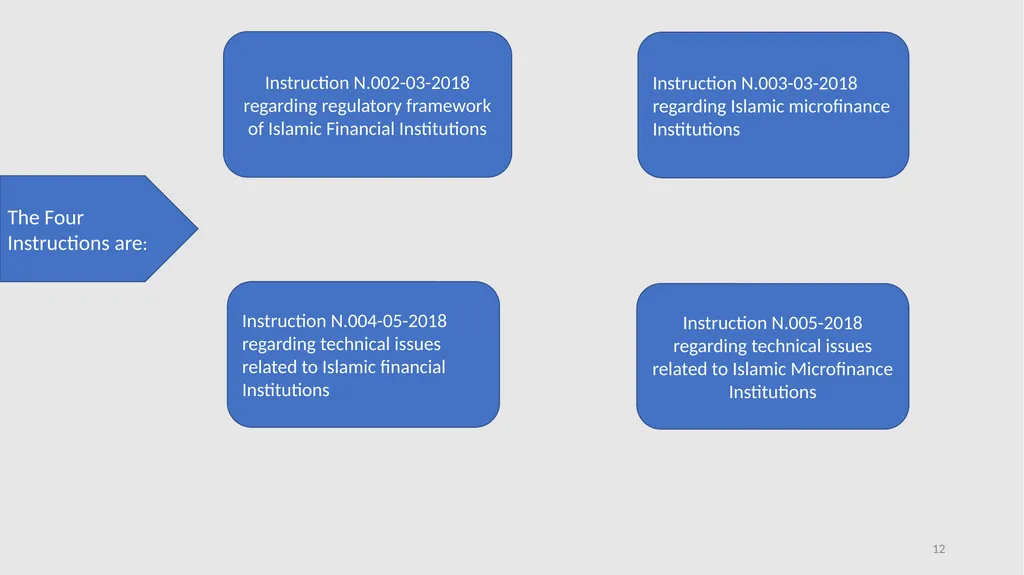
The Four Instructions are: Instruction N.003-03-2018 regarding Islamic microfinance Institutions Instruction N.005-2018 regarding technical issues related to Islamic Microfinance Institutions Instruction N.004-05-2018 regarding technical issues related to Islamic financial Institutions Instruction N.002-03-2018 regarding regulatory framework of Islamic Financial Institutions 12<br>
13
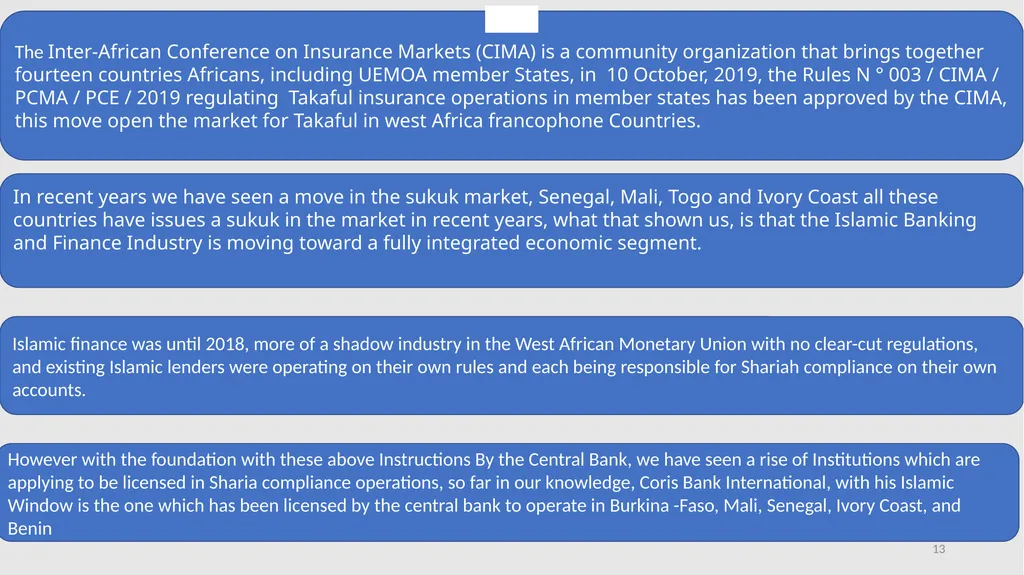
The Inter-African Conference on Insurance Markets (CIMA) is a community organization that brings together fourteen countries Africans, including UEMOA member States, in 10 October, 2019, the Rules N ° 003 / CIMA / PCMA / PCE / 2019 regulating Takaful insurance operations in member states has been approved by the CIMA, this move open the market for Takaful in west Africa francophone Countries. Islamic finance was until 2018, more of a shadow industry in the West African Monetary Union with no clear-cut regulations, and existing Islamic lenders were operating on their own rules and each being responsible for Shariah compliance on their own accounts. In recent years we have seen a move in the sukuk market, Senegal, Mali, Togo and Ivory Coast all these countries have issues a sukuk in the market in recent years, what that shown us, is that the Islamic Banking and Finance Industry is moving toward a fully integrated economic segment. However with the foundation with these above Instructions By the Central Bank, we have seen a rise of Institutions which are applying to be licensed in Sharia compliance operations, so far in our knowledge, Coris Bank International, with his Islamic Window is the one which has been licensed by the central bank to operate in Burkina -Faso, Mali, Senegal, Ivory Coast, and Benin 13<br>
14
Its worthy to note here, for the African continent, there are great opportunities to take advantage of these great financial resources available. The potential of the Islamic finance market remains largely under-exploited in West Africa where it represents less than 1% of the banking system Another asset for the 8 member countries of the West African Economic and Monetary Union (UEMOA) are all members of the Islamic Development Bank, which bank finances in the form of technical assistance, studies and texts governing financial activity. Islamic in order to strengthen the legal infrastructure of member countries 14<br>
15
Central Africa Region/ French Speaking countries Tchad Gabon Congo Demo Rep (Kinshasa) Cameroon Central African republic Congo Rep (brazaville) 15<br>
16
Cameroon In Cameroon, only one bank (Afriland First Bank) and three microfinance institutions, out of the 53 banks and nearly 500 microfinance institutions approved in the country, practice Islamic financing. Yet, the appropriation of this type of financing, based on the equitable distribution of wealth and the prohibition of profit, can considerably contribute to the development of financial inclusion in Cameroon. According to Finance Minister Louis Paul Motazé, this type of finance “can promote the development of financial inclusion by targeting all those still excluded from the traditional financial system for cultural reasons. It can also constitute a complementary lever for economic growth by attracting foreign investment, particularly those from certain Middle Eastern countries wishing to recycle their excess liquidity.” 16<br>
17
In a announcement release, in August 7, 2019 in Financial Afrik, it has been stated that, BEAC wants to regulate Islamic finance in Central Africa
The Franc Zone brings together three currency zones: ... - the Member States of the Central African Monetary Union (UMAC) - Cameroon, Chad, Central African Republic, Congo, Gabon and Equatorial Guinea (since 1985); - the Comoros 17<br>
The Franc Zone brings together three currency zones: ... - the Member States of the Central African Monetary Union (UMAC) - Cameroon, Chad, Central African Republic, Congo, Gabon and Equatorial Guinea (since 1985); - the Comoros 17<br>
18
East Africa/French Speaking Countries Burundi Rwanda Madagascar Comoros Djibouti 18<br>
19
Islamic banking set to grow in Africa Islamic banking assets are set to increase 10 per cent over the next five years in total African banking assets, according to Moody's 19 Sudan and Djibouti so far exhibit meaningful levels of Islamic banking assets as a proportion of total banking assets, at 100 per cent and 20 per cent respectively.
There are more than 80 Islamic financial institutions in Africa, many of which have been licensed in the last five years. The greatest numbers are in northern Africa, especially Sudan. Nigeria, Senegal and Kenya have implemented banking, legal and regulatory frameworks to spur growth in their Islamic banking sectors.
Nigeria's only Islamic bank, Jaiz Bank, has grown its assets by 519 per cent over the last five years, expanding its branch network from just three branches in 2013 to 33 and serving 230,000 customers across the country.<br>
There are more than 80 Islamic financial institutions in Africa, many of which have been licensed in the last five years. The greatest numbers are in northern Africa, especially Sudan. Nigeria, Senegal and Kenya have implemented banking, legal and regulatory frameworks to spur growth in their Islamic banking sectors.
Nigeria's only Islamic bank, Jaiz Bank, has grown its assets by 519 per cent over the last five years, expanding its branch network from just three branches in 2013 to 33 and serving 230,000 customers across the country.<br>
20
According to Moody’s, Africa's large Muslim population, which is predominantly unbanked or underserved, are expected to provide a solid foundation in which Islamic banking assets can grow rapidly.
In addition to Islamic financial institutions, a number of well-established conventional banks across Africa have set up Islamic departments in which they provide Shari'ah-compliant products. These include Absa Bank of South Africa, Ecobank Chad and Sterling Bank Plc of Nigeria.
In 2019, Sterling has flagged its Islamic finance division as both a source of strategic differentiation and asset growth for the company. Sterling’s non-interest division serves around 50,000 customers in more than 200 branches and has a balance sheet of around US$100mn as of yearend 2017. 20<br>
In addition to Islamic financial institutions, a number of well-established conventional banks across Africa have set up Islamic departments in which they provide Shari'ah-compliant products. These include Absa Bank of South Africa, Ecobank Chad and Sterling Bank Plc of Nigeria.
In 2019, Sterling has flagged its Islamic finance division as both a source of strategic differentiation and asset growth for the company. Sterling’s non-interest division serves around 50,000 customers in more than 200 branches and has a balance sheet of around US$100mn as of yearend 2017. 20<br>
21
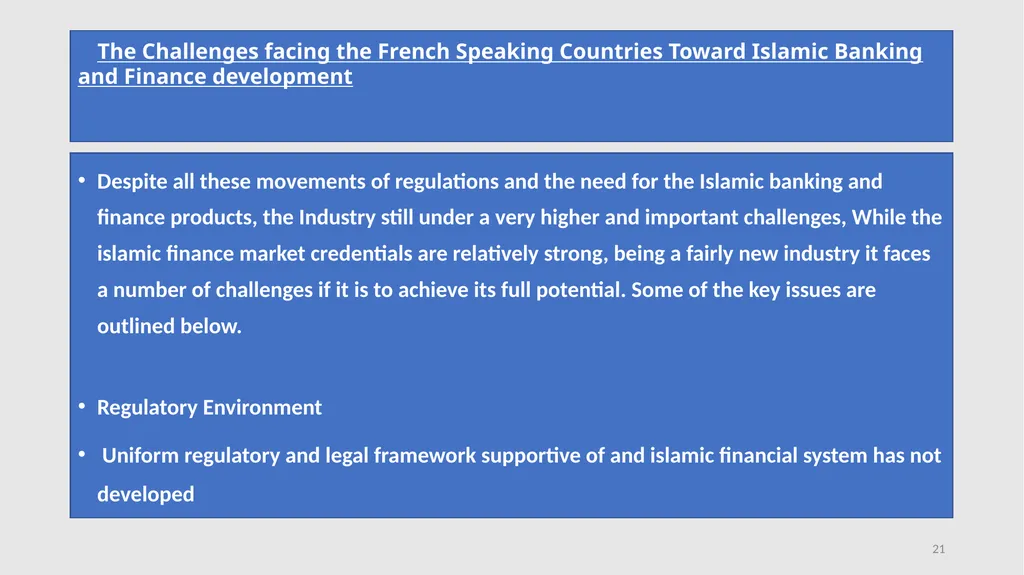
The Challenges facing the French Speaking Countries Toward Islamic Banking and Finance development Despite all these movements of regulations and the need for the Islamic banking and finance products, the Industry still under a very higher and important challenges, While the islamic finance market credentials are relatively strong, being a fairly new industry it faces a number of challenges if it is to achieve its full potential. Some of the key issues are outlined below.
Regulatory Environment
Uniform regulatory and legal framework supportive of and islamic financial system has not developed 21<br>
Regulatory Environment
Uniform regulatory and legal framework supportive of and islamic financial system has not developed 21<br>
22
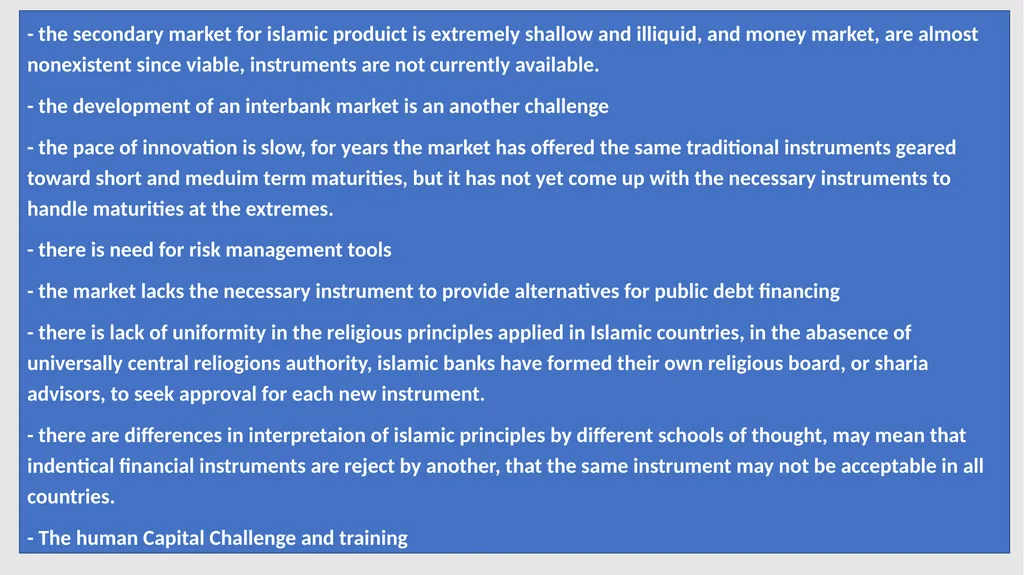
- the secondary market for islamic produict is extremely shallow and illiquid, and money market, are almost nonexistent since viable, instruments are not currently available.
- the development of an interbank market is an another challenge
- the pace of innovation is slow, for years the market has offered the same traditional instruments geared toward short and meduim term maturities, but it has not yet come up with the necessary instruments to handle maturities at the extremes.
- there is need for risk management tools
- the market lacks the necessary instrument to provide alternatives for public debt financing
- there is lack of uniformity in the religious principles applied in Islamic countries, in the abasence of universally central reliogions authority, islamic banks have formed their own religious board, or sharia advisors, to seek approval for each new instrument.
- there are differences in interpretaion of islamic principles by different schools of thought, may mean that indentical financial instruments are reject by another, that the same instrument may not be acceptable in all countries.
- The human Capital Challenge and training 22<br>
- the development of an interbank market is an another challenge
- the pace of innovation is slow, for years the market has offered the same traditional instruments geared toward short and meduim term maturities, but it has not yet come up with the necessary instruments to handle maturities at the extremes.
- there is need for risk management tools
- the market lacks the necessary instrument to provide alternatives for public debt financing
- there is lack of uniformity in the religious principles applied in Islamic countries, in the abasence of universally central reliogions authority, islamic banks have formed their own religious board, or sharia advisors, to seek approval for each new instrument.
- there are differences in interpretaion of islamic principles by different schools of thought, may mean that indentical financial instruments are reject by another, that the same instrument may not be acceptable in all countries.
- The human Capital Challenge and training 22<br>
23
THANK YOU 23<br>