
Dr Jekyll and Mr Hyde: Contexts Wednesday, 17
PT
Published · 20 slides · 0 views

1 / 1

Description
Dr Jekyll and Mr Hyde: Contexts Wednesday, 17 November 2021 2 Types of context and 2 focuses Context of reception how a work has been received over time Context of creation how a work was influenced by contemporary issues
Related Topics
Share
Embed code
Download this presentation From Below
"Dr Jekyll and Mr Hyde: Contexts Wednesday, 17" is the property of its rightful owner. Permission is granted to download and print the materials on this website for personal, non-commercial use only, and to display it on your personal computer provided you do not modify the materials and that you retain all copyright notices contained in the materials. By downloading content from our website, you accept the terms of this agreement.
Presentation Transcript
01
Dr Jekyll and Mr Hyde: Contexts Wednesday, 17 November 2021<br>
02
2 Types of context and 2 focuses Context of reception – how a work has been received over time
Context of creation – how a work was influenced by contemporary issues
Literary/Artistic Context – how the writer was influenced by other writings or artistic movements
Social Context – how the writer was influenced by the world around him/her.<br>
Context of creation – how a work was influenced by contemporary issues
Literary/Artistic Context – how the writer was influenced by other writings or artistic movements
Social Context – how the writer was influenced by the world around him/her.<br>
03
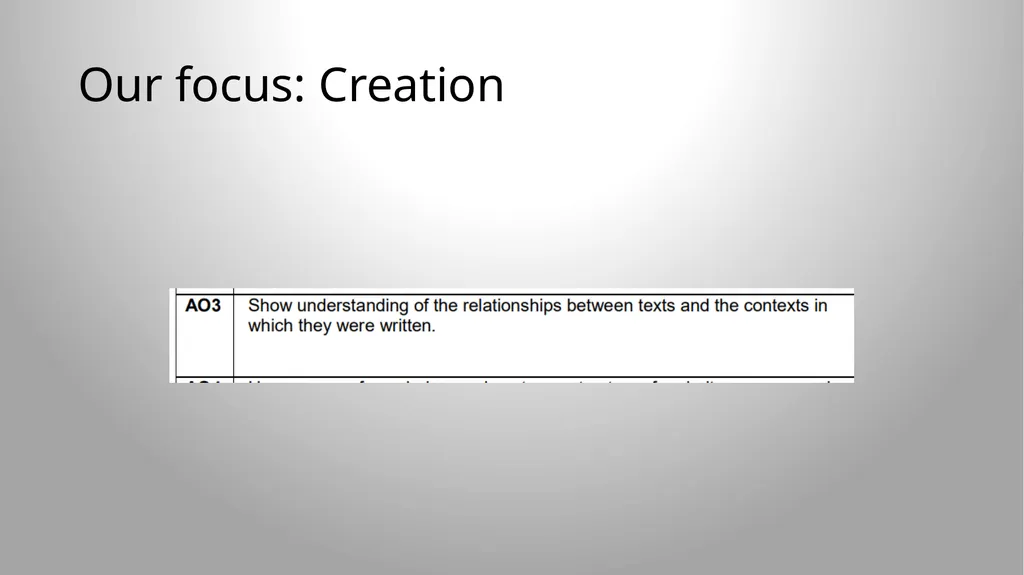
Our focus: Creation<br>
04
Writing about context NEVER a ‘bolt on’, context should be integrated into the essay and should add clarity and depth to the point being made.
Context should be relevant to the specific question
Context can be tailored to add information about specific characters.<br>
Context should be relevant to the specific question
Context can be tailored to add information about specific characters.<br>
05
Themes and Contexts Science and Discovery
Twinship and disability: the Doppelganger
The Victorian Gentleman
Victorian London: Clubs and Secrecy
Drugs and Addiction
Literature<br>
Twinship and disability: the Doppelganger
The Victorian Gentleman
Victorian London: Clubs and Secrecy
Drugs and Addiction
Literature<br>
06
Science and Discovery 19th Century: Huge advances in all areas, especially engineering and medicine.
Darwin –Origin of the Species (1859) and Descent of Man (1871)
Deeply unsettling to society:
Establishes Humans as part of the Animal Kingdom and not ‘special’
Raises fears of ‘Degeneration’ – slipping back to the animal state
Raising potential of extinction
Rendering Christianity obsolete<br>
Darwin –Origin of the Species (1859) and Descent of Man (1871)
Deeply unsettling to society:
Establishes Humans as part of the Animal Kingdom and not ‘special’
Raises fears of ‘Degeneration’ – slipping back to the animal state
Raising potential of extinction
Rendering Christianity obsolete<br>
07
Science and Discovery: uses in an essay Degeneration: note how often Hyde is given ape like features or behaviours or through a semantic field of animal or subhuman traits: ‘ape-like spite’, ‘snarled’, ‘hissing intake of breath’, ‘corded and hairy’, troglodytic…
Structure: Hyde begins to dominate as the book progresses. The fear was that if the slums of London outgrew the ‘good’ areas, then the chances of regression were greater. Survival of the fittest is not necessarily a good thing.
Hyde can be seen as a warning of what might occur
Recognition that the degenerate exists in us all and is not a laboratory experiment.<br>
Structure: Hyde begins to dominate as the book progresses. The fear was that if the slums of London outgrew the ‘good’ areas, then the chances of regression were greater. Survival of the fittest is not necessarily a good thing.
Hyde can be seen as a warning of what might occur
Recognition that the degenerate exists in us all and is not a laboratory experiment.<br>
08
Twinship and disability: the Doppelganger Recognition that the degenerate exists in us all and is not a laboratory experiment. The book extends the Literary Context of works such as Frankenstein.
Victorian culture fascinated by twins and conjoined twins. Often used in freak shows and establishing the idea of the ‘parasite twin’.
Hyde cannot exist without Jekyll and ultimately causes his death.
Might Hyde’s anger and violence be a comment about the appalling treatment of such outcasts of society –shunned and treated as degenerates?
The Doppelganger means an evil double (not necessarily related) and is found in many Gothic stories, such as Frankenstein. It would be fitting, in terms of the idea, if the sight of Hyde transforming into Jekyll were a strong enough shock to kill Lanyon.<br>
Victorian culture fascinated by twins and conjoined twins. Often used in freak shows and establishing the idea of the ‘parasite twin’.
Hyde cannot exist without Jekyll and ultimately causes his death.
Might Hyde’s anger and violence be a comment about the appalling treatment of such outcasts of society –shunned and treated as degenerates?
The Doppelganger means an evil double (not necessarily related) and is found in many Gothic stories, such as Frankenstein. It would be fitting, in terms of the idea, if the sight of Hyde transforming into Jekyll were a strong enough shock to kill Lanyon.<br>
09
The Victorian Gentleman Expected to conform to certain behaviours by his good birth and education, Jekyll cannot shake off his ‘dark desires’.
Utterson is keen not to disturb the societal status quo: he silences Guest (I wouldn’t speak of this note…’) and never seeks to bring the police into the case.
Enfield would never seek to investigate anything for fear of what might be the outcome, presumably so as not to rock the boat.
Gentlemen had to maintain the façade of moral righteousness. As this was not always possible, secret clubs were founded to allow them to indulge their ‘passions’ – drugs and sex.<br>
Utterson is keen not to disturb the societal status quo: he silences Guest (I wouldn’t speak of this note…’) and never seeks to bring the police into the case.
Enfield would never seek to investigate anything for fear of what might be the outcome, presumably so as not to rock the boat.
Gentlemen had to maintain the façade of moral righteousness. As this was not always possible, secret clubs were founded to allow them to indulge their ‘passions’ – drugs and sex.<br>
10
Victorian London: Clubs and Secrecy Male Brothels and drinking club were a feature of late 19th century London
Many respectable men covered their tracks and engaged in secrecy in their private ‘clubland’
Secrecy pervades the novel and men seem to be seeking the company of men exclusively.
Jekyll’s ‘all intelligent reputable men’
Enfield’s ‘some place at the end of the world’ at 3.00AM
Carew wandering London streets late at night
Utterson is aware of ‘his own past’ and scared of ‘some Jack-in-the-Box’. He despises the ‘many ill things he had done’
With awareness of desire, goes repression<br>
Many respectable men covered their tracks and engaged in secrecy in their private ‘clubland’
Secrecy pervades the novel and men seem to be seeking the company of men exclusively.
Jekyll’s ‘all intelligent reputable men’
Enfield’s ‘some place at the end of the world’ at 3.00AM
Carew wandering London streets late at night
Utterson is aware of ‘his own past’ and scared of ‘some Jack-in-the-Box’. He despises the ‘many ill things he had done’
With awareness of desire, goes repression<br>
11
DOORS Consider the many doors in the novel – 60 or so mentions….
Doors are usually closed and locked, especially at the start of the novel.
They are forced open at the end of the novel.
A liminal marker between the public and private, doors can symbolise the self-enforced repression of the Victorian male. They serve to hide the degenerate from sight until they are forced open.<br>
Doors are usually closed and locked, especially at the start of the novel.
They are forced open at the end of the novel.
A liminal marker between the public and private, doors can symbolise the self-enforced repression of the Victorian male. They serve to hide the degenerate from sight until they are forced open.<br>
12
Drugs and Addiction Part of the degenerate lifestyle: Opium and Laudanum – one the drug of the slum dwellers and visitors to the Chinese community in areas around St Giles (Soho); the other the pain killing drug of polite society and old women… they are the same thing.
Late 19C saw many morphine-addicted doctors – even the respectable can become degenerate.
Jekyll is addicted to his drug which removes all barriers to his degenerate self. He needs more and more and is unable to fight its negative effects.
Many saw addiction as a low class phenomenon. Stevenson is challenging this idea.<br>
Late 19C saw many morphine-addicted doctors – even the respectable can become degenerate.
Jekyll is addicted to his drug which removes all barriers to his degenerate self. He needs more and more and is unable to fight its negative effects.
Many saw addiction as a low class phenomenon. Stevenson is challenging this idea.<br>
13
Literature The Gothic - designed to create fear and excitement by a brush with the unimaginable and the degenerate.
Victorian Gothic reaches its high point at this time – Dracula and J&H can be seen as exploring ideas which frighten society by their proximity.
J&H especially because it is not set in a far-off land
It does not focus on a constructed being or a vampire, but on the drak side of the personality.
Typical settings: Night-time, trapped behind locked doors, mysterious landscapes swathed in fog, castles, towers… Stevenson makes London the centre of his Gothic world<br>
Victorian Gothic reaches its high point at this time – Dracula and J&H can be seen as exploring ideas which frighten society by their proximity.
J&H especially because it is not set in a far-off land
It does not focus on a constructed being or a vampire, but on the drak side of the personality.
Typical settings: Night-time, trapped behind locked doors, mysterious landscapes swathed in fog, castles, towers… Stevenson makes London the centre of his Gothic world<br>
14
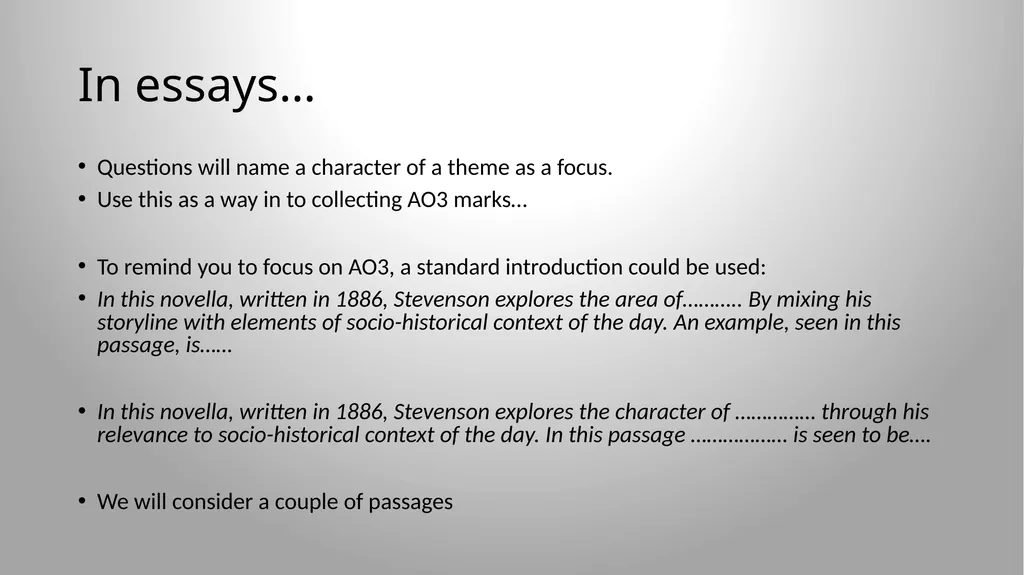
In essays… Questions will name a character of a theme as a focus.
Use this as a way in to collecting AO3 marks…
To remind you to focus on AO3, a standard introduction could be used:
In this novella, written in 1886, Stevenson explores the area of……….. By mixing his storyline with elements of socio-historical context of the day. An example, seen in this passage, is……
In this novella, written in 1886, Stevenson explores the character of …………… through his relevance to socio-historical context of the day. In this passage ……………… is seen to be….
We will consider a couple of passages<br>
Use this as a way in to collecting AO3 marks…
To remind you to focus on AO3, a standard introduction could be used:
In this novella, written in 1886, Stevenson explores the area of……….. By mixing his storyline with elements of socio-historical context of the day. An example, seen in this passage, is……
In this novella, written in 1886, Stevenson explores the character of …………… through his relevance to socio-historical context of the day. In this passage ……………… is seen to be….
We will consider a couple of passages<br>
15
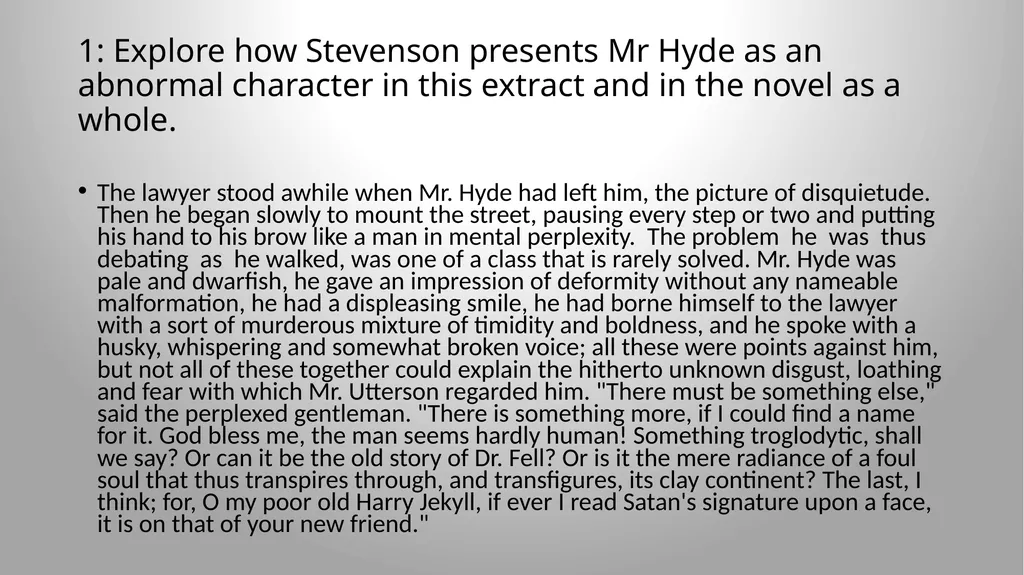
1: Explore how Stevenson presents Mr Hyde as an abnormal character in this extract and in the novel as a whole. The lawyer stood awhile when Mr. Hyde had left him, the picture of disquietude. Then he began slowly to mount the street, pausing every step or two and putting his hand to his brow like a man in mental perplexity. The problem he was thus debating as he walked, was one of a class that is rarely solved. Mr. Hyde was pale and dwarfish, he gave an impression of deformity without any nameable malformation, he had a displeasing smile, he had borne himself to the lawyer with a sort of murderous mixture of timidity and boldness, and he spoke with a husky, whispering and somewhat broken voice; all these were points against him, but not all of these together could explain the hitherto unknown disgust, loathing and fear with which Mr. Utterson regarded him. "There must be something else," said the perplexed gentleman. "There is something more, if I could find a name for it. God bless me, the man seems hardly human! Something troglodytic, shall we say? Or can it be the old story of Dr. Fell? Or is it the mere radiance of a foul soul that thus transpires through, and transfigures, its clay continent? The last, I think; for, O my poor old Harry Jekyll, if ever I read Satan's signature upon a face, it is on that of your new friend."<br>
16
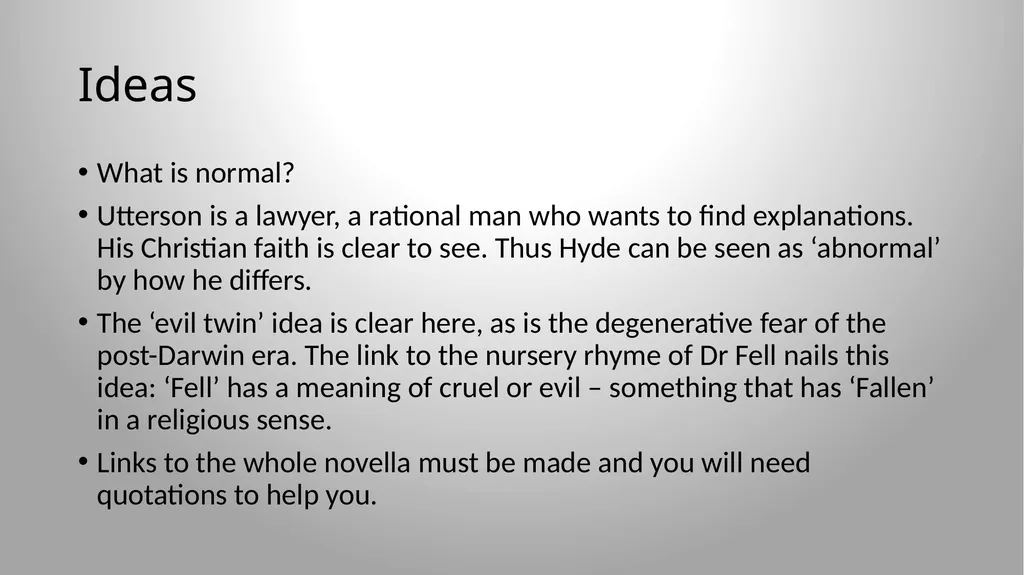
Ideas What is normal?
Utterson is a lawyer, a rational man who wants to find explanations. His Christian faith is clear to see. Thus Hyde can be seen as ‘abnormal’ by how he differs.
The ‘evil twin’ idea is clear here, as is the degenerative fear of the post-Darwin era. The link to the nursery rhyme of Dr Fell nails this idea: ‘Fell’ has a meaning of cruel or evil – something that has ‘Fallen’ in a religious sense.
Links to the whole novella must be made and you will need quotations to help you.<br>
Utterson is a lawyer, a rational man who wants to find explanations. His Christian faith is clear to see. Thus Hyde can be seen as ‘abnormal’ by how he differs.
The ‘evil twin’ idea is clear here, as is the degenerative fear of the post-Darwin era. The link to the nursery rhyme of Dr Fell nails this idea: ‘Fell’ has a meaning of cruel or evil – something that has ‘Fallen’ in a religious sense.
Links to the whole novella must be made and you will need quotations to help you.<br>
17
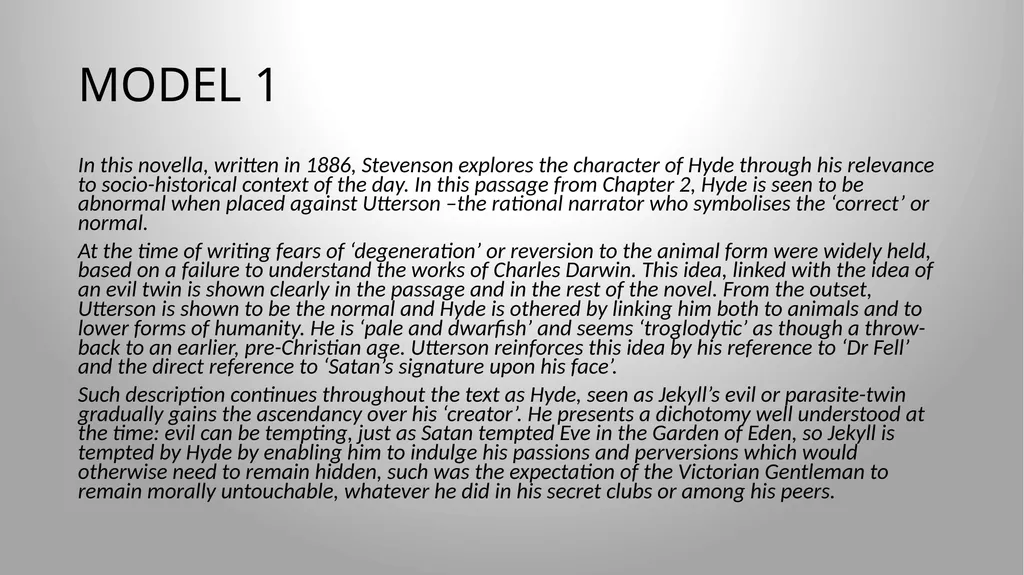
MODEL 1 In this novella, written in 1886, Stevenson explores the character of Hyde through his relevance to socio-historical context of the day. In this passage from Chapter 2, Hyde is seen to be abnormal when placed against Utterson –the rational narrator who symbolises the ‘correct’ or normal.
At the time of writing fears of ‘degeneration’ or reversion to the animal form were widely held, based on a failure to understand the works of Charles Darwin. This idea, linked with the idea of an evil twin is shown clearly in the passage and in the rest of the novel. From the outset, Utterson is shown to be the normal and Hyde is othered by linking him both to animals and to lower forms of humanity. He is ‘pale and dwarfish’ and seems ‘troglodytic’ as though a throw-back to an earlier, pre-Christian age. Utterson reinforces this idea by his reference to ‘Dr Fell’ and the direct reference to ‘Satan’s signature upon his face’.
Such description continues throughout the text as Hyde, seen as Jekyll’s evil or parasite-twin gradually gains the ascendancy over his ‘creator’. He presents a dichotomy well understood at the time: evil can be tempting, just as Satan tempted Eve in the Garden of Eden, so Jekyll is tempted by Hyde by enabling him to indulge his passions and perversions which would otherwise need to remain hidden, such was the expectation of the Victorian Gentleman to remain morally untouchable, whatever he did in his secret clubs or among his peers.<br>
At the time of writing fears of ‘degeneration’ or reversion to the animal form were widely held, based on a failure to understand the works of Charles Darwin. This idea, linked with the idea of an evil twin is shown clearly in the passage and in the rest of the novel. From the outset, Utterson is shown to be the normal and Hyde is othered by linking him both to animals and to lower forms of humanity. He is ‘pale and dwarfish’ and seems ‘troglodytic’ as though a throw-back to an earlier, pre-Christian age. Utterson reinforces this idea by his reference to ‘Dr Fell’ and the direct reference to ‘Satan’s signature upon his face’.
Such description continues throughout the text as Hyde, seen as Jekyll’s evil or parasite-twin gradually gains the ascendancy over his ‘creator’. He presents a dichotomy well understood at the time: evil can be tempting, just as Satan tempted Eve in the Garden of Eden, so Jekyll is tempted by Hyde by enabling him to indulge his passions and perversions which would otherwise need to remain hidden, such was the expectation of the Victorian Gentleman to remain morally untouchable, whatever he did in his secret clubs or among his peers.<br>
18
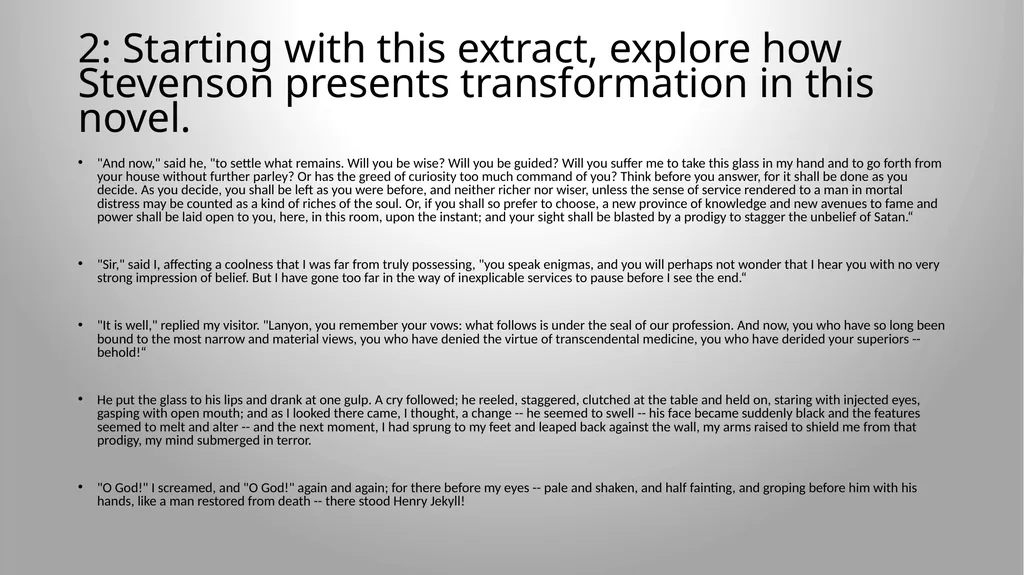
2: Starting with this extract, explore how Stevenson presents transformation in this novel. "And now," said he, "to settle what remains. Will you be wise? Will you be guided? Will you suffer me to take this glass in my hand and to go forth from your house without further parley? Or has the greed of curiosity too much command of you? Think before you answer, for it shall be done as you decide. As you decide, you shall be left as you were before, and neither richer nor wiser, unless the sense of service rendered to a man in mortal distress may be counted as a kind of riches of the soul. Or, if you shall so prefer to choose, a new province of knowledge and new avenues to fame and power shall be laid open to you, here, in this room, upon the instant; and your sight shall be blasted by a prodigy to stagger the unbelief of Satan.“
"Sir," said I, affecting a coolness that I was far from truly possessing, "you speak enigmas, and you will perhaps not wonder that I hear you with no very strong impression of belief. But I have gone too far in the way of inexplicable services to pause before I see the end.“
"It is well," replied my visitor. "Lanyon, you remember your vows: what follows is under the seal of our profession. And now, you who have so long been bound to the most narrow and material views, you who have denied the virtue of transcendental medicine, you who have derided your superiors -- behold!“
He put the glass to his lips and drank at one gulp. A cry followed; he reeled, staggered, clutched at the table and held on, staring with injected eyes, gasping with open mouth; and as I looked there came, I thought, a change -- he seemed to swell -- his face became suddenly black and the features seemed to melt and alter -- and the next moment, I had sprung to my feet and leaped back against the wall, my arms raised to shield me from that prodigy, my mind submerged in terror.
"O God!" I screamed, and "O God!" again and again; for there before my eyes -- pale and shaken, and half fainting, and groping before him with his hands, like a man restored from death -- there stood Henry Jekyll!<br>
"Sir," said I, affecting a coolness that I was far from truly possessing, "you speak enigmas, and you will perhaps not wonder that I hear you with no very strong impression of belief. But I have gone too far in the way of inexplicable services to pause before I see the end.“
"It is well," replied my visitor. "Lanyon, you remember your vows: what follows is under the seal of our profession. And now, you who have so long been bound to the most narrow and material views, you who have denied the virtue of transcendental medicine, you who have derided your superiors -- behold!“
He put the glass to his lips and drank at one gulp. A cry followed; he reeled, staggered, clutched at the table and held on, staring with injected eyes, gasping with open mouth; and as I looked there came, I thought, a change -- he seemed to swell -- his face became suddenly black and the features seemed to melt and alter -- and the next moment, I had sprung to my feet and leaped back against the wall, my arms raised to shield me from that prodigy, my mind submerged in terror.
"O God!" I screamed, and "O God!" again and again; for there before my eyes -- pale and shaken, and half fainting, and groping before him with his hands, like a man restored from death -- there stood Henry Jekyll!<br>
19
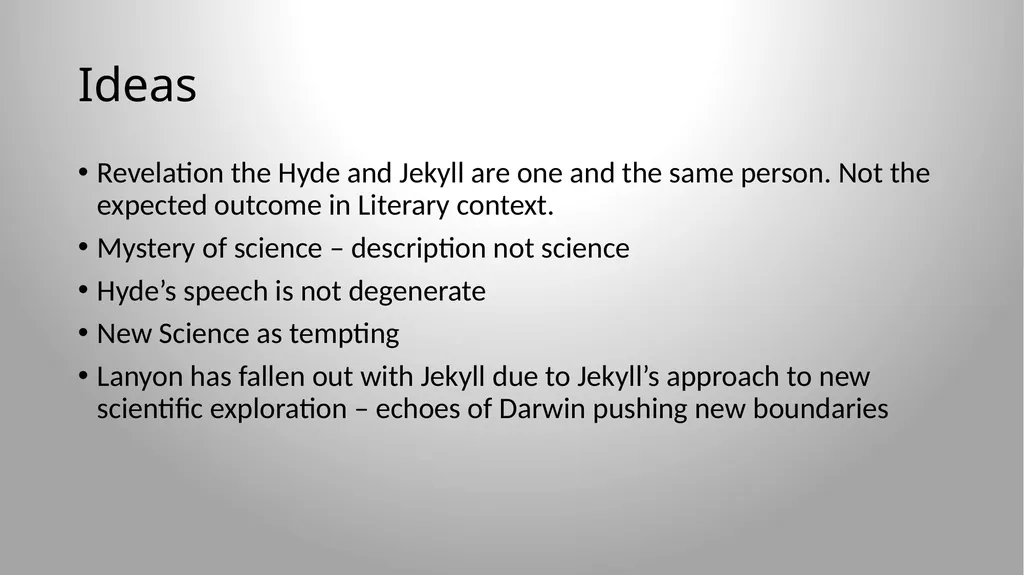
Ideas Revelation the Hyde and Jekyll are one and the same person. Not the expected outcome in Literary context.
Mystery of science – description not science
Hyde’s speech is not degenerate
New Science as tempting
Lanyon has fallen out with Jekyll due to Jekyll’s approach to new scientific exploration – echoes of Darwin pushing new boundaries<br>
Mystery of science – description not science
Hyde’s speech is not degenerate
New Science as tempting
Lanyon has fallen out with Jekyll due to Jekyll’s approach to new scientific exploration – echoes of Darwin pushing new boundaries<br>
20
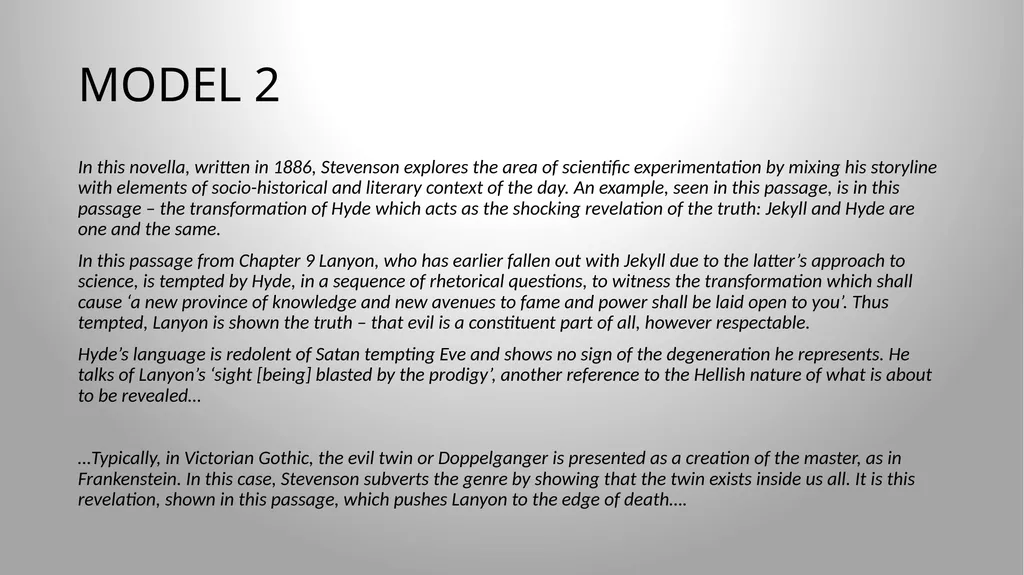
MODEL 2 In this novella, written in 1886, Stevenson explores the area of scientific experimentation by mixing his storyline with elements of socio-historical and literary context of the day. An example, seen in this passage, is in this passage – the transformation of Hyde which acts as the shocking revelation of the truth: Jekyll and Hyde are one and the same.
In this passage from Chapter 9 Lanyon, who has earlier fallen out with Jekyll due to the latter’s approach to science, is tempted by Hyde, in a sequence of rhetorical questions, to witness the transformation which shall cause ‘a new province of knowledge and new avenues to fame and power shall be laid open to you’. Thus tempted, Lanyon is shown the truth – that evil is a constituent part of all, however respectable.
Hyde’s language is redolent of Satan tempting Eve and shows no sign of the degeneration he represents. He talks of Lanyon’s ‘sight [being] blasted by the prodigy’, another reference to the Hellish nature of what is about to be revealed…
…Typically, in Victorian Gothic, the evil twin or Doppelganger is presented as a creation of the master, as in Frankenstein. In this case, Stevenson subverts the genre by showing that the twin exists inside us all. It is this revelation, shown in this passage, which pushes Lanyon to the edge of death….<br>
In this passage from Chapter 9 Lanyon, who has earlier fallen out with Jekyll due to the latter’s approach to science, is tempted by Hyde, in a sequence of rhetorical questions, to witness the transformation which shall cause ‘a new province of knowledge and new avenues to fame and power shall be laid open to you’. Thus tempted, Lanyon is shown the truth – that evil is a constituent part of all, however respectable.
Hyde’s language is redolent of Satan tempting Eve and shows no sign of the degeneration he represents. He talks of Lanyon’s ‘sight [being] blasted by the prodigy’, another reference to the Hellish nature of what is about to be revealed…
…Typically, in Victorian Gothic, the evil twin or Doppelganger is presented as a creation of the master, as in Frankenstein. In this case, Stevenson subverts the genre by showing that the twin exists inside us all. It is this revelation, shown in this passage, which pushes Lanyon to the edge of death….<br>