
Draft script for the Nature Dialogue Use this as a
TA
Published · 15 slides · 0 views
1 / 1

Description
Draft script for the Nature Dialogue Use this as a basis for your discussion and the wordings you will use in its facilitation Duration 120 or 180 minutes Guidelines for altering the script Plan your discussion in advance on the basis of
Related Topics
Share
Embed code
Download this presentation From Below
"Draft script for the Nature Dialogue Use this as a" is the property of its rightful owner. Permission is granted to download and print the materials on this website for personal, non-commercial use only, and to display it on your personal computer provided you do not modify the materials and that you retain all copyright notices contained in the materials. By downloading content from our website, you accept the terms of this agreement.
Presentation Transcript
01
Draft script for the Nature Dialogue Use this as a basis for your discussion and the wordings you will use in its facilitation
Duration 120 or 180 minutes &<br>
Duration 120 or 180 minutes &<br>
02
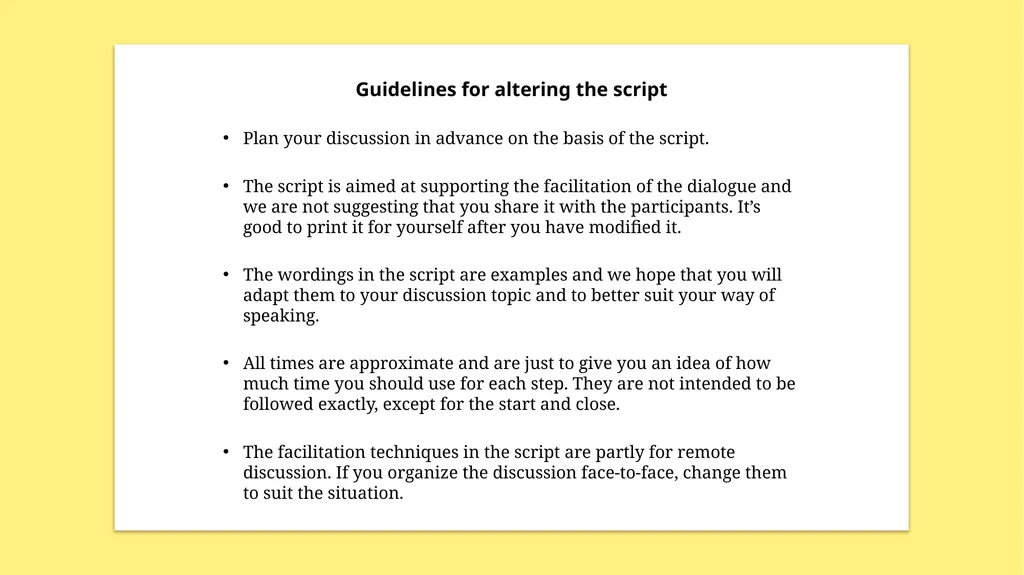
Guidelines for altering the script
Plan your discussion in advance on the basis of the script.
The script is aimed at supporting the facilitation of the dialogue and we are not suggesting that you share it with the participants. It’s good to print it for yourself after you have modified it.
The wordings in the script are examples and we hope that you will adapt them to your discussion topic and to better suit your way of speaking.
All times are approximate and are just to give you an idea of how much time you should use for each step. They are not intended to be followed exactly, except for the start and close.
The facilitation techniques in the script are partly for remote discussion. If you organize the discussion face-to-face, change them to suit the situation.<br>
Plan your discussion in advance on the basis of the script.
The script is aimed at supporting the facilitation of the dialogue and we are not suggesting that you share it with the participants. It’s good to print it for yourself after you have modified it.
The wordings in the script are examples and we hope that you will adapt them to your discussion topic and to better suit your way of speaking.
All times are approximate and are just to give you an idea of how much time you should use for each step. They are not intended to be followed exactly, except for the start and close.
The facilitation techniques in the script are partly for remote discussion. If you organize the discussion face-to-face, change them to suit the situation.<br>
03
Start (1/2)
Welcome to the Nature Dialogue on “What does nature mean to you / to our class / work community / hobby group / organization and how does that contribute to biodiversity conservation?”
The aim of this discussion is to better understand the diverse relationships people have with nature. Why do they matter to each of us and what prevents us from stopping the loss of biodiversity? What would get you or your organization inspired by a nature-wise Finland and to contribute to stopping the loss of biodiversity?
My name is XX and I will be facilitating this discussion. I will make sure that we have as equal a discussion as possible so that everyone has a chance to take part. In practice, this means that if you talk over each other or do monologues, I will interrupt you. Is that OK with everyone?
Continues on the next page… (Ask the participants to arrive approximately 15 minutes before the start and to test the technique or grab a cup of coffee and sit down.)
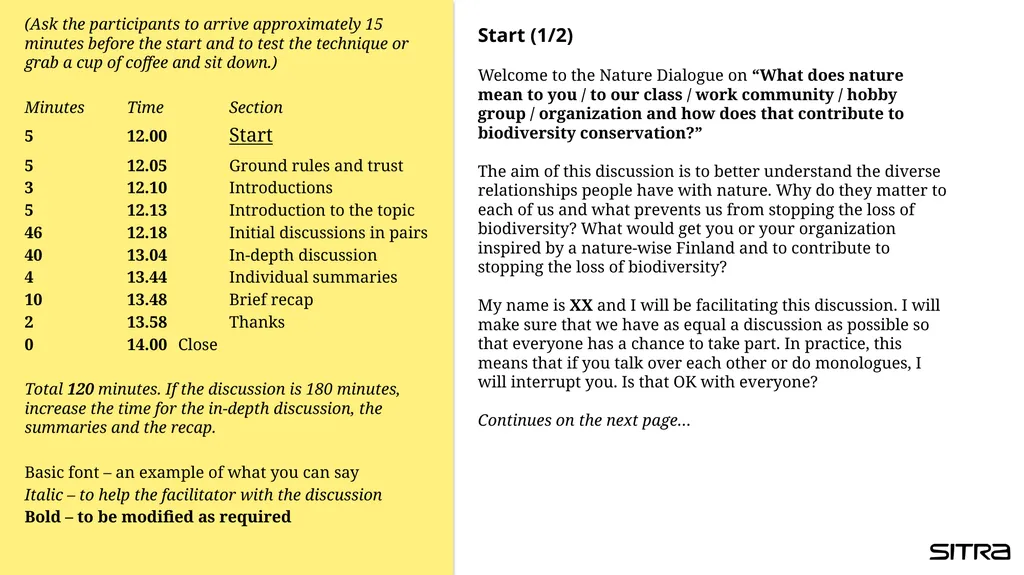
Minutes Time Section
5 12.00 Start
5 12.05 Ground rules and trust
3 12.10 Introductions
5 12.13 Introduction to the topic
46 12.18 Initial discussions in pairs
40 13.04 In-depth discussion
4 13.44 Individual summaries
10 13.48 Brief recap
2 13.58 Thanks
0 14.00 Close
Total 120 minutes. If the discussion is 180 minutes, increase the time for the in-depth discussion, the summaries and the recap.
Basic font – an example of what you can say
Italic – to help the facilitator with the discussion
Bold – to be modified as required<br>
Welcome to the Nature Dialogue on “What does nature mean to you / to our class / work community / hobby group / organization and how does that contribute to biodiversity conservation?”
The aim of this discussion is to better understand the diverse relationships people have with nature. Why do they matter to each of us and what prevents us from stopping the loss of biodiversity? What would get you or your organization inspired by a nature-wise Finland and to contribute to stopping the loss of biodiversity?
My name is XX and I will be facilitating this discussion. I will make sure that we have as equal a discussion as possible so that everyone has a chance to take part. In practice, this means that if you talk over each other or do monologues, I will interrupt you. Is that OK with everyone?
Continues on the next page… (Ask the participants to arrive approximately 15 minutes before the start and to test the technique or grab a cup of coffee and sit down.)
Minutes Time Section
5 12.00 Start
5 12.05 Ground rules and trust
3 12.10 Introductions
5 12.13 Introduction to the topic
46 12.18 Initial discussions in pairs
40 13.04 In-depth discussion
4 13.44 Individual summaries
10 13.48 Brief recap
2 13.58 Thanks
0 14.00 Close
Total 120 minutes. If the discussion is 180 minutes, increase the time for the in-depth discussion, the summaries and the recap.
Basic font – an example of what you can say
Italic – to help the facilitator with the discussion
Bold – to be modified as required<br>
04
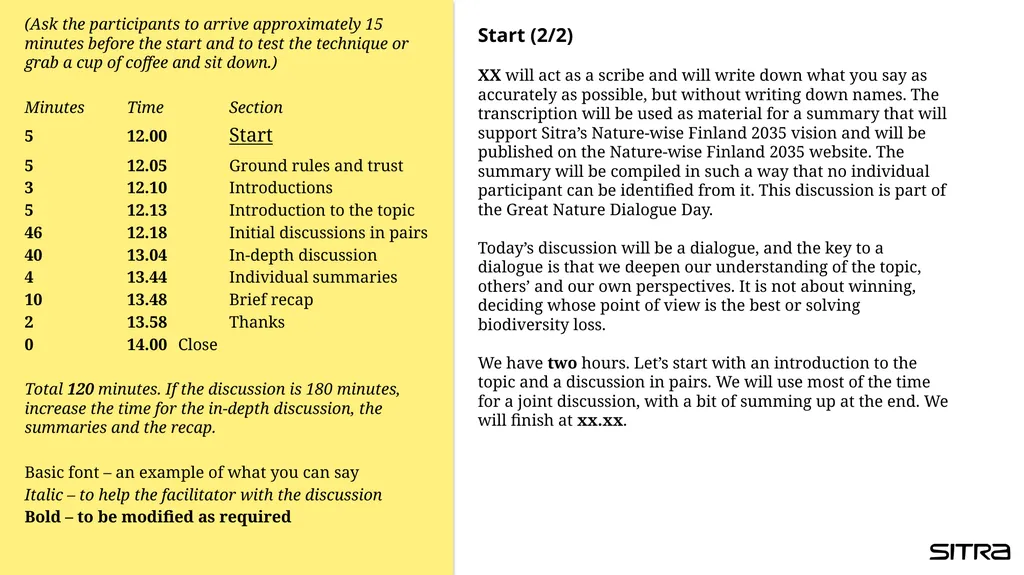
Start (2/2)
XX will act as a scribe and will write down what you say as accurately as possible, but without writing down names. The transcription will be used as material for a summary that will support Sitra’s Nature-wise Finland 2035 vision and will be published on the Nature-wise Finland 2035 website. The summary will be compiled in such a way that no individual participant can be identified from it. This discussion is part of the Great Nature Dialogue Day.
Today’s discussion will be a dialogue, and the key to a dialogue is that we deepen our understanding of the topic, others’ and our own perspectives. It is not about winning, deciding whose point of view is the best or solving biodiversity loss.
We have two hours. Let’s start with an introduction to the topic and a discussion in pairs. We will use most of the time for a joint discussion, with a bit of summing up at the end. We will finish at xx.xx. (Ask the participants to arrive approximately 15 minutes before the start and to test the technique or grab a cup of coffee and sit down.)
Minutes Time Section
5 12.00 Start
5 12.05 Ground rules and trust
3 12.10 Introductions
5 12.13 Introduction to the topic
46 12.18 Initial discussions in pairs
40 13.04 In-depth discussion
4 13.44 Individual summaries
10 13.48 Brief recap
2 13.58 Thanks
0 14.00 Close
Total 120 minutes. If the discussion is 180 minutes, increase the time for the in-depth discussion, the summaries and the recap.
Basic font – an example of what you can say
Italic – to help the facilitator with the discussion
Bold – to be modified as required<br>
XX will act as a scribe and will write down what you say as accurately as possible, but without writing down names. The transcription will be used as material for a summary that will support Sitra’s Nature-wise Finland 2035 vision and will be published on the Nature-wise Finland 2035 website. The summary will be compiled in such a way that no individual participant can be identified from it. This discussion is part of the Great Nature Dialogue Day.
Today’s discussion will be a dialogue, and the key to a dialogue is that we deepen our understanding of the topic, others’ and our own perspectives. It is not about winning, deciding whose point of view is the best or solving biodiversity loss.
We have two hours. Let’s start with an introduction to the topic and a discussion in pairs. We will use most of the time for a joint discussion, with a bit of summing up at the end. We will finish at xx.xx. (Ask the participants to arrive approximately 15 minutes before the start and to test the technique or grab a cup of coffee and sit down.)
Minutes Time Section
5 12.00 Start
5 12.05 Ground rules and trust
3 12.10 Introductions
5 12.13 Introduction to the topic
46 12.18 Initial discussions in pairs
40 13.04 In-depth discussion
4 13.44 Individual summaries
10 13.48 Brief recap
2 13.58 Thanks
0 14.00 Close
Total 120 minutes. If the discussion is 180 minutes, increase the time for the in-depth discussion, the summaries and the recap.
Basic font – an example of what you can say
Italic – to help the facilitator with the discussion
Bold – to be modified as required<br>
05
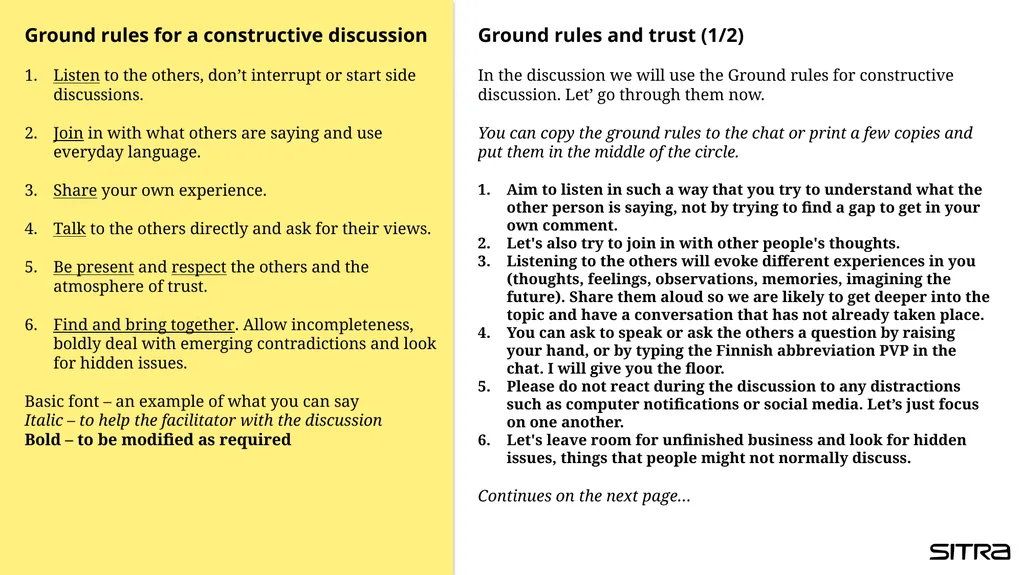
Ground rules for a constructive discussion
Listen to the others, don’t interrupt or start side discussions.
Join in with what others are saying and use everyday language.
Share your own experience.
Talk to the others directly and ask for their views.
Be present and respect the others and the atmosphere of trust.
Find and bring together. Allow incompleteness, boldly deal with emerging contradictions and look for hidden issues.
Basic font – an example of what you can say
Italic – to help the facilitator with the discussion
Bold – to be modified as required Ground rules and trust (1/2)
In the discussion we will use the Ground rules for constructive discussion. Let’ go through them now.
You can copy the ground rules to the chat or print a few copies and put them in the middle of the circle.
Aim to listen in such a way that you try to understand what the other person is saying, not by trying to find a gap to get in your own comment.
Let's also try to join in with other people's thoughts.
Listening to the others will evoke different experiences in you (thoughts, feelings, observations, memories, imagining the future). Share them aloud so we are likely to get deeper into the topic and have a conversation that has not already taken place.
You can ask to speak or ask the others a question by raising your hand, or by typing the Finnish abbreviation PVP in the chat. I will give you the floor.
Please do not react during the discussion to any distractions such as computer notifications or social media. Let’s just focus on one another.
Let's leave room for unfinished business and look for hidden issues, things that people might not normally discuss.
Continues on the next page…<br>
Listen to the others, don’t interrupt or start side discussions.
Join in with what others are saying and use everyday language.
Share your own experience.
Talk to the others directly and ask for their views.
Be present and respect the others and the atmosphere of trust.
Find and bring together. Allow incompleteness, boldly deal with emerging contradictions and look for hidden issues.
Basic font – an example of what you can say
Italic – to help the facilitator with the discussion
Bold – to be modified as required Ground rules and trust (1/2)
In the discussion we will use the Ground rules for constructive discussion. Let’ go through them now.
You can copy the ground rules to the chat or print a few copies and put them in the middle of the circle.
Aim to listen in such a way that you try to understand what the other person is saying, not by trying to find a gap to get in your own comment.
Let's also try to join in with other people's thoughts.
Listening to the others will evoke different experiences in you (thoughts, feelings, observations, memories, imagining the future). Share them aloud so we are likely to get deeper into the topic and have a conversation that has not already taken place.
You can ask to speak or ask the others a question by raising your hand, or by typing the Finnish abbreviation PVP in the chat. I will give you the floor.
Please do not react during the discussion to any distractions such as computer notifications or social media. Let’s just focus on one another.
Let's leave room for unfinished business and look for hidden issues, things that people might not normally discuss.
Continues on the next page…<br>
06
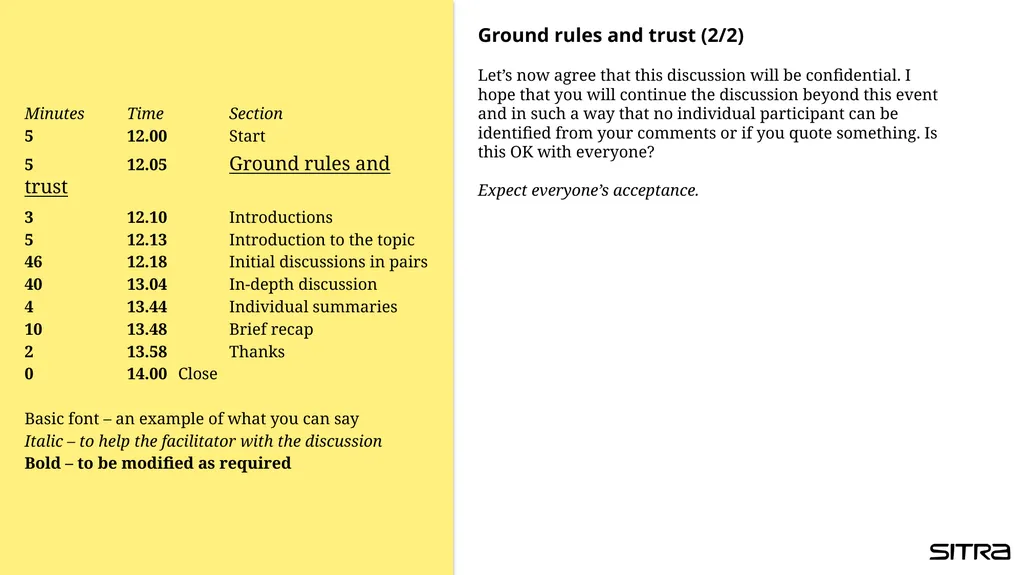
Ground rules and trust (2/2)
Let’s now agree that this discussion will be confidential. I hope that you will continue the discussion beyond this event and in such a way that no individual participant can be identified from your comments or if you quote something. Is this OK with everyone?
Expect everyone’s acceptance. Minutes Time Section
5 12.00 Start
5 12.05 Ground rules and trust
3 12.10 Introductions
5 12.13 Introduction to the topic
46 12.18 Initial discussions in pairs
40 13.04 In-depth discussion
4 13.44 Individual summaries
10 13.48 Brief recap
2 13.58 Thanks
0 14.00 Close
Basic font – an example of what you can say
Italic – to help the facilitator with the discussion
Bold – to be modified as required<br>
Let’s now agree that this discussion will be confidential. I hope that you will continue the discussion beyond this event and in such a way that no individual participant can be identified from your comments or if you quote something. Is this OK with everyone?
Expect everyone’s acceptance. Minutes Time Section
5 12.00 Start
5 12.05 Ground rules and trust
3 12.10 Introductions
5 12.13 Introduction to the topic
46 12.18 Initial discussions in pairs
40 13.04 In-depth discussion
4 13.44 Individual summaries
10 13.48 Brief recap
2 13.58 Thanks
0 14.00 Close
Basic font – an example of what you can say
Italic – to help the facilitator with the discussion
Bold – to be modified as required<br>
07
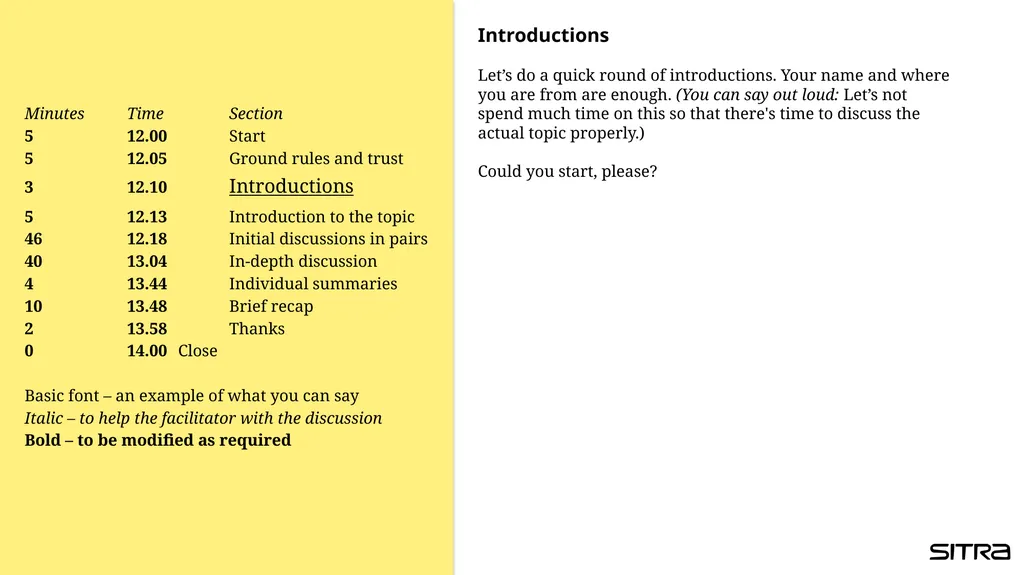
Introductions
Let’s do a quick round of introductions. Your name and where you are from are enough. (You can say out loud: Let’s not spend much time on this so that there's time to discuss the actual topic properly.)
Could you start, please? Minutes Time Section
5 12.00 Start
5 12.05 Ground rules and trust
3 12.10 Introductions
5 12.13 Introduction to the topic
46 12.18 Initial discussions in pairs
40 13.04 In-depth discussion
4 13.44 Individual summaries
10 13.48 Brief recap
2 13.58 Thanks
0 14.00 Close
Basic font – an example of what you can say
Italic – to help the facilitator with the discussion
Bold – to be modified as required<br>
Let’s do a quick round of introductions. Your name and where you are from are enough. (You can say out loud: Let’s not spend much time on this so that there's time to discuss the actual topic properly.)
Could you start, please? Minutes Time Section
5 12.00 Start
5 12.05 Ground rules and trust
3 12.10 Introductions
5 12.13 Introduction to the topic
46 12.18 Initial discussions in pairs
40 13.04 In-depth discussion
4 13.44 Individual summaries
10 13.48 Brief recap
2 13.58 Thanks
0 14.00 Close
Basic font – an example of what you can say
Italic – to help the facilitator with the discussion
Bold – to be modified as required<br>
08
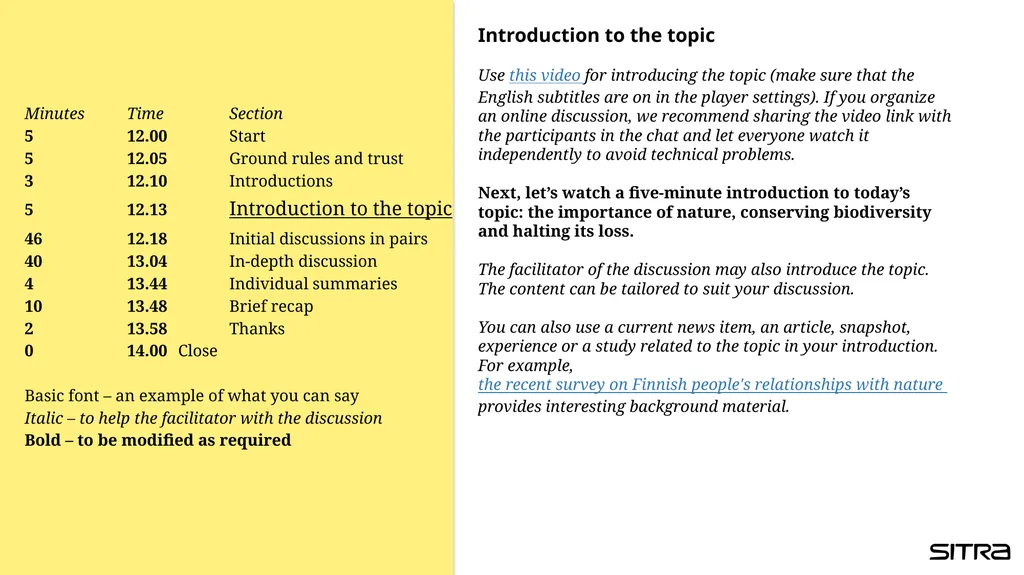
Introduction to the topic
Use this video for introducing the topic (make sure that the English subtitles are on in the player settings). If you organize an online discussion, we recommend sharing the video link with the participants in the chat and let everyone watch it independently to avoid technical problems.
Next, let’s watch a five-minute introduction to today’s topic: the importance of nature, conserving biodiversity and halting its loss.
The facilitator of the discussion may also introduce the topic. The content can be tailored to suit your discussion.
You can also use a current news item, an article, snapshot, experience or a study related to the topic in your introduction. For example, the recent survey on Finnish people's relationships with nature provides interesting background material. Minutes Time Section
5 12.00 Start
5 12.05 Ground rules and trust
3 12.10 Introductions
5 12.13 Introduction to the topic
46 12.18 Initial discussions in pairs
40 13.04 In-depth discussion
4 13.44 Individual summaries
10 13.48 Brief recap
2 13.58 Thanks
0 14.00 Close
Basic font – an example of what you can say
Italic – to help the facilitator with the discussion
Bold – to be modified as required<br>
Use this video for introducing the topic (make sure that the English subtitles are on in the player settings). If you organize an online discussion, we recommend sharing the video link with the participants in the chat and let everyone watch it independently to avoid technical problems.
Next, let’s watch a five-minute introduction to today’s topic: the importance of nature, conserving biodiversity and halting its loss.
The facilitator of the discussion may also introduce the topic. The content can be tailored to suit your discussion.
You can also use a current news item, an article, snapshot, experience or a study related to the topic in your introduction. For example, the recent survey on Finnish people's relationships with nature provides interesting background material. Minutes Time Section
5 12.00 Start
5 12.05 Ground rules and trust
3 12.10 Introductions
5 12.13 Introduction to the topic
46 12.18 Initial discussions in pairs
40 13.04 In-depth discussion
4 13.44 Individual summaries
10 13.48 Brief recap
2 13.58 Thanks
0 14.00 Close
Basic font – an example of what you can say
Italic – to help the facilitator with the discussion
Bold – to be modified as required<br>
09
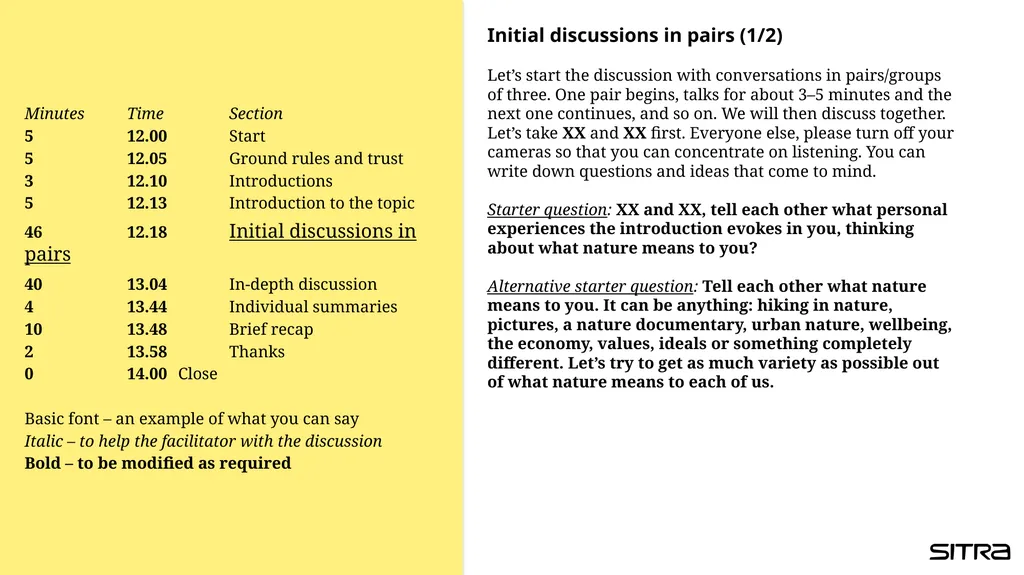
Initial discussions in pairs (1/2)
Let’s start the discussion with conversations in pairs/groups of three. One pair begins, talks for about 3–5 minutes and the next one continues, and so on. We will then discuss together. Let’s take XX and XX first. Everyone else, please turn off your cameras so that you can concentrate on listening. You can write down questions and ideas that come to mind.
Starter question: XX and XX, tell each other what personal experiences the introduction evokes in you, thinking about what nature means to you?
Alternative starter question: Tell each other what nature means to you. It can be anything: hiking in nature, pictures, a nature documentary, urban nature, wellbeing, the economy, values, ideals or something completely different. Let’s try to get as much variety as possible out of what nature means to each of us. Minutes Time Section
5 12.00 Start
5 12.05 Ground rules and trust
3 12.10 Introductions
5 12.13 Introduction to the topic
46 12.18 Initial discussions in pairs
40 13.04 In-depth discussion
4 13.44 Individual summaries
10 13.48 Brief recap
2 13.58 Thanks
0 14.00 Close
Basic font – an example of what you can say
Italic – to help the facilitator with the discussion
Bold – to be modified as required<br>
Let’s start the discussion with conversations in pairs/groups of three. One pair begins, talks for about 3–5 minutes and the next one continues, and so on. We will then discuss together. Let’s take XX and XX first. Everyone else, please turn off your cameras so that you can concentrate on listening. You can write down questions and ideas that come to mind.
Starter question: XX and XX, tell each other what personal experiences the introduction evokes in you, thinking about what nature means to you?
Alternative starter question: Tell each other what nature means to you. It can be anything: hiking in nature, pictures, a nature documentary, urban nature, wellbeing, the economy, values, ideals or something completely different. Let’s try to get as much variety as possible out of what nature means to each of us. Minutes Time Section
5 12.00 Start
5 12.05 Ground rules and trust
3 12.10 Introductions
5 12.13 Introduction to the topic
46 12.18 Initial discussions in pairs
40 13.04 In-depth discussion
4 13.44 Individual summaries
10 13.48 Brief recap
2 13.58 Thanks
0 14.00 Close
Basic font – an example of what you can say
Italic – to help the facilitator with the discussion
Bold – to be modified as required<br>
10
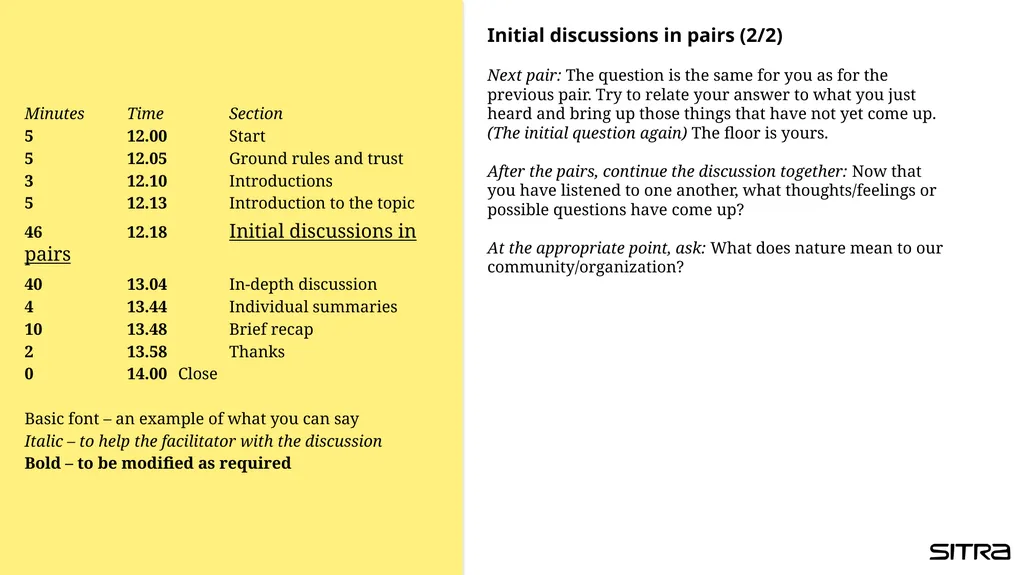
Initial discussions in pairs (2/2)
Next pair: The question is the same for you as for the previous pair. Try to relate your answer to what you just heard and bring up those things that have not yet come up. (The initial question again) The floor is yours.
After the pairs, continue the discussion together: Now that you have listened to one another, what thoughts/feelings or possible questions have come up?
At the appropriate point, ask: What does nature mean to our community/organization? Minutes Time Section
5 12.00 Start
5 12.05 Ground rules and trust
3 12.10 Introductions
5 12.13 Introduction to the topic
46 12.18 Initial discussions in pairs
40 13.04 In-depth discussion
4 13.44 Individual summaries
10 13.48 Brief recap
2 13.58 Thanks
0 14.00 Close
Basic font – an example of what you can say
Italic – to help the facilitator with the discussion
Bold – to be modified as required<br>
Next pair: The question is the same for you as for the previous pair. Try to relate your answer to what you just heard and bring up those things that have not yet come up. (The initial question again) The floor is yours.
After the pairs, continue the discussion together: Now that you have listened to one another, what thoughts/feelings or possible questions have come up?
At the appropriate point, ask: What does nature mean to our community/organization? Minutes Time Section
5 12.00 Start
5 12.05 Ground rules and trust
3 12.10 Introductions
5 12.13 Introduction to the topic
46 12.18 Initial discussions in pairs
40 13.04 In-depth discussion
4 13.44 Individual summaries
10 13.48 Brief recap
2 13.58 Thanks
0 14.00 Close
Basic font – an example of what you can say
Italic – to help the facilitator with the discussion
Bold – to be modified as required<br>
11
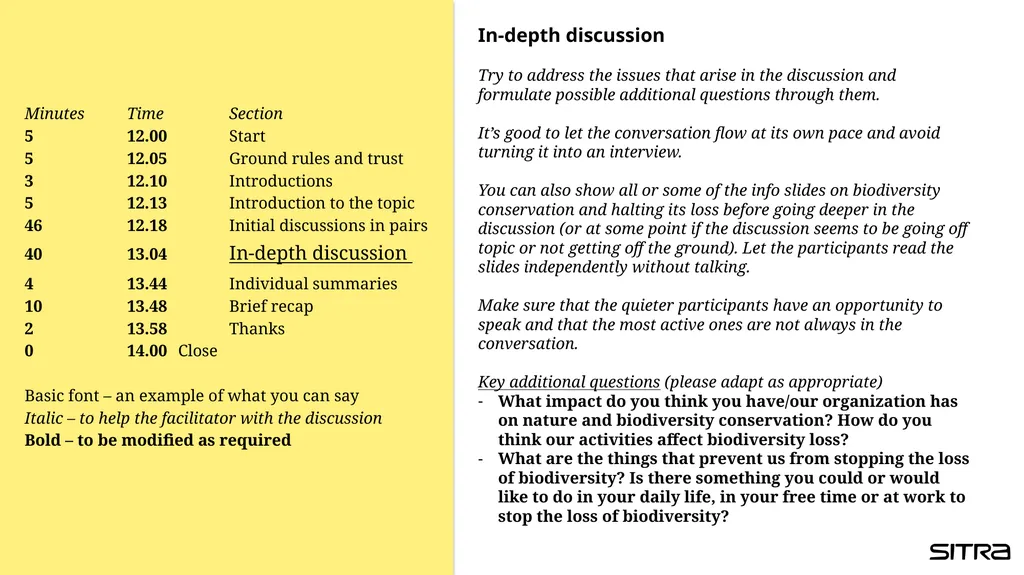
In-depth discussion
Try to address the issues that arise in the discussion and formulate possible additional questions through them.
It’s good to let the conversation flow at its own pace and avoid turning it into an interview.
You can also show all or some of the info slides on biodiversity conservation and halting its loss before going deeper in the discussion (or at some point if the discussion seems to be going off topic or not getting off the ground). Let the participants read the slides independently without talking.
Make sure that the quieter participants have an opportunity to speak and that the most active ones are not always in the conversation.
Key additional questions (please adapt as appropriate)
What impact do you think you have/our organization has on nature and biodiversity conservation? How do you think our activities affect biodiversity loss?
What are the things that prevent us from stopping the loss of biodiversity? Is there something you could or would like to do in your daily life, in your free time or at work to stop the loss of biodiversity? Minutes Time Section
5 12.00 Start
5 12.05 Ground rules and trust
3 12.10 Introductions
5 12.13 Introduction to the topic
46 12.18 Initial discussions in pairs
40 13.04 In-depth discussion
4 13.44 Individual summaries
10 13.48 Brief recap
2 13.58 Thanks
0 14.00 Close
Basic font – an example of what you can say
Italic – to help the facilitator with the discussion
Bold – to be modified as required<br>
Try to address the issues that arise in the discussion and formulate possible additional questions through them.
It’s good to let the conversation flow at its own pace and avoid turning it into an interview.
You can also show all or some of the info slides on biodiversity conservation and halting its loss before going deeper in the discussion (or at some point if the discussion seems to be going off topic or not getting off the ground). Let the participants read the slides independently without talking.
Make sure that the quieter participants have an opportunity to speak and that the most active ones are not always in the conversation.
Key additional questions (please adapt as appropriate)
What impact do you think you have/our organization has on nature and biodiversity conservation? How do you think our activities affect biodiversity loss?
What are the things that prevent us from stopping the loss of biodiversity? Is there something you could or would like to do in your daily life, in your free time or at work to stop the loss of biodiversity? Minutes Time Section
5 12.00 Start
5 12.05 Ground rules and trust
3 12.10 Introductions
5 12.13 Introduction to the topic
46 12.18 Initial discussions in pairs
40 13.04 In-depth discussion
4 13.44 Individual summaries
10 13.48 Brief recap
2 13.58 Thanks
0 14.00 Close
Basic font – an example of what you can say
Italic – to help the facilitator with the discussion
Bold – to be modified as required<br>
12
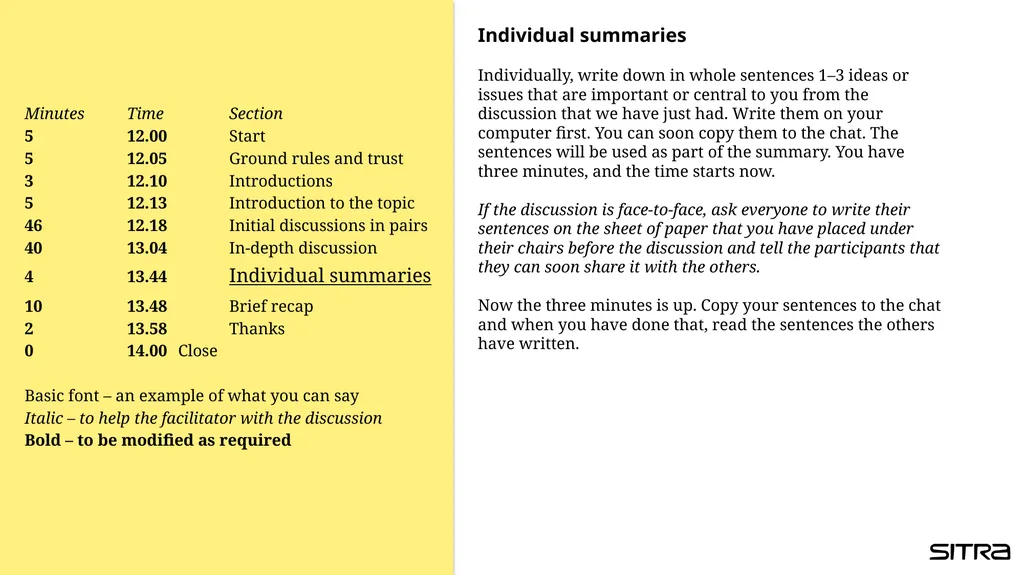
Individual summaries
Individually, write down in whole sentences 1–3 ideas or issues that are important or central to you from the discussion that we have just had. Write them on your computer first. You can soon copy them to the chat. The sentences will be used as part of the summary. You have three minutes, and the time starts now.
If the discussion is face-to-face, ask everyone to write their sentences on the sheet of paper that you have placed under their chairs before the discussion and tell the participants that they can soon share it with the others.
Now the three minutes is up. Copy your sentences to the chat and when you have done that, read the sentences the others have written. Minutes Time Section
5 12.00 Start
5 12.05 Ground rules and trust
3 12.10 Introductions
5 12.13 Introduction to the topic
46 12.18 Initial discussions in pairs
40 13.04 In-depth discussion
4 13.44 Individual summaries
10 13.48 Brief recap
2 13.58 Thanks
0 14.00 Close
Basic font – an example of what you can say
Italic – to help the facilitator with the discussion
Bold – to be modified as required<br>
Individually, write down in whole sentences 1–3 ideas or issues that are important or central to you from the discussion that we have just had. Write them on your computer first. You can soon copy them to the chat. The sentences will be used as part of the summary. You have three minutes, and the time starts now.
If the discussion is face-to-face, ask everyone to write their sentences on the sheet of paper that you have placed under their chairs before the discussion and tell the participants that they can soon share it with the others.
Now the three minutes is up. Copy your sentences to the chat and when you have done that, read the sentences the others have written. Minutes Time Section
5 12.00 Start
5 12.05 Ground rules and trust
3 12.10 Introductions
5 12.13 Introduction to the topic
46 12.18 Initial discussions in pairs
40 13.04 In-depth discussion
4 13.44 Individual summaries
10 13.48 Brief recap
2 13.58 Thanks
0 14.00 Close
Basic font – an example of what you can say
Italic – to help the facilitator with the discussion
Bold – to be modified as required<br>
13
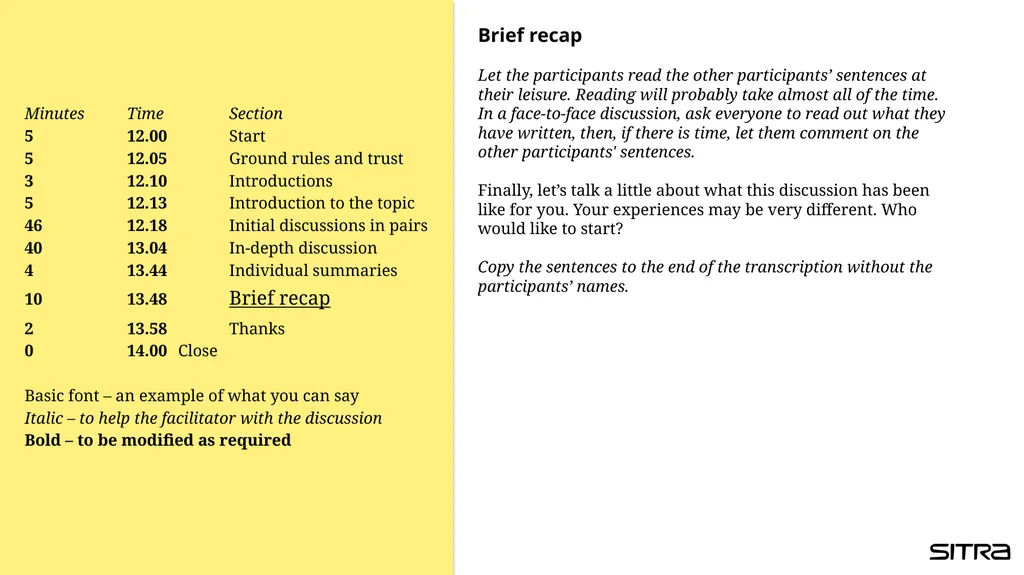
Brief recap
Let the participants read the other participants’ sentences at their leisure. Reading will probably take almost all of the time. In a face-to-face discussion, ask everyone to read out what they have written, then, if there is time, let them comment on the other participants' sentences.
Finally, let’s talk a little about what this discussion has been like for you. Your experiences may be very different. Who would like to start?
Copy the sentences to the end of the transcription without the participants’ names. Minutes Time Section
5 12.00 Start
5 12.05 Ground rules and trust
3 12.10 Introductions
5 12.13 Introduction to the topic
46 12.18 Initial discussions in pairs
40 13.04 In-depth discussion
4 13.44 Individual summaries
10 13.48 Brief recap
2 13.58 Thanks
0 14.00 Close
Basic font – an example of what you can say
Italic – to help the facilitator with the discussion
Bold – to be modified as required<br>
Let the participants read the other participants’ sentences at their leisure. Reading will probably take almost all of the time. In a face-to-face discussion, ask everyone to read out what they have written, then, if there is time, let them comment on the other participants' sentences.
Finally, let’s talk a little about what this discussion has been like for you. Your experiences may be very different. Who would like to start?
Copy the sentences to the end of the transcription without the participants’ names. Minutes Time Section
5 12.00 Start
5 12.05 Ground rules and trust
3 12.10 Introductions
5 12.13 Introduction to the topic
46 12.18 Initial discussions in pairs
40 13.04 In-depth discussion
4 13.44 Individual summaries
10 13.48 Brief recap
2 13.58 Thanks
0 14.00 Close
Basic font – an example of what you can say
Italic – to help the facilitator with the discussion
Bold – to be modified as required<br>
14
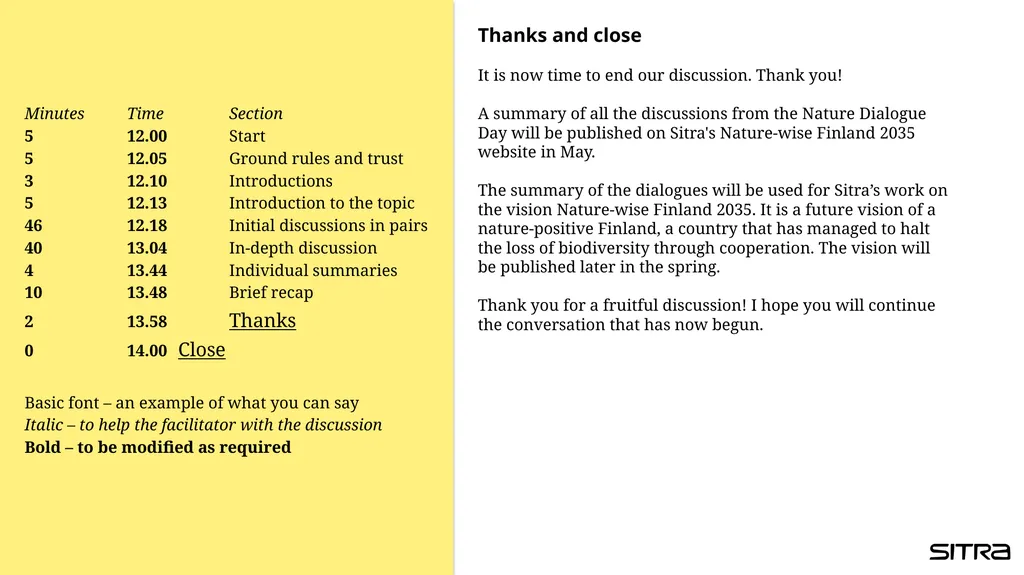
Thanks and close
It is now time to end our discussion. Thank you!
A summary of all the discussions from the Nature Dialogue Day will be published on Sitra's Nature-wise Finland 2035 website in May.
The summary of the dialogues will be used for Sitra’s work on the vision Nature-wise Finland 2035. It is a future vision of a nature-positive Finland, a country that has managed to halt the loss of biodiversity through cooperation. The vision will be published later in the spring.
Thank you for a fruitful discussion! I hope you will continue the conversation that has now begun. Minutes Time Section
5 12.00 Start
5 12.05 Ground rules and trust
3 12.10 Introductions
5 12.13 Introduction to the topic
46 12.18 Initial discussions in pairs
40 13.04 In-depth discussion
4 13.44 Individual summaries
10 13.48 Brief recap
2 13.58 Thanks
0 14.00 Close
Basic font – an example of what you can say
Italic – to help the facilitator with the discussion
Bold – to be modified as required<br>
It is now time to end our discussion. Thank you!
A summary of all the discussions from the Nature Dialogue Day will be published on Sitra's Nature-wise Finland 2035 website in May.
The summary of the dialogues will be used for Sitra’s work on the vision Nature-wise Finland 2035. It is a future vision of a nature-positive Finland, a country that has managed to halt the loss of biodiversity through cooperation. The vision will be published later in the spring.
Thank you for a fruitful discussion! I hope you will continue the conversation that has now begun. Minutes Time Section
5 12.00 Start
5 12.05 Ground rules and trust
3 12.10 Introductions
5 12.13 Introduction to the topic
46 12.18 Initial discussions in pairs
40 13.04 In-depth discussion
4 13.44 Individual summaries
10 13.48 Brief recap
2 13.58 Thanks
0 14.00 Close
Basic font – an example of what you can say
Italic – to help the facilitator with the discussion
Bold – to be modified as required<br>
15
sitra.fi/en/<br>