
Draft White Paper on Audio and Audiovisual Media
CS
Published · 19 slides · 0 views

1 / 1
Description
Draft White Paper on Audio and Audiovisual Media Services and Online Content Safety: A New Vision for South Africa 2023 Briefing to the Portfolio Committee on Communications and Digital Technologies 28 November 2023 1 Background and Context
Related Topics
Share
Embed code
Download this presentation From Below
"Draft White Paper on Audio and Audiovisual Media" is the property of its rightful owner. Permission is granted to download and print the materials on this website for personal, non-commercial use only, and to display it on your personal computer provided you do not modify the materials and that you retain all copyright notices contained in the materials. By downloading content from our website, you accept the terms of this agreement.
Presentation Transcript
01
Draft White Paper on Audio and Audiovisual Media Services and Online Content Safety:
A New Vision for South Africa 2023
Briefing to the Portfolio Committee on Communications and Digital Technologies
28 November 2023 1<br>
A New Vision for South Africa 2023
Briefing to the Portfolio Committee on Communications and Digital Technologies
28 November 2023 1<br>
02
Background and Context
International Developments
Purpose and Rationale
White Paper Proposals PRESENTATION OUTLINE 2<br>
International Developments
Purpose and Rationale
White Paper Proposals PRESENTATION OUTLINE 2<br>
03
BACKGROUND AND CONTEXT Globally, a majority of countries have been reviewing their policies and regulatory approaches in the new digital environment.
The transition to digital economies has prompted governments to consider the need to expand the conventional ICT regulatory and policy agenda.
In line with ITU assertions, based on externalities of the converged digital ecosystem and environment, the assessment of policy and regulatory agendas need to consider areas related to the promotion of innovation and digital transformation1 and therefore requires a different and new approach in legislative and regulatory frameworks for the digital economy.
By 2023, the DCDT had to finalise the audio-visual strategy to deal with the promotion of local content, local languages, cultural diversity and heritage, and protect local media against unfair competition by international emerging media (streaming and social media). 3 1 ITU, Sector Benchmark of fifth-generation collaborative digital regulation<br>
04
INTERNATIONAL DEVELOPMENTS New Zealand has just published a Safer Online Services and Media Platforms Consultation in June 2023.
This is after New Zealand realised that its existing regulatory system is not capable of adapting or responding to growing risks of harm from recent and emerging media channels; and that internationally other governments are also grappling with outdated media content regulatory systems to regulate online content and are aligning for greater efficiency and effectiveness of regulation more comprehensively.
On 10 December 2022, the long anticipated Online Safety and Media Regulation Act (OSMR Act) was signed into Irish law.
The Act creates a new Media Commission in place of the existing Broadcasting Authority of Ireland. The Media Commission has the responsibility to oversee the updated regulations for broadcasting, audio-visual on-demand media services and video-sharing platform services.
The Media Commission will establish and maintain a register of media services for all audiovisual on-demand media services in Ireland. Significantly, the Media Commission will have a broad range of investigative and enforcement powers.
The new Act goes above and beyond mere implementation of the provisions of the revised Audiovisual Media Services Directive and anticipates penalties and an enforcement mechanism.
OSMR Act 2022 amends the Broadcasting Act 2009 and introduces a new regulatory framework for audiovisual media services.
The regulatory authorities in the Nordic countries, Denmark, Finland, Norway, and Sweden, have established regional cooperation. The regulators deal with classification, media development and diversity, and online content matters. For example, the mission of the Norwegian Media Authority is to promote media diversity (administers media policy instruments, such as direct media support schemes and allocation of broadcasting licences); increase media literacy (it engages the public on how to expose fake news and misinformation); responsible for data processing, insight / analyses and studies across all specialist areas in the areas such as market economy / market trends, children and the digital media, technology and international development/global actors; and responsible for age classification of films for public screening. 4<br>
05
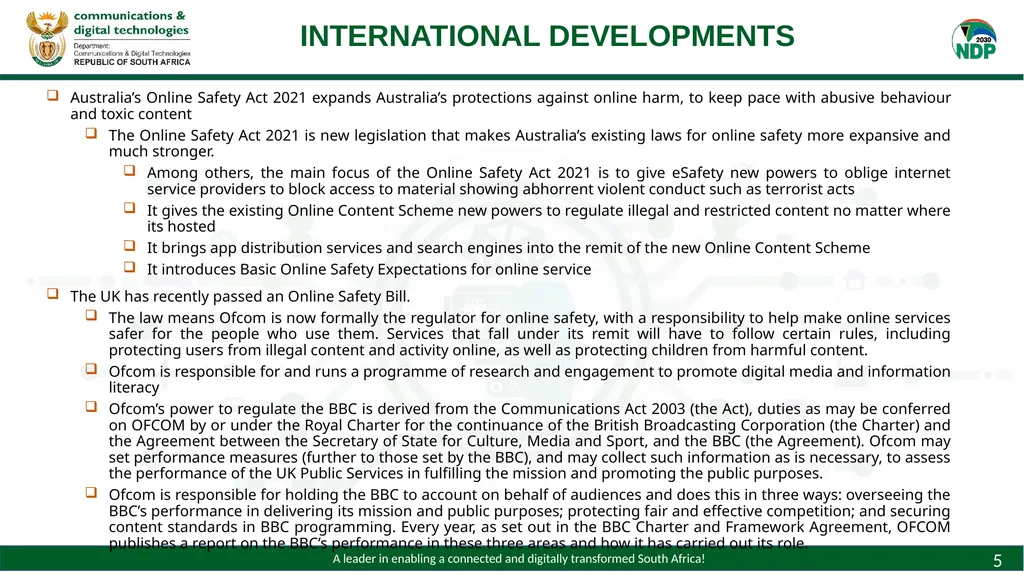
INTERNATIONAL DEVELOPMENTS Australia’s Online Safety Act 2021 expands Australia’s protections against online harm, to keep pace with abusive behaviour and toxic content
The Online Safety Act 2021 is new legislation that makes Australia’s existing laws for online safety more expansive and much stronger.
Among others, the main focus of the Online Safety Act 2021 is to give eSafety new powers to oblige internet service providers to block access to material showing abhorrent violent conduct such as terrorist acts
It gives the existing Online Content Scheme new powers to regulate illegal and restricted content no matter where its hosted
It brings app distribution services and search engines into the remit of the new Online Content Scheme
It introduces Basic Online Safety Expectations for online service
The UK has recently passed an Online Safety Bill.
The law means Ofcom is now formally the regulator for online safety, with a responsibility to help make online services safer for the people who use them. Services that fall under its remit will have to follow certain rules, including protecting users from illegal content and activity online, as well as protecting children from harmful content.
Ofcom is responsible for and runs a programme of research and engagement to promote digital media and information literacy
Ofcom’s power to regulate the BBC is derived from the Communications Act 2003 (the Act), duties as may be conferred on OFCOM by or under the Royal Charter for the continuance of the British Broadcasting Corporation (the Charter) and the Agreement between the Secretary of State for Culture, Media and Sport, and the BBC (the Agreement). Ofcom may set performance measures (further to those set by the BBC), and may collect such information as is necessary, to assess the performance of the UK Public Services in fulfilling the mission and promoting the public purposes.
Ofcom is responsible for holding the BBC to account on behalf of audiences and does this in three ways: overseeing the BBC’s performance in delivering its mission and public purposes; protecting fair and effective competition; and securing content standards in BBC programming. Every year, as set out in the BBC Charter and Framework Agreement, OFCOM publishes a report on the BBC’s performance in these three areas and how it has carried out its role. 5<br>
06
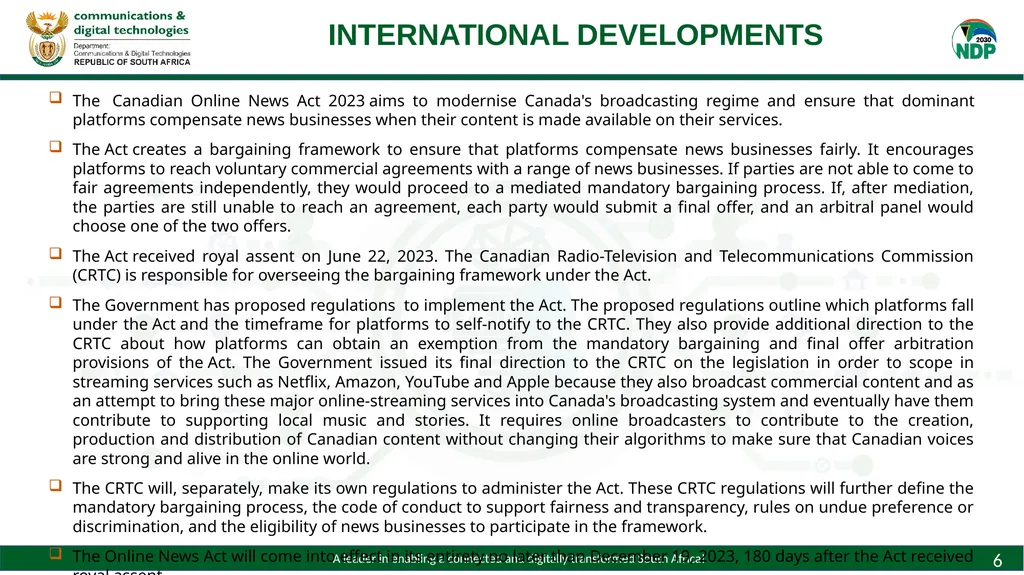
INTERNATIONAL DEVELOPMENTS The Canadian Online News Act 2023 aims to modernise Canada's broadcasting regime and ensure that dominant platforms compensate news businesses when their content is made available on their services.
The Act creates a bargaining framework to ensure that platforms compensate news businesses fairly. It encourages platforms to reach voluntary commercial agreements with a range of news businesses. If parties are not able to come to fair agreements independently, they would proceed to a mediated mandatory bargaining process. If, after mediation, the parties are still unable to reach an agreement, each party would submit a final offer, and an arbitral panel would choose one of the two offers.
The Act received royal assent on June 22, 2023. The Canadian Radio-Television and Telecommunications Commission (CRTC) is responsible for overseeing the bargaining framework under the Act.
The Government has proposed regulations to implement the Act. The proposed regulations outline which platforms fall under the Act and the timeframe for platforms to self-notify to the CRTC. They also provide additional direction to the CRTC about how platforms can obtain an exemption from the mandatory bargaining and final offer arbitration provisions of the Act. The Government issued its final direction to the CRTC on the legislation in order to scope in streaming services such as Netflix, Amazon, YouTube and Apple because they also broadcast commercial content and as an attempt to bring these major online-streaming services into Canada's broadcasting system and eventually have them contribute to supporting local music and stories. It requires online broadcasters to contribute to the creation, production and distribution of Canadian content without changing their algorithms to make sure that Canadian voices are strong and alive in the online world.
The CRTC will, separately, make its own regulations to administer the Act. These CRTC regulations will further define the mandatory bargaining process, the code of conduct to support fairness and transparency, rules on undue preference or discrimination, and the eligibility of news businesses to participate in the framework.
The Online News Act will come into effect in its entirety no later than December 19, 2023, 180 days after the Act received royal assent. 6<br>
07
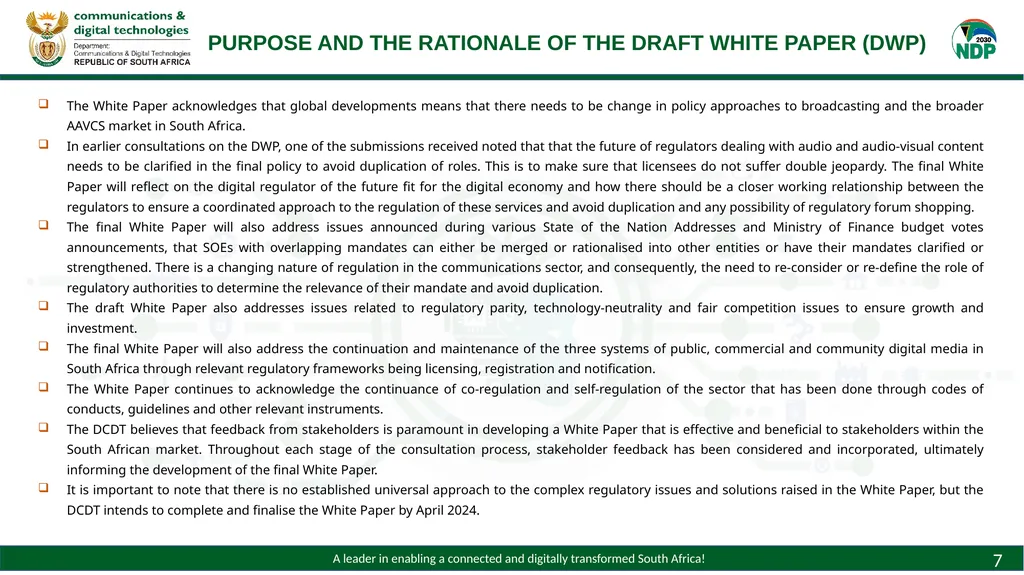
PURPOSE AND THE RATIONALE OF THE DRAFT WHITE PAPER (DWP) The White Paper acknowledges that global developments means that there needs to be change in policy approaches to broadcasting and the broader AAVCS market in South Africa.
In earlier consultations on the DWP, one of the submissions received noted that that the future of regulators dealing with audio and audio-visual content needs to be clarified in the final policy to avoid duplication of roles. This is to make sure that licensees do not suffer double jeopardy. The final White Paper will reflect on the digital regulator of the future fit for the digital economy and how there should be a closer working relationship between the regulators to ensure a coordinated approach to the regulation of these services and avoid duplication and any possibility of regulatory forum shopping.
The final White Paper will also address issues announced during various State of the Nation Addresses and Ministry of Finance budget votes announcements, that SOEs with overlapping mandates can either be merged or rationalised into other entities or have their mandates clarified or strengthened. There is a changing nature of regulation in the communications sector, and consequently, the need to re-consider or re-define the role of regulatory authorities to determine the relevance of their mandate and avoid duplication.
The draft White Paper also addresses issues related to regulatory parity, technology-neutrality and fair competition issues to ensure growth and investment.
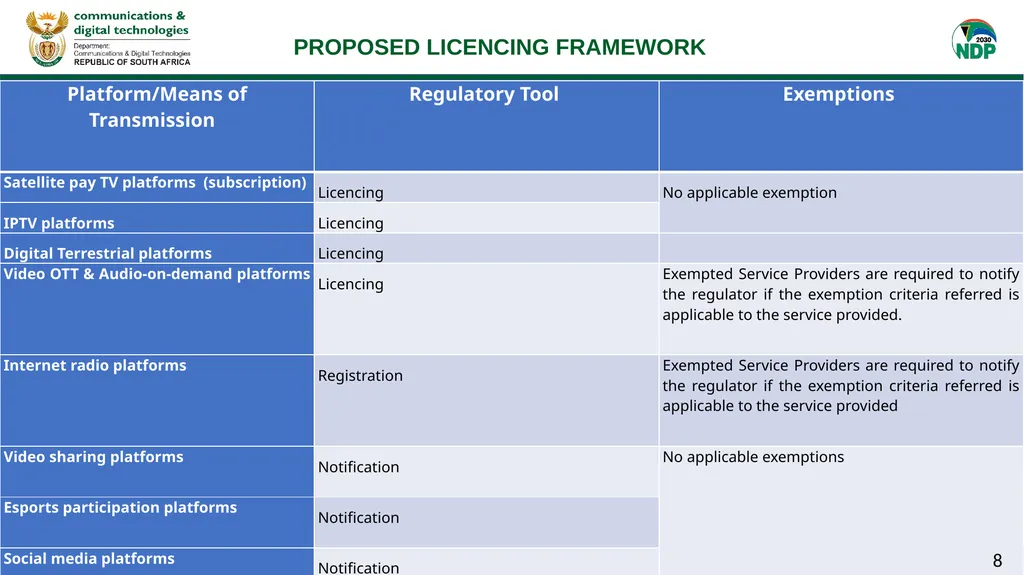
The final White Paper will also address the continuation and maintenance of the three systems of public, commercial and community digital media in South Africa through relevant regulatory frameworks being licensing, registration and notification.
The White Paper continues to acknowledge the continuance of co-regulation and self-regulation of the sector that has been done through codes of conducts, guidelines and other relevant instruments.
The DCDT believes that feedback from stakeholders is paramount in developing a White Paper that is effective and beneficial to stakeholders within the South African market. Throughout each stage of the consultation process, stakeholder feedback has been considered and incorporated, ultimately informing the development of the final White Paper.
It is important to note that there is no established universal approach to the complex regulatory issues and solutions raised in the White Paper, but the DCDT intends to complete and finalise the White Paper by April 2024. 7<br>
08
PROPOSED LICENCING FRAMEWORK 8<br>
09
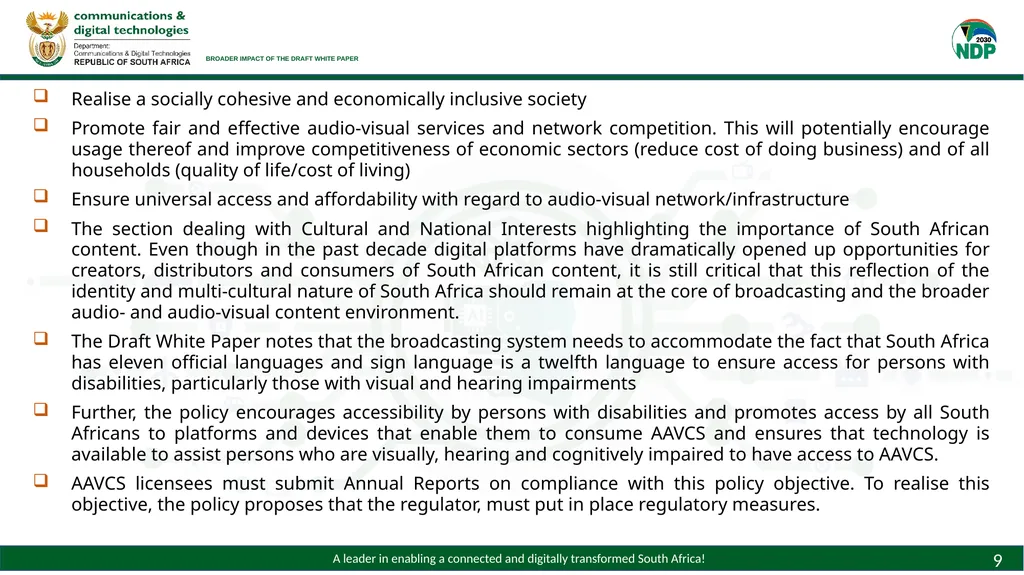
BROADER IMPACT OF THE DRAFT WHITE PAPER Realise a socially cohesive and economically inclusive society
Promote fair and effective audio-visual services and network competition. This will potentially encourage usage thereof and improve competitiveness of economic sectors (reduce cost of doing business) and of all households (quality of life/cost of living)
Ensure universal access and affordability with regard to audio-visual network/infrastructure
The section dealing with Cultural and National Interests highlighting the importance of South African content. Even though in the past decade digital platforms have dramatically opened up opportunities for creators, distributors and consumers of South African content, it is still critical that this reflection of the identity and multi-cultural nature of South Africa should remain at the core of broadcasting and the broader audio- and audio-visual content environment.
The Draft White Paper notes that the broadcasting system needs to accommodate the fact that South Africa has eleven official languages and sign language is a twelfth language to ensure access for persons with disabilities, particularly those with visual and hearing impairments
Further, the policy encourages accessibility by persons with disabilities and promotes access by all South Africans to platforms and devices that enable them to consume AAVCS and ensures that technology is available to assist persons who are visually, hearing and cognitively impaired to have access to AAVCS.
AAVCS licensees must submit Annual Reports on compliance with this policy objective. To realise this objective, the policy proposes that the regulator, must put in place regulatory measures. 9<br>
10
CREATIVE INDUSTRIES MASTER PLAN ISSUES Constraints of the SABC within the production industry: to be addressed by the SABC Bill.
Improving access to finance and encouraging investment: addressed by the section imposing obligations on OTT to contribute funding.
Incentivise the creation of local content and productions: imposing obligations on OTT.
Improving the skills of SA AV professionals: section on human capital. 10<br>
Improving access to finance and encouraging investment: addressed by the section imposing obligations on OTT to contribute funding.
Incentivise the creation of local content and productions: imposing obligations on OTT.
Improving the skills of SA AV professionals: section on human capital. 10<br>
11
CONTENT REGULATION OF THE AUDIO- AND AUDIO-VISUAL CONTENT SERVICES (AAVCS) Access to AAVCS by persons with disabilities
The existing legal provisions on accessibility obligations for public service broadcasters and commercial broadcasters need to apply to all AAVCS.
The regulator must provide annual reports and research on the specific obligations of AAVCS to address access by persons with disabilities.
The draft White Paper proposes that the Universal Digital Development Fund (proposed in IWP) of the time must grant funding for accessibility services.
Protection of Children and Consumers
The protection of children and consumers is a key guiding principle in the regulation of AAVCS.
The draft White Paper proposes that the current instruments used to promote the protection of children and consumers in respect of broadcasting services needs to be reviewed so that the Codes of Conduct are inclusive of all AAVCS. 11<br>
12
MUST CARRY AND FINDABILITY Must carry rules have achieved its intended objective, but going forward may distort competition.
The draft White Paper proposes amending legislation to remove must carry regulation and governing the public broadcaster to reflect that the SABC may negotiate retransmission consent agreements on commercial terms.
With the proviso that in South Africa the retransmission consent agreements for audio-visual content broadcast free-to-air terrestrially by the public broadcaster may not be exclusive to a single subscription audio-visual content service.
ICASA has published the must carry regulations allowing public broadcasters to enter into commercial agreements on the carrying of its channels.
Moving forward, the Authority will need to draft new regulations on the findability and discoverability to ensure public service media content of the SABC is found in all the different audio- and audio-visual content services across platforms. 12<br>
13
OWNERSHIP AND LIMITATIONS Foreign Control of Broadcasting Services
In the interests of promoting foreign investment and growing the sector, the draft White Paper proposes the amendment of legislation to empower the regulator to consider allowing foreign ownership of linear individual audiovisual content services (broadcasting services) to a maximum of 49% to stimulate investment.
In the case of foreigners from AU member countries, this maximum of 49% may be waived as long as there is a reciprocal agreement between South Africa and the relevant AU country. 13<br>
14
DIGITAL MEDIA AND INFORMATION LITERACY Legislation must ensure the regulator promotes digital media literacy.
To promote a unified approach to digital media and information literacy an inter-ministerial committee should be established to develop policies that strengthen digital media and information literacy and co-ordinate the publication of annual digital media and information literacy research.
Annual digital media research to be funded from the fund meant for universal services. 14<br>
15
ONLINE SAFETY AND MEDIA REGULATION The draft White Paper proposes that the review process be prioritised as soon as possible to create policy certainty and ensure limited resources can be used for implementation of the draft policy and developmental areas.
In this regard, the policy introduces issues on Online Safety and Media Regulation as a response to the changed and changing landscape of media and content consumption as a result of the digital economy. It proposes new rules through regulations to make this consumption safer and in line with the regulation applicable to traditional broadcast media.
The online safety section of the White Paper is meant to make the internet a safer place for all users by prohibiting providers of user-to-user services (social media platforms) from hosting illegal or harmful content.
The provisions will also include the prohibition of online advertising to children.
In other jurisdictions such as the UK, Australia, Canada, Ireland, and USA which are adding new requirements on its online Safety Bill, hold social media platforms and search engines accountable for scam or fraudulent adverts that appear on their sites.
The section will ensure that the online environment remains a safe space, safeguarding freedom of expression and opportunities for digital businesses. 15<br>
16
STATUS OF THE DRAFT WHITE PAPER On 31 July 2023, the Department gazetted the draft White Paper on Audio- and Audio-Visual Content Media Services and Online Content Safety for public comments for a period of eight weeks to give stakeholders enough time to engage with the complex proposals raised within the Policy Framework.
The initial closing date was 8 September 2023 but extended to 9 October 2023 due to the request for extension by stakeholders.
The Department is currently analysing the submissions from stakeholders.
Following the analysis, these inputs will be incorporated into the draft White Paper
The process of analysis will also inform the final SEIAS process and the Department has alerted the Presidency in this regard.
The final White Paper will be submitted to the Minister and Cabinet before the end of this term, latest by April 2024.
The Department will also develop an implementation plan and commence with the drafting of the relevant Bill for the public comment before submission to Parliament before end of the 2024 financial year. 16<br>
17
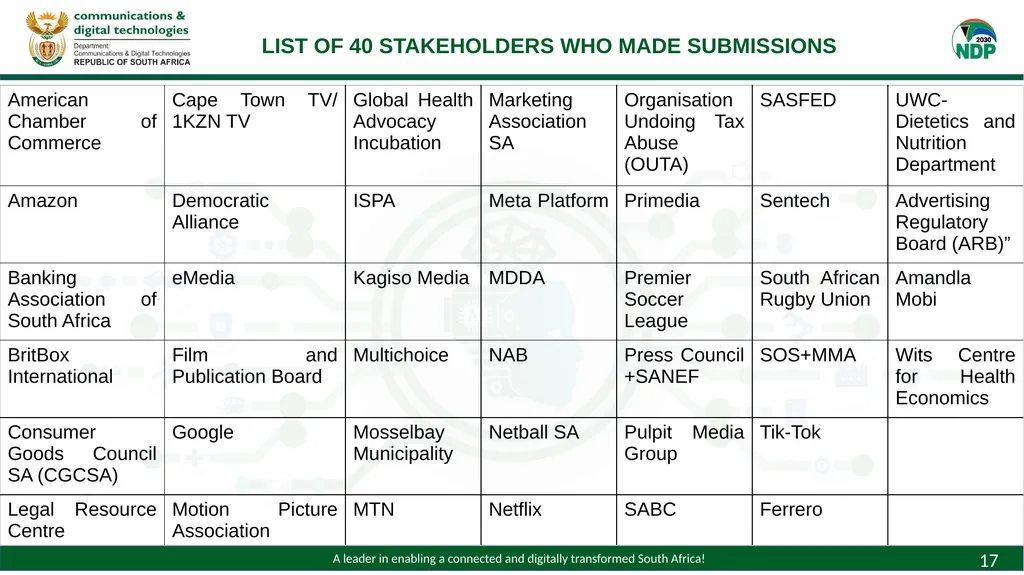
LIST OF 40 STAKEHOLDERS WHO MADE SUBMISSIONS 17<br>
18
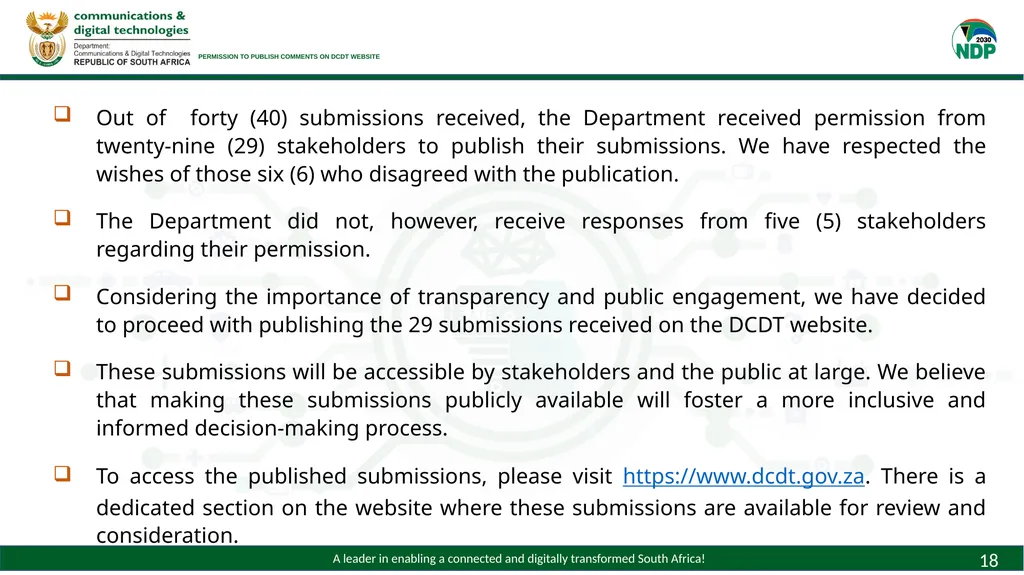
PERMISSION TO PUBLISH COMMENTS ON DCDT WEBSITE Out of forty (40) submissions received, the Department received permission from twenty-nine (29) stakeholders to publish their submissions. We have respected the wishes of those six (6) who disagreed with the publication.
The Department did not, however, receive responses from five (5) stakeholders regarding their permission.
Considering the importance of transparency and public engagement, we have decided to proceed with publishing the 29 submissions received on the DCDT website.
These submissions will be accessible by stakeholders and the public at large. We believe that making these submissions publicly available will foster a more inclusive and informed decision-making process.
To access the published submissions, please visit https://www.dcdt.gov.za. There is a dedicated section on the website where these submissions are available for review and consideration. 18<br>
19
19<br>