
Drainage 101 – Council Educational Session
Description: Drainage 101 Council Educational Session Prepared By: Eric Chamberlain Drainage 101 So, Whats a Municipal Drain? It is a Drainage System either open ditch or enclosed pipe system or any other water control structure and protective works
Related Topics
Download Presentation
"Drainage 101 – Council Educational Session" is the property of its rightful owner. Permission is granted to download and print the materials on this website for personal, non-commercial use only, and to display it on your personal computer provided you do not modify the materials and that you retain all copyright notices contained in the materials. By downloading content from our website, you accept the terms of this agreement.
Presentation Transcript
slide1. Drainage 101 –
Council Educational Session Prepared By:
Eric Chamberlain<br>
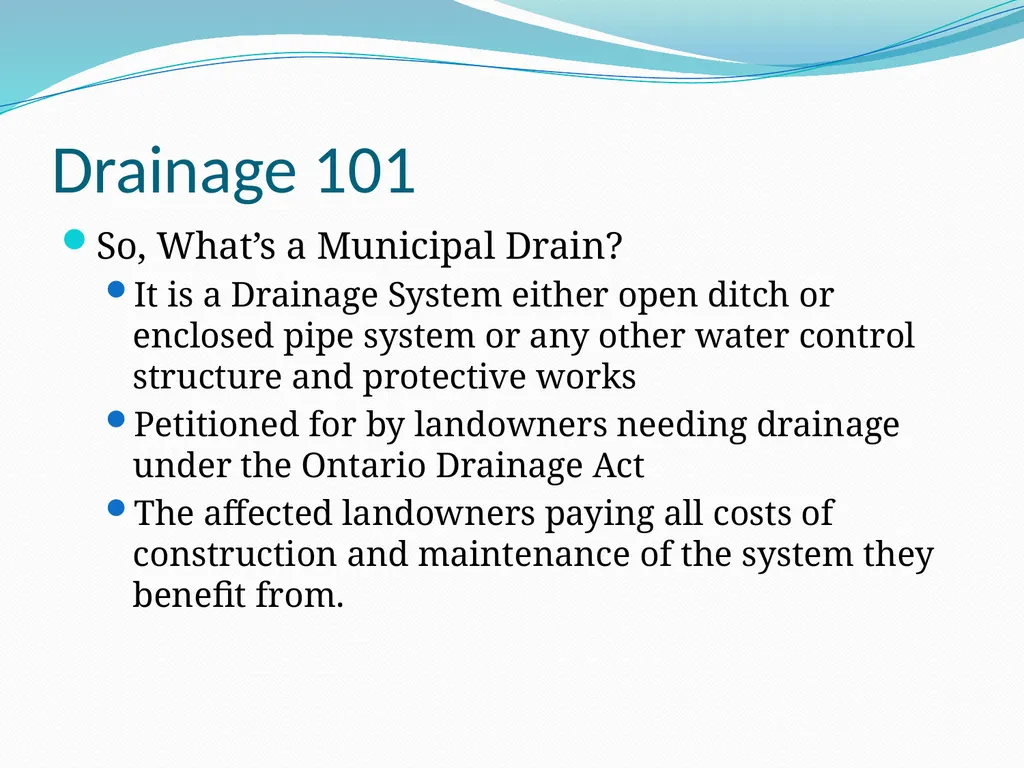
slide2. Drainage 101 So, What’s a Municipal Drain?
It is a Drainage System either open ditch or enclosed pipe system or any other water control structure and protective works
Petitioned for by landowners needing drainage under the Ontario Drainage Act
The affected landowners paying all costs of construction and maintenance of the system they benefit from.<br>
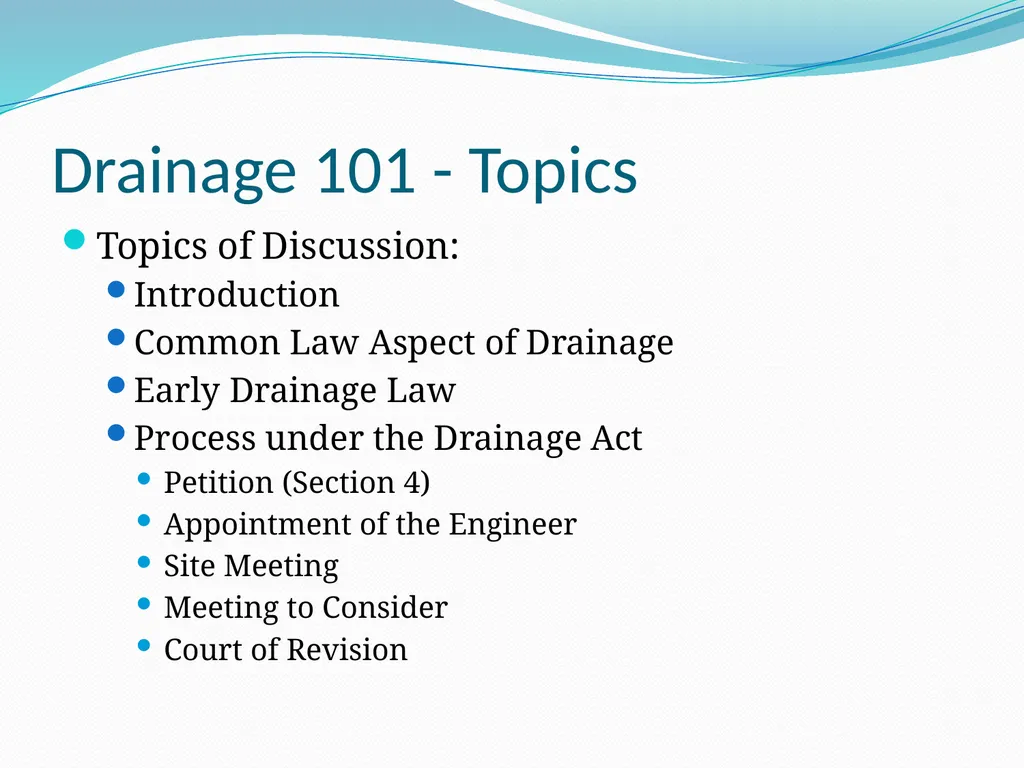
slide3. Drainage 101 - Topics Topics of Discussion:
Introduction
Common Law Aspect of Drainage
Early Drainage Law
Process under the Drainage Act
Petition (Section 4)
Appointment of the Engineer
Site Meeting
Meeting to Consider
Court of Revision<br>
slide4. Drainage 101 - Topics Process under the Drainage Act (Con’t)
Repair and Improvement (Section 78)
Maintenance and Repair (Section 74)
New Maintenance Schedules (Section 76)
Island Considerations
Future Considerations
Final Thoughts<br>
slide5. Introduction Water issues causes disputes between:
Neighbours
Family Members
Landowners vs Road Authority
Drainage Act was created to provide drainage to those landowners requiring drainage.
The Drainage Act empowers the municipality to facilitate & maintain the drainage works at the cost of lands and roads benefiting from the drainage system.
Drainage projects are communal projects
Involvement of the Landowners is necessary<br>
slide6. Common Law Aspect of Water Common Law – foundation of today’s Statute Law
Common Law as it relates to natural watercourse states the following:
“A natural watercourse is defined generally as a stream of water which flows along a defined channel, with beds and banks, for a sufficient time to give it substantial existence”
There are no natural water courses that exist on the island<br>
slide7. Common Law Aspect of Water Landowners adjacent to Natural Watercourses are considered riparian owner
These landowners have the rights under “The Riparian Doctrine”
One of the rights is “the right to drain their property”<br>
slide8. Common Law Aspect of Water Common Law also states the following regarding surface water:
“No right of drainage to mere surface water exists as long as the flow is not in a defined channel”
An owner of lower land may, at his own choice, either allow water from higher land to flow over it or keep such water off their property by dams and banks.<br>
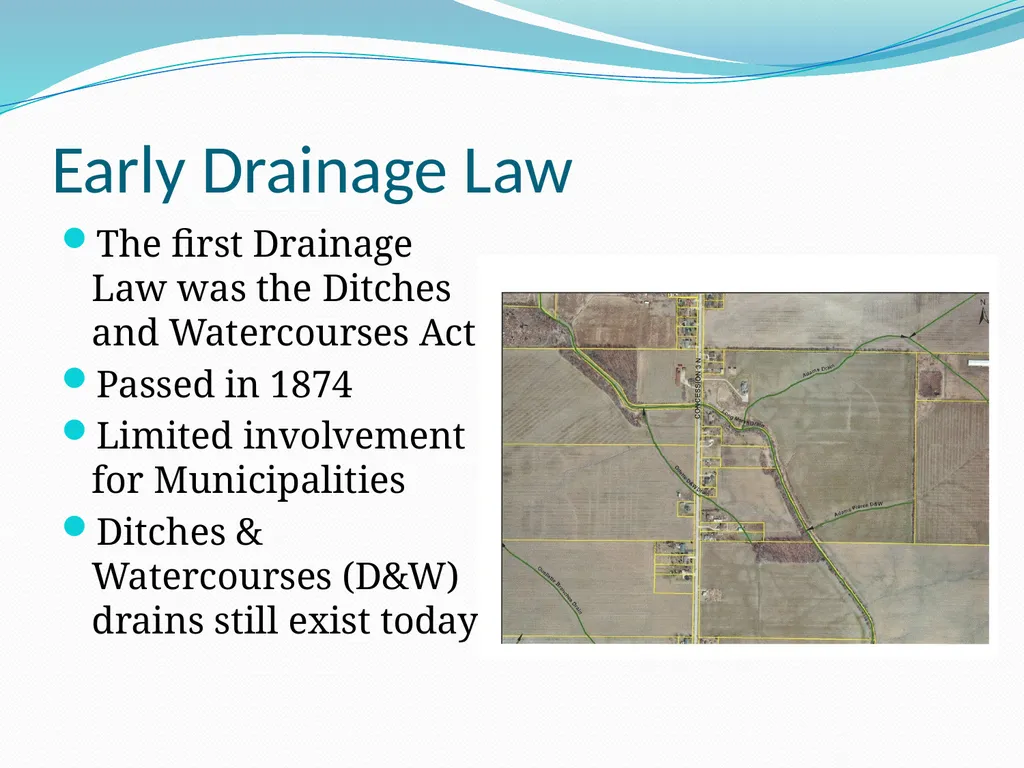
slide9. Early Drainage Law The first Drainage Law was the Ditches and Watercourses Act
Passed in 1874
Limited involvement for Municipalities
Ditches & Watercourses (D&W) drains still exist today<br>
slide10. Drainage Act Process Current legislation 1990 with revisions completed in 2010.
One of the most democratic Act in Ontario
Provides landowners with the ability to obtain legal drainage
Provides the municipality with the ability to manage the drainage systems and recover cost.<br>
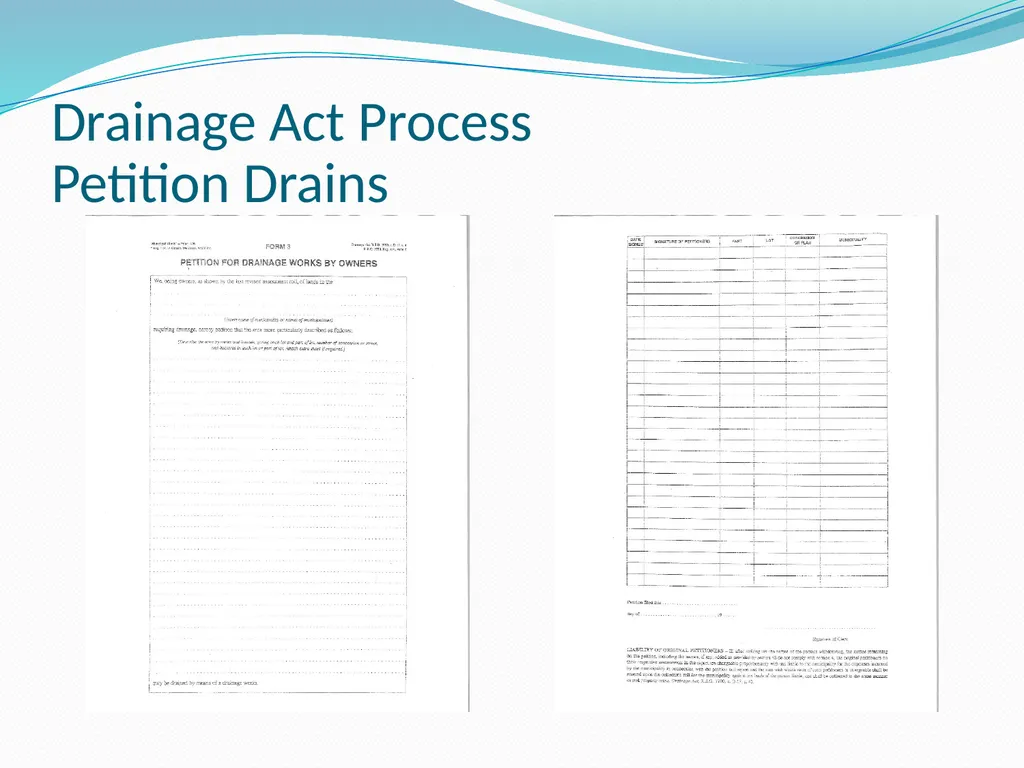
slide11. Drainage Act Process Petition Drains Section 4 – Petition is the method for landowners start the process for a new municipal drain
The petition is valid based on the following 4 criteria:
Majority in numbers of the owner
The area representing at least 60% of the hectarage in the area requiring drainage
Road Authority
Director of Ministry of Agriculture, Food and Rural Affairs.<br>
slide12. Drainage Act Process Petition Drains<br>
slide13. Drainage Act Process Appointment The petition is file with the Clerk’s Office
Municipality needs to inform environmental agencies of the potential Drainage Project
Environmental Agencies have 30 days to request an Environmental Appraisal to be completed before the engineer is appointed
Council appoints an Engineer to prepare a report.
Engineer confirms that the petition is valid.
If necessary landowners are directed to obtain more signatures if petition is not valid.
Once the petition is valid, administration schedule a site meeting.<br>
slide14. Drainage Act Process On-Site Meeting Meeting is schedule with all of the landowners impacted by the proposed project.
The meeting is held on-site to review the drainage concern
Fact gathering meeting for the engineer to understand the landowners concerns<br>
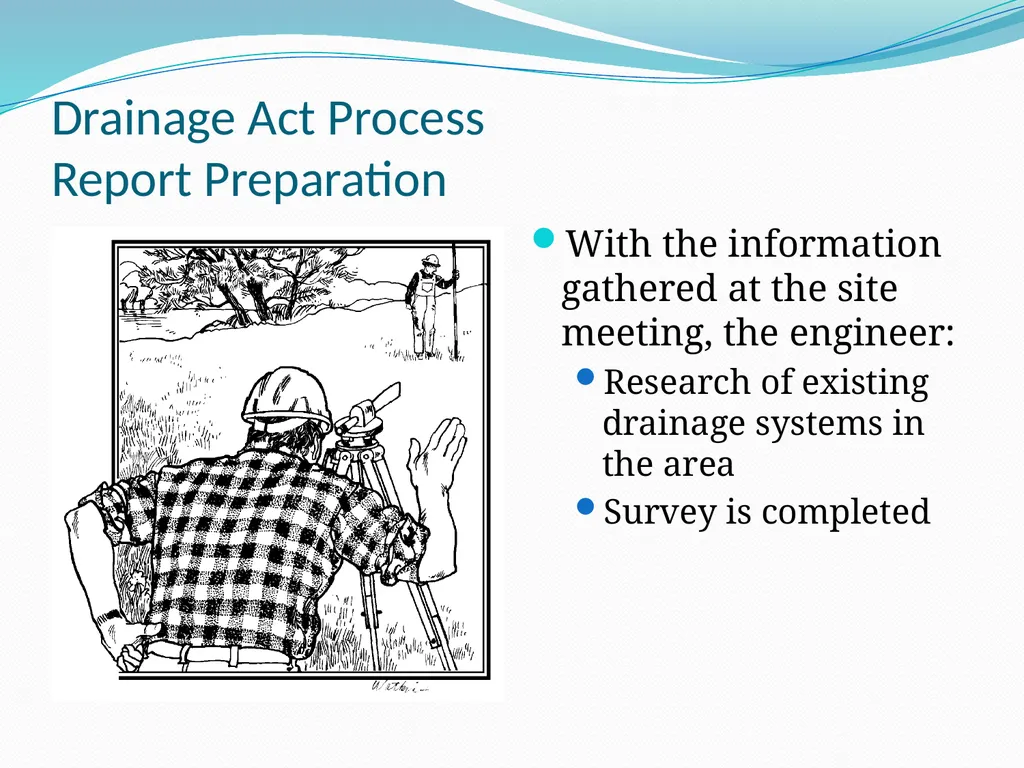
slide15. Drainage Act Process Report Preparation With the information gathered at the site meeting, the engineer:
Research of existing drainage systems in the area
Survey is completed<br>
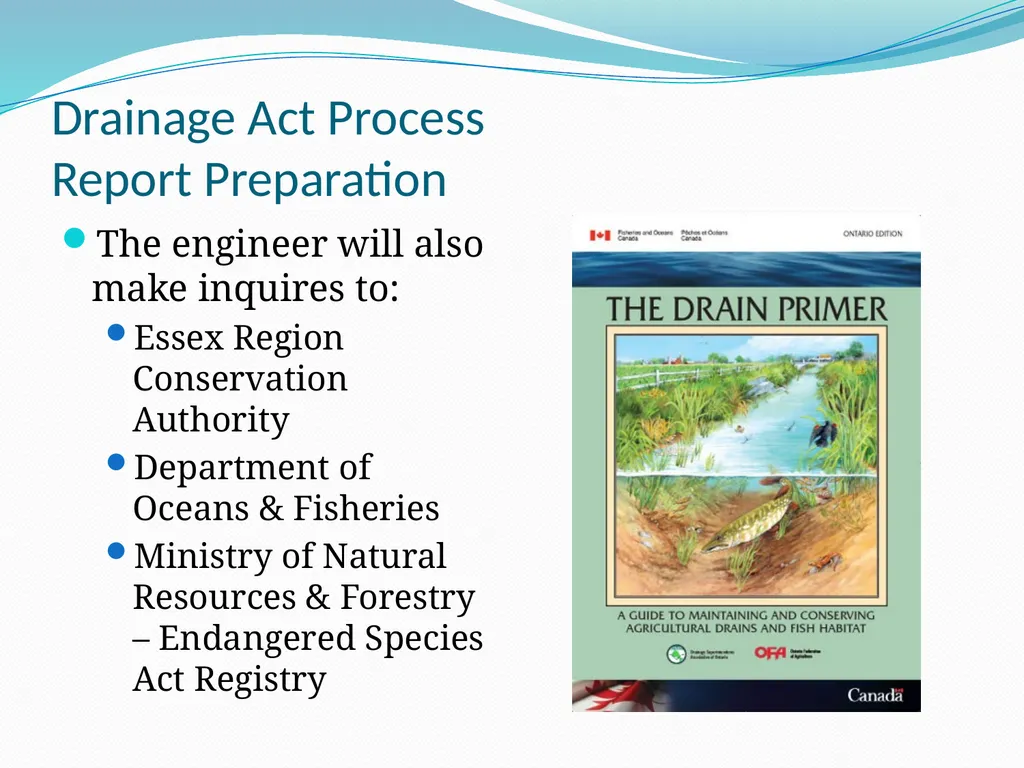
slide16. Drainage Act Process Report Preparation The engineer will also make inquires to:
Essex Region Conservation Authority
Department of Oceans & Fisheries
Ministry of Natural Resources & Forestry – Endangered Species Act Registry<br>
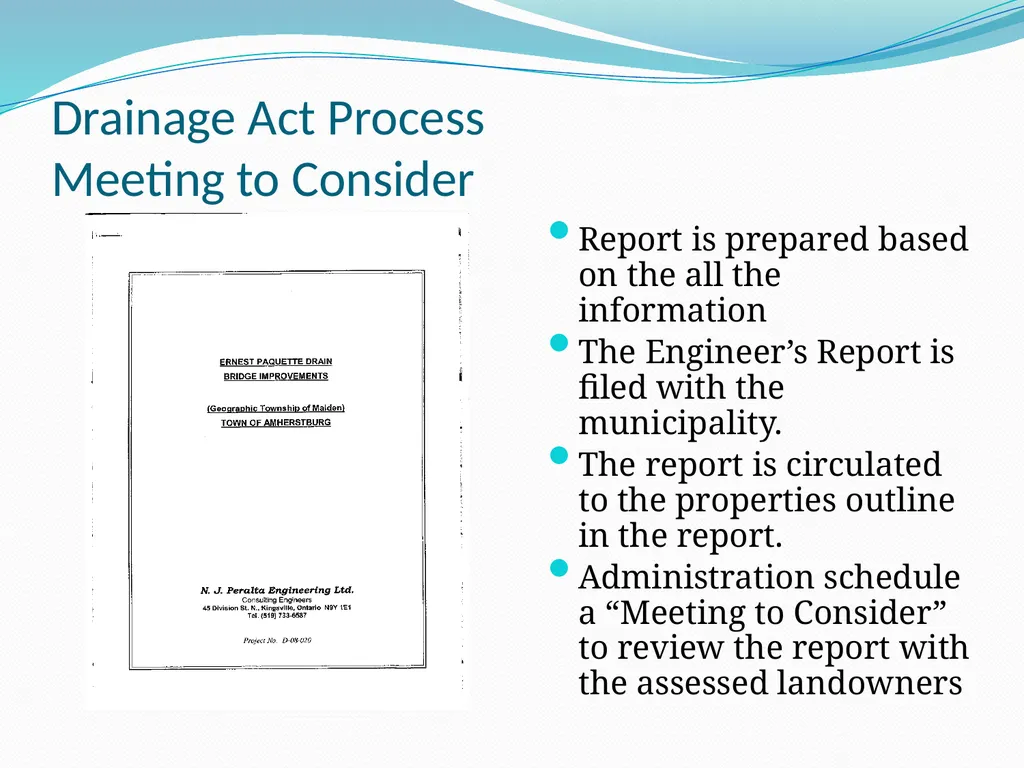
slide17. Drainage Act Process Meeting to Consider Report is prepared based on the all the information
The Engineer’s Report is filed with the municipality.
The report is circulated to the properties outline in the report.
Administration schedule a “Meeting to Consider” to review the report with the assessed landowners<br>
slide18. Drainage Act Process Meeting to Consider Meeting to Consider the report is held before Council.
This allows the landowners with the opportunity to provide input into the technical aspects of the design.<br>
slide19. Drainage Act Process Meeting to Consider With the information from the meeting, Council has three options:
Stop the project (subject to landowner concerns)
Refer the report back to the Engineer
Adopt the report by giving two reading to a provisional by-law.
If adopted, administration schedules the Court of Revision.<br>
slide20. Drainage Act Process Court of Revision The Court of Revision is scheduled between 20 and 30 days from Council adopting the report.
Court of Revision is where landowners raise concerns regarding their assessments or discrepancies in affected land areas.<br>
slide21. Drainage Act Process Court of Revision Court of Revision Members:
Three or Five member panel made up of Council Members or lay people appointed by Council
Landowners concerns must be based on facts:
Property size
Amount of area drained for the property
Property drains to another drainage system<br>
slide22. Drainage Act Process Court of Revision Based on the concerns raised by the owners, Court of Revision has options:
Approve the schedule of assessment as submitted
In minor assessment changes, the Court of Revision can make changes to the assessment and have the difference added to the roads assessments
Request the engineer to make changes to the schedule of assessment and pro-rate cost to other affected lands
Second Court of Revision will be necessary if the entire schedule changes.<br>
slide23. Drainage Act Process Appeals Landowners are given:
40 days for the date at Council adopts the Engineer’s Report by provisional By-Law, and
21 days from the date of the Court of Revision’s decision to make an appeal to the Ontario Drainage Tribunal.
Once the appeals have lapsed, and the clerk does not receive an appeal, Council can give third and final reading to the by-law.
There are various stages throughout the process where landowners can appeal to the tribunal or the referee.<br>
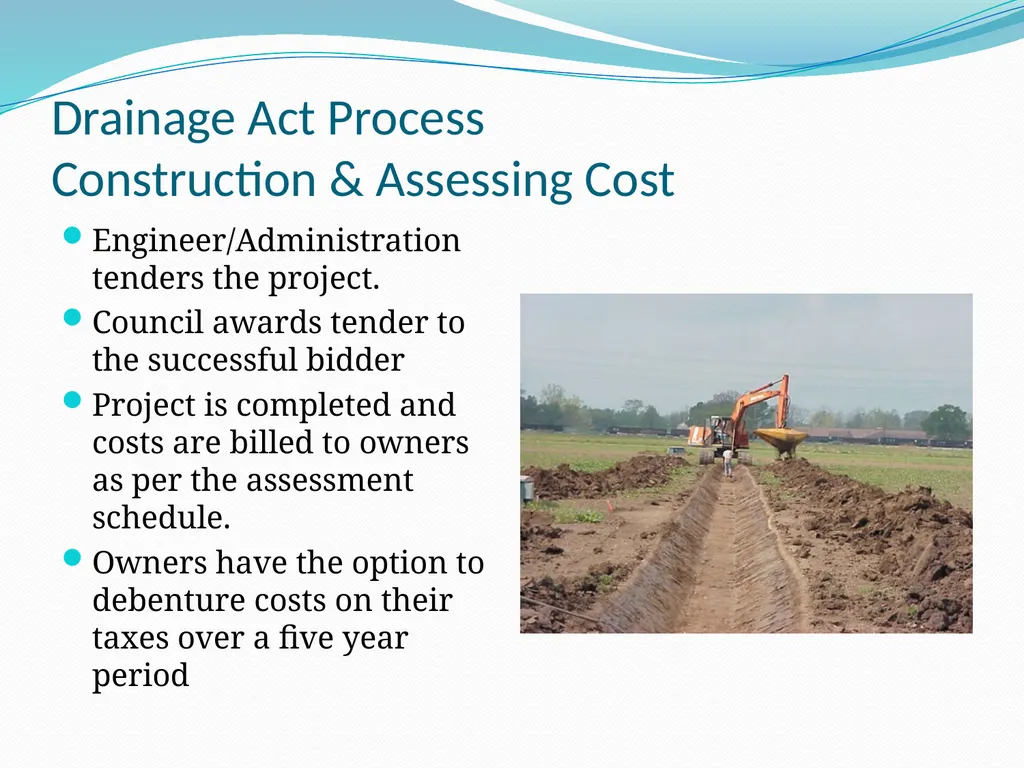
slide24. Drainage Act Process Construction & Assessing Cost Engineer/Administration tenders the project.
Council awards tender to the successful bidder
Project is completed and costs are billed to owners as per the assessment schedule.
Owners have the option to debenture costs on their taxes over a five year period<br>
slide25. Drainage Act Process Petition Drain Recap of New Drains (Petition)
Landowners initiate the process
Council appoints Engineer
Landowners are involved at various public meeting
Engineer prepares municipal drain report “Engineer’s Report”
Costs are assessed to the benefiting landowners<br>
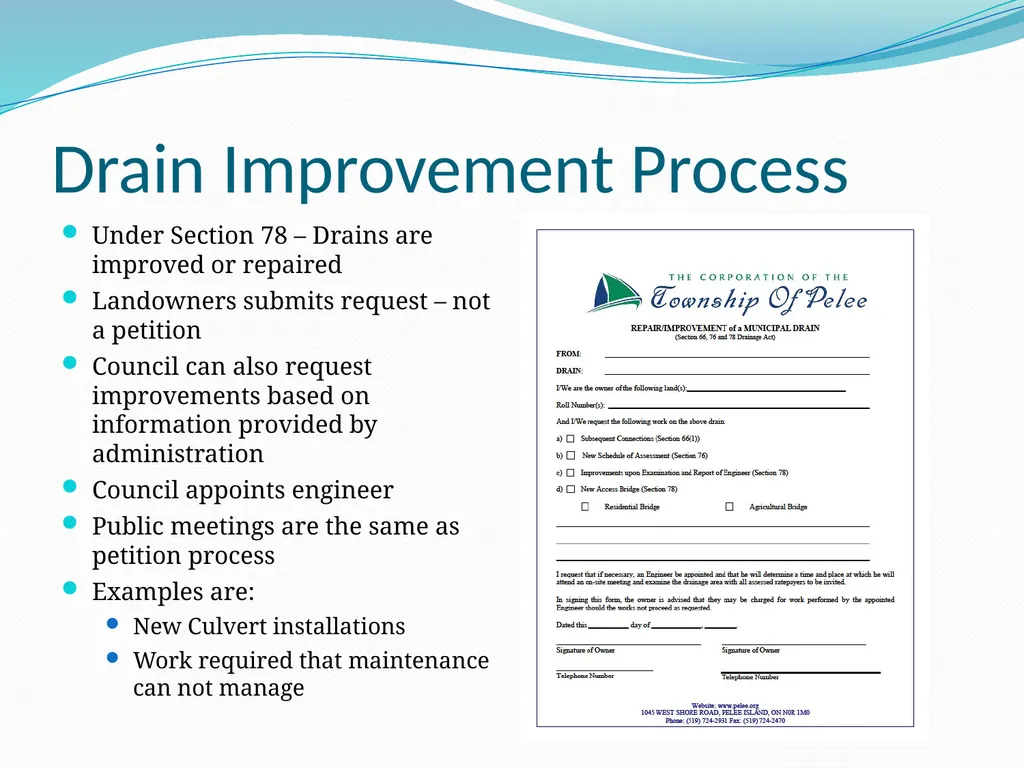
slide26. Drain Improvement Process Under Section 78 – Drains are improved or repaired
Landowners submits request – not a petition
Council can also request improvements based on information provided by administration
Council appoints engineer
Public meetings are the same as petition process
Examples are:
New Culvert installations
Work required that maintenance can not manage<br>
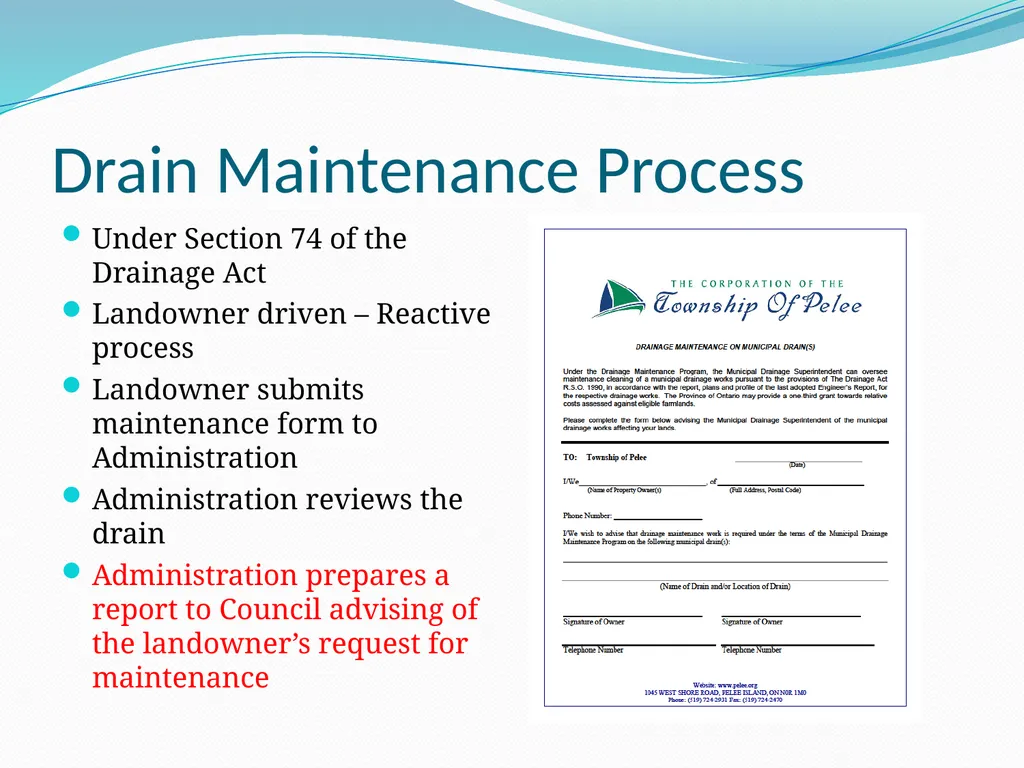
slide27. Drain Maintenance Process Under Section 74 of the Drainage Act
Landowner driven – Reactive process
Landowner submits maintenance form to Administration
Administration reviews the drain
Administration prepares a report to Council advising of the landowner’s request for maintenance<br>
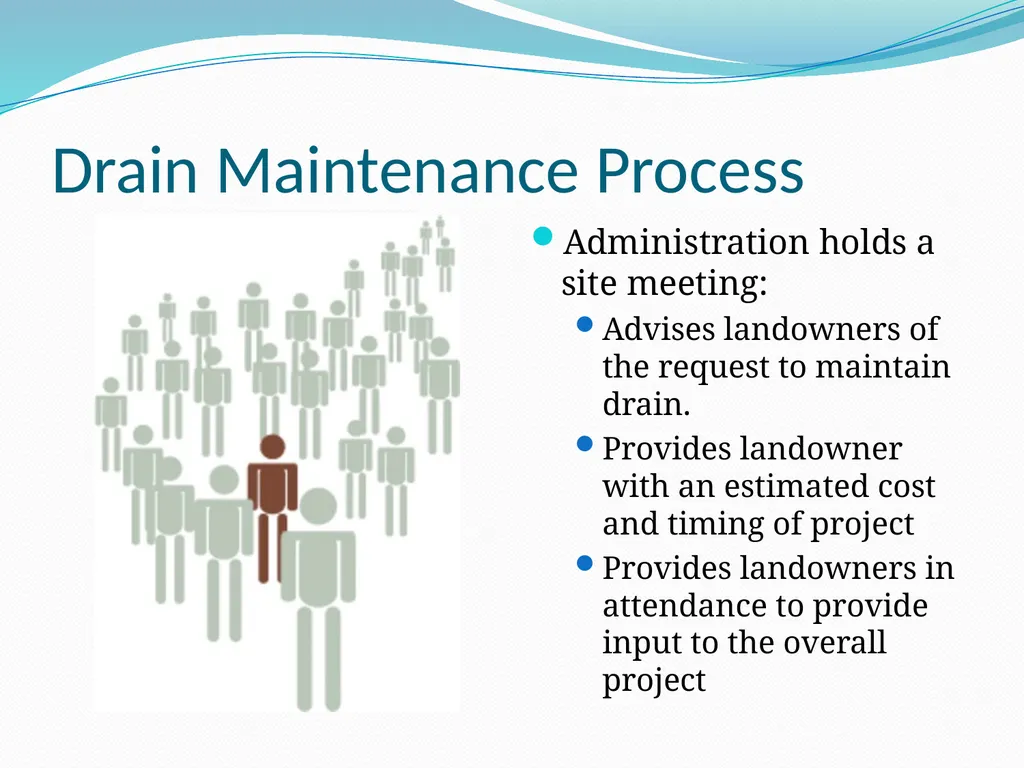
slide28. Drain Maintenance Process Administration holds a site meeting:
Advises landowners of the request to maintain drain.
Provides landowner with an estimated cost and timing of project
Provides landowners in attendance to provide input to the overall project<br>
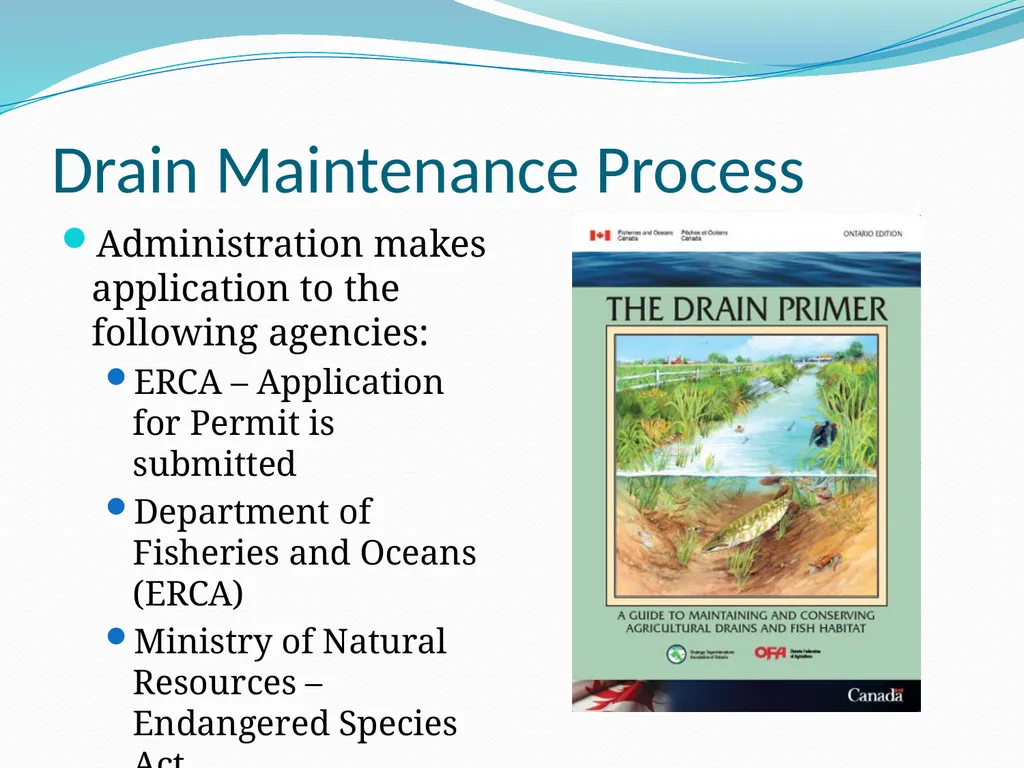
slide29. Drain Maintenance Process Administration makes application to the following agencies:
ERCA – Application for Permit is submitted
Department of Fisheries and Oceans (ERCA)
Ministry of Natural Resources – Endangered Species Act<br>
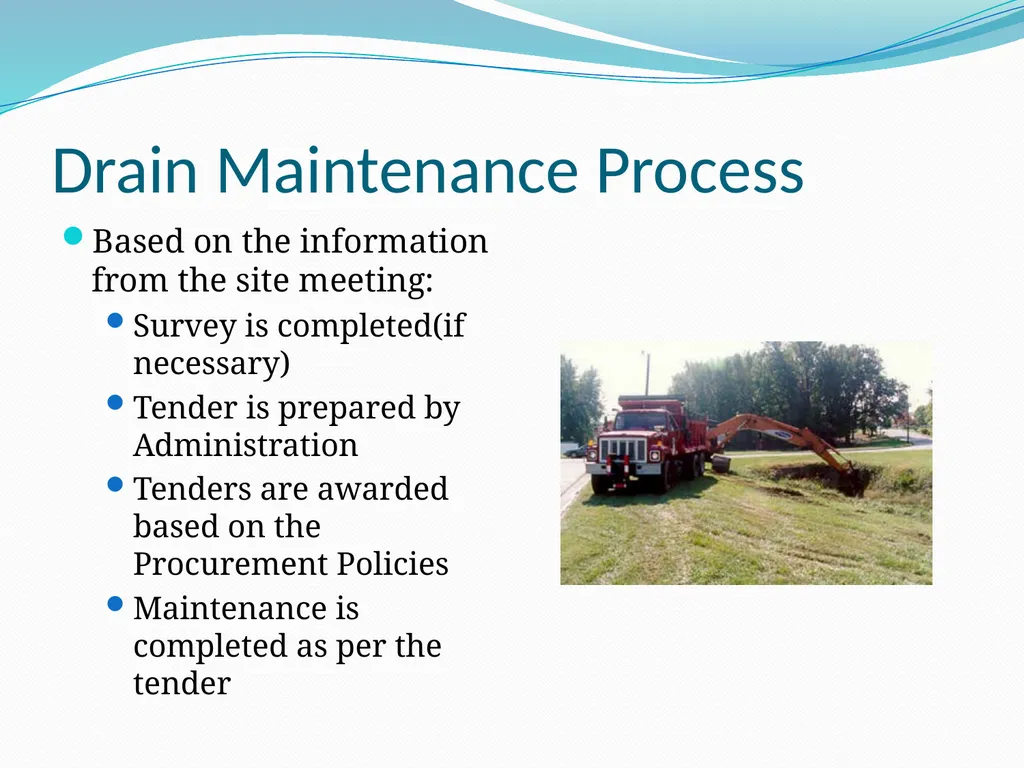
slide30. Drain Maintenance Process Based on the information from the site meeting:
Survey is completed(if necessary)
Tender is prepared by Administration
Tenders are awarded based on the Procurement Policies
Maintenance is completed as per the tender<br>
slide31. Drain Maintenance Process Costs are collected by the municipality
Costs are assessed to the landowners as defined in the current engineer’s report
Landowners are billed directly
Landowners have the option to let the cost be placed on their final tax bill
Under Maintenance, the landowners are not able to debenture the cost over a 5 year period.<br>
slide32. Environmental Agencies Approvals are required from the following three agencies:
Essex Region Conservation Authority (Conservation Act)
Ministry of Natural Resources (Endangered Species Act)
Department Fisheries & Oceans (Fisheries Act & Species At Risk Act)<br>
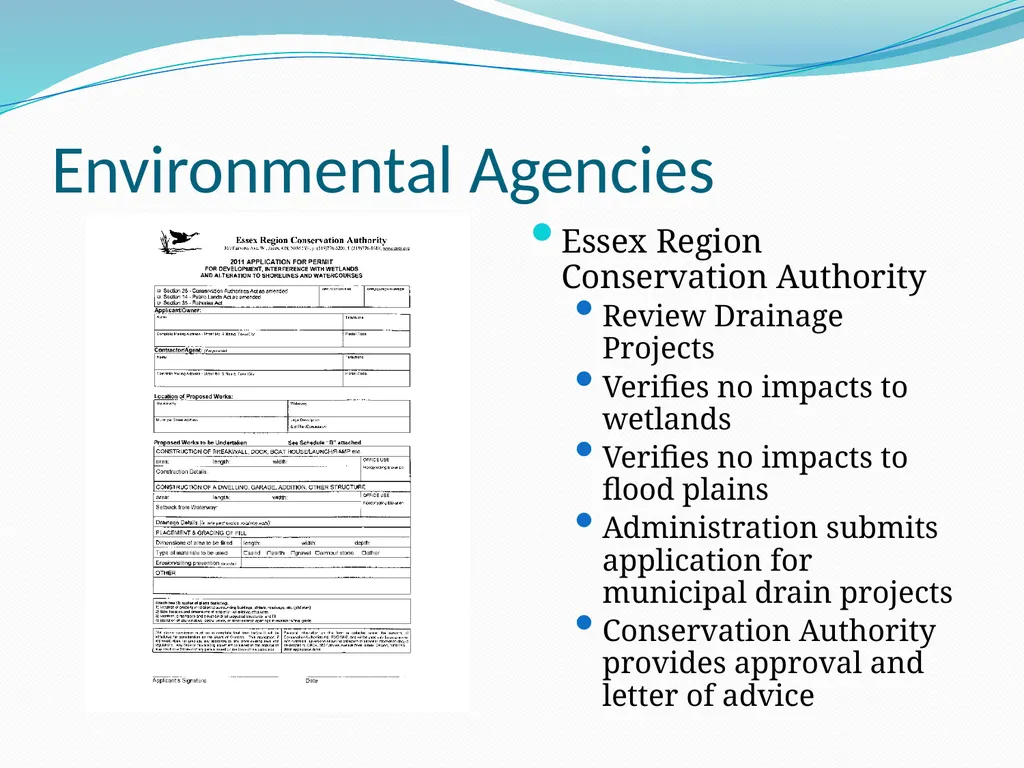
slide33. Environmental Agencies Essex Region Conservation Authority
Review Drainage Projects
Verifies no impacts to wetlands
Verifies no impacts to flood plains
Administration submits application for municipal drain projects
Conservation Authority provides approval and letter of advice<br>
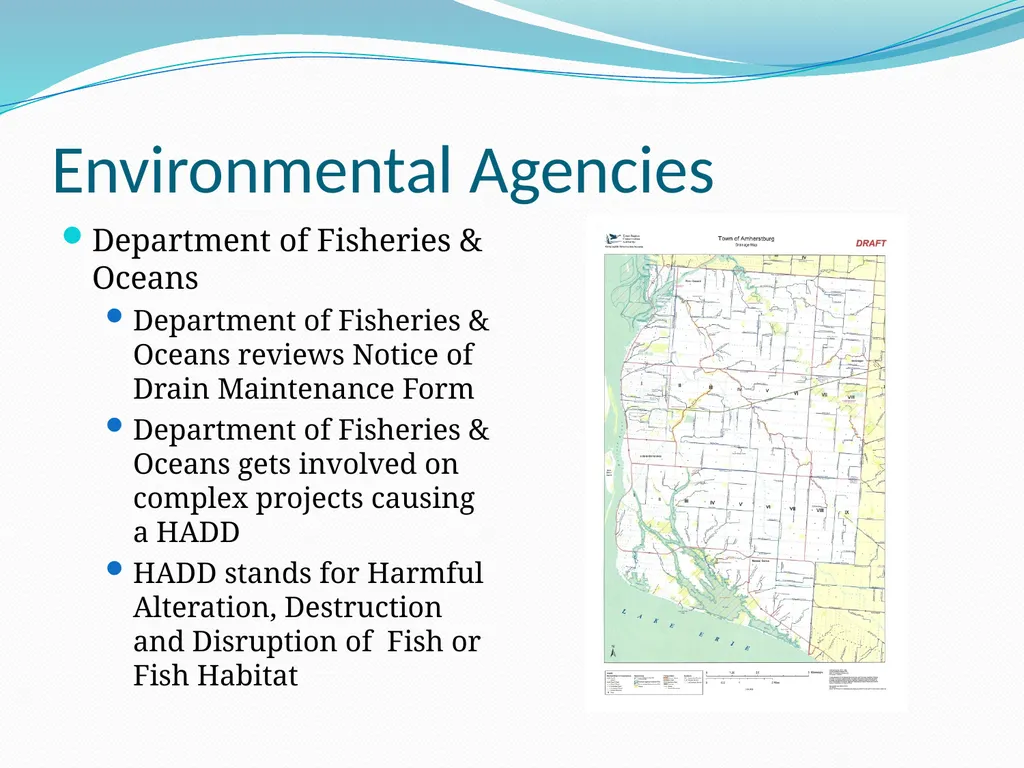
slide34. Environmental Agencies Department of Fisheries & Oceans
Department of Fisheries & Oceans reviews Notice of Drain Maintenance Form
Department of Fisheries & Oceans gets involved on complex projects causing a HADD
HADD stands for Harmful Alteration, Destruction and Disruption of Fish or Fish Habitat<br>
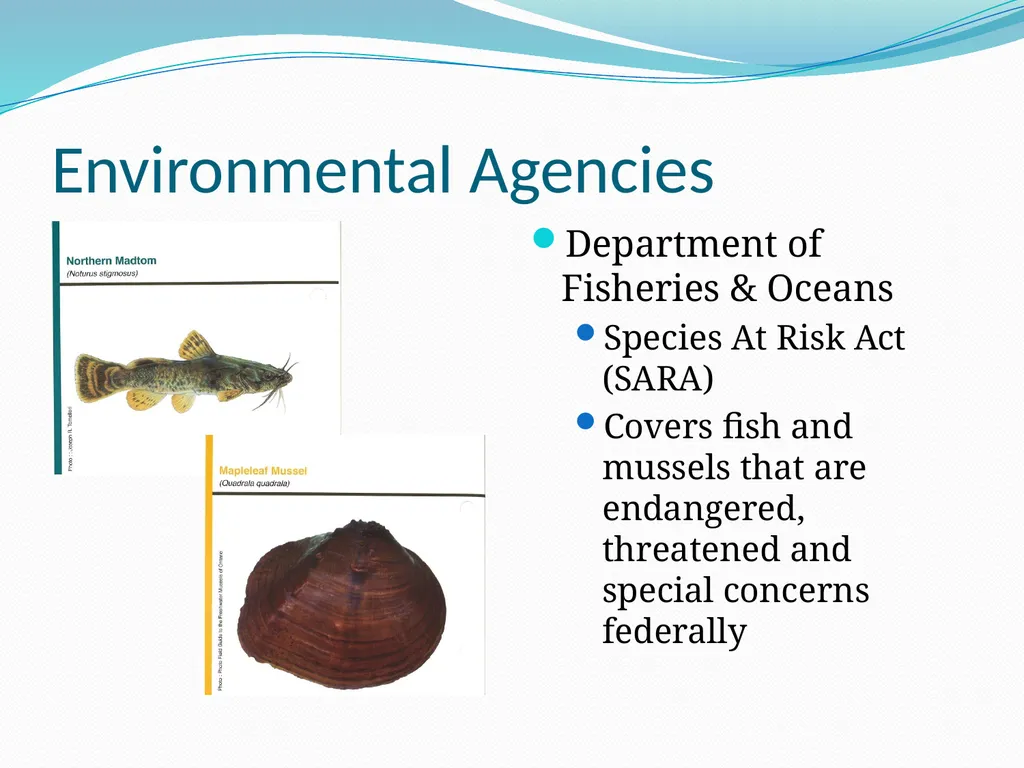
slide35. Environmental Agencies Department of Fisheries & Oceans
Species At Risk Act (SARA)
Covers fish and mussels that are endangered, threatened and special concerns federally<br>
slide36. Environmental Agencies Ministry of Natural Resources
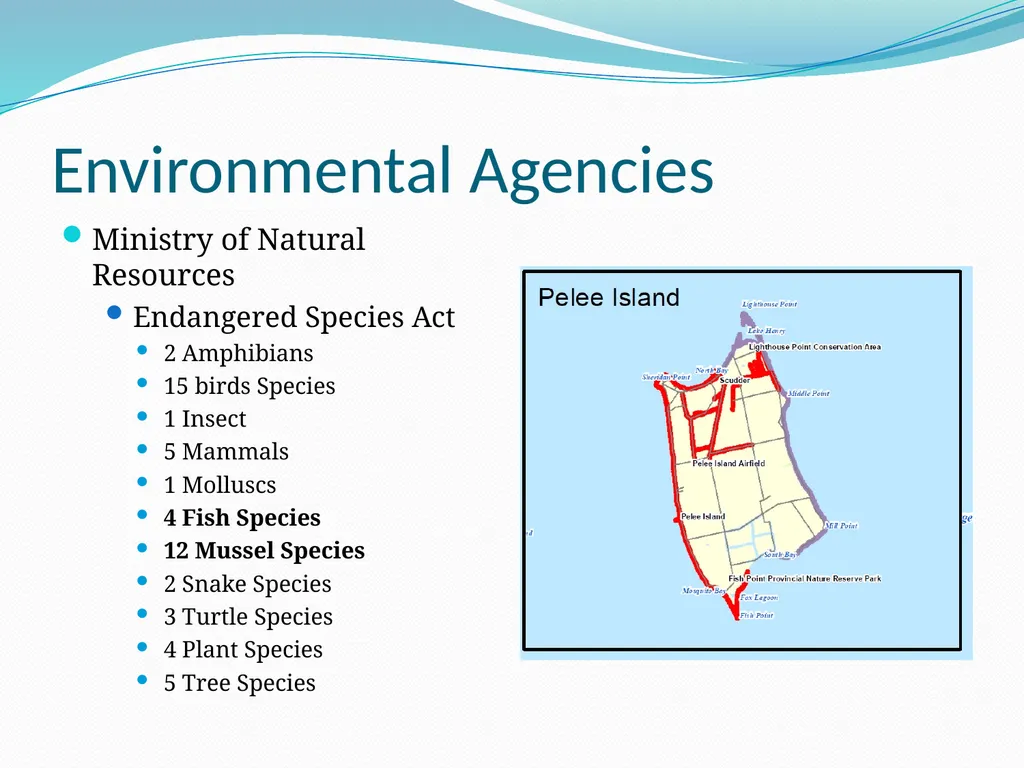
Endangered Species Act
2 Amphibians
15 birds Species
1 Insect
5 Mammals
1 Molluscs
4 Fish Species
12 Mussel Species
2 Snake Species
3 Turtle Species
4 Plant Species
5 Tree Species<br>
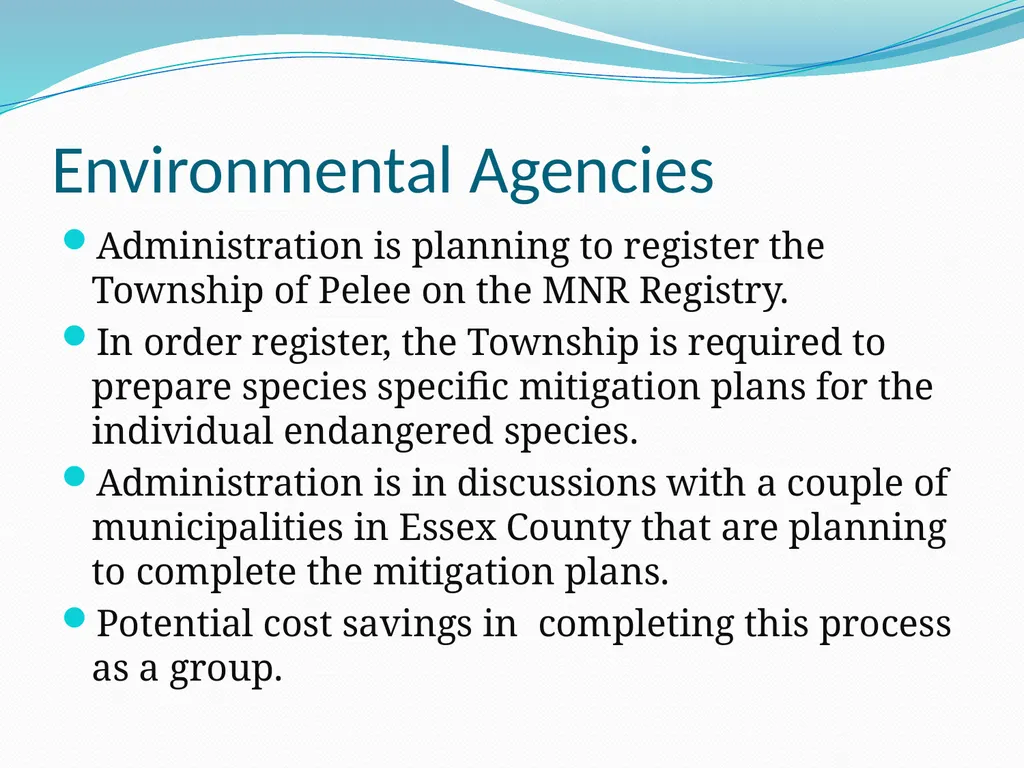
slide37. Environmental Agencies Administration is planning to register the Township of Pelee on the MNR Registry.
In order register, the Township is required to prepare species specific mitigation plans for the individual endangered species.
Administration is in discussions with a couple of municipalities in Essex County that are planning to complete the mitigation plans.
Potential cost savings in completing this process as a group.<br>
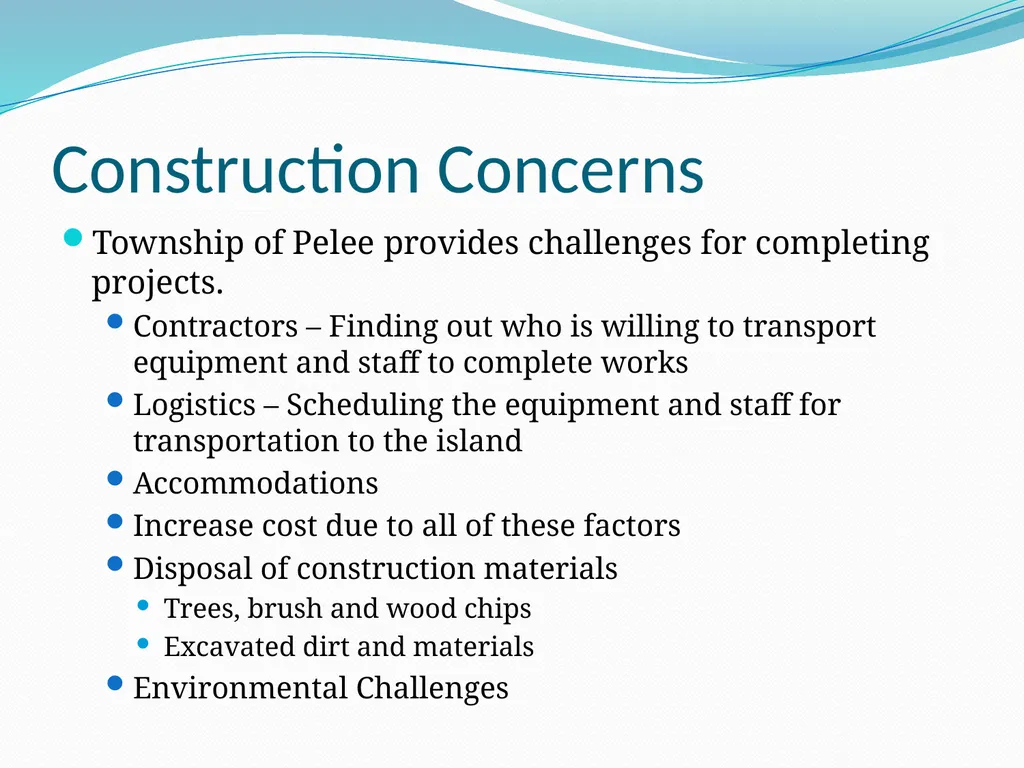
slide38. Construction Concerns Township of Pelee provides challenges for completing projects.
Contractors – Finding out who is willing to transport equipment and staff to complete works
Logistics – Scheduling the equipment and staff for transportation to the island
Accommodations
Increase cost due to all of these factors
Disposal of construction materials
Trees, brush and wood chips
Excavated dirt and materials
Environmental Challenges<br>
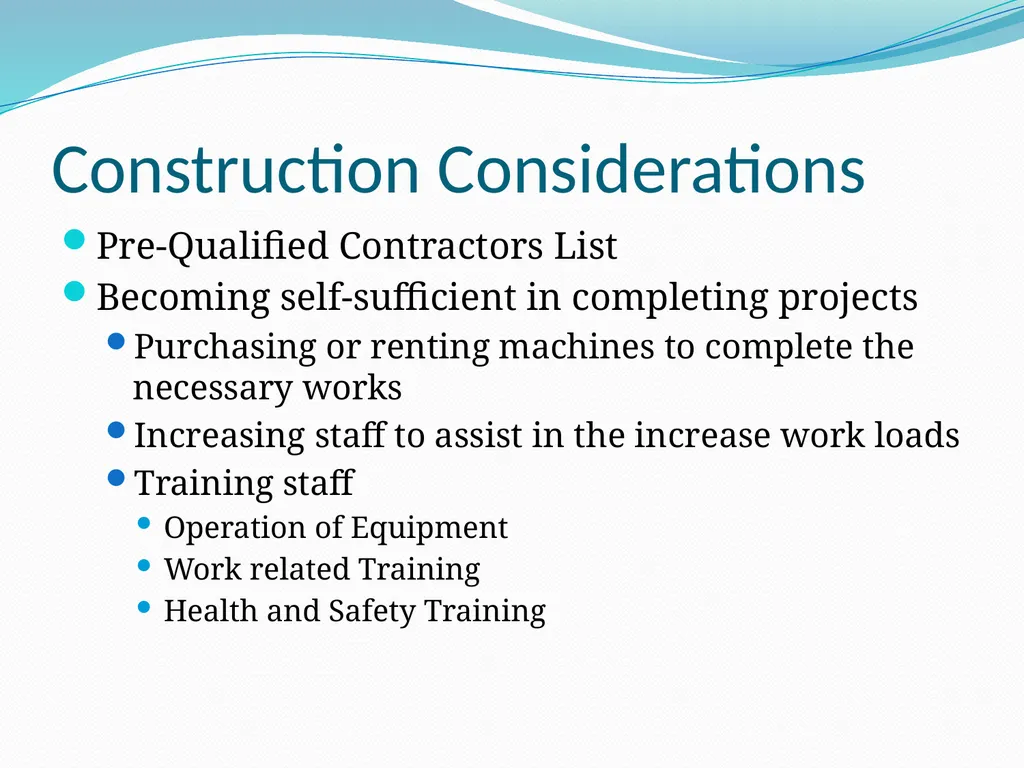
slide39. Construction Considerations Pre-Qualified Contractors List
Becoming self-sufficient in completing projects
Purchasing or renting machines to complete the necessary works
Increasing staff to assist in the increase work loads
Training staff
Operation of Equipment
Work related Training
Health and Safety Training<br>
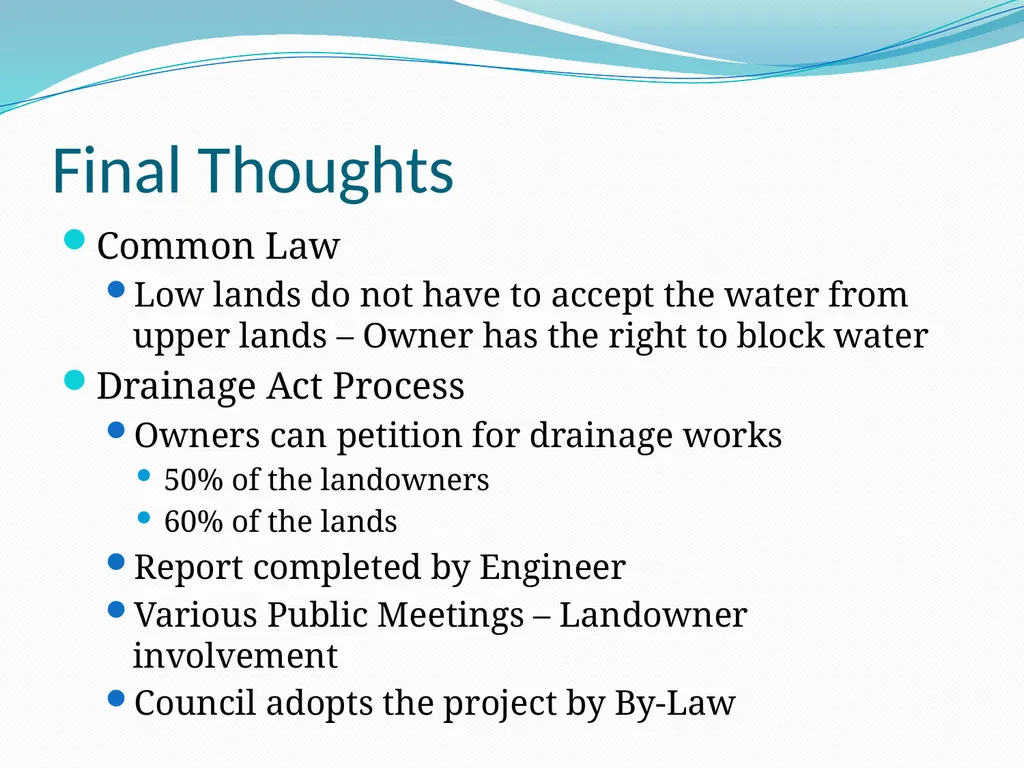
slide40. Final Thoughts Common Law
Low lands do not have to accept the water from upper lands – Owner has the right to block water
Drainage Act Process
Owners can petition for drainage works
50% of the landowners
60% of the lands
Report completed by Engineer
Various Public Meetings – Landowner involvement
Council adopts the project by By-Law<br>
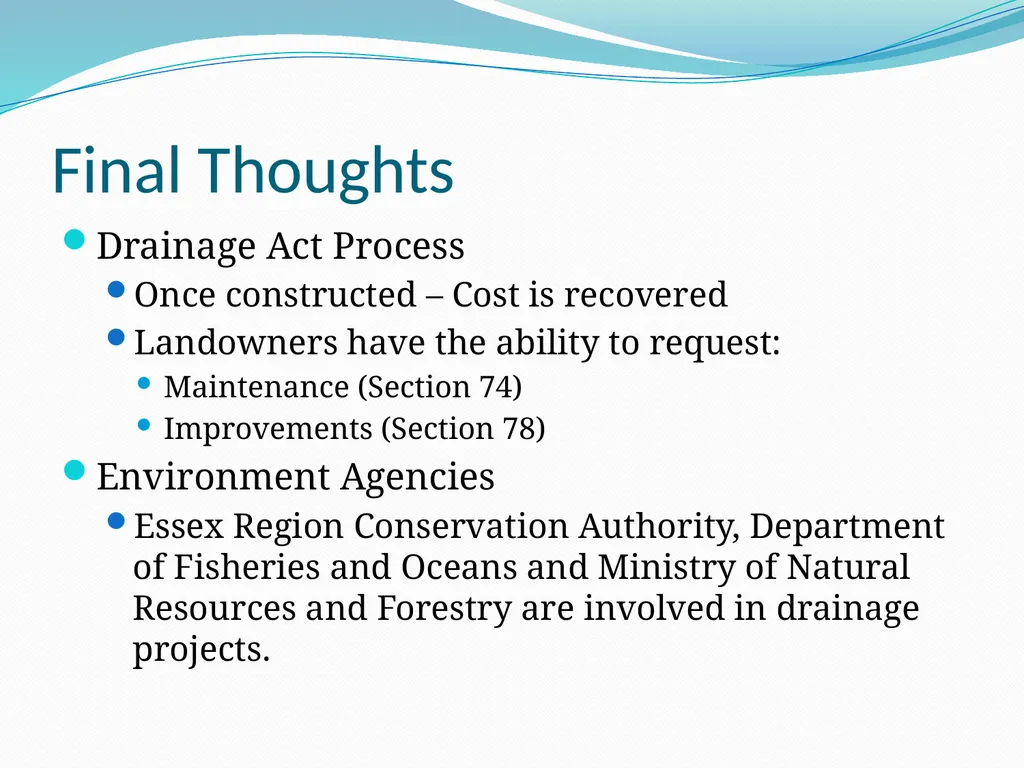
slide41. Final Thoughts Drainage Act Process
Once constructed – Cost is recovered
Landowners have the ability to request:
Maintenance (Section 74)
Improvements (Section 78)
Environment Agencies
Essex Region Conservation Authority, Department of Fisheries and Oceans and Ministry of Natural Resources and Forestry are involved in drainage projects.<br>
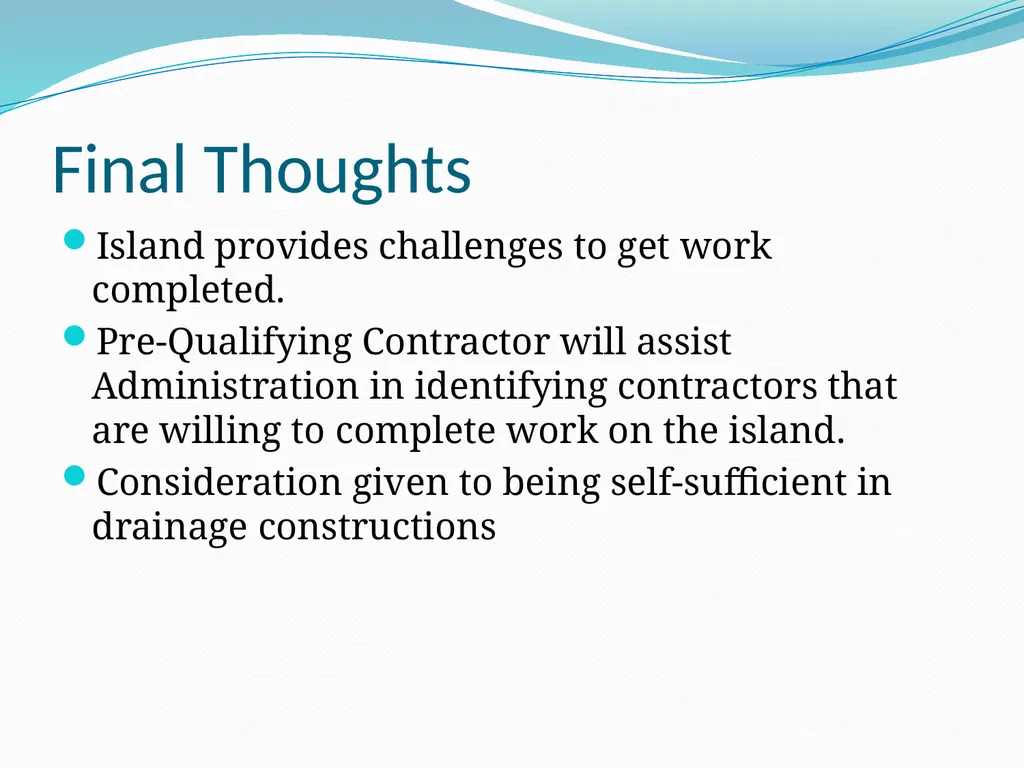
slide42. Final Thoughts Island provides challenges to get work completed.
Pre-Qualifying Contractor will assist Administration in identifying contractors that are willing to complete work on the island.
Consideration given to being self-sufficient in drainage constructions<br>
slide43. Questions?<br>
Eric Chamberlain<br>
slide2. Drainage 101 So, What’s a Municipal Drain?
It is a Drainage System either open ditch or enclosed pipe system or any other water control structure and protective works
Petitioned for by landowners needing drainage under the Ontario Drainage Act
The affected landowners paying all costs of construction and maintenance of the system they benefit from.<br>
slide3. Drainage 101 - Topics Topics of Discussion:
Introduction
Common Law Aspect of Drainage
Early Drainage Law
Process under the Drainage Act
Petition (Section 4)
Appointment of the Engineer
Site Meeting
Meeting to Consider
Court of Revision<br>
slide4. Drainage 101 - Topics Process under the Drainage Act (Con’t)
Repair and Improvement (Section 78)
Maintenance and Repair (Section 74)
New Maintenance Schedules (Section 76)
Island Considerations
Future Considerations
Final Thoughts<br>
slide5. Introduction Water issues causes disputes between:
Neighbours
Family Members
Landowners vs Road Authority
Drainage Act was created to provide drainage to those landowners requiring drainage.
The Drainage Act empowers the municipality to facilitate & maintain the drainage works at the cost of lands and roads benefiting from the drainage system.
Drainage projects are communal projects
Involvement of the Landowners is necessary<br>
slide6. Common Law Aspect of Water Common Law – foundation of today’s Statute Law
Common Law as it relates to natural watercourse states the following:
“A natural watercourse is defined generally as a stream of water which flows along a defined channel, with beds and banks, for a sufficient time to give it substantial existence”
There are no natural water courses that exist on the island<br>
slide7. Common Law Aspect of Water Landowners adjacent to Natural Watercourses are considered riparian owner
These landowners have the rights under “The Riparian Doctrine”
One of the rights is “the right to drain their property”<br>
slide8. Common Law Aspect of Water Common Law also states the following regarding surface water:
“No right of drainage to mere surface water exists as long as the flow is not in a defined channel”
An owner of lower land may, at his own choice, either allow water from higher land to flow over it or keep such water off their property by dams and banks.<br>
slide9. Early Drainage Law The first Drainage Law was the Ditches and Watercourses Act
Passed in 1874
Limited involvement for Municipalities
Ditches & Watercourses (D&W) drains still exist today<br>
slide10. Drainage Act Process Current legislation 1990 with revisions completed in 2010.
One of the most democratic Act in Ontario
Provides landowners with the ability to obtain legal drainage
Provides the municipality with the ability to manage the drainage systems and recover cost.<br>
slide11. Drainage Act Process Petition Drains Section 4 – Petition is the method for landowners start the process for a new municipal drain
The petition is valid based on the following 4 criteria:
Majority in numbers of the owner
The area representing at least 60% of the hectarage in the area requiring drainage
Road Authority
Director of Ministry of Agriculture, Food and Rural Affairs.<br>
slide12. Drainage Act Process Petition Drains<br>
slide13. Drainage Act Process Appointment The petition is file with the Clerk’s Office
Municipality needs to inform environmental agencies of the potential Drainage Project
Environmental Agencies have 30 days to request an Environmental Appraisal to be completed before the engineer is appointed
Council appoints an Engineer to prepare a report.
Engineer confirms that the petition is valid.
If necessary landowners are directed to obtain more signatures if petition is not valid.
Once the petition is valid, administration schedule a site meeting.<br>
slide14. Drainage Act Process On-Site Meeting Meeting is schedule with all of the landowners impacted by the proposed project.
The meeting is held on-site to review the drainage concern
Fact gathering meeting for the engineer to understand the landowners concerns<br>
slide15. Drainage Act Process Report Preparation With the information gathered at the site meeting, the engineer:
Research of existing drainage systems in the area
Survey is completed<br>
slide16. Drainage Act Process Report Preparation The engineer will also make inquires to:
Essex Region Conservation Authority
Department of Oceans & Fisheries
Ministry of Natural Resources & Forestry – Endangered Species Act Registry<br>
slide17. Drainage Act Process Meeting to Consider Report is prepared based on the all the information
The Engineer’s Report is filed with the municipality.
The report is circulated to the properties outline in the report.
Administration schedule a “Meeting to Consider” to review the report with the assessed landowners<br>
slide18. Drainage Act Process Meeting to Consider Meeting to Consider the report is held before Council.
This allows the landowners with the opportunity to provide input into the technical aspects of the design.<br>
slide19. Drainage Act Process Meeting to Consider With the information from the meeting, Council has three options:
Stop the project (subject to landowner concerns)
Refer the report back to the Engineer
Adopt the report by giving two reading to a provisional by-law.
If adopted, administration schedules the Court of Revision.<br>
slide20. Drainage Act Process Court of Revision The Court of Revision is scheduled between 20 and 30 days from Council adopting the report.
Court of Revision is where landowners raise concerns regarding their assessments or discrepancies in affected land areas.<br>
slide21. Drainage Act Process Court of Revision Court of Revision Members:
Three or Five member panel made up of Council Members or lay people appointed by Council
Landowners concerns must be based on facts:
Property size
Amount of area drained for the property
Property drains to another drainage system<br>
slide22. Drainage Act Process Court of Revision Based on the concerns raised by the owners, Court of Revision has options:
Approve the schedule of assessment as submitted
In minor assessment changes, the Court of Revision can make changes to the assessment and have the difference added to the roads assessments
Request the engineer to make changes to the schedule of assessment and pro-rate cost to other affected lands
Second Court of Revision will be necessary if the entire schedule changes.<br>
slide23. Drainage Act Process Appeals Landowners are given:
40 days for the date at Council adopts the Engineer’s Report by provisional By-Law, and
21 days from the date of the Court of Revision’s decision to make an appeal to the Ontario Drainage Tribunal.
Once the appeals have lapsed, and the clerk does not receive an appeal, Council can give third and final reading to the by-law.
There are various stages throughout the process where landowners can appeal to the tribunal or the referee.<br>
slide24. Drainage Act Process Construction & Assessing Cost Engineer/Administration tenders the project.
Council awards tender to the successful bidder
Project is completed and costs are billed to owners as per the assessment schedule.
Owners have the option to debenture costs on their taxes over a five year period<br>
slide25. Drainage Act Process Petition Drain Recap of New Drains (Petition)
Landowners initiate the process
Council appoints Engineer
Landowners are involved at various public meeting
Engineer prepares municipal drain report “Engineer’s Report”
Costs are assessed to the benefiting landowners<br>
slide26. Drain Improvement Process Under Section 78 – Drains are improved or repaired
Landowners submits request – not a petition
Council can also request improvements based on information provided by administration
Council appoints engineer
Public meetings are the same as petition process
Examples are:
New Culvert installations
Work required that maintenance can not manage<br>
slide27. Drain Maintenance Process Under Section 74 of the Drainage Act
Landowner driven – Reactive process
Landowner submits maintenance form to Administration
Administration reviews the drain
Administration prepares a report to Council advising of the landowner’s request for maintenance<br>
slide28. Drain Maintenance Process Administration holds a site meeting:
Advises landowners of the request to maintain drain.
Provides landowner with an estimated cost and timing of project
Provides landowners in attendance to provide input to the overall project<br>
slide29. Drain Maintenance Process Administration makes application to the following agencies:
ERCA – Application for Permit is submitted
Department of Fisheries and Oceans (ERCA)
Ministry of Natural Resources – Endangered Species Act<br>
slide30. Drain Maintenance Process Based on the information from the site meeting:
Survey is completed(if necessary)
Tender is prepared by Administration
Tenders are awarded based on the Procurement Policies
Maintenance is completed as per the tender<br>
slide31. Drain Maintenance Process Costs are collected by the municipality
Costs are assessed to the landowners as defined in the current engineer’s report
Landowners are billed directly
Landowners have the option to let the cost be placed on their final tax bill
Under Maintenance, the landowners are not able to debenture the cost over a 5 year period.<br>
slide32. Environmental Agencies Approvals are required from the following three agencies:
Essex Region Conservation Authority (Conservation Act)
Ministry of Natural Resources (Endangered Species Act)
Department Fisheries & Oceans (Fisheries Act & Species At Risk Act)<br>
slide33. Environmental Agencies Essex Region Conservation Authority
Review Drainage Projects
Verifies no impacts to wetlands
Verifies no impacts to flood plains
Administration submits application for municipal drain projects
Conservation Authority provides approval and letter of advice<br>
slide34. Environmental Agencies Department of Fisheries & Oceans
Department of Fisheries & Oceans reviews Notice of Drain Maintenance Form
Department of Fisheries & Oceans gets involved on complex projects causing a HADD
HADD stands for Harmful Alteration, Destruction and Disruption of Fish or Fish Habitat<br>
slide35. Environmental Agencies Department of Fisheries & Oceans
Species At Risk Act (SARA)
Covers fish and mussels that are endangered, threatened and special concerns federally<br>
slide36. Environmental Agencies Ministry of Natural Resources
Endangered Species Act
2 Amphibians
15 birds Species
1 Insect
5 Mammals
1 Molluscs
4 Fish Species
12 Mussel Species
2 Snake Species
3 Turtle Species
4 Plant Species
5 Tree Species<br>
slide37. Environmental Agencies Administration is planning to register the Township of Pelee on the MNR Registry.
In order register, the Township is required to prepare species specific mitigation plans for the individual endangered species.
Administration is in discussions with a couple of municipalities in Essex County that are planning to complete the mitigation plans.
Potential cost savings in completing this process as a group.<br>
slide38. Construction Concerns Township of Pelee provides challenges for completing projects.
Contractors – Finding out who is willing to transport equipment and staff to complete works
Logistics – Scheduling the equipment and staff for transportation to the island
Accommodations
Increase cost due to all of these factors
Disposal of construction materials
Trees, brush and wood chips
Excavated dirt and materials
Environmental Challenges<br>
slide39. Construction Considerations Pre-Qualified Contractors List
Becoming self-sufficient in completing projects
Purchasing or renting machines to complete the necessary works
Increasing staff to assist in the increase work loads
Training staff
Operation of Equipment
Work related Training
Health and Safety Training<br>
slide40. Final Thoughts Common Law
Low lands do not have to accept the water from upper lands – Owner has the right to block water
Drainage Act Process
Owners can petition for drainage works
50% of the landowners
60% of the lands
Report completed by Engineer
Various Public Meetings – Landowner involvement
Council adopts the project by By-Law<br>
slide41. Final Thoughts Drainage Act Process
Once constructed – Cost is recovered
Landowners have the ability to request:
Maintenance (Section 74)
Improvements (Section 78)
Environment Agencies
Essex Region Conservation Authority, Department of Fisheries and Oceans and Ministry of Natural Resources and Forestry are involved in drainage projects.<br>
slide42. Final Thoughts Island provides challenges to get work completed.
Pre-Qualifying Contractor will assist Administration in identifying contractors that are willing to complete work on the island.
Consideration given to being self-sufficient in drainage constructions<br>
slide43. Questions?<br>