
DRAMA GCSE DEVISING 1 Knowledge Organiser Devising
YM
Published · 10 slides · 0 views
1 / 1
Description
DRAMA GCSE DEVISING 1 Knowledge Organiser Devising Drama Section A: AOs and how to respond to a stimulus. Work as part of a group. Create and perform an original piece of theatre based on a stimulus. Evaluate your piece of theatre. Create
Related Topics
Share
Embed code
Download this presentation From Below
"DRAMA GCSE DEVISING 1 Knowledge Organiser Devising" is the property of its rightful owner. Permission is granted to download and print the materials on this website for personal, non-commercial use only, and to display it on your personal computer provided you do not modify the materials and that you retain all copyright notices contained in the materials. By downloading content from our website, you accept the terms of this agreement.
Presentation Transcript
01
DRAMA GCSE DEVISING 1 Knowledge
Organiser
Devising Drama Section A: AO’s and how to respond to a stimulus. Work as part of a group.
Create and perform an original piece of theatre based on a stimulus.
Evaluate your piece of theatre. Create and develop ideas to communicate meaning for theatrical performance AO1 Apply theatrical skills to realise artistic intentions in live performance AO2 Analyse and evaluate your own work and the work of others AO4 Devising log – 60 marks 20% of GCSE
Performance – 20 marks 20% of GCSE Know your course: Responding to a stimulus.
You always use a stimulus as a starting point for devising drama.
A stimulus is something that is used to provoke your thinking and get your ideas flowing.
When looking at a stimulus, always think about:
Your very first impressions of it. What does it make you think/feel, if anything?
Does it bring up any memories for you?
Does it suggest any particular time period or setting?
Does it suggest or make you think of any themes?
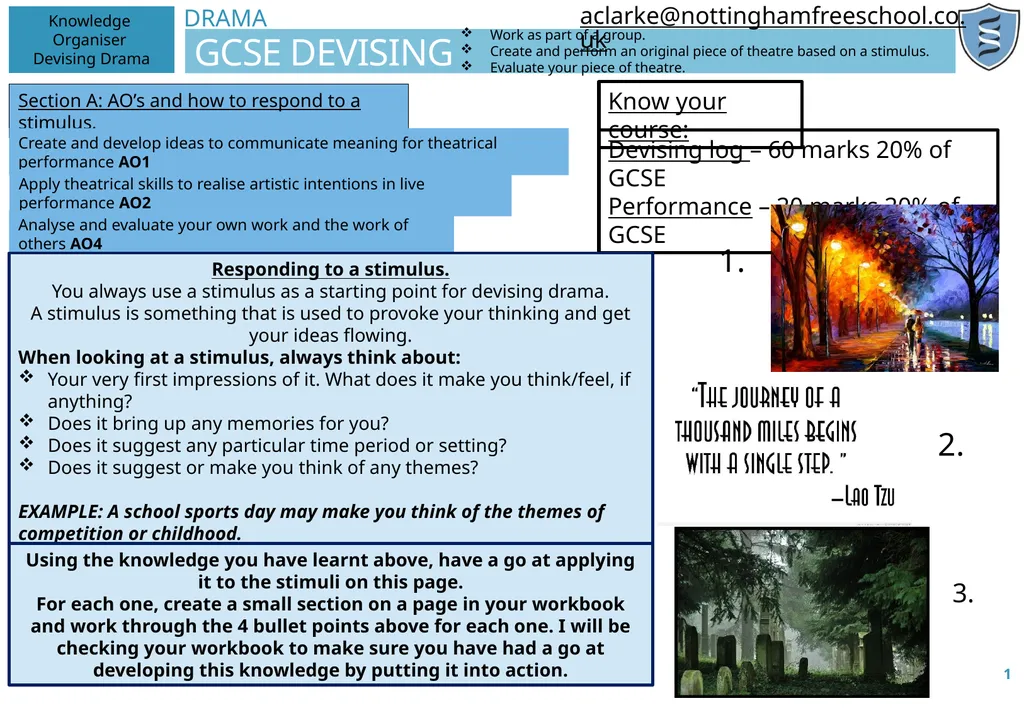
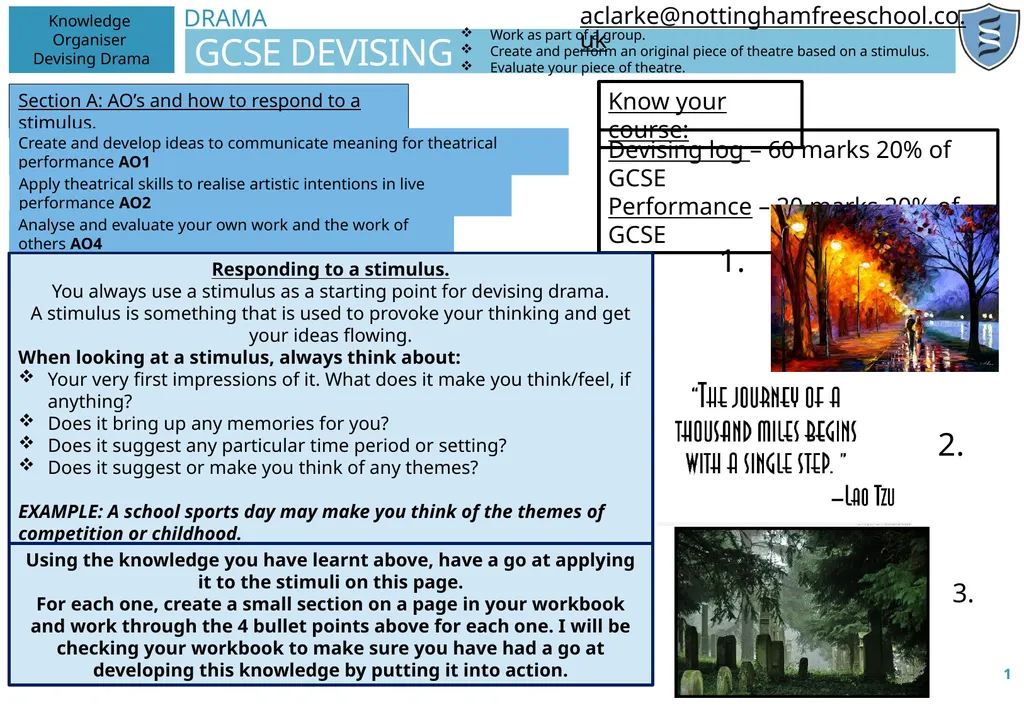
EXAMPLE: A school sports day may make you think of the themes of competition or childhood. Using the knowledge you have learnt above, have a go at applying it to the stimuli on this page.
For each one, create a small section on a page in your workbook and work through the 4 bullet points above for each one. I will be checking your workbook to make sure you have had a go at developing this knowledge by putting it into action. 1. 2. 3. aclarke@nottinghamfreeschool.co.uk<br>
Organiser
Devising Drama Section A: AO’s and how to respond to a stimulus. Work as part of a group.
Create and perform an original piece of theatre based on a stimulus.
Evaluate your piece of theatre. Create and develop ideas to communicate meaning for theatrical performance AO1 Apply theatrical skills to realise artistic intentions in live performance AO2 Analyse and evaluate your own work and the work of others AO4 Devising log – 60 marks 20% of GCSE
Performance – 20 marks 20% of GCSE Know your course: Responding to a stimulus.
You always use a stimulus as a starting point for devising drama.
A stimulus is something that is used to provoke your thinking and get your ideas flowing.
When looking at a stimulus, always think about:
Your very first impressions of it. What does it make you think/feel, if anything?
Does it bring up any memories for you?
Does it suggest any particular time period or setting?
Does it suggest or make you think of any themes?
EXAMPLE: A school sports day may make you think of the themes of competition or childhood. Using the knowledge you have learnt above, have a go at applying it to the stimuli on this page.
For each one, create a small section on a page in your workbook and work through the 4 bullet points above for each one. I will be checking your workbook to make sure you have had a go at developing this knowledge by putting it into action. 1. 2. 3. aclarke@nottinghamfreeschool.co.uk<br>
02
DRAMA GCSE DEVISING 2 Year 10 Knowledge Organiser
Devising Drama Work as part of a group.
Create and perform an original piece of theatre based on a stimulus.
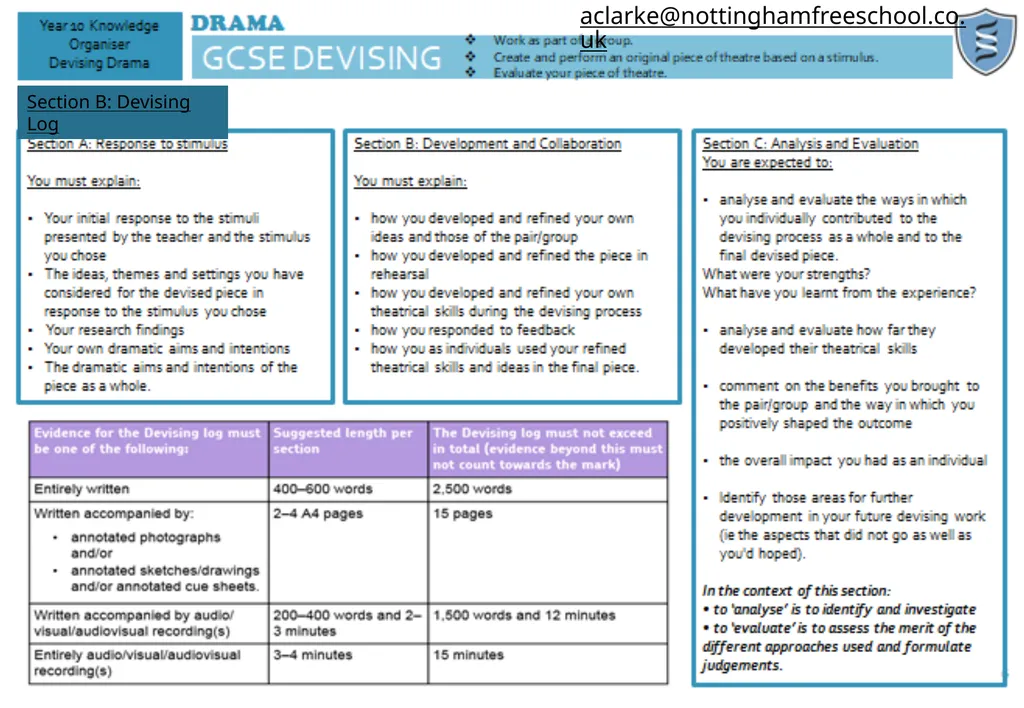
Evaluate your piece of theatre. Remember: there are no small parts, only small actors.Konstantin Stanislavski Section B: Devising Log aclarke@nottinghamfreeschool.co.uk<br>
Devising Drama Work as part of a group.
Create and perform an original piece of theatre based on a stimulus.
Evaluate your piece of theatre. Remember: there are no small parts, only small actors.Konstantin Stanislavski Section B: Devising Log aclarke@nottinghamfreeschool.co.uk<br>
03
DRAMA GCSE DEVISING 3 Knowledge
Organiser
Devising Drama Work as part of a group.
Create and perform an original piece of theatre based on a stimulus.
Evaluate your piece of theatre. Remember: there are no small parts, only small actors.Konstantin Stanislavski Section C: Developing your ideas and research
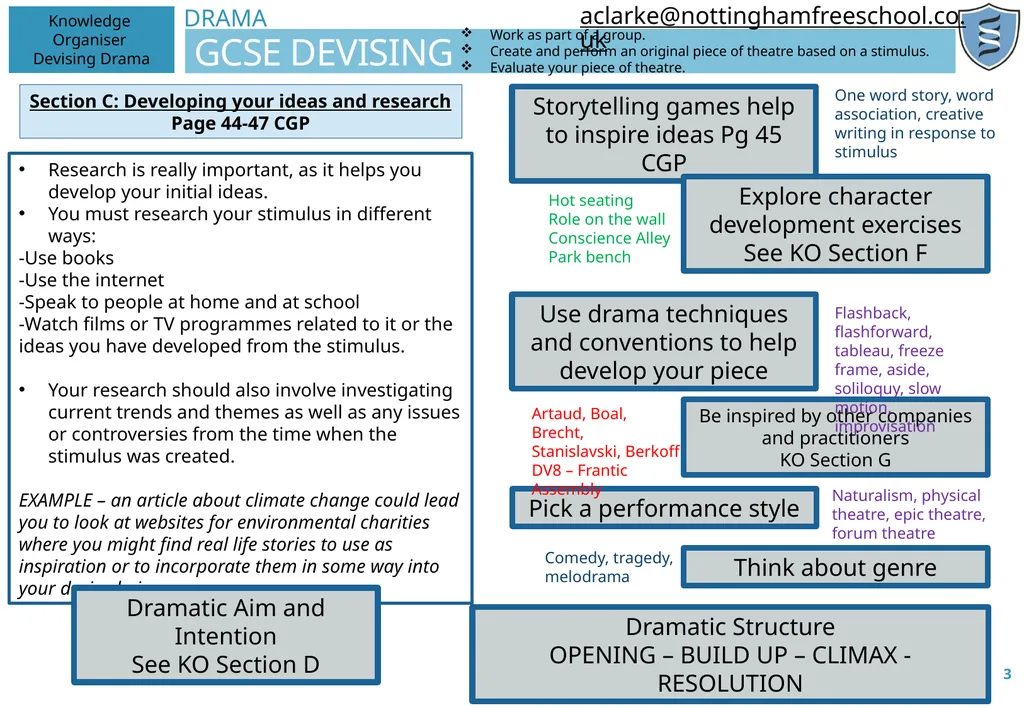
Page 44-47 CGP Research is really important, as it helps you develop your initial ideas.
You must research your stimulus in different ways:
-Use books
-Use the internet
-Speak to people at home and at school
-Watch films or TV programmes related to it or the ideas you have developed from the stimulus.
Your research should also involve investigating current trends and themes as well as any issues or controversies from the time when the stimulus was created.
EXAMPLE – an article about climate change could lead you to look at websites for environmental charities where you might find real life stories to use as inspiration or to incorporate them in some way into your devised piece. Dramatic Aim and Intention
See KO Section D Storytelling games help to inspire ideas Pg 45 CGP Explore character development exercises
See KO Section F Use drama techniques and conventions to help develop your piece Be inspired by other companies and practitioners
KO Section G Pick a performance style Think about genre Dramatic Structure
OPENING – BUILD UP – CLIMAX - RESOLUTION Artaud, Boal, Brecht,
Stanislavski, Berkoff
DV8 – Frantic Assembly Flashback, flashforward,
tableau, freeze frame, aside, soliloquy, slow motion, improvisation Hot seating
Role on the wall
Conscience Alley
Park bench One word story, word association, creative writing in response to stimulus Naturalism, physical theatre, epic theatre, forum theatre Comedy, tragedy, melodrama aclarke@nottinghamfreeschool.co.uk<br>
Organiser
Devising Drama Work as part of a group.
Create and perform an original piece of theatre based on a stimulus.
Evaluate your piece of theatre. Remember: there are no small parts, only small actors.Konstantin Stanislavski Section C: Developing your ideas and research
Page 44-47 CGP Research is really important, as it helps you develop your initial ideas.
You must research your stimulus in different ways:
-Use books
-Use the internet
-Speak to people at home and at school
-Watch films or TV programmes related to it or the ideas you have developed from the stimulus.
Your research should also involve investigating current trends and themes as well as any issues or controversies from the time when the stimulus was created.
EXAMPLE – an article about climate change could lead you to look at websites for environmental charities where you might find real life stories to use as inspiration or to incorporate them in some way into your devised piece. Dramatic Aim and Intention
See KO Section D Storytelling games help to inspire ideas Pg 45 CGP Explore character development exercises
See KO Section F Use drama techniques and conventions to help develop your piece Be inspired by other companies and practitioners
KO Section G Pick a performance style Think about genre Dramatic Structure
OPENING – BUILD UP – CLIMAX - RESOLUTION Artaud, Boal, Brecht,
Stanislavski, Berkoff
DV8 – Frantic Assembly Flashback, flashforward,
tableau, freeze frame, aside, soliloquy, slow motion, improvisation Hot seating
Role on the wall
Conscience Alley
Park bench One word story, word association, creative writing in response to stimulus Naturalism, physical theatre, epic theatre, forum theatre Comedy, tragedy, melodrama aclarke@nottinghamfreeschool.co.uk<br>
04
DRAMA GCSE DEVISING 4 Knowledge
Organiser
Devising Drama Work as part of a group.
Create and perform an original piece of theatre based on a stimulus.
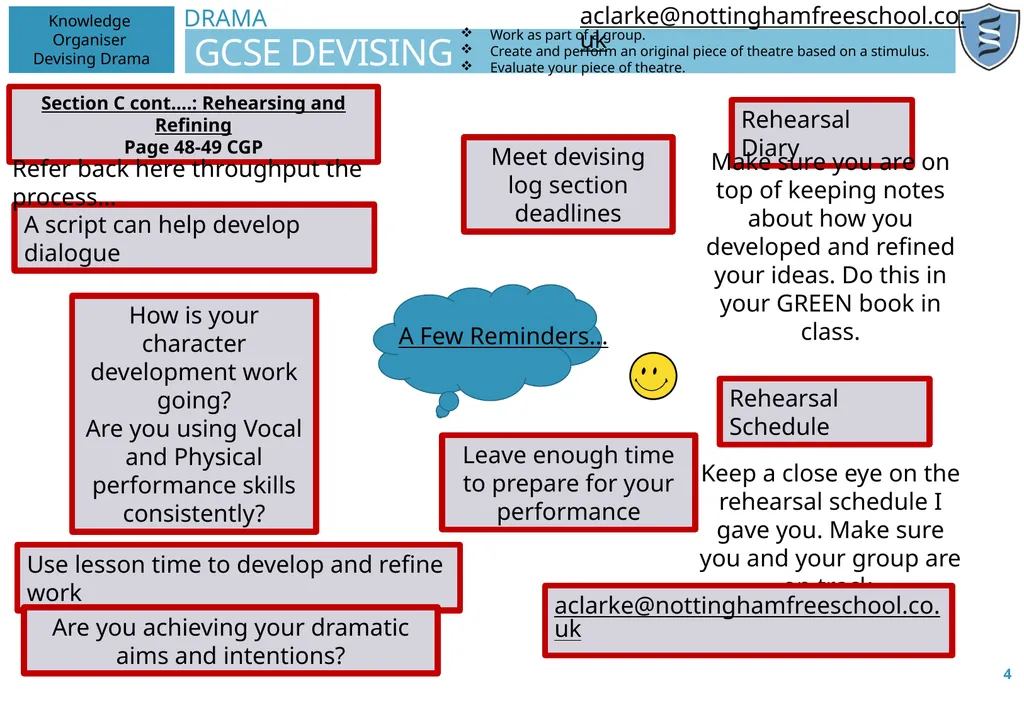
Evaluate your piece of theatre. Remember: there are no small parts, only small actors.Konstantin Stanislavski Section C cont....: Rehearsing and Refining
Page 48-49 CGP Rehearsal Schedule Rehearsal Diary A script can help develop dialogue Use lesson time to develop and refine work Leave enough time to prepare for your performance Make sure you are on top of keeping notes about how you developed and refined your ideas. Do this in your GREEN book in class.
Keep a close eye on the rehearsal schedule I gave you. Make sure you and your group are on track. A Few Reminders... How is your character development work going?
Are you using Vocal and Physical performance skills consistently? Are you achieving your dramatic aims and intentions? Refer back here throughput the process... Meet devising log section deadlines aclarke@nottinghamfreeschool.co.uk aclarke@nottinghamfreeschool.co.uk<br>
Organiser
Devising Drama Work as part of a group.
Create and perform an original piece of theatre based on a stimulus.
Evaluate your piece of theatre. Remember: there are no small parts, only small actors.Konstantin Stanislavski Section C cont....: Rehearsing and Refining
Page 48-49 CGP Rehearsal Schedule Rehearsal Diary A script can help develop dialogue Use lesson time to develop and refine work Leave enough time to prepare for your performance Make sure you are on top of keeping notes about how you developed and refined your ideas. Do this in your GREEN book in class.
Keep a close eye on the rehearsal schedule I gave you. Make sure you and your group are on track. A Few Reminders... How is your character development work going?
Are you using Vocal and Physical performance skills consistently? Are you achieving your dramatic aims and intentions? Refer back here throughput the process... Meet devising log section deadlines aclarke@nottinghamfreeschool.co.uk aclarke@nottinghamfreeschool.co.uk<br>
05
DRAMA GCSE DEVISING 5 Knowledge
Organiser
Devising Drama Work as part of a group.
Create and perform an original piece of theatre based on a stimulus.
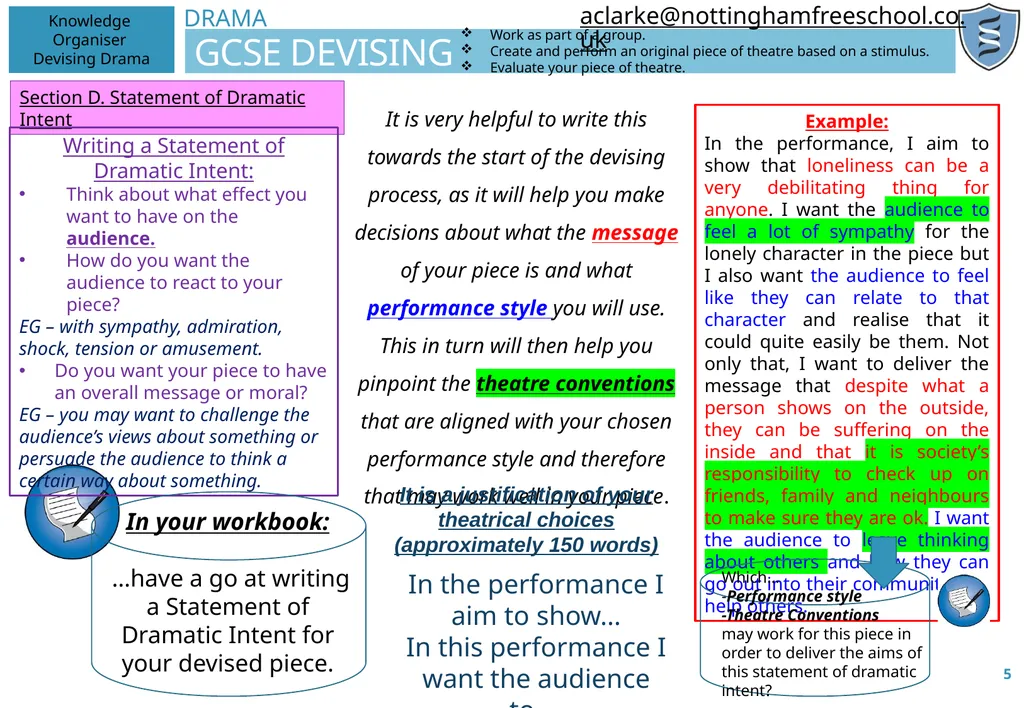
Evaluate your piece of theatre. Remember: there are no small parts, only small actors.Konstantin Stanislavski Section D. Statement of Dramatic Intent Writing a Statement of Dramatic Intent:
Think about what effect you want to have on the audience.
How do you want the audience to react to your piece?
EG – with sympathy, admiration, shock, tension or amusement.
Do you want your piece to have an overall message or moral?
EG – you may want to challenge the audience’s views about something or persuade the audience to think a certain way about something. It is very helpful to write this towards the start of the devising process, as it will help you make decisions about what the message of your piece is and what performance style you will use. This in turn will then help you pinpoint the theatre conventions that are aligned with your chosen performance style and therefore that may work well in your piece. Example:
In the performance, I aim to show that loneliness can be a very debilitating thing for anyone. I want the audience to feel a lot of sympathy for the lonely character in the piece but I also want the audience to feel like they can relate to that character and realise that it could quite easily be them. Not only that, I want to deliver the message that despite what a person shows on the outside, they can be suffering on the inside and that it is society’s responsibility to check up on friends, family and neighbours to make sure they are ok. I want the audience to leave thinking about others and how they can go out into their community and help others. In your workbook:
…have a go at writing a Statement of Dramatic Intent for your devised piece. It is a justification of your theatrical choices (approximately 150 words) In the performance I aim to show…
In this performance I want the audience to… Which…
-Performance style
-Theatre Conventions
may work for this piece in order to deliver the aims of this statement of dramatic intent? aclarke@nottinghamfreeschool.co.uk<br>
Organiser
Devising Drama Work as part of a group.
Create and perform an original piece of theatre based on a stimulus.
Evaluate your piece of theatre. Remember: there are no small parts, only small actors.Konstantin Stanislavski Section D. Statement of Dramatic Intent Writing a Statement of Dramatic Intent:
Think about what effect you want to have on the audience.
How do you want the audience to react to your piece?
EG – with sympathy, admiration, shock, tension or amusement.
Do you want your piece to have an overall message or moral?
EG – you may want to challenge the audience’s views about something or persuade the audience to think a certain way about something. It is very helpful to write this towards the start of the devising process, as it will help you make decisions about what the message of your piece is and what performance style you will use. This in turn will then help you pinpoint the theatre conventions that are aligned with your chosen performance style and therefore that may work well in your piece. Example:
In the performance, I aim to show that loneliness can be a very debilitating thing for anyone. I want the audience to feel a lot of sympathy for the lonely character in the piece but I also want the audience to feel like they can relate to that character and realise that it could quite easily be them. Not only that, I want to deliver the message that despite what a person shows on the outside, they can be suffering on the inside and that it is society’s responsibility to check up on friends, family and neighbours to make sure they are ok. I want the audience to leave thinking about others and how they can go out into their community and help others. In your workbook:
…have a go at writing a Statement of Dramatic Intent for your devised piece. It is a justification of your theatrical choices (approximately 150 words) In the performance I aim to show…
In this performance I want the audience to… Which…
-Performance style
-Theatre Conventions
may work for this piece in order to deliver the aims of this statement of dramatic intent? aclarke@nottinghamfreeschool.co.uk<br>
06
DRAMA GCSE DEVISING 6 Knowledge Organiser
Devising Drama Work as part of a group.
Create and perform an original piece of theatre based on a stimulus.
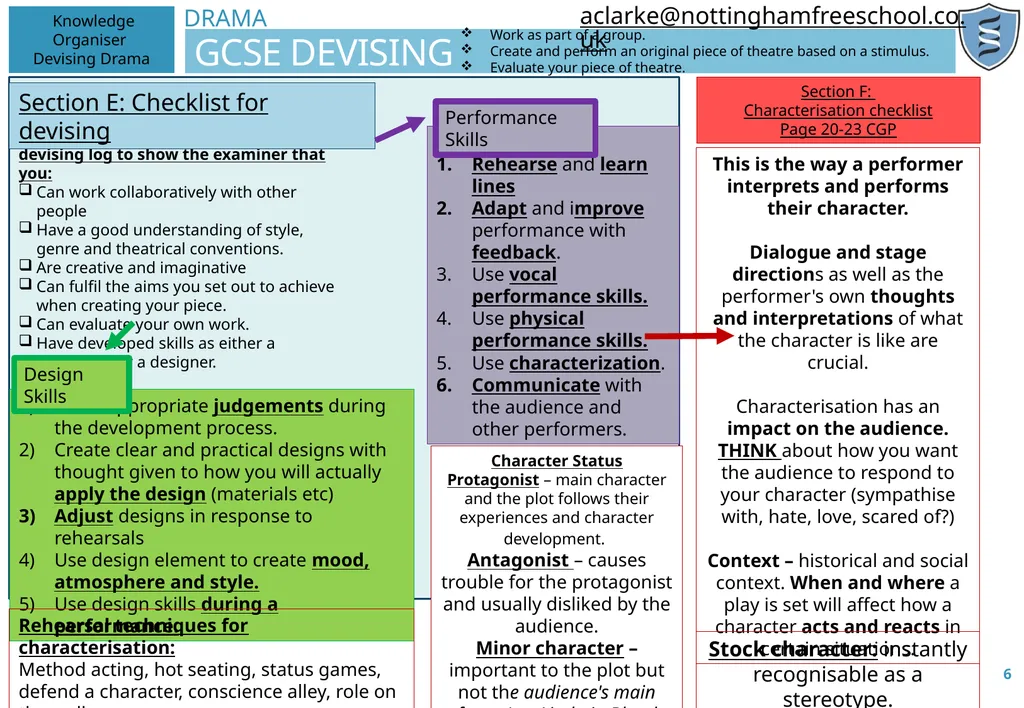
Evaluate your piece of theatre. Remember: there are no small parts, only small actors.Konstantin Stanislavski You need to use your performance and devising log to show the examiner that you:
Can work collaboratively with other people
Have a good understanding of style, genre and theatrical conventions.
Are creative and imaginative
Can fulfil the aims you set out to achieve when creating your piece.
Can evaluate your own work.
Have developed skills as either a performer or a designer. Section E: Checklist for devising Make appropriate judgements during the development process.
Create clear and practical designs with thought given to how you will actually apply the design (materials etc)
Adjust designs in response to rehearsals
Use design element to create mood, atmosphere and style.
Use design skills during a performance. Design Skills Rehearse and learn lines
Adapt and improve performance with feedback.
Use vocal performance skills.
Use physical performance skills.
Use characterization.
Communicate with the audience and other performers. Performance Skills Section F:
Characterisation checklist
Page 20-23 CGP This is the way a performer interprets and performs their character.
Dialogue and stage directions as well as the performer's own thoughts and interpretations of what the character is like are crucial.
Characterisation has an impact on the audience.
THINK about how you want the audience to respond to your character (sympathise with, hate, love, scared of?)
Context – historical and social context. When and where a play is set will affect how a character acts and reacts in certain situations. Character Status
Protagonist – main character and the plot follows their experiences and character development.
Antagonist – causes trouble for the protagonist and usually disliked by the audience.
Minor character – important to the plot but not the audience's main focus (eg: Linda in Blood Brothers) Stock character: instantly recognisable as a stereotype. Rehearsal techniques for characterisation:
Method acting, hot seating, status games, defend a character, conscience alley, role on the wall. aclarke@nottinghamfreeschool.co.uk<br>
Devising Drama Work as part of a group.
Create and perform an original piece of theatre based on a stimulus.
Evaluate your piece of theatre. Remember: there are no small parts, only small actors.Konstantin Stanislavski You need to use your performance and devising log to show the examiner that you:
Can work collaboratively with other people
Have a good understanding of style, genre and theatrical conventions.
Are creative and imaginative
Can fulfil the aims you set out to achieve when creating your piece.
Can evaluate your own work.
Have developed skills as either a performer or a designer. Section E: Checklist for devising Make appropriate judgements during the development process.
Create clear and practical designs with thought given to how you will actually apply the design (materials etc)
Adjust designs in response to rehearsals
Use design element to create mood, atmosphere and style.
Use design skills during a performance. Design Skills Rehearse and learn lines
Adapt and improve performance with feedback.
Use vocal performance skills.
Use physical performance skills.
Use characterization.
Communicate with the audience and other performers. Performance Skills Section F:
Characterisation checklist
Page 20-23 CGP This is the way a performer interprets and performs their character.
Dialogue and stage directions as well as the performer's own thoughts and interpretations of what the character is like are crucial.
Characterisation has an impact on the audience.
THINK about how you want the audience to respond to your character (sympathise with, hate, love, scared of?)
Context – historical and social context. When and where a play is set will affect how a character acts and reacts in certain situations. Character Status
Protagonist – main character and the plot follows their experiences and character development.
Antagonist – causes trouble for the protagonist and usually disliked by the audience.
Minor character – important to the plot but not the audience's main focus (eg: Linda in Blood Brothers) Stock character: instantly recognisable as a stereotype. Rehearsal techniques for characterisation:
Method acting, hot seating, status games, defend a character, conscience alley, role on the wall. aclarke@nottinghamfreeschool.co.uk<br>
07
DRAMA GCSE DEVISING 7 Knowledge Organiser
Devising Drama Work as part of a group.
Create and perform an original piece of theatre based on a stimulus.
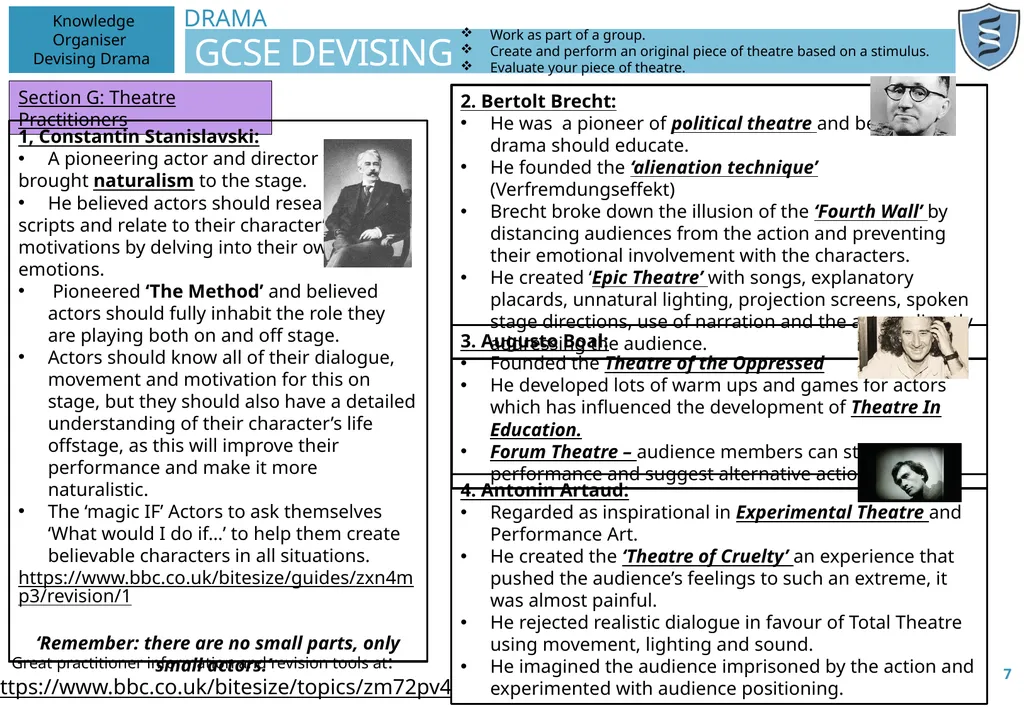
Evaluate your piece of theatre. Section G: Theatre Practitioners 1, Constantin Stanislavski:
A pioneering actor and director who
brought naturalism to the stage.
He believed actors should research
scripts and relate to their character’s
motivations by delving into their own
emotions.
Pioneered ‘The Method’ and believed actors should fully inhabit the role they are playing both on and off stage.
Actors should know all of their dialogue, movement and motivation for this on stage, but they should also have a detailed understanding of their character’s life offstage, as this will improve their performance and make it more naturalistic.
The ‘magic IF’ Actors to ask themselves ‘What would I do if…’ to help them create believable characters in all situations.
https://www.bbc.co.uk/bitesize/guides/zxn4mp3/revision/1
‘Remember: there are no small parts, only small actors.’ Remember: there are no small parts, only small actors.Konstantin Stanislavski https://www.bbc.co.uk/bitesize/topics/zm72pv4 Great practitioner information and revision tools at: 2. Bertolt Brecht:
He was a pioneer of political theatre and believed drama should educate.
He founded the ‘alienation technique’ (Verfremdungseffekt)
Brecht broke down the illusion of the ‘Fourth Wall’ by distancing audiences from the action and preventing their emotional involvement with the characters.
He created ‘Epic Theatre’ with songs, explanatory placards, unnatural lighting, projection screens, spoken stage directions, use of narration and the actors directly addressing the audience. 3. Augusto Boal:
Founded the Theatre of the Oppressed
He developed lots of warm ups and games for actors which has influenced the development of Theatre In Education.
Forum Theatre – audience members can stop the performance and suggest alternative actions. 4. Antonin Artaud:
Regarded as inspirational in Experimental Theatre and Performance Art.
He created the ‘Theatre of Cruelty’ an experience that pushed the audience’s feelings to such an extreme, it was almost painful.
He rejected realistic dialogue in favour of Total Theatre using movement, lighting and sound.
He imagined the audience imprisoned by the action and experimented with audience positioning.<br>
Devising Drama Work as part of a group.
Create and perform an original piece of theatre based on a stimulus.
Evaluate your piece of theatre. Section G: Theatre Practitioners 1, Constantin Stanislavski:
A pioneering actor and director who
brought naturalism to the stage.
He believed actors should research
scripts and relate to their character’s
motivations by delving into their own
emotions.
Pioneered ‘The Method’ and believed actors should fully inhabit the role they are playing both on and off stage.
Actors should know all of their dialogue, movement and motivation for this on stage, but they should also have a detailed understanding of their character’s life offstage, as this will improve their performance and make it more naturalistic.
The ‘magic IF’ Actors to ask themselves ‘What would I do if…’ to help them create believable characters in all situations.
https://www.bbc.co.uk/bitesize/guides/zxn4mp3/revision/1
‘Remember: there are no small parts, only small actors.’ Remember: there are no small parts, only small actors.Konstantin Stanislavski https://www.bbc.co.uk/bitesize/topics/zm72pv4 Great practitioner information and revision tools at: 2. Bertolt Brecht:
He was a pioneer of political theatre and believed drama should educate.
He founded the ‘alienation technique’ (Verfremdungseffekt)
Brecht broke down the illusion of the ‘Fourth Wall’ by distancing audiences from the action and preventing their emotional involvement with the characters.
He created ‘Epic Theatre’ with songs, explanatory placards, unnatural lighting, projection screens, spoken stage directions, use of narration and the actors directly addressing the audience. 3. Augusto Boal:
Founded the Theatre of the Oppressed
He developed lots of warm ups and games for actors which has influenced the development of Theatre In Education.
Forum Theatre – audience members can stop the performance and suggest alternative actions. 4. Antonin Artaud:
Regarded as inspirational in Experimental Theatre and Performance Art.
He created the ‘Theatre of Cruelty’ an experience that pushed the audience’s feelings to such an extreme, it was almost painful.
He rejected realistic dialogue in favour of Total Theatre using movement, lighting and sound.
He imagined the audience imprisoned by the action and experimented with audience positioning.<br>
08
DRAMA GCSE DEVISING 8 Knowledge
Organiser
Devising Drama Work as part of a group.
Create and perform an original piece of theatre based on a stimulus.
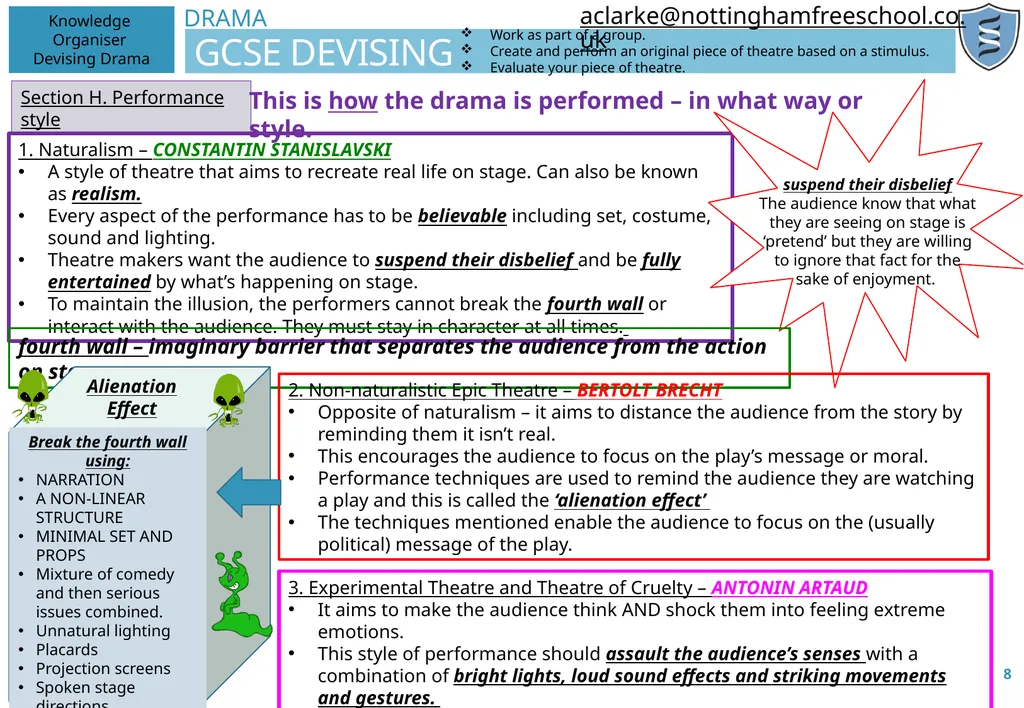
Evaluate your piece of theatre. Section H. Performance style This is how the drama is performed – in what way or style. 1. Naturalism – CONSTANTIN STANISLAVSKI
A style of theatre that aims to recreate real life on stage. Can also be known as realism.
Every aspect of the performance has to be believable including set, costume, sound and lighting.
Theatre makers want the audience to suspend their disbelief and be fully entertained by what’s happening on stage.
To maintain the illusion, the performers cannot break the fourth wall or interact with the audience. They must stay in character at all times. suspend their disbelief
The audience know that what they are seeing on stage is ‘pretend’ but they are willing to ignore that fact for the sake of enjoyment. fourth wall – imaginary barrier that separates the audience from the action on stage. 2. Non-naturalistic Epic Theatre – BERTOLT BRECHT
Opposite of naturalism – it aims to distance the audience from the story by reminding them it isn’t real.
This encourages the audience to focus on the play’s message or moral.
Performance techniques are used to remind the audience they are watching a play and this is called the ‘alienation effect’
The techniques mentioned enable the audience to focus on the (usually political) message of the play. Alienation Effect Break the fourth wall using:
NARRATION
A NON-LINEAR STRUCTURE
MINIMAL SET AND PROPS
Mixture of comedy and then serious issues combined.
Unnatural lighting
Placards
Projection screens
Spoken stage directions 3. Experimental Theatre and Theatre of Cruelty – ANTONIN ARTAUD
It aims to make the audience think AND shock them into feeling extreme emotions.
This style of performance should assault the audience’s senses with a combination of bright lights, loud sound effects and striking movements and gestures.
Artaud felt these techniques were more effective than dialogue. PTO aclarke@nottinghamfreeschool.co.uk<br>
Organiser
Devising Drama Work as part of a group.
Create and perform an original piece of theatre based on a stimulus.
Evaluate your piece of theatre. Section H. Performance style This is how the drama is performed – in what way or style. 1. Naturalism – CONSTANTIN STANISLAVSKI
A style of theatre that aims to recreate real life on stage. Can also be known as realism.
Every aspect of the performance has to be believable including set, costume, sound and lighting.
Theatre makers want the audience to suspend their disbelief and be fully entertained by what’s happening on stage.
To maintain the illusion, the performers cannot break the fourth wall or interact with the audience. They must stay in character at all times. suspend their disbelief
The audience know that what they are seeing on stage is ‘pretend’ but they are willing to ignore that fact for the sake of enjoyment. fourth wall – imaginary barrier that separates the audience from the action on stage. 2. Non-naturalistic Epic Theatre – BERTOLT BRECHT
Opposite of naturalism – it aims to distance the audience from the story by reminding them it isn’t real.
This encourages the audience to focus on the play’s message or moral.
Performance techniques are used to remind the audience they are watching a play and this is called the ‘alienation effect’
The techniques mentioned enable the audience to focus on the (usually political) message of the play. Alienation Effect Break the fourth wall using:
NARRATION
A NON-LINEAR STRUCTURE
MINIMAL SET AND PROPS
Mixture of comedy and then serious issues combined.
Unnatural lighting
Placards
Projection screens
Spoken stage directions 3. Experimental Theatre and Theatre of Cruelty – ANTONIN ARTAUD
It aims to make the audience think AND shock them into feeling extreme emotions.
This style of performance should assault the audience’s senses with a combination of bright lights, loud sound effects and striking movements and gestures.
Artaud felt these techniques were more effective than dialogue. PTO aclarke@nottinghamfreeschool.co.uk<br>
09
DRAMA GCSE DEVISING 9 Knowledge
Organiser
Devising Drama Work as part of a group.
Create and perform an original piece of theatre based on a stimulus.
Evaluate your piece of theatre. Remember: there are no small parts, only small actors.Konstantin Stanislavski Section H: Performance style cont… 3. Experimental Theatre and Theatre of Cruelty – ANTONIN ARTAUD
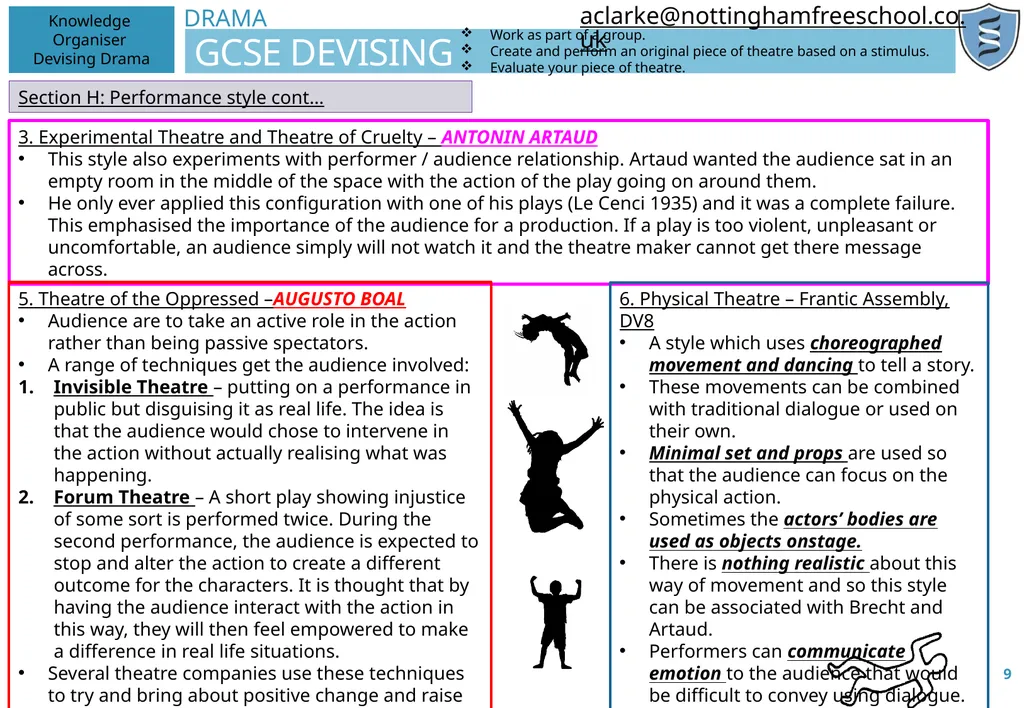
This style also experiments with performer / audience relationship. Artaud wanted the audience sat in an empty room in the middle of the space with the action of the play going on around them.
He only ever applied this configuration with one of his plays (Le Cenci 1935) and it was a complete failure. This emphasised the importance of the audience for a production. If a play is too violent, unpleasant or uncomfortable, an audience simply will not watch it and the theatre maker cannot get there message across. 5. Theatre of the Oppressed –AUGUSTO BOAL
Audience are to take an active role in the action rather than being passive spectators.
A range of techniques get the audience involved:
Invisible Theatre – putting on a performance in public but disguising it as real life. The idea is that the audience would chose to intervene in the action without actually realising what was happening.
Forum Theatre – A short play showing injustice of some sort is performed twice. During the second performance, the audience is expected to stop and alter the action to create a different outcome for the characters. It is thought that by having the audience interact with the action in this way, they will then feel empowered to make a difference in real life situations.
Several theatre companies use these techniques to try and bring about positive change and raise awareness of key issues. 6. Physical Theatre – Frantic Assembly, DV8
A style which uses choreographed movement and dancing to tell a story.
These movements can be combined with traditional dialogue or used on their own.
Minimal set and props are used so that the audience can focus on the physical action.
Sometimes the actors’ bodies are used as objects onstage.
There is nothing realistic about this way of movement and so this style can be associated with Brecht and Artaud.
Performers can communicate emotion to the audience that would be difficult to convey using dialogue. aclarke@nottinghamfreeschool.co.uk<br>
Organiser
Devising Drama Work as part of a group.
Create and perform an original piece of theatre based on a stimulus.
Evaluate your piece of theatre. Remember: there are no small parts, only small actors.Konstantin Stanislavski Section H: Performance style cont… 3. Experimental Theatre and Theatre of Cruelty – ANTONIN ARTAUD
This style also experiments with performer / audience relationship. Artaud wanted the audience sat in an empty room in the middle of the space with the action of the play going on around them.
He only ever applied this configuration with one of his plays (Le Cenci 1935) and it was a complete failure. This emphasised the importance of the audience for a production. If a play is too violent, unpleasant or uncomfortable, an audience simply will not watch it and the theatre maker cannot get there message across. 5. Theatre of the Oppressed –AUGUSTO BOAL
Audience are to take an active role in the action rather than being passive spectators.
A range of techniques get the audience involved:
Invisible Theatre – putting on a performance in public but disguising it as real life. The idea is that the audience would chose to intervene in the action without actually realising what was happening.
Forum Theatre – A short play showing injustice of some sort is performed twice. During the second performance, the audience is expected to stop and alter the action to create a different outcome for the characters. It is thought that by having the audience interact with the action in this way, they will then feel empowered to make a difference in real life situations.
Several theatre companies use these techniques to try and bring about positive change and raise awareness of key issues. 6. Physical Theatre – Frantic Assembly, DV8
A style which uses choreographed movement and dancing to tell a story.
These movements can be combined with traditional dialogue or used on their own.
Minimal set and props are used so that the audience can focus on the physical action.
Sometimes the actors’ bodies are used as objects onstage.
There is nothing realistic about this way of movement and so this style can be associated with Brecht and Artaud.
Performers can communicate emotion to the audience that would be difficult to convey using dialogue. aclarke@nottinghamfreeschool.co.uk<br>
10
DRAMA GCSE DEVISING 10 Knowledge
Organiser
Devising Drama Work as part of a group.
Create and perform an original piece of theatre based on a stimulus.
Evaluate your piece of theatre. Remember: there are no small parts, only small actors.Konstantin Stanislavski aclarke@nottinghamfreeschool.co.uk Section I – Form and Genre FORM:
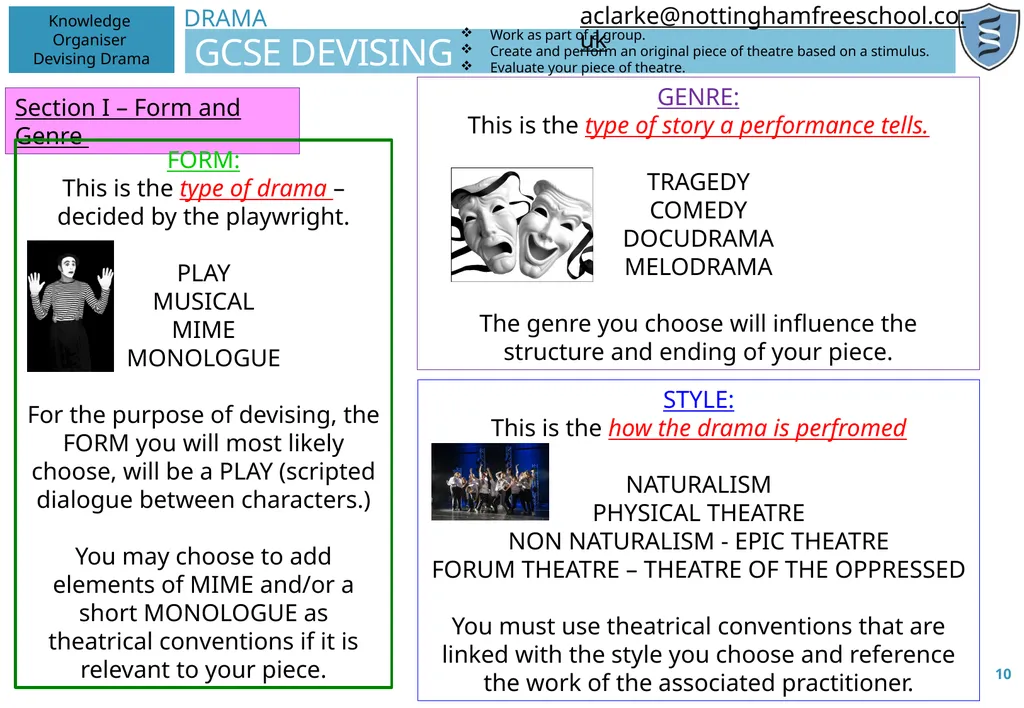
This is the type of drama – decided by the playwright.
PLAY
MUSICAL
MIME
MONOLOGUE
For the purpose of devising, the FORM you will most likely choose, will be a PLAY (scripted dialogue between characters.)
You may choose to add elements of MIME and/or a short MONOLOGUE as theatrical conventions if it is relevant to your piece. GENRE:
This is the type of story a performance tells.
TRAGEDY
COMEDY
DOCUDRAMA
MELODRAMA
The genre you choose will influence the structure and ending of your piece. STYLE:
This is the how the drama is perfromed
NATURALISM
PHYSICAL THEATRE
NON NATURALISM - EPIC THEATRE
FORUM THEATRE – THEATRE OF THE OPPRESSED
You must use theatrical conventions that are linked with the style you choose and reference the work of the associated practitioner.<br>
Organiser
Devising Drama Work as part of a group.
Create and perform an original piece of theatre based on a stimulus.
Evaluate your piece of theatre. Remember: there are no small parts, only small actors.Konstantin Stanislavski aclarke@nottinghamfreeschool.co.uk Section I – Form and Genre FORM:
This is the type of drama – decided by the playwright.
PLAY
MUSICAL
MIME
MONOLOGUE
For the purpose of devising, the FORM you will most likely choose, will be a PLAY (scripted dialogue between characters.)
You may choose to add elements of MIME and/or a short MONOLOGUE as theatrical conventions if it is relevant to your piece. GENRE:
This is the type of story a performance tells.
TRAGEDY
COMEDY
DOCUDRAMA
MELODRAMA
The genre you choose will influence the structure and ending of your piece. STYLE:
This is the how the drama is perfromed
NATURALISM
PHYSICAL THEATRE
NON NATURALISM - EPIC THEATRE
FORUM THEATRE – THEATRE OF THE OPPRESSED
You must use theatrical conventions that are linked with the style you choose and reference the work of the associated practitioner.<br>