
Driver Safety for 15-Passenger Vans DISCLAIMER

Description: Driver Safety for 15-Passenger Vans DISCLAIMER This training material presents very important, pertinent information. It should not be assumed, however, that this program satisfies every legal requirement of every state. Some states require
Related Topics
Download Presentation
"Driver Safety for 15-Passenger Vans DISCLAIMER" is the property of its rightful owner. Permission is granted to download and print the materials on this website for personal, non-commercial use only, and to display it on your personal computer provided you do not modify the materials and that you retain all copyright notices contained in the materials. By downloading content from our website, you accept the terms of this agreement.
Presentation Transcript
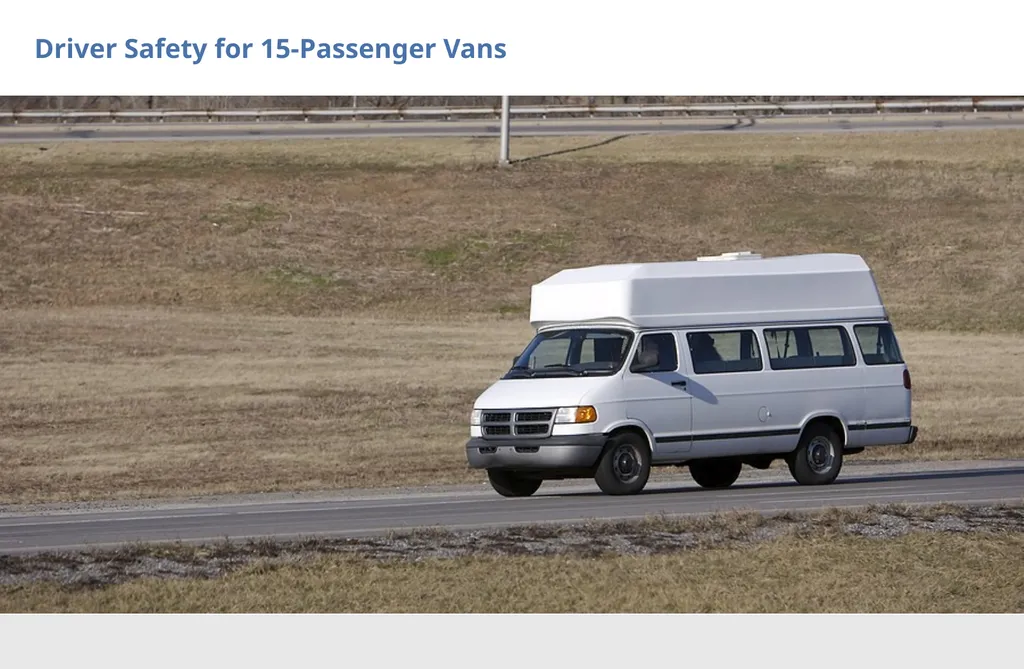
slide1. Driver Safety for 15-Passenger Vans<br>
slide2. DISCLAIMER This training material presents very important, pertinent information. It should not be assumed, however, that this program satisfies every legal requirement of every state. Some states require the training be developed and delivered by an individual with specific training and experience.
This training is AWARENESS LEVEL and does not authorize any person to perform work or validate their level of competency; it must be supplemented with operation and process-specific assessments and training, as well as management oversight, to assure that all training is understood and followed. Your organization must do an evaluation of all exposures and applicable codes and regulations. In addition, establish proper controls, training, and protective measures to effectively control exposures and assure compliance.
This program is neither a determination that the conditions and practices of your organization are safe, nor a warranty that reliance upon this program will prevent accidents and losses or satisfy local, state, or federal regulations. How to Use this Presentation This presentation contains base material for use in an instructor-led training setting. You may modify this presentation to satisfy the specific training needs of your organization.
On some slides, the display text is supplemented with additional material in the slide notes.
This content is licensed for modification and use in a classroom setting. You may not redistribute this material in any form. Introduction<br>
slide3. Introduction In this course, you’ll learn about:
Common risks.
Methods to minimize the chances of accidents.
Best practices for staying safe on the road.
How to prepare for and respond to emergencies. Introduction The size, availability, and affordability of 15-passenger vans make them a common choice for moving large groups of people and their cargo.
However, the design and construction of 15-passenger vans also make them extremely dangerous in certain situations.<br>
slide4. Course Outline The Risks of 15-Passenger Vans
Pre-Trip Preparations
Road Safety Best Practices
Emergency Response
Summary Introduction<br>
slide5. The Risks of 15-Passenger Vans What you need to know:
Common risks associated with 15-passenger vans
Strategies for reducing these risks 1<br>
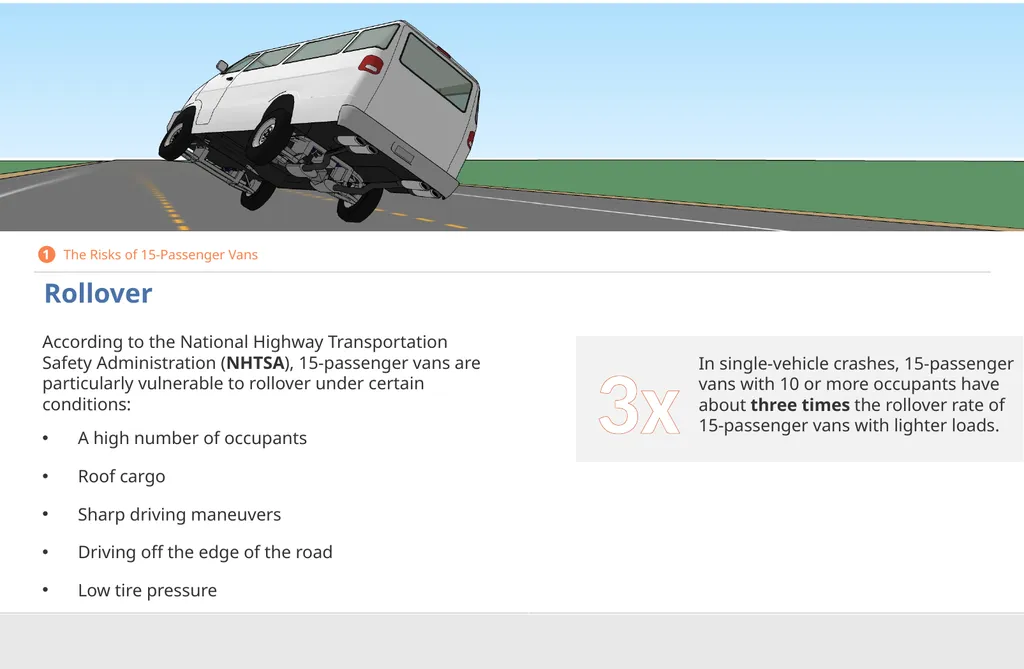
slide6. Rollover According to the National Highway Transportation Safety Administration (NHTSA), 15-passenger vans are particularly vulnerable to rollover under certain conditions:
A high number of occupants
Roof cargo
Sharp driving maneuvers
Driving off the edge of the road
Low tire pressure In single-vehicle crashes, 15-passenger vans with 10 or more occupants have about three times the rollover rate of 15-passenger vans with lighter loads. 1 The Risks of 15-Passenger Vans 3x<br>
slide7. Driver Inexperience Drivers with a lack of experience operating 15-passenger vans are more prone to loss of control and rollovers.
Only drive a 15-passenger van if you are authorized.
Authorized drivers must have:
Proper, vehicle-specific training.
Driving experience.
A valid driver’s license. 1 The Risks of 15-Passenger Vans A commercial license may be required to drive a 15-passenger van in certain states or under certain circumstances. *<br>
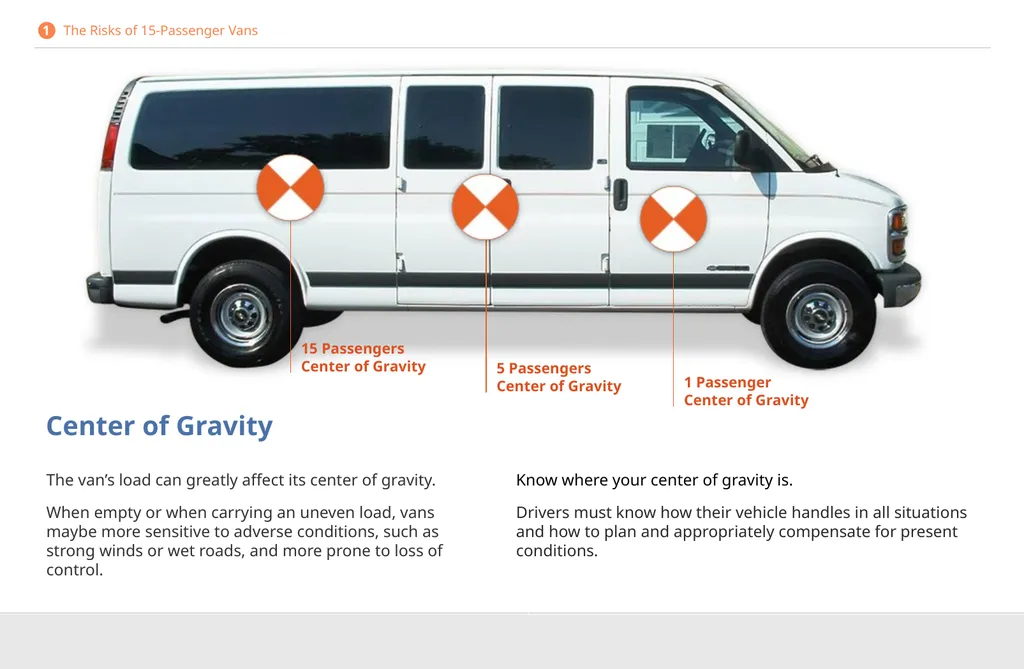
slide8. Center of Gravity The van’s load can greatly affect its center of gravity.
When empty or when carrying an uneven load, vans maybe more sensitive to adverse conditions, such as strong winds or wet roads, and more prone to loss of control. 15 Passengers Center of Gravity 5 Passengers Center of Gravity 1 Passenger Center of Gravity 1 The Risks of 15-Passenger Vans Know where your center of gravity is.
Drivers must know how their vehicle handles in all situations and how to plan and appropriately compensate for present conditions.<br>
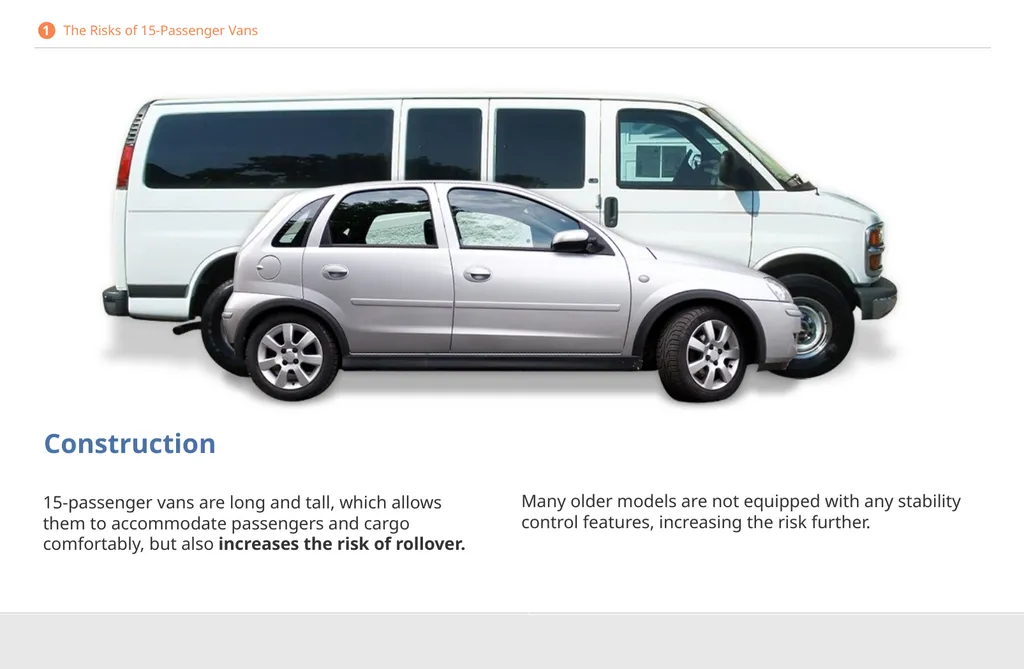
slide9. Construction 15-passenger vans are long and tall, which allows them to accommodate passengers and cargo comfortably, but also increases the risk of rollover. Many older models are not equipped with any stability control features, increasing the risk further. 1 The Risks of 15-Passenger Vans<br>
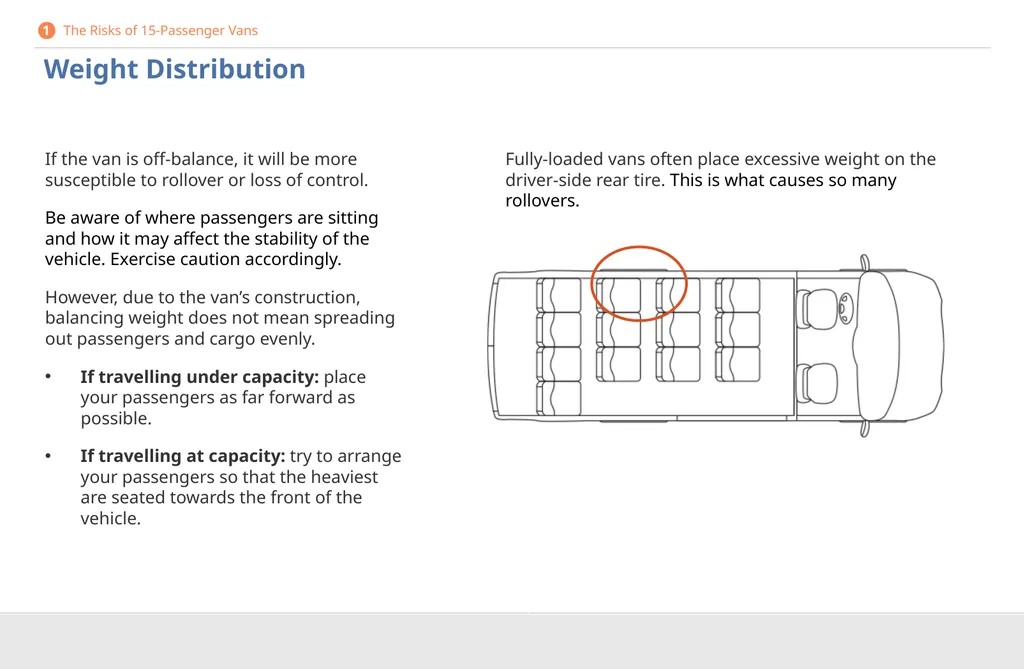
slide10. Weight Distribution Fully-loaded vans often place excessive weight on the driver-side rear tire. This is what causes so many rollovers. If the van is off-balance, it will be more susceptible to rollover or loss of control.
Be aware of where passengers are sitting and how it may affect the stability of the vehicle. Exercise caution accordingly.
However, due to the van’s construction, balancing weight does not mean spreading out passengers and cargo evenly.
If travelling under capacity: place your passengers as far forward as possible.
If travelling at capacity: try to arrange your passengers so that the heaviest are seated towards the front of the vehicle. 1 The Risks of 15-Passenger Vans<br>
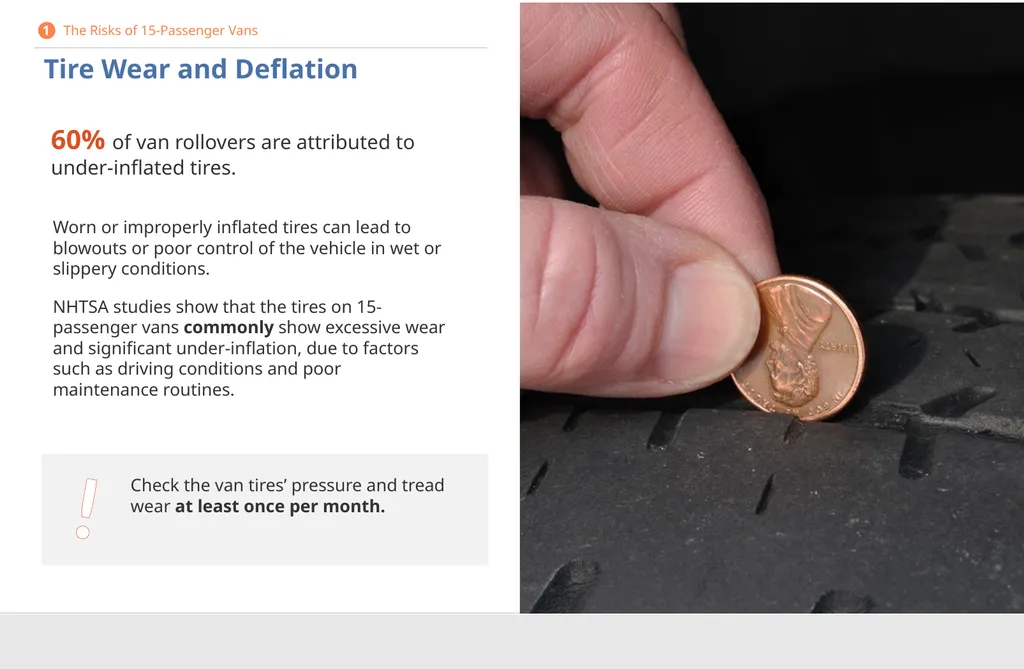
slide11. Tire Wear and Deflation Worn or improperly inflated tires can lead to blowouts or poor control of the vehicle in wet or slippery conditions.
NHTSA studies show that the tires on 15-passenger vans commonly show excessive wear and significant under-inflation, due to factors such as driving conditions and poor maintenance routines. Check the van tires’ pressure and tread wear at least once per month. 60% of van rollovers are attributed to under-inflated tires. ! 1 The Risks of 15-Passenger Vans<br>
slide12. Make sure that you are qualified.
Only drive 15-passenger vans if you have a valid driver’s license and vehicle-specific training.
A commercial license may be required to drive a 15-passenger van in certain states or under certain circumstances. Balance weight across the van.
Arrange your passengers or cargo so that the van’s center of gravity is in the middle of the van:
If travelling at under capacity, place your passengers or cargo as far forward as possible.
If travelling at capacity, try to arrange your passengers so that the heaviest are seated towards the front of the vehicle. Check your tire pressure.
Check the van’s tire pressure at least monthly. Frequency may depend on how much the van is used. Summary If driving a 15-passenger van, take the following precautions to lower the risks. 1 The Risks of 15-Passenger Vans<br>
slide13. Pre-Trip Preparations What you need to know:
Vehicle preparedness
Driver preparedness
Avoiding fatigue
Minimizing distractions 2 2<br>
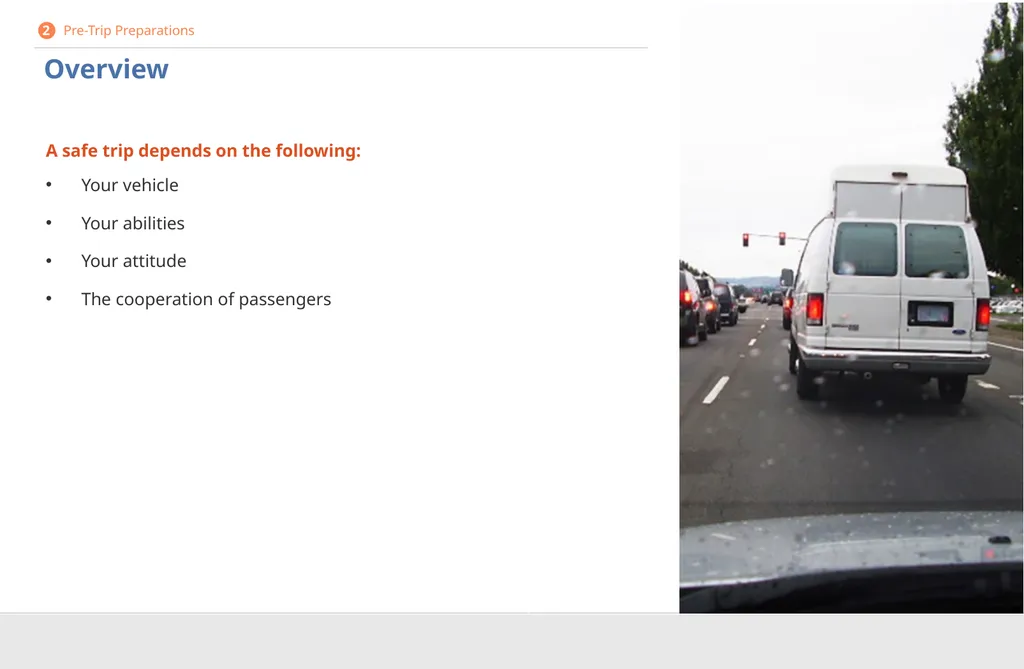
slide14. Overview A safe trip depends on the following:
Your vehicle
Your abilities
Your attitude
The cooperation of passengers 2 Pre-Trip Preparations<br>
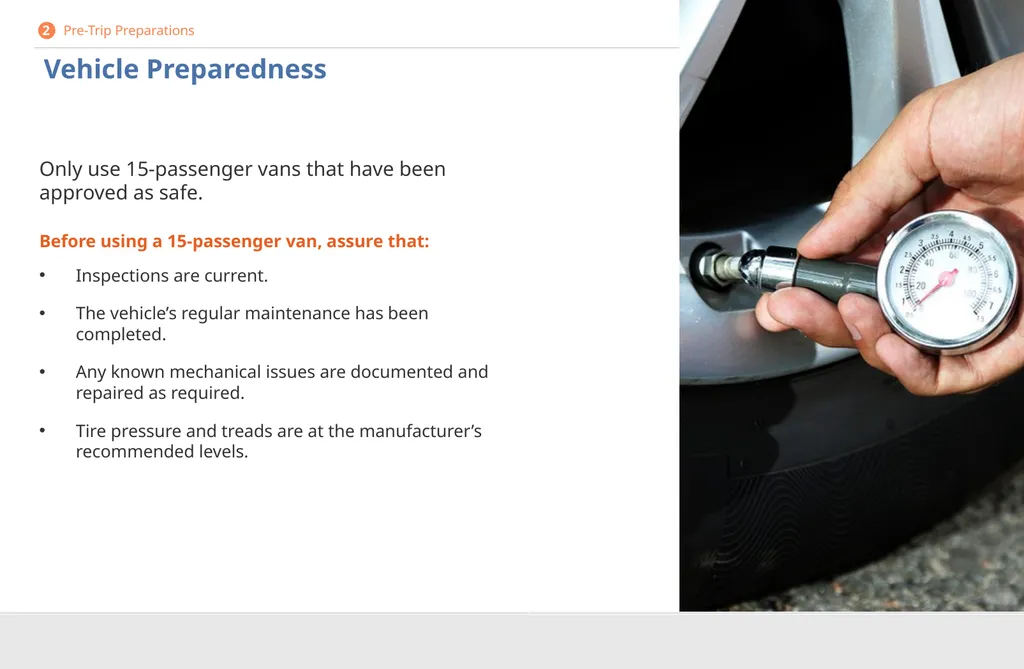
slide15. Vehicle Preparedness Only use 15-passenger vans that have been approved as safe.
Before using a 15-passenger van, assure that:
Inspections are current.
The vehicle’s regular maintenance has been completed.
Any known mechanical issues are documented and repaired as required.
Tire pressure and treads are at the manufacturer’s recommended levels. 2 Pre-Trip Preparations<br>
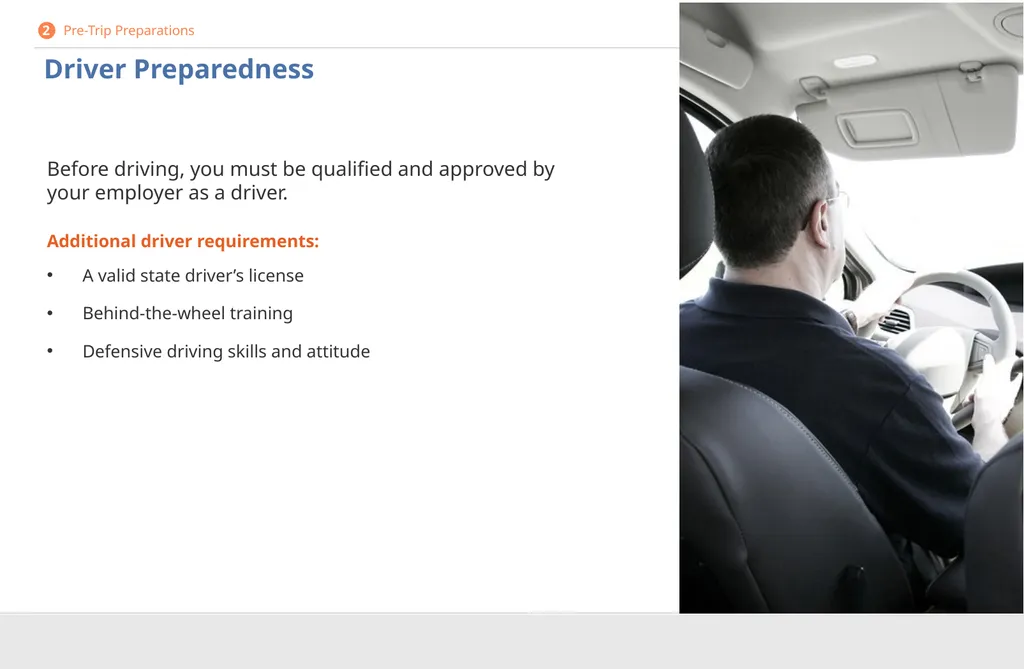
slide16. Driver Preparedness Before driving, you must be qualified and approved by your employer as a driver.
Additional driver requirements:
A valid state driver’s license
Behind-the-wheel training
Defensive driving skills and attitude 2 Pre-Trip Preparations<br>
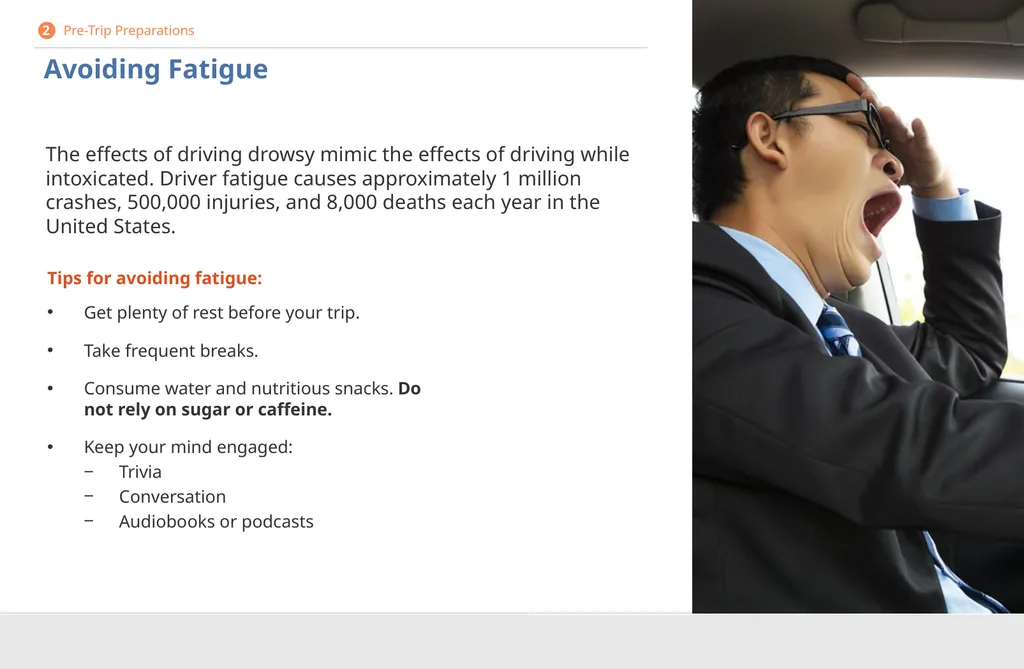
slide17. Tips for avoiding fatigue:
Get plenty of rest before your trip.
Take frequent breaks.
Consume water and nutritious snacks. Do not rely on sugar or caffeine.
Keep your mind engaged:
Trivia
Conversation
Audiobooks or podcasts 2 Pre-Trip Preparations Avoiding Fatigue The effects of driving drowsy mimic the effects of driving while intoxicated. Driver fatigue causes approximately 1 million crashes, 500,000 injuries, and 8,000 deaths each year in the United States.<br>
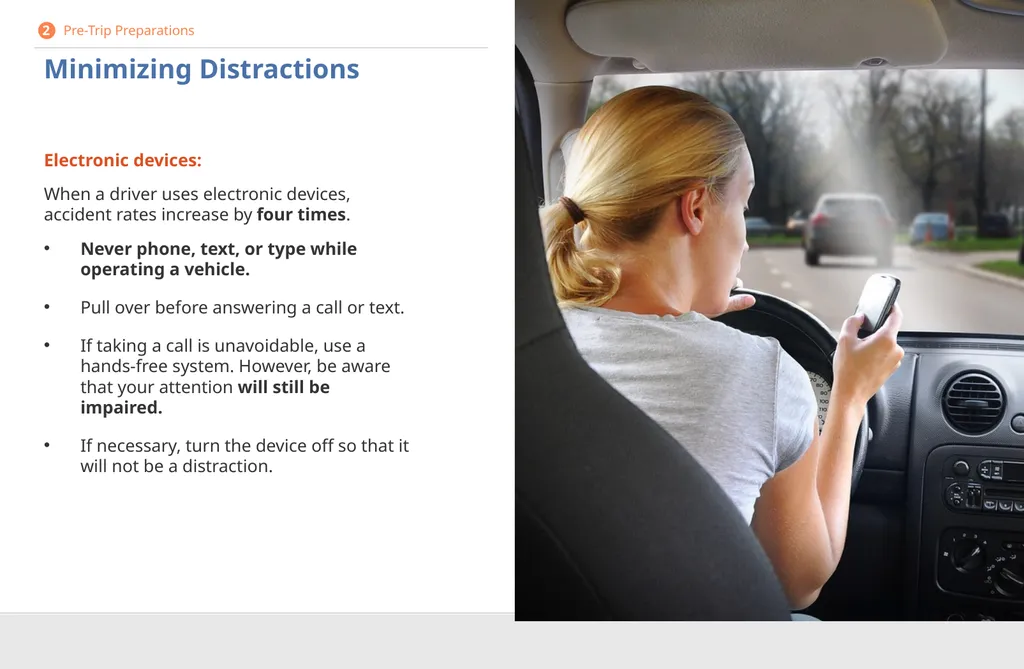
slide18. Minimizing Distractions Electronic devices:
When a driver uses electronic devices, accident rates increase by four times.
Never phone, text, or type while operating a vehicle.
Pull over before answering a call or text.
If taking a call is unavoidable, use a hands-free system. However, be aware that your attention will still be impaired.
If necessary, turn the device off so that it will not be a distraction. 2 Pre-Trip Preparations<br>
slide19. Minimizing Distractions Other common distractions:
Adjusting vehicle controls
Reaching for objects
Grooming
Eating or drinking
Tending to children 2 Pre-Trip Preparations Whenever possible, delay these activities until you are able to pull over to a safe location or have reached your destination.<br>
slide20. Road Safety Best Practices What you need to know:
Safe loading and unloading
Regulating speed
Maneuvering safely
Following at a safe distance
Judging stop time
Taking precautions when driving in reverse
Backing up
Turning safely 3<br>
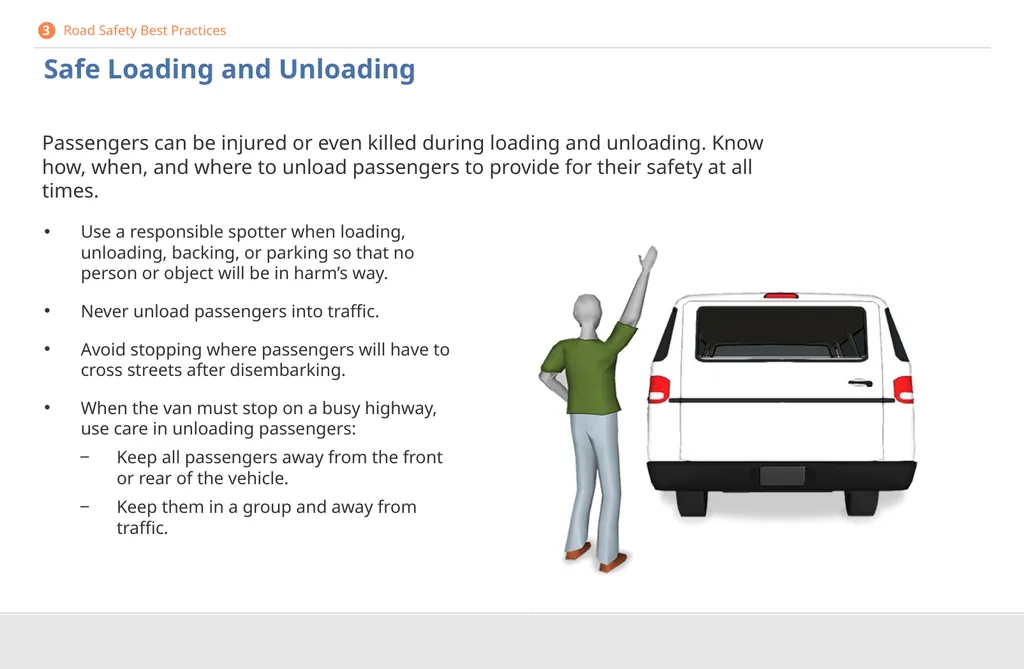
slide21. Safe Loading and Unloading Use a responsible spotter when loading, unloading, backing, or parking so that no person or object will be in harm’s way.
Never unload passengers into traffic.
Avoid stopping where passengers will have to cross streets after disembarking.
When the van must stop on a busy highway, use care in unloading passengers:
Keep all passengers away from the front or rear of the vehicle.
Keep them in a group and away from traffic. 3 Road Safety Best Practices Passengers can be injured or even killed during loading and unloading. Know how, when, and where to unload passengers to provide for their safety at all times.<br>
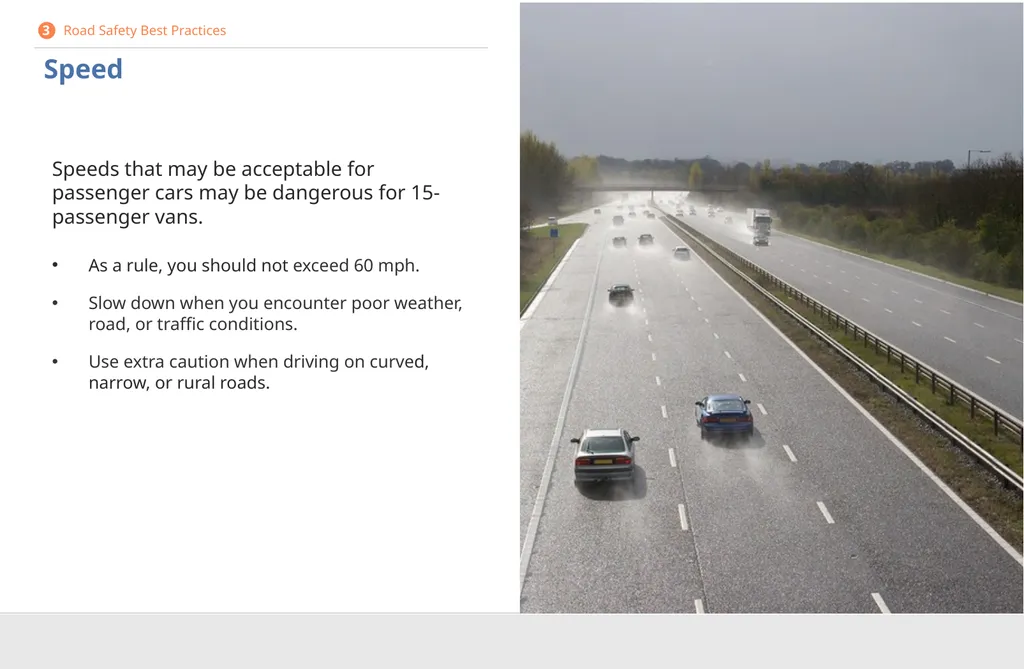
slide22. Speed Speeds that may be acceptable for passenger cars may be dangerous for 15-passenger vans.
As a rule, you should not exceed 60 mph.
Slow down when you encounter poor weather, road, or traffic conditions.
Use extra caution when driving on curved, narrow, or rural roads. 3 Road Safety Best Practices<br>
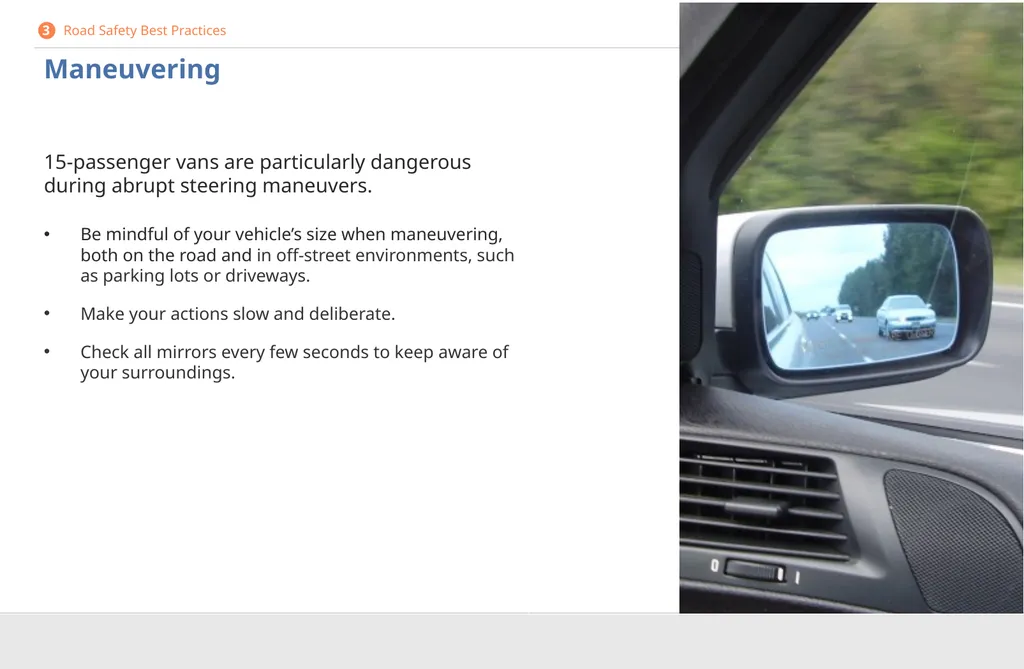
slide23. Maneuvering 15-passenger vans are particularly dangerous during abrupt steering maneuvers.
Be mindful of your vehicle’s size when maneuvering, both on the road and in off-street environments, such as parking lots or driveways.
Make your actions slow and deliberate.
Check all mirrors every few seconds to keep aware of your surroundings. 3 Road Safety Best Practices<br>
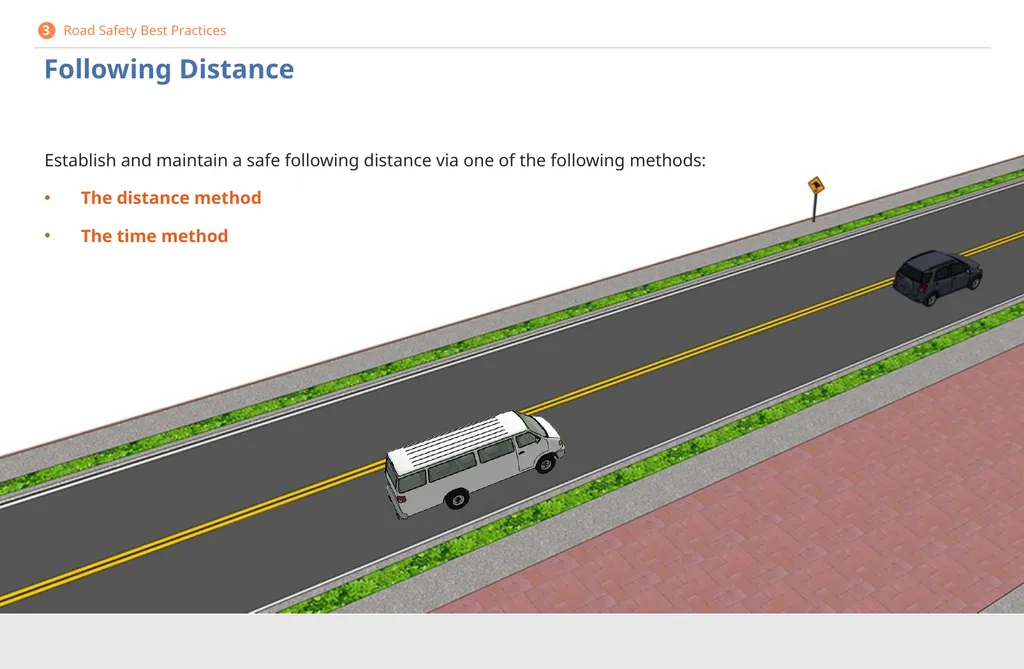
slide24. Following Distance Establish and maintain a safe following distance via one of the following methods:
The distance method
The time method 3 Road Safety Best Practices<br>
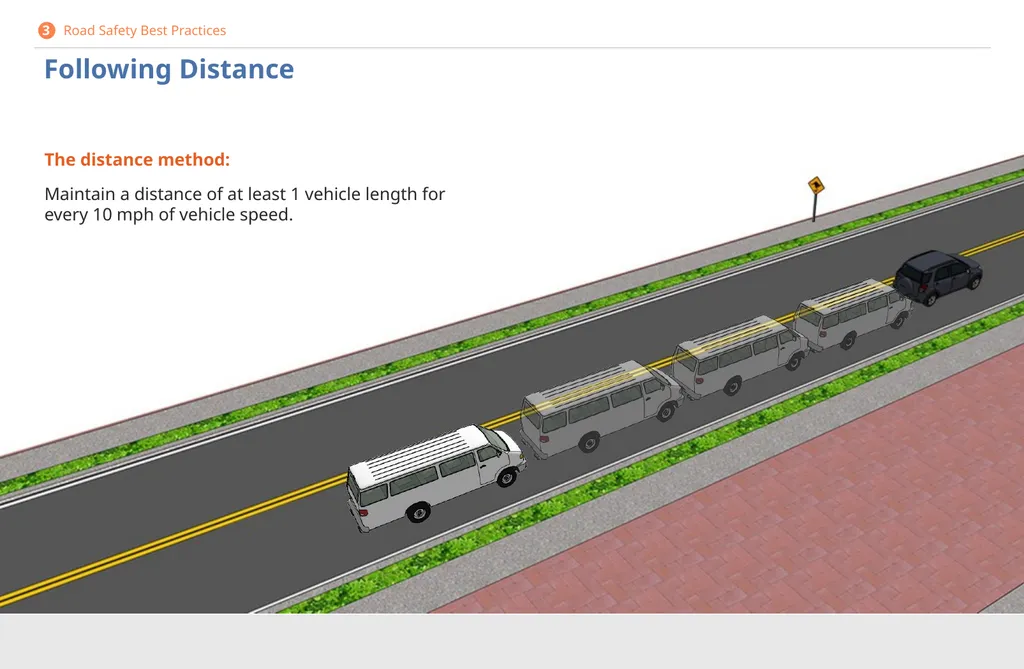
slide25. Following Distance The distance method:
Maintain a distance of at least 1 vehicle length for every 10 mph of vehicle speed. 3 Road Safety Best Practices<br>
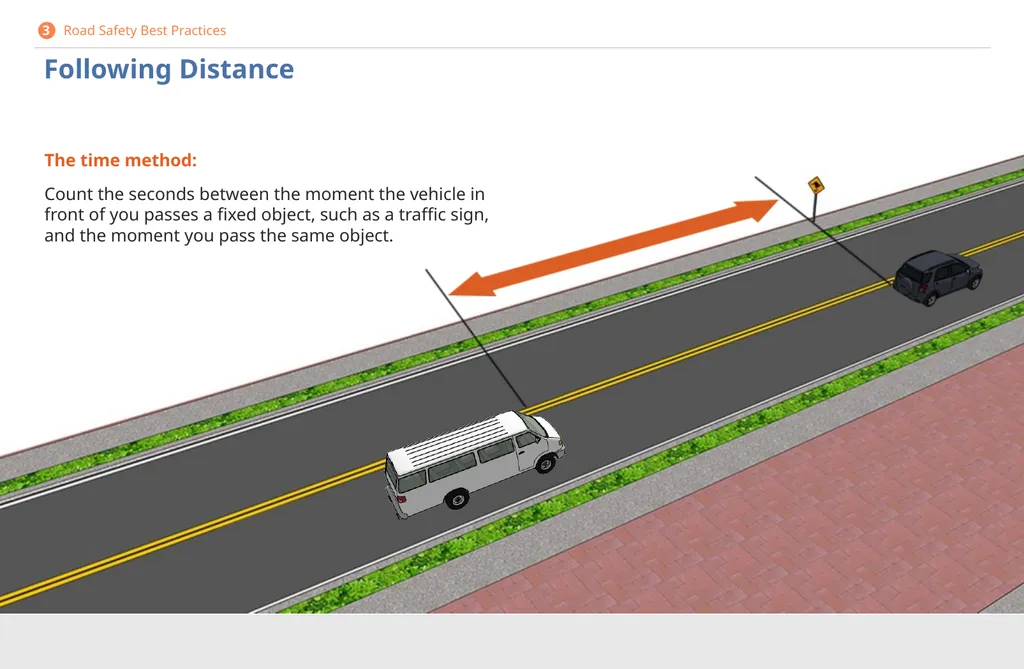
slide26. Following Distance The time method:
Count the seconds between the moment the vehicle in front of you passes a fixed object, such as a traffic sign, and the moment you pass the same object. 3 Road Safety Best Practices<br>
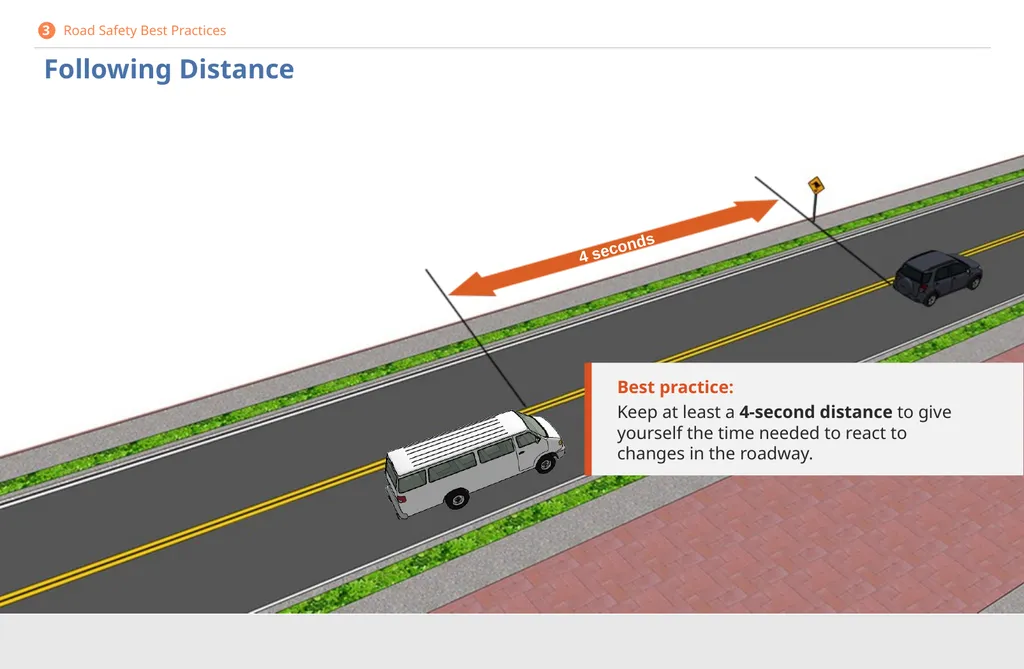
slide27. Following Distance 3 Road Safety Best Practices 4 seconds Best practice:
Keep at least a 4-second distance to give yourself the time needed to react to changes in the roadway.<br>
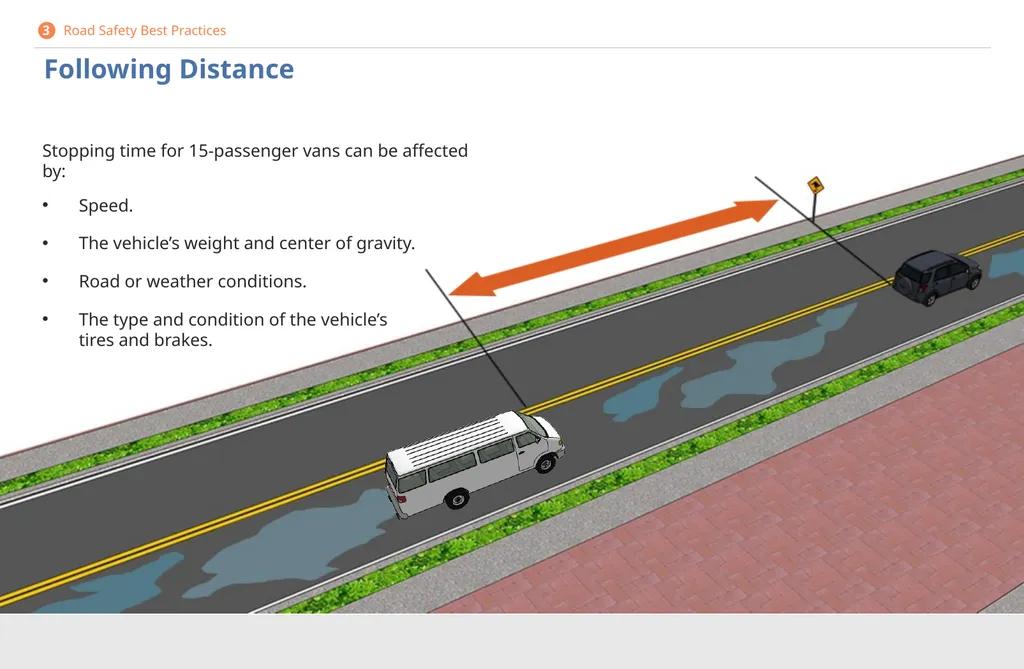
slide28. Following Distance 3 Road Safety Best Practices Stopping time for 15-passenger vans can be affected by:
Speed.
The vehicle’s weight and center of gravity.
Road or weather conditions.
The type and condition of the vehicle’s tires and brakes.<br>
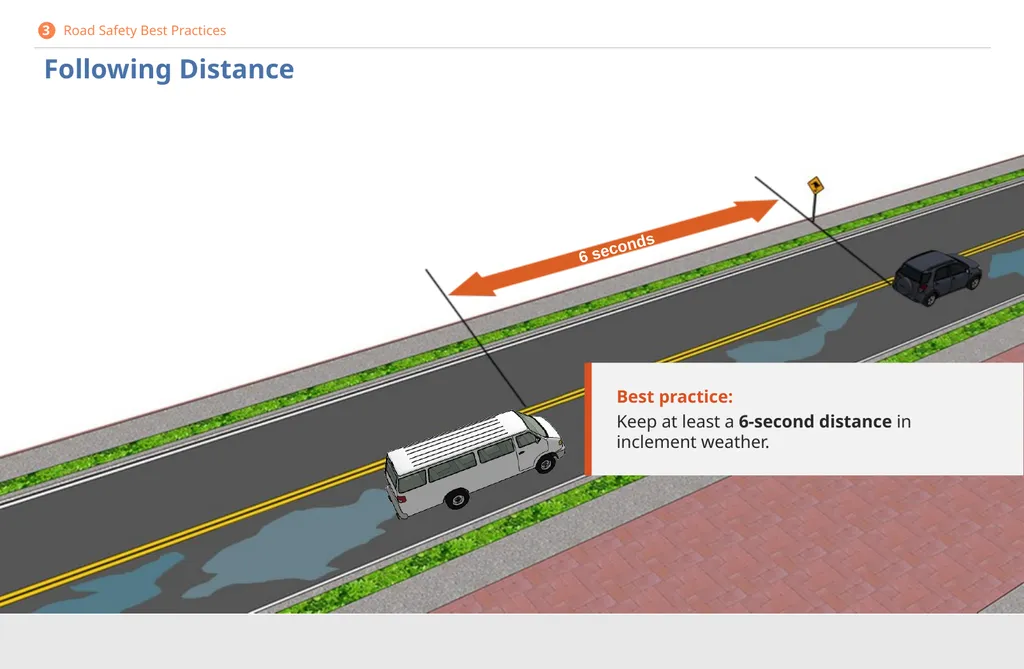
slide29. Following Distance 3 Road Safety Best Practices 6 seconds Best practice:
Keep at least a 6-second distance in inclement weather.<br>
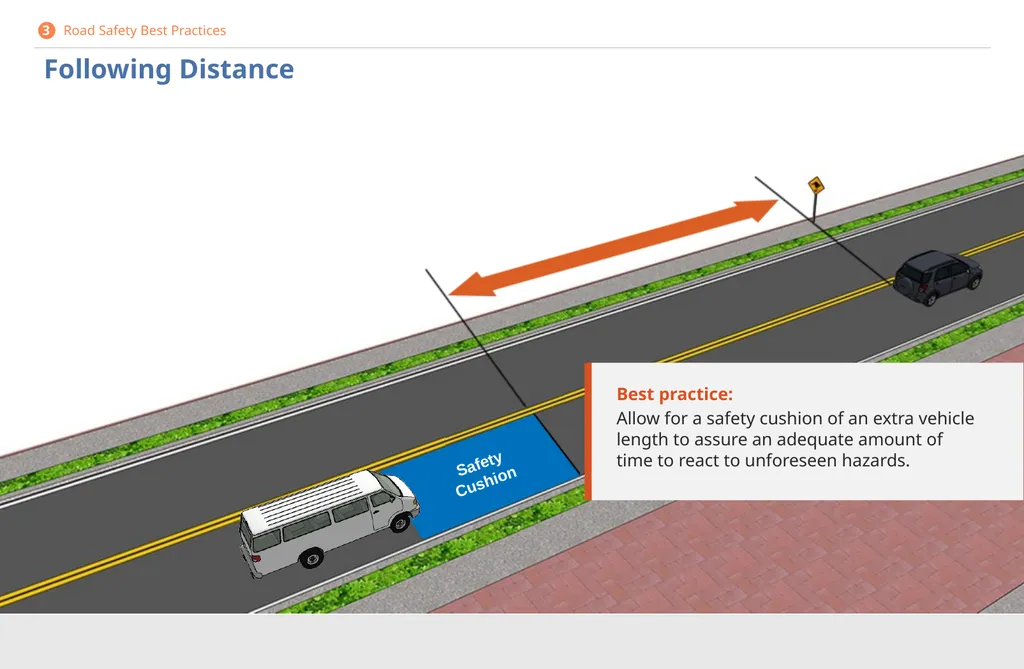
slide30. Following Distance 3 Road Safety Best Practices Best practice:
Allow for a safety cushion of an extra vehicle length to assure an adequate amount of time to react to unforeseen hazards. Safety
Cushion<br>
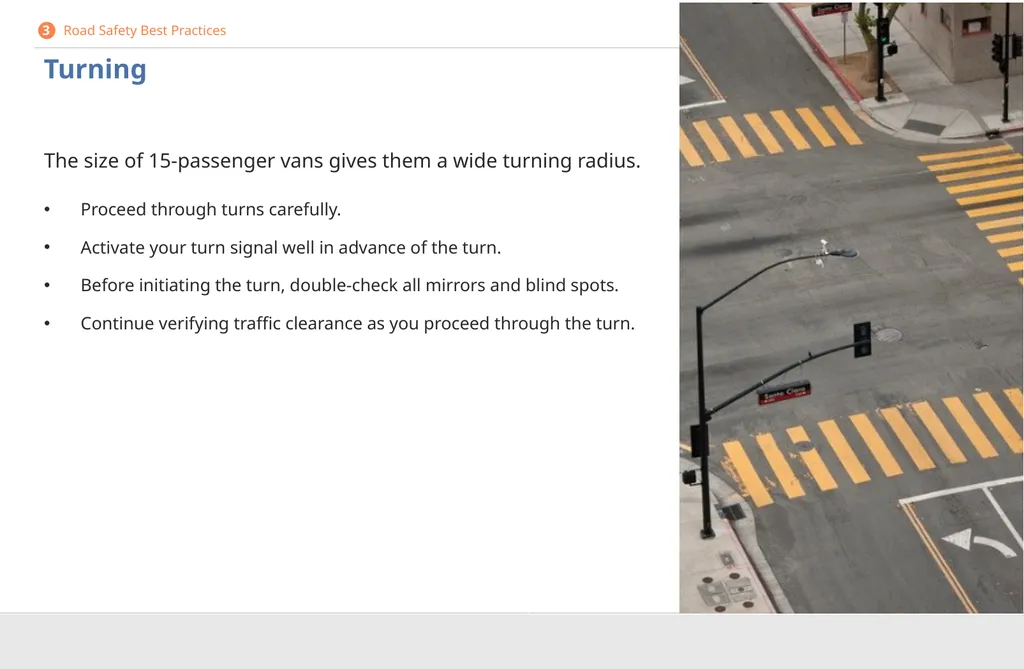
slide31. Turning The size of 15-passenger vans gives them a wide turning radius.
Proceed through turns carefully.
Activate your turn signal well in advance of the turn.
Before initiating the turn, double-check all mirrors and blind spots.
Continue verifying traffic clearance as you proceed through the turn. 3 Road Safety Best Practices<br>
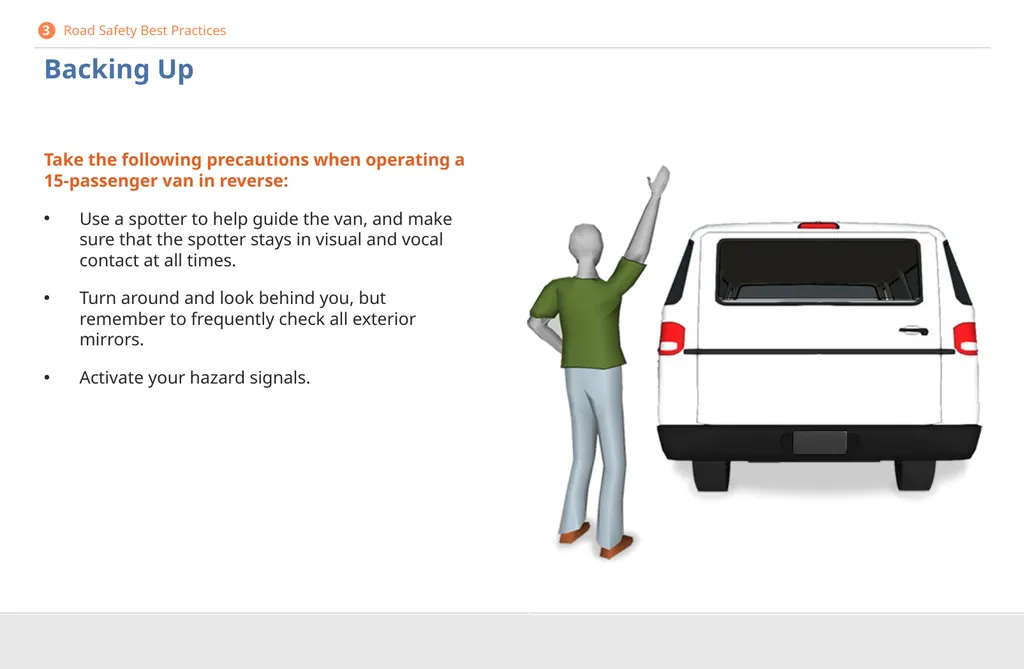
slide32. Backing Up Take the following precautions when operating a 15-passenger van in reverse:
Use a spotter to help guide the van, and make sure that the spotter stays in visual and vocal contact at all times.
Turn around and look behind you, but remember to frequently check all exterior mirrors.
Activate your hazard signals. 3 Road Safety Best Practices<br>
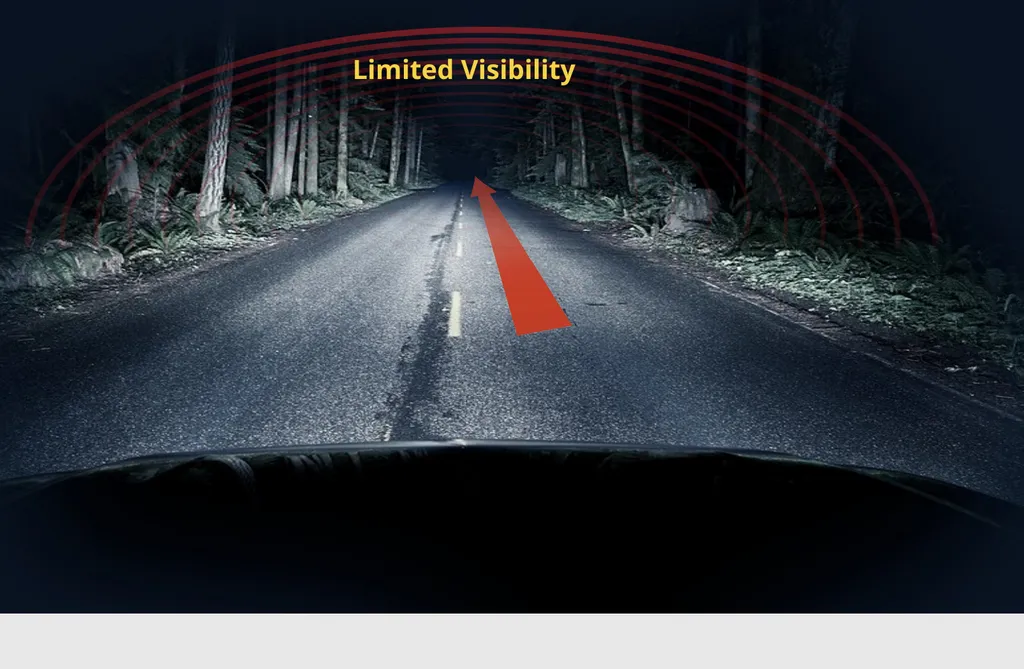
slide33. Limited Visibility<br>
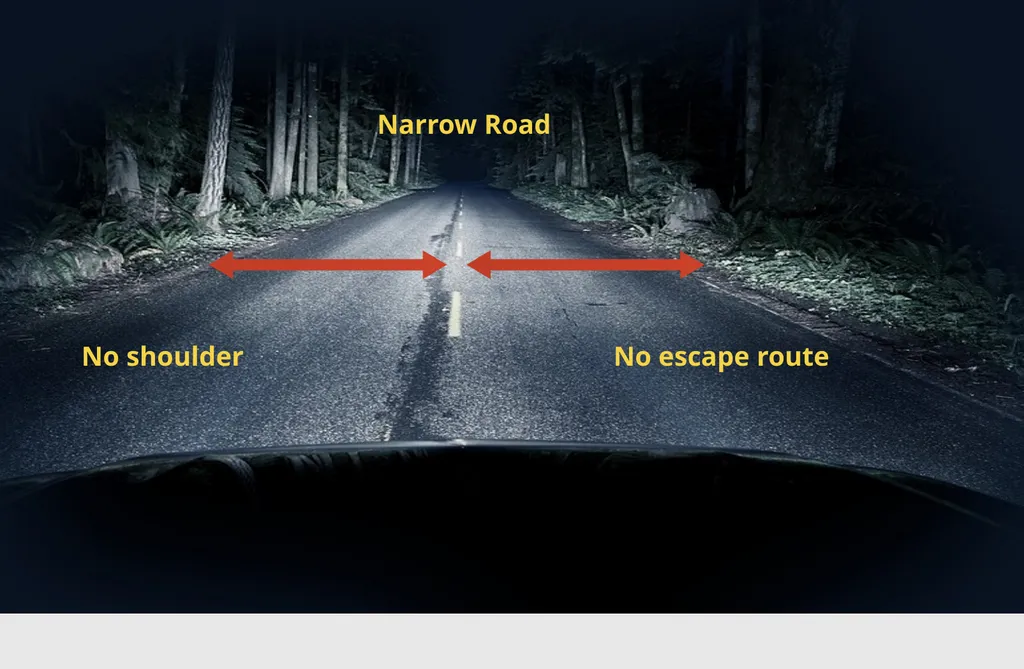
slide34. Narrow Road No shoulder No escape route<br>
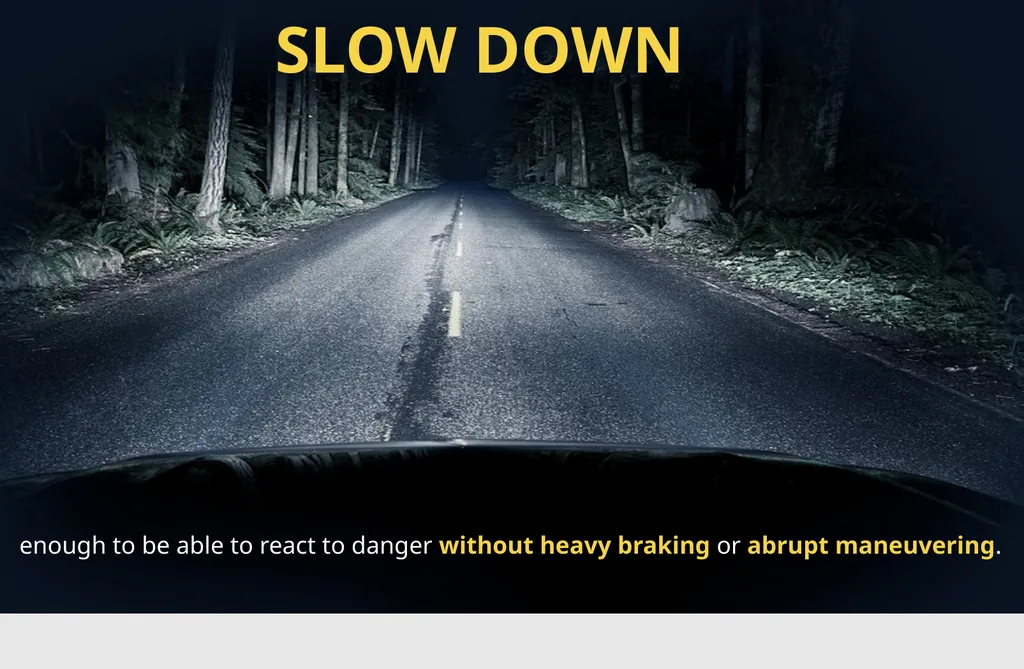
slide35. 3 Road Safety Best Practices enough to be able to react to danger without heavy braking or abrupt maneuvering. SLOW DOWN<br>
slide36. Emergency Response What you need to know:
Proper vehicle preparation for an emergency
Procedures necessary to respond to an emergency 4<br>
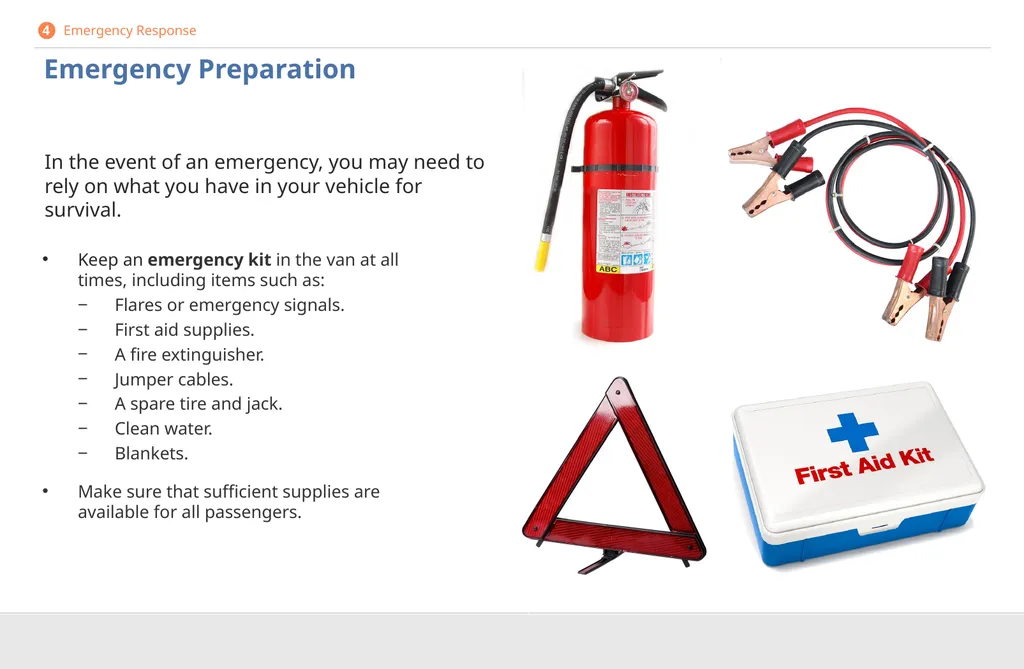
slide37. Emergency Preparation In the event of an emergency, you may need to rely on what you have in your vehicle for survival. 4 Emergency Response Keep an emergency kit in the van at all times, including items such as:
Flares or emergency signals.
First aid supplies.
A fire extinguisher.
Jumper cables.
A spare tire and jack.
Clean water.
Blankets.
Make sure that sufficient supplies are available for all passengers.<br>
slide38. If an emergency occurs:
Do not slam on the brakes.
Maintain a firm grip on the steering wheel.
Take your foot off the gas pedal.
Move the vehicle towards the shoulder or exit.
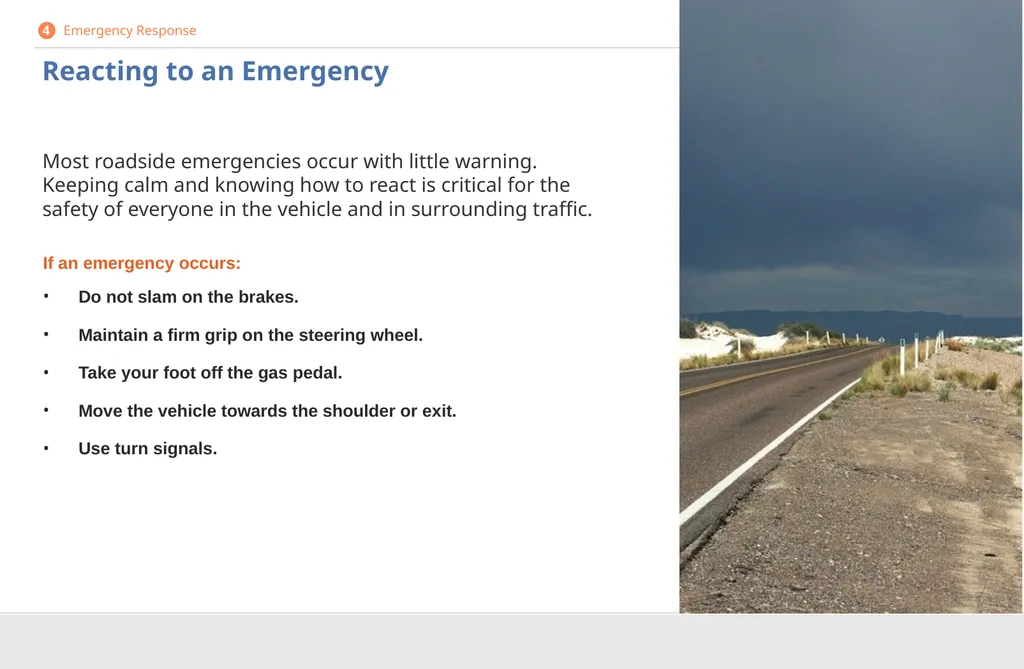
Use turn signals. Reacting to an Emergency Most roadside emergencies occur with little warning. Keeping calm and knowing how to react is critical for the safety of everyone in the vehicle and in surrounding traffic. 4 Emergency Response<br>
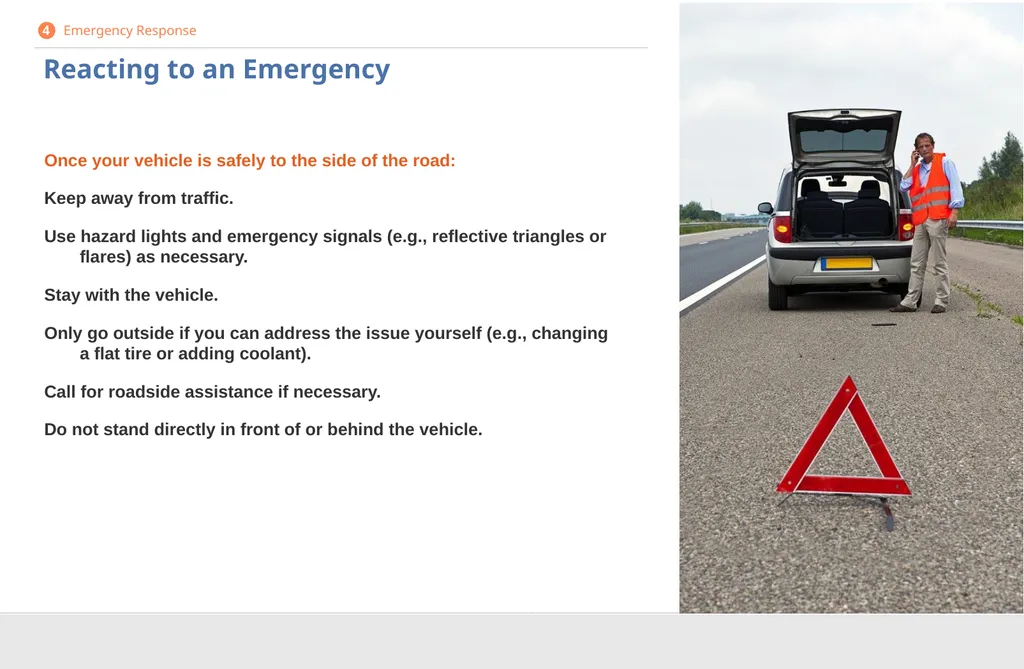
slide39. Reacting to an Emergency Once your vehicle is safely to the side of the road:
Keep away from traffic.
Use hazard lights and emergency signals (e.g., reflective triangles or flares) as necessary.
Stay with the vehicle.
Only go outside if you can address the issue yourself (e.g., changing a flat tire or adding coolant).
Call for roadside assistance if necessary.
Do not stand directly in front of or behind the vehicle. 4 Emergency Response<br>
slide40. Summary You are responsible for your passengers’ well-being, so follow road safety best practices.
Make sure that your vehicle maintenance is up to date.
Load and unload passengers properly.
Know what to do in an emergency.
You, your attitude, and your vehicle’s condition are key to preventing accidents. For more comprehensive information about general driver safety, please see our Defensive Driving Safety course. Finish<br>
slide2. DISCLAIMER This training material presents very important, pertinent information. It should not be assumed, however, that this program satisfies every legal requirement of every state. Some states require the training be developed and delivered by an individual with specific training and experience.
This training is AWARENESS LEVEL and does not authorize any person to perform work or validate their level of competency; it must be supplemented with operation and process-specific assessments and training, as well as management oversight, to assure that all training is understood and followed. Your organization must do an evaluation of all exposures and applicable codes and regulations. In addition, establish proper controls, training, and protective measures to effectively control exposures and assure compliance.
This program is neither a determination that the conditions and practices of your organization are safe, nor a warranty that reliance upon this program will prevent accidents and losses or satisfy local, state, or federal regulations. How to Use this Presentation This presentation contains base material for use in an instructor-led training setting. You may modify this presentation to satisfy the specific training needs of your organization.
On some slides, the display text is supplemented with additional material in the slide notes.
This content is licensed for modification and use in a classroom setting. You may not redistribute this material in any form. Introduction<br>
slide3. Introduction In this course, you’ll learn about:
Common risks.
Methods to minimize the chances of accidents.
Best practices for staying safe on the road.
How to prepare for and respond to emergencies. Introduction The size, availability, and affordability of 15-passenger vans make them a common choice for moving large groups of people and their cargo.
However, the design and construction of 15-passenger vans also make them extremely dangerous in certain situations.<br>
slide4. Course Outline The Risks of 15-Passenger Vans
Pre-Trip Preparations
Road Safety Best Practices
Emergency Response
Summary Introduction<br>
slide5. The Risks of 15-Passenger Vans What you need to know:
Common risks associated with 15-passenger vans
Strategies for reducing these risks 1<br>
slide6. Rollover According to the National Highway Transportation Safety Administration (NHTSA), 15-passenger vans are particularly vulnerable to rollover under certain conditions:
A high number of occupants
Roof cargo
Sharp driving maneuvers
Driving off the edge of the road
Low tire pressure In single-vehicle crashes, 15-passenger vans with 10 or more occupants have about three times the rollover rate of 15-passenger vans with lighter loads. 1 The Risks of 15-Passenger Vans 3x<br>
slide7. Driver Inexperience Drivers with a lack of experience operating 15-passenger vans are more prone to loss of control and rollovers.
Only drive a 15-passenger van if you are authorized.
Authorized drivers must have:
Proper, vehicle-specific training.
Driving experience.
A valid driver’s license. 1 The Risks of 15-Passenger Vans A commercial license may be required to drive a 15-passenger van in certain states or under certain circumstances. *<br>
slide8. Center of Gravity The van’s load can greatly affect its center of gravity.
When empty or when carrying an uneven load, vans maybe more sensitive to adverse conditions, such as strong winds or wet roads, and more prone to loss of control. 15 Passengers Center of Gravity 5 Passengers Center of Gravity 1 Passenger Center of Gravity 1 The Risks of 15-Passenger Vans Know where your center of gravity is.
Drivers must know how their vehicle handles in all situations and how to plan and appropriately compensate for present conditions.<br>
slide9. Construction 15-passenger vans are long and tall, which allows them to accommodate passengers and cargo comfortably, but also increases the risk of rollover. Many older models are not equipped with any stability control features, increasing the risk further. 1 The Risks of 15-Passenger Vans<br>
slide10. Weight Distribution Fully-loaded vans often place excessive weight on the driver-side rear tire. This is what causes so many rollovers. If the van is off-balance, it will be more susceptible to rollover or loss of control.
Be aware of where passengers are sitting and how it may affect the stability of the vehicle. Exercise caution accordingly.
However, due to the van’s construction, balancing weight does not mean spreading out passengers and cargo evenly.
If travelling under capacity: place your passengers as far forward as possible.
If travelling at capacity: try to arrange your passengers so that the heaviest are seated towards the front of the vehicle. 1 The Risks of 15-Passenger Vans<br>
slide11. Tire Wear and Deflation Worn or improperly inflated tires can lead to blowouts or poor control of the vehicle in wet or slippery conditions.
NHTSA studies show that the tires on 15-passenger vans commonly show excessive wear and significant under-inflation, due to factors such as driving conditions and poor maintenance routines. Check the van tires’ pressure and tread wear at least once per month. 60% of van rollovers are attributed to under-inflated tires. ! 1 The Risks of 15-Passenger Vans<br>
slide12. Make sure that you are qualified.
Only drive 15-passenger vans if you have a valid driver’s license and vehicle-specific training.
A commercial license may be required to drive a 15-passenger van in certain states or under certain circumstances. Balance weight across the van.
Arrange your passengers or cargo so that the van’s center of gravity is in the middle of the van:
If travelling at under capacity, place your passengers or cargo as far forward as possible.
If travelling at capacity, try to arrange your passengers so that the heaviest are seated towards the front of the vehicle. Check your tire pressure.
Check the van’s tire pressure at least monthly. Frequency may depend on how much the van is used. Summary If driving a 15-passenger van, take the following precautions to lower the risks. 1 The Risks of 15-Passenger Vans<br>
slide13. Pre-Trip Preparations What you need to know:
Vehicle preparedness
Driver preparedness
Avoiding fatigue
Minimizing distractions 2 2<br>
slide14. Overview A safe trip depends on the following:
Your vehicle
Your abilities
Your attitude
The cooperation of passengers 2 Pre-Trip Preparations<br>
slide15. Vehicle Preparedness Only use 15-passenger vans that have been approved as safe.
Before using a 15-passenger van, assure that:
Inspections are current.
The vehicle’s regular maintenance has been completed.
Any known mechanical issues are documented and repaired as required.
Tire pressure and treads are at the manufacturer’s recommended levels. 2 Pre-Trip Preparations<br>
slide16. Driver Preparedness Before driving, you must be qualified and approved by your employer as a driver.
Additional driver requirements:
A valid state driver’s license
Behind-the-wheel training
Defensive driving skills and attitude 2 Pre-Trip Preparations<br>
slide17. Tips for avoiding fatigue:
Get plenty of rest before your trip.
Take frequent breaks.
Consume water and nutritious snacks. Do not rely on sugar or caffeine.
Keep your mind engaged:
Trivia
Conversation
Audiobooks or podcasts 2 Pre-Trip Preparations Avoiding Fatigue The effects of driving drowsy mimic the effects of driving while intoxicated. Driver fatigue causes approximately 1 million crashes, 500,000 injuries, and 8,000 deaths each year in the United States.<br>
slide18. Minimizing Distractions Electronic devices:
When a driver uses electronic devices, accident rates increase by four times.
Never phone, text, or type while operating a vehicle.
Pull over before answering a call or text.
If taking a call is unavoidable, use a hands-free system. However, be aware that your attention will still be impaired.
If necessary, turn the device off so that it will not be a distraction. 2 Pre-Trip Preparations<br>
slide19. Minimizing Distractions Other common distractions:
Adjusting vehicle controls
Reaching for objects
Grooming
Eating or drinking
Tending to children 2 Pre-Trip Preparations Whenever possible, delay these activities until you are able to pull over to a safe location or have reached your destination.<br>
slide20. Road Safety Best Practices What you need to know:
Safe loading and unloading
Regulating speed
Maneuvering safely
Following at a safe distance
Judging stop time
Taking precautions when driving in reverse
Backing up
Turning safely 3<br>
slide21. Safe Loading and Unloading Use a responsible spotter when loading, unloading, backing, or parking so that no person or object will be in harm’s way.
Never unload passengers into traffic.
Avoid stopping where passengers will have to cross streets after disembarking.
When the van must stop on a busy highway, use care in unloading passengers:
Keep all passengers away from the front or rear of the vehicle.
Keep them in a group and away from traffic. 3 Road Safety Best Practices Passengers can be injured or even killed during loading and unloading. Know how, when, and where to unload passengers to provide for their safety at all times.<br>
slide22. Speed Speeds that may be acceptable for passenger cars may be dangerous for 15-passenger vans.
As a rule, you should not exceed 60 mph.
Slow down when you encounter poor weather, road, or traffic conditions.
Use extra caution when driving on curved, narrow, or rural roads. 3 Road Safety Best Practices<br>
slide23. Maneuvering 15-passenger vans are particularly dangerous during abrupt steering maneuvers.
Be mindful of your vehicle’s size when maneuvering, both on the road and in off-street environments, such as parking lots or driveways.
Make your actions slow and deliberate.
Check all mirrors every few seconds to keep aware of your surroundings. 3 Road Safety Best Practices<br>
slide24. Following Distance Establish and maintain a safe following distance via one of the following methods:
The distance method
The time method 3 Road Safety Best Practices<br>
slide25. Following Distance The distance method:
Maintain a distance of at least 1 vehicle length for every 10 mph of vehicle speed. 3 Road Safety Best Practices<br>
slide26. Following Distance The time method:
Count the seconds between the moment the vehicle in front of you passes a fixed object, such as a traffic sign, and the moment you pass the same object. 3 Road Safety Best Practices<br>
slide27. Following Distance 3 Road Safety Best Practices 4 seconds Best practice:
Keep at least a 4-second distance to give yourself the time needed to react to changes in the roadway.<br>
slide28. Following Distance 3 Road Safety Best Practices Stopping time for 15-passenger vans can be affected by:
Speed.
The vehicle’s weight and center of gravity.
Road or weather conditions.
The type and condition of the vehicle’s tires and brakes.<br>
slide29. Following Distance 3 Road Safety Best Practices 6 seconds Best practice:
Keep at least a 6-second distance in inclement weather.<br>
slide30. Following Distance 3 Road Safety Best Practices Best practice:
Allow for a safety cushion of an extra vehicle length to assure an adequate amount of time to react to unforeseen hazards. Safety
Cushion<br>
slide31. Turning The size of 15-passenger vans gives them a wide turning radius.
Proceed through turns carefully.
Activate your turn signal well in advance of the turn.
Before initiating the turn, double-check all mirrors and blind spots.
Continue verifying traffic clearance as you proceed through the turn. 3 Road Safety Best Practices<br>
slide32. Backing Up Take the following precautions when operating a 15-passenger van in reverse:
Use a spotter to help guide the van, and make sure that the spotter stays in visual and vocal contact at all times.
Turn around and look behind you, but remember to frequently check all exterior mirrors.
Activate your hazard signals. 3 Road Safety Best Practices<br>
slide33. Limited Visibility<br>
slide34. Narrow Road No shoulder No escape route<br>
slide35. 3 Road Safety Best Practices enough to be able to react to danger without heavy braking or abrupt maneuvering. SLOW DOWN<br>
slide36. Emergency Response What you need to know:
Proper vehicle preparation for an emergency
Procedures necessary to respond to an emergency 4<br>
slide37. Emergency Preparation In the event of an emergency, you may need to rely on what you have in your vehicle for survival. 4 Emergency Response Keep an emergency kit in the van at all times, including items such as:
Flares or emergency signals.
First aid supplies.
A fire extinguisher.
Jumper cables.
A spare tire and jack.
Clean water.
Blankets.
Make sure that sufficient supplies are available for all passengers.<br>
slide38. If an emergency occurs:
Do not slam on the brakes.
Maintain a firm grip on the steering wheel.
Take your foot off the gas pedal.
Move the vehicle towards the shoulder or exit.
Use turn signals. Reacting to an Emergency Most roadside emergencies occur with little warning. Keeping calm and knowing how to react is critical for the safety of everyone in the vehicle and in surrounding traffic. 4 Emergency Response<br>
slide39. Reacting to an Emergency Once your vehicle is safely to the side of the road:
Keep away from traffic.
Use hazard lights and emergency signals (e.g., reflective triangles or flares) as necessary.
Stay with the vehicle.
Only go outside if you can address the issue yourself (e.g., changing a flat tire or adding coolant).
Call for roadside assistance if necessary.
Do not stand directly in front of or behind the vehicle. 4 Emergency Response<br>
slide40. Summary You are responsible for your passengers’ well-being, so follow road safety best practices.
Make sure that your vehicle maintenance is up to date.
Load and unload passengers properly.
Know what to do in an emergency.
You, your attitude, and your vehicle’s condition are key to preventing accidents. For more comprehensive information about general driver safety, please see our Defensive Driving Safety course. Finish<br>