
Drug & Alcohol Family Support Needs Analysis
PT
Published · 40 slides · 0 views

1 / 1





Description
Drug Alcohol Family Support Needs Analysis Report Debbie McDonagh Family Support Development Worker Problem drug use has considerable negative impacts for families and their functioning. The effects of drug misuse on the family overall
Related Topics
Share
Embed code
Download this presentation From Below
"Drug & Alcohol Family Support Needs Analysis" is the property of its rightful owner. Permission is granted to download and print the materials on this website for personal, non-commercial use only, and to display it on your personal computer provided you do not modify the materials and that you retain all copyright notices contained in the materials. By downloading content from our website, you accept the terms of this agreement.
Presentation Transcript
01
Drug & Alcohol Family Support Needs Analysis Report Debbie McDonagh
Family Support Development Worker<br>
Family Support Development Worker<br>
02
“Problem drug use has considerable negative impacts for families and their functioning. The effects of drug misuse on the family overall include deteriorating relationships and making the family dysfunctional, psychological and social problems, increased stress, depression and behavioural disorders, financial difficulties, all of which can contribute to family breakdown and negative impacts on adult and child members of the family.”
(NACD, 2004. The Role of Family Support Service in Drug Prevention)<br>
(NACD, 2004. The Role of Family Support Service in Drug Prevention)<br>
03
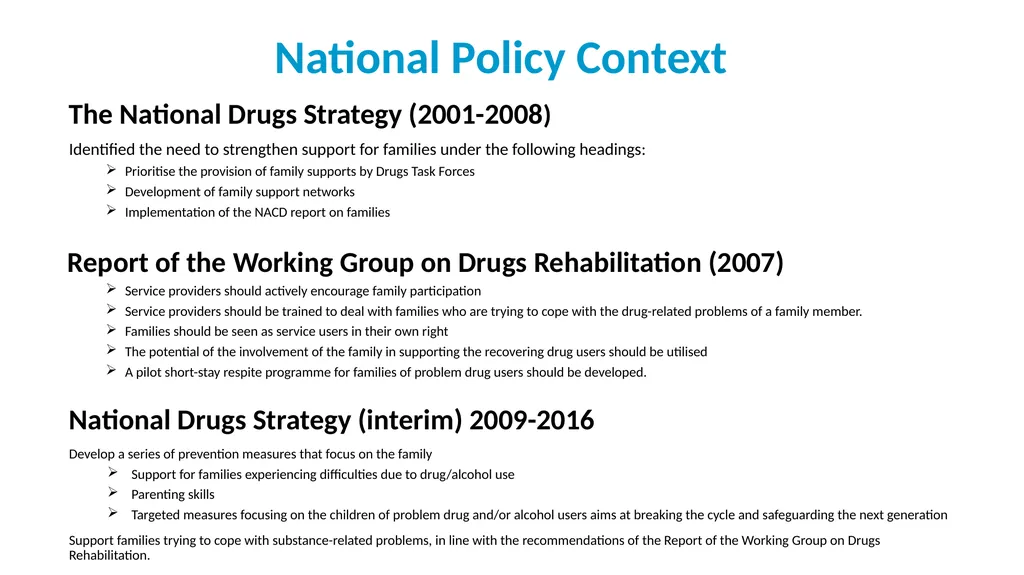
The National Drugs Strategy (2001-2008)
Identified the need to strengthen support for families under the following headings:
Prioritise the provision of family supports by Drugs Task Forces
Development of family support networks
Implementation of the NACD report on families
Report of the Working Group on Drugs Rehabilitation (2007)
Service providers should actively encourage family participation
Service providers should be trained to deal with families who are trying to cope with the drug-related problems of a family member.
Families should be seen as service users in their own right
The potential of the involvement of the family in supporting the recovering drug users should be utilised
A pilot short-stay respite programme for families of problem drug users should be developed.
National Drugs Strategy (interim) 2009-2016
Develop a series of prevention measures that focus on the family
Support for families experiencing difficulties due to drug/alcohol use
Parenting skills
Targeted measures focusing on the children of problem drug and/or alcohol users aims at breaking the cycle and safeguarding the next generation
Support families trying to cope with substance-related problems, in line with the recommendations of the Report of the Working Group on Drugs Rehabilitation. National Policy Context<br>
Identified the need to strengthen support for families under the following headings:
Prioritise the provision of family supports by Drugs Task Forces
Development of family support networks
Implementation of the NACD report on families
Report of the Working Group on Drugs Rehabilitation (2007)
Service providers should actively encourage family participation
Service providers should be trained to deal with families who are trying to cope with the drug-related problems of a family member.
Families should be seen as service users in their own right
The potential of the involvement of the family in supporting the recovering drug users should be utilised
A pilot short-stay respite programme for families of problem drug users should be developed.
National Drugs Strategy (interim) 2009-2016
Develop a series of prevention measures that focus on the family
Support for families experiencing difficulties due to drug/alcohol use
Parenting skills
Targeted measures focusing on the children of problem drug and/or alcohol users aims at breaking the cycle and safeguarding the next generation
Support families trying to cope with substance-related problems, in line with the recommendations of the Report of the Working Group on Drugs Rehabilitation. National Policy Context<br>
04
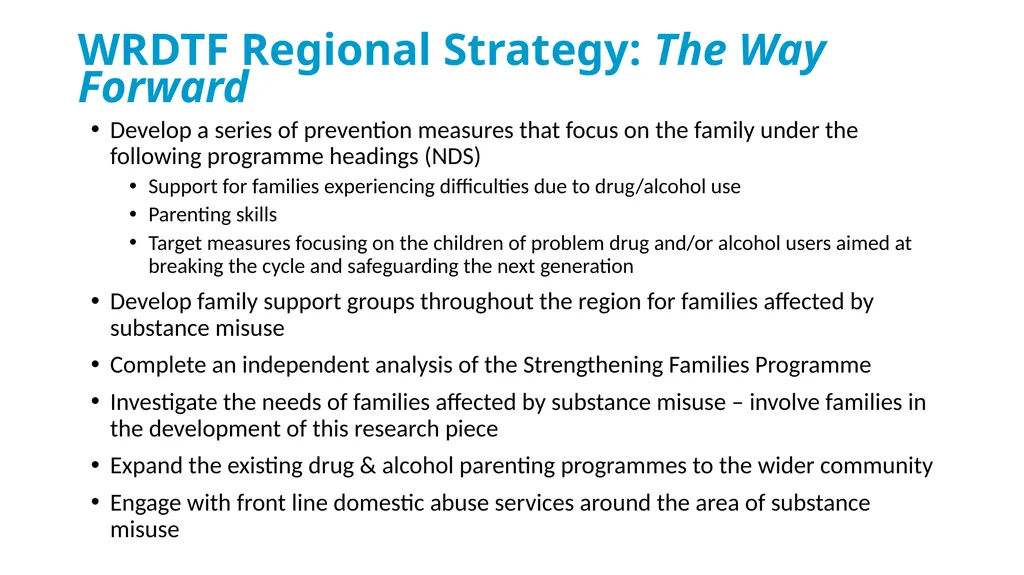
WRDTF Regional Strategy: The Way Forward Develop a series of prevention measures that focus on the family under the following programme headings (NDS)
Support for families experiencing difficulties due to drug/alcohol use
Parenting skills
Target measures focusing on the children of problem drug and/or alcohol users aimed at breaking the cycle and safeguarding the next generation
Develop family support groups throughout the region for families affected by substance misuse
Complete an independent analysis of the Strengthening Families Programme
Investigate the needs of families affected by substance misuse – involve families in the development of this research piece
Expand the existing drug & alcohol parenting programmes to the wider community
Engage with front line domestic abuse services around the area of substance misuse<br>
Support for families experiencing difficulties due to drug/alcohol use
Parenting skills
Target measures focusing on the children of problem drug and/or alcohol users aimed at breaking the cycle and safeguarding the next generation
Develop family support groups throughout the region for families affected by substance misuse
Complete an independent analysis of the Strengthening Families Programme
Investigate the needs of families affected by substance misuse – involve families in the development of this research piece
Expand the existing drug & alcohol parenting programmes to the wider community
Engage with front line domestic abuse services around the area of substance misuse<br>
05
Family Support Initiatives (WRDTF funded) Family Support Groups
Teen wellness programme
Wellness/respite days
Headspace programme (Roscommon)
Child to parent violence intervention programme
Living with addiction courses
Personal Development courses (Castlerea Prison FVC) “Wasted” (a play run by ARTSI about families affected by addiction)
Funding for SFP, CRAFT & 5-STEP
Targeted workshops/seminars
Regional network
Website
Home-truths conference and awareness week<br>
Teen wellness programme
Wellness/respite days
Headspace programme (Roscommon)
Child to parent violence intervention programme
Living with addiction courses
Personal Development courses (Castlerea Prison FVC) “Wasted” (a play run by ARTSI about families affected by addiction)
Funding for SFP, CRAFT & 5-STEP
Targeted workshops/seminars
Regional network
Website
Home-truths conference and awareness week<br>
06
Training
Facilitation
Awareness
Work with Families
Network
Programme development
Family Support Resource
Research: Needs Analysis WRDTF Family Support Development Worker<br>
Facilitation
Awareness
Work with Families
Network
Programme development
Family Support Resource
Research: Needs Analysis WRDTF Family Support Development Worker<br>
07
Needs Analysis - Background This research:
Aims to contribute to a greater understanding of the ways families affected by substance use seek support in the western region.
Explores the availability and effectiveness of supports to families from a service perspective
Contributes to the development of a family support strategy to identify and help improve service provision to families affected by substance use<br>
Aims to contribute to a greater understanding of the ways families affected by substance use seek support in the western region.
Explores the availability and effectiveness of supports to families from a service perspective
Contributes to the development of a family support strategy to identify and help improve service provision to families affected by substance use<br>
08
It is envisaged that the report will:
Identify gaps in existing service provision for drug and alcohol family support;
Contribute to the continuing development of drug and alcohol family support services in the region;
Highlight appropriate training as identified by relevant services;
Ensure that interventions and services remain an integral part of WRDTF work with children and families affected by substance use;
Provide recommendations for the forthcoming strategy<br>
Identify gaps in existing service provision for drug and alcohol family support;
Contribute to the continuing development of drug and alcohol family support services in the region;
Highlight appropriate training as identified by relevant services;
Ensure that interventions and services remain an integral part of WRDTF work with children and families affected by substance use;
Provide recommendations for the forthcoming strategy<br>
09
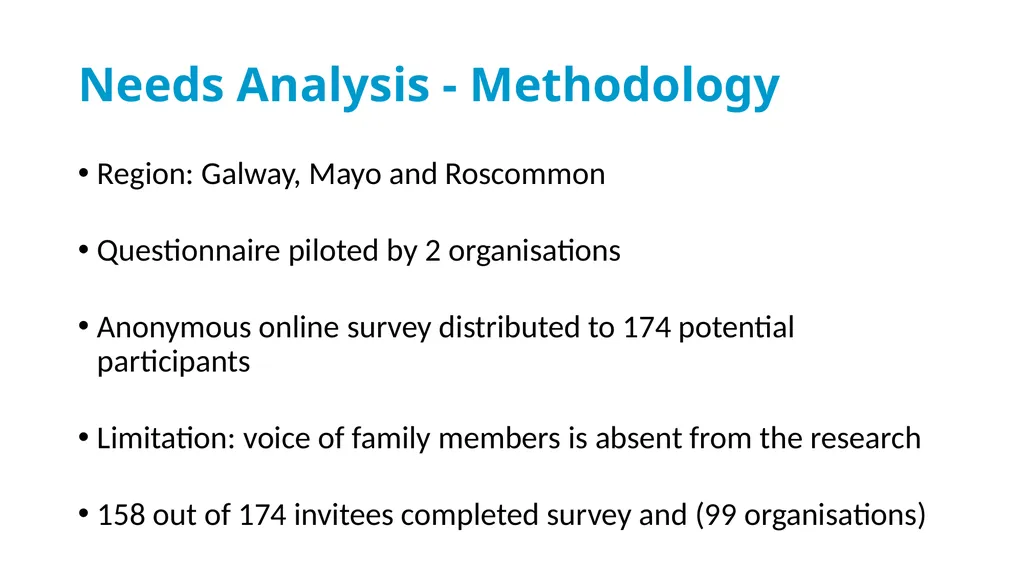
Needs Analysis - Methodology Region: Galway, Mayo and Roscommon
Questionnaire piloted by 2 organisations
Anonymous online survey distributed to 174 potential participants
Limitation: voice of family members is absent from the research
158 out of 174 invitees completed survey and (99 organisations)<br>
Questionnaire piloted by 2 organisations
Anonymous online survey distributed to 174 potential participants
Limitation: voice of family members is absent from the research
158 out of 174 invitees completed survey and (99 organisations)<br>
10
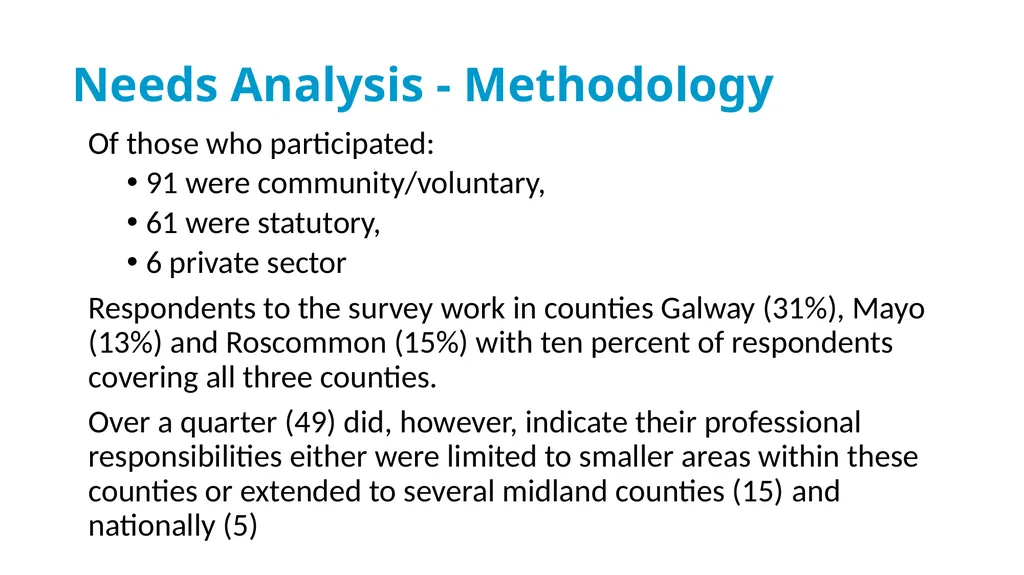
Needs Analysis - Methodology Of those who participated:
91 were community/voluntary,
61 were statutory,
6 private sector
Respondents to the survey work in counties Galway (31%), Mayo (13%) and Roscommon (15%) with ten percent of respondents covering all three counties.
Over a quarter (49) did, however, indicate their professional responsibilities either were limited to smaller areas within these counties or extended to several midland counties (15) and nationally (5)<br>
91 were community/voluntary,
61 were statutory,
6 private sector
Respondents to the survey work in counties Galway (31%), Mayo (13%) and Roscommon (15%) with ten percent of respondents covering all three counties.
Over a quarter (49) did, however, indicate their professional responsibilities either were limited to smaller areas within these counties or extended to several midland counties (15) and nationally (5)<br>
11
What the literature says<br>
12
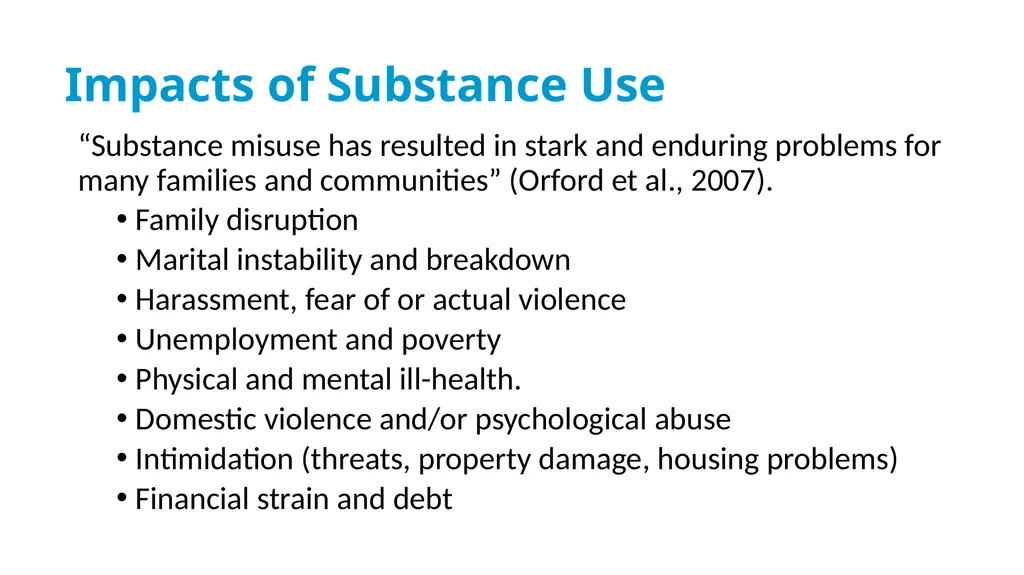
Impacts of Substance Use “Substance misuse has resulted in stark and enduring problems for many families and communities” (Orford et al., 2007).
Family disruption
Marital instability and breakdown
Harassment, fear of or actual violence
Unemployment and poverty
Physical and mental ill-health.
Domestic violence and/or psychological abuse
Intimidation (threats, property damage, housing problems)
Financial strain and debt<br>
Family disruption
Marital instability and breakdown
Harassment, fear of or actual violence
Unemployment and poverty
Physical and mental ill-health.
Domestic violence and/or psychological abuse
Intimidation (threats, property damage, housing problems)
Financial strain and debt<br>
13
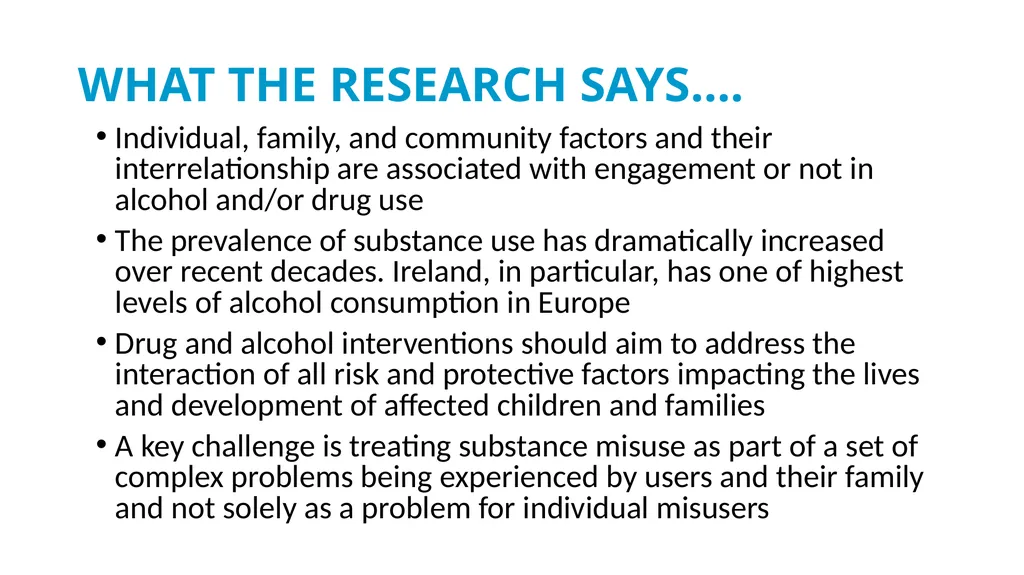
WHAT THE RESEARCH SAYS…. Individual, family, and community factors and their interrelationship are associated with engagement or not in alcohol and/or drug use
The prevalence of substance use has dramatically increased over recent decades. Ireland, in particular, has one of highest levels of alcohol consumption in Europe
Drug and alcohol interventions should aim to address the interaction of all risk and protective factors impacting the lives and development of affected children and families
A key challenge is treating substance misuse as part of a set of complex problems being experienced by users and their family and not solely as a problem for individual misusers<br>
The prevalence of substance use has dramatically increased over recent decades. Ireland, in particular, has one of highest levels of alcohol consumption in Europe
Drug and alcohol interventions should aim to address the interaction of all risk and protective factors impacting the lives and development of affected children and families
A key challenge is treating substance misuse as part of a set of complex problems being experienced by users and their family and not solely as a problem for individual misusers<br>
14
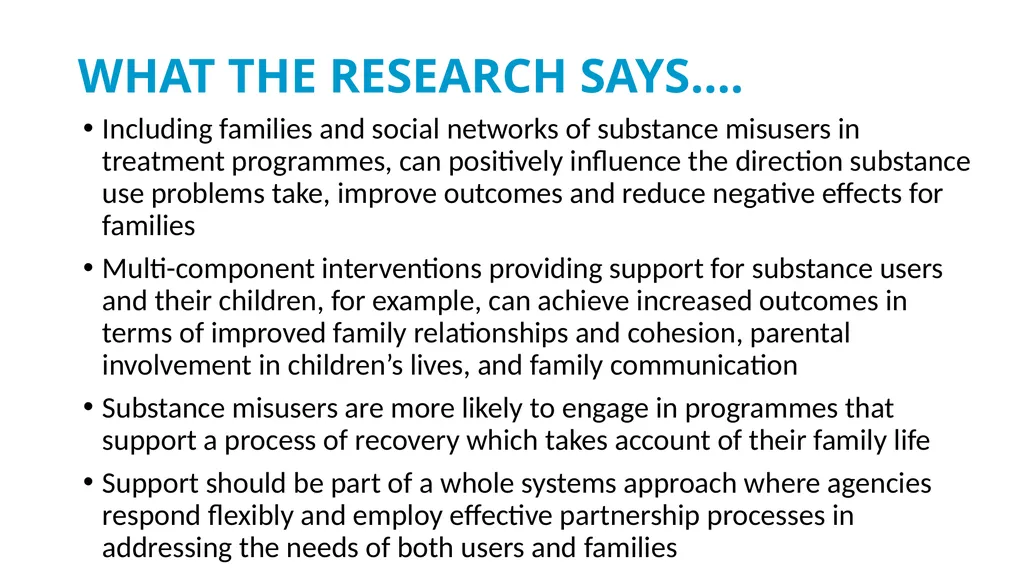
WHAT THE RESEARCH SAYS…. Including families and social networks of substance misusers in treatment programmes, can positively influence the direction substance use problems take, improve outcomes and reduce negative effects for families
Multi-component interventions providing support for substance users and their children, for example, can achieve increased outcomes in terms of improved family relationships and cohesion, parental involvement in children’s lives, and family communication
Substance misusers are more likely to engage in programmes that support a process of recovery which takes account of their family life
Support should be part of a whole systems approach where agencies respond flexibly and employ effective partnership processes in addressing the needs of both users and families<br>
Multi-component interventions providing support for substance users and their children, for example, can achieve increased outcomes in terms of improved family relationships and cohesion, parental involvement in children’s lives, and family communication
Substance misusers are more likely to engage in programmes that support a process of recovery which takes account of their family life
Support should be part of a whole systems approach where agencies respond flexibly and employ effective partnership processes in addressing the needs of both users and families<br>
15
Needs Analysis: Key Findings<br>
16
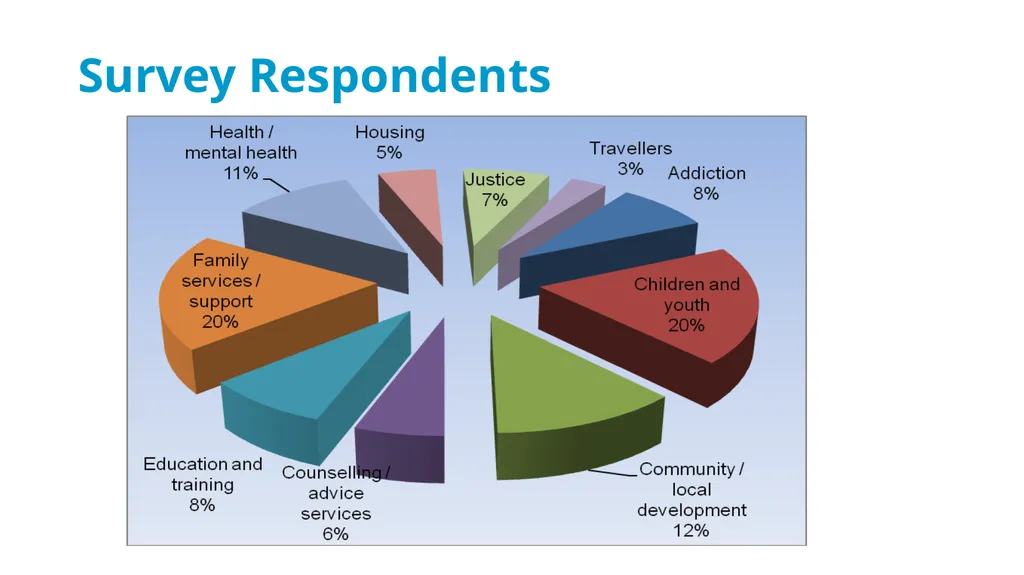
Survey Respondents<br>
17
Services provided by the organisations<br>
18
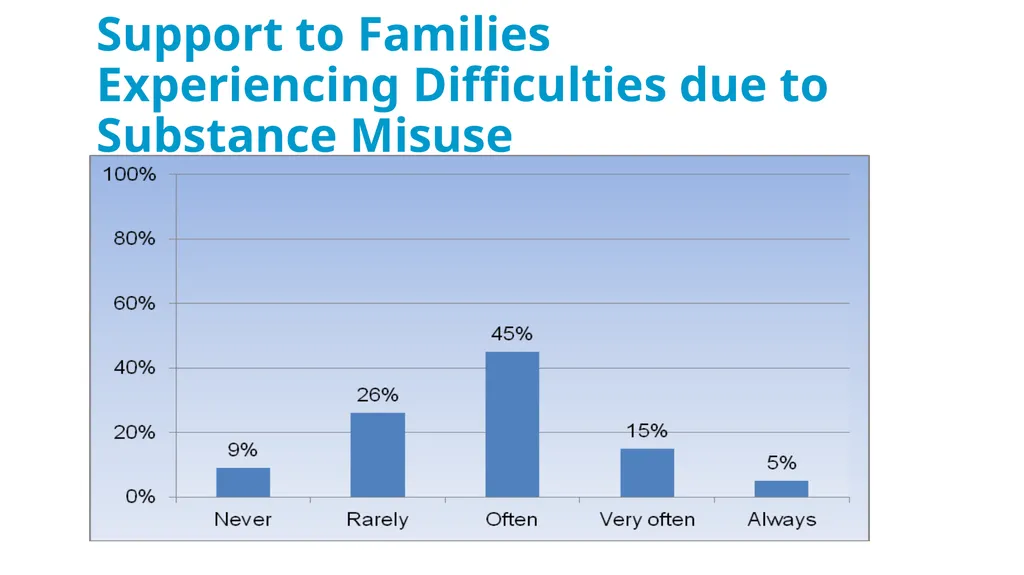
Support to Families Experiencing Difficulties due to Substance Misuse<br>
19
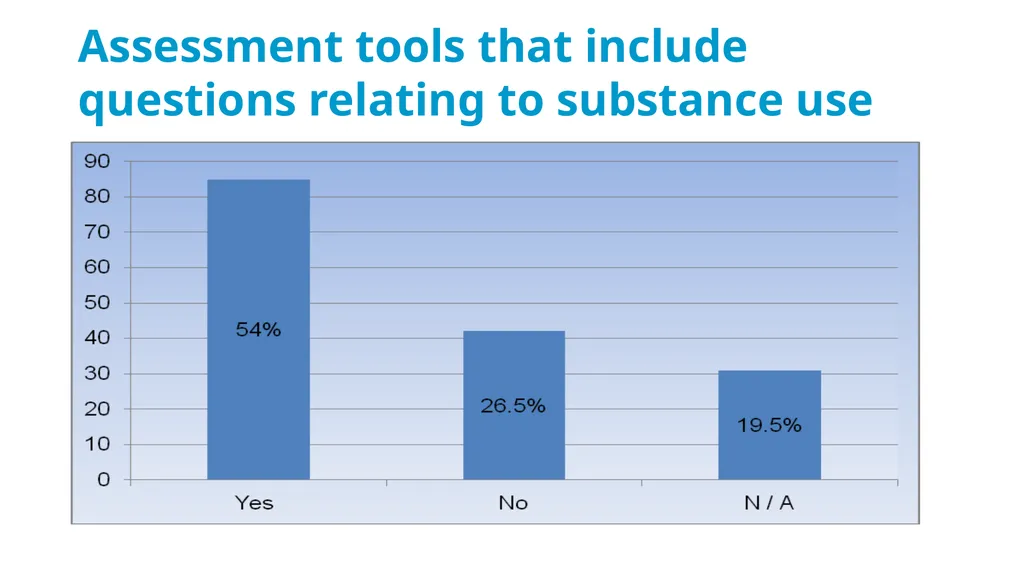
Assessment tools that include questions relating to substance use<br>
20
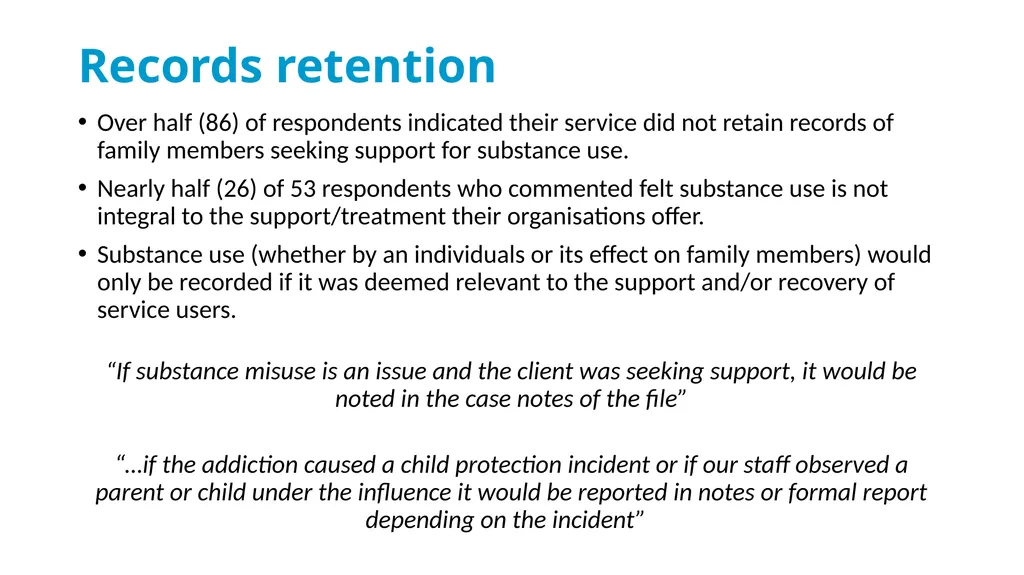
Records retention Over half (86) of respondents indicated their service did not retain records of family members seeking support for substance use.
Nearly half (26) of 53 respondents who commented felt substance use is not integral to the support/treatment their organisations offer.
Substance use (whether by an individuals or its effect on family members) would only be recorded if it was deemed relevant to the support and/or recovery of service users.
“If substance misuse is an issue and the client was seeking support, it would be noted in the case notes of the file”
“…if the addiction caused a child protection incident or if our staff observed a parent or child under the influence it would be reported in notes or formal report depending on the incident”<br>
Nearly half (26) of 53 respondents who commented felt substance use is not integral to the support/treatment their organisations offer.
Substance use (whether by an individuals or its effect on family members) would only be recorded if it was deemed relevant to the support and/or recovery of service users.
“If substance misuse is an issue and the client was seeking support, it would be noted in the case notes of the file”
“…if the addiction caused a child protection incident or if our staff observed a parent or child under the influence it would be reported in notes or formal report depending on the incident”<br>
21
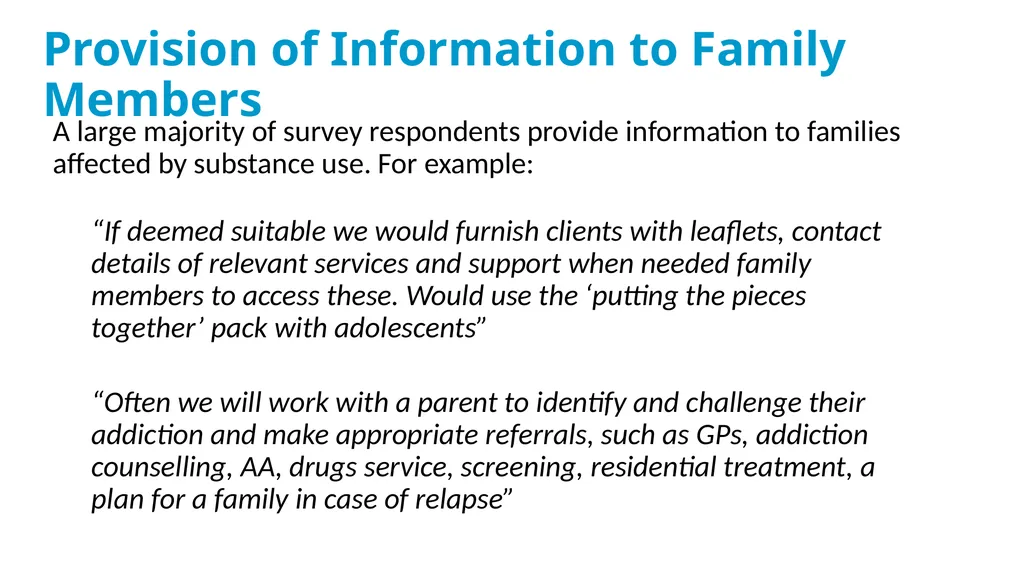
Provision of Information to Family Members A large majority of survey respondents provide information to families affected by substance use. For example:
“If deemed suitable we would furnish clients with leaflets, contact details of relevant services and support when needed family members to access these. Would use the ‘putting the pieces together’ pack with adolescents”
“Often we will work with a parent to identify and challenge their addiction and make appropriate referrals, such as GPs, addiction counselling, AA, drugs service, screening, residential treatment, a plan for a family in case of relapse”<br>
“If deemed suitable we would furnish clients with leaflets, contact details of relevant services and support when needed family members to access these. Would use the ‘putting the pieces together’ pack with adolescents”
“Often we will work with a parent to identify and challenge their addiction and make appropriate referrals, such as GPs, addiction counselling, AA, drugs service, screening, residential treatment, a plan for a family in case of relapse”<br>
22
Information offered to families affected by substance use<br>
23
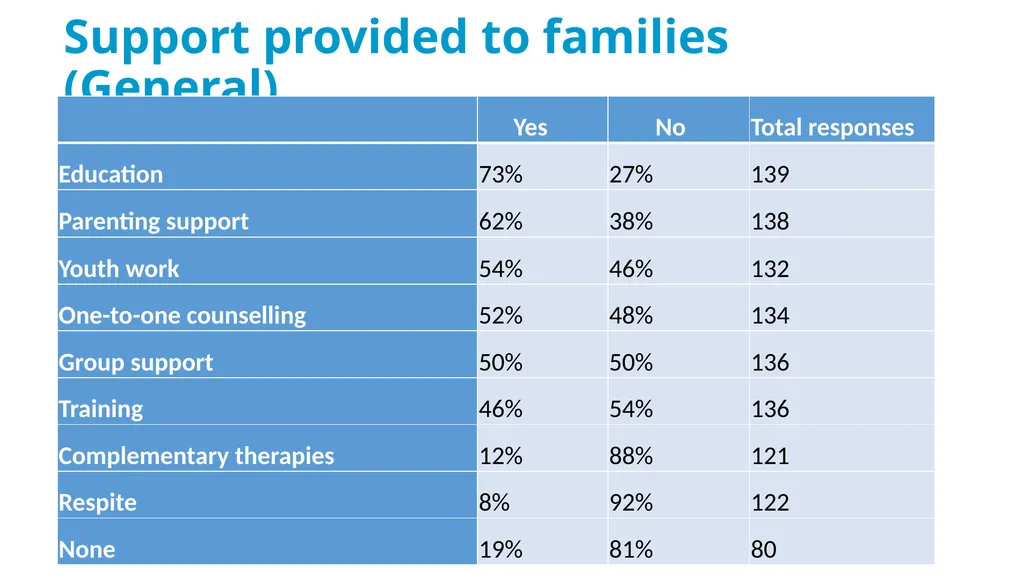
Support provided to families (General) Table Five: Support provided to families<br>
24
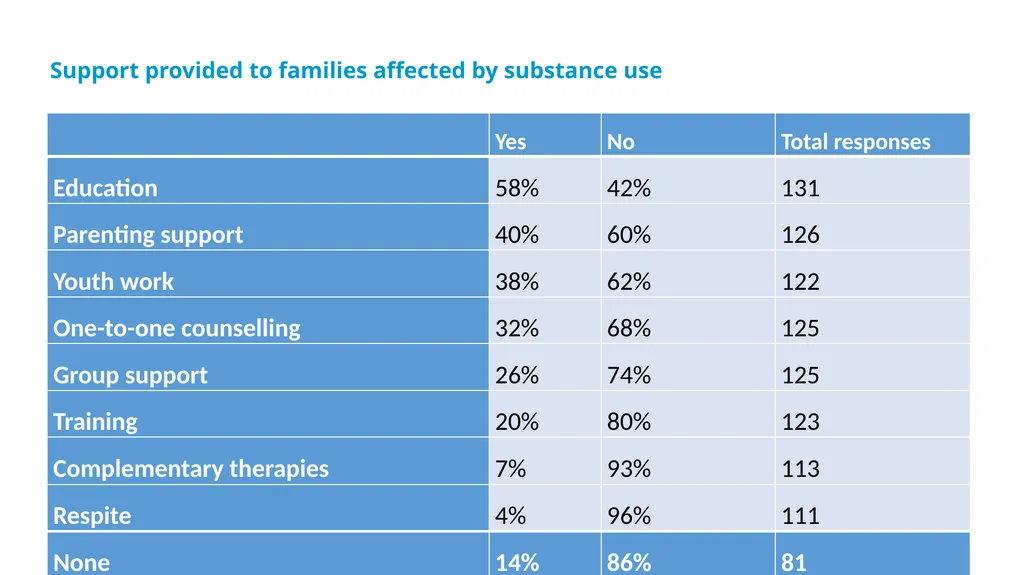
Support provided to families affected by substance use<br>
25
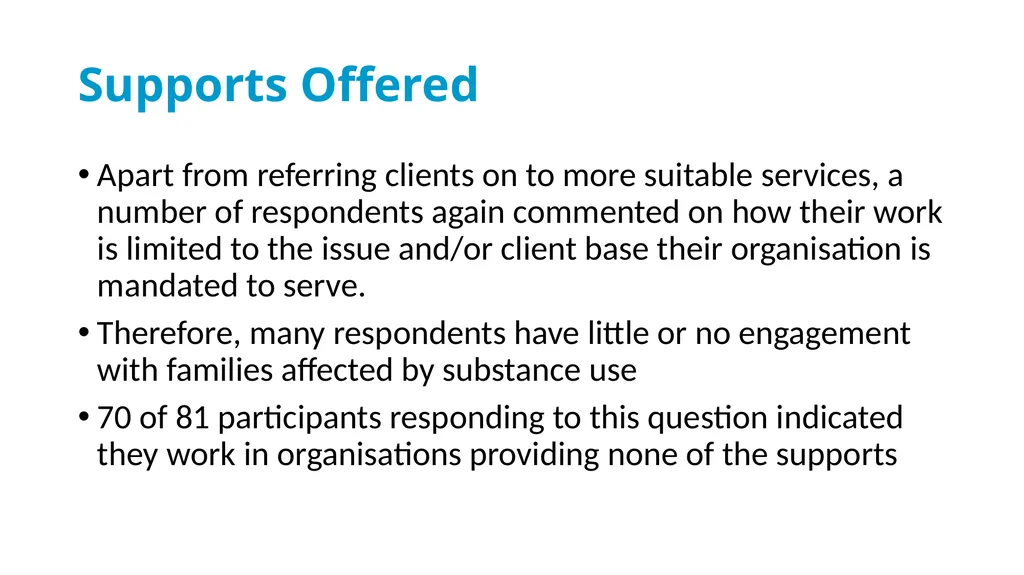
Supports Offered Apart from referring clients on to more suitable services, a number of respondents again commented on how their work is limited to the issue and/or client base their organisation is mandated to serve.
Therefore, many respondents have little or no engagement with families affected by substance use
70 of 81 participants responding to this question indicated they work in organisations providing none of the supports
h<br>
Therefore, many respondents have little or no engagement with families affected by substance use
70 of 81 participants responding to this question indicated they work in organisations providing none of the supports
h<br>
26
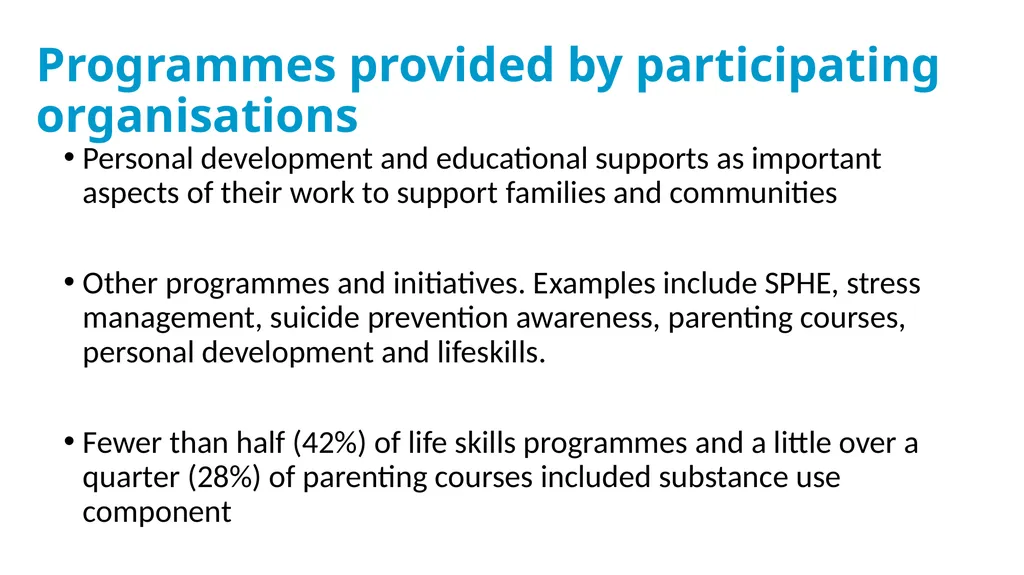
Programmes provided by participating organisations Personal development and educational supports as important aspects of their work to support families and communities
Other programmes and initiatives. Examples include SPHE, stress management, suicide prevention awareness, parenting courses, personal development and lifeskills.
Fewer than half (42%) of life skills programmes and a little over a quarter (28%) of parenting courses included substance use component<br>
Other programmes and initiatives. Examples include SPHE, stress management, suicide prevention awareness, parenting courses, personal development and lifeskills.
Fewer than half (42%) of life skills programmes and a little over a quarter (28%) of parenting courses included substance use component<br>
27
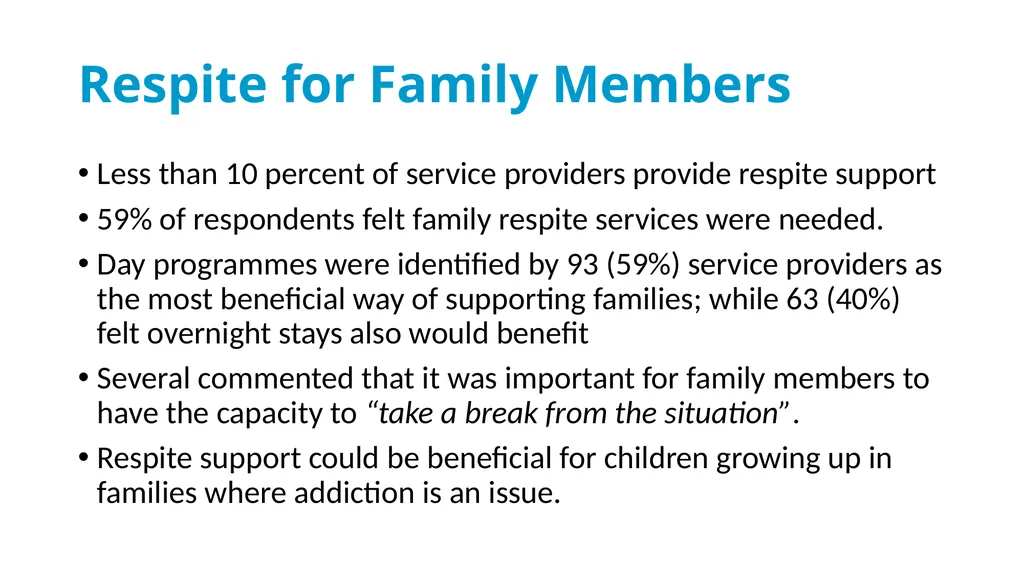
Respite for Family Members Less than 10 percent of service providers provide respite support
59% of respondents felt family respite services were needed.
Day programmes were identified by 93 (59%) service providers as the most beneficial way of supporting families; while 63 (40%) felt overnight stays also would benefit
Several commented that it was important for family members to have the capacity to “take a break from the situation”.
Respite support could be beneficial for children growing up in families where addiction is an issue.<br>
59% of respondents felt family respite services were needed.
Day programmes were identified by 93 (59%) service providers as the most beneficial way of supporting families; while 63 (40%) felt overnight stays also would benefit
Several commented that it was important for family members to have the capacity to “take a break from the situation”.
Respite support could be beneficial for children growing up in families where addiction is an issue.<br>
28
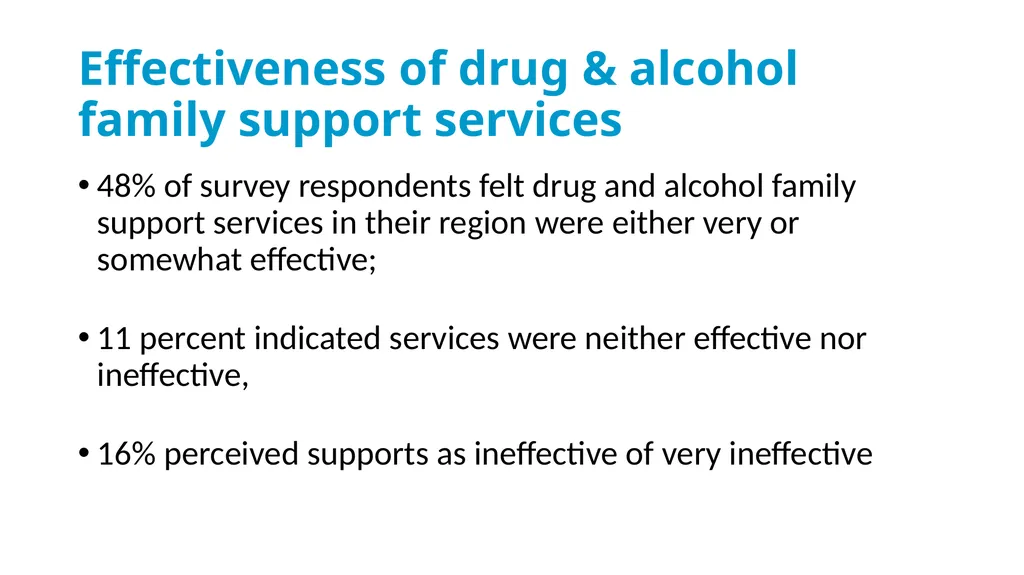
Effectiveness of drug & alcohol family support services 48% of survey respondents felt drug and alcohol family support services in their region were either very or somewhat effective;
11 percent indicated services were neither effective nor ineffective,
16% perceived supports as ineffective of very ineffective<br>
11 percent indicated services were neither effective nor ineffective,
16% perceived supports as ineffective of very ineffective<br>
29
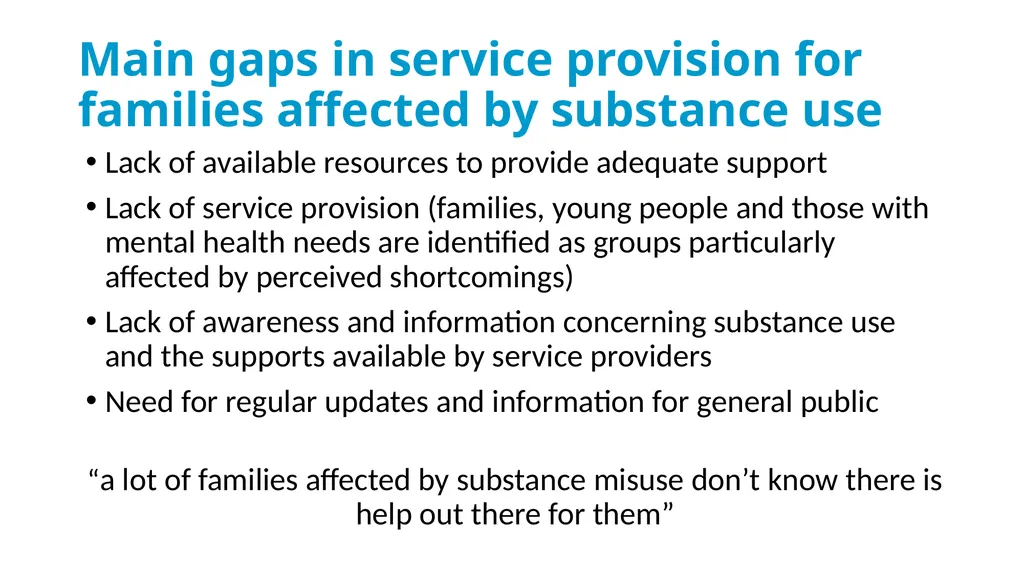
Main gaps in service provision for families affected by substance use Lack of available resources to provide adequate support
Lack of service provision (families, young people and those with mental health needs are identified as groups particularly affected by perceived shortcomings)
Lack of awareness and information concerning substance use and the supports available by service providers
Need for regular updates and information for general public
“a lot of families affected by substance misuse don’t know there is help out there for them”<br>
Lack of service provision (families, young people and those with mental health needs are identified as groups particularly affected by perceived shortcomings)
Lack of awareness and information concerning substance use and the supports available by service providers
Need for regular updates and information for general public
“a lot of families affected by substance misuse don’t know there is help out there for them”<br>
30
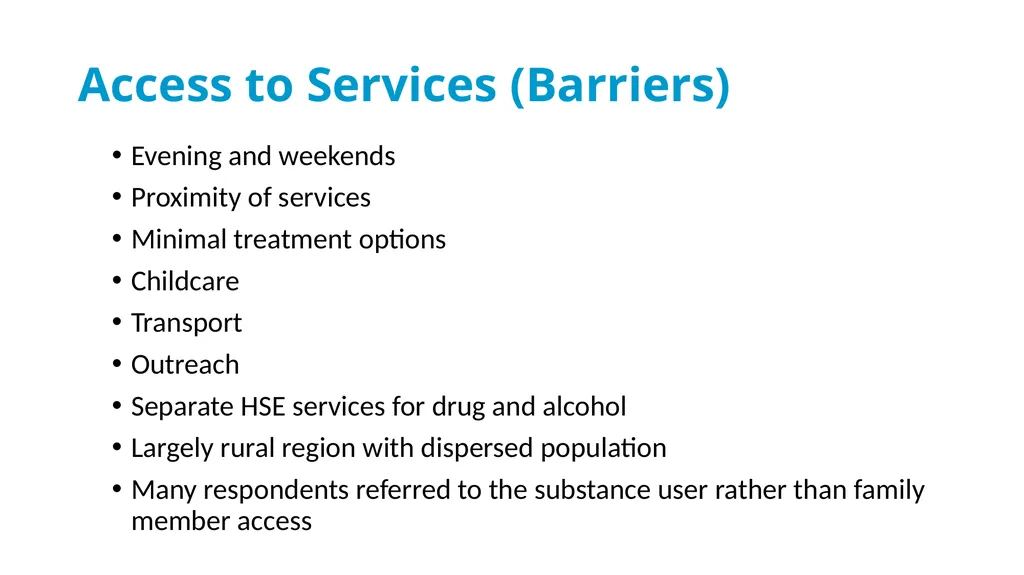
Access to Services (Barriers) Evening and weekends
Proximity of services
Minimal treatment options
Childcare
Transport
Outreach
Separate HSE services for drug and alcohol
Largely rural region with dispersed population
Many respondents referred to the substance user rather than family member access<br>
Proximity of services
Minimal treatment options
Childcare
Transport
Outreach
Separate HSE services for drug and alcohol
Largely rural region with dispersed population
Many respondents referred to the substance user rather than family member access<br>
31
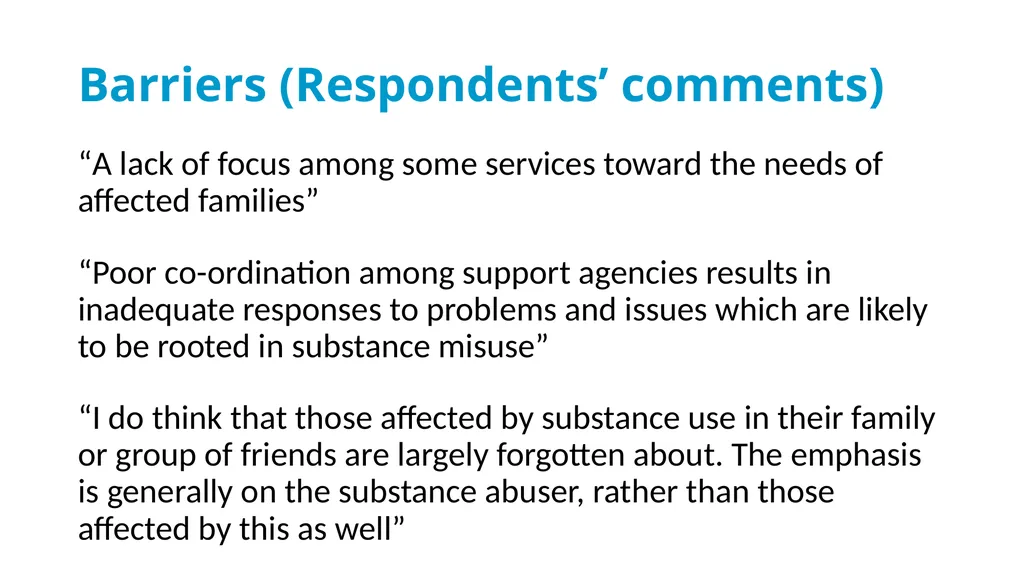
Barriers (Respondents’ comments) “A lack of focus among some services toward the needs of affected families”
“Poor co-ordination among support agencies results in inadequate responses to problems and issues which are likely to be rooted in substance misuse”
“I do think that those affected by substance use in their family or group of friends are largely forgotten about. The emphasis is generally on the substance abuser, rather than those affected by this as well”<br>
“Poor co-ordination among support agencies results in inadequate responses to problems and issues which are likely to be rooted in substance misuse”
“I do think that those affected by substance use in their family or group of friends are largely forgotten about. The emphasis is generally on the substance abuser, rather than those affected by this as well”<br>
32
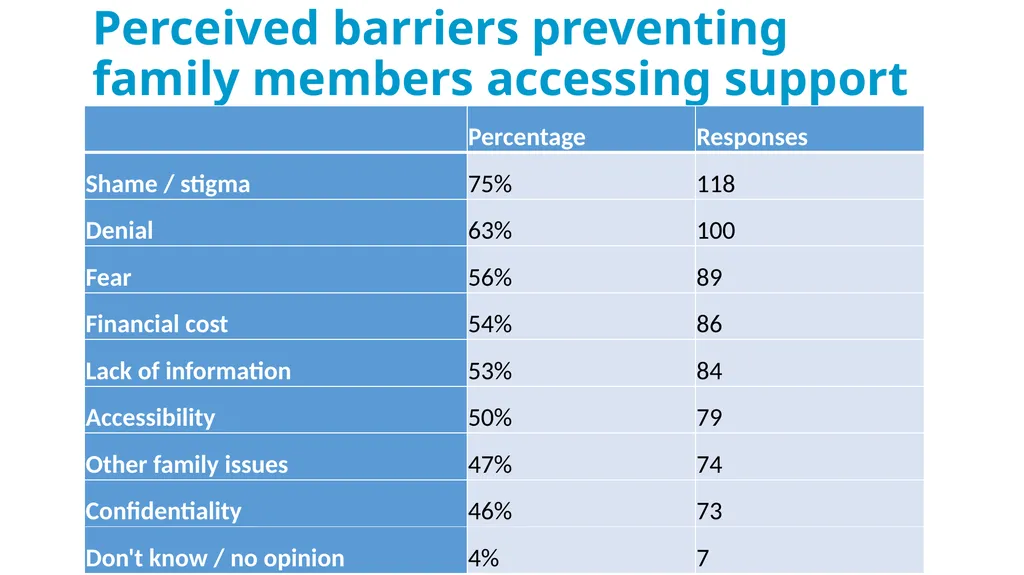
Perceived barriers preventing family members accessing support<br>
33
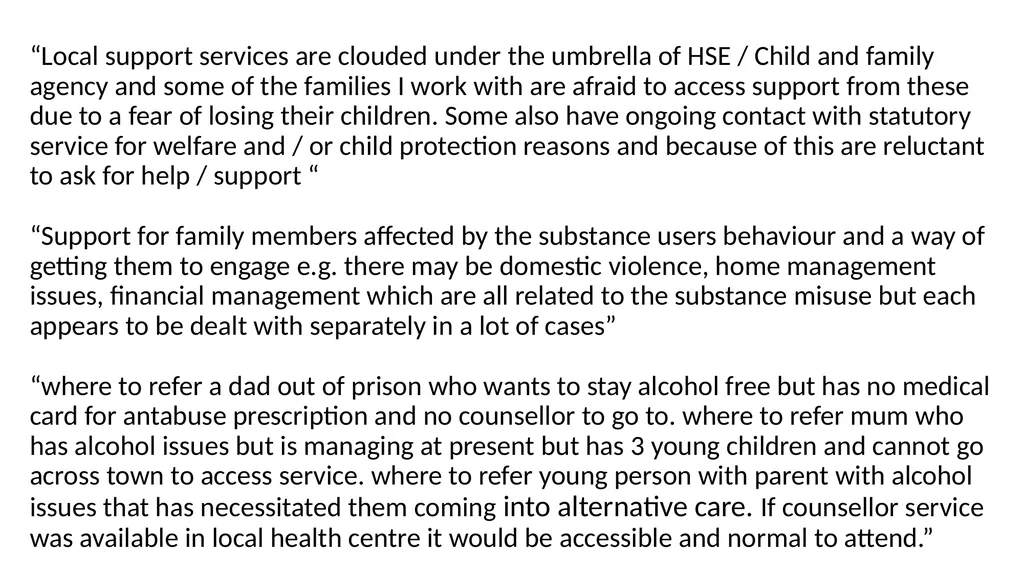
“Local support services are clouded under the umbrella of HSE / Child and family agency and some of the families I work with are afraid to access support from these due to a fear of losing their children. Some also have ongoing contact with statutory service for welfare and / or child protection reasons and because of this are reluctant to ask for help / support “
“Support for family members affected by the substance users behaviour and a way of getting them to engage e.g. there may be domestic violence, home management issues, financial management which are all related to the substance misuse but each appears to be dealt with separately in a lot of cases”
“where to refer a dad out of prison who wants to stay alcohol free but has no medical card for antabuse prescription and no counsellor to go to. where to refer mum who has alcohol issues but is managing at present but has 3 young children and cannot go across town to access service. where to refer young person with parent with alcohol issues that has necessitated them coming into alternative care. If counsellor service was available in local health centre it would be accessible and normal to attend.”<br>
“Support for family members affected by the substance users behaviour and a way of getting them to engage e.g. there may be domestic violence, home management issues, financial management which are all related to the substance misuse but each appears to be dealt with separately in a lot of cases”
“where to refer a dad out of prison who wants to stay alcohol free but has no medical card for antabuse prescription and no counsellor to go to. where to refer mum who has alcohol issues but is managing at present but has 3 young children and cannot go across town to access service. where to refer young person with parent with alcohol issues that has necessitated them coming into alternative care. If counsellor service was available in local health centre it would be accessible and normal to attend.”<br>
34
Needs Analysis: Recommendations<br>
35
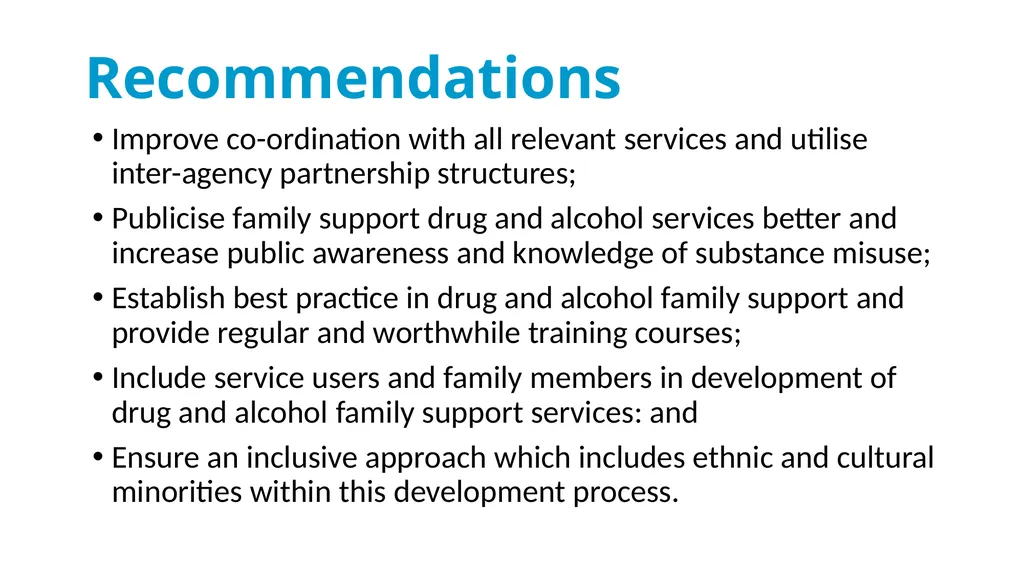
Recommendations Improve co-ordination with all relevant services and utilise inter-agency partnership structures;
Publicise family support drug and alcohol services better and increase public awareness and knowledge of substance misuse;
Establish best practice in drug and alcohol family support and provide regular and worthwhile training courses;
Include service users and family members in development of drug and alcohol family support services: and
Ensure an inclusive approach which includes ethnic and cultural minorities within this development process.<br>
Publicise family support drug and alcohol services better and increase public awareness and knowledge of substance misuse;
Establish best practice in drug and alcohol family support and provide regular and worthwhile training courses;
Include service users and family members in development of drug and alcohol family support services: and
Ensure an inclusive approach which includes ethnic and cultural minorities within this development process.<br>
36
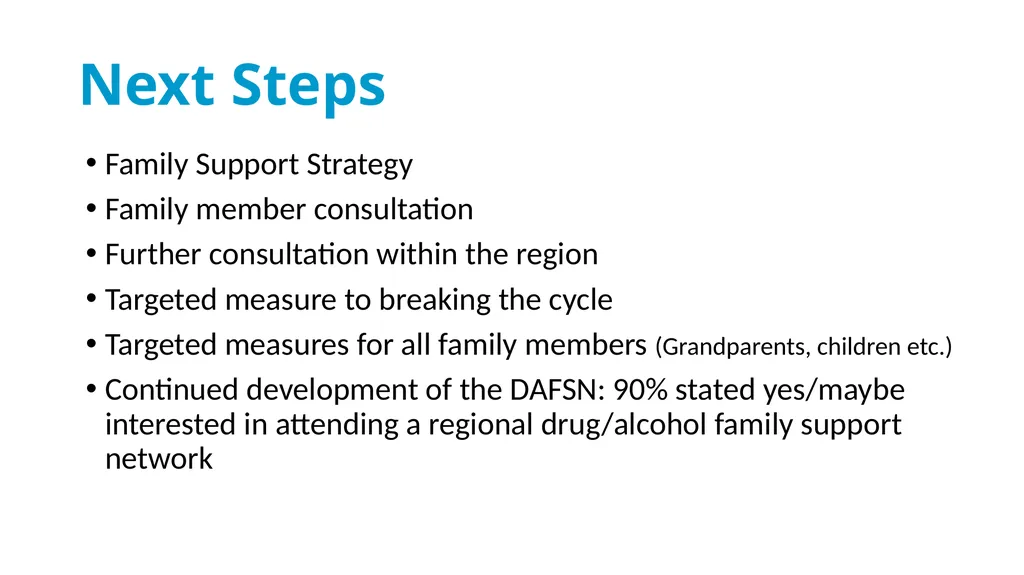
Next Steps Family Support Strategy
Family member consultation
Further consultation within the region
Targeted measure to breaking the cycle
Targeted measures for all family members (Grandparents, children etc.)
Continued development of the DAFSN: 90% stated yes/maybe interested in attending a regional drug/alcohol family support network<br>
Family member consultation
Further consultation within the region
Targeted measure to breaking the cycle
Targeted measures for all family members (Grandparents, children etc.)
Continued development of the DAFSN: 90% stated yes/maybe interested in attending a regional drug/alcohol family support network<br>
37
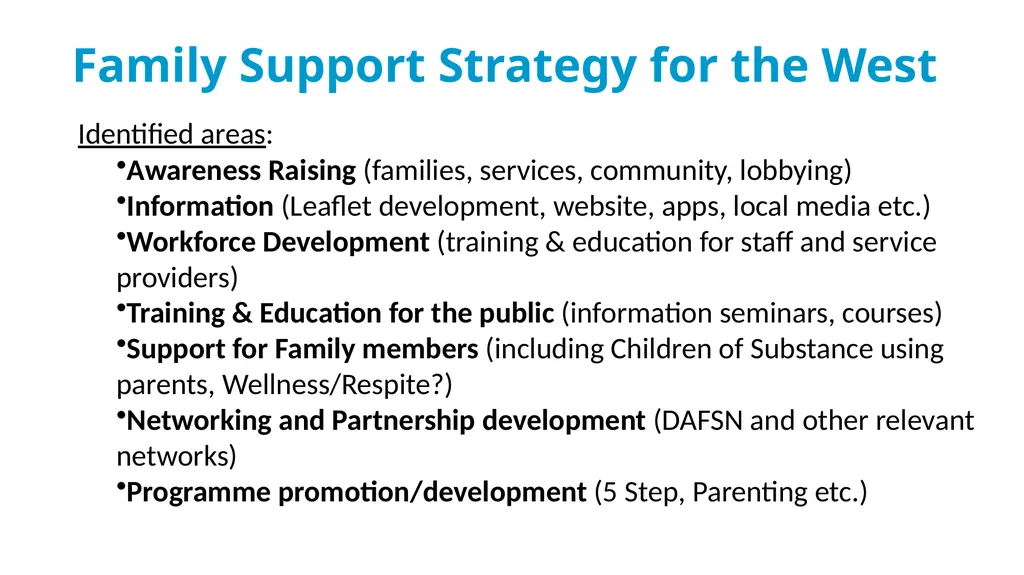
Family Support Strategy for the West Identified areas:
Awareness Raising (families, services, community, lobbying)
Information (Leaflet development, website, apps, local media etc.)
Workforce Development (training & education for staff and service providers)
Training & Education for the public (information seminars, courses)
Support for Family members (including Children of Substance using parents, Wellness/Respite?)
Networking and Partnership development (DAFSN and other relevant networks)
Programme promotion/development (5 Step, Parenting etc.)<br>
Awareness Raising (families, services, community, lobbying)
Information (Leaflet development, website, apps, local media etc.)
Workforce Development (training & education for staff and service providers)
Training & Education for the public (information seminars, courses)
Support for Family members (including Children of Substance using parents, Wellness/Respite?)
Networking and Partnership development (DAFSN and other relevant networks)
Programme promotion/development (5 Step, Parenting etc.)<br>
38
Thank you<br>
39
Report will be available on www.wrdtf.ie
Contact Details:
Debbie McDonagh
WRDTF
Tel:091 480059
Mob: 087 6955557
E-mail: debbie.mcdonagh@wrdtf.ie<br>
Contact Details:
Debbie McDonagh
WRDTF
Tel:091 480059
Mob: 087 6955557
E-mail: debbie.mcdonagh@wrdtf.ie<br>