
DSQ What does heliocentric mean???? Geocentric???



Description: DSQ What does heliocentric mean???? Geocentric??? How did Galileo study gravity without a really good clock? What evidence do we have that the sun is the center of the solar system? DSQ What causes tides? What causes the phases of the moon?
Related Topics
Download Presentation
"DSQ What does heliocentric mean???? Geocentric???" is the property of its rightful owner. Permission is granted to download and print the materials on this website for personal, non-commercial use only, and to display it on your personal computer provided you do not modify the materials and that you retain all copyright notices contained in the materials. By downloading content from our website, you accept the terms of this agreement.
Presentation Transcript
slide1. DSQ What does heliocentric mean????
Geocentric???
How did Galileo study gravity without a really good clock?
What evidence do we have that the sun is the center of the solar system?<br>
slide2. DSQ What causes tides?
What causes the phases of the moon?
Why do large stars have a shorter life span then small stars?
Why does the moon shine?<br>
slide3. DSQ What’s the difference between rotation and revolution?
Why do we have a leap year every 4 years?
Why do we have seasons? (does it have anything to do with the distance of earth from the sun?)<br>
slide4. DSQ For the fusion reaction, what would we consider the reactants, what are the products?
Average stars end with these elements, they are not hot enough to fuse?
Massive stars end with these elements, they are not hot enough to fuse past?
What is the fate of our sun?<br>
slide5. DSQ How do we know the Earth is round?
What is the circumference of the Earth?
Why does the Sun appear yellow and the sky blue?<br>
slide6. DSQ What are the 2 big factors in the brightness of a star?
What is the basic pattern when we compare temperature and brightness on the H-R Diagram?
Compare blue stars to red stars, which has a greater life span?
Most stars are grouped together on a line-ish, what is this grouping called?<br>
slide7. Star Cycle and Life Notes<br>
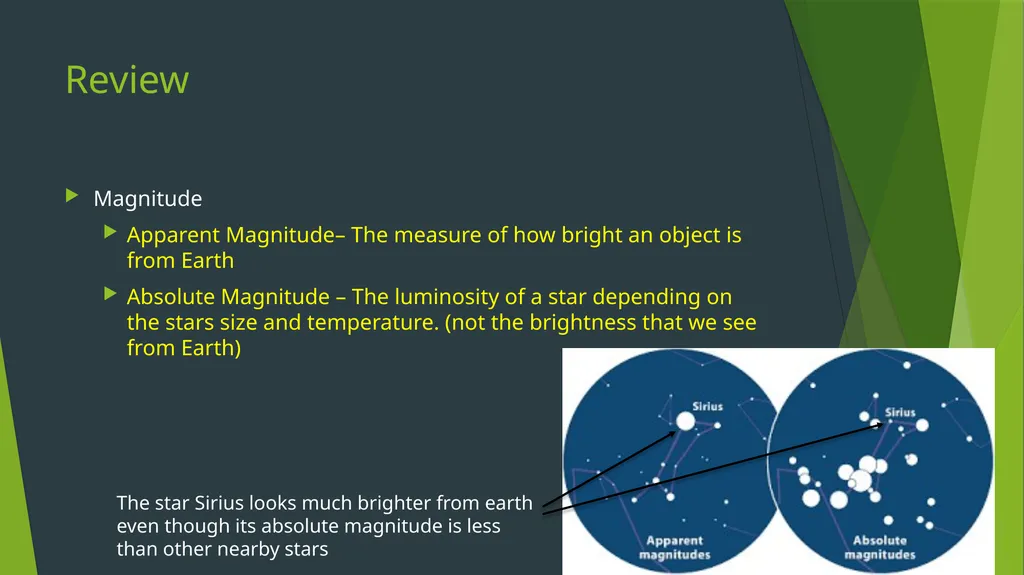
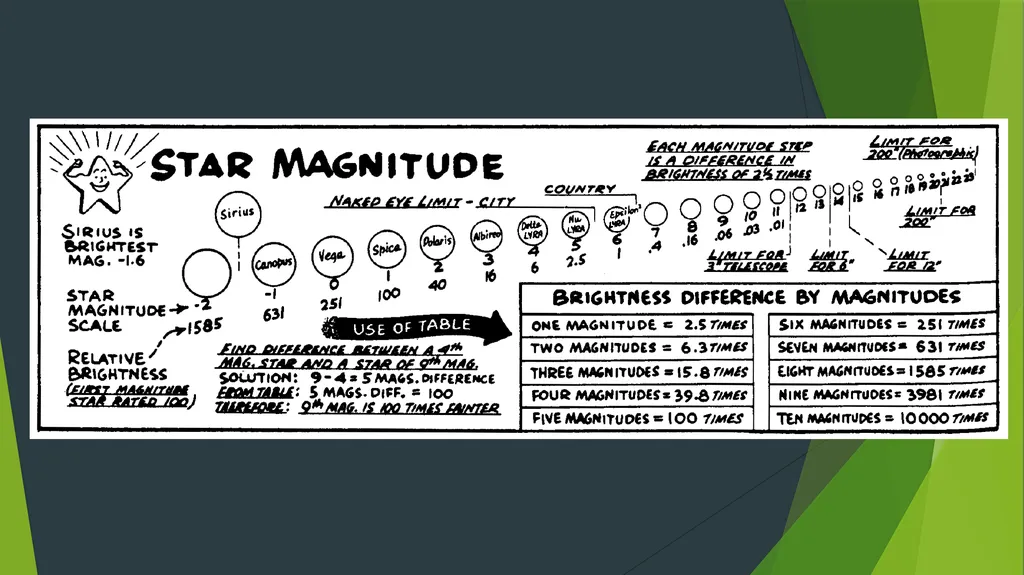
slide8. Review Magnitude
Apparent Magnitude– The measure of how bright an object is from Earth
Absolute Magnitude – The luminosity of a star depending on the stars size and temperature. (not the brightness that we see from Earth) The star Sirius looks much brighter from earth even though its absolute magnitude is less than other nearby stars<br>
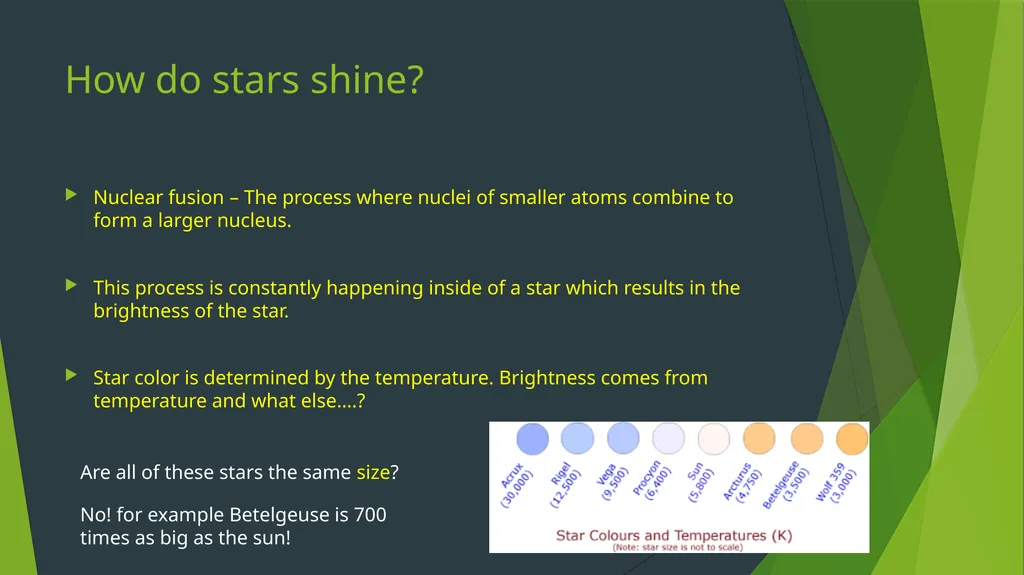
slide10. How do stars shine? Nuclear fusion – The process where nuclei of smaller atoms combine to form a larger nucleus.
This process is constantly happening inside of a star which results in the brightness of the star.
Star color is determined by the temperature. Brightness comes from temperature and what else….? Are all of these stars the same size? No! for example Betelgeuse is 700 times as big as the sun!<br>
slide11. What are stars made of? Our sun is made of Hydrogen H2 (75%), Helium He (25%), and <.001% other metals.
Other Stars in the Milky Way galaxy are around Hydrogen (71%), Helium (27%) and the rest is heavier metals. What causes the difference between our sun and other stars in the Milky Way?<br>
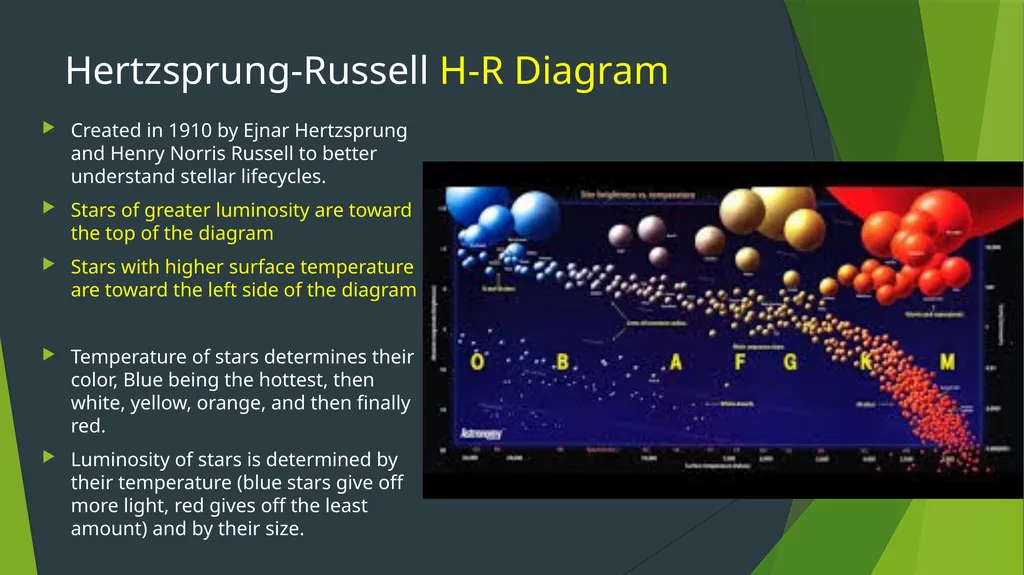
slide12. Hertzsprung-Russell H-R Diagram Created in 1910 by Ejnar Hertzsprung and Henry Norris Russell to better understand stellar lifecycles.
Stars of greater luminosity are toward the top of the diagram
Stars with higher surface temperature are toward the left side of the diagram
Temperature of stars determines their color, Blue being the hottest, then white, yellow, orange, and then finally red.
Luminosity of stars is determined by their temperature (blue stars give off more light, red gives off the least amount) and by their size.<br>
slide13. H-R Diagram activity You will be handed out 3-5 circle representing stars.
Compare your stars with your neighbors and note the differences in temperature, brightness, and color.
Look at the Star Chart Graph, There are two axes “Temperature (K)” and “Brightness (# of Suns)”
Bring your stars up a couple students at a time and place them on the graph at the appropriate temperature and brightness.<br>
slide14. Questions about the H-R diagram star chart Describe the general trend between temperature and brightness.
What is the color and brightness of the most abundant stars? The rarest stars?
What are the characteristics of the stars that do not conform to the graph’s trend?
In terms of the graph’s trend, is our sun typical or exceptional?
If you replaced the temperature scale on the graph’s x-axis with a color scale, which color would be closest to the graph’s origin and which would farthest away?
In the stars that fit the general trend (these are often called Main Sequence stars), what relationship do you notice between color and expected lifetime?<br>
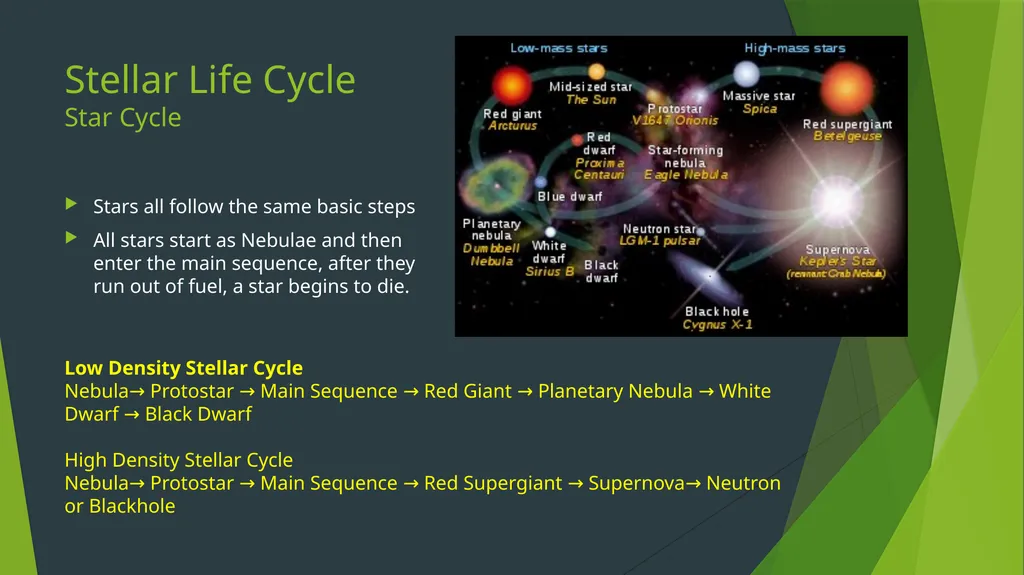
slide15. Stellar Life Cycle Star Cycle Stars all follow the same basic steps
All stars start as Nebulae and then enter the main sequence, after they run out of fuel, a star begins to die. Low Density Stellar Cycle
Nebula→ Protostar → Main Sequence → Red Giant → Planetary Nebula → White Dwarf → Black Dwarf
High Density Stellar Cycle
Nebula→ Protostar → Main Sequence → Red Supergiant → Supernova→ Neutron or Blackhole<br>
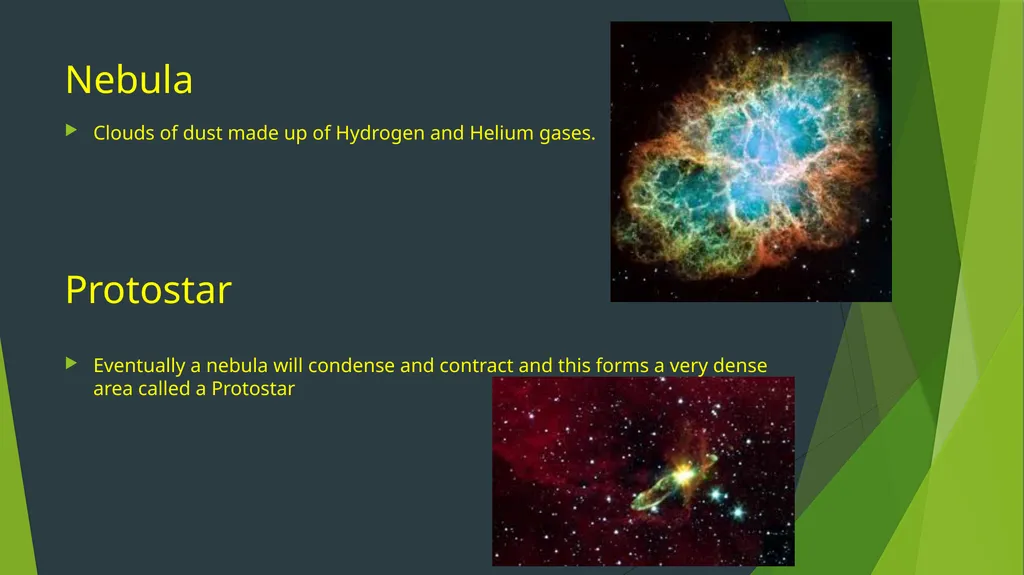
slide16. Nebula Clouds of dust made up of Hydrogen and Helium gases. Protostar Eventually a nebula will condense and contract and this forms a very dense area called a Protostar<br>
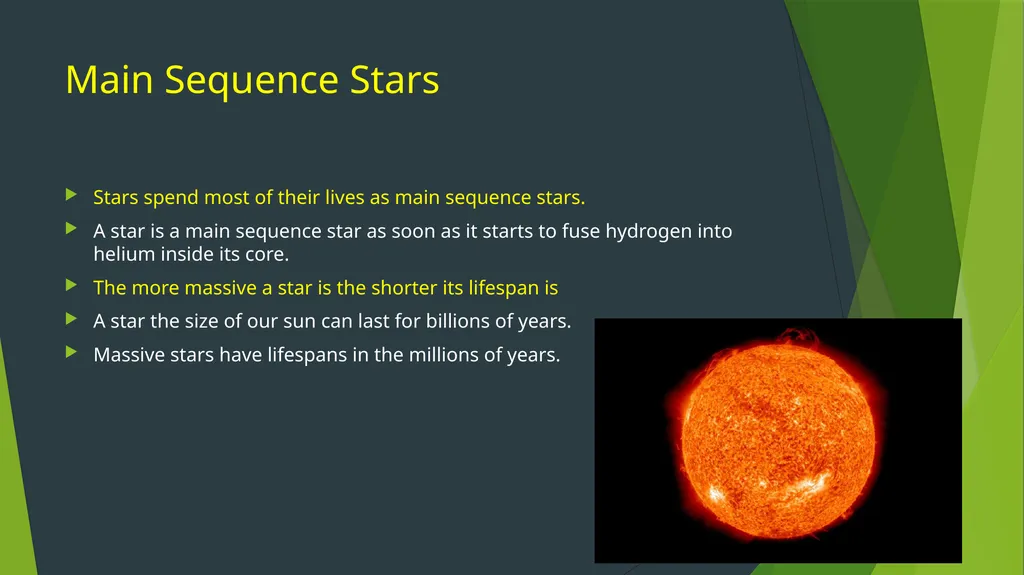
slide17. Main Sequence Stars Stars spend most of their lives as main sequence stars.
A star is a main sequence star as soon as it starts to fuse hydrogen into helium inside its core.
The more massive a star is the shorter its lifespan is
A star the size of our sun can last for billions of years.
Massive stars have lifespans in the millions of years.<br>
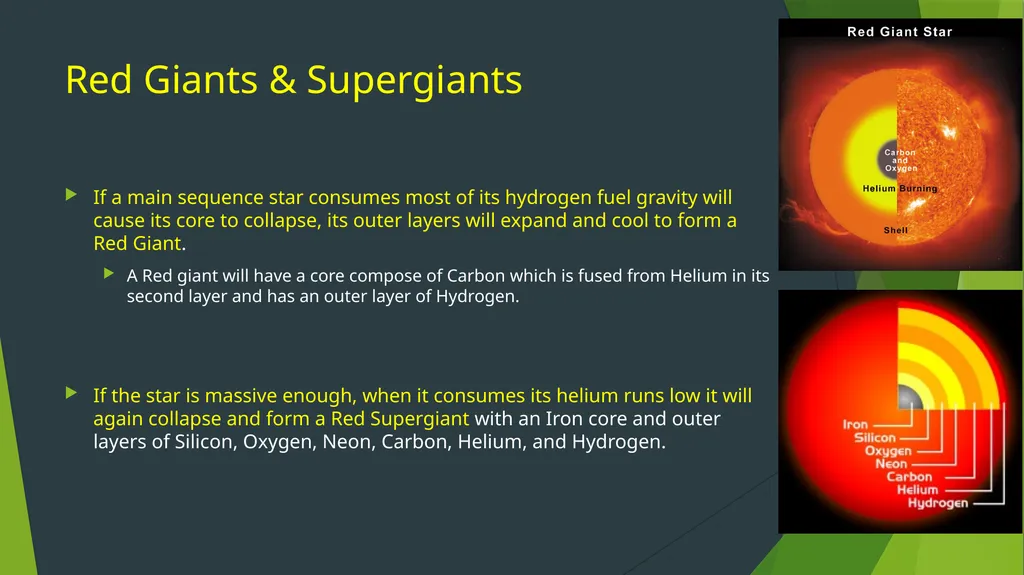
slide18. Red Giants & Supergiants If a main sequence star consumes most of its hydrogen fuel gravity will cause its core to collapse, its outer layers will expand and cool to form a Red Giant.
A Red giant will have a core compose of Carbon which is fused from Helium in its second layer and has an outer layer of Hydrogen.
If the star is massive enough, when it consumes its helium runs low it will again collapse and form a Red Supergiant with an Iron core and outer layers of Silicon, Oxygen, Neon, Carbon, Helium, and Hydrogen.<br>
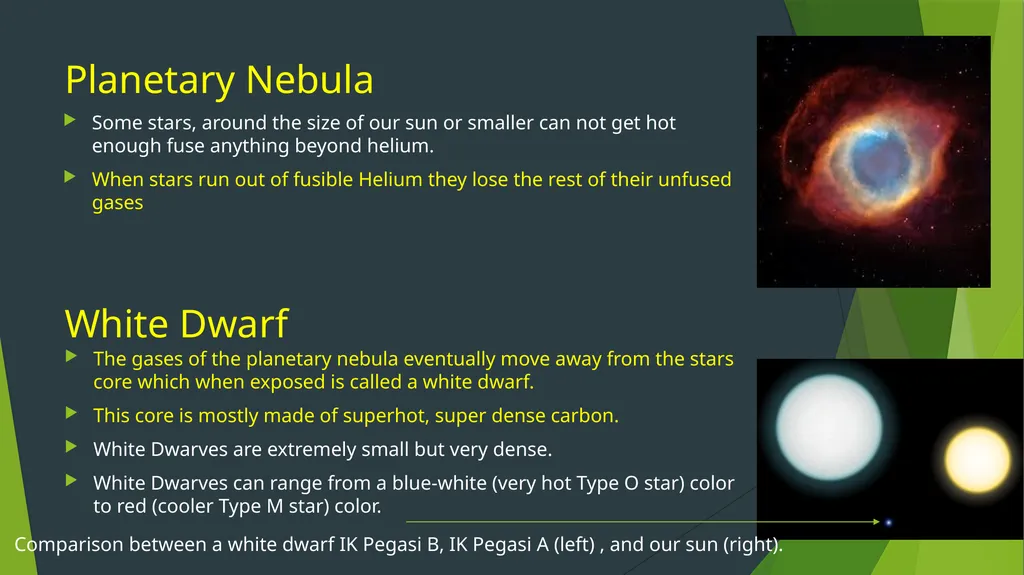
slide19. Planetary Nebula Some stars, around the size of our sun or smaller can not get hot enough fuse anything beyond helium.
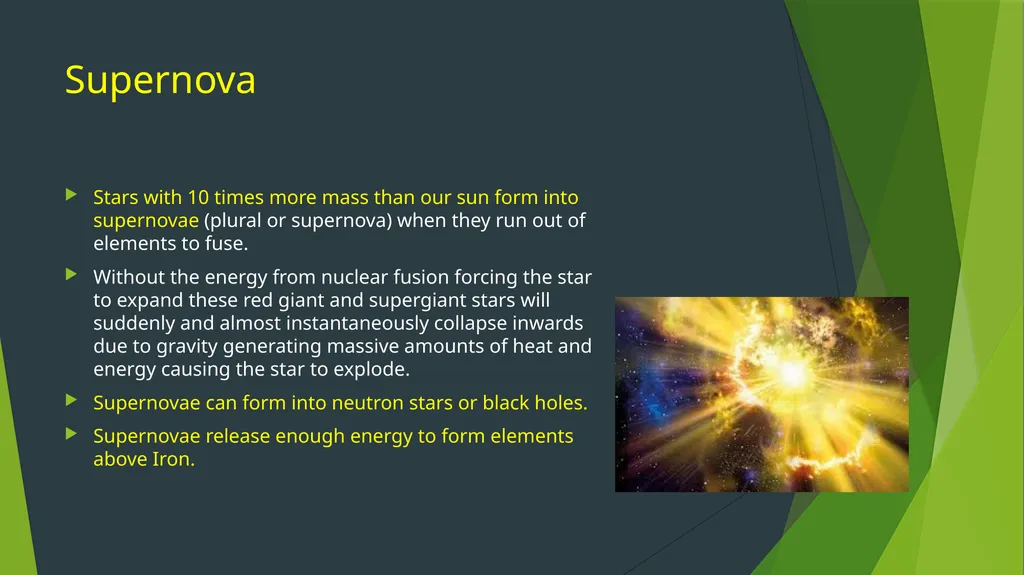
When stars run out of fusible Helium they lose the rest of their unfused gases White Dwarf The gases of the planetary nebula eventually move away from the stars core which when exposed is called a white dwarf.
This core is mostly made of superhot, super dense carbon.
White Dwarves are extremely small but very dense.
White Dwarves can range from a blue-white (very hot Type O star) color to red (cooler Type M star) color. Comparison between a white dwarf IK Pegasi B, IK Pegasi A (left) , and our sun (right).<br>
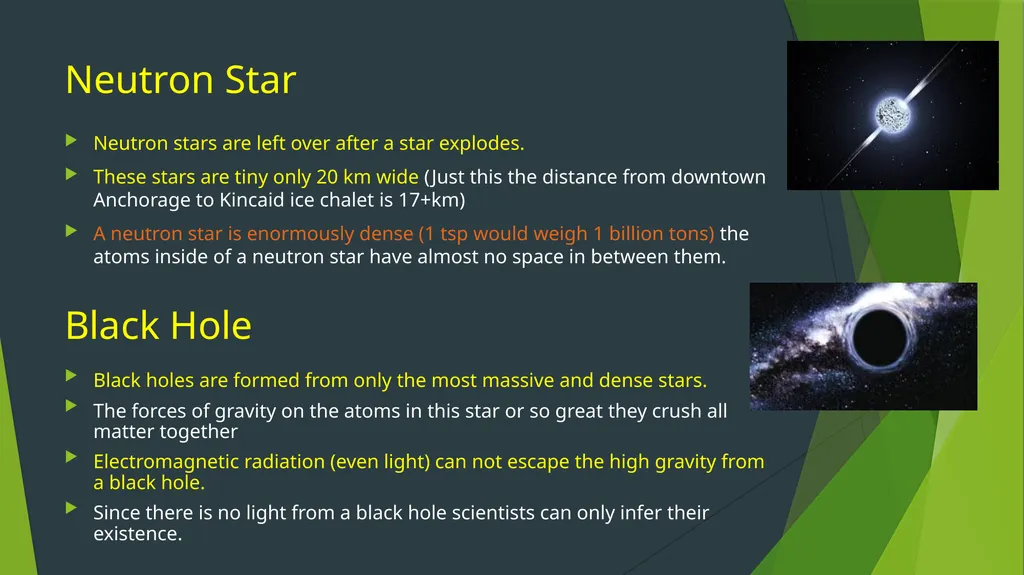
slide20. Supernova Stars with 10 times more mass than our sun form into supernovae (plural or supernova) when they run out of elements to fuse.
Without the energy from nuclear fusion forcing the star to expand these red giant and supergiant stars will suddenly and almost instantaneously collapse inwards due to gravity generating massive amounts of heat and energy causing the star to explode.
Supernovae can form into neutron stars or black holes.
Supernovae release enough energy to form elements above Iron.<br>
slide21. Neutron Star Neutron stars are left over after a star explodes.
These stars are tiny only 20 km wide (Just this the distance from downtown Anchorage to Kincaid ice chalet is 17+km)
A neutron star is enormously dense (1 tsp would weigh 1 billion tons) the atoms inside of a neutron star have almost no space in between them. Black Hole Black holes are formed from only the most massive and dense stars.
The forces of gravity on the atoms in this star or so great they crush all matter together
Electromagnetic radiation (even light) can not escape the high gravity from a black hole.
Since there is no light from a black hole scientists can only infer their existence.<br>
Geocentric???
How did Galileo study gravity without a really good clock?
What evidence do we have that the sun is the center of the solar system?<br>
slide2. DSQ What causes tides?
What causes the phases of the moon?
Why do large stars have a shorter life span then small stars?
Why does the moon shine?<br>
slide3. DSQ What’s the difference between rotation and revolution?
Why do we have a leap year every 4 years?
Why do we have seasons? (does it have anything to do with the distance of earth from the sun?)<br>
slide4. DSQ For the fusion reaction, what would we consider the reactants, what are the products?
Average stars end with these elements, they are not hot enough to fuse?
Massive stars end with these elements, they are not hot enough to fuse past?
What is the fate of our sun?<br>
slide5. DSQ How do we know the Earth is round?
What is the circumference of the Earth?
Why does the Sun appear yellow and the sky blue?<br>
slide6. DSQ What are the 2 big factors in the brightness of a star?
What is the basic pattern when we compare temperature and brightness on the H-R Diagram?
Compare blue stars to red stars, which has a greater life span?
Most stars are grouped together on a line-ish, what is this grouping called?<br>
slide7. Star Cycle and Life Notes<br>
slide8. Review Magnitude
Apparent Magnitude– The measure of how bright an object is from Earth
Absolute Magnitude – The luminosity of a star depending on the stars size and temperature. (not the brightness that we see from Earth) The star Sirius looks much brighter from earth even though its absolute magnitude is less than other nearby stars<br>
slide10. How do stars shine? Nuclear fusion – The process where nuclei of smaller atoms combine to form a larger nucleus.
This process is constantly happening inside of a star which results in the brightness of the star.
Star color is determined by the temperature. Brightness comes from temperature and what else….? Are all of these stars the same size? No! for example Betelgeuse is 700 times as big as the sun!<br>
slide11. What are stars made of? Our sun is made of Hydrogen H2 (75%), Helium He (25%), and <.001% other metals.
Other Stars in the Milky Way galaxy are around Hydrogen (71%), Helium (27%) and the rest is heavier metals. What causes the difference between our sun and other stars in the Milky Way?<br>
slide12. Hertzsprung-Russell H-R Diagram Created in 1910 by Ejnar Hertzsprung and Henry Norris Russell to better understand stellar lifecycles.
Stars of greater luminosity are toward the top of the diagram
Stars with higher surface temperature are toward the left side of the diagram
Temperature of stars determines their color, Blue being the hottest, then white, yellow, orange, and then finally red.
Luminosity of stars is determined by their temperature (blue stars give off more light, red gives off the least amount) and by their size.<br>
slide13. H-R Diagram activity You will be handed out 3-5 circle representing stars.
Compare your stars with your neighbors and note the differences in temperature, brightness, and color.
Look at the Star Chart Graph, There are two axes “Temperature (K)” and “Brightness (# of Suns)”
Bring your stars up a couple students at a time and place them on the graph at the appropriate temperature and brightness.<br>
slide14. Questions about the H-R diagram star chart Describe the general trend between temperature and brightness.
What is the color and brightness of the most abundant stars? The rarest stars?
What are the characteristics of the stars that do not conform to the graph’s trend?
In terms of the graph’s trend, is our sun typical or exceptional?
If you replaced the temperature scale on the graph’s x-axis with a color scale, which color would be closest to the graph’s origin and which would farthest away?
In the stars that fit the general trend (these are often called Main Sequence stars), what relationship do you notice between color and expected lifetime?<br>
slide15. Stellar Life Cycle Star Cycle Stars all follow the same basic steps
All stars start as Nebulae and then enter the main sequence, after they run out of fuel, a star begins to die. Low Density Stellar Cycle
Nebula→ Protostar → Main Sequence → Red Giant → Planetary Nebula → White Dwarf → Black Dwarf
High Density Stellar Cycle
Nebula→ Protostar → Main Sequence → Red Supergiant → Supernova→ Neutron or Blackhole<br>
slide16. Nebula Clouds of dust made up of Hydrogen and Helium gases. Protostar Eventually a nebula will condense and contract and this forms a very dense area called a Protostar<br>
slide17. Main Sequence Stars Stars spend most of their lives as main sequence stars.
A star is a main sequence star as soon as it starts to fuse hydrogen into helium inside its core.
The more massive a star is the shorter its lifespan is
A star the size of our sun can last for billions of years.
Massive stars have lifespans in the millions of years.<br>
slide18. Red Giants & Supergiants If a main sequence star consumes most of its hydrogen fuel gravity will cause its core to collapse, its outer layers will expand and cool to form a Red Giant.
A Red giant will have a core compose of Carbon which is fused from Helium in its second layer and has an outer layer of Hydrogen.
If the star is massive enough, when it consumes its helium runs low it will again collapse and form a Red Supergiant with an Iron core and outer layers of Silicon, Oxygen, Neon, Carbon, Helium, and Hydrogen.<br>
slide19. Planetary Nebula Some stars, around the size of our sun or smaller can not get hot enough fuse anything beyond helium.
When stars run out of fusible Helium they lose the rest of their unfused gases White Dwarf The gases of the planetary nebula eventually move away from the stars core which when exposed is called a white dwarf.
This core is mostly made of superhot, super dense carbon.
White Dwarves are extremely small but very dense.
White Dwarves can range from a blue-white (very hot Type O star) color to red (cooler Type M star) color. Comparison between a white dwarf IK Pegasi B, IK Pegasi A (left) , and our sun (right).<br>
slide20. Supernova Stars with 10 times more mass than our sun form into supernovae (plural or supernova) when they run out of elements to fuse.
Without the energy from nuclear fusion forcing the star to expand these red giant and supergiant stars will suddenly and almost instantaneously collapse inwards due to gravity generating massive amounts of heat and energy causing the star to explode.
Supernovae can form into neutron stars or black holes.
Supernovae release enough energy to form elements above Iron.<br>
slide21. Neutron Star Neutron stars are left over after a star explodes.
These stars are tiny only 20 km wide (Just this the distance from downtown Anchorage to Kincaid ice chalet is 17+km)
A neutron star is enormously dense (1 tsp would weigh 1 billion tons) the atoms inside of a neutron star have almost no space in between them. Black Hole Black holes are formed from only the most massive and dense stars.
The forces of gravity on the atoms in this star or so great they crush all matter together
Electromagnetic radiation (even light) can not escape the high gravity from a black hole.
Since there is no light from a black hole scientists can only infer their existence.<br>