
Dual Mandate: New Directions in Curriculum
PT
Published · 47 slides · 0 views

1 / 1

Description
Dual Mandate: New Directions in Curriculum Development and Implementation for a College B.Ed Programme By Professor M. I. Junaid Department of Educational Foundations Usmanu Danfodiyo University, Sokoto The main thesis of the paper The idea
Related Topics
Share
Embed code
Download this presentation From Below
"Dual Mandate: New Directions in Curriculum" is the property of its rightful owner. Permission is granted to download and print the materials on this website for personal, non-commercial use only, and to display it on your personal computer provided you do not modify the materials and that you retain all copyright notices contained in the materials. By downloading content from our website, you accept the terms of this agreement.
Presentation Transcript
01
Dual Mandate: New Directions in Curriculum Development and Implementation for a College B.Ed Programme By
Professor M. I. Junaid
Department of Educational Foundations
Usmanu Danfodiyo University, Sokoto<br>
Professor M. I. Junaid
Department of Educational Foundations
Usmanu Danfodiyo University, Sokoto<br>
02
The main thesis of the paper The idea of professionalism as a unifying factor of the two major concerns of NCCE and the CoEs of:
creating a clearly distinguishable institutional identity of degree-awarding status for the colleges
without losing their mandate of offering NCE or their name as CoEs; and
What the essence of its contribution might be to curriculum development and implementation for a new college B.Ed degree course.
The main argument: the affiliated B.Ed programmes of approved universities currently being offered by the colleges of education have been dominated by external influences from the universities where they originate; and
Such B.Ed programmes are therefore, more academic oriented than professional.
In this sense, the B.Ed programmes are fundamentally constrained within a limiting policy of affiliation which originates and is controlled from outside the colleges<br>
creating a clearly distinguishable institutional identity of degree-awarding status for the colleges
without losing their mandate of offering NCE or their name as CoEs; and
What the essence of its contribution might be to curriculum development and implementation for a new college B.Ed degree course.
The main argument: the affiliated B.Ed programmes of approved universities currently being offered by the colleges of education have been dominated by external influences from the universities where they originate; and
Such B.Ed programmes are therefore, more academic oriented than professional.
In this sense, the B.Ed programmes are fundamentally constrained within a limiting policy of affiliation which originates and is controlled from outside the colleges<br>
03
Other criticisms of the affiliated B.Ed Lack of depth of subject matter knowledge, especially in specialized areas producing graduate teachers that are ill-prepared for teaching complex concepts in their chosen subjects (Okebukola, 2015).
Overemphasis on theory at the expense of practical application in the pedagogical focus of the B.Ed degree, which creates a theory/practical dichotomy
Limited duration and quality of practical teaching experience that fails to provide trainee teachers with the essential practical teaching skills and classroom management techniques required for effective teaching (Adeyanju, 2005)
Worries concerning quality and a lack of a central control on practice despite the regulatory oversight by the NUC (Rasheed, 2020).
These concerns form the basis upon which a case for new directions for curriculum development and implementation for a college B.Ed is being made.<br>
Overemphasis on theory at the expense of practical application in the pedagogical focus of the B.Ed degree, which creates a theory/practical dichotomy
Limited duration and quality of practical teaching experience that fails to provide trainee teachers with the essential practical teaching skills and classroom management techniques required for effective teaching (Adeyanju, 2005)
Worries concerning quality and a lack of a central control on practice despite the regulatory oversight by the NUC (Rasheed, 2020).
These concerns form the basis upon which a case for new directions for curriculum development and implementation for a college B.Ed is being made.<br>
04
The Historical Setting For nearly two decades now, if not more, colleges of education (CoEs) have been in a dilemma about their impending future.
The 2006 FME educational reforms, which sought to automatically convert the colleges to degree awarding institutions by transforming them into campuses of proximate universities were vehemently resisted
The sub-sector saw this move by the FME as an affront on teacher education
Since then, developments in both the official policy and legal framework in teacher education have reflected three main characteristics that are affecting the present and future directions of the CoEs.<br>
The 2006 FME educational reforms, which sought to automatically convert the colleges to degree awarding institutions by transforming them into campuses of proximate universities were vehemently resisted
The sub-sector saw this move by the FME as an affront on teacher education
Since then, developments in both the official policy and legal framework in teacher education have reflected three main characteristics that are affecting the present and future directions of the CoEs.<br>
05
The three Characteristics affecting F/CoEs Declining resource allocation accompanied with low rates of release of the allocated funds that combined to stunt the growth of the institutions.
A sharp drop in intake into CoEs over the years, which poses existential threat to the colleges leading to diversification into all kinds of non-education diploma courses and concurrent affiliated degree courses.
A growing demand for degree awarding status by the CoEs, which culminated into the 2023 amended Act of federal colleges of education (FCEs)
These developments have contributed to the changes that are now taking place in the colleges<br>
A sharp drop in intake into CoEs over the years, which poses existential threat to the colleges leading to diversification into all kinds of non-education diploma courses and concurrent affiliated degree courses.
A growing demand for degree awarding status by the CoEs, which culminated into the 2023 amended Act of federal colleges of education (FCEs)
These developments have contributed to the changes that are now taking place in the colleges<br>
06
The Ongoing changes in F/CoEs Changes in the structure and content of the teacher training institutions.
Changes in the nature and emphasis of subjects and curriculum
Changes in professional and educational studies
Changes in teaching practice organisation and supervision
Changes in the composition of intakes into F/CoEs - the fact that F/CoEs are admitting more students into the diploma and B.Ed courses than in the NCE courses; and
The 2023 amended Act of FCoEs and associated debates currently raging about the concurrent NCE/B.Ed dualism within an expanded mandate.<br>
Changes in the nature and emphasis of subjects and curriculum
Changes in professional and educational studies
Changes in teaching practice organisation and supervision
Changes in the composition of intakes into F/CoEs - the fact that F/CoEs are admitting more students into the diploma and B.Ed courses than in the NCE courses; and
The 2023 amended Act of FCoEs and associated debates currently raging about the concurrent NCE/B.Ed dualism within an expanded mandate.<br>
07
The 2023 amended Act and its Implications The 2023 amended Act of the FCoEs empowers the colleges to concurrently offer and award both the NCE and B.Ed degrees in education.
The NCE/B.Ed dualism is not however, new to the colleges. Prior to this expanded mandate, the colleges have for decades offered B.Ed degrees in affiliation with approved universities
The amended Act now eliminates the need for F/CoEs to offer B.Ed degrees in affiliation with universities and empowers them to award degrees in their own right.
What is not clear from the Act, however, is the role of NCCE in the regulation of the dual mode<br>
The NCE/B.Ed dualism is not however, new to the colleges. Prior to this expanded mandate, the colleges have for decades offered B.Ed degrees in affiliation with approved universities
The amended Act now eliminates the need for F/CoEs to offer B.Ed degrees in affiliation with universities and empowers them to award degrees in their own right.
What is not clear from the Act, however, is the role of NCCE in the regulation of the dual mode<br>
08
A Potential clash of Mandates? Progress may be prejudiced by the danger that a blanket application of the new legal framework may lead to a turf battle between NCCE & NUC over regulation of the B.Ed degree course(s)
That will hinder the identification of elements of the law that could offer more relevant alternative strategies and development
Nevertheless, most ongoing transitional activity in the colleges, confirms a growing acceptance of the need for improvement and expansion in the structure and curriculum of TTIs<br>
That will hinder the identification of elements of the law that could offer more relevant alternative strategies and development
Nevertheless, most ongoing transitional activity in the colleges, confirms a growing acceptance of the need for improvement and expansion in the structure and curriculum of TTIs<br>
09
The Future Agenda for F/CoEs There is a broad agreement between educationalists and politicians that what is needed is an expanded mandate for the F/CoEs
A better initial selection of student teachers to attract the best brains to take up teaching as a profession
A high standard of training; and
A carefully designed, relevant and purposeful curriculum that meets the needs of both the student teachers and those of the broader society<br>
A better initial selection of student teachers to attract the best brains to take up teaching as a profession
A high standard of training; and
A carefully designed, relevant and purposeful curriculum that meets the needs of both the student teachers and those of the broader society<br>
10
Significance of the 2012 NCE Reforms In some respects, therefore, these issues do show some continuity to the whole post-2012 debate on NCE reforms initiated by NCCE that:
aimed to enable F/CoEs to produce new teachers that are urgently needed by the basic education system; and
steer the colleges in the direction of their future development preparatory to becoming degree awarding institutions.
The good news, then, is that some of the major ingredients of this transition were already identified and a solid foundation for the future laid by the 2012 NCE reforms.<br>
aimed to enable F/CoEs to produce new teachers that are urgently needed by the basic education system; and
steer the colleges in the direction of their future development preparatory to becoming degree awarding institutions.
The good news, then, is that some of the major ingredients of this transition were already identified and a solid foundation for the future laid by the 2012 NCE reforms.<br>
11
Focus of the 2012 NCE Reforms The reforms entailed changes in:
curriculum focus
emphasis on appropriate methods of instruction in each of the five areas of basic education -ECCDE, PES, JSS, SNE & ANFE
A restructuring of the colleges to create appropriate teaching and learning environment for sustainable quality teacher education and development.
These changes were not without a basis as they were prompted by the implications of the then current trends in education: New BEC & NTEP<br>
curriculum focus
emphasis on appropriate methods of instruction in each of the five areas of basic education -ECCDE, PES, JSS, SNE & ANFE
A restructuring of the colleges to create appropriate teaching and learning environment for sustainable quality teacher education and development.
These changes were not without a basis as they were prompted by the implications of the then current trends in education: New BEC & NTEP<br>
12
Official Roots of the Reforms The new BEC introduced in 2007 by NERDC: fashioned out distinctive curriculum for each of the five areas of basic education, each demanding specialised teachers; and
The subsequent draft of the NTEP approved by the National Council on Education in 2010: emphasized “sufficient mastery of content” and “level-specific methods of teaching” in the training of teachers
Both documents gave “official” recognition to the concept of “specialist teachers” and the need for the NCE curriculum to be age- and level-specific rather than subject-based
Central to the NTEP was the insistence that attention should be focused on selecting the best brains for training as teachers at all levels of education<br>
The subsequent draft of the NTEP approved by the National Council on Education in 2010: emphasized “sufficient mastery of content” and “level-specific methods of teaching” in the training of teachers
Both documents gave “official” recognition to the concept of “specialist teachers” and the need for the NCE curriculum to be age- and level-specific rather than subject-based
Central to the NTEP was the insistence that attention should be focused on selecting the best brains for training as teachers at all levels of education<br>
13
Official Roots Cont'd NTEP was the lever by which thinking in the CoEs was directed away from the subject-based model to level-specific training model introduced in 2012
NTEP’s emphasis upon external links with local education also gave weight to more purposeful partnerships and linkages with the local schools, SUBEBs and LGEAs
These changes in focus, structure and content of the new NCE programmes point to the future directions for the F/CoEs, which should be acknowledged and developed in the new college B.Ed curriculum.
They provide a justification for the professional norms in the training of teachers<br>
NTEP’s emphasis upon external links with local education also gave weight to more purposeful partnerships and linkages with the local schools, SUBEBs and LGEAs
These changes in focus, structure and content of the new NCE programmes point to the future directions for the F/CoEs, which should be acknowledged and developed in the new college B.Ed curriculum.
They provide a justification for the professional norms in the training of teachers<br>
14
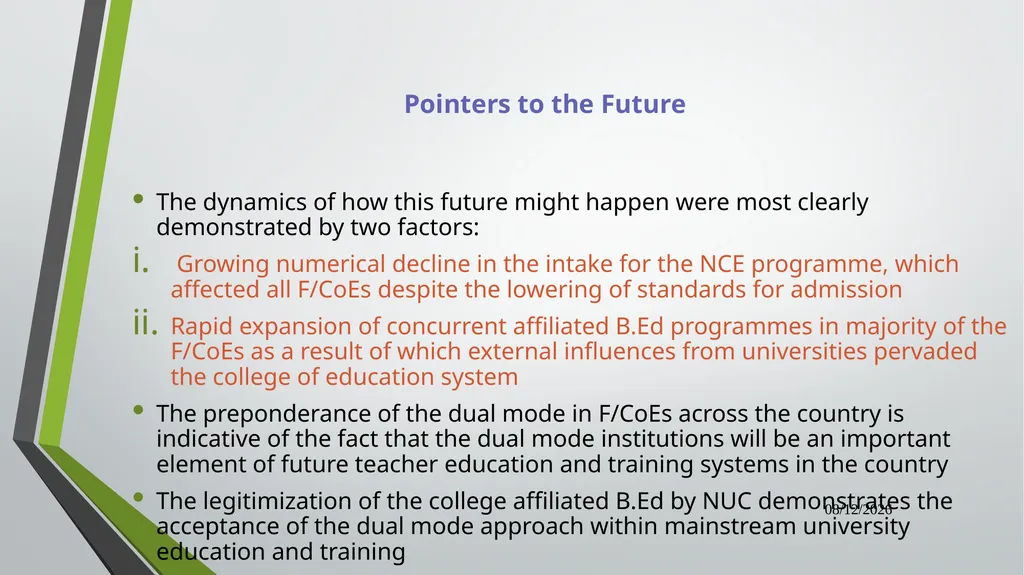
Pointers to the Future The dynamics of how this future might happen were most clearly demonstrated by two factors:
Growing numerical decline in the intake for the NCE programme, which affected all F/CoEs despite the lowering of standards for admission
Rapid expansion of concurrent affiliated B.Ed programmes in majority of the F/CoEs as a result of which external influences from universities pervaded the college of education system
The preponderance of the dual mode in F/CoEs across the country is indicative of the fact that the dual mode institutions will be an important element of future teacher education and training systems in the country
The legitimization of the college affiliated B.Ed by NUC demonstrates the acceptance of the dual mode approach within mainstream university education and training<br>
Growing numerical decline in the intake for the NCE programme, which affected all F/CoEs despite the lowering of standards for admission
Rapid expansion of concurrent affiliated B.Ed programmes in majority of the F/CoEs as a result of which external influences from universities pervaded the college of education system
The preponderance of the dual mode in F/CoEs across the country is indicative of the fact that the dual mode institutions will be an important element of future teacher education and training systems in the country
The legitimization of the college affiliated B.Ed by NUC demonstrates the acceptance of the dual mode approach within mainstream university education and training<br>
15
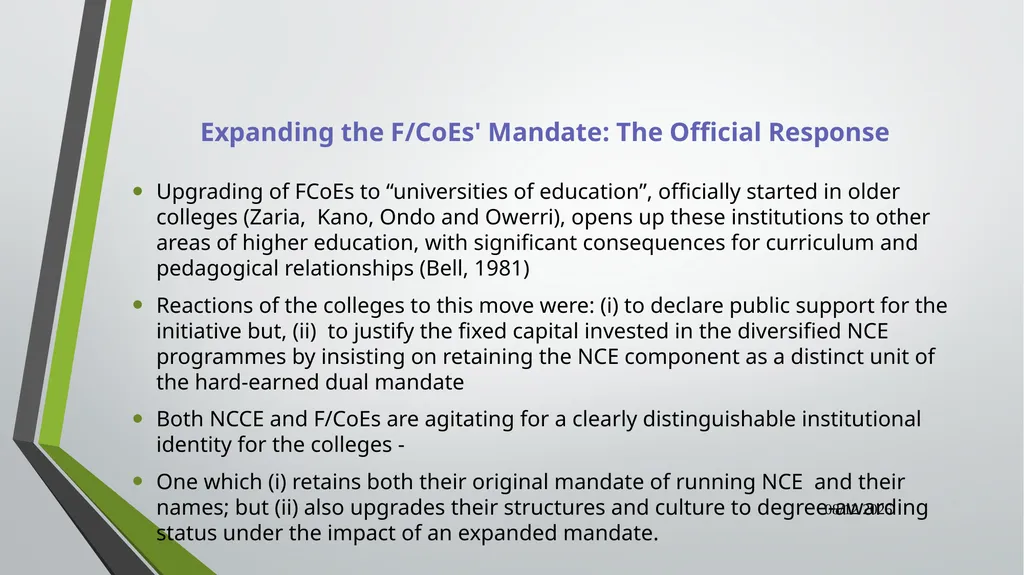
Expanding the F/CoEs' Mandate: The Official Response Upgrading of FCoEs to “universities of education”, officially started in older colleges (Zaria, Kano, Ondo and Owerri), opens up these institutions to other areas of higher education, with significant consequences for curriculum and pedagogical relationships (Bell, 1981)
Reactions of the colleges to this move were: (i) to declare public support for the initiative but, (ii) to justify the fixed capital invested in the diversified NCE programmes by insisting on retaining the NCE component as a distinct unit of the hard-earned dual mandate
Both NCCE and F/CoEs are agitating for a clearly distinguishable institutional identity for the colleges -
One which (i) retains both their original mandate of running NCE and their names; but (ii) also upgrades their structures and culture to degree-awarding status under the impact of an expanded mandate.<br>
Reactions of the colleges to this move were: (i) to declare public support for the initiative but, (ii) to justify the fixed capital invested in the diversified NCE programmes by insisting on retaining the NCE component as a distinct unit of the hard-earned dual mandate
Both NCCE and F/CoEs are agitating for a clearly distinguishable institutional identity for the colleges -
One which (i) retains both their original mandate of running NCE and their names; but (ii) also upgrades their structures and culture to degree-awarding status under the impact of an expanded mandate.<br>
16
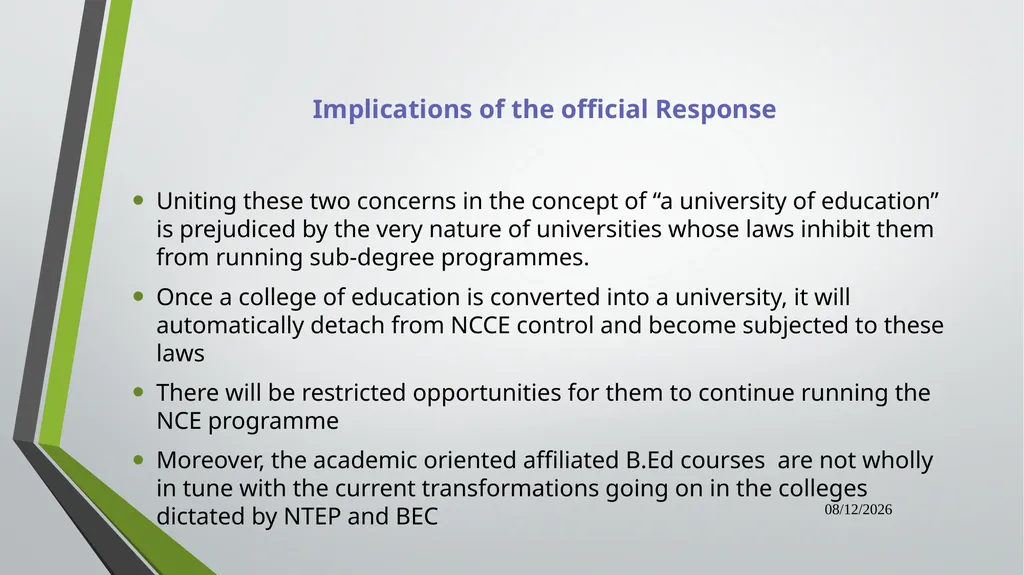
Implications of the official Response Uniting these two concerns in the concept of “a university of education” is prejudiced by the very nature of universities whose laws inhibit them from running sub-degree programmes.
Once a college of education is converted into a university, it will automatically detach from NCCE control and become subjected to these laws
There will be restricted opportunities for them to continue running the NCE programme
Moreover, the academic oriented affiliated B.Ed courses are not wholly in tune with the current transformations going on in the colleges dictated by NTEP and BEC<br>
Once a college of education is converted into a university, it will automatically detach from NCCE control and become subjected to these laws
There will be restricted opportunities for them to continue running the NCE programme
Moreover, the academic oriented affiliated B.Ed courses are not wholly in tune with the current transformations going on in the colleges dictated by NTEP and BEC<br>
17
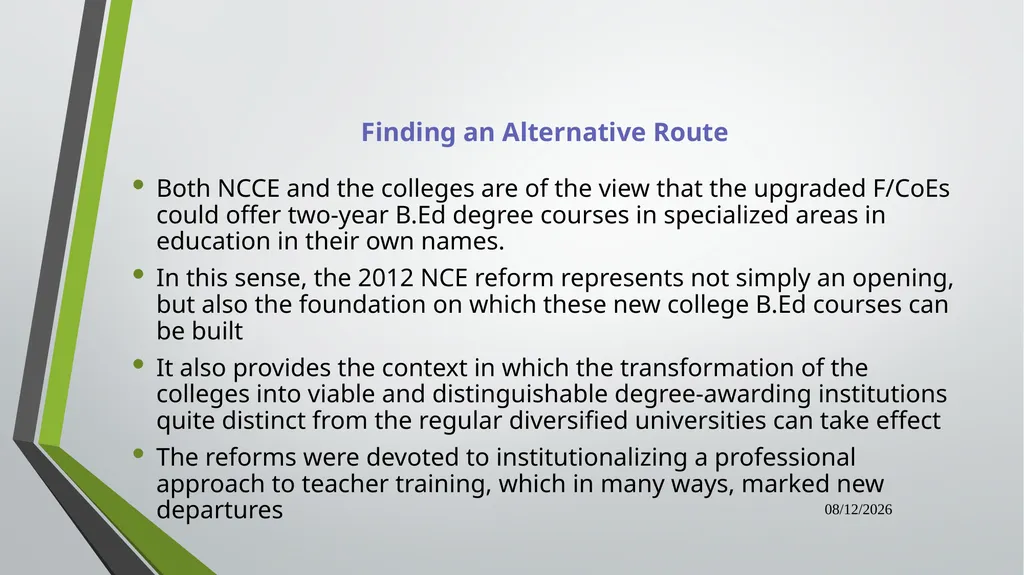
Finding an Alternative Route Both NCCE and the colleges are of the view that the upgraded F/CoEs could offer two-year B.Ed degree courses in specialized areas in education in their own names.
In this sense, the 2012 NCE reform represents not simply an opening, but also the foundation on which these new college B.Ed courses can be built
It also provides the context in which the transformation of the colleges into viable and distinguishable degree-awarding institutions quite distinct from the regular diversified universities can take effect
The reforms were devoted to institutionalizing a professional approach to teacher training, which in many ways, marked new departures<br>
In this sense, the 2012 NCE reform represents not simply an opening, but also the foundation on which these new college B.Ed courses can be built
It also provides the context in which the transformation of the colleges into viable and distinguishable degree-awarding institutions quite distinct from the regular diversified universities can take effect
The reforms were devoted to institutionalizing a professional approach to teacher training, which in many ways, marked new departures<br>
18
Points of departure from the old Model A shift in curriculum focus and emphasis on appropriate methods of instruction in each area of basic education. The curriculum of the training institutions was revised and refocused.
The instrument of this revision was the NCE Minimum Standards, the contents of which were largely extended versions of the approved national curriculum for the various areas of Basic Education.
Accordingly, appropriate minimum standards for training teachers to handle the five areas of basic education were developed.<br>
The instrument of this revision was the NCE Minimum Standards, the contents of which were largely extended versions of the approved national curriculum for the various areas of Basic Education.
Accordingly, appropriate minimum standards for training teachers to handle the five areas of basic education were developed.<br>
19
Points of departure Cont'd Changes in institutional structures of the training colleges:
The training institutions were encouraged and supported to undertake fundamental changes in their structures to reflect the type of specialised teachers they were training.
Thus, instead of naming schools against the names of subjects such as School of Languages, the schools were named after the types of specialised training they offered.
Argument: training that is located within level-specific context and is based on the processes of teaching and learning appropriate to that level has greater potential for producing effective/professional teachers than the fragmented subject-based training.<br>
The training institutions were encouraged and supported to undertake fundamental changes in their structures to reflect the type of specialised teachers they were training.
Thus, instead of naming schools against the names of subjects such as School of Languages, the schools were named after the types of specialised training they offered.
Argument: training that is located within level-specific context and is based on the processes of teaching and learning appropriate to that level has greater potential for producing effective/professional teachers than the fragmented subject-based training.<br>
20
Points of departure Cont'd Changes in pedagogy:
It was observed that most of the then teacher educators in the colleges, as is also the case now, who were expected to deliver the new curriculum were themselves handicapped.
Either they were unfamiliar with the recommended strategies or they had an unchanging mindset.
This was not surprising as many, if not all staff of most colleges, were recruited based almost exclusively on their competence as subject specialists.
Although invariably they partook in supervision of TP and taught methods courses, their main preoccupation was their main subject teaching and that was the biggest institutional demand on them<br>
It was observed that most of the then teacher educators in the colleges, as is also the case now, who were expected to deliver the new curriculum were themselves handicapped.
Either they were unfamiliar with the recommended strategies or they had an unchanging mindset.
This was not surprising as many, if not all staff of most colleges, were recruited based almost exclusively on their competence as subject specialists.
Although invariably they partook in supervision of TP and taught methods courses, their main preoccupation was their main subject teaching and that was the biggest institutional demand on them<br>
21
Points of departure Cont'd Furthermore, the existing formal power structures of the colleges also reflected and reinforced the prominence of main subject teaching over technical training.
The vision of teaching implied by the notion of professional training embedded within the new NCE curriculum called for changes in teacher educators’ methods and styles of teaching that were predominantly lecture-based,
But, the reform was flexible enough to accommodate the old two-subjects NCE courses of the colleges alongside the new level-specific courses.
With an expanded mandate, these old courses have now gained additional justification and significance for those who wish to train for senior secondary school teaching.<br>
The vision of teaching implied by the notion of professional training embedded within the new NCE curriculum called for changes in teacher educators’ methods and styles of teaching that were predominantly lecture-based,
But, the reform was flexible enough to accommodate the old two-subjects NCE courses of the colleges alongside the new level-specific courses.
With an expanded mandate, these old courses have now gained additional justification and significance for those who wish to train for senior secondary school teaching.<br>
22
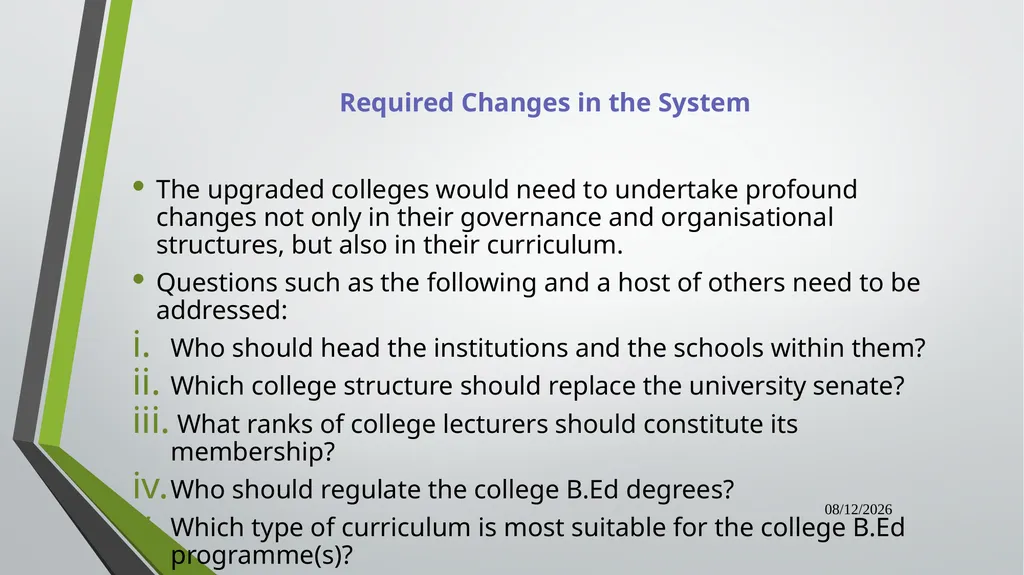
Required Changes in the System The upgraded colleges would need to undertake profound changes not only in their governance and organisational structures, but also in their curriculum.
Questions such as the following and a host of others need to be addressed:
Who should head the institutions and the schools within them?
Which college structure should replace the university senate?
What ranks of college lecturers should constitute its membership?
Who should regulate the college B.Ed degrees?
Which type of curriculum is most suitable for the college B.Ed programme(s)?<br>
Questions such as the following and a host of others need to be addressed:
Who should head the institutions and the schools within them?
Which college structure should replace the university senate?
What ranks of college lecturers should constitute its membership?
Who should regulate the college B.Ed degrees?
Which type of curriculum is most suitable for the college B.Ed programme(s)?<br>
23
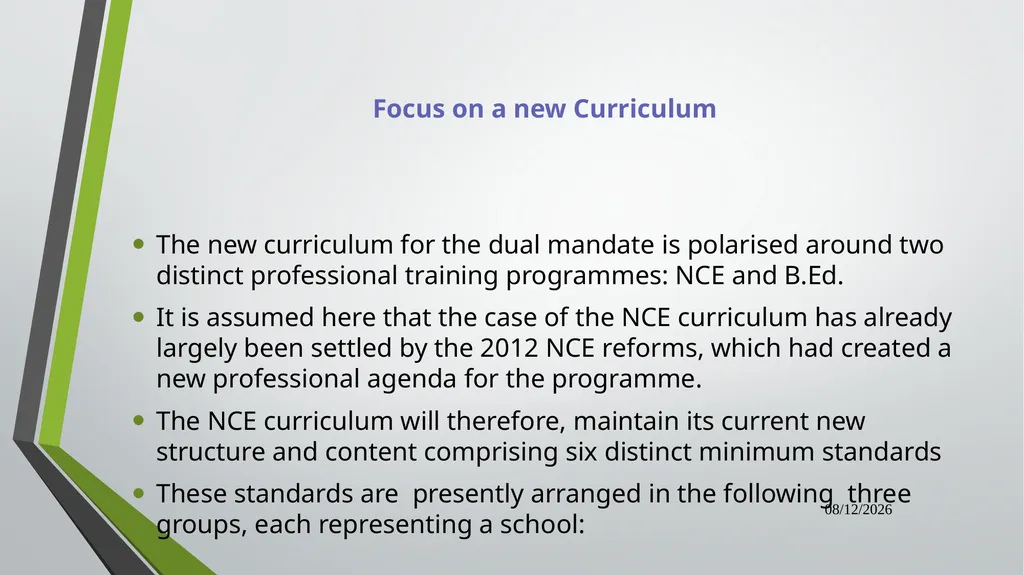
Focus on a new Curriculum The new curriculum for the dual mandate is polarised around two distinct professional training programmes: NCE and B.Ed.
It is assumed here that the case of the NCE curriculum has already largely been settled by the 2012 NCE reforms, which had created a new professional agenda for the programme.
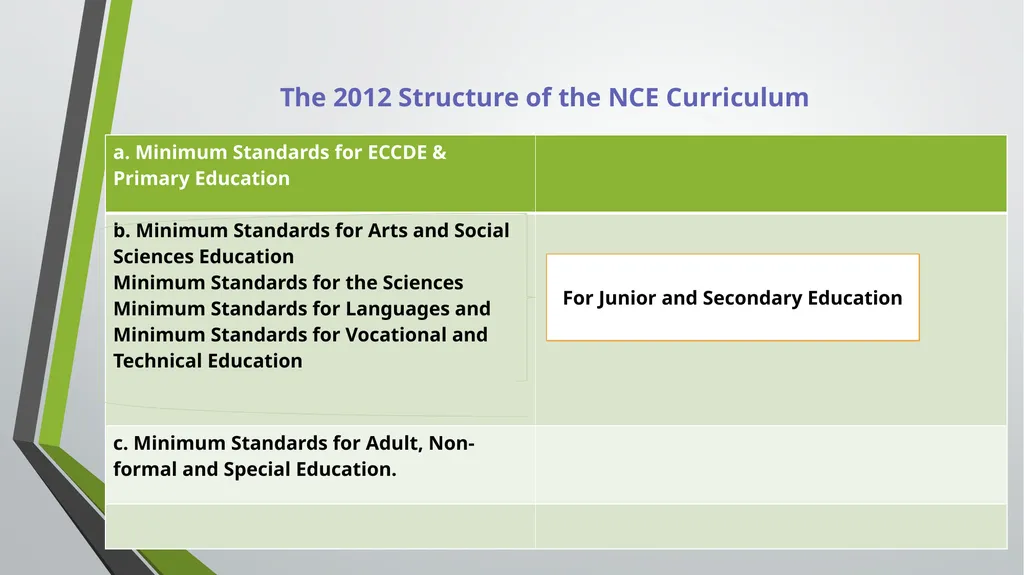
The NCE curriculum will therefore, maintain its current new structure and content comprising six distinct minimum standards
These standards are presently arranged in the following three groups, each representing a school:<br>
It is assumed here that the case of the NCE curriculum has already largely been settled by the 2012 NCE reforms, which had created a new professional agenda for the programme.
The NCE curriculum will therefore, maintain its current new structure and content comprising six distinct minimum standards
These standards are presently arranged in the following three groups, each representing a school:<br>
24
The 2012 Structure of the NCE Curriculum For Junior and Secondary Education<br>
25
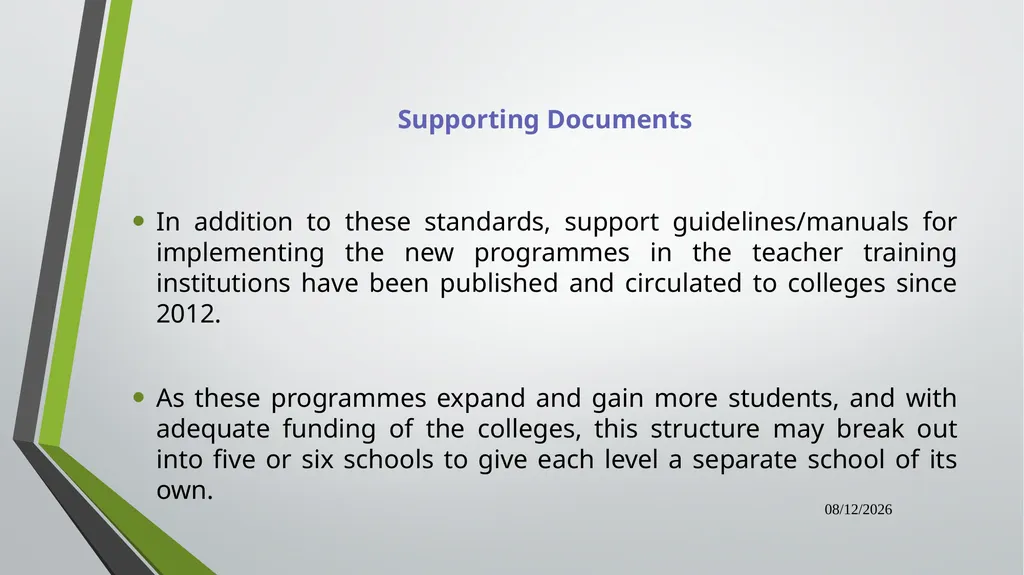
Supporting Documents In addition to these standards, support guidelines/manuals for implementing the new programmes in the teacher training institutions have been published and circulated to colleges since 2012.
As these programmes expand and gain more students, and with adequate funding of the colleges, this structure may break out into five or six schools to give each level a separate school of its own.<br>
As these programmes expand and gain more students, and with adequate funding of the colleges, this structure may break out into five or six schools to give each level a separate school of its own.<br>
26
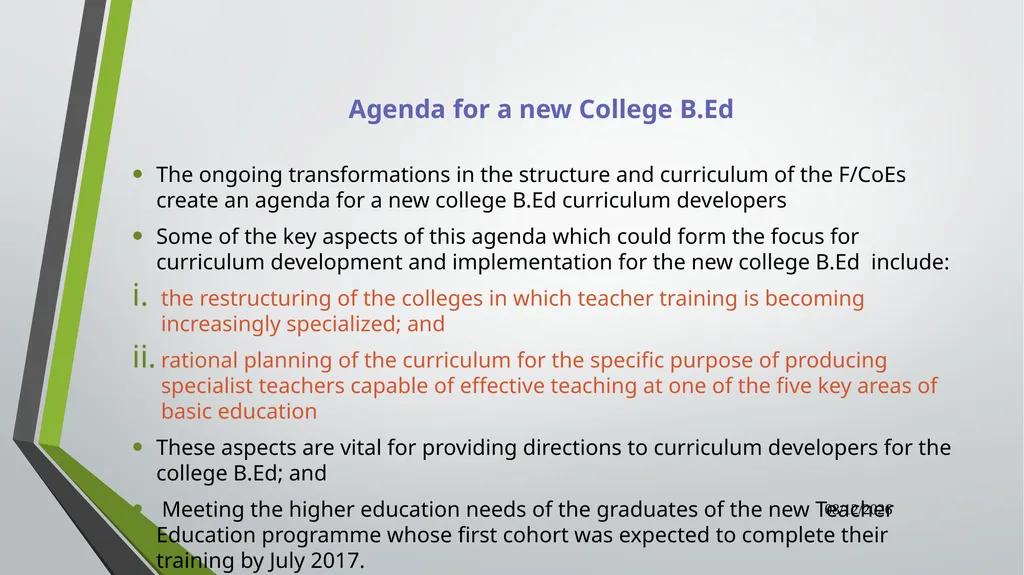
Agenda for a new College B.Ed The ongoing transformations in the structure and curriculum of the F/CoEs create an agenda for a new college B.Ed curriculum developers
Some of the key aspects of this agenda which could form the focus for curriculum development and implementation for the new college B.Ed include:
the restructuring of the colleges in which teacher training is becoming increasingly specialized; and
rational planning of the curriculum for the specific purpose of producing specialist teachers capable of effective teaching at one of the five key areas of basic education
These aspects are vital for providing directions to curriculum developers for the college B.Ed; and
Meeting the higher education needs of the graduates of the new Teacher Education programme whose first cohort was expected to complete their training by July 2017.<br>
Some of the key aspects of this agenda which could form the focus for curriculum development and implementation for the new college B.Ed include:
the restructuring of the colleges in which teacher training is becoming increasingly specialized; and
rational planning of the curriculum for the specific purpose of producing specialist teachers capable of effective teaching at one of the five key areas of basic education
These aspects are vital for providing directions to curriculum developers for the college B.Ed; and
Meeting the higher education needs of the graduates of the new Teacher Education programme whose first cohort was expected to complete their training by July 2017.<br>
27
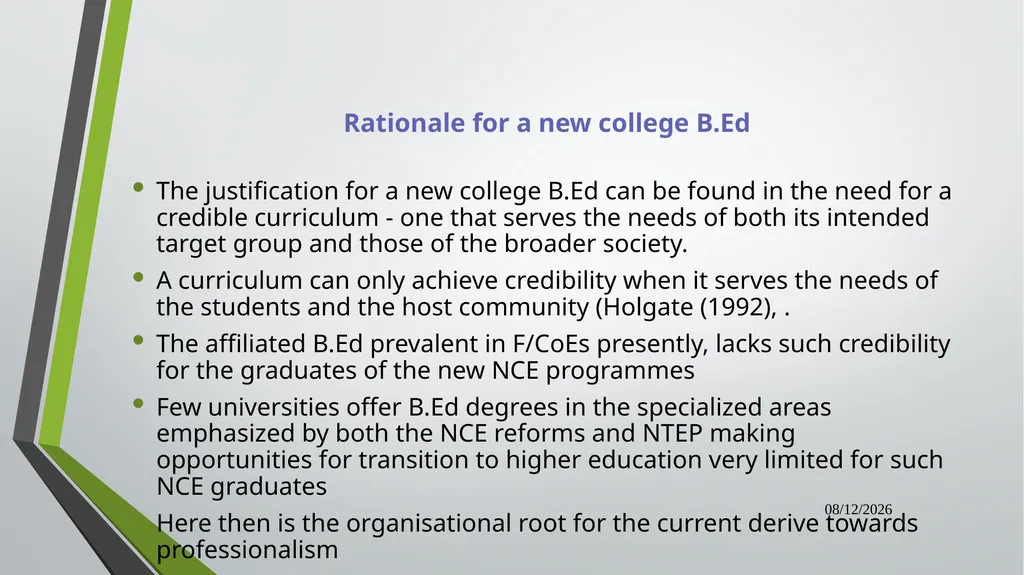
Rationale for a new college B.Ed The justification for a new college B.Ed can be found in the need for a credible curriculum - one that serves the needs of both its intended target group and those of the broader society.
A curriculum can only achieve credibility when it serves the needs of the students and the host community (Holgate (1992), .
The affiliated B.Ed prevalent in F/CoEs presently, lacks such credibility for the graduates of the new NCE programmes
Few universities offer B.Ed degrees in the specialized areas emphasized by both the NCE reforms and NTEP making opportunities for transition to higher education very limited for such NCE graduates
Here then is the organisational root for the current derive towards professionalism<br>
A curriculum can only achieve credibility when it serves the needs of the students and the host community (Holgate (1992), .
The affiliated B.Ed prevalent in F/CoEs presently, lacks such credibility for the graduates of the new NCE programmes
Few universities offer B.Ed degrees in the specialized areas emphasized by both the NCE reforms and NTEP making opportunities for transition to higher education very limited for such NCE graduates
Here then is the organisational root for the current derive towards professionalism<br>
28
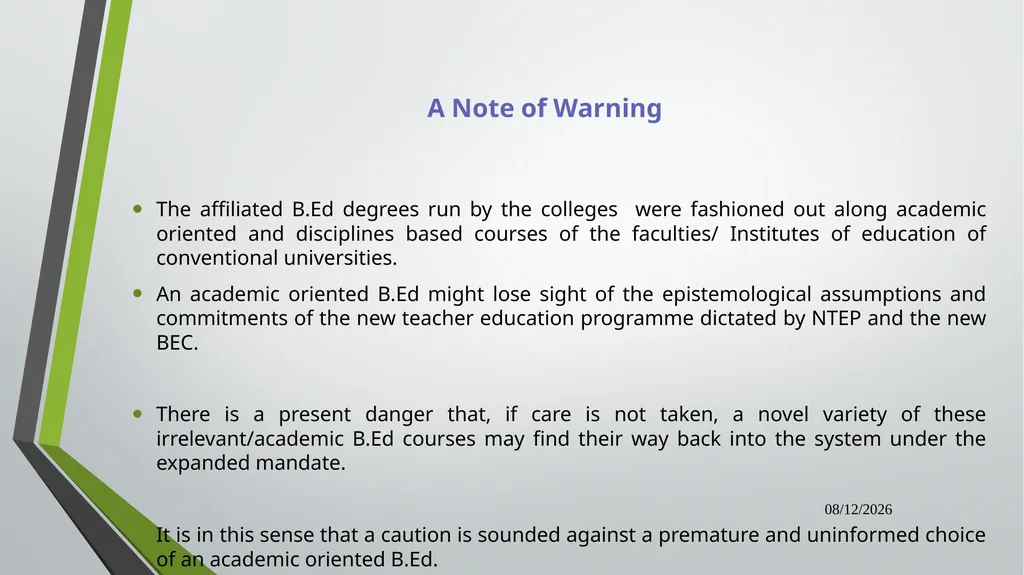
A Note of Warning The affiliated B.Ed degrees run by the colleges were fashioned out along academic oriented and disciplines based courses of the faculties/ Institutes of education of conventional universities.
An academic oriented B.Ed might lose sight of the epistemological assumptions and commitments of the new teacher education programme dictated by NTEP and the new BEC.
There is a present danger that, if care is not taken, a novel variety of these irrelevant/academic B.Ed courses may find their way back into the system under the expanded mandate.
It is in this sense that a caution is sounded against a premature and uninformed choice of an academic oriented B.Ed.<br>
An academic oriented B.Ed might lose sight of the epistemological assumptions and commitments of the new teacher education programme dictated by NTEP and the new BEC.
There is a present danger that, if care is not taken, a novel variety of these irrelevant/academic B.Ed courses may find their way back into the system under the expanded mandate.
It is in this sense that a caution is sounded against a premature and uninformed choice of an academic oriented B.Ed.<br>
29
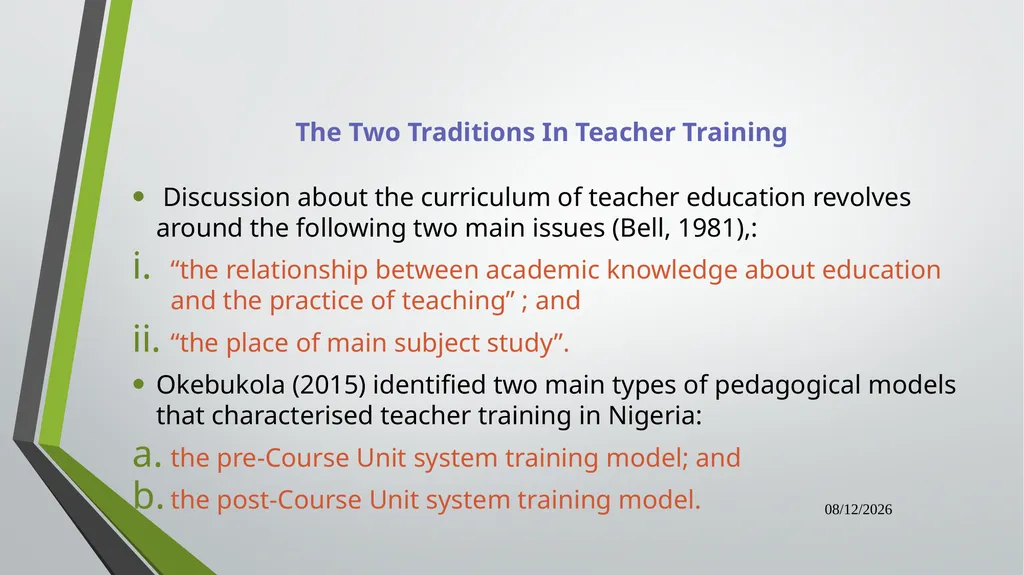
The Two Traditions In Teacher Training Discussion about the curriculum of teacher education revolves around the following two main issues (Bell, 1981),:
“the relationship between academic knowledge about education and the practice of teaching” ; and
“the place of main subject study”.
Okebukola (2015) identified two main types of pedagogical models that characterised teacher training in Nigeria:
the pre-Course Unit system training model; and
the post-Course Unit system training model.<br>
“the relationship between academic knowledge about education and the practice of teaching” ; and
“the place of main subject study”.
Okebukola (2015) identified two main types of pedagogical models that characterised teacher training in Nigeria:
the pre-Course Unit system training model; and
the post-Course Unit system training model.<br>
30
The Pre-Course Unit Model This pedagogical model was one in which the student teacher was exposed to more content knowledge in his/her teaching subjects than in education.
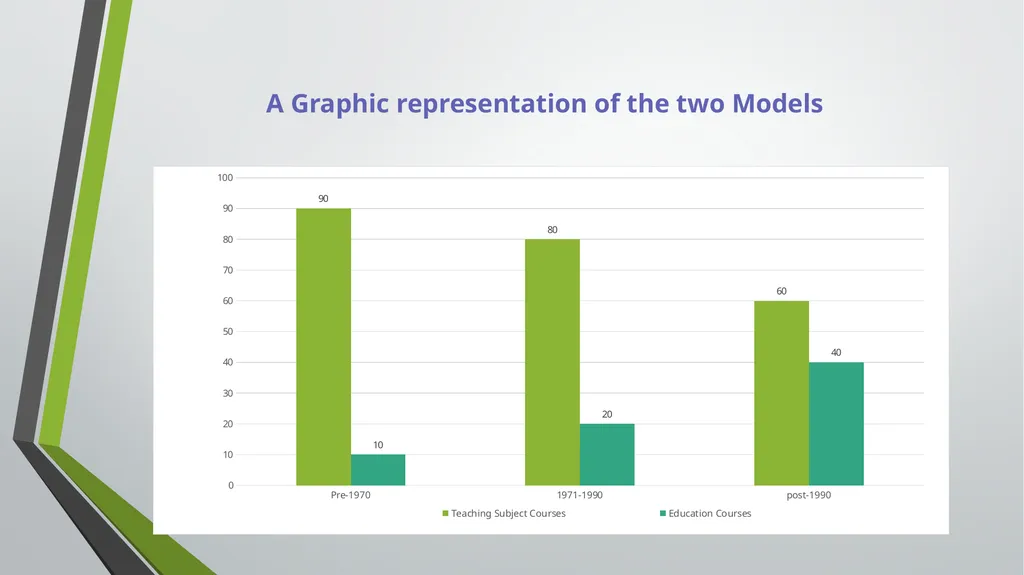
The common practice in teacher preparation institutions was to devote about 90% of the teacher education curriculum to the teaching subject and about 10% to education”.
The model produced high levels of mastery of the content knowledge of the teaching subjects in their students,
It also built their practical skills of teaching and professional competence by ensuring that only relevant and useful knowledge and skills of the education components were taught to them.<br>
The common practice in teacher preparation institutions was to devote about 90% of the teacher education curriculum to the teaching subject and about 10% to education”.
The model produced high levels of mastery of the content knowledge of the teaching subjects in their students,
It also built their practical skills of teaching and professional competence by ensuring that only relevant and useful knowledge and skills of the education components were taught to them.<br>
31
Post-Course Unit Model In the second model, the ratio of subject studies to education courses is reversed.
The education experts in particular, seized the opportunity of the course unit system to “navigate their way to increasing the load of the courses in education” at the expense of the teaching subjects.
The result: “a recipe for producing the half-baked teachers we are now confronted with in terms of content knowledge”.
The assumption underpinning this training model is that broad and intense exposure to all manner of education courses is a grooming experience which produces a fully and truly competent teacher.<br>
The education experts in particular, seized the opportunity of the course unit system to “navigate their way to increasing the load of the courses in education” at the expense of the teaching subjects.
The result: “a recipe for producing the half-baked teachers we are now confronted with in terms of content knowledge”.
The assumption underpinning this training model is that broad and intense exposure to all manner of education courses is a grooming experience which produces a fully and truly competent teacher.<br>
32
A Graphic representation of the two Models<br>
33
The Two Models Contrasted In theory, the abiding concern of both models was to produce what Bell (1981) described as the “professionally skilled practitioner of effective teaching.”
But in practice, they differed in the emphasis they laid on the kind of teacher they aimed to produce.
The first typology, with its emphasis on the study of education theory leaned more towards preparing student teachers for intelligent and informed discourse about educational issues than practical expertise or knowledge of the subject matter.
Hence, its curriculum, pedagogy and assessment processes were all skewed in accordance with its own conception of what it is to be an effective teacher - a teacher well grounded in educational discourse but deficient in subject matter knowledge.<br>
But in practice, they differed in the emphasis they laid on the kind of teacher they aimed to produce.
The first typology, with its emphasis on the study of education theory leaned more towards preparing student teachers for intelligent and informed discourse about educational issues than practical expertise or knowledge of the subject matter.
Hence, its curriculum, pedagogy and assessment processes were all skewed in accordance with its own conception of what it is to be an effective teacher - a teacher well grounded in educational discourse but deficient in subject matter knowledge.<br>
34
The Two Models Contrasted The second model was concerned to produce what both Bell (1981) and Okebukola (2015) defined as “a highly educated teacher in the subject area who happened to want to be a teacher”.
Accordingly, the curriculum laid greater emphasis on the main subject study with diminished and largely applied role for the study of education theory and practice.
The model downplayed the usefulness of the education disciplines in initial preparation of teachers except in so far as they could be tailored to offer direct practical applicability.
Their role was regarded as contributory to effective teaching of the main subject.<br>
Accordingly, the curriculum laid greater emphasis on the main subject study with diminished and largely applied role for the study of education theory and practice.
The model downplayed the usefulness of the education disciplines in initial preparation of teachers except in so far as they could be tailored to offer direct practical applicability.
Their role was regarded as contributory to effective teaching of the main subject.<br>
35
The Two Models Contrasted This view is rooted in the dual function of the training institutions, which involves not only technical training but also the broader education of the student teacher.
The adage that “a teacher must himself be educated before he can educate others” is at the heart of the main subject study.
Here then lies the rationale for the current derive towards a professional B.Ed.<br>
The adage that “a teacher must himself be educated before he can educate others” is at the heart of the main subject study.
Here then lies the rationale for the current derive towards a professional B.Ed.<br>
36
Choosing a Focus a new College B.Ed Choosing a focus for the new college B.Ed within the age- and level-specific model of training prescribed by NTEP, calls for a balanced attention to these two crucial functions of the training programme.
No one function must be undermined by the other such as in the prevailing disciplines-based model.
Hence, in developing a curriculum for the new college B.Ed, one must be concerned to identify both the subject matter knowledge and the technical methods that are consistent with the qualities of the kind of specialist teacher prescribed by the training objectives.
This is very different from identifying technical methods merely in terms of their effectiveness in teaching a particular subject or topic as the practice is presently in colleges.<br>
No one function must be undermined by the other such as in the prevailing disciplines-based model.
Hence, in developing a curriculum for the new college B.Ed, one must be concerned to identify both the subject matter knowledge and the technical methods that are consistent with the qualities of the kind of specialist teacher prescribed by the training objectives.
This is very different from identifying technical methods merely in terms of their effectiveness in teaching a particular subject or topic as the practice is presently in colleges.<br>
37
Choosing a Focus for a new College B.Ed The development of professional practices of individual teachers is limited if they simply reflect about them in isolation from relevant contexts and their peers (Lortie, 1975).
This means that the capacity for technical knowledge to support competent practice depends on the extent to which it is contextualized and shared among members of a professional group (e.g., Association of Early Childhood Teachers).
In this structural context, the notion of a specialised expert training to produce “effective teaching” makes considerable sense.<br>
This means that the capacity for technical knowledge to support competent practice depends on the extent to which it is contextualized and shared among members of a professional group (e.g., Association of Early Childhood Teachers).
In this structural context, the notion of a specialised expert training to produce “effective teaching” makes considerable sense.<br>
38
Arguments for a Professional B.Ed Before 2012, there was insufficient recognition of the importance of aligning teacher training with the curricula of the levels of education for which teachers were being trained, or the willingness to do so in the colleges.
Both the dominant power structures of the F/CoEs and the affiliated B.Ed courses reflected and reinforced a distorted version of the second training model.
The professional tradition of the old teacher training colleges (TTCs) was relegated to much reduced importance and subject study was given more prominence.
Again, the duration for practical training was short and teaching practice was poorly organised and supervised during this short period.<br>
Both the dominant power structures of the F/CoEs and the affiliated B.Ed courses reflected and reinforced a distorted version of the second training model.
The professional tradition of the old teacher training colleges (TTCs) was relegated to much reduced importance and subject study was given more prominence.
Again, the duration for practical training was short and teaching practice was poorly organised and supervised during this short period.<br>
39
Arguments for a Professional B.Ed This problem was further compounded by the following factors:
separation of the academic education theory course from technical methods training and aligning these methods to subjects teaching.
recruitment and preponderance of younger and less professionally experienced but better academically qualified staff in the college.
the fact that due to expansion in size and academic influences from outside, F/CoEs have had to increasingly deal with a majority of students whose vocational interest is not in teaching.
These factors led to increased acceptance of the academic norms of the disciplines approach at the expense of technical training in the colleges.<br>
separation of the academic education theory course from technical methods training and aligning these methods to subjects teaching.
recruitment and preponderance of younger and less professionally experienced but better academically qualified staff in the college.
the fact that due to expansion in size and academic influences from outside, F/CoEs have had to increasingly deal with a majority of students whose vocational interest is not in teaching.
These factors led to increased acceptance of the academic norms of the disciplines approach at the expense of technical training in the colleges.<br>
40
My own Conclusion The age- and level-specific or the professional model has most to offer in terms of creating a clearly distinguishable institutional identity of degree-awarding status for the colleges.
It will allow the colleges to offer a professional B.Ed without losing their original mandate of offering the NCE programme or their names.
It provides an opportunity and the structural context for making practical teaching skills and professional studies the centre and culmination of the B.Ed degree course(s) in the five key specialised areas introduced at the NCE level by the 2012 reforms.<br>
It will allow the colleges to offer a professional B.Ed without losing their original mandate of offering the NCE programme or their names.
It provides an opportunity and the structural context for making practical teaching skills and professional studies the centre and culmination of the B.Ed degree course(s) in the five key specialised areas introduced at the NCE level by the 2012 reforms.<br>
41
My own Conclusion It will guarantee a seamless transition from the NCE courses to the degree courses for the F/CoE students; and
Provides an opportunity for the colleges to develop truly professional degree courses, quite distinct from the subject-based, academic oriented B.Ed courses offered by the universities.
By providing a clear historical understanding of the rationale for and the distinguishable nature of the professional B.Ed, the apparent paradox of regulatory role, which fits the NCCE against the NUC might be better understood and resolved.<br>
Provides an opportunity for the colleges to develop truly professional degree courses, quite distinct from the subject-based, academic oriented B.Ed courses offered by the universities.
By providing a clear historical understanding of the rationale for and the distinguishable nature of the professional B.Ed, the apparent paradox of regulatory role, which fits the NCCE against the NUC might be better understood and resolved.<br>
42
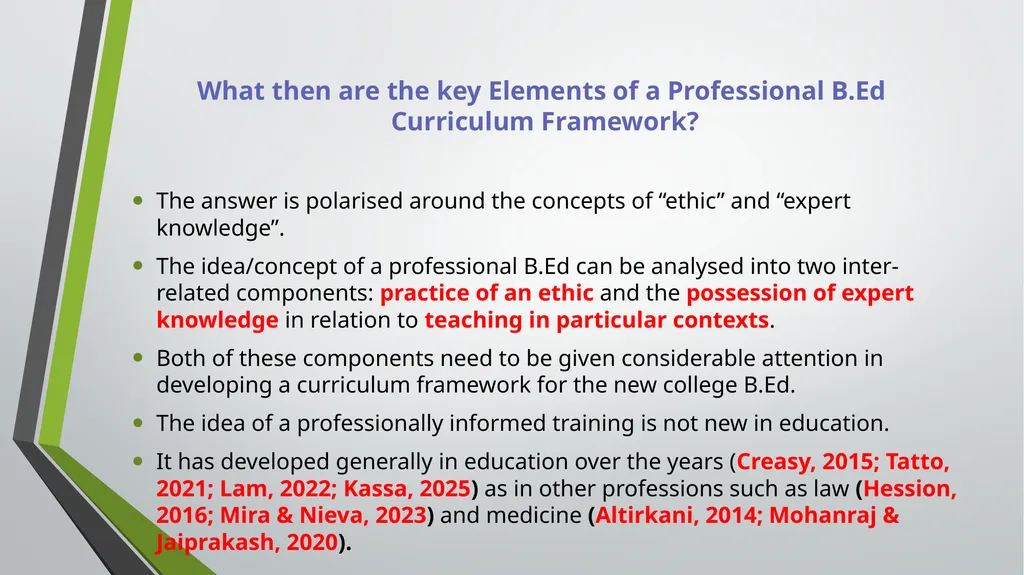
What then are the key Elements of a Professional B.Ed Curriculum Framework? The answer is polarised around the concepts of “ethic” and “expert knowledge”.
The idea/concept of a professional B.Ed can be analysed into two inter-related components: practice of an ethic and the possession of expert knowledge in relation to teaching in particular contexts.
Both of these components need to be given considerable attention in developing a curriculum framework for the new college B.Ed.
The idea of a professionally informed training is not new in education.
It has developed generally in education over the years (Creasy, 2015; Tatto, 2021; Lam, 2022; Kassa, 2025) as in other professions such as law (Hession, 2016; Mira & Nieva, 2023) and medicine (Altirkani, 2014; Mohanraj & Jaiprakash, 2020).<br>
The idea/concept of a professional B.Ed can be analysed into two inter-related components: practice of an ethic and the possession of expert knowledge in relation to teaching in particular contexts.
Both of these components need to be given considerable attention in developing a curriculum framework for the new college B.Ed.
The idea of a professionally informed training is not new in education.
It has developed generally in education over the years (Creasy, 2015; Tatto, 2021; Lam, 2022; Kassa, 2025) as in other professions such as law (Hession, 2016; Mira & Nieva, 2023) and medicine (Altirkani, 2014; Mohanraj & Jaiprakash, 2020).<br>
43
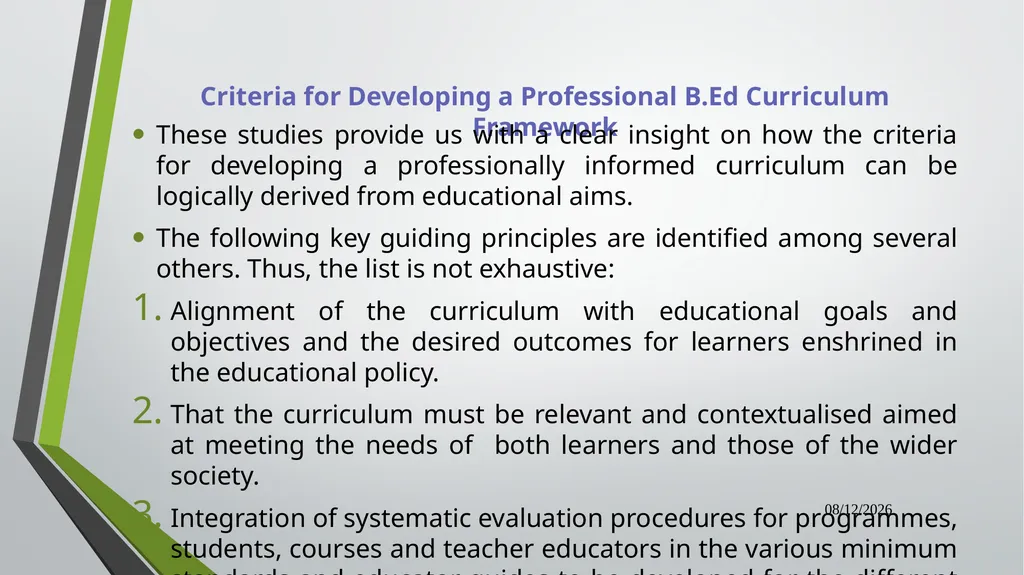
Criteria for Developing a Professional B.Ed Curriculum Framework These studies provide us with a clear insight on how the criteria for developing a professionally informed curriculum can be logically derived from educational aims.
The following key guiding principles are identified among several others. Thus, the list is not exhaustive:
Alignment of the curriculum with educational goals and objectives and the desired outcomes for learners enshrined in the educational policy.
That the curriculum must be relevant and contextualised aimed at meeting the needs of both learners and those of the wider society.
Integration of systematic evaluation procedures for programmes, students, courses and teacher educators in the various minimum standards and educator guides to be developed for the different levels of education.<br>
The following key guiding principles are identified among several others. Thus, the list is not exhaustive:
Alignment of the curriculum with educational goals and objectives and the desired outcomes for learners enshrined in the educational policy.
That the curriculum must be relevant and contextualised aimed at meeting the needs of both learners and those of the wider society.
Integration of systematic evaluation procedures for programmes, students, courses and teacher educators in the various minimum standards and educator guides to be developed for the different levels of education.<br>
44
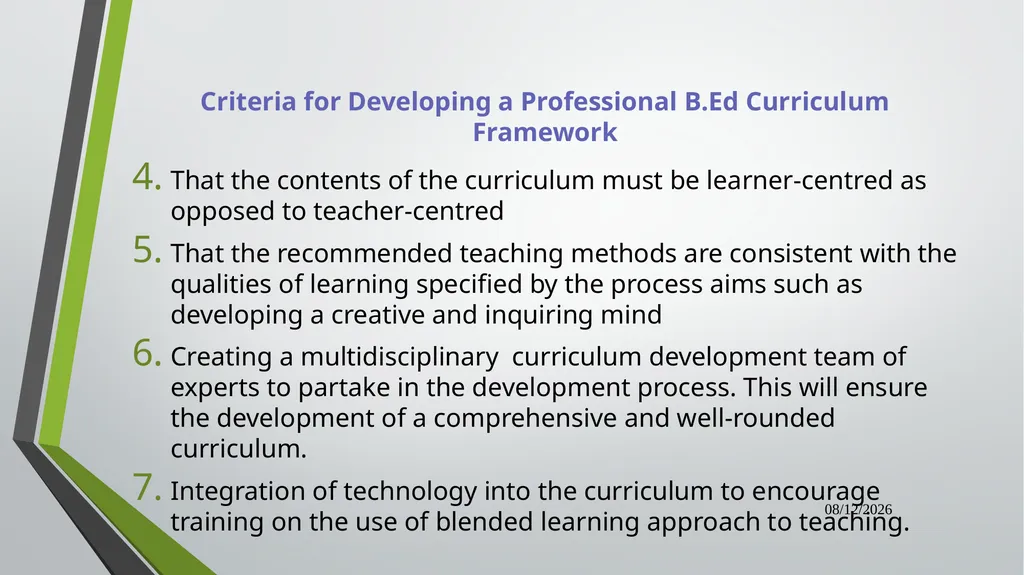
Criteria for Developing a Professional B.Ed Curriculum Framework That the contents of the curriculum must be learner-centred as opposed to teacher-centred
That the recommended teaching methods are consistent with the qualities of learning specified by the process aims such as developing a creative and inquiring mind
Creating a multidisciplinary curriculum development team of experts to partake in the development process. This will ensure the development of a comprehensive and well-rounded curriculum.
Integration of technology into the curriculum to encourage training on the use of blended learning approach to teaching.<br>
That the recommended teaching methods are consistent with the qualities of learning specified by the process aims such as developing a creative and inquiring mind
Creating a multidisciplinary curriculum development team of experts to partake in the development process. This will ensure the development of a comprehensive and well-rounded curriculum.
Integration of technology into the curriculum to encourage training on the use of blended learning approach to teaching.<br>
45
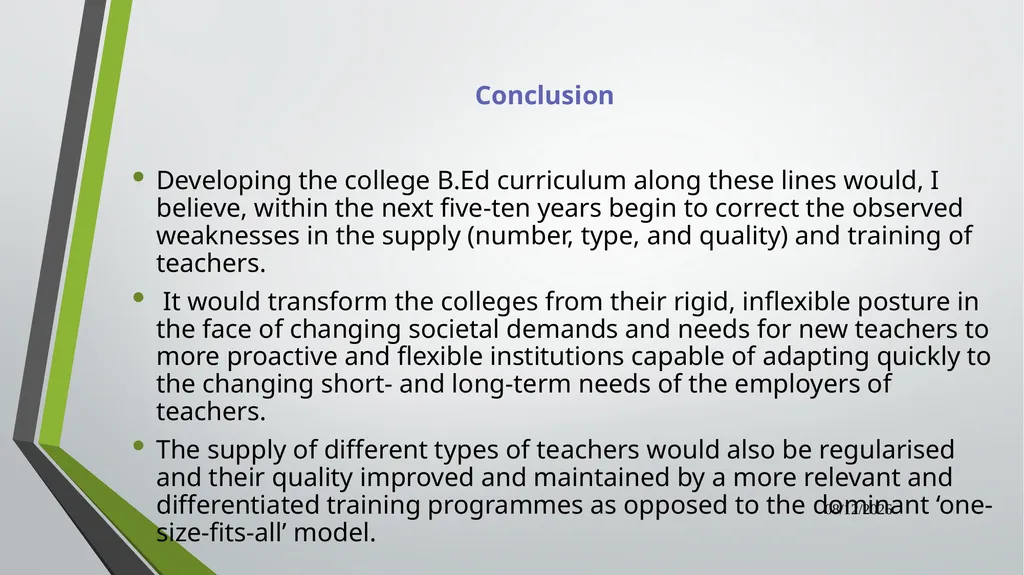
Conclusion Developing the college B.Ed curriculum along these lines would, I believe, within the next five-ten years begin to correct the observed weaknesses in the supply (number, type, and quality) and training of teachers.
It would transform the colleges from their rigid, inflexible posture in the face of changing societal demands and needs for new teachers to more proactive and flexible institutions capable of adapting quickly to the changing short- and long-term needs of the employers of teachers.
The supply of different types of teachers would also be regularised and their quality improved and maintained by a more relevant and differentiated training programmes as opposed to the dominant ‘one-size-fits-all’ model.<br>
It would transform the colleges from their rigid, inflexible posture in the face of changing societal demands and needs for new teachers to more proactive and flexible institutions capable of adapting quickly to the changing short- and long-term needs of the employers of teachers.
The supply of different types of teachers would also be regularised and their quality improved and maintained by a more relevant and differentiated training programmes as opposed to the dominant ‘one-size-fits-all’ model.<br>
46
Conclusion Cont'd Sadly, though, experience from implementation of the recent NCE reforms has shown that mere changes to the curriculum and college structures alone are not enough to bring about the desired change.
Rigid opposition in the form of vested interests and recalcitrant habits is too strong among college staff (both academic and non-academic).
Courageous leadership at both federal (FME & NCCE) and college levels is therefore needed to carry through these innovative changes in the system.
The good news however, is that this move for change is now being initiated and championed by the colleges themselves rather than being forced on them from the top.<br>
Rigid opposition in the form of vested interests and recalcitrant habits is too strong among college staff (both academic and non-academic).
Courageous leadership at both federal (FME & NCCE) and college levels is therefore needed to carry through these innovative changes in the system.
The good news however, is that this move for change is now being initiated and championed by the colleges themselves rather than being forced on them from the top.<br>
47
The End Thank You<br>