DualSteer Way Forward discussion Oct 26th , 2023 DualSteer SA1 R19 way forward compromise Summary ) Optional in SA1 reqs means: shall may be supported (Pseudo CR changes would apply to the three general requirements on
Related Topics
Share
Embed code
Download this presentation From Below
"DualSteer – Way Forward discussion Oct 26th , 2023" is the property of its rightful owner. Permission is granted to
download and print the materials on this website for personal, non-commercial use only, and to display it
on your personal computer provided you do not modify the materials and that you retain all copyright
notices contained in the materials. By downloading content from our website, you accept the terms of this
agreement.
Presentation Transcript
01
DualSteer – Way Forward discussion Oct 26th , 2023<br>
02
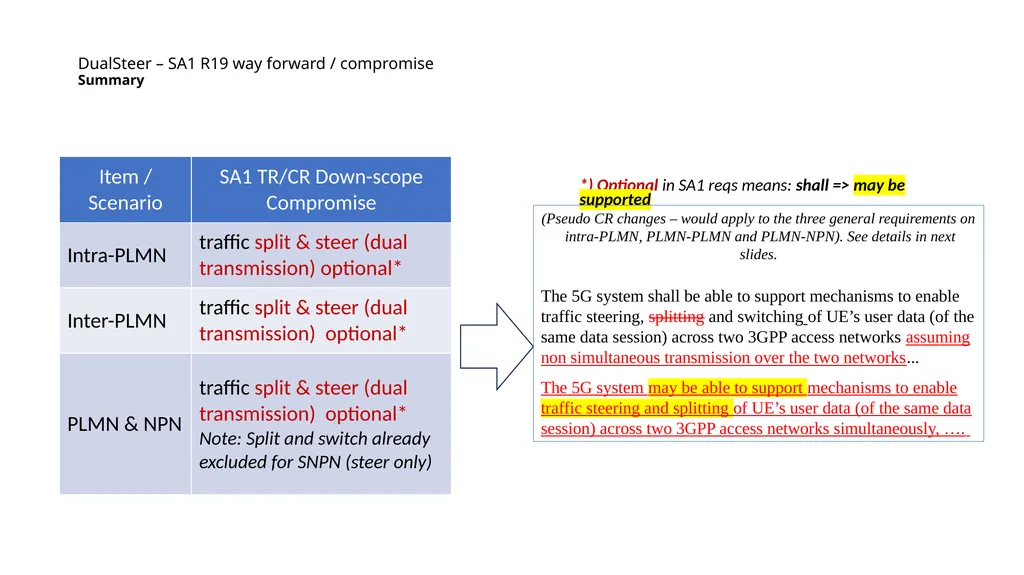
DualSteer – SA1 R19 way forward / compromise Summary *) Optional in SA1 reqs means: shall => may be supported (Pseudo CR changes – would apply to the three general requirements on intra-PLMN, PLMN-PLMN and PLMN-NPN). See details in next slides.
The 5G system shall be able to support mechanisms to enable traffic steering, splitting and switching of UE’s user data (of the same data session) across two 3GPP access networks assuming non simultaneous transmission over the two networks...
The 5G system may be able to support mechanisms to enable traffic steering and splitting of UE’s user data (of the same data session) across two 3GPP access networks simultaneously, ….<br>
03
SA1 Way Forward Corresponding Changes to SA1 requirements
Pseudo CR vs S1-232371
(see also revised draft CR, here)<br>
04
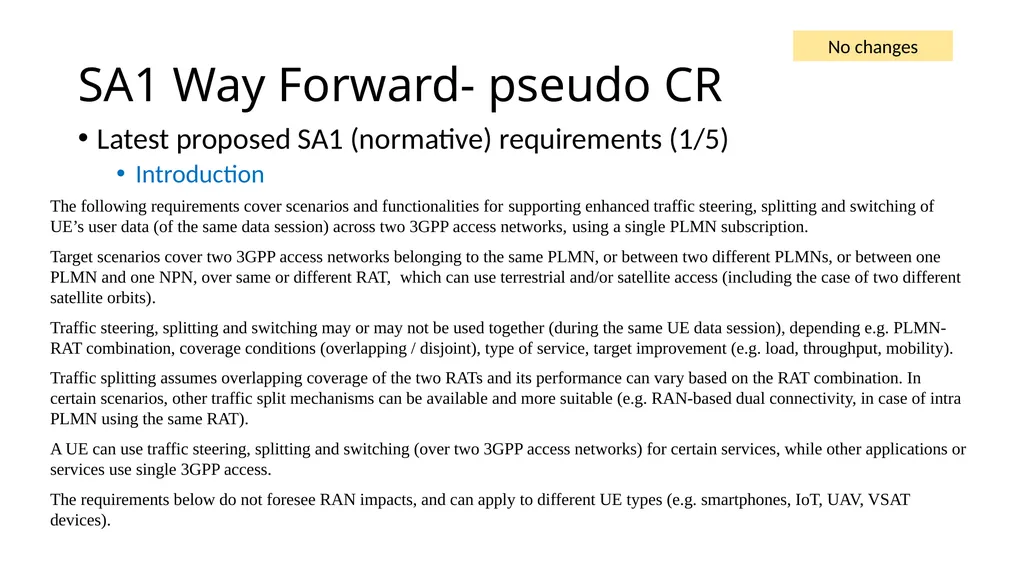
SA1 Way Forward- pseudo CR Latest proposed SA1 (normative) requirements (1/5)
Introduction The following requirements cover scenarios and functionalities for supporting enhanced traffic steering, splitting and switching of UE’s user data (of the same data session) across two 3GPP access networks, using a single PLMN subscription.
Target scenarios cover two 3GPP access networks belonging to the same PLMN, or between two different PLMNs, or between one PLMN and one NPN, over same or different RAT, which can use terrestrial and/or satellite access (including the case of two different satellite orbits).
Traffic steering, splitting and switching may or may not be used together (during the same UE data session), depending e.g. PLMN-RAT combination, coverage conditions (overlapping / disjoint), type of service, target improvement (e.g. load, throughput, mobility).
Traffic splitting assumes overlapping coverage of the two RATs and its performance can vary based on the RAT combination. In certain scenarios, other traffic split mechanisms can be available and more suitable (e.g. RAN-based dual connectivity, in case of intra PLMN using the same RAT).
A UE can use traffic steering, splitting and switching (over two 3GPP access networks) for certain services, while other applications or services use single 3GPP access.
The requirements below do not foresee RAN impacts, and can apply to different UE types (e.g. smartphones, IoT, UAV, VSAT devices). No changes<br>
05
SA1 Way Forward- pseudo CR Latest proposed SA1 (normative) requirements (2/5)
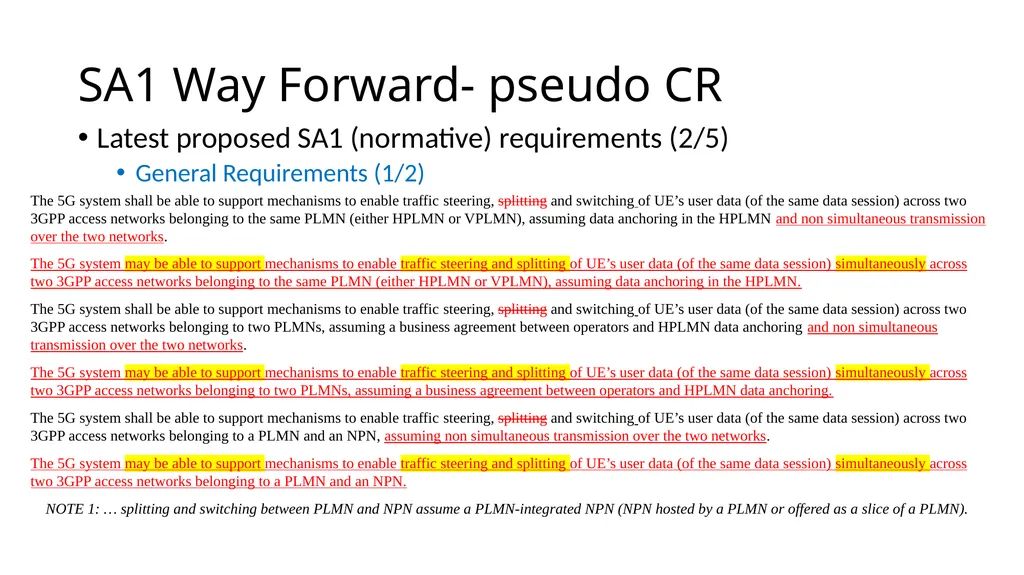
General Requirements (1/2) The 5G system shall be able to support mechanisms to enable traffic steering, splitting and switching of UE’s user data (of the same data session) across two 3GPP access networks belonging to the same PLMN (either HPLMN or VPLMN), assuming data anchoring in the HPLMN and non simultaneous transmission over the two networks.
The 5G system may be able to support mechanisms to enable traffic steering and splitting of UE’s user data (of the same data session) simultaneously across two 3GPP access networks belonging to the same PLMN (either HPLMN or VPLMN), assuming data anchoring in the HPLMN.
The 5G system shall be able to support mechanisms to enable traffic steering, splitting and switching of UE’s user data (of the same data session) across two 3GPP access networks belonging to two PLMNs, assuming a business agreement between operators and HPLMN data anchoring and non simultaneous transmission over the two networks.
The 5G system may be able to support mechanisms to enable traffic steering and splitting of UE’s user data (of the same data session) simultaneously across two 3GPP access networks belonging to two PLMNs, assuming a business agreement between operators and HPLMN data anchoring.
The 5G system shall be able to support mechanisms to enable traffic steering, splitting and switching of UE’s user data (of the same data session) across two 3GPP access networks belonging to a PLMN and an NPN, assuming non simultaneous transmission over the two networks.
The 5G system may be able to support mechanisms to enable traffic steering and splitting of UE’s user data (of the same data session) simultaneously across two 3GPP access networks belonging to a PLMN and an NPN.
NOTE 1: … splitting and switching between PLMN and NPN assume a PLMN-integrated NPN (NPN hosted by a PLMN or offered as a slice of a PLMN).<br>
06
SA1 Way Forward- pseudo CR Latest proposed SA1 (normative) requirements (3/5)
General Requirements (2/2) (cont…)
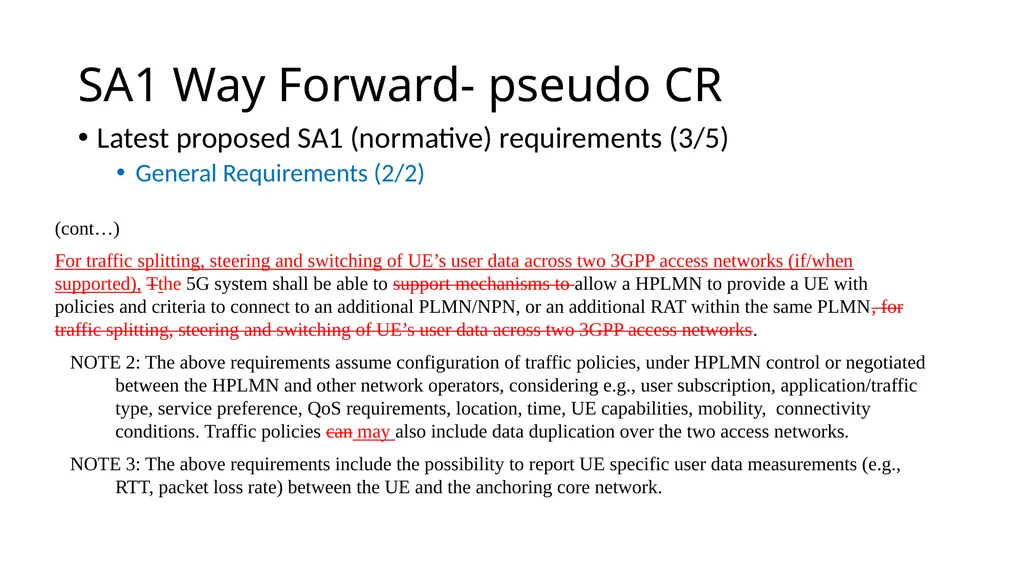
For traffic splitting, steering and switching of UE’s user data across two 3GPP access networks (if/when supported), Tthe 5G system shall be able to support mechanisms to allow a HPLMN to provide a UE with policies and criteria to connect to an additional PLMN/NPN, or an additional RAT within the same PLMN, for traffic splitting, steering and switching of UE’s user data across two 3GPP access networks.
NOTE 2: The above requirements assume configuration of traffic policies, under HPLMN control or negotiated between the HPLMN and other network operators, considering e.g., user subscription, application/traffic type, service preference, QoS requirements, location, time, UE capabilities, mobility, connectivity conditions. Traffic policies can may also include data duplication over the two access networks.
NOTE 3: The above requirements include the possibility to report UE specific user data measurements (e.g., RTT, packet loss rate) between the UE and the anchoring core network.<br>
07
SA1 Way Forward- pseudo CR Latest proposed SA1 (normative) requirements (4/5)
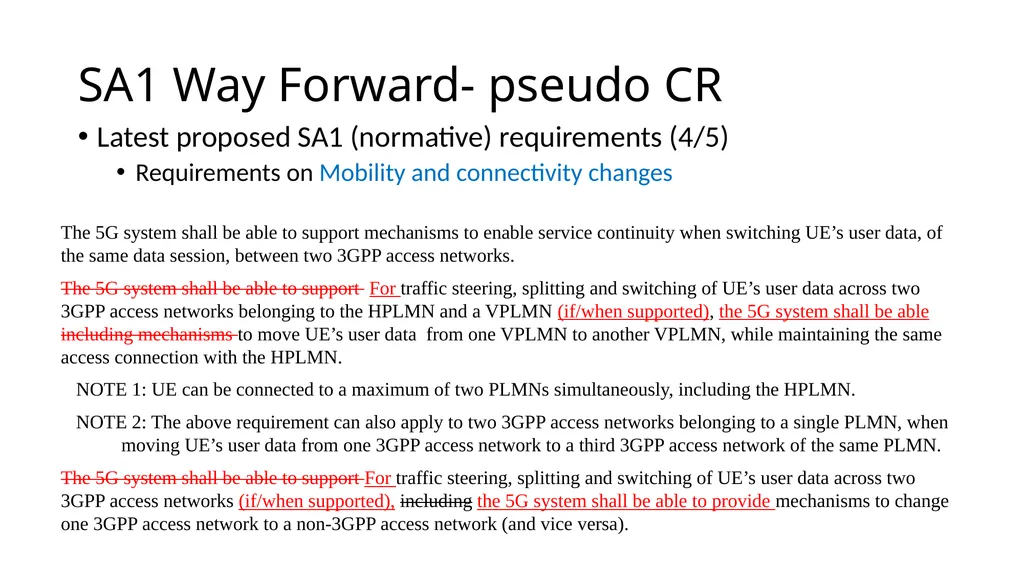
Requirements on Mobility and connectivity changes The 5G system shall be able to support mechanisms to enable service continuity when switching UE’s user data, of the same data session, between two 3GPP access networks.
The 5G system shall be able to support For traffic steering, splitting and switching of UE’s user data across two 3GPP access networks belonging to the HPLMN and a VPLMN (if/when supported), the 5G system shall be able including mechanisms to move UE’s user data from one VPLMN to another VPLMN, while maintaining the same access connection with the HPLMN.
NOTE 1: UE can be connected to a maximum of two PLMNs simultaneously, including the HPLMN.
NOTE 2: The above requirement can also apply to two 3GPP access networks belonging to a single PLMN, when moving UE’s user data from one 3GPP access network to a third 3GPP access network of the same PLMN.
The 5G system shall be able to support For traffic steering, splitting and switching of UE’s user data across two 3GPP access networks (if/when supported), including the 5G system shall be able to provide mechanisms to change one 3GPP access network to a non-3GPP access network (and vice versa).<br>
08
SA1 Way Forward- pseudo CR Latest proposed SA1 (normative) requirements (5/5)
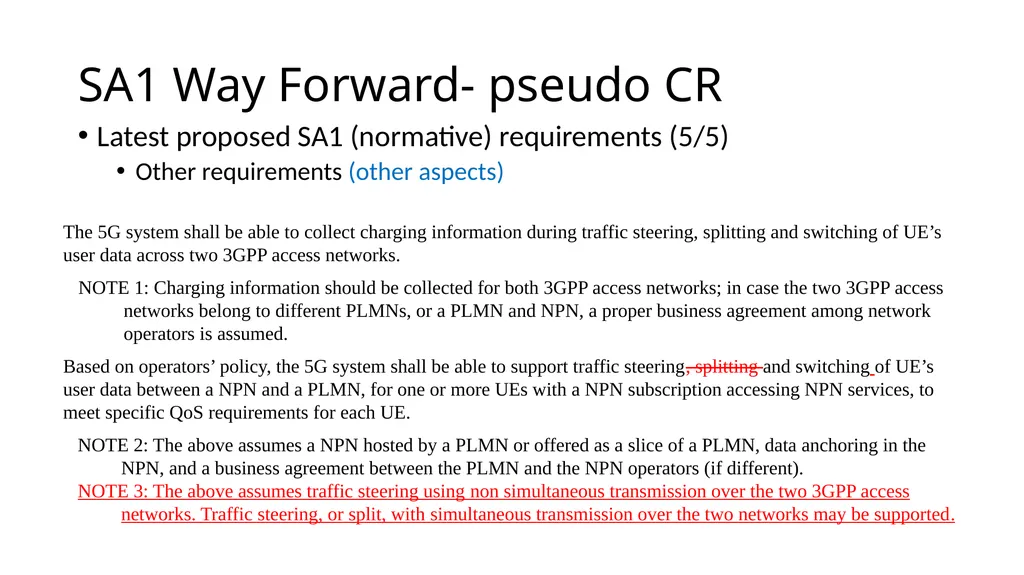
Other requirements (other aspects) The 5G system shall be able to collect charging information during traffic steering, splitting and switching of UE’s user data across two 3GPP access networks.
NOTE 1: Charging information should be collected for both 3GPP access networks; in case the two 3GPP access networks belong to different PLMNs, or a PLMN and NPN, a proper business agreement among network operators is assumed.
Based on operators’ policy, the 5G system shall be able to support traffic steering, splitting and switching of UE’s user data between a NPN and a PLMN, for one or more UEs with a NPN subscription accessing NPN services, to meet specific QoS requirements for each UE.
NOTE 2: The above assumes a NPN hosted by a PLMN or offered as a slice of a PLMN, data anchoring in the NPN, and a business agreement between the PLMN and the NPN operators (if different).
NOTE 3: The above assumes traffic steering using non simultaneous transmission over the two 3GPP access networks. Traffic steering, or split, with simultaneous transmission over the two networks may be supported.<br>