04
4 Current Retirement Financial Planning Maximize annual spending under an investment strategy
Do not incorporate actuarial probabilities of mortality and morbidity
Do not capture changes in actual investment performance compared to expected
Generally assume a level of ruin, typically 5%<br>
05
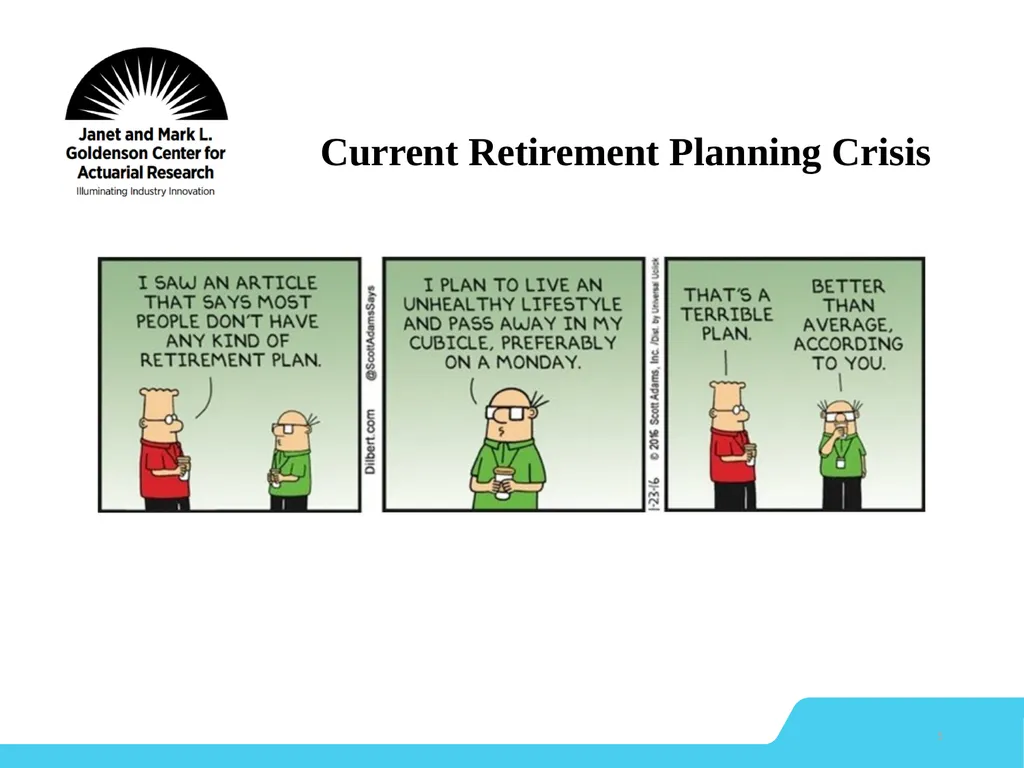
5 Current Retirement Planning Crisis<br>
06
6 Millions entering retirement every year without a plan Built JourneyGuide to answer two simple questions: How much can I spend in retirement after taxes and inflation? Will I run out of money before I run out of breath? Current Retirement Planning Crisis<br>
07
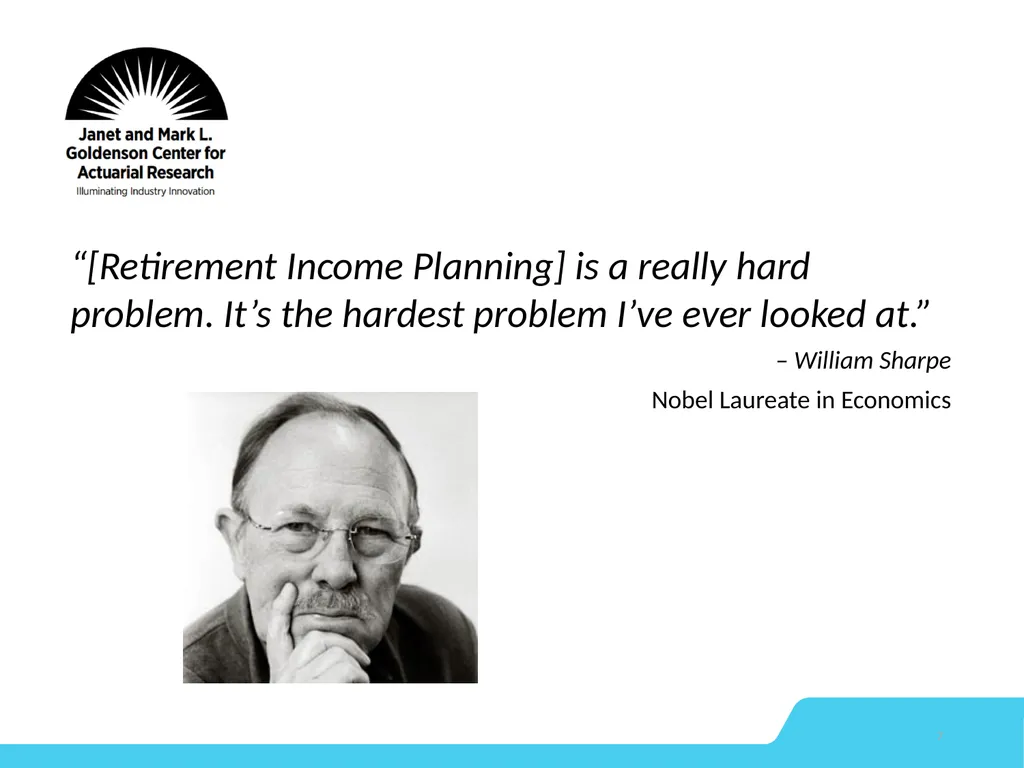
7 “[Retirement Income Planning] is a really hard problem. It’s the hardest problem I’ve ever looked at.”
– William Sharpe
Nobel Laureate in Economics<br>
08
8 The Good News: We were able to calculate the answer to “how much?” Where we were… Conclusion: Professor Sharpe was right! Too time-consuming to be commercially viable Built an Excel model to determine the spending amount with annual cash flows and the purchase of an annuity The Bad News: Took several hours to iterate over many runs of 1000 simulations each<br>
09
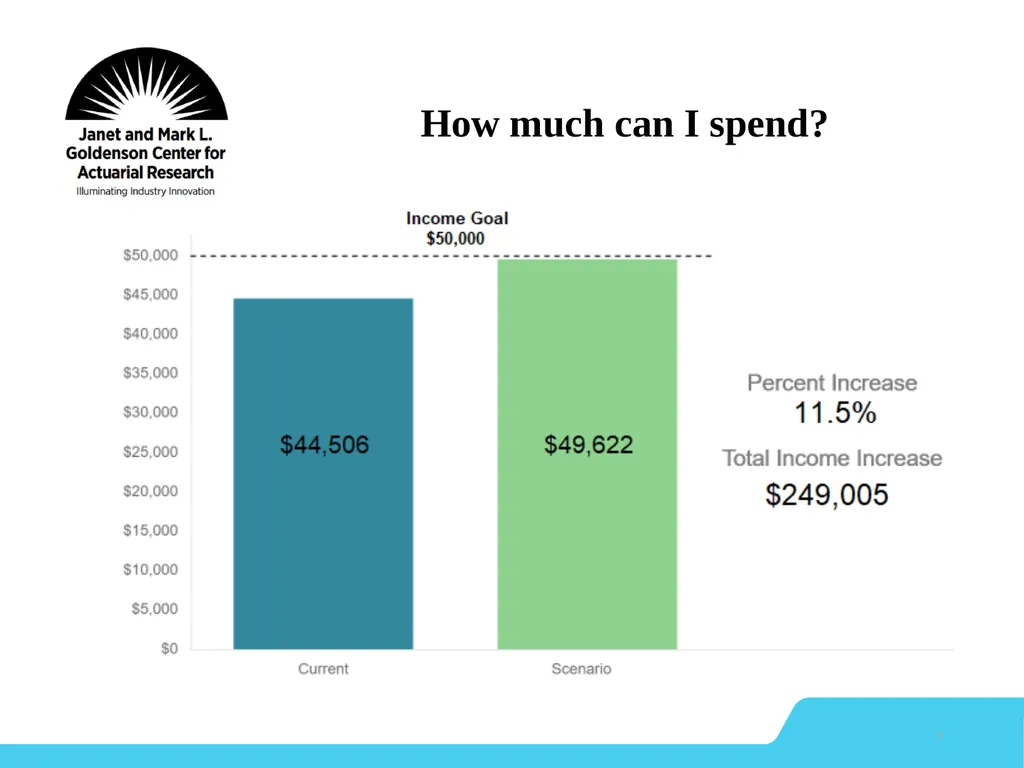
9 How much can I spend?<br>
10
10 5000 Monte Carlo simulations on 19 asset classes using Cholesky decomposition Partnership with the Goldenson Center Result: Immensely powerful, commercially viable solution to a pressing problem facing millions of people Built recursive, closed-form algorithm to calculate pre-tax spending given inflation assumptions, pre-retirement savings, capital infusions, Soc Sec, pension, and annuity payments Proprietary tax formula to convert to after-tax spending Reduced calculation time to 0.2 second leveraging Julia<br>
11
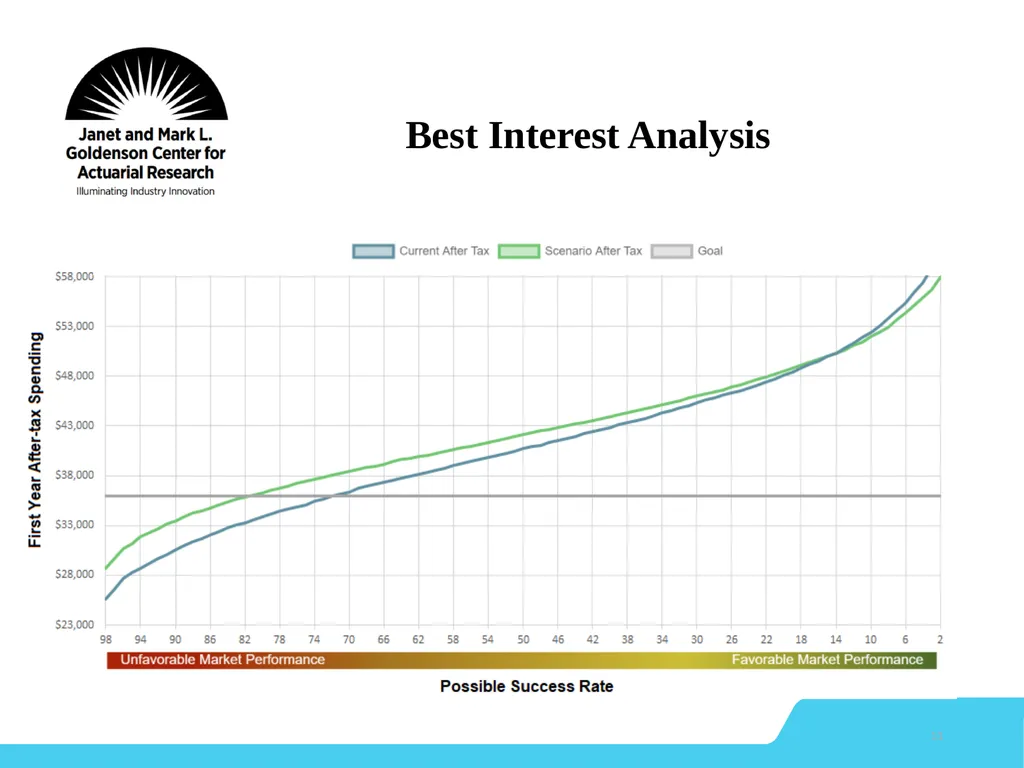
11 Best Interest Analysis<br>
12
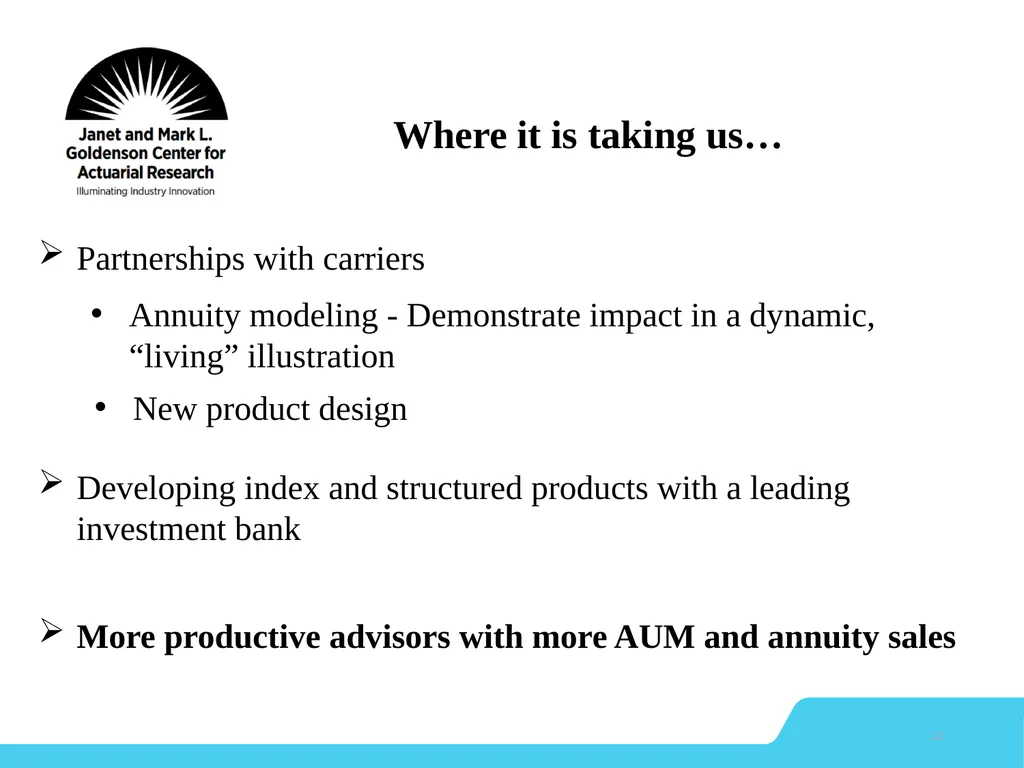
12 Annuity modeling - Demonstrate impact in a dynamic, “living” illustration Where it is taking us… More productive advisors with more AUM and annuity sales Developing index and structured products with a leading investment bank Partnerships with carriers New product design<br>
13
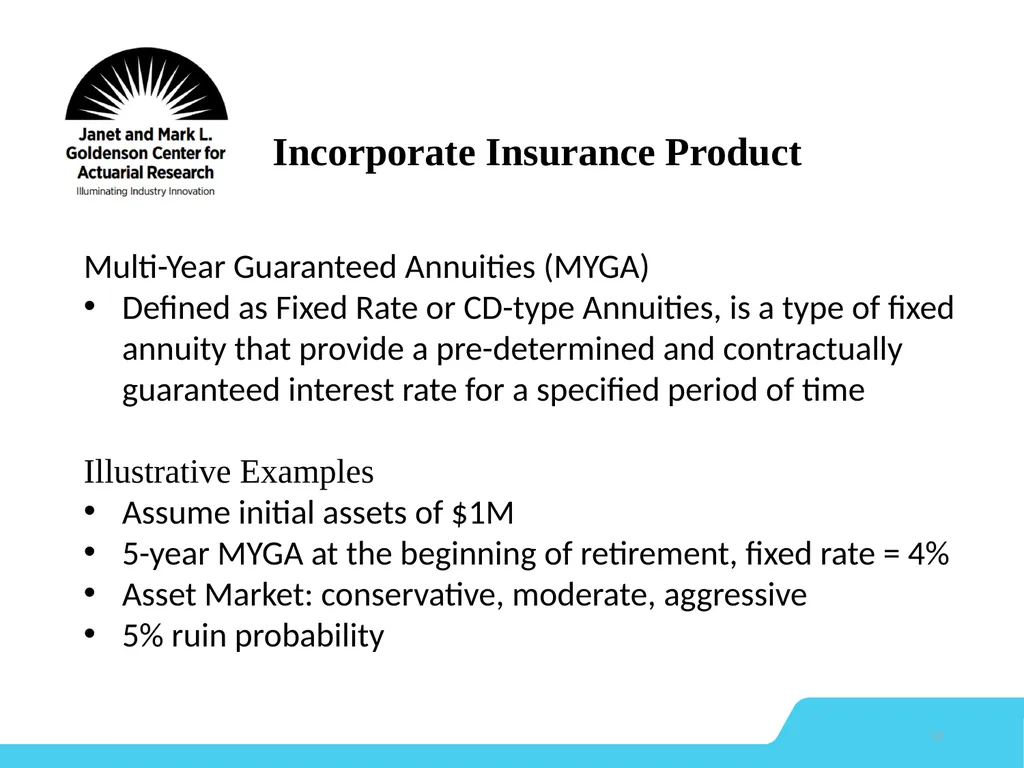
13 Incorporate Insurance Product Multi-Year Guaranteed Annuities (MYGA)
Defined as Fixed Rate or CD-type Annuities, is a type of fixed annuity that provide a pre-determined and contractually guaranteed interest rate for a specified period of time
Illustrative Examples
Assume initial assets of $1M
5-year MYGA at the beginning of retirement, fixed rate = 4%
Asset Market: conservative, moderate, aggressive
5% ruin probability<br>
14
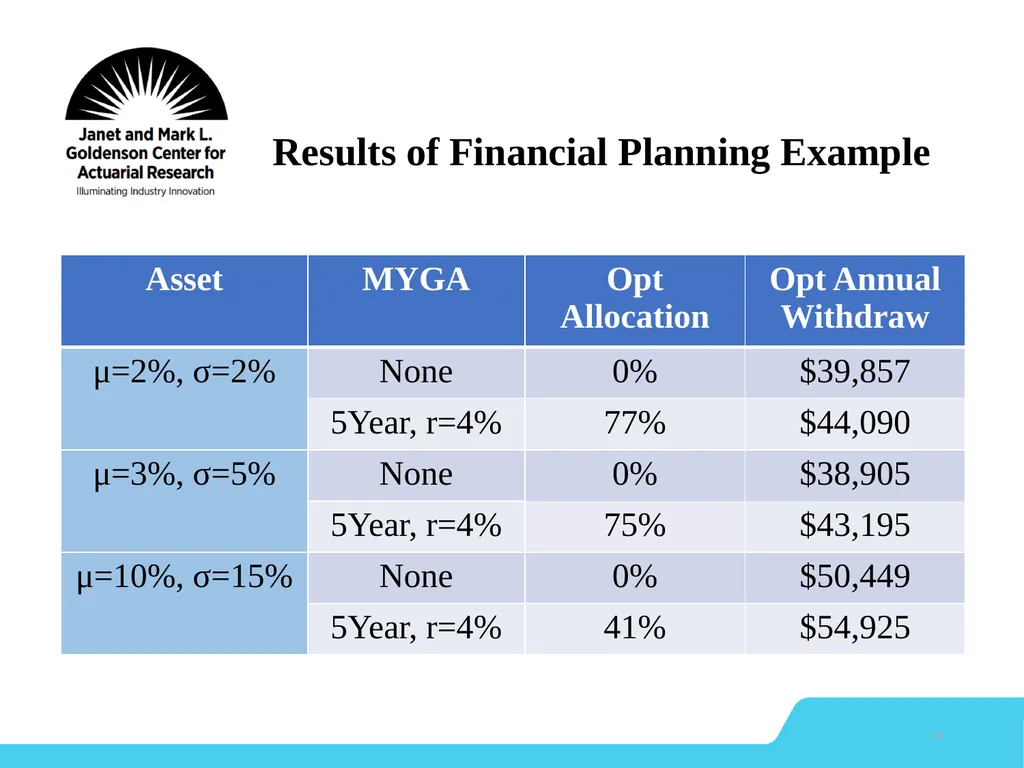
14 Results of Financial Planning Example<br>
15
15 Comments on Examples Incorporating MYGA to financial planning:
Increases annual spending by $4.5K for each market scenario
Neutralizes high volatility in aggressive investment
Optimal allocation of MYGA decreases with increasing asset return<br>
16
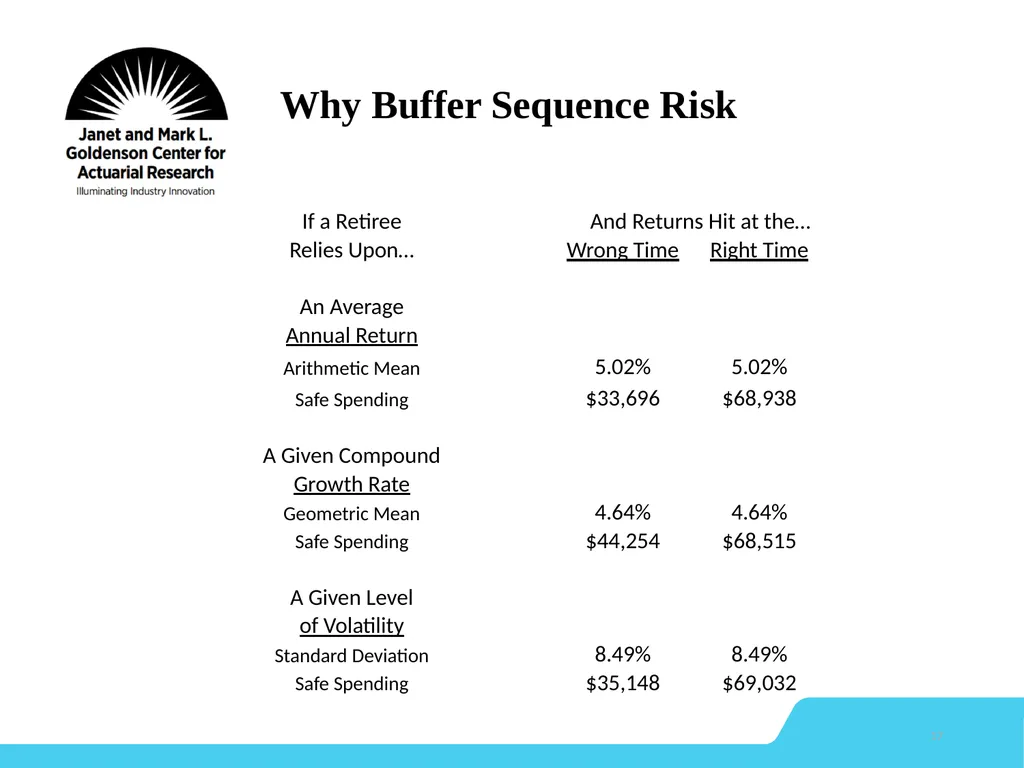
16 Why MYGAs Work Buffer sequence of return risk when it is most dangerous Partially immunize the portfolio during critical pre-retirement accumulation years and post-retirement spending years Buffer by allowing for reduced market exposure during MYGA durations with serial reinvestment back into markets through 10% annual withdrawals and laddered MYGA maturities<br>
17
17 Why Buffer Sequence Risk<br>
18
18 Incorporate HLE Defined as the expected future lifetime that one stays healthy
Termination from a healthy state occurs by death or disability
Disability uses a long term care definition which is inability to perform some of the activities of daily living
The only recovery from disability is death
In contrast, Unhealthy Life Expectancy (ULE) is the expected future lifetime that one stays unhealthy
HLE + ULE = Life Expectancy (LE)<br>
19
19 Financial Planning Illustrative Example Assume initial assets of $1.5M, i = 6%, HLE = 22 years and ULE = 8 years
Assume p.v. of basic expenses = 20% of initial assets
Assume basic expenses are double over ULE period and there are no discretionary expenses<br>
20
20 Results of Financial Planning Example Financial planning not based on HLE:
Annual spending over LE of 30 years approximately $103,000
Financial planning model based on HLE:
Annual spending over HLE approximately $112,000
Annual spending over ULE approximately $41,000
Additional annual discretionary spending is $9,000 or approximately $750 of additional monthly spending<br>
21
21 Incorporate Kalman-Filter Re-calibration Defined as an algorithm that uses the actual performance of daily market return from previous year as sample data to estimate the real μ and σ
Combines the result with our prediction at the beginning of previous year based on credibility principles.<br>
22
22 Incorporate Kalman-Filter Re-calibration Illustrative Example
Assume μ = 4% and σ = 10% at beginning of retirement
Future market either goes up to μ1 = 8% and σ = 10%, or goes down to μ2 = 1.5% and σ = 10%
Initial asset is $1M
Duration is 30 years
Choose the median path from 1000 simulations as the “actual” path given by μ1 and μ2
Comparison between 5%-ruin simple method and Kalman-Filter Re-calibration method<br>
23
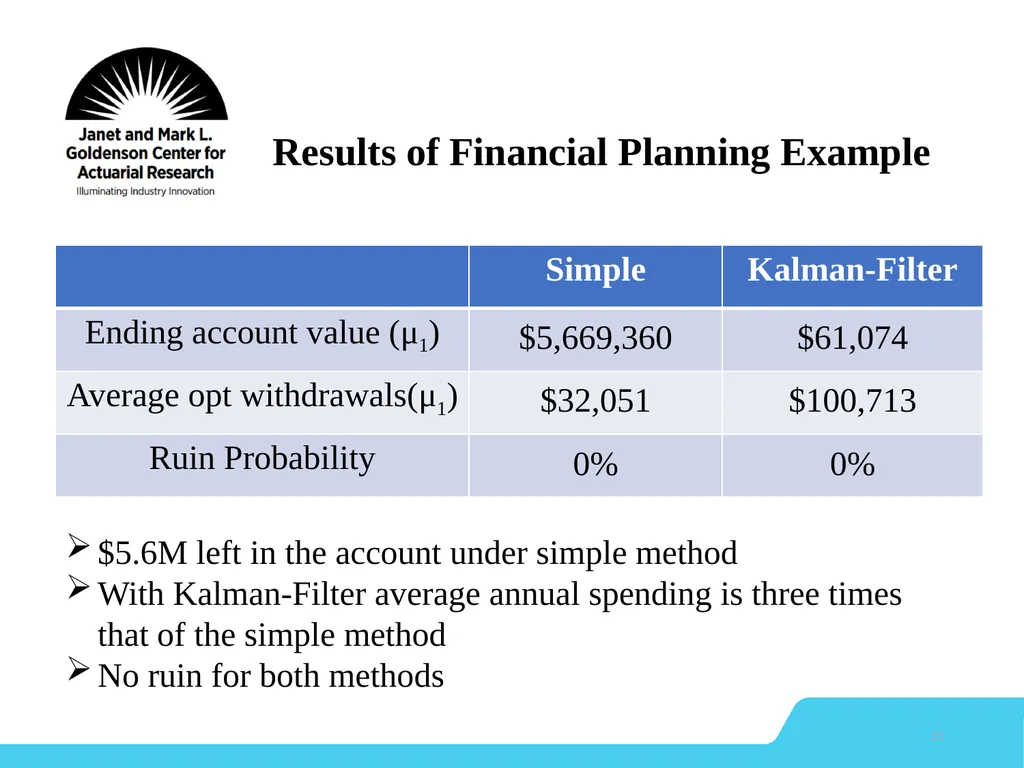
23 Results of Financial Planning Example $5.6M left in the account under simple method
With Kalman-Filter average annual spending is three times that of the simple method
No ruin for both methods<br>
24
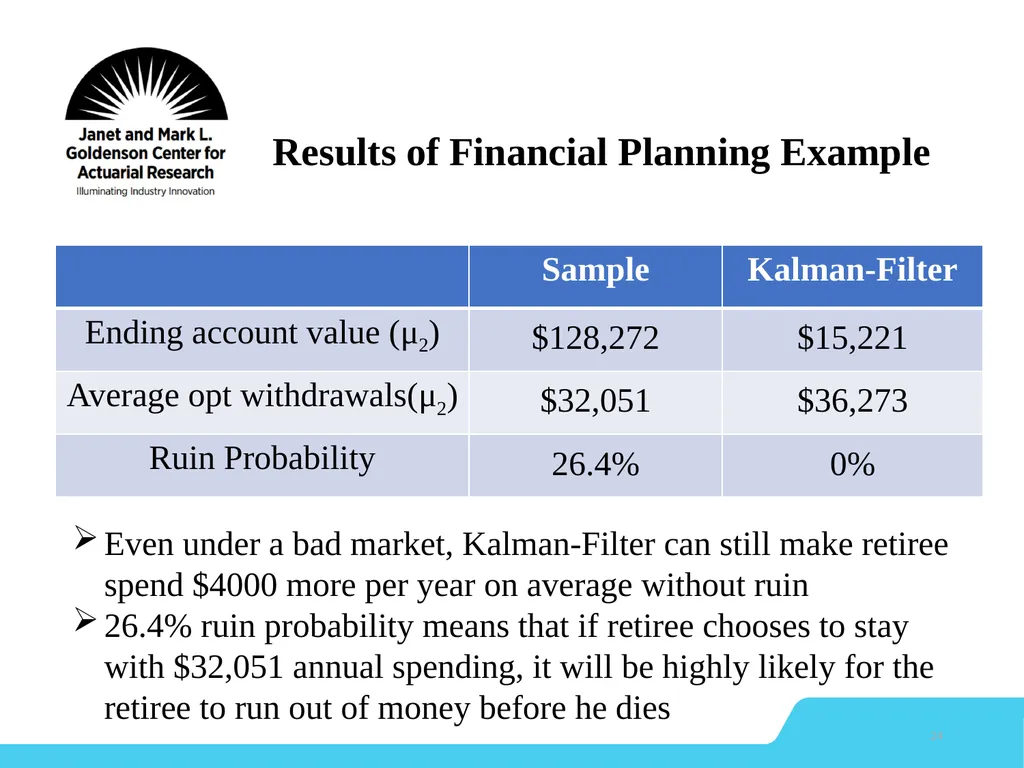
24 Results of Financial Planning Example Even under a bad market, Kalman-Filter can still make retiree spend $4000 more per year on average without ruin
26.4% ruin probability means that if retiree chooses to stay with $32,051 annual spending, it will be highly likely for the retiree to run out of money before he dies<br>
25
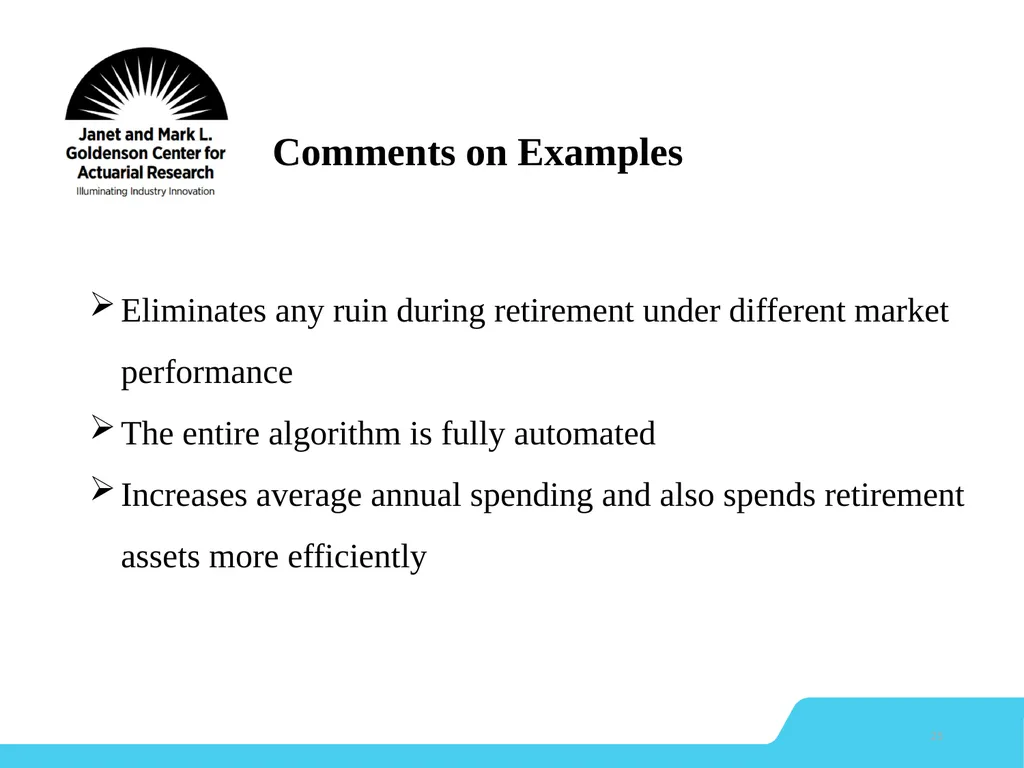
25 Comments on Examples Eliminates any ruin during retirement under different market performance
The entire algorithm is fully automated
Increases average annual spending and also spends retirement assets more efficiently<br>
26
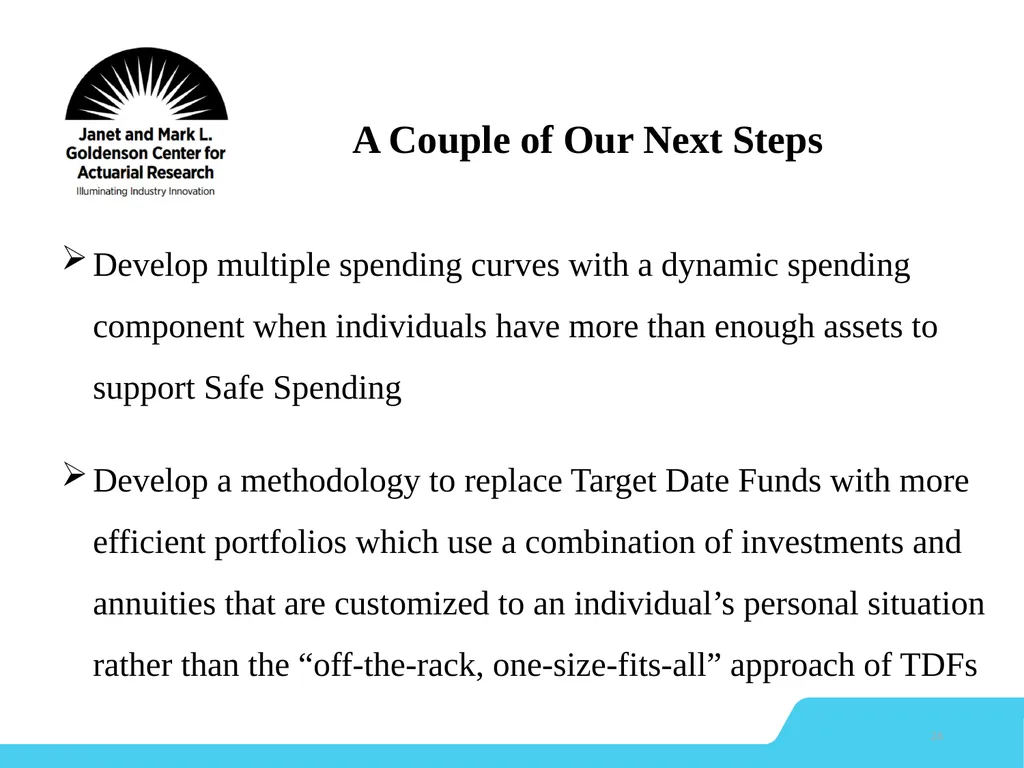
26 A Couple of Our Next Steps Develop multiple spending curves with a dynamic spending component when individuals have more than enough assets to support Safe Spending Develop a methodology to replace Target Date Funds with more efficient portfolios which use a combination of investments and annuities that are customized to an individual’s personal situation rather than the “off-the-rack, one-size-fits-all” approach of TDFs<br>