
Dysfunction of the Genito-Urinary Tract Mihretu
PC
Published · 86 slides · 0 views

1 / 1

Description
Dysfunction of the Genito-Urinary Tract Mihretu Molla (Bsc, Msc) 6292018 Mihretu Molla 1 Presentation outline Pelvic organ prolapse Urinary incontinence Genito urinary fistula 6292018 Mihretu Molla 2 PELVIC ORGAN PROLAPSE (POP)
Related Topics
Share
Embed code
Download this presentation From Below
"Dysfunction of the Genito-Urinary Tract Mihretu" is the property of its rightful owner. Permission is granted to download and print the materials on this website for personal, non-commercial use only, and to display it on your personal computer provided you do not modify the materials and that you retain all copyright notices contained in the materials. By downloading content from our website, you accept the terms of this agreement.
Presentation Transcript
01
Dysfunction of the Genito-Urinary Tract Mihretu Molla (Bsc, Msc) 6/29/2018 Mihretu Molla 1<br>
02
Presentation outline Pelvic organ prolapse
Urinary incontinence
Genito urinary fistula 6/29/2018 Mihretu Molla 2<br>
Urinary incontinence
Genito urinary fistula 6/29/2018 Mihretu Molla 2<br>
03
PELVIC ORGAN PROLAPSE (POP) 6/29/2018 Mihretu Molla 3<br>
04
Objectives Define POP
Describe clinical presentation
Explain factors involved in the pathogenesis
Current management principles 6/29/2018 Mihretu Molla 4<br>
Describe clinical presentation
Explain factors involved in the pathogenesis
Current management principles 6/29/2018 Mihretu Molla 4<br>
05
INTRODUCTION POP is the downward displacement of the structures that are normally located adjacent to the vaginal vault.
Protrusion of the pelvic organs into or out the vaginal canal
POP occurs when the pelvic floor muscles become weak or damaged and can no longer support the pelvic organs. 6/29/2018 Mihretu Molla 5<br>
Protrusion of the pelvic organs into or out the vaginal canal
POP occurs when the pelvic floor muscles become weak or damaged and can no longer support the pelvic organs. 6/29/2018 Mihretu Molla 5<br>
06
INTRODUCTION…. It's estimated that half of women who have children will experience some form of prolapse in later life
but because many women don't seek help , the actual number of women affected by prolapse is unknown.
The life time risk of requiring at least 1 operation to correct incontinence or prolapse is estimated at approximately 11%
Mortality from this condition is negligible, significant morbidity or deterioration of lifestyle may be associated with prolapse 6/29/2018 Mihretu Molla 6<br>
but because many women don't seek help , the actual number of women affected by prolapse is unknown.
The life time risk of requiring at least 1 operation to correct incontinence or prolapse is estimated at approximately 11%
Mortality from this condition is negligible, significant morbidity or deterioration of lifestyle may be associated with prolapse 6/29/2018 Mihretu Molla 6<br>
07
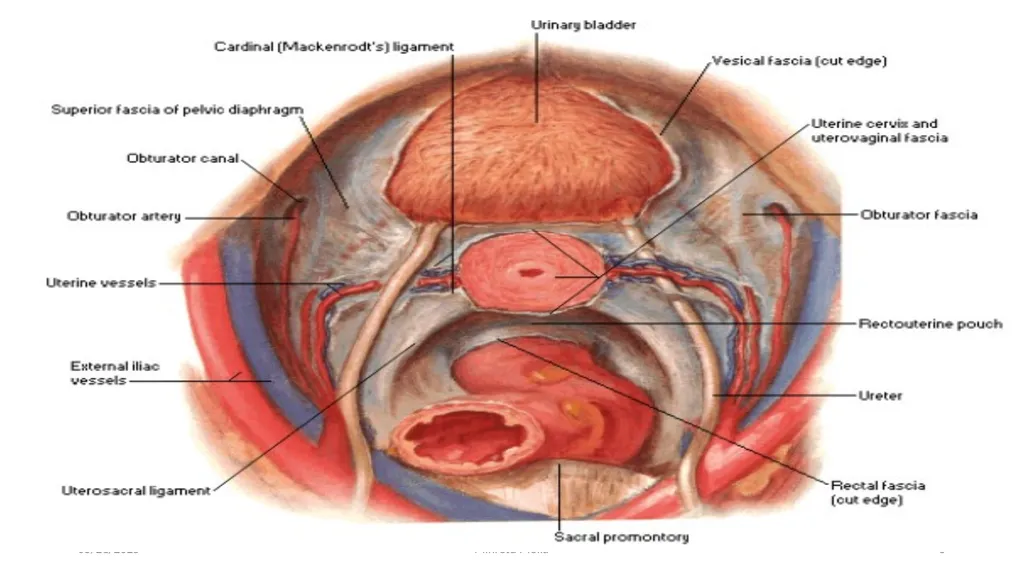
ANATOMY OF PELVIC SUPPORT Provided by an interaction between the muscles of the pelvic floor and connective tissue attachments to the bony pelvis
The levator ani muscle complex provides primary support to the pelvic organs, providing a firm, yet elastic-base upon which the pelvic organs rest
The endopelvic fascial attachments, in particular condensations of the endopelvic fascia referred to as the uterosacral and cardinal ligaments, stabilize the pelvic organs in the correct position so that the pelvic muscles can provide optimal support 6/29/2018 Mihretu Molla 7<br>
The levator ani muscle complex provides primary support to the pelvic organs, providing a firm, yet elastic-base upon which the pelvic organs rest
The endopelvic fascial attachments, in particular condensations of the endopelvic fascia referred to as the uterosacral and cardinal ligaments, stabilize the pelvic organs in the correct position so that the pelvic muscles can provide optimal support 6/29/2018 Mihretu Molla 7<br>
08
6/29/2018 Mihretu Molla 8<br>
09
Levels of pelvic organ support Level 1: Uterosacral /cardinal ligament complex
suspends the uterus and upper vagina to the sacrum and lateral pelvic side wall.
Loss of level 1 support contributes to the prolapse of the uterus and/or vaginal apex.
Level 2
Paravaginal attachments along the length of the vagina to the superior fascia of the levator ani muscle and the arcus tendineus fascia pelvis (also referred to as the “white line”).
Loss of level 2 support contributes to anterior vaginal wall prolapse (cystocele). 6/29/2018 Mihretu Molla 9<br>
suspends the uterus and upper vagina to the sacrum and lateral pelvic side wall.
Loss of level 1 support contributes to the prolapse of the uterus and/or vaginal apex.
Level 2
Paravaginal attachments along the length of the vagina to the superior fascia of the levator ani muscle and the arcus tendineus fascia pelvis (also referred to as the “white line”).
Loss of level 2 support contributes to anterior vaginal wall prolapse (cystocele). 6/29/2018 Mihretu Molla 9<br>
10
Levels of pelvic organ support…. Level 3
Perineal body, perineal membrane, and superficial and deep perineal muscles, which support the distal one third of the vagina.
Anteriorly, loss of level 3 support can result in urethral hypermobility.
Posteriorly, loss of level 3 support can result in a distal rectocele or perineal descent. 6/29/2018 Mihretu Molla 10<br>
Perineal body, perineal membrane, and superficial and deep perineal muscles, which support the distal one third of the vagina.
Anteriorly, loss of level 3 support can result in urethral hypermobility.
Posteriorly, loss of level 3 support can result in a distal rectocele or perineal descent. 6/29/2018 Mihretu Molla 10<br>
11
Cont.. All levels of support are connected through a continuous supporting network of endopelvic fascia
Defects in this network can occur at one level or at all levels
The innervation of the pelvic region derives from the S2, S3, and S4 segments of the spinal cord, which fuse to form the pudendal nerve 6/29/2018 Mihretu Molla 11<br>
Defects in this network can occur at one level or at all levels
The innervation of the pelvic region derives from the S2, S3, and S4 segments of the spinal cord, which fuse to form the pudendal nerve 6/29/2018 Mihretu Molla 11<br>
12
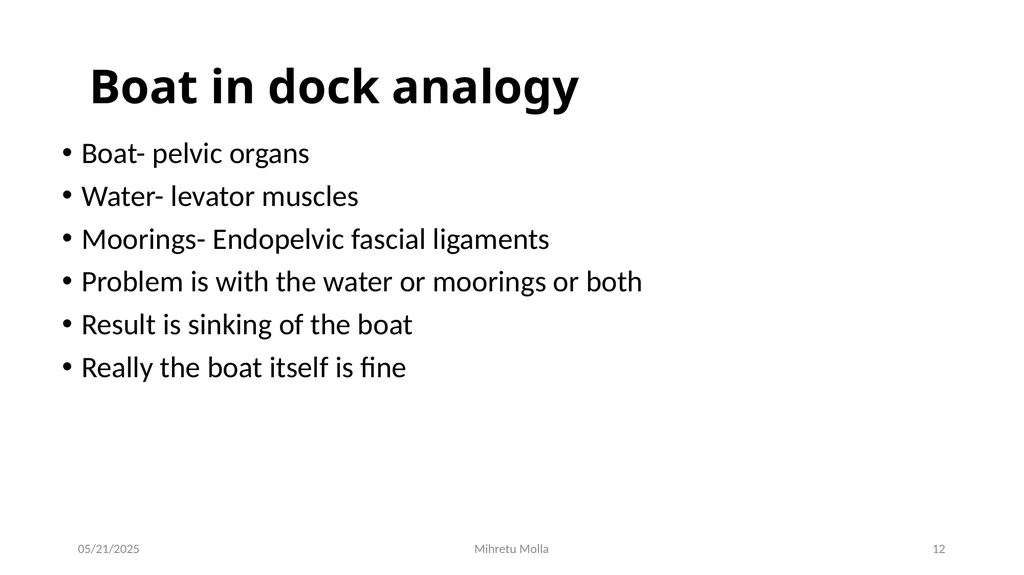
Boat in dock analogy Boat- pelvic organs
Water- levator muscles
Moorings- Endopelvic fascial ligaments
Problem is with the water or moorings or both
Result is sinking of the boat
Really the boat itself is fine 6/29/2018 Mihretu Molla 12<br>
Water- levator muscles
Moorings- Endopelvic fascial ligaments
Problem is with the water or moorings or both
Result is sinking of the boat
Really the boat itself is fine 6/29/2018 Mihretu Molla 12<br>
13
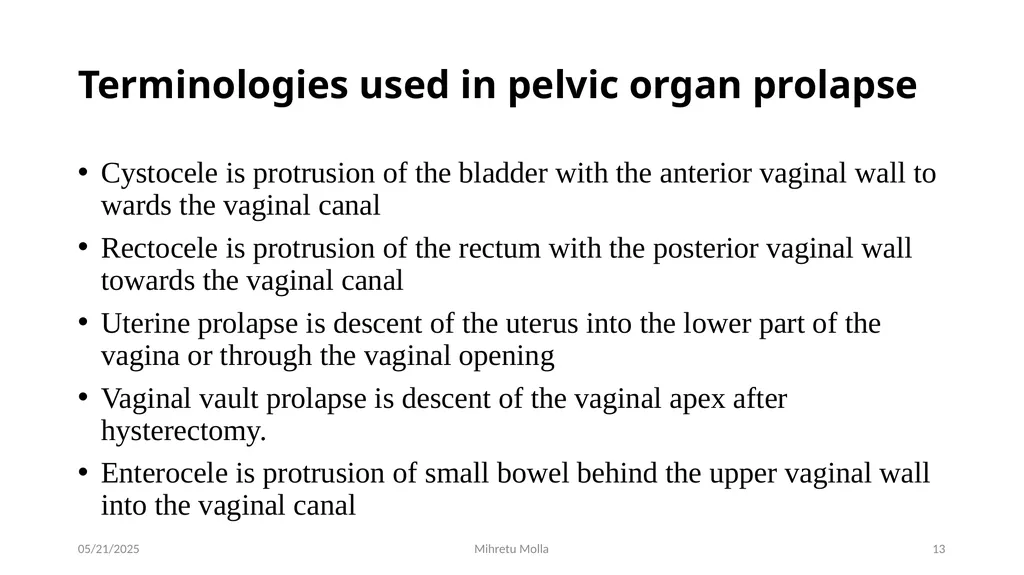
Terminologies used in pelvic organ prolapse Cystocele is protrusion of the bladder with the anterior vaginal wall to wards the vaginal canal
Rectocele is protrusion of the rectum with the posterior vaginal wall towards the vaginal canal
Uterine prolapse is descent of the uterus into the lower part of the vagina or through the vaginal opening
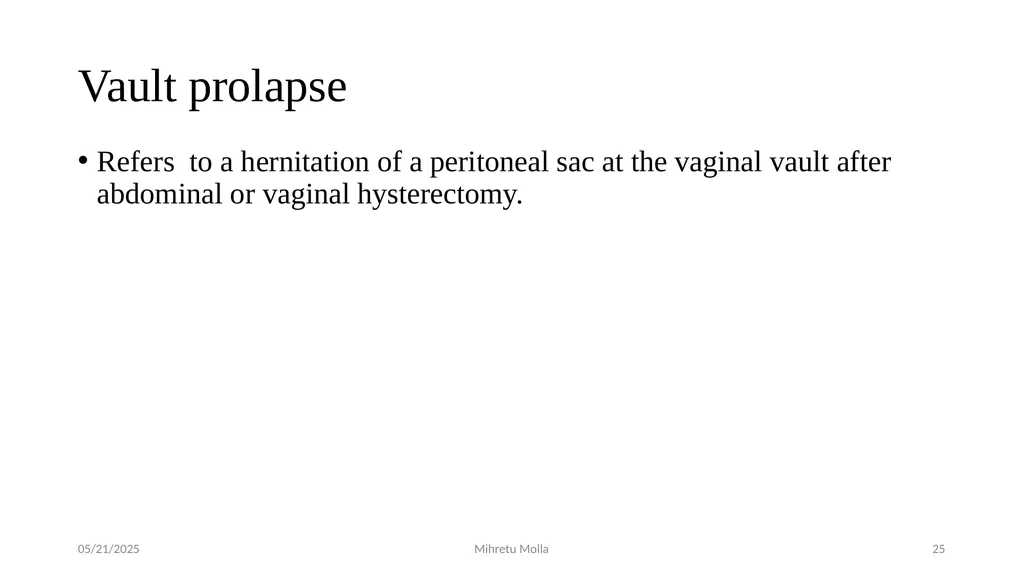
Vaginal vault prolapse is descent of the vaginal apex after hysterectomy.
Enterocele is protrusion of small bowel behind the upper vaginal wall into the vaginal canal 6/29/2018 Mihretu Molla 13<br>
Rectocele is protrusion of the rectum with the posterior vaginal wall towards the vaginal canal
Uterine prolapse is descent of the uterus into the lower part of the vagina or through the vaginal opening
Vaginal vault prolapse is descent of the vaginal apex after hysterectomy.
Enterocele is protrusion of small bowel behind the upper vaginal wall into the vaginal canal 6/29/2018 Mihretu Molla 13<br>
14
Factors Promoting Prolapse Erect posture ( causes increased stress on muscles, nerves and connective tissue(Evolution)).
Acute and chronic trauma of vaginal delivery
Aging-b/c of estrogen withdrawal and collagen break down
Obesity
Congenital weakness of the pelvic supports (Intrinsic collagen abnormalities)
Neurologic problems affecting the pelvic musculature and its innervations.
Chronic increase in intra-abdominal pressure (heavy lifting, Chronic coughing, Chronic constipation…) 6/29/2018 Mihretu Molla 14<br>
Acute and chronic trauma of vaginal delivery
Aging-b/c of estrogen withdrawal and collagen break down
Obesity
Congenital weakness of the pelvic supports (Intrinsic collagen abnormalities)
Neurologic problems affecting the pelvic musculature and its innervations.
Chronic increase in intra-abdominal pressure (heavy lifting, Chronic coughing, Chronic constipation…) 6/29/2018 Mihretu Molla 14<br>
15
Anterior compartment defects Cystocele
Cytocele is a hernia of base of bladder in the anterior vaginal wall due to weakness or defect in the the pubo-vesical-cervical fascia.
Midline weakness allows bladder to descend causing central cystocele
Tearing of endopelvic fascial connections from lateral sulci to arcus tendinii causes lateral or displacement cystocele
Detachment of pubocervical fascia from pericervical ring causes a transverse or apical cystocele 6/29/2018 Mihretu Molla 15<br>
Cytocele is a hernia of base of bladder in the anterior vaginal wall due to weakness or defect in the the pubo-vesical-cervical fascia.
Midline weakness allows bladder to descend causing central cystocele
Tearing of endopelvic fascial connections from lateral sulci to arcus tendinii causes lateral or displacement cystocele
Detachment of pubocervical fascia from pericervical ring causes a transverse or apical cystocele 6/29/2018 Mihretu Molla 15<br>
16
Posterior compartment defects Rectocele
Chiefly a hernia in the posterior vaginal wall secondary to weakness or defect in the rectovaginal septum or fascia of Denonvilliers
Symptoms include difficulty evacuating stool, a vaginal mass, and fullness sensation
Rectovaginal examination confirms diagnosis and helps to differentiate it from enterocele
Damage generally due to excessive pushing in childbirth or chronic constipation
Mass In the vagina + pocket while doing rectal examination is diagnostic 6/29/2018 Mihretu Molla 16<br>
Chiefly a hernia in the posterior vaginal wall secondary to weakness or defect in the rectovaginal septum or fascia of Denonvilliers
Symptoms include difficulty evacuating stool, a vaginal mass, and fullness sensation
Rectovaginal examination confirms diagnosis and helps to differentiate it from enterocele
Damage generally due to excessive pushing in childbirth or chronic constipation
Mass In the vagina + pocket while doing rectal examination is diagnostic 6/29/2018 Mihretu Molla 16<br>
17
Apical defects Includes
Utero vaginal prolapse (UVP)
Vault prolapse
Enterocele 6/29/2018 Mihretu Molla 17<br>
Utero vaginal prolapse (UVP)
Vault prolapse
Enterocele 6/29/2018 Mihretu Molla 17<br>
18
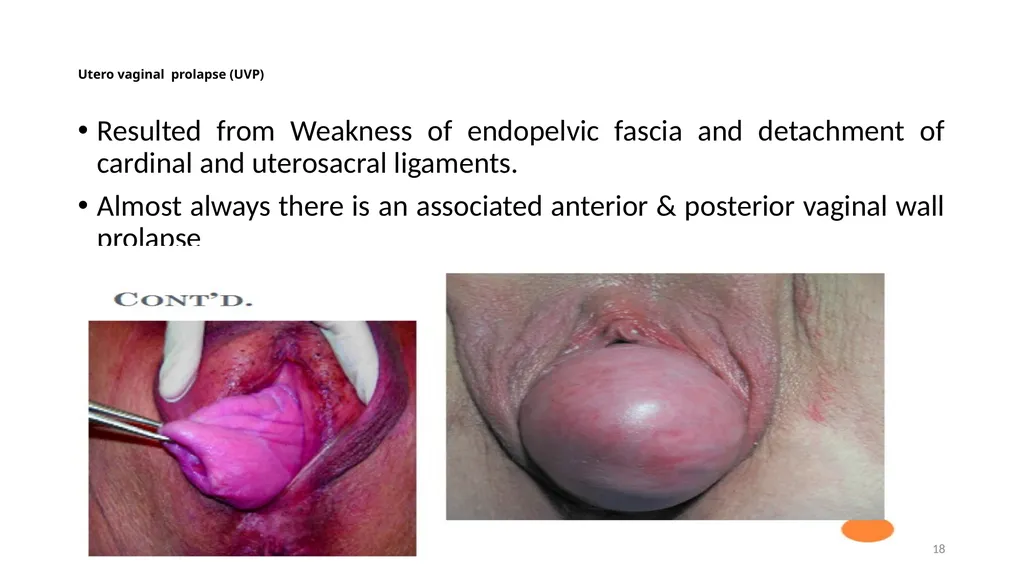
Utero vaginal prolapse (UVP) Resulted from Weakness of endopelvic fascia and detachment of cardinal and uterosacral ligaments.
Almost always there is an associated anterior & posterior vaginal wall prolapse 6/29/2018 Mihretu Molla 18<br>
Almost always there is an associated anterior & posterior vaginal wall prolapse 6/29/2018 Mihretu Molla 18<br>
19
Grading/staging/degrees of Uterine Prolapse A. Degree system: three degrees
The uterine component of the utero vaginal prolapse is measured in relation to the degree of prolapse of the cervix below the level of the ischial spines ( the normal station of the cervix in the pelvis).
1st degree: external cervical os is below the ischial spines but within the vagina
2nd degree: external os protrudes out of the interoitus but fundus inside the vagina
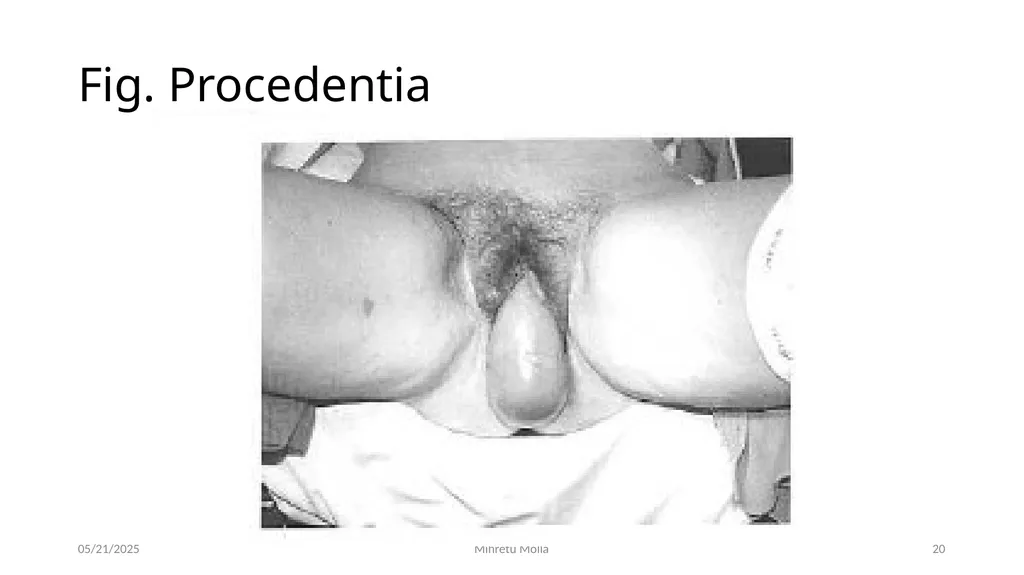
3rd degree: uterine body outside of the interoitus. It is also called as PROCEDENTIA 6/29/2018 Mihretu Molla 19<br>
The uterine component of the utero vaginal prolapse is measured in relation to the degree of prolapse of the cervix below the level of the ischial spines ( the normal station of the cervix in the pelvis).
1st degree: external cervical os is below the ischial spines but within the vagina
2nd degree: external os protrudes out of the interoitus but fundus inside the vagina
3rd degree: uterine body outside of the interoitus. It is also called as PROCEDENTIA 6/29/2018 Mihretu Molla 19<br>
20
Fig. Procedentia 6/29/2018 Mihretu Molla 20<br>
21
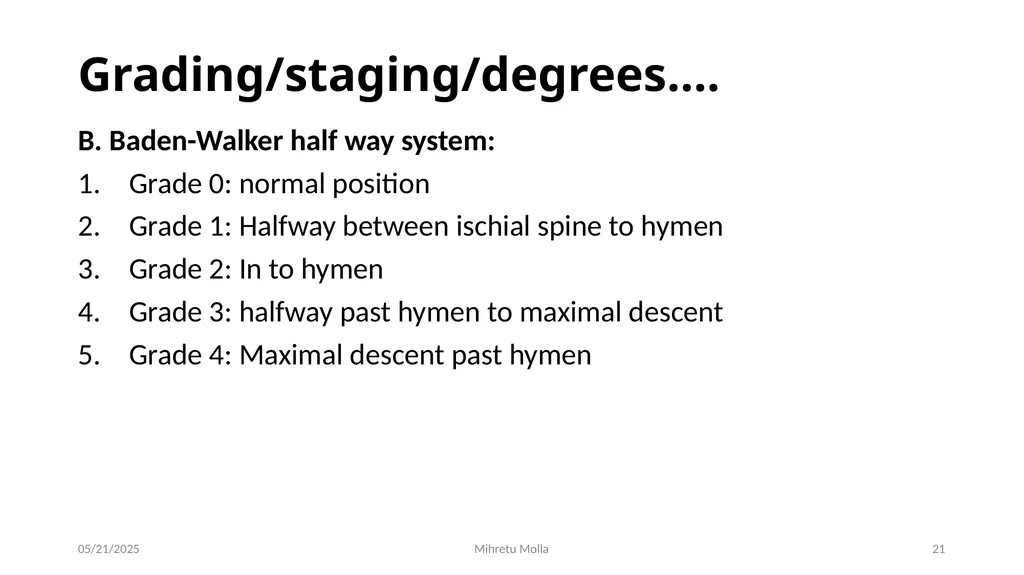
Grading/staging/degrees…. B. Baden-Walker half way system:
Grade 0: normal position
Grade 1: Halfway between ischial spine to hymen
Grade 2: In to hymen
Grade 3: halfway past hymen to maximal descent
Grade 4: Maximal descent past hymen 6/29/2018 Mihretu Molla 21<br>
Grade 0: normal position
Grade 1: Halfway between ischial spine to hymen
Grade 2: In to hymen
Grade 3: halfway past hymen to maximal descent
Grade 4: Maximal descent past hymen 6/29/2018 Mihretu Molla 21<br>
22
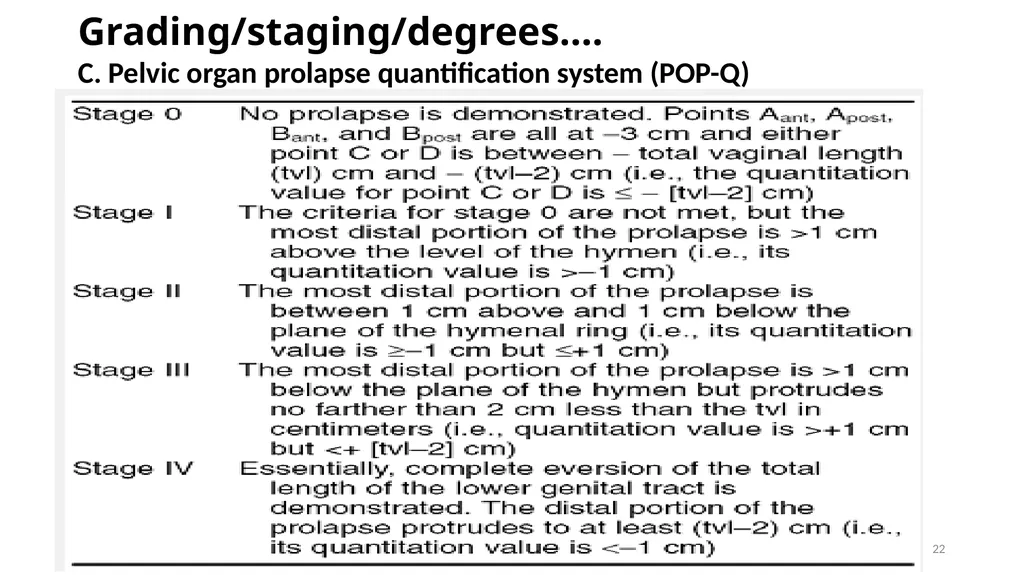
Grading/staging/degrees…. C. Pelvic organ prolapse quantification system (POP-Q) 6/29/2018 Mihretu Molla 22<br>
23
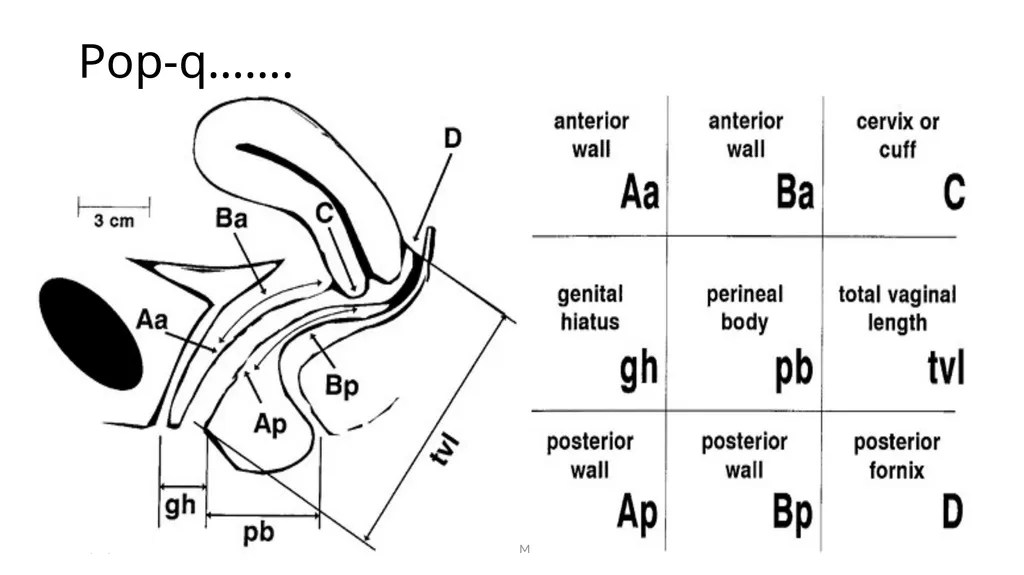
Pop-q……. 6/29/2018 Mihretu Molla 23<br>
24
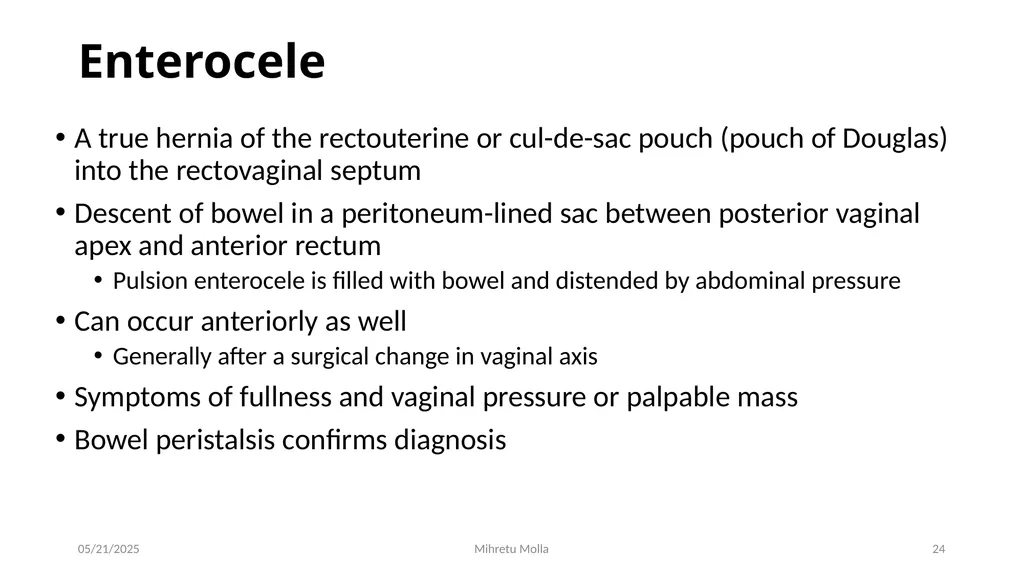
Enterocele A true hernia of the rectouterine or cul-de-sac pouch (pouch of Douglas) into the rectovaginal septum
Descent of bowel in a peritoneum-lined sac between posterior vaginal apex and anterior rectum
Pulsion enterocele is filled with bowel and distended by abdominal pressure
Can occur anteriorly as well
Generally after a surgical change in vaginal axis
Symptoms of fullness and vaginal pressure or palpable mass
Bowel peristalsis confirms diagnosis 6/29/2018 Mihretu Molla 24<br>
Descent of bowel in a peritoneum-lined sac between posterior vaginal apex and anterior rectum
Pulsion enterocele is filled with bowel and distended by abdominal pressure
Can occur anteriorly as well
Generally after a surgical change in vaginal axis
Symptoms of fullness and vaginal pressure or palpable mass
Bowel peristalsis confirms diagnosis 6/29/2018 Mihretu Molla 24<br>
25
Vault prolapse Refers to a hernitation of a peritoneal sac at the vaginal vault after abdominal or vaginal hysterectomy. 6/29/2018 Mihretu Molla 25<br>
26
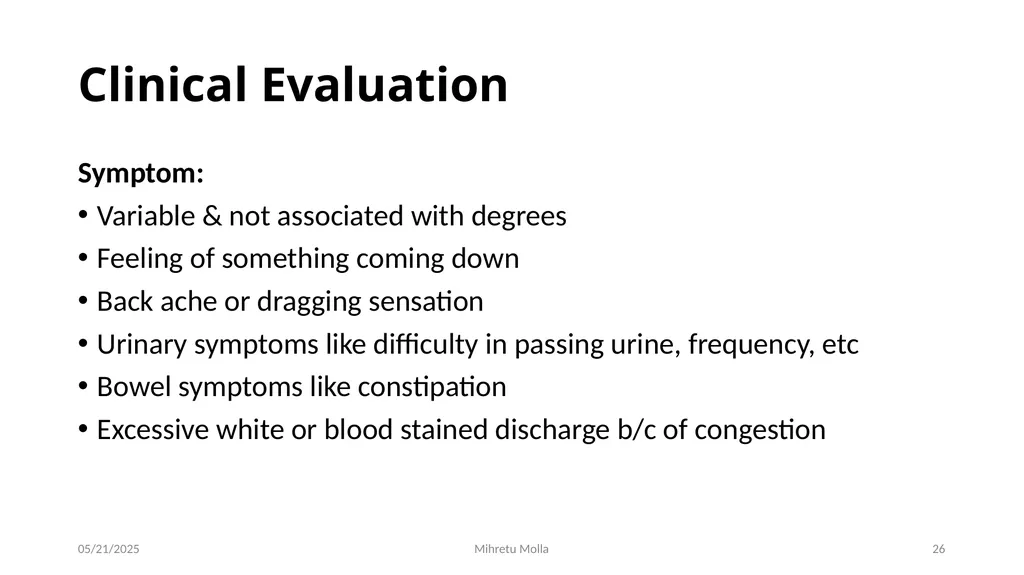
Clinical Evaluation Symptom:
Variable & not associated with degrees
Feeling of something coming down
Back ache or dragging sensation
Urinary symptoms like difficulty in passing urine, frequency, etc
Bowel symptoms like constipation
Excessive white or blood stained discharge b/c of congestion 6/29/2018 Mihretu Molla 26<br>
Variable & not associated with degrees
Feeling of something coming down
Back ache or dragging sensation
Urinary symptoms like difficulty in passing urine, frequency, etc
Bowel symptoms like constipation
Excessive white or blood stained discharge b/c of congestion 6/29/2018 Mihretu Molla 26<br>
27
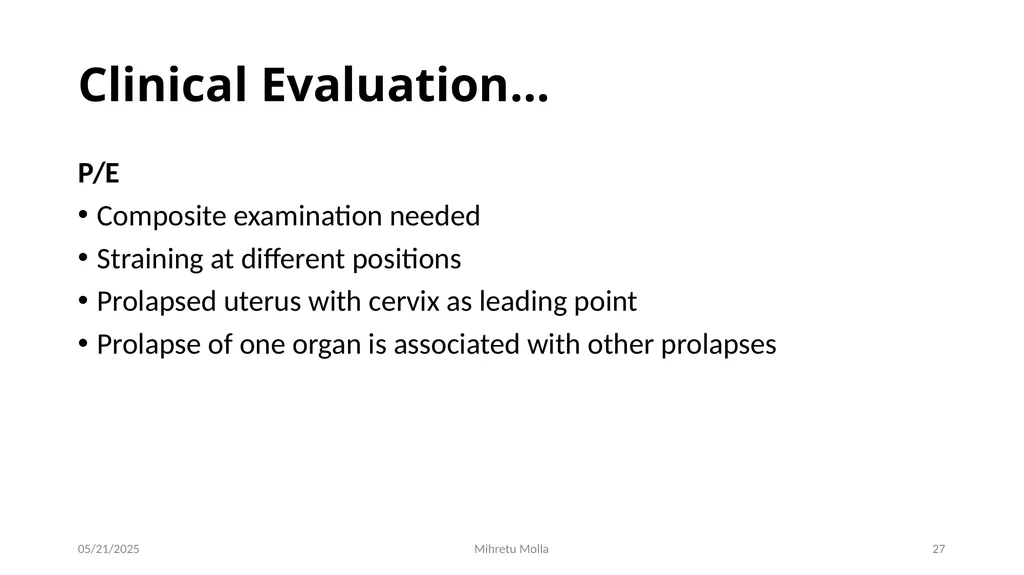
Clinical Evaluation… P/E
Composite examination needed
Straining at different positions
Prolapsed uterus with cervix as leading point
Prolapse of one organ is associated with other prolapses 6/29/2018 Mihretu Molla 27<br>
Composite examination needed
Straining at different positions
Prolapsed uterus with cervix as leading point
Prolapse of one organ is associated with other prolapses 6/29/2018 Mihretu Molla 27<br>
28
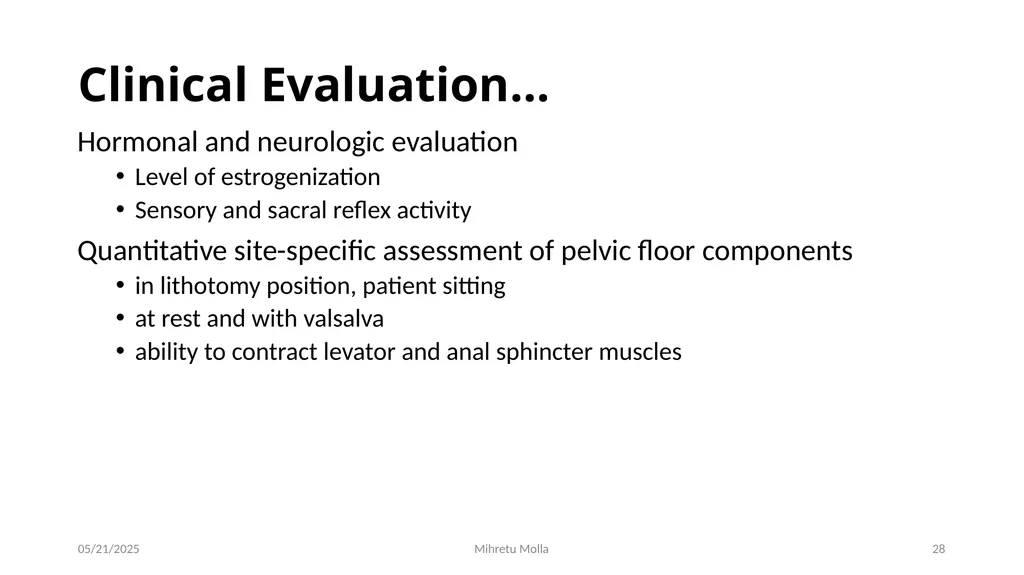
Clinical Evaluation… Hormonal and neurologic evaluation
Level of estrogenization
Sensory and sacral reflex activity
Quantitative site-specific assessment of pelvic floor components
in lithotomy position, patient sitting
at rest and with valsalva
ability to contract levator and anal sphincter muscles 6/29/2018 Mihretu Molla 28<br>
Level of estrogenization
Sensory and sacral reflex activity
Quantitative site-specific assessment of pelvic floor components
in lithotomy position, patient sitting
at rest and with valsalva
ability to contract levator and anal sphincter muscles 6/29/2018 Mihretu Molla 28<br>
29
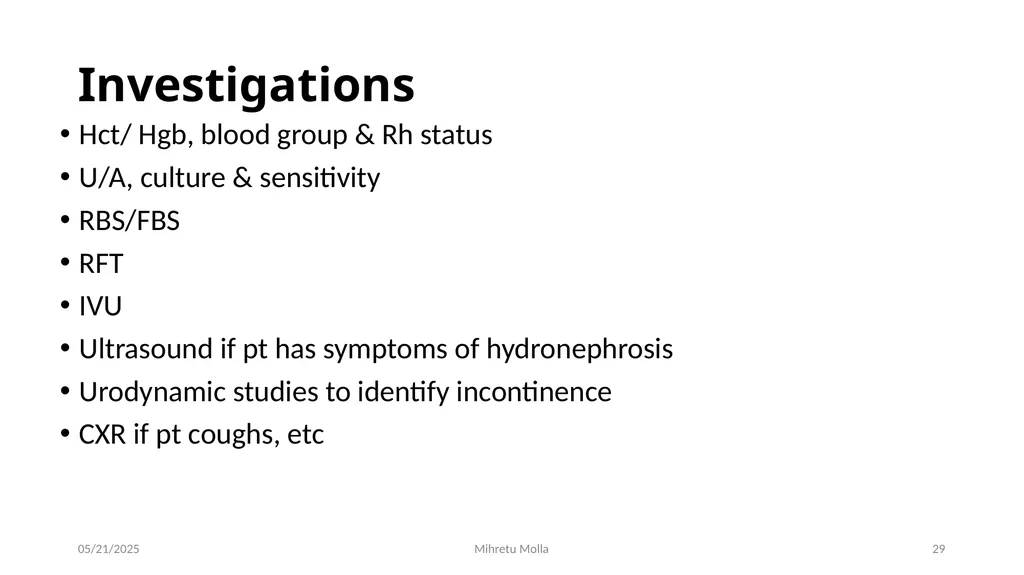
Investigations Hct/ Hgb, blood group & Rh status
U/A, culture & sensitivity
RBS/FBS
RFT
IVU
Ultrasound if pt has symptoms of hydronephrosis
Urodynamic studies to identify incontinence
CXR if pt coughs, etc 6/29/2018 Mihretu Molla 29<br>
U/A, culture & sensitivity
RBS/FBS
RFT
IVU
Ultrasound if pt has symptoms of hydronephrosis
Urodynamic studies to identify incontinence
CXR if pt coughs, etc 6/29/2018 Mihretu Molla 29<br>
30
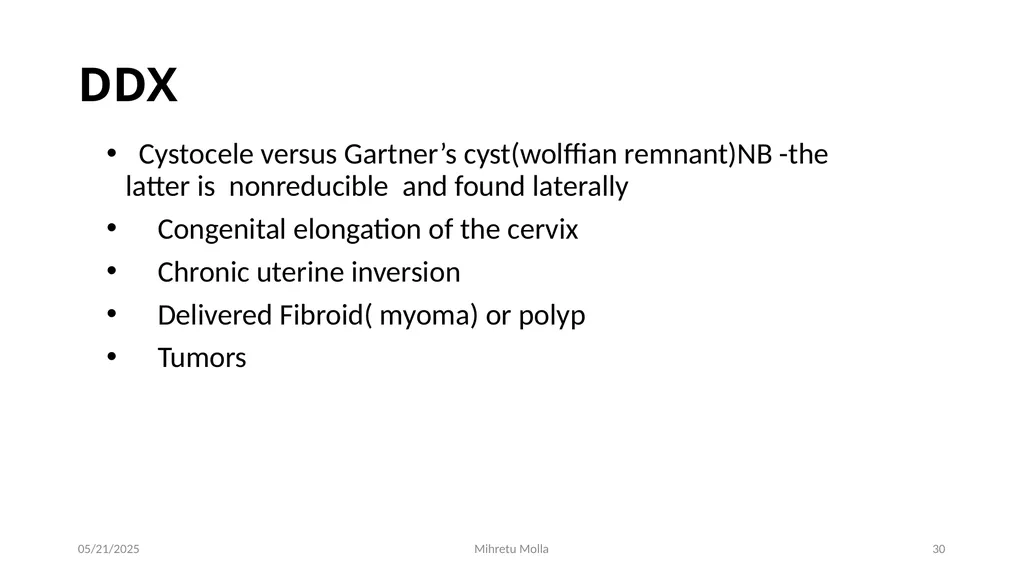
DDX Cystocele versus Gartner’s cyst(wolffian remnant)NB -the latter is nonreducible and found laterally
Congenital elongation of the cervix
Chronic uterine inversion
Delivered Fibroid( myoma) or polyp
Tumors 6/29/2018 Mihretu Molla 30<br>
Congenital elongation of the cervix
Chronic uterine inversion
Delivered Fibroid( myoma) or polyp
Tumors 6/29/2018 Mihretu Molla 30<br>
31
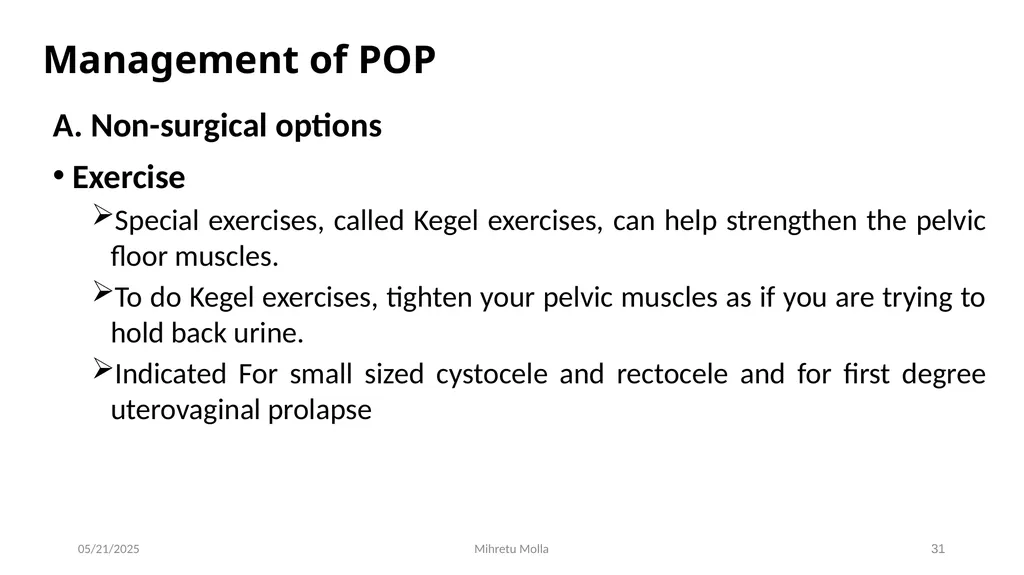
Management of POP A. Non-surgical options
Exercise
Special exercises, called Kegel exercises, can help strengthen the pelvic floor muscles.
To do Kegel exercises, tighten your pelvic muscles as if you are trying to hold back urine.
Indicated For small sized cystocele and rectocele and for first degree uterovaginal prolapse 31 6/29/2018 Mihretu Molla<br>
Exercise
Special exercises, called Kegel exercises, can help strengthen the pelvic floor muscles.
To do Kegel exercises, tighten your pelvic muscles as if you are trying to hold back urine.
Indicated For small sized cystocele and rectocele and for first degree uterovaginal prolapse 31 6/29/2018 Mihretu Molla<br>
32
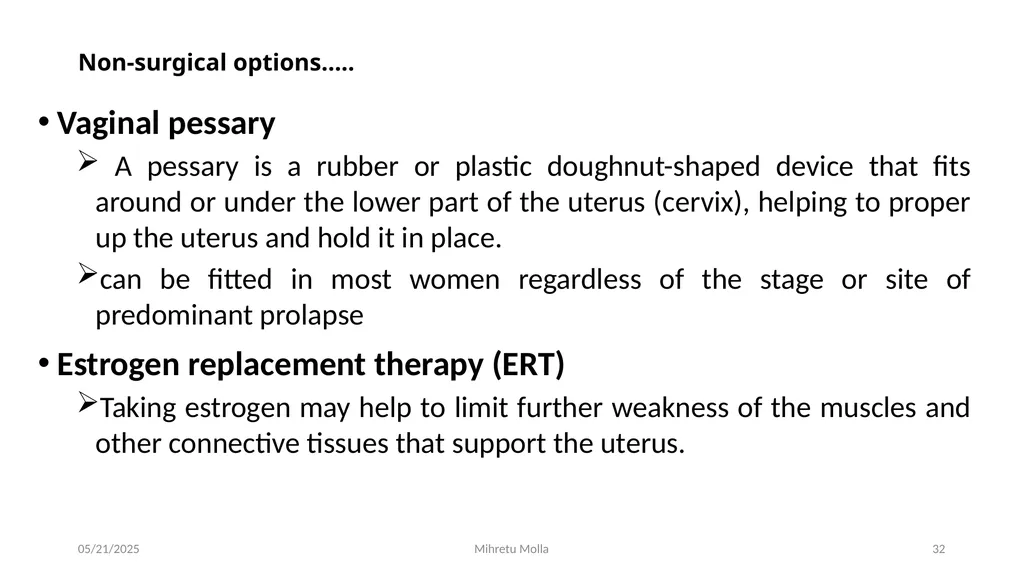
Non-surgical options….. Vaginal pessary
A pessary is a rubber or plastic doughnut-shaped device that fits around or under the lower part of the uterus (cervix), helping to proper up the uterus and hold it in place.
can be fitted in most women regardless of the stage or site of predominant prolapse
Estrogen replacement therapy (ERT)
Taking estrogen may help to limit further weakness of the muscles and other connective tissues that support the uterus. 6/29/2018 Mihretu Molla 32<br>
A pessary is a rubber or plastic doughnut-shaped device that fits around or under the lower part of the uterus (cervix), helping to proper up the uterus and hold it in place.
can be fitted in most women regardless of the stage or site of predominant prolapse
Estrogen replacement therapy (ERT)
Taking estrogen may help to limit further weakness of the muscles and other connective tissues that support the uterus. 6/29/2018 Mihretu Molla 32<br>
33
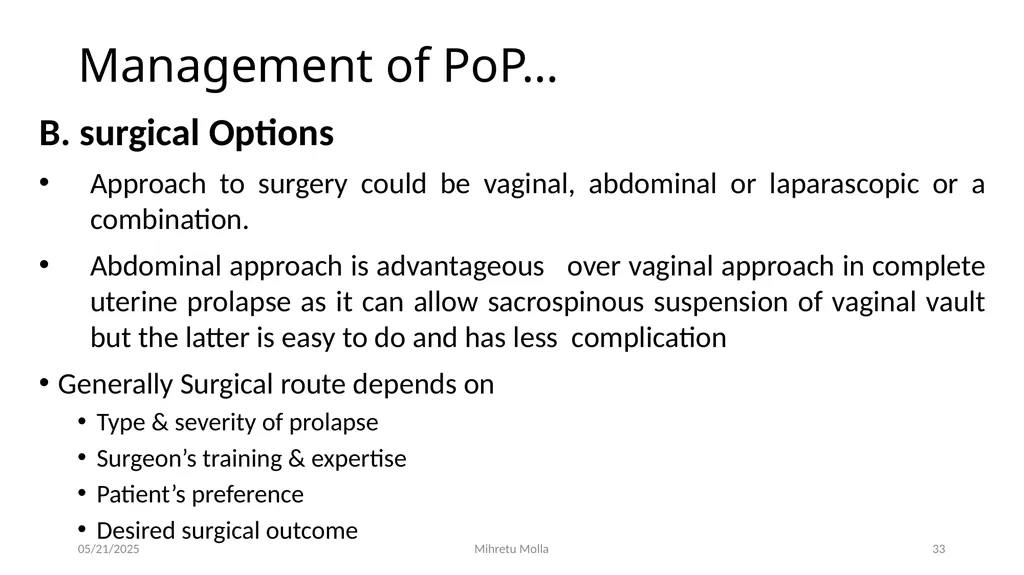
Management of PoP… B. surgical Options
Approach to surgery could be vaginal, abdominal or laparascopic or a combination.
Abdominal approach is advantageous over vaginal approach in complete uterine prolapse as it can allow sacrospinous suspension of vaginal vault but the latter is easy to do and has less complication
Generally Surgical route depends on
Type & severity of prolapse
Surgeon’s training & expertise
Patient’s preference
Desired surgical outcome 6/29/2018 Mihretu Molla 33<br>
Approach to surgery could be vaginal, abdominal or laparascopic or a combination.
Abdominal approach is advantageous over vaginal approach in complete uterine prolapse as it can allow sacrospinous suspension of vaginal vault but the latter is easy to do and has less complication
Generally Surgical route depends on
Type & severity of prolapse
Surgeon’s training & expertise
Patient’s preference
Desired surgical outcome 6/29/2018 Mihretu Molla 33<br>
34
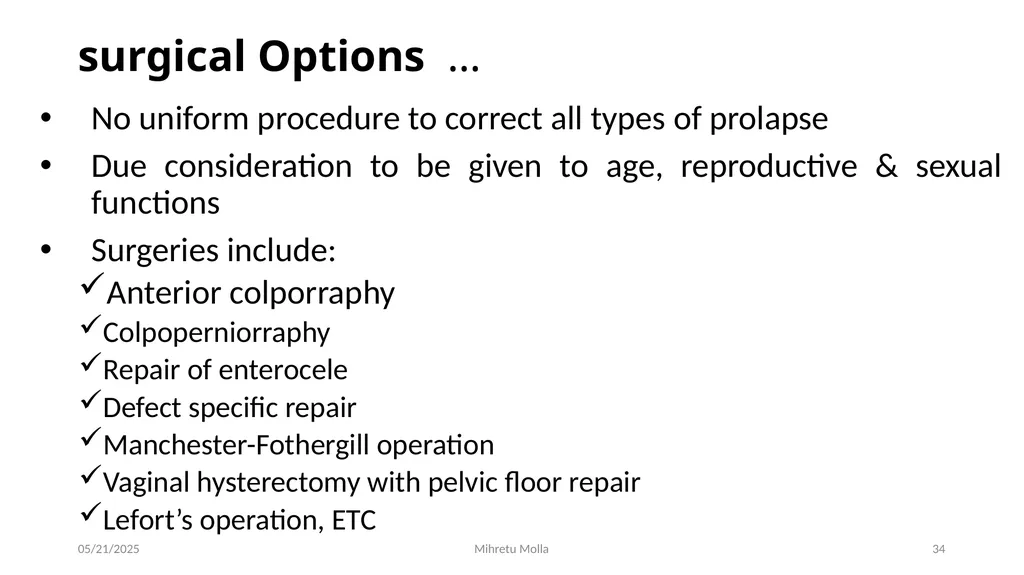
surgical Options … No uniform procedure to correct all types of prolapse
Due consideration to be given to age, reproductive & sexual functions
Surgeries include:
Anterior colporraphy
Colpoperniorraphy
Repair of enterocele
Defect specific repair
Manchester-Fothergill operation
Vaginal hysterectomy with pelvic floor repair
Lefort’s operation, ETC 6/29/2018 Mihretu Molla 34<br>
Due consideration to be given to age, reproductive & sexual functions
Surgeries include:
Anterior colporraphy
Colpoperniorraphy
Repair of enterocele
Defect specific repair
Manchester-Fothergill operation
Vaginal hysterectomy with pelvic floor repair
Lefort’s operation, ETC 6/29/2018 Mihretu Molla 34<br>
35
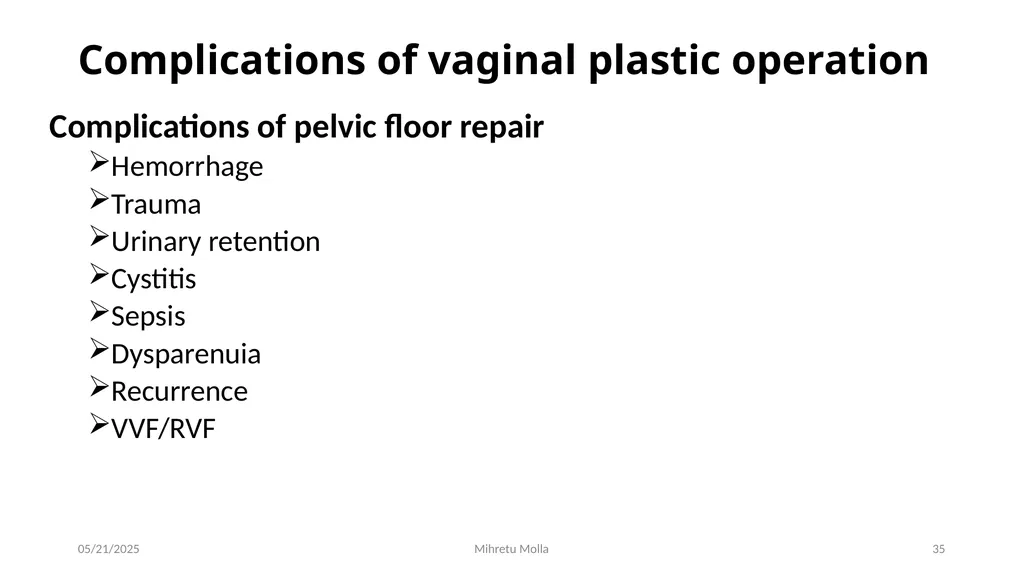
Complications of vaginal plastic operation Complications of pelvic floor repair
Hemorrhage
Trauma
Urinary retention
Cystitis
Sepsis
Dysparenuia
Recurrence
VVF/RVF 6/29/2018 Mihretu Molla 35<br>
Hemorrhage
Trauma
Urinary retention
Cystitis
Sepsis
Dysparenuia
Recurrence
VVF/RVF 6/29/2018 Mihretu Molla 35<br>
36
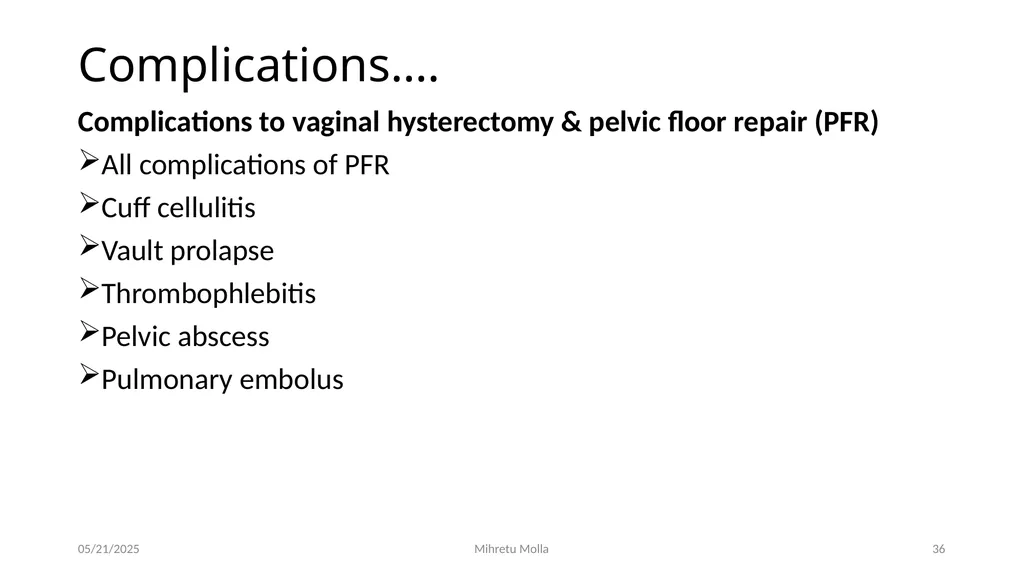
Complications…. Complications to vaginal hysterectomy & pelvic floor repair (PFR)
All complications of PFR
Cuff cellulitis
Vault prolapse
Thrombophlebitis
Pelvic abscess
Pulmonary embolus 6/29/2018 Mihretu Molla 36<br>
All complications of PFR
Cuff cellulitis
Vault prolapse
Thrombophlebitis
Pelvic abscess
Pulmonary embolus 6/29/2018 Mihretu Molla 36<br>
37
Complications of POP keratinization & decubitus ulcer of Vaginal mucosa
hypertrophy & elongation of Cervix
Urinary symptoms
Bladder: cystitis, trabeculation, b/c of incomplete evacuation
Ureters: hydroureter, pyelonephritis(water under the bridge)
Incarceration
Peritonitis
Carcinoma: rarely develops on decubitus ulcer 6/29/2018 Mihretu Molla 37<br>
hypertrophy & elongation of Cervix
Urinary symptoms
Bladder: cystitis, trabeculation, b/c of incomplete evacuation
Ureters: hydroureter, pyelonephritis(water under the bridge)
Incarceration
Peritonitis
Carcinoma: rarely develops on decubitus ulcer 6/29/2018 Mihretu Molla 37<br>
38
Prevention Obstetric care to protect pelvic floor
Decreased pushing times
Avoid forceps, major lacerations
Proper suturing of laceration or tear
Permit passive descent
General lifestyle changes
Smoking cessation and cough cessation
Routine use of Kegel pelvic floor exercises
Regular physical activity
Proper nutrition
Weight loss
Avoid constipation and repetitive heavy lifting
Use of family planning
Hormone replacement therapy 6/29/2018 Mihretu Molla 38<br>
Decreased pushing times
Avoid forceps, major lacerations
Proper suturing of laceration or tear
Permit passive descent
General lifestyle changes
Smoking cessation and cough cessation
Routine use of Kegel pelvic floor exercises
Regular physical activity
Proper nutrition
Weight loss
Avoid constipation and repetitive heavy lifting
Use of family planning
Hormone replacement therapy 6/29/2018 Mihretu Molla 38<br>
39
Urinary Incontinence Mihretu Molla (Bsc, Msc) 6/29/2018 Mihretu Molla 39<br>
40
Session objectives Describe the physiology of micturation
Define incontinence
Classify incontinence
Evaluate urinary incontinence
Describe stress urinary incontinence & treatment
Describe urge incontinence & treatment
Describe genital fistulas 6/29/2018 Mihretu Molla 40<br>
Define incontinence
Classify incontinence
Evaluate urinary incontinence
Describe stress urinary incontinence & treatment
Describe urge incontinence & treatment
Describe genital fistulas 6/29/2018 Mihretu Molla 40<br>
41
Introduction Bladder & urethra should be considered as a single unit for storage of urine & voiding
Storage & emptying of urine depends on a complex interplay between the brain, spinal cord, bladder, urethra & pelvic floor. 6/29/2018 Mihretu Molla 41<br>
Storage & emptying of urine depends on a complex interplay between the brain, spinal cord, bladder, urethra & pelvic floor. 6/29/2018 Mihretu Molla 41<br>
42
The bladder The bladder is a complex organ and functions to
Stores urine
Discharge urine voluntarily effortlessly, completely, and painlessly.
To meet these demands, the bladder must have normal anatomic support and neurophysiologic function. 42 6/29/2018 Mihretu Molla<br>
Stores urine
Discharge urine voluntarily effortlessly, completely, and painlessly.
To meet these demands, the bladder must have normal anatomic support and neurophysiologic function. 42 6/29/2018 Mihretu Molla<br>
43
The Bladder…… Is a low–pressure system that expands to accommodate increasing volumes of urine WOT an appreciable rise in pressure.( mediated by the SNS).
When bladder has filled to a certain volume, fullness is registered by tension–stretch receptors, signal the brain to initiate a micturition reflex(controlled by cortical control mechanisms, depending on the social circumstances and the state of the patient's nervous system).
Normal voiding is accomplished by voluntary relaxation of the pelvic floor and urethra, sustained contraction of the detrusor muscle, leading to complete bladder emptying 43 6/29/2018 Mihretu Molla<br>
When bladder has filled to a certain volume, fullness is registered by tension–stretch receptors, signal the brain to initiate a micturition reflex(controlled by cortical control mechanisms, depending on the social circumstances and the state of the patient's nervous system).
Normal voiding is accomplished by voluntary relaxation of the pelvic floor and urethra, sustained contraction of the detrusor muscle, leading to complete bladder emptying 43 6/29/2018 Mihretu Molla<br>
44
The Urethra Normal Urethral Closure Is maintained by a combination of intrinsic and extrinsic factors.
The extrinsic factors ( Levator ani ms, endopelvic fascia,and their attachments to the pelvic sidewalls and the urethra).
Forms a hammock beneath the urethra that responds to increases in intra–abdominal pressure by tensing, allowing the urethra to be closed against the posterior supporting shelf 44 6/29/2018 Mihretu Molla<br>
The extrinsic factors ( Levator ani ms, endopelvic fascia,and their attachments to the pelvic sidewalls and the urethra).
Forms a hammock beneath the urethra that responds to increases in intra–abdominal pressure by tensing, allowing the urethra to be closed against the posterior supporting shelf 44 6/29/2018 Mihretu Molla<br>
45
Urethra …. The intrinsic factors contributing to urethral closure
Striated muscle of the urethral wall
Vascular congestion of the submucosal venous plexus
Smooth muscle of the urethral wall and associated blood vessels
Epithelial coaptation of the folds of the urethral lining, urethral elasticity
The tone of urethra mediated by α–adrenergic receptors of the sympathetic nervous system 45 6/29/2018 Mihretu Molla<br>
Striated muscle of the urethral wall
Vascular congestion of the submucosal venous plexus
Smooth muscle of the urethral wall and associated blood vessels
Epithelial coaptation of the folds of the urethral lining, urethral elasticity
The tone of urethra mediated by α–adrenergic receptors of the sympathetic nervous system 45 6/29/2018 Mihretu Molla<br>
46
Innervation of the bladder and the urethra The sympathetic NS
Primarily controls bladder storage
Originates T11 through L2 or L3
Two types of receptors
α receptors located in the urethra and bladder neck
Stimulation of α receptors increases urethral tone and promotes closure
α–adrenergic receptor blockers have the opposite effect
β receptors, located in the bladder body.
Stimulation of β receptors decreases tone in the bladder body. 46 6/29/2018 Mihretu Molla<br>
Primarily controls bladder storage
Originates T11 through L2 or L3
Two types of receptors
α receptors located in the urethra and bladder neck
Stimulation of α receptors increases urethral tone and promotes closure
α–adrenergic receptor blockers have the opposite effect
β receptors, located in the bladder body.
Stimulation of β receptors decreases tone in the bladder body. 46 6/29/2018 Mihretu Molla<br>
47
Innervation…. Parasympathetic NS
Controls bladder motor function–bladder contraction and bladder emptying.
Originates in the sacral spinal cord(S2 to S4)
The neurons of the somatic nervous system (external urethral sphincter).
Plays only a peripheral role in neurologic control of the lower urinary tract through its innervation of the pelvic floor and external urethral sphincter. 47 6/29/2018 Mihretu Molla<br>
Controls bladder motor function–bladder contraction and bladder emptying.
Originates in the sacral spinal cord(S2 to S4)
The neurons of the somatic nervous system (external urethral sphincter).
Plays only a peripheral role in neurologic control of the lower urinary tract through its innervation of the pelvic floor and external urethral sphincter. 47 6/29/2018 Mihretu Molla<br>
48
Physiology of micturation Storage phase:
Filling rate: 0.5-5 ml/min
As bladder fills, walls stretch to maintain a constant tone.
Intra-vesical pressure is maintained to a steady level of 10cmH2O even with a volume of 500ml.
Occur by Spinal reflex pathway.
During the storage of urine, distention of the bladder produces low level vesical afferent firing
This produces Pres(ves) < Press(ureth) 6/29/2018 Mihretu Molla 48<br>
Filling rate: 0.5-5 ml/min
As bladder fills, walls stretch to maintain a constant tone.
Intra-vesical pressure is maintained to a steady level of 10cmH2O even with a volume of 500ml.
Occur by Spinal reflex pathway.
During the storage of urine, distention of the bladder produces low level vesical afferent firing
This produces Pres(ves) < Press(ureth) 6/29/2018 Mihretu Molla 48<br>
49
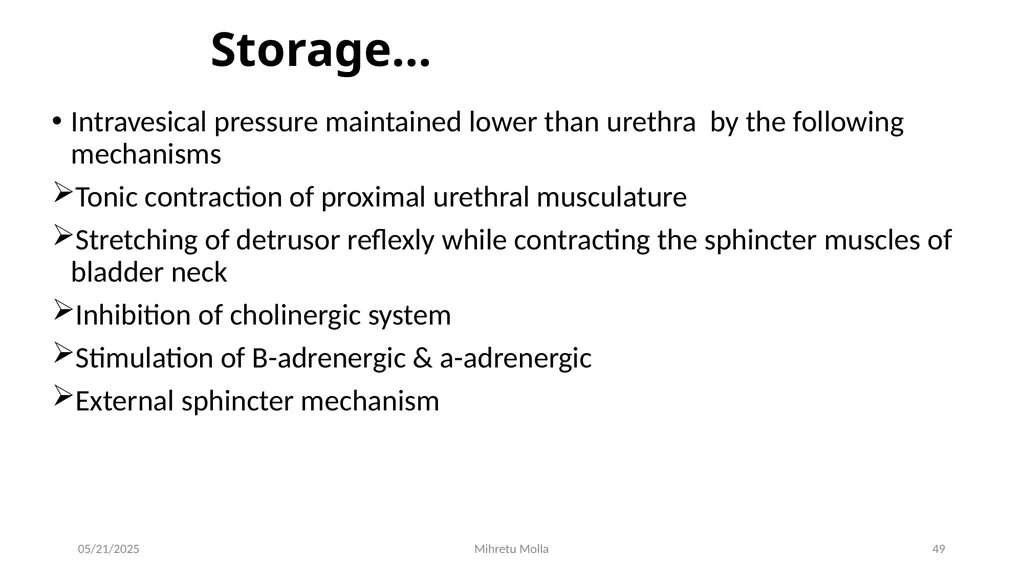
Storage… Intravesical pressure maintained lower than urethra by the following mechanisms
Tonic contraction of proximal urethral musculature
Stretching of detrusor reflexly while contracting the sphincter muscles of bladder neck
Inhibition of cholinergic system
Stimulation of B-adrenergic & a-adrenergic
External sphincter mechanism 6/29/2018 Mihretu Molla 49<br>
Tonic contraction of proximal urethral musculature
Stretching of detrusor reflexly while contracting the sphincter muscles of bladder neck
Inhibition of cholinergic system
Stimulation of B-adrenergic & a-adrenergic
External sphincter mechanism 6/29/2018 Mihretu Molla 49<br>
50
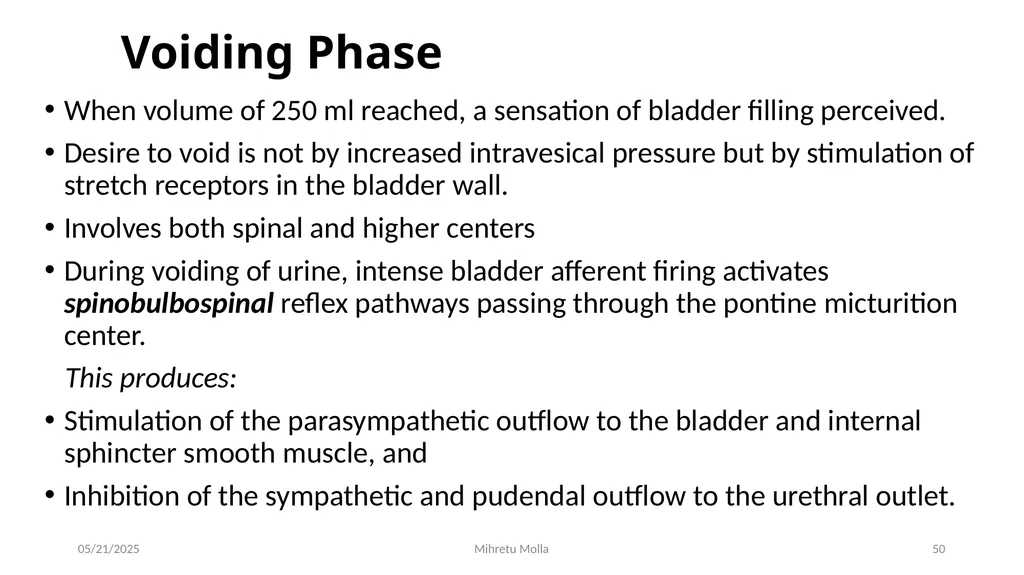
Voiding Phase When volume of 250 ml reached, a sensation of bladder filling perceived.
Desire to void is not by increased intravesical pressure but by stimulation of stretch receptors in the bladder wall.
Involves both spinal and higher centers
During voiding of urine, intense bladder afferent firing activates spinobulbospinal reflex pathways passing through the pontine micturition center.
This produces:
Stimulation of the parasympathetic outflow to the bladder and internal sphincter smooth muscle, and
Inhibition of the sympathetic and pudendal outflow to the urethral outlet. 6/29/2018 Mihretu Molla 50<br>
Desire to void is not by increased intravesical pressure but by stimulation of stretch receptors in the bladder wall.
Involves both spinal and higher centers
During voiding of urine, intense bladder afferent firing activates spinobulbospinal reflex pathways passing through the pontine micturition center.
This produces:
Stimulation of the parasympathetic outflow to the bladder and internal sphincter smooth muscle, and
Inhibition of the sympathetic and pudendal outflow to the urethral outlet. 6/29/2018 Mihretu Molla 50<br>
51
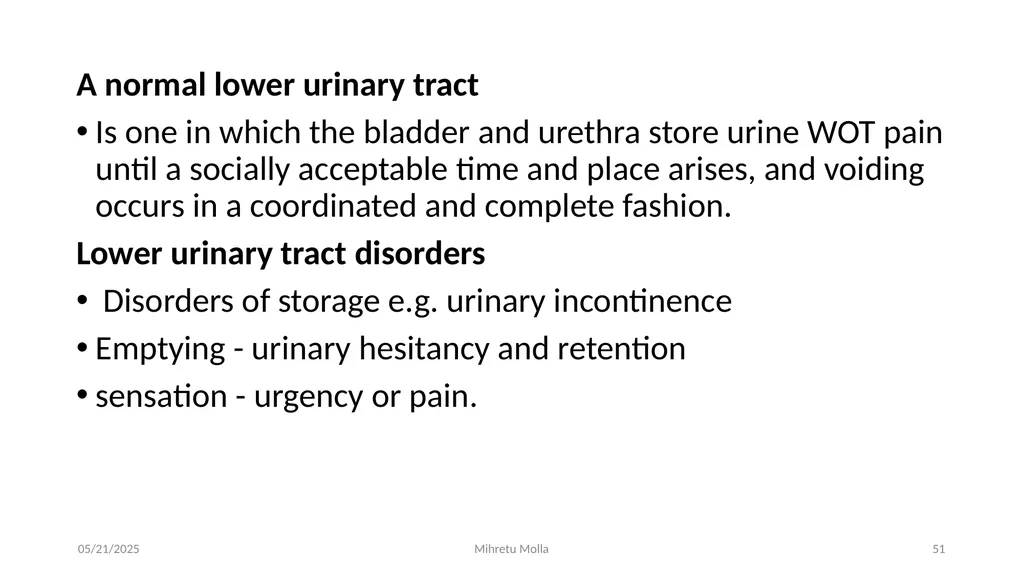
A normal lower urinary tract
Is one in which the bladder and urethra store urine WOT pain until a socially acceptable time and place arises, and voiding occurs in a coordinated and complete fashion.
Lower urinary tract disorders
Disorders of storage e.g. urinary incontinence
Emptying - urinary hesitancy and retention
sensation - urgency or pain. 51 6/29/2018 Mihretu Molla<br>
Is one in which the bladder and urethra store urine WOT pain until a socially acceptable time and place arises, and voiding occurs in a coordinated and complete fashion.
Lower urinary tract disorders
Disorders of storage e.g. urinary incontinence
Emptying - urinary hesitancy and retention
sensation - urgency or pain. 51 6/29/2018 Mihretu Molla<br>
52
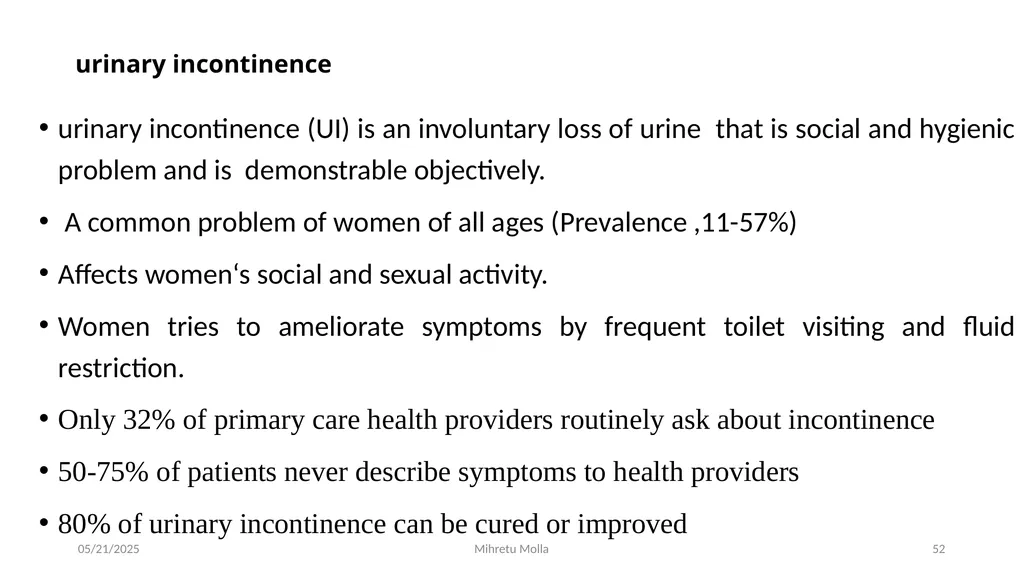
urinary incontinence urinary incontinence (UI) is an involuntary loss of urine that is social and hygienic problem and is demonstrable objectively.
A common problem of women of all ages (Prevalence ,11-57%)
Affects women‘s social and sexual activity.
Women tries to ameliorate symptoms by frequent toilet visiting and fluid restriction.
Only 32% of primary care health providers routinely ask about incontinence
50-75% of patients never describe symptoms to health providers
80% of urinary incontinence can be cured or improved 6/29/2018 Mihretu Molla 52<br>
A common problem of women of all ages (Prevalence ,11-57%)
Affects women‘s social and sexual activity.
Women tries to ameliorate symptoms by frequent toilet visiting and fluid restriction.
Only 32% of primary care health providers routinely ask about incontinence
50-75% of patients never describe symptoms to health providers
80% of urinary incontinence can be cured or improved 6/29/2018 Mihretu Molla 52<br>
53
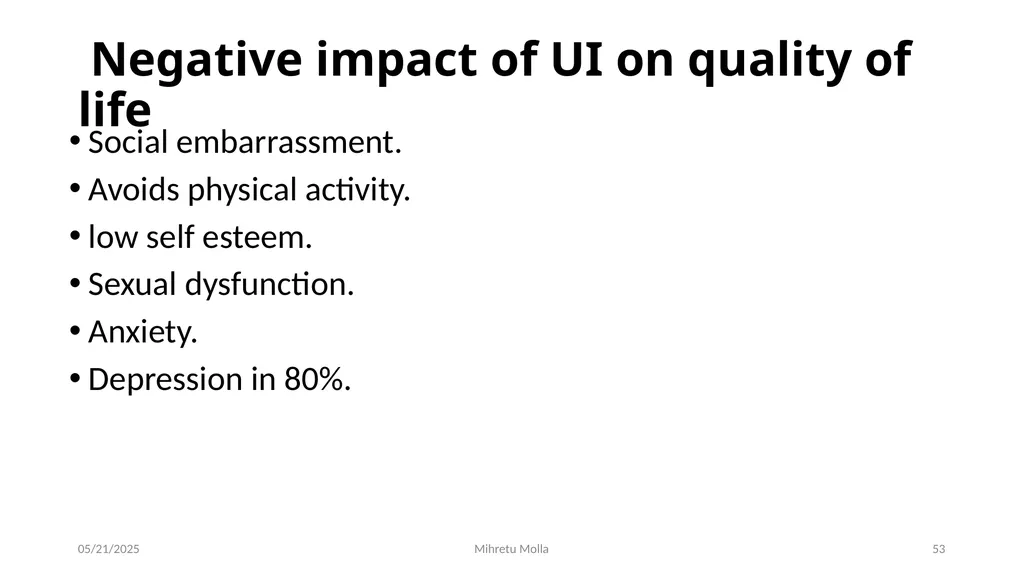
Negative impact of UI on quality of life Social embarrassment.
Avoids physical activity.
low self esteem.
Sexual dysfunction.
Anxiety.
Depression in 80%. 6/29/2018 Mihretu Molla 53<br>
Avoids physical activity.
low self esteem.
Sexual dysfunction.
Anxiety.
Depression in 80%. 6/29/2018 Mihretu Molla 53<br>
54
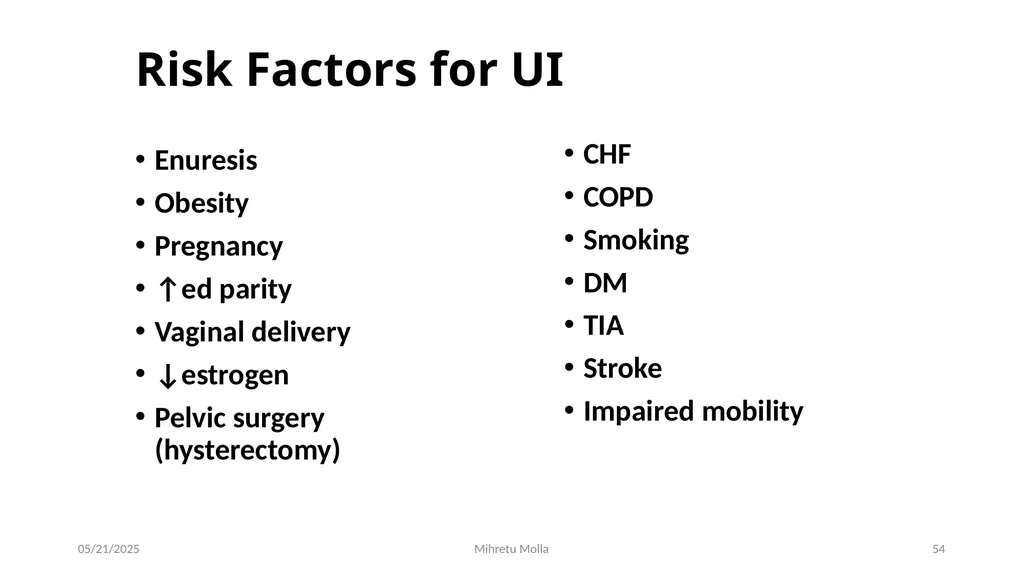
Risk Factors for UI Enuresis
Obesity
Pregnancy
↑ed parity
Vaginal delivery
↓estrogen
Pelvic surgery (hysterectomy) CHF
COPD
Smoking
DM
TIA
Stroke
Impaired mobility 6/29/2018 Mihretu Molla 54<br>
Obesity
Pregnancy
↑ed parity
Vaginal delivery
↓estrogen
Pelvic surgery (hysterectomy) CHF
COPD
Smoking
DM
TIA
Stroke
Impaired mobility 6/29/2018 Mihretu Molla 54<br>
55
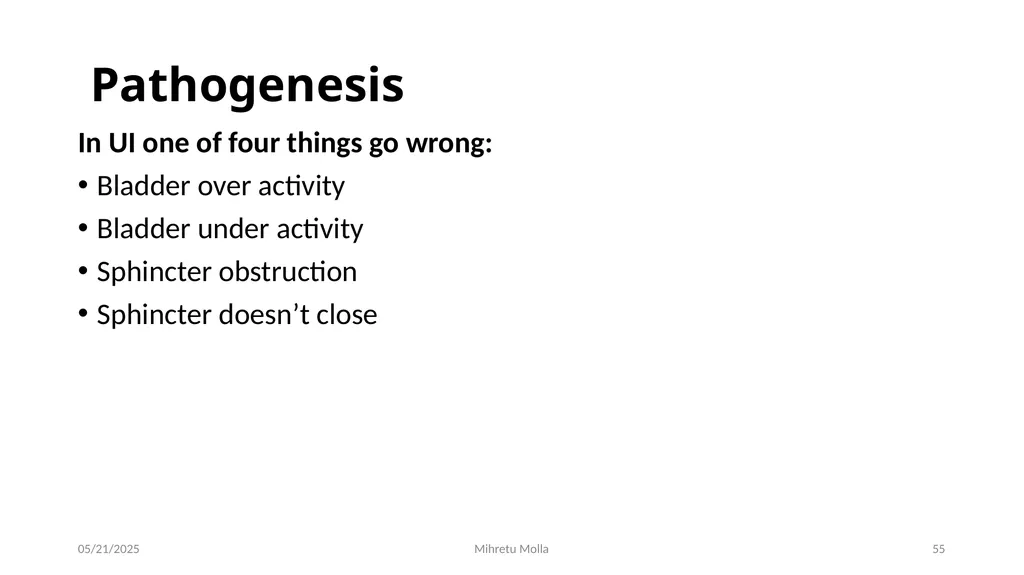
Pathogenesis In UI one of four things go wrong:
Bladder over activity
Bladder under activity
Sphincter obstruction
Sphincter doesn’t close 6/29/2018 Mihretu Molla 55<br>
Bladder over activity
Bladder under activity
Sphincter obstruction
Sphincter doesn’t close 6/29/2018 Mihretu Molla 55<br>
56
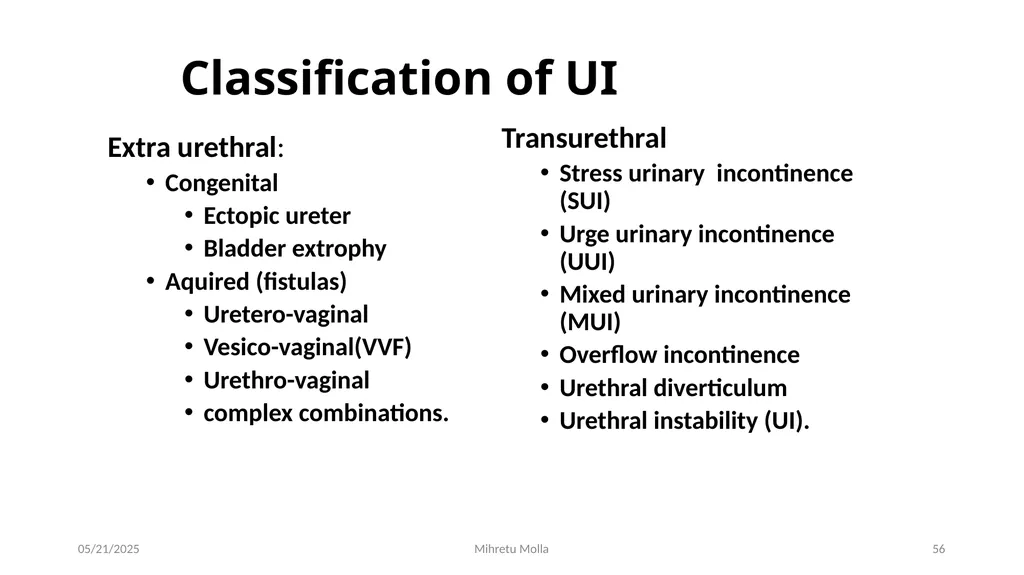
Classification of UI Extra urethral:
Congenital
Ectopic ureter
Bladder extrophy
Aquired (fistulas)
Uretero-vaginal
Vesico-vaginal(VVF)
Urethro-vaginal
complex combinations. Transurethral
Stress urinary incontinence (SUI)
Urge urinary incontinence (UUI)
Mixed urinary incontinence (MUI)
Overflow incontinence
Urethral diverticulum
Urethral instability (UI). 6/29/2018 Mihretu Molla 56<br>
Congenital
Ectopic ureter
Bladder extrophy
Aquired (fistulas)
Uretero-vaginal
Vesico-vaginal(VVF)
Urethro-vaginal
complex combinations. Transurethral
Stress urinary incontinence (SUI)
Urge urinary incontinence (UUI)
Mixed urinary incontinence (MUI)
Overflow incontinence
Urethral diverticulum
Urethral instability (UI). 6/29/2018 Mihretu Molla 56<br>
57
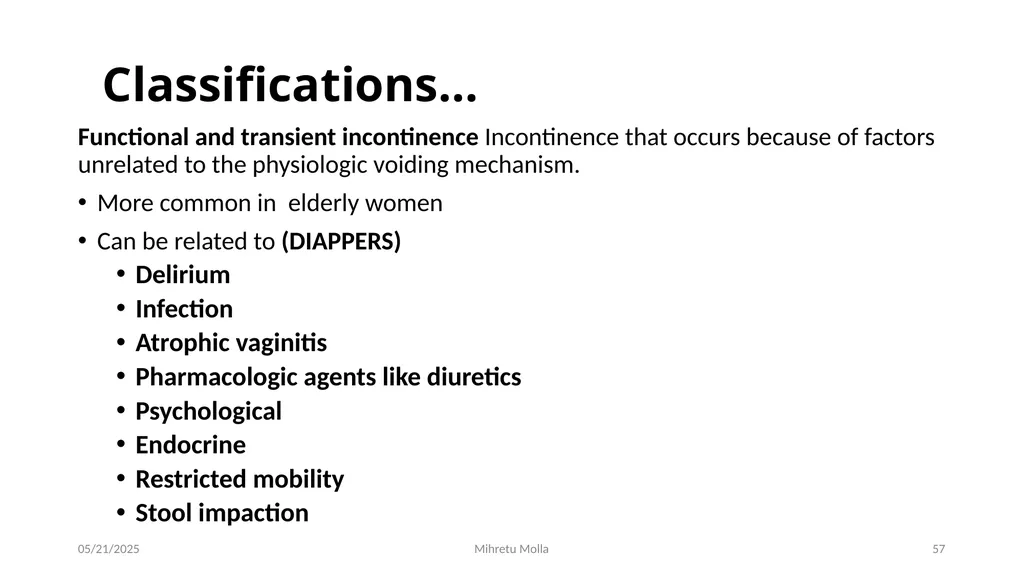
Classifications… Functional and transient incontinence Incontinence that occurs because of factors unrelated to the physiologic voiding mechanism.
More common in elderly women
Can be related to (DIAPPERS)
Delirium
Infection
Atrophic vaginitis
Pharmacologic agents like diuretics
Psychological
Endocrine
Restricted mobility
Stool impaction 6/29/2018 Mihretu Molla 57<br>
More common in elderly women
Can be related to (DIAPPERS)
Delirium
Infection
Atrophic vaginitis
Pharmacologic agents like diuretics
Psychological
Endocrine
Restricted mobility
Stool impaction 6/29/2018 Mihretu Molla 57<br>
58
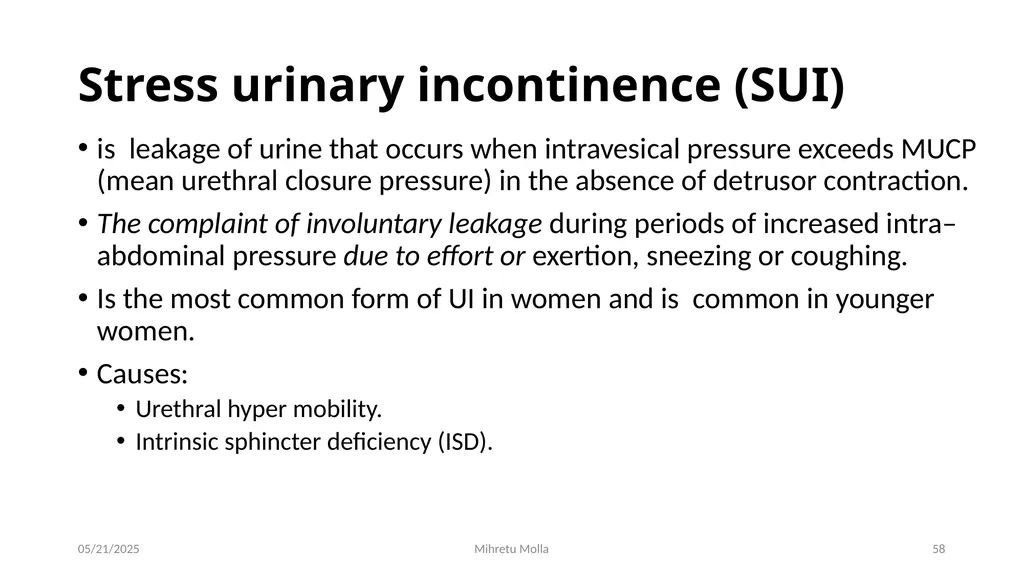
Stress urinary incontinence (SUI) is leakage of urine that occurs when intravesical pressure exceeds MUCP (mean urethral closure pressure) in the absence of detrusor contraction.
The complaint of involuntary leakage during periods of increased intra–abdominal pressure due to effort or exertion, sneezing or coughing.
Is the most common form of UI in women and is common in younger women.
Causes:
Urethral hyper mobility.
Intrinsic sphincter deficiency (ISD). 6/29/2018 Mihretu Molla 58<br>
The complaint of involuntary leakage during periods of increased intra–abdominal pressure due to effort or exertion, sneezing or coughing.
Is the most common form of UI in women and is common in younger women.
Causes:
Urethral hyper mobility.
Intrinsic sphincter deficiency (ISD). 6/29/2018 Mihretu Molla 58<br>
59
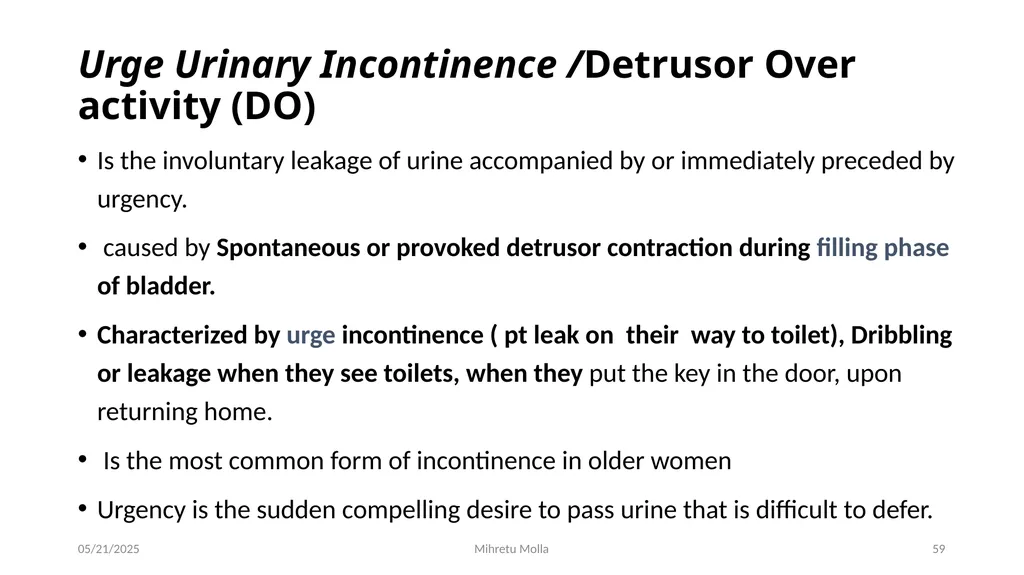
Urge Urinary Incontinence /Detrusor Over activity (DO) Is the involuntary leakage of urine accompanied by or immediately preceded by urgency.
caused by Spontaneous or provoked detrusor contraction during filling phase of bladder.
Characterized by urge incontinence ( pt leak on their way to toilet), Dribbling or leakage when they see toilets, when they put the key in the door, upon returning home.
Is the most common form of incontinence in older women
Urgency is the sudden compelling desire to pass urine that is difficult to defer. 59 6/29/2018 Mihretu Molla<br>
caused by Spontaneous or provoked detrusor contraction during filling phase of bladder.
Characterized by urge incontinence ( pt leak on their way to toilet), Dribbling or leakage when they see toilets, when they put the key in the door, upon returning home.
Is the most common form of incontinence in older women
Urgency is the sudden compelling desire to pass urine that is difficult to defer. 59 6/29/2018 Mihretu Molla<br>
60
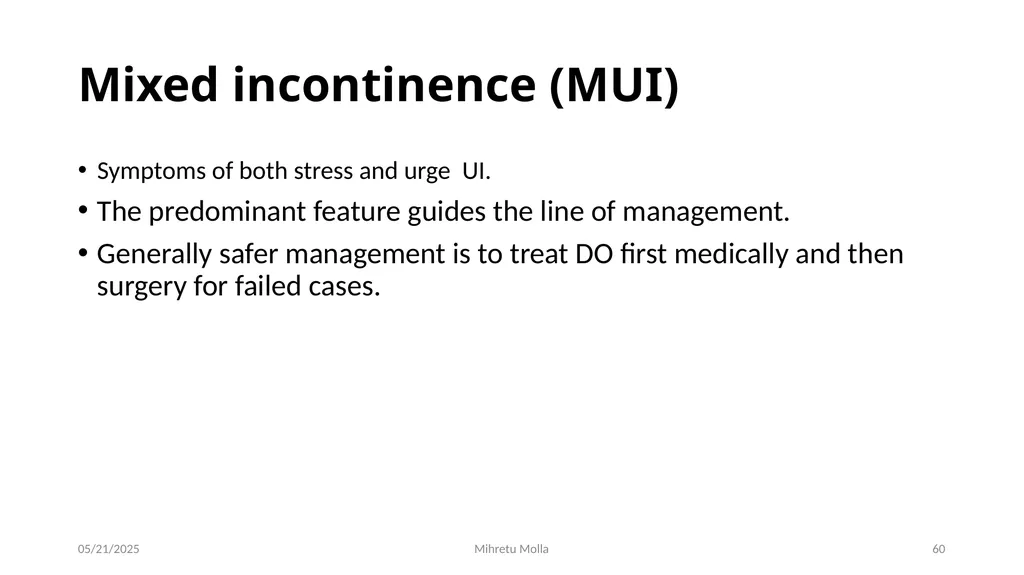
Mixed incontinence (MUI) Symptoms of both stress and urge UI.
The predominant feature guides the line of management.
Generally safer management is to treat DO first medically and then surgery for failed cases. 6/29/2018 Mihretu Molla 60<br>
The predominant feature guides the line of management.
Generally safer management is to treat DO first medically and then surgery for failed cases. 6/29/2018 Mihretu Molla 60<br>
61
Overflow incontinence (Incomplete Emptying) The leakage is associated with incomplete bladder emptying, resulting from impaired detrusor contractility (weakness) or bladder outlet obstruction.
Typically the leakage is small in volume.
↑ed post void residual urine.
Poor streaming, dribbling, hesitancy. 6/29/2018 Mihretu Molla 61<br>
Typically the leakage is small in volume.
↑ed post void residual urine.
Poor streaming, dribbling, hesitancy. 6/29/2018 Mihretu Molla 61<br>
62
OI… Detrusor under activity may be caused by
Replacement of detrusor smooth muscle by fibrous tissue.
Peripheral neuropathy.
Damage to spinal detrusor afferent.
bladder outlet obstruction may be caused by
Anti incontinence surgery
Cystocele
Spinal cord injury….. 6/29/2018 Mihretu Molla 62<br>
Replacement of detrusor smooth muscle by fibrous tissue.
Peripheral neuropathy.
Damage to spinal detrusor afferent.
bladder outlet obstruction may be caused by
Anti incontinence surgery
Cystocele
Spinal cord injury….. 6/29/2018 Mihretu Molla 62<br>
63
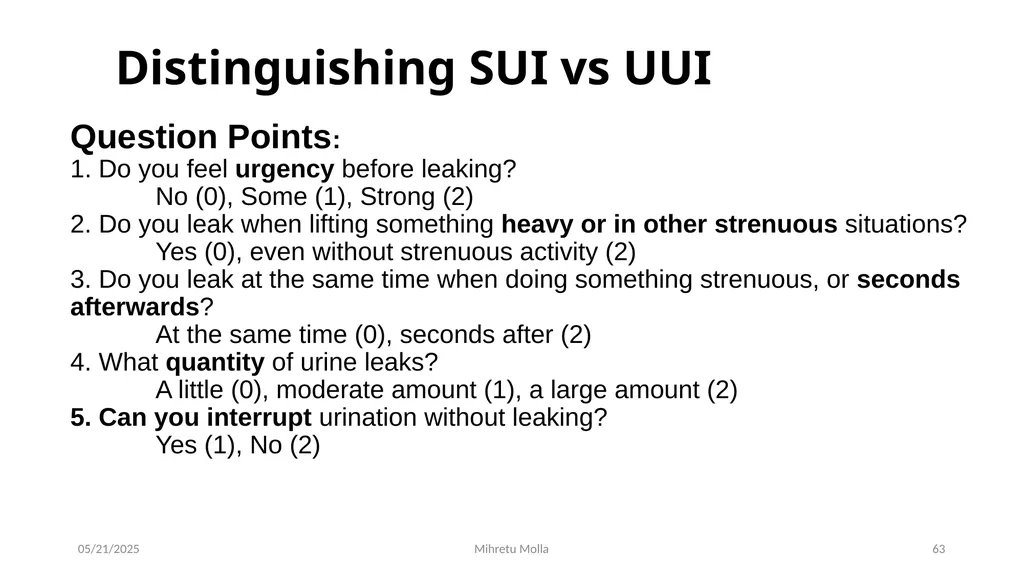
Distinguishing SUI vs UUI Question Points:
Do you feel urgency before leaking?
No (0), Some (1), Strong (2)
2. Do you leak when lifting something heavy or in other strenuous situations?
Yes (0), even without strenuous activity (2)
3. Do you leak at the same time when doing something strenuous, or seconds afterwards?
At the same time (0), seconds after (2)
4. What quantity of urine leaks?
A little (0), moderate amount (1), a large amount (2)
5. Can you interrupt urination without leaking?
Yes (1), No (2) 6/29/2018 Mihretu Molla 63<br>
Do you feel urgency before leaking?
No (0), Some (1), Strong (2)
2. Do you leak when lifting something heavy or in other strenuous situations?
Yes (0), even without strenuous activity (2)
3. Do you leak at the same time when doing something strenuous, or seconds afterwards?
At the same time (0), seconds after (2)
4. What quantity of urine leaks?
A little (0), moderate amount (1), a large amount (2)
5. Can you interrupt urination without leaking?
Yes (1), No (2) 6/29/2018 Mihretu Molla 63<br>
64
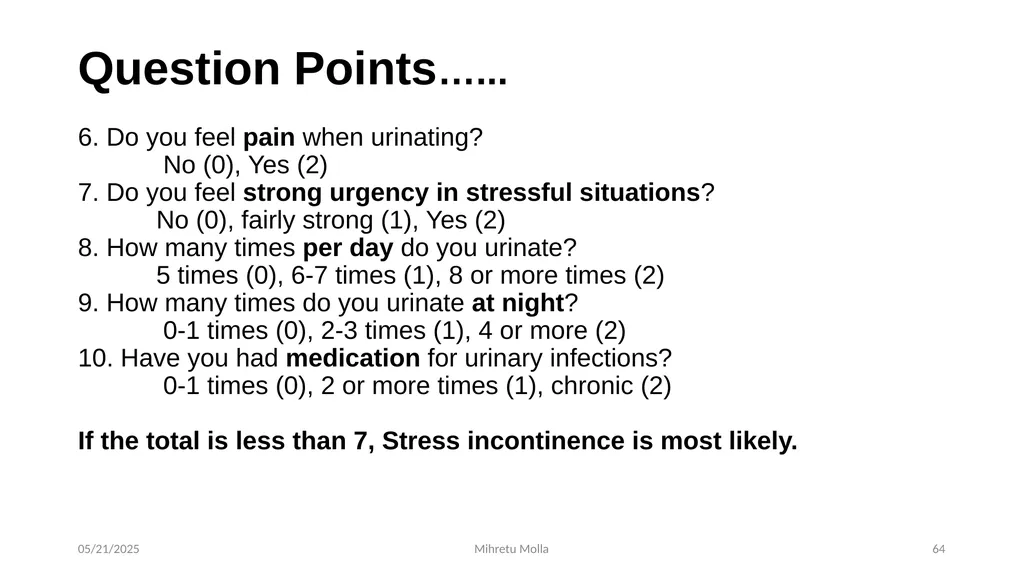
Question Points…... 6. Do you feel pain when urinating?
No (0), Yes (2)
7. Do you feel strong urgency in stressful situations?
No (0), fairly strong (1), Yes (2)
8. How many times per day do you urinate?
5 times (0), 6-7 times (1), 8 or more times (2)
9. How many times do you urinate at night?
0-1 times (0), 2-3 times (1), 4 or more (2)
10. Have you had medication for urinary infections?
0-1 times (0), 2 or more times (1), chronic (2)
If the total is less than 7, Stress incontinence is most likely. 6/29/2018 Mihretu Molla 64<br>
No (0), Yes (2)
7. Do you feel strong urgency in stressful situations?
No (0), fairly strong (1), Yes (2)
8. How many times per day do you urinate?
5 times (0), 6-7 times (1), 8 or more times (2)
9. How many times do you urinate at night?
0-1 times (0), 2-3 times (1), 4 or more (2)
10. Have you had medication for urinary infections?
0-1 times (0), 2 or more times (1), chronic (2)
If the total is less than 7, Stress incontinence is most likely. 6/29/2018 Mihretu Molla 64<br>
65
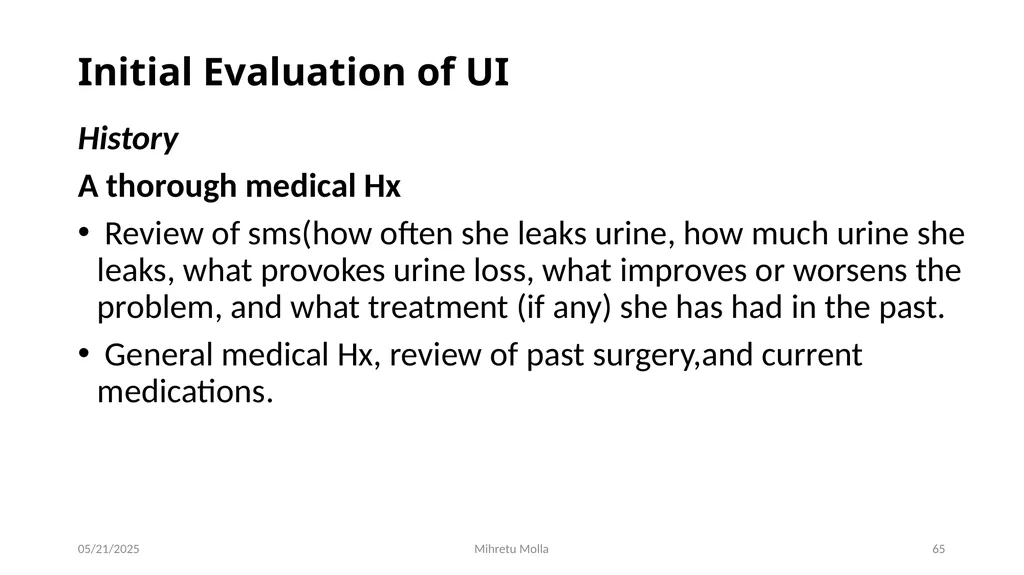
Initial Evaluation of UI History
A thorough medical Hx
Review of sms(how often she leaks urine, how much urine she leaks, what provokes urine loss, what improves or worsens the problem, and what treatment (if any) she has had in the past.
General medical Hx, review of past surgery,and current medications. 65 6/29/2018 Mihretu Molla<br>
A thorough medical Hx
Review of sms(how often she leaks urine, how much urine she leaks, what provokes urine loss, what improves or worsens the problem, and what treatment (if any) she has had in the past.
General medical Hx, review of past surgery,and current medications. 65 6/29/2018 Mihretu Molla<br>
66
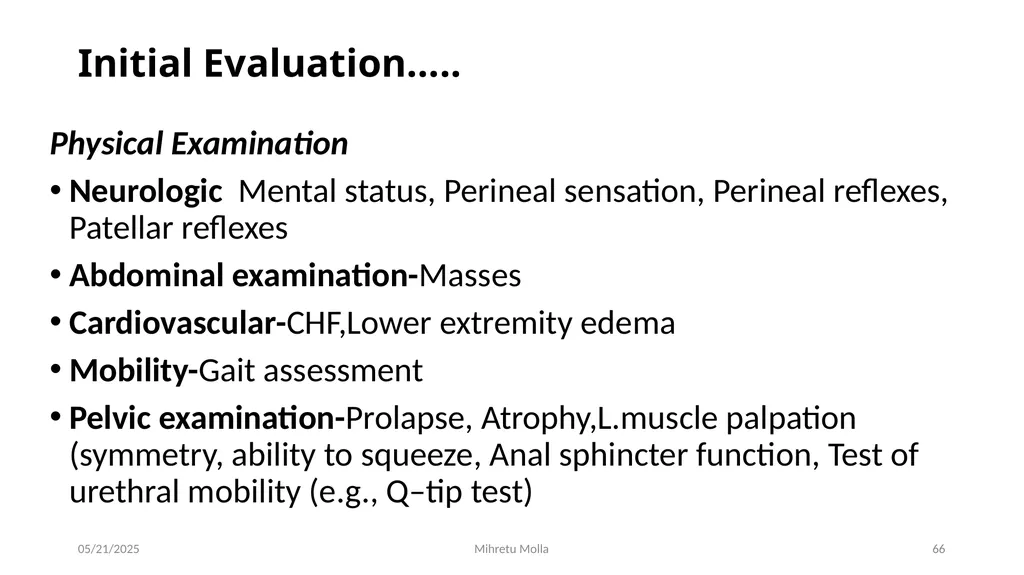
Initial Evaluation….. Physical Examination
Neurologic Mental status, Perineal sensation, Perineal reflexes, Patellar reflexes
Abdominal examination-Masses
Cardiovascular-CHF,Lower extremity edema
Mobility-Gait assessment
Pelvic examination-Prolapse, Atrophy,L.muscle palpation (symmetry, ability to squeeze, Anal sphincter function, Test of urethral mobility (e.g., Q–tip test) 66 6/29/2018 Mihretu Molla<br>
Neurologic Mental status, Perineal sensation, Perineal reflexes, Patellar reflexes
Abdominal examination-Masses
Cardiovascular-CHF,Lower extremity edema
Mobility-Gait assessment
Pelvic examination-Prolapse, Atrophy,L.muscle palpation (symmetry, ability to squeeze, Anal sphincter function, Test of urethral mobility (e.g., Q–tip test) 66 6/29/2018 Mihretu Molla<br>
67
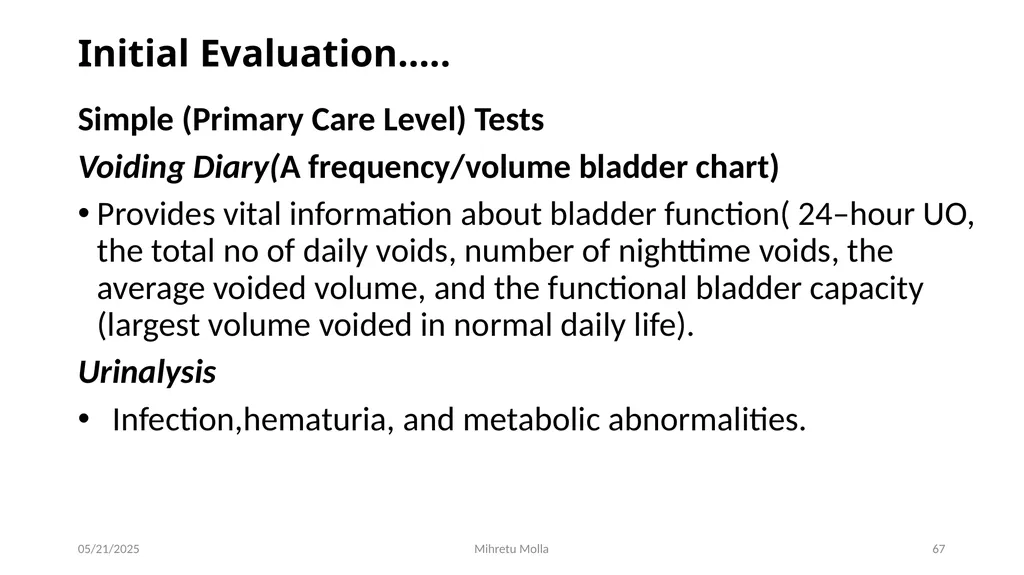
Initial Evaluation….. Simple (Primary Care Level) Tests
Voiding Diary(A frequency/volume bladder chart)
Provides vital information about bladder function( 24–hour UO, the total no of daily voids, number of nighttime voids, the average voided volume, and the functional bladder capacity (largest volume voided in normal daily life).
Urinalysis
Infection,hematuria, and metabolic abnormalities. 67 6/29/2018 Mihretu Molla<br>
Voiding Diary(A frequency/volume bladder chart)
Provides vital information about bladder function( 24–hour UO, the total no of daily voids, number of nighttime voids, the average voided volume, and the functional bladder capacity (largest volume voided in normal daily life).
Urinalysis
Infection,hematuria, and metabolic abnormalities. 67 6/29/2018 Mihretu Molla<br>
68
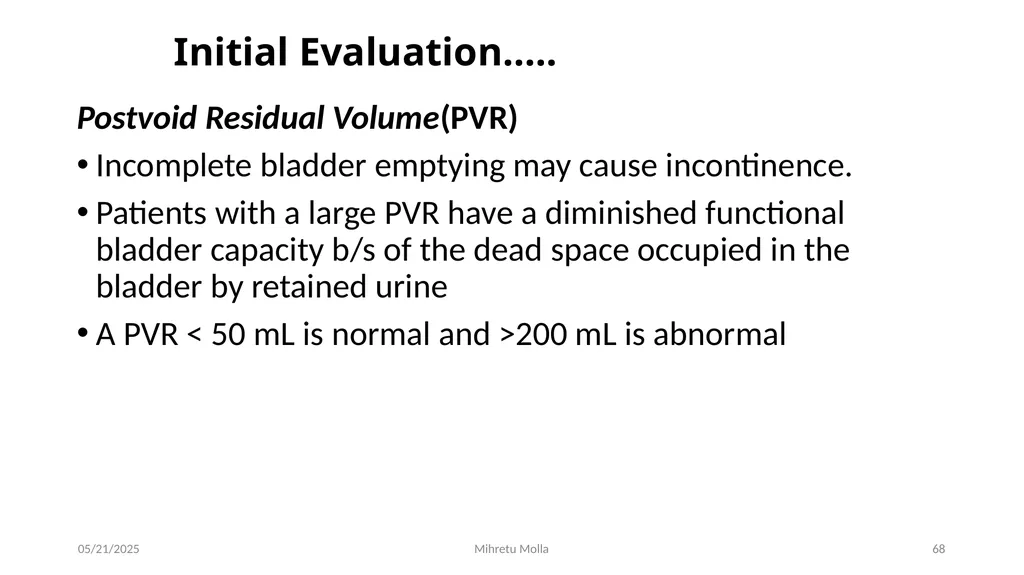
Initial Evaluation….. Postvoid Residual Volume(PVR)
Incomplete bladder emptying may cause incontinence.
Patients with a large PVR have a diminished functional bladder capacity b/s of the dead space occupied in the bladder by retained urine
A PVR < 50 mL is normal and >200 mL is abnormal 68 6/29/2018 Mihretu Molla<br>
Incomplete bladder emptying may cause incontinence.
Patients with a large PVR have a diminished functional bladder capacity b/s of the dead space occupied in the bladder by retained urine
A PVR < 50 mL is normal and >200 mL is abnormal 68 6/29/2018 Mihretu Molla<br>
69
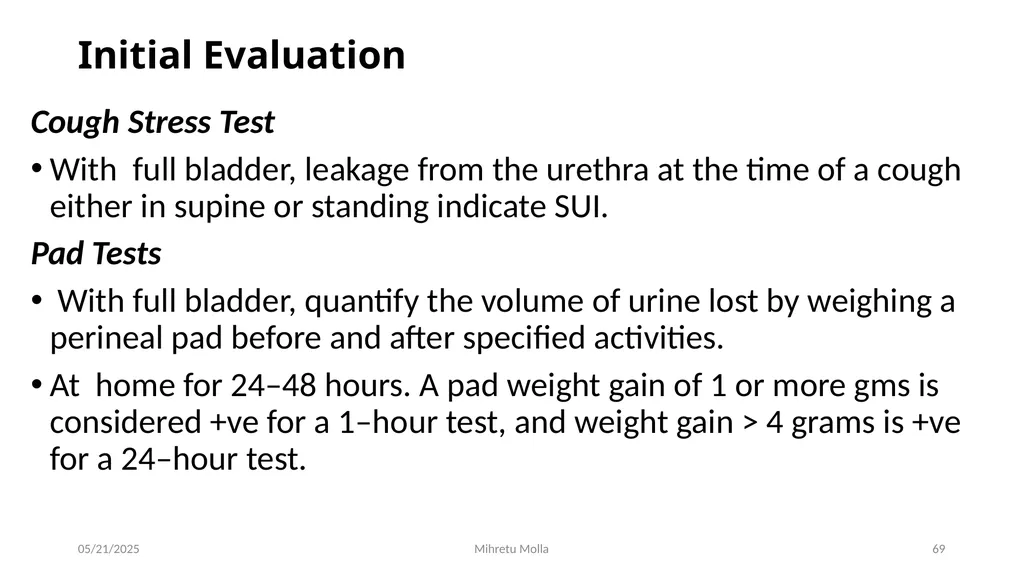
Initial Evaluation Cough Stress Test
With full bladder, leakage from the urethra at the time of a cough either in supine or standing indicate SUI.
Pad Tests
With full bladder, quantify the volume of urine lost by weighing a perineal pad before and after specified activities.
At home for 24–48 hours. A pad weight gain of 1 or more gms is considered +ve for a 1–hour test, and weight gain > 4 grams is +ve for a 24–hour test. 69 6/29/2018 Mihretu Molla<br>
With full bladder, leakage from the urethra at the time of a cough either in supine or standing indicate SUI.
Pad Tests
With full bladder, quantify the volume of urine lost by weighing a perineal pad before and after specified activities.
At home for 24–48 hours. A pad weight gain of 1 or more gms is considered +ve for a 1–hour test, and weight gain > 4 grams is +ve for a 24–hour test. 69 6/29/2018 Mihretu Molla<br>
70
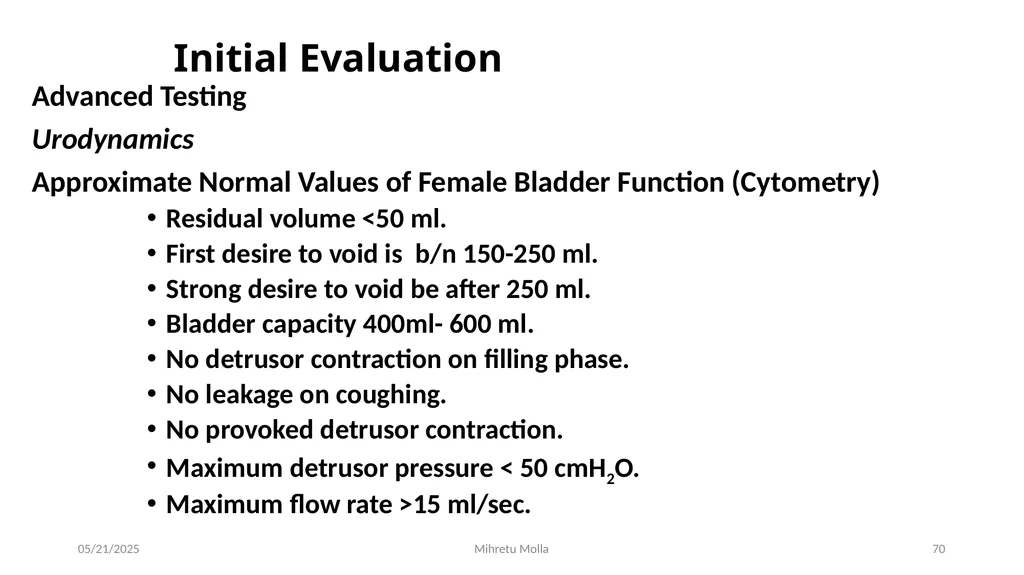
Initial Evaluation Advanced Testing
Urodynamics
Approximate Normal Values of Female Bladder Function (Cytometry)
Residual volume <50 ml.
First desire to void is b/n 150-250 ml.
Strong desire to void be after 250 ml.
Bladder capacity 400ml- 600 ml.
No detrusor contraction on filling phase.
No leakage on coughing.
No provoked detrusor contraction.
Maximum detrusor pressure < 50 cmH2O.
Maximum flow rate >15 ml/sec. 70 6/29/2018 Mihretu Molla<br>
Urodynamics
Approximate Normal Values of Female Bladder Function (Cytometry)
Residual volume <50 ml.
First desire to void is b/n 150-250 ml.
Strong desire to void be after 250 ml.
Bladder capacity 400ml- 600 ml.
No detrusor contraction on filling phase.
No leakage on coughing.
No provoked detrusor contraction.
Maximum detrusor pressure < 50 cmH2O.
Maximum flow rate >15 ml/sec. 70 6/29/2018 Mihretu Molla<br>
71
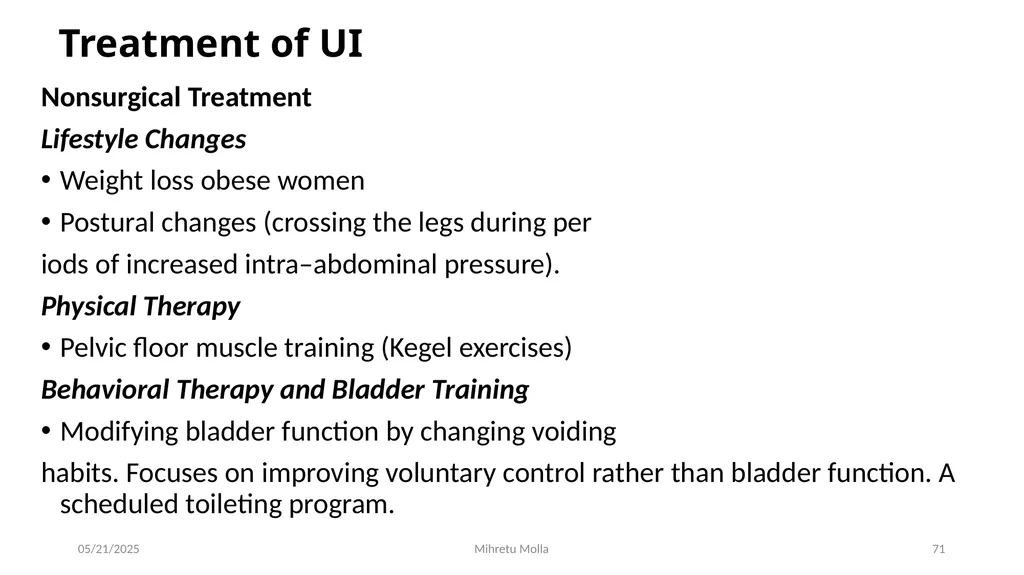
Treatment of UI Nonsurgical Treatment
Lifestyle Changes
Weight loss obese women
Postural changes (crossing the legs during per
iods of increased intra–abdominal pressure).
Physical Therapy
Pelvic floor muscle training (Kegel exercises)
Behavioral Therapy and Bladder Training
Modifying bladder function by changing voiding
habits. Focuses on improving voluntary control rather than bladder function. A scheduled toileting program. 71 6/29/2018 Mihretu Molla<br>
Lifestyle Changes
Weight loss obese women
Postural changes (crossing the legs during per
iods of increased intra–abdominal pressure).
Physical Therapy
Pelvic floor muscle training (Kegel exercises)
Behavioral Therapy and Bladder Training
Modifying bladder function by changing voiding
habits. Focuses on improving voluntary control rather than bladder function. A scheduled toileting program. 71 6/29/2018 Mihretu Molla<br>
72
Treatment of UI…… Medications
Urge I and OABI
Anticholinergic – oxybutynin, Hyoscyamine, Dicyclomine, Probantheline, Tolteridene etc. 72 6/29/2018 Mihretu Molla<br>
Urge I and OABI
Anticholinergic – oxybutynin, Hyoscyamine, Dicyclomine, Probantheline, Tolteridene etc. 72 6/29/2018 Mihretu Molla<br>
73
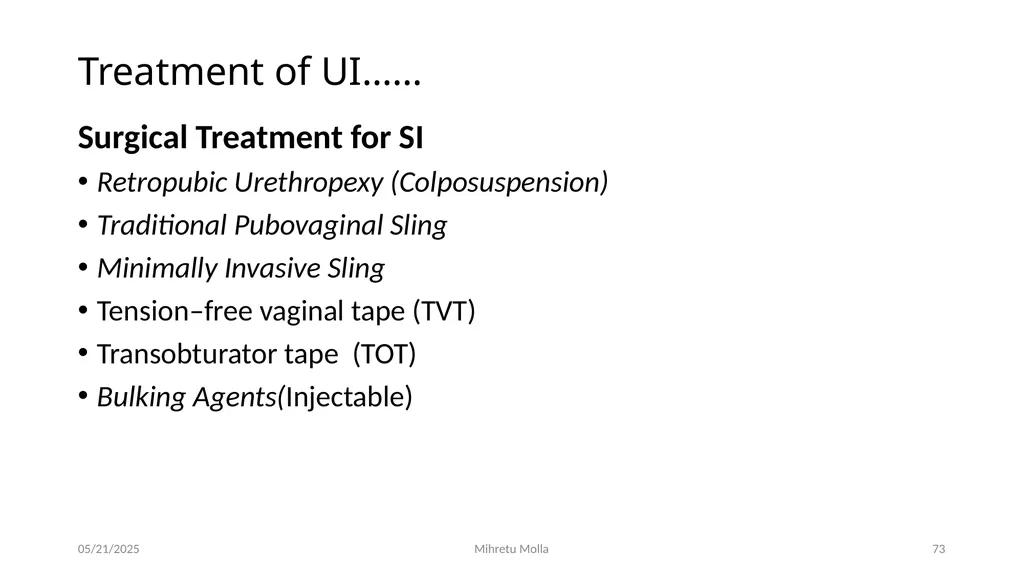
Treatment of UI…… Surgical Treatment for SI
Retropubic Urethropexy (Colposuspension)
Traditional Pubovaginal Sling
Minimally Invasive Sling
Tension–free vaginal tape (TVT)
Transobturator tape (TOT)
Bulking Agents(Injectable) 73 6/29/2018 Mihretu Molla<br>
Retropubic Urethropexy (Colposuspension)
Traditional Pubovaginal Sling
Minimally Invasive Sling
Tension–free vaginal tape (TVT)
Transobturator tape (TOT)
Bulking Agents(Injectable) 73 6/29/2018 Mihretu Molla<br>
74
Genito-Urinary Fistula Mihretu Molla (Bsc, Msc) 6/29/2018 Mihretu Molla 74<br>
75
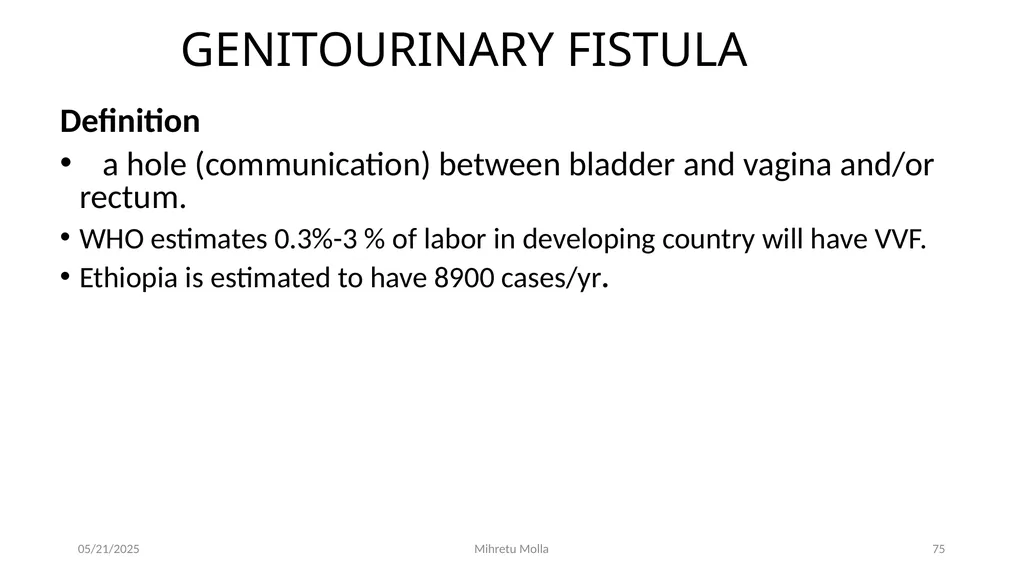
GENITOURINARY FISTULA Definition
a hole (communication) between bladder and vagina and/or rectum.
WHO estimates 0.3%-3 % of labor in developing country will have VVF.
Ethiopia is estimated to have 8900 cases/yr. 6/29/2018 Mihretu Molla 75<br>
a hole (communication) between bladder and vagina and/or rectum.
WHO estimates 0.3%-3 % of labor in developing country will have VVF.
Ethiopia is estimated to have 8900 cases/yr. 6/29/2018 Mihretu Molla 75<br>
76
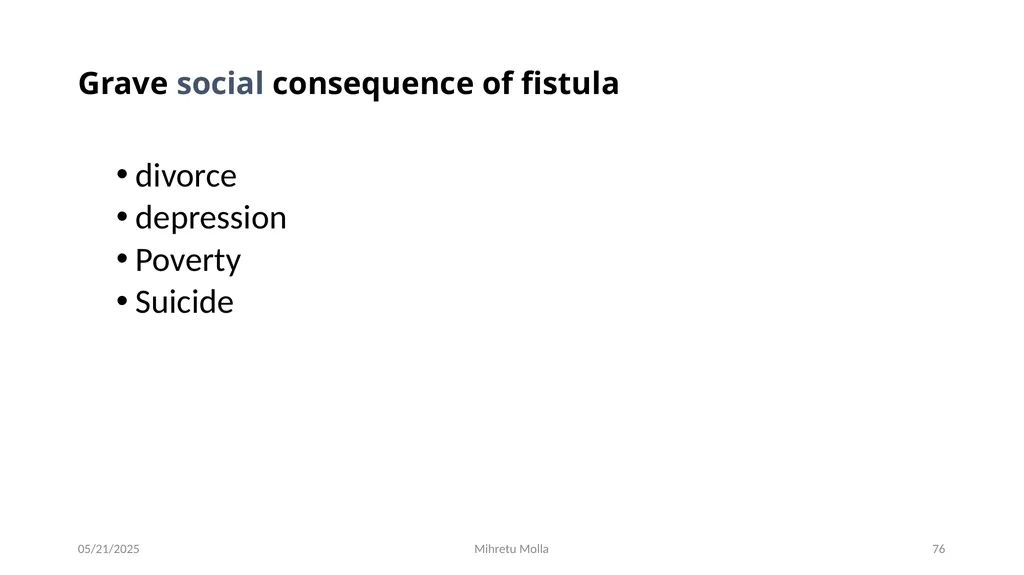
Grave social consequence of fistula divorce
depression
Poverty
Suicide 6/29/2018 Mihretu Molla 76<br>
depression
Poverty
Suicide 6/29/2018 Mihretu Molla 76<br>
77
Etiology Congenital
Acquired
child birth (obstructed labor is the commonest cause)
Radiotherapy.
Surgery
Malignancy.
Childhood
Penetrating trauma.
Foreign body.
Surgery. 6/29/2018 Mihretu Molla 77<br>
Acquired
child birth (obstructed labor is the commonest cause)
Radiotherapy.
Surgery
Malignancy.
Childhood
Penetrating trauma.
Foreign body.
Surgery. 6/29/2018 Mihretu Molla 77<br>
78
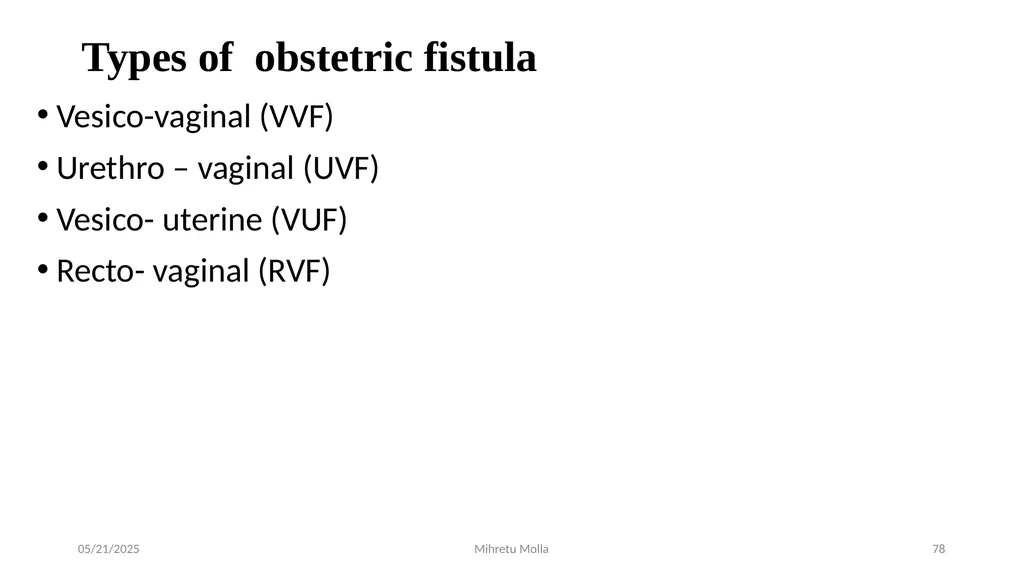
Types of obstetric fistula Vesico-vaginal (VVF)
Urethro – vaginal (UVF)
Vesico- uterine (VUF)
Recto- vaginal (RVF) 78 6/29/2018 Mihretu Molla<br>
Urethro – vaginal (UVF)
Vesico- uterine (VUF)
Recto- vaginal (RVF) 78 6/29/2018 Mihretu Molla<br>
79
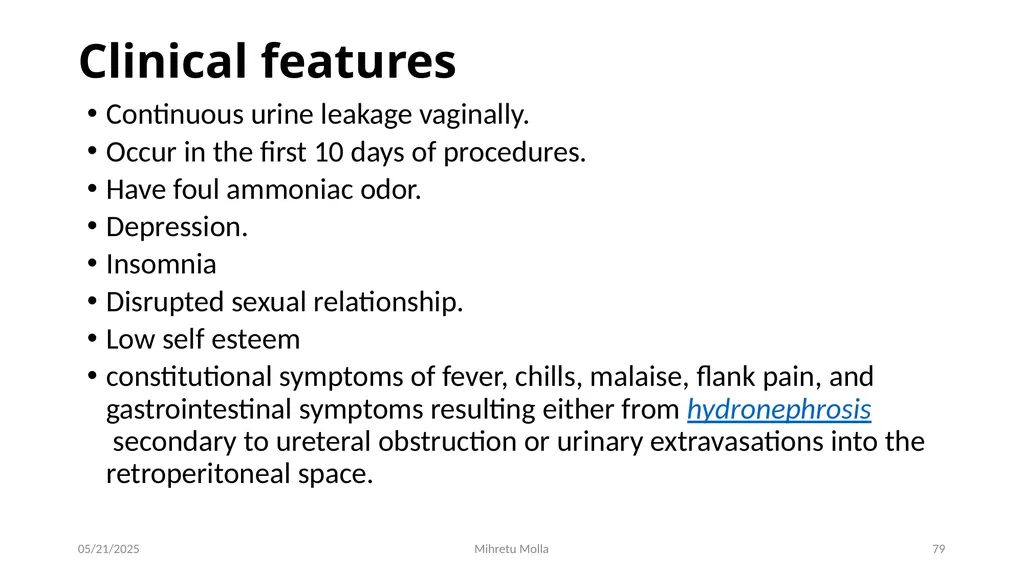
Clinical features Continuous urine leakage vaginally.
Occur in the first 10 days of procedures.
Have foul ammoniac odor.
Depression.
Insomnia
Disrupted sexual relationship.
Low self esteem
constitutional symptoms of fever, chills, malaise, flank pain, and gastrointestinal symptoms resulting either from hydronephrosis secondary to ureteral obstruction or urinary extravasations into the retroperitoneal space. 6/29/2018 Mihretu Molla 79<br>
Occur in the first 10 days of procedures.
Have foul ammoniac odor.
Depression.
Insomnia
Disrupted sexual relationship.
Low self esteem
constitutional symptoms of fever, chills, malaise, flank pain, and gastrointestinal symptoms resulting either from hydronephrosis secondary to ureteral obstruction or urinary extravasations into the retroperitoneal space. 6/29/2018 Mihretu Molla 79<br>
80
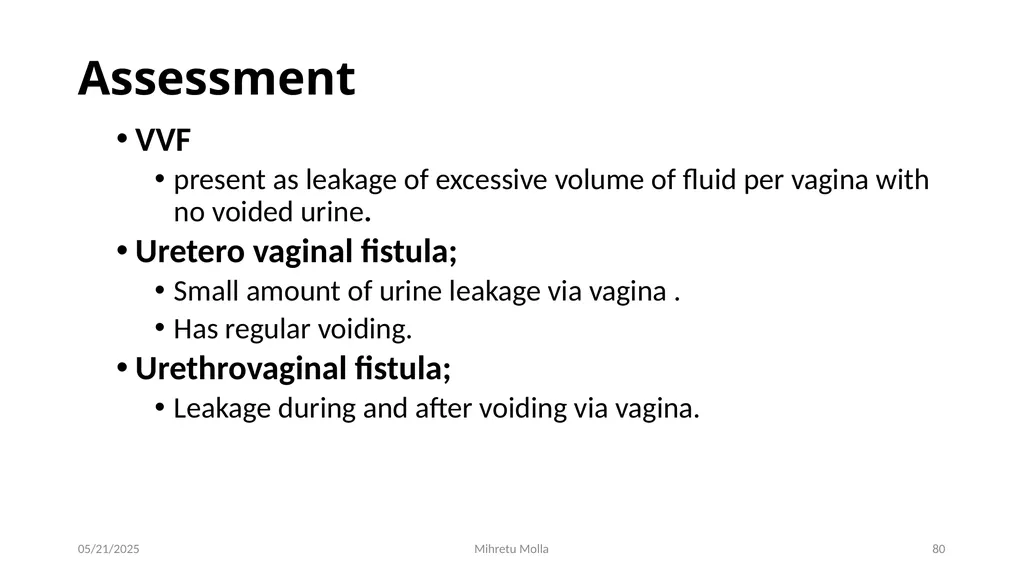
Assessment VVF
present as leakage of excessive volume of fluid per vagina with no voided urine.
Uretero vaginal fistula;
Small amount of urine leakage via vagina .
Has regular voiding.
Urethrovaginal fistula;
Leakage during and after voiding via vagina. 6/29/2018 Mihretu Molla 80<br>
present as leakage of excessive volume of fluid per vagina with no voided urine.
Uretero vaginal fistula;
Small amount of urine leakage via vagina .
Has regular voiding.
Urethrovaginal fistula;
Leakage during and after voiding via vagina. 6/29/2018 Mihretu Molla 80<br>
81
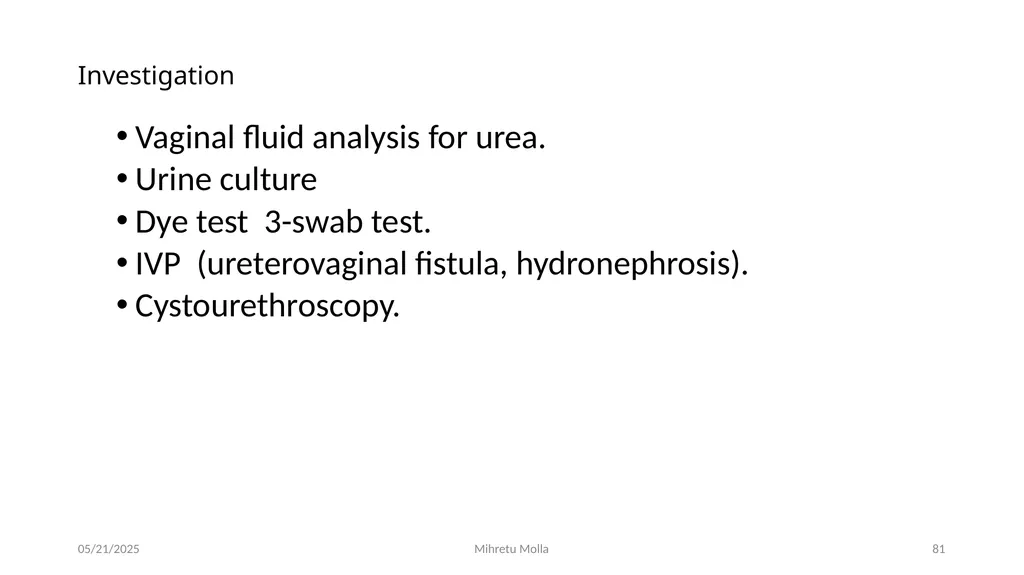
Investigation Vaginal fluid analysis for urea.
Urine culture
Dye test 3-swab test.
IVP (ureterovaginal fistula, hydronephrosis).
Cystourethroscopy. 6/29/2018 Mihretu Molla 81<br>
Urine culture
Dye test 3-swab test.
IVP (ureterovaginal fistula, hydronephrosis).
Cystourethroscopy. 6/29/2018 Mihretu Molla 81<br>
82
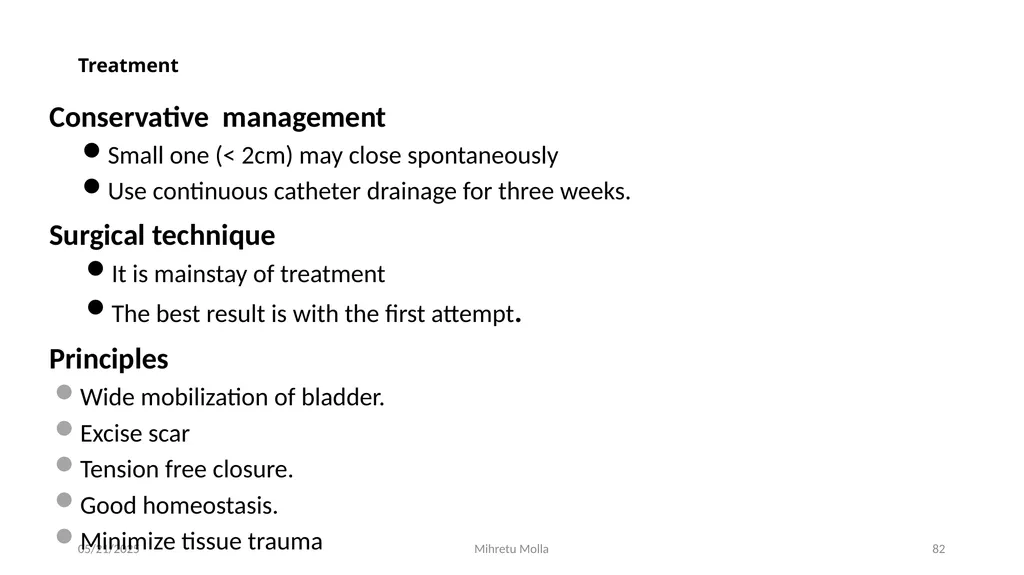
Treatment Conservative management
Small one (< 2cm) may close spontaneously
Use continuous catheter drainage for three weeks.
Surgical technique
It is mainstay of treatment
The best result is with the first attempt.
Principles
Wide mobilization of bladder.
Excise scar
Tension free closure.
Good homeostasis.
Minimize tissue trauma 6/29/2018 Mihretu Molla 82<br>
Small one (< 2cm) may close spontaneously
Use continuous catheter drainage for three weeks.
Surgical technique
It is mainstay of treatment
The best result is with the first attempt.
Principles
Wide mobilization of bladder.
Excise scar
Tension free closure.
Good homeostasis.
Minimize tissue trauma 6/29/2018 Mihretu Molla 82<br>
83
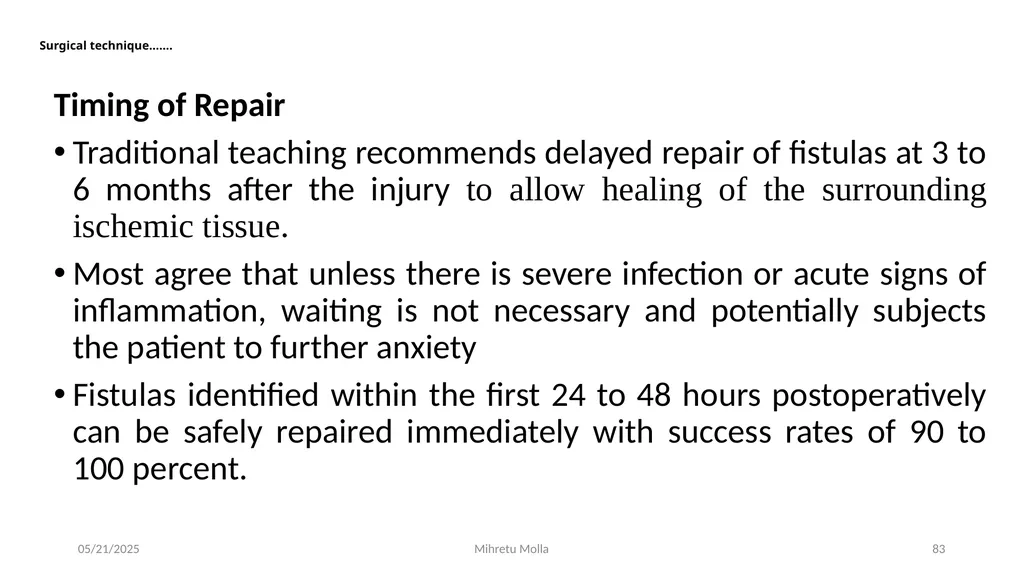
Surgical technique……. Timing of Repair
Traditional teaching recommends delayed repair of fistulas at 3 to 6 months after the injury to allow healing of the surrounding ischemic tissue.
Most agree that unless there is severe infection or acute signs of inflammation, waiting is not necessary and potentially subjects the patient to further anxiety
Fistulas identified within the first 24 to 48 hours postoperatively can be safely repaired immediately with success rates of 90 to 100 percent. 6/29/2018 Mihretu Molla 83<br>
Traditional teaching recommends delayed repair of fistulas at 3 to 6 months after the injury to allow healing of the surrounding ischemic tissue.
Most agree that unless there is severe infection or acute signs of inflammation, waiting is not necessary and potentially subjects the patient to further anxiety
Fistulas identified within the first 24 to 48 hours postoperatively can be safely repaired immediately with success rates of 90 to 100 percent. 6/29/2018 Mihretu Molla 83<br>
84
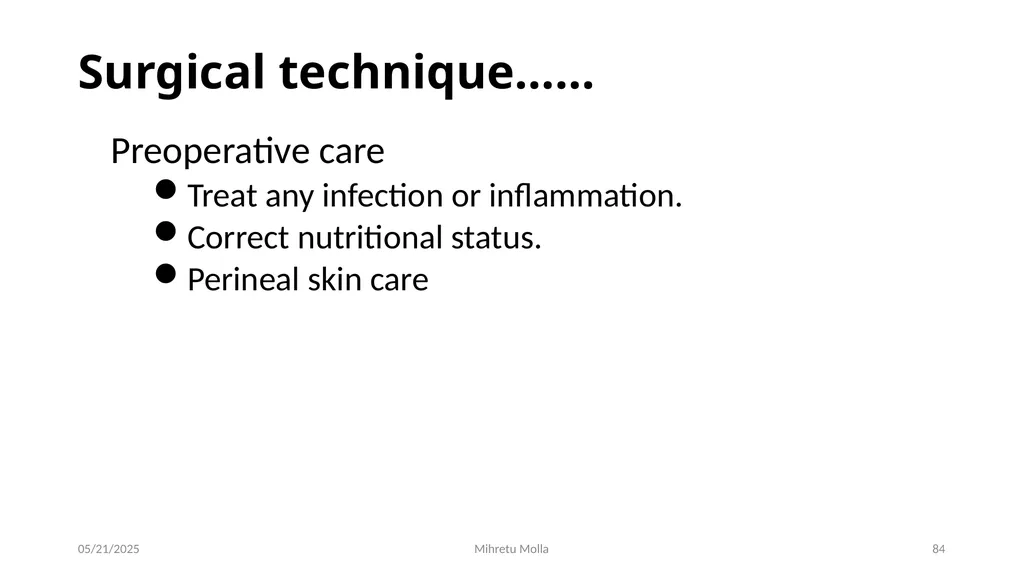
Surgical technique…… Preoperative care
Treat any infection or inflammation.
Correct nutritional status.
Perineal skin care 6/29/2018 Mihretu Molla 84<br>
Treat any infection or inflammation.
Correct nutritional status.
Perineal skin care 6/29/2018 Mihretu Molla 84<br>
85
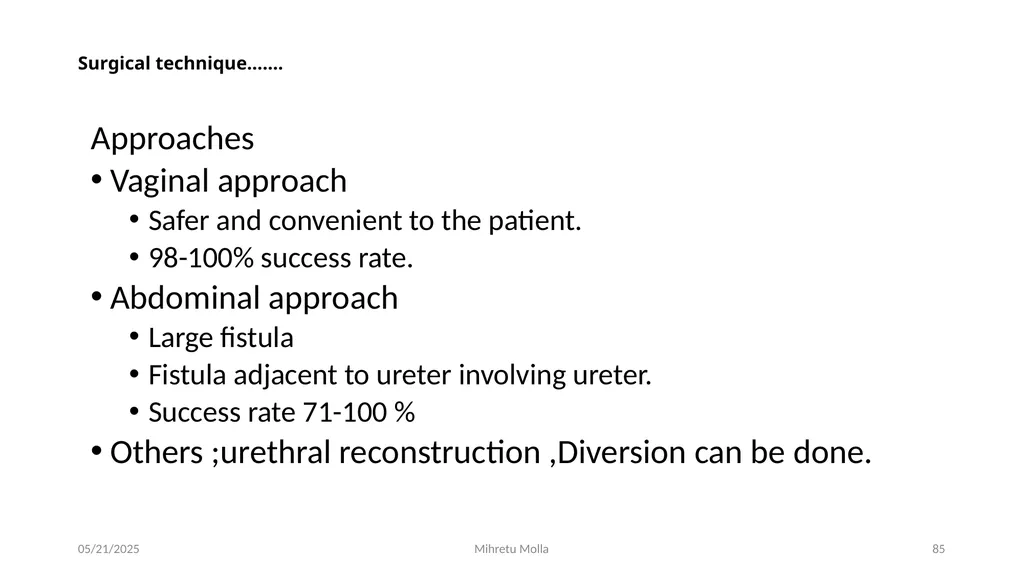
Surgical technique……. Approaches
Vaginal approach
Safer and convenient to the patient.
98-100% success rate.
Abdominal approach
Large fistula
Fistula adjacent to ureter involving ureter.
Success rate 71-100 %
Others ;urethral reconstruction ,Diversion can be done. 6/29/2018 Mihretu Molla 85<br>
Vaginal approach
Safer and convenient to the patient.
98-100% success rate.
Abdominal approach
Large fistula
Fistula adjacent to ureter involving ureter.
Success rate 71-100 %
Others ;urethral reconstruction ,Diversion can be done. 6/29/2018 Mihretu Molla 85<br>
86
Post operative care Stool should be soften for 21 days
Keep the catheter for 14 days
On discharge
Advise to pass urine adequately
Avoid coitus for 2-3 days
Avoid pregnancy for 3 years
Subsequent delivery with elective C/S 86 6/29/2018 Mihretu Molla<br>
Keep the catheter for 14 days
On discharge
Advise to pass urine adequately
Avoid coitus for 2-3 days
Avoid pregnancy for 3 years
Subsequent delivery with elective C/S 86 6/29/2018 Mihretu Molla<br>