
E-Marketing Communication: Owned Media
YM
Published · 29 slides · 0 views

1 / 1


Description
E-Marketing Communication: Owned Media E-Marketing7E Chapter 12 Chapter 12 Objectives After reading Chapter 12, you will be able to: Define integrated marketing communication. Explain how marketers use the AIDA model and the hierarchy of
Related Topics
Share
Embed code
Download this presentation From Below
"E-Marketing Communication: Owned Media" is the property of its rightful owner. Permission is granted to download and print the materials on this website for personal, non-commercial use only, and to display it on your personal computer provided you do not modify the materials and that you retain all copyright notices contained in the materials. By downloading content from our website, you accept the terms of this agreement.
Presentation Transcript
01
E-Marketing Communication:
Owned Media E-Marketing/7E Chapter 12<br>
Owned Media E-Marketing/7E Chapter 12<br>
02
Chapter 12 Objectives After reading Chapter 12, you will be able to:
Define integrated marketing communication.
Explain how marketers use the AIDA model and the hierarchy of effects model.
List the five traditional marketing communication tools and distinguish between traditional media and social media.
Identify the differences in control and reach among owned, paid, and earned media. 12-2 ©2014 Pearson Education, Inc. publishing as Prentice Hall<br>
Define integrated marketing communication.
Explain how marketers use the AIDA model and the hierarchy of effects model.
List the five traditional marketing communication tools and distinguish between traditional media and social media.
Identify the differences in control and reach among owned, paid, and earned media. 12-2 ©2014 Pearson Education, Inc. publishing as Prentice Hall<br>
03
Chapter 12 Objectives, cont. Discuss why companies use content marketing.
Describe the most commonly used owned media and their benefits for marketing.
Explain how and why marketers use search engine optimization.
Highlight some of the metrics marketers can use to evaluate owned media performance. 12-3 ©2014 Pearson Education, Inc. publishing as Prentice Hall<br>
Describe the most commonly used owned media and their benefits for marketing.
Explain how and why marketers use search engine optimization.
Highlight some of the metrics marketers can use to evaluate owned media performance. 12-3 ©2014 Pearson Education, Inc. publishing as Prentice Hall<br>
04
Integrated Marketing Communication (IMC) IMC is a cross-functional process for planning, executing, and monitoring brand communications.
The goal is to profitably acquire, retain, and grow customers.
IMC strategy requires a thorough understanding of target markets, the brand, its competition, and other internal and external factors. 12-4 ©2014 Pearson Education, Inc. publishing as Prentice Hall<br>
The goal is to profitably acquire, retain, and grow customers.
IMC strategy requires a thorough understanding of target markets, the brand, its competition, and other internal and external factors. 12-4 ©2014 Pearson Education, Inc. publishing as Prentice Hall<br>
05
The AIDA and “think, feel, do” (hierarchy of effects) models help guide selection of online and offline MarCom tools to meet their goals.
The models suggest that consumers first become aware of a product before they develop feelings and purchase it.
The models can help marketers select appropriate communication objectives and strategies, such as:
Build brand equity.
Elicitيستنبط a sales response. IMC Goals And Strategies 12-5 ©2014 Pearson Education, Inc. publishing as Prentice Hall<br>
The models suggest that consumers first become aware of a product before they develop feelings and purchase it.
The models can help marketers select appropriate communication objectives and strategies, such as:
Build brand equity.
Elicitيستنبط a sales response. IMC Goals And Strategies 12-5 ©2014 Pearson Education, Inc. publishing as Prentice Hall<br>
06
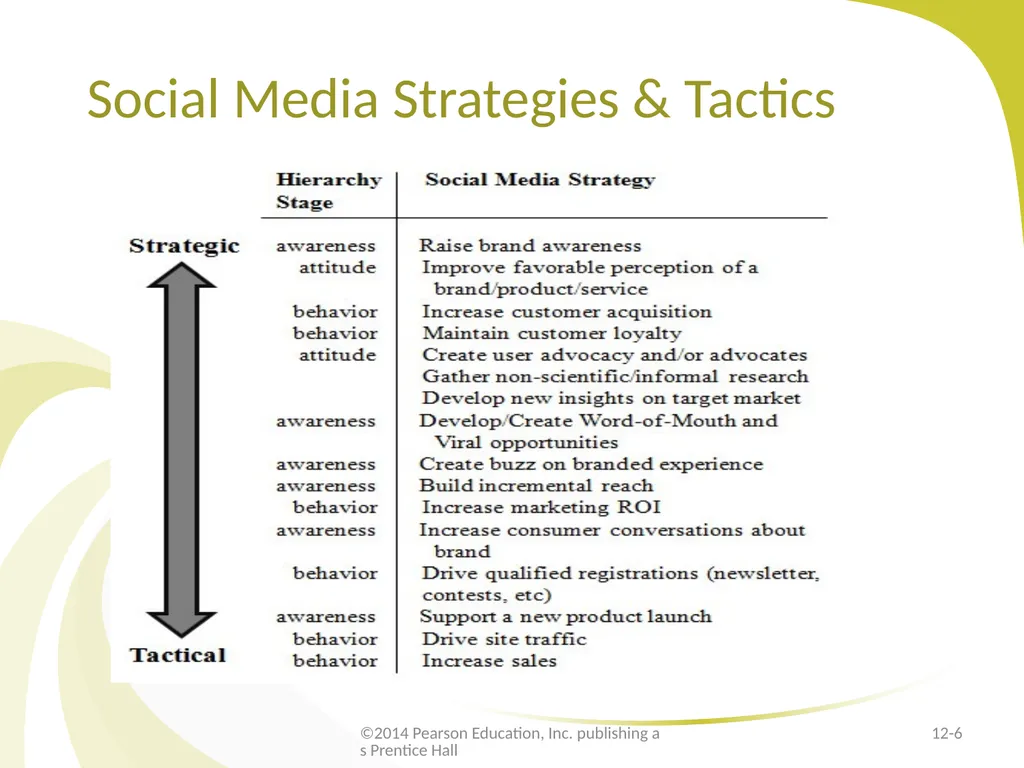
Social Media Strategies & Tactics 12-6 ©2014 Pearson Education, Inc. publishing as Prentice Hall<br>
07
Traditional Marketing Communication Tools The five key marketing communication tools are also called the promotion mix:
Advertising
Public relations
Sales promotion
Direct marketing
Personal selling
Marketers often discuss IMC in terms of senders and recipients, media type, and owned, paid and earned media. 12-7 ©2014 Pearson Education, Inc. publishing as Prentice Hall<br>
Advertising
Public relations
Sales promotion
Direct marketing
Personal selling
Marketers often discuss IMC in terms of senders and recipients, media type, and owned, paid and earned media. 12-7 ©2014 Pearson Education, Inc. publishing as Prentice Hall<br>
08
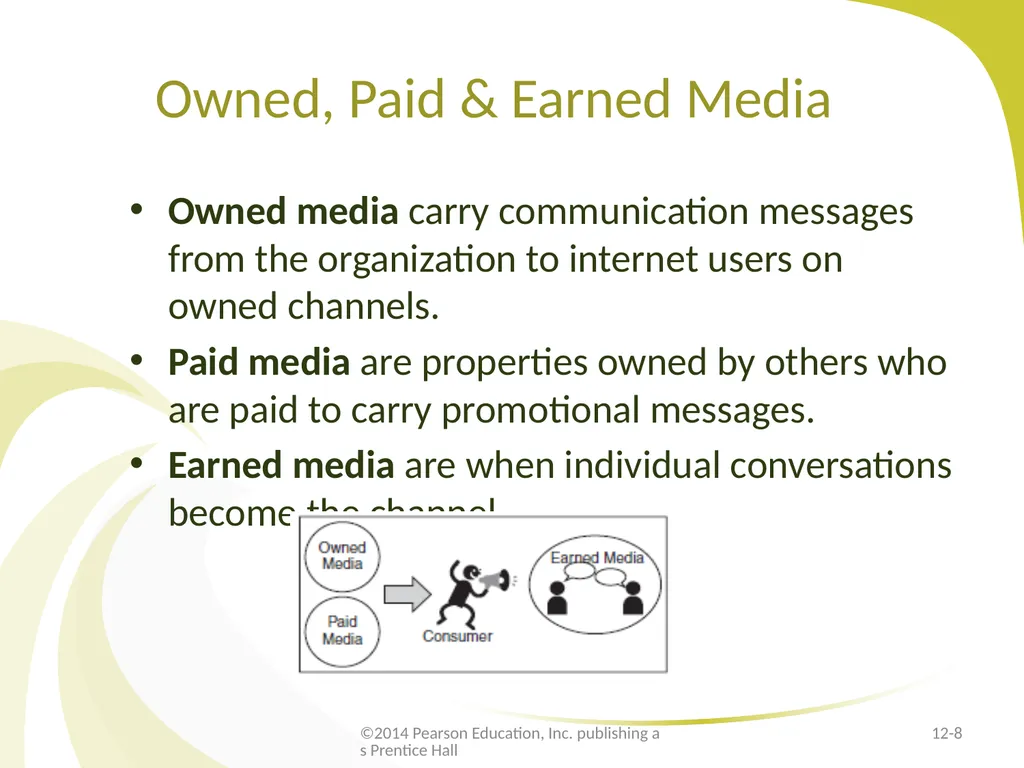
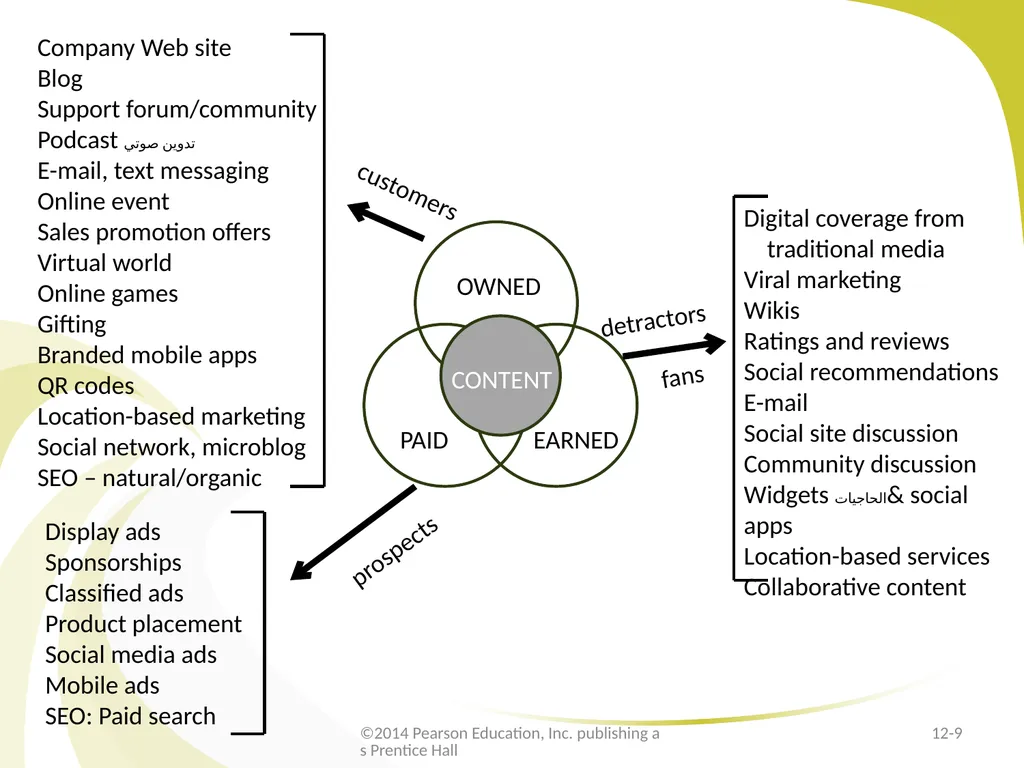
Owned, Paid & Earned Media Owned media carry communication messages from the organization to internet users on owned channels.
Paid media are properties owned by others who are paid to carry promotional messages.
Earned media are when individual conversations become the channel. 12-8 ©2014 Pearson Education, Inc. publishing as Prentice Hall<br>
Paid media are properties owned by others who are paid to carry promotional messages.
Earned media are when individual conversations become the channel. 12-8 ©2014 Pearson Education, Inc. publishing as Prentice Hall<br>
09
©2014 Pearson Education, Inc. publishing as Prentice Hall 12-9<br>
10
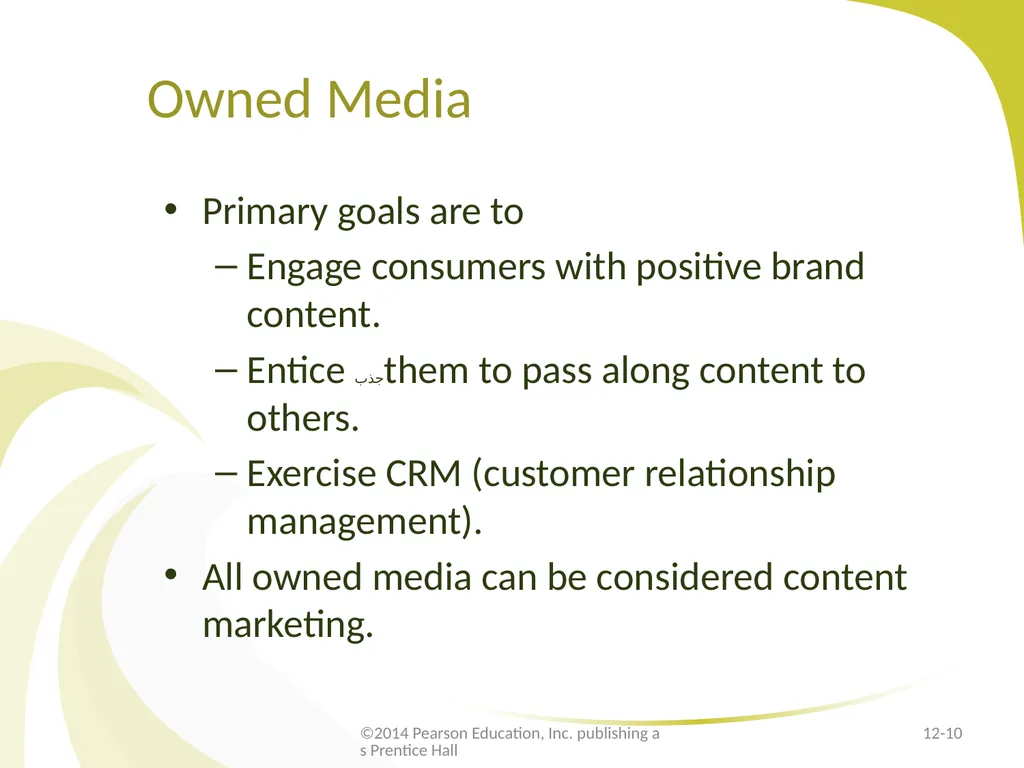
Owned Media Primary goals are to
Engage consumers with positive brand content.
Entice جذبthem to pass along content to others.
Exercise CRM (customer relationship management).
All owned media can be considered content marketing. 12-10 ©2014 Pearson Education, Inc. publishing as Prentice Hall<br>
Engage consumers with positive brand content.
Entice جذبthem to pass along content to others.
Exercise CRM (customer relationship management).
All owned media can be considered content marketing. 12-10 ©2014 Pearson Education, Inc. publishing as Prentice Hall<br>
11
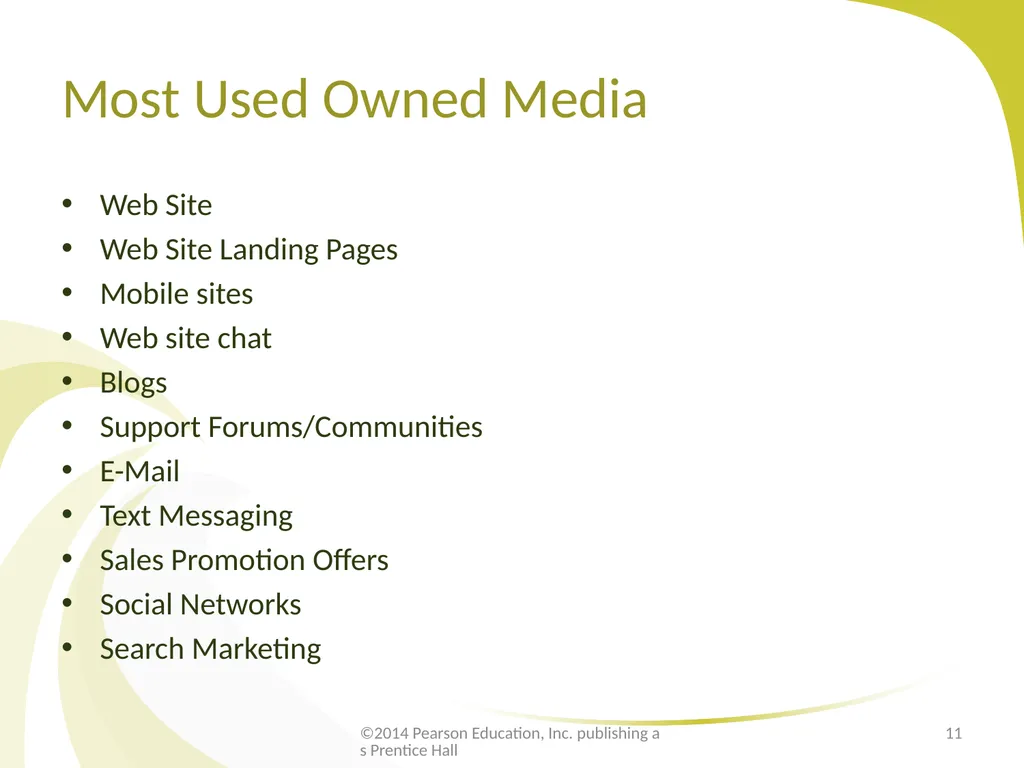
Most Used Owned Media Web Site
Web Site Landing Pages
Mobile sites
Web site chat
Blogs
Support Forums/Communities
E-Mail
Text Messaging
Sales Promotion Offers
Social Networks
Search Marketing ©2014 Pearson Education, Inc. publishing as Prentice Hall 11<br>
Web Site Landing Pages
Mobile sites
Web site chat
Blogs
Support Forums/Communities
Text Messaging
Sales Promotion Offers
Social Networks
Search Marketing ©2014 Pearson Education, Inc. publishing as Prentice Hall 11<br>
12
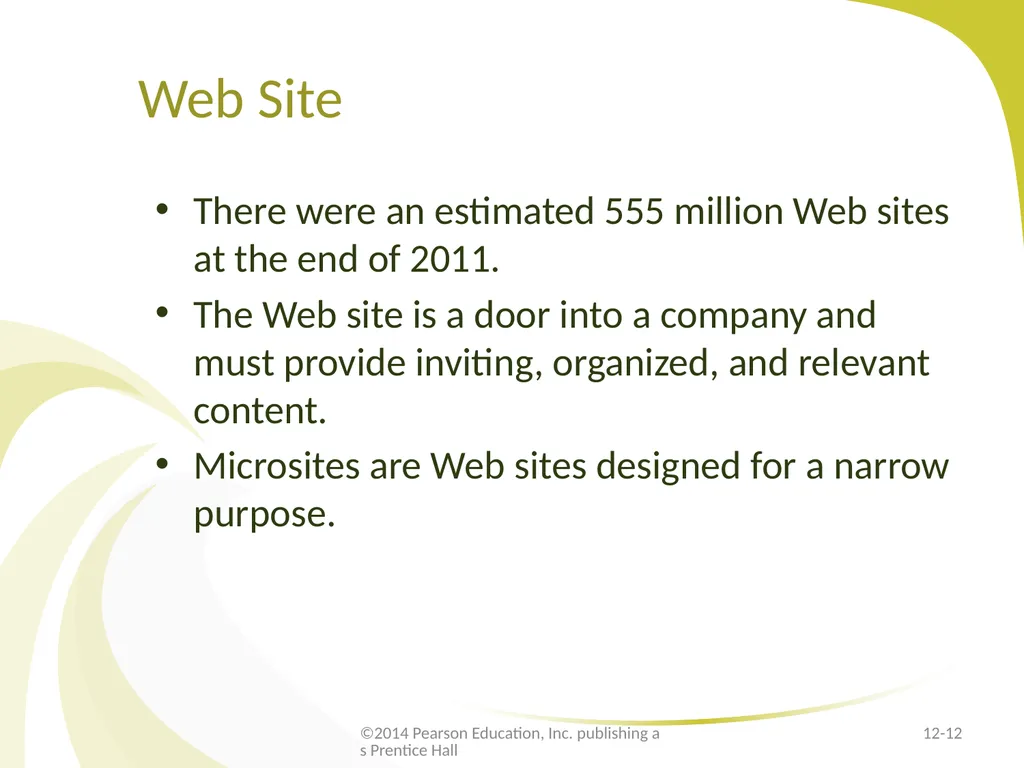
Web Site There were an estimated 555 million Web sites at the end of 2011.
The Web site is a door into a company and must provide inviting, organized, and relevant content.
Microsites are Web sites designed for a narrow purpose. 12-12 ©2014 Pearson Education, Inc. publishing as Prentice Hall<br>
The Web site is a door into a company and must provide inviting, organized, and relevant content.
Microsites are Web sites designed for a narrow purpose. 12-12 ©2014 Pearson Education, Inc. publishing as Prentice Hall<br>
13
Web Site Landing Pages A landing page is a unique page that appears after a user clicks on a link associated with a Web site.
Companies create many different landing pages that match key words, current offers, ads, and more.
A/B testing is when there are two versions of a Web page and the company conducts A/B tests to optimize clickthrough rates and conversion to purchase. 12-13 ©2014 Pearson Education, Inc. publishing as Prentice Hall<br>
Companies create many different landing pages that match key words, current offers, ads, and more.
A/B testing is when there are two versions of a Web page and the company conducts A/B tests to optimize clickthrough rates and conversion to purchase. 12-13 ©2014 Pearson Education, Inc. publishing as Prentice Hall<br>
14
Mobile sites mobile version of their websites
In 2012, 46% will create mobile version of websites,
45% are creating mobile apps
Mobile sites are quicker to download, simpler and focussed on the key content ©2014 Pearson Education, Inc. publishing as Prentice Hall 14<br>
In 2012, 46% will create mobile version of websites,
45% are creating mobile apps
Mobile sites are quicker to download, simpler and focussed on the key content ©2014 Pearson Education, Inc. publishing as Prentice Hall 14<br>
15
Web site Chat provide real time sales assistance online
live chat where users can open it and questions about product
automated chat bots or virtual agents, which are automated figures that will answer many customer questions using a database ©2014 Pearson Education, Inc. publishing as Prentice Hall 15<br>
live chat where users can open it and questions about product
automated chat bots or virtual agents, which are automated figures that will answer many customer questions using a database ©2014 Pearson Education, Inc. publishing as Prentice Hall 15<br>
16
Blogs There were more than 181M blogs at the end of 2011.
CEOs, consultants and thought leaders create blogs to disseminate views, promote books, etc.
Marketers use blogs to draw users to their Web sites and need to decide:
Which platform to use?
Who will do the writing?
How often will they post?
What is the purpose of the blog? 12-16 ©2014 Pearson Education, Inc. publishing as Prentice Hall<br>
CEOs, consultants and thought leaders create blogs to disseminate views, promote books, etc.
Marketers use blogs to draw users to their Web sites and need to decide:
Which platform to use?
Who will do the writing?
How often will they post?
What is the purpose of the blog? 12-16 ©2014 Pearson Education, Inc. publishing as Prentice Hall<br>
17
Support Forums/Commitees Companies create spaces for consumers, prospects العملاء المحتملين and business customers
-to discuss topics of interest
-provide new product ideas or
-seek company support with technical or product
issues ©2014 Pearson Education, Inc. publishing as Prentice Hall 17<br>
-to discuss topics of interest
-provide new product ideas or
-seek company support with technical or product
issues ©2014 Pearson Education, Inc. publishing as Prentice Hall 17<br>
18
E-Mail E-mail remains the most important communication technique for building customer relationships.
75.4% of marketers invest in e-mail campaigns.
E-mail has advantages over postal direct mail.
No postage or printing charges.
Immediate and convenient avenue for direct response using hyperlinks.
Can be automatically individualized.
E-mail difficulties include spam filters and finding and maintaining appropriate e-mail lists. 12-18 ©2014 Pearson Education, Inc. publishing as Prentice Hall<br>
75.4% of marketers invest in e-mail campaigns.
E-mail has advantages over postal direct mail.
No postage or printing charges.
Immediate and convenient avenue for direct response using hyperlinks.
Can be automatically individualized.
E-mail difficulties include spam filters and finding and maintaining appropriate e-mail lists. 12-18 ©2014 Pearson Education, Inc. publishing as Prentice Hall<br>
19
Short Message Services (SMS), commonly known as text messaging, are up to 160 characters of text sent over the internet with a cell phone or smartphone.
Marketers can build relationships by sending permission-based information when and where consumers want to receive it.
Should be short, personalized, interactive, and relevant. Text Messaging 12-19 ©2014 Pearson Education, Inc. publishing as Prentice Hall<br>
Marketers can build relationships by sending permission-based information when and where consumers want to receive it.
Should be short, personalized, interactive, and relevant. Text Messaging 12-19 ©2014 Pearson Education, Inc. publishing as Prentice Hall<br>
20
Online Events Online events are designed to generate user brand interest, draw traffic to a site, or generate revenue with paid admission
Companies can hold seminar (Webinars), workshops and discussions online
In online events clients get to talk to senior or prestigious people ©2014 Pearson Education, Inc. publishing as Prentice Hall 20<br>
Companies can hold seminar (Webinars), workshops and discussions online
In online events clients get to talk to senior or prestigious people ©2014 Pearson Education, Inc. publishing as Prentice Hall 20<br>
21
Online sales promotions can build brands, databases, and support sales.
Most do not build long term customer relationships.
Offers are short-term incentives حوافزthat facilitate the movement of products to the end user. They include:
Coupons
Sampling
Contestsمسابقات, sweepstakesيانصيب
Virtual worlds
Online games & gifting Sales Promotion Offers 12-21 ©2014 Pearson Education, Inc. publishing as Prentice Hall<br>
Most do not build long term customer relationships.
Offers are short-term incentives حوافزthat facilitate the movement of products to the end user. They include:
Coupons
Sampling
Contestsمسابقات, sweepstakesيانصيب
Virtual worlds
Online games & gifting Sales Promotion Offers 12-21 ©2014 Pearson Education, Inc. publishing as Prentice Hall<br>
22
Sales Promotion Offers, cont. Many companies create branded mobile applications and widgetsالحاجيات that support social interactions.
45% of companies had branded apps and another 31% planned them in 2012.
Marketers are placing QR codes on physical objects, such as ads, but the outlook is not positive.
Use of two-dimensional mobile tags in retail stores is growing. 12-22 ©2014 Pearson Education, Inc. publishing as Prentice Hall<br>
45% of companies had branded apps and another 31% planned them in 2012.
Marketers are placing QR codes on physical objects, such as ads, but the outlook is not positive.
Use of two-dimensional mobile tags in retail stores is growing. 12-22 ©2014 Pearson Education, Inc. publishing as Prentice Hall<br>
23
Social Networks 90% of companies with over 100 employees participate in social media.
Marketers must realize that social networks are not purely for selling.
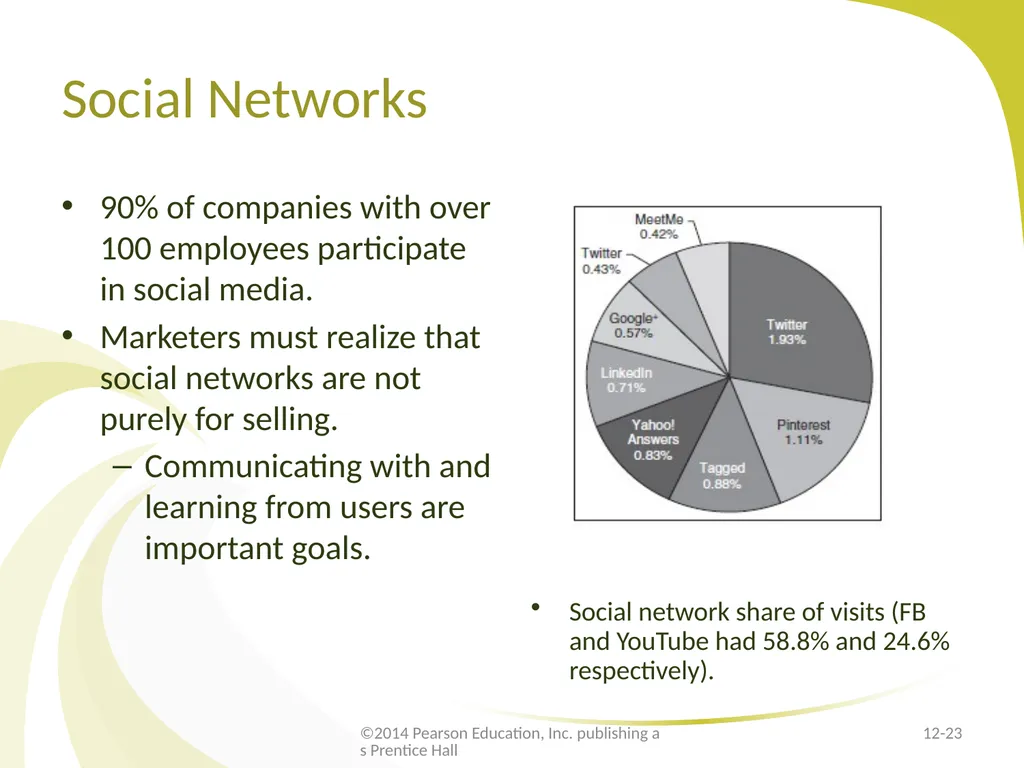
Communicating with and learning from users are important goals. Social network share of visits (FB and YouTube had 58.8% and 24.6% respectively). 12-23 ©2014 Pearson Education, Inc. publishing as Prentice Hall<br>
Marketers must realize that social networks are not purely for selling.
Communicating with and learning from users are important goals. Social network share of visits (FB and YouTube had 58.8% and 24.6% respectively). 12-23 ©2014 Pearson Education, Inc. publishing as Prentice Hall<br>
24
Search Marketing Search marketing is marketing via search engines.
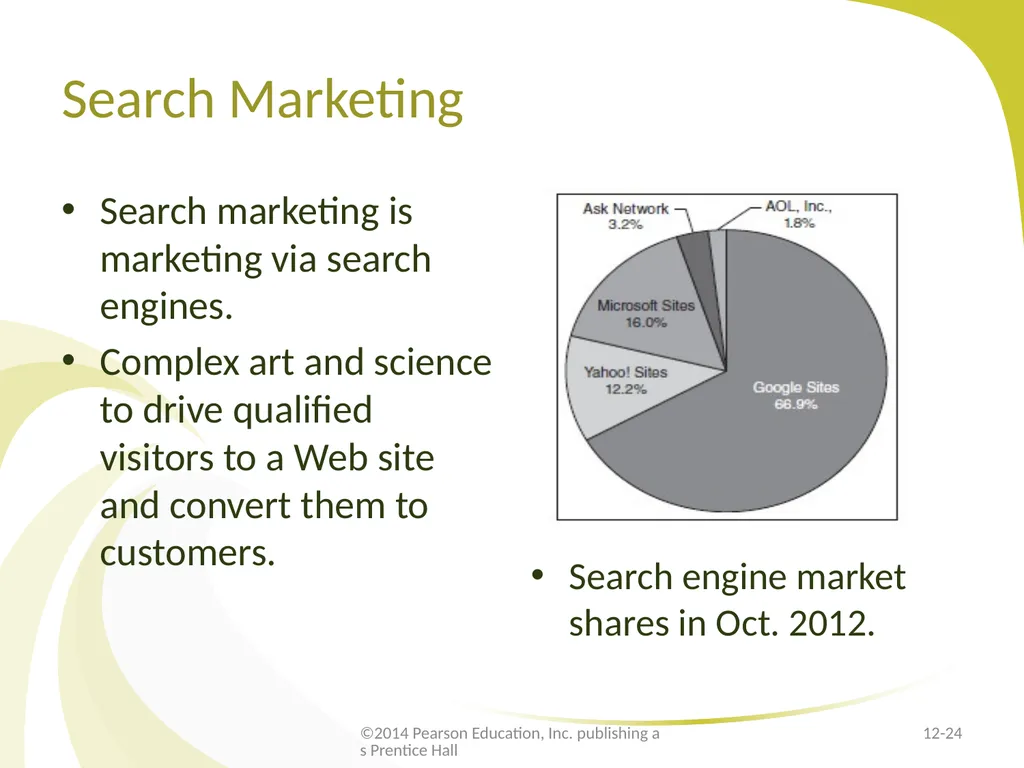
Complex art and science to drive qualified visitors to a Web site and convert them to customers. Search engine market shares in Oct. 2012. 12-24 ©2014 Pearson Education, Inc. publishing as Prentice Hall<br>
Complex art and science to drive qualified visitors to a Web site and convert them to customers. Search engine market shares in Oct. 2012. 12-24 ©2014 Pearson Education, Inc. publishing as Prentice Hall<br>
25
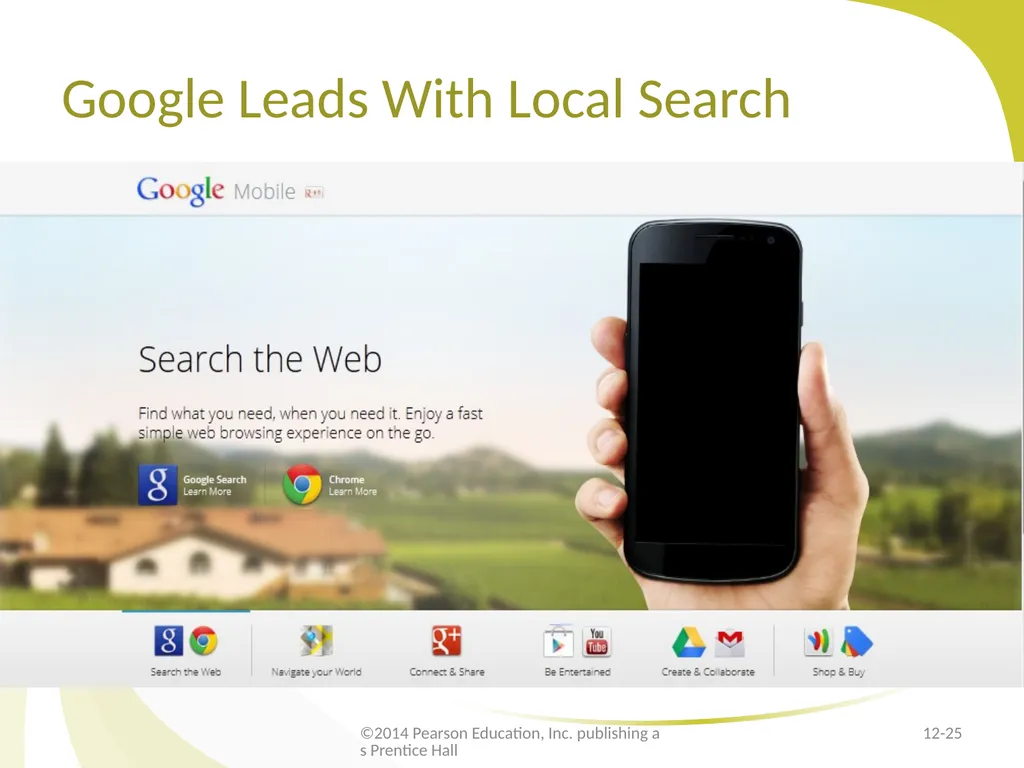
Google Leads With Local Search 12-25 ©2014 Pearson Education, Inc. publishing as Prentice Hall<br>
26
Natural Search Natural search (organic search) involves optimizing a Web site so it will appear near the top of search engine results.
When Web sites are optimized for content and meta tags that hold keywords, search engines know how to categorize the site.
Principles of SEO (search engine optimization) include:
Spread fresh content all over the Web.
Design for relevance and popularity.
Optimize content.
Adjust site to changing search algorithms. 12-26 ©2014 Pearson Education, Inc. publishing as Prentice Hall<br>
When Web sites are optimized for content and meta tags that hold keywords, search engines know how to categorize the site.
Principles of SEO (search engine optimization) include:
Spread fresh content all over the Web.
Design for relevance and popularity.
Optimize content.
Adjust site to changing search algorithms. 12-26 ©2014 Pearson Education, Inc. publishing as Prentice Hall<br>
27
Vertical Search Vertical search is site-specific search on specialized topics, such as travel or books that helps users find what they are looking for quickly.
Hotels, for example, would want to be listed on a vertical search site such as TripAdvisor.
Vertical search site examples include:
ZoomInfo
LinkedIn
CareerBuilder 12-27 ©2014 Pearson Education, Inc. publishing as Prentice Hall<br>
Hotels, for example, would want to be listed on a vertical search site such as TripAdvisor.
Vertical search site examples include:
ZoomInfo
CareerBuilder 12-27 ©2014 Pearson Education, Inc. publishing as Prentice Hall<br>
28
Owned Media Performance Metrics Marketers use Web analytics for company-owned Web sites and blogs.
For owned media, sales promotions, and direct marketing, there are also appropriate metrics.
Podcasts: number of downloads and length of time listening.
Branded mobile apps: number of downloads, updates and actions.
Visits to sales promotion game sites.
Communication opt-in from content participants
Number of email messages read or forwarded to a friend. 12-28 ©2014 Pearson Education, Inc. publishing as Prentice Hall<br>
For owned media, sales promotions, and direct marketing, there are also appropriate metrics.
Podcasts: number of downloads and length of time listening.
Branded mobile apps: number of downloads, updates and actions.
Visits to sales promotion game sites.
Communication opt-in from content participants
Number of email messages read or forwarded to a friend. 12-28 ©2014 Pearson Education, Inc. publishing as Prentice Hall<br>
29
All rights reserved. No part of this publication may be reproduced, stored in a retrieval system, or transmitted, in any form or by any means, electronic, mechanical, photocopying, recording, or otherwise, without the prior written permission of the publisher. Printed in the United States of America. Copyright © 2014 Pearson Education, Inc.
Publishing as Prentice Hall 12-29<br>
Publishing as Prentice Hall 12-29<br>