E-MOS: Efficient Energy Management Policies in Operating Systems Vinay Gangadhar, Clint Lestourgeon, Jay Yang, Varun Dattatreya CS736: Advanced Operating Systems Spring 2015 1 2 Computing Platforms Power Management (PM) problem Mobile and
"E-MOS: Efficient Energy Management Policies in" is the property of its rightful owner. Permission is granted to
download and print the materials on this website for personal, non-commercial use only, and to display it
on your personal computer provided you do not modify the materials and that you retain all copyright
notices contained in the materials. By downloading content from our website, you accept the terms of this
agreement.
Presentation Transcript
01
E-MOS: Efficient Energy Management Policies in Operating Systems Vinay Gangadhar, Clint Lestourgeon, Jay Yang, Varun Dattatreya
CS736: Advanced Operating Systems
Spring 2015 1<br>
02
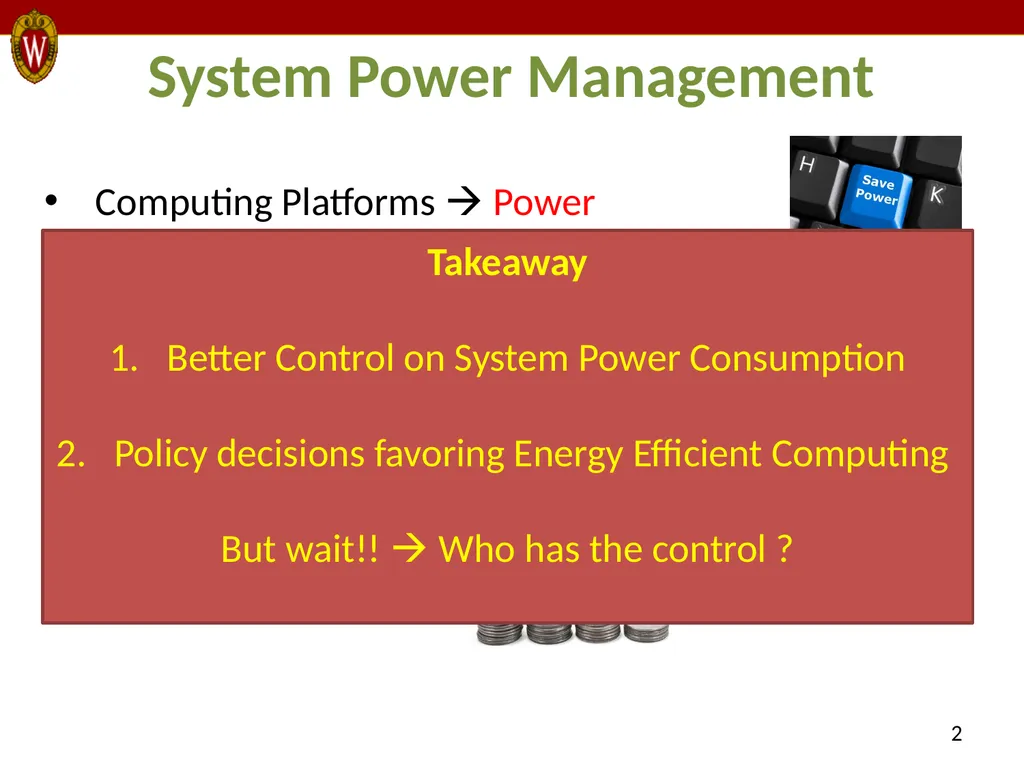
2 Computing Platforms Power Management (PM) problem
Mobile and Embedded Devices
Desktop Systems
Server Environment System Power Management Takeaway
Better Control on System Power Consumption
Policy decisions favoring Energy Efficient Computing
But wait!! Who has the control ?<br>
03
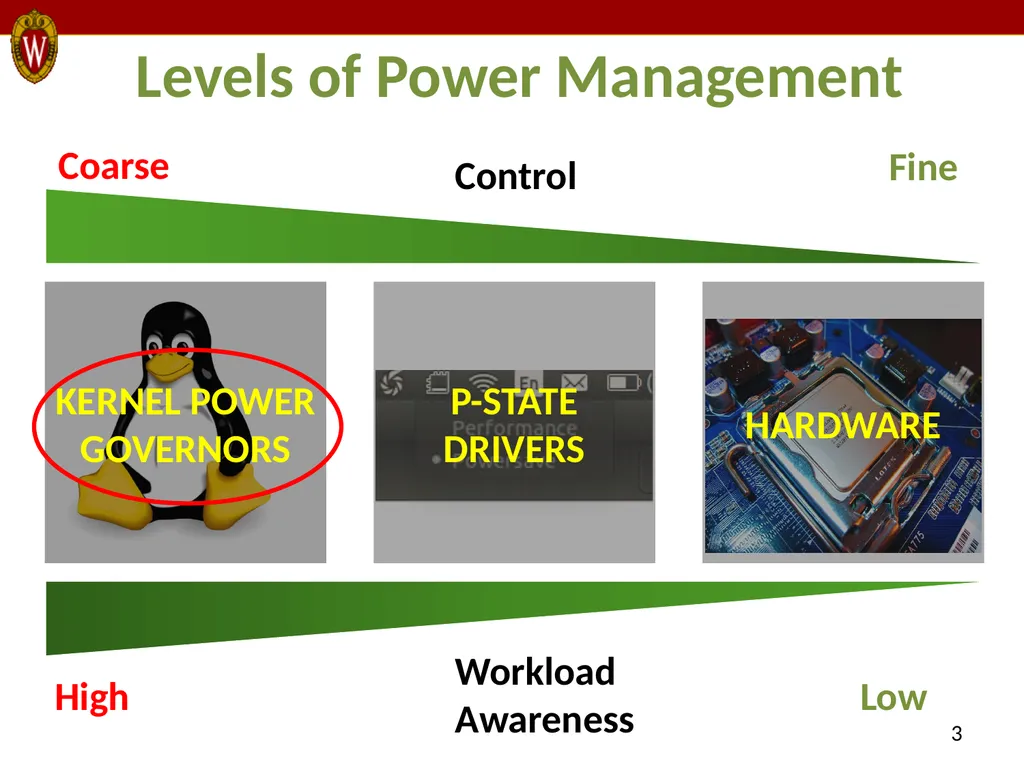
P-STATE
DRIVERS KERNEL POWER GOVERNORS 3 Levels of Power Management HARDWARE Control Coarse Fine High Low Workload Awareness<br>
04
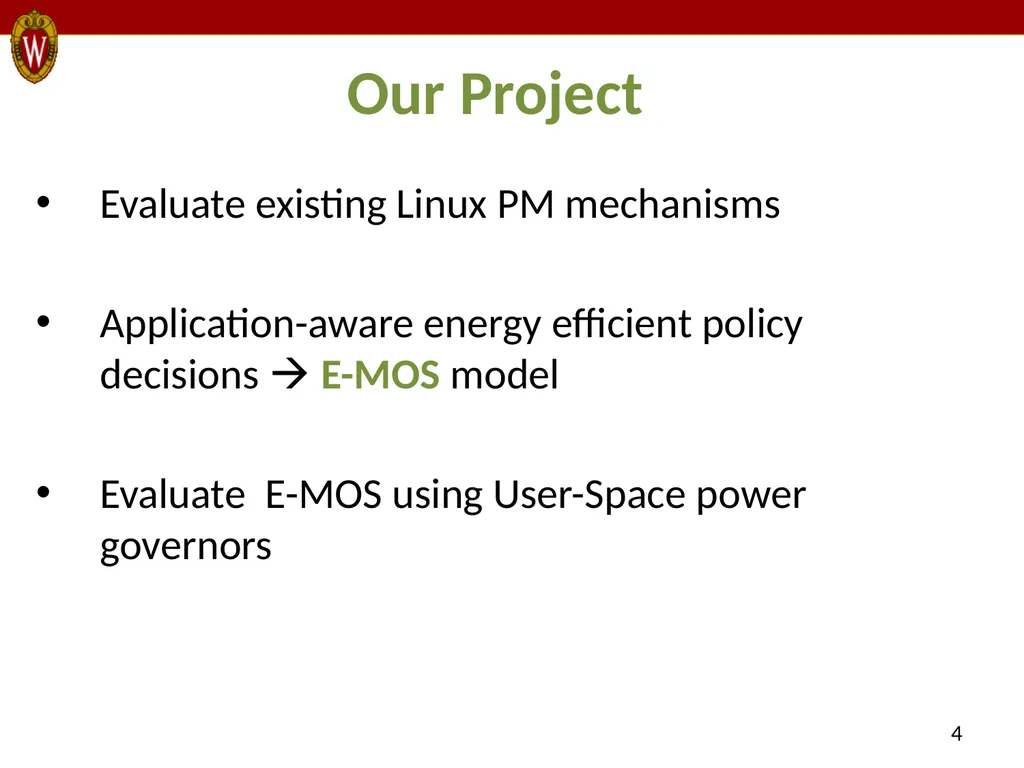
4 Evaluate existing Linux PM mechanisms
Application-aware energy efficient policy decisions E-MOS model
Evaluate E-MOS using User-Space power governors Our Project<br>
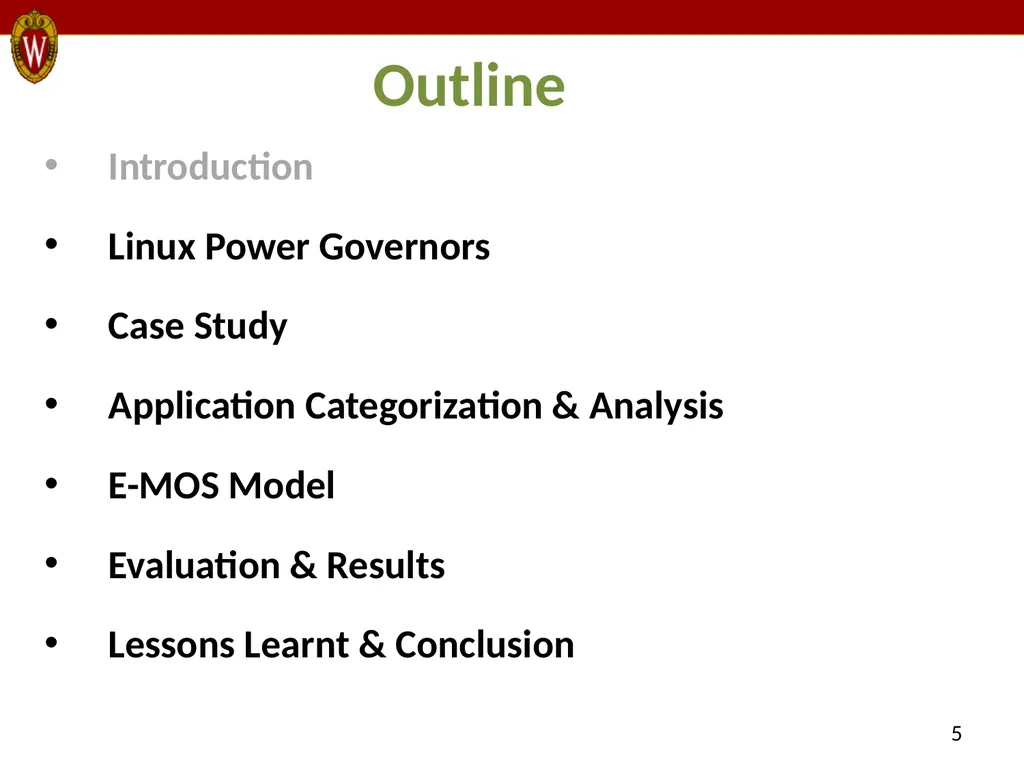
05
5 Introduction
Linux Power Governors
Case Study
Application Categorization & Analysis
E-MOS Model
Evaluation & Results
Lessons Learnt & Conclusion Outline<br>
06
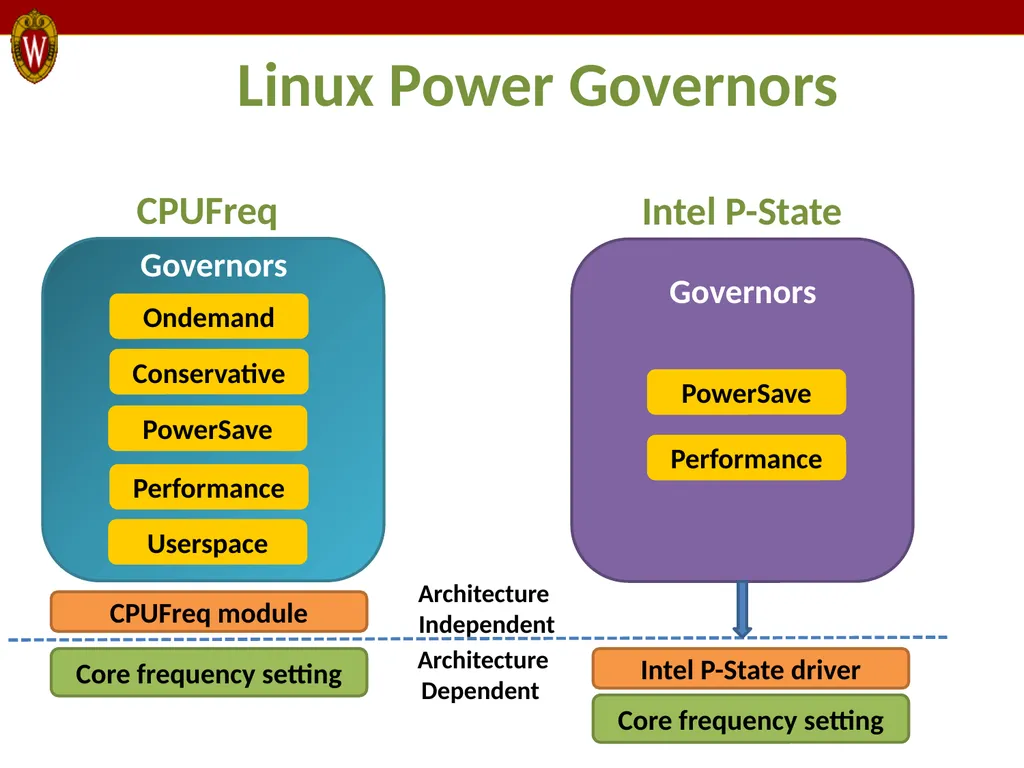
Linux Power Governors CPUFreq CPUFreq module Core frequency setting Intel P-State Ondemand Conservative PowerSave Performance Userspace Architecture
Independent Architecture
Dependent PowerSave Performance Intel P-State driver Core frequency setting Governors Governors<br>
07
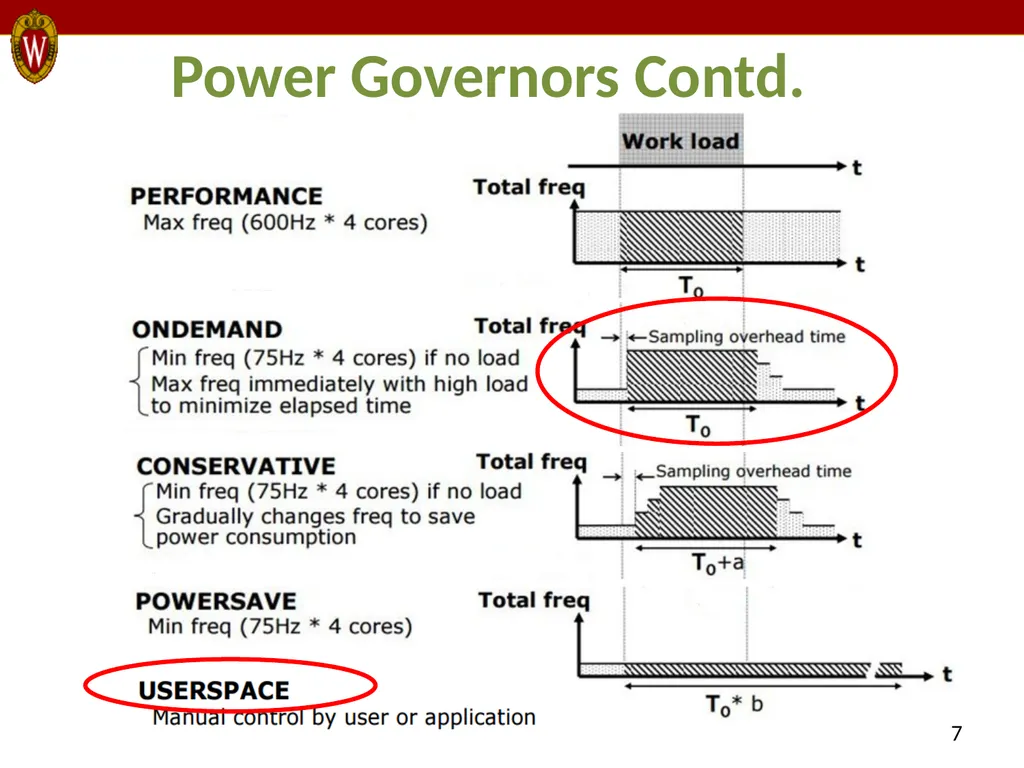
7 Power Governors Contd.<br>
08
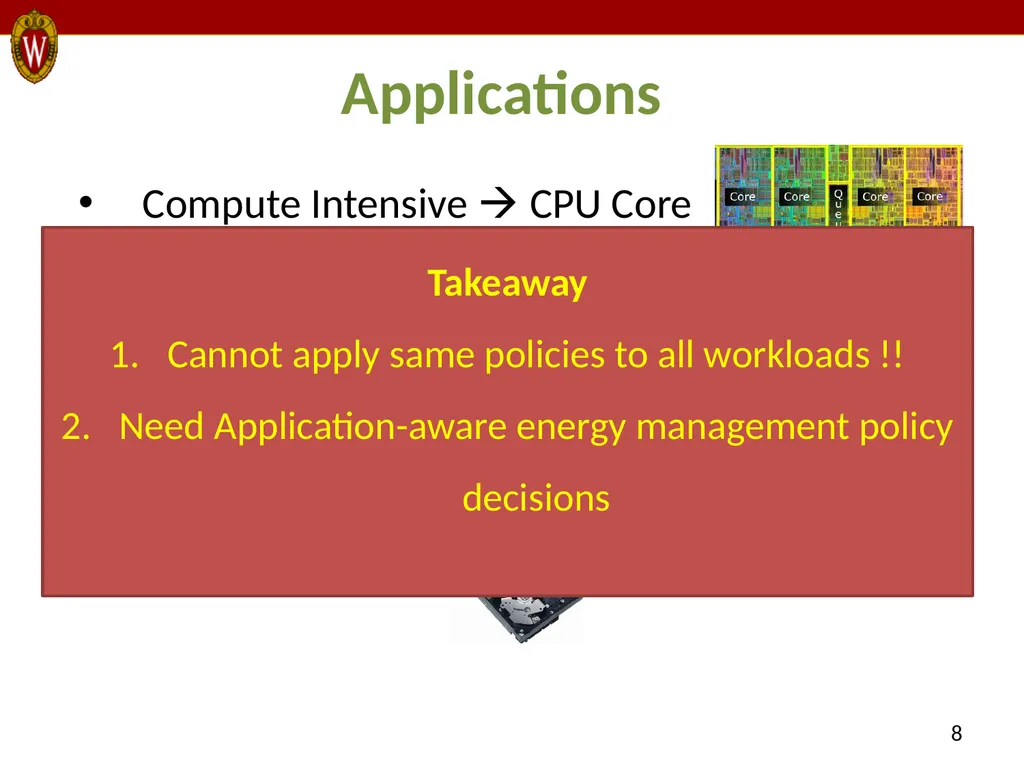
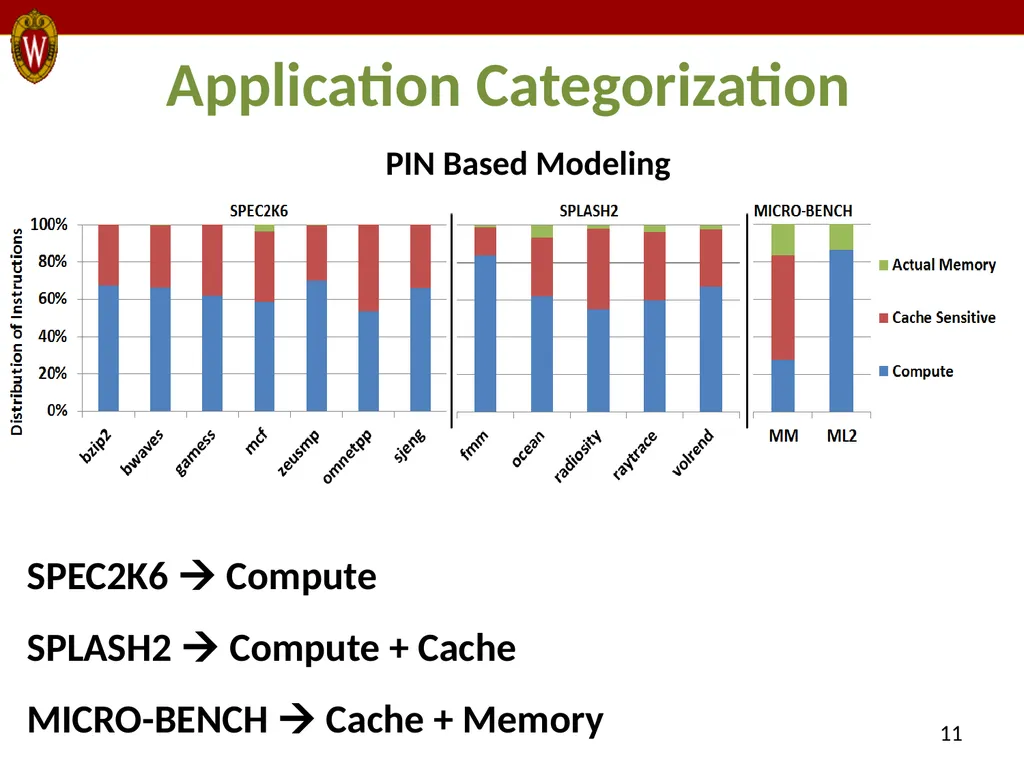
8 Compute Intensive CPU Core
Cache Sensitive
Memory Intensive
I/O Intensive Applications Takeaway
Cannot apply same policies to all workloads !!
Need Application-aware energy management policy decisions<br>
09
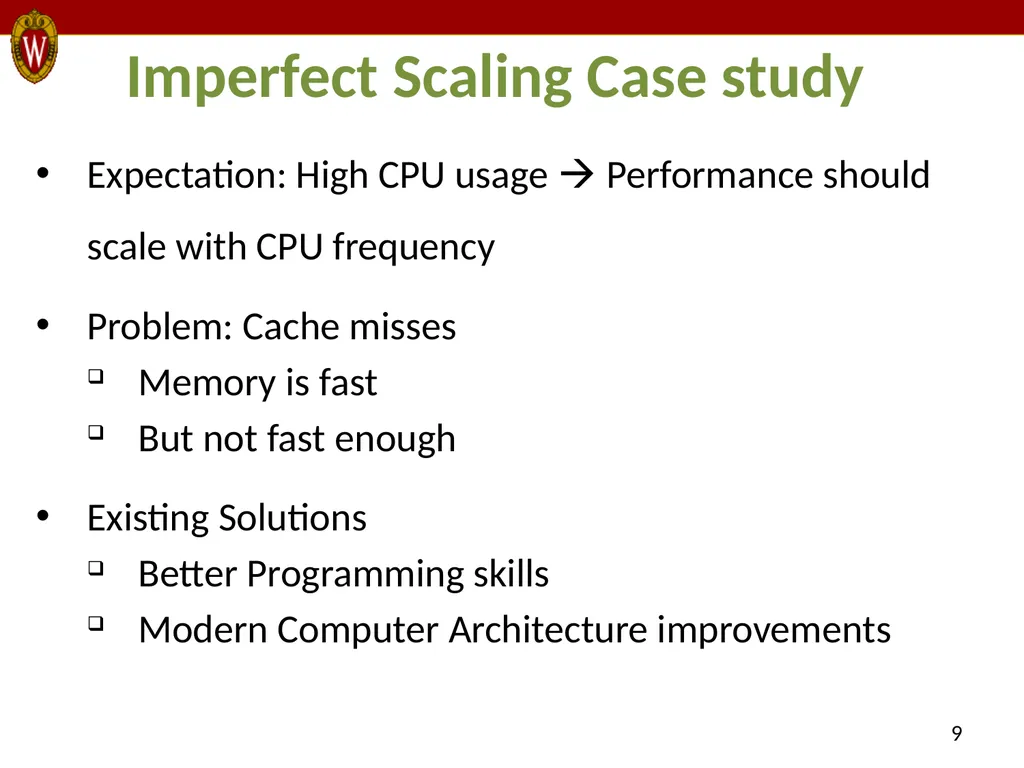
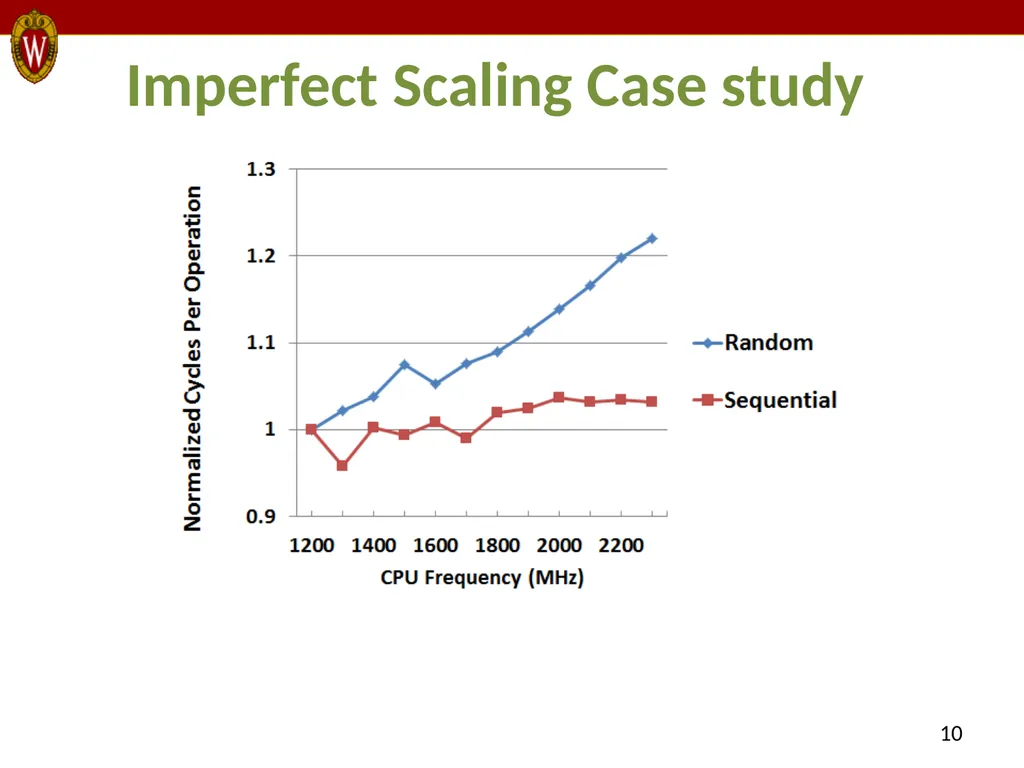
9 Expectation: High CPU usage Performance should scale with CPU frequency
Problem: Cache misses
Memory is fast
But not fast enough
Existing Solutions
Better Programming skills
Modern Computer Architecture improvements Imperfect Scaling Case study<br>
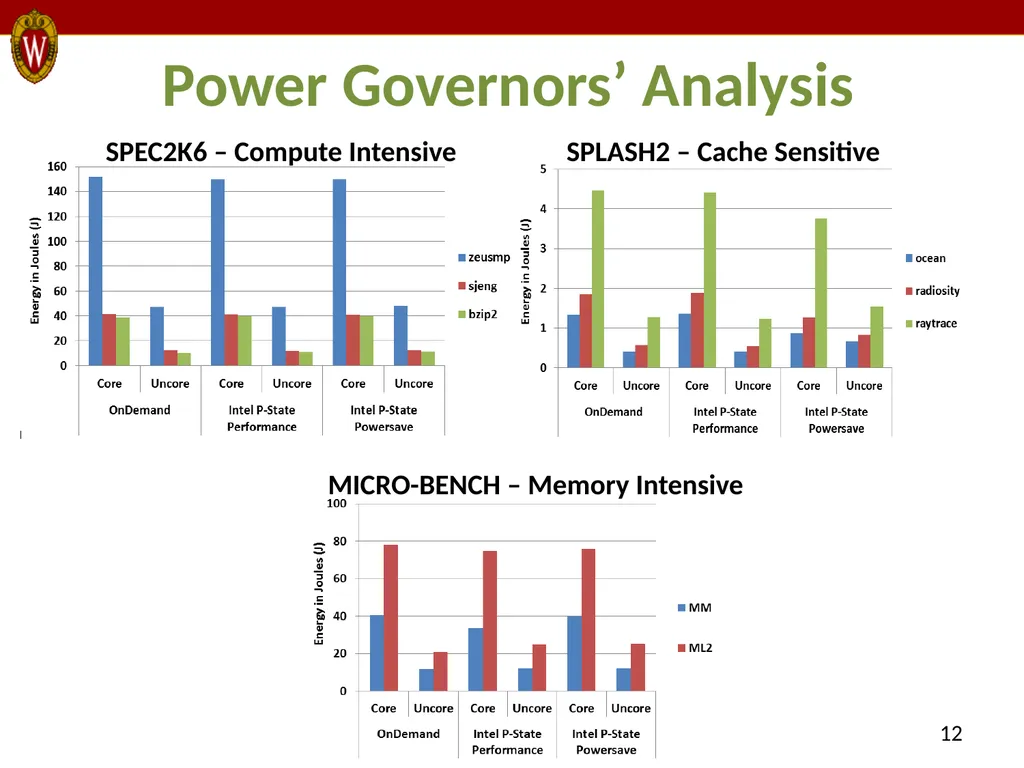
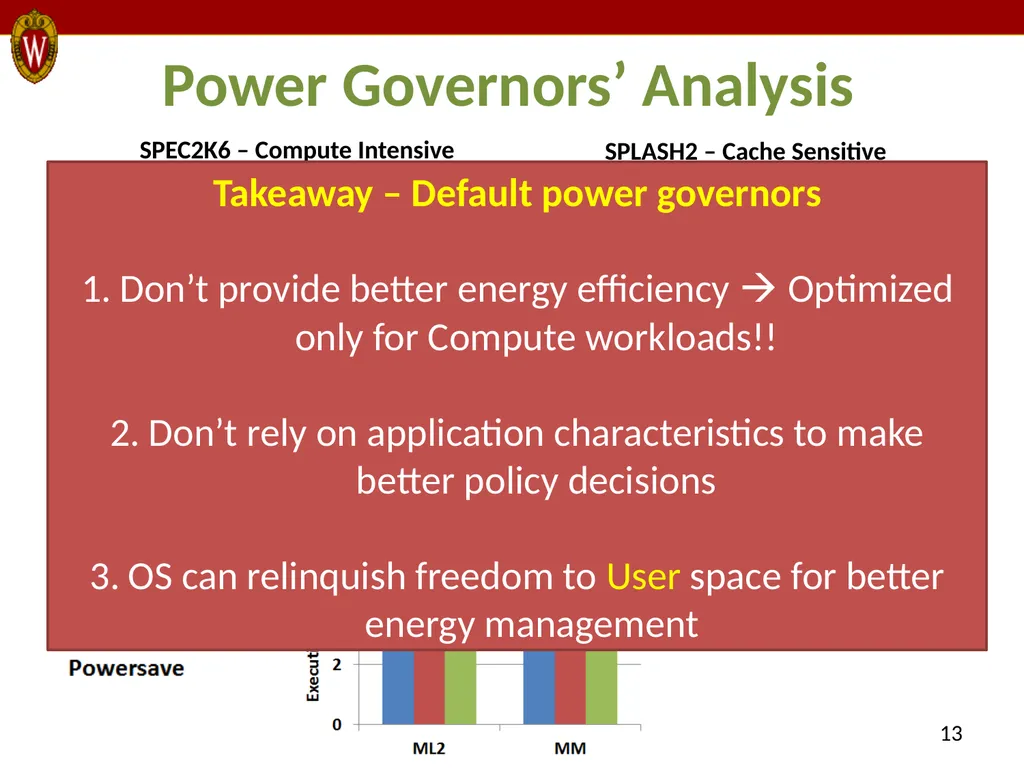
Don’t provide better energy efficiency Optimized only for Compute workloads!!
Don’t rely on application characteristics to make better policy decisions
OS can relinquish freedom to User space for better energy management<br>
14
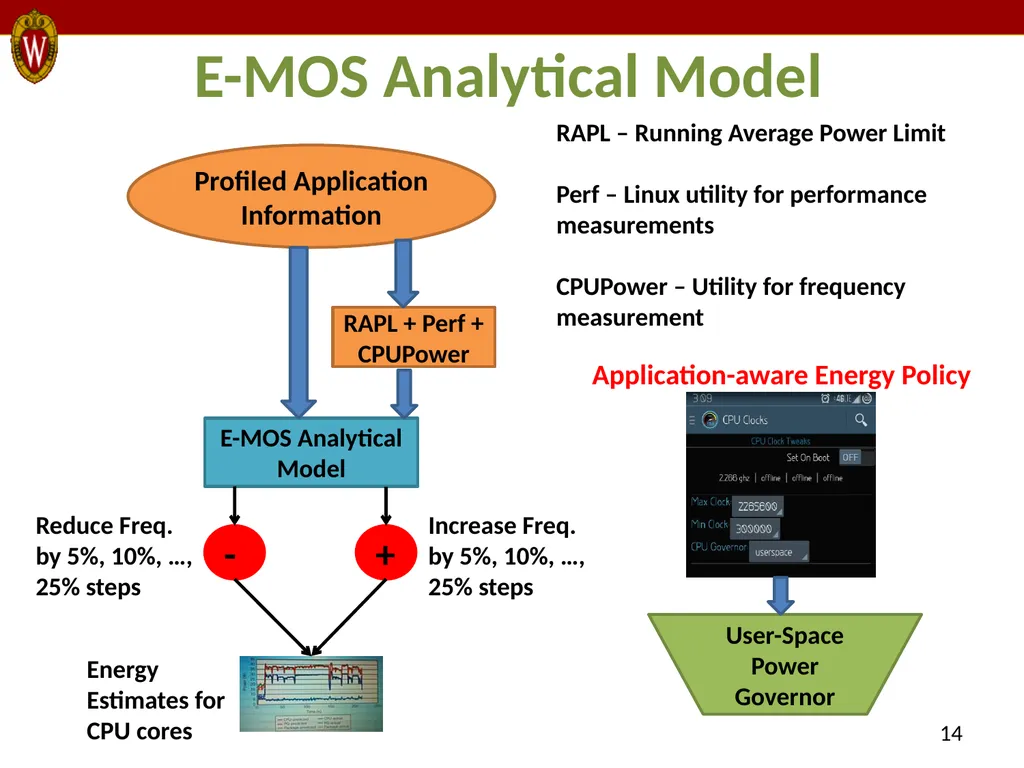
- 14 E-MOS Analytical Model Profiled Application Information RAPL + Perf + CPUPower E-MOS Analytical Model User-Space Power Governor + Reduce Freq.
by 5%, 10%, …, 25% steps Energy Estimates for CPU cores RAPL – Running Average Power Limit
Perf – Linux utility for performance measurements
CPUPower – Utility for frequency measurement Application-aware Energy Policy Increase Freq.
by 5%, 10%, …, 25% steps<br>
15
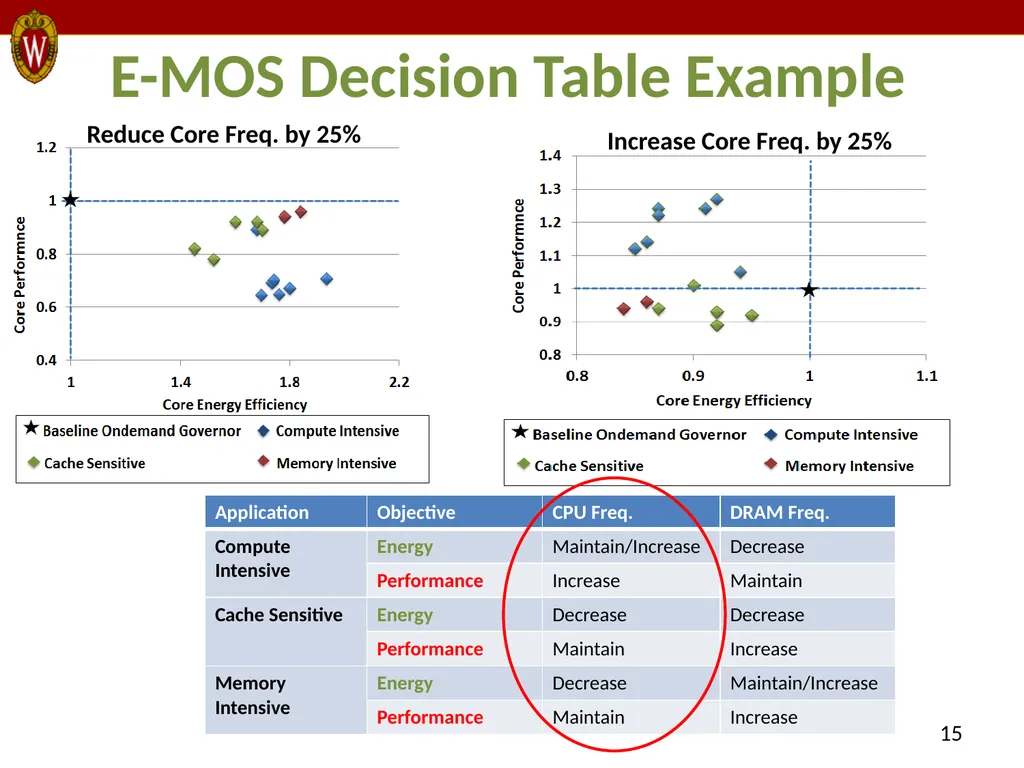
15 E-MOS Decision Table Example Reduce Core Freq. by 25% Increase Core Freq. by 25%<br>
16
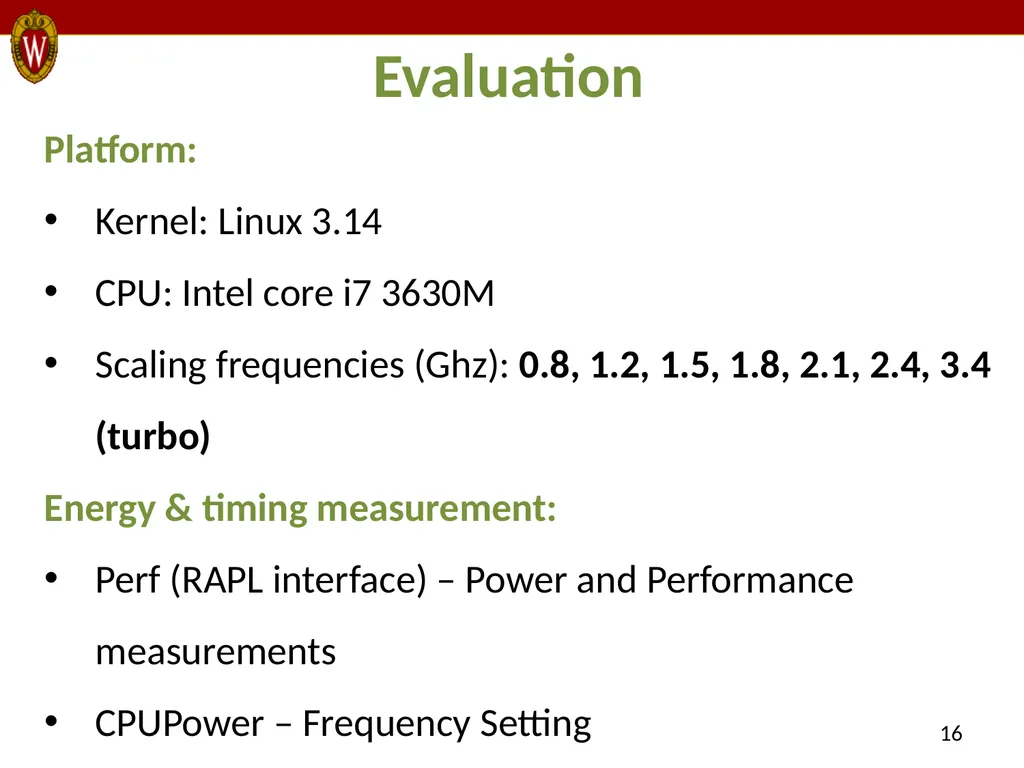
16 Evaluation Platform:
Kernel: Linux 3.14
CPU: Intel core i7 3630M
Scaling frequencies (Ghz): 0.8, 1.2, 1.5, 1.8, 2.1, 2.4, 3.4 (turbo) Energy & timing measurement:
Perf (RAPL interface) – Power and Performance measurements
CPUPower – Frequency Setting<br>
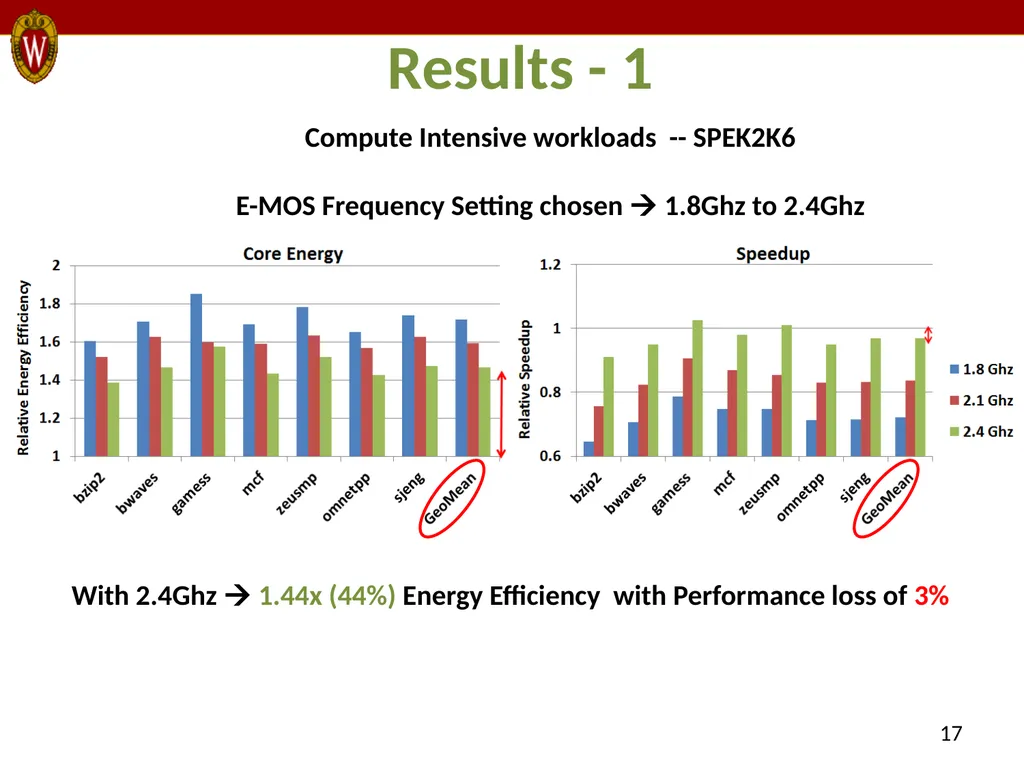
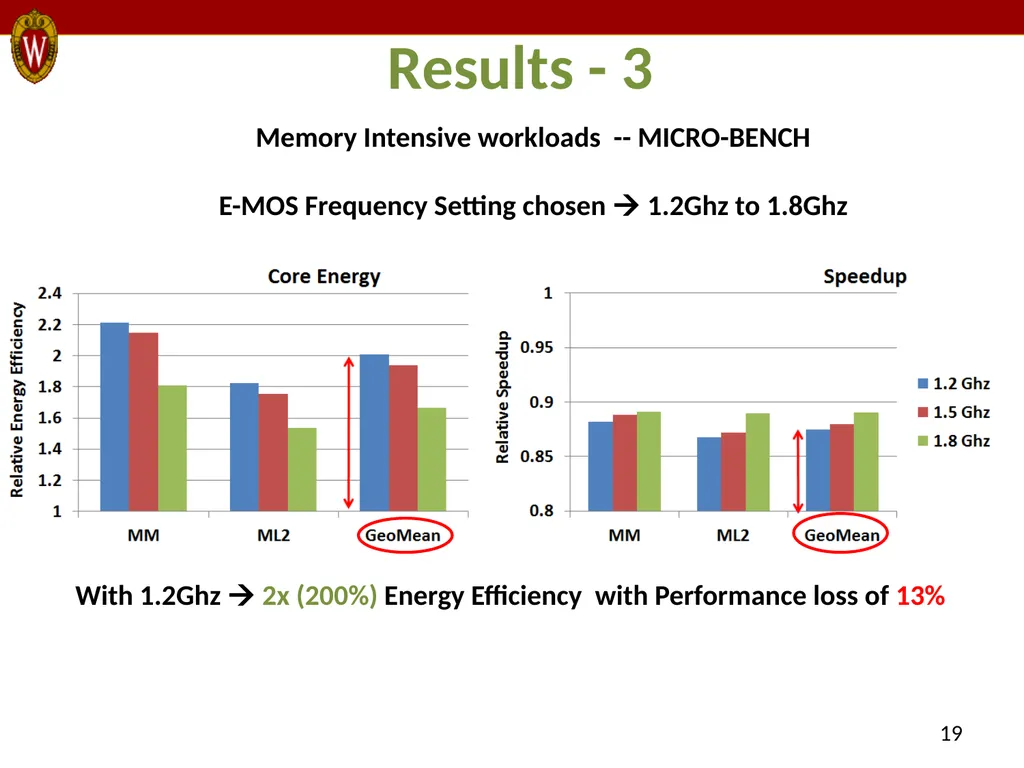
E-MOS Frequency Setting chosen 1.2Ghz to 1.8Ghz With 1.2Ghz 2x (200%) Energy Efficiency with Performance loss of 13%<br>
20
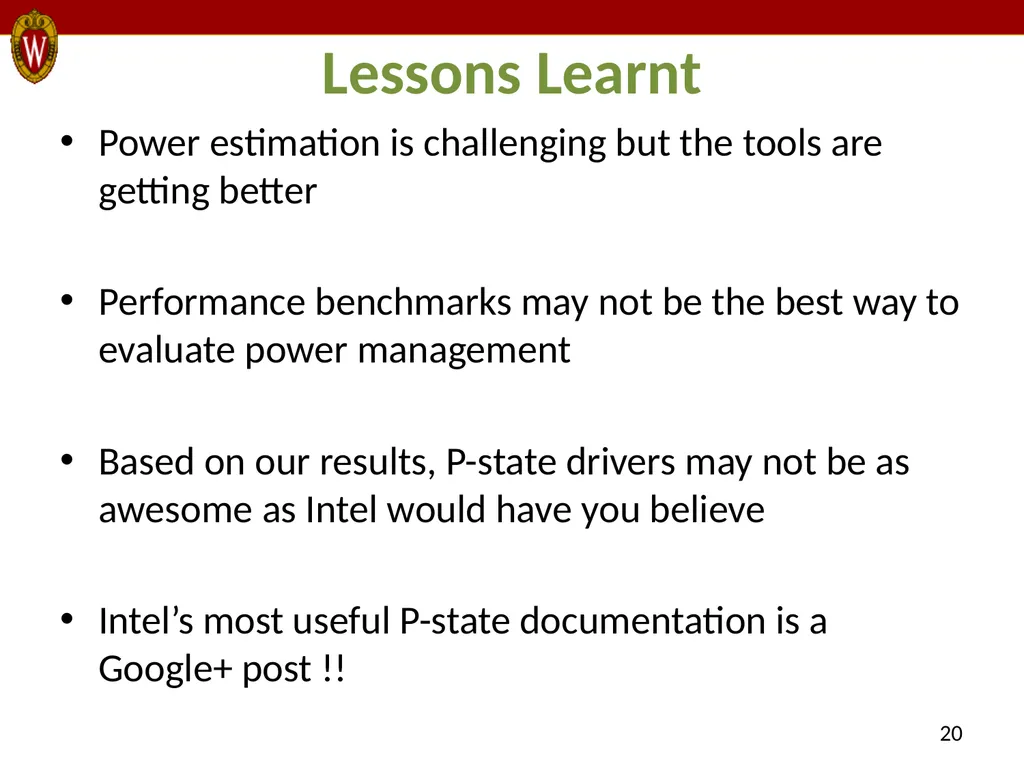
Lessons Learnt Power estimation is challenging but the tools are getting better
Performance benchmarks may not be the best way to evaluate power management
Based on our results, P-state drivers may not be as awesome as Intel would have you believe
Intel’s most useful P-state documentation is a Google+ post !! 20<br>
21
Conclusion Application-aware energy management Energy as a first class resource
EMOS achieves upto 2x energy efficiency with performance loss of 13%
Power governors can take advantage of reducing CPU frequency for Memory bound applications
User-space power governors with more runtime library support can be more efficient than Ondemand 21<br>
22
22 Back Up Slides<br>
23
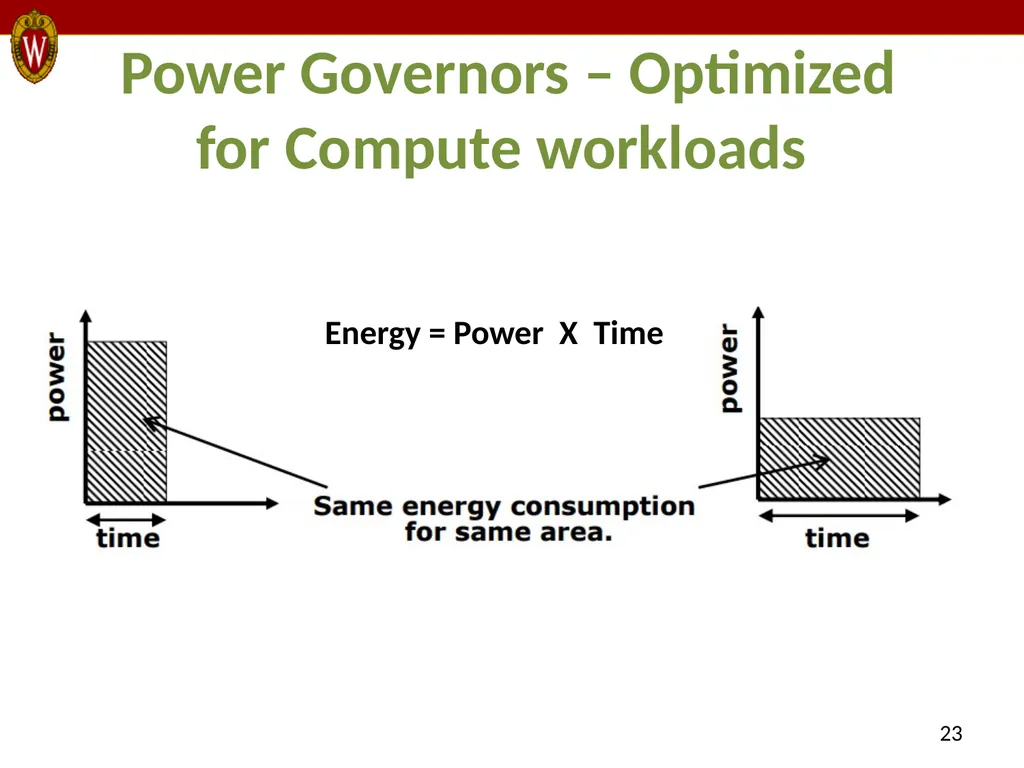
23 Power Governors – Optimized for Compute workloads Benchmarks:
SPEC CPU2006, Splash2, Micro benchmarks Energy = Power X Time<br>
24
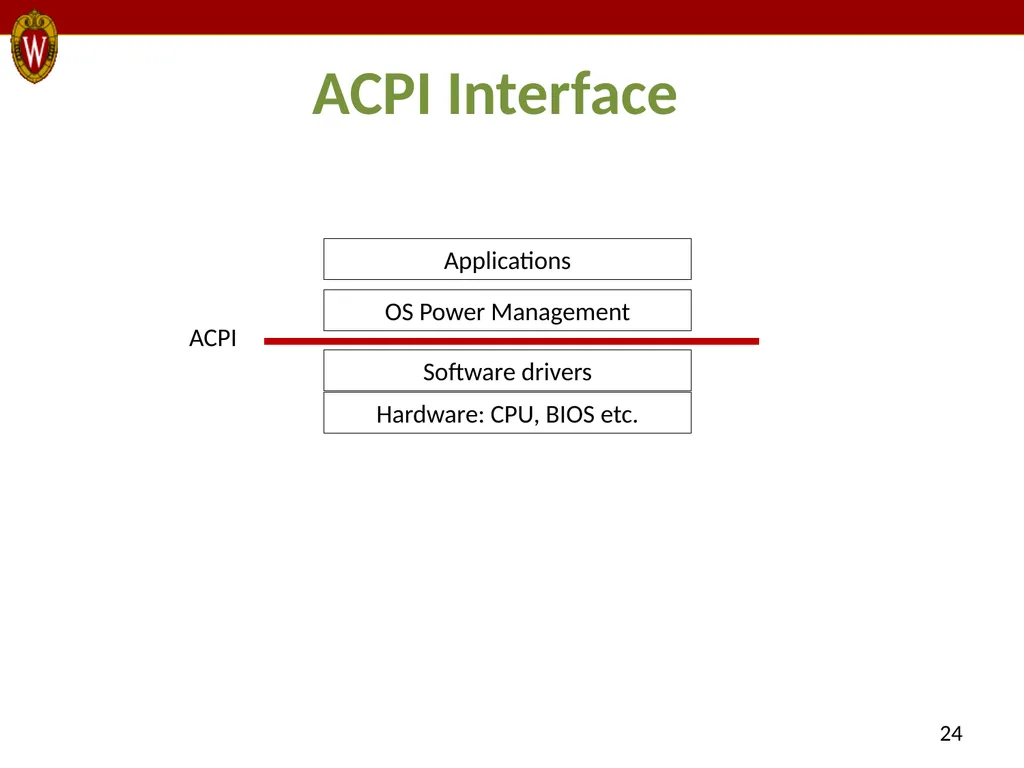
24 ACPI Interface OS Power Management Hardware: CPU, BIOS etc. Software drivers ACPI Applications<br>
25
Problem with Power Governors Power management tends to be simplistic
Most policies use “race to halt” approach
Run the workload to completion at the maximum performance setting and then transition into a low-power mode
Assumes that the highest energy savings can be achieved by running at the lowest performance setting
Either statically scale the CPU frequency or provide limited CPU capability to define energy requirements of an application
Use only CPU usage as source of information
What about memory bound applications?
Do not provide a fine-grained control and management over the energy utilized by the applications<br>