
E-Safety Training Alan MacKenzie What is E-Safety?

Description: E-Safety Training Alan MacKenzie What is E-Safety? E-Safety, or online safety, is very difficult to define as the risks that children face online are wide ranging and are constantly changing. It is important for parents and educators to
Related Topics
Download Presentation
"E-Safety Training Alan MacKenzie What is E-Safety?" is the property of its rightful owner. Permission is granted to download and print the materials on this website for personal, non-commercial use only, and to display it on your personal computer provided you do not modify the materials and that you retain all copyright notices contained in the materials. By downloading content from our website, you accept the terms of this agreement.
Presentation Transcript
slide1. E-Safety Training Alan MacKenzie<br>
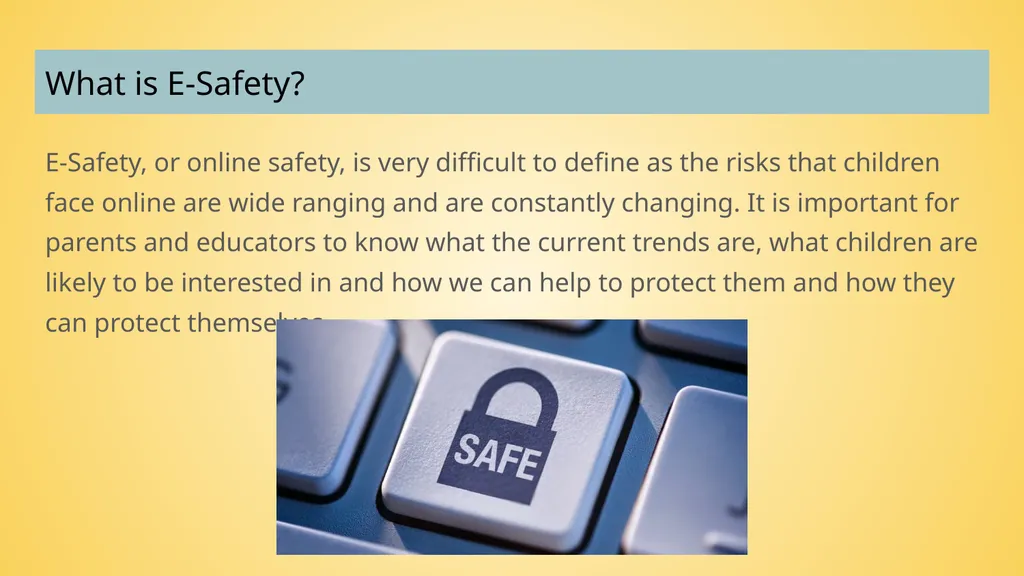
slide2. What is E-Safety? E-Safety, or online safety, is very difficult to define as the risks that children face online are wide ranging and are constantly changing. It is important for parents and educators to know what the current trends are, what children are likely to be interested in and how we can help to protect them and how they can protect themselves.<br>
slide3. Child Sexual Abuse / Exploitation The Child Exploitation and Online Protection Centre (CEOP) define it as follows:
Child Sexual Abuse (CSA) involves forcing or enticing a child to take part in sexual activity, whether or not the child is aware of what is happening. This may include activities such as involving children in looking at, or in the production of, sexual images, watching sexual activities, encouraging children to behave in sexually inappropriate ways or grooming a child in preparation for abuse.
Child Sexual Exploitation (CSE) is a form of CSA. It occurs where an individual or group takes advantage of an imbalance of power to coerce, manipulate or deceive a child or young person under the age of 18 into sexual activity (a) in exchange for something the victim needs or wants, and/or (b) the financial advantage or increased status of the perpetrator or facilitator. The victim may have been sexually exploited even if the activity appears consensual.<br>
slide4. Grooming online Grooming can take place online just as it does in the real world. Perpetrators will prey on victims according to:
Ease of access, e.g. children’s privacy settings
Vulnerability, e.g children feeling lonely
Children have a digital footprint making it easy for perpetrators to appear friendly, e.g. they know their name and where they go to school
Common interests or hobbies
Grooming in the real world usually takes place within the family or trusted circle; however online grooming has no geographical boundaries. Technology advancements lead to new forms of CSE, such as live streaming where children are coerced using apps or webcams.<br>
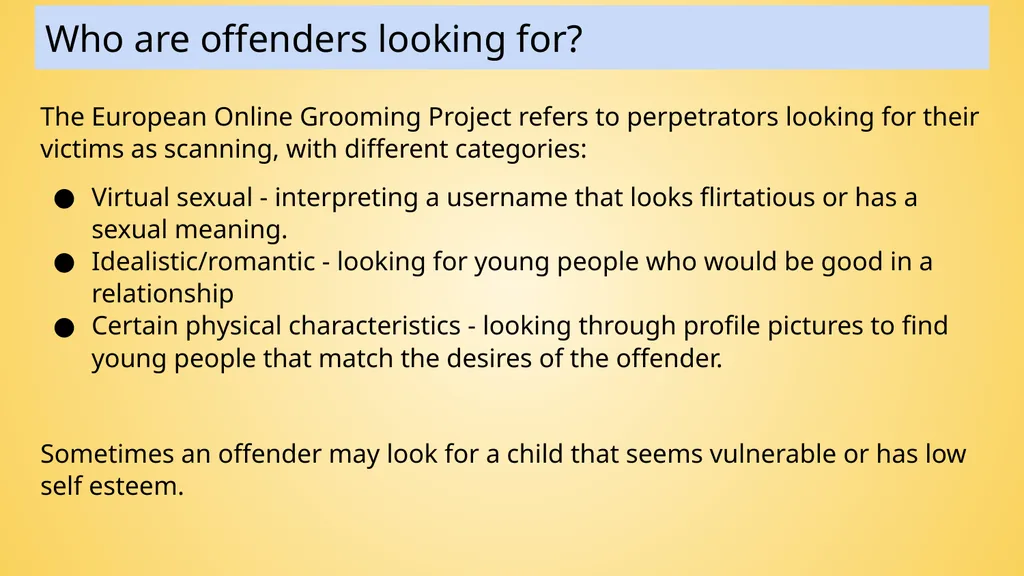
slide5. Who are offenders looking for? The European Online Grooming Project refers to perpetrators looking for their victims as scanning, with different categories:
Virtual sexual - interpreting a username that looks flirtatious or has a sexual meaning.
Idealistic/romantic - looking for young people who would be good in a relationship
Certain physical characteristics - looking through profile pictures to find young people that match the desires of the offender.
Sometimes an offender may look for a child that seems vulnerable or has low self esteem.<br>
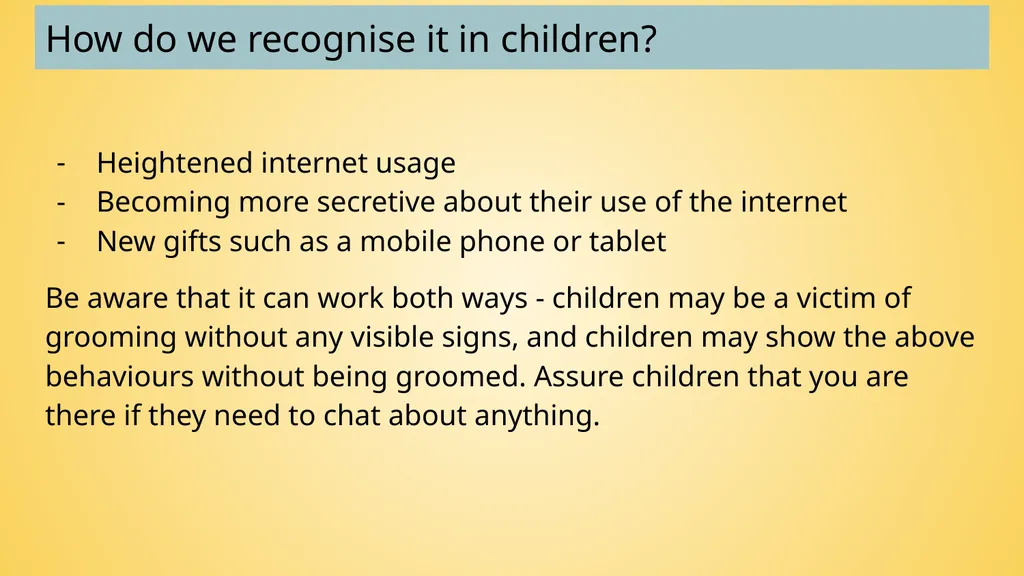
slide6. How do we recognise it in children? Heightened internet usage
Becoming more secretive about their use of the internet
New gifts such as a mobile phone or tablet
Be aware that it can work both ways - children may be a victim of grooming without any visible signs, and children may show the above behaviours without being groomed. Assure children that you are there if they need to chat about anything.<br>
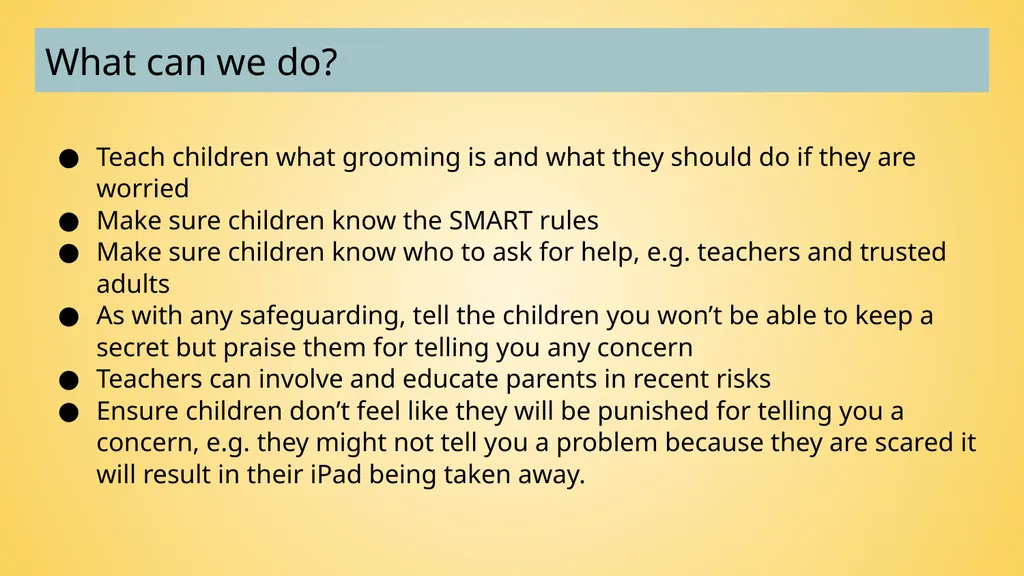
slide7. What can we do? Teach children what grooming is and what they should do if they are worried
Make sure children know the SMART rules
Make sure children know who to ask for help, e.g. teachers and trusted adults
As with any safeguarding, tell the children you won’t be able to keep a secret but praise them for telling you any concern
Teachers can involve and educate parents in recent risks
Ensure children don’t feel like they will be punished for telling you a concern, e.g. they might not tell you a problem because they are scared it will result in their iPad being taken away.<br>
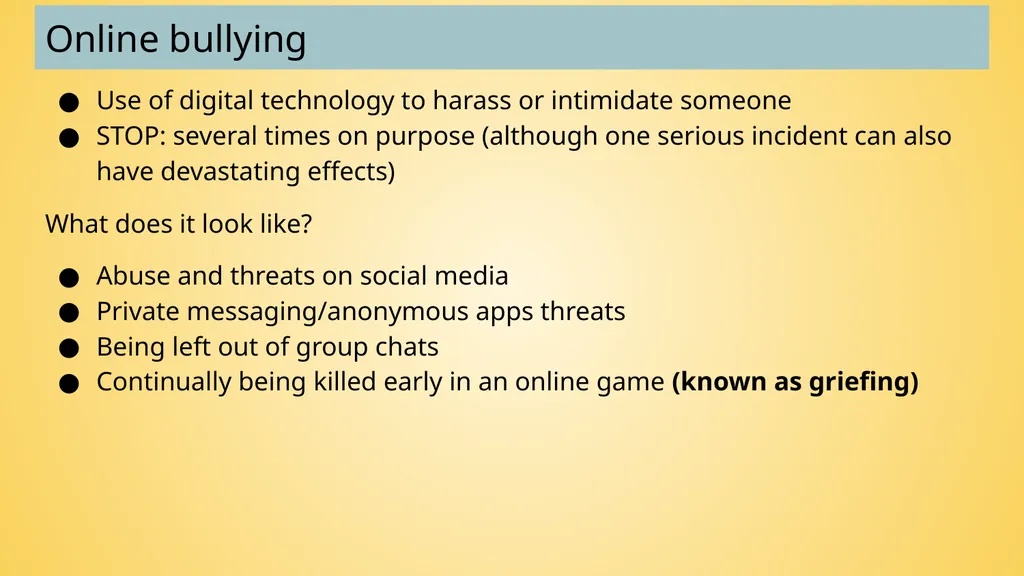
slide8. Online bullying Use of digital technology to harass or intimidate someone
STOP: several times on purpose (although one serious incident can also have devastating effects)
What does it look like?
Abuse and threats on social media
Private messaging/anonymous apps threats
Being left out of group chats
Continually being killed early in an online game (known as griefing)<br>
slide9. How do we recognise it in children? Children have different levels of resilience so there is no one-size-fits all approach to recognising online bullying.
It could include:
Children appearing upset after using their device
Being unwilling to talk about, or secretive about, their online activities
Spending less/more time on their device<br>
slide10. What can we do? Foster a culture at school and home about acceptable behaviour
Ensure cyberbullying is included in the anti-bullying policy
Ensure children have a safe person to go to if they are being bullied
Teach children how to take screenshots and explain what they are for - remind children that everything they do online is recorded
It is important to remember that online bullying is bullying - so treat it the same as real life bullying.<br>
slide11. Digital self harm Digital self harm is where a person will post intentionally harmful comments or pictures about themselves. Also called self-trolling and self-cyber bullying.
It may be due to:
Self loathing
A cry for help
Low self esteem
Attention seeking
Friendship testing Young people do not easily distinguish between the real world and the digital world. Being aware of digital self harm is important as with any mental health issue, specialist intervention may be required. Almost any physical act can be enacted online.<br>
slide12. Sexting This is when someone takes and/or shares an naked or seminaked picture or video of themselves (can also apply to sexually explicit messages). However, the law was made before most young people had access to smartphones and does not account for two young people in a relationship who have given consent to each other. Therefore it is vitally important to tell young people that even if they have agreed with each other that it’s okay, it is illegal to possess sexual images of under 18s. The Law
The law is clear that the creation, storage and sharing of sexually explicit images of children are offences under the 1978 Protection of Children Act. In theory, anyone that takes an image, has an image or shares an image is committing an offence.<br>
slide13. Why does sexting happen? There are many reasons why sexting happens amongst young people. Reasons given by young people include:
I was in a relationship and wanted to
I was in a relationship and felt expected to
For fun
I wanted to see the reaction from the other person
I was pressured or blackmailed
I was tricked into it
I didn’t want to but other people were doing it<br>
slide14. Sextortion The act of coercing a person into of taking and sharing indecent images and videos online.
Coercing people to pay money as a result of sharing their indecent images and videos (blackmail)
There was a significant increase during Covid-19 as young people were spending more time online.<br>
slide15. Sextortion - example In May 2020, a man tried to blackmail over 20 people by threatening to distribute their private photos. He tricked people into a clicking a link on social media which supposedly gave information about Covid-19. Lots of people at the time were researching the virus so many people clicked on it. When they did, it prompted them to give their Snapchat log in details. This was a scam website and the man behind it was able to harvest all the details of the people who had logged in. He then could log into their Snapchat accounts to find any private or explicit images, steal them, and blackmail or coerce the people for money.<br>
slide16. Live streaming The act of broadcasting yourself, publicly or privately, online.
Whilst this can be a great tool, sadly it has been used for live streaming child abuse.
In 2018 the Internet Watch Foundation (IWF) looked at captures of live streamed child abuse:
98% of images showed children younger than 13
96% were girls
100% of the images had been copied from their original location and redistributed.
Lots of videos had children saying things like ‘I’m not doing that unless I get 1000 likes’ - in other words, they are being exploited and groomed.<br>
slide17. Sad fishing Posting a sad update with no detail to gain a sympathetic response, or posting all of your personal troubles online.
Kendall Jenner and her mum began posting all of her acne worries and grew to having 29 million followers. She gained a lot of sympathy but was being paid to do it.
According to most teens, this is just a way to vent. Some are looking for sympathy or support, perhaps due to low self esteem, but posts are often met with backlash and criticism. It’s worth talking to students about how to air their worries in person with a trusted adult.<br>
slide18. Deepfakes Deepfakes are unbelievably realistic images or videos where your face and voice have been superimposed onto something else. Imagine seeing your face starring in an x-rated movie - this is a deepfake.
Through deep learning, computers can generate convincing representations of something that never happened. In 2020 Samsung announced it could produce deepfakes with one photo.
The name deepfake originated from a Reddit username who was producing fake videos of female celebrities having sex. In 2019 a company called Deeptrace carried out a study finding almost 15,000 deepfake videos, of which 96% were pornographic. All were women and had millions of views.
Children should be educated about this issue and a discussion should be had, highlighting any positives but showing the devastating effects it can have. This can be tied into discussions about digital footprints and how easily you can be found online.<br>
slide19. Digital Footprints Digital footprint is a concept taught in school from an early age. It is the trail of data we leave behind and can be used for a range of purposes such as advertisers at one end of the spectrum and offenders looking for victims at the other.
Active digital footprints:
What we intentionally post, e.g. an email, a social media update, a like on Youtube. Pictures posted on social media often have a location tag.
Passive digital footprints:
A more technical aspect, e.g. cookies, when and where we logged into a service, browsing and buying habits. Smartphones are not dormant when not in use; they are always sending out data.<br>
slide20. Digital Footprints - what do children need to know Children need to understand that things posted online will be around forever, even after we’ve passed away. All humans have made mistakes in their past but if they are posted online they will continue to shape their future.
Social media can act as a secondary CV for employers and many people have not been hired due to their personal profiles.
Posts and pictures can be taken out of context to someone who wasn’t there at the time.
Students should look at the sites they are using and change their privacy settings.<br>
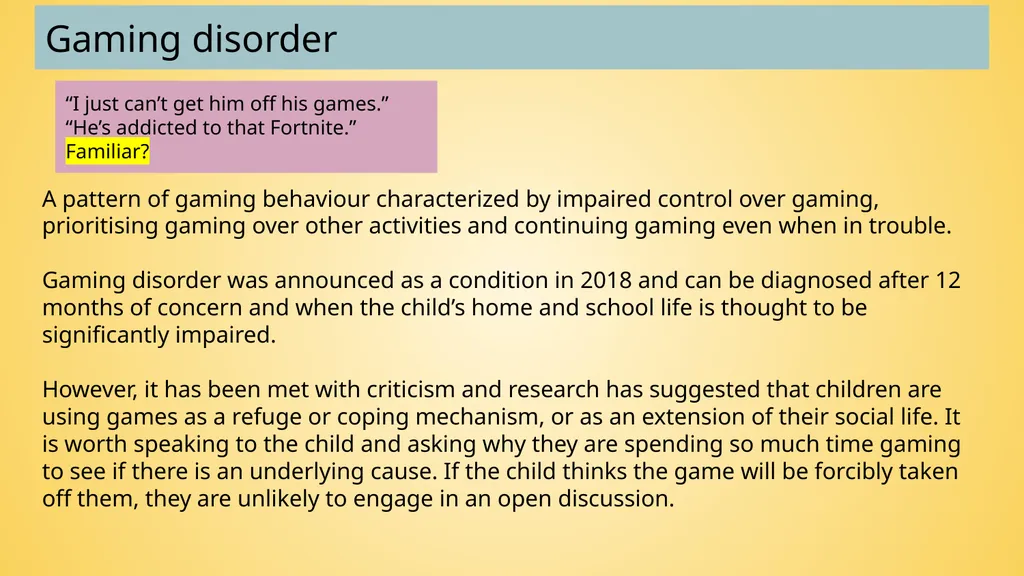
slide21. Gaming disorder A pattern of gaming behaviour characterized by impaired control over gaming, prioritising gaming over other activities and continuing gaming even when in trouble.
Gaming disorder was announced as a condition in 2018 and can be diagnosed after 12 months of concern and when the child’s home and school life is thought to be significantly impaired.
However, it has been met with criticism and research has suggested that children are using games as a refuge or coping mechanism, or as an extension of their social life. It is worth speaking to the child and asking why they are spending so much time gaming to see if there is an underlying cause. If the child thinks the game will be forcibly taken off them, they are unlikely to engage in an open discussion. “I just can’t get him off his games.” “He’s addicted to that Fortnite.”
Familiar?<br>
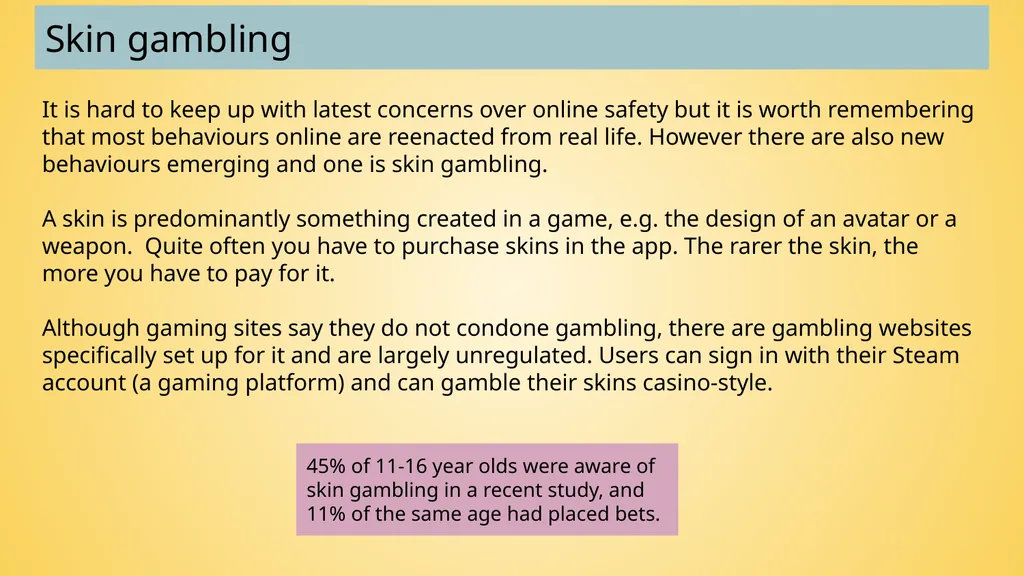
slide22. Skin gambling It is hard to keep up with latest concerns over online safety but it is worth remembering that most behaviours online are reenacted from real life. However there are also new behaviours emerging and one is skin gambling.
A skin is predominantly something created in a game, e.g. the design of an avatar or a weapon. Quite often you have to purchase skins in the app. The rarer the skin, the more you have to pay for it.
Although gaming sites say they do not condone gambling, there are gambling websites specifically set up for it and are largely unregulated. Users can sign in with their Steam account (a gaming platform) and can gamble their skins casino-style. 45% of 11-16 year olds were aware of skin gambling in a recent study, and 11% of the same age had placed bets.<br>
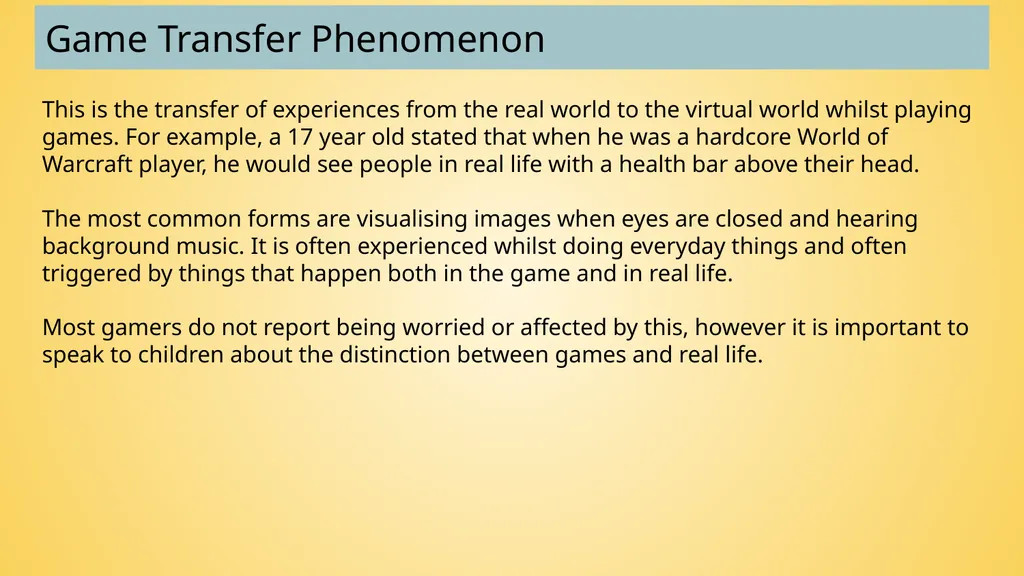
slide23. Game Transfer Phenomenon This is the transfer of experiences from the real world to the virtual world whilst playing games. For example, a 17 year old stated that when he was a hardcore World of Warcraft player, he would see people in real life with a health bar above their head.
The most common forms are visualising images when eyes are closed and hearing background music. It is often experienced whilst doing everyday things and often triggered by things that happen both in the game and in real life.
Most gamers do not report being worried or affected by this, however it is important to speak to children about the distinction between games and real life.<br>
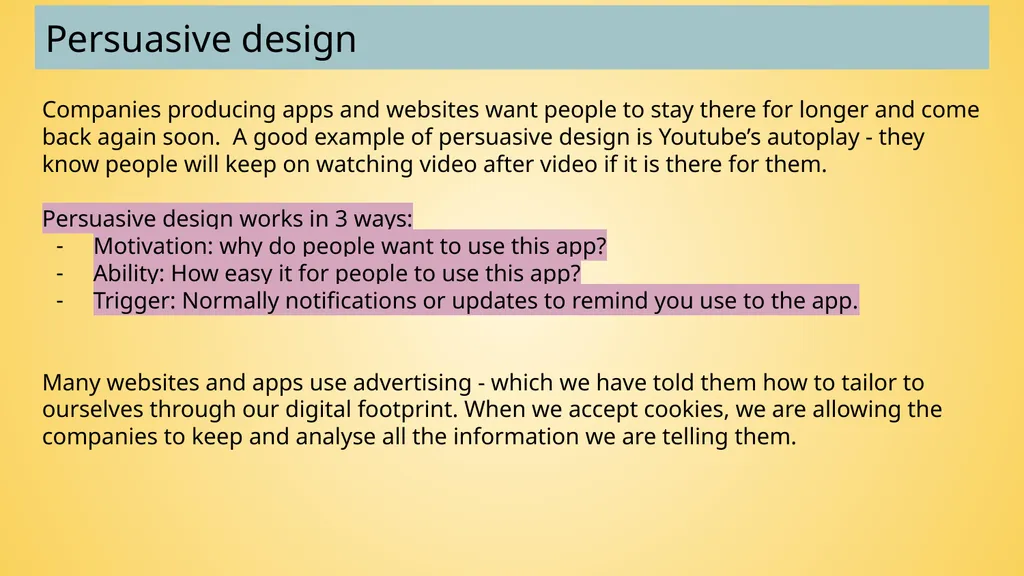
slide24. Persuasive design Companies producing apps and websites want people to stay there for longer and come back again soon. A good example of persuasive design is Youtube’s autoplay - they know people will keep on watching video after video if it is there for them.
Persuasive design works in 3 ways:
Motivation: why do people want to use this app?
Ability: How easy it for people to use this app?
Trigger: Normally notifications or updates to remind you use to the app.
Many websites and apps use advertising - which we have told them how to tailor to ourselves through our digital footprint. When we accept cookies, we are allowing the companies to keep and analyse all the information we are telling them.<br>
slide25. Like farming There are several reasons why people do this, including:
To get more followers
The user will be signposted to marketing websites and the original poster gets paid by the amount of new visitors
Criminal activity, similar to above but where the websites lure you into revealing personal information
Every action in Facebook is logged and stored, so Facebook can use the information about you to target ads. This is the process of deceiving users with the aim to get them to like, share of comment on a post to make it go viral. A sad common example might be an image of an animal suffering saying ‘Animals suffering all over the world, like if you want this to stop.’<br>
slide26. Decoy apps Also known as ghost apps, secret apps and safe apps.
They can be useful for things like storing passwords and locking away private information in case your device is stolen.
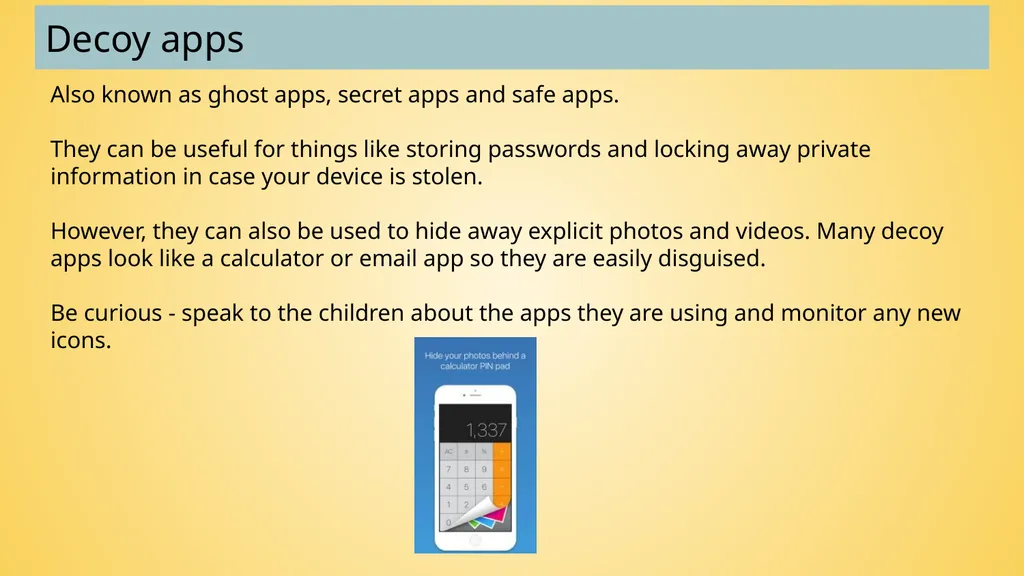
However, they can also be used to hide away explicit photos and videos. Many decoy apps look like a calculator or email app so they are easily disguised.
Be curious - speak to the children about the apps they are using and monitor any new icons.<br>
slide27. Top tips for parents Foster an atmosphere at home of open dialogue around technology. Make sure children know that you understand what they are using.
If you don’t understand an app or a game, find out. Children can hide things easily if they think you don’t understand something.
Monitor what apps they have - set up a pin on the app store or make it clear that you will be looking at which apps they have once a week.
Work with your child to ensure their privacy settings are on the most private they can be.
Show them examples online of where companies are collecting information and how to avoid it.
Talk to your child about real life examples where you may have regretted putting something on social media.
Don’t take away devices as a punishment for not being safe online - children are far less likely to share concerns that way.
Instead, talk often and honestly about staying safe and sharing concerns.<br>
slide2. What is E-Safety? E-Safety, or online safety, is very difficult to define as the risks that children face online are wide ranging and are constantly changing. It is important for parents and educators to know what the current trends are, what children are likely to be interested in and how we can help to protect them and how they can protect themselves.<br>
slide3. Child Sexual Abuse / Exploitation The Child Exploitation and Online Protection Centre (CEOP) define it as follows:
Child Sexual Abuse (CSA) involves forcing or enticing a child to take part in sexual activity, whether or not the child is aware of what is happening. This may include activities such as involving children in looking at, or in the production of, sexual images, watching sexual activities, encouraging children to behave in sexually inappropriate ways or grooming a child in preparation for abuse.
Child Sexual Exploitation (CSE) is a form of CSA. It occurs where an individual or group takes advantage of an imbalance of power to coerce, manipulate or deceive a child or young person under the age of 18 into sexual activity (a) in exchange for something the victim needs or wants, and/or (b) the financial advantage or increased status of the perpetrator or facilitator. The victim may have been sexually exploited even if the activity appears consensual.<br>
slide4. Grooming online Grooming can take place online just as it does in the real world. Perpetrators will prey on victims according to:
Ease of access, e.g. children’s privacy settings
Vulnerability, e.g children feeling lonely
Children have a digital footprint making it easy for perpetrators to appear friendly, e.g. they know their name and where they go to school
Common interests or hobbies
Grooming in the real world usually takes place within the family or trusted circle; however online grooming has no geographical boundaries. Technology advancements lead to new forms of CSE, such as live streaming where children are coerced using apps or webcams.<br>
slide5. Who are offenders looking for? The European Online Grooming Project refers to perpetrators looking for their victims as scanning, with different categories:
Virtual sexual - interpreting a username that looks flirtatious or has a sexual meaning.
Idealistic/romantic - looking for young people who would be good in a relationship
Certain physical characteristics - looking through profile pictures to find young people that match the desires of the offender.
Sometimes an offender may look for a child that seems vulnerable or has low self esteem.<br>
slide6. How do we recognise it in children? Heightened internet usage
Becoming more secretive about their use of the internet
New gifts such as a mobile phone or tablet
Be aware that it can work both ways - children may be a victim of grooming without any visible signs, and children may show the above behaviours without being groomed. Assure children that you are there if they need to chat about anything.<br>
slide7. What can we do? Teach children what grooming is and what they should do if they are worried
Make sure children know the SMART rules
Make sure children know who to ask for help, e.g. teachers and trusted adults
As with any safeguarding, tell the children you won’t be able to keep a secret but praise them for telling you any concern
Teachers can involve and educate parents in recent risks
Ensure children don’t feel like they will be punished for telling you a concern, e.g. they might not tell you a problem because they are scared it will result in their iPad being taken away.<br>
slide8. Online bullying Use of digital technology to harass or intimidate someone
STOP: several times on purpose (although one serious incident can also have devastating effects)
What does it look like?
Abuse and threats on social media
Private messaging/anonymous apps threats
Being left out of group chats
Continually being killed early in an online game (known as griefing)<br>
slide9. How do we recognise it in children? Children have different levels of resilience so there is no one-size-fits all approach to recognising online bullying.
It could include:
Children appearing upset after using their device
Being unwilling to talk about, or secretive about, their online activities
Spending less/more time on their device<br>
slide10. What can we do? Foster a culture at school and home about acceptable behaviour
Ensure cyberbullying is included in the anti-bullying policy
Ensure children have a safe person to go to if they are being bullied
Teach children how to take screenshots and explain what they are for - remind children that everything they do online is recorded
It is important to remember that online bullying is bullying - so treat it the same as real life bullying.<br>
slide11. Digital self harm Digital self harm is where a person will post intentionally harmful comments or pictures about themselves. Also called self-trolling and self-cyber bullying.
It may be due to:
Self loathing
A cry for help
Low self esteem
Attention seeking
Friendship testing Young people do not easily distinguish between the real world and the digital world. Being aware of digital self harm is important as with any mental health issue, specialist intervention may be required. Almost any physical act can be enacted online.<br>
slide12. Sexting This is when someone takes and/or shares an naked or seminaked picture or video of themselves (can also apply to sexually explicit messages). However, the law was made before most young people had access to smartphones and does not account for two young people in a relationship who have given consent to each other. Therefore it is vitally important to tell young people that even if they have agreed with each other that it’s okay, it is illegal to possess sexual images of under 18s. The Law
The law is clear that the creation, storage and sharing of sexually explicit images of children are offences under the 1978 Protection of Children Act. In theory, anyone that takes an image, has an image or shares an image is committing an offence.<br>
slide13. Why does sexting happen? There are many reasons why sexting happens amongst young people. Reasons given by young people include:
I was in a relationship and wanted to
I was in a relationship and felt expected to
For fun
I wanted to see the reaction from the other person
I was pressured or blackmailed
I was tricked into it
I didn’t want to but other people were doing it<br>
slide14. Sextortion The act of coercing a person into of taking and sharing indecent images and videos online.
Coercing people to pay money as a result of sharing their indecent images and videos (blackmail)
There was a significant increase during Covid-19 as young people were spending more time online.<br>
slide15. Sextortion - example In May 2020, a man tried to blackmail over 20 people by threatening to distribute their private photos. He tricked people into a clicking a link on social media which supposedly gave information about Covid-19. Lots of people at the time were researching the virus so many people clicked on it. When they did, it prompted them to give their Snapchat log in details. This was a scam website and the man behind it was able to harvest all the details of the people who had logged in. He then could log into their Snapchat accounts to find any private or explicit images, steal them, and blackmail or coerce the people for money.<br>
slide16. Live streaming The act of broadcasting yourself, publicly or privately, online.
Whilst this can be a great tool, sadly it has been used for live streaming child abuse.
In 2018 the Internet Watch Foundation (IWF) looked at captures of live streamed child abuse:
98% of images showed children younger than 13
96% were girls
100% of the images had been copied from their original location and redistributed.
Lots of videos had children saying things like ‘I’m not doing that unless I get 1000 likes’ - in other words, they are being exploited and groomed.<br>
slide17. Sad fishing Posting a sad update with no detail to gain a sympathetic response, or posting all of your personal troubles online.
Kendall Jenner and her mum began posting all of her acne worries and grew to having 29 million followers. She gained a lot of sympathy but was being paid to do it.
According to most teens, this is just a way to vent. Some are looking for sympathy or support, perhaps due to low self esteem, but posts are often met with backlash and criticism. It’s worth talking to students about how to air their worries in person with a trusted adult.<br>
slide18. Deepfakes Deepfakes are unbelievably realistic images or videos where your face and voice have been superimposed onto something else. Imagine seeing your face starring in an x-rated movie - this is a deepfake.
Through deep learning, computers can generate convincing representations of something that never happened. In 2020 Samsung announced it could produce deepfakes with one photo.
The name deepfake originated from a Reddit username who was producing fake videos of female celebrities having sex. In 2019 a company called Deeptrace carried out a study finding almost 15,000 deepfake videos, of which 96% were pornographic. All were women and had millions of views.
Children should be educated about this issue and a discussion should be had, highlighting any positives but showing the devastating effects it can have. This can be tied into discussions about digital footprints and how easily you can be found online.<br>
slide19. Digital Footprints Digital footprint is a concept taught in school from an early age. It is the trail of data we leave behind and can be used for a range of purposes such as advertisers at one end of the spectrum and offenders looking for victims at the other.
Active digital footprints:
What we intentionally post, e.g. an email, a social media update, a like on Youtube. Pictures posted on social media often have a location tag.
Passive digital footprints:
A more technical aspect, e.g. cookies, when and where we logged into a service, browsing and buying habits. Smartphones are not dormant when not in use; they are always sending out data.<br>
slide20. Digital Footprints - what do children need to know Children need to understand that things posted online will be around forever, even after we’ve passed away. All humans have made mistakes in their past but if they are posted online they will continue to shape their future.
Social media can act as a secondary CV for employers and many people have not been hired due to their personal profiles.
Posts and pictures can be taken out of context to someone who wasn’t there at the time.
Students should look at the sites they are using and change their privacy settings.<br>
slide21. Gaming disorder A pattern of gaming behaviour characterized by impaired control over gaming, prioritising gaming over other activities and continuing gaming even when in trouble.
Gaming disorder was announced as a condition in 2018 and can be diagnosed after 12 months of concern and when the child’s home and school life is thought to be significantly impaired.
However, it has been met with criticism and research has suggested that children are using games as a refuge or coping mechanism, or as an extension of their social life. It is worth speaking to the child and asking why they are spending so much time gaming to see if there is an underlying cause. If the child thinks the game will be forcibly taken off them, they are unlikely to engage in an open discussion. “I just can’t get him off his games.” “He’s addicted to that Fortnite.”
Familiar?<br>
slide22. Skin gambling It is hard to keep up with latest concerns over online safety but it is worth remembering that most behaviours online are reenacted from real life. However there are also new behaviours emerging and one is skin gambling.
A skin is predominantly something created in a game, e.g. the design of an avatar or a weapon. Quite often you have to purchase skins in the app. The rarer the skin, the more you have to pay for it.
Although gaming sites say they do not condone gambling, there are gambling websites specifically set up for it and are largely unregulated. Users can sign in with their Steam account (a gaming platform) and can gamble their skins casino-style. 45% of 11-16 year olds were aware of skin gambling in a recent study, and 11% of the same age had placed bets.<br>
slide23. Game Transfer Phenomenon This is the transfer of experiences from the real world to the virtual world whilst playing games. For example, a 17 year old stated that when he was a hardcore World of Warcraft player, he would see people in real life with a health bar above their head.
The most common forms are visualising images when eyes are closed and hearing background music. It is often experienced whilst doing everyday things and often triggered by things that happen both in the game and in real life.
Most gamers do not report being worried or affected by this, however it is important to speak to children about the distinction between games and real life.<br>
slide24. Persuasive design Companies producing apps and websites want people to stay there for longer and come back again soon. A good example of persuasive design is Youtube’s autoplay - they know people will keep on watching video after video if it is there for them.
Persuasive design works in 3 ways:
Motivation: why do people want to use this app?
Ability: How easy it for people to use this app?
Trigger: Normally notifications or updates to remind you use to the app.
Many websites and apps use advertising - which we have told them how to tailor to ourselves through our digital footprint. When we accept cookies, we are allowing the companies to keep and analyse all the information we are telling them.<br>
slide25. Like farming There are several reasons why people do this, including:
To get more followers
The user will be signposted to marketing websites and the original poster gets paid by the amount of new visitors
Criminal activity, similar to above but where the websites lure you into revealing personal information
Every action in Facebook is logged and stored, so Facebook can use the information about you to target ads. This is the process of deceiving users with the aim to get them to like, share of comment on a post to make it go viral. A sad common example might be an image of an animal suffering saying ‘Animals suffering all over the world, like if you want this to stop.’<br>
slide26. Decoy apps Also known as ghost apps, secret apps and safe apps.
They can be useful for things like storing passwords and locking away private information in case your device is stolen.
However, they can also be used to hide away explicit photos and videos. Many decoy apps look like a calculator or email app so they are easily disguised.
Be curious - speak to the children about the apps they are using and monitor any new icons.<br>
slide27. Top tips for parents Foster an atmosphere at home of open dialogue around technology. Make sure children know that you understand what they are using.
If you don’t understand an app or a game, find out. Children can hide things easily if they think you don’t understand something.
Monitor what apps they have - set up a pin on the app store or make it clear that you will be looking at which apps they have once a week.
Work with your child to ensure their privacy settings are on the most private they can be.
Show them examples online of where companies are collecting information and how to avoid it.
Talk to your child about real life examples where you may have regretted putting something on social media.
Don’t take away devices as a punishment for not being safe online - children are far less likely to share concerns that way.
Instead, talk often and honestly about staying safe and sharing concerns.<br>