
ECE467: Natural Language Processing Parsing If you
JO
Published · 46 slides · 0 views
1 / 1

Description
ECE467: Natural Language Processing Parsing If you are following along in the book The first part of this topic is related to Sections 17.4 through 17.6 of the textbook, related to constituency parsing Chapter 17, in general, is titled
Related Topics
Share
Embed code
Download this presentation From Below
"ECE467: Natural Language Processing Parsing If you" is the property of its rightful owner. Permission is granted to download and print the materials on this website for personal, non-commercial use only, and to display it on your personal computer provided you do not modify the materials and that you retain all copyright notices contained in the materials. By downloading content from our website, you accept the terms of this agreement.
Presentation Transcript
01
ECE467: Natural Language Processing Parsing<br>
02
If you are following along in the book… The first part of this topic is related to Sections 17.4 through 17.6 of the textbook, related to constituency parsing
Chapter 17, in general, is titled "Context-Free Grammars and Constituency Parsing"
We covered material from the first few sections of the chapter when we discussed phase structure grammars
The next portion of this topic is related to Appendix C of the textbook, titled "Statistical Constituency Parsing"; we will not cover this in detail
At the end of the topic, we will briefly talk about garden sentences, which are discussed in "The Language Instinct" by Pinker
A few other examples from Pinker are scattered throughout<br>
Chapter 17, in general, is titled "Context-Free Grammars and Constituency Parsing"
We covered material from the first few sections of the chapter when we discussed phase structure grammars
The next portion of this topic is related to Appendix C of the textbook, titled "Statistical Constituency Parsing"; we will not cover this in detail
At the end of the topic, we will briefly talk about garden sentences, which are discussed in "The Language Instinct" by Pinker
A few other examples from Pinker are scattered throughout<br>
03
Constituency Parsing The textbook defines syntactic parsing to be "the task of assigning a syntactic structure to a sentence"
When using phrase structure grammars, a.k.a. constituency grammars, the task is known as constituency parsing
An alternative to constituency parsing is dependency parsing, discussed in Chapter 18 of the textbook
We briefly discussed dependency grammars in a previous topic, but we will not discuss dependency parsing
Later, we will discuss an algorithm that parses an input sentence according to a context-free grammar (CFG)
In a previous topic, we learned that linguists often use CFGs to represent phrase structure grammars
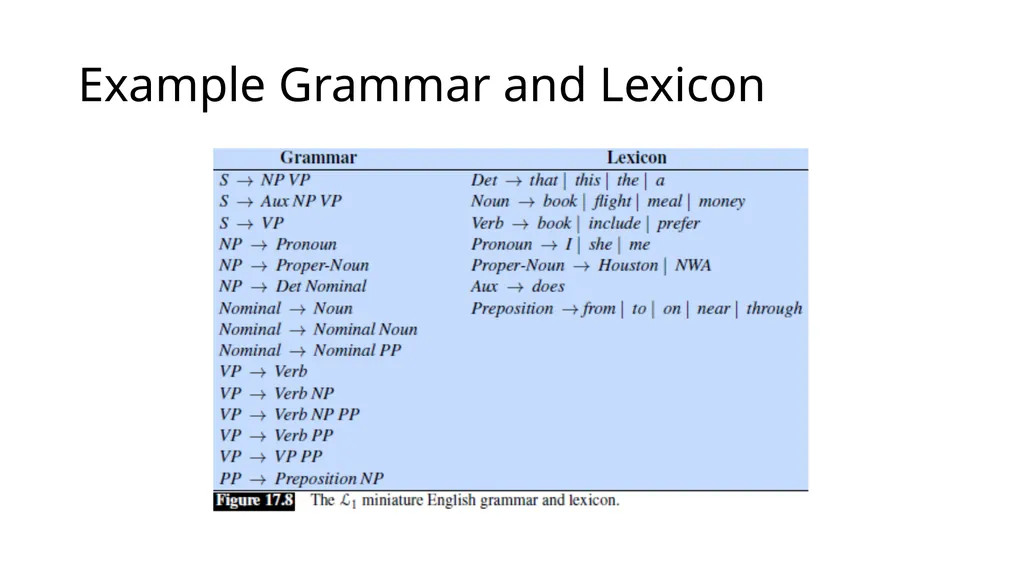
An example of a CFG, L1, including a lexicon (indicating words with their parts of speech, or POS), is shown on the next slide; we saw a similar example during a previous topic
Constituency parsing can be viewed as a search for an appropriate parse tree (or all appropriate parse trees) given a CFG and an input sentence
We saw examples of parse trees as part of a previous topic, and we'll look at another example in a few slides
The discovered parse trees can be useful for applications such as grammar checking
In conventional NLP, they could serve as an intermediate representation for semantic analysis, which was useful for applications such as information extraction and question answering (QA)<br>
When using phrase structure grammars, a.k.a. constituency grammars, the task is known as constituency parsing
An alternative to constituency parsing is dependency parsing, discussed in Chapter 18 of the textbook
We briefly discussed dependency grammars in a previous topic, but we will not discuss dependency parsing
Later, we will discuss an algorithm that parses an input sentence according to a context-free grammar (CFG)
In a previous topic, we learned that linguists often use CFGs to represent phrase structure grammars
An example of a CFG, L1, including a lexicon (indicating words with their parts of speech, or POS), is shown on the next slide; we saw a similar example during a previous topic
Constituency parsing can be viewed as a search for an appropriate parse tree (or all appropriate parse trees) given a CFG and an input sentence
We saw examples of parse trees as part of a previous topic, and we'll look at another example in a few slides
The discovered parse trees can be useful for applications such as grammar checking
In conventional NLP, they could serve as an intermediate representation for semantic analysis, which was useful for applications such as information extraction and question answering (QA)<br>
04
Example Grammar and Lexicon<br>
05
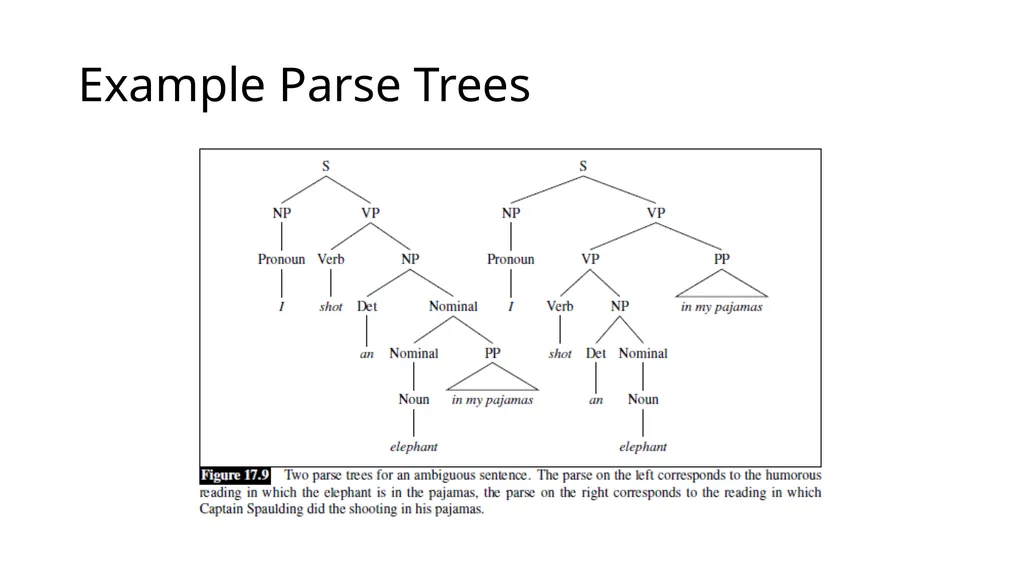
Ambiguous Sentences The next slide shows two valid parse trees, according to the given CFG, for the sentence: "One morning, I shot an elephant in my pajamas"
Although the book doesn't state it, they are obviously assuming the existence of additional words in the lexicon
This example raises the notion of syntactic ambiguity, a.k.a. structural ambiguity
This particular example is a case of attachment ambiguity
The book points out that this is a line from Groucho Marx in the movie, "Animal Crackers", and the full quote, with context, is shown at the start of the chapter
The full context is: "One morning, I shot an elephant in my pajamas. How he got into my pajamas, I don't know."
I add: Given that context, the parse tree on the left would be the correct one!
Another example of attachment ambiguity mentioned in the textbook is: "We saw the Eiffel Tower flying to Paris."<br>
Although the book doesn't state it, they are obviously assuming the existence of additional words in the lexicon
This example raises the notion of syntactic ambiguity, a.k.a. structural ambiguity
This particular example is a case of attachment ambiguity
The book points out that this is a line from Groucho Marx in the movie, "Animal Crackers", and the full quote, with context, is shown at the start of the chapter
The full context is: "One morning, I shot an elephant in my pajamas. How he got into my pajamas, I don't know."
I add: Given that context, the parse tree on the left would be the correct one!
Another example of attachment ambiguity mentioned in the textbook is: "We saw the Eiffel Tower flying to Paris."<br>
06
Example Parse Trees<br>
07
Coordination Ambiguity Another type of syntactic ambiguity is coordination ambiguity, involving conjunctions
For example, the phrase "old men and women" can be viewed as [old [men and women]] or [old men] and [women]
I add: Such ambiguity can have non-trivial consequences; I will describe one that personally affected me (and many thousands of other people)!
In 2006, the United States Congress passed a law called the Unlawful Internet Gambling Enforcement Act (UIGEA)
This led to an event on April 15, 2011, later referred to by the on-line poker community as Black Friday
On that day, all on-line poker sites were shut down within the United States by the U.S. government
Part of the legal justification of the UIGEA was the Federal Wire Act, from 1961, which made it illegal to place certain bets over the telephone
This has since been interpreted to also apply to bets made over the Internet
It is debatable, however, if the Federal Wire Act should legally apply to poker
This has been fought (and is probably still being fought) in courts, and it largely comes down to the parsing of the ambiguous phrase, "sporting event or contest" (see the next slide for the relevant context)<br>
For example, the phrase "old men and women" can be viewed as [old [men and women]] or [old men] and [women]
I add: Such ambiguity can have non-trivial consequences; I will describe one that personally affected me (and many thousands of other people)!
In 2006, the United States Congress passed a law called the Unlawful Internet Gambling Enforcement Act (UIGEA)
This led to an event on April 15, 2011, later referred to by the on-line poker community as Black Friday
On that day, all on-line poker sites were shut down within the United States by the U.S. government
Part of the legal justification of the UIGEA was the Federal Wire Act, from 1961, which made it illegal to place certain bets over the telephone
This has since been interpreted to also apply to bets made over the Internet
It is debatable, however, if the Federal Wire Act should legally apply to poker
This has been fought (and is probably still being fought) in courts, and it largely comes down to the parsing of the ambiguous phrase, "sporting event or contest" (see the next slide for the relevant context)<br>
08
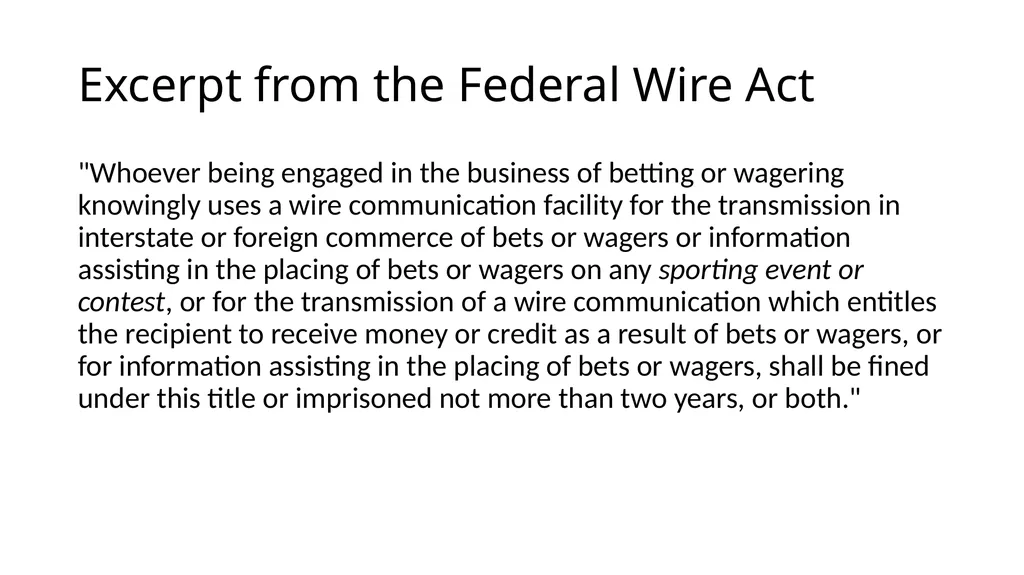
Excerpt from the Federal Wire Act "Whoever being engaged in the business of betting or wagering knowingly uses a wire communication facility for the transmission in interstate or foreign commerce of bets or wagers or information assisting in the placing of bets or wagers on any sporting event or contest, or for the transmission of a wire communication which entitles the recipient to receive money or credit as a result of bets or wagers, or for information assisting in the placing of bets or wagers, shall be fined under this title or imprisoned not more than two years, or both."<br>
09
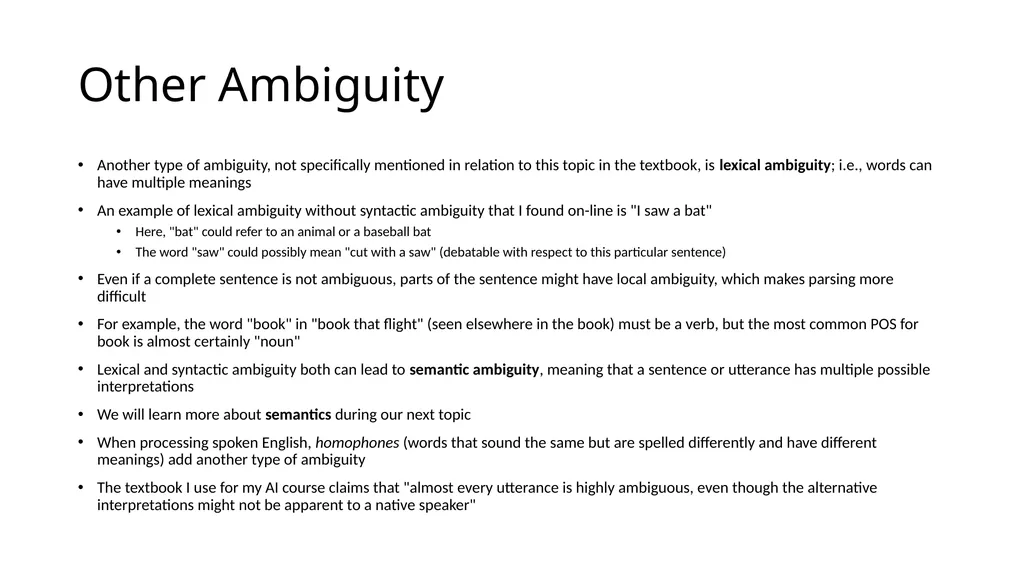
Other Ambiguity Another type of ambiguity, not specifically mentioned in relation to this topic in the textbook, is lexical ambiguity; i.e., words can have multiple meanings
An example of lexical ambiguity without syntactic ambiguity that I found on-line is "I saw a bat"
Here, "bat" could refer to an animal or a baseball bat
The word "saw" could possibly mean "cut with a saw" (debatable with respect to this particular sentence)
Even if a complete sentence is not ambiguous, parts of the sentence might have local ambiguity, which makes parsing more difficult
For example, the word "book" in "book that flight" (seen elsewhere in the book) must be a verb, but the most common POS for book is almost certainly "noun"
Lexical and syntactic ambiguity both can lead to semantic ambiguity, meaning that a sentence or utterance has multiple possible interpretations
We will learn more about semantics during our next topic
When processing spoken English, homophones (words that sound the same but are spelled differently and have different meanings) add another type of ambiguity
The textbook I use for my AI course claims that "almost every utterance is highly ambiguous, even though the alternative interpretations might not be apparent to a native speaker"<br>
An example of lexical ambiguity without syntactic ambiguity that I found on-line is "I saw a bat"
Here, "bat" could refer to an animal or a baseball bat
The word "saw" could possibly mean "cut with a saw" (debatable with respect to this particular sentence)
Even if a complete sentence is not ambiguous, parts of the sentence might have local ambiguity, which makes parsing more difficult
For example, the word "book" in "book that flight" (seen elsewhere in the book) must be a verb, but the most common POS for book is almost certainly "noun"
Lexical and syntactic ambiguity both can lead to semantic ambiguity, meaning that a sentence or utterance has multiple possible interpretations
We will learn more about semantics during our next topic
When processing spoken English, homophones (words that sound the same but are spelled differently and have different meanings) add another type of ambiguity
The textbook I use for my AI course claims that "almost every utterance is highly ambiguous, even though the alternative interpretations might not be apparent to a native speaker"<br>
10
Time Flies Like an Arrow In "The Language Instinct", Pinker discusses a famous example of an ambiguous sentence from NLP history
The sentence is: "Time flies like an arrow."
According to Pinker, this was the first sentence input to one of the first-ever implemented parsers
Supposedly, the programmers were originally surprised that the computer found five possible parses
They soon realized that all the parses were valid according to the grammar
The parses related to five possible interpretations of the sentence!<br>
The sentence is: "Time flies like an arrow."
According to Pinker, this was the first sentence input to one of the first-ever implemented parsers
Supposedly, the programmers were originally surprised that the computer found five possible parses
They soon realized that all the parses were valid according to the grammar
The parses related to five possible interpretations of the sentence!<br>
11
"Time flies like an arrow." (five meanings) Possible meaning #1: Time proceeds as quickly as an arrow proceeds (probably the intended meaning)<br>
12
"Time flies like an arrow." (five meanings) Possible meaning #1: Time proceeds as quickly as an arrow proceeds (probably the intended meaning)
Possible meaning #2: Measure the speed of flies in the same way that you measure the speed of an arrow<br>
Possible meaning #2: Measure the speed of flies in the same way that you measure the speed of an arrow<br>
13
"Time flies like an arrow." (five meanings) Possible meaning #1: Time proceeds as quickly as an arrow proceeds (probably the intended meaning)
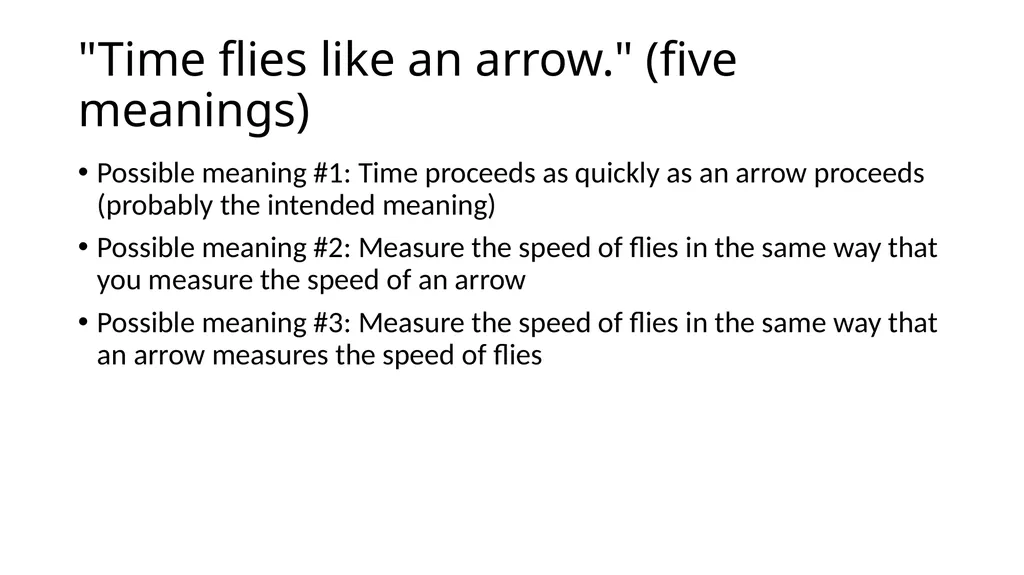
Possible meaning #2: Measure the speed of flies in the same way that you measure the speed of an arrow
Possible meaning #3: Measure the speed of flies in the same way that an arrow measures the speed of flies<br>
Possible meaning #2: Measure the speed of flies in the same way that you measure the speed of an arrow
Possible meaning #3: Measure the speed of flies in the same way that an arrow measures the speed of flies<br>
14
"Time flies like an arrow." (five meanings) Possible meaning #1: Time proceeds as quickly as an arrow proceeds (probably the intended meaning)
Possible meaning #2: Measure the speed of flies in the same way that you measure the speed of an arrow
Possible meaning #3: Measure the speed of flies in the same way that an arrow measures the speed of flies
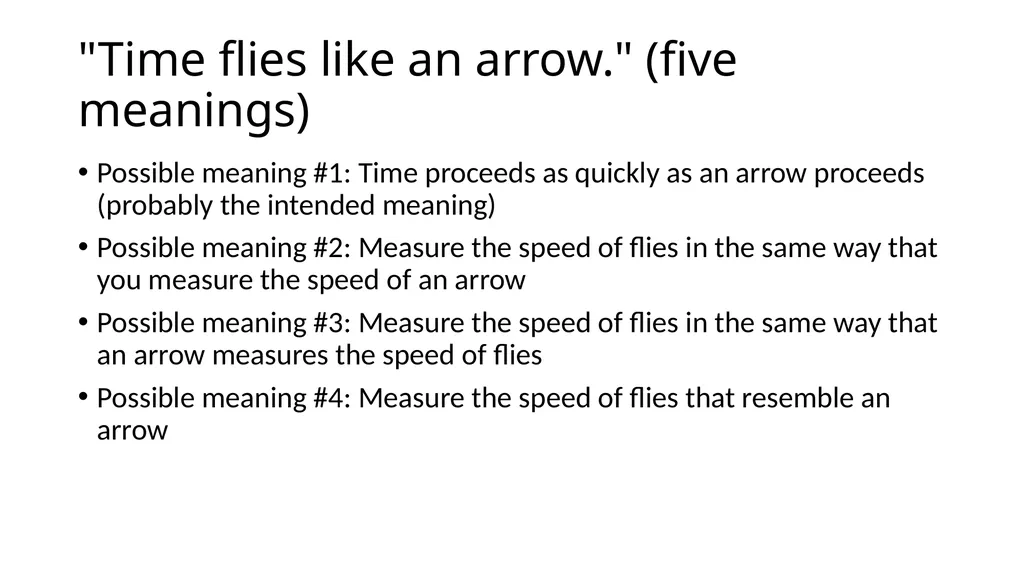
Possible meaning #4: Measure the speed of flies that resemble an arrow<br>
Possible meaning #2: Measure the speed of flies in the same way that you measure the speed of an arrow
Possible meaning #3: Measure the speed of flies in the same way that an arrow measures the speed of flies
Possible meaning #4: Measure the speed of flies that resemble an arrow<br>
15
"Time flies like an arrow." (five meanings) Possible meaning #1: Time proceeds as quickly as an arrow proceeds (probably the intended meaning)
Possible meaning #2: Measure the speed of flies in the same way that you measure the speed of an arrow
Possible meaning #3: Measure the speed of flies in the same way that an arrow measures the speed of flies
Possible meaning #4: Measure the speed of flies that resemble an arrow
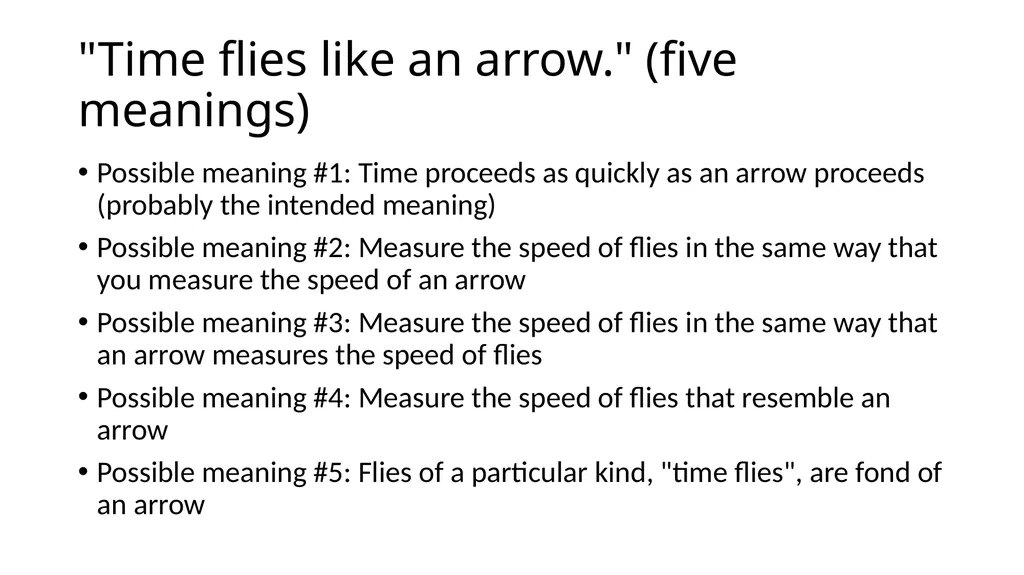
Possible meaning #5: Flies of a particular kind, "time flies", are fond of an arrow<br>
Possible meaning #2: Measure the speed of flies in the same way that you measure the speed of an arrow
Possible meaning #3: Measure the speed of flies in the same way that an arrow measures the speed of flies
Possible meaning #4: Measure the speed of flies that resemble an arrow
Possible meaning #5: Flies of a particular kind, "time flies", are fond of an arrow<br>
16
"Time flies like an arrow." (five meanings) Possible meaning #1: Time proceeds as quickly as an arrow proceeds (probably the intended meaning)
Possible meaning #2: Measure the speed of flies in the same way that you measure the speed of an arrow
Possible meaning #3: Measure the speed of flies in the same way that an arrow measures the speed of flies
Possible meaning #4: Measure the speed of flies that resemble an arrow
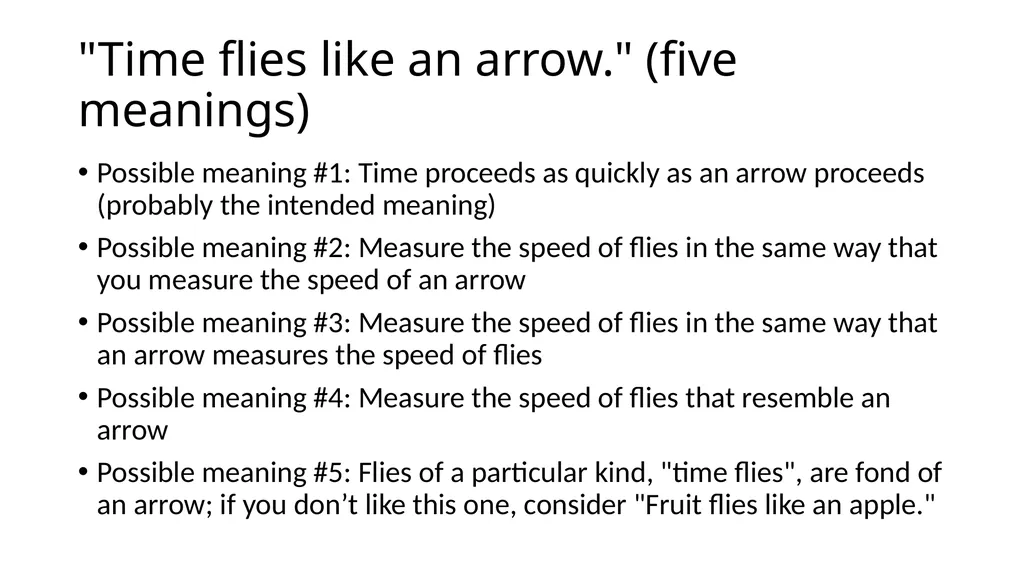
Possible meaning #5: Flies of a particular kind, "time flies", are fond of an arrow; if you don’t like this one, consider "Fruit flies like an apple."<br>
Possible meaning #2: Measure the speed of flies in the same way that you measure the speed of an arrow
Possible meaning #3: Measure the speed of flies in the same way that an arrow measures the speed of flies
Possible meaning #4: Measure the speed of flies that resemble an arrow
Possible meaning #5: Flies of a particular kind, "time flies", are fond of an arrow; if you don’t like this one, consider "Fruit flies like an apple."<br>
17
Syntactic Disambiguation Syntactic disambiguation involves choosing the correct (or most likely) parse tree
The techniques discussed in Chapter 17 of the textbook, including the main parsing algorithm we will cover, are not capable of this
We will cover a solution that determines if a sentence is valid according to a grammar (i.e., it acts as a recognizer)
We will also cover how to expand the solution to find all valid parse trees
Syntactic disambiguation involves knowledge from probabilistic context-free grammars (PCFGs), discussed in Appendix C, and, in some cases, semantic analysis
We will briefly cover probabilistic context-free grammars later in this topic, and the main parsing we will cover can be extended to rely on them for syntactic disambiguation
In our next topic, we will cover the use of first-order logic as a representation for semantics
However, we will not cover computational semantics or semantic parsing in this course (and the on-line draft of the textbook has not filled in the chapter on these topics yet – it is one of three missing chapters)
Even when there is no ambiguity, sentences that are valid according to a grammar may be difficult for humans to parse; we'll see examples known as garden path sentences at the end of this topic<br>
The techniques discussed in Chapter 17 of the textbook, including the main parsing algorithm we will cover, are not capable of this
We will cover a solution that determines if a sentence is valid according to a grammar (i.e., it acts as a recognizer)
We will also cover how to expand the solution to find all valid parse trees
Syntactic disambiguation involves knowledge from probabilistic context-free grammars (PCFGs), discussed in Appendix C, and, in some cases, semantic analysis
We will briefly cover probabilistic context-free grammars later in this topic, and the main parsing we will cover can be extended to rely on them for syntactic disambiguation
In our next topic, we will cover the use of first-order logic as a representation for semantics
However, we will not cover computational semantics or semantic parsing in this course (and the on-line draft of the textbook has not filled in the chapter on these topics yet – it is one of three missing chapters)
Even when there is no ambiguity, sentences that are valid according to a grammar may be difficult for humans to parse; we'll see examples known as garden path sentences at the end of this topic<br>
18
Buffalo The word "buffalo" is ambiguous, with at least three possible meanings if we ignore case
It is the name of a city in New York
It is a type of animal
It can be a verb, roughly meaning "to bully" or "to intimidate"
Here is (perhaps) my favorite sentence from "The Language Instinct":
"Buffalo buffalo Buffalo buffalo buffalo buffalo Buffalo buffalo."
The sentence, probably with different numbers of words, has been attributed to various people earlier than Pinker
To help parse the sentence, here is a sentence I constructed that has a similar structure but is simpler to parse (as a human):
"NYC dogs NYC squirrels encounter chase NYC squirrels."
Also, my friends and I were easily able to conclude that any sentence composed of buffalo one or more times is valid, assuming a typical grammar for English<br>
It is the name of a city in New York
It is a type of animal
It can be a verb, roughly meaning "to bully" or "to intimidate"
Here is (perhaps) my favorite sentence from "The Language Instinct":
"Buffalo buffalo Buffalo buffalo buffalo buffalo Buffalo buffalo."
The sentence, probably with different numbers of words, has been attributed to various people earlier than Pinker
To help parse the sentence, here is a sentence I constructed that has a similar structure but is simpler to parse (as a human):
"NYC dogs NYC squirrels encounter chase NYC squirrels."
Also, my friends and I were easily able to conclude that any sentence composed of buffalo one or more times is valid, assuming a typical grammar for English<br>
19
Top-down and Bottom-up Strategies Syntactic parsing can be viewed as a search problem through the space of all possible parse trees, given a grammar, to find a valid parse tree for a given sentence
To be valid, the parse tree must have the following characteristics:
It must have the words from the sentence in the correct order as its leaves
It must have S (the presumed start symbol) as its root
It must expand all internal nodes according to a rule of the grammar
Two general search strategies for discovering such a parse tree are top-down search and bottom-up search (discussion of these general strategies has been dropped from the current version of the textbook)
A top-down search strategy starts with S and tries all possible expansions, hoping to produce the words from the sentence in the correct order
A backtracking approach, possibly using a depth-first search (DFS), can take a long time due to repeated calculations
Straight-forward backtracking searches can also get stuck in infinite loops due to recursive rules (e.g., the rule VP VP PP in the grammar), although this can be avoided with proper pruning
A breadth-first search (BFS) can possibly help with time, although it would still be exponential, and this strategy can involve unrealistic amounts of memory, since the size of plies in the search tree increase exponentially
A bottom-up strategy starts with the words and tries to build up trees by applying rules from the grammar (where the right-hand side fits), hoping to form an S node that covers all the input
The bottom-up strategy may waste time exploring trees that have no hope in leading to an S<br>
To be valid, the parse tree must have the following characteristics:
It must have the words from the sentence in the correct order as its leaves
It must have S (the presumed start symbol) as its root
It must expand all internal nodes according to a rule of the grammar
Two general search strategies for discovering such a parse tree are top-down search and bottom-up search (discussion of these general strategies has been dropped from the current version of the textbook)
A top-down search strategy starts with S and tries all possible expansions, hoping to produce the words from the sentence in the correct order
A backtracking approach, possibly using a depth-first search (DFS), can take a long time due to repeated calculations
Straight-forward backtracking searches can also get stuck in infinite loops due to recursive rules (e.g., the rule VP VP PP in the grammar), although this can be avoided with proper pruning
A breadth-first search (BFS) can possibly help with time, although it would still be exponential, and this strategy can involve unrealistic amounts of memory, since the size of plies in the search tree increase exponentially
A bottom-up strategy starts with the words and tries to build up trees by applying rules from the grammar (where the right-hand side fits), hoping to form an S node that covers all the input
The bottom-up strategy may waste time exploring trees that have no hope in leading to an S<br>
20
Chart Parsers The speed and memory problems associated with straight-forward top-down and bottom-up approaches can be solved by using dynamic programming strategies
The Viterbi algorithm, discussed during the topic of POS tagging, is also an example of dynamic programming
A parsing algorithm that relies on dynamic programming is known as a chart parser
The chart filled in by the dynamic programming techniques contain solutions to sub-problems (in this case, partial parse trees for constituents of the sentence)
These partial solutions can be combined to solve the problem as a whole
Three widely used chart parsing algorithms in conventional computational linguistics are:
The Cocke-Kasami-Younger (CKY) algorithm, which uses bottom-up dynamic programming
The Earley algorithm, which uses top-down dynamic programming
Generalized chart parsing, which combines top-down and bottom-up approaches
I used to cover the first two algorithms in detail and also briefly discuss the third
Now, we will only cover the CKY algorithm (as does the current edition of the textbook)<br>
The Viterbi algorithm, discussed during the topic of POS tagging, is also an example of dynamic programming
A parsing algorithm that relies on dynamic programming is known as a chart parser
The chart filled in by the dynamic programming techniques contain solutions to sub-problems (in this case, partial parse trees for constituents of the sentence)
These partial solutions can be combined to solve the problem as a whole
Three widely used chart parsing algorithms in conventional computational linguistics are:
The Cocke-Kasami-Younger (CKY) algorithm, which uses bottom-up dynamic programming
The Earley algorithm, which uses top-down dynamic programming
Generalized chart parsing, which combines top-down and bottom-up approaches
I used to cover the first two algorithms in detail and also briefly discuss the third
Now, we will only cover the CKY algorithm (as does the current edition of the textbook)<br>
21
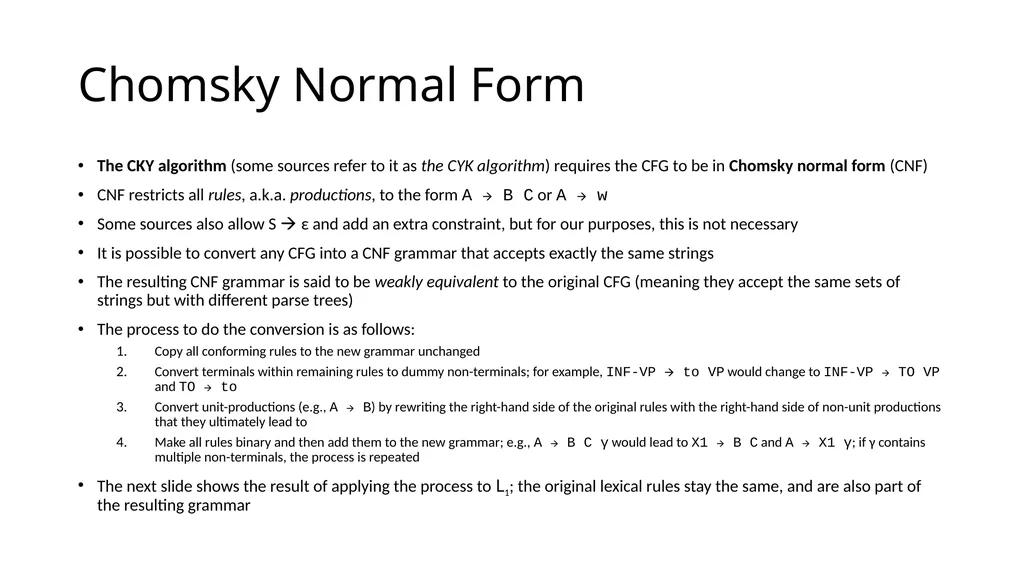
Chomsky Normal Form The CKY algorithm (some sources refer to it as the CYK algorithm) requires the CFG to be in Chomsky normal form (CNF)
CNF restricts all rules, a.k.a. productions, to the form A B C or A w
Some sources also allow S ε and add an extra constraint, but for our purposes, this is not necessary
It is possible to convert any CFG into a CNF grammar that accepts exactly the same strings
The resulting CNF grammar is said to be weakly equivalent to the original CFG (meaning they accept the same sets of strings but with different parse trees)
The process to do the conversion is as follows:
Copy all conforming rules to the new grammar unchanged
Convert terminals within remaining rules to dummy non-terminals; for example, INF-VP to VP would change to INF-VP TO VP and TO to
Convert unit-productions (e.g., A B) by rewriting the right-hand side of the original rules with the right-hand side of non-unit productions that they ultimately lead to
Make all rules binary and then add them to the new grammar; e.g., A B C γ would lead to X1 B C and A X1 γ; if γ contains multiple non-terminals, the process is repeated
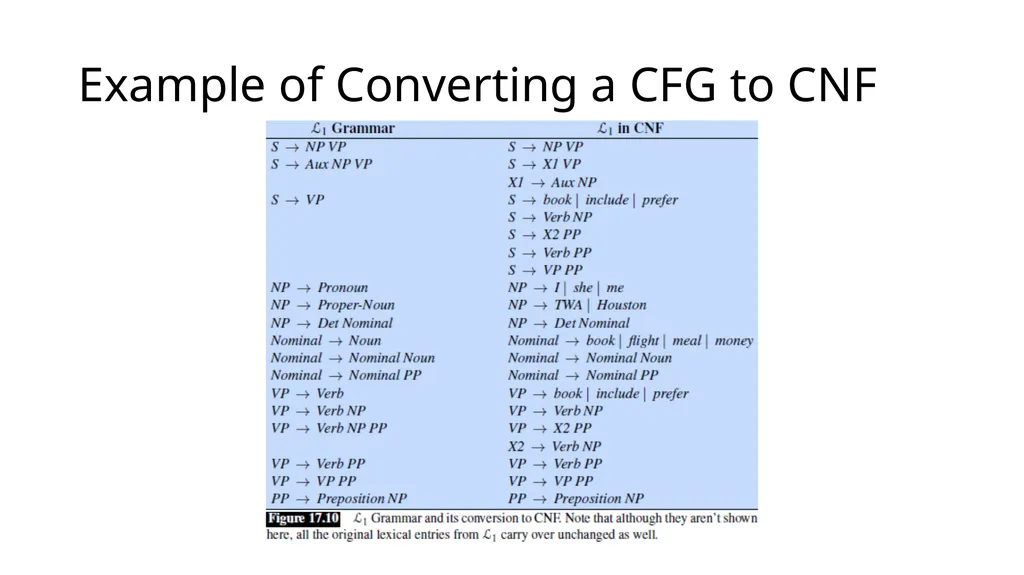
The next slide shows the result of applying the process to L1; the original lexical rules stay the same, and are also part of the resulting grammar<br>
CNF restricts all rules, a.k.a. productions, to the form A B C or A w
Some sources also allow S ε and add an extra constraint, but for our purposes, this is not necessary
It is possible to convert any CFG into a CNF grammar that accepts exactly the same strings
The resulting CNF grammar is said to be weakly equivalent to the original CFG (meaning they accept the same sets of strings but with different parse trees)
The process to do the conversion is as follows:
Copy all conforming rules to the new grammar unchanged
Convert terminals within remaining rules to dummy non-terminals; for example, INF-VP to VP would change to INF-VP TO VP and TO to
Convert unit-productions (e.g., A B) by rewriting the right-hand side of the original rules with the right-hand side of non-unit productions that they ultimately lead to
Make all rules binary and then add them to the new grammar; e.g., A B C γ would lead to X1 B C and A X1 γ; if γ contains multiple non-terminals, the process is repeated
The next slide shows the result of applying the process to L1; the original lexical rules stay the same, and are also part of the resulting grammar<br>
22
Example of Converting a CFG to CNF<br>
23
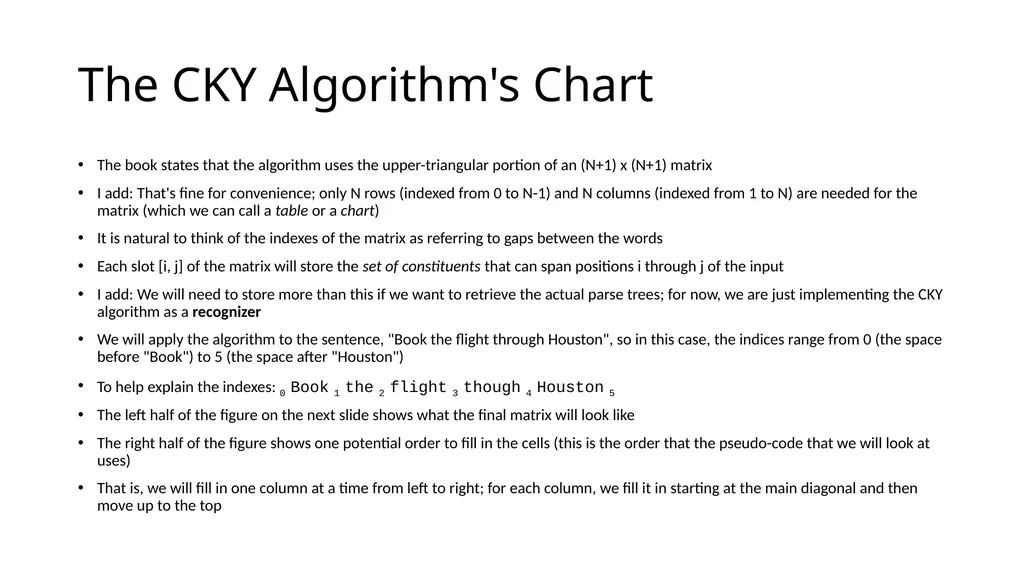
The CKY Algorithm's Chart The book states that the algorithm uses the upper-triangular portion of an (N+1) x (N+1) matrix
I add: That's fine for convenience; only N rows (indexed from 0 to N-1) and N columns (indexed from 1 to N) are needed for the matrix (which we can call a table or a chart)
It is natural to think of the indexes of the matrix as referring to gaps between the words
Each slot [i, j] of the matrix will store the set of constituents that can span positions i through j of the input
I add: We will need to store more than this if we want to retrieve the actual parse trees; for now, we are just implementing the CKY algorithm as a recognizer
We will apply the algorithm to the sentence, "Book the flight through Houston", so in this case, the indices range from 0 (the space before "Book") to 5 (the space after "Houston")
To help explain the indexes: 0 Book 1 the 2 flight 3 though 4 Houston 5
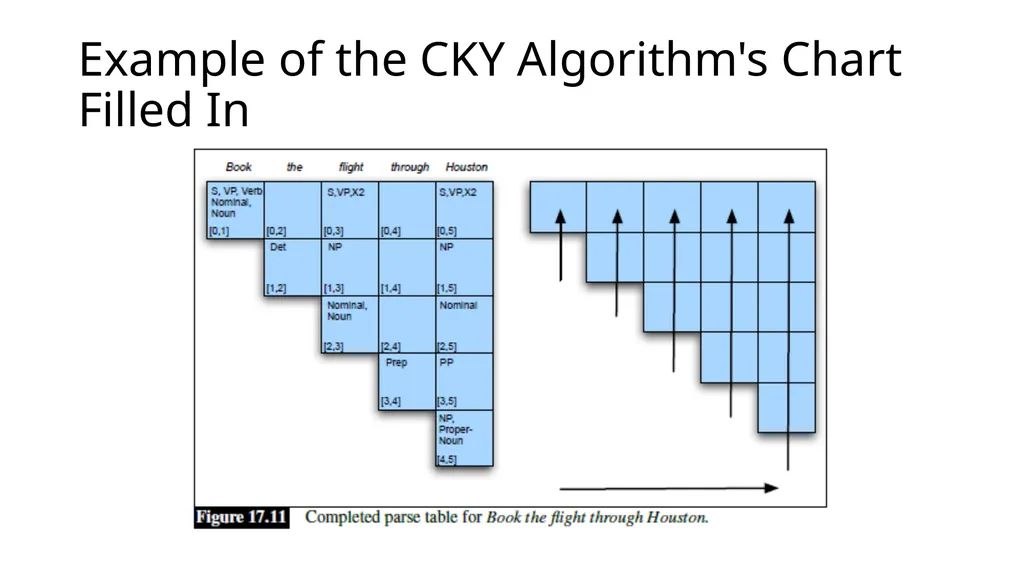
The left half of the figure on the next slide shows what the final matrix will look like
The right half of the figure shows one potential order to fill in the cells (this is the order that the pseudo-code that we will look at uses)
That is, we will fill in one column at a time from left to right; for each column, we fill it in starting at the main diagonal and then move up to the top<br>
I add: That's fine for convenience; only N rows (indexed from 0 to N-1) and N columns (indexed from 1 to N) are needed for the matrix (which we can call a table or a chart)
It is natural to think of the indexes of the matrix as referring to gaps between the words
Each slot [i, j] of the matrix will store the set of constituents that can span positions i through j of the input
I add: We will need to store more than this if we want to retrieve the actual parse trees; for now, we are just implementing the CKY algorithm as a recognizer
We will apply the algorithm to the sentence, "Book the flight through Houston", so in this case, the indices range from 0 (the space before "Book") to 5 (the space after "Houston")
To help explain the indexes: 0 Book 1 the 2 flight 3 though 4 Houston 5
The left half of the figure on the next slide shows what the final matrix will look like
The right half of the figure shows one potential order to fill in the cells (this is the order that the pseudo-code that we will look at uses)
That is, we will fill in one column at a time from left to right; for each column, we fill it in starting at the main diagonal and then move up to the top<br>
24
Example of the CKY Algorithm's Chart Filled In<br>
25
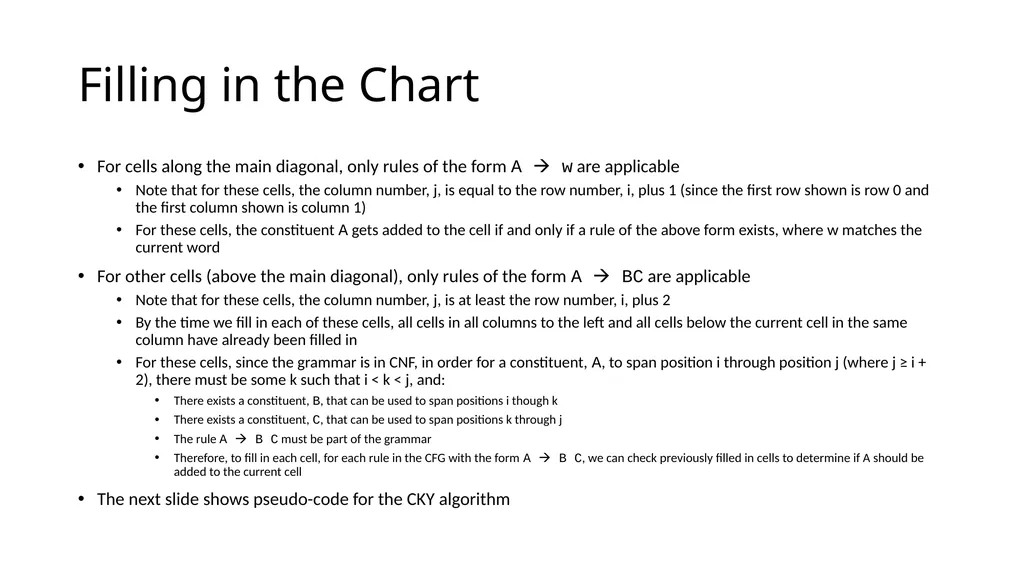
Filling in the Chart For cells along the main diagonal, only rules of the form A w are applicable
Note that for these cells, the column number, j, is equal to the row number, i, plus 1 (since the first row shown is row 0 and the first column shown is column 1)
For these cells, the constituent A gets added to the cell if and only if a rule of the above form exists, where w matches the current word
For other cells (above the main diagonal), only rules of the form A BC are applicable
Note that for these cells, the column number, j, is at least the row number, i, plus 2
By the time we fill in each of these cells, all cells in all columns to the left and all cells below the current cell in the same column have already been filled in
For these cells, since the grammar is in CNF, in order for a constituent, A, to span position i through position j (where j ≥ i + 2), there must be some k such that i < k < j, and:
There exists a constituent, B, that can be used to span positions i though k
There exists a constituent, C, that can be used to span positions k through j
The rule A B C must be part of the grammar
Therefore, to fill in each cell, for each rule in the CFG with the form A B C, we can check previously filled in cells to determine if A should be added to the current cell
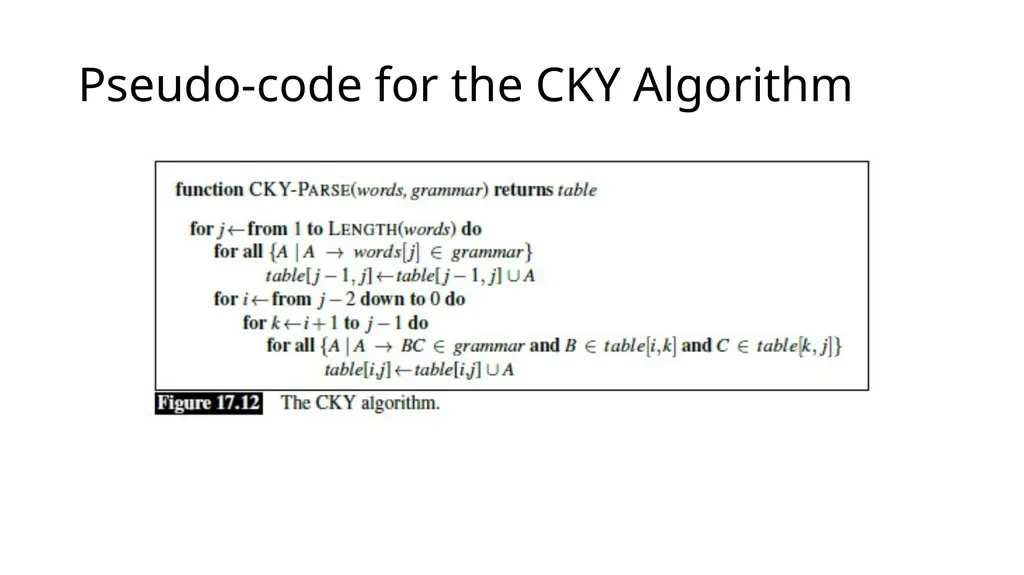
The next slide shows pseudo-code for the CKY algorithm<br>
Note that for these cells, the column number, j, is equal to the row number, i, plus 1 (since the first row shown is row 0 and the first column shown is column 1)
For these cells, the constituent A gets added to the cell if and only if a rule of the above form exists, where w matches the current word
For other cells (above the main diagonal), only rules of the form A BC are applicable
Note that for these cells, the column number, j, is at least the row number, i, plus 2
By the time we fill in each of these cells, all cells in all columns to the left and all cells below the current cell in the same column have already been filled in
For these cells, since the grammar is in CNF, in order for a constituent, A, to span position i through position j (where j ≥ i + 2), there must be some k such that i < k < j, and:
There exists a constituent, B, that can be used to span positions i though k
There exists a constituent, C, that can be used to span positions k through j
The rule A B C must be part of the grammar
Therefore, to fill in each cell, for each rule in the CFG with the form A B C, we can check previously filled in cells to determine if A should be added to the current cell
The next slide shows pseudo-code for the CKY algorithm<br>
26
Pseudo-code for the CKY Algorithm<br>
27
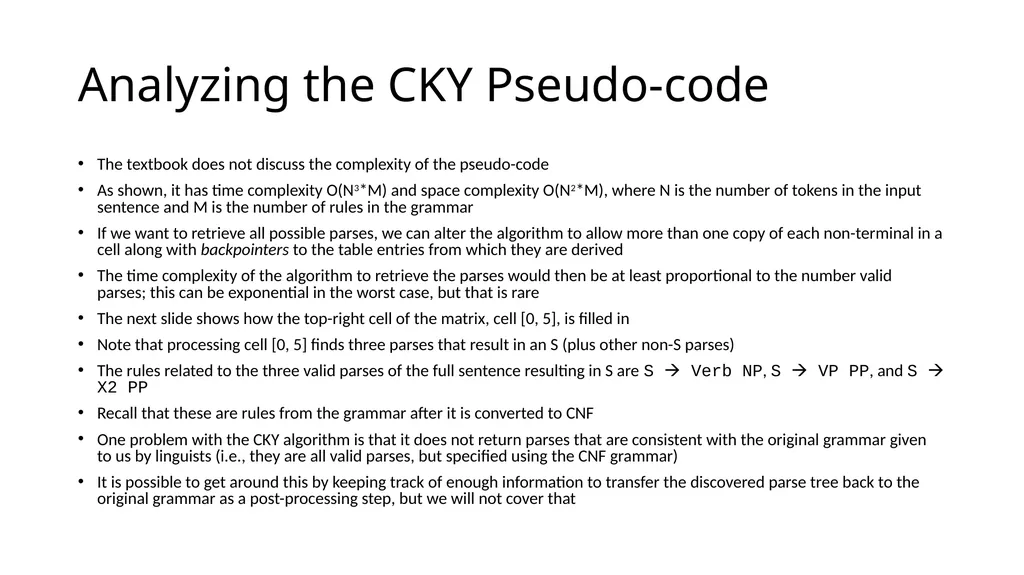
Analyzing the CKY Pseudo-code The textbook does not discuss the complexity of the pseudo-code
As shown, it has time complexity O(N3*M) and space complexity O(N2*M), where N is the number of tokens in the input sentence and M is the number of rules in the grammar
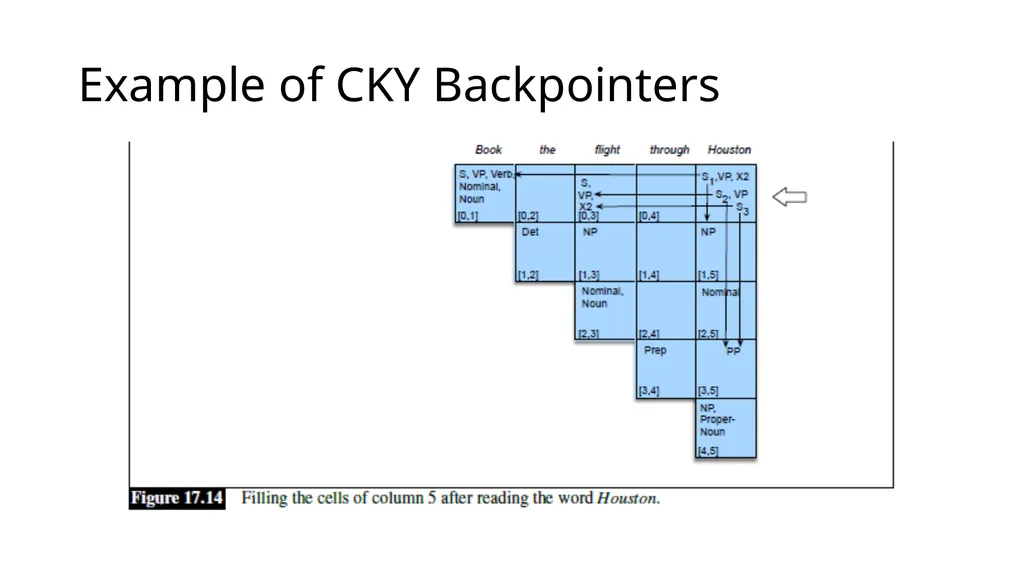
If we want to retrieve all possible parses, we can alter the algorithm to allow more than one copy of each non-terminal in a cell along with backpointers to the table entries from which they are derived
The time complexity of the algorithm to retrieve the parses would then be at least proportional to the number valid parses; this can be exponential in the worst case, but that is rare
The next slide shows how the top-right cell of the matrix, cell [0, 5], is filled in
Note that processing cell [0, 5] finds three parses that result in an S (plus other non-S parses)
The rules related to the three valid parses of the full sentence resulting in S are S Verb NP, S VP PP, and S X2 PP
Recall that these are rules from the grammar after it is converted to CNF
One problem with the CKY algorithm is that it does not return parses that are consistent with the original grammar given to us by linguists (i.e., they are all valid parses, but specified using the CNF grammar)
It is possible to get around this by keeping track of enough information to transfer the discovered parse tree back to the original grammar as a post-processing step, but we will not cover that<br>
As shown, it has time complexity O(N3*M) and space complexity O(N2*M), where N is the number of tokens in the input sentence and M is the number of rules in the grammar
If we want to retrieve all possible parses, we can alter the algorithm to allow more than one copy of each non-terminal in a cell along with backpointers to the table entries from which they are derived
The time complexity of the algorithm to retrieve the parses would then be at least proportional to the number valid parses; this can be exponential in the worst case, but that is rare
The next slide shows how the top-right cell of the matrix, cell [0, 5], is filled in
Note that processing cell [0, 5] finds three parses that result in an S (plus other non-S parses)
The rules related to the three valid parses of the full sentence resulting in S are S Verb NP, S VP PP, and S X2 PP
Recall that these are rules from the grammar after it is converted to CNF
One problem with the CKY algorithm is that it does not return parses that are consistent with the original grammar given to us by linguists (i.e., they are all valid parses, but specified using the CNF grammar)
It is possible to get around this by keeping track of enough information to transfer the discovered parse tree back to the original grammar as a post-processing step, but we will not cover that<br>
28
Example of CKY Backpointers<br>
29
Some Other Parsing Algorithms Some chart parsing algorithms, such as the Earley algorithm, parse sentences according to the original grammar
I used to cover this approach, but it is no longer discussed in the book, and I dropped it (along with many other topics) to save time
An earlier draft of the textbook covered CCG parsing, which can be used with lexicalized grammars, but this has also been dropped now
When we covered grammar, we discussed a more general form of augmented grammar (as opposed to lexicalized grammars), and we will not cover CCG parsing
The current draft of the textbook covers span-based neural constituency parsing, which involves "a simple neural extension of the CKY algorithm", but we will not cover this
A separate chapter of the textbook covers dependency parsing
We briefly discussed dependency grammars when we covered grammar, but we will not cover dependency parsing<br>
I used to cover this approach, but it is no longer discussed in the book, and I dropped it (along with many other topics) to save time
An earlier draft of the textbook covered CCG parsing, which can be used with lexicalized grammars, but this has also been dropped now
When we covered grammar, we discussed a more general form of augmented grammar (as opposed to lexicalized grammars), and we will not cover CCG parsing
The current draft of the textbook covers span-based neural constituency parsing, which involves "a simple neural extension of the CKY algorithm", but we will not cover this
A separate chapter of the textbook covers dependency parsing
We briefly discussed dependency grammars when we covered grammar, but we will not cover dependency parsing<br>
30
Probabilistic Context-free Grammars The CKY algorithm as discussed so far can serve as a recognizer, or with backpointers, it can discover all valid parse trees for an input sentence given a CFG in CNF
However, real-world parsers are generally expected to output a single parse (or parse tree)
As mentioned earlier in the topic, when multiple valid parse trees exist for a sentence, the task of choosing one is known as syntactic disambiguation
One formalism that can help with this is a probabilistic context-free grammar (PCFG)
A PCFG augments a regular CFG by adding a conditional probability to each rule
Such a rule can be expressed: A β [p], where A and β have the same meaning as before (A is a single non-terminal and β is a sequence of one or more terminals and non-terminals)
The textbook says there are three ways to express, but I think only two make sense:
P(A β) <------ I say this form does not make sense
P(A β | A)
P(RHS | LHS)
The sum of the conditional probabilities over all rules stating possible forms for any particular non-terminal on the left-hand side of the arrow must sum to 1<br>
However, real-world parsers are generally expected to output a single parse (or parse tree)
As mentioned earlier in the topic, when multiple valid parse trees exist for a sentence, the task of choosing one is known as syntactic disambiguation
One formalism that can help with this is a probabilistic context-free grammar (PCFG)
A PCFG augments a regular CFG by adding a conditional probability to each rule
Such a rule can be expressed: A β [p], where A and β have the same meaning as before (A is a single non-terminal and β is a sequence of one or more terminals and non-terminals)
The textbook says there are three ways to express, but I think only two make sense:
P(A β) <------ I say this form does not make sense
P(A β | A)
P(RHS | LHS)
The sum of the conditional probabilities over all rules stating possible forms for any particular non-terminal on the left-hand side of the arrow must sum to 1<br>
31
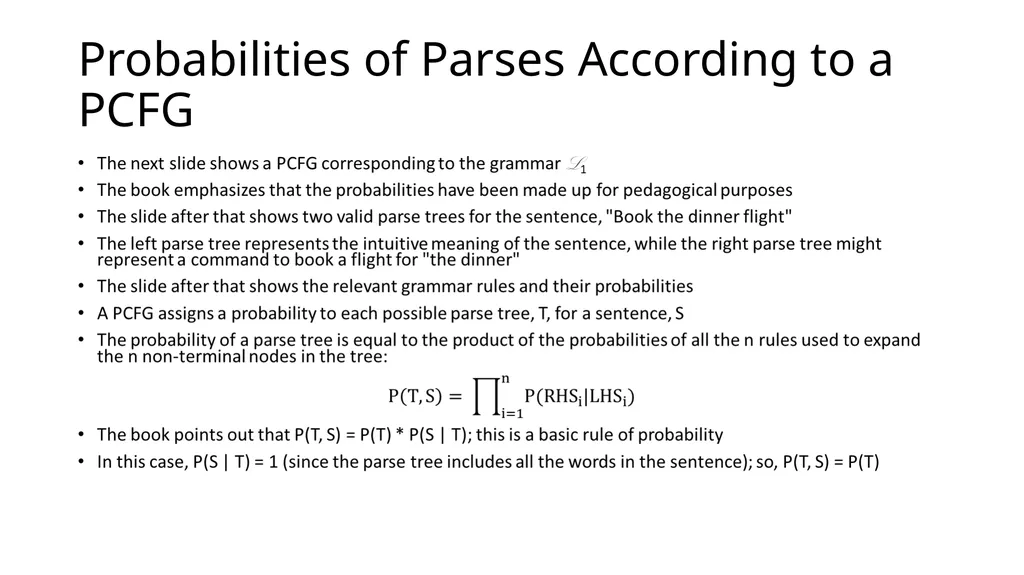
Probabilities of Parses According to a PCFG<br>
32
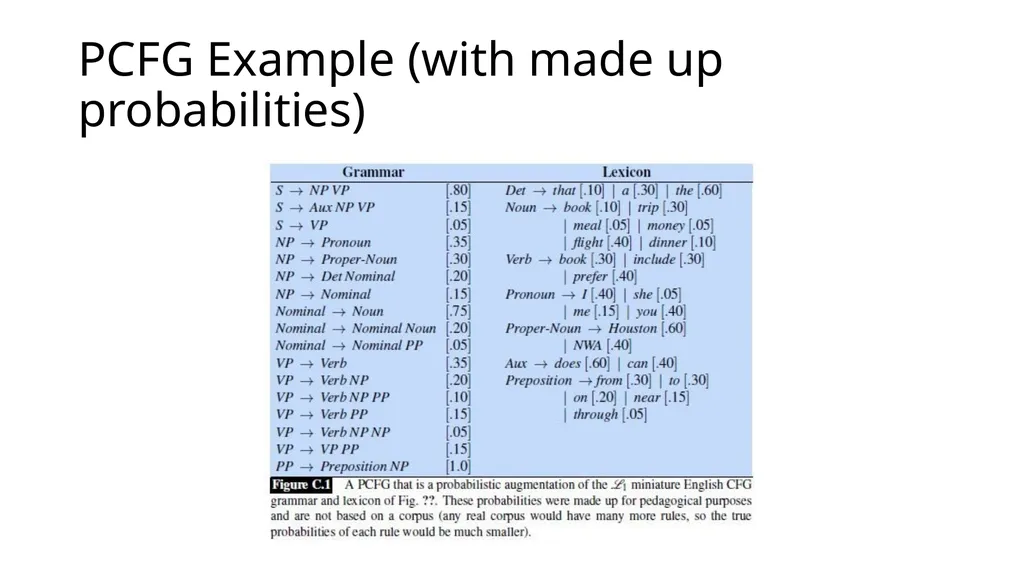
PCFG Example (with made up probabilities)<br>
33
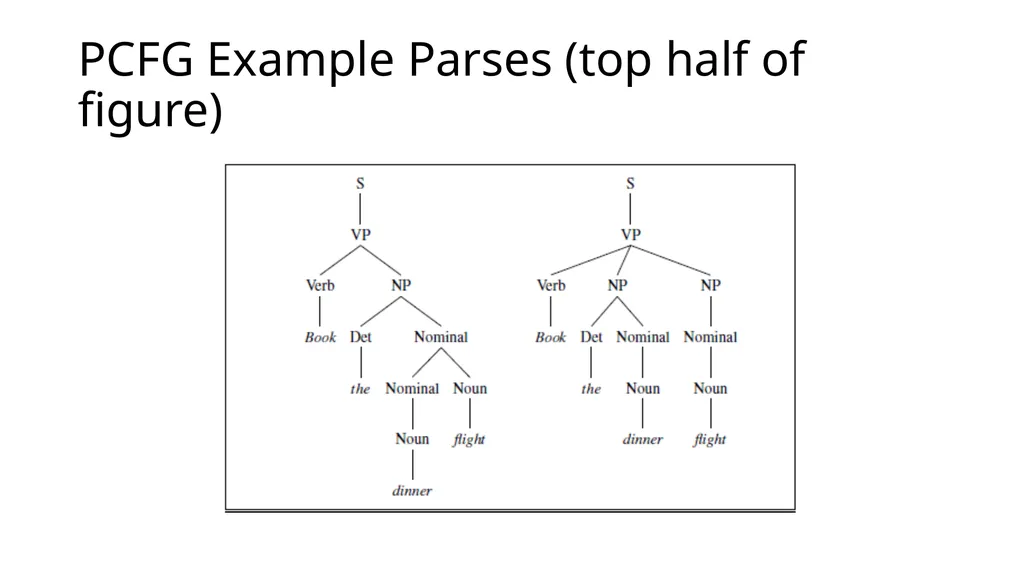
PCFG Example Parses (top half of figure)<br>
34
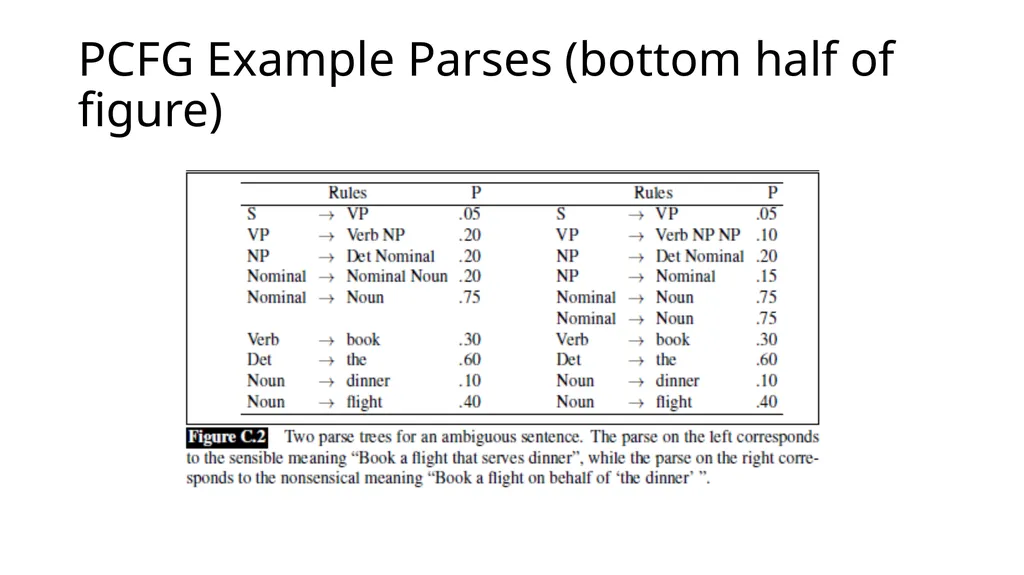
PCFG Example Parses (bottom half of figure)<br>
35
Estimating PCFG Probabilities In order to create a PCFG, after producing the grammar rules, we must estimate the probability associated with each rule
The simplest way is to base all estimates on a treebank (e.g., the Penn Treebank)
We can estimate P(A B | A) to be Count(A B) / Count(A)
This is another example of maximum likelihood estimation (MLE), also seen during our topics on N-grams and POS tagging
If no treebank is available, it is possible to use a corpus together with a non-probabilistic parser to estimate probabilities for rules
This can be done using the expectation maximization (EM) algorithm, which had several important uses in conventional, statistical NLP
We briefly mentioned it when discussing HMMs for POS tagging (it can be used to estimate the parameters of an HMM without labeled training data)
The current edition of the textbook covers this use of EM in Appendix A (related to HMMs); we will not cover the details<br>
The simplest way is to base all estimates on a treebank (e.g., the Penn Treebank)
We can estimate P(A B | A) to be Count(A B) / Count(A)
This is another example of maximum likelihood estimation (MLE), also seen during our topics on N-grams and POS tagging
If no treebank is available, it is possible to use a corpus together with a non-probabilistic parser to estimate probabilities for rules
This can be done using the expectation maximization (EM) algorithm, which had several important uses in conventional, statistical NLP
We briefly mentioned it when discussing HMMs for POS tagging (it can be used to estimate the parameters of an HMM without labeled training data)
The current edition of the textbook covers this use of EM in Appendix A (related to HMMs); we will not cover the details<br>
36
Using a PCFG to Choose a Parse Tree In my opinion, the book does not fully explain the process of using a PCFG to choose a parse tree, although it is pretty intuitive
Really, we want to choose the parse tree that maximizes P(T | S)
Use Bayes’ Law, we obtain: P(T | S) = P(S | T) * P(T) / P(S)
P(S) is constant over consistent trees (valid trees according to the PCFG), and P(S |T) is 1
So, maximizing P(T | S) is equivalent to maximizing P(T)
Once we find all valid parse trees, we can then choose the one that has the highest probability according to the PCFG
Therefore, we can find all valid parses according to the PCFG, calculate the probability of each, and choose the one with highest probability<br>
Really, we want to choose the parse tree that maximizes P(T | S)
Use Bayes’ Law, we obtain: P(T | S) = P(S | T) * P(T) / P(S)
P(S) is constant over consistent trees (valid trees according to the PCFG), and P(S |T) is 1
So, maximizing P(T | S) is equivalent to maximizing P(T)
Once we find all valid parse trees, we can then choose the one that has the highest probability according to the PCFG
Therefore, we can find all valid parses according to the PCFG, calculate the probability of each, and choose the one with highest probability<br>
37
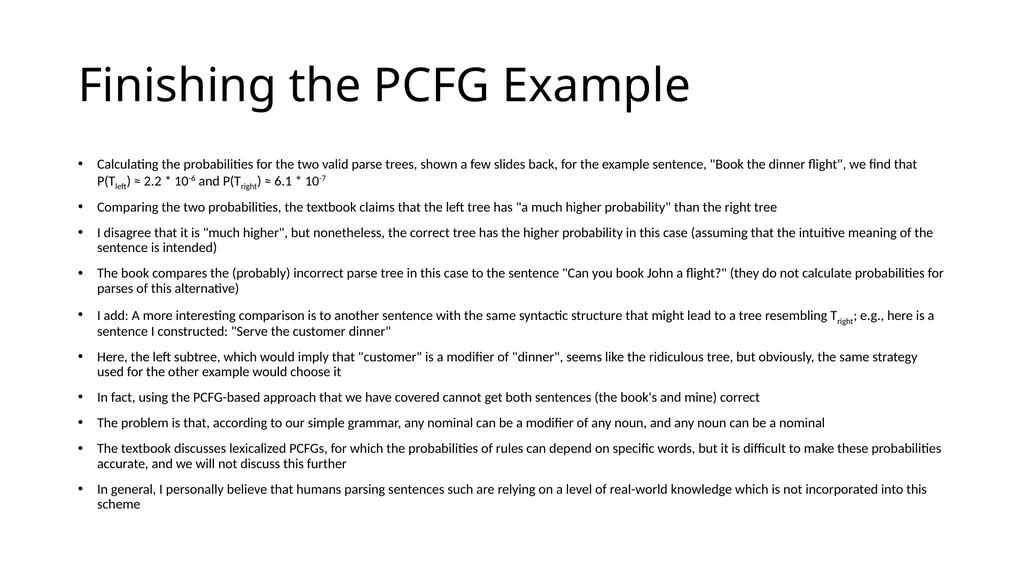
Finishing the PCFG Example Calculating the probabilities for the two valid parse trees, shown a few slides back, for the example sentence, "Book the dinner flight", we find that P(Tleft) ≈ 2.2 * 10-6 and P(Tright) ≈ 6.1 * 10-7
Comparing the two probabilities, the textbook claims that the left tree has "a much higher probability" than the right tree
I disagree that it is "much higher", but nonetheless, the correct tree has the higher probability in this case (assuming that the intuitive meaning of the sentence is intended)
The book compares the (probably) incorrect parse tree in this case to the sentence "Can you book John a flight?" (they do not calculate probabilities for parses of this alternative)
I add: A more interesting comparison is to another sentence with the same syntactic structure that might lead to a tree resembling Tright; e.g., here is a sentence I constructed: "Serve the customer dinner"
Here, the left subtree, which would imply that "customer" is a modifier of "dinner", seems like the ridiculous tree, but obviously, the same strategy used for the other example would choose it
In fact, using the PCFG-based approach that we have covered cannot get both sentences (the book's and mine) correct
The problem is that, according to our simple grammar, any nominal can be a modifier of any noun, and any noun can be a nominal
The textbook discusses lexicalized PCFGs, for which the probabilities of rules can depend on specific words, but it is difficult to make these probabilities accurate, and we will not discuss this further
In general, I personally believe that humans parsing sentences such are relying on a level of real-world knowledge which is not incorporated into this scheme<br>
Comparing the two probabilities, the textbook claims that the left tree has "a much higher probability" than the right tree
I disagree that it is "much higher", but nonetheless, the correct tree has the higher probability in this case (assuming that the intuitive meaning of the sentence is intended)
The book compares the (probably) incorrect parse tree in this case to the sentence "Can you book John a flight?" (they do not calculate probabilities for parses of this alternative)
I add: A more interesting comparison is to another sentence with the same syntactic structure that might lead to a tree resembling Tright; e.g., here is a sentence I constructed: "Serve the customer dinner"
Here, the left subtree, which would imply that "customer" is a modifier of "dinner", seems like the ridiculous tree, but obviously, the same strategy used for the other example would choose it
In fact, using the PCFG-based approach that we have covered cannot get both sentences (the book's and mine) correct
The problem is that, according to our simple grammar, any nominal can be a modifier of any noun, and any noun can be a nominal
The textbook discusses lexicalized PCFGs, for which the probabilities of rules can depend on specific words, but it is difficult to make these probabilities accurate, and we will not discuss this further
In general, I personally believe that humans parsing sentences such are relying on a level of real-world knowledge which is not incorporated into this scheme<br>
38
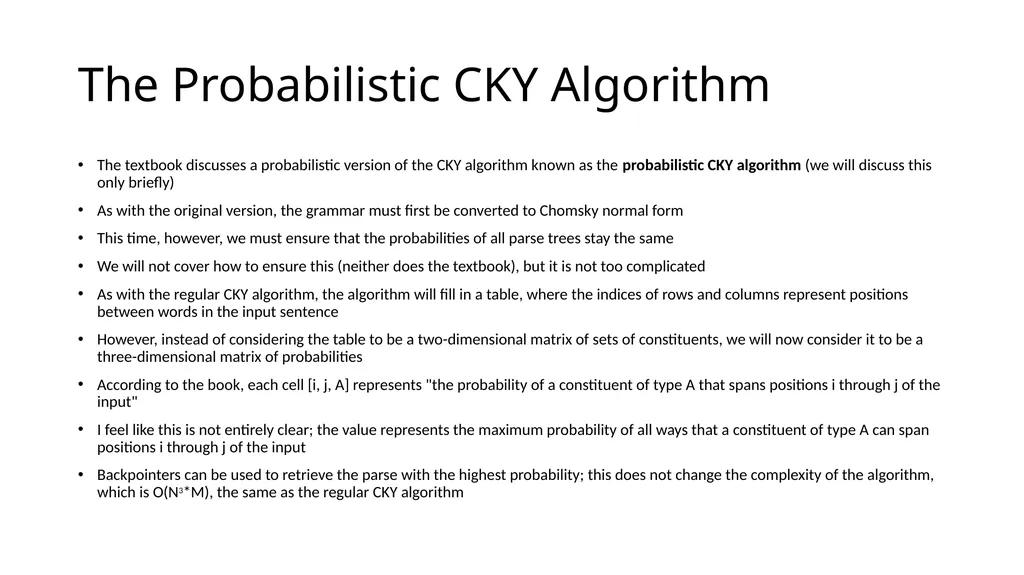
The Probabilistic CKY Algorithm The textbook discusses a probabilistic version of the CKY algorithm known as the probabilistic CKY algorithm (we will discuss this only briefly)
As with the original version, the grammar must first be converted to Chomsky normal form
This time, however, we must ensure that the probabilities of all parse trees stay the same
We will not cover how to ensure this (neither does the textbook), but it is not too complicated
As with the regular CKY algorithm, the algorithm will fill in a table, where the indices of rows and columns represent positions between words in the input sentence
However, instead of considering the table to be a two-dimensional matrix of sets of constituents, we will now consider it to be a three-dimensional matrix of probabilities
According to the book, each cell [i, j, A] represents "the probability of a constituent of type A that spans positions i through j of the input"
I feel like this is not entirely clear; the value represents the maximum probability of all ways that a constituent of type A can span positions i through j of the input
Backpointers can be used to retrieve the parse with the highest probability; this does not change the complexity of the algorithm, which is O(N3*M), the same as the regular CKY algorithm<br>
As with the original version, the grammar must first be converted to Chomsky normal form
This time, however, we must ensure that the probabilities of all parse trees stay the same
We will not cover how to ensure this (neither does the textbook), but it is not too complicated
As with the regular CKY algorithm, the algorithm will fill in a table, where the indices of rows and columns represent positions between words in the input sentence
However, instead of considering the table to be a two-dimensional matrix of sets of constituents, we will now consider it to be a three-dimensional matrix of probabilities
According to the book, each cell [i, j, A] represents "the probability of a constituent of type A that spans positions i through j of the input"
I feel like this is not entirely clear; the value represents the maximum probability of all ways that a constituent of type A can span positions i through j of the input
Backpointers can be used to retrieve the parse with the highest probability; this does not change the complexity of the algorithm, which is O(N3*M), the same as the regular CKY algorithm<br>
39
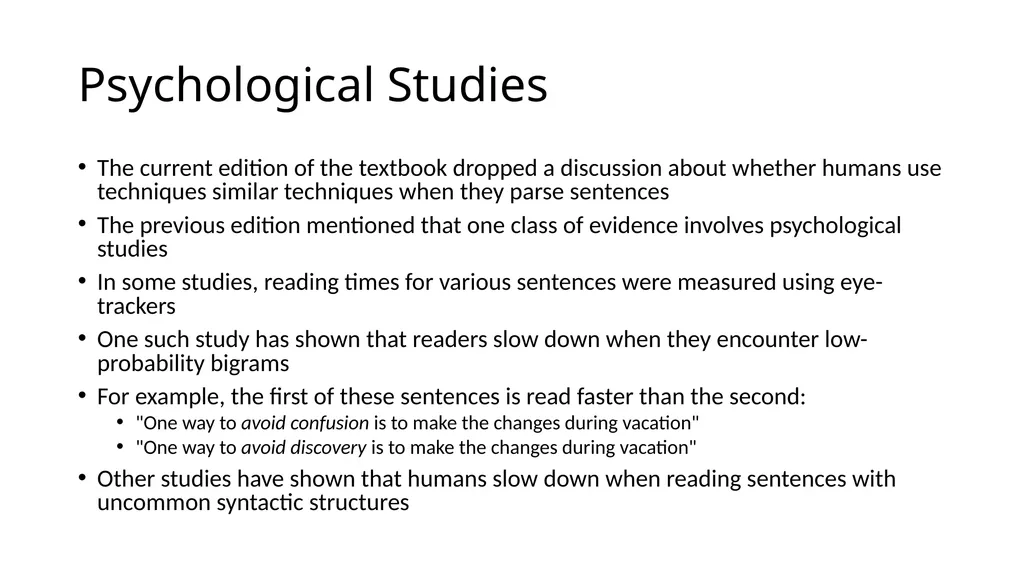
Psychological Studies The current edition of the textbook dropped a discussion about whether humans use techniques similar techniques when they parse sentences
The previous edition mentioned that one class of evidence involves psychological studies
In some studies, reading times for various sentences were measured using eye-trackers
One such study has shown that readers slow down when they encounter low-probability bigrams
For example, the first of these sentences is read faster than the second:
"One way to avoid confusion is to make the changes during vacation"
"One way to avoid discovery is to make the changes during vacation"
Other studies have shown that humans slow down when reading sentences with uncommon syntactic structures<br>
The previous edition mentioned that one class of evidence involves psychological studies
In some studies, reading times for various sentences were measured using eye-trackers
One such study has shown that readers slow down when they encounter low-probability bigrams
For example, the first of these sentences is read faster than the second:
"One way to avoid confusion is to make the changes during vacation"
"One way to avoid discovery is to make the changes during vacation"
Other studies have shown that humans slow down when reading sentences with uncommon syntactic structures<br>
40
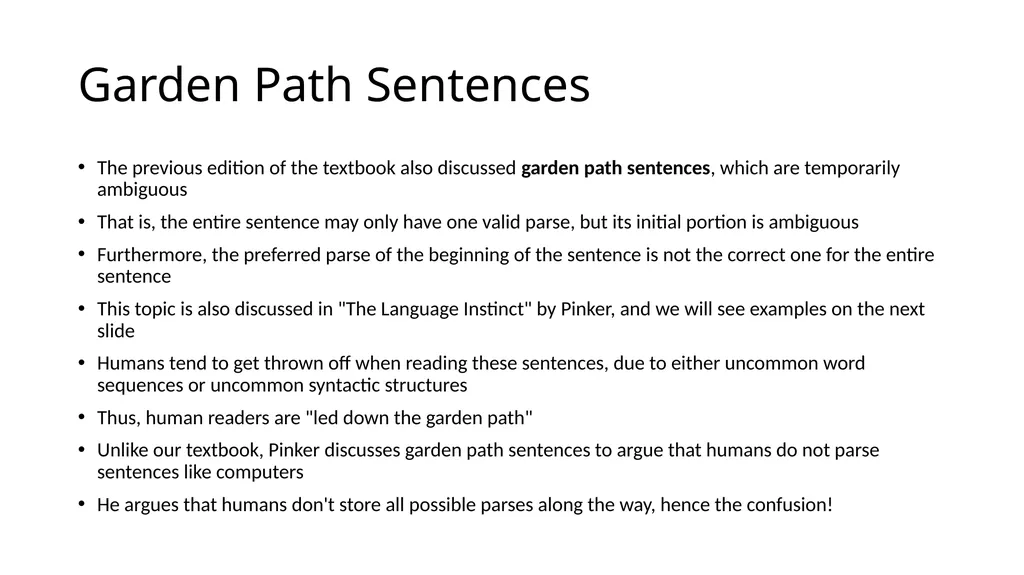
Garden Path Sentences The previous edition of the textbook also discussed garden path sentences, which are temporarily ambiguous
That is, the entire sentence may only have one valid parse, but its initial portion is ambiguous
Furthermore, the preferred parse of the beginning of the sentence is not the correct one for the entire sentence
This topic is also discussed in "The Language Instinct" by Pinker, and we will see examples on the next slide
Humans tend to get thrown off when reading these sentences, due to either uncommon word sequences or uncommon syntactic structures
Thus, human readers are "led down the garden path"
Unlike our textbook, Pinker discusses garden path sentences to argue that humans do not parse sentences like computers
He argues that humans don't store all possible parses along the way, hence the confusion!<br>
That is, the entire sentence may only have one valid parse, but its initial portion is ambiguous
Furthermore, the preferred parse of the beginning of the sentence is not the correct one for the entire sentence
This topic is also discussed in "The Language Instinct" by Pinker, and we will see examples on the next slide
Humans tend to get thrown off when reading these sentences, due to either uncommon word sequences or uncommon syntactic structures
Thus, human readers are "led down the garden path"
Unlike our textbook, Pinker discusses garden path sentences to argue that humans do not parse sentences like computers
He argues that humans don't store all possible parses along the way, hence the confusion!<br>
41
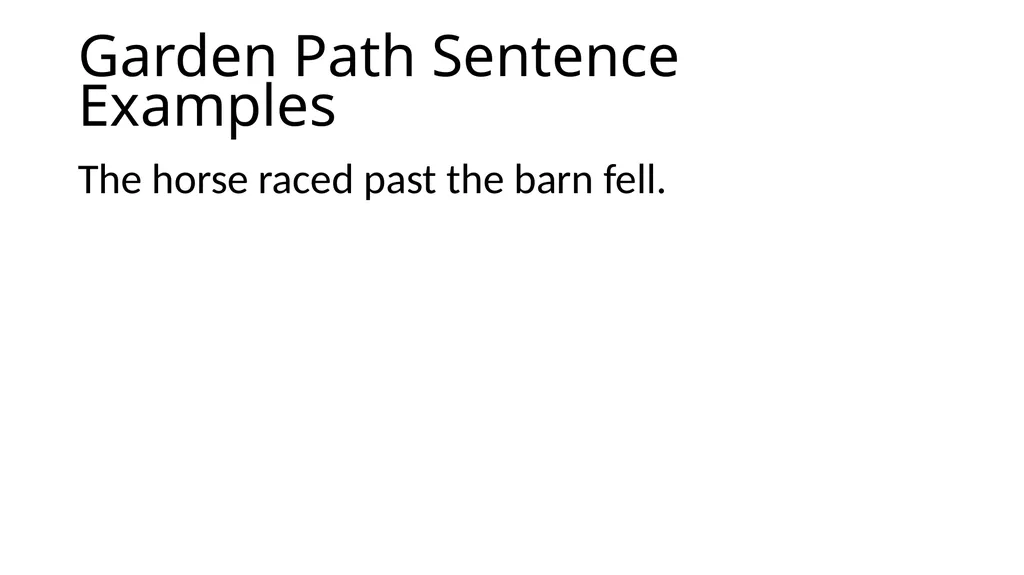
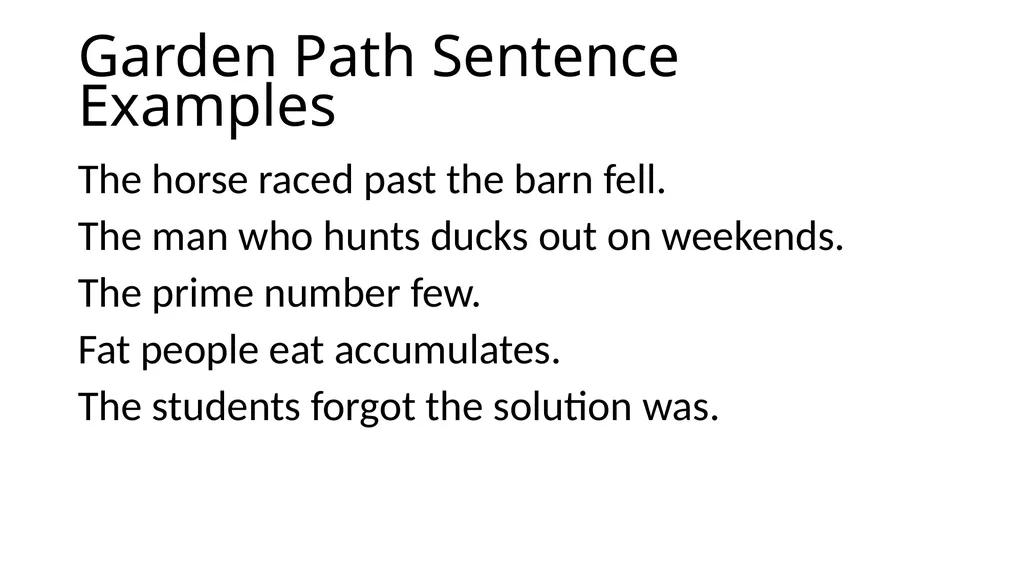
Garden Path Sentence Examples The horse raced past the barn fell.<br>
42
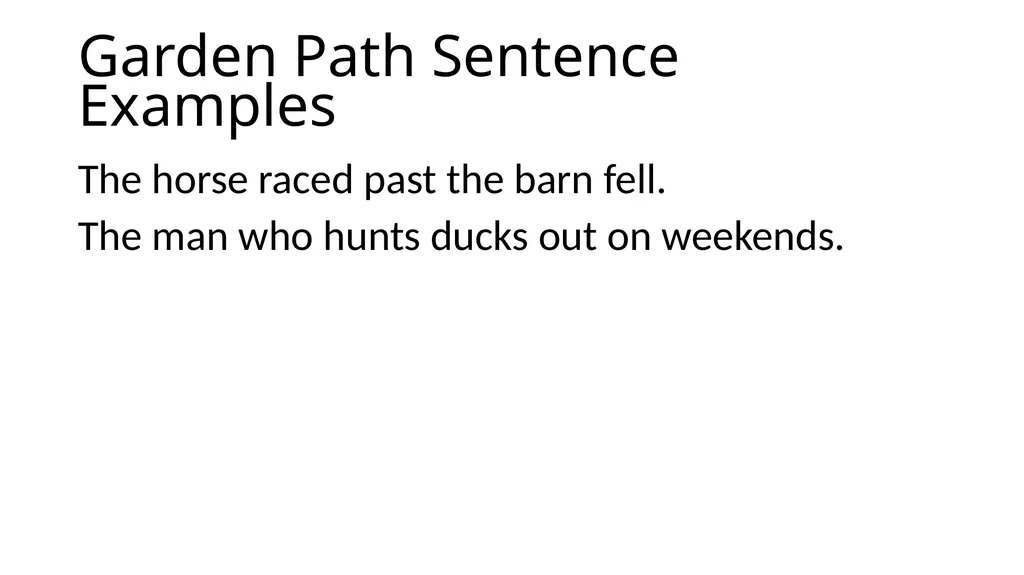
Garden Path Sentence Examples The horse raced past the barn fell.
The man who hunts ducks out on weekends.<br>
The man who hunts ducks out on weekends.<br>
43
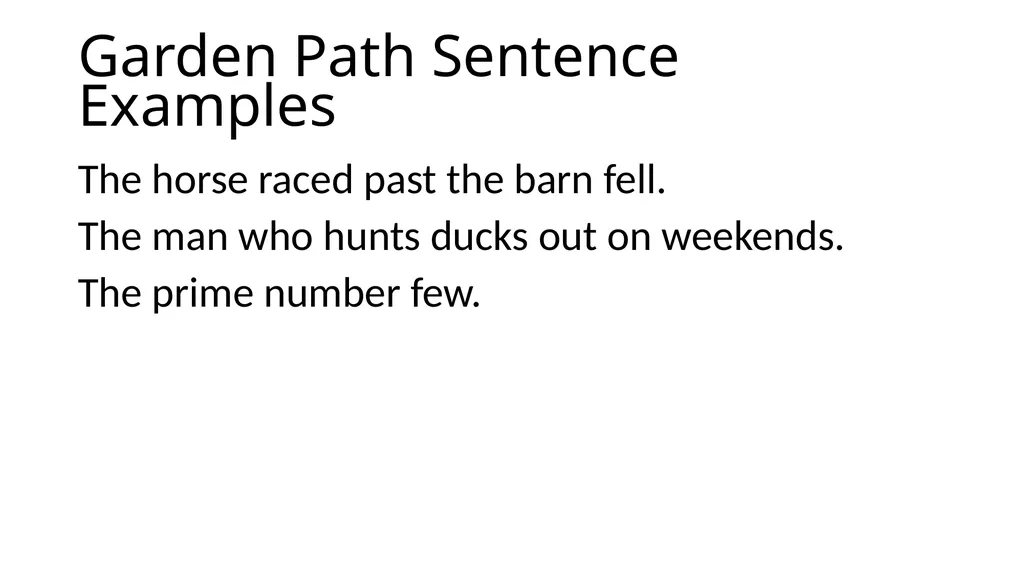
Garden Path Sentence Examples The horse raced past the barn fell.
The man who hunts ducks out on weekends.
The prime number few.<br>
The man who hunts ducks out on weekends.
The prime number few.<br>
44
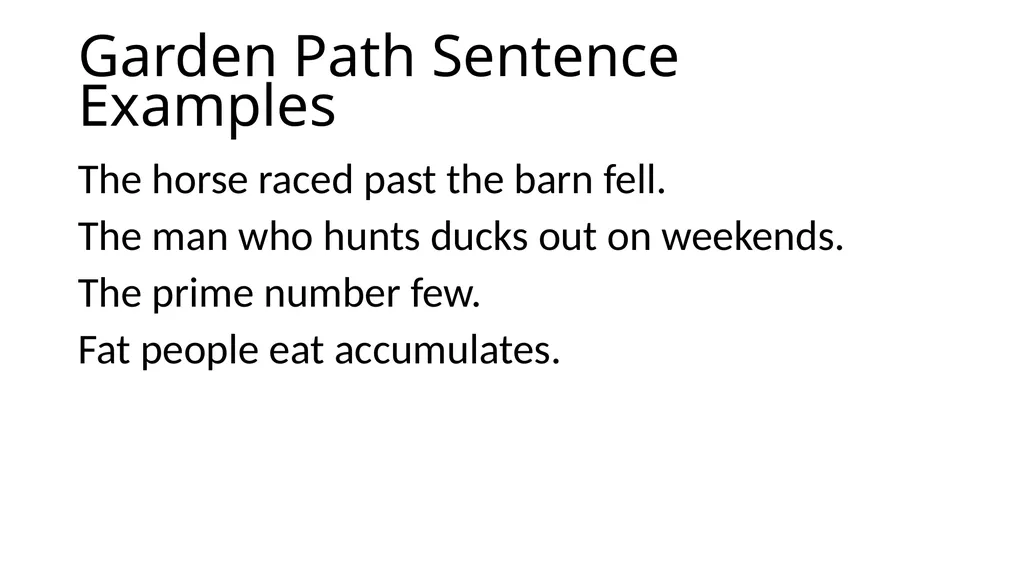
Garden Path Sentence Examples The horse raced past the barn fell.
The man who hunts ducks out on weekends.
The prime number few.
Fat people eat accumulates.<br>
The man who hunts ducks out on weekends.
The prime number few.
Fat people eat accumulates.<br>
45
Garden Path Sentence Examples The horse raced past the barn fell.
The man who hunts ducks out on weekends.
The prime number few.
Fat people eat accumulates.
The students forgot the solution was.<br>
The man who hunts ducks out on weekends.
The prime number few.
Fat people eat accumulates.
The students forgot the solution was.<br>
46
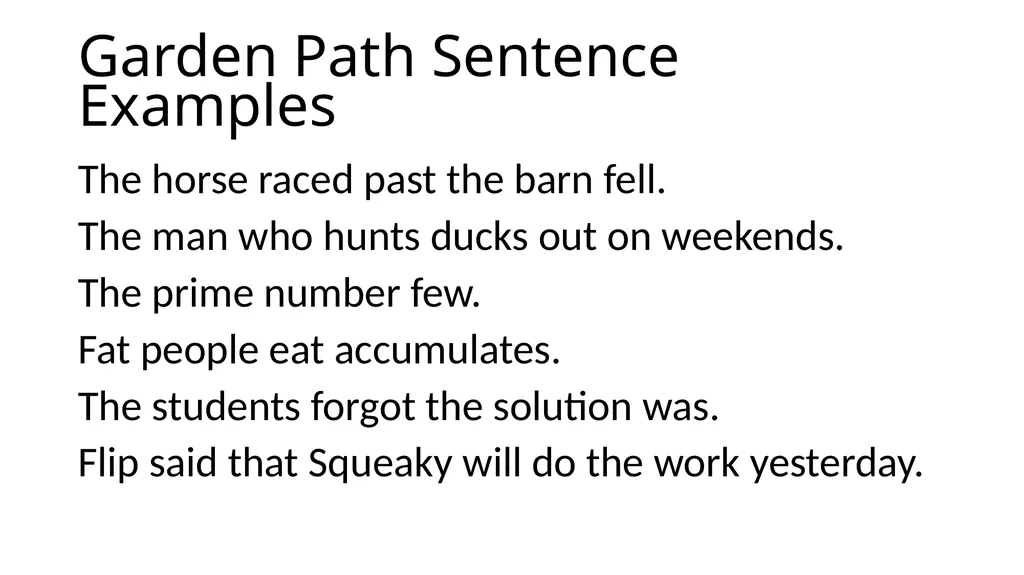
Garden Path Sentence Examples The horse raced past the barn fell.
The man who hunts ducks out on weekends.
The prime number few.
Fat people eat accumulates.
The students forgot the solution was.
Flip said that Squeaky will do the work yesterday.<br>
The man who hunts ducks out on weekends.
The prime number few.
Fat people eat accumulates.
The students forgot the solution was.
Flip said that Squeaky will do the work yesterday.<br>