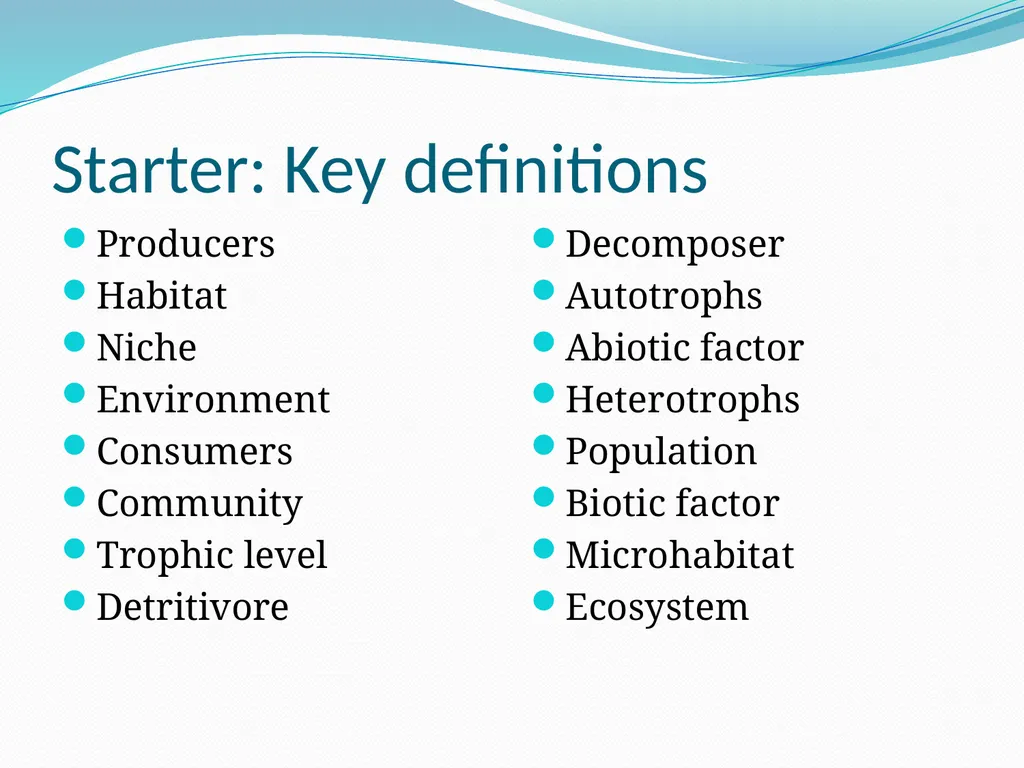
"Ecosystems Starter: Key definitions Decomposer" is the property of its rightful owner. Permission is granted to
download and print the materials on this website for personal, non-commercial use only, and to display it
on your personal computer provided you do not modify the materials and that you retain all copyright
notices contained in the materials. By downloading content from our website, you accept the terms of this
agreement.
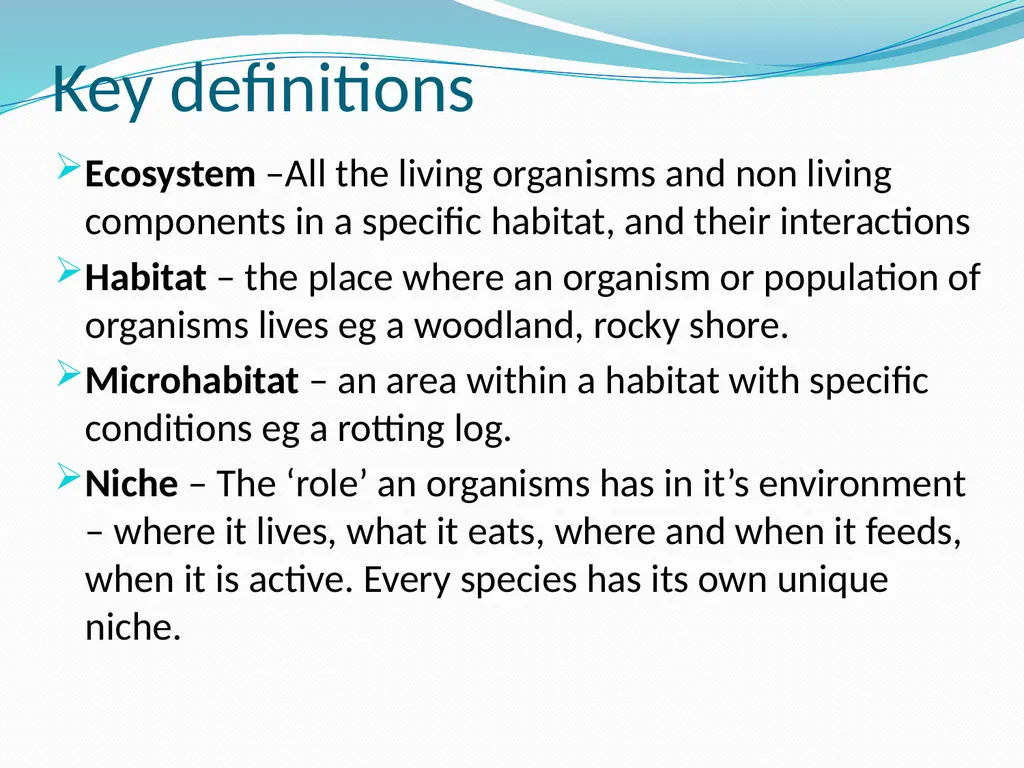
Ecosystem –All the living organisms and non living components in a specific habitat, and their interactions
Habitat – the place where an organism or population of organisms lives eg a woodland, rocky shore.
Microhabitat – an area within a habitat with specific conditions eg a rotting log.
Niche – The ‘role’ an organisms has in it’s environment – where it lives, what it eats, where and when it feeds, when it is active. Every species has its own unique niche. Key definitions<br>
04
Community – All the populations of different species that live in the same place at the same time, and who can interact with each other.
Population - all of the organisms of one species, who live in the same place at the same time, and can breed together
Environment – The conditions surrounding an organism, including both abiotic factors and biotic factors Key definitions<br>
05
Key definitions Abiotic factor – the effects of the non-living components of an ecosystem eg temperature
Biotic factor – the effects of the living parts of the ecosystem eg competition, predation
Autotrophs – organisms that can make their own food.
Heterotrophs - organisms that can’t make their own food.
Trophic level – the level at which an organisms feeds in a food chain<br>
06
Producers - autotrophic organisms that convert light energy to chemical energy, which they then supply to consumers
Consumers – living organisms that feed on other living organisms
Decomposer – An organism that breaks down complex organic molecules into simple inorganic molecules that can be recycled. Also know as a saprophyte.
Detritivore – An organism that feed on dead organic matter. Key definitions<br>
07
Learning outcomes (a) ecosystems, which range in size, are dynamic and are influenced by both biotic and abiotic factors
To include reference to a variety of ecosystems of different sizes (e.g. a rock pool, a playing field, a large tree) and named examples of biotic and abiotic factors.<br>
08
Biotic factors Depending on their niche, the living organisms of an ecosystem can effect each other:
Producers
Consumers
Decomposers<br>
09
Abiotic factors The non-living components of the ecosystem e.g. pH, relative humidity, temperature, concentration of pollutants.
Abiotic factors can also be influenced by the biotic component e.g. rainforest canopy can influence temperature and humidity<br>
10
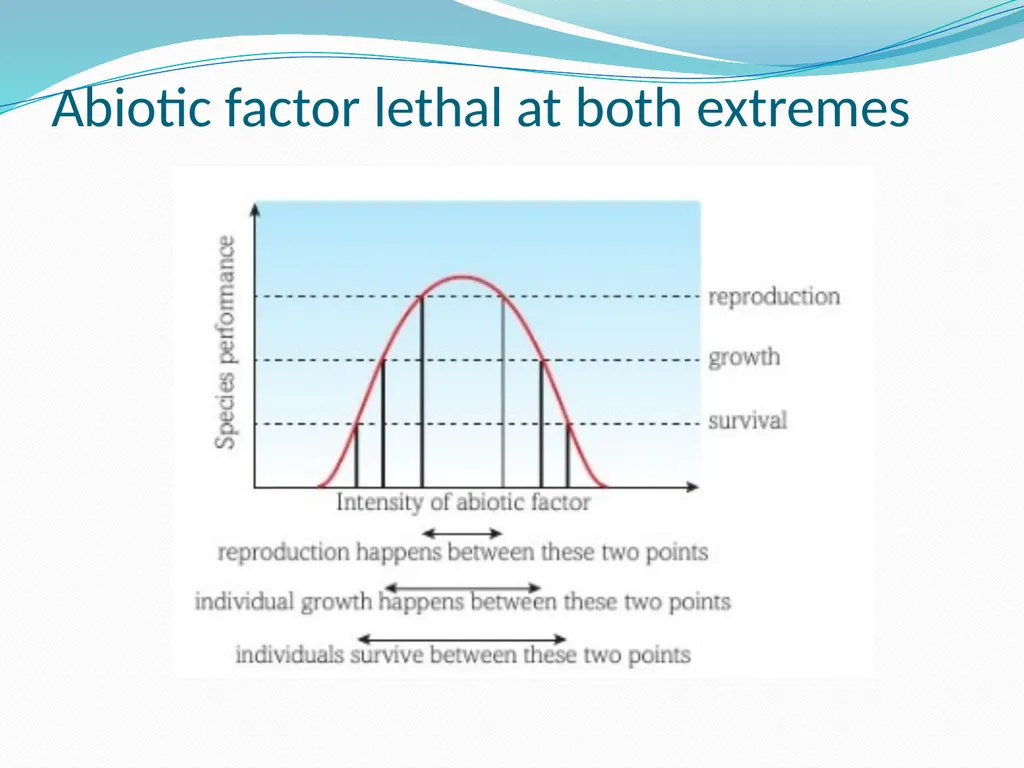
Abiotic factor lethal at both extremes<br>
11
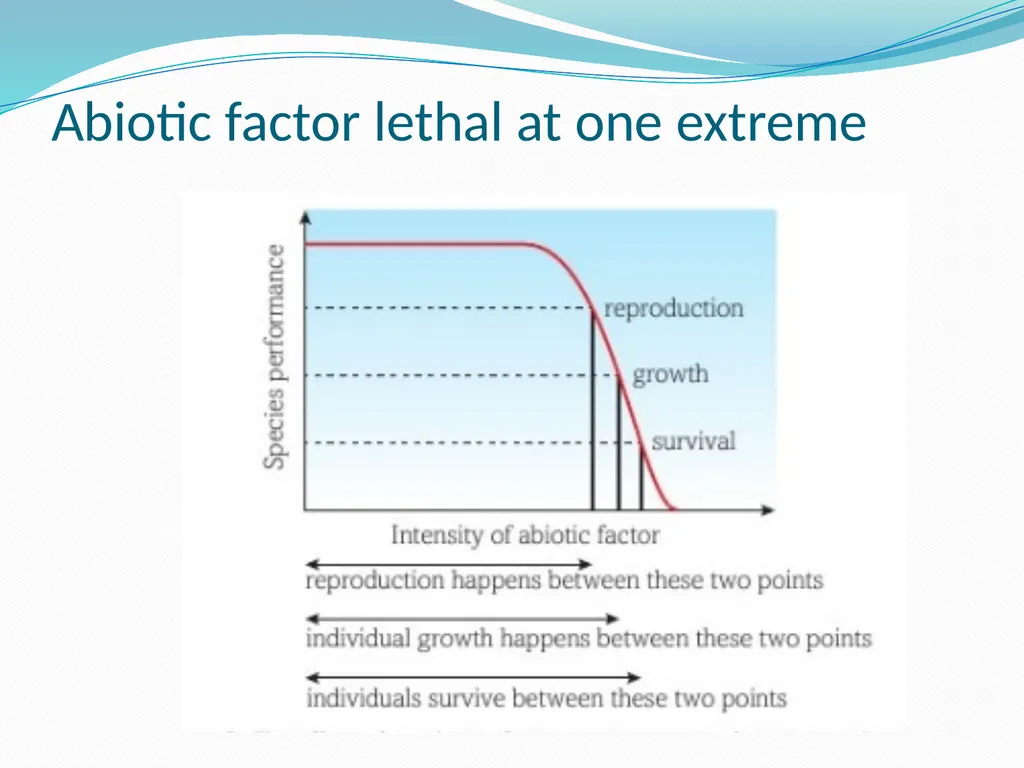
Abiotic factor lethal at one extreme<br>
12
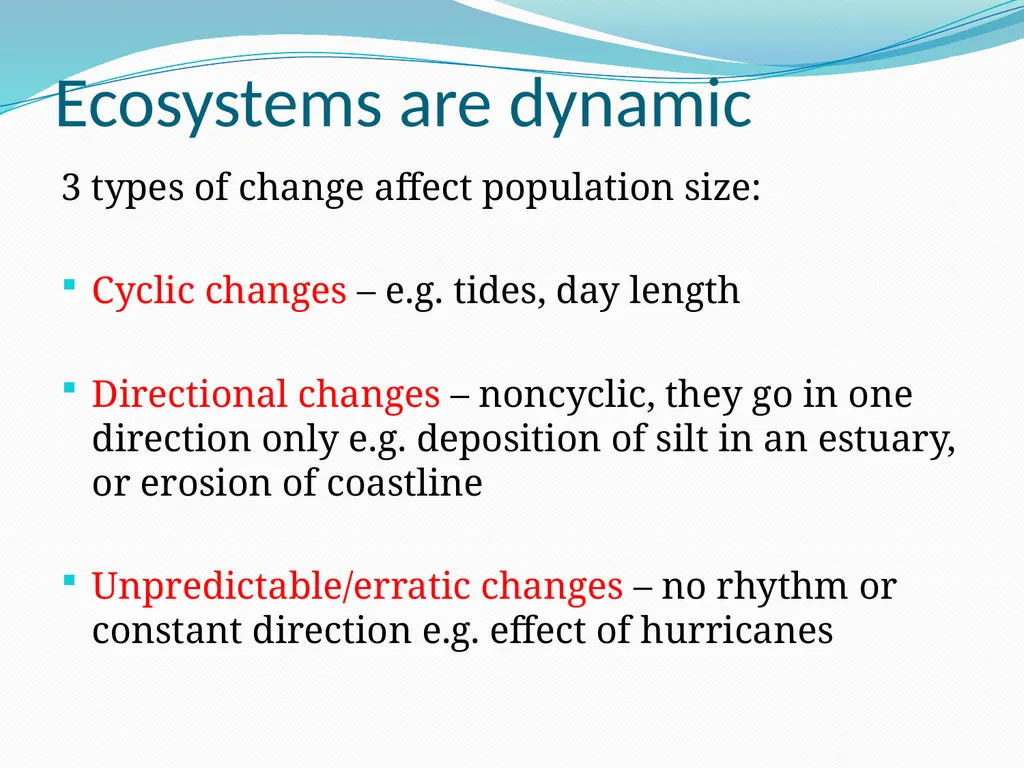
Ecosystems are dynamic 3 types of change affect population size:
Cyclic changes – e.g. tides, day length
Directional changes – noncyclic, they go in one direction only e.g. deposition of silt in an estuary, or erosion of coastline
Unpredictable/erratic changes – no rhythm or constant direction e.g. effect of hurricanes<br>
13
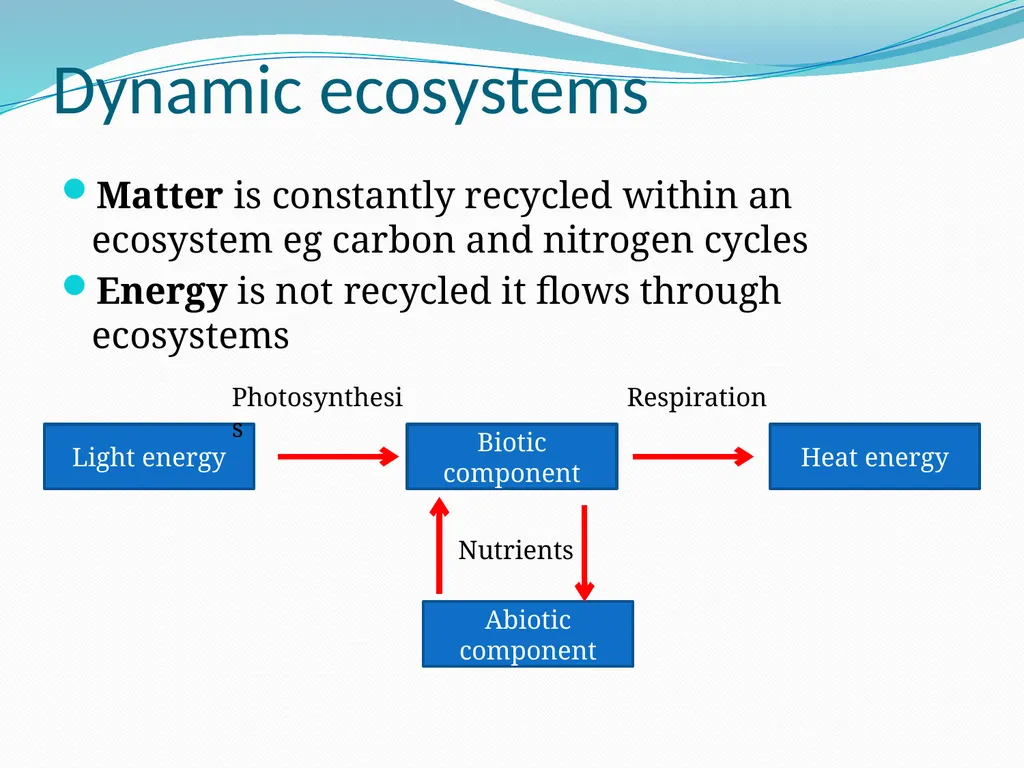
Dynamic ecosystems Matter is constantly recycled within an ecosystem eg carbon and nitrogen cycles
Energy is not recycled it flows through ecosystems Light energy Heat energy Biotic component Abiotic component Photosynthesis Respiration Nutrients<br>
14
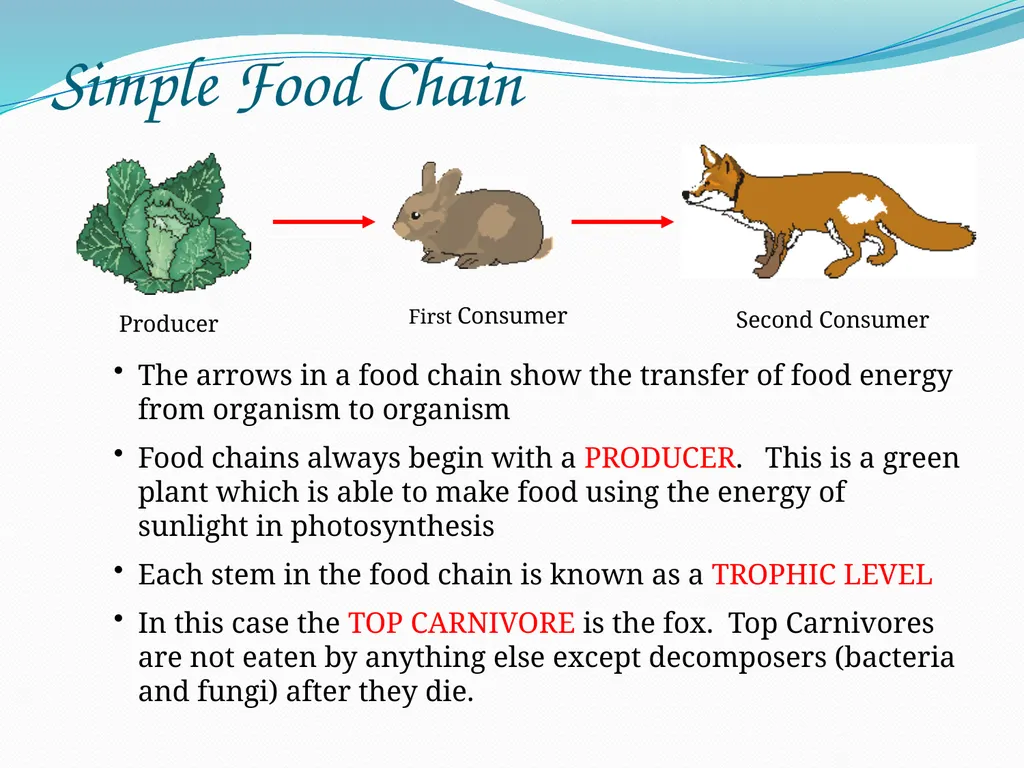
Simple Food Chain Producer First Consumer Second Consumer The arrows in a food chain show the transfer of food energy from organism to organism
Food chains always begin with a PRODUCER. This is a green plant which is able to make food using the energy of sunlight in photosynthesis
Each stem in the food chain is known as a TROPHIC LEVEL
In this case the TOP CARNIVORE is the fox. Top Carnivores are not eaten by anything else except decomposers (bacteria and fungi) after they die.<br>
15
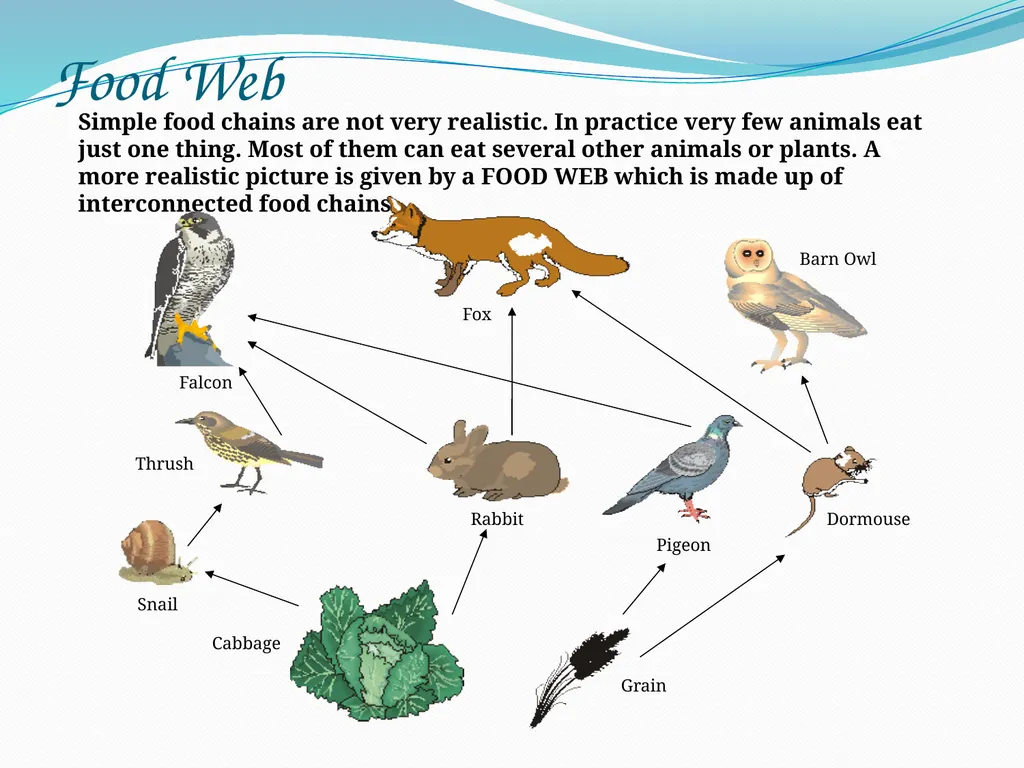
Food Web Simple food chains are not very realistic. In practice very few animals eat just one thing. Most of them can eat several other animals or plants. A more realistic picture is given by a FOOD WEB which is made up of interconnected food chains. Falcon Fox Barn Owl Thrush Rabbit Pigeon Dormouse Cabbage Grain Snail<br>