01
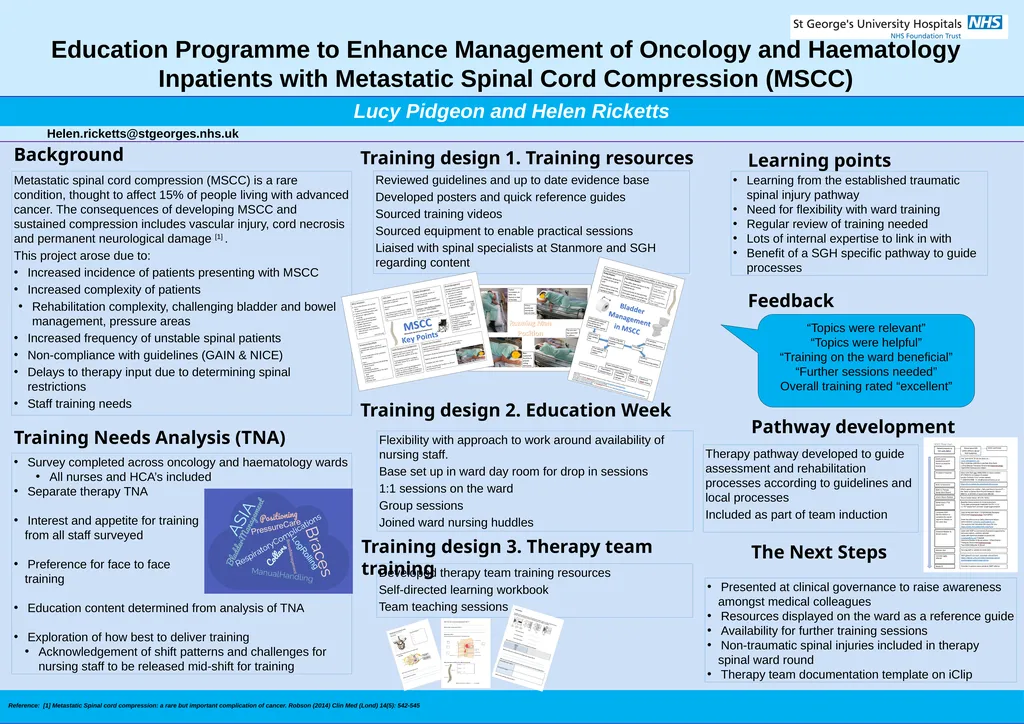
Education Programme to Enhance Management of Oncology and Haematology Inpatients with Metastatic Spinal Cord Compression (MSCC) Lucy Pidgeon and Helen Ricketts Helen.ricketts@stgeorges.nhs.uk Background Metastatic spinal cord compression (MSCC) is a rare condition, thought to affect 15% of people living with advanced cancer. The consequences of developing MSCC and sustained compression includes vascular injury, cord necrosis and permanent neurological damage [1] .
This project arose due to:
Increased incidence of patients presenting with MSCC
Increased complexity of patients
Rehabilitation complexity, challenging bladder and bowel management, pressure areas
Increased frequency of unstable spinal patients
Non-compliance with guidelines (GAIN & NICE)
Delays to therapy input due to determining spinal restrictions
Staff training needs Learning points Training design 1. Training resources Reviewed guidelines and up to date evidence base
Developed posters and quick reference guides
Sourced training videos
Sourced equipment to enable practical sessions
Liaised with spinal specialists at Stanmore and SGH regarding content Survey completed across oncology and haematology wards
All nurses and HCA’s included
Separate therapy TNA
Interest and appetite for training
from all staff surveyed
Preference for face to face
training
Education content determined from analysis of TNA
Exploration of how best to deliver training
Acknowledgement of shift patterns and challenges for nursing staff to be released mid-shift for training Training Needs Analysis (TNA) The Next Steps Presented at clinical governance to raise awareness
amongst medical colleagues
Resources displayed on the ward as a reference guide
Availability for further training sessions
Non-traumatic spinal injuries included in therapy
spinal ward round
Therapy team documentation template on iClip Pathway development Learning from the established traumatic spinal injury pathway
Need for flexibility with ward training
Regular review of training needed
Lots of internal expertise to link in with
Benefit of a SGH specific pathway to guide processes Reference: [1] Metastatic Spinal cord compression: a rare but important complication of cancer. Robson (2014) Clin Med (Lond) 14(5): 542-545 Training design 2. Education Week Therapy pathway developed to guide assessment and rehabilitation processes according to guidelines and local processes
Included as part of team induction Training design 3. Therapy team training Developed therapy team training resources
Self-directed learning workbook
Team teaching sessions “Topics were relevant”
“Topics were helpful”
“Training on the ward beneficial”
“Further sessions needed”
Overall training rated “excellent” Feedback Flexibility with approach to work around availability of nursing staff.
Base set up in ward day room for drop in sessions
1:1 sessions on the ward
Group sessions
Joined ward nursing huddles<br>