
“EFFECTIVE IMPLEMENTATION OF COMPETITION REGIME IN


Description: EFFECTIVE IMPLEMENTATION OF COMPETITION REGIME IN OTHER DEVELOPING COUNTRIES: LESSONS FOR BANGLADESH 2nd July, 2012 Ratnesh Sahay, Advisor Indian Competition Law: Objectives Make the market work for the benefit and welfare of consumers
Related Topics
Download Presentation
"“EFFECTIVE IMPLEMENTATION OF COMPETITION REGIME IN" is the property of its rightful owner. Permission is granted to download and print the materials on this website for personal, non-commercial use only, and to display it on your personal computer provided you do not modify the materials and that you retain all copyright notices contained in the materials. By downloading content from our website, you accept the terms of this agreement.
Presentation Transcript
slide1. “EFFECTIVE IMPLEMENTATION OF COMPETITION REGIME IN OTHER DEVELOPING COUNTRIES: LESSONS FOR BANGLADESH” 2nd July, 2012
Ratnesh Sahay,
Advisor<br>
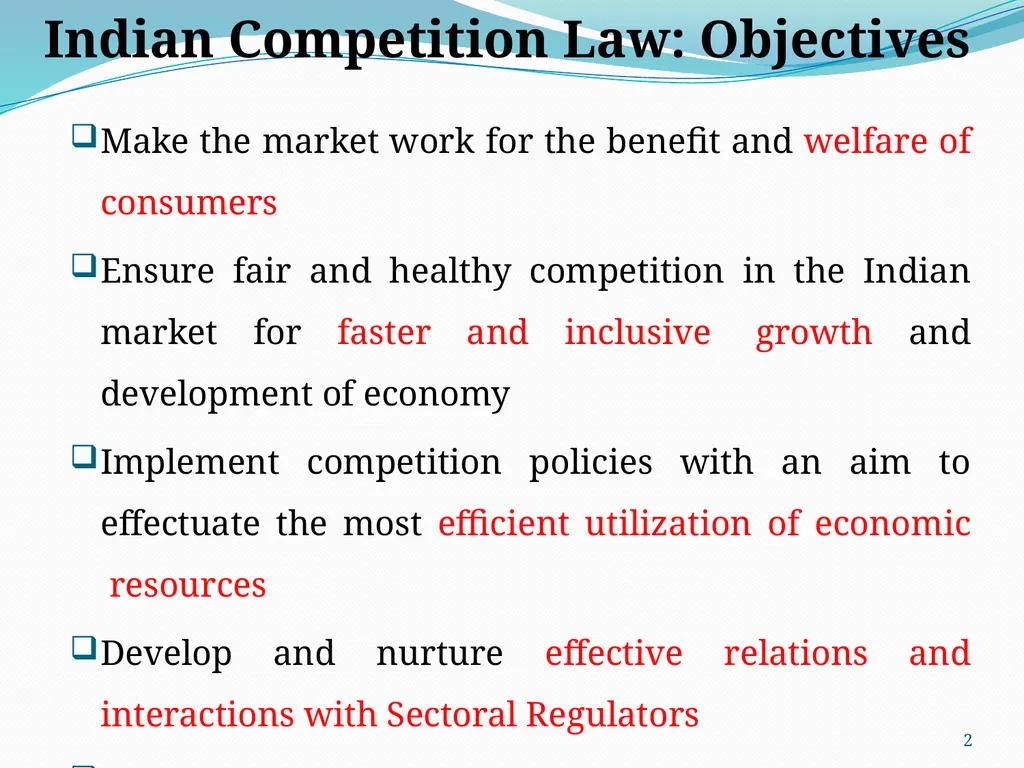
slide2. Indian Competition Law: Objectives Make the market work for the benefit and welfare of consumers
Ensure fair and healthy competition in the Indian market for faster and inclusive growth and development of economy
Implement competition policies with an aim to effectuate the most efficient utilization of economic resources
Develop and nurture effective relations and interactions with Sectoral Regulators
Effectively carry out competition advocacy
Share information on benefits of competition to build competition culture among stakeholders 2<br>
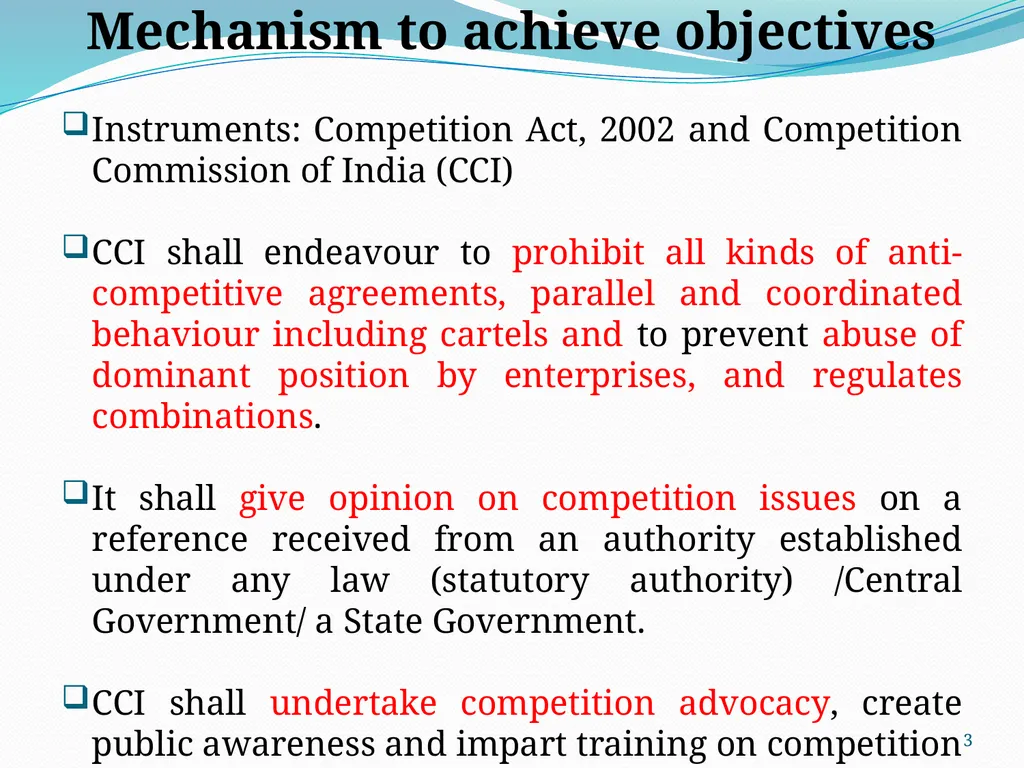
slide3. Mechanism to achieve objectives Instruments: Competition Act, 2002 and Competition Commission of India (CCI)
CCI shall endeavour to prohibit all kinds of anti-competitive agreements, parallel and coordinated behaviour including cartels and to prevent abuse of dominant position by enterprises, and regulates combinations.
It shall give opinion on competition issues on a reference received from an authority established under any law (statutory authority) /Central Government/ a State Government.
CCI shall undertake competition advocacy, create public awareness and impart training on competition issues. 3<br>
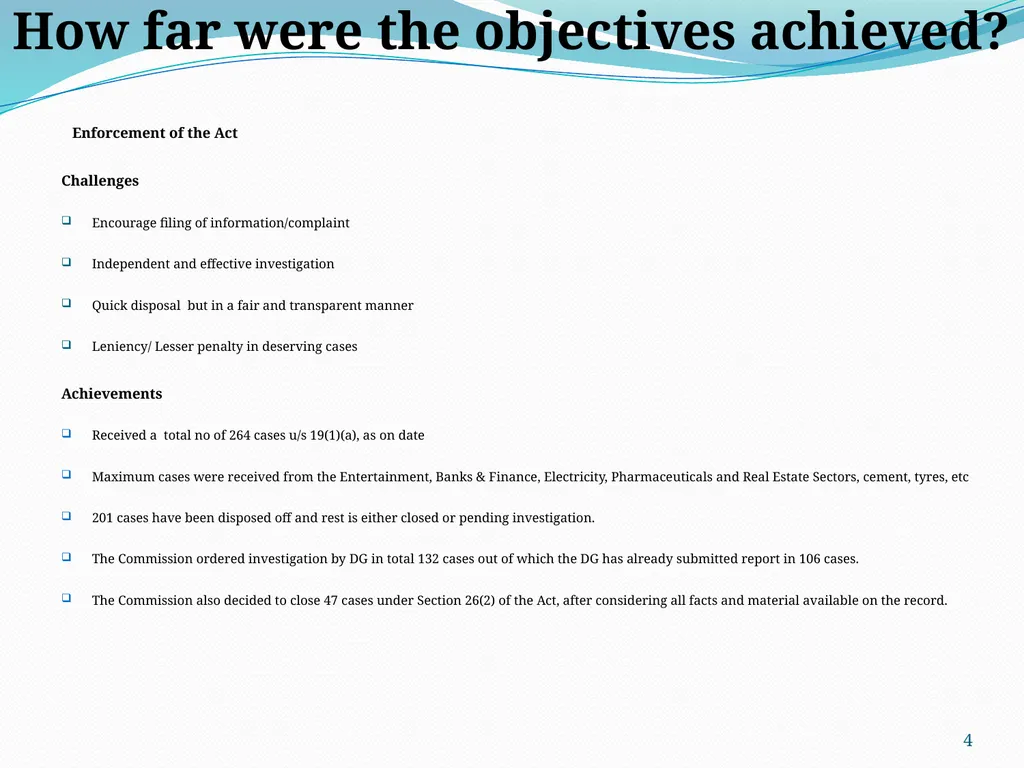
slide4. How far were the objectives achieved? Enforcement of the Act
Challenges
Encourage filing of information/complaint
Independent and effective investigation
Quick disposal but in a fair and transparent manner
Leniency/ Lesser penalty in deserving cases
Achievements
Received a total no of 264 cases u/s 19(1)(a), as on date
Maximum cases were received from the Entertainment, Banks & Finance, Electricity, Pharmaceuticals and Real Estate Sectors, cement, tyres, etc
201 cases have been disposed off and rest is either closed or pending investigation.
The Commission ordered investigation by DG in total 132 cases out of which the DG has already submitted report in 106 cases.
The Commission also decided to close 47 cases under Section 26(2) of the Act, after considering all facts and material available on the record. 4<br>
slide5. Suo-moto Cases
The Act empowers the Commission to initiate suo-motu action against anti-competitive conduct
sugar cartels, onion price, airlines air fare, petroleum prices, milk prices, etc
Gathering evidence in number of such cases was found to be difficult
In other jurisdictions like FTC/DOJ or EU a large number of information is provided by the whistleblowers who files leniency applications to get immunity. In India, this has not picked up though there is a provision in the Act for Leniency. So, this is a big challenge not only for India but for all developing countries where cartels are rampant.
Framing of Regulations
A major task before the Commission was to frame the Regulations as required under Section 64 of the Competition Act to facilitate the working of the Commission. The Commission has notified the various regulations which have been published in the extra ordinary issue of the Gazette of India to establish SOPs to deal with the enforcement measures and to facilitate various activities undertaken by the commission. How far were the objectives achieved?<br>
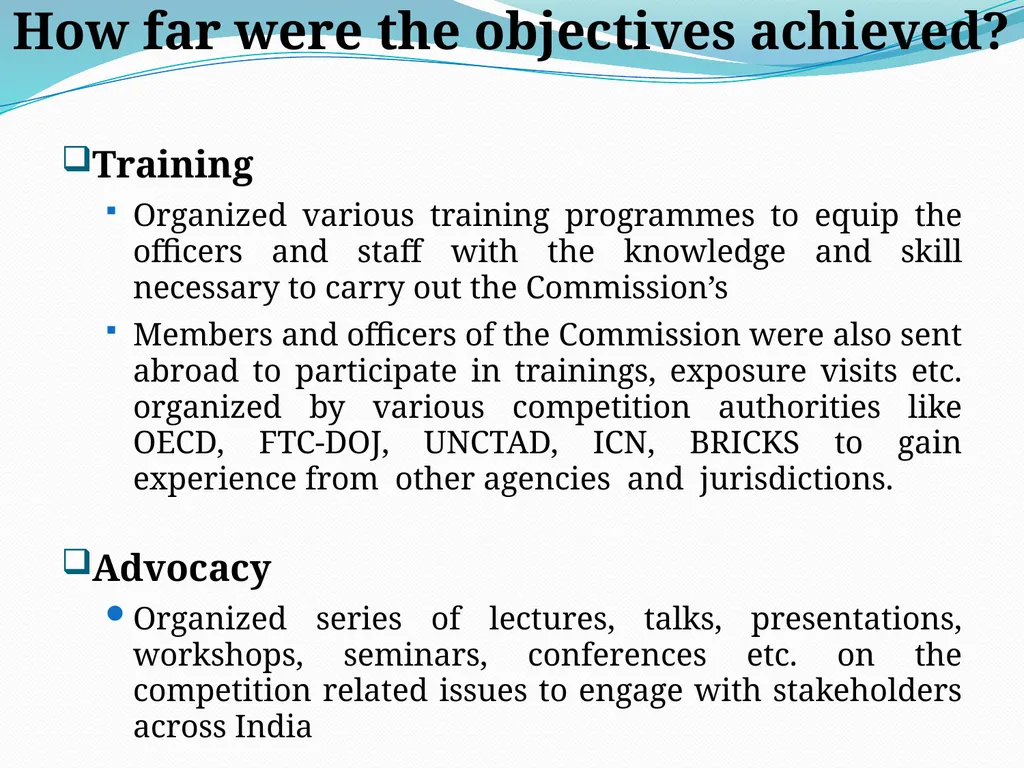
slide6. Training
Organized various training programmes to equip the officers and staff with the knowledge and skill necessary to carry out the Commission’s
Members and officers of the Commission were also sent abroad to participate in trainings, exposure visits etc. organized by various competition authorities like OECD, FTC-DOJ, UNCTAD, ICN, BRICKS to gain experience from other agencies and jurisdictions.
Advocacy
Organized series of lectures, talks, presentations, workshops, seminars, conferences etc. on the competition related issues to engage with stakeholders across India How far were the objectives achieved?<br>
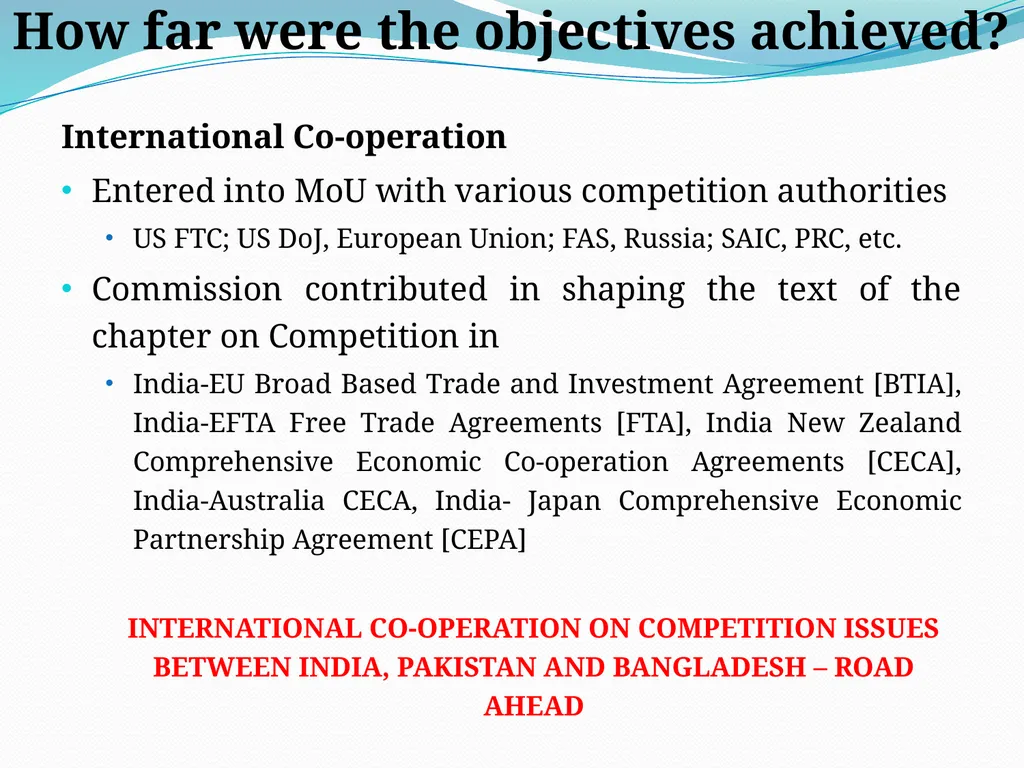
slide7. International Co-operation
Entered into MoU with various competition authorities
US FTC; US DoJ, European Union; FAS, Russia; SAIC, PRC, etc.
Commission contributed in shaping the text of the chapter on Competition in
India-EU Broad Based Trade and Investment Agreement [BTIA], India-EFTA Free Trade Agreements [FTA], India New Zealand Comprehensive Economic Co-operation Agreements [CECA], India-Australia CECA, India- Japan Comprehensive Economic Partnership Agreement [CEPA]
INTERNATIONAL CO-OPERATION ON COMPETITION ISSUES BETWEEN INDIA, PAKISTAN AND BANGLADESH – ROAD AHEAD How far were the objectives achieved?<br>
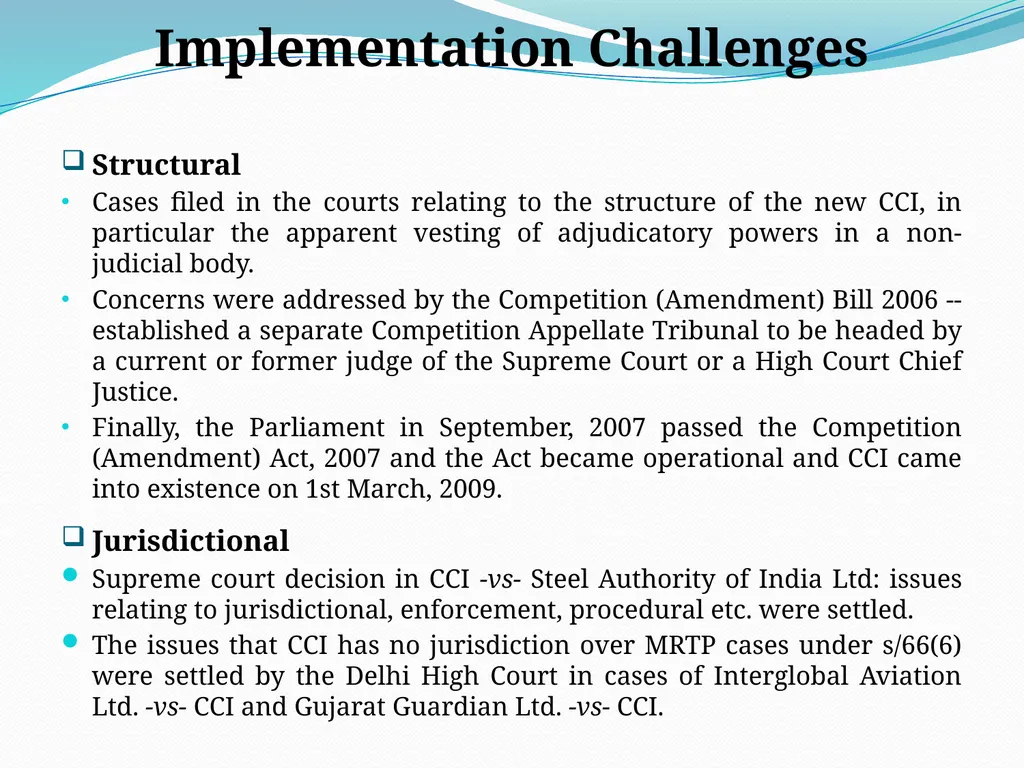
slide8. Implementation Challenges Structural
Cases filed in the courts relating to the structure of the new CCI, in particular the apparent vesting of adjudicatory powers in a non-judicial body.
Concerns were addressed by the Competition (Amendment) Bill 2006 -- established a separate Competition Appellate Tribunal to be headed by a current or former judge of the Supreme Court or a High Court Chief Justice.
Finally, the Parliament in September, 2007 passed the Competition (Amendment) Act, 2007 and the Act became operational and CCI came into existence on 1st March, 2009.
Jurisdictional
Supreme court decision in CCI -vs- Steel Authority of India Ltd: issues relating to jurisdictional, enforcement, procedural etc. were settled.
The issues that CCI has no jurisdiction over MRTP cases under s/66(6) were settled by the Delhi High Court in cases of Interglobal Aviation Ltd. -vs- CCI and Gujarat Guardian Ltd. -vs- CCI.<br>
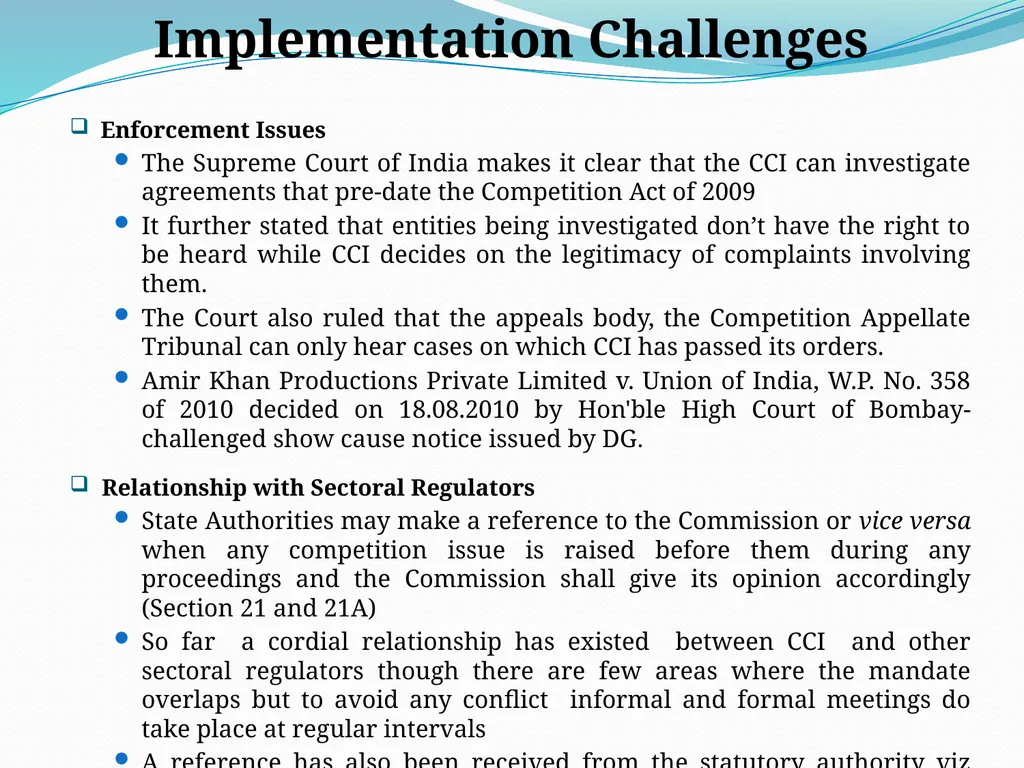
slide9. Enforcement Issues
The Supreme Court of India makes it clear that the CCI can investigate agreements that pre-date the Competition Act of 2009
It further stated that entities being investigated don’t have the right to be heard while CCI decides on the legitimacy of complaints involving them.
The Court also ruled that the appeals body, the Competition Appellate Tribunal can only hear cases on which CCI has passed its orders.
Amir Khan Productions Private Limited v. Union of India, W.P. No. 358 of 2010 decided on 18.08.2010 by Hon'ble High Court of Bombay- challenged show cause notice issued by DG.
Relationship with Sectoral Regulators
State Authorities may make a reference to the Commission or vice versa when any competition issue is raised before them during any proceedings and the Commission shall give its opinion accordingly (Section 21 and 21A)
So far a cordial relationship has existed between CCI and other sectoral regulators though there are few areas where the mandate overlaps but to avoid any conflict informal and formal meetings do take place at regular intervals
A reference has also been received from the statutory authority viz Maharashtra Electricity Regulatory Commission (MERC) as provided in the Section 21 of the Act, 2002, in which the Commission gave its opinion within stipulated time frame. Implementation Challenges<br>
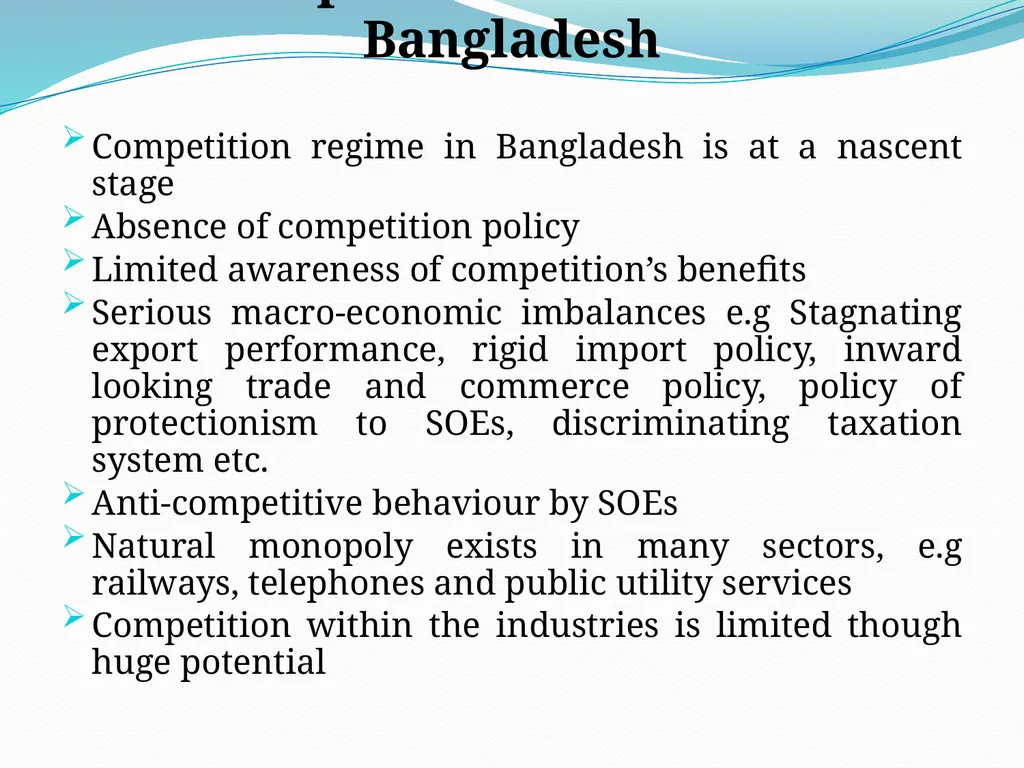
slide10. Competition scenario in Bangladesh Competition regime in Bangladesh is at a nascent stage
Absence of competition policy
Limited awareness of competition’s benefits
Serious macro-economic imbalances e.g Stagnating export performance, rigid import policy, inward looking trade and commerce policy, policy of protectionism to SOEs, discriminating taxation system etc.
Anti-competitive behaviour by SOEs
Natural monopoly exists in many sectors, e.g railways, telephones and public utility services
Competition within the industries is limited though huge potential<br>
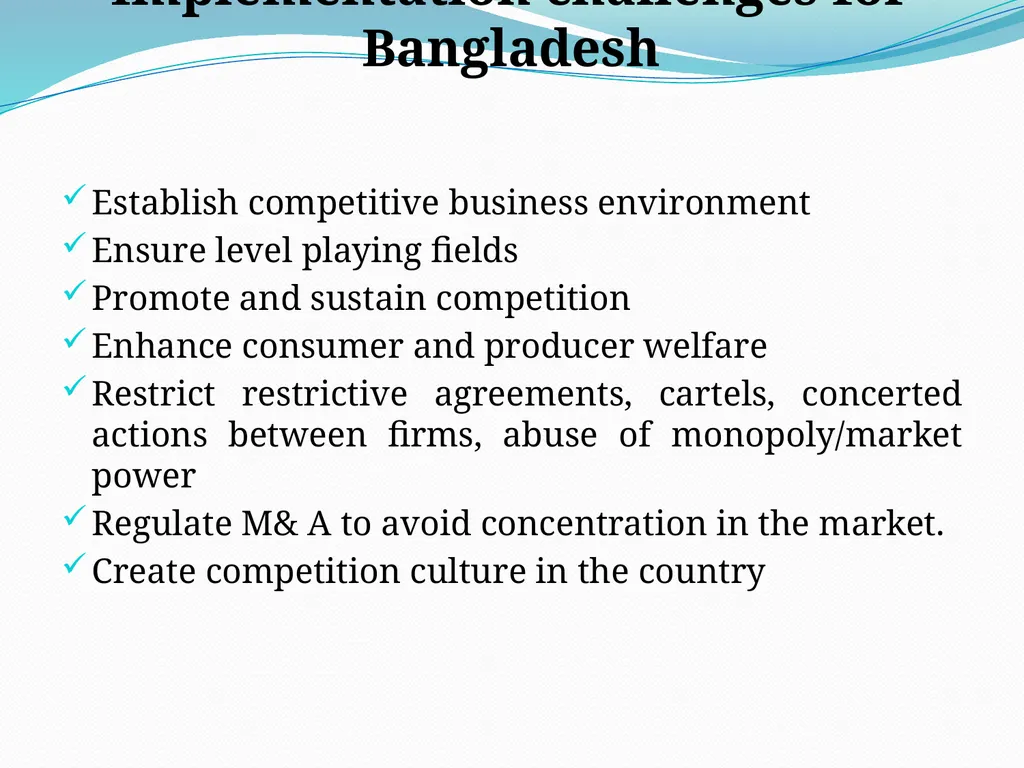
slide11. Implementation challenges for Bangladesh Establish competitive business environment
Ensure level playing fields
Promote and sustain competition
Enhance consumer and producer welfare
Restrict restrictive agreements, cartels, concerted actions between firms, abuse of monopoly/market power
Regulate M& A to avoid concentration in the market.
Create competition culture in the country<br>
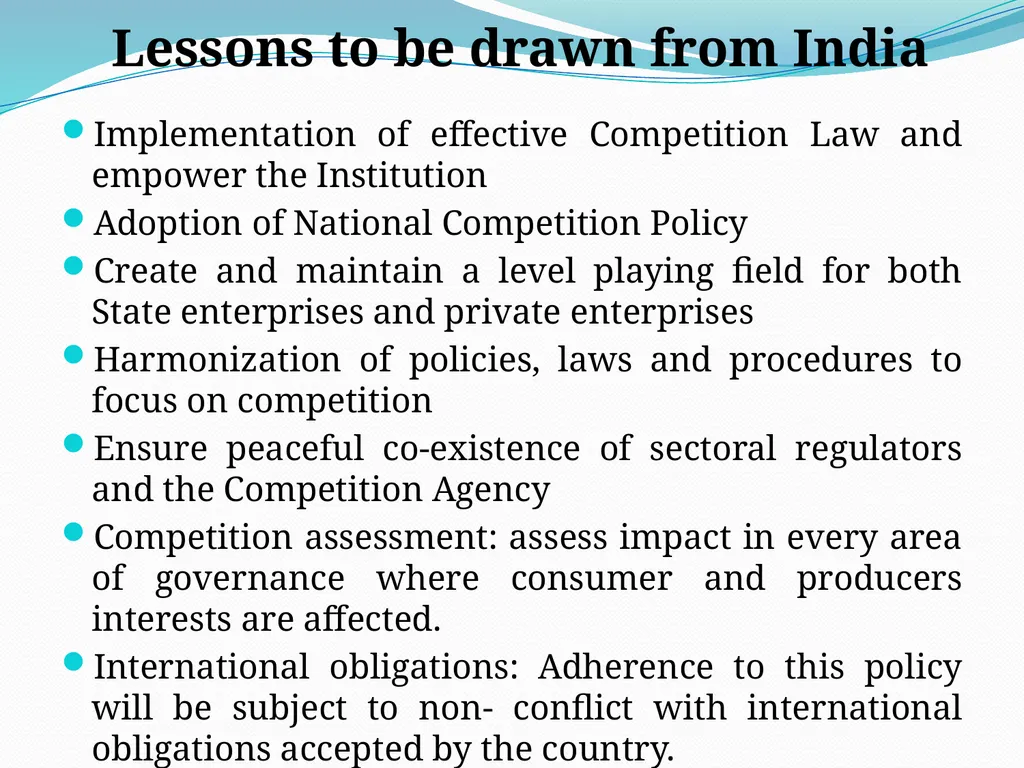
slide12. Lessons to be drawn from India Implementation of effective Competition Law and empower the Institution
Adoption of National Competition Policy
Create and maintain a level playing field for both State enterprises and private enterprises
Harmonization of policies, laws and procedures to focus on competition
Ensure peaceful co-existence of sectoral regulators and the Competition Agency
Competition assessment: assess impact in every area of governance where consumer and producers interests are affected.
International obligations: Adherence to this policy will be subject to non- conflict with international obligations accepted by the country.<br>
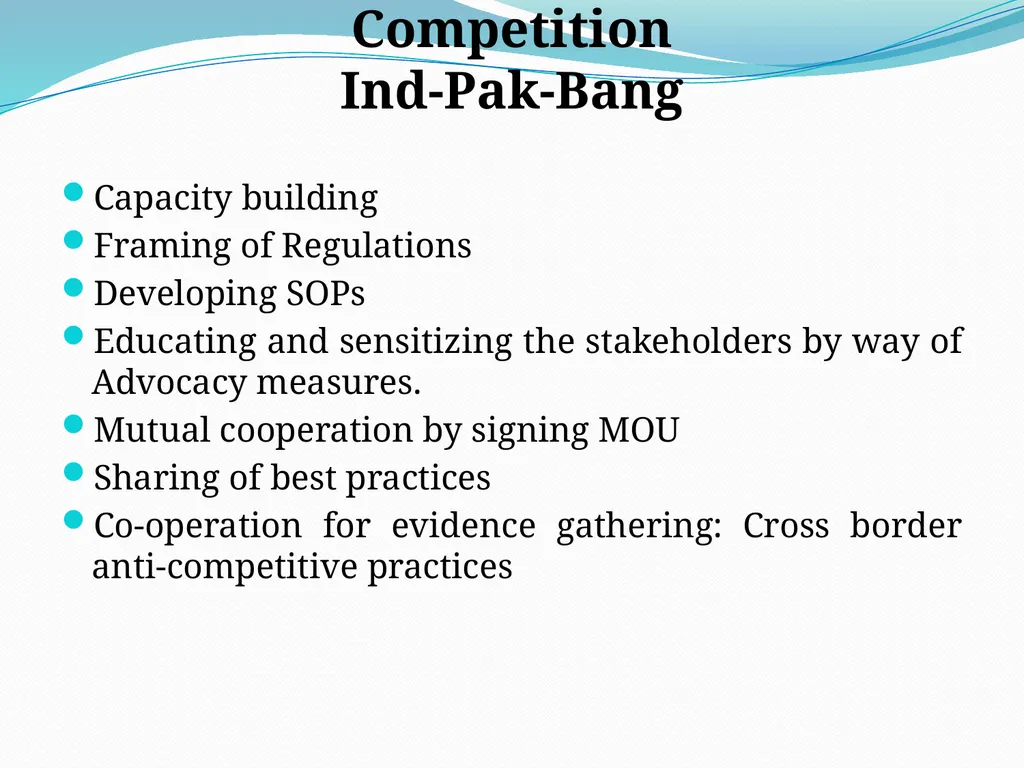
slide13. Regional Cooperation on Competition Ind-Pak-Bang Capacity building
Framing of Regulations
Developing SOPs
Educating and sensitizing the stakeholders by way of Advocacy measures.
Mutual cooperation by signing MOU
Sharing of best practices
Co-operation for evidence gathering: Cross border anti-competitive practices<br>
slide14. THANKS<br>
Ratnesh Sahay,
Advisor<br>
slide2. Indian Competition Law: Objectives Make the market work for the benefit and welfare of consumers
Ensure fair and healthy competition in the Indian market for faster and inclusive growth and development of economy
Implement competition policies with an aim to effectuate the most efficient utilization of economic resources
Develop and nurture effective relations and interactions with Sectoral Regulators
Effectively carry out competition advocacy
Share information on benefits of competition to build competition culture among stakeholders 2<br>
slide3. Mechanism to achieve objectives Instruments: Competition Act, 2002 and Competition Commission of India (CCI)
CCI shall endeavour to prohibit all kinds of anti-competitive agreements, parallel and coordinated behaviour including cartels and to prevent abuse of dominant position by enterprises, and regulates combinations.
It shall give opinion on competition issues on a reference received from an authority established under any law (statutory authority) /Central Government/ a State Government.
CCI shall undertake competition advocacy, create public awareness and impart training on competition issues. 3<br>
slide4. How far were the objectives achieved? Enforcement of the Act
Challenges
Encourage filing of information/complaint
Independent and effective investigation
Quick disposal but in a fair and transparent manner
Leniency/ Lesser penalty in deserving cases
Achievements
Received a total no of 264 cases u/s 19(1)(a), as on date
Maximum cases were received from the Entertainment, Banks & Finance, Electricity, Pharmaceuticals and Real Estate Sectors, cement, tyres, etc
201 cases have been disposed off and rest is either closed or pending investigation.
The Commission ordered investigation by DG in total 132 cases out of which the DG has already submitted report in 106 cases.
The Commission also decided to close 47 cases under Section 26(2) of the Act, after considering all facts and material available on the record. 4<br>
slide5. Suo-moto Cases
The Act empowers the Commission to initiate suo-motu action against anti-competitive conduct
sugar cartels, onion price, airlines air fare, petroleum prices, milk prices, etc
Gathering evidence in number of such cases was found to be difficult
In other jurisdictions like FTC/DOJ or EU a large number of information is provided by the whistleblowers who files leniency applications to get immunity. In India, this has not picked up though there is a provision in the Act for Leniency. So, this is a big challenge not only for India but for all developing countries where cartels are rampant.
Framing of Regulations
A major task before the Commission was to frame the Regulations as required under Section 64 of the Competition Act to facilitate the working of the Commission. The Commission has notified the various regulations which have been published in the extra ordinary issue of the Gazette of India to establish SOPs to deal with the enforcement measures and to facilitate various activities undertaken by the commission. How far were the objectives achieved?<br>
slide6. Training
Organized various training programmes to equip the officers and staff with the knowledge and skill necessary to carry out the Commission’s
Members and officers of the Commission were also sent abroad to participate in trainings, exposure visits etc. organized by various competition authorities like OECD, FTC-DOJ, UNCTAD, ICN, BRICKS to gain experience from other agencies and jurisdictions.
Advocacy
Organized series of lectures, talks, presentations, workshops, seminars, conferences etc. on the competition related issues to engage with stakeholders across India How far were the objectives achieved?<br>
slide7. International Co-operation
Entered into MoU with various competition authorities
US FTC; US DoJ, European Union; FAS, Russia; SAIC, PRC, etc.
Commission contributed in shaping the text of the chapter on Competition in
India-EU Broad Based Trade and Investment Agreement [BTIA], India-EFTA Free Trade Agreements [FTA], India New Zealand Comprehensive Economic Co-operation Agreements [CECA], India-Australia CECA, India- Japan Comprehensive Economic Partnership Agreement [CEPA]
INTERNATIONAL CO-OPERATION ON COMPETITION ISSUES BETWEEN INDIA, PAKISTAN AND BANGLADESH – ROAD AHEAD How far were the objectives achieved?<br>
slide8. Implementation Challenges Structural
Cases filed in the courts relating to the structure of the new CCI, in particular the apparent vesting of adjudicatory powers in a non-judicial body.
Concerns were addressed by the Competition (Amendment) Bill 2006 -- established a separate Competition Appellate Tribunal to be headed by a current or former judge of the Supreme Court or a High Court Chief Justice.
Finally, the Parliament in September, 2007 passed the Competition (Amendment) Act, 2007 and the Act became operational and CCI came into existence on 1st March, 2009.
Jurisdictional
Supreme court decision in CCI -vs- Steel Authority of India Ltd: issues relating to jurisdictional, enforcement, procedural etc. were settled.
The issues that CCI has no jurisdiction over MRTP cases under s/66(6) were settled by the Delhi High Court in cases of Interglobal Aviation Ltd. -vs- CCI and Gujarat Guardian Ltd. -vs- CCI.<br>
slide9. Enforcement Issues
The Supreme Court of India makes it clear that the CCI can investigate agreements that pre-date the Competition Act of 2009
It further stated that entities being investigated don’t have the right to be heard while CCI decides on the legitimacy of complaints involving them.
The Court also ruled that the appeals body, the Competition Appellate Tribunal can only hear cases on which CCI has passed its orders.
Amir Khan Productions Private Limited v. Union of India, W.P. No. 358 of 2010 decided on 18.08.2010 by Hon'ble High Court of Bombay- challenged show cause notice issued by DG.
Relationship with Sectoral Regulators
State Authorities may make a reference to the Commission or vice versa when any competition issue is raised before them during any proceedings and the Commission shall give its opinion accordingly (Section 21 and 21A)
So far a cordial relationship has existed between CCI and other sectoral regulators though there are few areas where the mandate overlaps but to avoid any conflict informal and formal meetings do take place at regular intervals
A reference has also been received from the statutory authority viz Maharashtra Electricity Regulatory Commission (MERC) as provided in the Section 21 of the Act, 2002, in which the Commission gave its opinion within stipulated time frame. Implementation Challenges<br>
slide10. Competition scenario in Bangladesh Competition regime in Bangladesh is at a nascent stage
Absence of competition policy
Limited awareness of competition’s benefits
Serious macro-economic imbalances e.g Stagnating export performance, rigid import policy, inward looking trade and commerce policy, policy of protectionism to SOEs, discriminating taxation system etc.
Anti-competitive behaviour by SOEs
Natural monopoly exists in many sectors, e.g railways, telephones and public utility services
Competition within the industries is limited though huge potential<br>
slide11. Implementation challenges for Bangladesh Establish competitive business environment
Ensure level playing fields
Promote and sustain competition
Enhance consumer and producer welfare
Restrict restrictive agreements, cartels, concerted actions between firms, abuse of monopoly/market power
Regulate M& A to avoid concentration in the market.
Create competition culture in the country<br>
slide12. Lessons to be drawn from India Implementation of effective Competition Law and empower the Institution
Adoption of National Competition Policy
Create and maintain a level playing field for both State enterprises and private enterprises
Harmonization of policies, laws and procedures to focus on competition
Ensure peaceful co-existence of sectoral regulators and the Competition Agency
Competition assessment: assess impact in every area of governance where consumer and producers interests are affected.
International obligations: Adherence to this policy will be subject to non- conflict with international obligations accepted by the country.<br>
slide13. Regional Cooperation on Competition Ind-Pak-Bang Capacity building
Framing of Regulations
Developing SOPs
Educating and sensitizing the stakeholders by way of Advocacy measures.
Mutual cooperation by signing MOU
Sharing of best practices
Co-operation for evidence gathering: Cross border anti-competitive practices<br>
slide14. THANKS<br>