Effective Inclusive Education: Views from Norway Anne Lium Berger, project member European Agency Tromsø Norwegian school system (1) Education for all is a basic precept of Norwegian educational policy. The school system is based on equity,
Related Topics
Share
Embed code
Download this presentation From Below
"Effective Inclusive Education: Views from Norway" is the property of its rightful owner. Permission is granted to
download and print the materials on this website for personal, non-commercial use only, and to display it
on your personal computer provided you do not modify the materials and that you retain all copyright
notices contained in the materials. By downloading content from our website, you accept the terms of this
agreement.
Presentation Transcript
01
Effective Inclusive Education: Views from Norway Anne Lium Berger, project member European Agency<br>
02
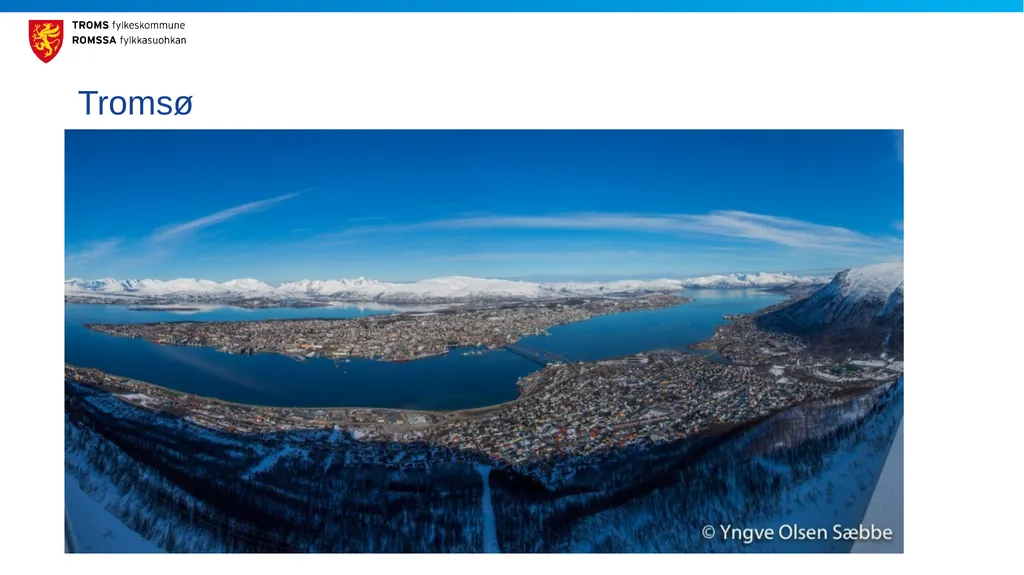
Tromsø<br>
03
Norwegian school system (1) Education for all is a basic precept of Norwegian educational policy.
The school system is based on equity, involving equal educational opportunities for all children.
Regardless of gender, place of living or learning ability.
Principle of equity and adaptive education for all pupils based on the same National Curriculum.<br>
04
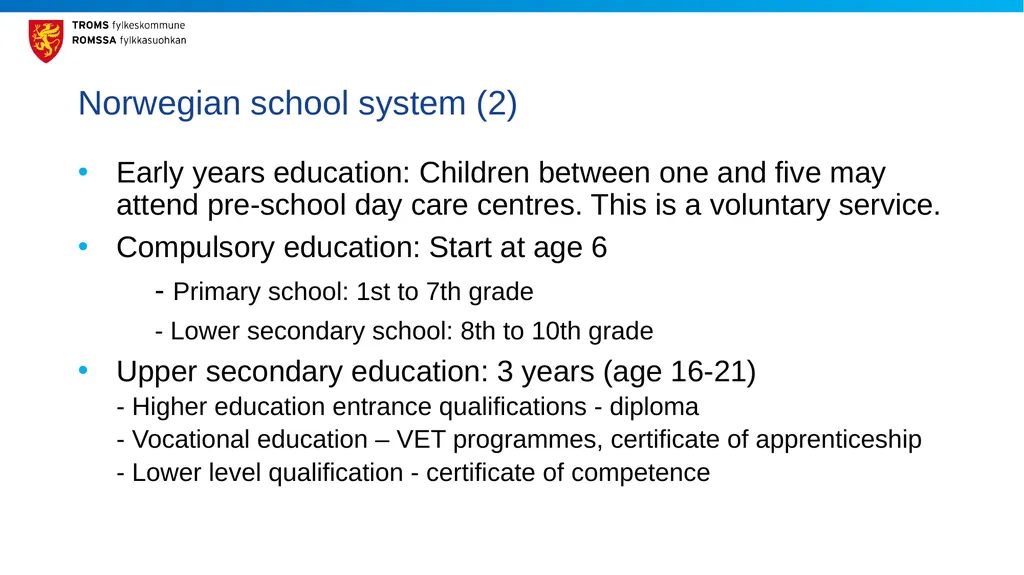
Norwegian school system (2) Early years education: Children between one and five may attend pre-school day care centres. This is a voluntary service.
Compulsory education: Start at age 6
- Primary school: 1st to 7th grade
- Lower secondary school: 8th to 10th grade
Upper secondary education: 3 years (age 16-21)
- Higher education entrance qualifications - diploma
- Vocational education – VET programmes, certificate of apprenticeship
- Lower level qualification - certificate of competence<br>
05
The Education Act (1) The principle of adaptive education is provided for in the Education Act § 1-3. “Education shall be adapted to the abilities and assumptions of individual pupils, apprentices and trainees." adaptive education is not an aim but a means of learning. All pupils shall work with the subjects and face realistic challenges and requirements they can achieve, and that they can cope with on their own or with others. Pupils have different teaching conditions and different needs in working with the nationally established goals. Involves also variation in methods, subject matter and organization”.<br>
06
The Education Act (2) (§ 5-1) The right to special needs education.
Pupils who either do not or are unable to benefit satisfactorily from ordinary teaching or adaptive education have the right to special education.
In assessing what kind of instruction shall be provided, particular emphasis shall be placed on the pupil’s developmental prospects.
The content of the courses offered shall be such that the pupil receives adequate benefit from the instruction as a whole in relation to other pupils and in relation to educational objectives that are realistic for the pupil.
Pupils who receive special education shall have the same total number of teaching hours as other pupils.<br>
07
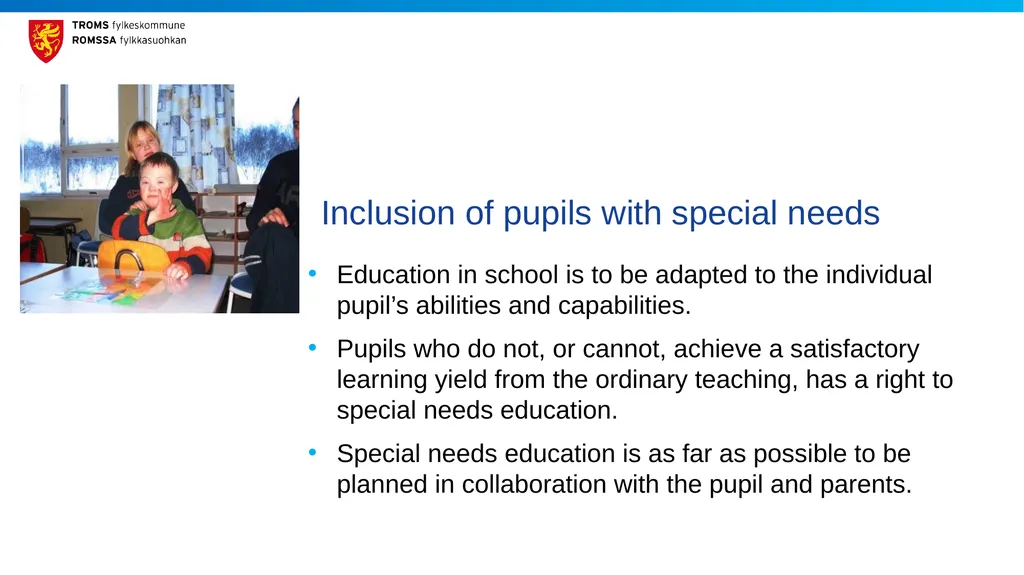
Inclusion of pupils with special needs Education in school is to be adapted to the individual pupil’s abilities and capabilities.
Pupils who do not, or cannot, achieve a satisfactory learning yield from the ordinary teaching, has a right to special needs education.
Special needs education is as far as possible to be planned in collaboration with the pupil and parents.<br>
08
The Support System in Norway - PPT §5-6 Educational and psychological counselling service:
Each municipality and county authority in Norway shall provide an educational and psychological counselling service. The service in a municipality can be organized in cooperation with other municipalities or with the county authority.
The service shall assist the school in work on organizational development and development of expertise in order to improve the adaptation of instruction for pupils with special needs. The educational and psychological counselling service shall ensure that expert assessments are prepared where this is required by the Act.<br>
09
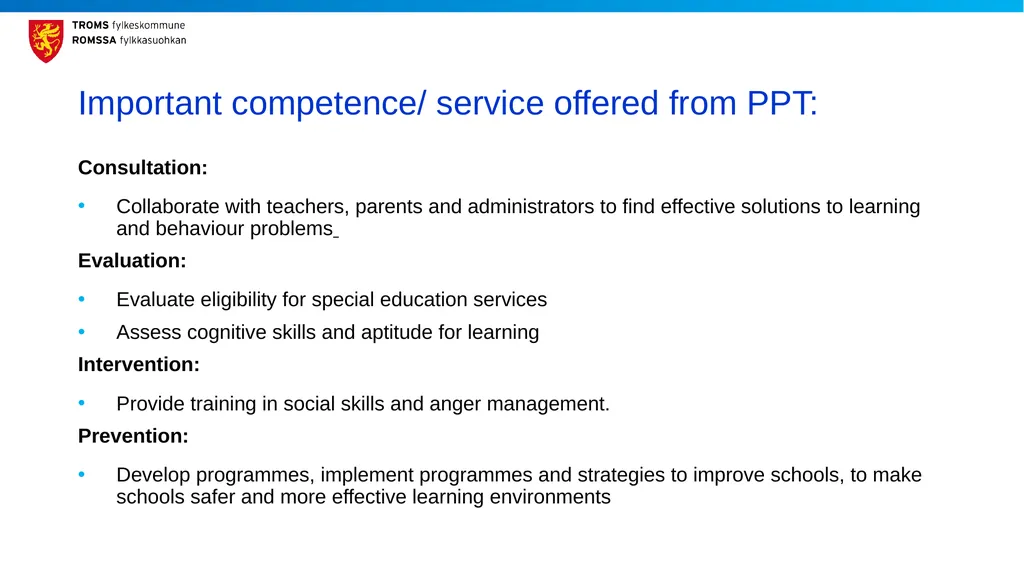
Important competence/ service offered from PPT: Consultation:
Collaborate with teachers, parents and administrators to find effective solutions to learning and behaviour problems
Evaluation:
Evaluate eligibility for special education services
Assess cognitive skills and aptitude for learning
Intervention:
Provide training in social skills and anger management.
Prevention:
Develop programmes, implement programmes and strategies to improve schools, to make schools safer and more effective learning environments<br>
10
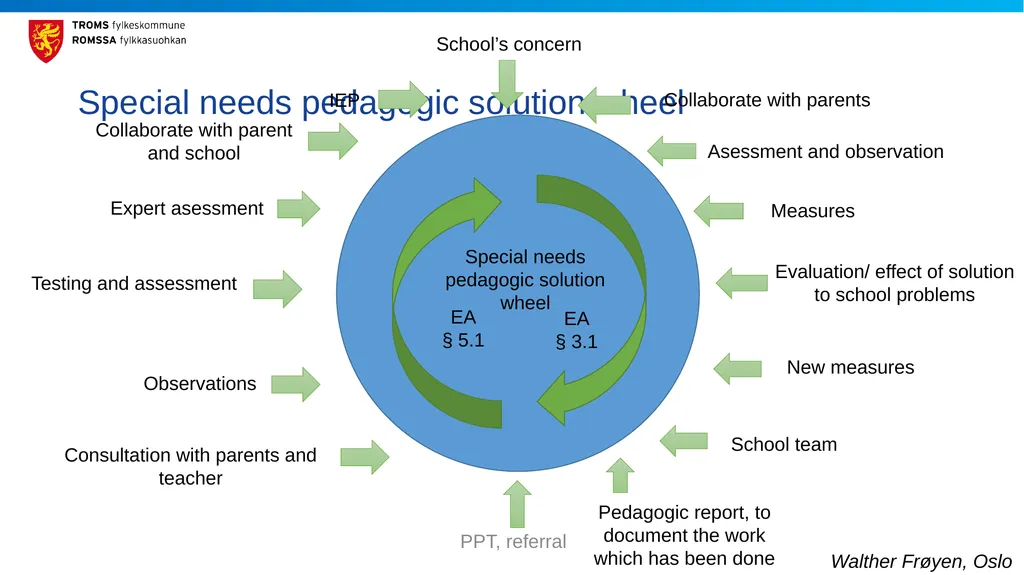
Special needs pedagogic solution wheel Testing and assessment Pedagogic report, to document the work which has been done PPT, referral Consultation with parents and teacher Walther Frøyen, Oslo<br>
11
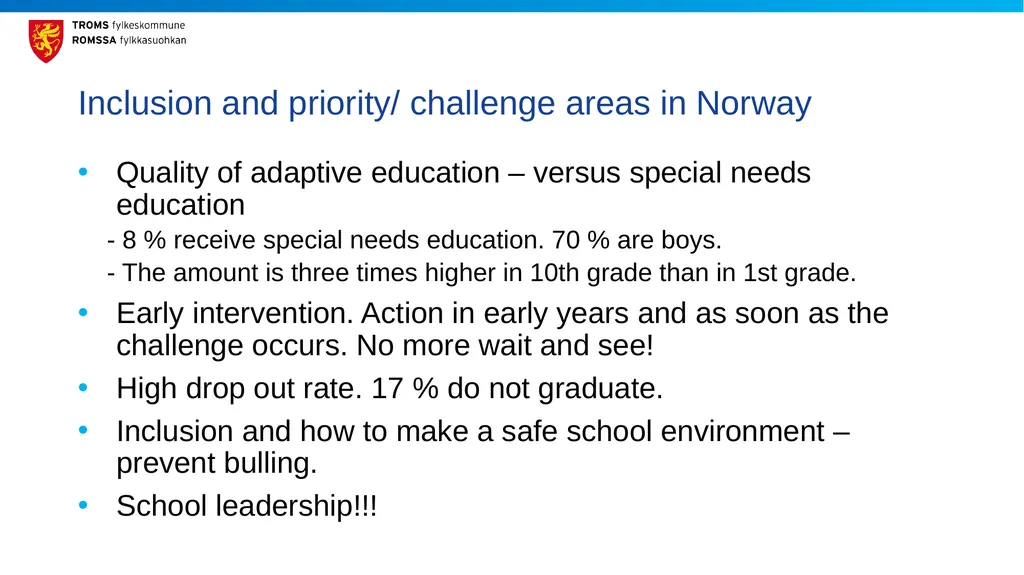
Inclusion and priority/ challenge areas in Norway Quality of adaptive education – versus special needs education
- 8 % receive special needs education. 70 % are boys.
- The amount is three times higher in 10th grade than in 1st grade.
Early intervention. Action in early years and as soon as the challenge occurs. No more wait and see!
High drop out rate. 17 % do not graduate.
Inclusion and how to make a safe school environment – prevent bulling.
School leadership!!!<br>
12
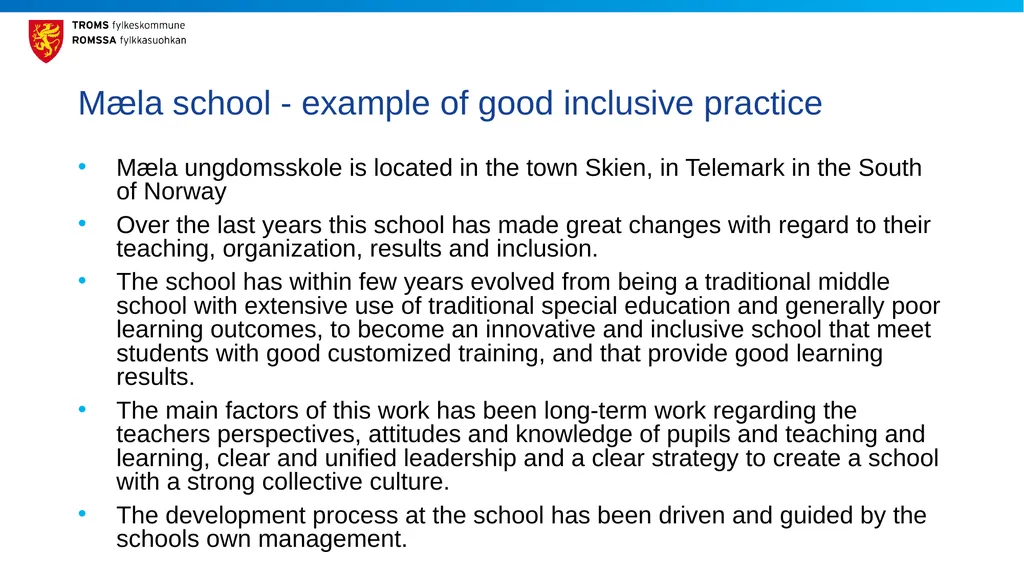
Mæla school - example of good inclusive practice Mæla ungdomsskole is located in the town Skien, in Telemark in the South of Norway
Over the last years this school has made great changes with regard to their teaching, organization, results and inclusion.
The school has within few years evolved from being a traditional middle school with extensive use of traditional special education and generally poor learning outcomes, to become an innovative and inclusive school that meet students with good customized training, and that provide good learning results.
The main factors of this work has been long-term work regarding the teachers perspectives, attitudes and knowledge of pupils and teaching and learning, clear and unified leadership and a clear strategy to create a school with a strong collective culture.
The development process at the school has been driven and guided by the schools own management.<br>
13
Mæla school (1) The school management describe the start of the development work as an intensive work with teachers’ perspectives, attitudes and knowledge on pupils, teaching and learning.
A common understanding and platform for what kind of school they wanted to develop was established jointly.
Cooperation with parents and local Educational Psychological-service about the need of special needs education
Eventually, the school was organized with a fixed team of teachers at every stage and this team followed students during 8th, 9th and 10th grade.
Core subjects such as Norwegian, mathematics and English were placed in the timetable in a way that all students that are on the same stage have these subjects simultaneously.
The school and its teaching have structures and a clear focus on what promotes student learning.
Building strong teams of teachers at each step rather than using a lot of resources on traditional special education.<br>
14
Mæla school (2) The teaching is not based on use of books in a traditional way. Each team make their own teaching material based on the curriculum.
Every week teachers have 1.5 hour collaborative work used for educational development.
The school has a clear and strong culture for cooperation both within and across the stages, and the management is very clear concerning both educational and administrative management.
All employees understand the task equally and that it has had such a strong and consistent open collaboration culture.<br>
15
Inclusion: how far can we go? Robot i klasserommet
No Isolation - How it works - YouTube<br>