
Effective Managed Care Strategy in a Volatile
KB
Published · 37 slides · 0 views
1 / 1




Description
Effective Managed Care Strategy in a Volatile World Kelly Mooney, VP of Contracting and Client Service Mike Scribner, Partner Strategic Healthcare Partners, LLC Who We Are and Who We Serve Helping healthcare organizations turn complex
Related Topics
Share
Embed code
Download this presentation From Below
"Effective Managed Care Strategy in a Volatile" is the property of its rightful owner. Permission is granted to download and print the materials on this website for personal, non-commercial use only, and to display it on your personal computer provided you do not modify the materials and that you retain all copyright notices contained in the materials. By downloading content from our website, you accept the terms of this agreement.
Presentation Transcript
01
Effective Managed Care Strategy
in a Volatile World Kelly Mooney, VP of Contracting and Client Service
Mike Scribner, Partner<br>
Mike Scribner, Partner<br>
02
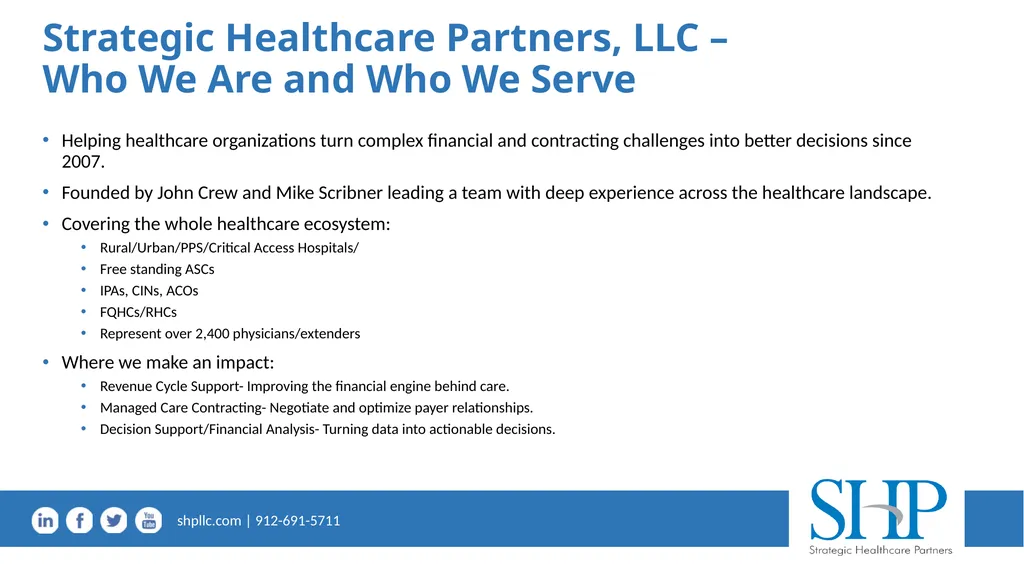
Strategic Healthcare Partners, LLC –
Who We Are and Who We Serve Helping healthcare organizations turn complex financial and contracting challenges into better decisions since 2007.
Founded by John Crew and Mike Scribner leading a team with deep experience across the healthcare landscape.
Covering the whole healthcare ecosystem:
Rural/Urban/PPS/Critical Access Hospitals/
Free standing ASCs
IPAs, CINs, ACOs
FQHCs/RHCs
Represent over 2,400 physicians/extenders
Where we make an impact:
Revenue Cycle Support- Improving the financial engine behind care.
Managed Care Contracting- Negotiate and optimize payer relationships.
Decision Support/Financial Analysis- Turning data into actionable decisions.<br>
Founded by John Crew and Mike Scribner leading a team with deep experience across the healthcare landscape.
Covering the whole healthcare ecosystem:
Rural/Urban/PPS/Critical Access Hospitals/
Free standing ASCs
IPAs, CINs, ACOs
FQHCs/RHCs
Represent over 2,400 physicians/extenders
Where we make an impact:
Revenue Cycle Support- Improving the financial engine behind care.
Managed Care Contracting- Negotiate and optimize payer relationships.
Decision Support/Financial Analysis- Turning data into actionable decisions.<br>
03
Effective Managed Care Strategy
In a Volatile World<br>
In a Volatile World<br>
04
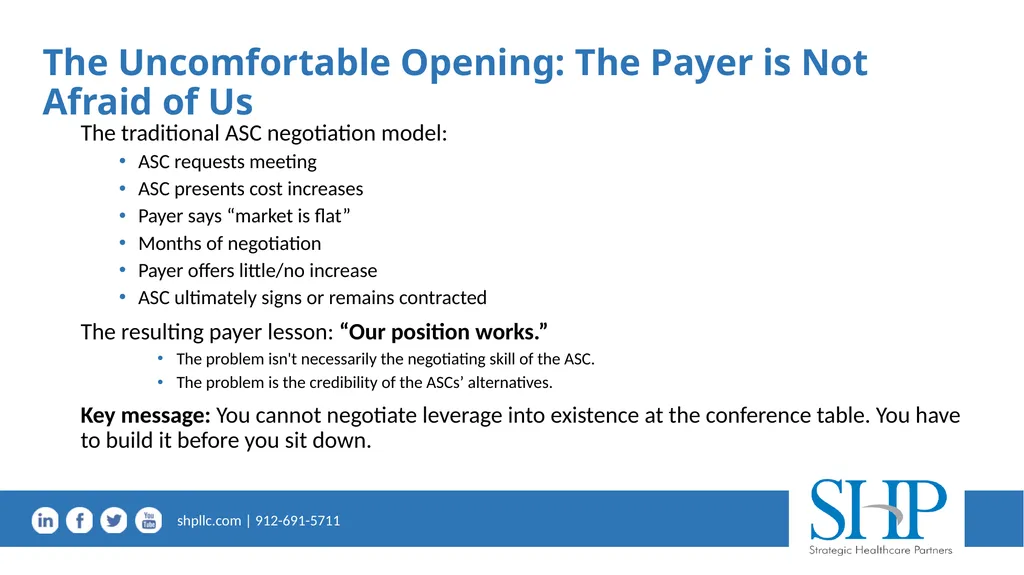
The Uncomfortable Opening: The Payer is Not Afraid of Us The traditional ASC negotiation model:
ASC requests meeting
ASC presents cost increases
Payer says “market is flat”
Months of negotiation
Payer offers little/no increase
ASC ultimately signs or remains contracted
The resulting payer lesson: “Our position works.”
The problem isn't necessarily the negotiating skill of the ASC.
The problem is the credibility of the ASCs’ alternatives.
Key message: You cannot negotiate leverage into existence at the conference table. You have to build it before you sit down.<br>
ASC requests meeting
ASC presents cost increases
Payer says “market is flat”
Months of negotiation
Payer offers little/no increase
ASC ultimately signs or remains contracted
The resulting payer lesson: “Our position works.”
The problem isn't necessarily the negotiating skill of the ASC.
The problem is the credibility of the ASCs’ alternatives.
Key message: You cannot negotiate leverage into existence at the conference table. You have to build it before you sit down.<br>
05
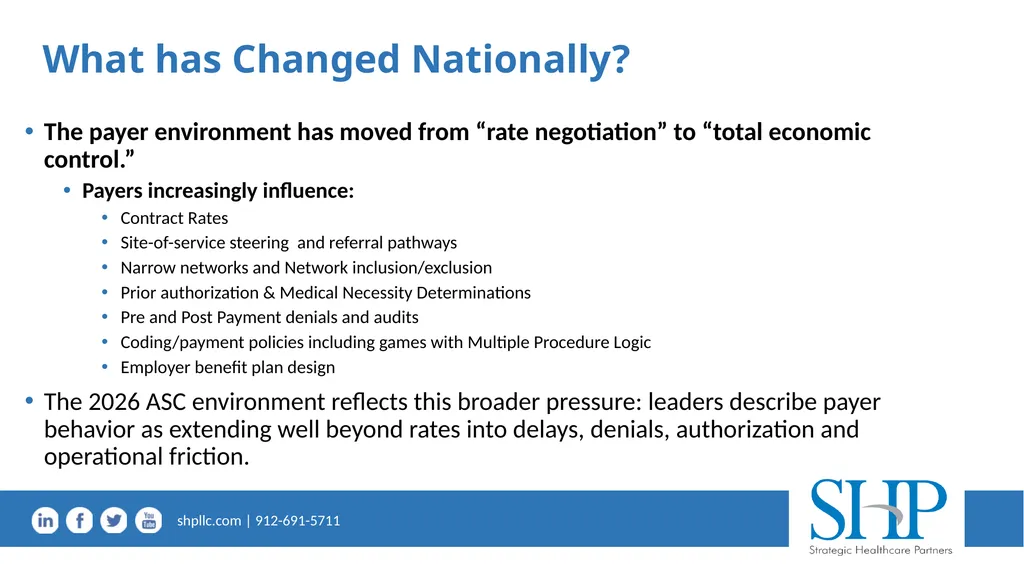
What has Changed Nationally? The payer environment has moved from “rate negotiation” to “total economic control.”
Payers increasingly influence:
Contract Rates
Site-of-service steering and referral pathways
Narrow networks and Network inclusion/exclusion
Prior authorization & Medical Necessity Determinations
Pre and Post Payment denials and audits
Coding/payment policies including games with Multiple Procedure Logic
Employer benefit plan design
The 2026 ASC environment reflects this broader pressure: leaders describe payer behavior as extending well beyond rates into delays, denials, authorization and operational friction.<br>
Payers increasingly influence:
Contract Rates
Site-of-service steering and referral pathways
Narrow networks and Network inclusion/exclusion
Prior authorization & Medical Necessity Determinations
Pre and Post Payment denials and audits
Coding/payment policies including games with Multiple Procedure Logic
Employer benefit plan design
The 2026 ASC environment reflects this broader pressure: leaders describe payer behavior as extending well beyond rates into delays, denials, authorization and operational friction.<br>
06
National ASC Managed Care Contracting Trends:
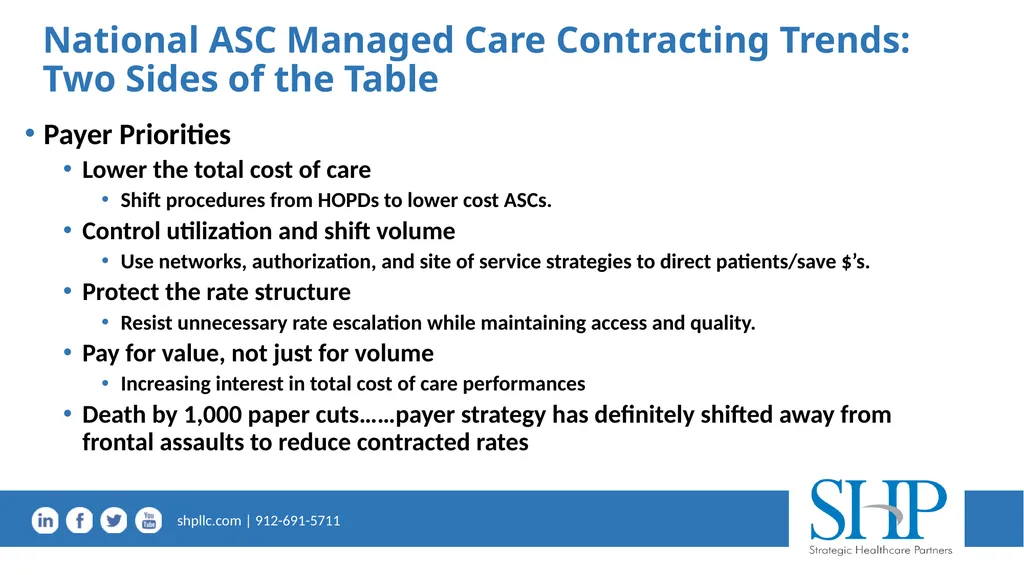
Two Sides of the Table Payer Priorities
Lower the total cost of care
Shift procedures from HOPDs to lower cost ASCs.
Control utilization and shift volume
Use networks, authorization, and site of service strategies to direct patients/save $’s.
Protect the rate structure
Resist unnecessary rate escalation while maintaining access and quality.
Pay for value, not just for volume
Increasing interest in total cost of care performances
Death by 1,000 paper cuts……payer strategy has definitely shifted away from frontal assaults to reduce contracted rates<br>
Lower the total cost of care
Shift procedures from HOPDs to lower cost ASCs.
Control utilization and shift volume
Use networks, authorization, and site of service strategies to direct patients/save $’s.
Protect the rate structure
Resist unnecessary rate escalation while maintaining access and quality.
Pay for value, not just for volume
Increasing interest in total cost of care performances
Death by 1,000 paper cuts……payer strategy has definitely shifted away from frontal assaults to reduce contracted rates<br>
07
National ASC Managed Care Contracting:
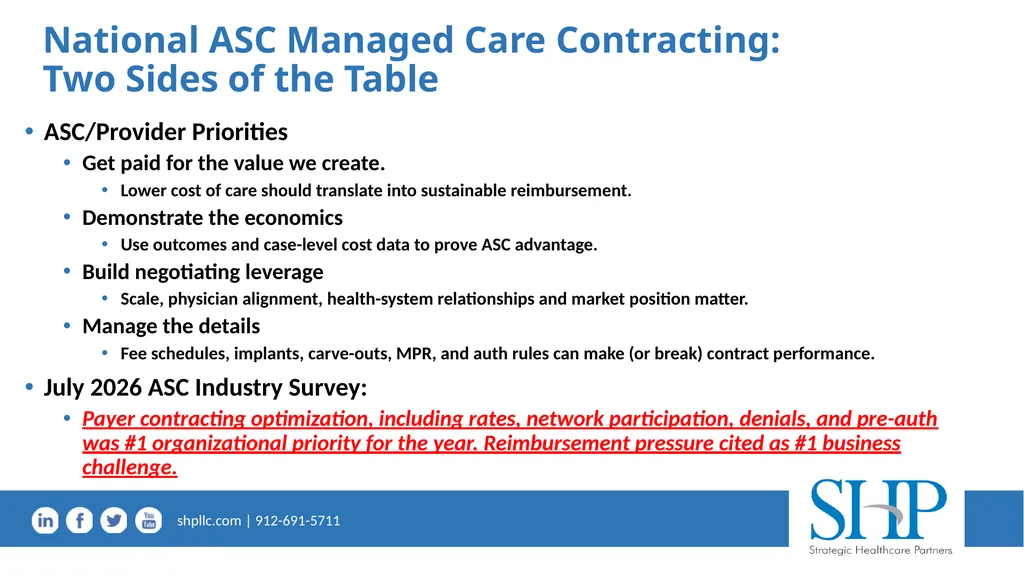
Two Sides of the Table ASC/Provider Priorities
Get paid for the value we create.
Lower cost of care should translate into sustainable reimbursement.
Demonstrate the economics
Use outcomes and case-level cost data to prove ASC advantage.
Build negotiating leverage
Scale, physician alignment, health-system relationships and market position matter.
Manage the details
Fee schedules, implants, carve-outs, MPR, and auth rules can make (or break) contract performance.
July 2026 ASC Industry Survey:
Payer contracting optimization, including rates, network participation, denials, and pre-auth was #1 organizational priority for the year. Reimbursement pressure cited as #1 business challenge.<br>
Get paid for the value we create.
Lower cost of care should translate into sustainable reimbursement.
Demonstrate the economics
Use outcomes and case-level cost data to prove ASC advantage.
Build negotiating leverage
Scale, physician alignment, health-system relationships and market position matter.
Manage the details
Fee schedules, implants, carve-outs, MPR, and auth rules can make (or break) contract performance.
July 2026 ASC Industry Survey:
Payer contracting optimization, including rates, network participation, denials, and pre-auth was #1 organizational priority for the year. Reimbursement pressure cited as #1 business challenge.<br>
08
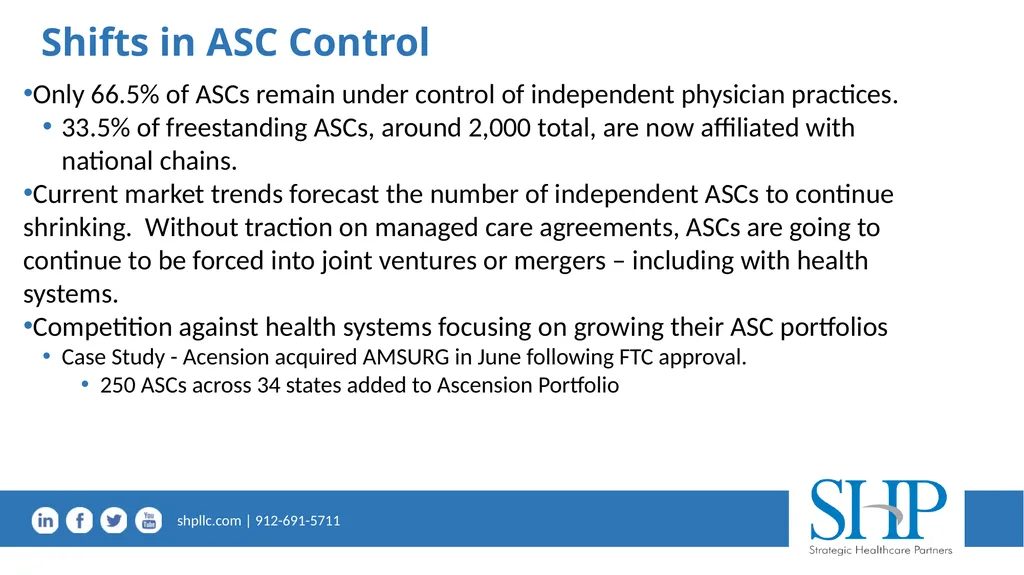
Shifts in ASC Control Only 66.5% of ASCs remain under control of independent physician practices.
33.5% of freestanding ASCs, around 2,000 total, are now affiliated with national chains.
Current market trends forecast the number of independent ASCs to continue shrinking. Without traction on managed care agreements, ASCs are going to continue to be forced into joint ventures or mergers – including with health systems.
Competition against health systems focusing on growing their ASC portfolios
Case Study - Acension acquired AMSURG in June following FTC approval.
250 ASCs across 34 states added to Ascension Portfolio<br>
33.5% of freestanding ASCs, around 2,000 total, are now affiliated with national chains.
Current market trends forecast the number of independent ASCs to continue shrinking. Without traction on managed care agreements, ASCs are going to continue to be forced into joint ventures or mergers – including with health systems.
Competition against health systems focusing on growing their ASC portfolios
Case Study - Acension acquired AMSURG in June following FTC approval.
250 ASCs across 34 states added to Ascension Portfolio<br>
09
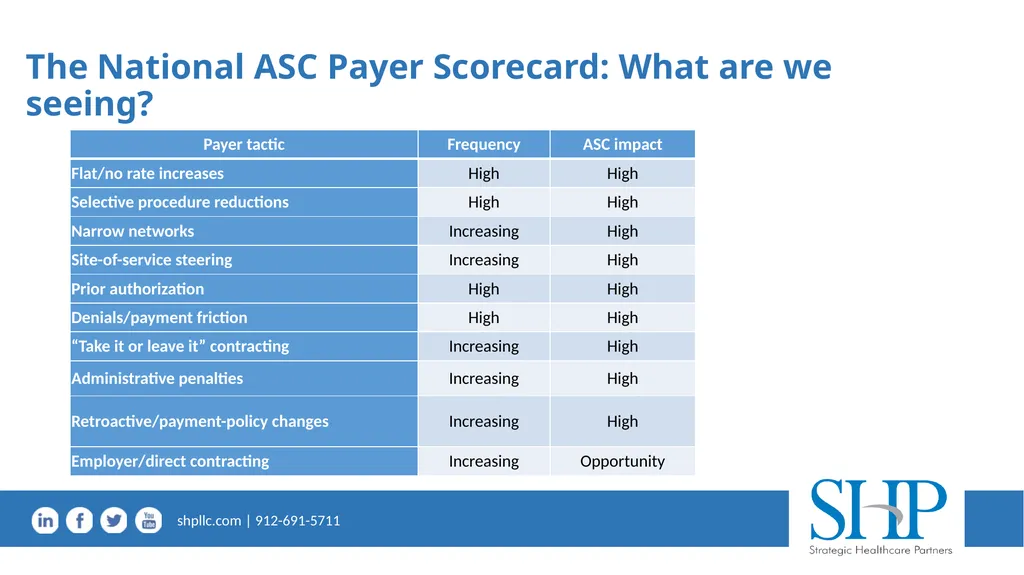
The National ASC Payer Scorecard: What are we seeing?<br>
10
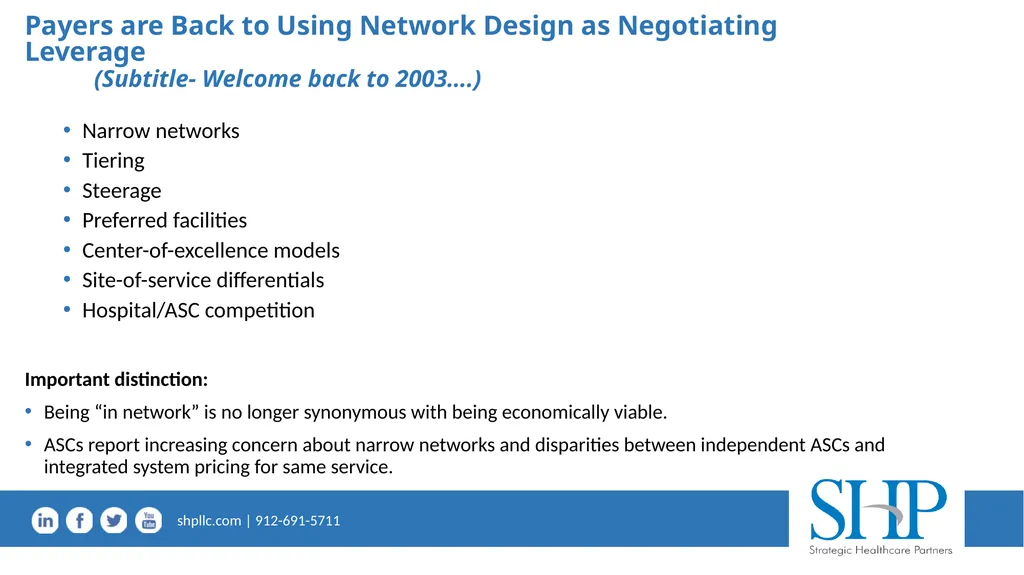
Payers are Back to Using Network Design as Negotiating Leverage
(Subtitle- Welcome back to 2003….) Narrow networks
Tiering
Steerage
Preferred facilities
Center-of-excellence models
Site-of-service differentials
Hospital/ASC competition
Important distinction:
Being “in network” is no longer synonymous with being economically viable.
ASCs report increasing concern about narrow networks and disparities between independent ASCs and integrated system pricing for same service.<br>
Tiering
Steerage
Preferred facilities
Center-of-excellence models
Site-of-service differentials
Hospital/ASC competition
Important distinction:
Being “in network” is no longer synonymous with being economically viable.
ASCs report increasing concern about narrow networks and disparities between independent ASCs and integrated system pricing for same service.<br>
11
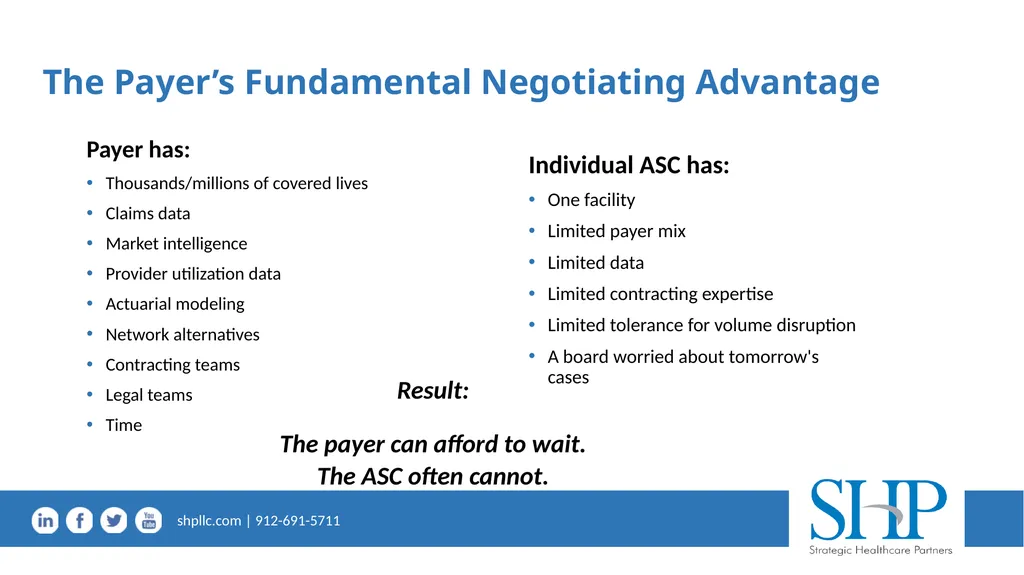
The Payer’s Fundamental Negotiating Advantage Payer has:
Thousands/millions of covered lives
Claims data
Market intelligence
Provider utilization data
Actuarial modeling
Network alternatives
Contracting teams
Legal teams
Time Individual ASC has:
One facility
Limited payer mix
Limited data
Limited contracting expertise
Limited tolerance for volume disruption
A board worried about tomorrow's cases Result:
The payer can afford to wait.
The ASC often cannot.<br>
Thousands/millions of covered lives
Claims data
Market intelligence
Provider utilization data
Actuarial modeling
Network alternatives
Contracting teams
Legal teams
Time Individual ASC has:
One facility
Limited payer mix
Limited data
Limited contracting expertise
Limited tolerance for volume disruption
A board worried about tomorrow's cases Result:
The payer can afford to wait.
The ASC often cannot.<br>
12
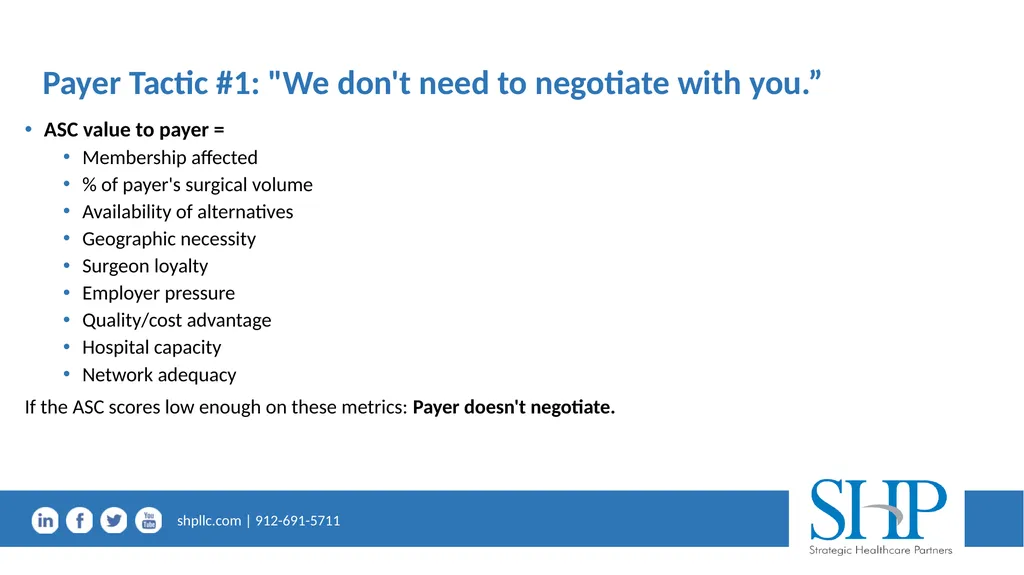
Payer Tactic #1: "We don't need to negotiate with you.” ASC value to payer =
Membership affected
% of payer's surgical volume
Availability of alternatives
Geographic necessity
Surgeon loyalty
Employer pressure
Quality/cost advantage
Hospital capacity
Network adequacy
If the ASC scores low enough on these metrics: Payer doesn't negotiate.<br>
Membership affected
% of payer's surgical volume
Availability of alternatives
Geographic necessity
Surgeon loyalty
Employer pressure
Quality/cost advantage
Hospital capacity
Network adequacy
If the ASC scores low enough on these metrics: Payer doesn't negotiate.<br>
13
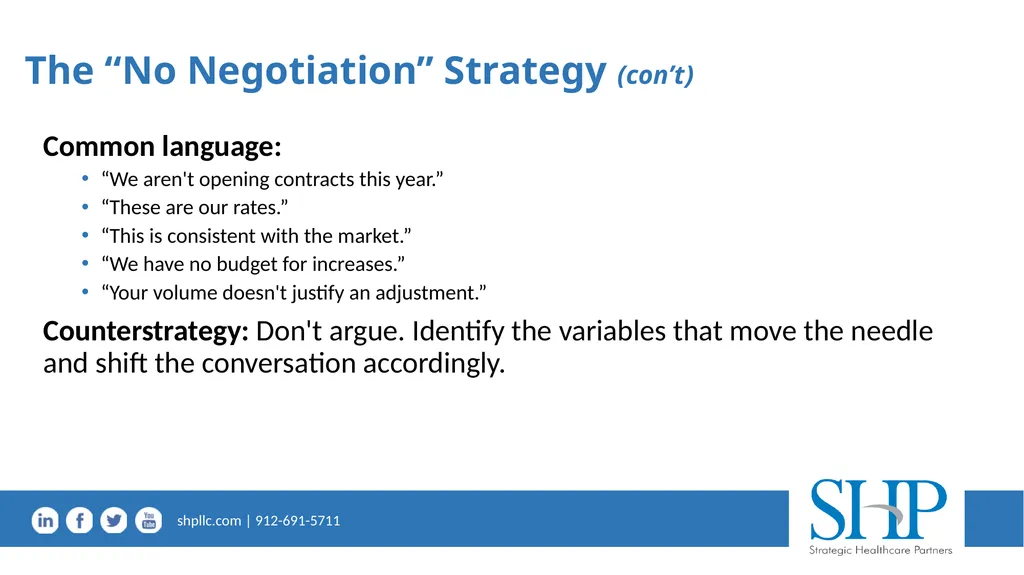
The “No Negotiation” Strategy (con’t) Common language:
“We aren't opening contracts this year.”
“These are our rates.”
“This is consistent with the market.”
“We have no budget for increases.”
“Your volume doesn't justify an adjustment.”
Counterstrategy: Don't argue. Identify the variables that move the needle and shift the conversation accordingly.<br>
“We aren't opening contracts this year.”
“These are our rates.”
“This is consistent with the market.”
“We have no budget for increases.”
“Your volume doesn't justify an adjustment.”
Counterstrategy: Don't argue. Identify the variables that move the needle and shift the conversation accordingly.<br>
14
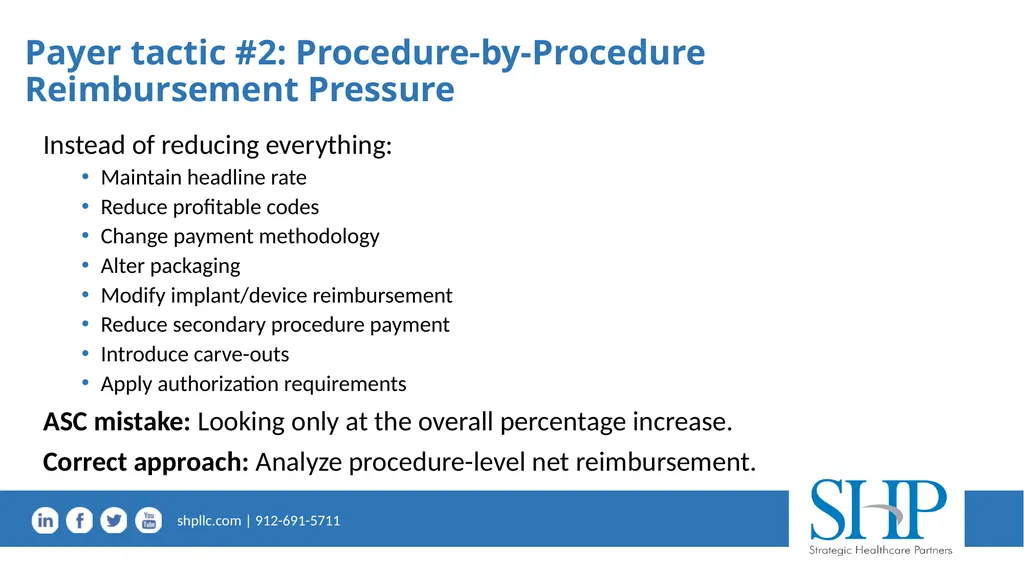
Payer tactic #2: Procedure-by-Procedure Reimbursement Pressure Instead of reducing everything:
Maintain headline rate
Reduce profitable codes
Change payment methodology
Alter packaging
Modify implant/device reimbursement
Reduce secondary procedure payment
Introduce carve-outs
Apply authorization requirements
ASC mistake: Looking only at the overall percentage increase.
Correct approach: Analyze procedure-level net reimbursement.<br>
Maintain headline rate
Reduce profitable codes
Change payment methodology
Alter packaging
Modify implant/device reimbursement
Reduce secondary procedure payment
Introduce carve-outs
Apply authorization requirements
ASC mistake: Looking only at the overall percentage increase.
Correct approach: Analyze procedure-level net reimbursement.<br>
15
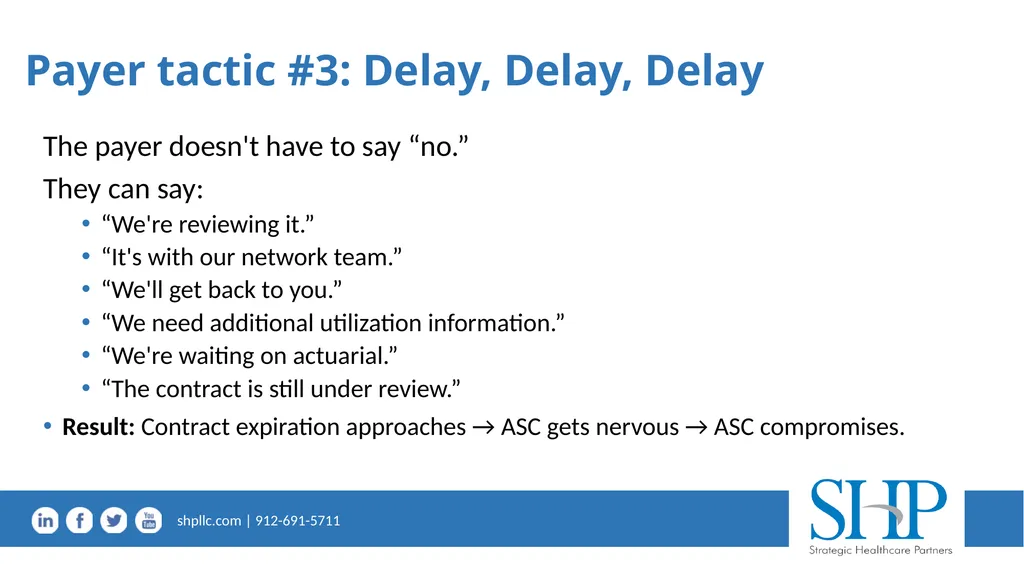
Payer tactic #3: Delay, Delay, Delay The payer doesn't have to say “no.”
They can say:
“We're reviewing it.”
“It's with our network team.”
“We'll get back to you.”
“We need additional utilization information.”
“We're waiting on actuarial.”
“The contract is still under review.”
Result: Contract expiration approaches → ASC gets nervous → ASC compromises.<br>
They can say:
“We're reviewing it.”
“It's with our network team.”
“We'll get back to you.”
“We need additional utilization information.”
“We're waiting on actuarial.”
“The contract is still under review.”
Result: Contract expiration approaches → ASC gets nervous → ASC compromises.<br>
16
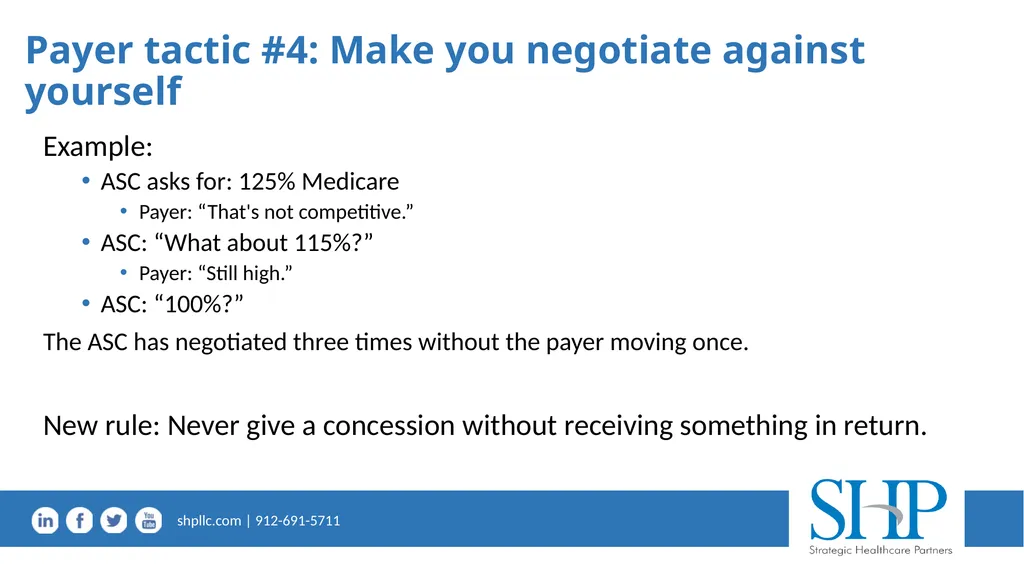
Payer tactic #4: Make you negotiate against yourself Example:
ASC asks for: 125% Medicare
Payer: “That's not competitive.”
ASC: “What about 115%?”
Payer: “Still high.”
ASC: “100%?”
The ASC has negotiated three times without the payer moving once.
New rule: Never give a concession without receiving something in return.<br>
ASC asks for: 125% Medicare
Payer: “That's not competitive.”
ASC: “What about 115%?”
Payer: “Still high.”
ASC: “100%?”
The ASC has negotiated three times without the payer moving once.
New rule: Never give a concession without receiving something in return.<br>
17
Payer tactic #5: Volume as the trap Payer: “We'll give you better rates if you send us more volume.”
But the ASC's economics may already be poor.
Show: Bad rate × more volume = more losses
The right question is: “At what reimbursement level does additional volume create economic value?”
ASCA's Naya Kehayes makes essentially this point: if the economics of the rate are negative, volume may not solve the problem; rate targets should be established before migrating additional surgery.<br>
But the ASC's economics may already be poor.
Show: Bad rate × more volume = more losses
The right question is: “At what reimbursement level does additional volume create economic value?”
ASCA's Naya Kehayes makes essentially this point: if the economics of the rate are negative, volume may not solve the problem; rate targets should be established before migrating additional surgery.<br>
18
What does a successful ASC response look like?<br>
19
What Successful Providers Are Doing Differently The successful organizations aren't necessarily the ones with the best negotiating scripts.
They're doing five things:
Know their true economics
Know the payer's economics
Create credible alternatives
Align physicians before negotiation
Actually use leverage when necessary
And Increasingly:
Create scale
Pursue employer/direct opportunities
Treat contracting as an enterprise strategy- not an administrative function<br>
They're doing five things:
Know their true economics
Know the payer's economics
Create credible alternatives
Align physicians before negotiation
Actually use leverage when necessary
And Increasingly:
Create scale
Pursue employer/direct opportunities
Treat contracting as an enterprise strategy- not an administrative function<br>
20
Stop Asking the Payer to Value You Payers already know ASCs provide value. The question isn't whether an ASC is cheaper.
The question is: Who captures the value?
If the ASC has no alternative, the payer captures it.
If the ASC can demonstrate value and has credible alternatives, the ASC can capture some of it.
If a group of ASCs can create meaningful network value, the negotiating equation changes entirely.
Final takeaway:
Don't negotiate harder.
Build leverage.
Then negotiate.<br>
The question is: Who captures the value?
If the ASC has no alternative, the payer captures it.
If the ASC can demonstrate value and has credible alternatives, the ASC can capture some of it.
If a group of ASCs can create meaningful network value, the negotiating equation changes entirely.
Final takeaway:
Don't negotiate harder.
Build leverage.
Then negotiate.<br>
21
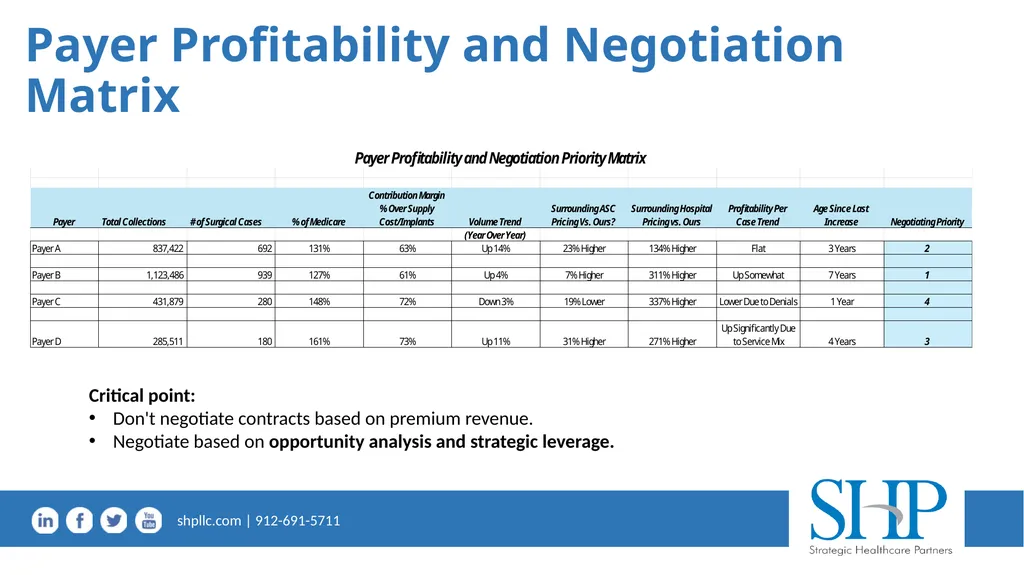
Payer Profitability and Negotiation Matrix Critical point:
Don't negotiate contracts based on premium revenue.
Negotiate based on opportunity analysis and strategic leverage.<br>
Don't negotiate contracts based on premium revenue.
Negotiate based on opportunity analysis and strategic leverage.<br>
22
The ASC’s Strongest Negotiating Asset: Surgical Migration This is the centerpiece.
Payer does NOT care that:
Your costs went up.
Your staff needs raises.
Your supplies cost more.
Your quality scores.
Your patient satisfaction scores.
Payer cares about: “What happens to this surgery if I don't contract with you?”
If the answer is: “It goes to another ASC at a similar cost” that isn't much leverage.
If the answer is: “It goes to a hospital at 3.5 × the cost.”; now you have the platform to have a conversation.
ASCs specifically identifies the ability to migrate surgical volume as a major source of ASC negotiating power.<br>
Payer does NOT care that:
Your costs went up.
Your staff needs raises.
Your supplies cost more.
Your quality scores.
Your patient satisfaction scores.
Payer cares about: “What happens to this surgery if I don't contract with you?”
If the answer is: “It goes to another ASC at a similar cost” that isn't much leverage.
If the answer is: “It goes to a hospital at 3.5 × the cost.”; now you have the platform to have a conversation.
ASCs specifically identifies the ability to migrate surgical volume as a major source of ASC negotiating power.<br>
23
Build the Payer Savings Story Don't sell: “We are cheaper than the hospital.”
Prove: “Here is what you spend today.” vs. “Here is what you would spend if this surgery (and potentially all of our services) migrated.”
Include:
Facility
Professional
Anesthesia
Imaging
Pathology
Drugs
Follow-up
Complications
Readmissions
Total episode cost
The negotiation should be about total medical spend, not just your ASC reimbursement.<br>
Prove: “Here is what you spend today.” vs. “Here is what you would spend if this surgery (and potentially all of our services) migrated.”
Include:
Facility
Professional
Anesthesia
Imaging
Pathology
Drugs
Follow-up
Complications
Readmissions
Total episode cost
The negotiation should be about total medical spend, not just your ASC reimbursement.<br>
24
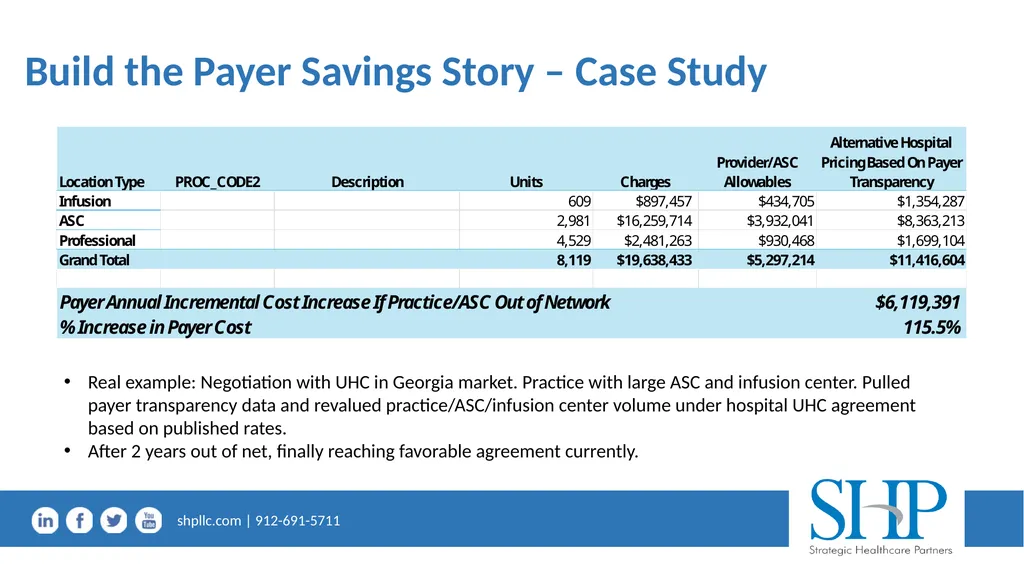
Build the Payer Savings Story – Case Study Real example: Negotiation with UHC in Georgia market. Practice with large ASC and infusion center. Pulled payer transparency data and revalued practice/ASC/infusion center volume under hospital UHC agreement based on published rates.
After 2 years out of net, finally reaching favorable agreement currently.<br>
After 2 years out of net, finally reaching favorable agreement currently.<br>
25
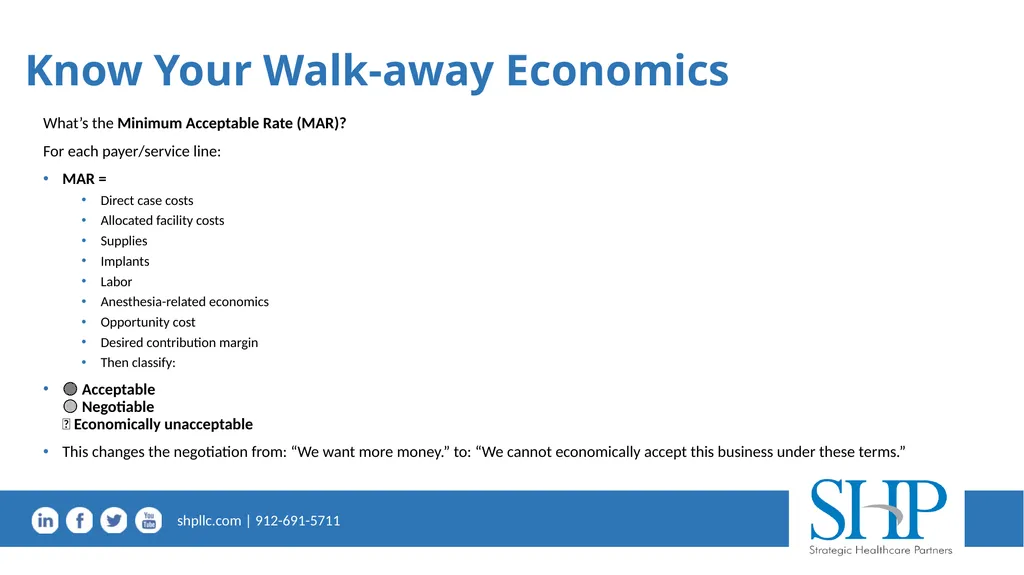
Know Your Walk-away Economics What’s the Minimum Acceptable Rate (MAR)?
For each payer/service line:
MAR =
Direct case costs
Allocated facility costs
Supplies
Implants
Labor
Anesthesia-related economics
Opportunity cost
Desired contribution margin
Then classify:
🟢 Acceptable 🟡 Negotiable 🔴 Economically unacceptable
This changes the negotiation from: “We want more money.” to: “We cannot economically accept this business under these terms.”<br>
For each payer/service line:
MAR =
Direct case costs
Allocated facility costs
Supplies
Implants
Labor
Anesthesia-related economics
Opportunity cost
Desired contribution margin
Then classify:
🟢 Acceptable 🟡 Negotiable 🔴 Economically unacceptable
This changes the negotiation from: “We want more money.” to: “We cannot economically accept this business under these terms.”<br>
26
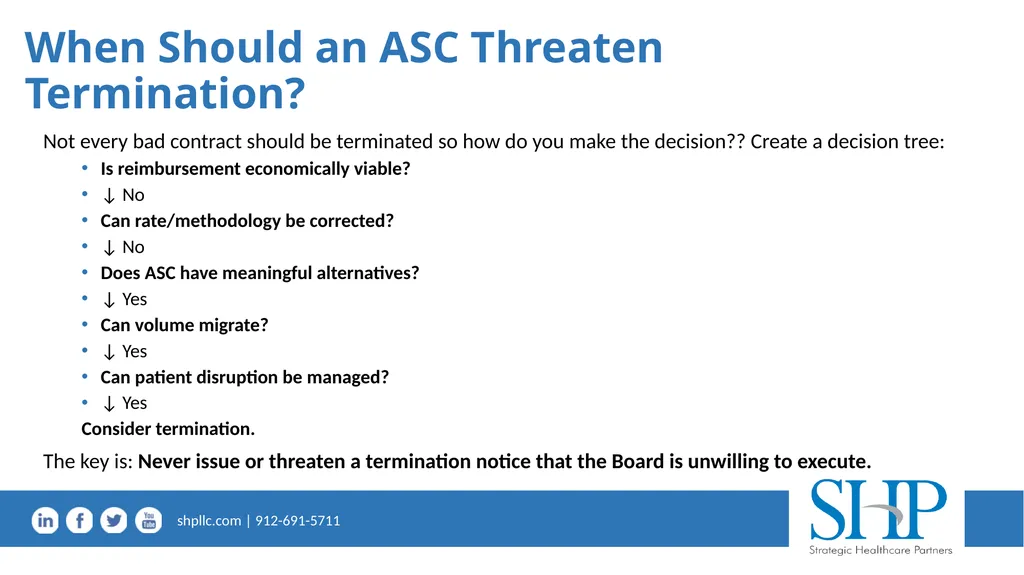
When Should an ASC Threaten Termination? Not every bad contract should be terminated so how do you make the decision?? Create a decision tree:
Is reimbursement economically viable?
↓ No
Can rate/methodology be corrected?
↓ No
Does ASC have meaningful alternatives?
↓ Yes
Can volume migrate?
↓ Yes
Can patient disruption be managed?
↓ Yes
Consider termination.
The key is: Never issue or threaten a termination notice that the Board is unwilling to execute.<br>
Is reimbursement economically viable?
↓ No
Can rate/methodology be corrected?
↓ No
Does ASC have meaningful alternatives?
↓ Yes
Can volume migrate?
↓ Yes
Can patient disruption be managed?
↓ Yes
Consider termination.
The key is: Never issue or threaten a termination notice that the Board is unwilling to execute.<br>
27
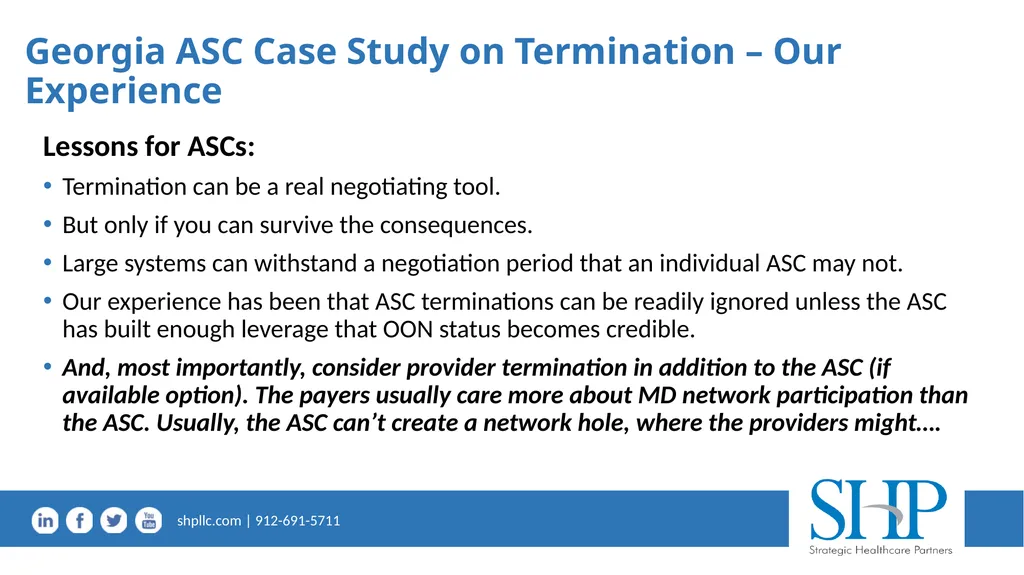
Georgia ASC Case Study on Termination – Our Experience Lessons for ASCs:
Termination can be a real negotiating tool.
But only if you can survive the consequences.
Large systems can withstand a negotiation period that an individual ASC may not.
Our experience has been that ASC terminations can be readily ignored unless the ASC has built enough leverage that OON status becomes credible.
And, most importantly, consider provider termination in addition to the ASC (if available option). The payers usually care more about MD network participation than the ASC. Usually, the ASC can’t create a network hole, where the providers might….<br>
Termination can be a real negotiating tool.
But only if you can survive the consequences.
Large systems can withstand a negotiation period that an individual ASC may not.
Our experience has been that ASC terminations can be readily ignored unless the ASC has built enough leverage that OON status becomes credible.
And, most importantly, consider provider termination in addition to the ASC (if available option). The payers usually care more about MD network participation than the ASC. Usually, the ASC can’t create a network hole, where the providers might….<br>
28
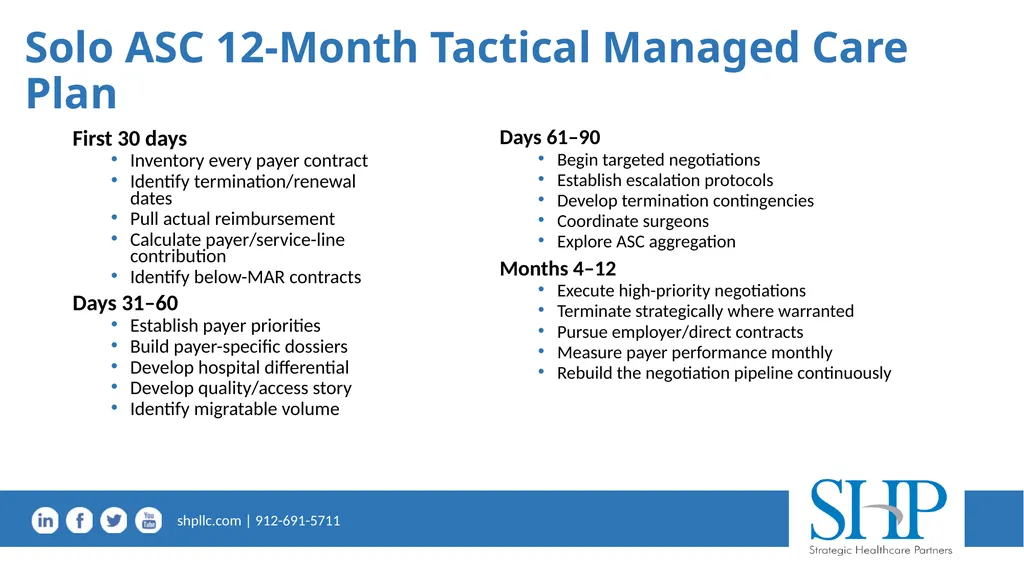
Solo ASC 12-Month Tactical Managed Care Plan First 30 days
Inventory every payer contract
Identify termination/renewal dates
Pull actual reimbursement
Calculate payer/service-line contribution
Identify below-MAR contracts
Days 31–60
Establish payer priorities
Build payer-specific dossiers
Develop hospital differential
Develop quality/access story
Identify migratable volume Days 61–90
Begin targeted negotiations
Establish escalation protocols
Develop termination contingencies
Coordinate surgeons
Explore ASC aggregation
Months 4–12
Execute high-priority negotiations
Terminate strategically where warranted
Pursue employer/direct contracts
Measure payer performance monthly
Rebuild the negotiation pipeline continuously<br>
Inventory every payer contract
Identify termination/renewal dates
Pull actual reimbursement
Calculate payer/service-line contribution
Identify below-MAR contracts
Days 31–60
Establish payer priorities
Build payer-specific dossiers
Develop hospital differential
Develop quality/access story
Identify migratable volume Days 61–90
Begin targeted negotiations
Establish escalation protocols
Develop termination contingencies
Coordinate surgeons
Explore ASC aggregation
Months 4–12
Execute high-priority negotiations
Terminate strategically where warranted
Pursue employer/direct contracts
Measure payer performance monthly
Rebuild the negotiation pipeline continuously<br>
29
How Do You Build Leverage in
ASC Collaborations?<br>
ASC Collaborations?<br>
30
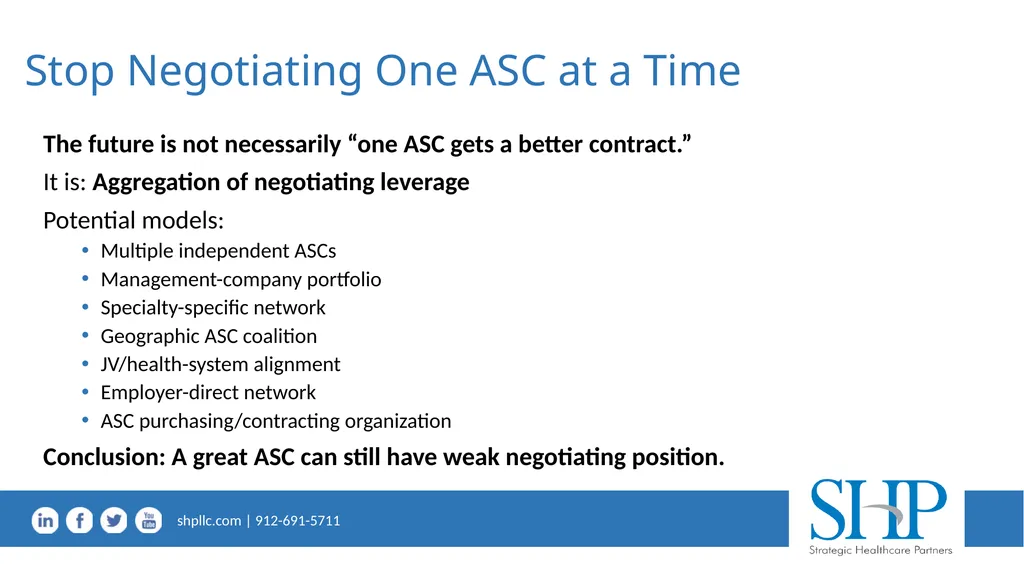
Stop Negotiating One ASC at a Time The future is not necessarily “one ASC gets a better contract.”
It is: Aggregation of negotiating leverage
Potential models:
Multiple independent ASCs
Management-company portfolio
Specialty-specific network
Geographic ASC coalition
JV/health-system alignment
Employer-direct network
ASC purchasing/contracting organization
Conclusion: A great ASC can still have weak negotiating position.<br>
It is: Aggregation of negotiating leverage
Potential models:
Multiple independent ASCs
Management-company portfolio
Specialty-specific network
Geographic ASC coalition
JV/health-system alignment
Employer-direct network
ASC purchasing/contracting organization
Conclusion: A great ASC can still have weak negotiating position.<br>
31
Scale is Leverage—but Not Necessarily Ownership Level 1 — Single ASC: “Pay us more.”
Level 2 — ASC portfolio: “Here is our aggregate volume.”
Level 3 — Alternative network: “Here is the network solution we can offer your members.”
The third is fundamentally different. You aren't negotiating a rate. You're negotiating network value.<br>
Level 2 — ASC portfolio: “Here is our aggregate volume.”
Level 3 — Alternative network: “Here is the network solution we can offer your members.”
The third is fundamentally different. You aren't negotiating a rate. You're negotiating network value.<br>
32
What changes the conversation? More providers + more specialties + grip on local market + better data= Greater strategic value to the payer.
Scale does not automatically mean better…but scale almost always creates negotiating relevance.
Question is not “What can we get?”; It’s “What value do we bring to your network?”<br>
Scale does not automatically mean better…but scale almost always creates negotiating relevance.
Question is not “What can we get?”; It’s “What value do we bring to your network?”<br>
33
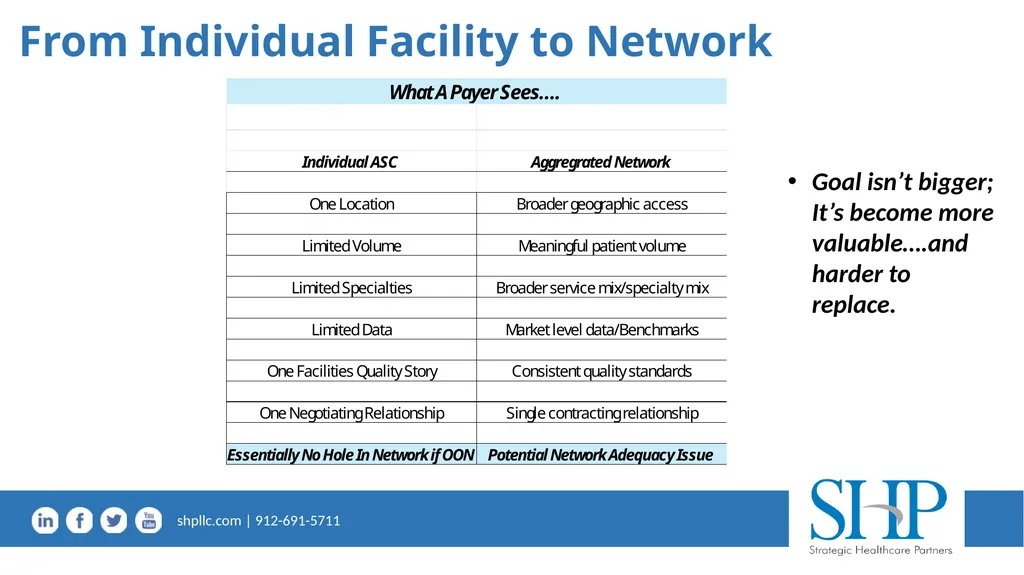
From Individual Facility to Network Goal isn’t bigger; It’s become more valuable….and harder to replace.<br>
34
The Strategic Imperative Band Together
Build Scale.
Create Value.
Measure It.
Use it to Negotiate.<br>
Build Scale.
Create Value.
Measure It.
Use it to Negotiate.<br>
35
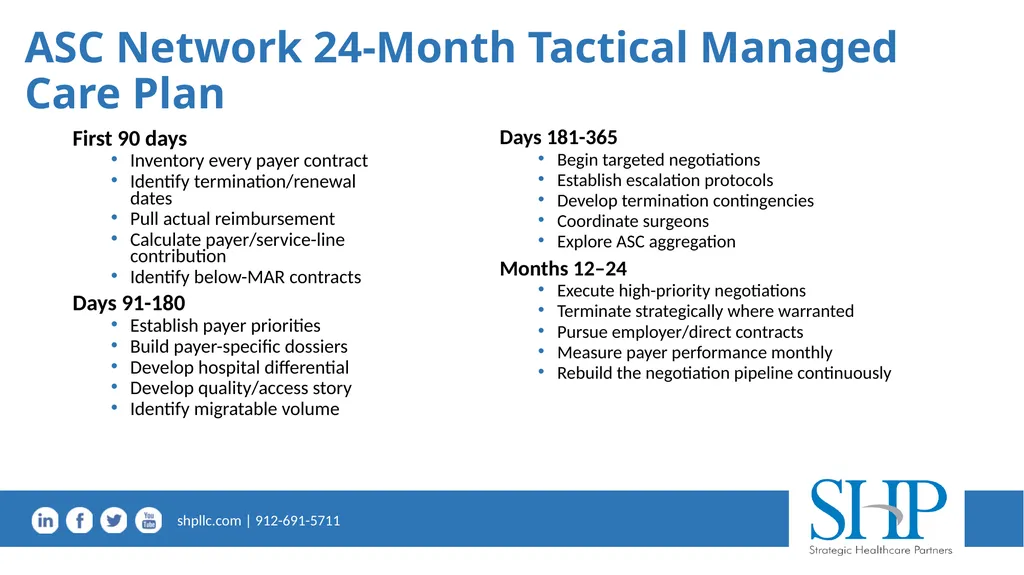
ASC Network 24-Month Tactical Managed Care Plan First 90 days
Inventory every payer contract
Identify termination/renewal dates
Pull actual reimbursement
Calculate payer/service-line contribution
Identify below-MAR contracts
Days 91-180
Establish payer priorities
Build payer-specific dossiers
Develop hospital differential
Develop quality/access story
Identify migratable volume Days 181-365
Begin targeted negotiations
Establish escalation protocols
Develop termination contingencies
Coordinate surgeons
Explore ASC aggregation
Months 12–24
Execute high-priority negotiations
Terminate strategically where warranted
Pursue employer/direct contracts
Measure payer performance monthly
Rebuild the negotiation pipeline continuously<br>
Inventory every payer contract
Identify termination/renewal dates
Pull actual reimbursement
Calculate payer/service-line contribution
Identify below-MAR contracts
Days 91-180
Establish payer priorities
Build payer-specific dossiers
Develop hospital differential
Develop quality/access story
Identify migratable volume Days 181-365
Begin targeted negotiations
Establish escalation protocols
Develop termination contingencies
Coordinate surgeons
Explore ASC aggregation
Months 12–24
Execute high-priority negotiations
Terminate strategically where warranted
Pursue employer/direct contracts
Measure payer performance monthly
Rebuild the negotiation pipeline continuously<br>
36
Wrap Up & Questions
Follow Up:
kmooney@shpllc.com<br>
37
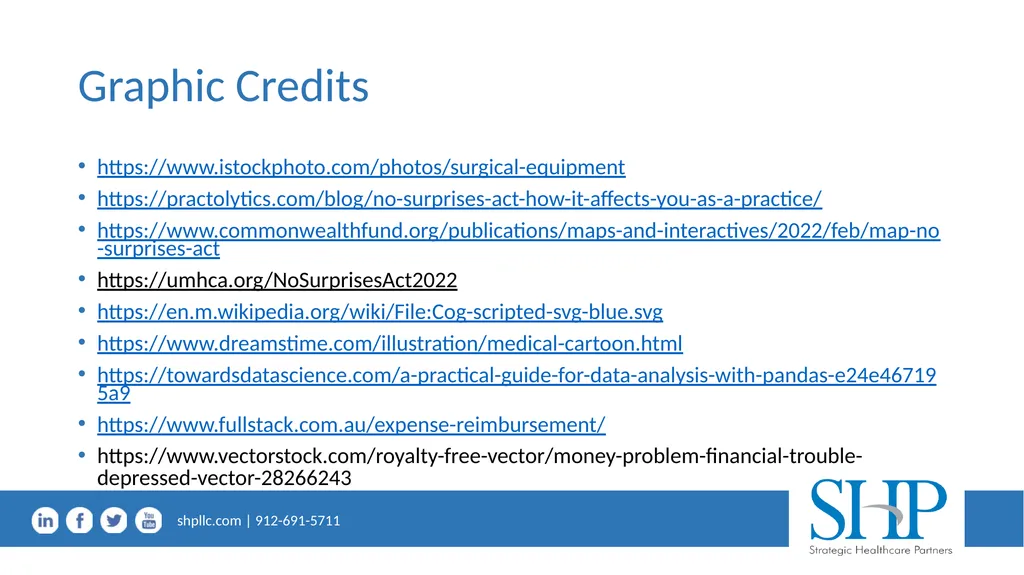
Graphic Credits https://www.istockphoto.com/photos/surgical-equipment
https://practolytics.com/blog/no-surprises-act-how-it-affects-you-as-a-practice/
https://www.commonwealthfund.org/publications/maps-and-interactives/2022/feb/map-no-surprises-act
https://umhca.org/NoSurprisesAct2022
https://en.m.wikipedia.org/wiki/File:Cog-scripted-svg-blue.svg
https://www.dreamstime.com/illustration/medical-cartoon.html
https://towardsdatascience.com/a-practical-guide-for-data-analysis-with-pandas-e24e467195a9
https://www.fullstack.com.au/expense-reimbursement/
https://www.vectorstock.com/royalty-free-vector/money-problem-financial-trouble-depressed-vector-28266243<br>
https://practolytics.com/blog/no-surprises-act-how-it-affects-you-as-a-practice/
https://www.commonwealthfund.org/publications/maps-and-interactives/2022/feb/map-no-surprises-act
https://umhca.org/NoSurprisesAct2022
https://en.m.wikipedia.org/wiki/File:Cog-scripted-svg-blue.svg
https://www.dreamstime.com/illustration/medical-cartoon.html
https://towardsdatascience.com/a-practical-guide-for-data-analysis-with-pandas-e24e467195a9
https://www.fullstack.com.au/expense-reimbursement/
https://www.vectorstock.com/royalty-free-vector/money-problem-financial-trouble-depressed-vector-28266243<br>