04
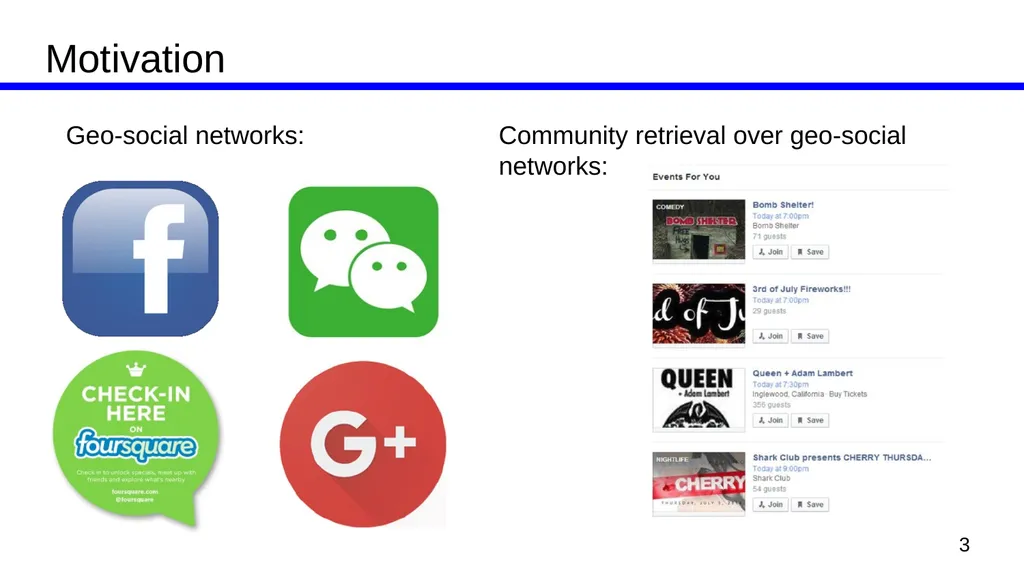
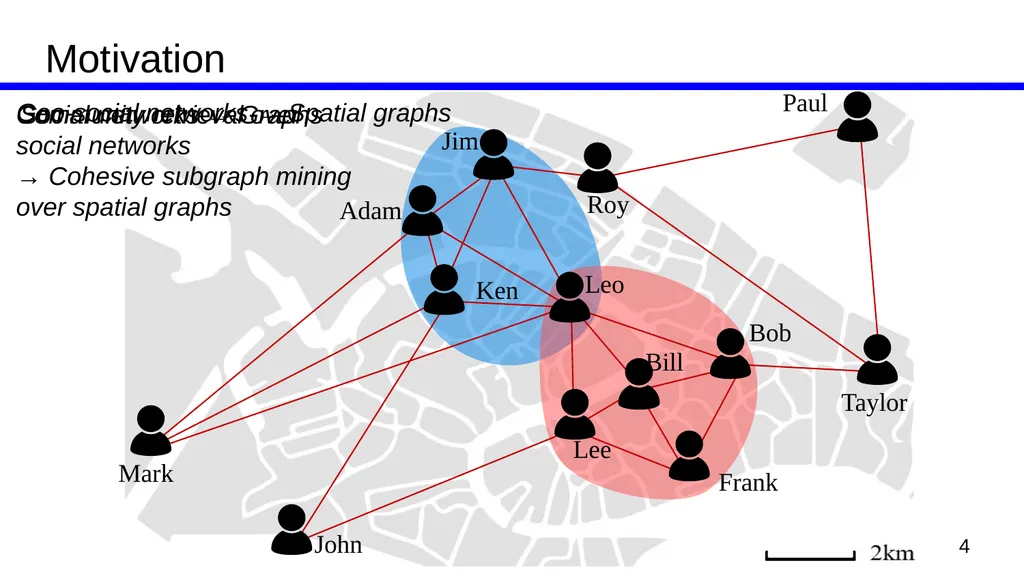
4 Geo-social networks → Spatial graphs Community retrieval over social networks
→ Cohesive subgraph mining over spatial graphs Social networks → Graphs Motivation Adam Leo Paul Roy Ken Taylor Bob Frank John Mark Jim Bill Lee<br>
05
Community retrieval Spatial databases
- Spatial keyword query[6], locality search[7], …
Non-spatial graphs
- Models: k-core[1], k-truss[4], clique[5], …
Spatial graphs
- Spatial-aware-community search[2], (k, r)-core[3], … 5 [1] S. B. Seidman. Network structure and minimum degree. Social networks, 5(3):269–287, 1983.
[2] F. Zhang, Y. Zhang, L. Qin, W. Zhang, and X. Lin, “When engagement meets similarity: efficient (k, r)-core computation on social networks,” PVLDB, 2017.
[3] Y. Fang, R. Cheng, X. Li, S. Luo, and J. Hu, “Effective community search over large spatial graphs,” PVLDB, 2017.
[4] J. Cohen, “Trusses: Cohesive subgraphs for social network analysis,” NSATR, vol. 16, 2008. �[5] R. D. Luce and A. D. Perry, “A method of matrix analysis of group structure,” Psychometrika, vol. 14, no. 2, pp. 95–116, 1949 �[6]T. Guo, X. Cao, and G. Cong, “Efficient algorithms for answering the m-closest keywords query,” in SIGMOD. �[7] Q. Qu, S. Liu, B. Yang, and C. S. Jensen, “Efficient top-k spatial locality search for co-located spatial web objects,” in Mobile Data Management (MDM), 2014<br>
06
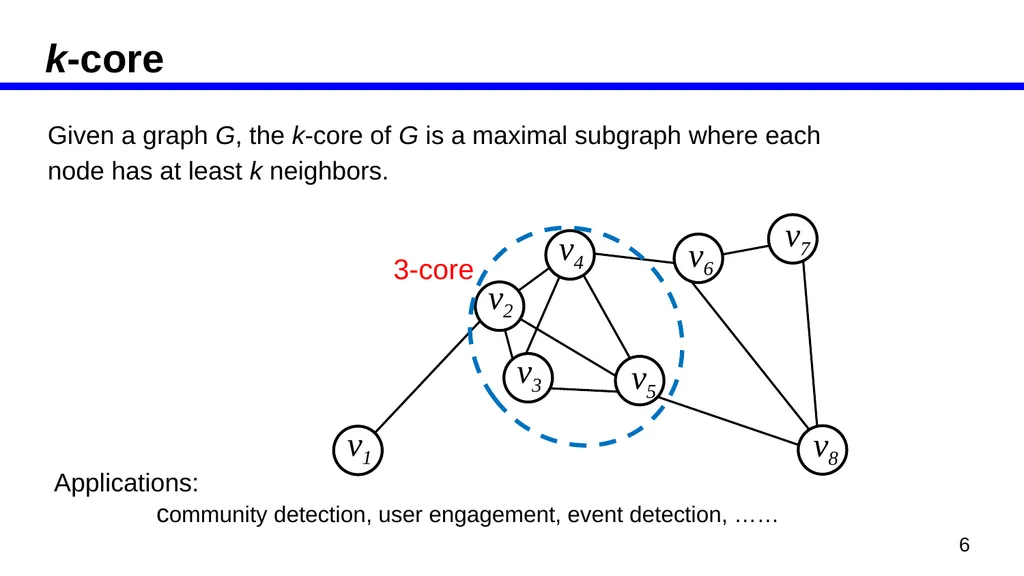
k-core 6 Given a graph G, the k-core of G is a maximal subgraph where each node has at least k neighbors. Applications:
community detection, user engagement, event detection, …… 3-core v1 v4 v2 v3 v5 v6 v7 v8<br>
07
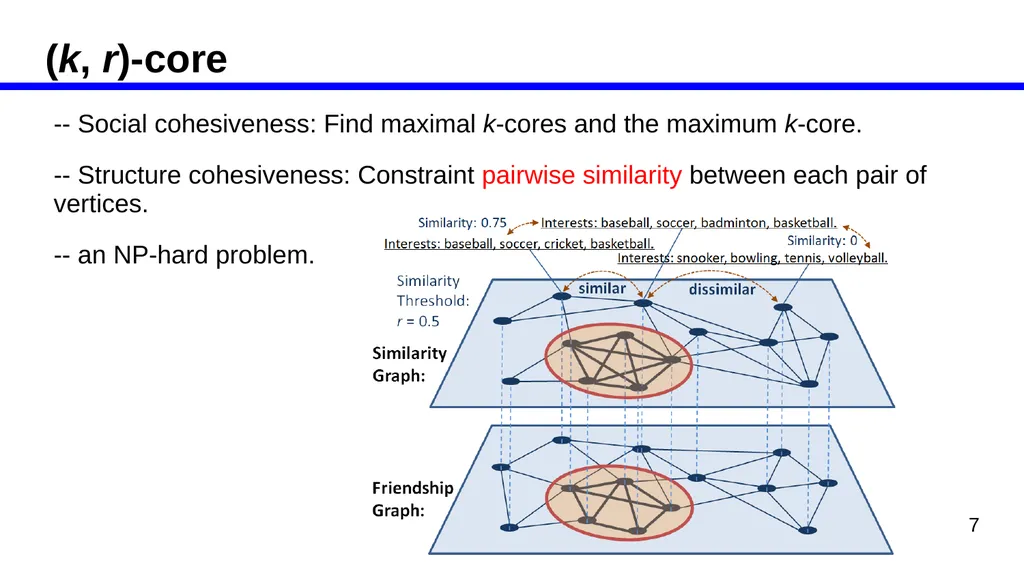
(k, r)-core -- Social cohesiveness: Find maximal k-cores and the maximum k-core.
-- Structure cohesiveness: Constraint pairwise similarity between each pair of vertices.
-- an NP-hard problem. 7<br>
08
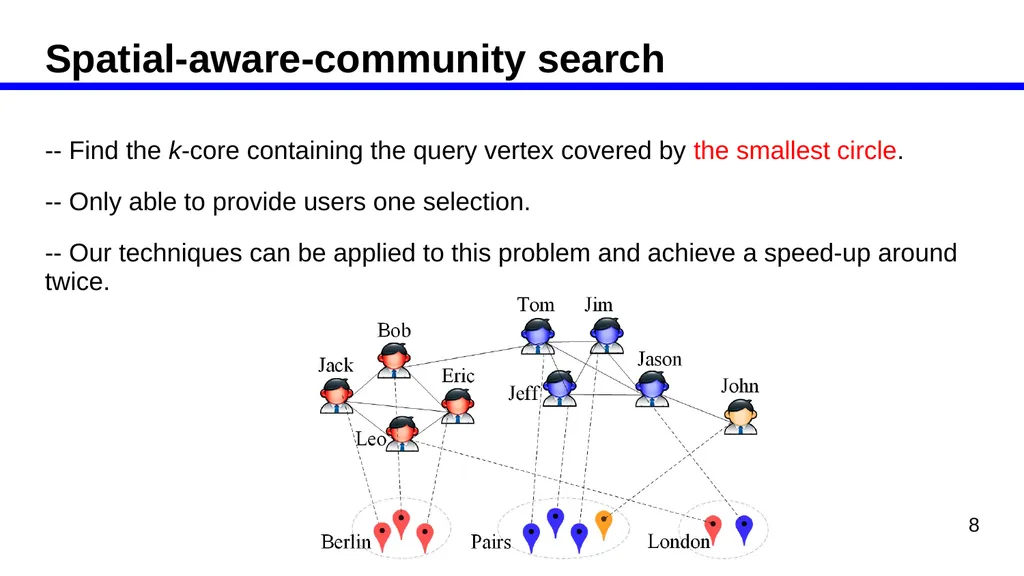
Spatial-aware-community search 8 -- Find the k-core containing the query vertex covered by the smallest circle.
-- Only able to provide users one selection.
-- Our techniques can be applied to this problem and achieve a speed-up around twice.<br>
09
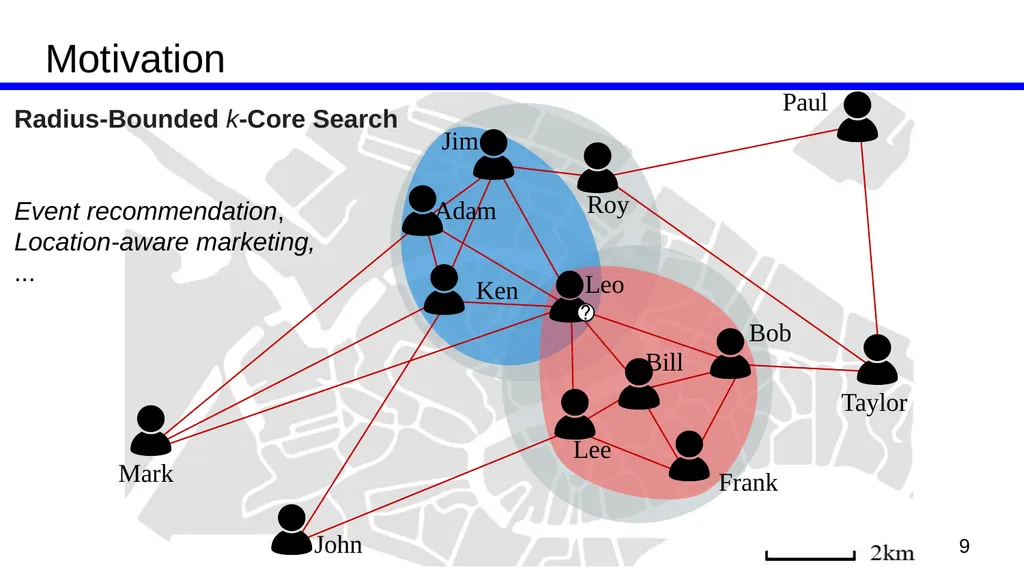
9 Radius-Bounded k-Core Search
Event recommendation,
Location-aware marketing,
... Motivation Adam Leo Paul Roy Ken Taylor Bob Frank John Mark Jim Bill Lee<br>
10
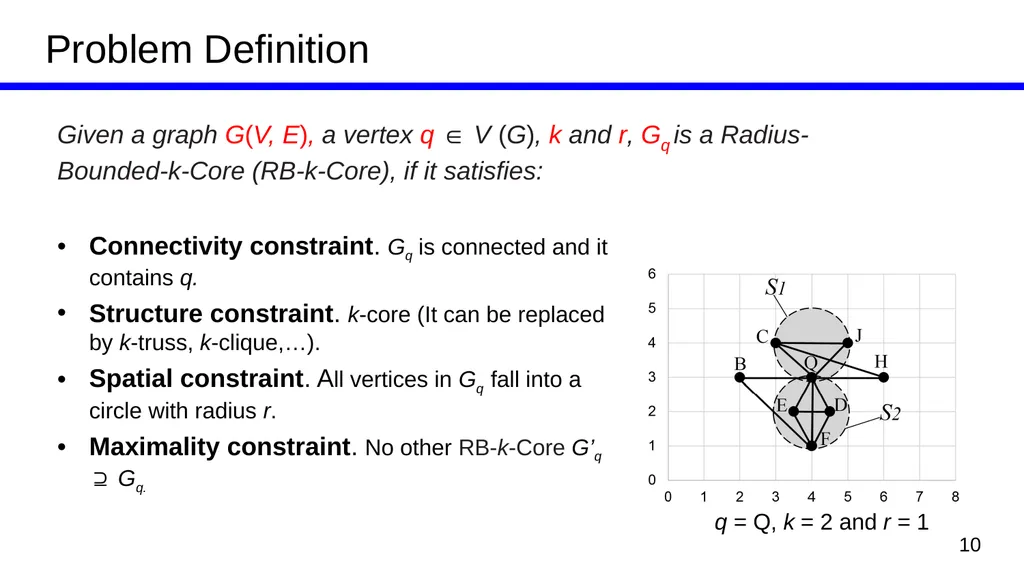
Problem Definition 10 Given a graph G(V, E), a vertex q ∈ V (G), k and r, Gq is a Radius-Bounded-k-Core (RB-k-Core), if it satisfies: Connectivity constraint. Gq is connected and it contains q.
Structure constraint. k-core (It can be replaced by k-truss, k-clique,…).
Spatial constraint. All vertices in Gq fall into a circle with radius r.
Maximality constraint. No other RB-k-Core G’q ⊇ Gq. q = Q, k = 2 and r = 1<br>
11
Challenges 11 The position of the radius-bounded circle of a RB-k-core is unknown.
It is time-consuming to verify all the candidate subgraphs individually.<br>
12
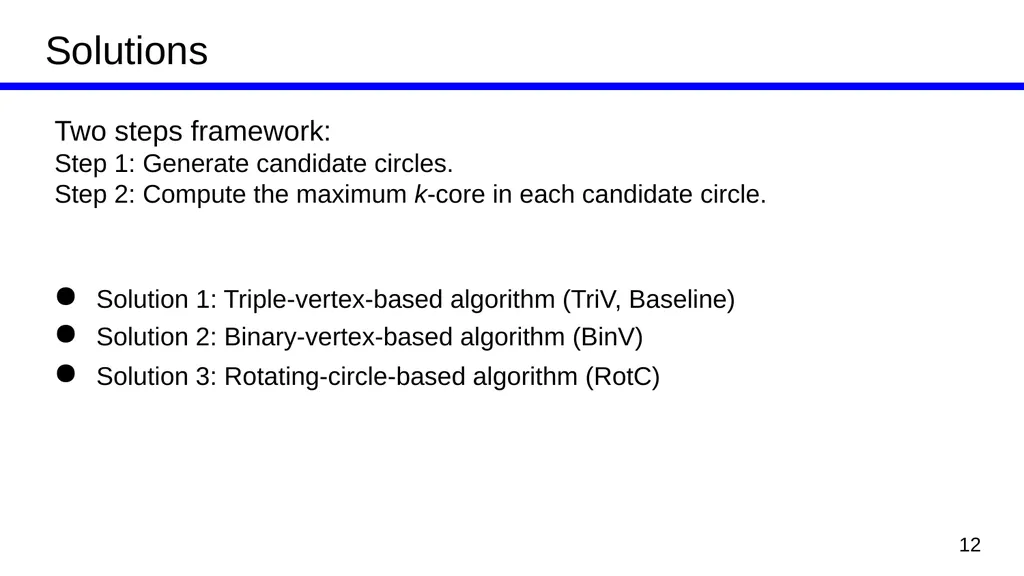
Solutions Solution 1: Triple-vertex-based algorithm (TriV, Baseline) 12 Solution 2: Binary-vertex-based algorithm (BinV) Solution 3: Rotating-circle-based algorithm (RotC) Two steps framework:
Step 1: Generate candidate circles.
Step 2: Compute the maximum k-core in each candidate circle.<br>
13
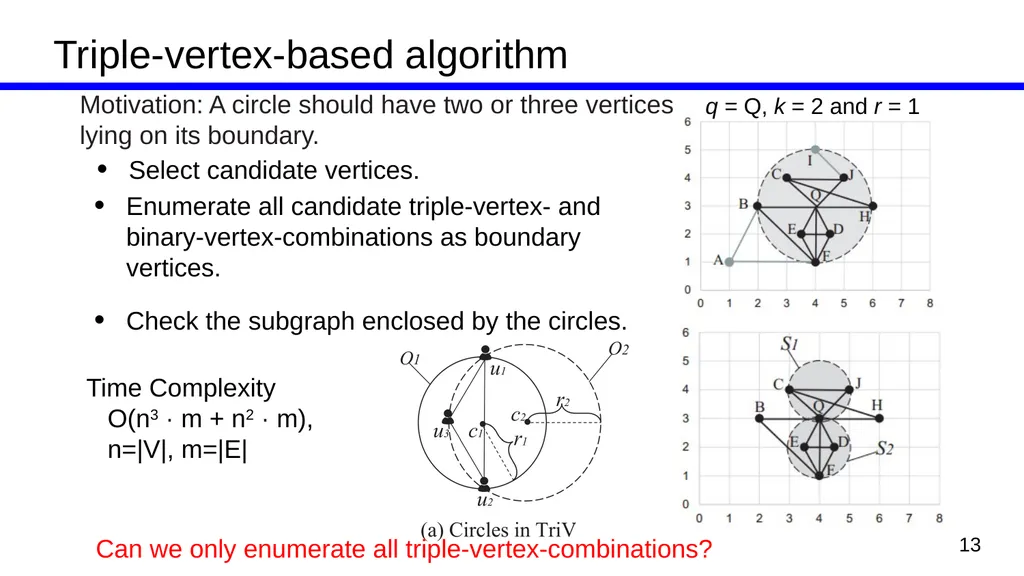
Triple-vertex-based algorithm Enumerate all candidate triple-vertex- and binary-vertex-combinations as boundary vertices.
Check the subgraph enclosed by the circles. 13 q = Q, k = 2 and r = 1 Select candidate vertices. Time Complexity
O(n3 · m + n2 · m),
n=|V|, m=|E| Can we only enumerate all triple-vertex-combinations? Motivation: A circle should have two or three vertices lying on its boundary.<br>
14
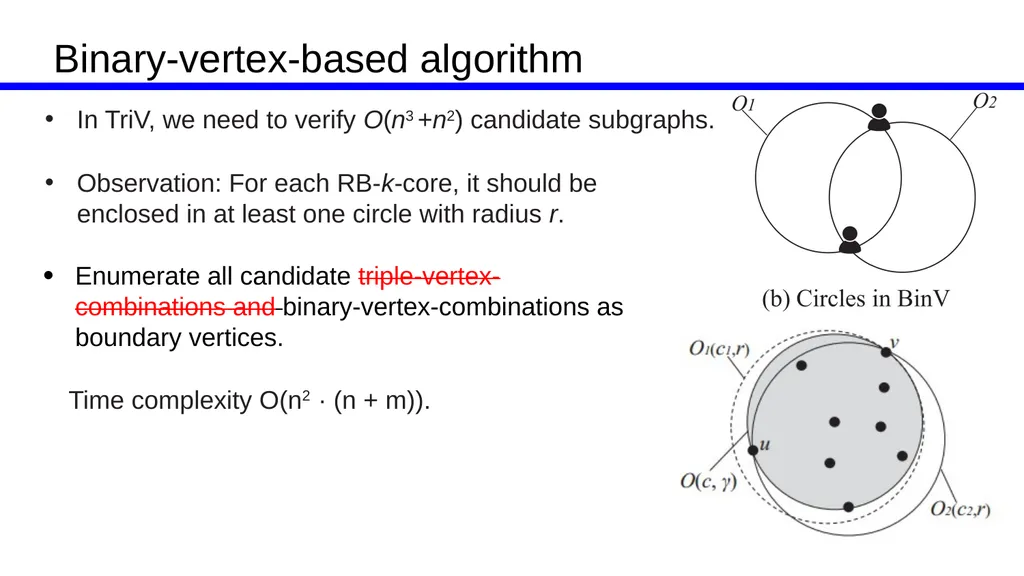
Binary-vertex-based algorithm 14 In TriV, we need to verify O(n3 +n2) candidate subgraphs. Observation: For each RB-k-core, it should be enclosed in at least one circle with radius r. Enumerate all candidate triple-vertex-combinations and binary-vertex-combinations as boundary vertices. Time complexity O(n2 · (n + m)).<br>
15
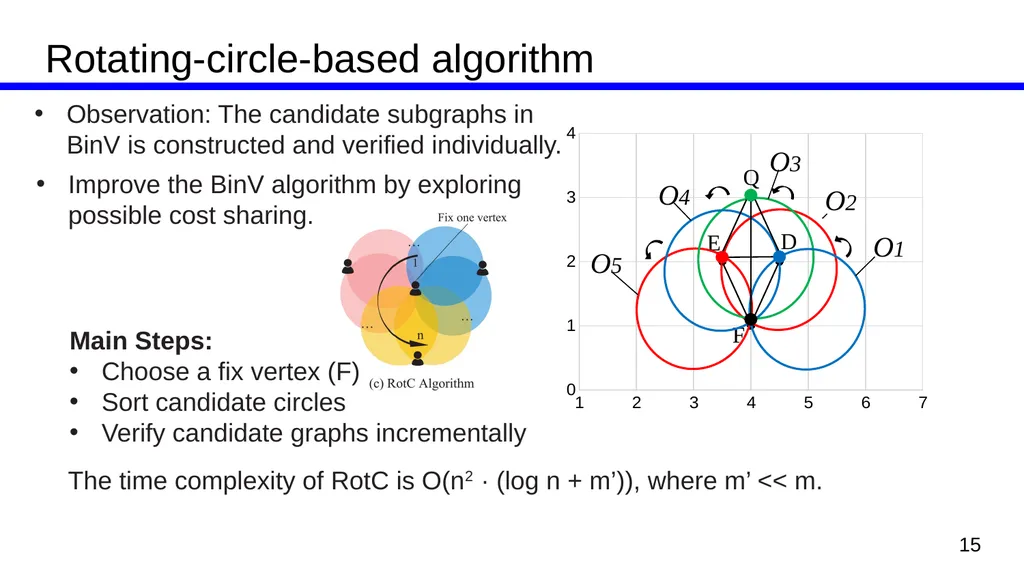
Rotating-circle-based algorithm 15 Observation: The candidate subgraphs in BinV is constructed and verified individually. Improve the BinV algorithm by exploring possible cost sharing. The time complexity of RotC is O(n2 · (log n + m’)), where m’ << m. Main Steps:
Choose a fix vertex (F)
Sort candidate circles
Verify candidate graphs incrementally F Q D E O1 O4 O2 O3 O5<br>
16
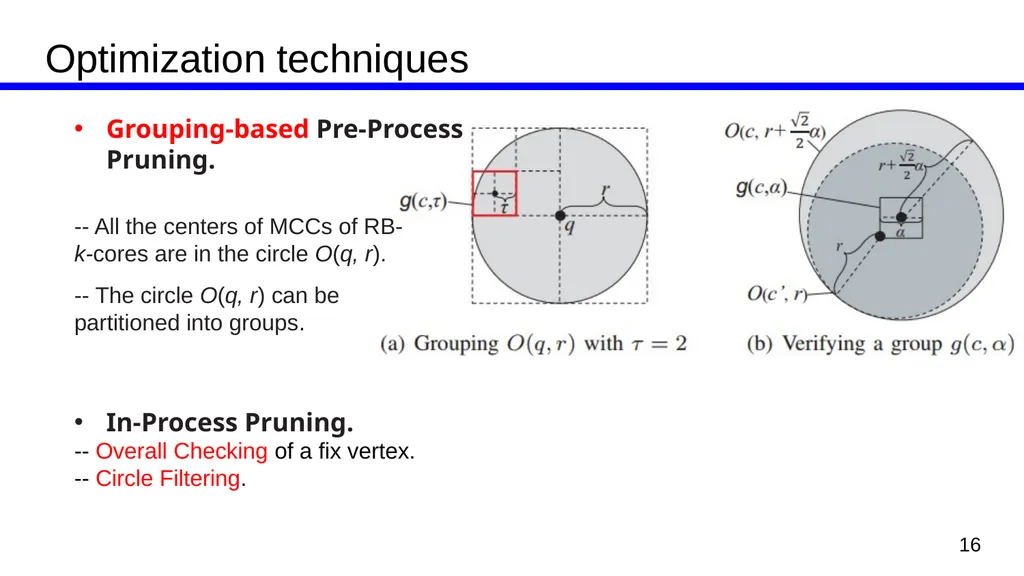
Optimization techniques 16 In-Process Pruning.
-- Overall Checking of a fix vertex. �-- Circle Filtering. Grouping-based Pre-Process Pruning. -- All the centers of MCCs of RB-k-cores are in the circle O(q, r). -- The circle O(q, r) can be partitioned into groups.<br>
18
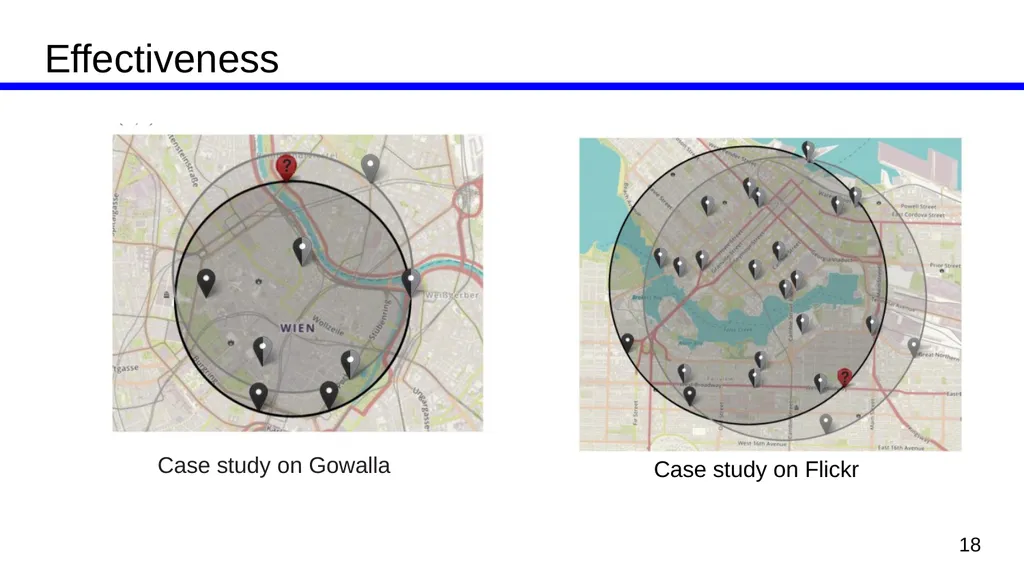
Effectiveness 18 Case study on Flickr Case study on Gowalla<br>
19
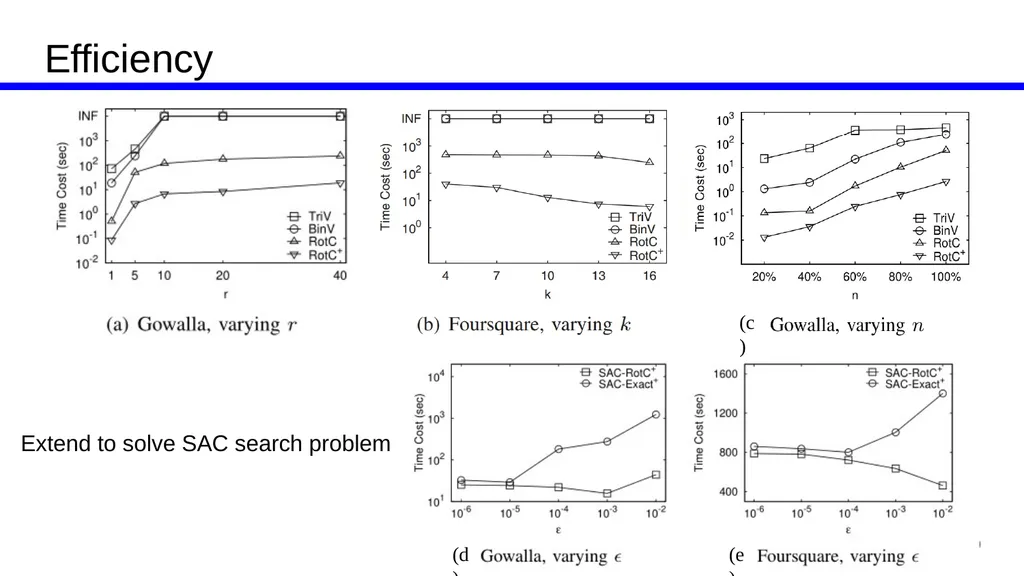
Efficiency 19 Extend to solve SAC search problem<br>
20
Conclusion 20 Propose RB-k-core model and a novel paradigm to compute RB-k-cores.
Propose several optimization techniques.
Extend our algorithms to solve the SAC search problem.
Conduct extensive experiments on real and synthetic datasets.<br>
21
Thank You!��Q&A End 21<br>