
Elaine McNally @mrsmacteach33 Structure: It’s a
KL
Published · 39 slides · 0 views

1 / 1






Description
Elaine McNally mrsmacteach33 Structure: Its a way in AQA Language Paper 1 Question 3 Creative Writing Transactional Writing Literature texts Structure: Question 3 and Question 5 They arrived shortly before lunchtime. The seagulls squawked
Related Topics
Share
Embed code
Download this presentation From Below
"Elaine McNally @mrsmacteach33 Structure: It’s a" is the property of its rightful owner. Permission is granted to download and print the materials on this website for personal, non-commercial use only, and to display it on your personal computer provided you do not modify the materials and that you retain all copyright notices contained in the materials. By downloading content from our website, you accept the terms of this agreement.
Presentation Transcript
01
Elaine McNally
@mrsmacteach33 Structure: It’s a way in<br>
@mrsmacteach33 Structure: It’s a way in<br>
02
AQA Language Paper 1 Question 3
Creative Writing
Transactional Writing
Literature texts<br>
Creative Writing
Transactional Writing
Literature texts<br>
03
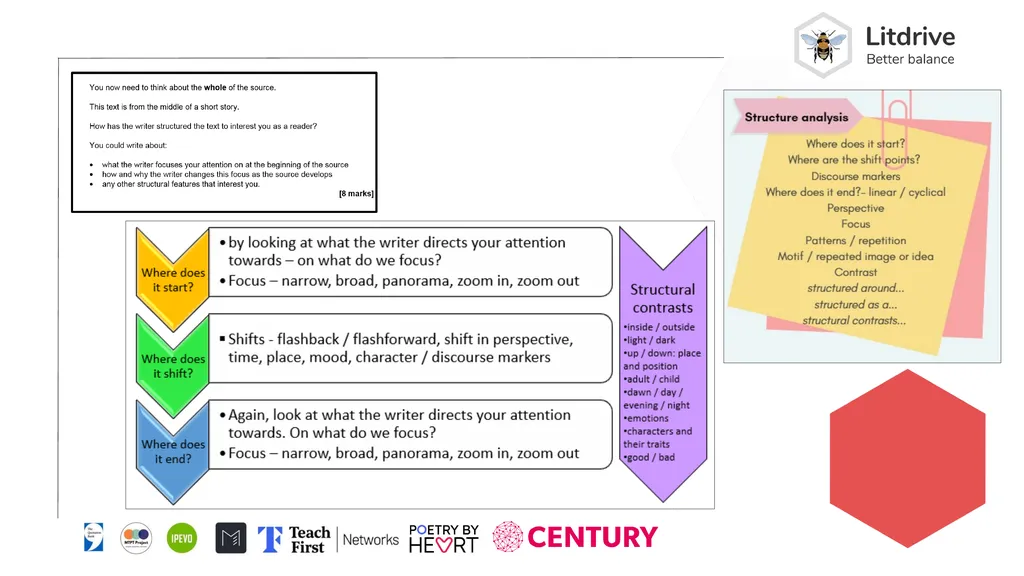
Structure: Question 3 and Question 5<br>
04
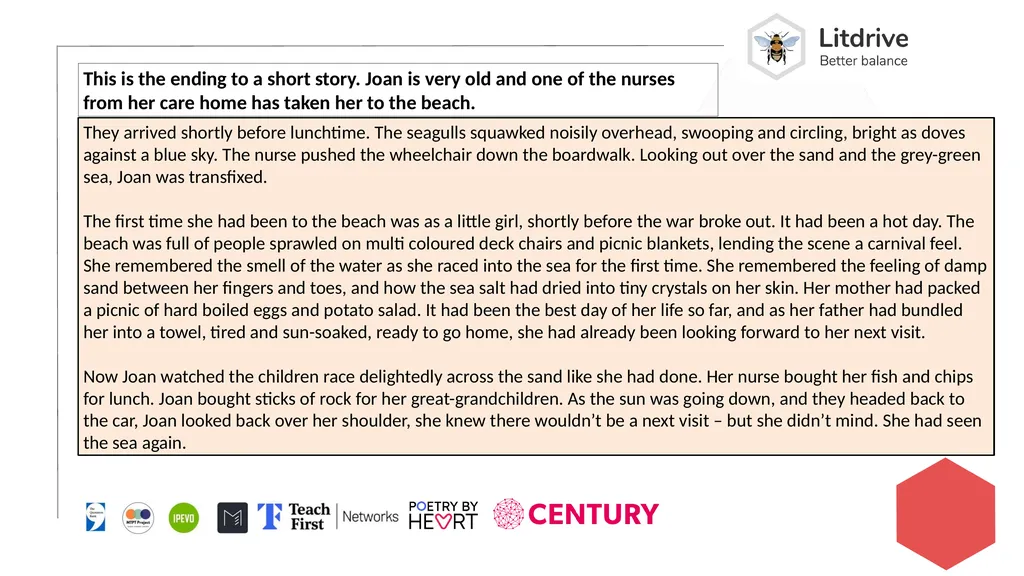
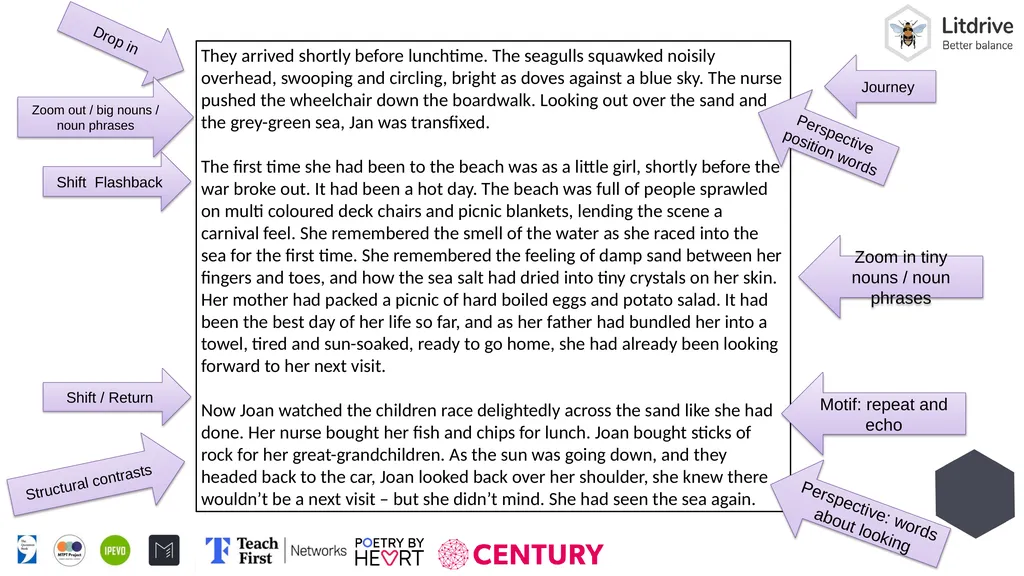
They arrived shortly before lunchtime. The seagulls squawked noisily overhead, swooping and circling, bright as doves against a blue sky. The nurse pushed the wheelchair down the boardwalk. Looking out over the sand and the grey-green sea, Joan was transfixed.
The first time she had been to the beach was as a little girl, shortly before the war broke out. It had been a hot day. The beach was full of people sprawled on multi coloured deck chairs and picnic blankets, lending the scene a carnival feel. She remembered the smell of the water as she raced into the sea for the first time. She remembered the feeling of damp sand between her fingers and toes, and how the sea salt had dried into tiny crystals on her skin. Her mother had packed a picnic of hard boiled eggs and potato salad. It had been the best day of her life so far, and as her father had bundled her into a towel, tired and sun-soaked, ready to go home, she had already been looking forward to her next visit.
Now Joan watched the children race delightedly across the sand like she had done. Her nurse bought her fish and chips for lunch. Joan bought sticks of rock for her great-grandchildren. As the sun was going down, and they headed back to the car, Joan looked back over her shoulder, she knew there wouldn’t be a next visit – but she didn’t mind. She had seen the sea again. This is the ending to a short story. Joan is very old and one of the nurses from her care home has taken her to the beach.<br>
The first time she had been to the beach was as a little girl, shortly before the war broke out. It had been a hot day. The beach was full of people sprawled on multi coloured deck chairs and picnic blankets, lending the scene a carnival feel. She remembered the smell of the water as she raced into the sea for the first time. She remembered the feeling of damp sand between her fingers and toes, and how the sea salt had dried into tiny crystals on her skin. Her mother had packed a picnic of hard boiled eggs and potato salad. It had been the best day of her life so far, and as her father had bundled her into a towel, tired and sun-soaked, ready to go home, she had already been looking forward to her next visit.
Now Joan watched the children race delightedly across the sand like she had done. Her nurse bought her fish and chips for lunch. Joan bought sticks of rock for her great-grandchildren. As the sun was going down, and they headed back to the car, Joan looked back over her shoulder, she knew there wouldn’t be a next visit – but she didn’t mind. She had seen the sea again. This is the ending to a short story. Joan is very old and one of the nurses from her care home has taken her to the beach.<br>
05
They arrived shortly before lunchtime. The seagulls squawked noisily overhead, swooping and circling, bright as doves against a blue sky. The nurse pushed the wheelchair down the boardwalk. Looking out over the sand and the grey-green sea, Jan was transfixed.
The first time she had been to the beach was as a little girl, shortly before the war broke out. It had been a hot day. The beach was full of people sprawled on multi coloured deck chairs and picnic blankets, lending the scene a carnival feel. She remembered the smell of the water as she raced into the sea for the first time. She remembered the feeling of damp sand between her fingers and toes, and how the sea salt had dried into tiny crystals on her skin. Her mother had packed a picnic of hard boiled eggs and potato salad. It had been the best day of her life so far, and as her father had bundled her into a towel, tired and sun-soaked, ready to go home, she had already been looking forward to her next visit.
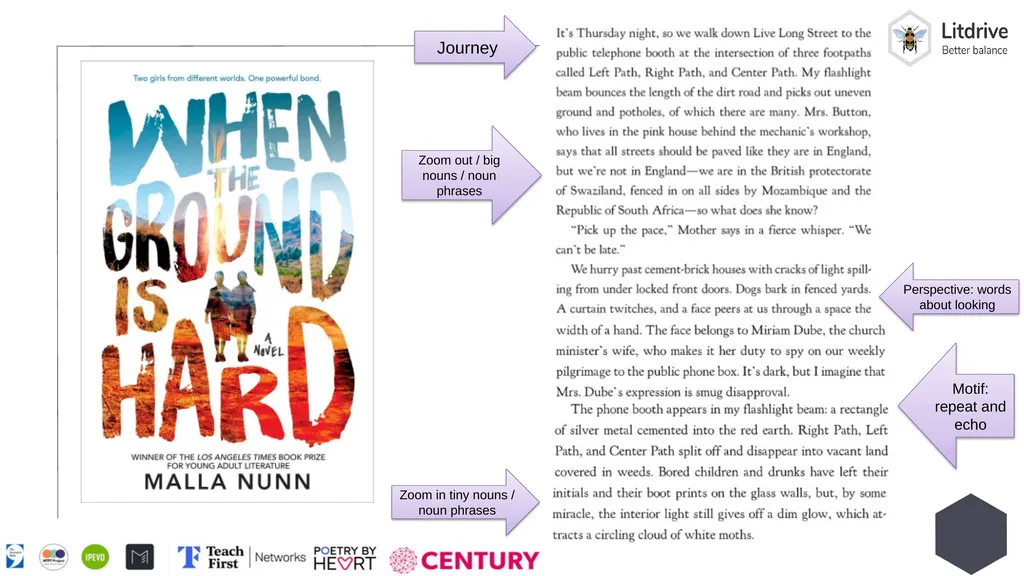
Now Joan watched the children race delightedly across the sand like she had done. Her nurse bought her fish and chips for lunch. Joan bought sticks of rock for her great-grandchildren. As the sun was going down, and they headed back to the car, Joan looked back over her shoulder, she knew there wouldn’t be a next visit – but she didn’t mind. She had seen the sea again. Drop in Zoom out / big nouns / noun phrases Shift Flashback Perspective position words Zoom in tiny nouns / noun phrases Shift / Return Motif: repeat and echo Perspective: words about looking Journey Structural contrasts<br>
The first time she had been to the beach was as a little girl, shortly before the war broke out. It had been a hot day. The beach was full of people sprawled on multi coloured deck chairs and picnic blankets, lending the scene a carnival feel. She remembered the smell of the water as she raced into the sea for the first time. She remembered the feeling of damp sand between her fingers and toes, and how the sea salt had dried into tiny crystals on her skin. Her mother had packed a picnic of hard boiled eggs and potato salad. It had been the best day of her life so far, and as her father had bundled her into a towel, tired and sun-soaked, ready to go home, she had already been looking forward to her next visit.
Now Joan watched the children race delightedly across the sand like she had done. Her nurse bought her fish and chips for lunch. Joan bought sticks of rock for her great-grandchildren. As the sun was going down, and they headed back to the car, Joan looked back over her shoulder, she knew there wouldn’t be a next visit – but she didn’t mind. She had seen the sea again. Drop in Zoom out / big nouns / noun phrases Shift Flashback Perspective position words Zoom in tiny nouns / noun phrases Shift / Return Motif: repeat and echo Perspective: words about looking Journey Structural contrasts<br>
06
Examiners report June 2022
Language paper 1 June 2022 Kino and the scorpion
Question 3
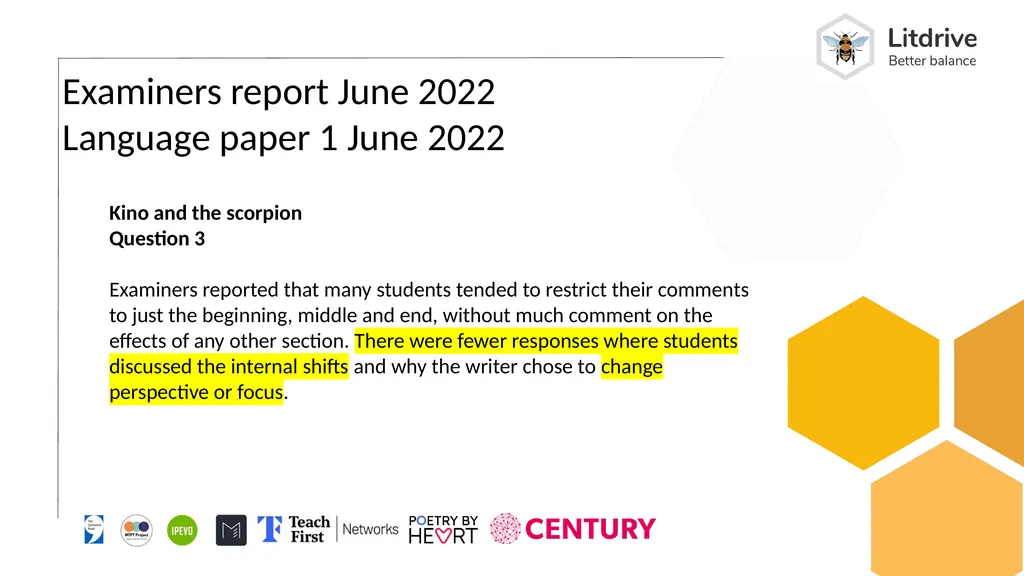
Examiners reported that many students tended to restrict their comments to just the beginning, middle and end, without much comment on the effects of any other section. There were fewer responses where students discussed the internal shifts and why the writer chose to change perspective or focus.<br>
Language paper 1 June 2022 Kino and the scorpion
Question 3
Examiners reported that many students tended to restrict their comments to just the beginning, middle and end, without much comment on the effects of any other section. There were fewer responses where students discussed the internal shifts and why the writer chose to change perspective or focus.<br>
07
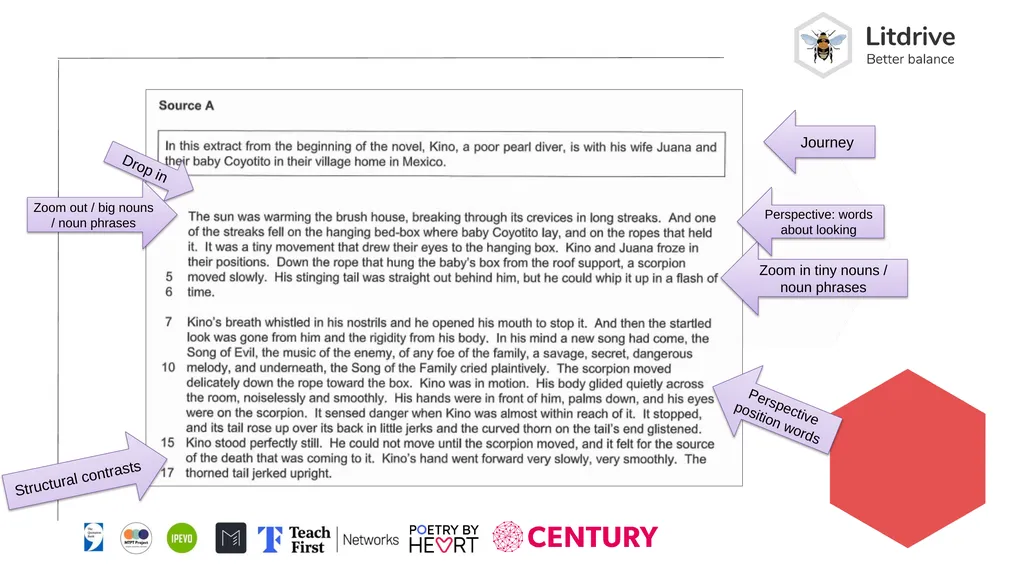
Drop in Zoom out / big nouns / noun phrases Perspective position words Zoom in tiny nouns / noun phrases Perspective: words about looking Journey Structural contrasts<br>
08
Examiners report June 2022
Language paper 1 June 2022 Question 5
Descriptive option: picture / story
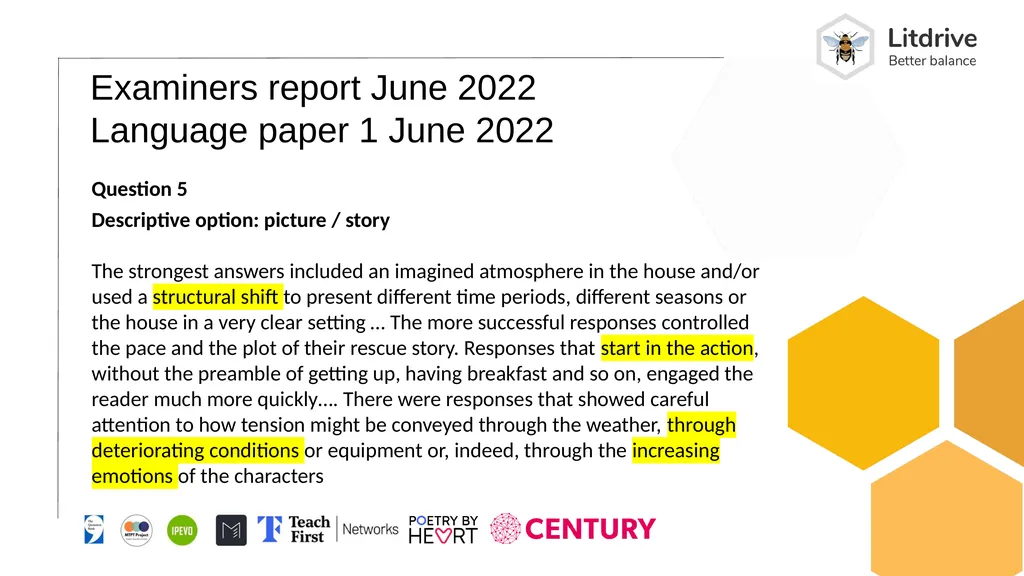
The strongest answers included an imagined atmosphere in the house and/or used a structural shift to present different time periods, different seasons or the house in a very clear setting … The more successful responses controlled the pace and the plot of their rescue story. Responses that start in the action, without the preamble of getting up, having breakfast and so on, engaged the reader much more quickly…. There were responses that showed careful attention to how tension might be conveyed through the weather, through deteriorating conditions or equipment or, indeed, through the increasing emotions of the characters<br>
Language paper 1 June 2022 Question 5
Descriptive option: picture / story
The strongest answers included an imagined atmosphere in the house and/or used a structural shift to present different time periods, different seasons or the house in a very clear setting … The more successful responses controlled the pace and the plot of their rescue story. Responses that start in the action, without the preamble of getting up, having breakfast and so on, engaged the reader much more quickly…. There were responses that showed careful attention to how tension might be conveyed through the weather, through deteriorating conditions or equipment or, indeed, through the increasing emotions of the characters<br>
09
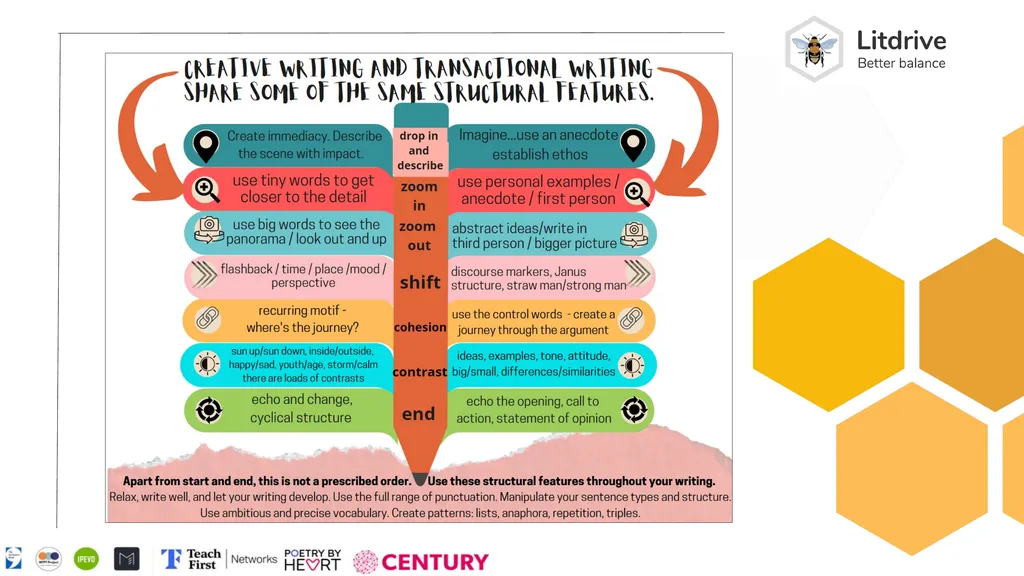
Structure and Transactional writing<br>
10
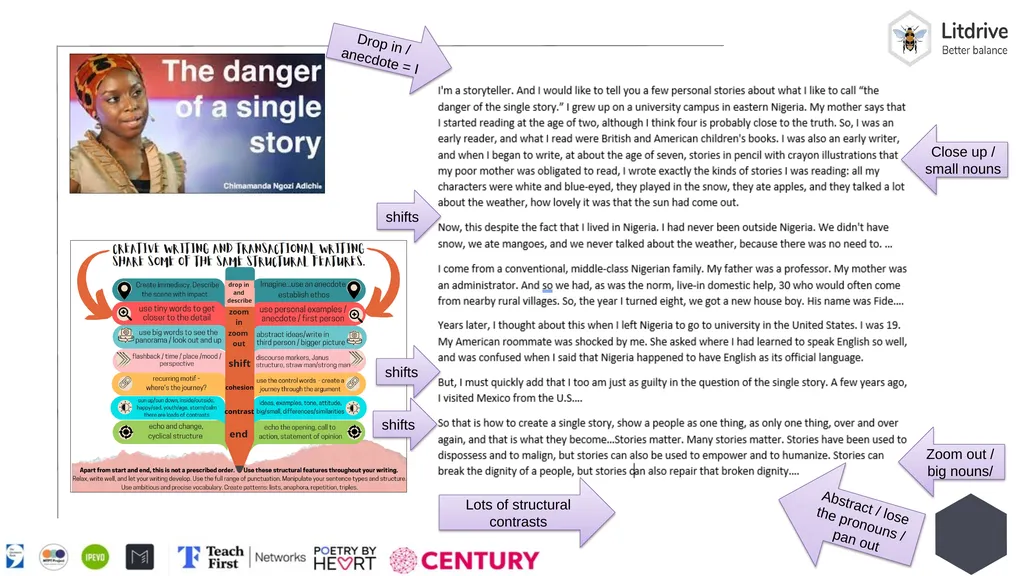
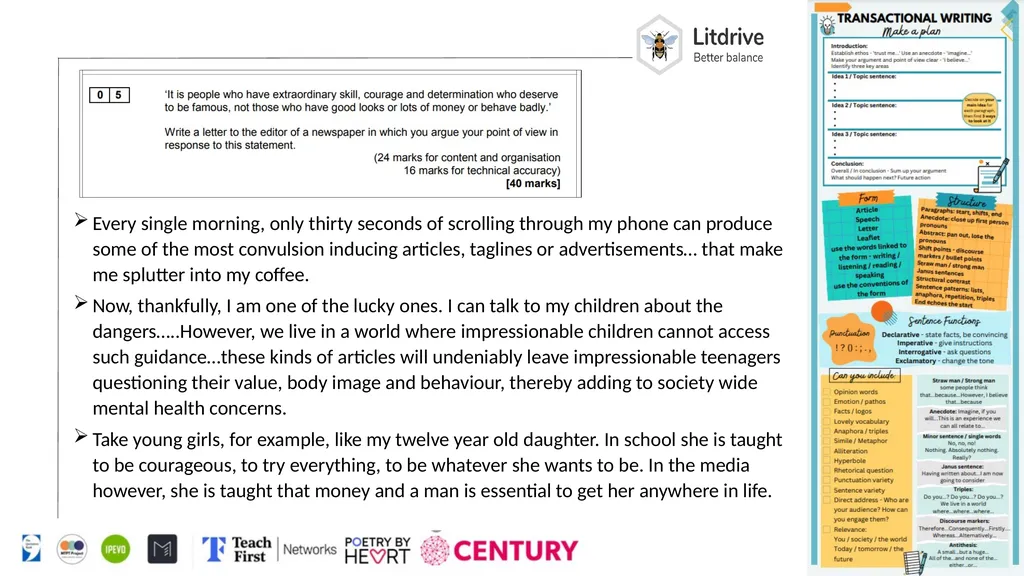
Drop in / anecdote = I Close up / small nouns shifts Abstract / lose the pronouns / pan out Zoom out / big nouns/ Lots of structural contrasts shifts shifts<br>
11
Every single morning, only thirty seconds of scrolling through my phone can produce some of the most convulsion inducing articles, taglines or advertisements… that make me splutter into my coffee.
Now, thankfully, I am one of the lucky ones. I can talk to my children about the dangers…..However, we live in a world where impressionable children cannot access such guidance…these kinds of articles will undeniably leave impressionable teenagers questioning their value, body image and behaviour, thereby adding to society wide mental health concerns.
Take young girls, for example, like my twelve year old daughter. In school she is taught to be courageous, to try everything, to be whatever she wants to be. In the media however, she is taught that money and a man is essential to get her anywhere in life.<br>
Now, thankfully, I am one of the lucky ones. I can talk to my children about the dangers…..However, we live in a world where impressionable children cannot access such guidance…these kinds of articles will undeniably leave impressionable teenagers questioning their value, body image and behaviour, thereby adding to society wide mental health concerns.
Take young girls, for example, like my twelve year old daughter. In school she is taught to be courageous, to try everything, to be whatever she wants to be. In the media however, she is taught that money and a man is essential to get her anywhere in life.<br>
12
The government should invest more money in public transport as there are so many good reasons to use it.
Picture this: It's a Tuesday morning, and I wake up feeling groggy and overwhelmed by the day ahead. Rushing to get ready for school, I realise that I've missed the bus once again. Desperate not to be late, I jump into my family's car and brace myself for the inevitable traffic jam, and wasted minutes staring at the squashed fly on the window…
When I eventually managed to catch the train to school one day, my experience was completely different. The train was clean, comfortable, and spacious. I found myself surrounded by fellow commuters, some engrossed in books or work, while others enjoyed their morning coffee. It was a peaceful atmosphere, in stark contrast to the gridlock I usually endure in my car…<br>
Picture this: It's a Tuesday morning, and I wake up feeling groggy and overwhelmed by the day ahead. Rushing to get ready for school, I realise that I've missed the bus once again. Desperate not to be late, I jump into my family's car and brace myself for the inevitable traffic jam, and wasted minutes staring at the squashed fly on the window…
When I eventually managed to catch the train to school one day, my experience was completely different. The train was clean, comfortable, and spacious. I found myself surrounded by fellow commuters, some engrossed in books or work, while others enjoyed their morning coffee. It was a peaceful atmosphere, in stark contrast to the gridlock I usually endure in my car…<br>
13
Non fiction and literary non-fiction
extracts<br>
extracts<br>
14
Structure and the Literature texts<br>
15
Examiners report June 2022
Shakespeare and unseen poetry AO2: the use of methods to create meanings
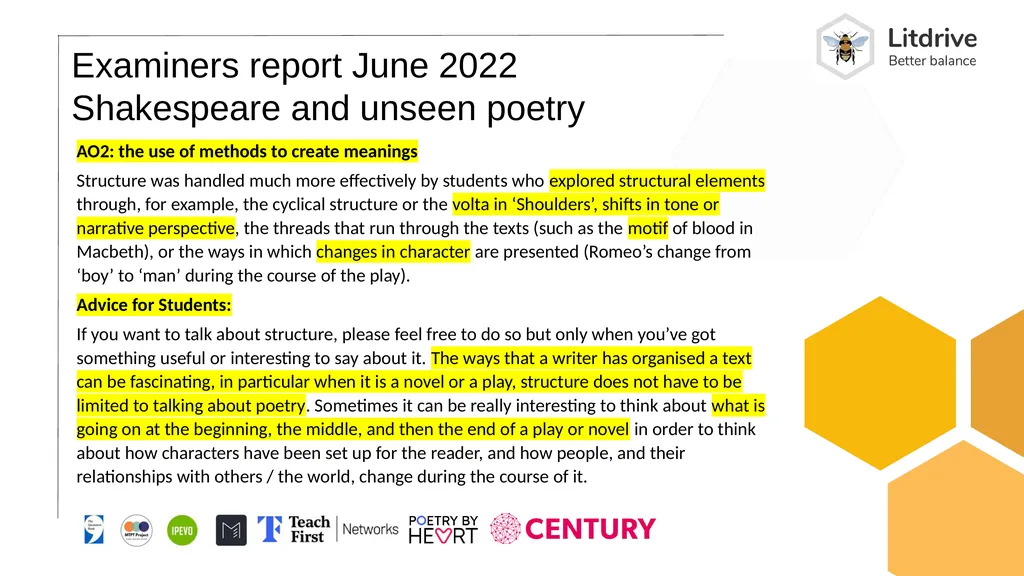
Structure was handled much more effectively by students who explored structural elements through, for example, the cyclical structure or the volta in ‘Shoulders’, shifts in tone or narrative perspective, the threads that run through the texts (such as the motif of blood in Macbeth), or the ways in which changes in character are presented (Romeo’s change from ‘boy’ to ‘man’ during the course of the play).
Advice for Students:
If you want to talk about structure, please feel free to do so but only when you’ve got something useful or interesting to say about it. The ways that a writer has organised a text can be fascinating, in particular when it is a novel or a play, structure does not have to be limited to talking about poetry. Sometimes it can be really interesting to think about what is going on at the beginning, the middle, and then the end of a play or novel in order to think about how characters have been set up for the reader, and how people, and their relationships with others / the world, change during the course of it.<br>
Shakespeare and unseen poetry AO2: the use of methods to create meanings
Structure was handled much more effectively by students who explored structural elements through, for example, the cyclical structure or the volta in ‘Shoulders’, shifts in tone or narrative perspective, the threads that run through the texts (such as the motif of blood in Macbeth), or the ways in which changes in character are presented (Romeo’s change from ‘boy’ to ‘man’ during the course of the play).
Advice for Students:
If you want to talk about structure, please feel free to do so but only when you’ve got something useful or interesting to say about it. The ways that a writer has organised a text can be fascinating, in particular when it is a novel or a play, structure does not have to be limited to talking about poetry. Sometimes it can be really interesting to think about what is going on at the beginning, the middle, and then the end of a play or novel in order to think about how characters have been set up for the reader, and how people, and their relationships with others / the world, change during the course of it.<br>
16
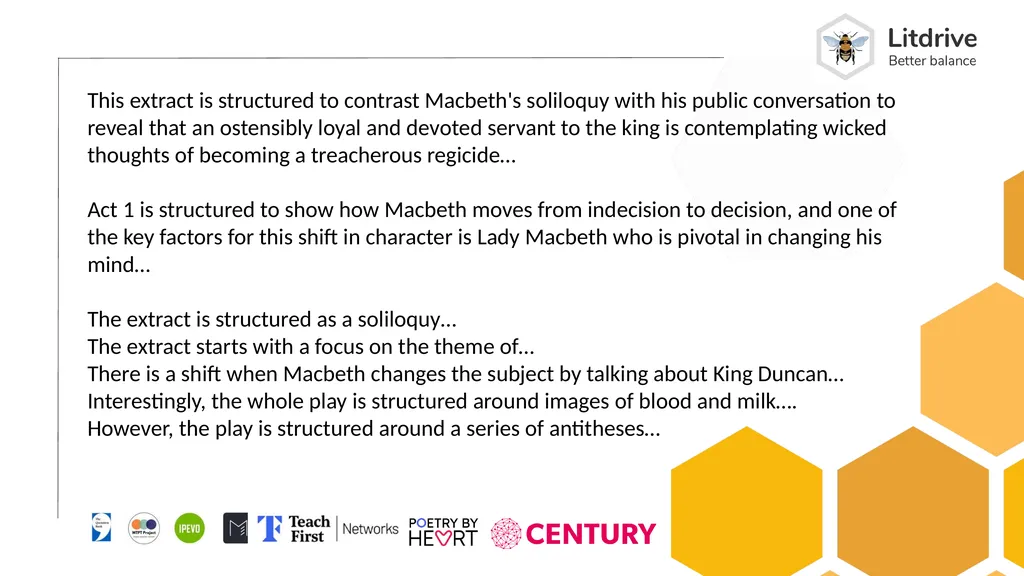
This extract is structured to contrast Macbeth's soliloquy with his public conversation to reveal that an ostensibly loyal and devoted servant to the king is contemplating wicked thoughts of becoming a treacherous regicide…
Act 1 is structured to show how Macbeth moves from indecision to decision, and one of the key factors for this shift in character is Lady Macbeth who is pivotal in changing his mind…
The extract is structured as a soliloquy…
The extract starts with a focus on the theme of…
There is a shift when Macbeth changes the subject by talking about King Duncan…
Interestingly, the whole play is structured around images of blood and milk….
However, the play is structured around a series of antitheses…<br>
Act 1 is structured to show how Macbeth moves from indecision to decision, and one of the key factors for this shift in character is Lady Macbeth who is pivotal in changing his mind…
The extract is structured as a soliloquy…
The extract starts with a focus on the theme of…
There is a shift when Macbeth changes the subject by talking about King Duncan…
Interestingly, the whole play is structured around images of blood and milk….
However, the play is structured around a series of antitheses…<br>
17
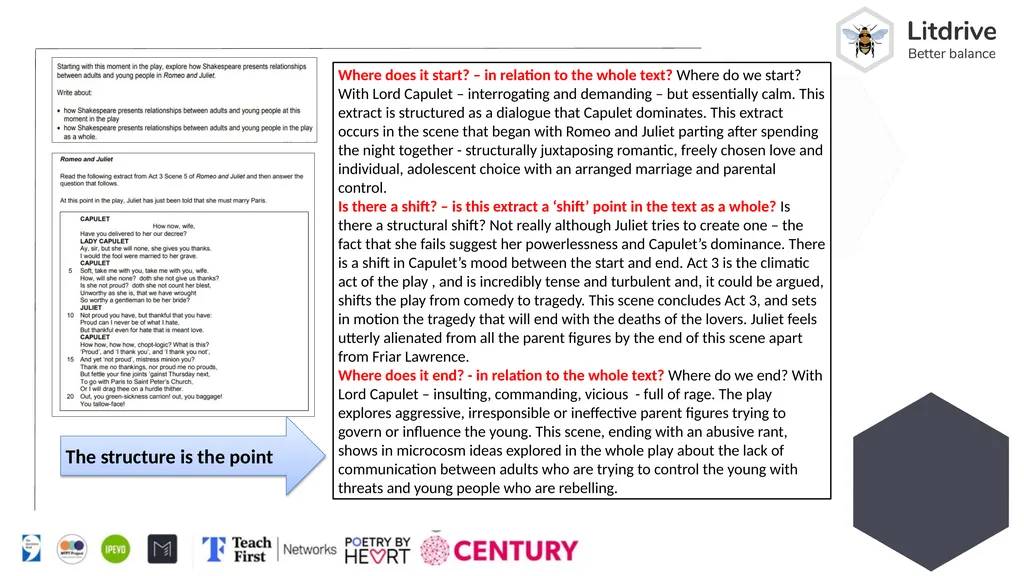
Where does it start? – in relation to the whole text? Where do we start? With Lord Capulet – interrogating and demanding – but essentially calm. This extract is structured as a dialogue that Capulet dominates. This extract occurs in the scene that began with Romeo and Juliet parting after spending the night together - structurally juxtaposing romantic, freely chosen love and individual, adolescent choice with an arranged marriage and parental control.
Is there a shift? – is this extract a ‘shift’ point in the text as a whole? Is there a structural shift? Not really although Juliet tries to create one – the fact that she fails suggest her powerlessness and Capulet’s dominance. There is a shift in Capulet’s mood between the start and end. Act 3 is the climatic act of the play , and is incredibly tense and turbulent and, it could be argued, shifts the play from comedy to tragedy. This scene concludes Act 3, and sets in motion the tragedy that will end with the deaths of the lovers. Juliet feels utterly alienated from all the parent figures by the end of this scene apart from Friar Lawrence.
Where does it end? - in relation to the whole text? Where do we end? With Lord Capulet – insulting, commanding, vicious - full of rage. The play explores aggressive, irresponsible or ineffective parent figures trying to govern or influence the young. This scene, ending with an abusive rant, shows in microcosm ideas explored in the whole play about the lack of communication between adults who are trying to control the young with threats and young people who are rebelling. The structure is the point<br>
Is there a shift? – is this extract a ‘shift’ point in the text as a whole? Is there a structural shift? Not really although Juliet tries to create one – the fact that she fails suggest her powerlessness and Capulet’s dominance. There is a shift in Capulet’s mood between the start and end. Act 3 is the climatic act of the play , and is incredibly tense and turbulent and, it could be argued, shifts the play from comedy to tragedy. This scene concludes Act 3, and sets in motion the tragedy that will end with the deaths of the lovers. Juliet feels utterly alienated from all the parent figures by the end of this scene apart from Friar Lawrence.
Where does it end? - in relation to the whole text? Where do we end? With Lord Capulet – insulting, commanding, vicious - full of rage. The play explores aggressive, irresponsible or ineffective parent figures trying to govern or influence the young. This scene, ending with an abusive rant, shows in microcosm ideas explored in the whole play about the lack of communication between adults who are trying to control the young with threats and young people who are rebelling. The structure is the point<br>
18
Examiners report June 2022
19th Century Novel AO2: the use of methods to create meanings
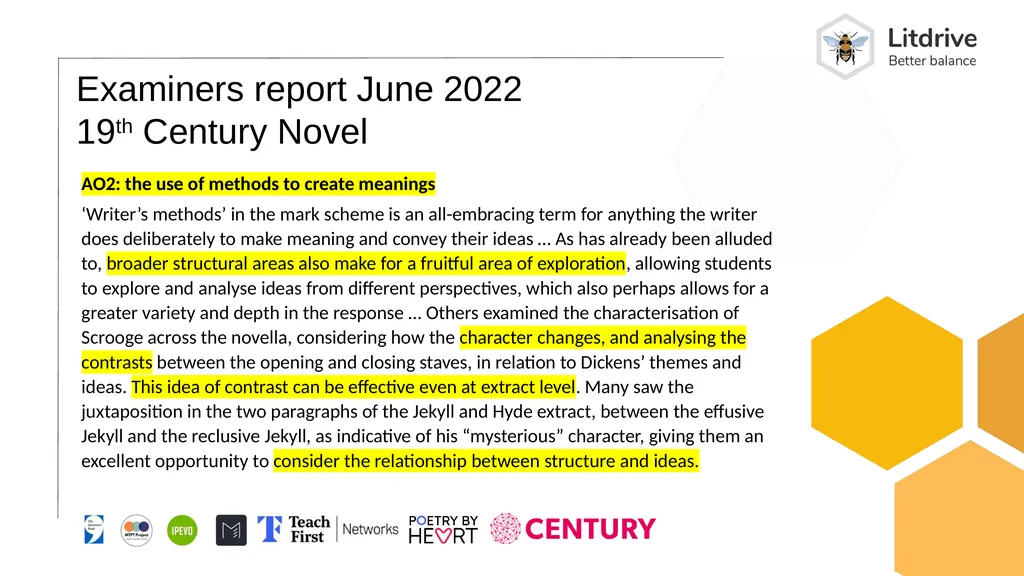
‘Writer’s methods’ in the mark scheme is an all-embracing term for anything the writer does deliberately to make meaning and convey their ideas … As has already been alluded to, broader structural areas also make for a fruitful area of exploration, allowing students to explore and analyse ideas from different perspectives, which also perhaps allows for a greater variety and depth in the response … Others examined the characterisation of Scrooge across the novella, considering how the character changes, and analysing the contrasts between the opening and closing staves, in relation to Dickens’ themes and ideas. This idea of contrast can be effective even at extract level. Many saw the juxtaposition in the two paragraphs of the Jekyll and Hyde extract, between the effusive Jekyll and the reclusive Jekyll, as indicative of his “mysterious” character, giving them an excellent opportunity to consider the relationship between structure and ideas.<br>
19th Century Novel AO2: the use of methods to create meanings
‘Writer’s methods’ in the mark scheme is an all-embracing term for anything the writer does deliberately to make meaning and convey their ideas … As has already been alluded to, broader structural areas also make for a fruitful area of exploration, allowing students to explore and analyse ideas from different perspectives, which also perhaps allows for a greater variety and depth in the response … Others examined the characterisation of Scrooge across the novella, considering how the character changes, and analysing the contrasts between the opening and closing staves, in relation to Dickens’ themes and ideas. This idea of contrast can be effective even at extract level. Many saw the juxtaposition in the two paragraphs of the Jekyll and Hyde extract, between the effusive Jekyll and the reclusive Jekyll, as indicative of his “mysterious” character, giving them an excellent opportunity to consider the relationship between structure and ideas.<br>
19
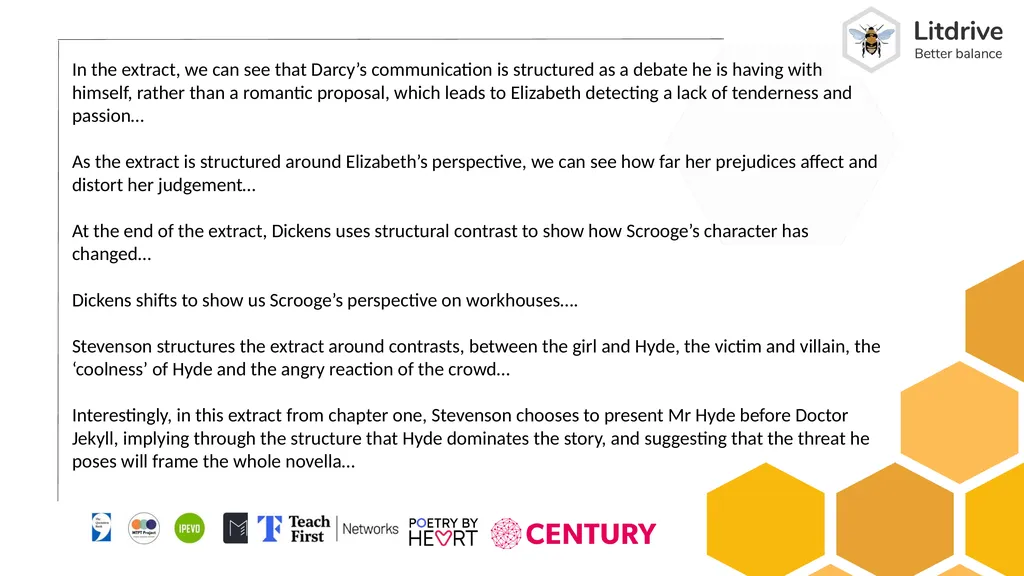
In the extract, we can see that Darcy’s communication is structured as a debate he is having with himself, rather than a romantic proposal, which leads to Elizabeth detecting a lack of tenderness and passion…
As the extract is structured around Elizabeth’s perspective, we can see how far her prejudices affect and distort her judgement…
At the end of the extract, Dickens uses structural contrast to show how Scrooge’s character has changed…
Dickens shifts to show us Scrooge’s perspective on workhouses….
Stevenson structures the extract around contrasts, between the girl and Hyde, the victim and villain, the ‘coolness’ of Hyde and the angry reaction of the crowd…
Interestingly, in this extract from chapter one, Stevenson chooses to present Mr Hyde before Doctor Jekyll, implying through the structure that Hyde dominates the story, and suggesting that the threat he poses will frame the whole novella…<br>
As the extract is structured around Elizabeth’s perspective, we can see how far her prejudices affect and distort her judgement…
At the end of the extract, Dickens uses structural contrast to show how Scrooge’s character has changed…
Dickens shifts to show us Scrooge’s perspective on workhouses….
Stevenson structures the extract around contrasts, between the girl and Hyde, the victim and villain, the ‘coolness’ of Hyde and the angry reaction of the crowd…
Interestingly, in this extract from chapter one, Stevenson chooses to present Mr Hyde before Doctor Jekyll, implying through the structure that Hyde dominates the story, and suggesting that the threat he poses will frame the whole novella…<br>
20
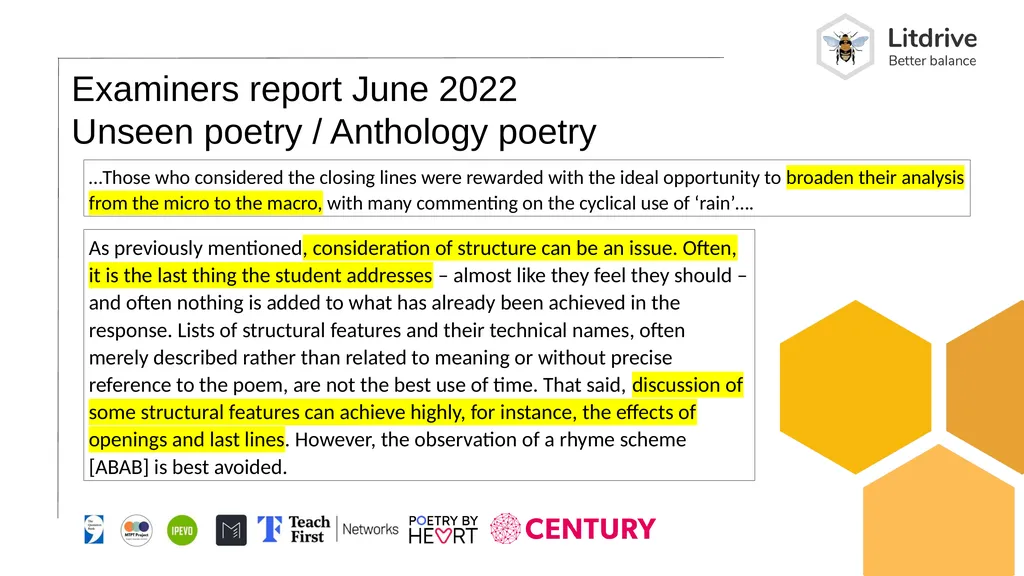
Examiners report June 2022
Unseen poetry / Anthology poetry …Those who considered the closing lines were rewarded with the ideal opportunity to broaden their analysis from the micro to the macro, with many commenting on the cyclical use of ‘rain’…. As previously mentioned, consideration of structure can be an issue. Often, it is the last thing the student addresses – almost like they feel they should – and often nothing is added to what has already been achieved in the response. Lists of structural features and their technical names, often merely described rather than related to meaning or without precise reference to the poem, are not the best use of time. That said, discussion of some structural features can achieve highly, for instance, the effects of openings and last lines. However, the observation of a rhyme scheme [ABAB] is best avoided.<br>
Unseen poetry / Anthology poetry …Those who considered the closing lines were rewarded with the ideal opportunity to broaden their analysis from the micro to the macro, with many commenting on the cyclical use of ‘rain’…. As previously mentioned, consideration of structure can be an issue. Often, it is the last thing the student addresses – almost like they feel they should – and often nothing is added to what has already been achieved in the response. Lists of structural features and their technical names, often merely described rather than related to meaning or without precise reference to the poem, are not the best use of time. That said, discussion of some structural features can achieve highly, for instance, the effects of openings and last lines. However, the observation of a rhyme scheme [ABAB] is best avoided.<br>
21
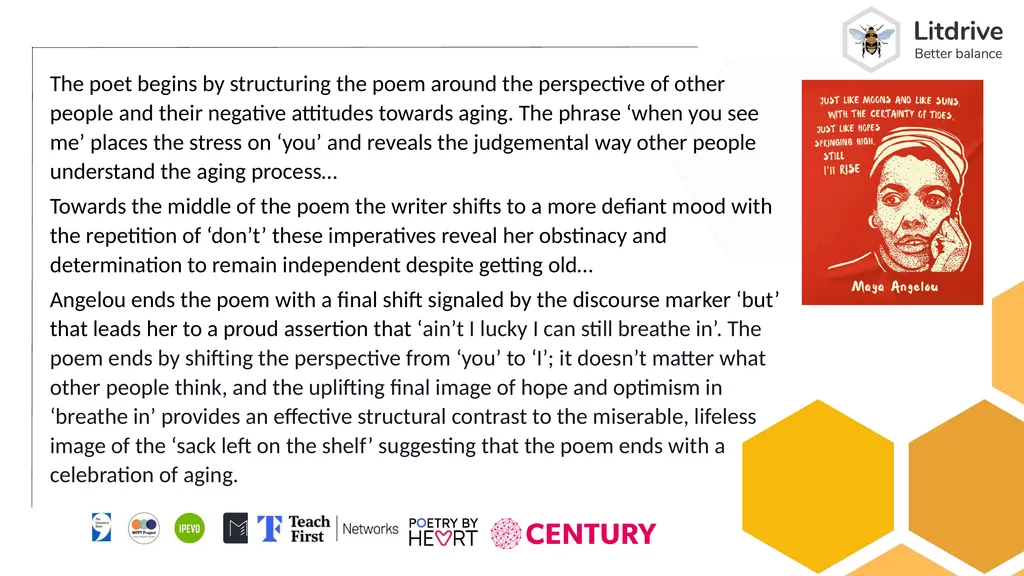
The poet begins by structuring the poem around the perspective of other people and their negative attitudes towards aging. The phrase ‘when you see me’ places the stress on ‘you’ and reveals the judgemental way other people understand the aging process…
Towards the middle of the poem the writer shifts to a more defiant mood with the repetition of ‘don’t’ these imperatives reveal her obstinacy and determination to remain independent despite getting old…
Angelou ends the poem with a final shift signaled by the discourse marker ‘but’ that leads her to a proud assertion that ‘ain’t I lucky I can still breathe in’. The poem ends by shifting the perspective from ‘you’ to ‘I’; it doesn’t matter what other people think, and the uplifting final image of hope and optimism in ‘breathe in’ provides an effective structural contrast to the miserable, lifeless image of the ‘sack left on the shelf’ suggesting that the poem ends with a celebration of aging.<br>
Towards the middle of the poem the writer shifts to a more defiant mood with the repetition of ‘don’t’ these imperatives reveal her obstinacy and determination to remain independent despite getting old…
Angelou ends the poem with a final shift signaled by the discourse marker ‘but’ that leads her to a proud assertion that ‘ain’t I lucky I can still breathe in’. The poem ends by shifting the perspective from ‘you’ to ‘I’; it doesn’t matter what other people think, and the uplifting final image of hope and optimism in ‘breathe in’ provides an effective structural contrast to the miserable, lifeless image of the ‘sack left on the shelf’ suggesting that the poem ends with a celebration of aging.<br>
22
Charles Causley starts the poem by structuring it around a description of both parents in their youth wearing their best clothes…Similarly, Duffy starts by structuring the poem around an image of her mother when she was younger and more glamourous.
Charles Causley shifts the poem in the middle by presenting his parents and him through the metaphor of ‘three suns’ which shifts the poem to a more religious perspective…Duffy shifts the perspective from imagining her mother to her own memories from childhood….
At the end of the poem, Causley concludes in an ambiguous way and structures the final image around vague language that creates a sombre mood….However, in Duffy’s poem, the end is structured to draw attention to the mother’s vibrancy and energy…. Winter Swans is structured in a linear way as we move from ‘waterlogged earth’ to ‘shingle and sand’. This structural shift indicates not only a physical movement in the couple as they change location to more stable ground, but a change in the relationship as it moves forwards and begins to heal. Contrastingly, Hardy uses a cyclical structure, as we begin and end at the pond, suggesting that he cannot move on from his pain and sorrow.<br>
Charles Causley shifts the poem in the middle by presenting his parents and him through the metaphor of ‘three suns’ which shifts the poem to a more religious perspective…Duffy shifts the perspective from imagining her mother to her own memories from childhood….
At the end of the poem, Causley concludes in an ambiguous way and structures the final image around vague language that creates a sombre mood….However, in Duffy’s poem, the end is structured to draw attention to the mother’s vibrancy and energy…. Winter Swans is structured in a linear way as we move from ‘waterlogged earth’ to ‘shingle and sand’. This structural shift indicates not only a physical movement in the couple as they change location to more stable ground, but a change in the relationship as it moves forwards and begins to heal. Contrastingly, Hardy uses a cyclical structure, as we begin and end at the pond, suggesting that he cannot move on from his pain and sorrow.<br>
23
David Didau asks this question about retrieving and using knowledge: 'can what you know in one context be applied in another?’
Didau continues to observe that 'when students were prompted that they would need to transfer related information to novel situations they were far more likely to successfully apply what they had learned in a new context. It seems that prompting students may be a necessary condition for transfer to occur.'<br>
Didau continues to observe that 'when students were prompted that they would need to transfer related information to novel situations they were far more likely to successfully apply what they had learned in a new context. It seems that prompting students may be a necessary condition for transfer to occur.'<br>
24
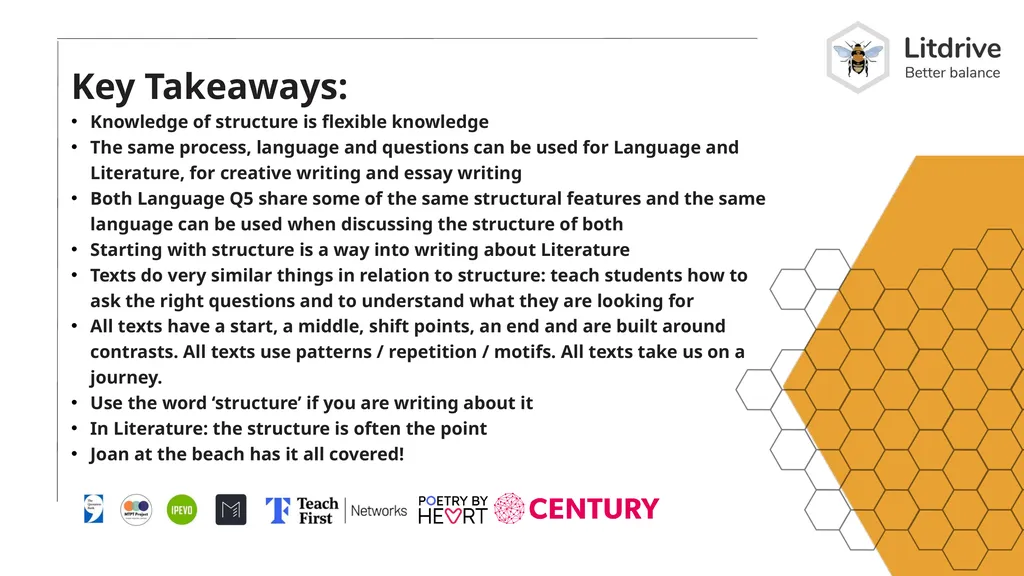
Key Takeaways:
Knowledge of structure is flexible knowledge
The same process, language and questions can be used for Language and Literature, for creative writing and essay writing
Both Language Q5 share some of the same structural features and the same language can be used when discussing the structure of both
Starting with structure is a way into writing about Literature
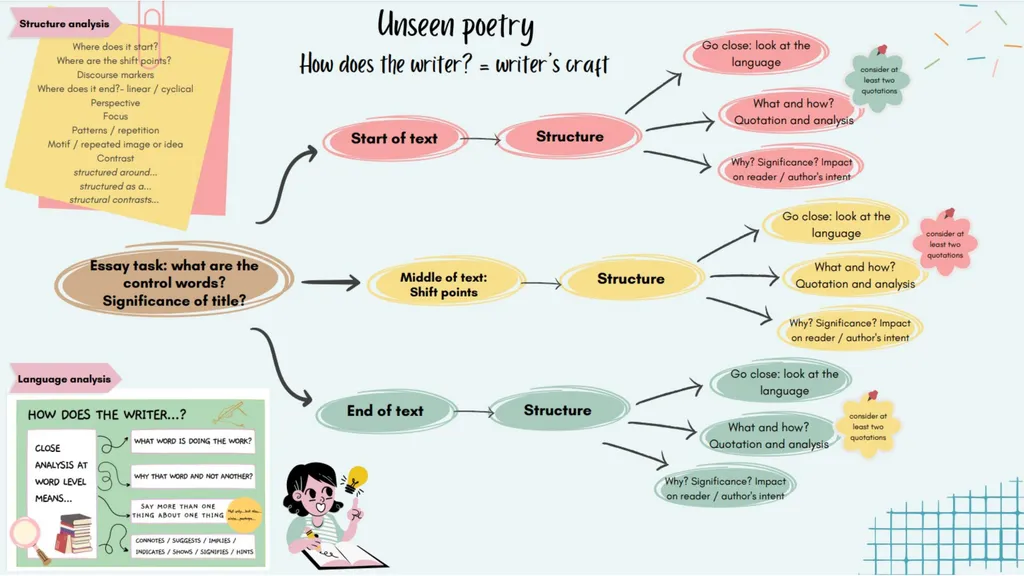
Texts do very similar things in relation to structure: teach students how to ask the right questions and to understand what they are looking for
All texts have a start, a middle, shift points, an end and are built around contrasts. All texts use patterns / repetition / motifs. All texts take us on a journey.
Use the word ‘structure’ if you are writing about it
In Literature: the structure is often the point
Joan at the beach has it all covered!<br>
Knowledge of structure is flexible knowledge
The same process, language and questions can be used for Language and Literature, for creative writing and essay writing
Both Language Q5 share some of the same structural features and the same language can be used when discussing the structure of both
Starting with structure is a way into writing about Literature
Texts do very similar things in relation to structure: teach students how to ask the right questions and to understand what they are looking for
All texts have a start, a middle, shift points, an end and are built around contrasts. All texts use patterns / repetition / motifs. All texts take us on a journey.
Use the word ‘structure’ if you are writing about it
In Literature: the structure is often the point
Joan at the beach has it all covered!<br>
25
Extra slides to share<br>
26
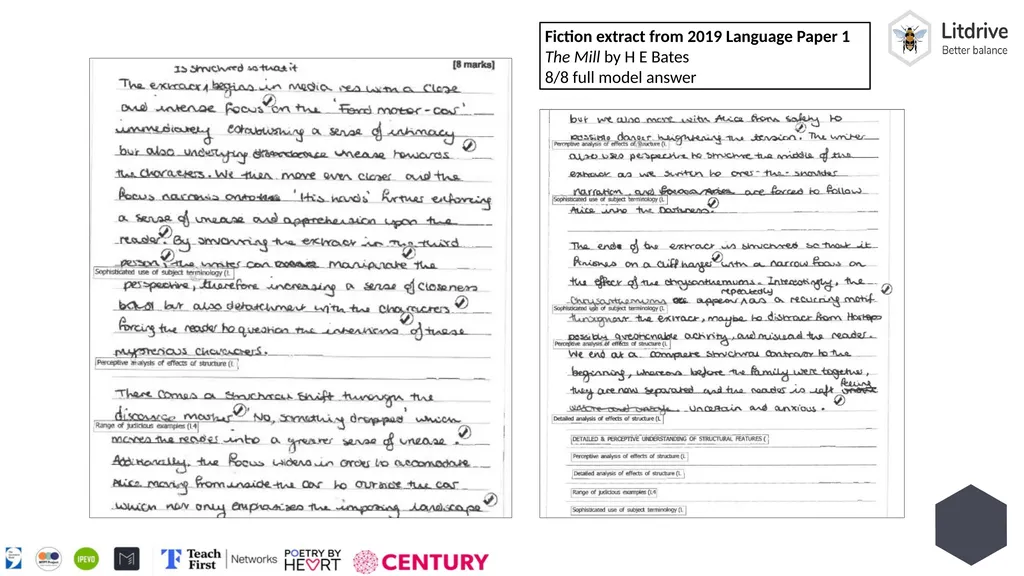
Fiction extract from 2019 Language Paper 1
The Mill by H E Bates
8/8 full model answer<br>
The Mill by H E Bates
8/8 full model answer<br>
27
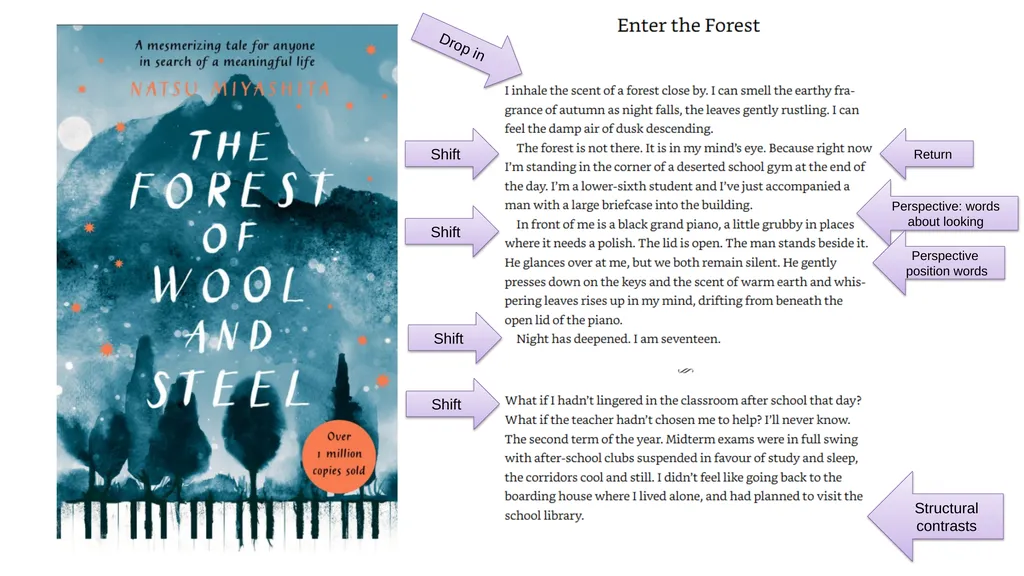
Drop in Shift Shift Shift Perspective: words about looking Perspective position words Return Shift Structural contrasts<br>
28
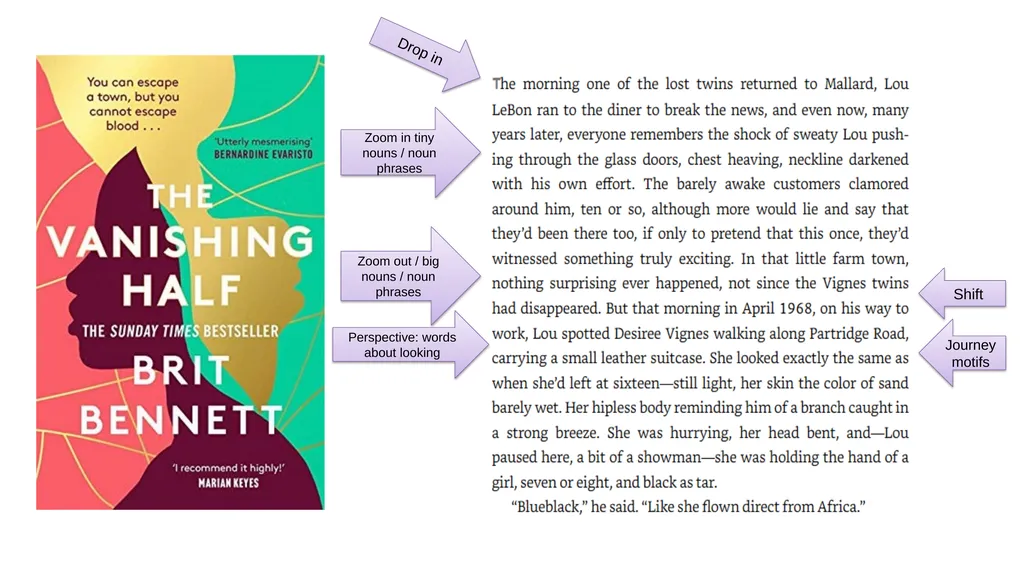
Zoom in tiny nouns / noun phrases Zoom out / big nouns / noun phrases Journey motifs Drop in Perspective: words about looking Shift<br>
29
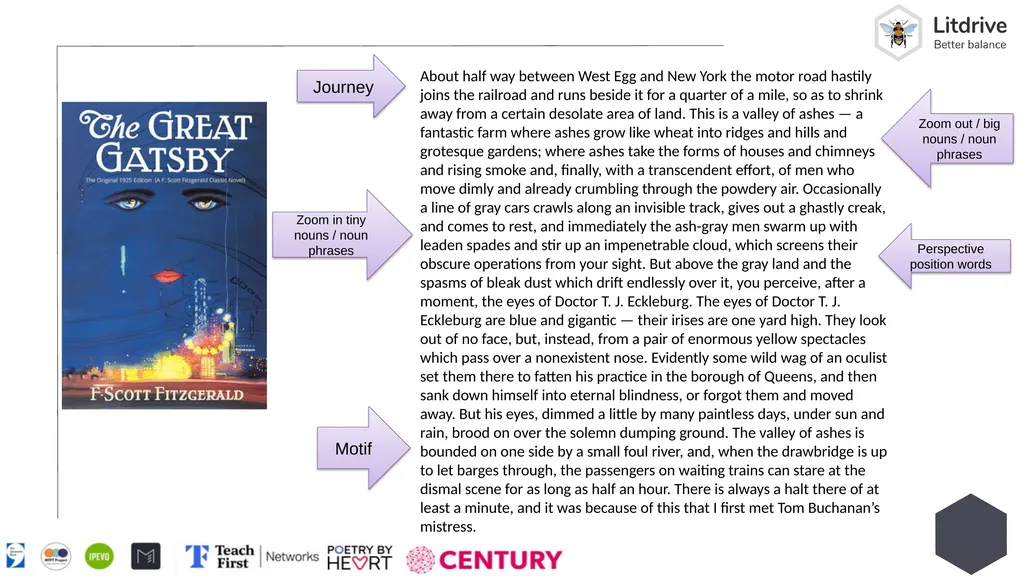
Journey Perspective position words Zoom out / big nouns / noun phrases Zoom in tiny nouns / noun phrases Motif About half way between West Egg and New York the motor road hastily joins the railroad and runs beside it for a quarter of a mile, so as to shrink away from a certain desolate area of land. This is a valley of ashes — a fantastic farm where ashes grow like wheat into ridges and hills and grotesque gardens; where ashes take the forms of houses and chimneys and rising smoke and, finally, with a transcendent effort, of men who move dimly and already crumbling through the powdery air. Occasionally a line of gray cars crawls along an invisible track, gives out a ghastly creak, and comes to rest, and immediately the ash-gray men swarm up with leaden spades and stir up an impenetrable cloud, which screens their obscure operations from your sight. But above the gray land and the spasms of bleak dust which drift endlessly over it, you perceive, after a moment, the eyes of Doctor T. J. Eckleburg. The eyes of Doctor T. J. Eckleburg are blue and gigantic — their irises are one yard high. They look out of no face, but, instead, from a pair of enormous yellow spectacles which pass over a nonexistent nose. Evidently some wild wag of an oculist set them there to fatten his practice in the borough of Queens, and then sank down himself into eternal blindness, or forgot them and moved away. But his eyes, dimmed a little by many paintless days, under sun and rain, brood on over the solemn dumping ground. The valley of ashes is bounded on one side by a small foul river, and, when the drawbridge is up to let barges through, the passengers on waiting trains can stare at the dismal scene for as long as half an hour. There is always a halt there of at least a minute, and it was because of this that I first met Tom Buchanan’s mistress.<br>
30
Journey Zoom out / big nouns / noun phrases Zoom in tiny nouns / noun phrases Motif: repeat and echo Perspective: words about looking<br>