
Elderly Urinary Incontinence Causes & Care August
PC
Published · 50 slides · 0 views

1 / 1




Description
Elderly Urinary Incontinence Causes Care August 2022 Adult Bladder and Bowel Service Oxford Health NHS Foundation Trust The Functions of the Urinary System The kidneys regulate blood volume and composition, which help to regulate blood
Related Topics
Share
Embed code
Download this presentation From Below
"Elderly Urinary Incontinence Causes & Care August" is the property of its rightful owner. Permission is granted to download and print the materials on this website for personal, non-commercial use only, and to display it on your personal computer provided you do not modify the materials and that you retain all copyright notices contained in the materials. By downloading content from our website, you accept the terms of this agreement.
Presentation Transcript
01
Elderly Urinary Incontinence Causes & Care
August 2022
Adult Bladder and Bowel Service
Oxford Health NHS Foundation Trust<br>
August 2022
Adult Bladder and Bowel Service
Oxford Health NHS Foundation Trust<br>
02
The Functions of the Urinary System The kidneys regulate blood volume and composition, which help to regulate blood pressure and urinary pH, participate in red blood cell production and synthesis of vitamin D, and excrete waste products and foreign substances.
The ureters transport urine from the kidneys to the urinary bladder.
The urinary bladder stores urine and expels urine into the urethra
The urethra discharges urine from the body.<br>
The ureters transport urine from the kidneys to the urinary bladder.
The urinary bladder stores urine and expels urine into the urethra
The urethra discharges urine from the body.<br>
03
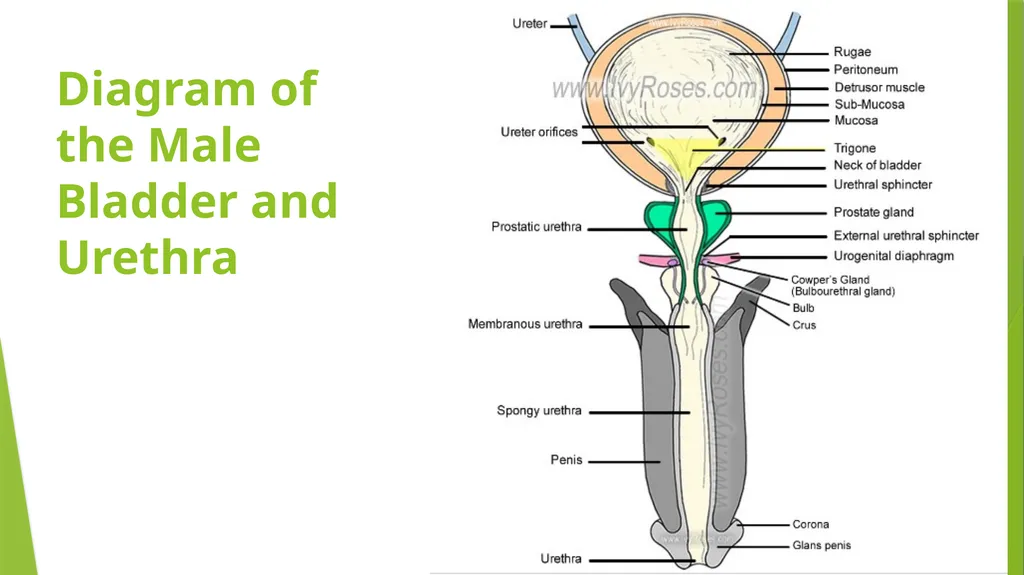
Diagram of the Male Bladder and Urethra<br>
04
Bladder Balloon-shaped hollow muscle. It is designed to stretch as it fills up and contract as it empties. The bladder muscle can become so weak that it is unable to contract strongly enough to empty. The Detrusor muscle is accountable for emptying/ voiding.
Damage to the nervous system can also affect the bladder’s ability to contract e.g. Parkinson’s disease, Stroke, Multiple Sclerosis and Alzheimer’s disease.<br>
Damage to the nervous system can also affect the bladder’s ability to contract e.g. Parkinson’s disease, Stroke, Multiple Sclerosis and Alzheimer’s disease.<br>
05
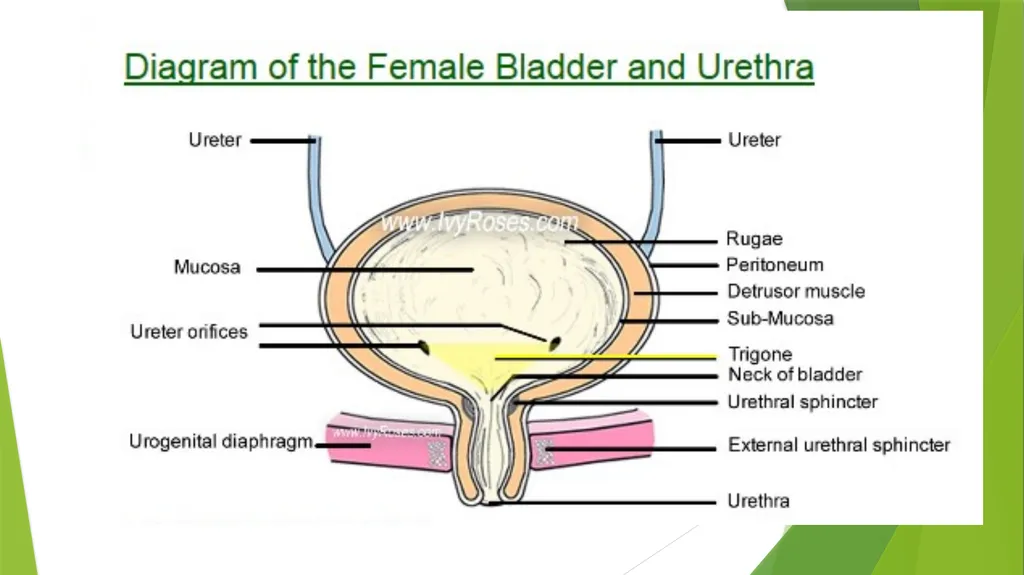
The bladder itself consists of 4 layers: Serous
The outer "serous" layer is a partial layer derived from the peritoneum
Muscular The detrusor muscle is the muscle of the urinary bladder wall. It consists of three layers of smooth (involuntary) muscle fibres. This is the most important layer.
Sub-mucous This is a thin layer of areolar tissue that loosely connects the muscular layer with the mucous layer, being itself intimately attached to the mucous layer.
Mucous The innermost layer of the wall of the urinary bladder is the mucous membrane (also called the 'mucosa'), which contains transitional epithelium tissue that can stretch. The ability of this tissue to stretch is important because it contains variable volumes of liquid - as the bladder is filled and emptied several times per day.<br>
Muscular The detrusor muscle is the muscle of the urinary bladder wall. It consists of three layers of smooth (involuntary) muscle fibres. This is the most important layer.
Sub-mucous This is a thin layer of areolar tissue that loosely connects the muscular layer with the mucous layer, being itself intimately attached to the mucous layer.
Mucous The innermost layer of the wall of the urinary bladder is the mucous membrane (also called the 'mucosa'), which contains transitional epithelium tissue that can stretch. The ability of this tissue to stretch is important because it contains variable volumes of liquid - as the bladder is filled and emptied several times per day.<br>
06
The bladder is a loose sack that can accommodate a range of volumes of urine ranging from 0 ml immediately after the bladder has been emptied, to a maximum of around 300-400ml in normal adults, less in cases of children and adults of below average size. Normal voiding of an adult is 5-8 times daily.
When the quantity of urine contained in the bladder exceeds that necessary to cause tension in the walls of the bladder this is communicated to the brain (i.e. the Central Nervous System, CNS, and is perceived consciously as the sensation of a full bladder.
Urine is released from the bladder into the urethra, and then out of the body, as a result of the actions of muscles. These muscles are innervated by nerve cells called motor neurons acting at neuromuscular junctions (NMJs).<br>
When the quantity of urine contained in the bladder exceeds that necessary to cause tension in the walls of the bladder this is communicated to the brain (i.e. the Central Nervous System, CNS, and is perceived consciously as the sensation of a full bladder.
Urine is released from the bladder into the urethra, and then out of the body, as a result of the actions of muscles. These muscles are innervated by nerve cells called motor neurons acting at neuromuscular junctions (NMJs).<br>
07
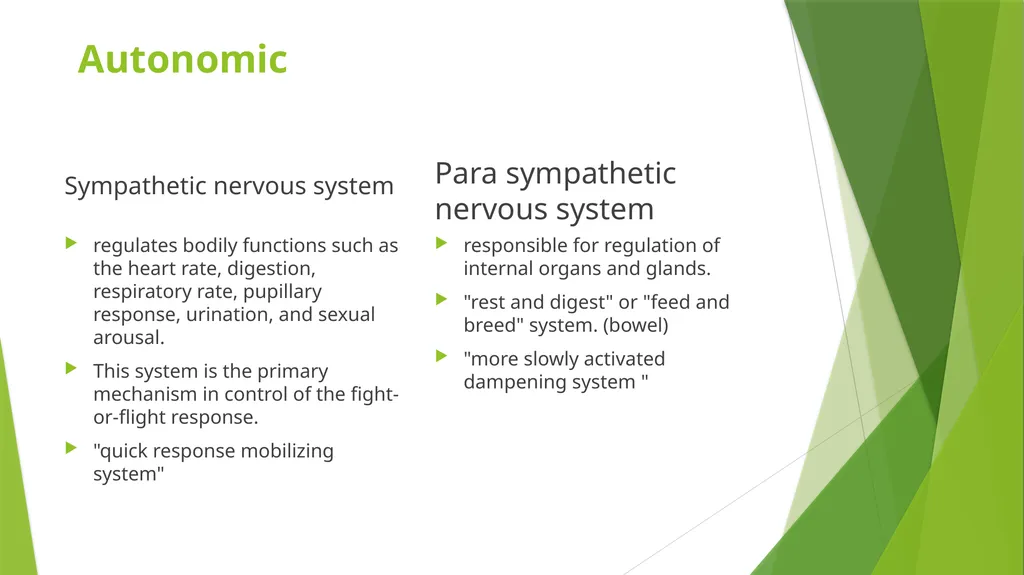
Autonomic Sympathetic nervous system regulates bodily functions such as the heart rate, digestion, respiratory rate, pupillary response, urination, and sexual arousal.
This system is the primary mechanism in control of the fight-or-flight response.
"quick response mobilizing system" Para sympathetic nervous system responsible for regulation of internal organs and glands.
"rest and digest" or "feed and breed" system. (bowel)
"more slowly activated dampening system "<br>
This system is the primary mechanism in control of the fight-or-flight response.
"quick response mobilizing system" Para sympathetic nervous system responsible for regulation of internal organs and glands.
"rest and digest" or "feed and breed" system. (bowel)
"more slowly activated dampening system "<br>
08
Summarise Both the SNS and the ANS are involved in micturition because the SNS controls skeletal muscles (also known as striated or voluntary muscles) and the ANS controls smooth muscle (also called 'involuntary' muscle). The part of the ANS that controls motor neurons, and therefore ultimately muscles, consists of the sympathetic division and the parasympathetic division.<br>
09
The detrusor muscle is the (smooth) muscle of the bladder wall and, together with the urethral (internal) sphincter muscle located at the neck of the bladder, is innervated by the sympathetic nerve fibres from the lumbar sections of spinal cord, and also by the parasympathetic nerve fibres from sacral segments 2 - 4 of the spinal cord.
Recall that these muscles are NOT under voluntary control.
However, the external urethral sphincter muscle is under voluntary control, and as such is innervated by the SNS.<br>
Recall that these muscles are NOT under voluntary control.
However, the external urethral sphincter muscle is under voluntary control, and as such is innervated by the SNS.<br>
10
Cholinergic system A cholinergic is a substance related to the neurotransmitter acetylcholine (ACh). This neurotransmitter plays a key role in the functioning of the parasympathetic nervous system along with other aspects of the nervous system.
Acetylcholine, sends impulses from the parasympathetic nervous system to the smooth muscle and causes contractions.
When the PNS does not work effectively or the transmitters are firing but not in conjunction to the ANS patients can develop symptoms of Overactive bladder.<br>
Acetylcholine, sends impulses from the parasympathetic nervous system to the smooth muscle and causes contractions.
When the PNS does not work effectively or the transmitters are firing but not in conjunction to the ANS patients can develop symptoms of Overactive bladder.<br>
11
Extent of the problem 1 in 5 over the age of 40 suffer from overactive bladder or urgency or frequency symptoms
In the nursing home population, at least 50 percent of residents have bladder and/or bowel symptoms- increased in this group due to reduced mobility, reduced cognition, over active bladder, constipation and carer availability<br>
In the nursing home population, at least 50 percent of residents have bladder and/or bowel symptoms- increased in this group due to reduced mobility, reduced cognition, over active bladder, constipation and carer availability<br>
12
"Incontinence is a common part of aging but it is never normal,"<br>
13
Elderly urinary incontinence Some people may only leak urine occasionally
Others may constantly dribble urine
A complete lack of both bladder and bowel control.<br>
Others may constantly dribble urine
A complete lack of both bladder and bowel control.<br>
14
Causes Low fluid intake
Inflamed bladder wall
Disease
infection
Pregnancy and childbirth
Onset of menopause can lead to incontinence.
Prostate
Even drinking coffee or tea or taking prescribed medications can aggravate your bladder
As one ages, changes in the body can make elderly urinary incontinence a more likely occurrence.
Cauda Equina<br>
Inflamed bladder wall
Disease
infection
Pregnancy and childbirth
Onset of menopause can lead to incontinence.
Prostate
Even drinking coffee or tea or taking prescribed medications can aggravate your bladder
As one ages, changes in the body can make elderly urinary incontinence a more likely occurrence.
Cauda Equina<br>
15
Diagnosis A urinalysis to rule out infection or blood in the urine N.B. urinalysis sticks should be stored correctly, in date and are read at the correct intervals
Blood tests to check on kidney function, calcium and glucose levels
A thorough discussion of one's medical history
Undertake a visual check (if appropriate and consent is given) for obvious prolapse, anal fissures, haemorrhoids and abnormalities.
A complete physical exam, bladder scan, Vaginal assessment, including a rectal exam and a pelvic exam for women, and a urological exam for men may be required<br>
Blood tests to check on kidney function, calcium and glucose levels
A thorough discussion of one's medical history
Undertake a visual check (if appropriate and consent is given) for obvious prolapse, anal fissures, haemorrhoids and abnormalities.
A complete physical exam, bladder scan, Vaginal assessment, including a rectal exam and a pelvic exam for women, and a urological exam for men may be required<br>
16
Treatments & Practical Management For the majority of the people in the community, it is 100 percent treatable. Most of the time, it's a non-surgical treatment
Usually the first line of treatment is behavioural therapy, which will often cure the incontinence.
Treatments can include bladder training;
scheduled bathroom trips,
pelvic floor muscles exercises,
fluid and diet management.
The nice thing about behavioural therapies is that there are no side effects and the response is proportional to the work of the patient,<br>
Usually the first line of treatment is behavioural therapy, which will often cure the incontinence.
Treatments can include bladder training;
scheduled bathroom trips,
pelvic floor muscles exercises,
fluid and diet management.
The nice thing about behavioural therapies is that there are no side effects and the response is proportional to the work of the patient,<br>
17
Medications are frequently used in combination with behavioural therapies Anticholinergic or Antispasmodic Drugs
These are usually prescribed for urge incontinence,
Hormone Replacement Estrogen therapy-with a vaginal cream, ring, or patch-is used to counteract the atrophy of the skin lining of the urethra and vagina in post-menopausal women.
Antibiotics These are prescribed when incontinence is caused by a urinary tract infection or an inflamed prostate gland.<br>
Hormone Replacement Estrogen therapy-with a vaginal cream, ring, or patch-is used to counteract the atrophy of the skin lining of the urethra and vagina in post-menopausal women.
Antibiotics These are prescribed when incontinence is caused by a urinary tract infection or an inflamed prostate gland.<br>
18
What are Anticholinergics/antispasmodics? Anticholinergics are a broad group of medicines that act on the neurotransmitter, acetylcholine. They are also called antispasmodics, antagonists.
By blocking the action of acetylcholine, anticholinergics prevent impulses from the parasympathetic nervous system from reaching smooth muscle and causing contractions, cramps or spasms. Anticholinergics are used in the treatment of some gastrointestinal and bladder conditions.
They may also be used in the treatment of some respiratory or movement disorders.
Idea is to inhibit involuntary bladder contractions to decrease urinary frequency.
One of the new medications, Betmiga/ Mirabegron, used in OAB is a synthesizer, beta 3 adrenoreceptor agonist which reduces bladder activity.<br>
By blocking the action of acetylcholine, anticholinergics prevent impulses from the parasympathetic nervous system from reaching smooth muscle and causing contractions, cramps or spasms. Anticholinergics are used in the treatment of some gastrointestinal and bladder conditions.
They may also be used in the treatment of some respiratory or movement disorders.
Idea is to inhibit involuntary bladder contractions to decrease urinary frequency.
One of the new medications, Betmiga/ Mirabegron, used in OAB is a synthesizer, beta 3 adrenoreceptor agonist which reduces bladder activity.<br>
19
Anticholinergic Burden Anticholinergic medications are used to block the neurotransmitter Acetylcholine. Anticholinergics have systemic effects on smooth muscle function including the lungs, gastrointestinal system and urinary tract. Anticholinergic drugs are therefore prescribed to treat a variety of medical conditions including Parkinson’s disease, allergies, Chronic Obstructive Pulmonary Disease, Depression and urinary incontinence.
Medications with anticholinergic properties can be associated Adverse Drug Reactions (ADRs). Examples of such ADRs include dry eyes, urinary retention, dizziness, cognitive impairment and falls. The Anticholinergic effect increases if a stronger Anticholinergic is used, or if different Anticholinergics are used in combination. Older patients are more likely to have multiple co- morbidities, and therefore to be on multiple medications. As the body ages, its ability to metabolise medications declines, and therefore older patients are more susceptible to the Anticholinergic effects of their medications.
Anticholinergic Burden tables were created in 2008 to quantify the effects of these medications and provide a practical tool for optimising prescribing for older patients4. Longitudinal studies have shown an association between the use of Anticholinergics and the risk of developing cognitive impairment and of death5. More recent research also indicates that there is a dose-dependent association between long term use of Anticholinergics and the risk of developing Dementia.
http://www.acbcalc.com/<br>
Medications with anticholinergic properties can be associated Adverse Drug Reactions (ADRs). Examples of such ADRs include dry eyes, urinary retention, dizziness, cognitive impairment and falls. The Anticholinergic effect increases if a stronger Anticholinergic is used, or if different Anticholinergics are used in combination. Older patients are more likely to have multiple co- morbidities, and therefore to be on multiple medications. As the body ages, its ability to metabolise medications declines, and therefore older patients are more susceptible to the Anticholinergic effects of their medications.
Anticholinergic Burden tables were created in 2008 to quantify the effects of these medications and provide a practical tool for optimising prescribing for older patients4. Longitudinal studies have shown an association between the use of Anticholinergics and the risk of developing cognitive impairment and of death5. More recent research also indicates that there is a dose-dependent association between long term use of Anticholinergics and the risk of developing Dementia.
http://www.acbcalc.com/<br>
20
Medication for stress incontinence: duloxetine. selective serotonin and norepinephrine reuptake inhibitor antidepressant (SSNRI). This can help increase the muscle tone of the urethra, which should help keep it closed.
Possible side effects of duloxetine can include:
nausea
dry mouth
extreme tiredness (fatigue)
Constipation
Not often tolerated<br>
Possible side effects of duloxetine can include:
nausea
dry mouth
extreme tiredness (fatigue)
Constipation
Not often tolerated<br>
21
Medication for urge incontinence: blocks the action of the neurotransmitter acetylcholine controls bladder function Solifenacin 5mg-10mg OD first line drug in Oxfordshire CCG guidance (ACB- 3)
Mirabegron 25-50mg OD second choice (BP controlled and reviewed) (ACB-0)
Oxybutanin can cause confusion and falls in the elderly – black listed
Tolterodine and fesoterodine – off formulary but still out there (ACB-3)<br>
Mirabegron 25-50mg OD second choice (BP controlled and reviewed) (ACB-0)
Oxybutanin can cause confusion and falls in the elderly – black listed
Tolterodine and fesoterodine – off formulary but still out there (ACB-3)<br>
22
Possible side effects include: dry mouth
constipation
dizziness
blurred vision
fatigue
In rare cases can also lead to a type of glaucoma, a build-up of pressure within the eye, called angle-closure glaucoma.
Anticholinergics – bind to cholinergic receptors<br>
constipation
dizziness
blurred vision
fatigue
In rare cases can also lead to a type of glaucoma, a build-up of pressure within the eye, called angle-closure glaucoma.
Anticholinergics – bind to cholinergic receptors<br>
23
Female hormone: oestrogen (ovestin cream, estirol pessary). The may protect against urinary tract infections in postmenopausal women by improving two of the body’s defence mechanisms, a new study found.
The researchers looked at the effects of estrogen supplements in healthy postmenopausal women, and found that the hormone helped trigger the production of body’s natural antimicrobial proteins in the bladder.
The hormone also strengthened urinary tract tissue by tightening the surface layer of the bladder cells, which protects the underlying cells from infection
Vaginal pessaries can be inserted by the patient using a clean finger into the vagina and Bladder and Bowel Advise to insert into the lower third of the vagina and eve/night is best so it has longer to work.<br>
The researchers looked at the effects of estrogen supplements in healthy postmenopausal women, and found that the hormone helped trigger the production of body’s natural antimicrobial proteins in the bladder.
The hormone also strengthened urinary tract tissue by tightening the surface layer of the bladder cells, which protects the underlying cells from infection
Vaginal pessaries can be inserted by the patient using a clean finger into the vagina and Bladder and Bowel Advise to insert into the lower third of the vagina and eve/night is best so it has longer to work.<br>
24
UTI A lower urinary tract infection is when only the urethra and/or bladder is infected. A diagnosis of lower urinary tract infection can be made using a simple urine dip test. The symptoms include at least one of the following:
pain, or a burning sensation when passing urine (called dysuria)
the need to pass urine immediately (called urgency)
the feeling of not being able to urinate fully
cloudy, bloody or bad-smelling urine
lower abdominal pain
urinary incontinence - the involuntary leakage of urine
mild fever (between 37-38°C or 98.6-101.0°F), and
delirium/acute confusion (sudden onset confusion developing within one to two days). This is more common in the elderly.<br>
pain, or a burning sensation when passing urine (called dysuria)
the need to pass urine immediately (called urgency)
the feeling of not being able to urinate fully
cloudy, bloody or bad-smelling urine
lower abdominal pain
urinary incontinence - the involuntary leakage of urine
mild fever (between 37-38°C or 98.6-101.0°F), and
delirium/acute confusion (sudden onset confusion developing within one to two days). This is more common in the elderly.<br>
25
Urinary retention inability to voluntary urinate Secondary to;
Urethral blockage
Drug treatment (such as use of antimuscarinic drugs, sympathomimetics, tricyclic antidepressants)
Conditions that reduce detrusor contractions or interfere with relaxation of the urethra, neurogenic causes
Postpartum
Postoperatively
Cauda Equina<br>
Urethral blockage
Drug treatment (such as use of antimuscarinic drugs, sympathomimetics, tricyclic antidepressants)
Conditions that reduce detrusor contractions or interfere with relaxation of the urethra, neurogenic causes
Postpartum
Postoperatively
Cauda Equina<br>
26
Cauda Equina The collection of nerves at the end of the spinal cord is known as the cauda equina, due to its resemblance to a horse's tail. The spinal cord ends at the upper portion of the lumbar (lower back) spine. The individual nerve roots at the end of the spinal cord that provide motor and sensory function to the legs and the bladder continue along in the spinal canal. The cauda equina is the continuation of these nerve roots in the lumbar and sacral region. These nerves send and receive messages to and from the lower limbs and pelvic organs.
Cauda equina syndrome (CES) occurs when there is dysfunction of multiple lumbar and sacral nerve roots of the cauda equina.
Potential Causes of CES
Spinal lesions and tumours
Spinal infections or inflammation
Lumbar spinal stenosis
Violent injuries to the lower back (gunshots, falls, auto accidents)
Birth abnormalities
Spinal arteriovenous malformations (AVMs)
Spinal haemorrhages (subarachnoid, subdural, epidural)
Postoperative lumbar spine surgery complications
Spinal anaesthesia<br>
Cauda equina syndrome (CES) occurs when there is dysfunction of multiple lumbar and sacral nerve roots of the cauda equina.
Potential Causes of CES
Spinal lesions and tumours
Spinal infections or inflammation
Lumbar spinal stenosis
Violent injuries to the lower back (gunshots, falls, auto accidents)
Birth abnormalities
Spinal arteriovenous malformations (AVMs)
Spinal haemorrhages (subarachnoid, subdural, epidural)
Postoperative lumbar spine surgery complications
Spinal anaesthesia<br>
27
Symptoms of CES CES is accompanied by a range of symptoms, the severity of which depend on the degree of compression and the precise nerve roots that are being compressed.
Patients with CES may experience some or all of these “red flag” symptoms.
Urinary retention: the most common symptom. The patient’s bladder fills with urine, but the patient does not experience the normal sensation or urge to urinate.
Urinary and/or fecal incontinence. The overfull bladder can result in incontinence of urine. Incontinence of stool can occur due to dysfunction of the anal sphincter.
“Saddle anesthesia” sensory disturbance, which can involve the anus, genitals and buttock region.
Weakness or paralysis of usually more than one nerve root. The weakness can affect lower extremities.
Pain in the back and/or legs (also known as sciatica).
Sexual dysfunction.
If a patient is experiencing any of the “red flag” symptoms above, immediate medical attention is required to evaluate whether these symptoms represent CES.<br>
Patients with CES may experience some or all of these “red flag” symptoms.
Urinary retention: the most common symptom. The patient’s bladder fills with urine, but the patient does not experience the normal sensation or urge to urinate.
Urinary and/or fecal incontinence. The overfull bladder can result in incontinence of urine. Incontinence of stool can occur due to dysfunction of the anal sphincter.
“Saddle anesthesia” sensory disturbance, which can involve the anus, genitals and buttock region.
Weakness or paralysis of usually more than one nerve root. The weakness can affect lower extremities.
Pain in the back and/or legs (also known as sciatica).
Sexual dysfunction.
If a patient is experiencing any of the “red flag” symptoms above, immediate medical attention is required to evaluate whether these symptoms represent CES.<br>
28
Acute urinary retention Is a medical emergency
Characterised by the abrupt development of the inability to pass urine (over a period of hours).
Painful
Requires catheterisation
Before the catheter is removed an alpha-adrenoceptor blocker (doxazosin, tamsulosin, prazosin, indoramin) should be given for at least two days to manage acute urinary retention. Chronic urinary retention Is the gradual (over months or years) development of the inability to empty the bladder completely
Characterised by a residual volume greater than one litre or associated with the presence of a distended or palpable bladder
Intermittent bladder catheterisation should be offered before an indwelling catheter<br>
Characterised by the abrupt development of the inability to pass urine (over a period of hours).
Painful
Requires catheterisation
Before the catheter is removed an alpha-adrenoceptor blocker (doxazosin, tamsulosin, prazosin, indoramin) should be given for at least two days to manage acute urinary retention. Chronic urinary retention Is the gradual (over months or years) development of the inability to empty the bladder completely
Characterised by a residual volume greater than one litre or associated with the presence of a distended or palpable bladder
Intermittent bladder catheterisation should be offered before an indwelling catheter<br>
29
In men who have symptoms that are bothersome, drug treatment should only be offered when other conservative management options have failed
Men with moderate-to-severe symptoms should be offered an alpha-adrenoceptor blocker (alfuzosin hydrochloride, doxazosin, tamsulosin hydrochloride or terazosin)
Treatment should initially be reviewed after 4–6 weeks and then every 6–12 months
Recent study shows tamsulosin and Dutasteride as a combination treatment proves better for men with urinary symptoms
(Medivizor)<br>
Men with moderate-to-severe symptoms should be offered an alpha-adrenoceptor blocker (alfuzosin hydrochloride, doxazosin, tamsulosin hydrochloride or terazosin)
Treatment should initially be reviewed after 4–6 weeks and then every 6–12 months
Recent study shows tamsulosin and Dutasteride as a combination treatment proves better for men with urinary symptoms
(Medivizor)<br>
30
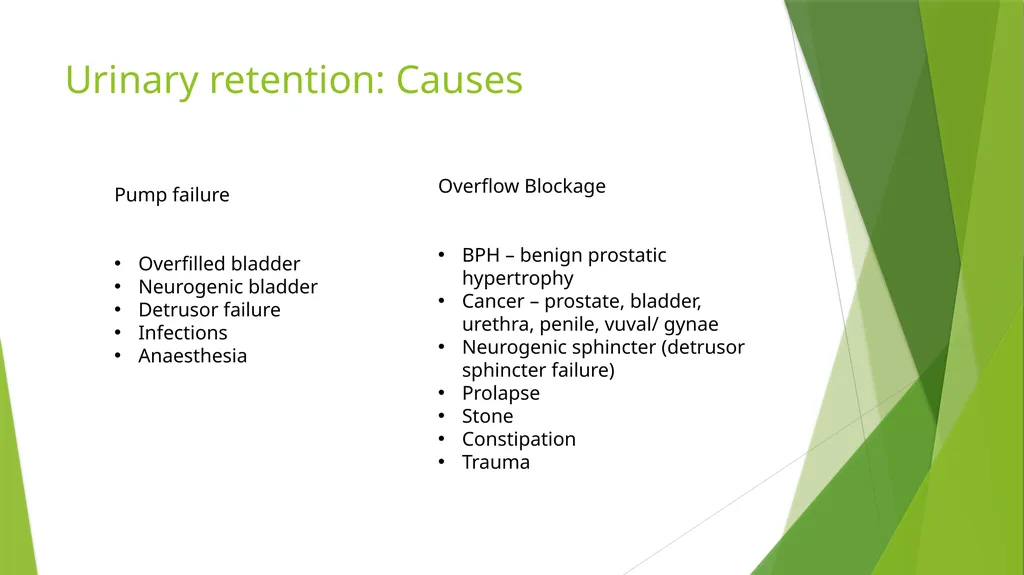
Urinary retention: Causes Pump failure
Overfilled bladder
Neurogenic bladder
Detrusor failure
Infections
Anaesthesia Overflow Blockage
BPH – benign prostatic hypertrophy
Cancer – prostate, bladder, urethra, penile, vuval/ gynae
Neurogenic sphincter (detrusor sphincter failure)
Prolapse
Stone
Constipation
Trauma<br>
Overfilled bladder
Neurogenic bladder
Detrusor failure
Infections
Anaesthesia Overflow Blockage
BPH – benign prostatic hypertrophy
Cancer – prostate, bladder, urethra, penile, vuval/ gynae
Neurogenic sphincter (detrusor sphincter failure)
Prolapse
Stone
Constipation
Trauma<br>
31
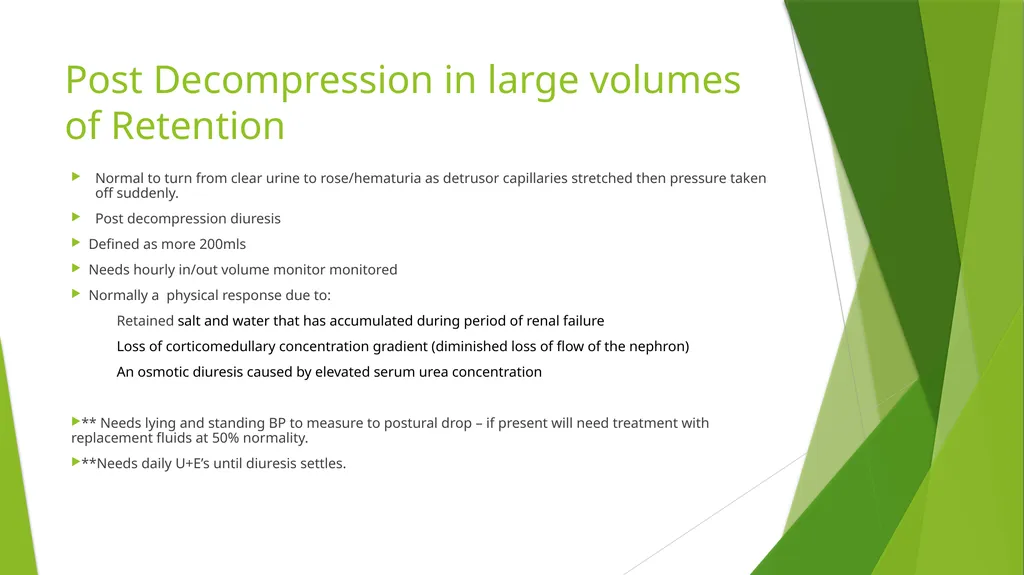
Post Decompression in large volumes of Retention Normal to turn from clear urine to rose/hematuria as detrusor capillaries stretched then pressure taken off suddenly.
Post decompression diuresis
Defined as more 200mls
Needs hourly in/out volume monitor monitored
Normally a physical response due to:
Retained salt and water that has accumulated during period of renal failure
Loss of corticomedullary concentration gradient (diminished loss of flow of the nephron)
An osmotic diuresis caused by elevated serum urea concentration
** Needs lying and standing BP to measure to postural drop – if present will need treatment with replacement fluids at 50% normality.
**Needs daily U+E’s until diuresis settles.<br>
Post decompression diuresis
Defined as more 200mls
Needs hourly in/out volume monitor monitored
Normally a physical response due to:
Retained salt and water that has accumulated during period of renal failure
Loss of corticomedullary concentration gradient (diminished loss of flow of the nephron)
An osmotic diuresis caused by elevated serum urea concentration
** Needs lying and standing BP to measure to postural drop – if present will need treatment with replacement fluids at 50% normality.
**Needs daily U+E’s until diuresis settles.<br>
32
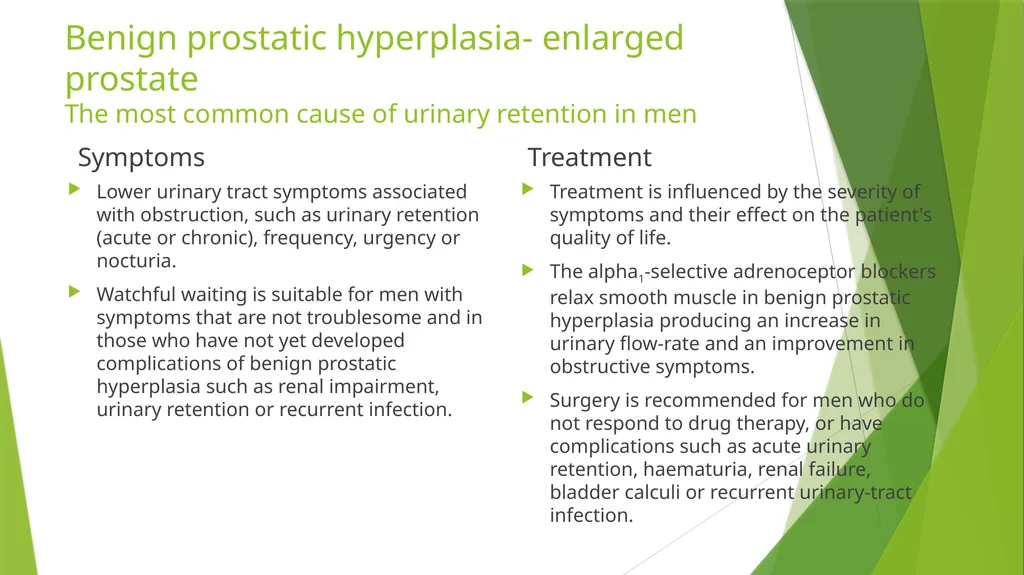
Benign prostatic hyperplasia- enlarged prostate
The most common cause of urinary retention in men Symptoms Lower urinary tract symptoms associated with obstruction, such as urinary retention (acute or chronic), frequency, urgency or nocturia.
Watchful waiting is suitable for men with symptoms that are not troublesome and in those who have not yet developed complications of benign prostatic hyperplasia such as renal impairment, urinary retention or recurrent infection. Treatment Treatment is influenced by the severity of symptoms and their effect on the patient's quality of life.
The alpha1-selective adrenoceptor blockers relax smooth muscle in benign prostatic hyperplasia producing an increase in urinary flow-rate and an improvement in obstructive symptoms.
Surgery is recommended for men who do not respond to drug therapy, or have complications such as acute urinary retention, haematuria, renal failure, bladder calculi or recurrent urinary-tract infection.<br>
Watchful waiting is suitable for men with symptoms that are not troublesome and in those who have not yet developed complications of benign prostatic hyperplasia such as renal impairment, urinary retention or recurrent infection. Treatment Treatment is influenced by the severity of symptoms and their effect on the patient's quality of life.
The alpha1-selective adrenoceptor blockers relax smooth muscle in benign prostatic hyperplasia producing an increase in urinary flow-rate and an improvement in obstructive symptoms.
Surgery is recommended for men who do not respond to drug therapy, or have complications such as acute urinary retention, haematuria, renal failure, bladder calculi or recurrent urinary-tract infection.<br>
33
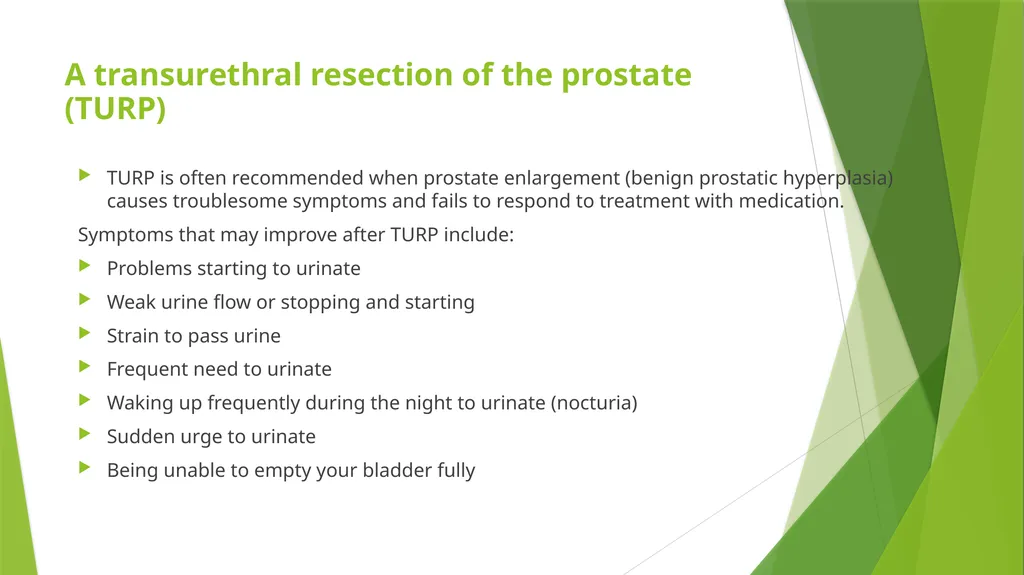
A transurethral resection of the prostate (TURP) TURP is often recommended when prostate enlargement (benign prostatic hyperplasia) causes troublesome symptoms and fails to respond to treatment with medication.
Symptoms that may improve after TURP include:
Problems starting to urinate
Weak urine flow or stopping and starting
Strain to pass urine
Frequent need to urinate
Waking up frequently during the night to urinate (nocturia)
Sudden urge to urinate
Being unable to empty your bladder fully<br>
Symptoms that may improve after TURP include:
Problems starting to urinate
Weak urine flow or stopping and starting
Strain to pass urine
Frequent need to urinate
Waking up frequently during the night to urinate (nocturia)
Sudden urge to urinate
Being unable to empty your bladder fully<br>
34
Faecal incontinence Some people experience incontinence on a daily basis, whereas for others it only happens from time to time.
It's thought one in 10 people will be affected by it at some point in their life. It can affect people of any age, although it's more common in elderly people. It's also more common in women than men.
Bowel incontinence isn't something to be ashamed of – it's simply a medical problem that's no different from diabetes or asthma.
It can be treated – there's a wide range of successful treatments.
Bowel incontinence isn't a normal part of ageing.
It won't usually go away on its own – most people need treatment for the condition.<br>
It's thought one in 10 people will be affected by it at some point in their life. It can affect people of any age, although it's more common in elderly people. It's also more common in women than men.
Bowel incontinence isn't something to be ashamed of – it's simply a medical problem that's no different from diabetes or asthma.
It can be treated – there's a wide range of successful treatments.
Bowel incontinence isn't a normal part of ageing.
It won't usually go away on its own – most people need treatment for the condition.<br>
35
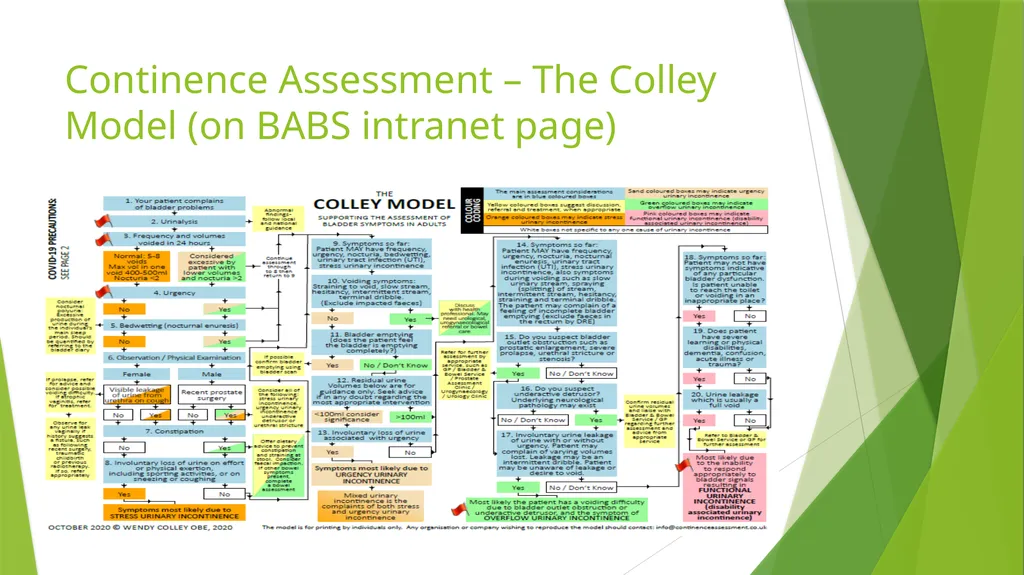
Continence Assessment – The Colley Model (on BABS intranet page)<br>
36
Continence products An anal plug is made of foam and designed to be inserted into your bottom. If the plug comes into contact with moisture from the bowel, it expands and prevents leakage or soiling. Anal plugs can be worn for up to 12 hours, after which time they are removed using an attached string.
Disposable body pads / washable pads
Single-use silicone inserts similar to anal plus, which form a seal around the rectum until the next bowel movement,<br>
Disposable body pads / washable pads
Single-use silicone inserts similar to anal plus, which form a seal around the rectum until the next bowel movement,<br>
37
Diarrhoea The advice from NICE includes the following:
limit fibre intake from wholegrain breads, bran, cereals, nuts and seeds (except golden linseeds)
avoid skin, pips and pith from fruit and vegetables
limit fresh and dried fruit to three portions a day and fruit juice to one small glass a day (make up the recommended ‘five a day’ with vegetables)
limit how often you have fizzy drinks and drinks containing caffeine
avoid foods high in fat, such as chips, fast foods and burgers<br>
limit fibre intake from wholegrain breads, bran, cereals, nuts and seeds (except golden linseeds)
avoid skin, pips and pith from fruit and vegetables
limit fresh and dried fruit to three portions a day and fruit juice to one small glass a day (make up the recommended ‘five a day’ with vegetables)
limit how often you have fizzy drinks and drinks containing caffeine
avoid foods high in fat, such as chips, fast foods and burgers<br>
38
Constipation A high-fibre diet is usually recommended for most people with constipation-associated bowel incontinence.
Fibre can soften stools, making them easier to pass. Foods that are high in fibre include:
fruit and vegetables
beans
wholegrain rice
Whole wheat pasta
wholemeal bread
seeds, nuts and oats
Drink plenty of fluids<br>
Fibre can soften stools, making them easier to pass. Foods that are high in fibre include:
fruit and vegetables
beans
wholegrain rice
Whole wheat pasta
wholemeal bread
seeds, nuts and oats
Drink plenty of fluids<br>
39
Try……. Pelvic floor muscle training
Bowel retraining
Correct positioning (Care with stools required with the cognitively and/or sight impaired)
Utilise the gastro colic reflex after meals<br>
Bowel retraining
Correct positioning (Care with stools required with the cognitively and/or sight impaired)
Utilise the gastro colic reflex after meals<br>
40
Medication Loperamide works by slowing down the movement of stools through the digestive system, allowing more water to be absorbed from the stools.
Laxatives are used to treat constipation. Bulk-forming laxatives are usually recommended. These help to retain fluid. This means they're less likely to dry out, which can lead to faecal impaction.
Senna, Bisacodyl, etc are used to speed up bowel transit time.
Enemas or rectal irrigation
Rectal irrigation or enemas are used when bowel incontinence is caused by faecal impaction and other treatments have failed to remove the impacted stool from the rectum.
These procedures involve a small tube that is placed into the anus.<br>
Laxatives are used to treat constipation. Bulk-forming laxatives are usually recommended. These help to retain fluid. This means they're less likely to dry out, which can lead to faecal impaction.
Senna, Bisacodyl, etc are used to speed up bowel transit time.
Enemas or rectal irrigation
Rectal irrigation or enemas are used when bowel incontinence is caused by faecal impaction and other treatments have failed to remove the impacted stool from the rectum.
These procedures involve a small tube that is placed into the anus.<br>
41
Surgery Surgery is usually only recommended after all other treatment options have been tried.
Sphincteroplasty
A sphincteroplasty is an operation to repair damaged sphincter muscles.
The surgeon removes some of the muscle tissue and the muscle edges are overlapped and sewn back together.
This provides extra support to the muscles, which makes them stronger.<br>
Sphincteroplasty
A sphincteroplasty is an operation to repair damaged sphincter muscles.
The surgeon removes some of the muscle tissue and the muscle edges are overlapped and sewn back together.
This provides extra support to the muscles, which makes them stronger.<br>
42
Sacral nerve stimulation Sacral nerve stimulation is a treatment used for people with weakened sphincter muscles.
Electrodes are inserted under the skin in the lower back and connected to a pulse generator.
The generator releases pulses of electricity that stimulate the sacral nerves, which causes the sphincter and pelvic floor muscles to work more effectively.
At first, the pulse generator is located outside the body. If the treatment is effective, the pulse generator will be implanted deep under the skin.<br>
Electrodes are inserted under the skin in the lower back and connected to a pulse generator.
The generator releases pulses of electricity that stimulate the sacral nerves, which causes the sphincter and pelvic floor muscles to work more effectively.
At first, the pulse generator is located outside the body. If the treatment is effective, the pulse generator will be implanted deep under the skin.<br>
43
Tibial nerve stimulation- not available in Oxfordshire Tibial nerve stimulation is a fairly new treatment for bowel incontinence.
A fine needle is inserted into the tibial nerve just above the ankle and an electrode is placed on the foot. A mild electric current is passed through the needle to stimulate the tibial nerve. It's not known exactly how this treatment works, but it's thought to work in a similar way to sacral nerve stimulation.
NICE concludes that the procedure appears to be safe, although there are still uncertainties about how well it works.<br>
A fine needle is inserted into the tibial nerve just above the ankle and an electrode is placed on the foot. A mild electric current is passed through the needle to stimulate the tibial nerve. It's not known exactly how this treatment works, but it's thought to work in a similar way to sacral nerve stimulation.
NICE concludes that the procedure appears to be safe, although there are still uncertainties about how well it works.<br>
44
Injectable bulking agents- not available in Oxfordshire yet Bulking agents, such as collagen or silicone, can be injected into the muscles of the sphincter and rectum to strengthen them.
The use of bulking agents in this way is a fairly new technique, so there's little information about their long-term effectiveness and safety.<br>
The use of bulking agents in this way is a fairly new technique, so there's little information about their long-term effectiveness and safety.<br>
45
Endoscopic heat therapy Endoscopic radiofrequency (heat) therapy is a fairly new treatment for bowel incontinence.
Heat energy is applied to the sphincter muscles through a thin probe, to encourage scarring of the tissue. This helps tighten the muscles and helps to control bowel movements.
The National Institute for Health and Care Excellence (NICE) recently produced guidelines on this procedure. NICE concluded that the procedure appears to be safe, although there are still uncertainties about how well it works.
As well as the uncertainties surrounding this procedure, it is also expensive. Therefore, it is usually only used on the NHS during clinical trials<br>
Heat energy is applied to the sphincter muscles through a thin probe, to encourage scarring of the tissue. This helps tighten the muscles and helps to control bowel movements.
The National Institute for Health and Care Excellence (NICE) recently produced guidelines on this procedure. NICE concluded that the procedure appears to be safe, although there are still uncertainties about how well it works.
As well as the uncertainties surrounding this procedure, it is also expensive. Therefore, it is usually only used on the NHS during clinical trials<br>
46
Artificial sphincter An artificial sphincter may be implanted if bowel incontinence is caused by a problem with sphincter muscles.
This operation involves placing a circular cuff under the skin around the anus. The cuff is filled with fluid and sits tightly around the anus, keeping it closed.
A tube is placed under the skin from the cuff to a control pump. In men, the pump is placed near the testicles, in women it’s placed near the vagina. A special balloon is placed into the tummy, and this is connected to the control pump by tubing that runs under the skin.
The pump is activated by pressing a button located under the skin. This drains the fluid from the cuff into the balloon, so the anus opens and can pass stools. When finished, the fluid slowly refills the cuff and the anus closes.<br>
This operation involves placing a circular cuff under the skin around the anus. The cuff is filled with fluid and sits tightly around the anus, keeping it closed.
A tube is placed under the skin from the cuff to a control pump. In men, the pump is placed near the testicles, in women it’s placed near the vagina. A special balloon is placed into the tummy, and this is connected to the control pump by tubing that runs under the skin.
The pump is activated by pressing a button located under the skin. This drains the fluid from the cuff into the balloon, so the anus opens and can pass stools. When finished, the fluid slowly refills the cuff and the anus closes.<br>
47
OH BAB Services provide Urinalysis
Bladder scanning
Pelvic floor muscle assessment and exercises
Bladder retraining
Toileting programmes
Self help measures
Intermittent self-catheterisation tuition and support
Advice regarding constipation and faecal incontinence
Product support
Assessment for rectal irrigation<br>
Bladder scanning
Pelvic floor muscle assessment and exercises
Bladder retraining
Toileting programmes
Self help measures
Intermittent self-catheterisation tuition and support
Advice regarding constipation and faecal incontinence
Product support
Assessment for rectal irrigation<br>