
ELECTION INVERSIONS UNDER PROPORTIONAL
Description: ELECTION INVERSIONS UNDER PROPORTIONAL REPRESENTATION Nicholas R. Miller Public Choice Society Meeting March 8-10, 2013 Election Inversions under Plurality Election CandidatesParties Votes Seats US Presidential 2000 George W. Bush 49.73
Related Topics
Download Presentation
"ELECTION INVERSIONS UNDER PROPORTIONAL" is the property of its rightful owner. Permission is granted to download and print the materials on this website for personal, non-commercial use only, and to display it on your personal computer provided you do not modify the materials and that you retain all copyright notices contained in the materials. By downloading content from our website, you accept the terms of this agreement.
Presentation Transcript
slide1. ELECTION INVERSIONS
UNDER PROPORTIONAL REPRESENTATION Nicholas R. Miller
Public Choice Society Meeting
March 8-10, 2013<br>
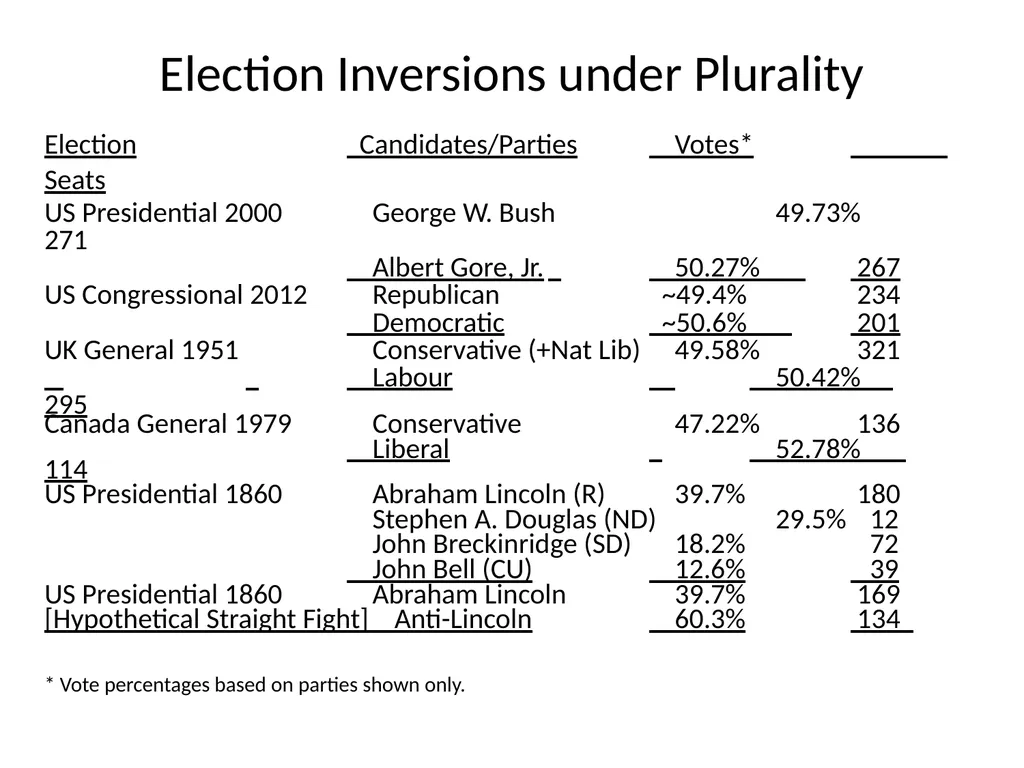
slide2. Election Inversions under Plurality Election Candidates/Parties Votes* Seats
US Presidential 2000 George W. Bush 49.73% 271
Albert Gore, Jr. 50.27% 267
US Congressional 2012 Republican ~49.4% 234
Democratic ~50.6% 201
UK General 1951 Conservative (+Nat Lib) 49.58% 321
Labour 50.42% 295
Canada General 1979 Conservative 47.22% 136
Liberal 52.78% 114
US Presidential 1860 Abraham Lincoln (R) 39.7% 180
Stephen A. Douglas (ND) 29.5% 12
John Breckinridge (SD) 18.2% 72
John Bell (CU) 12.6% 39
US Presidential 1860 Abraham Lincoln 39.7% 169
[Hypothetical Straight Fight] Anti-Lincoln 60.3% 134
* Vote percentages based on parties shown only.<br>
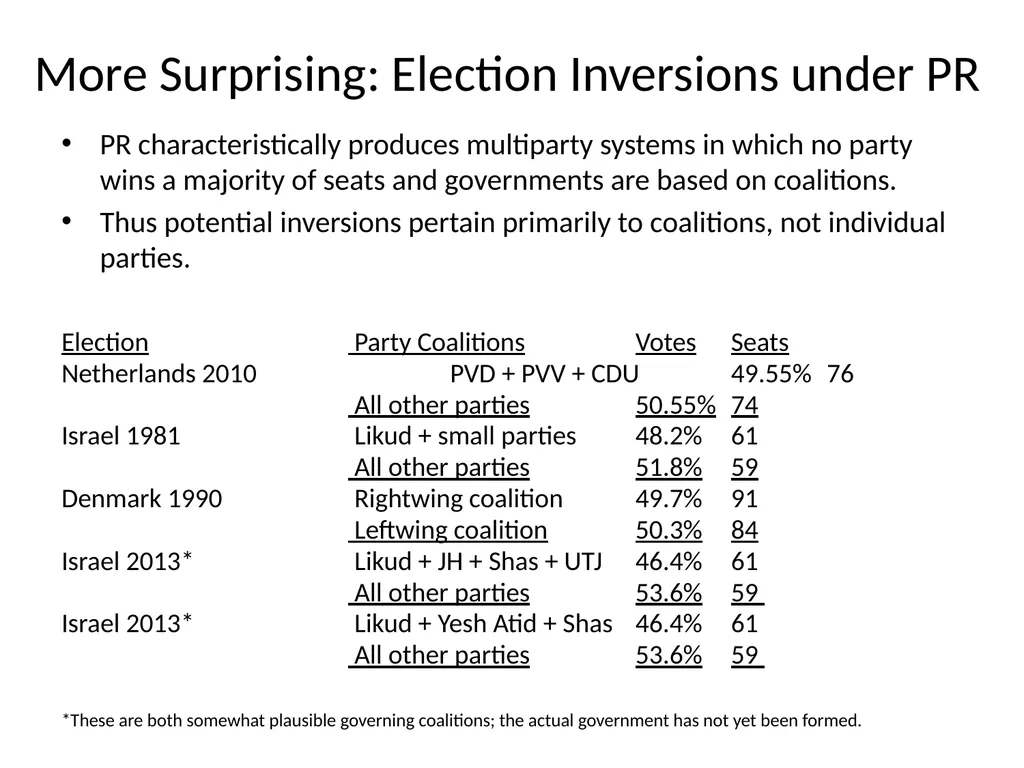
slide3. More Surprising: Election Inversions under PR PR characteristically produces multiparty systems in which no party wins a majority of seats and governments are based on coalitions.
Thus potential inversions pertain primarily to coalitions, not individual parties.
Election Party Coalitions Votes Seats
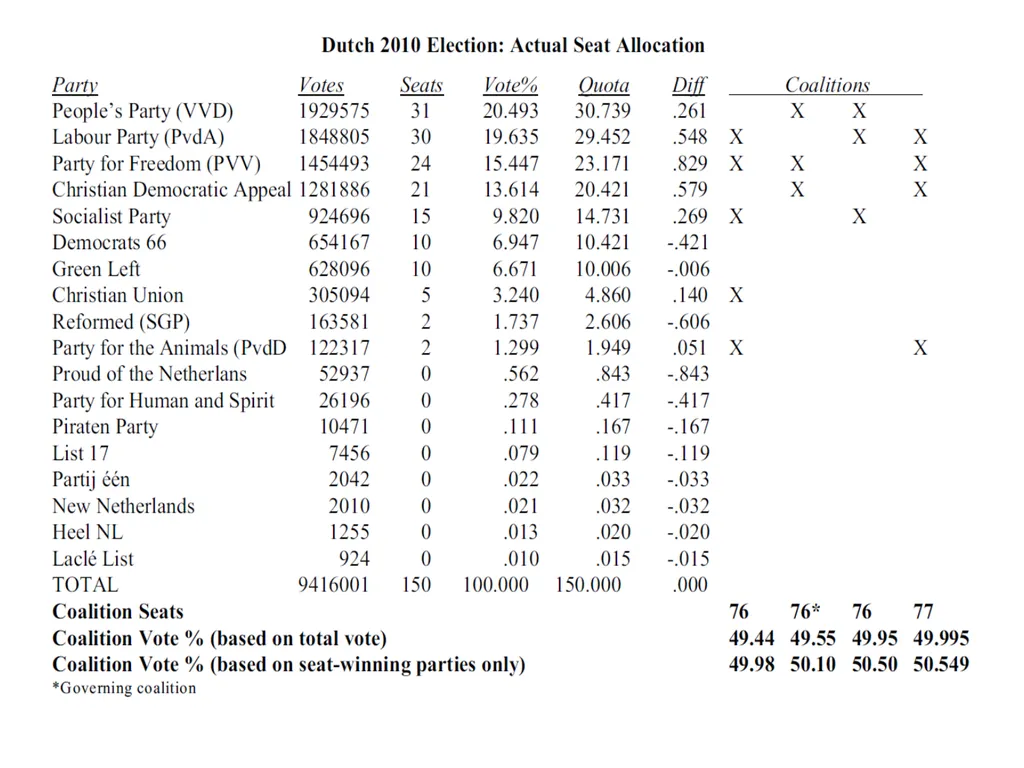
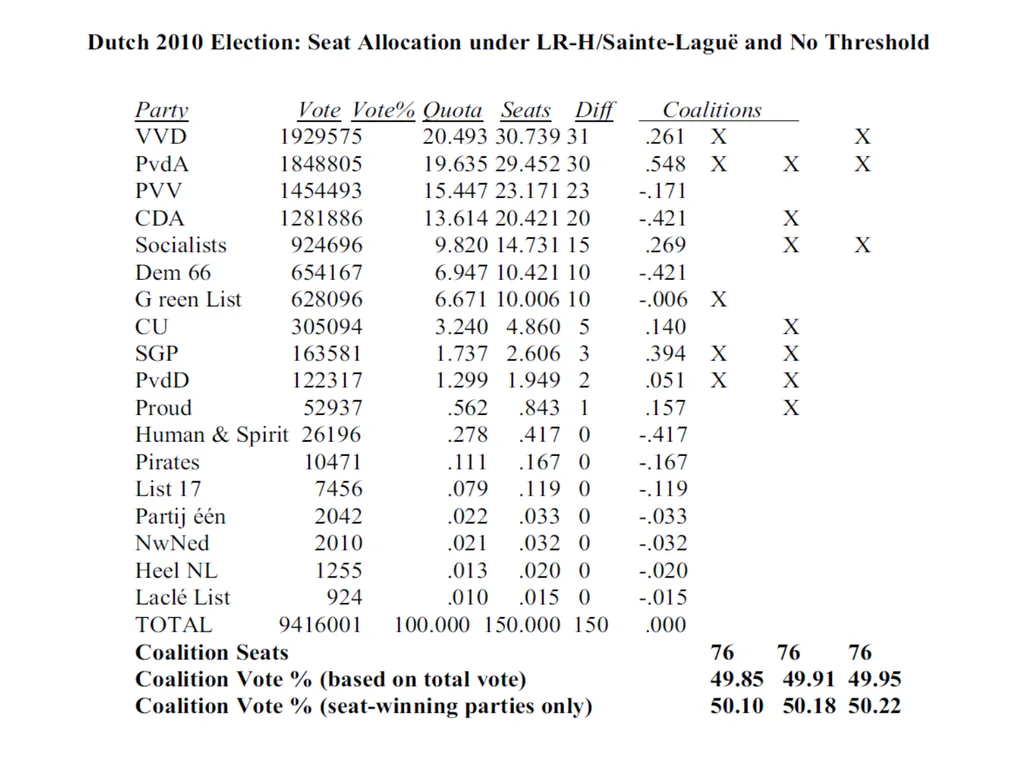
Netherlands 2010 PVD + PVV + CDU 49.55% 76
All other parties 50.55% 74
Israel 1981 Likud + small parties 48.2% 61
All other parties 51.8% 59
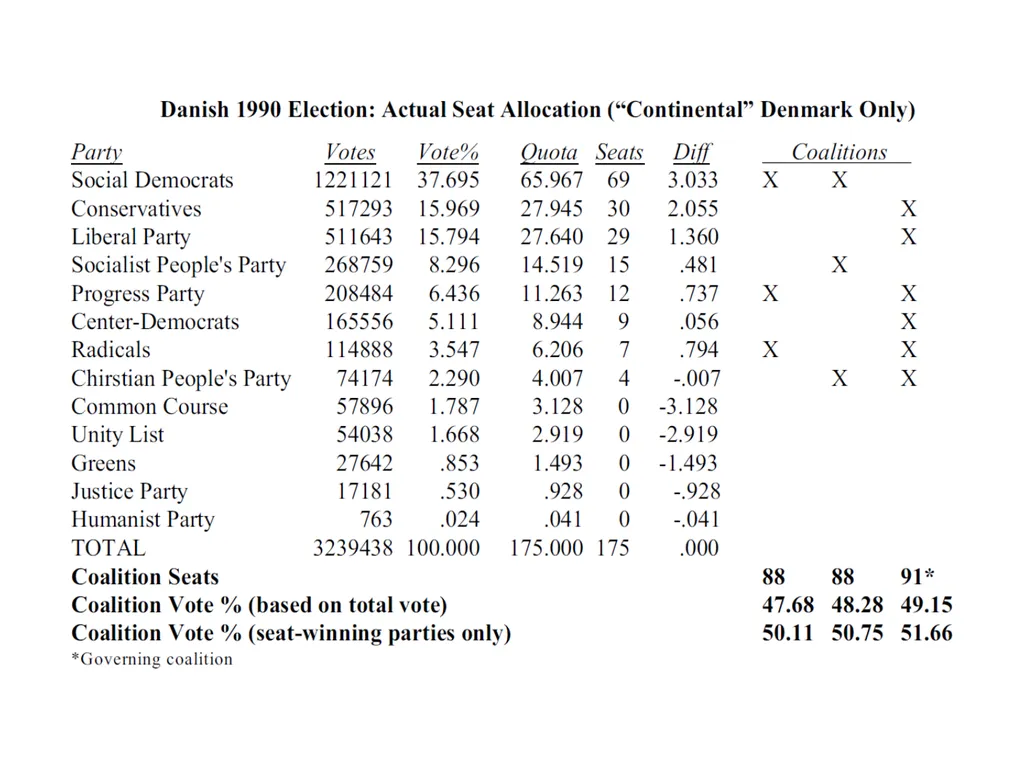
Denmark 1990 Rightwing coalition 49.7% 91
Leftwing coalition 50.3% 84
Israel 2013* Likud + JH + Shas + UTJ 46.4% 61
All other parties 53.6% 59
Israel 2013* Likud + Yesh Atid + Shas 46.4% 61
All other parties 53.6% 59
*These are both somewhat plausible governing coalitions; the actual government has not yet been formed.<br>
slide4. PK-K on Election Inversions in Denmark The possibility of [coalitionwise] election inversions under [Danish] PR was first pointed out by Peter Kurrild-Klitgaard in a paper presented at the World Congress of Public Choice Societies last year.
My paper originated as discussant commentary on PK-K’s paper.
However, his examples result from avoidable imperfections in the Danish (and most other) proportional representation systems,
that are deliberately introduced to serve goals other than proportionality, e.g.,
to provide local representation by using regional districts;
to deter excessive party proliferation by setting a minimum vote threshold a party must meet in order to win seats.
Peter Kurrild-Klitgaard. “Election Inversions, Coalitions and Proportional Representation: Examples of Voting Paradoxes in Danish Government Formations.” Scandinavian Political Studies, 2013, forthcoming.<br>
slide5. The Unavoidable Imperfection in PR Here I carry PK-K’s analysis a step further by showing that election inversions can and do occur under even the purest types of proportional representation —namely, ones that
use a single national constituency (without districts),
impose no explicit vote threshold to win a seat, and
employ a highly proportional electoral formula.
Even the purest proportional representation systems have unavoidable imperfections that result from the “whole number problem,” i.e.,
the fact parties must be awarded seats in terms of relatively small whole numbers,
while their vote support comes in terms of far larger numbers,
making party vote shares essentially continuous quantities.<br>
slide6. The Danish Electoral System The Danish electoral system is based on
135 seats apportioned on the basis of population among about a dozen multi-member districts of varying magnitudes,
40 national adjustment seats, and
two seats for each of two autonomous overseas territories (Greenland and the Faroe Islands).
The latter four seats are guaranteed regardless of population,
And in fact give the overseas territories disproportionate representation.
The 40 national adjustment seats effectively create a single “continental” constituency with 175 seats
allocated among political parties on the basis of the (quite proportional) modified Sainte-Laguë formula
with a 2% national threshold.
Thus the Danish system departs from pure PR in primarily in two respects:
the “federal” status the territories, and
the 2% threshold.
The inversions that PK-K identifies are due to what he calls “federal effects” and “threshold effects,” which result from these two avoidable imperfections in the Danish PR system.<br>
slide7. “Federal Effects” “Federal effects” are a special case of apportionment effects (Miller, 2012) in an electoral system based on states, regions, or other geographically defined districts;
they cannot occur in undistricted systems.
In 1971, the coalition of all center-right parties gained a bare majority of both votes and seats in “continental” Denmark.
But a left-of-center coalition secured the support of the three of the four overseas representatives, thereby securing a bare majority seats in parliament without also securing a majority of the vote nationwide (because of the over-representation of the territories).
However, due to peculiarities in the party systems in the two territories, there may be some ambiguity as to whether this represented a true coalitionwise inversion.
N. R. Miller, “Election Inversions by the U.S. Electoral College,” in D. S. Felsenthal and M. Machover, eds., Electoral Systems: Paradoxes, Assumptions, and Procedures, Berlin: Springer, 2012<br>
slide8. “Threshold Effects” “Threshold effects” are a special case of what Miller calls distribution effects.
In non-PR systems, distribution effects result when one party’s vote is more “efficiently” distributed over districts than another’s.
Under PR, the most obvious source of “inefficiently” distributed votes occurs when several small parties fail to win any seats,
whereas a single larger party with the same total vote would win one or more seats.
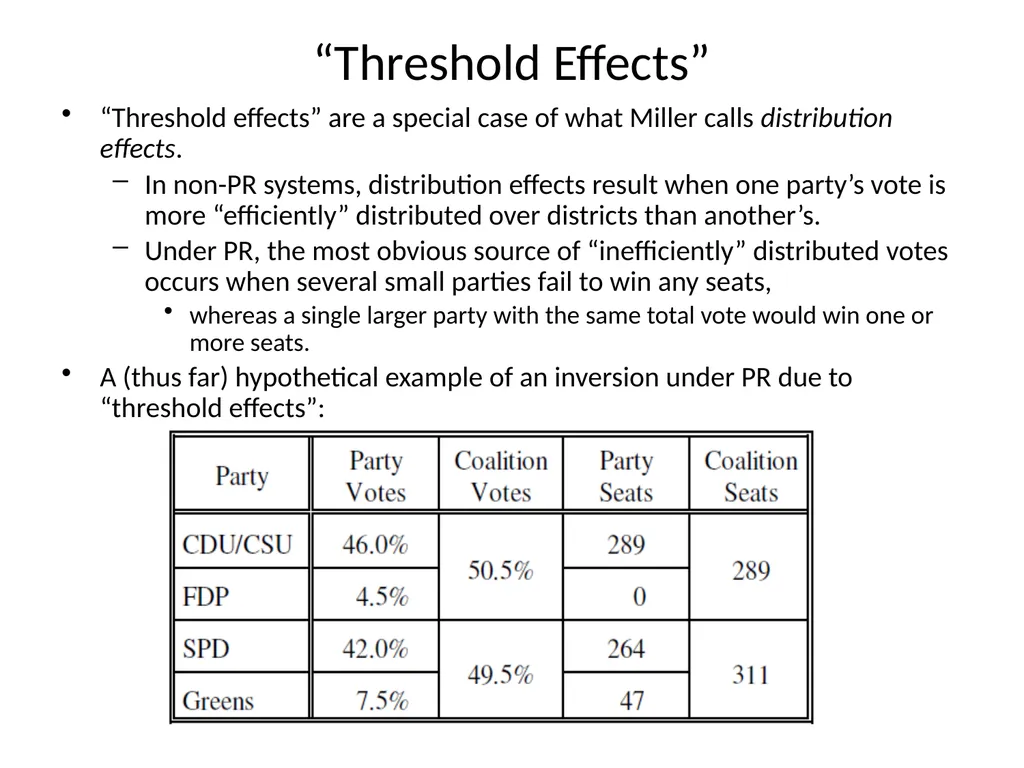
A (thus far) hypothetical example of an inversion under PR due to “threshold effects”:<br>
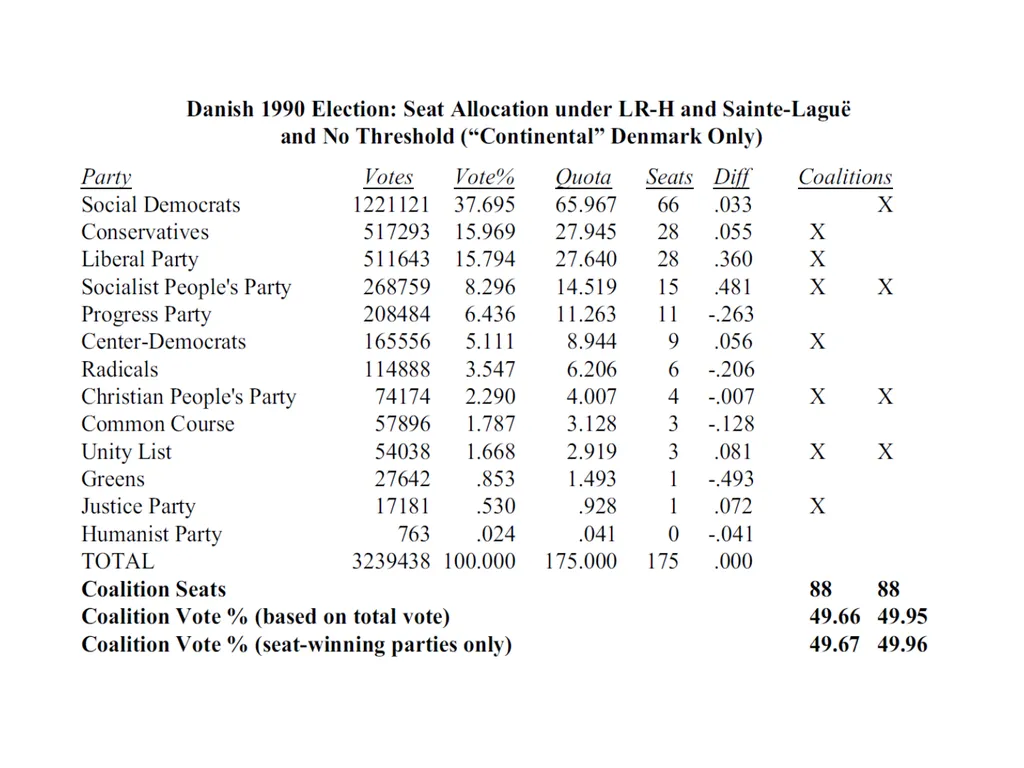
slide9. “Threshold Effects” (cont.) In the 1990 election [previously displayed],
with respect to “continental” Denmark only, the parties of the left collectively won a bare majority of the votes
but the parties of the center-right won a decisive majority of the seats,
while no plausible accounting for votes in the overseas territories could give the center-right party an overall majority of the vote.
The inversion resulted because a number of small leftist parties (but only one rightist one) each fell below the 2% threshold and failed to win any seats,
despite collectively winning 4.4% of the total vote.
Like supporters of minor parties under plurality voting, supporters of these parties “wasted” their votes.
If they had voted “tactically,” they could have concentrated their votes on a single leftist party that would have met the 2% threshold and won an (approximately) proportional share of the seats and given the left coalition a parliamentary majority.<br>
slide10. Election Inversions under Pure PR But neither federal nor threshold effects are necessary for election inversions under PR.
Nor is it necessary for any vote-winning parties to be denied seats.
Provided that there are three or more parties, coalitionwise election inversions can occur under even the purest types of proportional representation, i.e., those with a single nationwide district, no threshold requirement, and a highly proportional electoral formula.
and even if all (vote-winning) parties win seats, or
vote percentages are based on seat-winning parties only.
A partial inversion: two (or more) parties win equal numbers of seats, even though almost certainly one wins more votes.<br>
slide11. Election Inversions under Pure PR (cont.) An undistricted proportional representation system, cannot produce a (full as opposed to partial) partywise inversion,
because every PR formula awards party A at least as many seats as party B if A wins more votes than B.
The most proportional PR formulas are
Largest Remainder-Hare (LR-H), and
(unmodified) Sainte-Laguë
which allocate seats almost the same way
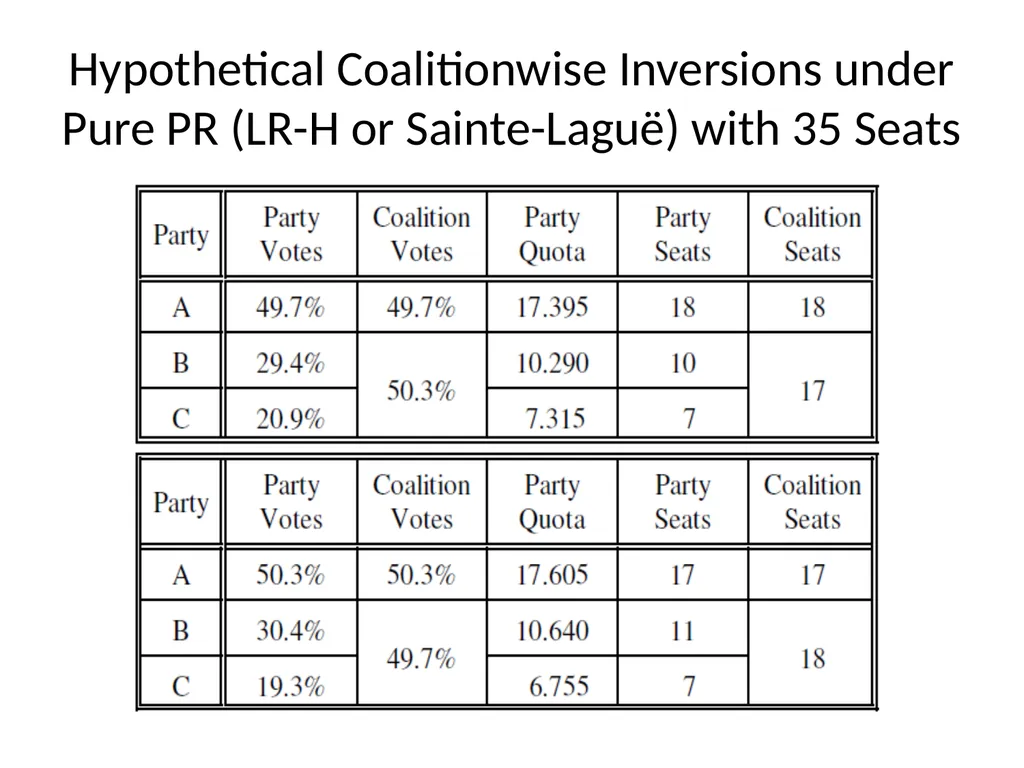
Since the claim is only that such inversions are possible, it is sufficient to provide a hypothetical example.
The table on the following slide provides two closely related examples,
both involving just three parties and 35 seats.<br>
slide12. Hypothetical Coalitionwise Inversions under Pure PR (LR-H or Sainte-Laguë) with 35 Seats<br>
slide13. A Note on “Coalitions” The word “coalition” is used in two distinct ways in formal political theory.
In the more general sense, a coalition refers merely to any set of players (e.g., voters or parties).
This is standard terminology in the theory of simple games and in voting power theory.
In the narrower sense, a coalition is a particular set of players who enter into an agreement, e.g., a “governing coalition.”
We use the term here in the more general sense.
However, Kurrild-Klitgaard’s examples of coalitionwise inversions in Danish politics pertain to sets of ideologically compatible parties that became (governing) coalitions.
Likewise the other introductory examples pertained to actual or plausible governing coalitions.
We are examining the properties of PR, which deals only with the numbers of votes and seats,
not ideological/policy position of parties or actual coalition formation.<br>
slide14. “Coalitions” vs. “Fusions” of Parties PR formulas treat “coalitions” of parties and “fusions” of parties differently, and therefore permit coalitionwise inversions but not partywise inversions.
If parties B and C in the preceding table were fused into a single party, no inversions would occur.
The vote profiles in the preceding table 2 were carefully devised,
by giving party A either slightly more or slightly less than half of the vote, and then
by “tuning” the division of the residual vote between parties B and C in relation to the total number of seats.
If there are relatively many parties with varying levels of vote support, inversion possibilities likely become more frequent — indeed perhaps typical.<br>
slide15. Finding Inversion Possibilities A party’s seat differential: seats won – quota.
Look for coalitions that
control a small majority of seats and
are composed of parties all or most of which have positive seat differentials,
and which therefore are likely to have the support of less than a majority of voters.
There is one easy way to construct hypothetical examples of inversion possibilities:
allow the number of small non-seat-winning parties to proliferate.
Even without an explicit threshold, parties that are small enough fail to win seats by the normal operation of the PR formula.
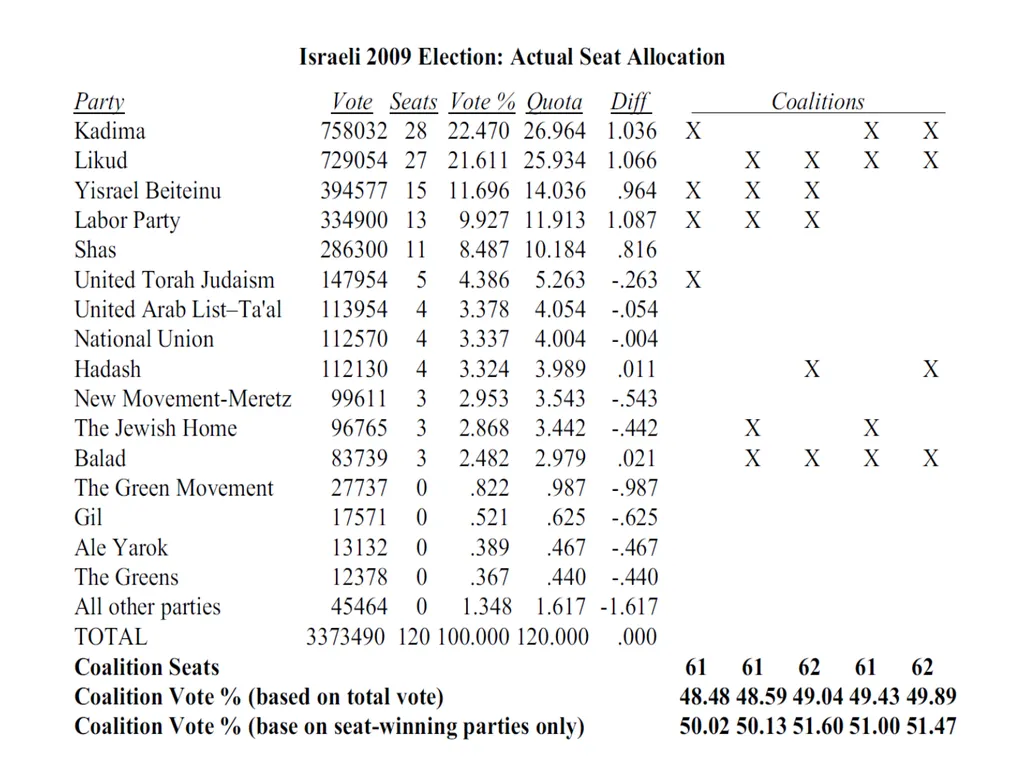
It then will be easy to find coalitions of seat-winning parties that control a majority of seats with less than a majority of the total vote.
Therefore, we further inquire whether we can find empirical examples of election inversions under PR when the analysis is restricted to seat-winning parties and the votes cast for them.<br>
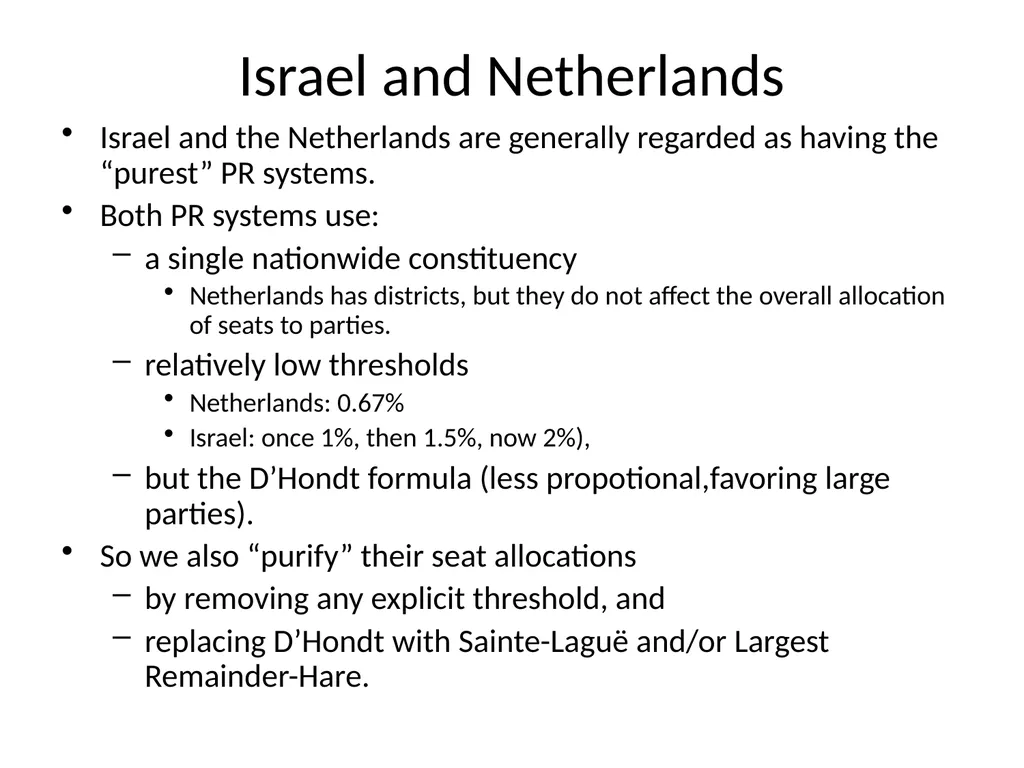
slide16. Israel and Netherlands Israel and the Netherlands are generally regarded as having the “purest” PR systems.
Both PR systems use:
a single nationwide constituency
Netherlands has districts, but they do not affect the overall allocation of seats to parties.
relatively low thresholds
Netherlands: 0.67%
Israel: once 1%, then 1.5%, now 2%),
but the D’Hondt formula (less propotional,favoring large parties).
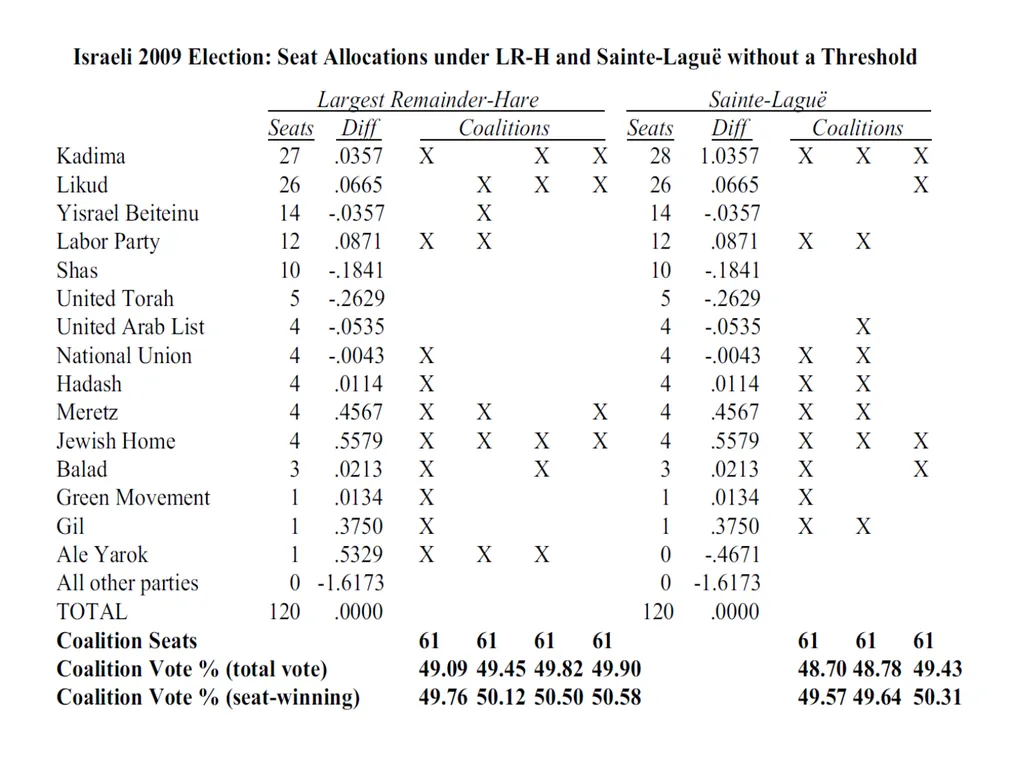
So we also “purify” their seat allocations
by removing any explicit threshold, and
replacing D’Hondt with Sainte-Laguë and/or Largest Remainder-Hare.<br>
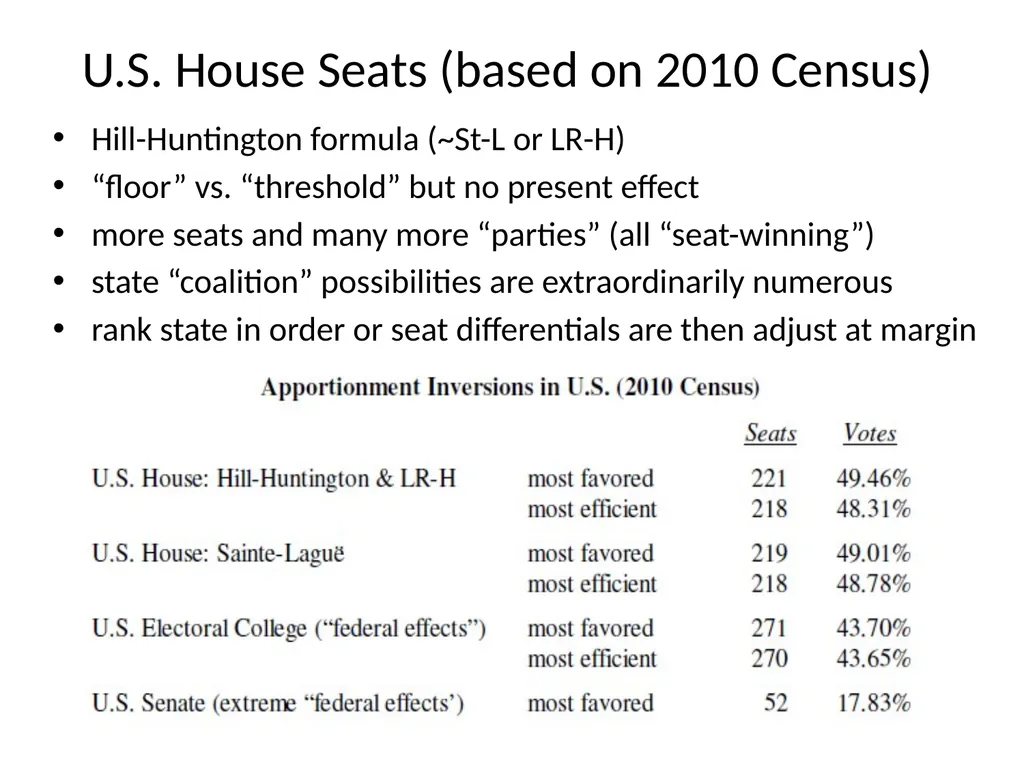
slide23. U.S. House Seats (based on 2010 Census) Hill-Huntington formula (~St-L or LR-H)
“floor” vs. “threshold” but no present effect
more seats and many more “parties” (all “seat-winning”)
state “coalition” possibilities are extraordinarily numerous
rank state in order or seat differentials are then adjust at margin<br>
Public Choice Society Meeting
March 8-10, 2013<br>
slide2. Election Inversions under Plurality Election Candidates/Parties Votes* Seats
US Presidential 2000 George W. Bush 49.73% 271
Albert Gore, Jr. 50.27% 267
US Congressional 2012 Republican ~49.4% 234
Democratic ~50.6% 201
UK General 1951 Conservative (+Nat Lib) 49.58% 321
Labour 50.42% 295
Canada General 1979 Conservative 47.22% 136
Liberal 52.78% 114
US Presidential 1860 Abraham Lincoln (R) 39.7% 180
Stephen A. Douglas (ND) 29.5% 12
John Breckinridge (SD) 18.2% 72
John Bell (CU) 12.6% 39
US Presidential 1860 Abraham Lincoln 39.7% 169
[Hypothetical Straight Fight] Anti-Lincoln 60.3% 134
* Vote percentages based on parties shown only.<br>
slide3. More Surprising: Election Inversions under PR PR characteristically produces multiparty systems in which no party wins a majority of seats and governments are based on coalitions.
Thus potential inversions pertain primarily to coalitions, not individual parties.
Election Party Coalitions Votes Seats
Netherlands 2010 PVD + PVV + CDU 49.55% 76
All other parties 50.55% 74
Israel 1981 Likud + small parties 48.2% 61
All other parties 51.8% 59
Denmark 1990 Rightwing coalition 49.7% 91
Leftwing coalition 50.3% 84
Israel 2013* Likud + JH + Shas + UTJ 46.4% 61
All other parties 53.6% 59
Israel 2013* Likud + Yesh Atid + Shas 46.4% 61
All other parties 53.6% 59
*These are both somewhat plausible governing coalitions; the actual government has not yet been formed.<br>
slide4. PK-K on Election Inversions in Denmark The possibility of [coalitionwise] election inversions under [Danish] PR was first pointed out by Peter Kurrild-Klitgaard in a paper presented at the World Congress of Public Choice Societies last year.
My paper originated as discussant commentary on PK-K’s paper.
However, his examples result from avoidable imperfections in the Danish (and most other) proportional representation systems,
that are deliberately introduced to serve goals other than proportionality, e.g.,
to provide local representation by using regional districts;
to deter excessive party proliferation by setting a minimum vote threshold a party must meet in order to win seats.
Peter Kurrild-Klitgaard. “Election Inversions, Coalitions and Proportional Representation: Examples of Voting Paradoxes in Danish Government Formations.” Scandinavian Political Studies, 2013, forthcoming.<br>
slide5. The Unavoidable Imperfection in PR Here I carry PK-K’s analysis a step further by showing that election inversions can and do occur under even the purest types of proportional representation —namely, ones that
use a single national constituency (without districts),
impose no explicit vote threshold to win a seat, and
employ a highly proportional electoral formula.
Even the purest proportional representation systems have unavoidable imperfections that result from the “whole number problem,” i.e.,
the fact parties must be awarded seats in terms of relatively small whole numbers,
while their vote support comes in terms of far larger numbers,
making party vote shares essentially continuous quantities.<br>
slide6. The Danish Electoral System The Danish electoral system is based on
135 seats apportioned on the basis of population among about a dozen multi-member districts of varying magnitudes,
40 national adjustment seats, and
two seats for each of two autonomous overseas territories (Greenland and the Faroe Islands).
The latter four seats are guaranteed regardless of population,
And in fact give the overseas territories disproportionate representation.
The 40 national adjustment seats effectively create a single “continental” constituency with 175 seats
allocated among political parties on the basis of the (quite proportional) modified Sainte-Laguë formula
with a 2% national threshold.
Thus the Danish system departs from pure PR in primarily in two respects:
the “federal” status the territories, and
the 2% threshold.
The inversions that PK-K identifies are due to what he calls “federal effects” and “threshold effects,” which result from these two avoidable imperfections in the Danish PR system.<br>
slide7. “Federal Effects” “Federal effects” are a special case of apportionment effects (Miller, 2012) in an electoral system based on states, regions, or other geographically defined districts;
they cannot occur in undistricted systems.
In 1971, the coalition of all center-right parties gained a bare majority of both votes and seats in “continental” Denmark.
But a left-of-center coalition secured the support of the three of the four overseas representatives, thereby securing a bare majority seats in parliament without also securing a majority of the vote nationwide (because of the over-representation of the territories).
However, due to peculiarities in the party systems in the two territories, there may be some ambiguity as to whether this represented a true coalitionwise inversion.
N. R. Miller, “Election Inversions by the U.S. Electoral College,” in D. S. Felsenthal and M. Machover, eds., Electoral Systems: Paradoxes, Assumptions, and Procedures, Berlin: Springer, 2012<br>
slide8. “Threshold Effects” “Threshold effects” are a special case of what Miller calls distribution effects.
In non-PR systems, distribution effects result when one party’s vote is more “efficiently” distributed over districts than another’s.
Under PR, the most obvious source of “inefficiently” distributed votes occurs when several small parties fail to win any seats,
whereas a single larger party with the same total vote would win one or more seats.
A (thus far) hypothetical example of an inversion under PR due to “threshold effects”:<br>
slide9. “Threshold Effects” (cont.) In the 1990 election [previously displayed],
with respect to “continental” Denmark only, the parties of the left collectively won a bare majority of the votes
but the parties of the center-right won a decisive majority of the seats,
while no plausible accounting for votes in the overseas territories could give the center-right party an overall majority of the vote.
The inversion resulted because a number of small leftist parties (but only one rightist one) each fell below the 2% threshold and failed to win any seats,
despite collectively winning 4.4% of the total vote.
Like supporters of minor parties under plurality voting, supporters of these parties “wasted” their votes.
If they had voted “tactically,” they could have concentrated their votes on a single leftist party that would have met the 2% threshold and won an (approximately) proportional share of the seats and given the left coalition a parliamentary majority.<br>
slide10. Election Inversions under Pure PR But neither federal nor threshold effects are necessary for election inversions under PR.
Nor is it necessary for any vote-winning parties to be denied seats.
Provided that there are three or more parties, coalitionwise election inversions can occur under even the purest types of proportional representation, i.e., those with a single nationwide district, no threshold requirement, and a highly proportional electoral formula.
and even if all (vote-winning) parties win seats, or
vote percentages are based on seat-winning parties only.
A partial inversion: two (or more) parties win equal numbers of seats, even though almost certainly one wins more votes.<br>
slide11. Election Inversions under Pure PR (cont.) An undistricted proportional representation system, cannot produce a (full as opposed to partial) partywise inversion,
because every PR formula awards party A at least as many seats as party B if A wins more votes than B.
The most proportional PR formulas are
Largest Remainder-Hare (LR-H), and
(unmodified) Sainte-Laguë
which allocate seats almost the same way
Since the claim is only that such inversions are possible, it is sufficient to provide a hypothetical example.
The table on the following slide provides two closely related examples,
both involving just three parties and 35 seats.<br>
slide12. Hypothetical Coalitionwise Inversions under Pure PR (LR-H or Sainte-Laguë) with 35 Seats<br>
slide13. A Note on “Coalitions” The word “coalition” is used in two distinct ways in formal political theory.
In the more general sense, a coalition refers merely to any set of players (e.g., voters or parties).
This is standard terminology in the theory of simple games and in voting power theory.
In the narrower sense, a coalition is a particular set of players who enter into an agreement, e.g., a “governing coalition.”
We use the term here in the more general sense.
However, Kurrild-Klitgaard’s examples of coalitionwise inversions in Danish politics pertain to sets of ideologically compatible parties that became (governing) coalitions.
Likewise the other introductory examples pertained to actual or plausible governing coalitions.
We are examining the properties of PR, which deals only with the numbers of votes and seats,
not ideological/policy position of parties or actual coalition formation.<br>
slide14. “Coalitions” vs. “Fusions” of Parties PR formulas treat “coalitions” of parties and “fusions” of parties differently, and therefore permit coalitionwise inversions but not partywise inversions.
If parties B and C in the preceding table were fused into a single party, no inversions would occur.
The vote profiles in the preceding table 2 were carefully devised,
by giving party A either slightly more or slightly less than half of the vote, and then
by “tuning” the division of the residual vote between parties B and C in relation to the total number of seats.
If there are relatively many parties with varying levels of vote support, inversion possibilities likely become more frequent — indeed perhaps typical.<br>
slide15. Finding Inversion Possibilities A party’s seat differential: seats won – quota.
Look for coalitions that
control a small majority of seats and
are composed of parties all or most of which have positive seat differentials,
and which therefore are likely to have the support of less than a majority of voters.
There is one easy way to construct hypothetical examples of inversion possibilities:
allow the number of small non-seat-winning parties to proliferate.
Even without an explicit threshold, parties that are small enough fail to win seats by the normal operation of the PR formula.
It then will be easy to find coalitions of seat-winning parties that control a majority of seats with less than a majority of the total vote.
Therefore, we further inquire whether we can find empirical examples of election inversions under PR when the analysis is restricted to seat-winning parties and the votes cast for them.<br>
slide16. Israel and Netherlands Israel and the Netherlands are generally regarded as having the “purest” PR systems.
Both PR systems use:
a single nationwide constituency
Netherlands has districts, but they do not affect the overall allocation of seats to parties.
relatively low thresholds
Netherlands: 0.67%
Israel: once 1%, then 1.5%, now 2%),
but the D’Hondt formula (less propotional,favoring large parties).
So we also “purify” their seat allocations
by removing any explicit threshold, and
replacing D’Hondt with Sainte-Laguë and/or Largest Remainder-Hare.<br>
slide23. U.S. House Seats (based on 2010 Census) Hill-Huntington formula (~St-L or LR-H)
“floor” vs. “threshold” but no present effect
more seats and many more “parties” (all “seat-winning”)
state “coalition” possibilities are extraordinarily numerous
rank state in order or seat differentials are then adjust at margin<br>