ELECTRIC VEHICLE TECHNOLOGY BATTERIES PREPARED BY
Description: ELECTRIC VEHICLE TECHNOLOGY BATTERIES PREPARED BY V.BHARANIGHA,APEEE Department of EEEBSA CRESCENT IS T Highest cost, weight and volume A battery consists of two or more electric cells joined Together The cells convert chemical energy
Related Topics
Download Presentation
"ELECTRIC VEHICLE TECHNOLOGY BATTERIES PREPARED BY" is the property of its rightful owner. Permission is granted to download and print the materials on this website for personal, non-commercial use only, and to display it on your personal computer provided you do not modify the materials and that you retain all copyright notices contained in the materials. By downloading content from our website, you accept the terms of this agreement.
Presentation Transcript
slide1. ELECTRIC VEHICLE TECHNOLOGY BATTERIES PREPARED BY V.BHARANIGHA,AP/EEE Department of EEE/BSA CRESCENT IS & T<br>
slide2. Highest cost, weight and volume
A battery consists of two or more electric cells joined Together
The cells convert chemical energy to electrical energy
The cells consist of positive and negative electrodes joined by an electrolyte
It is the chemical reaction between the electrodes
and the electrolyte which generates DC electricity
the chemical reaction can be reversed by reversing the current and the battery returned to a charged state BATTERIES Department of EEE/BSA CRESCENT IS & T<br>
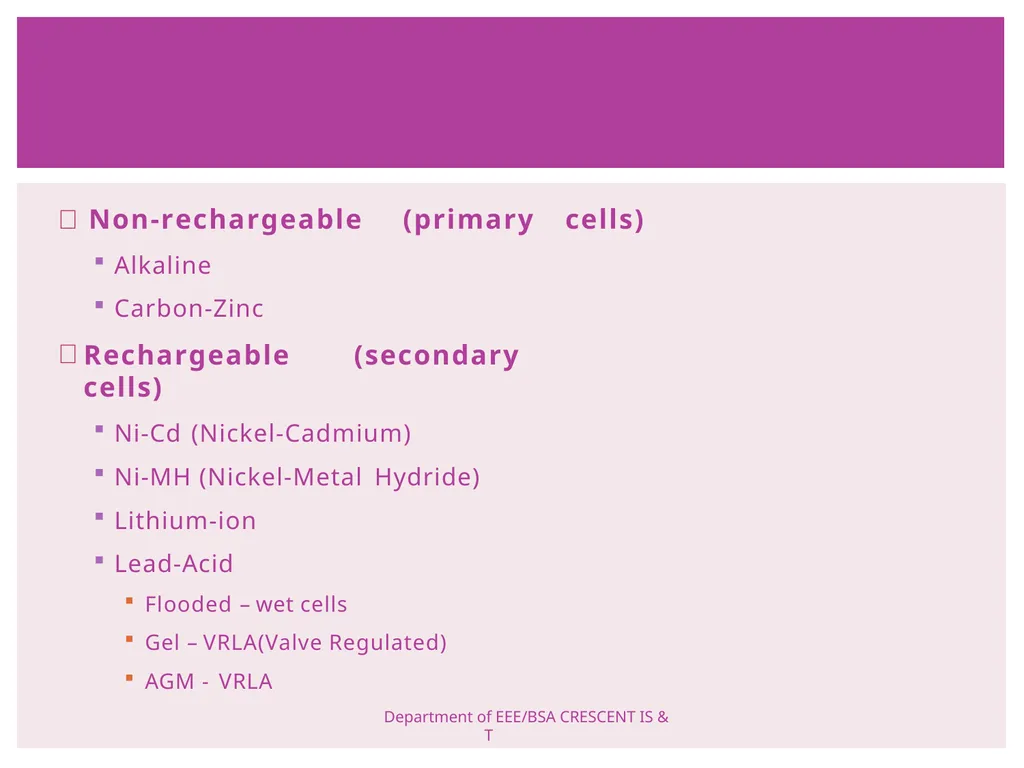
slide3. Non-rechargeable (primary cells) Alkaline
Carbon-Zinc
Rechargeable (secondary cells)
Ni-Cd (Nickel-Cadmium)
Ni-MH (Nickel-Metal Hydride)
Lithium-ion
Lead-Acid
Flooded – wet cells
Gel – VRLA(Valve Regulated)
AGM - VRLA Department of EEE/BSA CRESCENT IS & T<br>
slide4. lead acid
nickel iron
nickel
Cadmium
nickel metal hydride
lithium polymer and lithium iron
sodium sulphur
sodium metal chlori
mechanically refuelled - aluminium -air and zinc-air TYPES OF BATTERY Department of EEE/BSA CRESCENT IS & T<br>
slide5. when the cell is delivering electrical power, electric
cells offer nominal voltages
Cells connected in series to give the overall voltage required
Traction batteries – 6 V or 12 V
When a current is given out, the voltage will fall
When battery is being charged, the voltage will rise BATTERY PARAMETER
CELL AND BATTERY VOLTAGES Department of EEE/BSA CRESCENT IS & T<br>
slide6. BATTERY PARAMETER
CELL AND BATTERY VOLTAGES E - open circuit Voltage is constant But varies with State of Charge & Temperature
R – low
Simple equivalent circuit model of a battery - composed of six cells Department of EEE/BSA CRESCENT IS & T<br>
slide7. e l e ct ric c h ar ge - m o s t c r u c ial param e ter
C oulomb: t h e c h ar ge wh e n on e A mp f l ows f or on e s e c on d
( Amp e re H ou r ) Amph ou r : t h e c h ar ge wh e n o n e A m p f l o ws f o r o n e
H o u r
E x a mple: 1 0 Amphour s 1A m p f o r 10 h o u r s 2A m ps f o r 5 h o u r s
i n t h e o ry 10 A m ps f o r 1 h o u r bu t l e s s t h an 1 h o u r
prac t i cally BATTERY PARAMETER
CHARGE (OR AMPHOUR) CAPACITY Department of EEE/BSA CRESCENT IS & T<br>
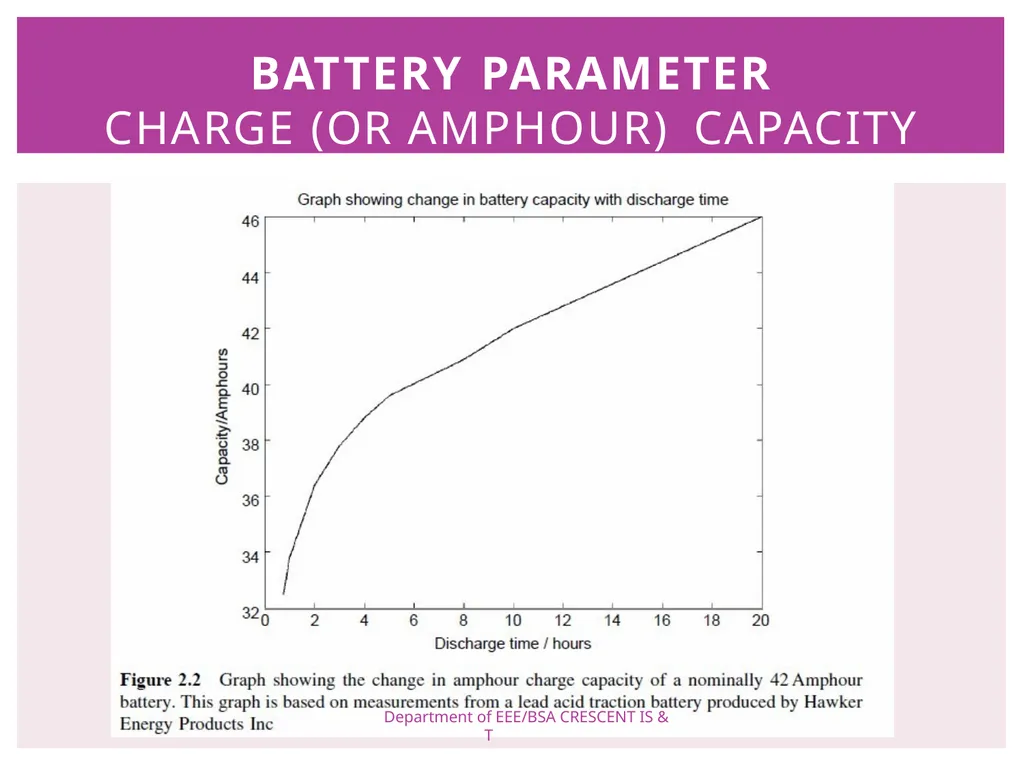
slide8. The capacity of the large batteries used in electric vehicles ( traction batteries ) is usually quoted for a 5 hour discharge
a battery has a capacity of 42 Amphours,
C10 = 42 Amphours
Battery users :
‘a discharge current of 2C’ or 2C10 = 84 Amps
‘charging the battery at 0.4C’ = 16.8 Amps BATTERY PARAMETER
CHARGE (OR AMPHOUR) CAPACITY Department of EEE/BSA CRESCENT IS & T<br>
slide9. BATTERY PARAMETER
CHARGE (OR AMPHOUR) CAPACITY Department of EEE/BSA CRESCENT IS & T<br>
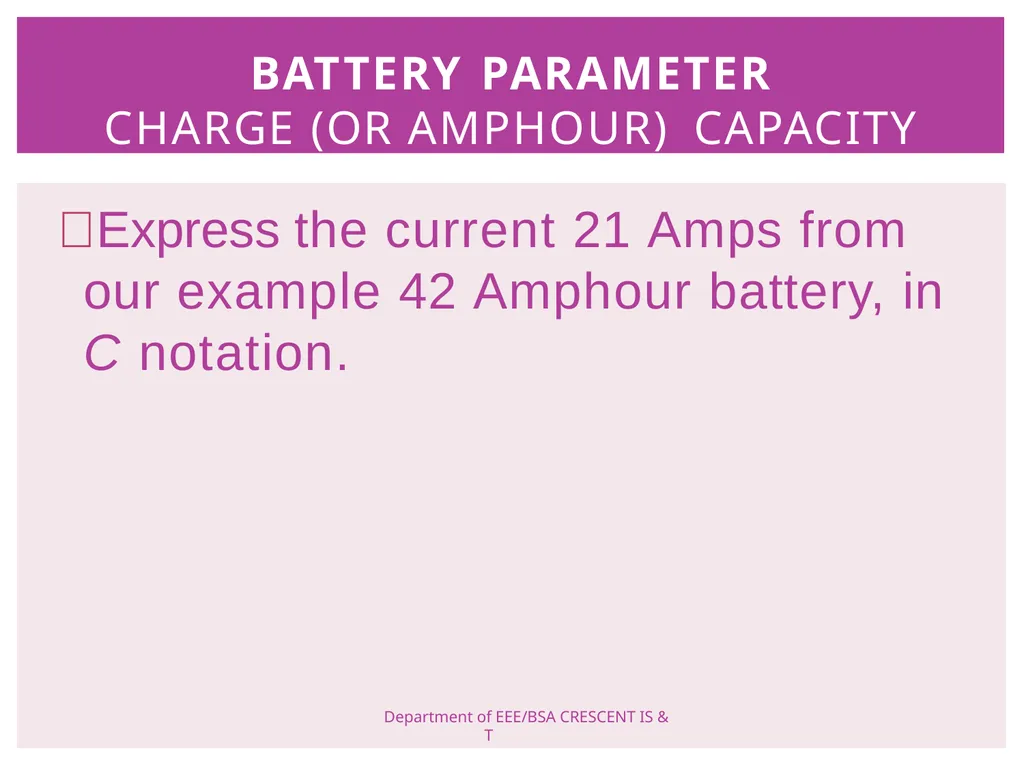
slide10. Express the current 21 Amps from our example 42 Amphour battery, in C notation. BATTERY PARAMETER
CHARGE (OR AMPHOUR) CAPACITY Department of EEE/BSA CRESCENT IS & T<br>
slide11. Express the current 21 Amps from our example 42 Amphour battery, in C notation.
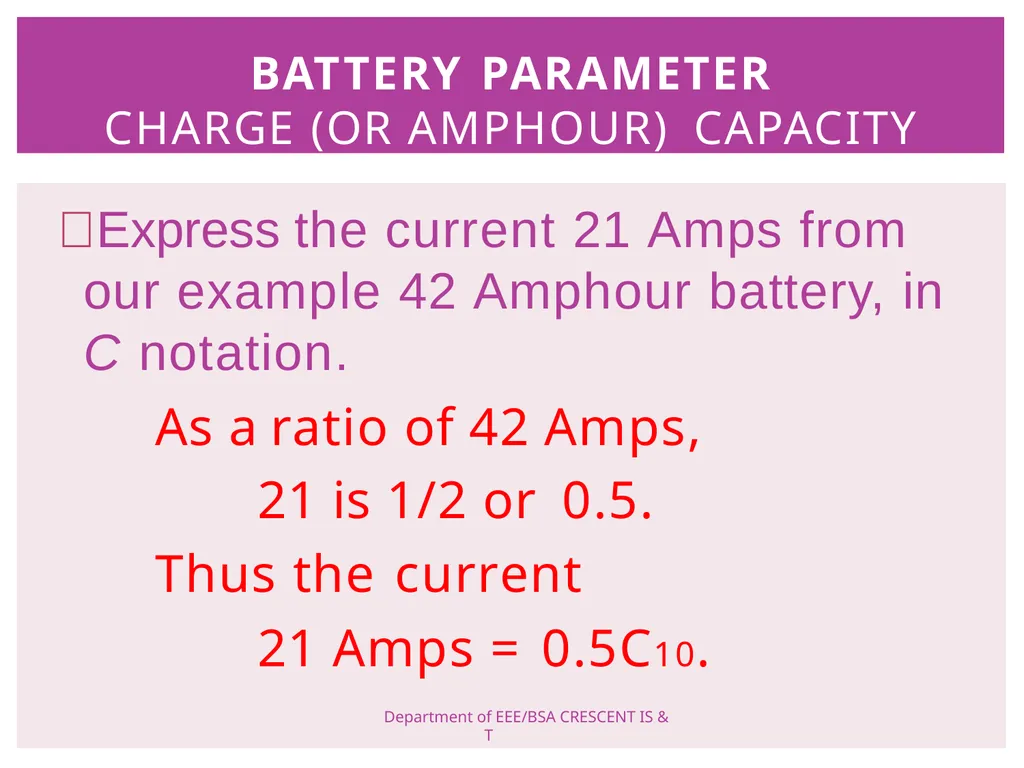
As a ratio of 42 Amps, 21 is 1/2 or 0.5.
Thus the current
21 Amps = 0.5C10. BATTERY PARAMETER
CHARGE (OR AMPHOUR) CAPACITY Department of EEE/BSA CRESCENT IS & T<br>
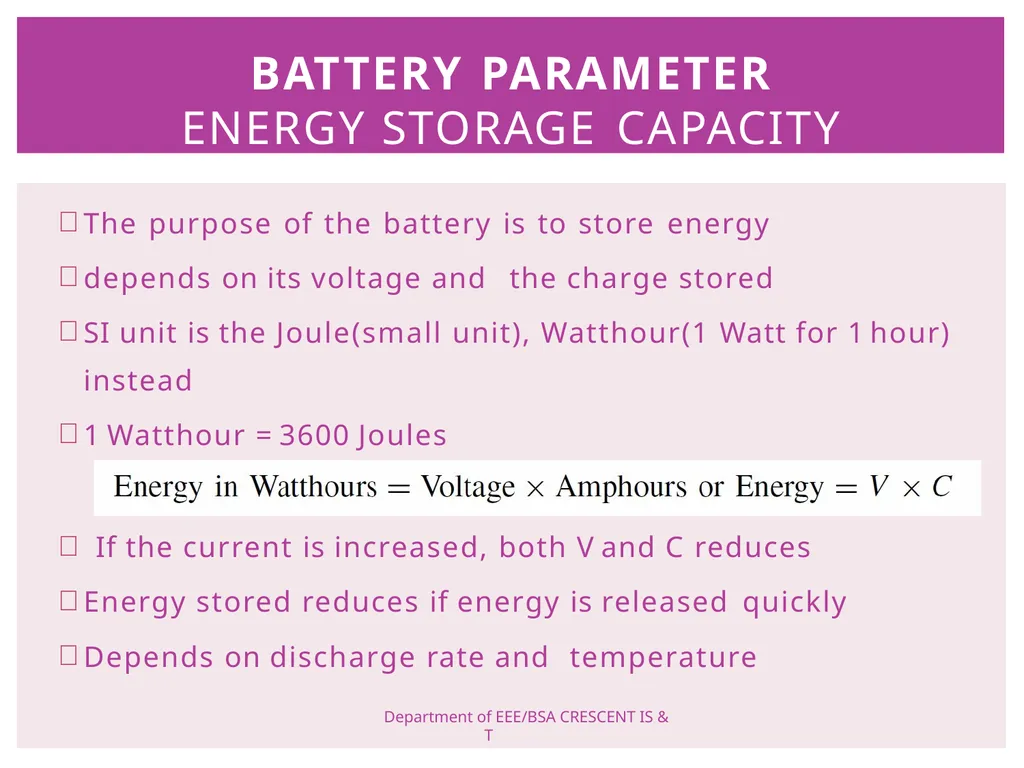
slide12. The purpose of the battery is to store energy
depends on its voltage and the charge stored
SI unit is the Joule(small unit), Watthour(1 Watt for 1 hour) instead
1 Watthour = 3600 Joules
If the current is increased, both V and C reduces
Energy stored reduces if energy is released quickly
Depends on discharge rate and temperature BATTERY PARAMETER
ENERGY STORAGE CAPACITY Department of EEE/BSA CRESCENT IS & T<br>
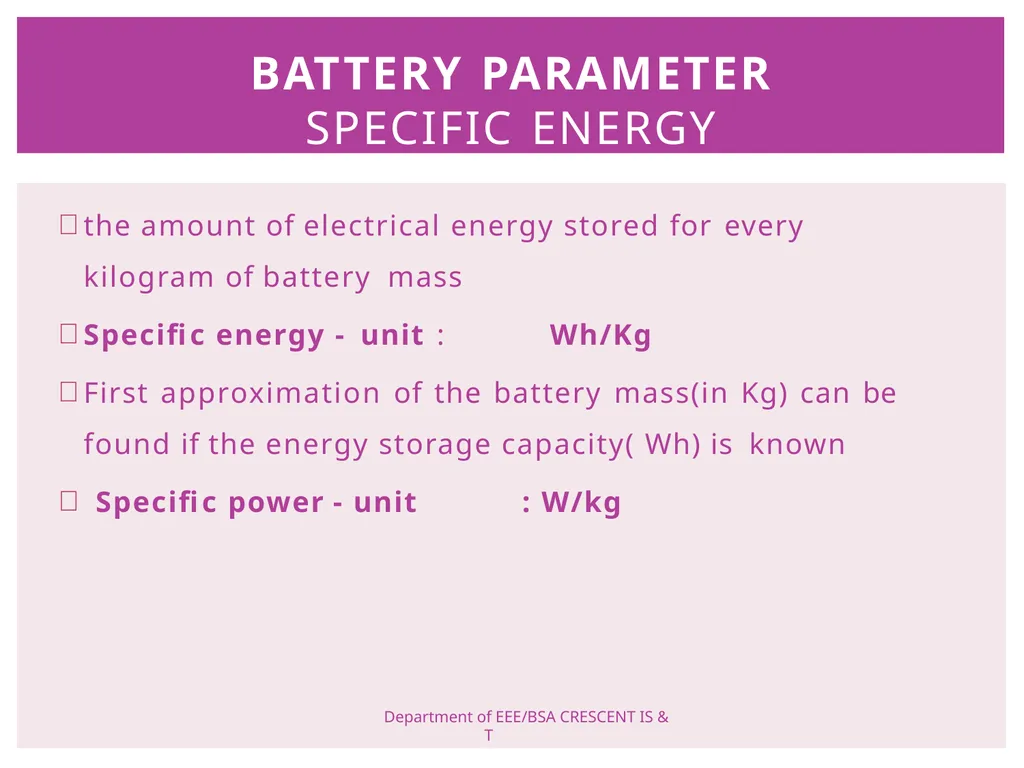
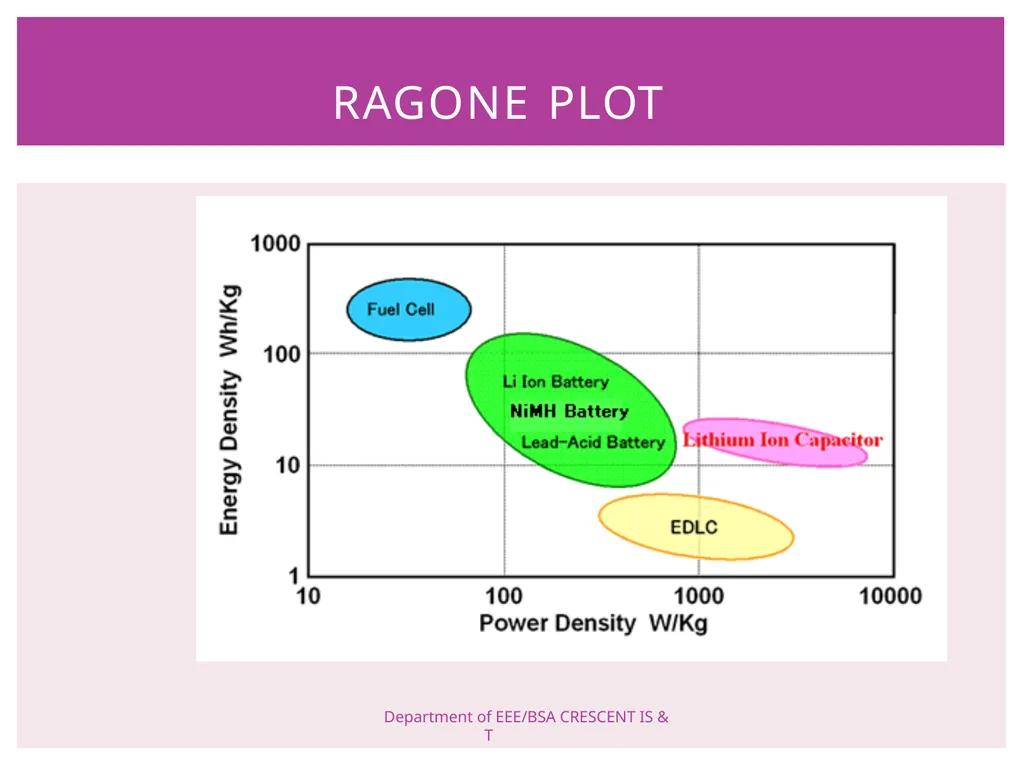
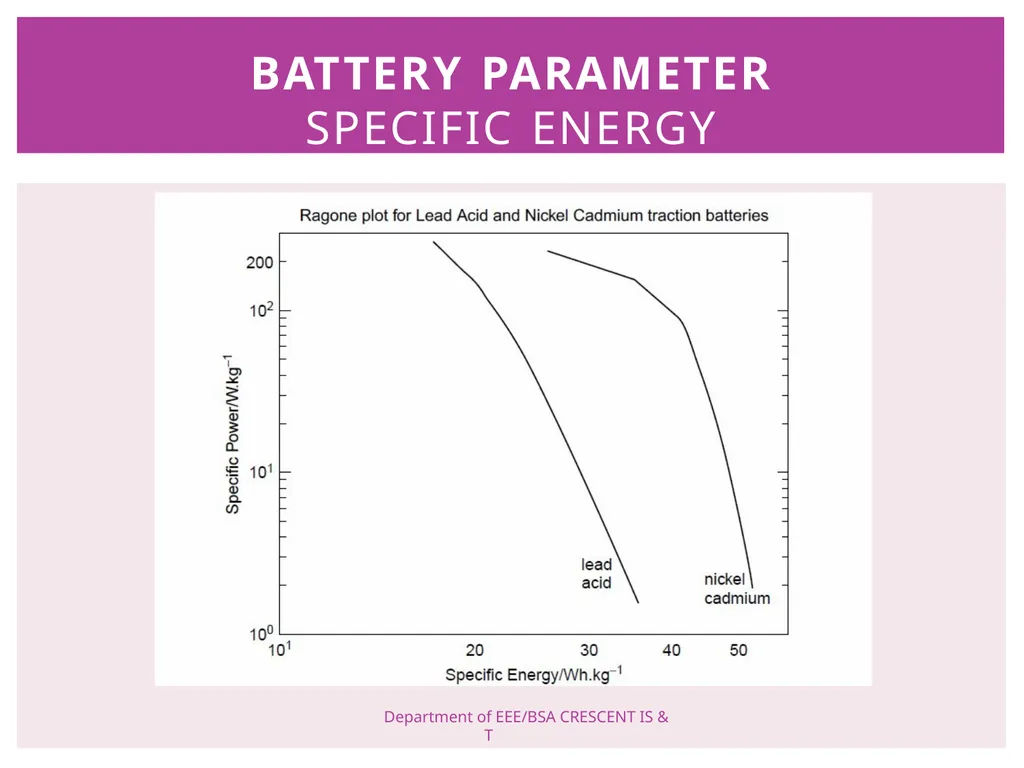
slide13. the amount of electrical energy stored for every
kilogram of battery mass
Specific energy - unit : Wh/Kg
First approximation of the battery mass(in Kg) can be
found if the energy storage capacity( Wh) is known
Specific power - unit : W/kg BATTERY PARAMETER
SPECIFIC ENERGY Department of EEE/BSA CRESCENT IS & T<br>
slide14. RAGONE PLOT Department of EEE/BSA CRESCENT IS & T<br>
slide15. BATTERY PARAMETER
SPECIFIC ENERGY Department of EEE/BSA CRESCENT IS & T<br>
slide16. It is also an important parameter
The amount of electrical energy stored per cubic metre
of battery volume
Unit : Wh/m3
Battery Volume (in m3) can be found if the energy storage capacity( Wh) is known
If a known volume is available for batteries,the volume (m3) can be multiplied by the batteries energy density (Wh.m−3) to give a first approximation of how much electrical energy can be made available BATTERY PARAMETER
ENERGY DENSITY Department of EEE/BSA CRESCENT IS & T<br>
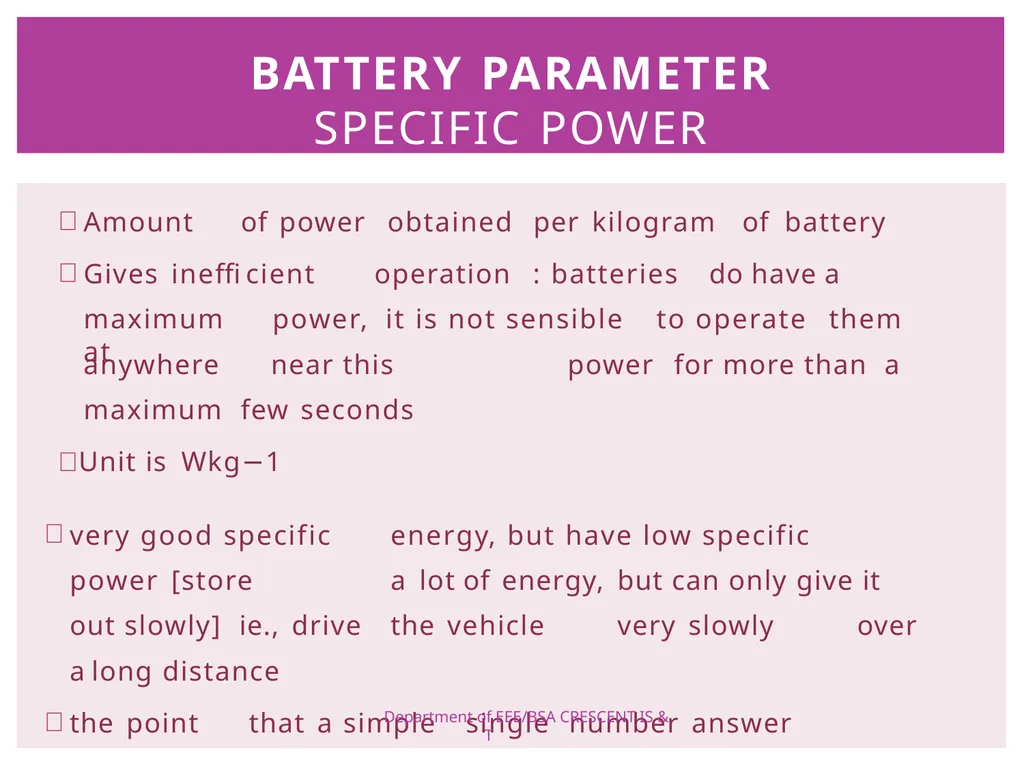
slide17. Amount of power obtained per kilogram of battery
Gives inefficient operation : batteries do have a
maximum power, it is not sensible to operate them at power for more than a anywhere near this maximum few seconds
Unit is Wkg−1 BATTERY PARAMETER
SPECIFIC POWER very good specific energy, but have low specific power [store a lot of energy, but can only give it out slowly] ie., drive the vehicle very slowly over a long distance
the point that a simple single number answer Department of EEE/BSA CRESCENT IS & T<br>
slide18. its charging efficiency is less than 100%
Depends upon different types of battery,
temperature, rate of charge and state of charge
when going from about 20% to 80% charged the efficiency will usually be very close to 100%, but as the Batteries last 20% of the charge is put in the efficiency falls off greatly BATTERY PARAMETER
AMPHOUR (CHARGE) EFFICIENCY Department of EEE/BSA CRESCENT IS & T<br>
slide19. BATTERY PARAMETER
ENERGY EFFICIENCY Energy efficiency =
electrical energy supplied by a battery
amount of electrical energy required to return it to the
state before discharge
reduction of overall emissions gives high energy efficiency
battery is charged and discharged rapidly - energy
efficiency decreases considerably Department of EEE/BSA CRESCENT IS & T<br>
slide20. Self discharge : when left unused – battery discharges
higher temperatures greatly increase self -discharge BATTERY PARAMETER
SELF-DISCHARGE RATES Department of EEE/BSA CRESCENT IS & T<br>
slide21. round, rectangular, prismatic or hexagonal
Fixed variation or wider variation in Ht,Wt & L BATTERY PARAMETER
BATTERY GEOMETRY Department of EEE/BSA CRESCENT IS & T<br>
slide22. ambient temperature
higher temperatures
need heating to start with and then cooling when in use
battery performance drops off at low temperatures
Overcomed by heating the battery BATTERY PARAMETER BATTERY
TEMPERATURE, HEATING AND COOLING NEEDS Department of EEE/BSA CRESCENT IS & T<br>
slide23. a few hundred deep cycles to 20% of the battery charge
depends on the battery type and how it is used
Decides the lifetime of the battery which in turn reflects in electric vehicle running costs BATTERY PARAMETER BATTERY
LIFE AND NUMBER OF DEEP CYCLES Department of EEE/BSA CRESCENT IS & T<br>
slide24. Department of EEE/BSA CRESCENT IS & T<br>
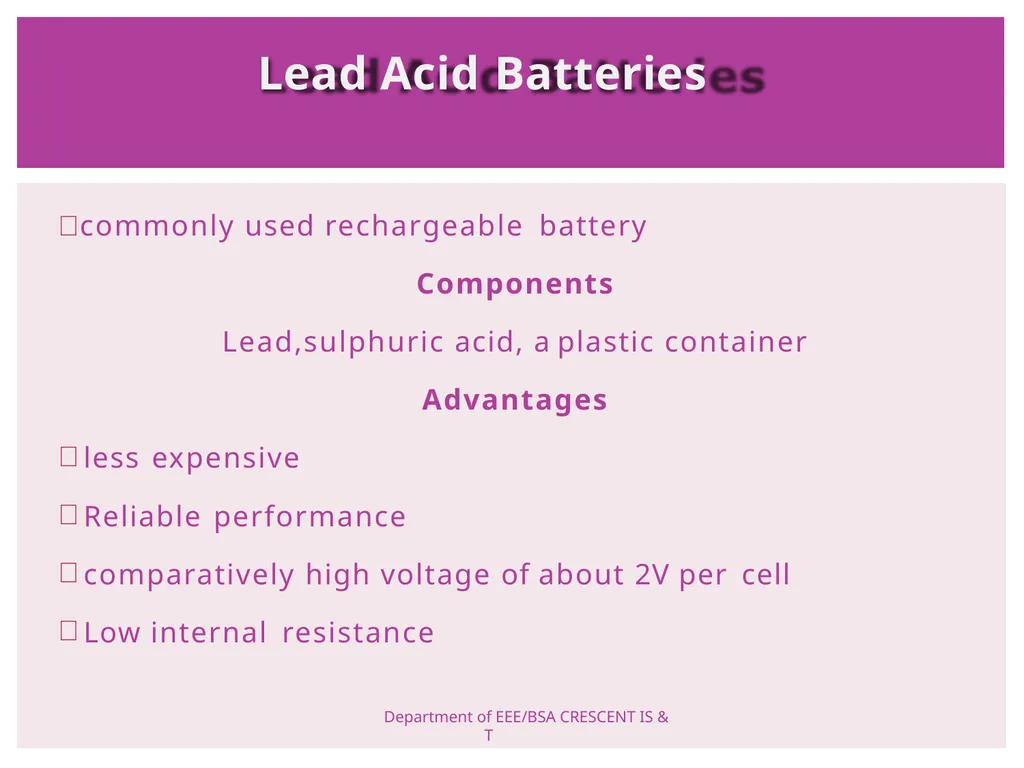
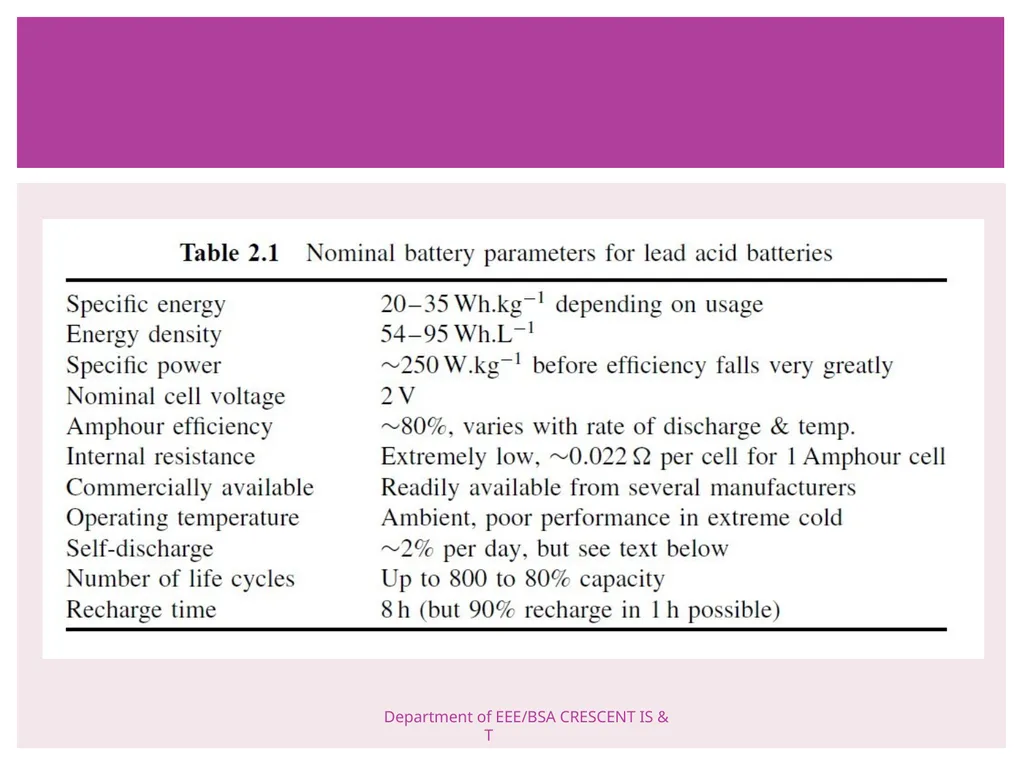
slide25. commonly used rechargeable battery
Components
Lead,sulphuric acid, a plastic container
Advantages
less expensive
Reliable performance
comparatively high voltage of about 2V per cell
Low internal resistance Lead Acid Batteries Department of EEE/BSA CRESCENT IS & T<br>
slide26. Department of EEE/BSA CRESCENT IS & T<br>
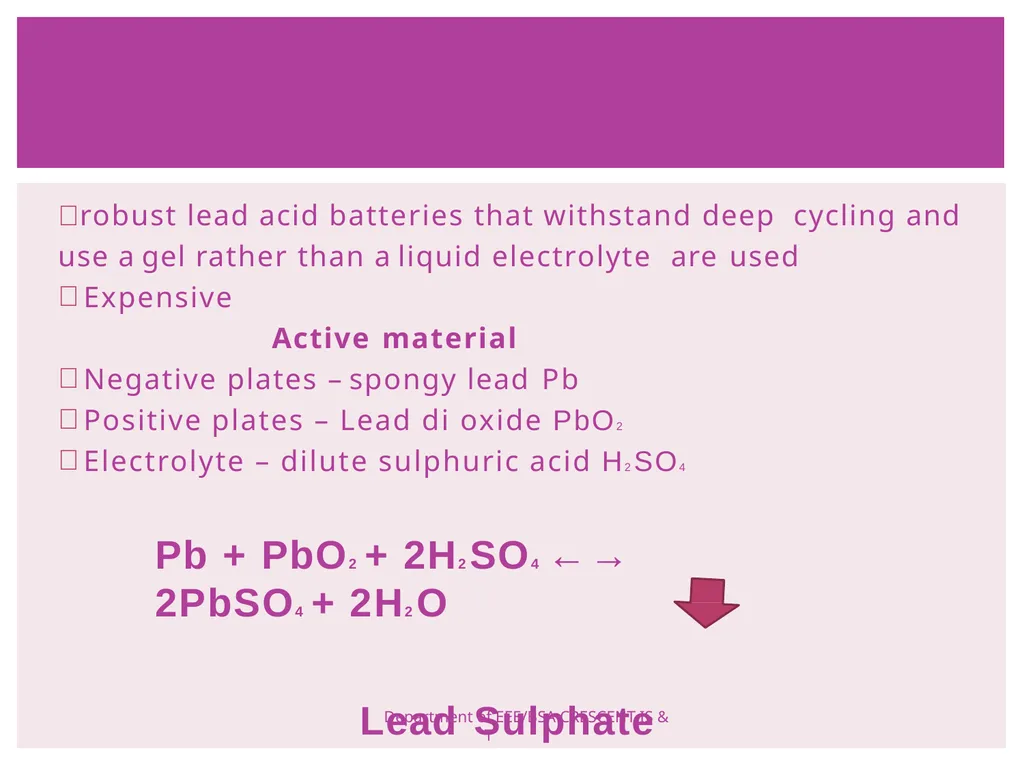
slide27. robust lead acid batteries that withstand deep cycling and use a gel rather than a liquid electrolyte are used Expensive
Active material
Negative plates – spongy lead Pb
Positive plates – Lead di oxide PbO2
Electrolyte – dilute sulphuric acid H2 SO4
Pb + PbO2 + 2H2 SO4 ←→ 2PbSO4 + 2H2 O
Lead Sulphate + Water Department of EEE/BSA CRESCENT IS & T<br>
slide28. Department of EEE/BSA CRESCENT IS & T<br>
slide29. Department of EEE/BSA CRESCENT IS & T<br>
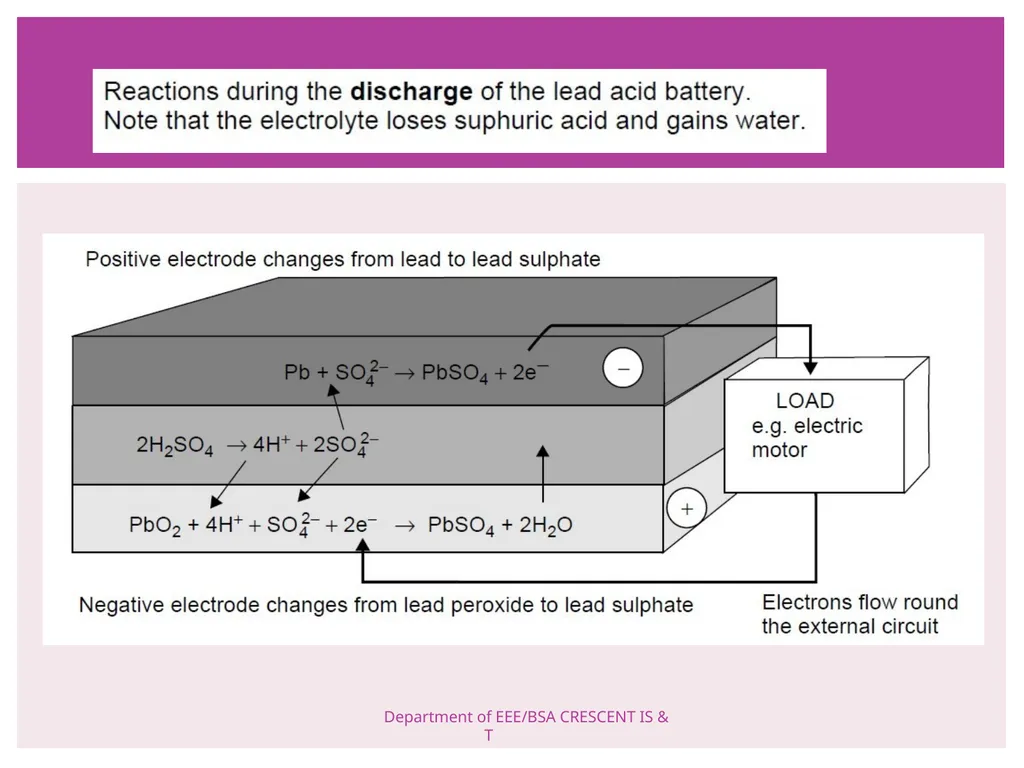
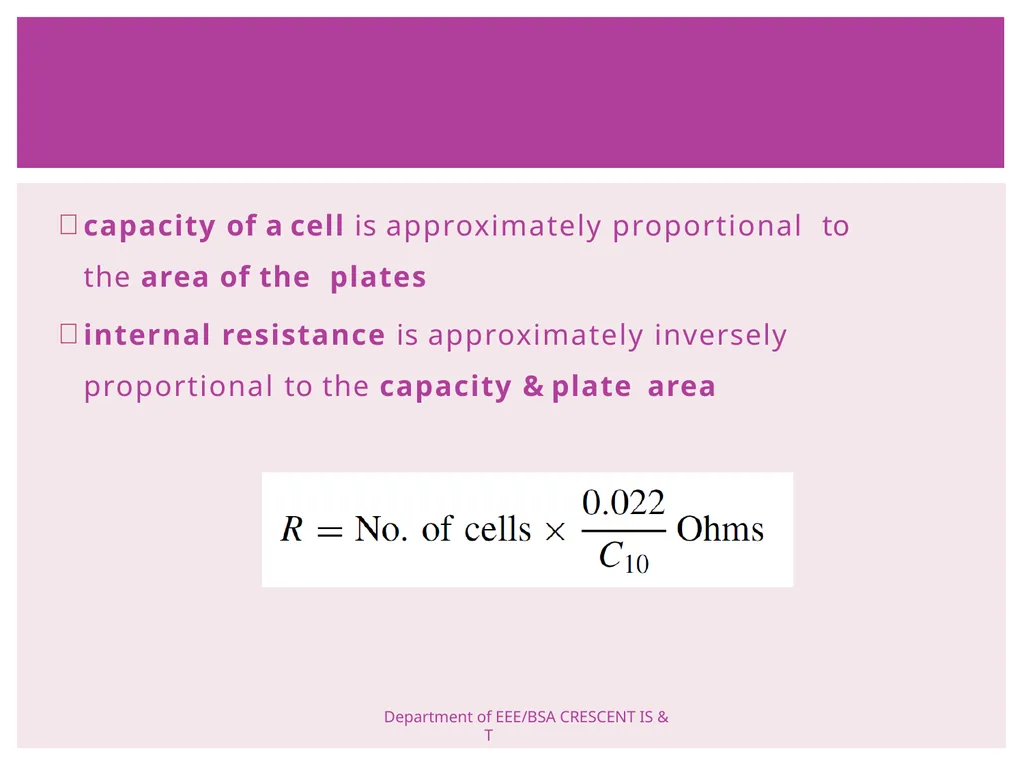
slide30. capacity of a cell is approximately proportional to
the area of the plates
internal resistance is approximately inversely proportional to the capacity & plate area Department of EEE/BSA CRESCENT IS & T<br>
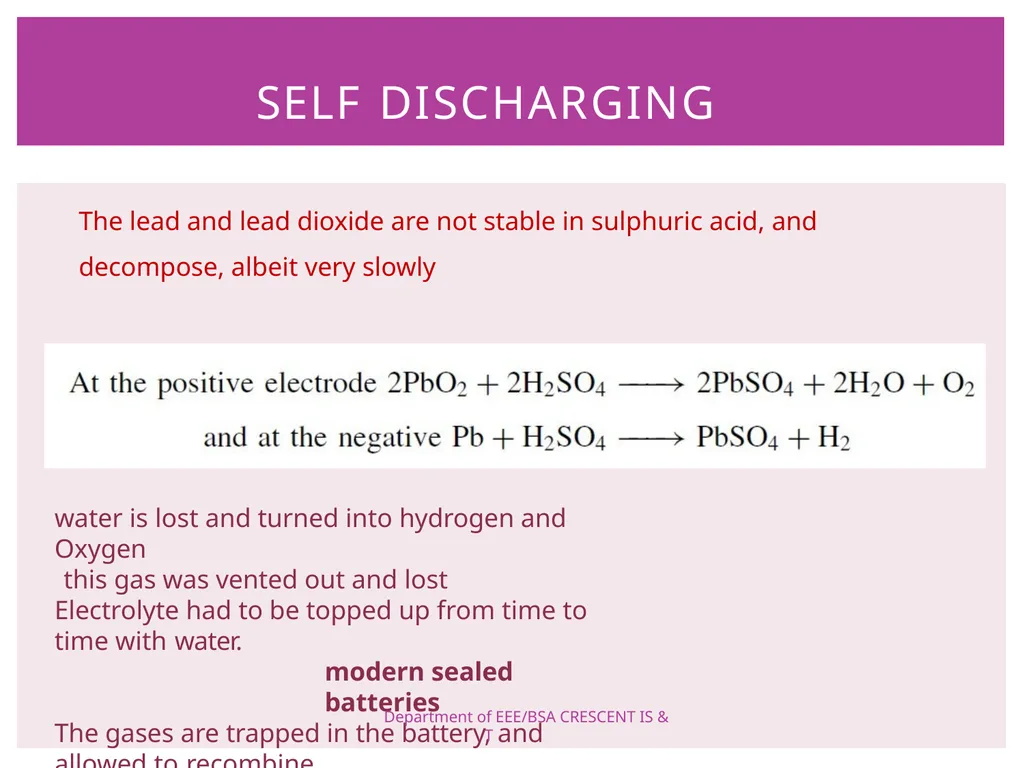
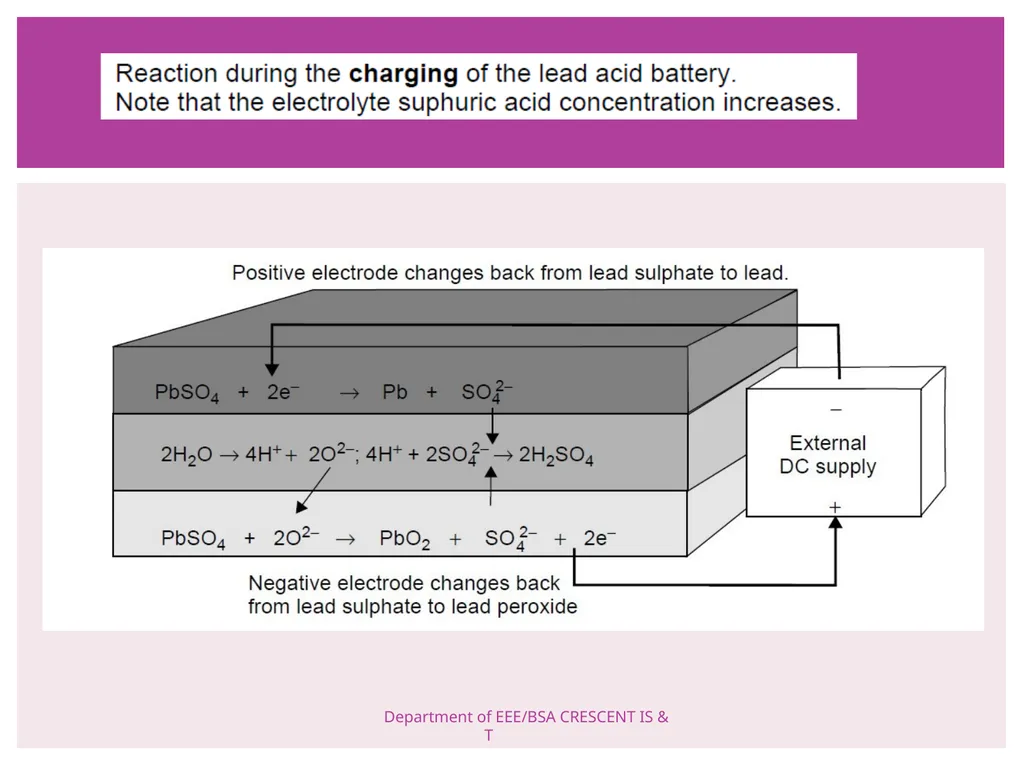
slide31. SELF DISCHARGING The lead and lead dioxide are not stable in sulphuric acid, and
decompose, albeit very slowly water is lost and turned into hydrogen and Oxygen
this gas was vented out and lost
Electrolyte had to be topped up from time to time with water.
modern sealed batteries
The gases are trapped in the battery, and allowed to recombine
(which happens at a reasonable rate spontaneously) to reform as Department of EEE/BSA CRESCENT IS & T<br>
slide32. Emergency lighting and alarms Conventional car
starting, lighting and ignition (SLI) Battery
unsuitable for electric vehicle applications
EV
‘traction’
or ‘deep cycling’ type
most expensive type of lead acid battery. USAGE Department of EEE/BSA CRESCENT IS & T<br>
slide33. REFERENCE 1) James Larminie and John Lowry, “Electric Vehicle Technology Explained”,John Wiley & Sons Ltd, 2nd edition, 2015. Department of EEE/BSA CRESCENT IS & T<br>

slide2. Highest cost, weight and volume
A battery consists of two or more electric cells joined Together
The cells convert chemical energy to electrical energy
The cells consist of positive and negative electrodes joined by an electrolyte
It is the chemical reaction between the electrodes
and the electrolyte which generates DC electricity
the chemical reaction can be reversed by reversing the current and the battery returned to a charged state BATTERIES Department of EEE/BSA CRESCENT IS & T<br>
slide3. Non-rechargeable (primary cells) Alkaline
Carbon-Zinc
Rechargeable (secondary cells)
Ni-Cd (Nickel-Cadmium)
Ni-MH (Nickel-Metal Hydride)
Lithium-ion
Lead-Acid
Flooded – wet cells
Gel – VRLA(Valve Regulated)
AGM - VRLA Department of EEE/BSA CRESCENT IS & T<br>
slide4. lead acid
nickel iron
nickel
Cadmium
nickel metal hydride
lithium polymer and lithium iron
sodium sulphur
sodium metal chlori
mechanically refuelled - aluminium -air and zinc-air TYPES OF BATTERY Department of EEE/BSA CRESCENT IS & T<br>
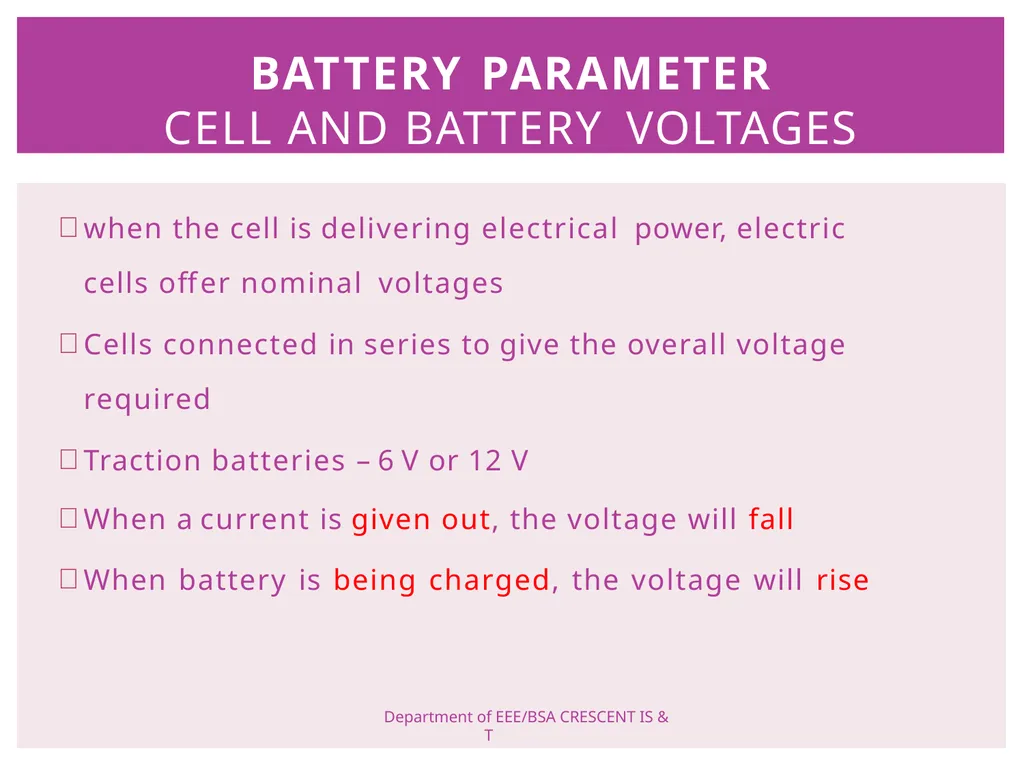
slide5. when the cell is delivering electrical power, electric
cells offer nominal voltages
Cells connected in series to give the overall voltage required
Traction batteries – 6 V or 12 V
When a current is given out, the voltage will fall
When battery is being charged, the voltage will rise BATTERY PARAMETER
CELL AND BATTERY VOLTAGES Department of EEE/BSA CRESCENT IS & T<br>
slide6. BATTERY PARAMETER
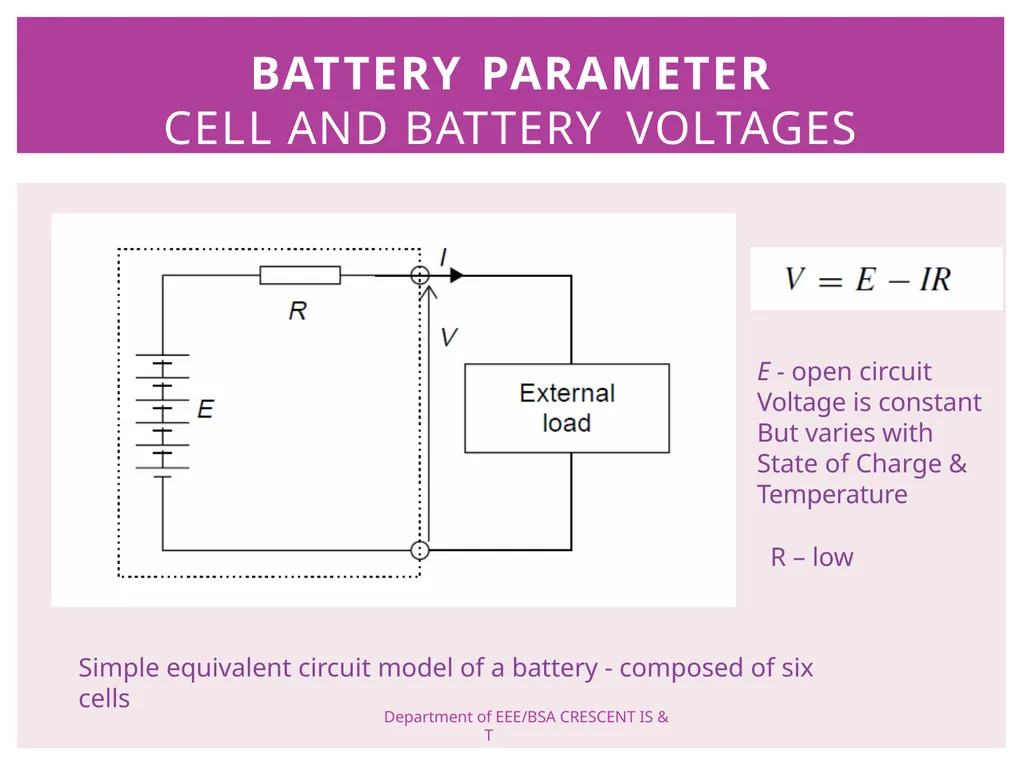
CELL AND BATTERY VOLTAGES E - open circuit Voltage is constant But varies with State of Charge & Temperature
R – low
Simple equivalent circuit model of a battery - composed of six cells Department of EEE/BSA CRESCENT IS & T<br>
slide7. e l e ct ric c h ar ge - m o s t c r u c ial param e ter
C oulomb: t h e c h ar ge wh e n on e A mp f l ows f or on e s e c on d
( Amp e re H ou r ) Amph ou r : t h e c h ar ge wh e n o n e A m p f l o ws f o r o n e
H o u r
E x a mple: 1 0 Amphour s 1A m p f o r 10 h o u r s 2A m ps f o r 5 h o u r s
i n t h e o ry 10 A m ps f o r 1 h o u r bu t l e s s t h an 1 h o u r
prac t i cally BATTERY PARAMETER
CHARGE (OR AMPHOUR) CAPACITY Department of EEE/BSA CRESCENT IS & T<br>
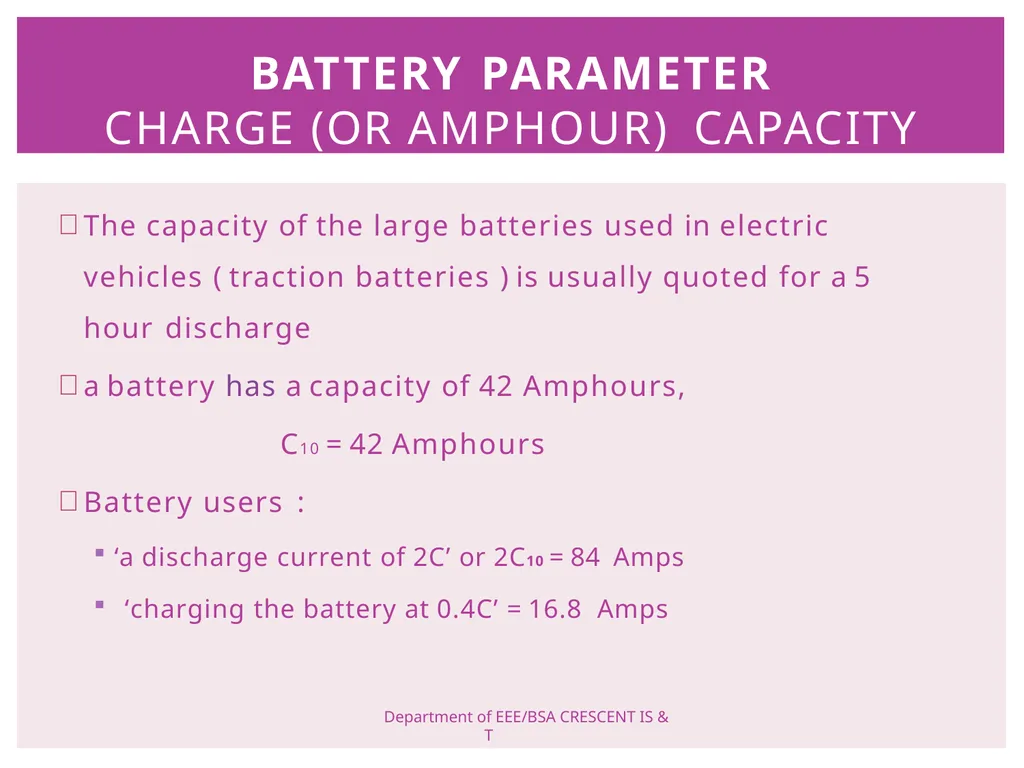
slide8. The capacity of the large batteries used in electric vehicles ( traction batteries ) is usually quoted for a 5 hour discharge
a battery has a capacity of 42 Amphours,
C10 = 42 Amphours
Battery users :
‘a discharge current of 2C’ or 2C10 = 84 Amps
‘charging the battery at 0.4C’ = 16.8 Amps BATTERY PARAMETER
CHARGE (OR AMPHOUR) CAPACITY Department of EEE/BSA CRESCENT IS & T<br>
slide9. BATTERY PARAMETER
CHARGE (OR AMPHOUR) CAPACITY Department of EEE/BSA CRESCENT IS & T<br>
slide10. Express the current 21 Amps from our example 42 Amphour battery, in C notation. BATTERY PARAMETER
CHARGE (OR AMPHOUR) CAPACITY Department of EEE/BSA CRESCENT IS & T<br>
slide11. Express the current 21 Amps from our example 42 Amphour battery, in C notation.
As a ratio of 42 Amps, 21 is 1/2 or 0.5.
Thus the current
21 Amps = 0.5C10. BATTERY PARAMETER
CHARGE (OR AMPHOUR) CAPACITY Department of EEE/BSA CRESCENT IS & T<br>
slide12. The purpose of the battery is to store energy
depends on its voltage and the charge stored
SI unit is the Joule(small unit), Watthour(1 Watt for 1 hour) instead
1 Watthour = 3600 Joules
If the current is increased, both V and C reduces
Energy stored reduces if energy is released quickly
Depends on discharge rate and temperature BATTERY PARAMETER
ENERGY STORAGE CAPACITY Department of EEE/BSA CRESCENT IS & T<br>
slide13. the amount of electrical energy stored for every
kilogram of battery mass
Specific energy - unit : Wh/Kg
First approximation of the battery mass(in Kg) can be
found if the energy storage capacity( Wh) is known
Specific power - unit : W/kg BATTERY PARAMETER
SPECIFIC ENERGY Department of EEE/BSA CRESCENT IS & T<br>
slide14. RAGONE PLOT Department of EEE/BSA CRESCENT IS & T<br>
slide15. BATTERY PARAMETER
SPECIFIC ENERGY Department of EEE/BSA CRESCENT IS & T<br>
slide16. It is also an important parameter
The amount of electrical energy stored per cubic metre
of battery volume
Unit : Wh/m3
Battery Volume (in m3) can be found if the energy storage capacity( Wh) is known
If a known volume is available for batteries,the volume (m3) can be multiplied by the batteries energy density (Wh.m−3) to give a first approximation of how much electrical energy can be made available BATTERY PARAMETER
ENERGY DENSITY Department of EEE/BSA CRESCENT IS & T<br>
slide17. Amount of power obtained per kilogram of battery
Gives inefficient operation : batteries do have a
maximum power, it is not sensible to operate them at power for more than a anywhere near this maximum few seconds
Unit is Wkg−1 BATTERY PARAMETER
SPECIFIC POWER very good specific energy, but have low specific power [store a lot of energy, but can only give it out slowly] ie., drive the vehicle very slowly over a long distance
the point that a simple single number answer Department of EEE/BSA CRESCENT IS & T<br>
slide18. its charging efficiency is less than 100%
Depends upon different types of battery,
temperature, rate of charge and state of charge
when going from about 20% to 80% charged the efficiency will usually be very close to 100%, but as the Batteries last 20% of the charge is put in the efficiency falls off greatly BATTERY PARAMETER
AMPHOUR (CHARGE) EFFICIENCY Department of EEE/BSA CRESCENT IS & T<br>
slide19. BATTERY PARAMETER
ENERGY EFFICIENCY Energy efficiency =
electrical energy supplied by a battery
amount of electrical energy required to return it to the
state before discharge
reduction of overall emissions gives high energy efficiency
battery is charged and discharged rapidly - energy
efficiency decreases considerably Department of EEE/BSA CRESCENT IS & T<br>
slide20. Self discharge : when left unused – battery discharges
higher temperatures greatly increase self -discharge BATTERY PARAMETER
SELF-DISCHARGE RATES Department of EEE/BSA CRESCENT IS & T<br>
slide21. round, rectangular, prismatic or hexagonal
Fixed variation or wider variation in Ht,Wt & L BATTERY PARAMETER
BATTERY GEOMETRY Department of EEE/BSA CRESCENT IS & T<br>
slide22. ambient temperature
higher temperatures
need heating to start with and then cooling when in use
battery performance drops off at low temperatures
Overcomed by heating the battery BATTERY PARAMETER BATTERY
TEMPERATURE, HEATING AND COOLING NEEDS Department of EEE/BSA CRESCENT IS & T<br>
slide23. a few hundred deep cycles to 20% of the battery charge
depends on the battery type and how it is used
Decides the lifetime of the battery which in turn reflects in electric vehicle running costs BATTERY PARAMETER BATTERY
LIFE AND NUMBER OF DEEP CYCLES Department of EEE/BSA CRESCENT IS & T<br>
slide24. Department of EEE/BSA CRESCENT IS & T<br>
slide25. commonly used rechargeable battery
Components
Lead,sulphuric acid, a plastic container
Advantages
less expensive
Reliable performance
comparatively high voltage of about 2V per cell
Low internal resistance Lead Acid Batteries Department of EEE/BSA CRESCENT IS & T<br>
slide26. Department of EEE/BSA CRESCENT IS & T<br>
slide27. robust lead acid batteries that withstand deep cycling and use a gel rather than a liquid electrolyte are used Expensive
Active material
Negative plates – spongy lead Pb
Positive plates – Lead di oxide PbO2
Electrolyte – dilute sulphuric acid H2 SO4
Pb + PbO2 + 2H2 SO4 ←→ 2PbSO4 + 2H2 O
Lead Sulphate + Water Department of EEE/BSA CRESCENT IS & T<br>
slide28. Department of EEE/BSA CRESCENT IS & T<br>
slide29. Department of EEE/BSA CRESCENT IS & T<br>
slide30. capacity of a cell is approximately proportional to
the area of the plates
internal resistance is approximately inversely proportional to the capacity & plate area Department of EEE/BSA CRESCENT IS & T<br>
slide31. SELF DISCHARGING The lead and lead dioxide are not stable in sulphuric acid, and
decompose, albeit very slowly water is lost and turned into hydrogen and Oxygen
this gas was vented out and lost
Electrolyte had to be topped up from time to time with water.
modern sealed batteries
The gases are trapped in the battery, and allowed to recombine
(which happens at a reasonable rate spontaneously) to reform as Department of EEE/BSA CRESCENT IS & T<br>
slide32. Emergency lighting and alarms Conventional car
starting, lighting and ignition (SLI) Battery
unsuitable for electric vehicle applications
EV
‘traction’
or ‘deep cycling’ type
most expensive type of lead acid battery. USAGE Department of EEE/BSA CRESCENT IS & T<br>
slide33. REFERENCE 1) James Larminie and John Lowry, “Electric Vehicle Technology Explained”,John Wiley & Sons Ltd, 2nd edition, 2015. Department of EEE/BSA CRESCENT IS & T<br>