Electricity Renewable energy sources Learning objectives I can describe what renewable energy means I can list some advantages and disadvantages for a range of energy sources What is energy? Discuss Energy is required to perform any kind of
"Electricity Renewable energy sources Learning" is the property of its rightful owner. Permission is granted to
download and print the materials on this website for personal, non-commercial use only, and to display it
on your personal computer provided you do not modify the materials and that you retain all copyright
notices contained in the materials. By downloading content from our website, you accept the terms of this
agreement.
Presentation Transcript
01
Electricity Renewable energy sources<br>
02
Learning objectives I can describe what renewable energy means
I can list some advantages and disadvantages for a range of energy sources<br>
03
What is energy? Discuss Energy is required to perform any kind of work.
Moving machines, heating an oven, breathing and even thinking are just a few of the things that require energy.
Sources of energy exist all around us.<br>
04
Warm-up Do you use electricity at home?
How do you know it’s in your home, if you can’t see it?<br>
05
Electricity comes into our homes through power cables. We can’t see it. But we are able to use it by plugging in things like our PlayStations, TVs and kettles to power sockets in the walls.<br>
06
Where do we get our power from?
In pairs, think about different kinds of energy used to produce electricity.
Make a list or draw a picture.<br>
07
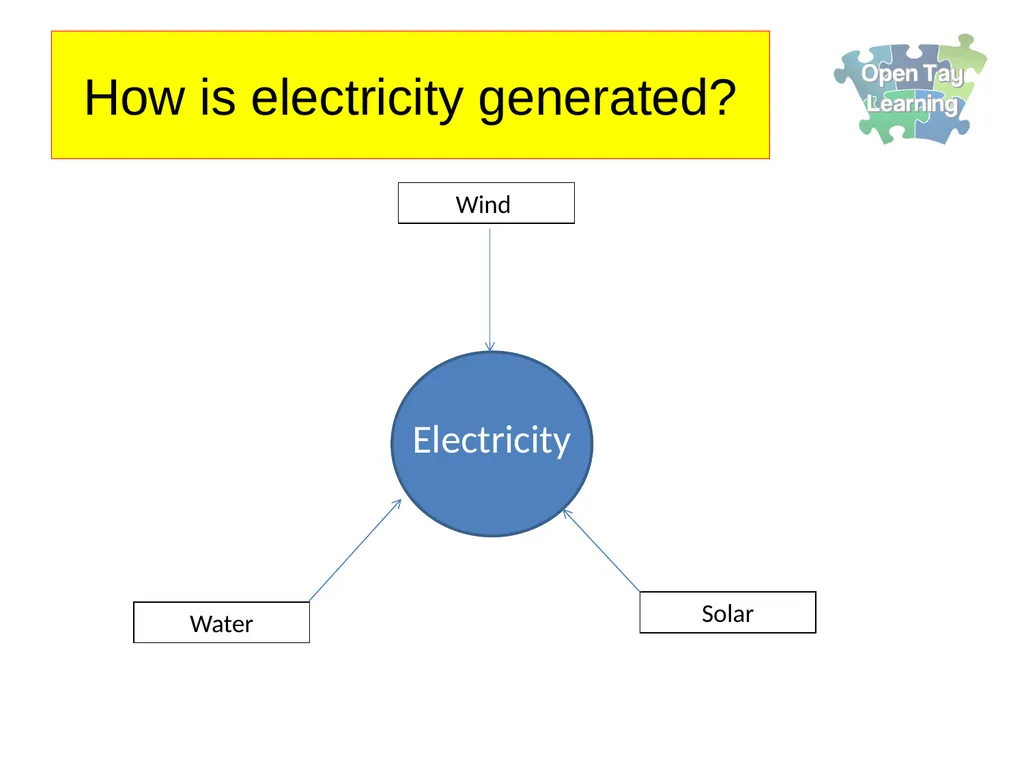
How is electricity generated? Electricity Water Wind Solar<br>
08
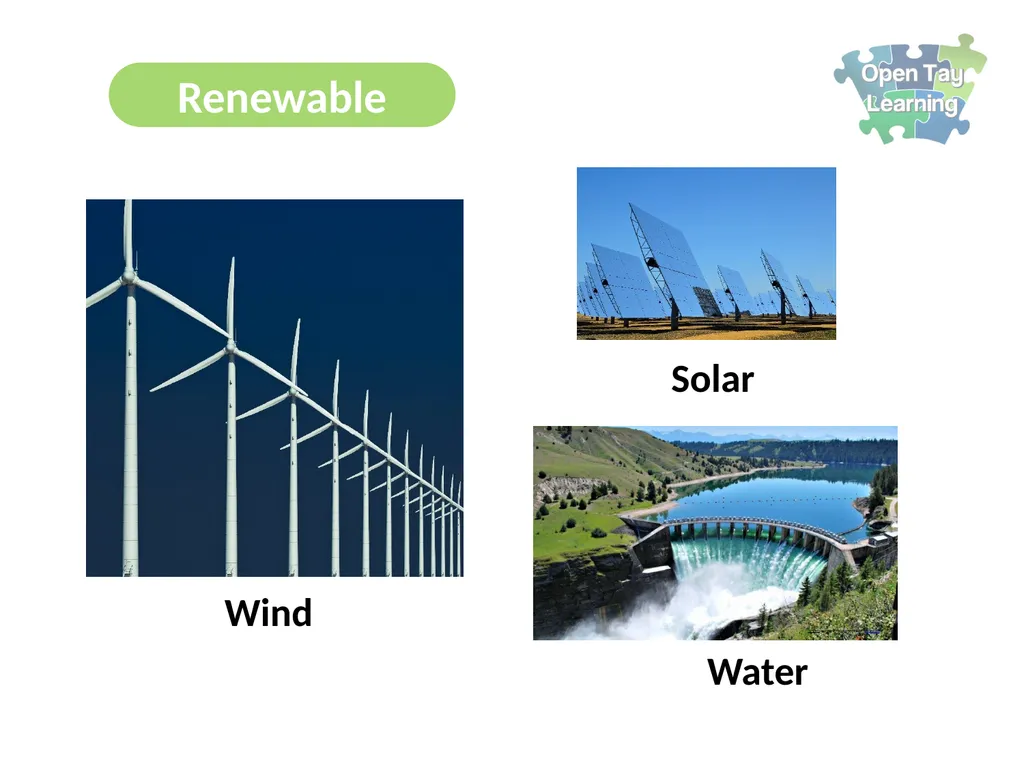
Renewable Wind Water Solar This Photo by Unknown Author is licensed under CC BY-SA-NC<br>
09
Renewable energy Renewable energy resources will never run out. They can be replaced and are a natural source of energy.<br>
10
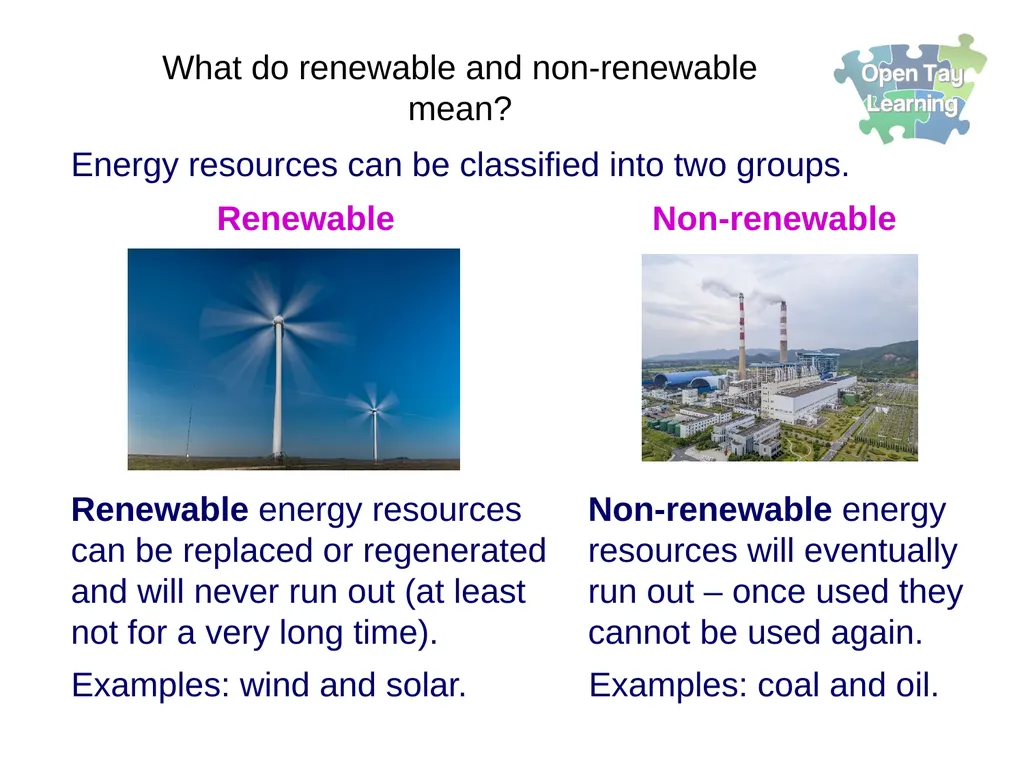
Energy resources can be classified into two groups. Renewable energy resources can be replaced or regenerated and will never run out (at least not for a very long time). Non-renewable energy resources will eventually run out – once used they cannot be used again. Non-renewable Renewable What do renewable and non-renewable mean? Examples: wind and solar. Examples: coal and oil.<br>
11
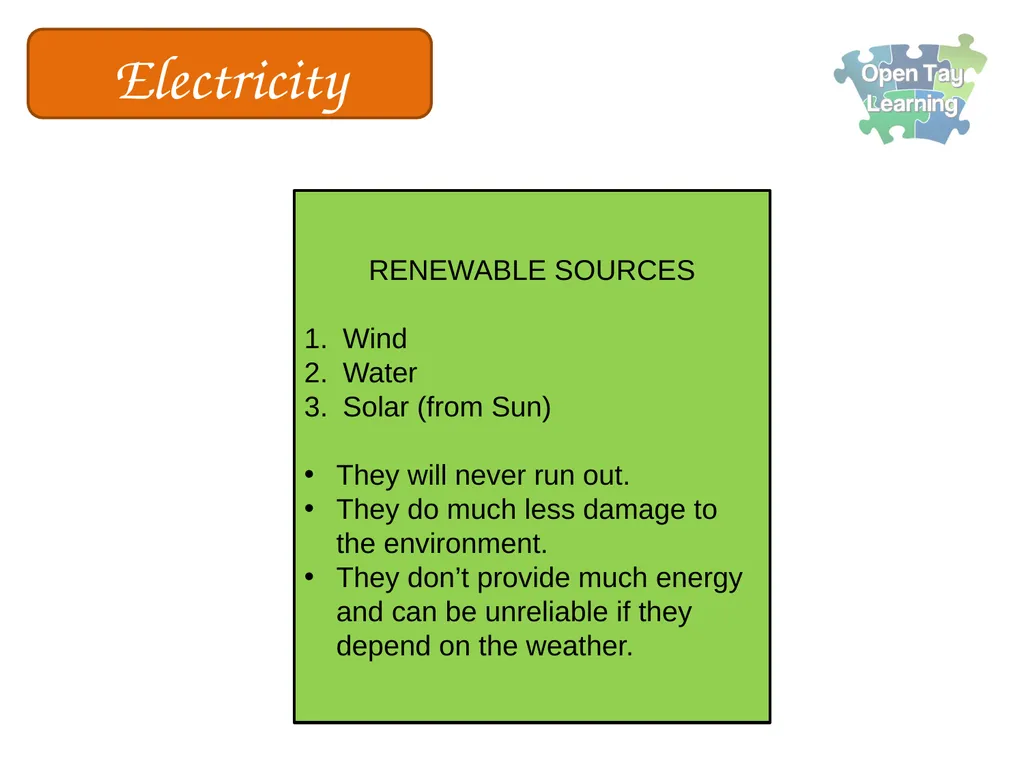
Electricity RENEWABLE SOURCES
Wind
Water
Solar (from Sun)
They will never run out.
They do much less damage to the environment.
They don’t provide much energy and can be unreliable if they depend on the weather.<br>
12
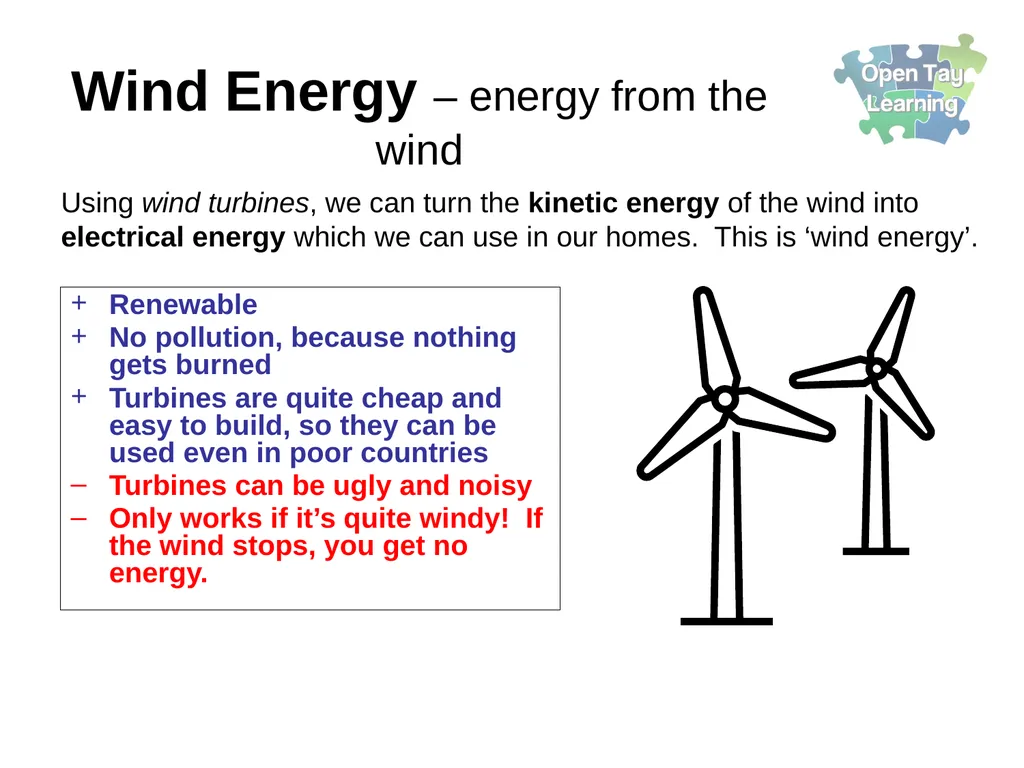
Wind Energy – energy from the wind Renewable
No pollution, because nothing gets burned
Turbines are quite cheap and easy to build, so they can be used even in poor countries
Turbines can be ugly and noisy
Only works if it’s quite windy! If the wind stops, you get no energy. Using wind turbines, we can turn the kinetic energy of the wind into electrical energy which we can use in our homes. This is ‘wind energy’.<br>
13
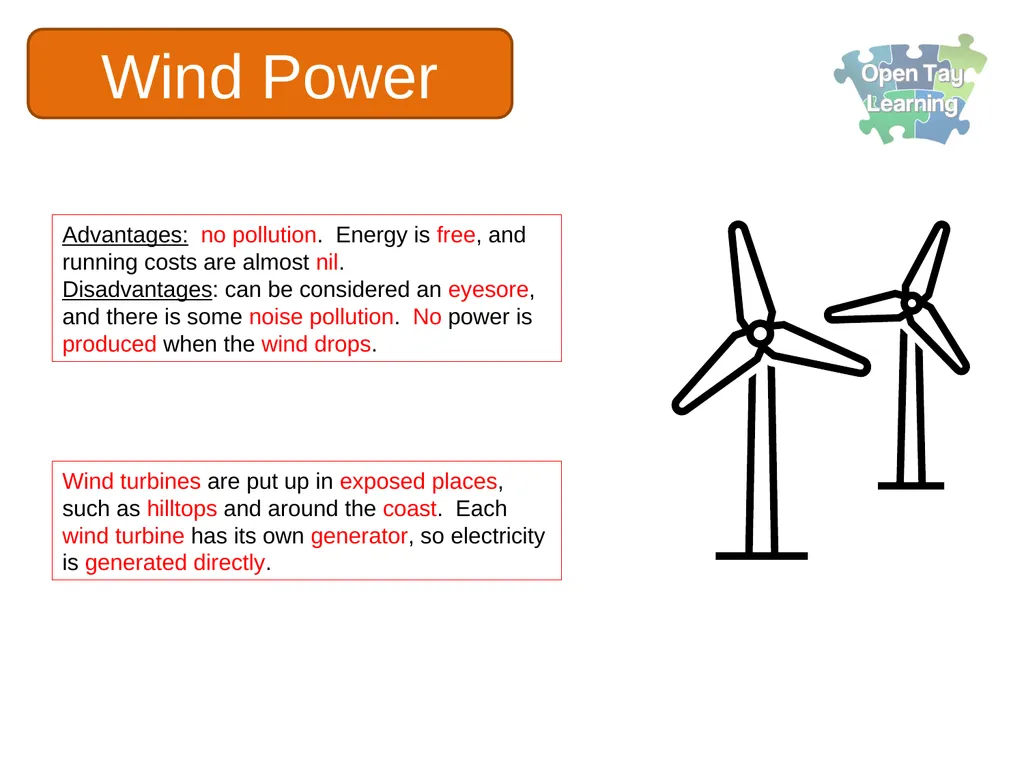
Wind Power Wind turbines are put up in exposed places, such as hilltops and around the coast. Each wind turbine has its own generator, so electricity is generated directly. Advantages: no pollution. Energy is free, and running costs are almost nil.
Disadvantages: can be considered an eyesore, and there is some noise pollution. No power is produced when the wind drops.<br>
14
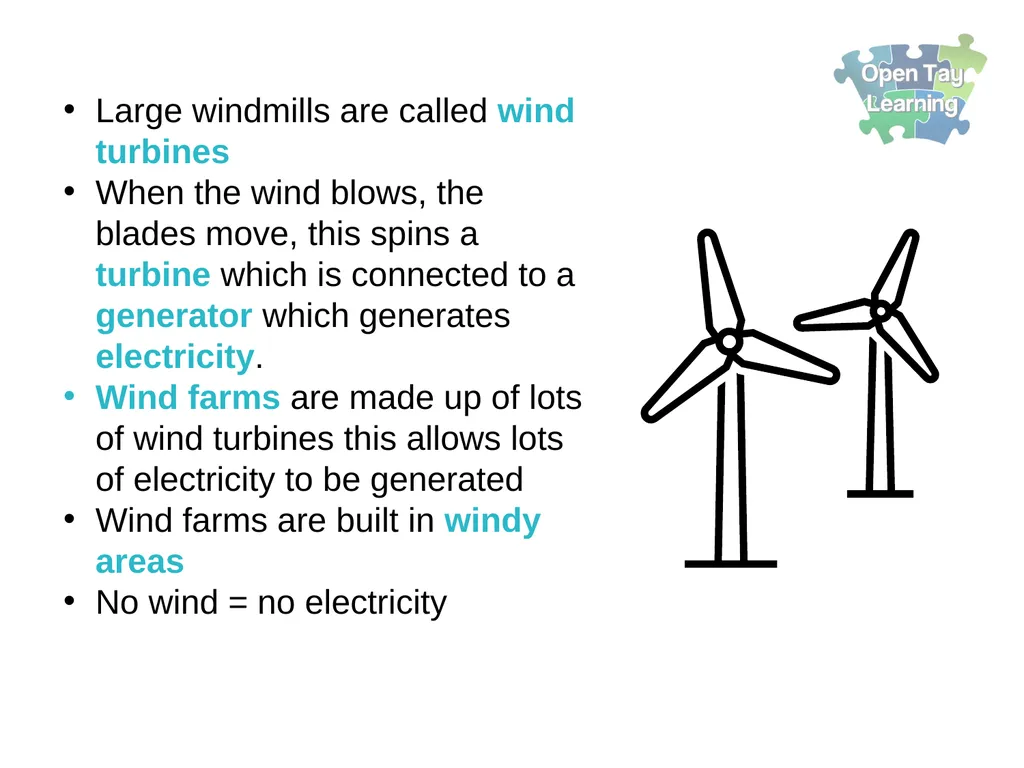
Large windmills are called wind turbines
When the wind blows, the blades move, this spins a turbine which is connected to a generator which generates electricity.
Wind farms are made up of lots of wind turbines this allows lots of electricity to be generated
Wind farms are built in windy areas
No wind = no electricity<br>
15
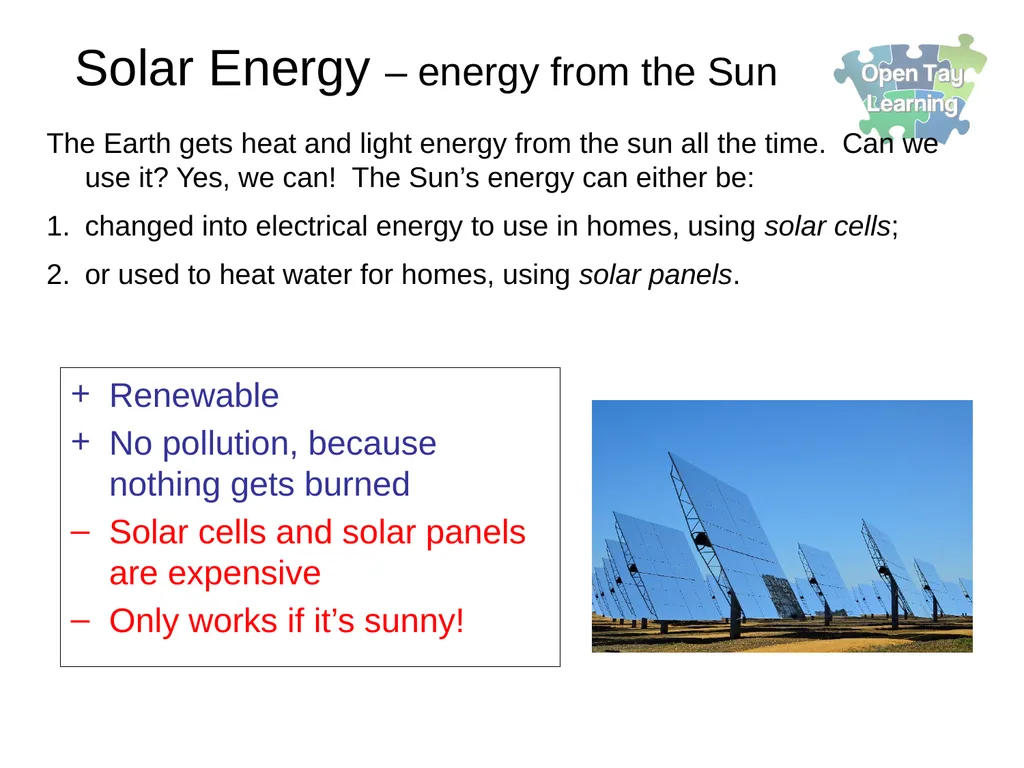
Solar Energy – energy from the Sun Renewable
No pollution, because nothing gets burned
Solar cells and solar panels are expensive
Only works if it’s sunny! The Earth gets heat and light energy from the sun all the time. Can we use it? Yes, we can! The Sun’s energy can either be:
changed into electrical energy to use in homes, using solar cells;
or used to heat water for homes, using solar panels.<br>
16
Solar cells Solar cells generate electricity directly from sunlight. Solar cells are usually used to provide electricity on a relatively small scale, such as for individual houses. Solar cell ‘farms’ are being developed, but connecting to the National Grid can be expensive. Advantages: no pollution, a very reliable source in sunny countries. Energy is free, and running costs are almost nil.
Disadvantages: initially very expensive, and a developing technology. Only produce electricity in daytime.<br>
17
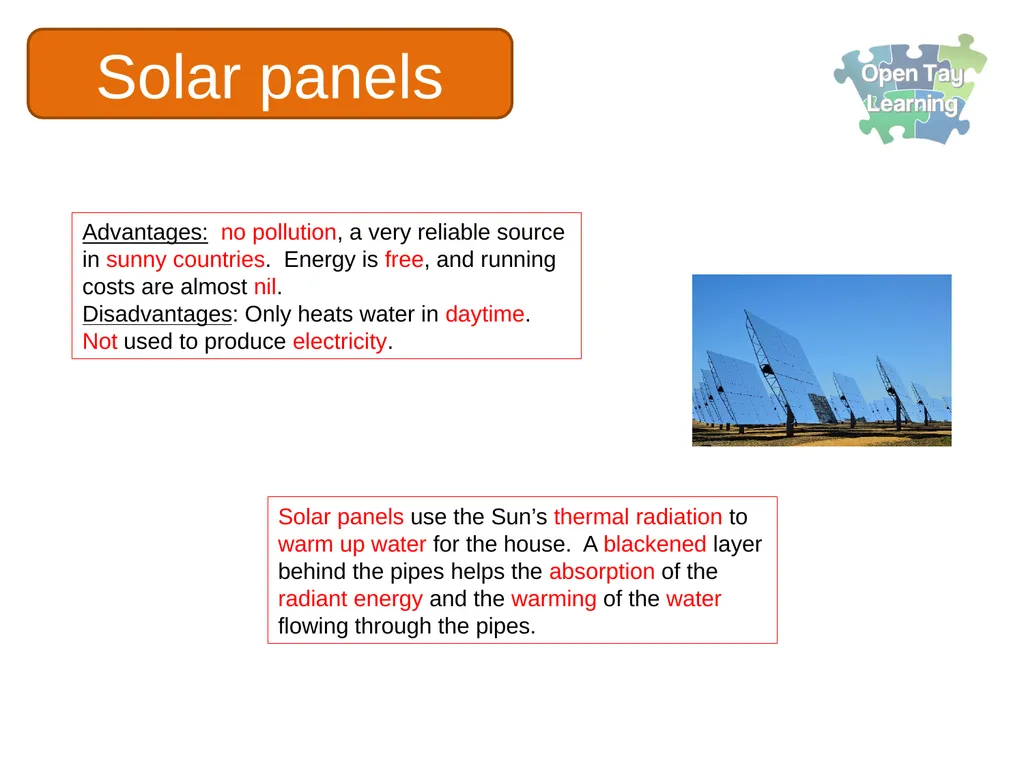
Solar panels Solar panels use the Sun’s thermal radiation to warm up water for the house. A blackened layer behind the pipes helps the absorption of the radiant energy and the warming of the water flowing through the pipes. Advantages: no pollution, a very reliable source in sunny countries. Energy is free, and running costs are almost nil.
Disadvantages: Only heats water in daytime. Not used to produce electricity.<br>
18
Hydroelectric Energy (water) – energy from rivers Renewable
No pollution, because nothing gets burned
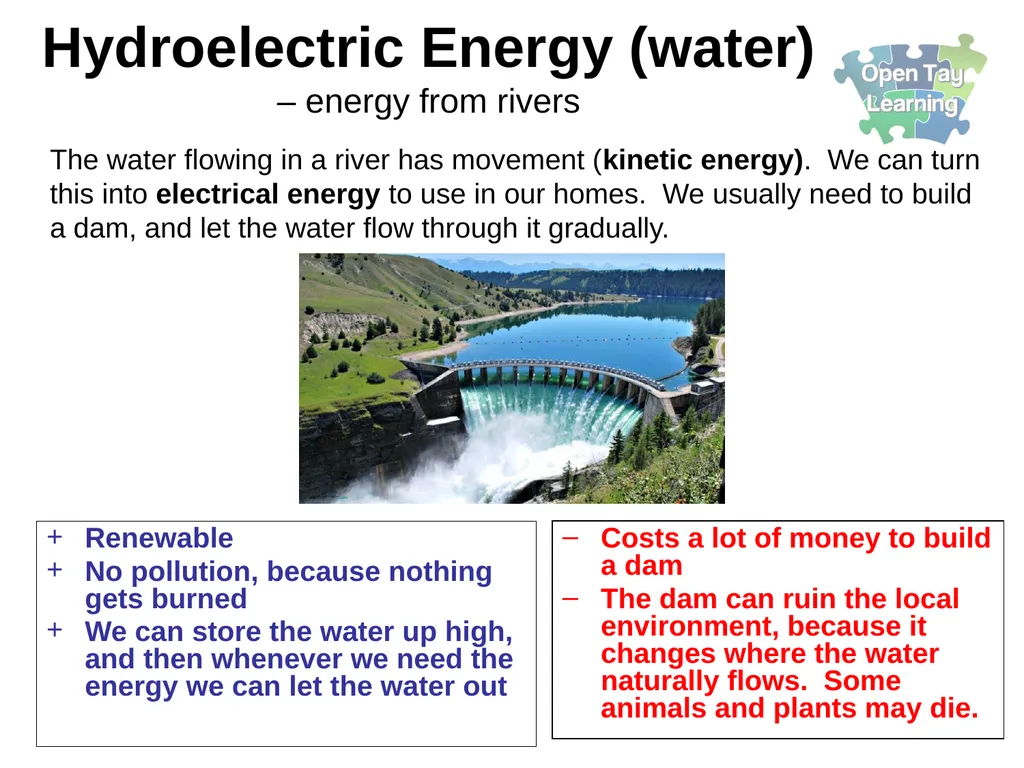
We can store the water up high, and then whenever we need the energy we can let the water out The water flowing in a river has movement (kinetic energy). We can turn this into electrical energy to use in our homes. We usually need to build a dam, and let the water flow through it gradually. Costs a lot of money to build a dam
The dam can ruin the local environment, because it changes where the water naturally flows. Some animals and plants may die. This Photo by Unknown Author is licensed under CC BY-SA-NC<br>