
ElECTROCONVULSIVE THERAPY (E.C.T) INTRODUCTION:-
CS
Published · 32 slides · 0 views
1 / 1






Description
ElECTROCONVULSIVE THERAPY (E.C.T) INTRODUCTION:- Somatic therapies are treatment approaches that use physiological or physical interventions to affect behavior change. The most common form of somatic therapy is Electroconvulsive therapy.
Related Topics
Share
Embed code
Download this presentation From Below
"ElECTROCONVULSIVE THERAPY (E.C.T) INTRODUCTION:-" is the property of its rightful owner. Permission is granted to download and print the materials on this website for personal, non-commercial use only, and to display it on your personal computer provided you do not modify the materials and that you retain all copyright notices contained in the materials. By downloading content from our website, you accept the terms of this agreement.
Presentation Transcript
01
ElECTROCONVULSIVE THERAPY (E.C.T)<br>
02
INTRODUCTION:-
Somatic therapies are treatment approaches that use physiological or physical interventions to affect behavior change. The most common form of somatic therapy is Electroconvulsive therapy. Electroconvulsive therapy (E.C.T) was first used as treatment modality in 1934 to “cure” psychotic disorders by inducing convulsions. E.C.T is one of the best potent and sometimes life saving treatment in psychiatry.<br>
Somatic therapies are treatment approaches that use physiological or physical interventions to affect behavior change. The most common form of somatic therapy is Electroconvulsive therapy. Electroconvulsive therapy (E.C.T) was first used as treatment modality in 1934 to “cure” psychotic disorders by inducing convulsions. E.C.T is one of the best potent and sometimes life saving treatment in psychiatry.<br>
03
HISTORY:-
Ledislas van meduna used the convulsant agent to treat schizophrenic patients after an extensive research for suitable convulsant agent meduna selected camphor in oil on , January 23, 1934 in the state hospital at the Budapest, Meduna gave the first injection to a male catatonic schizophrenic patient. He later switched to more reliable convalsant drug like cardiozol , it is because that his neuropathological studies on epileptical patients gave on observation of crushing growth of glial cells in the brains, in contrast to lack of glial reactions in the brain of schizophrenic patients.<br>
Ledislas van meduna used the convulsant agent to treat schizophrenic patients after an extensive research for suitable convulsant agent meduna selected camphor in oil on , January 23, 1934 in the state hospital at the Budapest, Meduna gave the first injection to a male catatonic schizophrenic patient. He later switched to more reliable convalsant drug like cardiozol , it is because that his neuropathological studies on epileptical patients gave on observation of crushing growth of glial cells in the brains, in contrast to lack of glial reactions in the brain of schizophrenic patients.<br>
04
In April, 1938, Bini and Cerletti in Rome for the first time administered E.C.T to a man of 34 yrs old a wondering lunatic he was alterning between periods of mutism and incompressible neurologistic speech and hallucinating. The first shock “stunned “ the patient but was sub convulsive Cerletti repeated the treatment a higher voltage (100) and successfully induced a convulsions with uneventful recovery.<br>
05
In 1974, American Psychiatric Association (APA’S) council on research and development appointed a task force on E.C.T in 1976, gave its report which provided clear guidelines for the use of E.C.T and decreased it to be safe & effective method of treatment when used by professionals’ trained in the technique.<br>
06
DEFINITION:-
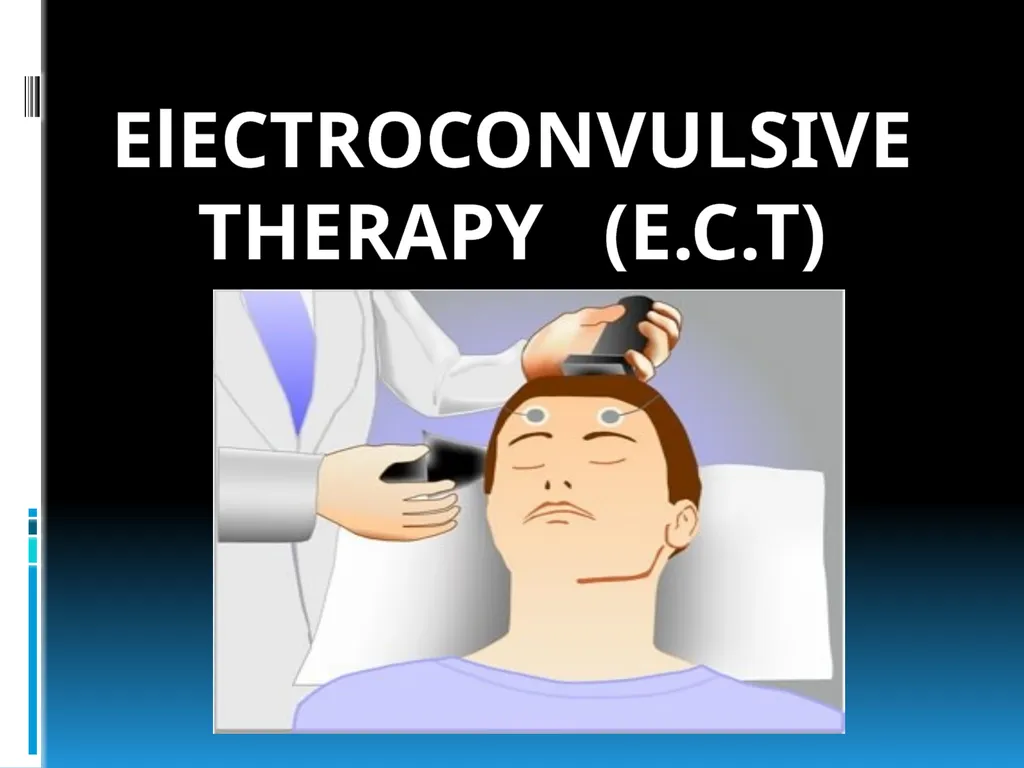
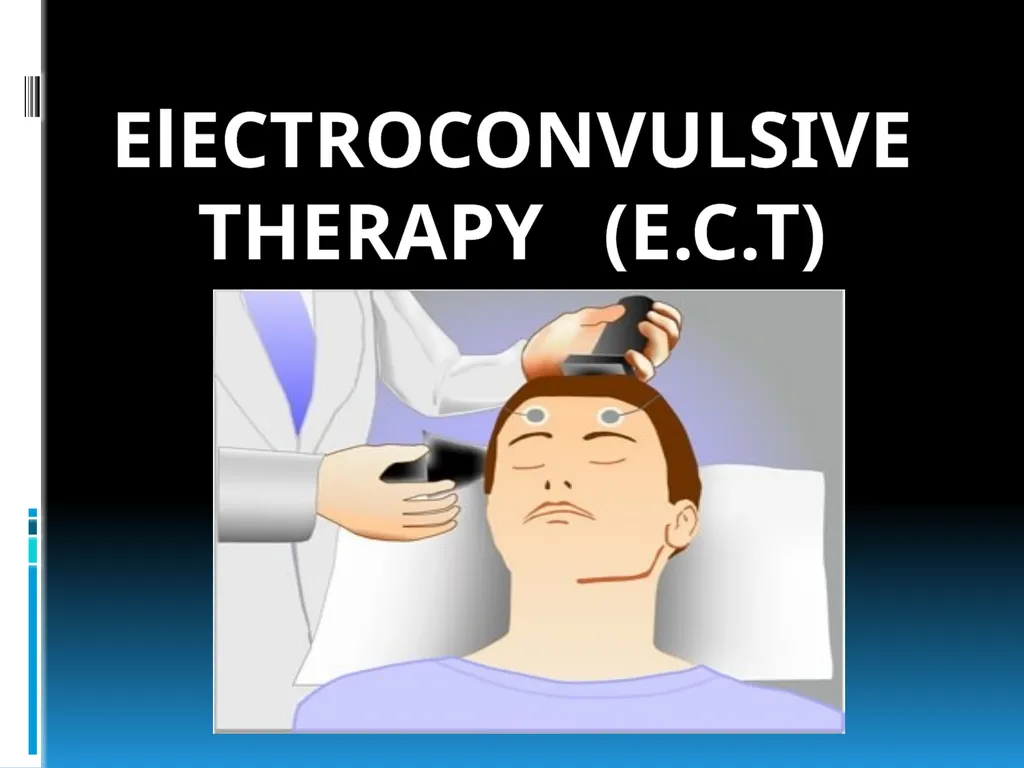
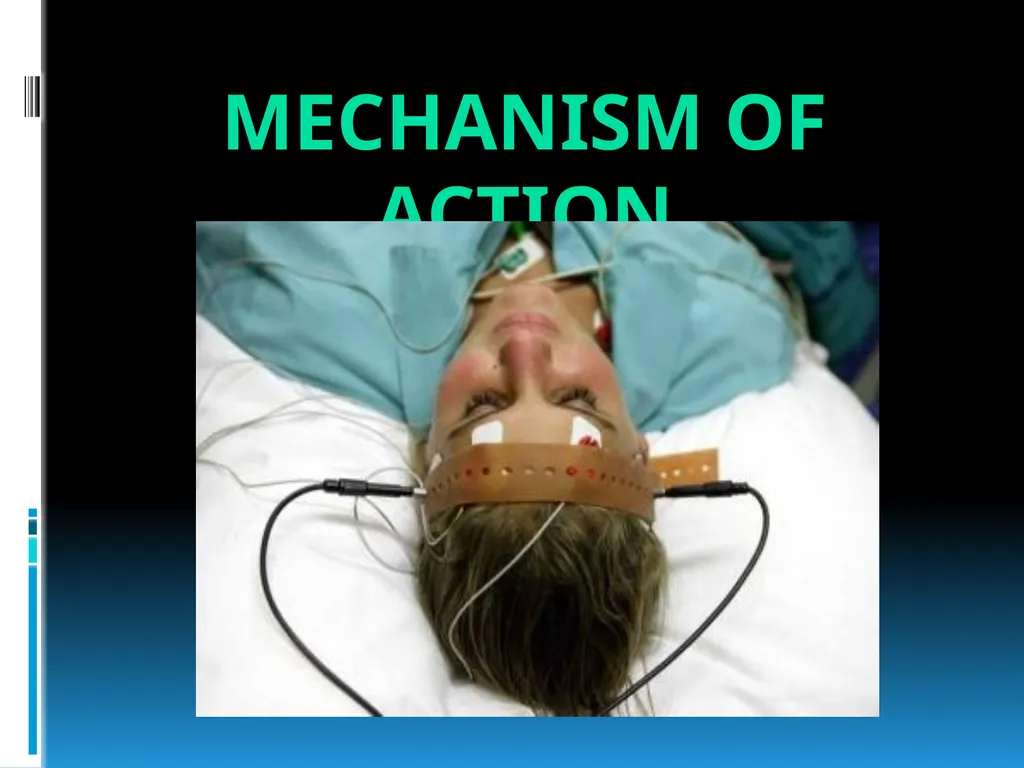
Electroconvulsive therapy is a type of a somatic treatment in which electric current is applied to the brain through electrodes placed on the tamples of the patient. The passage of an electrical stimulus of 70 to 150 volts to the brain for 0.1 to 0.5 second to produce a grandmal seizures<br>
Electroconvulsive therapy is a type of a somatic treatment in which electric current is applied to the brain through electrodes placed on the tamples of the patient. The passage of an electrical stimulus of 70 to 150 volts to the brain for 0.1 to 0.5 second to produce a grandmal seizures<br>
07
MECHANISM OF ACTION<br>
08
The exact mechanism of action is not known. One hypothesis state that E.C.T possibly affects the catecholamine pathway between diencephalon (from where seizures generalization occurs) & limbic system (which may be responsible for mood disorders) also involving the hypothalamus.<br>
09
INDICATIONS:-
The indications for Electroconvulsive therapy are ------
A) Major severe Depression:-
ECT is effective treatment in severe depression with suicidal risk.
With stupor, with melancholia.
B) Severe catatonia:-
With stupor
With poor intake of food and fluids
With unsatisfactory response to drug therapy
Where speedier recovery is needed.<br>
The indications for Electroconvulsive therapy are ------
A) Major severe Depression:-
ECT is effective treatment in severe depression with suicidal risk.
With stupor, with melancholia.
B) Severe catatonia:-
With stupor
With poor intake of food and fluids
With unsatisfactory response to drug therapy
Where speedier recovery is needed.<br>
10
C) Severe psychosis:-
- schizophrenia or mania with risk of suicide,
homicide or danger of physical assault
- With unsatisfactory response to drug therapy
- Where drug is contraindicated, have serious
side effects
- schizoaffective disorders<br>
- schizophrenia or mania with risk of suicide,
homicide or danger of physical assault
- With unsatisfactory response to drug therapy
- Where drug is contraindicated, have serious
side effects
- schizoaffective disorders<br>
11
RELATIVE CONTRAINDICATIONS:-
Raised intracranial pressure
History of cerebral infraction
Myocardial infraction
Brain tumor
Cardiac disease
Pulmonary disease (T.B. pneumonia)
Cardiovascular accident (C.V.A)
Retinal detachment
Cognitive heart failure<br>
Raised intracranial pressure
History of cerebral infraction
Myocardial infraction
Brain tumor
Cardiac disease
Pulmonary disease (T.B. pneumonia)
Cardiovascular accident (C.V.A)
Retinal detachment
Cognitive heart failure<br>
12
A) Administration:-
E.C.T can administered in a hospital, clinic or in nursing homes. ECT usually administered in the morning hours.
Consent:- Informed consent for ECT must be obtained from patient preferably in writing if patient psychological state does not permit this, consent may be obtained from patient legal guardian. Procedure of obtaining consent.
Psychotic features
With unsatisfactory response to drug therapy
Gives opportunity to educate the patient and family about ECT.<br>
E.C.T can administered in a hospital, clinic or in nursing homes. ECT usually administered in the morning hours.
Consent:- Informed consent for ECT must be obtained from patient preferably in writing if patient psychological state does not permit this, consent may be obtained from patient legal guardian. Procedure of obtaining consent.
Psychotic features
With unsatisfactory response to drug therapy
Gives opportunity to educate the patient and family about ECT.<br>
13
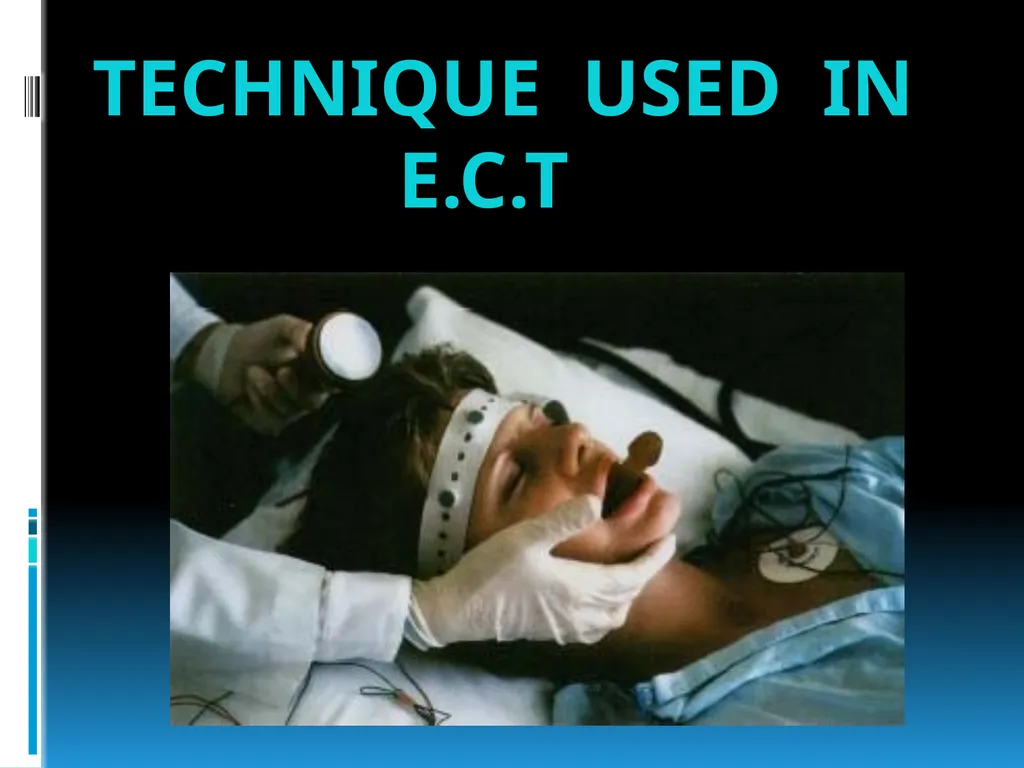
TECHNIQUE USED IN E.C.T<br>
14
The techniques used for ECT administration are of two types.
Direct E.C.T:- Here ECT is given in the absence of muscular relaxation and general anesthesia; All other stapes are the same this is now infrequently used.
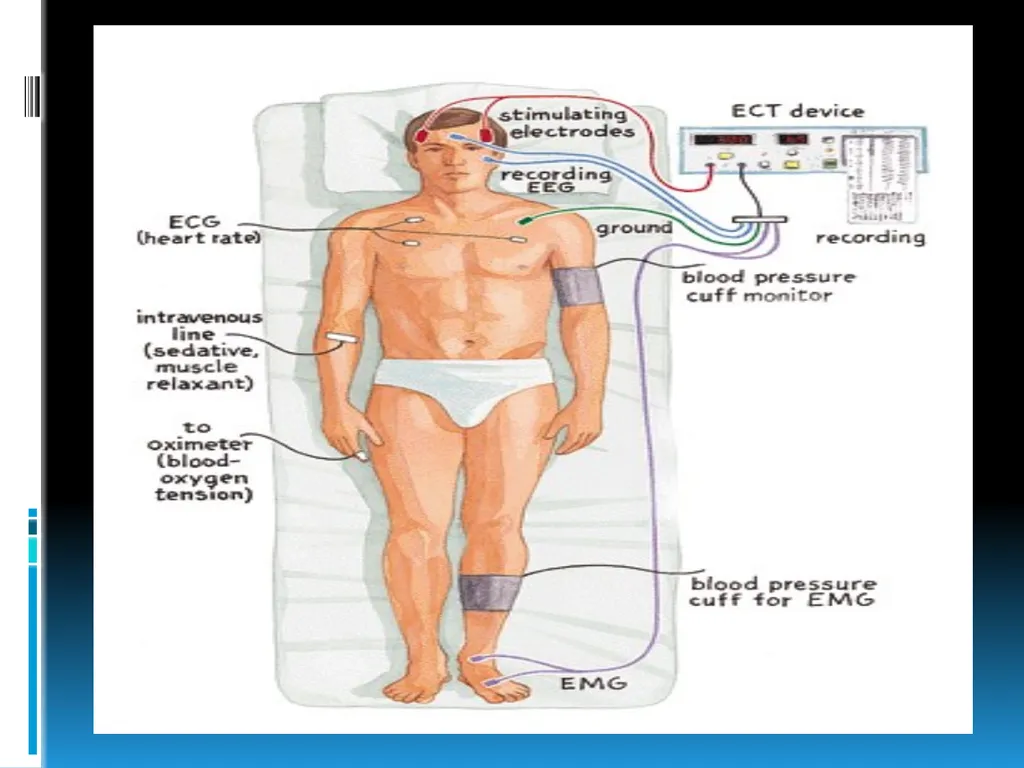
Modified E.C.T:- Here, ECT is modified by drug induced muscular relaxation & general anesthesia. ECT is usually administered in the morning after overnight, fast for 4 hrs before ECT.<br>
Direct E.C.T:- Here ECT is given in the absence of muscular relaxation and general anesthesia; All other stapes are the same this is now infrequently used.
Modified E.C.T:- Here, ECT is modified by drug induced muscular relaxation & general anesthesia. ECT is usually administered in the morning after overnight, fast for 4 hrs before ECT.<br>
15
TYPES OF ECT:- There are two types of administration
Bilateral E.C.T
Unilateral E.C.T<br>
Bilateral E.C.T
Unilateral E.C.T<br>
16
Bilateral E.C.T:-
This is the standard form of ECT most commonly used, in bilateral ECT electrodes are placed on each side one each above the midpoint of an imaginary line connecting the outer canthus of the eye and turgus of the ear, one of this electrodes (right non- dominant) other on the same side one- inch lateral to vertex are used in unilateral ECT.<br>
This is the standard form of ECT most commonly used, in bilateral ECT electrodes are placed on each side one each above the midpoint of an imaginary line connecting the outer canthus of the eye and turgus of the ear, one of this electrodes (right non- dominant) other on the same side one- inch lateral to vertex are used in unilateral ECT.<br>
17
Unilateral E.C.T :-
Here, the electrodes placed only one side of head usually non- dominant side unilateral ECT is safer with much fewer side effects particularly those of memory impairment. The place of electrodes placement is also cleaned with normal saline or 25% bicarbonate solution or a conducting gel is applied.<br>
Here, the electrodes placed only one side of head usually non- dominant side unilateral ECT is safer with much fewer side effects particularly those of memory impairment. The place of electrodes placement is also cleaned with normal saline or 25% bicarbonate solution or a conducting gel is applied.<br>
18
PRE- E.C.T PREPARATION:-
Psychiatric history and mental status examination to determine the indication for ECT should be available.
Anticonvulsant like carbamazepine need to be withhold before night E.C.T.
Check the record for recent physical examination and routine laboratory work.
Check for signed consent form
Involve the family as much as possible to inform them<br>
Psychiatric history and mental status examination to determine the indication for ECT should be available.
Anticonvulsant like carbamazepine need to be withhold before night E.C.T.
Check the record for recent physical examination and routine laboratory work.
Check for signed consent form
Involve the family as much as possible to inform them<br>
19
Communicate positive feeling about the procedure
Discourage cigarette smoking just before the procedure’s to avoid increased difficulty in managing pulmonary secretions during treatment.
Ensures that liquids and solids are not taken six hrs before treatment.
Remove dentures, glasses, jewelry, contact lenses.
Have the client evaluate bladder and bowels.
Monitor vital signs before, during and after treatment.<br>
Discourage cigarette smoking just before the procedure’s to avoid increased difficulty in managing pulmonary secretions during treatment.
Ensures that liquids and solids are not taken six hrs before treatment.
Remove dentures, glasses, jewelry, contact lenses.
Have the client evaluate bladder and bowels.
Monitor vital signs before, during and after treatment.<br>
20
MEDICINE TRAY:-
Sodium pentothal – 5mg /kg body wt (150-200mg)
Succnylcoline – 0.75mg/ kg body wt (30-50mg)
Injection atropine sulphate- 0.6mg Im
All emergency drugs like diazepam nitroglycerin tablets, etc
Anticolinergic agents
Sufficient autoclaved syringes and needles
Spirit swabs
I.V. glucose in water , glucose in saline
Tourniquet<br>
Sodium pentothal – 5mg /kg body wt (150-200mg)
Succnylcoline – 0.75mg/ kg body wt (30-50mg)
Injection atropine sulphate- 0.6mg Im
All emergency drugs like diazepam nitroglycerin tablets, etc
Anticolinergic agents
Sufficient autoclaved syringes and needles
Spirit swabs
I.V. glucose in water , glucose in saline
Tourniquet<br>
21
TREATMENT FACILITIES:-
There should a suite of three rooms-------
A pleasant and comfortable waiting room.
The room where E.C.T given
A well equipped recovery room
E.C.T Team:- This team consists of psychiatrist , anesthesiologist, trained nurses, and attainder.<br>
There should a suite of three rooms-------
A pleasant and comfortable waiting room.
The room where E.C.T given
A well equipped recovery room
E.C.T Team:- This team consists of psychiatrist , anesthesiologist, trained nurses, and attainder.<br>
22
PRE- E.C.T ROOM:-
A room which is pleasant and clam with dim light.
Sitting arrangements
Attached toilet and bathrooms.
Stretchers
E.C.T ROOM:-
ECT machine, jelly and electrodes.
Sphygmomanometer, stethoscope, intubation set ,
O2 delivery system etc
POST- ECT ROOM:-
Once the patient respond to a painful stimulus he is transferred to post ECT room<br>
A room which is pleasant and clam with dim light.
Sitting arrangements
Attached toilet and bathrooms.
Stretchers
E.C.T ROOM:-
ECT machine, jelly and electrodes.
Sphygmomanometer, stethoscope, intubation set ,
O2 delivery system etc
POST- ECT ROOM:-
Once the patient respond to a painful stimulus he is transferred to post ECT room<br>
23
FREQUENCY AND NUMBER OF TERATMENTS:-
Usually two or three ECTs per week are prescribed daily treatment is permissible in some cases in rapid onset of improvement is important as in severe mania, catatonia, high suicidal risk .etc
NUMBER:- A set number of treatments should not be prescribed. The patient should be assessed after each treatment see if there is need for further EC. The total number is 6 to 10 up to 25 may preferred as indicated.<br>
Usually two or three ECTs per week are prescribed daily treatment is permissible in some cases in rapid onset of improvement is important as in severe mania, catatonia, high suicidal risk .etc
NUMBER:- A set number of treatments should not be prescribed. The patient should be assessed after each treatment see if there is need for further EC. The total number is 6 to 10 up to 25 may preferred as indicated.<br>
24
SIDE EFFECTS OF E.C.T:-
E.C.T is also known as produce undesirable side effects like, amnesia, confusion, and EEG slowing, memory impairment, palpitation, nausea vomiting, dizziness, dryness of mouth, headache, weakness, muscle pain, poor concentration.etc
COMPLICATIONS:-
Respiratory arrest
Memory loss
Fractures sometimes occurs in elderly patient with osteoporosis<br>
E.C.T is also known as produce undesirable side effects like, amnesia, confusion, and EEG slowing, memory impairment, palpitation, nausea vomiting, dizziness, dryness of mouth, headache, weakness, muscle pain, poor concentration.etc
COMPLICATIONS:-
Respiratory arrest
Memory loss
Fractures sometimes occurs in elderly patient with osteoporosis<br>
25
ROLE OF THE NURSE:-
Pre- treatment evaluation:-
Detailed medical & psychiatric history including history of allergies.
Assessment of patients & family knowledge of indications side effects of E.C.T.
An informed consent should be taken.
Assess baseline vital signs.
Patient should be an empty stomach for 4-6 hrs prior to E.C.T.<br>
Pre- treatment evaluation:-
Detailed medical & psychiatric history including history of allergies.
Assessment of patients & family knowledge of indications side effects of E.C.T.
An informed consent should be taken.
Assess baseline vital signs.
Patient should be an empty stomach for 4-6 hrs prior to E.C.T.<br>
26
Withhold night doses of drugs which increase seizures threshold like diazepam & anticonvulsants.
Withhold oral medication in the morning
Head shampooing in the morning since oil causes impedance of passage electricity to brain.
Any jewelry, prosthesis, dentures, contact lenses, are removed.
Empty bladder & bowel before E.C.T.
Administered 0.6mg atropine IM or SC 30 min before ECT.<br>
Withhold oral medication in the morning
Head shampooing in the morning since oil causes impedance of passage electricity to brain.
Any jewelry, prosthesis, dentures, contact lenses, are removed.
Empty bladder & bowel before E.C.T.
Administered 0.6mg atropine IM or SC 30 min before ECT.<br>
27
Intra- procedure care:-
Place the patient comfortably in supine position
Stay with the patient to alley anxiety and fear.
Assisting in administering the anesthetic agent.
Mouth gag should be inserted to prevent possible toungue bite.
The place of electrode placement should be cleaned with normal saline or 25% bicarbonate solution are conducting gel applied.<br>
Place the patient comfortably in supine position
Stay with the patient to alley anxiety and fear.
Assisting in administering the anesthetic agent.
Mouth gag should be inserted to prevent possible toungue bite.
The place of electrode placement should be cleaned with normal saline or 25% bicarbonate solution are conducting gel applied.<br>
28
Monitor voltage intensity and duration of electrical stimulus given.
Monitor seizure activity.
100% O2 should be provided.
Monitor vital signs.
Record the findings and medicine given in the medicine chart.<br>
Monitor seizure activity.
100% O2 should be provided.
Monitor vital signs.
Record the findings and medicine given in the medicine chart.<br>
29
Post- operative care:-
Monitor vital signs
Continue oxygenation till spontaneous respiration starts.
Assess for post- ictal confusion and restlessness.
Take safety precautions to prevent injury .
Reorient the patient after recovery and stay with
him until fully oriented.
Document any findings as relevant in the patient record.<br>
Monitor vital signs
Continue oxygenation till spontaneous respiration starts.
Assess for post- ictal confusion and restlessness.
Take safety precautions to prevent injury .
Reorient the patient after recovery and stay with
him until fully oriented.
Document any findings as relevant in the patient record.<br>
30
THANK YOU<br>