
Electroluminescence as a phenomenon was discovered
TD
Published · 11 slides · 0 views

1 / 1

Description
Electroluminescence as a phenomenon was discovered in 1907 by the British experimenter H. J. Round of Marconi Labs Rubin Braunstein of the Radio Corporation of America reported on infrared emission from gallium arsenide (GaAs) and other
Related Topics
Share
Embed code
Download this presentation From Below
"Electroluminescence as a phenomenon was discovered" is the property of its rightful owner. Permission is granted to download and print the materials on this website for personal, non-commercial use only, and to display it on your personal computer provided you do not modify the materials and that you retain all copyright notices contained in the materials. By downloading content from our website, you accept the terms of this agreement.
Presentation Transcript
01
Electroluminescence as a phenomenon was discovered in 1907 by the British experimenter H. J. Round of Marconi Labs
Rubin Braunstein of the Radio Corporation of America reported on infrared emission from gallium arsenide (GaAs) and other semiconductor alloys in 1955.[
In the fall of 1961, while working at Texas Instruments Inc. in Dallas, TX, James R. Biard and Gary Pittman found that gallium arsenide (GaAs) emitted infrared light when electric current was applied.
The first visible-spectrum (red) LED was developed in 1962 by Nick Holonyak, Jr., while working at General Electric Company.[
M. George Craford, a former graduate student of Holonyak, invented the first yellow LED and improved the brightness of red and red-orange LEDs by a factor of ten in 1972
In 1976, T. P. Pearsall created the first high-brightness, high-efficiency LEDs for optical fiber telecommunications by inventing new semiconductor materials specifically adapted to optical fiber transmission wavelengths Light Emitting Diodes<br>
Rubin Braunstein of the Radio Corporation of America reported on infrared emission from gallium arsenide (GaAs) and other semiconductor alloys in 1955.[
In the fall of 1961, while working at Texas Instruments Inc. in Dallas, TX, James R. Biard and Gary Pittman found that gallium arsenide (GaAs) emitted infrared light when electric current was applied.
The first visible-spectrum (red) LED was developed in 1962 by Nick Holonyak, Jr., while working at General Electric Company.[
M. George Craford, a former graduate student of Holonyak, invented the first yellow LED and improved the brightness of red and red-orange LEDs by a factor of ten in 1972
In 1976, T. P. Pearsall created the first high-brightness, high-efficiency LEDs for optical fiber telecommunications by inventing new semiconductor materials specifically adapted to optical fiber transmission wavelengths Light Emitting Diodes<br>
02
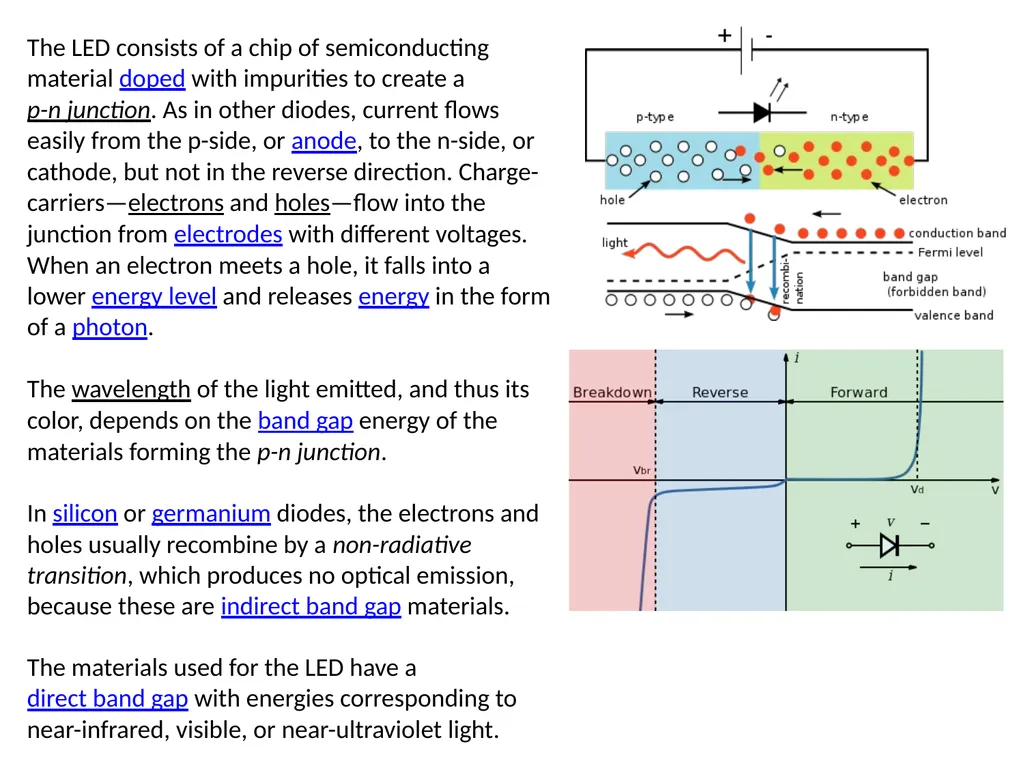
The LED consists of a chip of semiconducting material doped with impurities to create a p-n junction. As in other diodes, current flows easily from the p-side, or anode, to the n-side, or cathode, but not in the reverse direction. Charge-carriers—electrons and holes—flow into the junction from electrodes with different voltages. When an electron meets a hole, it falls into a lower energy level and releases energy in the form of a photon.
The wavelength of the light emitted, and thus its color, depends on the band gap energy of the materials forming the p-n junction.
In silicon or germanium diodes, the electrons and holes usually recombine by a non-radiative transition, which produces no optical emission, because these are indirect band gap materials.
The materials used for the LED have a direct band gap with energies corresponding to near-infrared, visible, or near-ultraviolet light.<br>
The wavelength of the light emitted, and thus its color, depends on the band gap energy of the materials forming the p-n junction.
In silicon or germanium diodes, the electrons and holes usually recombine by a non-radiative transition, which produces no optical emission, because these are indirect band gap materials.
The materials used for the LED have a direct band gap with energies corresponding to near-infrared, visible, or near-ultraviolet light.<br>
03
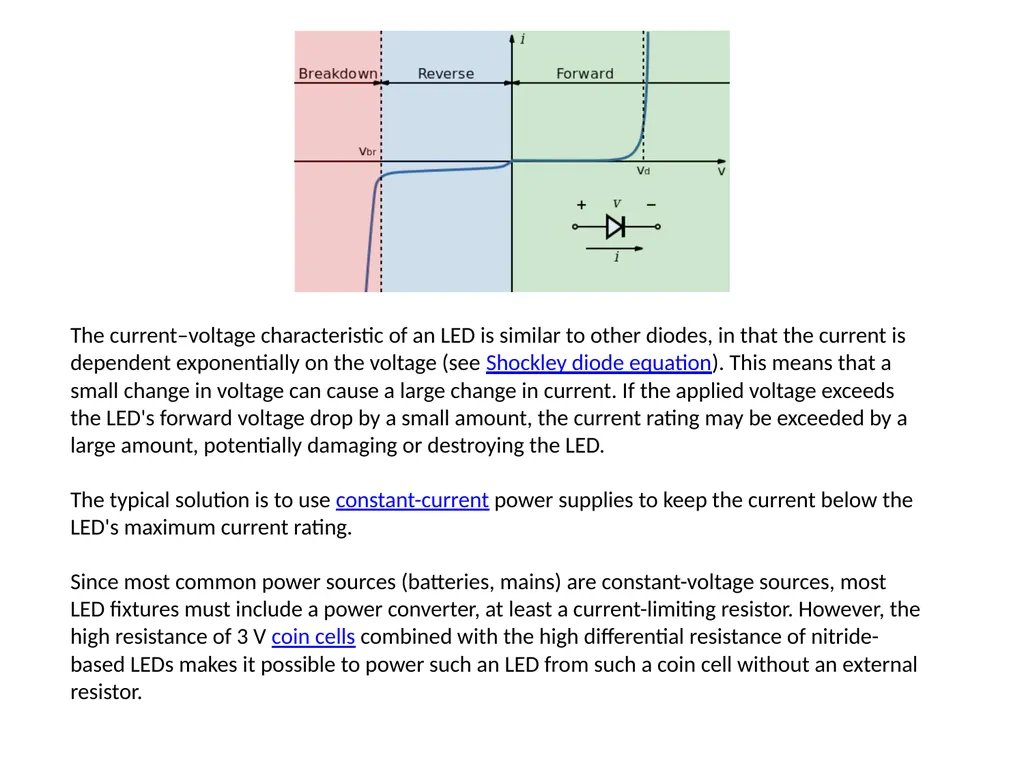
The current–voltage characteristic of an LED is similar to other diodes, in that the current is dependent exponentially on the voltage (see Shockley diode equation). This means that a small change in voltage can cause a large change in current. If the applied voltage exceeds the LED's forward voltage drop by a small amount, the current rating may be exceeded by a large amount, potentially damaging or destroying the LED.
The typical solution is to use constant-current power supplies to keep the current below the LED's maximum current rating.
Since most common power sources (batteries, mains) are constant-voltage sources, most LED fixtures must include a power converter, at least a current-limiting resistor. However, the high resistance of 3 V coin cells combined with the high differential resistance of nitride-based LEDs makes it possible to power such an LED from such a coin cell without an external resistor.<br>
The typical solution is to use constant-current power supplies to keep the current below the LED's maximum current rating.
Since most common power sources (batteries, mains) are constant-voltage sources, most LED fixtures must include a power converter, at least a current-limiting resistor. However, the high resistance of 3 V coin cells combined with the high differential resistance of nitride-based LEDs makes it possible to power such an LED from such a coin cell without an external resistor.<br>
04
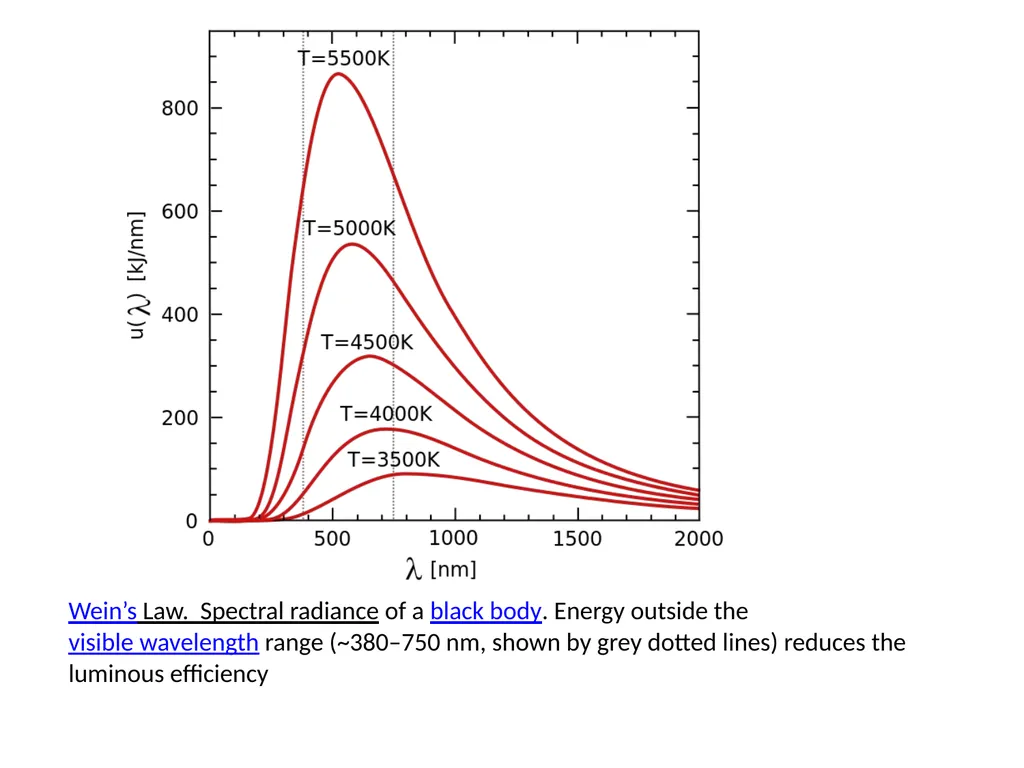
Wein’s Law. Spectral radiance of a black body. Energy outside the visible wavelength range (~380–750 nm, shown by grey dotted lines) reduces the luminous efficiency<br>
05
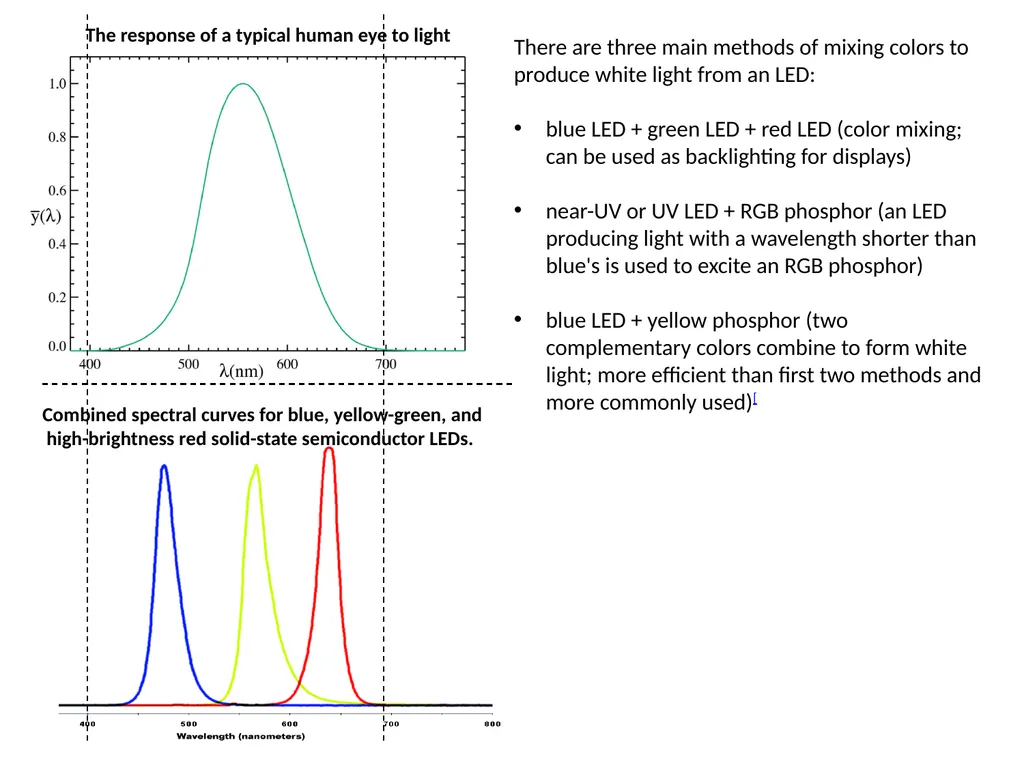
The response of a typical human eye to light There are three main methods of mixing colors to produce white light from an LED:
blue LED + green LED + red LED (color mixing; can be used as backlighting for displays)
near-UV or UV LED + RGB phosphor (an LED producing light with a wavelength shorter than blue's is used to excite an RGB phosphor)
blue LED + yellow phosphor (two complementary colors combine to form white light; more efficient than first two methods and more commonly used)[ Combined spectral curves for blue, yellow-green, and high-brightness red solid-state semiconductor LEDs.<br>
blue LED + green LED + red LED (color mixing; can be used as backlighting for displays)
near-UV or UV LED + RGB phosphor (an LED producing light with a wavelength shorter than blue's is used to excite an RGB phosphor)
blue LED + yellow phosphor (two complementary colors combine to form white light; more efficient than first two methods and more commonly used)[ Combined spectral curves for blue, yellow-green, and high-brightness red solid-state semiconductor LEDs.<br>
06
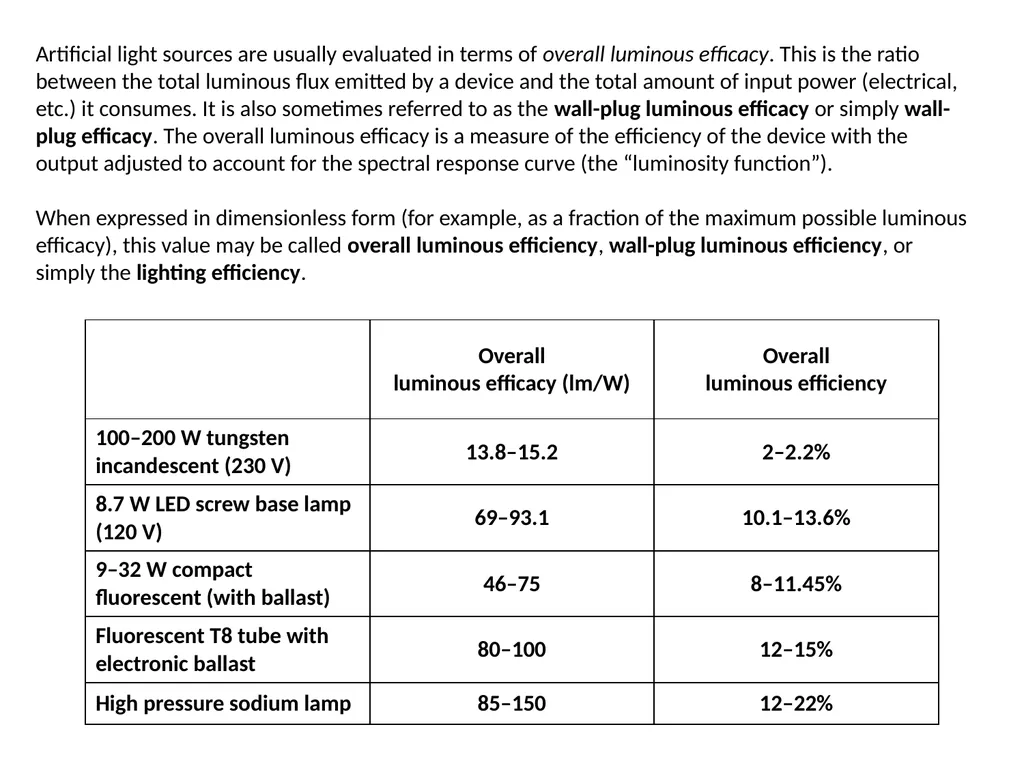
Artificial light sources are usually evaluated in terms of overall luminous efficacy. This is the ratio between the total luminous flux emitted by a device and the total amount of input power (electrical, etc.) it consumes. It is also sometimes referred to as the wall-plug luminous efficacy or simply wall-plug efficacy. The overall luminous efficacy is a measure of the efficiency of the device with the output adjusted to account for the spectral response curve (the “luminosity function”).
When expressed in dimensionless form (for example, as a fraction of the maximum possible luminous efficacy), this value may be called overall luminous efficiency, wall-plug luminous efficiency, or simply the lighting efficiency.<br>
When expressed in dimensionless form (for example, as a fraction of the maximum possible luminous efficacy), this value may be called overall luminous efficiency, wall-plug luminous efficiency, or simply the lighting efficiency.<br>
07
Advantages of LEDs
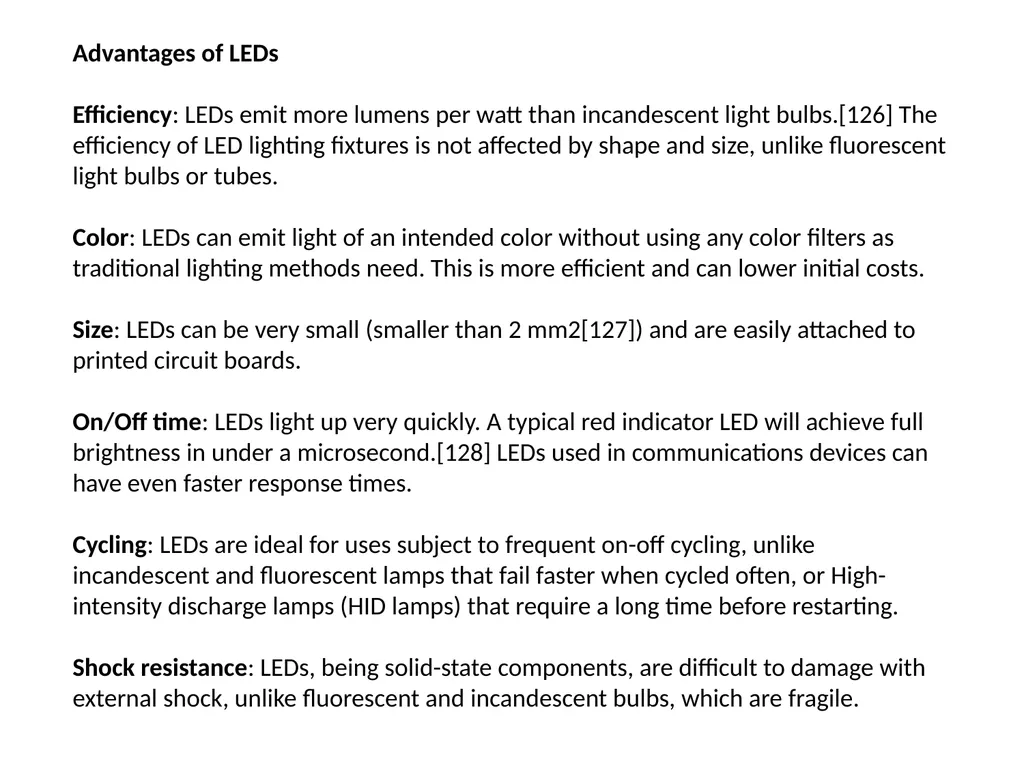
Efficiency: LEDs emit more lumens per watt than incandescent light bulbs.[126] The efficiency of LED lighting fixtures is not affected by shape and size, unlike fluorescent light bulbs or tubes.
Color: LEDs can emit light of an intended color without using any color filters as traditional lighting methods need. This is more efficient and can lower initial costs.
Size: LEDs can be very small (smaller than 2 mm2[127]) and are easily attached to printed circuit boards.
On/Off time: LEDs light up very quickly. A typical red indicator LED will achieve full brightness in under a microsecond.[128] LEDs used in communications devices can have even faster response times.
Cycling: LEDs are ideal for uses subject to frequent on-off cycling, unlike incandescent and fluorescent lamps that fail faster when cycled often, or High-intensity discharge lamps (HID lamps) that require a long time before restarting.
Shock resistance: LEDs, being solid-state components, are difficult to damage with external shock, unlike fluorescent and incandescent bulbs, which are fragile.<br>
Efficiency: LEDs emit more lumens per watt than incandescent light bulbs.[126] The efficiency of LED lighting fixtures is not affected by shape and size, unlike fluorescent light bulbs or tubes.
Color: LEDs can emit light of an intended color without using any color filters as traditional lighting methods need. This is more efficient and can lower initial costs.
Size: LEDs can be very small (smaller than 2 mm2[127]) and are easily attached to printed circuit boards.
On/Off time: LEDs light up very quickly. A typical red indicator LED will achieve full brightness in under a microsecond.[128] LEDs used in communications devices can have even faster response times.
Cycling: LEDs are ideal for uses subject to frequent on-off cycling, unlike incandescent and fluorescent lamps that fail faster when cycled often, or High-intensity discharge lamps (HID lamps) that require a long time before restarting.
Shock resistance: LEDs, being solid-state components, are difficult to damage with external shock, unlike fluorescent and incandescent bulbs, which are fragile.<br>
08
Advantages of LEDs, cont.
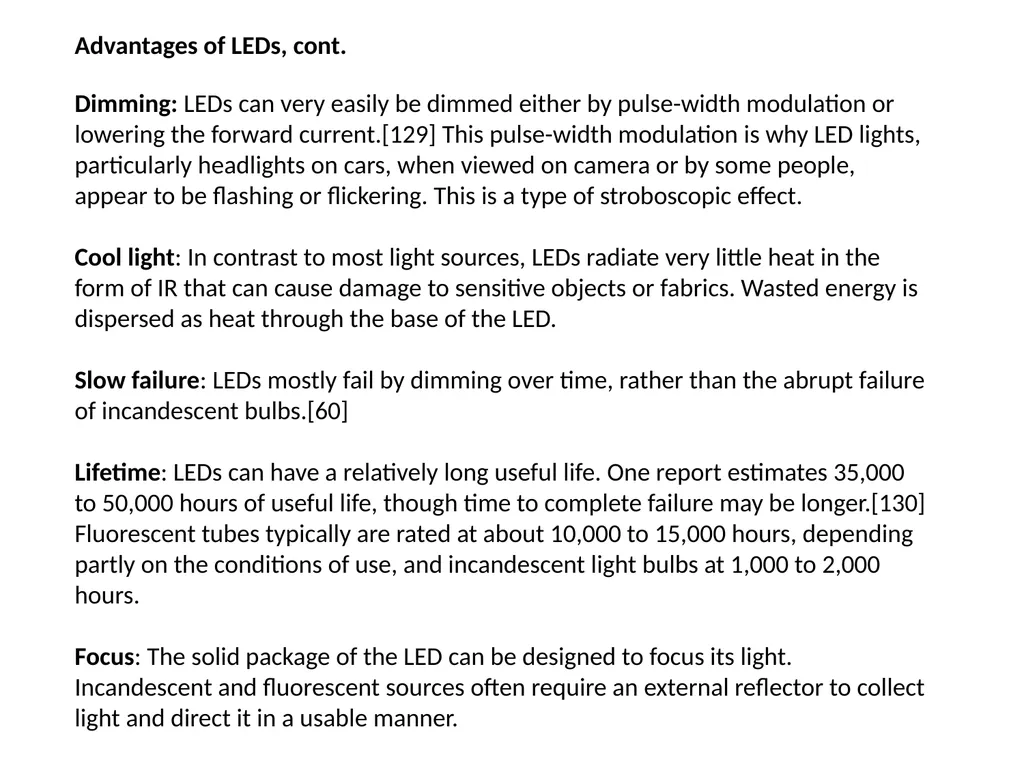
Dimming: LEDs can very easily be dimmed either by pulse-width modulation or lowering the forward current.[129] This pulse-width modulation is why LED lights, particularly headlights on cars, when viewed on camera or by some people, appear to be flashing or flickering. This is a type of stroboscopic effect.
Cool light: In contrast to most light sources, LEDs radiate very little heat in the form of IR that can cause damage to sensitive objects or fabrics. Wasted energy is dispersed as heat through the base of the LED.
Slow failure: LEDs mostly fail by dimming over time, rather than the abrupt failure of incandescent bulbs.[60]
Lifetime: LEDs can have a relatively long useful life. One report estimates 35,000 to 50,000 hours of useful life, though time to complete failure may be longer.[130] Fluorescent tubes typically are rated at about 10,000 to 15,000 hours, depending partly on the conditions of use, and incandescent light bulbs at 1,000 to 2,000 hours.
Focus: The solid package of the LED can be designed to focus its light. Incandescent and fluorescent sources often require an external reflector to collect light and direct it in a usable manner.<br>
Dimming: LEDs can very easily be dimmed either by pulse-width modulation or lowering the forward current.[129] This pulse-width modulation is why LED lights, particularly headlights on cars, when viewed on camera or by some people, appear to be flashing or flickering. This is a type of stroboscopic effect.
Cool light: In contrast to most light sources, LEDs radiate very little heat in the form of IR that can cause damage to sensitive objects or fabrics. Wasted energy is dispersed as heat through the base of the LED.
Slow failure: LEDs mostly fail by dimming over time, rather than the abrupt failure of incandescent bulbs.[60]
Lifetime: LEDs can have a relatively long useful life. One report estimates 35,000 to 50,000 hours of useful life, though time to complete failure may be longer.[130] Fluorescent tubes typically are rated at about 10,000 to 15,000 hours, depending partly on the conditions of use, and incandescent light bulbs at 1,000 to 2,000 hours.
Focus: The solid package of the LED can be designed to focus its light. Incandescent and fluorescent sources often require an external reflector to collect light and direct it in a usable manner.<br>
09
Disadvantages of LEDs
Higher initial price: LEDs are currently more expensive, price per lumen, on an initial capital cost basis, than most conventional lighting technologies.
Temperature dependence: LED performance largely depends on the ambient temperature of the operating environment – or "thermal management" properties. Over-driving an LED in high ambient temperatures may result in overheating the LED package, eventually leading to device failure. An adequate heat sink is needed to maintain long life.
Voltage sensitivity: LEDs must be supplied with the voltage above the threshold and a current below the rating. This can involve series resistors or current-regulated power supplies.
Light quality: Most cool-white LEDs have spectra that differ significantly from a black body radiator like the sun or an incandescent light. The spike at 460 nm and dip at 500 nm can cause the color of objects to be perceived differently under cool-white LED illumination than sunlight or incandescent sources, red surfaces being rendered particularly badly by typical phosphor-based cool-white LEDs. However, the color-rendering properties of common fluorescent lamps are often inferior to what is now available in state-of-art white LEDs.<br>
Higher initial price: LEDs are currently more expensive, price per lumen, on an initial capital cost basis, than most conventional lighting technologies.
Temperature dependence: LED performance largely depends on the ambient temperature of the operating environment – or "thermal management" properties. Over-driving an LED in high ambient temperatures may result in overheating the LED package, eventually leading to device failure. An adequate heat sink is needed to maintain long life.
Voltage sensitivity: LEDs must be supplied with the voltage above the threshold and a current below the rating. This can involve series resistors or current-regulated power supplies.
Light quality: Most cool-white LEDs have spectra that differ significantly from a black body radiator like the sun or an incandescent light. The spike at 460 nm and dip at 500 nm can cause the color of objects to be perceived differently under cool-white LED illumination than sunlight or incandescent sources, red surfaces being rendered particularly badly by typical phosphor-based cool-white LEDs. However, the color-rendering properties of common fluorescent lamps are often inferior to what is now available in state-of-art white LEDs.<br>
10
Disadvantages of LEDs, cont.
Area light source: Single LEDs do not approximate a point source of light giving a spherical light distribution, but rather a lambertian distribution. So LEDs are difficult to apply to uses needing a spherical light field
Electrical polarity: Unlike incandescent light bulbs, which illuminate regardless of the electrical polarity, LEDs will only light with correct electrical polarity. To automatically match source polarity to LED devices, rectifiers can be used.
Blue hazard: There is a concern that blue LEDs and cool-white LEDs are now capable of exceeding safe limits of the so-called blue-light hazard as defined in eye safety specifications such as ANSI/IESNA RP-27.1–05: Recommended Practice for Photobiological Safety for Lamp and Lamp Systems.
Blue pollution: Because cool-white LEDs with high color temperature emit proportionally more blue light than conventional outdoor light sources such as high-pressure sodium vapor lamps, the strong wavelength dependence of Rayleigh scattering means that cool-white LEDs can cause more light pollution than other light sources. The International Dark-Sky Association discourages using white light sources with correlated color temperature above 3,000 K.[119]<br>
Area light source: Single LEDs do not approximate a point source of light giving a spherical light distribution, but rather a lambertian distribution. So LEDs are difficult to apply to uses needing a spherical light field
Electrical polarity: Unlike incandescent light bulbs, which illuminate regardless of the electrical polarity, LEDs will only light with correct electrical polarity. To automatically match source polarity to LED devices, rectifiers can be used.
Blue hazard: There is a concern that blue LEDs and cool-white LEDs are now capable of exceeding safe limits of the so-called blue-light hazard as defined in eye safety specifications such as ANSI/IESNA RP-27.1–05: Recommended Practice for Photobiological Safety for Lamp and Lamp Systems.
Blue pollution: Because cool-white LEDs with high color temperature emit proportionally more blue light than conventional outdoor light sources such as high-pressure sodium vapor lamps, the strong wavelength dependence of Rayleigh scattering means that cool-white LEDs can cause more light pollution than other light sources. The International Dark-Sky Association discourages using white light sources with correlated color temperature above 3,000 K.[119]<br>
11
Disadvantages of LEDs, cont.
Impact on insects: LEDs are much more attractive to insects than sodium-vapor lights, so much so that there has been speculative concern about the possibility of disruption to food webs.<br>
Impact on insects: LEDs are much more attractive to insects than sodium-vapor lights, so much so that there has been speculative concern about the possibility of disruption to food webs.<br>