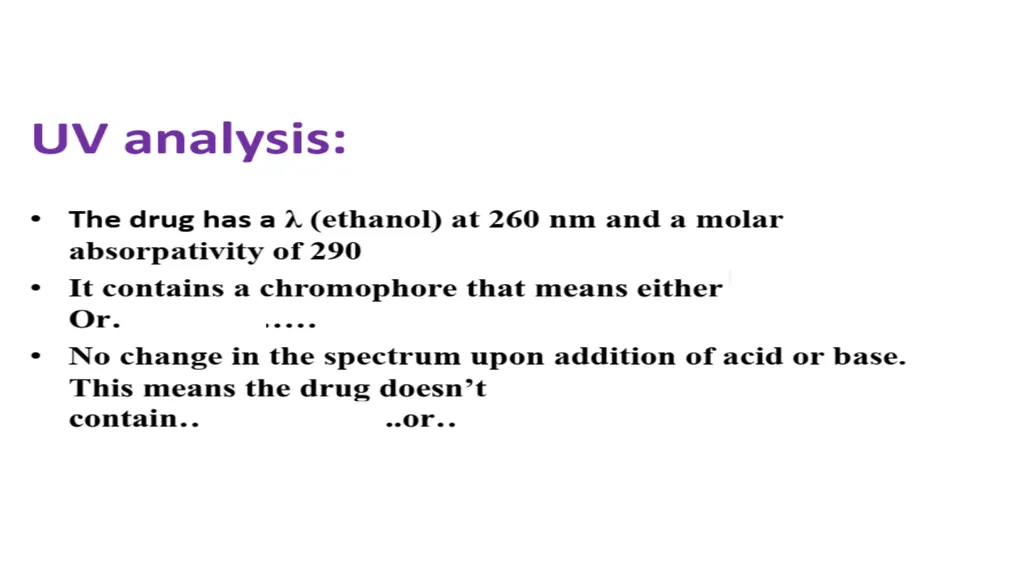
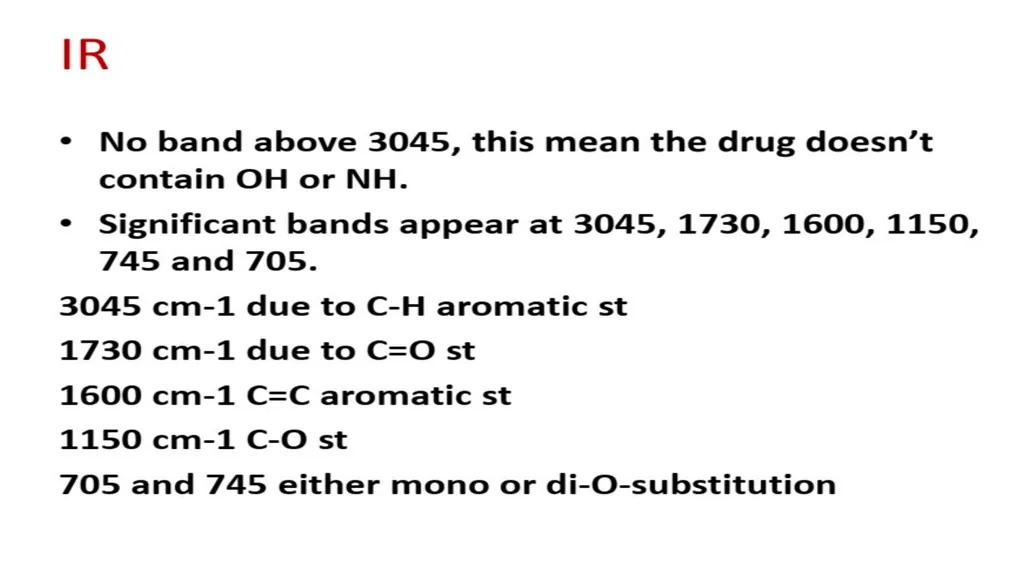
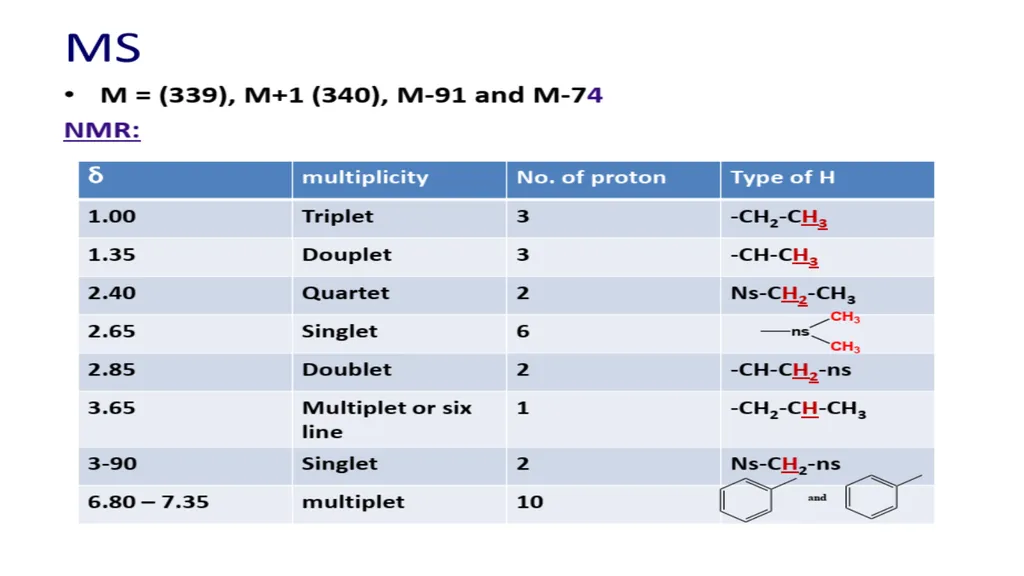
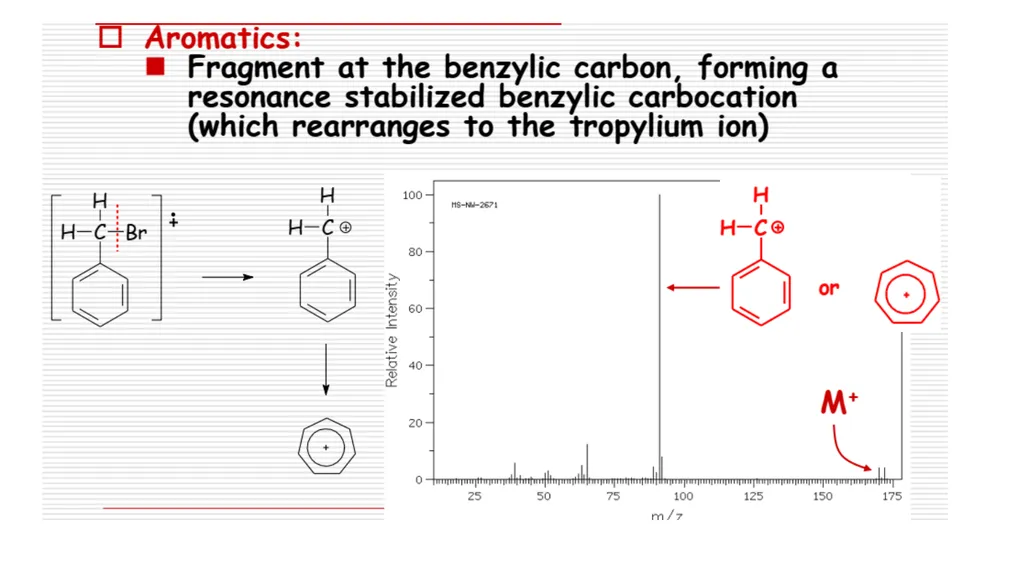
Elemental analysis Structure Elucidation Alkhair Adam Khalil, B. Pharm., M. Pharm. Department of Pharmaceutical Chemistry College of Pharmacy Karary University There are four data required for structure elucidation: Elemental analysis
"Elemental analysis & Structure Elucidation Alkhair" is the property of its rightful owner. Permission is granted to
download and print the materials on this website for personal, non-commercial use only, and to display it
on your personal computer provided you do not modify the materials and that you retain all copyright
notices contained in the materials. By downloading content from our website, you accept the terms of this
agreement.
Presentation Transcript
01
Elemental analysis & Structure Elucidation Alkhair Adam Khalil, B. Pharm., M. Pharm.
Department of Pharmaceutical Chemistry
College of Pharmacy – Karary University<br>
02
There are four data required for structure elucidation:
Elemental analysis
Mass spectrometry (MS)
Infrared spectroscopy (IR)
Nuclear magnetic spectroscopy (NMR)<br>
03
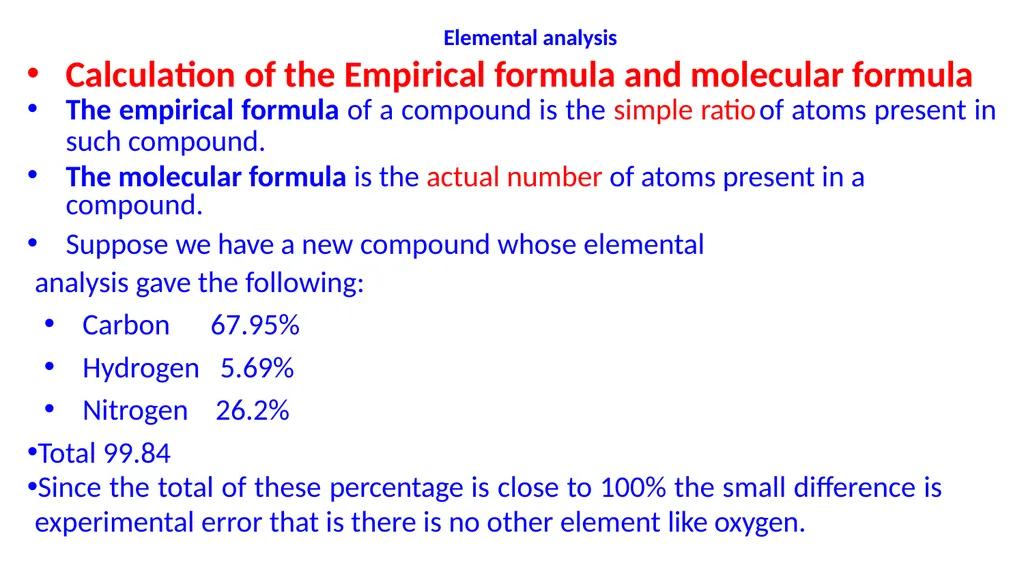
Elemental analysis Calculation of the Empirical formula and molecular formula
The empirical formula of a compound is the simple ratio of atoms present in such compound.
The molecular formula is the actual number of atoms present in a compound.
Suppose we have a new compound whose elemental
analysis gave the following:
Carbon 67.95%
Hydrogen 5.69%
Nitrogen 26.2%
Total 99.84
Since the total of these percentage is close to 100% the small difference is experimental error that is there is no other element like oxygen.<br>
04
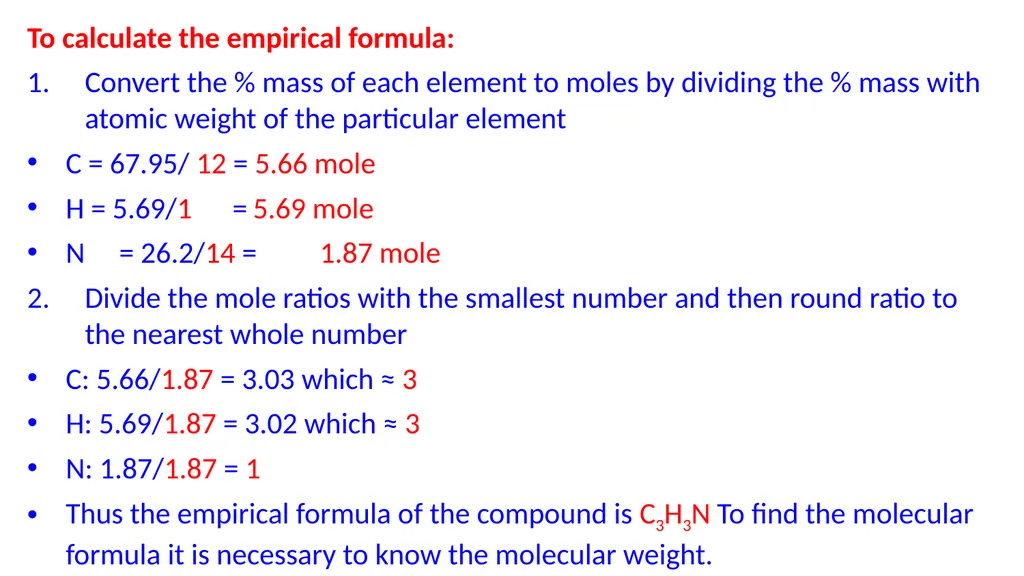
To calculate the empirical formula:
Convert the % mass of each element to moles by dividing the % mass with atomic weight of the particular element
C = 67.95/ 12 = 5.66 mole
H = 5.69/1 = 5.69 mole
N = 26.2/14 = 1.87 mole
Divide the mole ratios with the smallest number and then round ratio to the nearest whole number
C: 5.66/1.87 = 3.03 which ≈ 3
H: 5.69/1.87 = 3.02 which ≈ 3
N: 1.87/1.87 = 1
Thus the empirical formula of the compound is C3H3N To find the molecular formula it is necessary to know the molecular weight.<br>
05
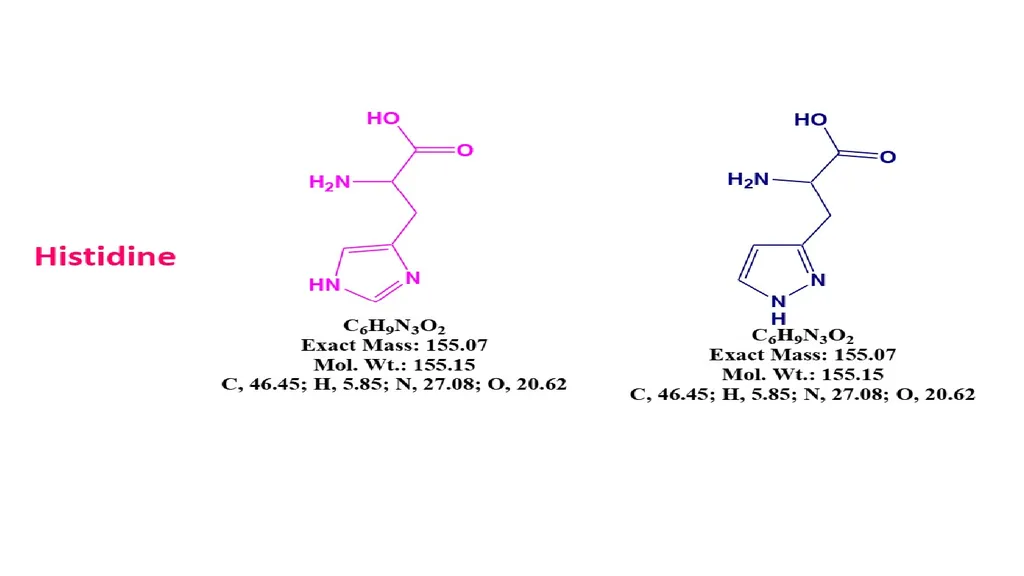
Histidine an amino acid isolated from protein gave the following elemental analysis: C, 46.38%, H, 5.90%, N, 27.01%.
Total is 79.29 in this case the difference is oxygen i.e. 100- 79.29 = 20.71%
To get the ratios as moles divide by atomic weight:
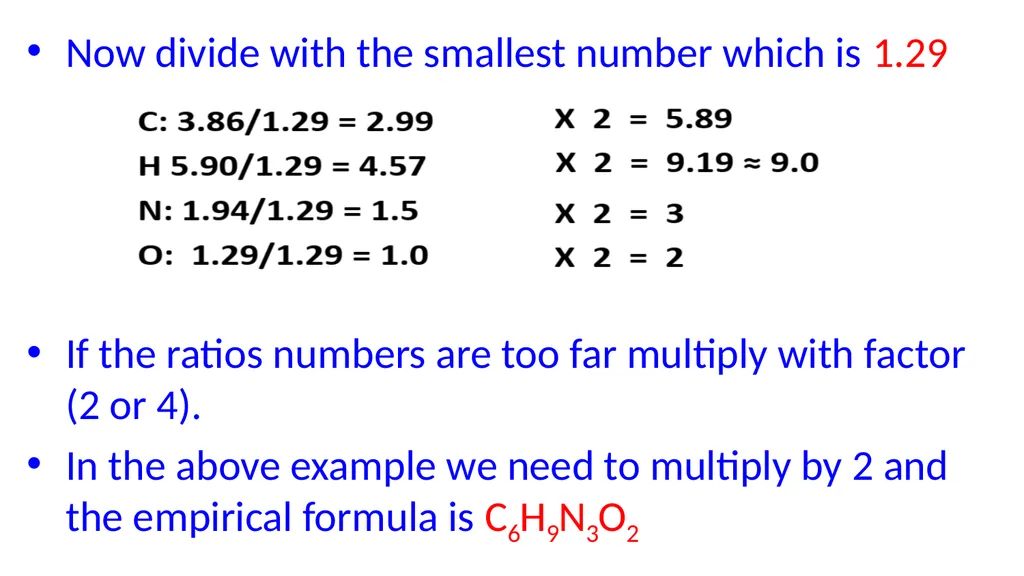
C: 46.38/12 = 3.86, H:5.9/1.0 = 5.90, N: 27.29/14 = 1.94, O: 20.71/16 = 1.29 Example:<br>
06
Now divide with the smallest number which is 1.29
If the ratios numbers are too far multiply with factor (2 or 4).
In the above example we need to multiply by 2 and the empirical formula is C6H9N3O2<br>
07
Mass spectrometry showed that histidine has the molecular weight 155
The empirical formula weight 155, therefore molecular formula of histidine is also C6H9N3O2
The way in which these atoms are joined together to give histidine is called the molecular structure of histidine this is determined by both physical and chemical methods.<br>
08
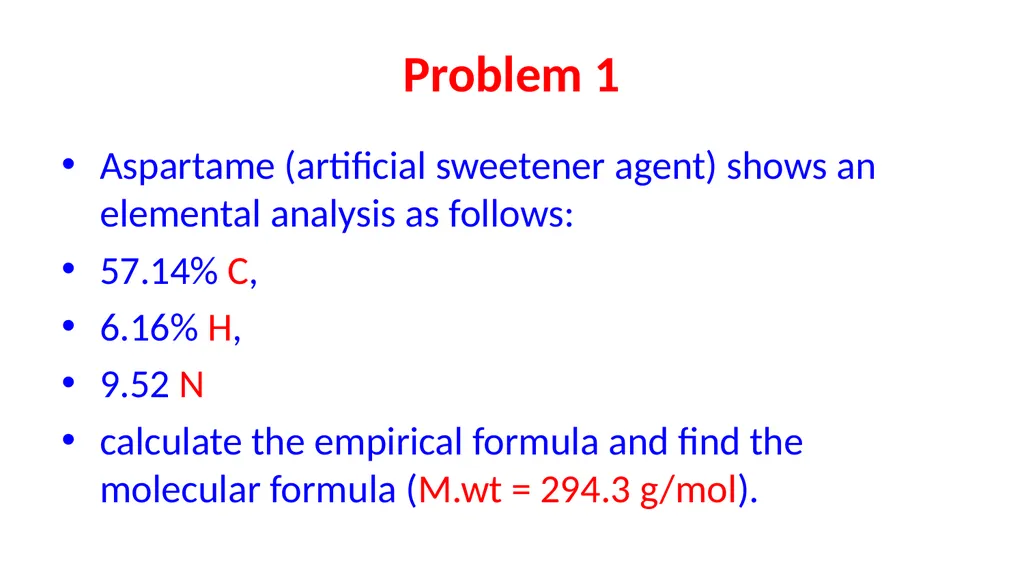
Problem 1 Aspartame (artificial sweetener agent) shows an elemental analysis as follows:
57.14% C,
6.16% H,
9.52 N
calculate the empirical formula and find the molecular formula (M.wt = 294.3 g/mol).<br>
09
57.14+6.16+9.52 = 72.82%
The remaining is oxygen = 27.18
57.14% C, = 57.14/12 = 4.762 moles
6.16% H, = 6.16/1 = 6.16 moles
9.52% N, = 9.52/14 = 0.68 mole
27.18% O = 27.18/16 = 1.7 moles
Divide by 0.68 C7H9NO2.5
Multiply by 2 C14H18N2O5 Molecular mass = 294
Therefore the empirical formula is the molecular formula<br>
10
C14H18N2O5 294.3 gram/mole
Degree of unsaturation = 7 ( (aromatic ring = 4) + 3 C=O) Aspartame<br>
11
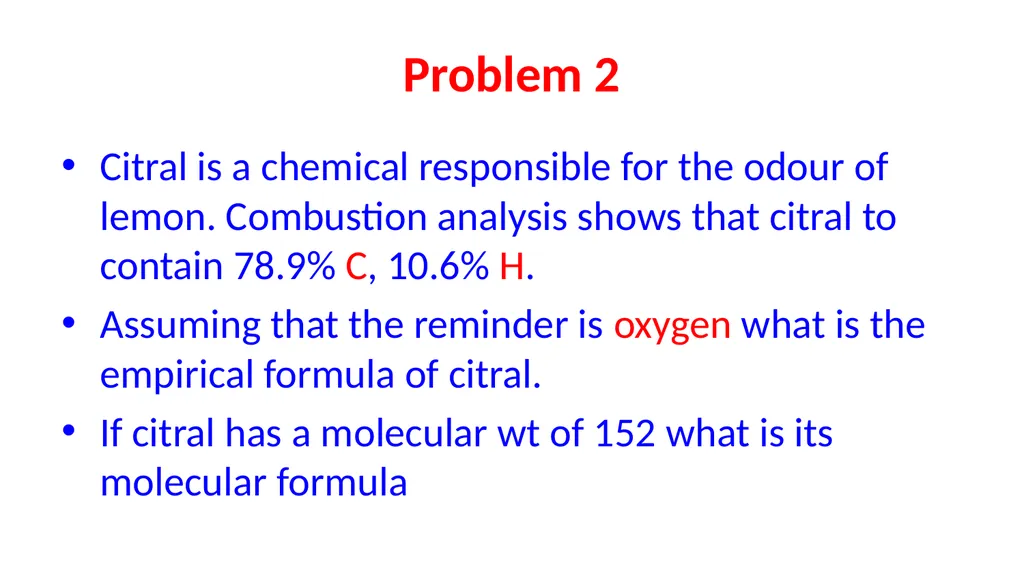
Problem 2 Citral is a chemical responsible for the odour of lemon. Combustion analysis shows that citral to contain 78.9% C, 10.6% H.
Assuming that the reminder is oxygen what is the empirical formula of citral.
If citral has a molecular wt of 152 what is its molecular formula<br>
12
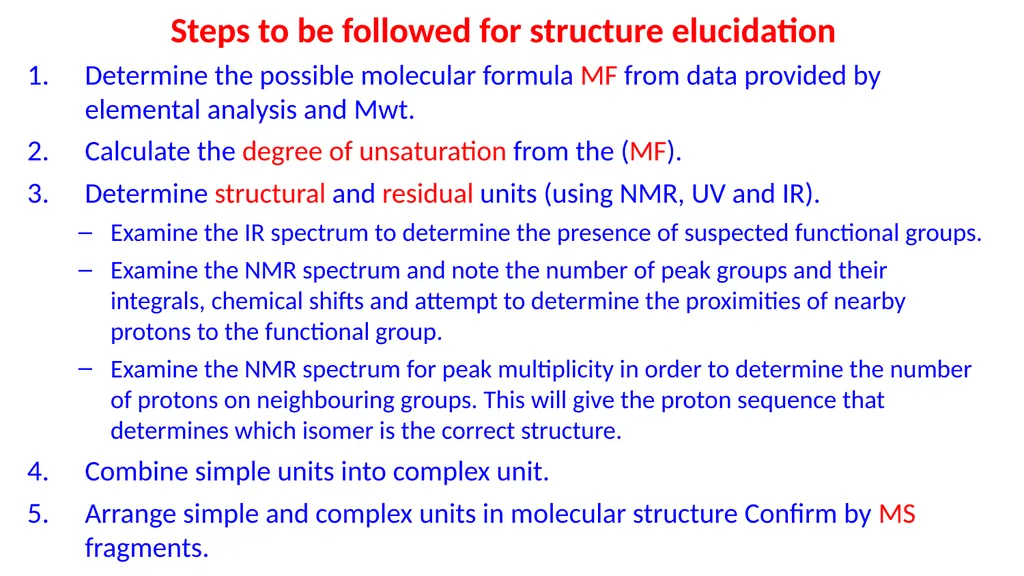
Steps to be followed for structure elucidation Determine the possible molecular formula MF from data provided by elemental analysis and Mwt.
Calculate the degree of unsaturation from the (MF).
Determine structural and residual units (using NMR, UV and IR).
Examine the IR spectrum to determine the presence of suspected functional groups.
Examine the NMR spectrum and note the number of peak groups and their integrals, chemical shifts and attempt to determine the proximities of nearby protons to the functional group.
Examine the NMR spectrum for peak multiplicity in order to determine the number of protons on neighbouring groups. This will give the proton sequence that determines which isomer is the correct structure.
Combine simple units into complex unit.
Arrange simple and complex units in molecular structure Confirm by MS fragments.<br>
13
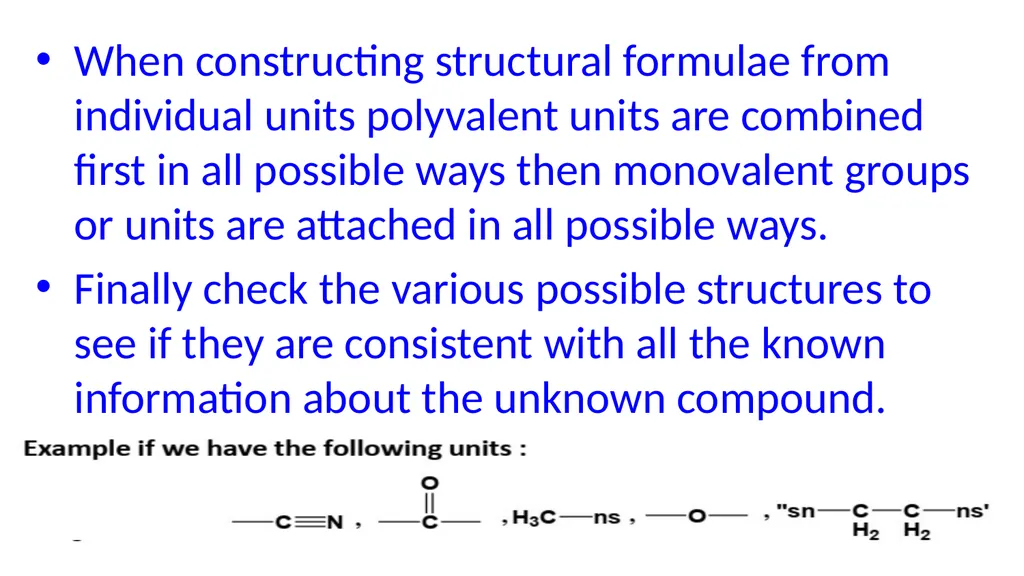
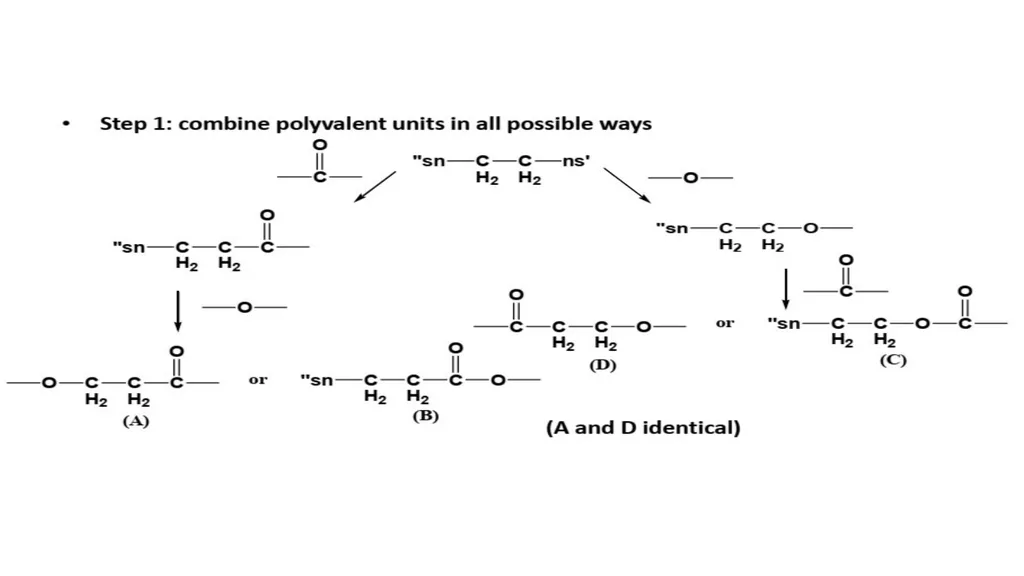
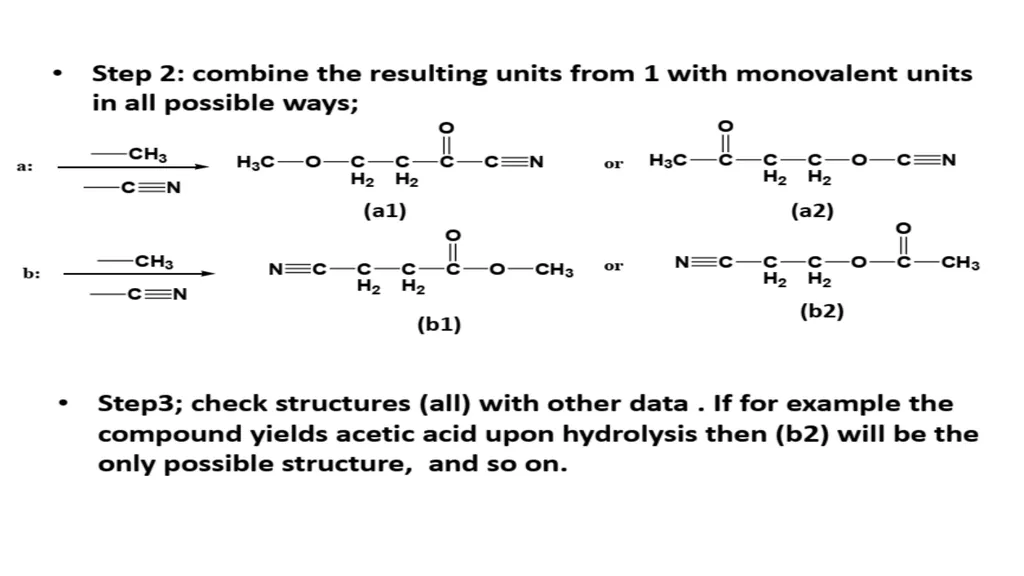
When constructing structural formulae from individual units polyvalent units are combined first in all possible ways then monovalent groups or units are attached in all possible ways.
Finally check the various possible structures to see if they are consistent with all the known information about the unknown compound.<br>