Elements of a clinical trial research protocol
Description: Elements of a clinical trial research protocol Outline Identify the session objective Discuss the content of a clinical trial protocol Discuss the content of observational study Conclusion Study objective Participants will learn about the
Related Topics
Download Presentation
"Elements of a clinical trial research protocol" is the property of its rightful owner. Permission is granted to download and print the materials on this website for personal, non-commercial use only, and to display it on your personal computer provided you do not modify the materials and that you retain all copyright notices contained in the materials. By downloading content from our website, you accept the terms of this agreement.
Presentation Transcript
slide1. Elements of a clinical trial research protocol<br>
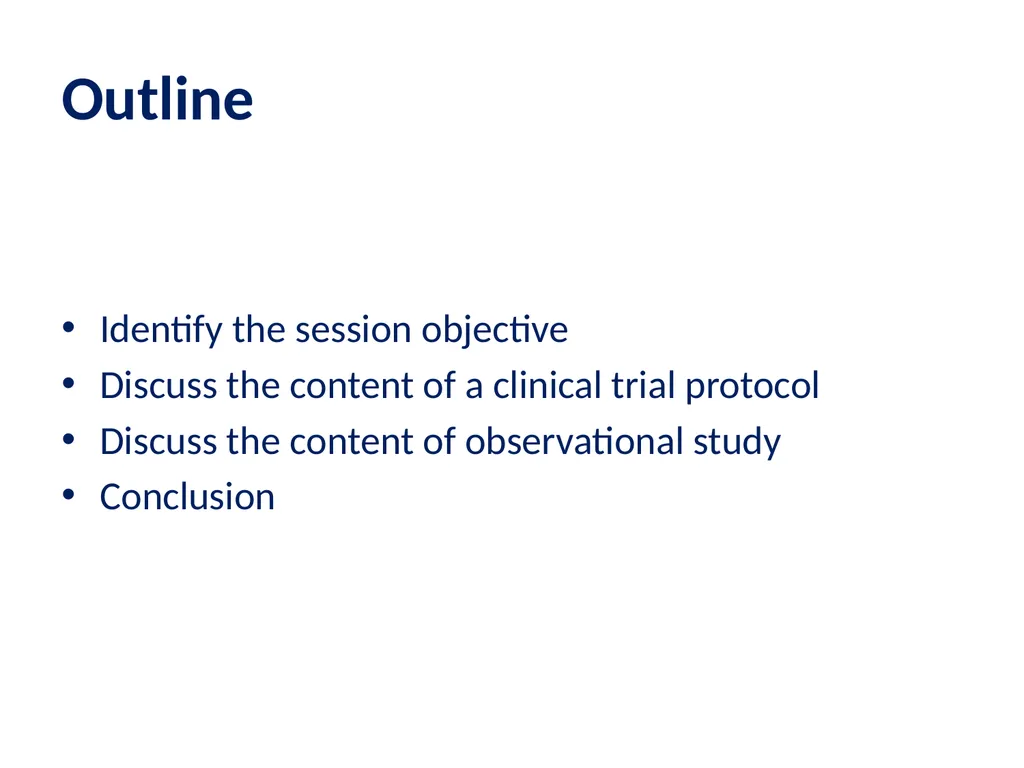
slide2. Outline Identify the session objective
Discuss the content of a clinical trial protocol
Discuss the content of observational study
Conclusion<br>
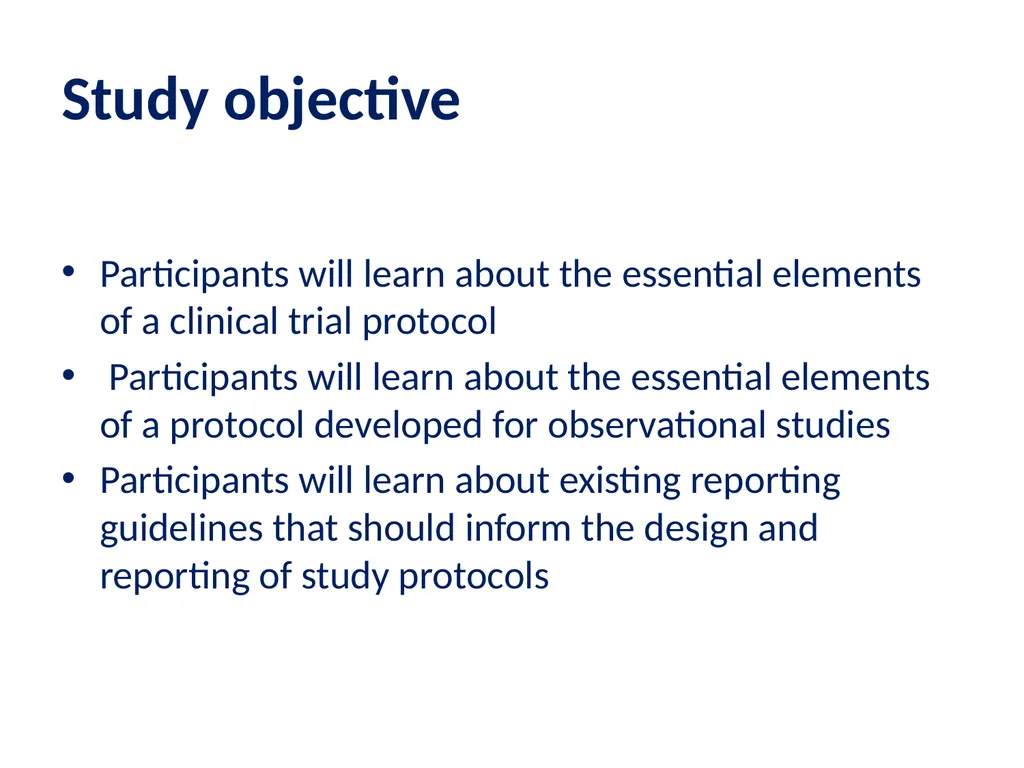
slide3. Study objective Participants will learn about the essential elements of a clinical trial protocol
Participants will learn about the essential elements of a protocol developed for observational studies
Participants will learn about existing reporting guidelines that should inform the design and reporting of study protocols<br>
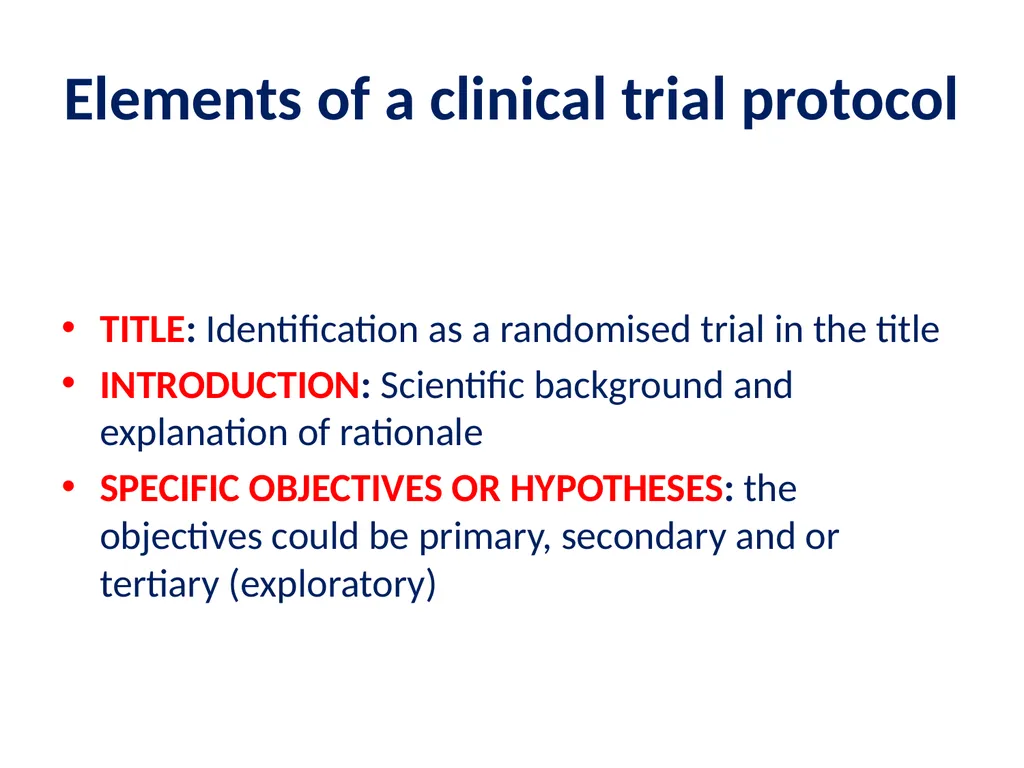
slide4. Elements of a clinical trial protocol TITLE: Identification as a randomised trial in the title
INTRODUCTION: Scientific background and explanation of rationale
SPECIFIC OBJECTIVES OR HYPOTHESES: the objectives could be primary, secondary and or tertiary (exploratory)<br>
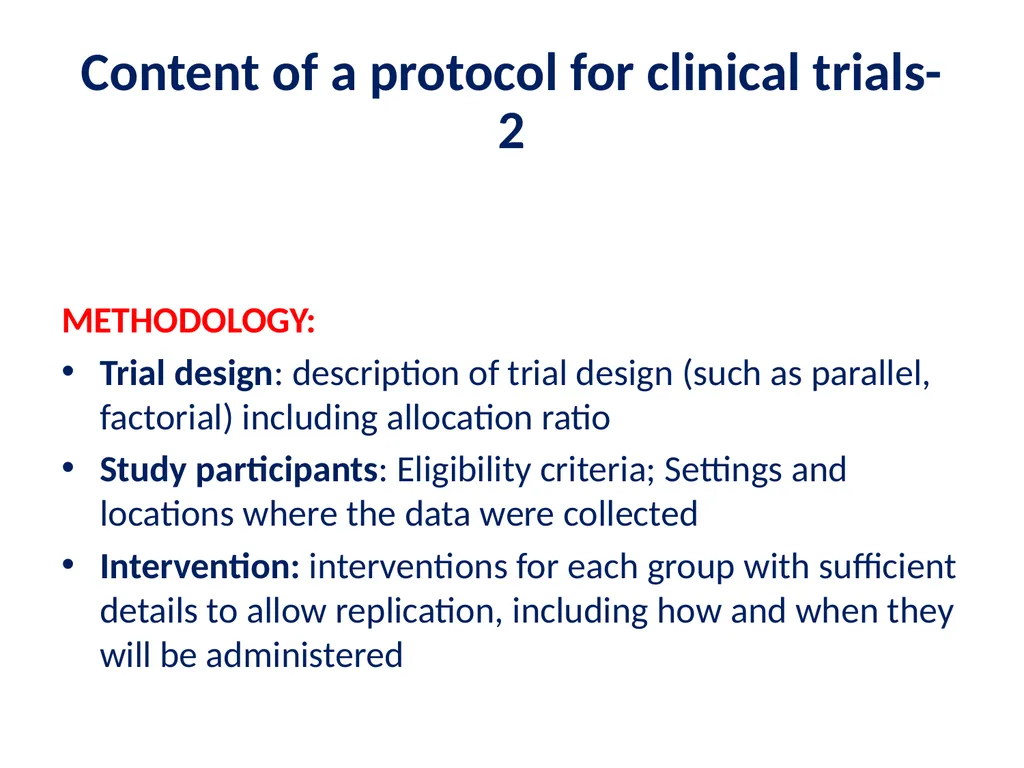
slide5. Content of a protocol for clinical trials- 2 METHODOLOGY:
Trial design: description of trial design (such as parallel, factorial) including allocation ratio
Study participants: Eligibility criteria; Settings and locations where the data were collected
Intervention: interventions for each group with sufficient details to allow replication, including how and when they will be administered<br>
slide6. Content of a protocol for clinical trials- 3 METHODOLOGY:
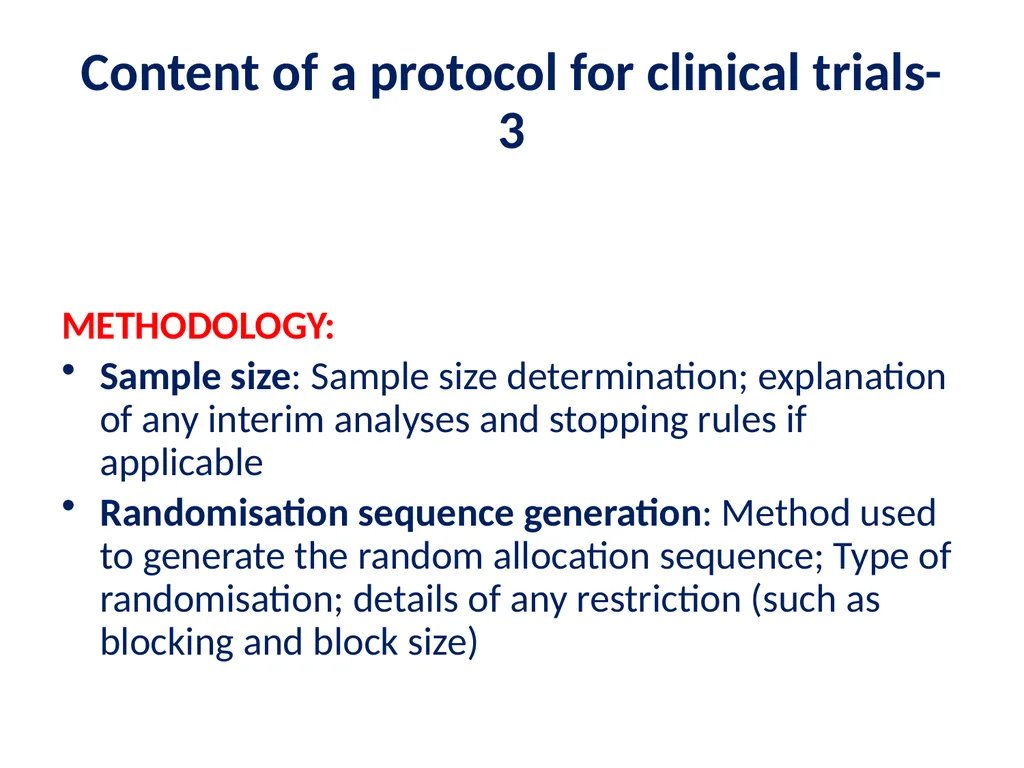
Sample size: Sample size determination; explanation of any interim analyses and stopping rules if applicable
Randomisation sequence generation: Method used to generate the random allocation sequence; Type of randomisation; details of any restriction (such as blocking and block size)<br>
slide7. Content of a protocol for clinical trials- 4 METHODOLOGY:
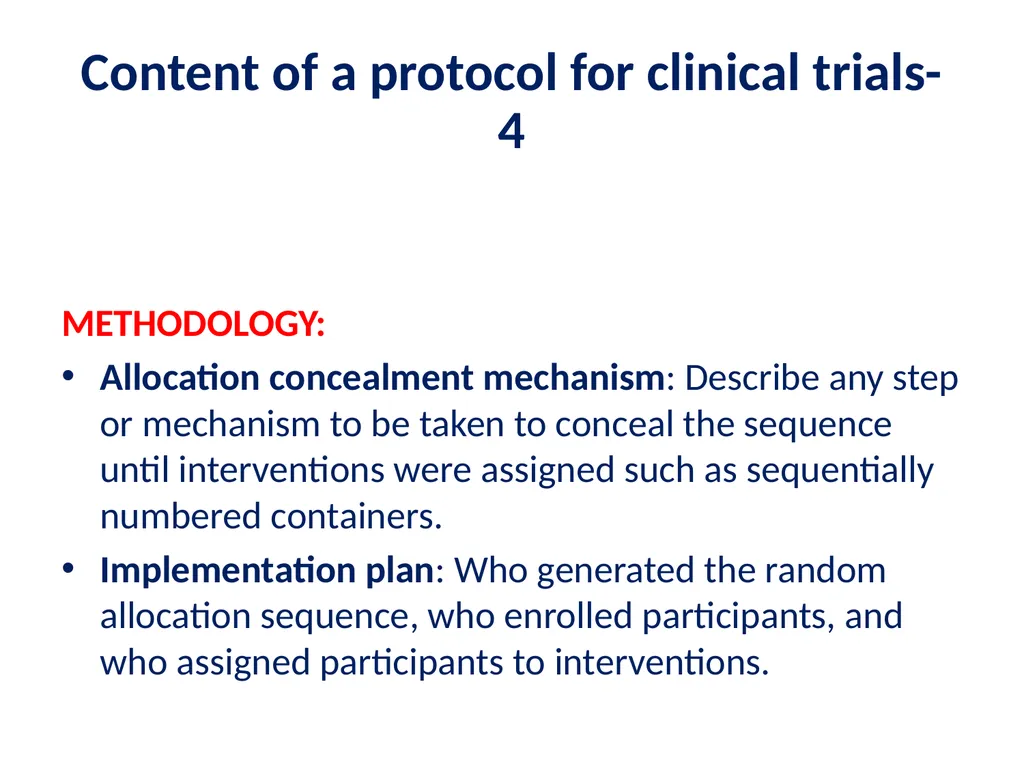
Allocation concealment mechanism: Describe any step or mechanism to be taken to conceal the sequence until interventions were assigned such as sequentially numbered containers.
Implementation plan: Who generated the random allocation sequence, who enrolled participants, and who assigned participants to interventions.<br>
slide8. Content of a protocol for clinical trials- 5 METHODOLOGY:
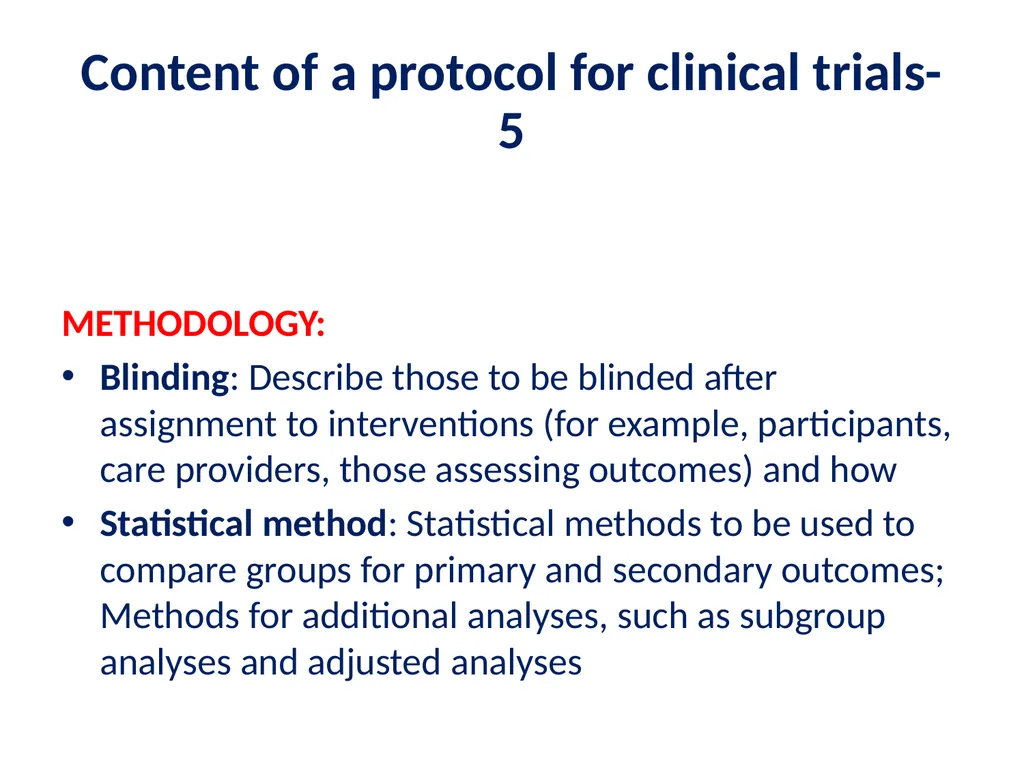
Blinding: Describe those to be blinded after assignment to interventions (for example, participants, care providers, those assessing outcomes) and how
Statistical method: Statistical methods to be used to compare groups for primary and secondary outcomes; Methods for additional analyses, such as subgroup analyses and adjusted analyses<br>
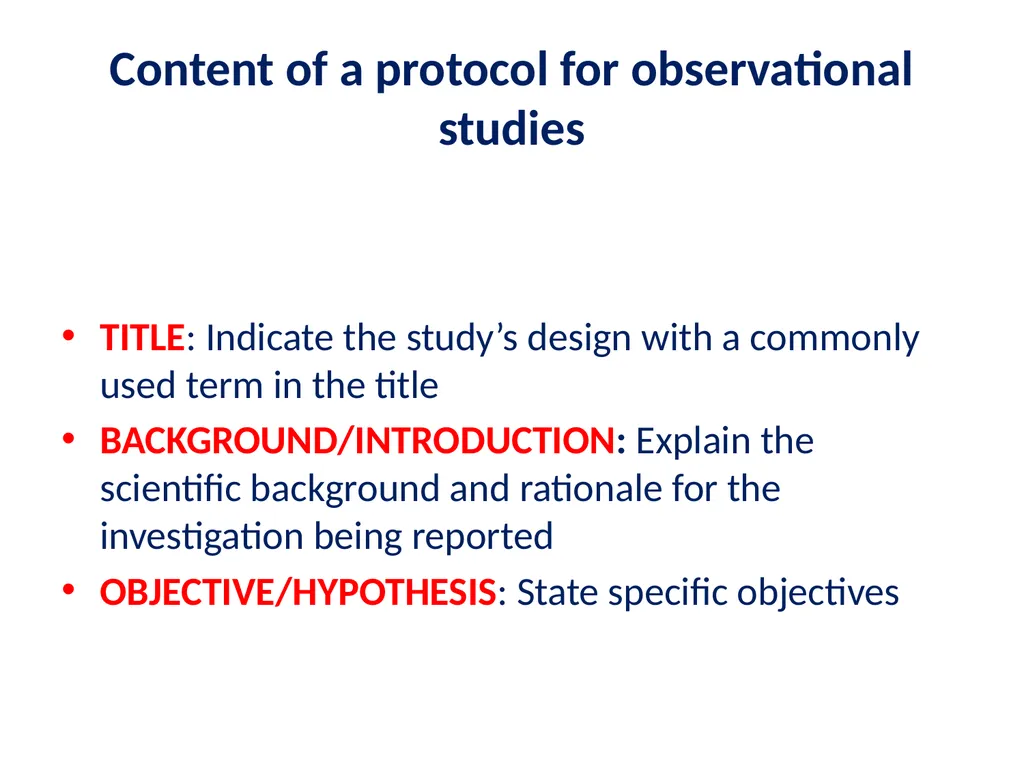
slide9. Content of a protocol for observational studies TITLE: Indicate the study’s design with a commonly used term in the title
BACKGROUND/INTRODUCTION: Explain the scientific background and rationale for the investigation being reported
OBJECTIVE/HYPOTHESIS: State specific objectives<br>
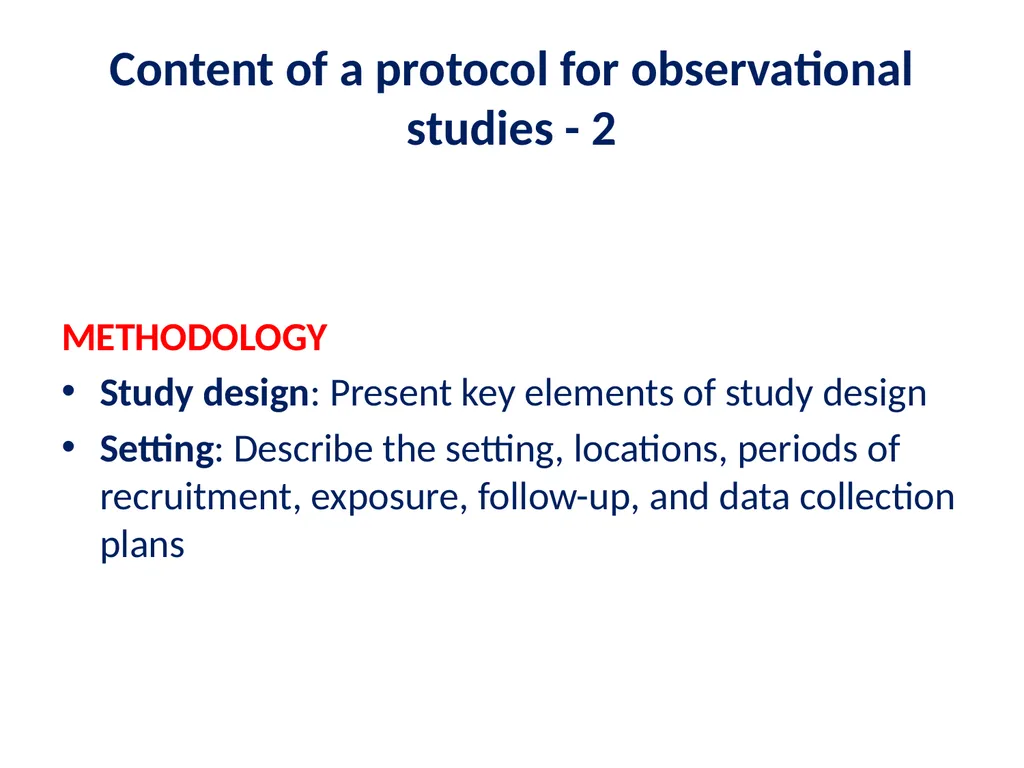
slide10. Content of a protocol for observational studies - 2 METHODOLOGY
Study design: Present key elements of study design
Setting: Describe the setting, locations, periods of recruitment, exposure, follow-up, and data collection plans<br>
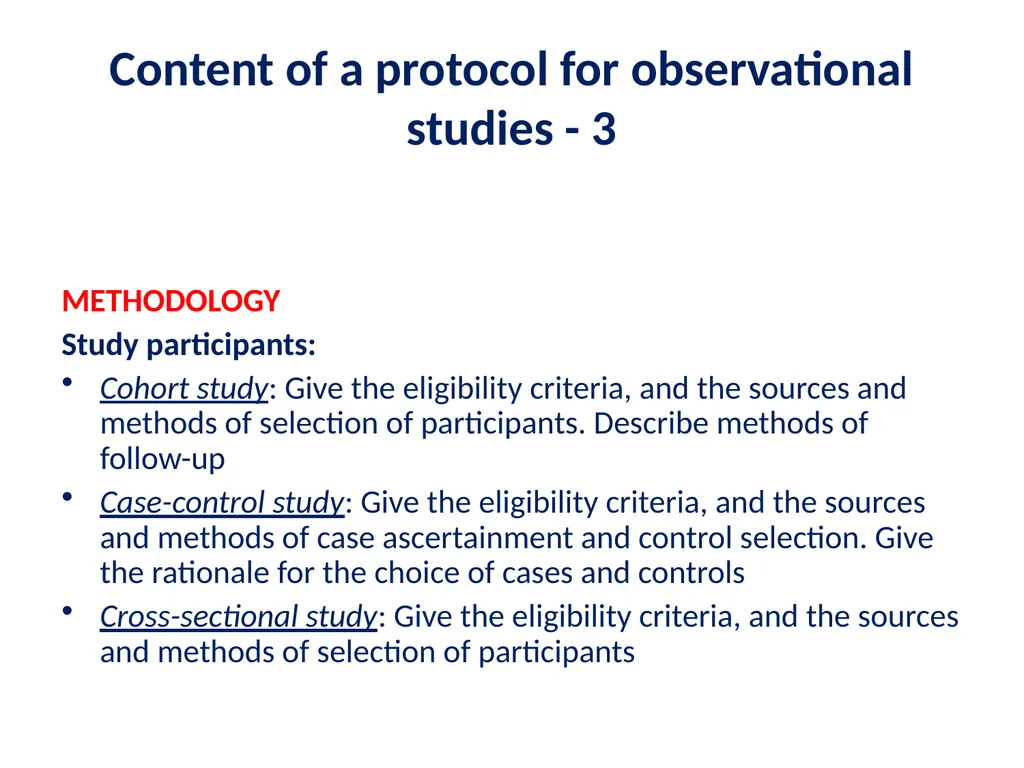
slide11. Content of a protocol for observational studies - 3 METHODOLOGY
Study participants:
Cohort study: Give the eligibility criteria, and the sources and methods of selection of participants. Describe methods of follow-up
Case-control study: Give the eligibility criteria, and the sources and methods of case ascertainment and control selection. Give the rationale for the choice of cases and controls
Cross-sectional study: Give the eligibility criteria, and the sources and methods of selection of participants<br>
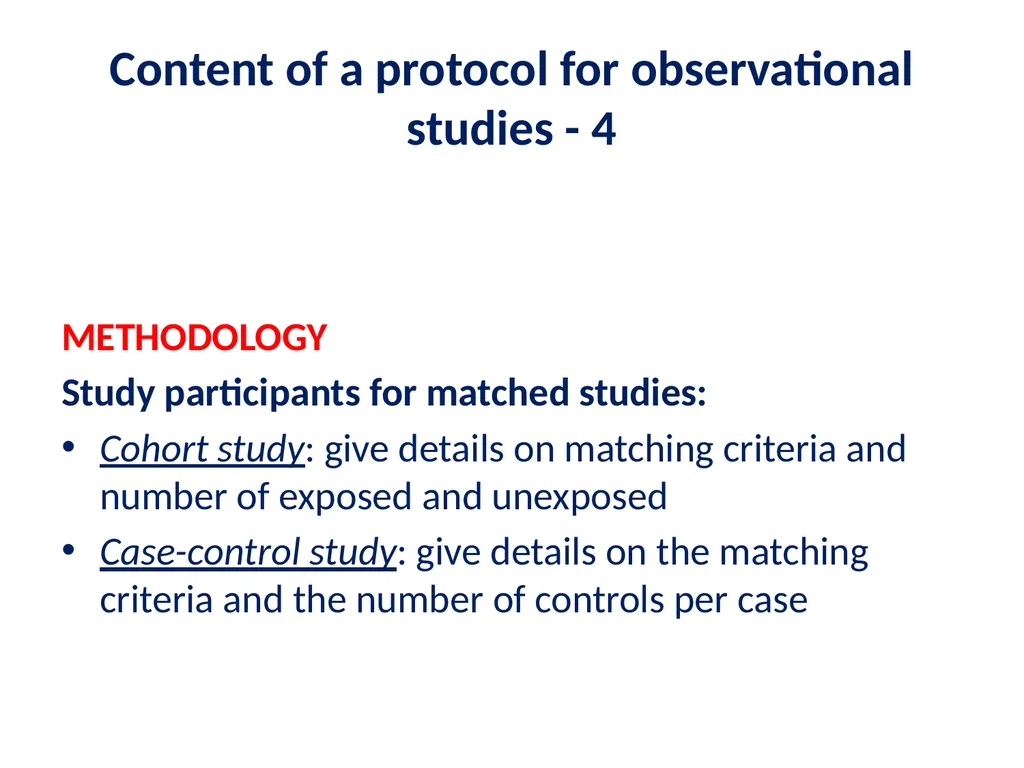
slide12. Content of a protocol for observational studies - 4 METHODOLOGY
Study participants for matched studies:
Cohort study: give details on matching criteria and number of exposed and unexposed
Case-control study: give details on the matching criteria and the number of controls per case<br>
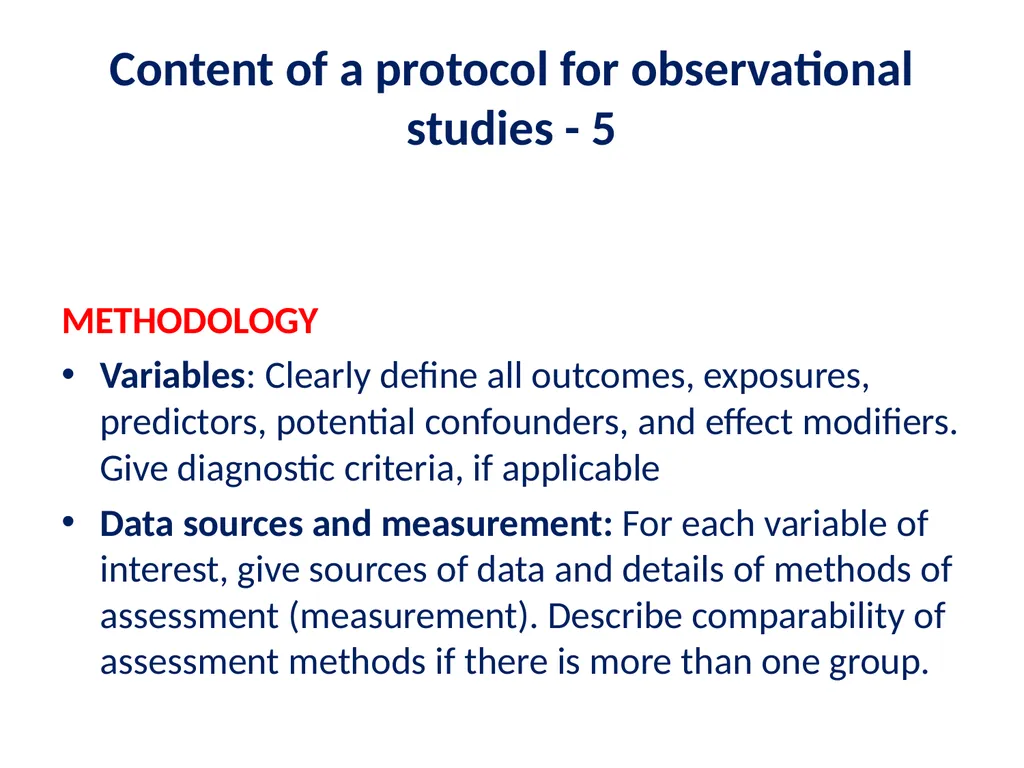
slide13. Content of a protocol for observational studies - 5 METHODOLOGY
Variables: Clearly define all outcomes, exposures, predictors, potential confounders, and effect modifiers. Give diagnostic criteria, if applicable
Data sources and measurement: For each variable of interest, give sources of data and details of methods of assessment (measurement). Describe comparability of assessment methods if there is more than one group.<br>
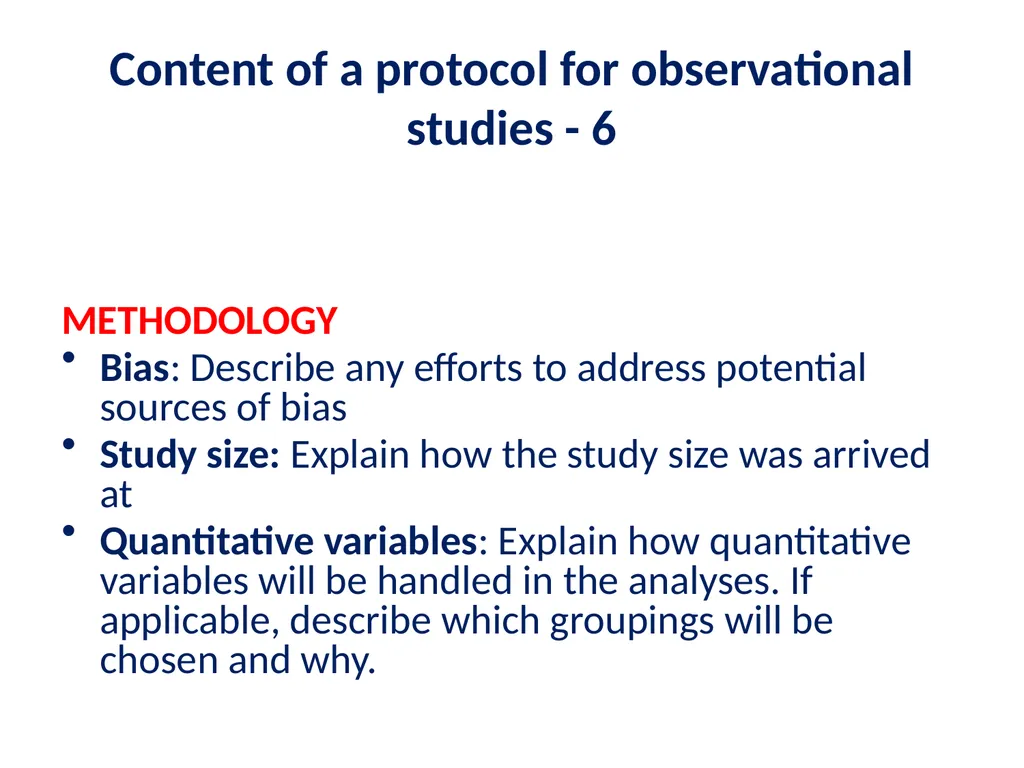
slide14. Content of a protocol for observational studies - 6 METHODOLOGY
Bias: Describe any efforts to address potential sources of bias
Study size: Explain how the study size was arrived at
Quantitative variables: Explain how quantitative variables will be handled in the analyses. If applicable, describe which groupings will be chosen and why.<br>
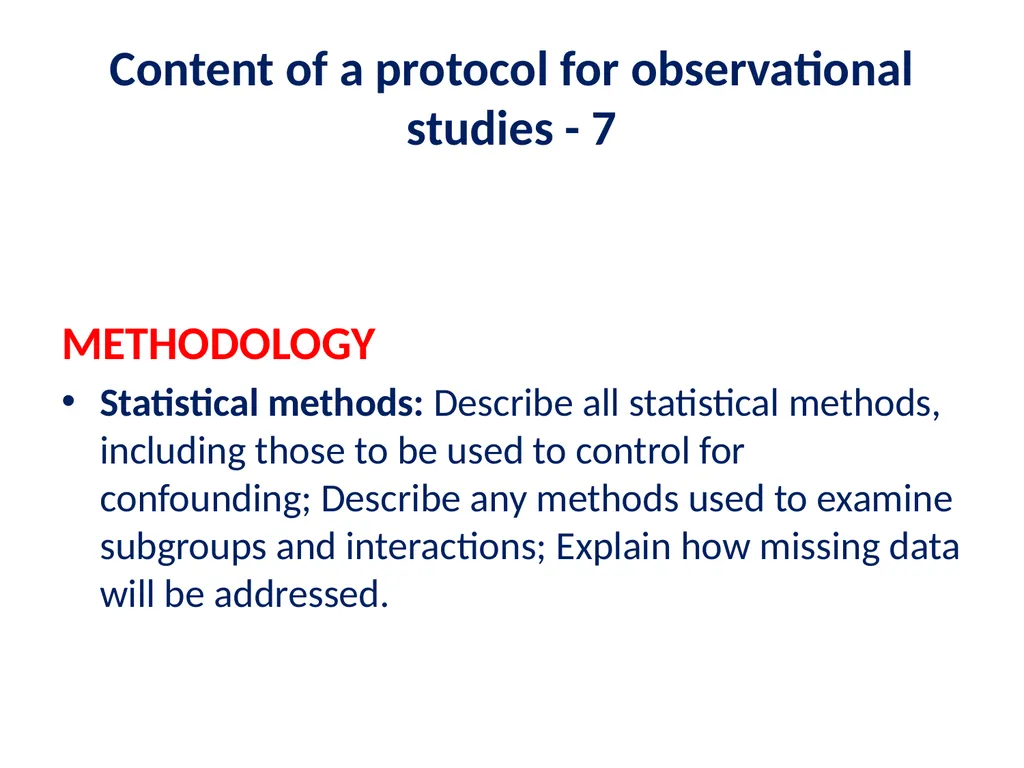
slide15. Content of a protocol for observational studies - 7 METHODOLOGY
Statistical methods: Describe all statistical methods, including those to be used to control for confounding; Describe any methods used to examine subgroups and interactions; Explain how missing data will be addressed.<br>
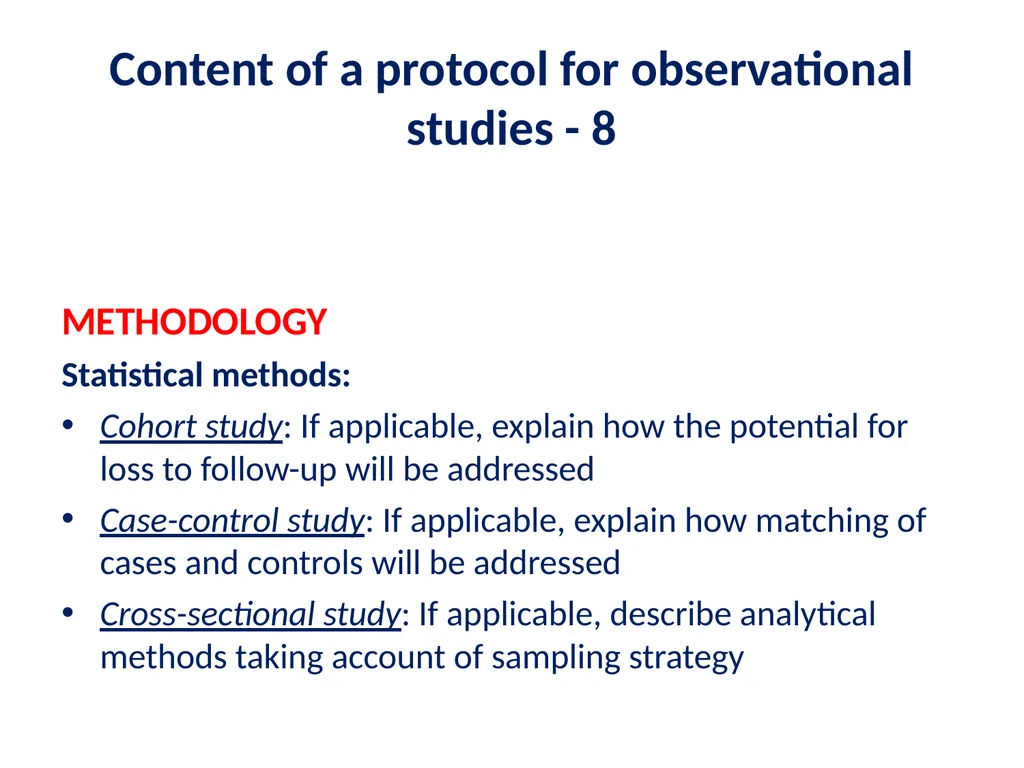
slide16. Content of a protocol for observational studies - 8 METHODOLOGY
Statistical methods:
Cohort study: If applicable, explain how the potential for loss to follow-up will be addressed
Case-control study: If applicable, explain how matching of cases and controls will be addressed
Cross-sectional study: If applicable, describe analytical methods taking account of sampling strategy<br>
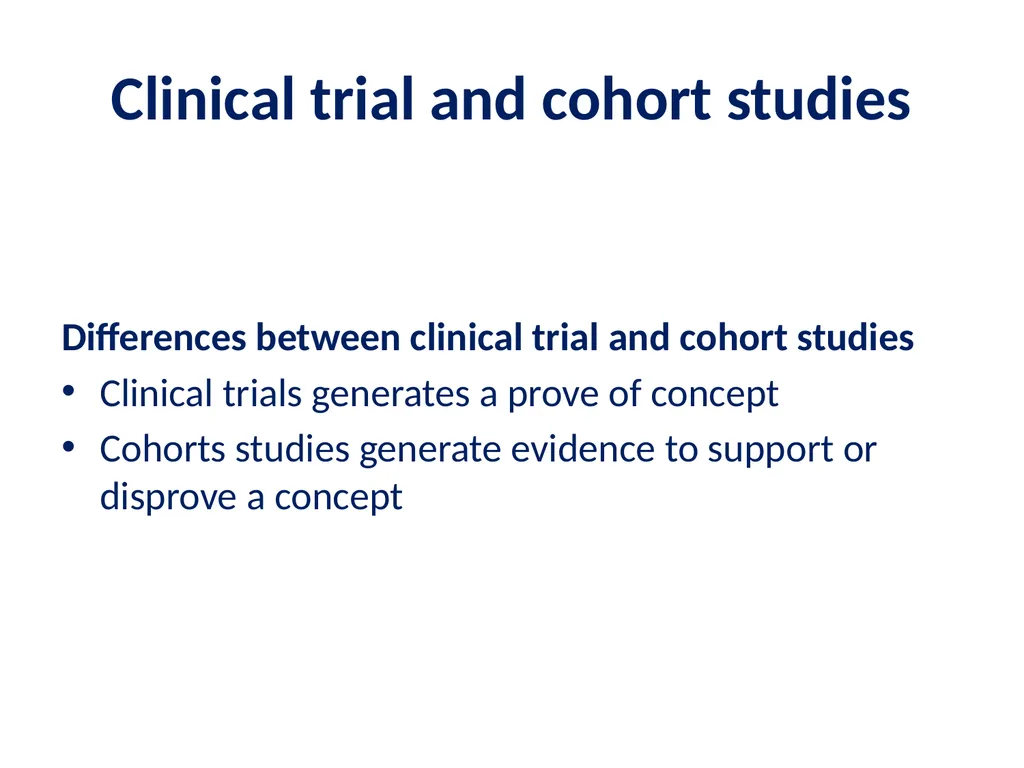
slide17. Clinical trial and cohort studies Differences between clinical trial and cohort studies
Clinical trials generates a prove of concept
Cohorts studies generate evidence to support or disprove a concept<br>
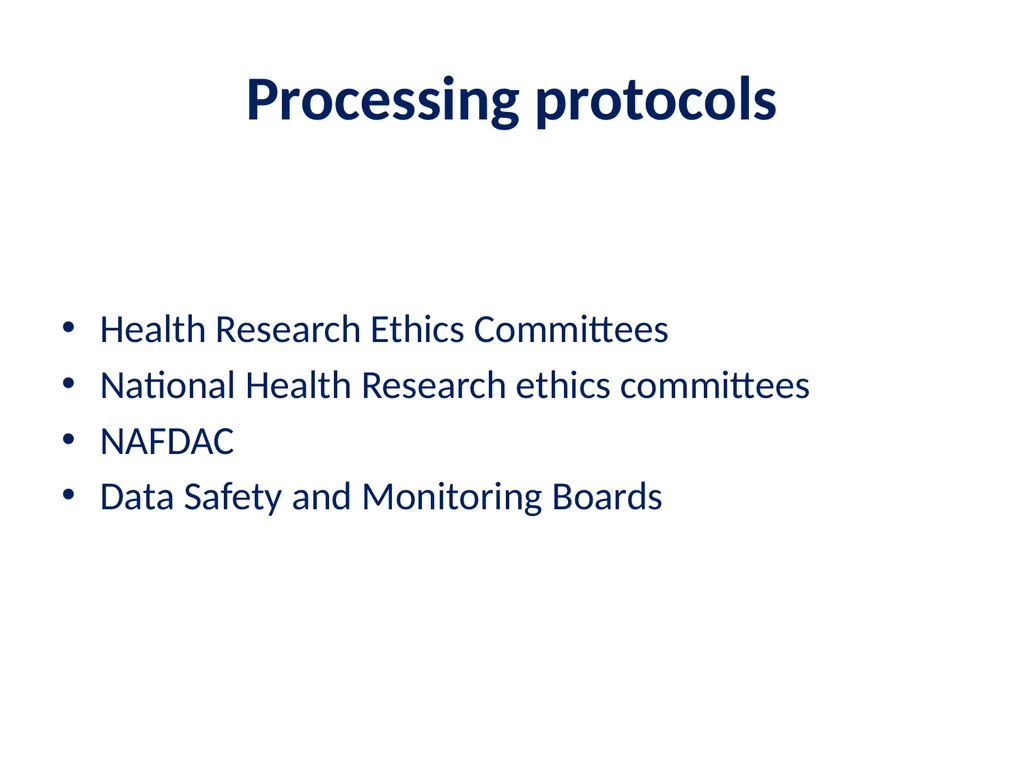
slide18. Processing protocols Health Research Ethics Committees
National Health Research ethics committees
NAFDAC
Data Safety and Monitoring Boards<br>
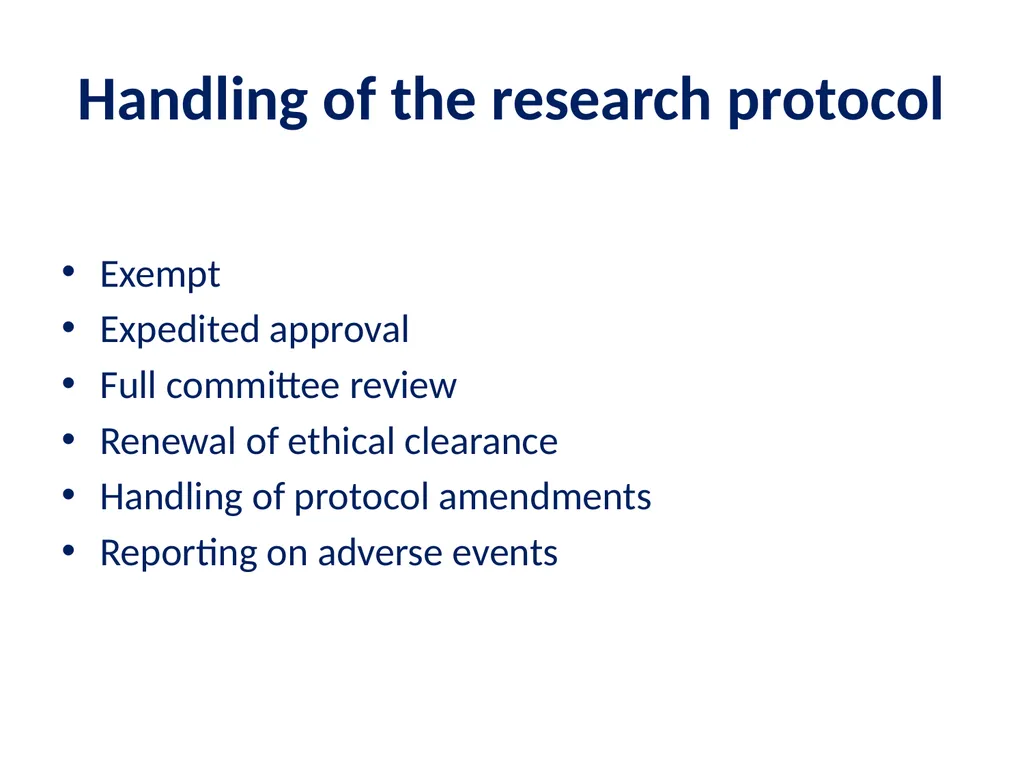
slide19. Handling of the research protocol Exempt
Expedited approval
Full committee review
Renewal of ethical clearance
Handling of protocol amendments
Reporting on adverse events<br>
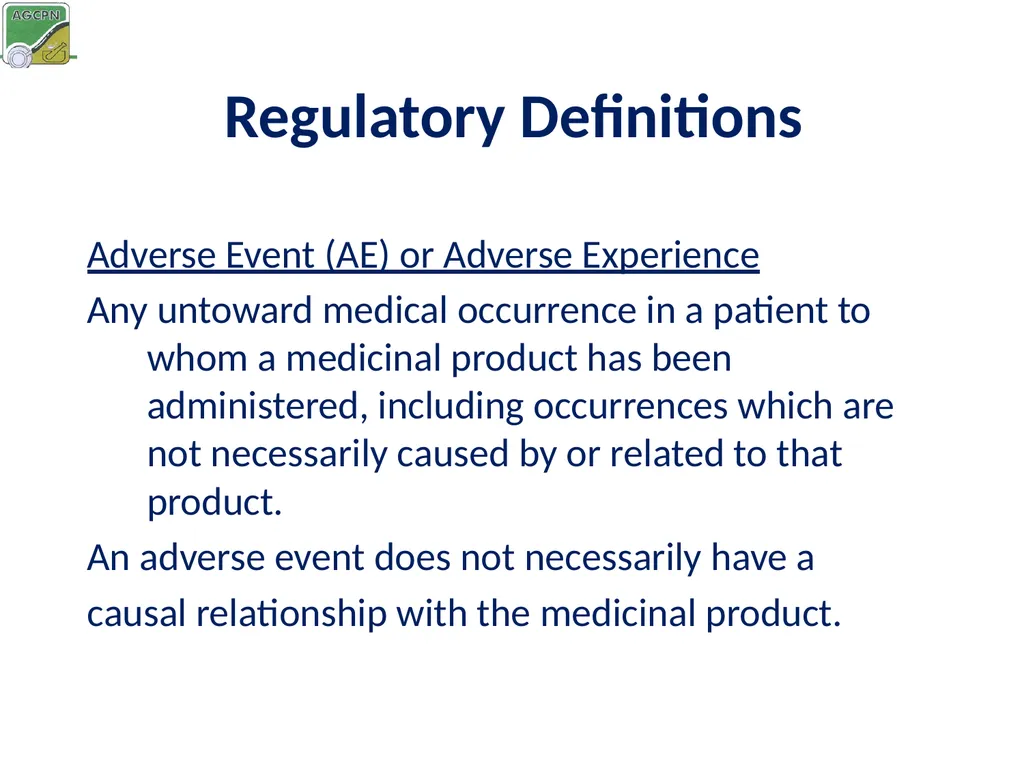
slide20. Regulatory Definitions Adverse Event (AE) or Adverse Experience
Any untoward medical occurrence in a patient to whom a medicinal product has been administered, including occurrences which are not necessarily caused by or related to that product.
An adverse event does not necessarily have a
causal relationship with the medicinal product.<br>
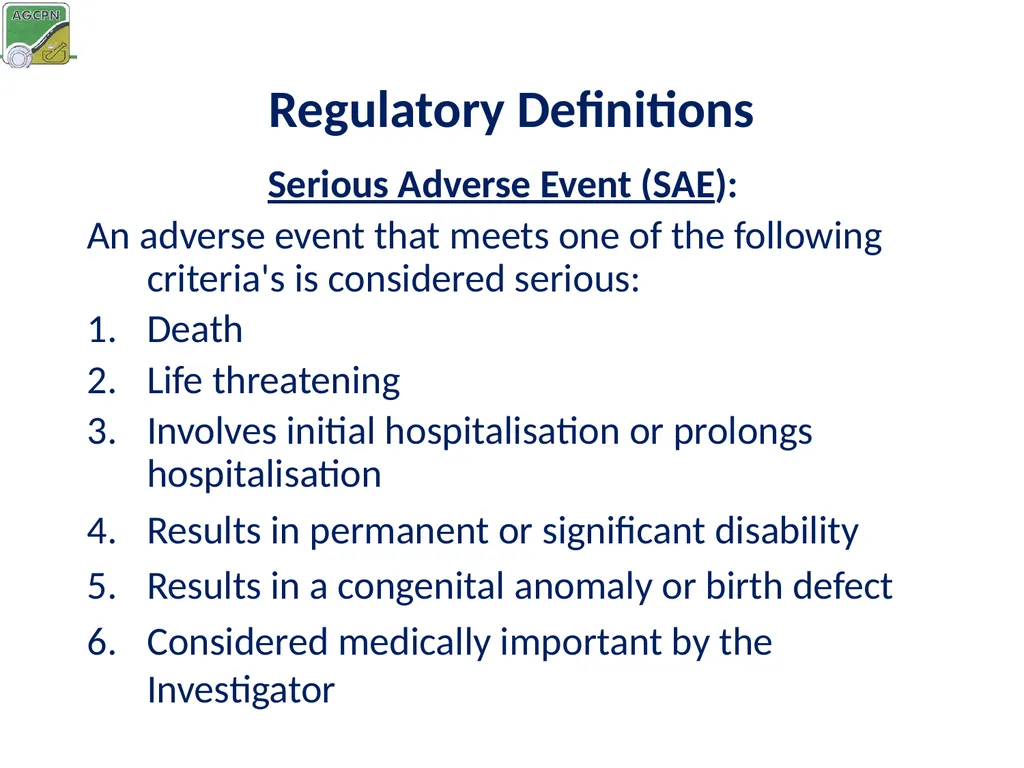
slide21. Regulatory Definitions Serious Adverse Event (SAE):
An adverse event that meets one of the following criteria's is considered serious:
1. Death
2. Life threatening
Involves initial hospitalisation or prolongs hospitalisation
Results in permanent or significant disability
Results in a congenital anomaly or birth defect
6. Considered medically important by the Investigator<br>
slide22. Timelines for Adverse Event Reporting All SAE’s must be reported to the sponsor or appropriate handler within one business day of an individual i.e. Investigator becoming aware of the event.
Deaths and Life -Threatening events should be reported to sponsor immediately by telephone and should be followed up within one business day with a completed SAE form.<br>
slide23. Reporting guidelines CONSORT Statement on reporting of randomized controlled trials
STARD on reporting of diagnostic accuracy studies
STROBE on reporting of observational studies in epidemiology
PRISMA on reporting of systematic reviews
MOOSE on reporting of meta-analyses of observational studies<br>
slide24. Conclusion There are global standards to design and reporting of research
The standardisation enables uniformity of research activities across the globe.
The process ensures data generate are comparable across regions and sites<br>
slide25. Thank You andQuestions<br>

slide2. Outline Identify the session objective
Discuss the content of a clinical trial protocol
Discuss the content of observational study
Conclusion<br>
slide3. Study objective Participants will learn about the essential elements of a clinical trial protocol
Participants will learn about the essential elements of a protocol developed for observational studies
Participants will learn about existing reporting guidelines that should inform the design and reporting of study protocols<br>
slide4. Elements of a clinical trial protocol TITLE: Identification as a randomised trial in the title
INTRODUCTION: Scientific background and explanation of rationale
SPECIFIC OBJECTIVES OR HYPOTHESES: the objectives could be primary, secondary and or tertiary (exploratory)<br>
slide5. Content of a protocol for clinical trials- 2 METHODOLOGY:
Trial design: description of trial design (such as parallel, factorial) including allocation ratio
Study participants: Eligibility criteria; Settings and locations where the data were collected
Intervention: interventions for each group with sufficient details to allow replication, including how and when they will be administered<br>
slide6. Content of a protocol for clinical trials- 3 METHODOLOGY:
Sample size: Sample size determination; explanation of any interim analyses and stopping rules if applicable
Randomisation sequence generation: Method used to generate the random allocation sequence; Type of randomisation; details of any restriction (such as blocking and block size)<br>
slide7. Content of a protocol for clinical trials- 4 METHODOLOGY:
Allocation concealment mechanism: Describe any step or mechanism to be taken to conceal the sequence until interventions were assigned such as sequentially numbered containers.
Implementation plan: Who generated the random allocation sequence, who enrolled participants, and who assigned participants to interventions.<br>
slide8. Content of a protocol for clinical trials- 5 METHODOLOGY:
Blinding: Describe those to be blinded after assignment to interventions (for example, participants, care providers, those assessing outcomes) and how
Statistical method: Statistical methods to be used to compare groups for primary and secondary outcomes; Methods for additional analyses, such as subgroup analyses and adjusted analyses<br>
slide9. Content of a protocol for observational studies TITLE: Indicate the study’s design with a commonly used term in the title
BACKGROUND/INTRODUCTION: Explain the scientific background and rationale for the investigation being reported
OBJECTIVE/HYPOTHESIS: State specific objectives<br>
slide10. Content of a protocol for observational studies - 2 METHODOLOGY
Study design: Present key elements of study design
Setting: Describe the setting, locations, periods of recruitment, exposure, follow-up, and data collection plans<br>
slide11. Content of a protocol for observational studies - 3 METHODOLOGY
Study participants:
Cohort study: Give the eligibility criteria, and the sources and methods of selection of participants. Describe methods of follow-up
Case-control study: Give the eligibility criteria, and the sources and methods of case ascertainment and control selection. Give the rationale for the choice of cases and controls
Cross-sectional study: Give the eligibility criteria, and the sources and methods of selection of participants<br>
slide12. Content of a protocol for observational studies - 4 METHODOLOGY
Study participants for matched studies:
Cohort study: give details on matching criteria and number of exposed and unexposed
Case-control study: give details on the matching criteria and the number of controls per case<br>
slide13. Content of a protocol for observational studies - 5 METHODOLOGY
Variables: Clearly define all outcomes, exposures, predictors, potential confounders, and effect modifiers. Give diagnostic criteria, if applicable
Data sources and measurement: For each variable of interest, give sources of data and details of methods of assessment (measurement). Describe comparability of assessment methods if there is more than one group.<br>
slide14. Content of a protocol for observational studies - 6 METHODOLOGY
Bias: Describe any efforts to address potential sources of bias
Study size: Explain how the study size was arrived at
Quantitative variables: Explain how quantitative variables will be handled in the analyses. If applicable, describe which groupings will be chosen and why.<br>
slide15. Content of a protocol for observational studies - 7 METHODOLOGY
Statistical methods: Describe all statistical methods, including those to be used to control for confounding; Describe any methods used to examine subgroups and interactions; Explain how missing data will be addressed.<br>
slide16. Content of a protocol for observational studies - 8 METHODOLOGY
Statistical methods:
Cohort study: If applicable, explain how the potential for loss to follow-up will be addressed
Case-control study: If applicable, explain how matching of cases and controls will be addressed
Cross-sectional study: If applicable, describe analytical methods taking account of sampling strategy<br>
slide17. Clinical trial and cohort studies Differences between clinical trial and cohort studies
Clinical trials generates a prove of concept
Cohorts studies generate evidence to support or disprove a concept<br>
slide18. Processing protocols Health Research Ethics Committees
National Health Research ethics committees
NAFDAC
Data Safety and Monitoring Boards<br>
slide19. Handling of the research protocol Exempt
Expedited approval
Full committee review
Renewal of ethical clearance
Handling of protocol amendments
Reporting on adverse events<br>
slide20. Regulatory Definitions Adverse Event (AE) or Adverse Experience
Any untoward medical occurrence in a patient to whom a medicinal product has been administered, including occurrences which are not necessarily caused by or related to that product.
An adverse event does not necessarily have a
causal relationship with the medicinal product.<br>
slide21. Regulatory Definitions Serious Adverse Event (SAE):
An adverse event that meets one of the following criteria's is considered serious:
1. Death
2. Life threatening
Involves initial hospitalisation or prolongs hospitalisation
Results in permanent or significant disability
Results in a congenital anomaly or birth defect
6. Considered medically important by the Investigator<br>
slide22. Timelines for Adverse Event Reporting All SAE’s must be reported to the sponsor or appropriate handler within one business day of an individual i.e. Investigator becoming aware of the event.
Deaths and Life -Threatening events should be reported to sponsor immediately by telephone and should be followed up within one business day with a completed SAE form.<br>
slide23. Reporting guidelines CONSORT Statement on reporting of randomized controlled trials
STARD on reporting of diagnostic accuracy studies
STROBE on reporting of observational studies in epidemiology
PRISMA on reporting of systematic reviews
MOOSE on reporting of meta-analyses of observational studies<br>
slide24. Conclusion There are global standards to design and reporting of research
The standardisation enables uniformity of research activities across the globe.
The process ensures data generate are comparable across regions and sites<br>
slide25. Thank You andQuestions<br>