
Ember Resistant Zone 0 Overview of Draft Rule
T
Published · 27 slides · 0 views

1 / 1




Description
Ember Resistant Zone 0 Overview of Draft Rule Plead July 24, 2025 Overview Proposed Changes to June 16 rule text. Overview of Public Comment from June 16 - July 22. Ember Resistant Zone Zero Rule Plead Concerns area within five (5) feet
Related Topics
Share
Embed code
Download this presentation From Below
"Ember Resistant Zone 0 Overview of Draft Rule" is the property of its rightful owner. Permission is granted to download and print the materials on this website for personal, non-commercial use only, and to display it on your personal computer provided you do not modify the materials and that you retain all copyright notices contained in the materials. By downloading content from our website, you accept the terms of this agreement.
Presentation Transcript
01
Ember Resistant Zone 0 Overview of Draft Rule Plead July 24, 2025<br>
02
Overview Proposed Changes to June 16 rule text.
Overview of Public Comment from June 16 - July 22.<br>
Overview of Public Comment from June 16 - July 22.<br>
03
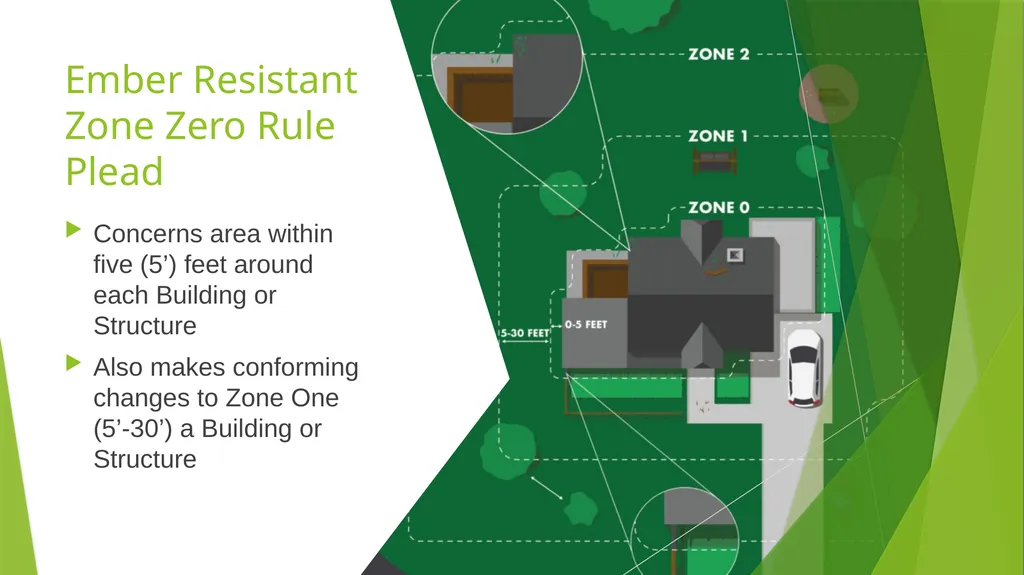
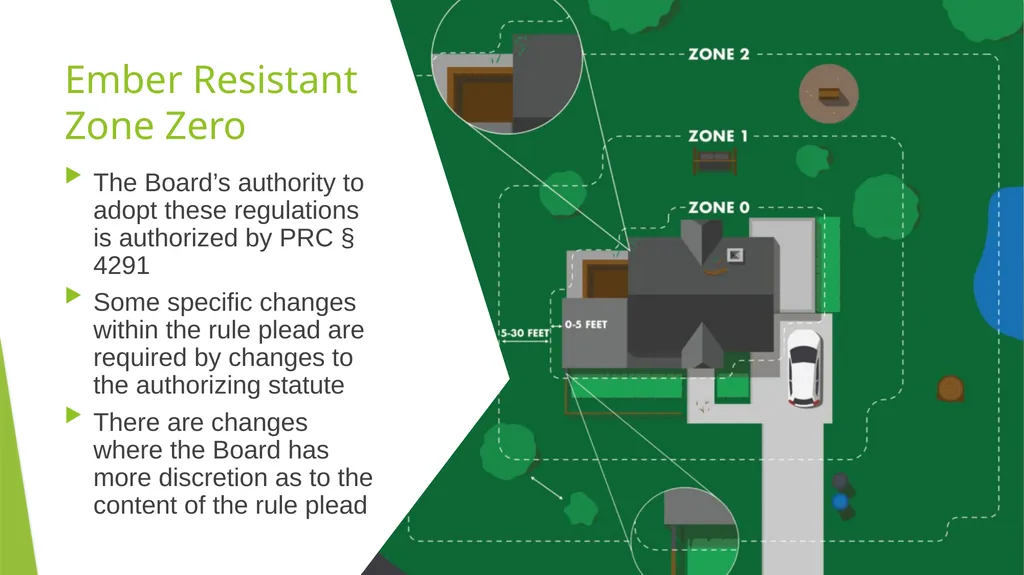
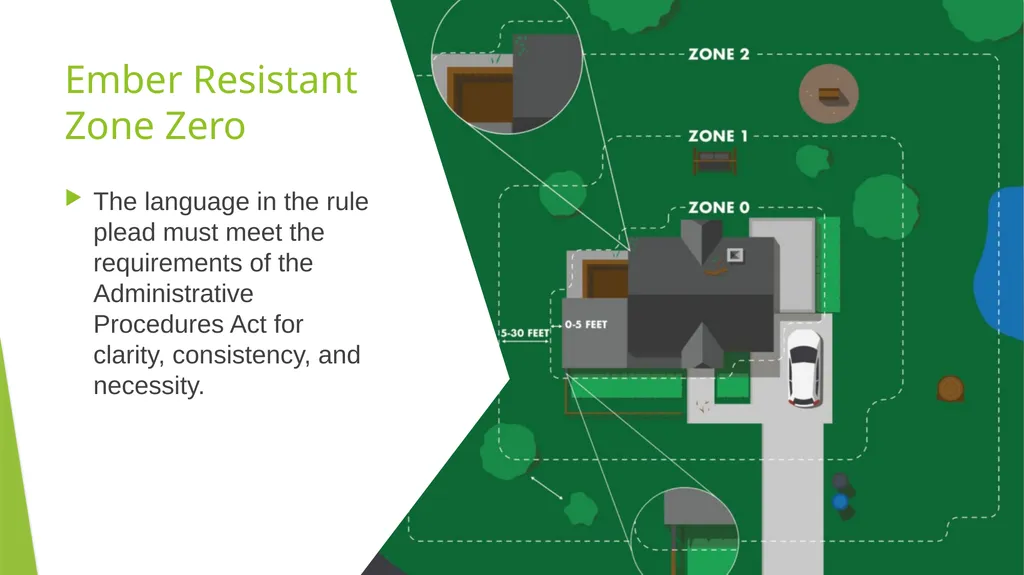
Ember Resistant Zone Zero Rule Plead Concerns area within five (5’) feet around each Building or Structure
Also makes conforming changes to Zone One (5’-30’) a Building or Structure<br>
Also makes conforming changes to Zone One (5’-30’) a Building or Structure<br>
04
Proposed Changes from June 16 Rule Text Plain text indicates existing regulatory text – no changes are proposed to this text.
Underlined text indicates proposed additions to the regulatory text
Strikethrough text indicates proposed deletions from the regulatory text
Red text is text that has been changed since the March 21 draft. It will have underline and strikethrough as appropriate<br>
Underlined text indicates proposed additions to the regulatory text
Strikethrough text indicates proposed deletions from the regulatory text
Red text is text that has been changed since the March 21 draft. It will have underline and strikethrough as appropriate<br>
05
Proposed Changes from June 16 Rule Text No changes to Vegetation, but the Committee has indicated they’d like to discuss potential changes during this meeting
Significant changes to how trees are treated within Zone 0.
Proposed language for greater locally relevant regulations under 14 CCR 1299.05
Other minor changes for clarity and consistency.<br>
Significant changes to how trees are treated within Zone 0.
Proposed language for greater locally relevant regulations under 14 CCR 1299.05
Other minor changes for clarity and consistency.<br>
06
§ 1299.02. Definitions Deletes “Roof Ridgeline” as it is no longer referenced in the rule text<br>
07
§ 1299.03.(b)(2) Landscaping Materials Relocates “branches” to 1299.03(b)(2) (Trees)<br>
08
§ 1299.03.(b)(2) Trees Both less than 3 story and greater than 3 story buildings now have the same requirements. Rule text now states that all dead and dying branches shall be removed and that that all live tree branches shall be maintained five feet above the adjacent Building or Structure’s roof, ten feet away from chimneys and stovepipe outlets, and five feet away from the sides of any Building or Structure.
Allows exception for single specimens of trees or other vegetation that are well-pruned and maintained so as to effectively manage fuels and fuel ladders, as provided in Public Resources Code Section 4291<br>
Allows exception for single specimens of trees or other vegetation that are well-pruned and maintained so as to effectively manage fuels and fuel ladders, as provided in Public Resources Code Section 4291<br>
09
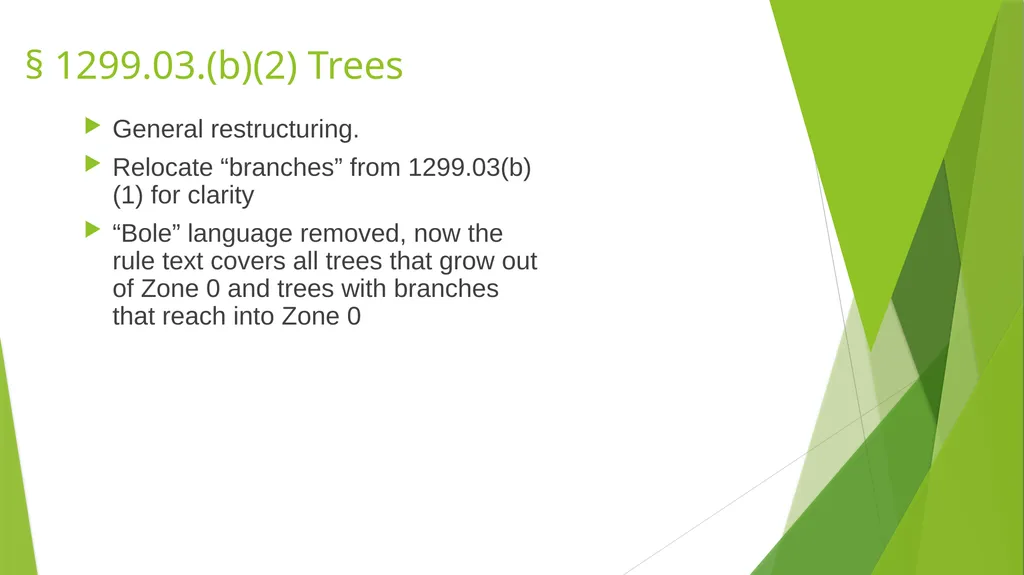
§ 1299.03.(b)(2) Trees General restructuring.
Relocate “branches” from 1299.03(b)(1) for clarity
“Bole” language removed, now the rule text covers all trees that grow out of Zone 0 and trees with branches that reach into Zone 0<br>
Relocate “branches” from 1299.03(b)(1) for clarity
“Bole” language removed, now the rule text covers all trees that grow out of Zone 0 and trees with branches that reach into Zone 0<br>
10
§1299.03(b)(3) Combustible Items Removed “attached” from window boxes, for clarity.
Replaces “synthetic lawn” with more broadly applicable “petroleum-based products<br>
Replaces “synthetic lawn” with more broadly applicable “petroleum-based products<br>
11
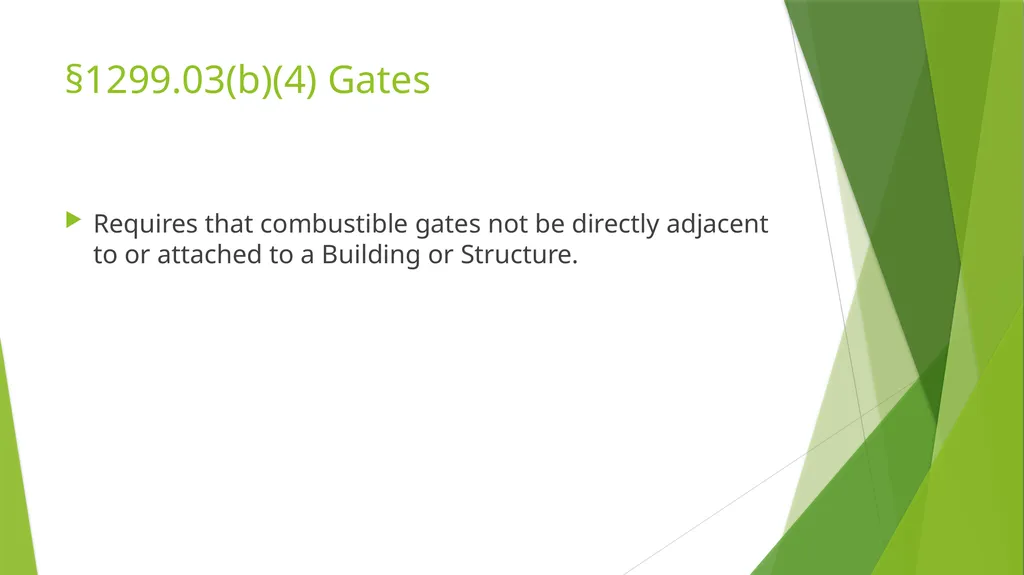
§1299.03(b)(4) Gates Requires that combustible gates not be directly adjacent to or attached to a Building or Structure.<br>
12
§1299.03(b)(8) Work in stages/Staging Clarifies that the Department may allow work “in stages” to support implementation and address the costs of compliance.<br>
13
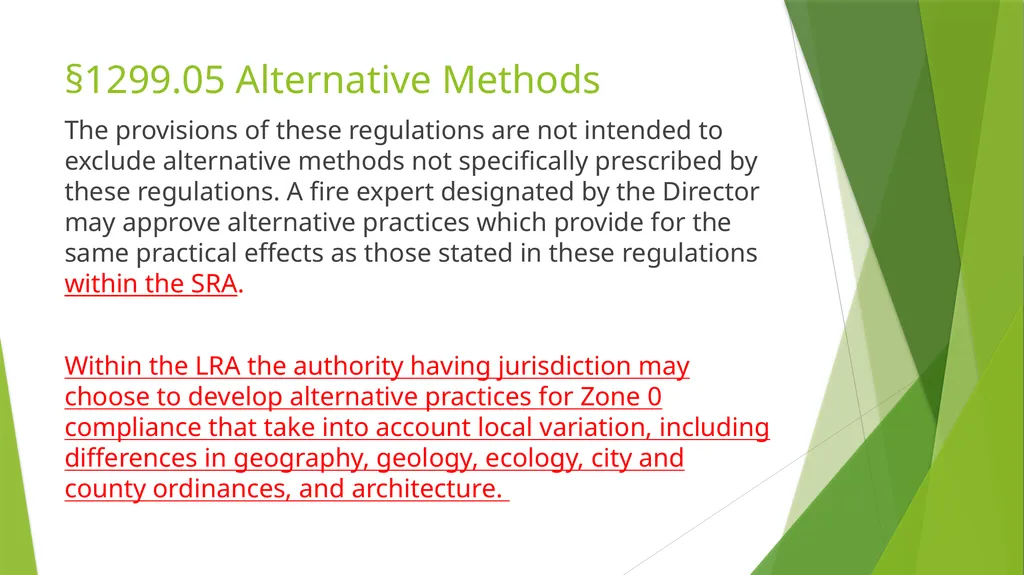
§1299.05 Alternative Methods The provisions of these regulations are not intended to exclude alternative methods not specifically prescribed by these regulations. A fire expert designated by the Director may approve alternative practices which provide for the same practical effects as those stated in these regulations within the SRA.
Within the LRA the authority having jurisdiction may choose to develop alternative practices for Zone 0 compliance that take into account local variation, including differences in geography, geology, ecology, city and county ordinances, and architecture.<br>
Within the LRA the authority having jurisdiction may choose to develop alternative practices for Zone 0 compliance that take into account local variation, including differences in geography, geology, ecology, city and county ordinances, and architecture.<br>
14
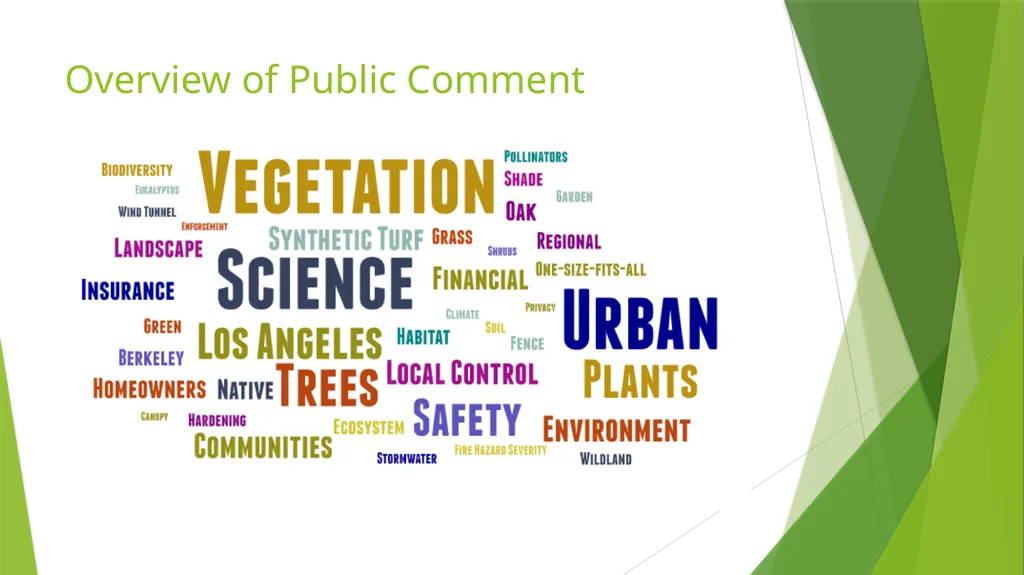
Overview of Public Comment<br>
15
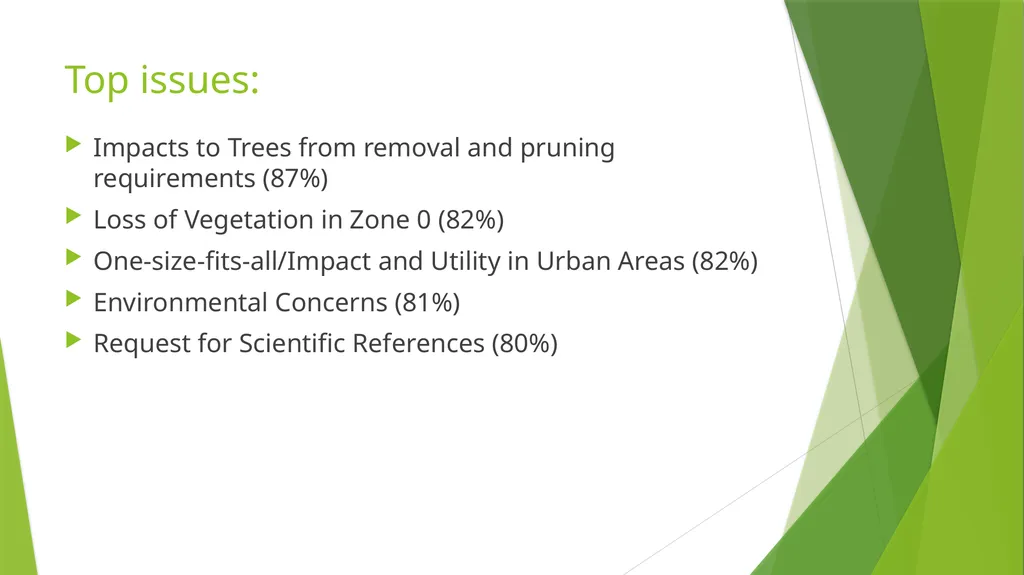
Top issues: Impacts to Trees from removal and pruning requirements (87%)
Loss of Vegetation in Zone 0 (82%)
One-size-fits-all/Impact and Utility in Urban Areas (82%)
Environmental Concerns (81%)
Request for Scientific References (80%)<br>
Loss of Vegetation in Zone 0 (82%)
One-size-fits-all/Impact and Utility in Urban Areas (82%)
Environmental Concerns (81%)
Request for Scientific References (80%)<br>
16
Quotes on Impacts to Trees Exempt native oaks and other ecologically beneficial, fire-resilient species from blanket removal requirements.
Los Angeles County, including its dense urban areas, is a biodiversity hotspot, meaning it has a high concentration of unique and diverse plant and animal life, hosting over 4,000 species. The city's biodiversity provides innumerable benefits. However, Los Angeles also faces biodiversity threats from habitat loss and a particular threat in our dense urban area is loss of tree cover and understory. In the interest of expanding our local tree canopy, and providing habitat and water conservation, local agencies such as the Los Angeles Department of Water and Power (LADWP) are giving away trees and providing rebates for installing drought-resistant shrubs in place of turf. Many of our Southern California Audubon Chapters, including SFVAS, have promoted and facilitated installation of bird and bug-friendly native habitat surrounding structures.
The consequences of applying the new Zone 0-1-2 rules to such urban areas would lead to catastrophic loss of and irreversible harm to our already dwindling urban tree canopy and ecosystem<br>
Los Angeles County, including its dense urban areas, is a biodiversity hotspot, meaning it has a high concentration of unique and diverse plant and animal life, hosting over 4,000 species. The city's biodiversity provides innumerable benefits. However, Los Angeles also faces biodiversity threats from habitat loss and a particular threat in our dense urban area is loss of tree cover and understory. In the interest of expanding our local tree canopy, and providing habitat and water conservation, local agencies such as the Los Angeles Department of Water and Power (LADWP) are giving away trees and providing rebates for installing drought-resistant shrubs in place of turf. Many of our Southern California Audubon Chapters, including SFVAS, have promoted and facilitated installation of bird and bug-friendly native habitat surrounding structures.
The consequences of applying the new Zone 0-1-2 rules to such urban areas would lead to catastrophic loss of and irreversible harm to our already dwindling urban tree canopy and ecosystem<br>
17
Quotes on Vegetation in Zone Zero Do not remove greenery! We need more native plants, and less invasive plants - California plants that are evergreen in summer instead of invasive mustard or foreign grasses that are tinder for wildfires. However, we DO need a ban on eucalyptus trees, which are highly flammable.
Consider alternatives to full removal, such as strategic pruning based on species behavior and proximity.
In 2015, my family paid to remove our front lawn and re-landscape the yard with native plants that need less water than others. Like many other people, we received a Metropolitan Water District Rebate of more than $2,000 from the SoCal Water Smart Program. Is there any data showing that removal of drought-tolerant plants will prevent fires? Requiring homeowners to rip out plants that local government helped pay for strikes me as fiscally irresponsible and lacking in governmental strategic planning.
We cannot run scared from fires with vegetation-killing measures. We need trees and greenery to cool houses and provide better environments in our towns and cities. Yes we need to manage vegetation; NO we do not need to go scorched earth on any vegetation near homes.<br>
Consider alternatives to full removal, such as strategic pruning based on species behavior and proximity.
In 2015, my family paid to remove our front lawn and re-landscape the yard with native plants that need less water than others. Like many other people, we received a Metropolitan Water District Rebate of more than $2,000 from the SoCal Water Smart Program. Is there any data showing that removal of drought-tolerant plants will prevent fires? Requiring homeowners to rip out plants that local government helped pay for strikes me as fiscally irresponsible and lacking in governmental strategic planning.
We cannot run scared from fires with vegetation-killing measures. We need trees and greenery to cool houses and provide better environments in our towns and cities. Yes we need to manage vegetation; NO we do not need to go scorched earth on any vegetation near homes.<br>
18
Quotes on one-size-fits-all/impact and utility in urban areas In Southern California, particularly in Los Angeles County, many homes are situated in densely populated neighborhoods with limited setbacks, multistory construction, and closely spaced neighboring structures. These conditions sharply contrast with many Northern California communities, where larger parcels and greater opportunities for defensible space exist.
The unique geography of our area—with small lots, multi-story homes, and closely spaced structures—means laboratory-style, one-size-fits-all approaches aren’t appropriate or effective for our community.<br>
The unique geography of our area—with small lots, multi-story homes, and closely spaced structures—means laboratory-style, one-size-fits-all approaches aren’t appropriate or effective for our community.<br>
19
Quotes on Environmental Concerns The proposed regulations will inflict long-term, irreversible environmental damage by removing thousands of tons of mature organic matter from our communities. The result: hotter communities that suffer from worse air quality and impacts to biodiversity and human health impacts of reduced green space.
Mass vegetation clearance—particularly in urban areas—will have cascading environmental consequences, including: Decreased air quality and increased particulate matter, Stormwater runoff and erosion, especially on urban hillsides, Rising urban heat island effects, Declines in native biodiversity, habitat, and pollinators.
Zone 0 will only be required in the areas designated Very High in the Local Responsibility Areas but for some reason will be required in the Moderate, High and Very High designated areas in the State Responsibility Areas. Inclusion of Zone 0 in the Moderate and High fire severity zones in the State Responsibility Area will have enormous negative financial, environmental and public health impacts to communities well outside of the wildland interface areas of our state and should trigger CEQA. Environmental Harm: Mass vegetation removal worsens air quality, stormwater runoff, urban heat, and biodiversity loss.<br>
Mass vegetation clearance—particularly in urban areas—will have cascading environmental consequences, including: Decreased air quality and increased particulate matter, Stormwater runoff and erosion, especially on urban hillsides, Rising urban heat island effects, Declines in native biodiversity, habitat, and pollinators.
Zone 0 will only be required in the areas designated Very High in the Local Responsibility Areas but for some reason will be required in the Moderate, High and Very High designated areas in the State Responsibility Areas. Inclusion of Zone 0 in the Moderate and High fire severity zones in the State Responsibility Area will have enormous negative financial, environmental and public health impacts to communities well outside of the wildland interface areas of our state and should trigger CEQA. Environmental Harm: Mass vegetation removal worsens air quality, stormwater runoff, urban heat, and biodiversity loss.<br>
20
Requests for Scientific References I respectfully request that, before moving forward, the Board conduct a dedicated study in Pacific Palisades and similar dense urban neighborhoods, with direct engagement from residents who experienced wildfire firsthand.
Research cited by experts and organizations—including the MySafe:LA recommendations submitted to your committee—shows that structural factors and home proximity play significant roles in wildfire survival. Mandating the removal of all vegetation within five feet of every house, regardless of local conditions, risks unnecessary harm to our neighborhoods while potentially undermining effective wildfire mitigation strategies already in place.
Science Ignored: Experts like Dr. Jon Keeley have shown that some vegetation reduces fire spread by blocking embers.<br>
Research cited by experts and organizations—including the MySafe:LA recommendations submitted to your committee—shows that structural factors and home proximity play significant roles in wildfire survival. Mandating the removal of all vegetation within five feet of every house, regardless of local conditions, risks unnecessary harm to our neighborhoods while potentially undermining effective wildfire mitigation strategies already in place.
Science Ignored: Experts like Dr. Jon Keeley have shown that some vegetation reduces fire spread by blocking embers.<br>
21
Requests for Clarity 1299.02(b): "Attached Deck" needs to be defined to exclude concrete patios, and include only those structures made of flammable materials. There is no rational reason to include a requirement to follow zone 0 requirements 5 feet from a concrete patio which extends 15 feet from the walls and roof line of a house. The concrete patio is already equivalent protection to that required by zone 0.
1299.03(a): Specify whether the 5 feet is measured from the wall or from the roof overhang. Many houses have covered porches that extend many feet from the wall of the house. This should be clearly spelled out so it is not subject to inconsistent interpretation and enforcement.
Your definition potentially allows an unscrupulous neighbor to deliberately or accidently create a fire hazard for their neighbor; and the innocent neighbor can’t stop it.<br>
1299.03(a): Specify whether the 5 feet is measured from the wall or from the roof overhang. Many houses have covered porches that extend many feet from the wall of the house. This should be clearly spelled out so it is not subject to inconsistent interpretation and enforcement.
Your definition potentially allows an unscrupulous neighbor to deliberately or accidently create a fire hazard for their neighbor; and the innocent neighbor can’t stop it.<br>
22
Thank you for your input<br>
23
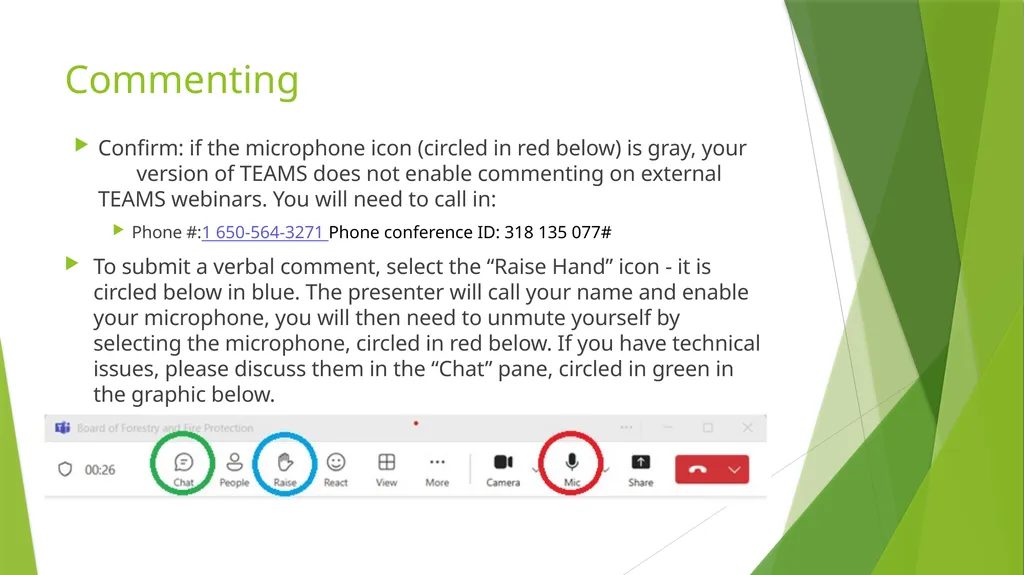
Commenting Confirm: if the microphone icon (circled in red below) is gray, your version of TEAMS does not enable commenting on external TEAMS webinars. You will need to call in:
Phone #:1 650-564-3271 Phone conference ID: 318 135 077#
To submit a verbal comment, select the “Raise Hand” icon - it is circled below in blue. The presenter will call your name and enable your microphone, you will then need to unmute yourself by selecting the microphone, circled in red below. If you have technical issues, please discuss them in the “Chat” pane, circled in green in the graphic below.<br>
Phone #:1 650-564-3271 Phone conference ID: 318 135 077#
To submit a verbal comment, select the “Raise Hand” icon - it is circled below in blue. The presenter will call your name and enable your microphone, you will then need to unmute yourself by selecting the microphone, circled in red below. If you have technical issues, please discuss them in the “Chat” pane, circled in green in the graphic below.<br>
24
Workshop will resume at: 1:00 PM<br>
25
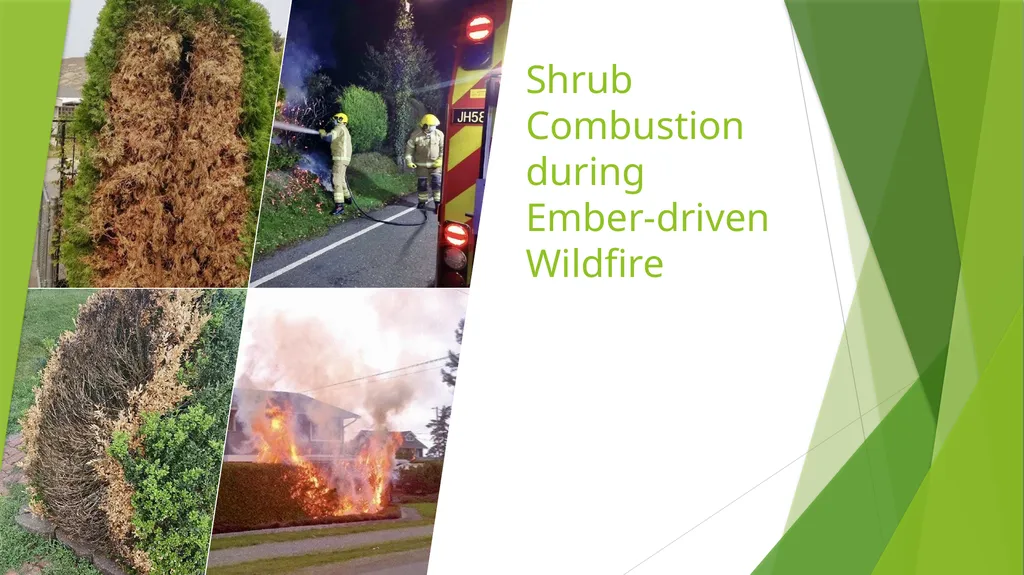
Shrub Combustion during Ember-driven Wildfire<br>
26
Ember Resistant Zone Zero The Board’s authority to adopt these regulations is authorized by PRC § 4291
Some specific changes within the rule plead are required by changes to the authorizing statute
There are changes where the Board has more discretion as to the content of the rule plead<br>
Some specific changes within the rule plead are required by changes to the authorizing statute
There are changes where the Board has more discretion as to the content of the rule plead<br>
27
Ember Resistant Zone Zero The language in the rule plead must meet the requirements of the Administrative Procedures Act for clarity, consistency, and necessity.<br>