EMBRYO TRANSFER IN CATTLE VBC-321 Animal Biotechnology Artificial Insemination has allowed genetic process to be achieved relatively, quickly through the widespread and efficient use of frozen semen for the past several decades. Genetic
"EMBRYO TRANSFER IN CATTLE VBC-321 Animal" is the property of its rightful owner. Permission is granted to
download and print the materials on this website for personal, non-commercial use only, and to display it
on your personal computer provided you do not modify the materials and that you retain all copyright
notices contained in the materials. By downloading content from our website, you accept the terms of this
agreement.
Presentation Transcript
01
EMBRYO TRANSFER IN CATTLE VBC-321 Animal Biotechnology<br>
02
Artificial Insemination has allowed genetic process to be achieved relatively, quickly through the widespread and efficient use of frozen semen for the past several decades.
Genetic programmes were limited to male side for genetic contribution because cows could relatively produce only one calf in one year. Today due to the advancement of embryo transfer technique cows can produce many offspring every year.
Embryo transfer is a method of artificial breeding for the genetic improvement of cattle.
Cows have a 21 day oestrus cycle with a day zero characterized by visual display of heat. Buffaloes are silent heaters. Approximately 12 hours after the end of heat a single non- fertilized egg (ova) is released from 1 or 2 ovaries.
If the cow is bred at the end of heat the egg will be fertilized shortly after ovulation and develop into embryo.<br>
03
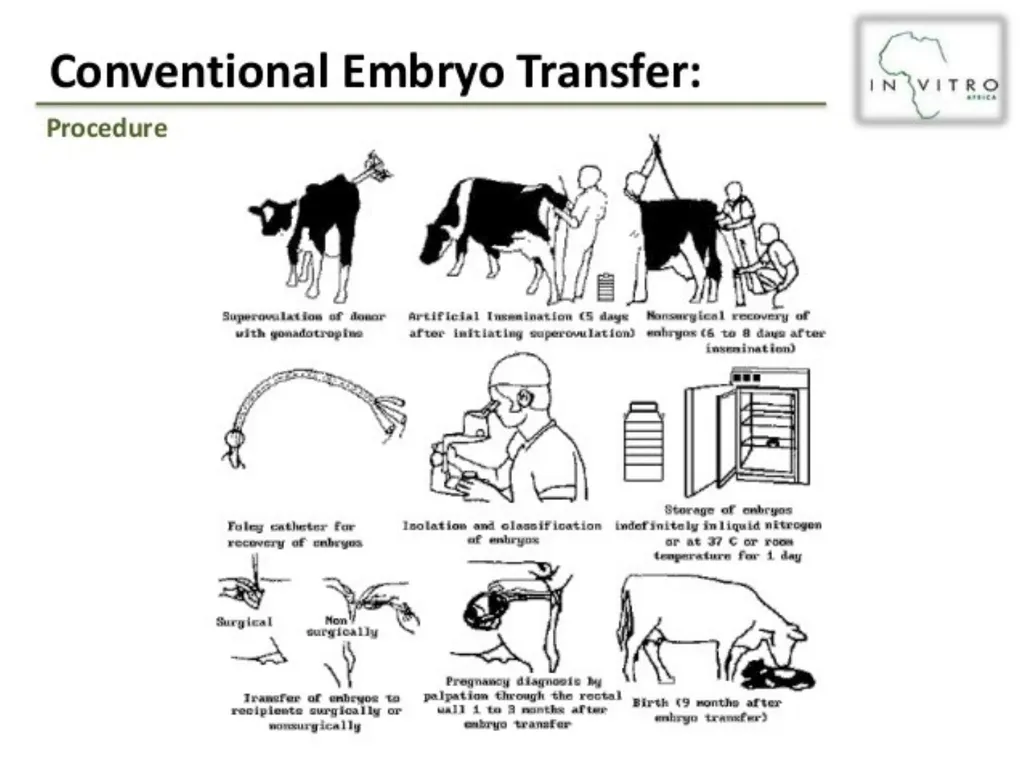
Cow is made to superovulate by hormone treatment so that at one single oestrus period instead of one usual ovum more ova are produced if the cow is bred at this stage more fertilized embryos may result.
If these embryos are physically collected from that cow. Each of the fertilized embryo may be transferred to each foster mother so that, more calves can be produced simultaneously from each foster mother. One major advantage of embryo transfer is the cross breeding for genetic improvement can be achieved quickly.
The first successful transfer of fertilized rabbit eggs was reported in 1891 by Walter and Heape at Cambridge. The first successful embryo transfer in farm animals was done in 1934 in Sheep and Goats. The first offspring after transfer of embryos in cattle and swine was reported in 1951.<br>
04
Steps in Embryo transfer technology Selection of donors
Synchronization of estrous
Induction of superovulation
Embryo collection
Evaluation of embryos
Selection of recipients
Transfer of embryos
Embryo transfer techniques have been extensively used in cattle and more sporadically in Sheep, Goats and Pigs.<br>
05
SELECTION OF DONORS Any regularly cyclic cow or heifer can successfully be termed as donor because technically it will respond to superovulatory treatment followed by embryo transfer.
Usually there are many reasons that a cow is preferable than a heifer because embryo transfer programme is based on milk yield or genetic superiority. In addition the following are the criteria for selection of donor,
Donor should be of age between three years and ten years.
Donor should be free from genetic diseases and conformational abnormalities.
They should exhibit regular oestrus cycle.
Superior production traits of economic importance.
Previous record of sound reproductive performance including successive fertility and artificial insemination.<br>
06
Synchronization of estrous Extending of luteal phage
Long term admistration of exogenous progesterone (7-12) days that continues to exert a negative feedback on LH secretion, which on withdrawal result into follicular growth, estrous and ovulation
Shortening of luteal phase
the primary leutolytic agent like prostaglandin induces premature regression of CL<br>
07
INDUCTION OF SUPEROVULATION Superovulation means the induction of multiple ovulations by application of exogenous hormones (PMSG - Pregnant Mare Serum gonadotrophins, FSH- Follicle Stimulating hormone, HMG - Human Menopausal Gonadotrophins) in the early follicular or in the luteal phase of the oestrus cycle in order to collect large number of fertilized eggs. Most frequenctly PMSG or FSH is used.
PMSG - one single injection (2000 to 3000 IU) as the substance has a very long half life time.
FSH – Multiple injections of FSH (35-50 mg) twice daily for four days.
48 and 60 hours after beginning the gondaotrophin treatment, Prostaglandins (PG) are administered to induce oestrus. Inseminations are performed at oestrus two days later. Embryos are recovered 8 days after insemination.<br>
08
EMBRYO COLLECTION In the bovine, embryos are recovered by non surgical methods.
Special catheters(Foley’s catheters) are introduced via the cerevix into the uterine horn and embryos are flushed with 250 – 300ml flushing medium.
Recovery rate is influenced by
The position of the embryos in the uterus
The flushing method
The time of recovery
Ovarian response
Embryo viability<br>
09
In other farm animals, Sheep, Pigs and Goats embryo recovery is performed by surgical methods. Disadvantage of the surgical method is the number of repetitions is limited by the occurrence of adhesions.
After recovering embryos from the flushing medium their further developmental capacity has to be evaluated. Embryo viability can be evaluated by various methods.<br>
10
Morphological evaluation Most frequently the morphological evaluation at various microscopical magnifications is used. Morphological criteria in embryo evaluation are shape, colour, number and compactness of cells, Size of the perivitelline space, number and size of vesicles and status of the zona pellucida. The ideal embryo is even, the perivitelline space is empty and of a regular diameter. According to their morphological appearance, embryos are classified into four groups.
Excellent embryos: Embryos in the appropriate developmental stage with a perfect morphology.
Good embryos: Embryos in the appropriate stage of development with slight morphological deviations. Eg. Minor damage of the zona pellucida and excluded blastomeres or vesicles in the perivitelline space.
Degenerated and / or retarded embryos: Embryos in the appropriate developmental stage with major morphological deviations (degenerated embryos)
Unfertilized ova.<br>
11
Staining methods Embryo viability can be evaluated by various vital staining and fluorescence techniques<br>
12
SELECTION OF RECIPIENTS Recipients are selected based on the
Normal physiological and health conditions.
The reproductive status.
Lack of any reproductive disorders.
Compatibility to the donor with respect to size of the foetus.
Oestrus synchronization.
In bovines, heifers and young cows are best suited as recipients.<br>
13
TRANSFER OF EMBRYOS Recently special catheters have been developed to perform non – surgical transfers in cattle.
It is important to transfer the embryo in to tip of the uterine horn without damaging the endometrium.
For a successful embryo transfer, the most important is embryo quality. It is very important to transfer the embryo ipsilateral, that means into the horn bearing the corpus luteum.<br>
14
CRYOPRESERVATION OF EMBRYOS Cryopreservation of embryos is an essential part of embryo transfer programme and it allows worldwide shipment of embryos.
Reliable freezing methods have been developed for bovine and sheep embryos.
An optimal method for bovine embryos includes a one step addition of 1.4M glycerol as cryoprotectant, a 20 minutes equilibration period and 0.25 ml straws as embryo containers, slow cooling down to -35°C and subsequent plunging to liquid nitrogen (-196°C). Embryos are thawed by placing the straws directly into warm water.<br>
15
APPLICATIONS OF EMBRYO TRANSFER Exploitation of female reproductive capacity (more offspring from valuable donors).
Significant facilitation of import and export for valuable genetic material.
Development of new breeding concepts.
Gene conservation by freezing techniques.
Twin production (Embryo splitting).
Introduction of new genes into closed herds.
Manipulation of embryos.
Gene transfer.<br>