Emissions Trading System Design Options Paper: Scope and Cap Stringency BOSNIA AND HERZEGOVINA Energy Summit 27 April, 2023 Neum, Bosnia and Herzegovina BACKGROUND Bosnia and Herzegovina has developed an emissions trading roadmap Starting
"Emissions Trading System Design Options Paper:" is the property of its rightful owner. Permission is granted to
download and print the materials on this website for personal, non-commercial use only, and to display it
on your personal computer provided you do not modify the materials and that you retain all copyright
notices contained in the materials. By downloading content from our website, you accept the terms of this
agreement.
Presentation Transcript
01
Emissions Trading System Design Options Paper: Scope and Cap Stringency BOSNIA AND HERZEGOVINA Energy Summit 27 April, 2023
Neum, Bosnia and Herzegovina<br>
02
BACKGROUND Bosnia and Herzegovina has developed an emissions trading roadmap
Starting to consider and plan how the various elements of the EU emission trading system (ETS) and related legislation can be introduced and implemented to enable carbon pricing in a timely manner
In the preliminary phase, the focus is on starting a dialogue in the country to explore the main design elements of emissions trading
BiH has also passed Monitoring, Reporting and Verification legislation for Greenhouse Gas emissions and reports electricity production emissions and CO2 intensity through the Energy Community. 2 BiH ETS Design Options Report<br>
03
BACKGROUND The World Bank is providing technical assistance, working with the Ministry for Foreign Trade and Economic Relations, as well as other donors, on a one-year project focusing on ETS design options, including computable general equilibrium (macroeconomic) modeling.
While there are several other design choices to be made in building an ETS, the decision was made to limit the analysis to scope and cap as they are early and fundamental decisions that need to be taken by the Government
Given the close relationship with the EU and political commitments to align with EU Climate Law, these design choices will also be influenced by the design of the EU ETS. Alignment and interactions with the NECP will also be considered.
To inform the report and modeling results, workshops with stakeholders will also be held throughout the report writing process. 3 BiH ETS Design Options Report<br>
04
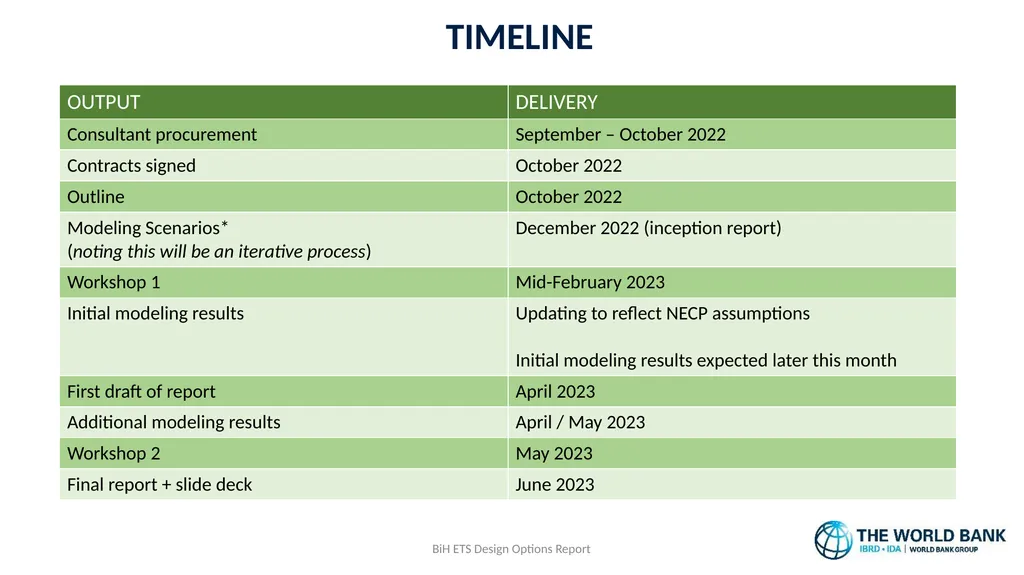
TIMELINE 4 BiH ETS Design Options Report<br>
05
ETS Design Options Paper 5 BiH ETS Design Options Report<br>
06
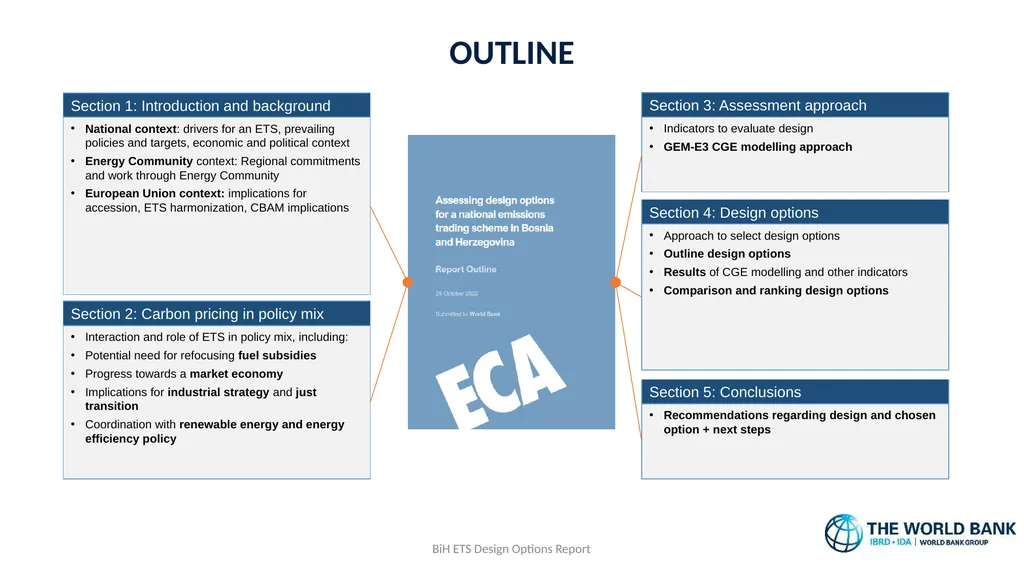
OUTLINE BiH ETS Design Options Report Section 1: Introduction and background National context: drivers for an ETS, prevailing policies and targets, economic and political context
Energy Community context: Regional commitments and work through Energy Community
European Union context: implications for accession, ETS harmonization, CBAM implications Section 2: Carbon pricing in policy mix Interaction and role of ETS in policy mix, including:
Potential need for refocusing fuel subsidies
Progress towards a market economy
Implications for industrial strategy and just transition
Coordination with renewable energy and energy efficiency policy Section 3: Assessment approach Indicators to evaluate design
GEM-E3 CGE modelling approach Section 4: Design options Approach to select design options
Outline design options
Results of CGE modelling and other indicators
Comparison and ranking design options Section 5: Conclusions Recommendations regarding design and chosen option + next steps<br>
07
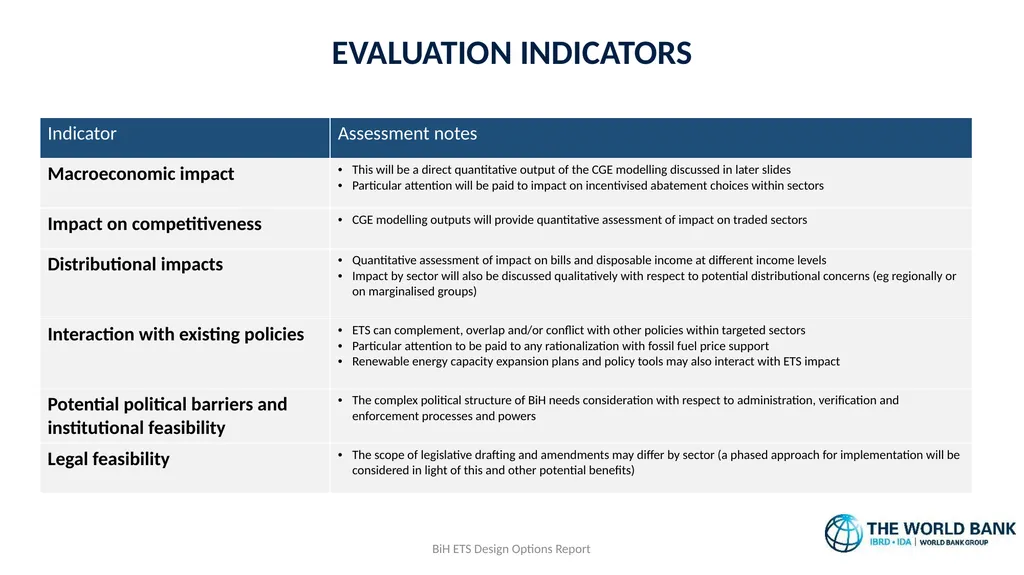
EVALUATION INDICATORS BiH ETS Design Options Report<br>
08
MODELING SCENARIOS The team, with input from the government, is developing a series of scenarios to model different options for ETS scope (e.g. which sectors will be covered) and cap ambition
The large-scale hybrid CGE model (GEM-E3-BIH) is a tailored version of the model used by European Commission, BiH and other WB6 countries.
The following aspects are varied: ETS sector coverage, level of cap ambition, allocation scheme, carbon revenue use
Results can help assess how different ETS designs help BiH achieve not only NDC but NECP scenarios and targets (for RE and EE by 2030 and beyond). Equally, how can NECP policies make the ETS more effective and reduce its impact on the economy. 8 BiH ETS Design Options Report<br>
09
MODELING SCENARIOS Sample scenarios include:
Initially lower ETS prices (as a % of EU allowance price forecast) vs. delayed alignment with EU allowance prices vs. Immediate harmonization with ETS price forecast
Scope: Power sector initially then expanding to industry (as currently in the EU ETS) vs. immediate EU ETS coverage
Revenue use: A mix of lump sum to households, R&D investments, labor force training etc.
Regional carbon pricing: BiH only vs. Energy Community members adopting a carbon price 9 BiH ETS Design Options Report<br>
10
Other work The World Bank is supporting other carbon pricing work ongoing in the region, including:
Montenegro (improving current ETS and looking at options to expand the carbon price signal through crediting or expanding to other sectors), Türkiye (developing a pilot ETS for implementation) and Ukraine (core design elements for a national ETS) are advancing emissions trading work through the World Bank’s Partnership for Market Implementation
Serbia: modeling carbon pricing and CBAM impacts as part of a broader report on green and resilient growth
Upcoming: Regular Economic Report and Country Climate Development Report for Western Balkans will look at CBAM and carbon pricing 10 BiH ETS Design Options Report<br>