Emma Jane Austen Presented by: Jaspal Kaur Matharu Guest Faculty Department of English Gangadhar Meher University Jane Austen Jane Austen, (born December 16, 1775- died July 18, 1817), English writer who first gave the novel its distinctly
"Emma Jane Austen Presented by: Jaspal Kaur Matharu" is the property of its rightful owner. Permission is granted to
download and print the materials on this website for personal, non-commercial use only, and to display it
on your personal computer provided you do not modify the materials and that you retain all copyright
notices contained in the materials. By downloading content from our website, you accept the terms of this
agreement.
Presentation Transcript
01
Emma
Jane Austen Presented by: Jaspal Kaur Matharu
Guest Faculty
Department of English
Gangadhar Meher University<br>
02
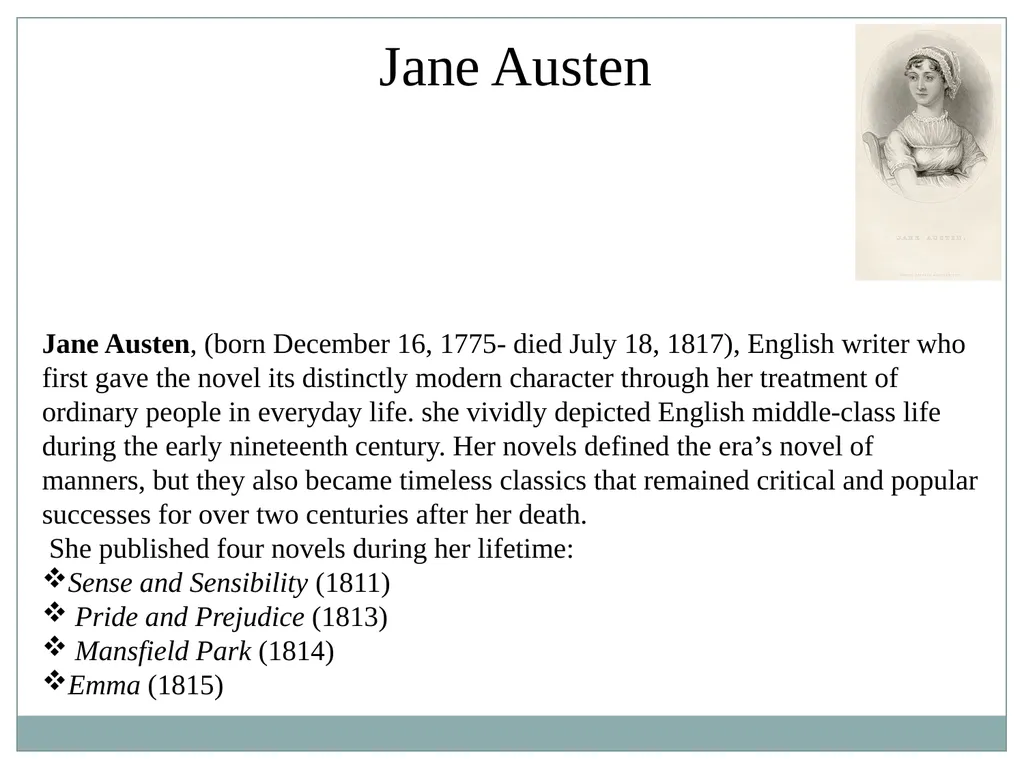
Jane Austen Jane Austen, (born December 16, 1775- died July 18, 1817), English writer who first gave the novel its distinctly modern character through her treatment of ordinary people in everyday life. she vividly depicted English middle-class life during the early nineteenth century. Her novels defined the era’s novel of manners, but they also became timeless classics that remained critical and popular successes for over two centuries after her death.
She published four novels during her lifetime:
Sense and Sensibility (1811)
Pride and Prejudice (1813)
Mansfield Park (1814)
Emma (1815)<br>
03
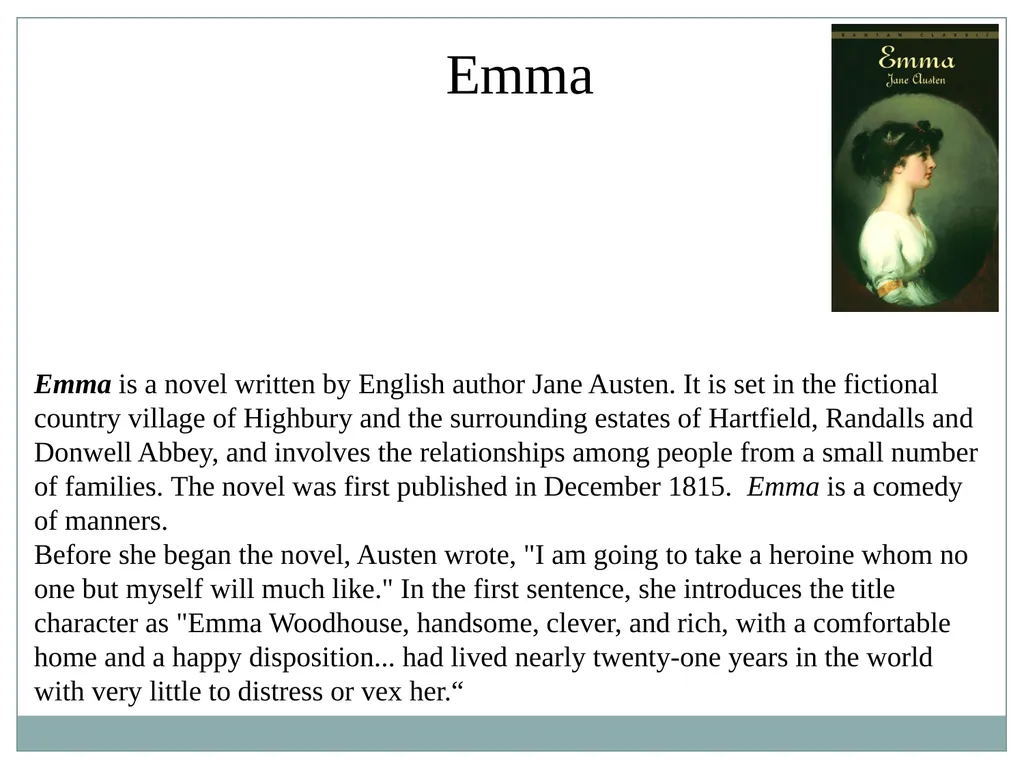
Emma Emma is a novel written by English author Jane Austen. It is set in the fictional country village of Highbury and the surrounding estates of Hartfield, Randalls and Donwell Abbey, and involves the relationships among people from a small number of families. The novel was first published in December 1815. Emma is a comedy of manners.
Before she began the novel, Austen wrote, "I am going to take a heroine whom no one but myself will much like." In the first sentence, she introduces the title character as "Emma Woodhouse, handsome, clever, and rich, with a comfortable home and a happy disposition... had lived nearly twenty-one years in the world with very little to distress or vex her.“<br>
04
Characters Emma Woodhouse
George Knightley
Frank Churchill
Mr. Elton
Jane Fairfax
Mrs. Weston
Mr. Weston
Harriet Smith
Mr. Woodhouse<br>
05
Plot Emma’s introduction of the character Emma Woodhouse is among the most famous in the history of fiction. Emma is indeed beautiful, wealthy, and smart. However, she is also spoiled, meddlesome, and self-deluded. Although she is convinced she will never marry, Emma believes she is an excellent matchmaker. As she tells her father and her dear friend Mr. Knightley, she practically arranged the recent marriage between her former governess, Miss Taylor, and the widower Mr. Weston. (She did, after all, introduce them.) After such a clear “success,” Emma is determined to make another match. This time, she has set her sights on the village vicar, Mr. Elton. Both Emma’s father and Mr. Knightley caution her against interfering, but they ultimately fail to dissuade her.
Shortly thereafter, Emma befriends Harriet Smith, a 17-year-old student at a local boarding school. Harriet’s parentage is unknown; she is “the natural daughter of somebody” who many years ago placed her in the care of the school’s headmistress, Mrs. Goddard. Despite the obscurity of her birth and her perceived inferior social status, Emma decides that Harriet is a perfect match for Mr. Elton. Emma sets about improving her friend, first, by discouraging her interest in Robert Martin, a young farmer whose family is renting land from Mr. Knightley. Harriet clearly has feelings for Robert (and Robert for her). Emma convinces her otherwise; she tells Harriet that Robert is beneath her. When Robert writes a letter asking for her hand in marriage, Harriet, with Emma’s counsel, refuses him.<br>
06
When Mr. Knightley visits Emma, he excitedly tells her about Robert’s intent to marry Harriet. After Emma informs him that Harriet has already rejected Robert’s proposal (with her help), Mr. Knightley is furious. He criticizes Emma for interfering, claiming Robert is a respectable man and a good match for Harriet. Mr. Knightley storms out. He does not visit Emma again for some time. In his absence, Emma continues to push Harriet and Mr. Elton together. With Robert out of the way, and Harriet and Mr. Elton spending more and more time together, Emma begins to celebrate the success of her endeavour. All seems to be going well until Christmas Eve, when Mr. Elton reveals to Emma that he is in love with her, not Harriet, and has been spending time with Harriet only to please her. Humiliated by her attempt to pair him with Harriet, Mr. Elton resolves to retire to Bath. Emma is forced to tell Harriet about Mr. Elton and spends the next several days consoling her.
Meanwhile, two new visitors arrive in Highbury: Jane Fairfax, the beautiful orphaned niece of Emma’s neighbour Miss Bates, and Frank Churchill, the dashing young son of Mr. Weston. Initially, Emma dislikes Jane. She condemns her for being too “cold” and too “cautious.” Mr. Knightley defends Jane, reminding Emma that, whereas she is privileged, Jane has no fortune and must soon leave to work as a governess. Mrs. Weston suspects that Mr. Knightley harbours some romantic feelings for Jane. Emma adamantly denies this.<br>
07
Emma’s initial interest in Frank does not last. After a while, she begins to imagine him as a potential match for Harriet, and, when Harriet confesses her love for a man of a higher social status, Emma assumes she means Frank. As it turns out, Harriet is in love with Mr. Knightley, who, at a recent village ball, saved her from the embarrassment of being snubbed by Mr. Elton and his new wife. Suddenly, Emma realizes that she, too, loves Mr. Knightley. She realizes that if she had let Harriet marry Robert, she might have avoided this whole mess. And thus the denouement begins.
Not long after Harriet’s confession, Frank makes a hasty departure from Highbury. As he later explains in a letter to Emma, he and Jane have secretly been engaged all along. His flirtation with Emma was just a ruse—a way to buy time until his relatives agreed to his marriage with Jane. Emma and Mr. Knightley discuss this surprise turn of events. To Mr. Knightley’s surprise, Emma confesses that she never loved Frank. Mr. Knightley, in response, professes his love for Emma. She is overjoyed, and they implicitly agree to be married.
Emma briefly worries about Harriet and how she will receive the news of their engagement. Emma is pleased to learn that Harriet has decided to marry Robert after all. The novel thus concludes with three marriages: Jane and Frank, Harriet and Robert, and Emma and Mr. Knightley.<br>
08
Themes Marriage
Love
Class
Gender limitation
Social Class
Misperception
Pride and Vanity<br>