03
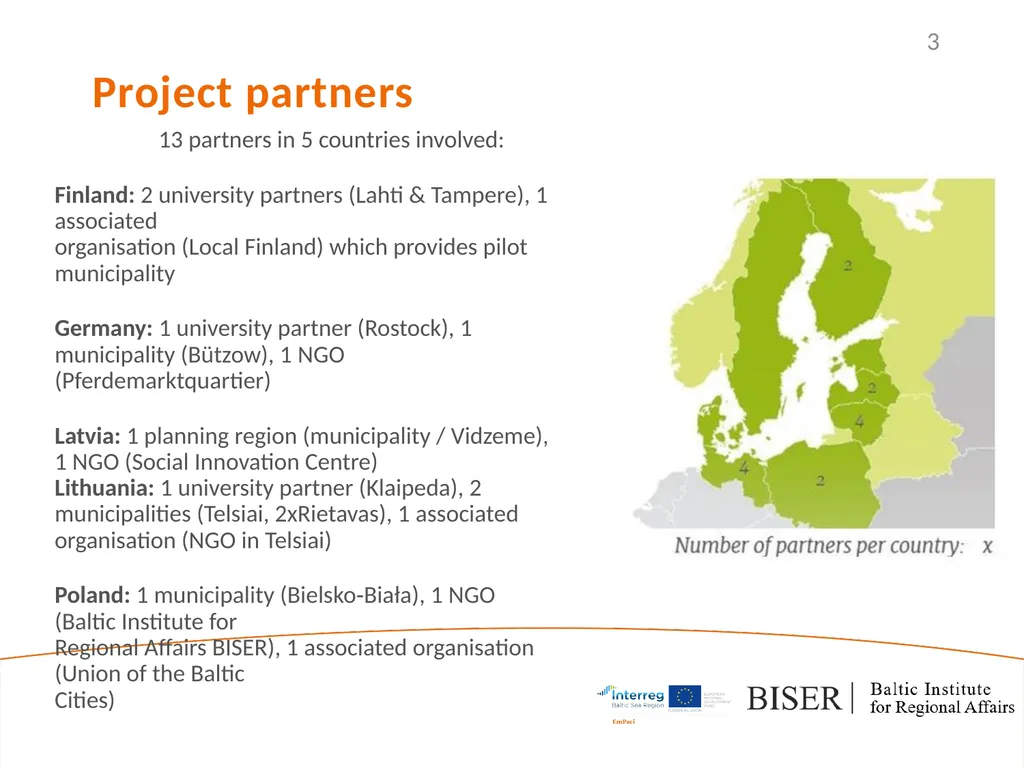
3 Project partners 13 partners in 5 countries involved:
Finland: 2 university partners (Lahti & Tampere), 1 associated
organisation (Local Finland) which provides pilot municipality
Germany: 1 university partner (Rostock), 1 municipality (Bützow), 1 NGO (Pferdemarktquartier)
Latvia: 1 planning region (municipality / Vidzeme), 1 NGO (Social Innovation Centre)
Lithuania: 1 university partner (Klaipeda), 2 municipalities (Telsiai, 2xRietavas), 1 associated organisation (NGO in Telsiai)
Poland: 1 municipality (Bielsko‐Biała), 1 NGO (Baltic Institute for
Regional Affairs BISER), 1 associated organisation (Union of the Baltic
Cities)<br>
04
4 Project partners NOW PP 15: Saint Petersburg National Research University of Information Technologies, Mechanics and Optics (ITMO University)
PP 16: Council of Municipalities of St. Petersburg
PP 17: «E-Development Partnership in the North-West» Non-Profit Partnership («PRIOR North-West» NPP).
Also there are three more associated organisations:
· AO 4 Association of SME support centers Kaliningrad;
· AO 7 Administration of City of Petrogradsky district;
· AO 8 The municipal council of the inner city municipality of St. Petersburg, Municipal District Moscow Zastava.<br>
05
5 Challenges to citizen participation in the BSR A majority of the BSR areas is characterized by largely fragmented living areas of their inhabitants.
This leads to challenges for public authorities and councils when it comes to involving all citizens into joint projects and to discuss relevant issues with all citizen groups.
Instruments are needed that enable and encourage the entire citizenry to take part in decisions of their municipality such as decisions regarding expenditures and revenues in the local budget.<br>
06
6 EmPaci produces ready to use material and establishes networks The main output is building capacities and knowledge as well as strengthening relations between municipalities and citizens by providing ready to use guidelines, training programs and tools to implement participatory budgeting.<br>
07
Baltic Institute for Regional Affairs BISER Country: Poland (Gdynia)
Type of organisation: NGO
Established: 2001
Short description:
BISER offers expertise, analysis and review services. Projects covering the aims of the Association concern particularly: social economy and social entrepreneurship, sustainable development, EU macroregional strategy and regional policy, Baltic Sea Region transnational cooperation and others.
Role in the project: Project partner
Persons involved in EmPaci: �Anna Fornalska-Skurczyńska, Magda Leszczyna-Rzucidło
www.biser-en.org.pl Partner introduction 7<br>
08
Status Quo of PB in POLAND Citizen participation in general 8 different age criteria for people submitting projects and voting for the PB
voter turnout is varied and ranging from a few percent to even over 45% in some city districts
the concept of PB is gaining popularity
around 50% of voters in the Tricity were 31-50 years old<br>
09
9 Status Quo of PB in POLAND Participatory Budgeting in particular remaining aspects depend on the municipalities only (form, deadlines, requirements)
usually introduced at the gmina level, sometimes at the city districts level, it is up to the municipalities
2011 - Sopot was the first Polish city to implement PB<br>
10
PB preconditions in POMORSKIE Size of population: 2 324 251
Average age of population:
Share of elderly (> 65 years) 26%
Share youth (< 16 years) 17%
Gender of population: 49% male, 51% female
Income level: PLN 4496 (99,3%) ~ EUR 1046
Unemployment level: 4,3%
Dispersion of citizenry (citizens/km²): 127 10<br>
11
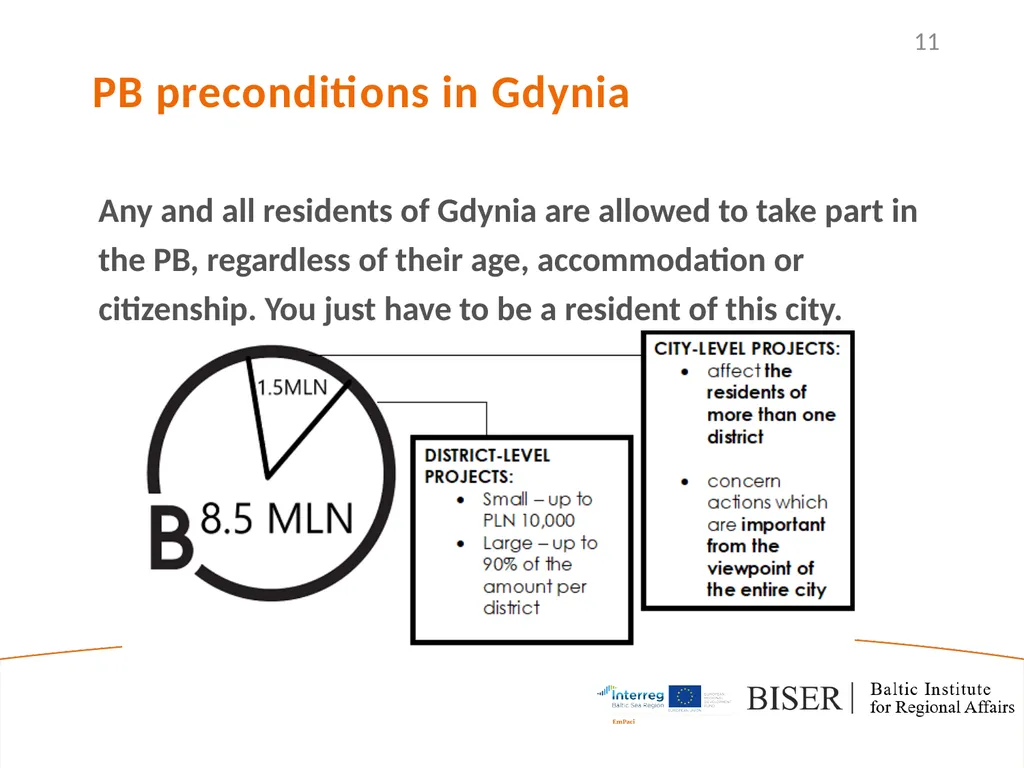
11 PB preconditions in Gdynia Any and all residents of Gdynia are allowed to take part in the PB, regardless of their age, accommodation or citizenship. You just have to be a resident of this city.<br>
12
12 What kind of projects can be submitted to the PB in Gdynia? Projects may be related to areas such as:
Education (e.g. workshops, regional education)
Transport and traffic organisation (e.g. bike lanes, road renovations, solutions that calm traffic
Culture (e.g. festivals, community festivities, artistic programmes, film screenings)
Environmental protection (e.g. recycling containers, solar panels, bins for dog poop)
Social support (e.g. promotion of social integration, subsidies for warm meals)
Public space (e.g. small architecture, decorative elements, lighting, development of yards and squares)
Sport and recreation (e.g. sport fields, sport activities, acquisition of sporting equipment available to everyone)
Health (e.g. prophylactic tests, pro-health education, new defibrillators)
Urban green areas (e.g. planting new trees and bushes, development of parks, seeding lawns and flower meadows)<br>
13
13 Our current EMPACI work - EmPaci GoA 2.2 - Citizen survey Survey with 42 questions
Done in all project partner countries, but nly in selected cities
5% of the city population to take part
Results being collected from August until November
Initial results in December 2019<br>
14
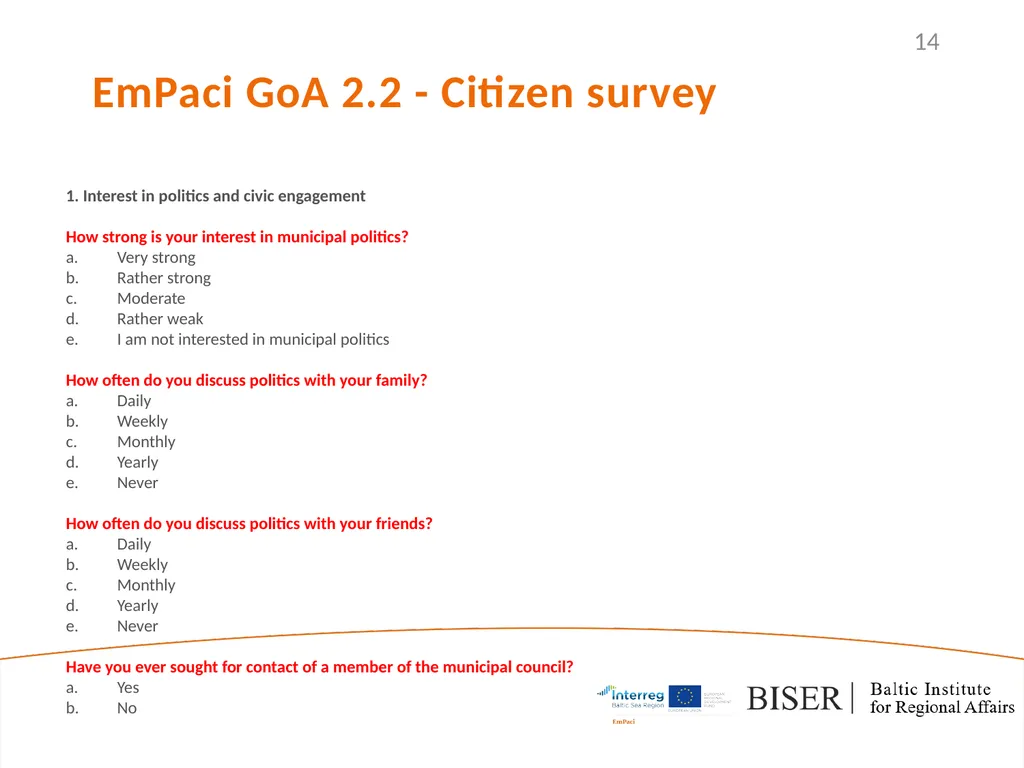
14 EmPaci GoA 2.2 - Citizen survey 1. Interest in politics and civic engagement
How strong is your interest in municipal politics?
a. Very strong
b. Rather strong
c. Moderate
d. Rather weak
e. I am not interested in municipal politics
How often do you discuss politics with your family?
a. Daily
b. Weekly
c. Monthly
d. Yearly
e. Never
How often do you discuss politics with your friends?
a. Daily
b. Weekly
c. Monthly
d. Yearly
e. Never
Have you ever sought for contact of a member of the municipal council?
a. Yes
b. No<br>
15
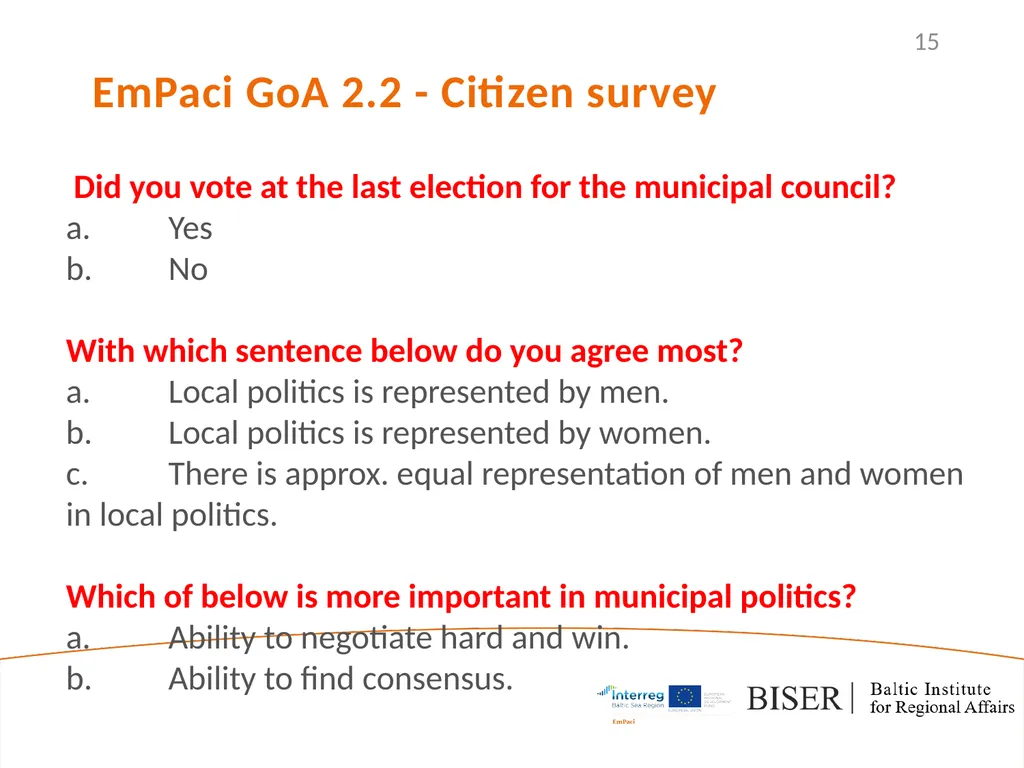
15 EmPaci GoA 2.2 - Citizen survey Did you vote at the last election for the municipal council?
a. Yes
b. No
With which sentence below do you agree most?
a. Local politics is represented by men.
b. Local politics is represented by women.
c. There is approx. equal representation of men and women in local politics.
Which of below is more important in municipal politics?
a. Ability to negotiate hard and win.
b. Ability to find consensus.<br>
16
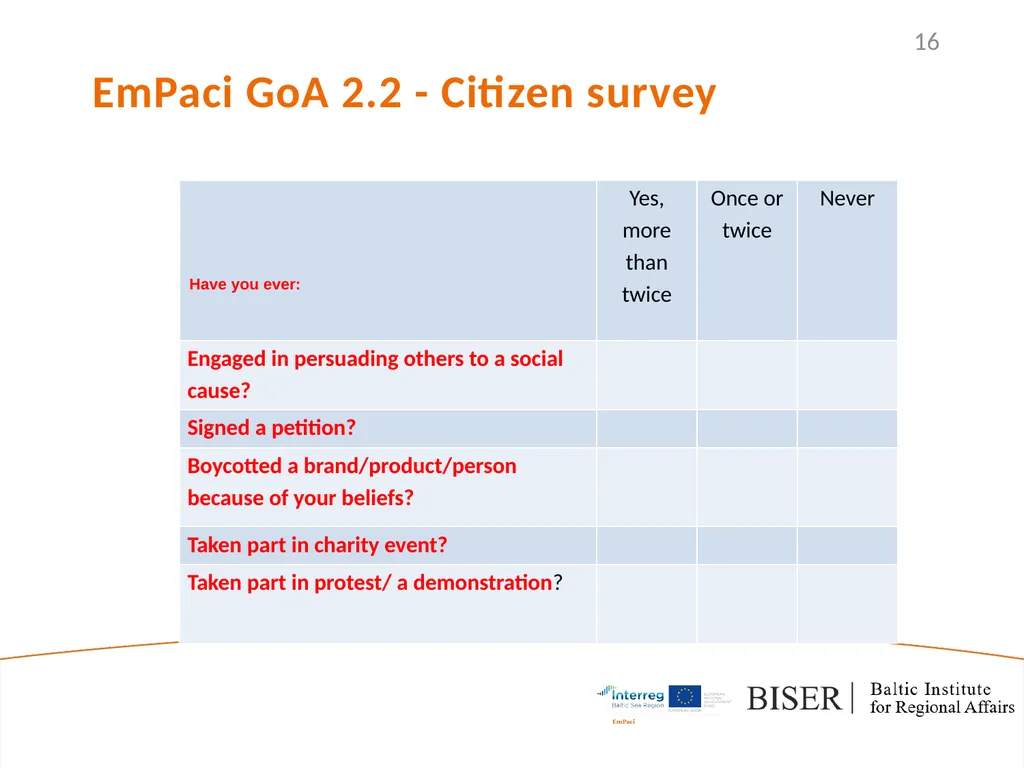
16 EmPaci GoA 2.2 - Citizen survey Have you ever:<br>
17
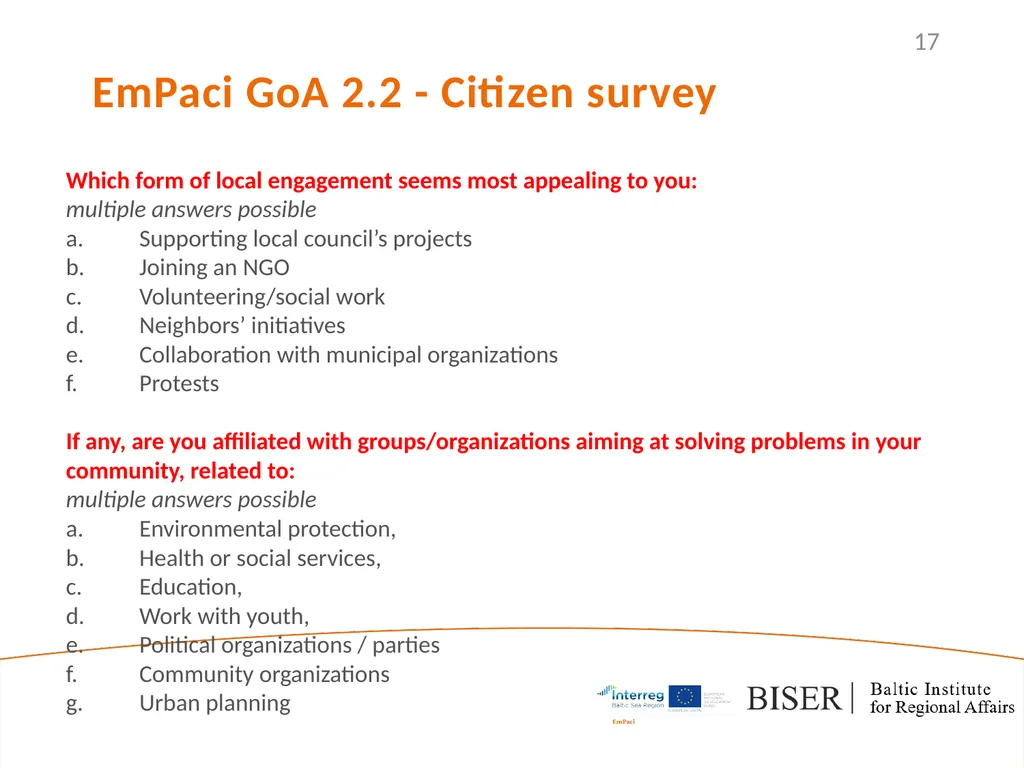
17 EmPaci GoA 2.2 - Citizen survey Which form of local engagement seems most appealing to you:
multiple answers possible
a. Supporting local council’s projects
b. Joining an NGO
c. Volunteering/social work
d. Neighbors’ initiatives
e. Collaboration with municipal organizations
f. Protests
If any, are you affiliated with groups/organizations aiming at solving problems in your community, related to:
multiple answers possible
a. Environmental protection,
b. Health or social services,
c. Education,
d. Work with youth,
e. Political organizations / parties
f. Community organizations
g. Urban planning<br>
18
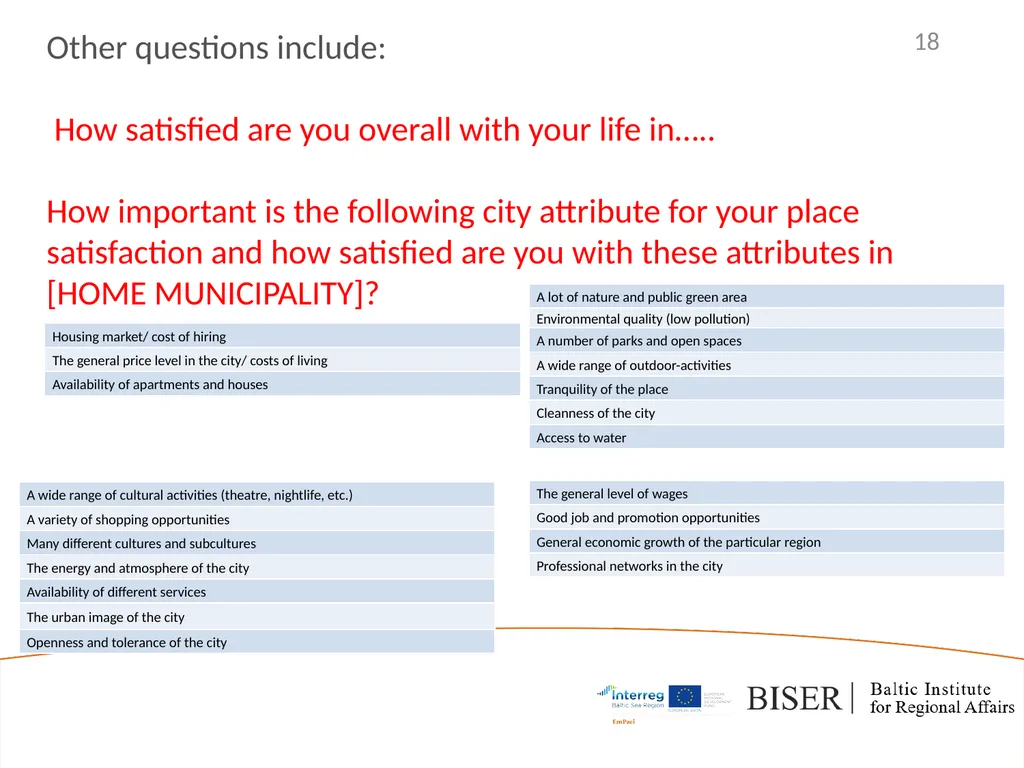
18 Other questions include:
How satisfied are you overall with your life in…..
How important is the following city attribute for your place satisfaction and how satisfied are you with these attributes in [HOME MUNICIPALITY]?<br>
19
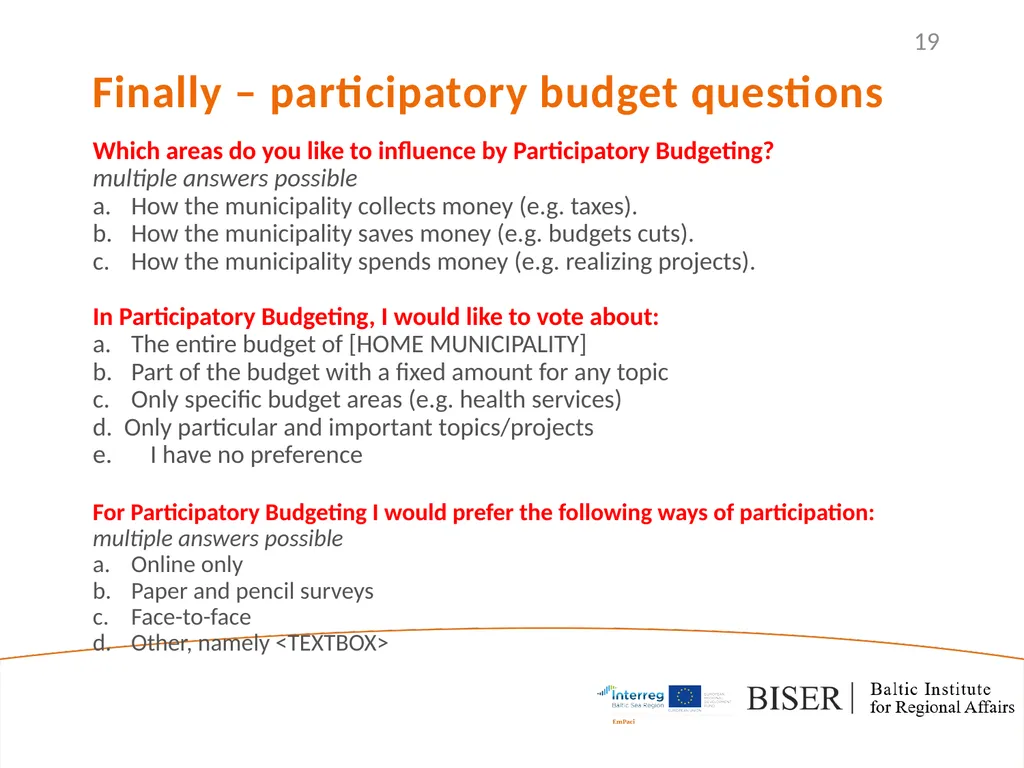
19 Finally – participatory budget questions Which areas do you like to influence by Participatory Budgeting? �multiple answers possible
a. How the municipality collects money (e.g. taxes).
b. How the municipality saves money (e.g. budgets cuts).
c. How the municipality spends money (e.g. realizing projects).
In Participatory Budgeting, I would like to vote about:
a. The entire budget of [HOME MUNICIPALITY]
b. Part of the budget with a fixed amount for any topic
c. Only specific budget areas (e.g. health services)
d. Only particular and important topics/projects
I have no preference
For Participatory Budgeting I would prefer the following ways of participation:
multiple answers possible
a. Online only
b. Paper and pencil surveys
c. Face-to-face
d. Other, namely <TEXTBOX><br>
20
Magda Leszczyna-Rzucidło
BISER, CEO
e-mail: magda@biser.org.pl
EUROREGION BALTIC
magda.rzucidlo@euroregionbaltic.eu EmPaci<br>