04
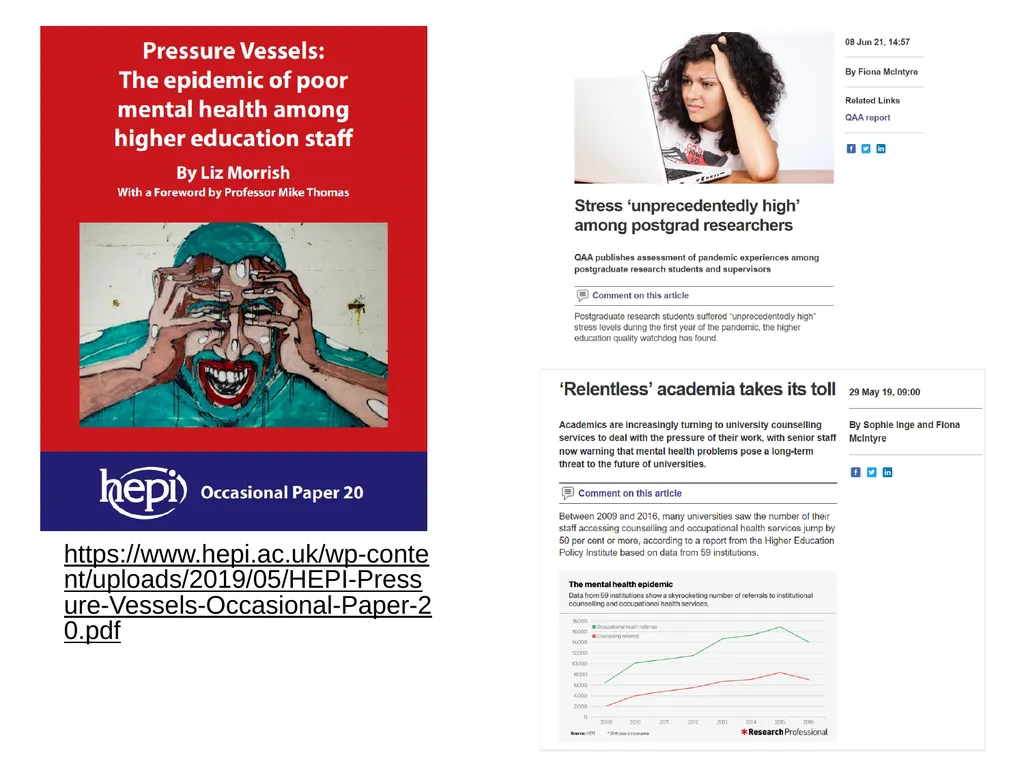
https://www.hepi.ac.uk/wp-content/uploads/2019/05/HEPI-Pressure-Vessels-Occasional-Paper-20.pdf<br>
05
'Everyone you meet is fighting a battle you know nothing about. Be kind. ALWAYS.'
- Robin Williams<br>
06
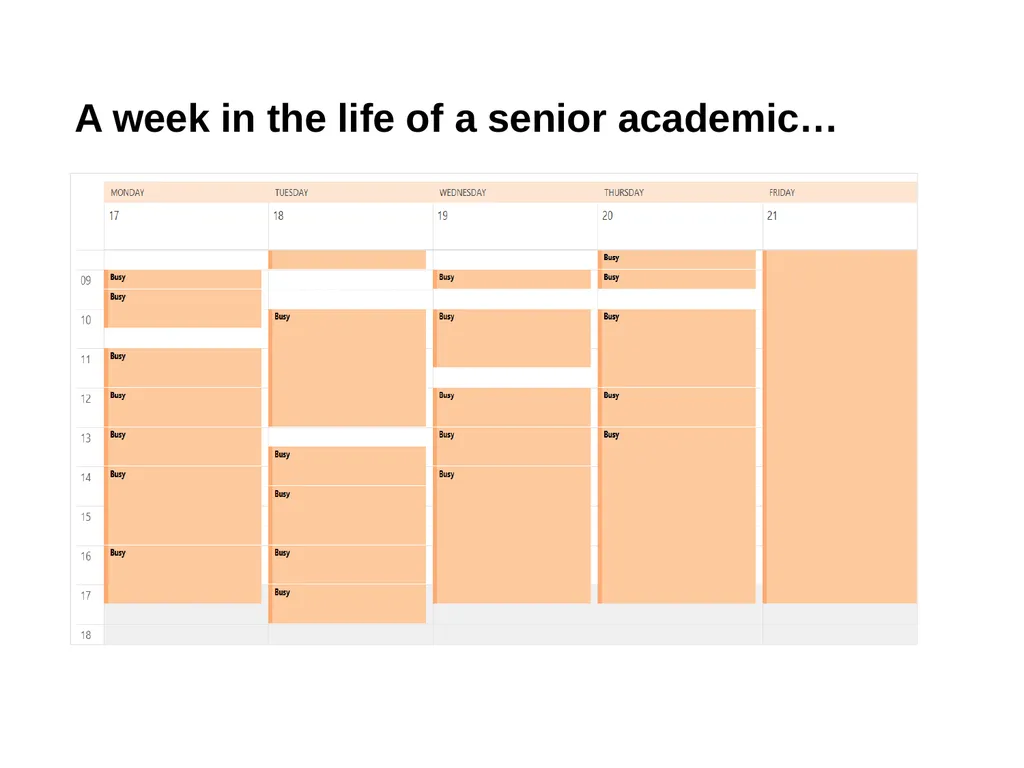
Shorter deadlines
Increasing requirements for demand management
Increasing targets
Increasing requirements for ethics and governance processes
Greater levels of competition
Larger, more complex applications
Cuts to Professional Services in Universities and at funders At the same time, we’re also facing:<br>
07
Spend five minutes on your own, thinking through a) the main issue(s) or source(s) of stress in your role. Write it down.
b) Why is it bothering you?
c) What needs to change to find a way forward here? What’s the ideal resolution?
Spend the next 20 minutes, as a group, firstly for each person to introduce themselves and read out what they wrote, without interruption; secondly, discussing these trigger points; and thirdly, putting these up on Jamboard. Activity 1: Identify your triggers<br>
08
Can you offer concrete, practical tips for any of these?
1. TIME – ‘I have a heavy workload, so struggle to offer in-depth support and then also have to contend with last-minute requests for help, against tight deadlines.’
2. COMMUNICATION – ‘I’m exhausted writing the same info in emails and people just coming back with more questions.’ (e.g. applicants, project partners, internal colleagues)
3. RESPECT – ‘I give applicants advice but they don’t listen to me! We’re trying to help improve quality and they don’t appreciate my expertise.’ Activity 2: Sharing best practice<br>
09
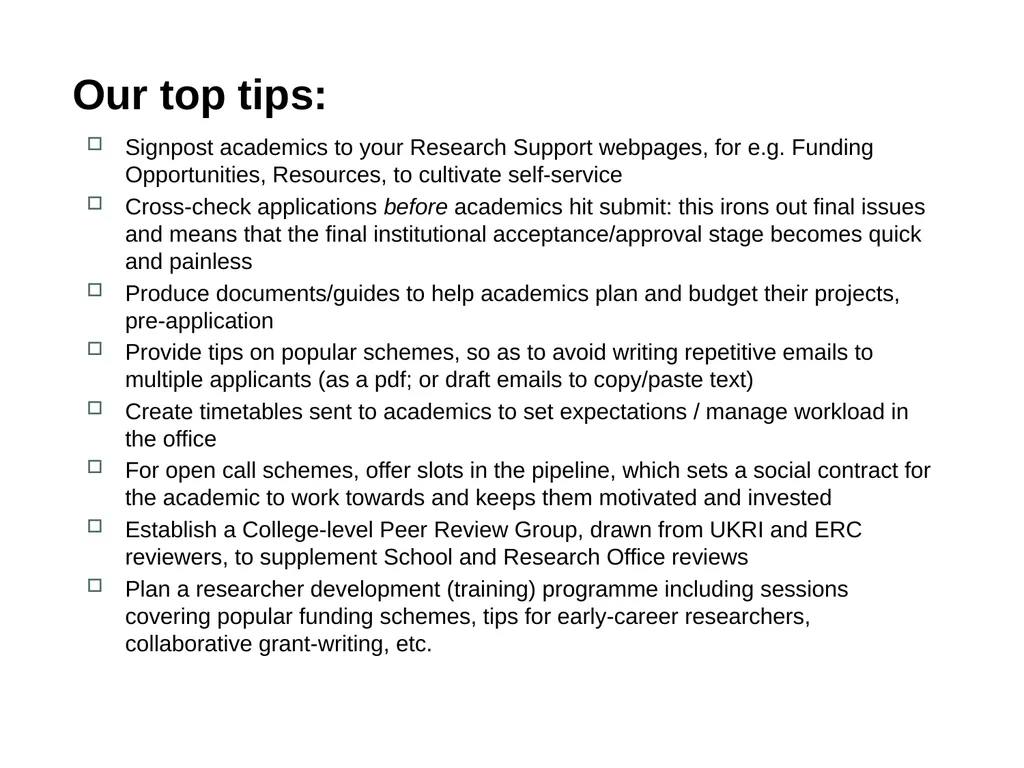
Signpost academics to your Research Support webpages, for e.g. Funding Opportunities, Resources, to cultivate self-service
Cross-check applications before academics hit submit: this irons out final issues and means that the final institutional acceptance/approval stage becomes quick and painless
Produce documents/guides to help academics plan and budget their projects, pre-application
Provide tips on popular schemes, so as to avoid writing repetitive emails to multiple applicants (as a pdf; or draft emails to copy/paste text)
Create timetables sent to academics to set expectations / manage workload in the office
For open call schemes, offer slots in the pipeline, which sets a social contract for the academic to work towards and keeps them motivated and invested
Establish a College-level Peer Review Group, drawn from UKRI and ERC reviewers, to supplement School and Research Office reviews
Plan a researcher development (training) programme including sessions covering popular funding schemes, tips for early-career researchers, collaborative grant-writing, etc. Our top tips:<br>
10
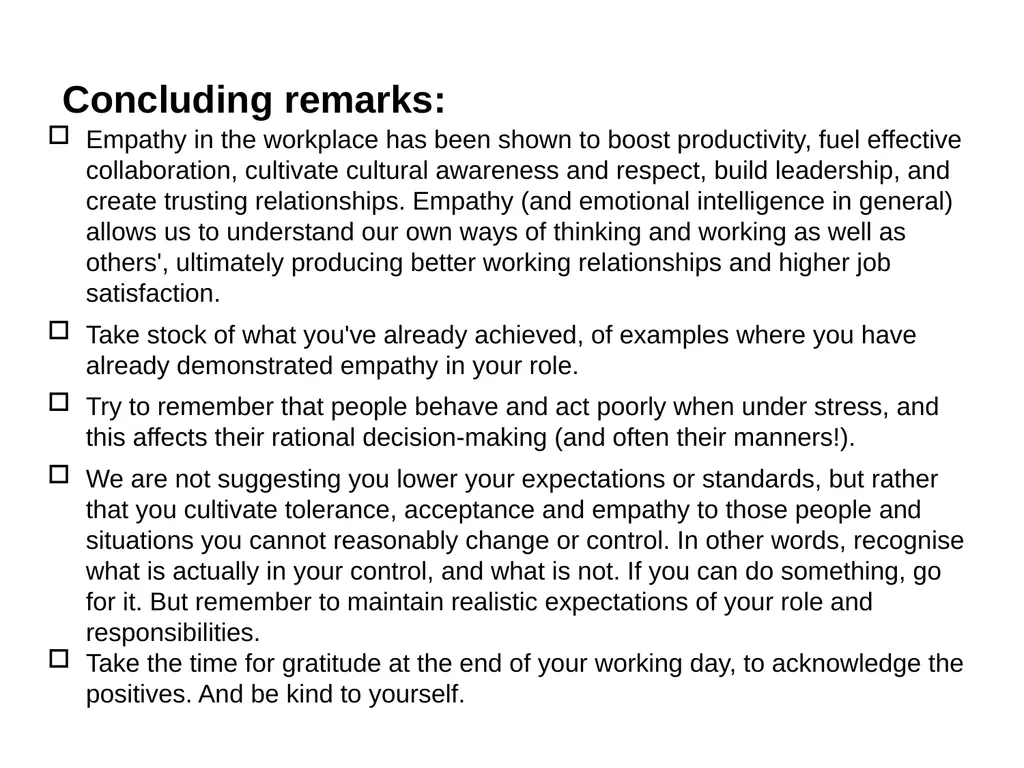
Empathy in the workplace has been shown to boost productivity, fuel effective collaboration, cultivate cultural awareness and respect, build leadership, and create trusting relationships. Empathy (and emotional intelligence in general) allows us to understand our own ways of thinking and working as well as others', ultimately producing better working relationships and higher job satisfaction.
Take stock of what you've already achieved, of examples where you have already demonstrated empathy in your role.
Try to remember that people behave and act poorly when under stress, and this affects their rational decision-making (and often their manners!).
We are not suggesting you lower your expectations or standards, but rather that you cultivate tolerance, acceptance and empathy to those people and situations you cannot reasonably change or control. In other words, recognise what is actually in your control, and what is not. If you can do something, go for it. But remember to maintain realistic expectations of your role and responsibilities.
Take the time for gratitude at the end of your working day, to acknowledge the positives. And be kind to yourself. Concluding remarks:<br>
11
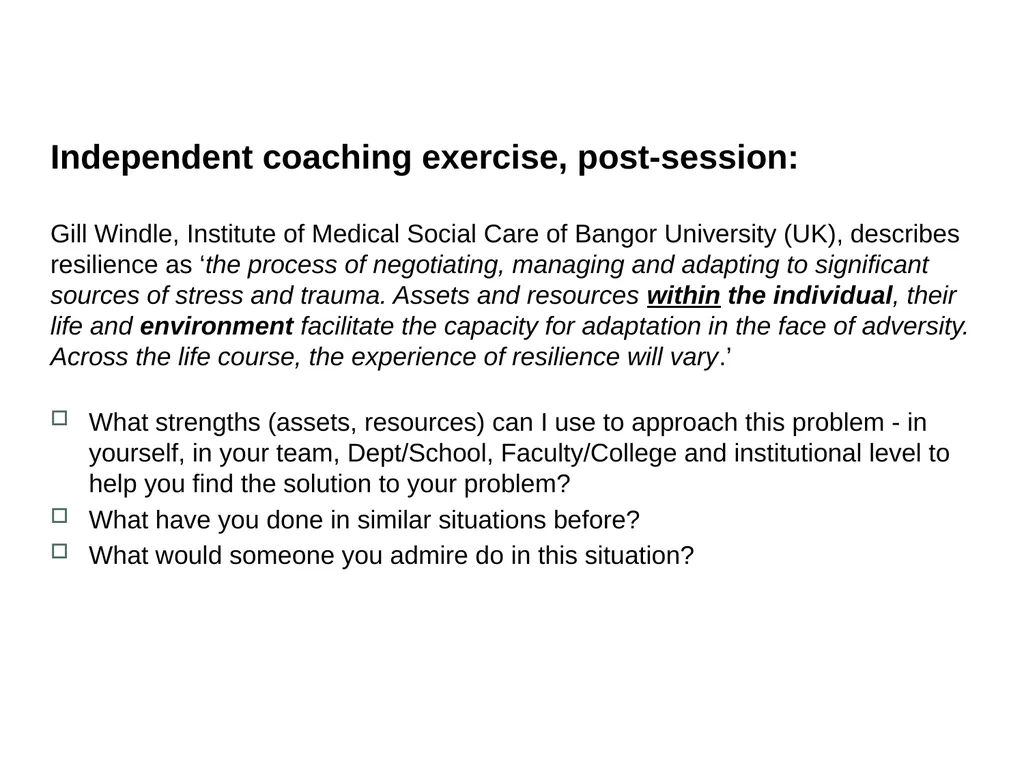
Independent coaching exercise, post-session:
Gill Windle, Institute of Medical Social Care of Bangor University (UK), describes resilience as ‘the process of negotiating, managing and adapting to significant sources of stress and trauma. Assets and resources within the individual, their life and environment facilitate the capacity for adaptation in the face of adversity. Across the life course, the experience of resilience will vary.’
What strengths (assets, resources) can I use to approach this problem - in yourself, in your team, Dept/School, Faculty/College and institutional level to help you find the solution to your problem?
What have you done in similar situations before?
What would someone you admire do in this situation?<br>
12
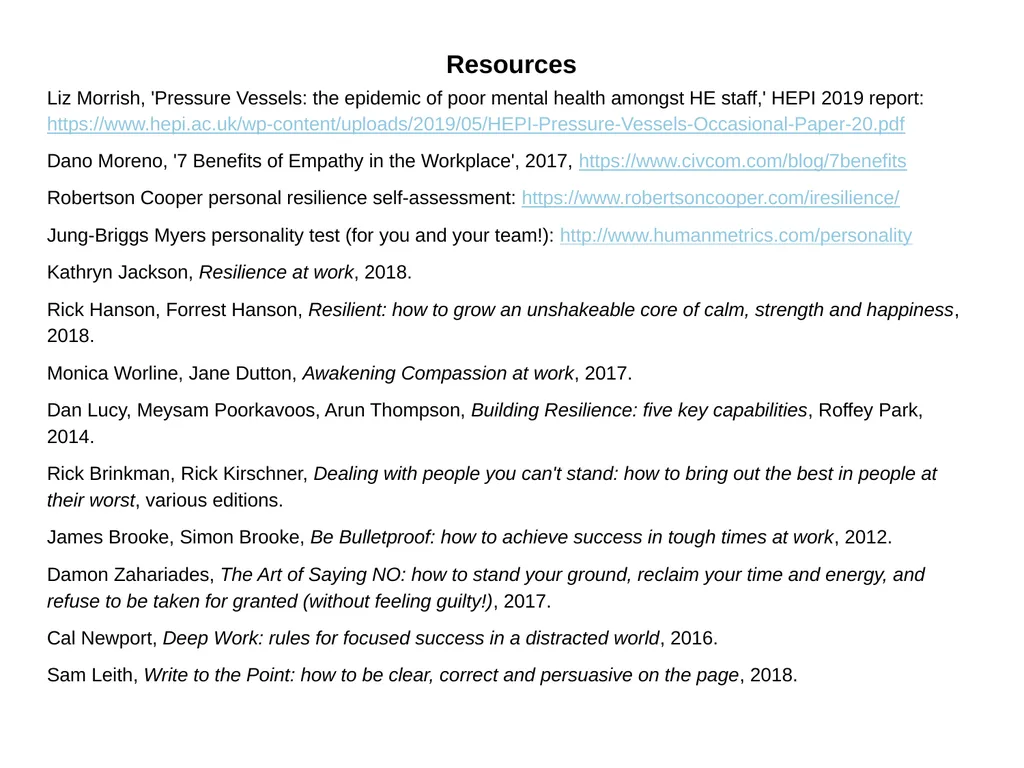
Resources
Liz Morrish, 'Pressure Vessels: the epidemic of poor mental health amongst HE staff,' HEPI 2019 report: https://www.hepi.ac.uk/wp-content/uploads/2019/05/HEPI-Pressure-Vessels-Occasional-Paper-20.pdf
Dano Moreno, '7 Benefits of Empathy in the Workplace', 2017, https://www.civcom.com/blog/7benefits
Robertson Cooper personal resilience self-assessment: https://www.robertsoncooper.com/iresilience/
Jung-Briggs Myers personality test (for you and your team!): http://www.humanmetrics.com/personality
Kathryn Jackson, Resilience at work, 2018.
Rick Hanson, Forrest Hanson, Resilient: how to grow an unshakeable core of calm, strength and happiness, 2018.
Monica Worline, Jane Dutton, Awakening Compassion at work, 2017.
Dan Lucy, Meysam Poorkavoos, Arun Thompson, Building Resilience: five key capabilities, Roffey Park, 2014.
Rick Brinkman, Rick Kirschner, Dealing with people you can't stand: how to bring out the best in people at their worst, various editions.
James Brooke, Simon Brooke, Be Bulletproof: how to achieve success in tough times at work, 2012.
Damon Zahariades, The Art of Saying NO: how to stand your ground, reclaim your time and energy, and refuse to be taken for granted (without feeling guilty!), 2017.
Cal Newport, Deep Work: rules for focused success in a distracted world, 2016.
Sam Leith, Write to the Point: how to be clear, correct and persuasive on the page, 2018.<br>